Here is another selection of my political cartoons from 2018. Besides providing a pictorial history of some of the people, ideas and events that helped shape the year they will also, hopefully, give some clues as to where we may be headed in 2019.
Our erstwhile Number One, for example, has shown little inclination to emulate his predecessor, Thabo Mbeki, by fading quietly in to the background – so it almost inevitable we will be hearing a lot more about Jacob Zuma. You can take it as read, too, that Julius Malema and the EFF will continue to push the boundaries of acceptable political behaviour and that Eskom will make the news for all the wrong reasons. Likewise, SAA, SABC and all our cash-strapped, disintegrating municipalities.
There will also be more stories about corruption and the misuse of public funds.
Another opportunity to practice my craft…
Internationally, you can rely on US President Donald Trump to keep banging on about his wretched Wall with Mexico while Britain will still be foundering on the rocks of Brexit.
If nothing else they will all provide abundant material for political cartoonists to practice their art…
So watch this space…
Jacob Zuma struggles to accept his days as the President of South Africa are numbered.
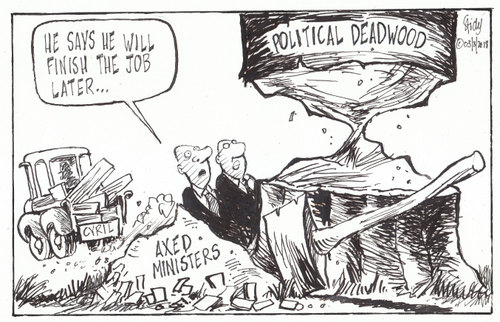
New President Cyril Ramaphosa doesn’t quite complete the job.
US President Donald Trump’s twin obsessions.
The DA loses some of the moral high ground with its mishandling of the Patricia De Lille affair.
Msunduzi’s long-suffering residents face more problems with their underperforming municipality.
NHI – big on ambition, lacking in detail.
Ex-President Jacob Zuma continues to live a charmed life
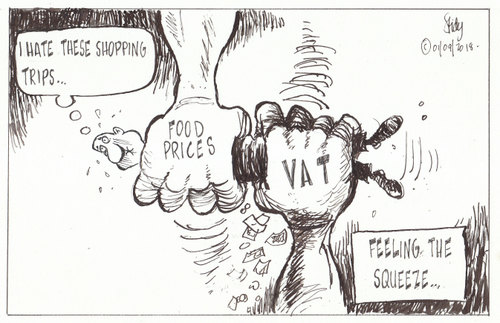
Consumers feel the squeeze after a VAT hike.
Uncertainty over the land issue continues to weigh down the economy.
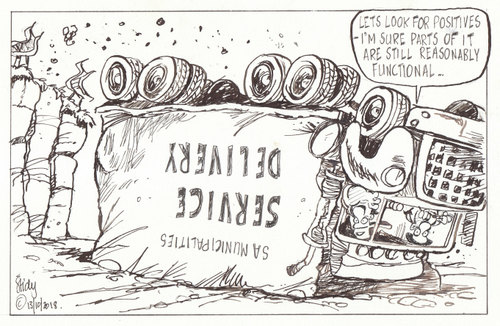
Service delivery fails to improve.
EFF leader, Julius Malema, gets hoisted on his own petard.
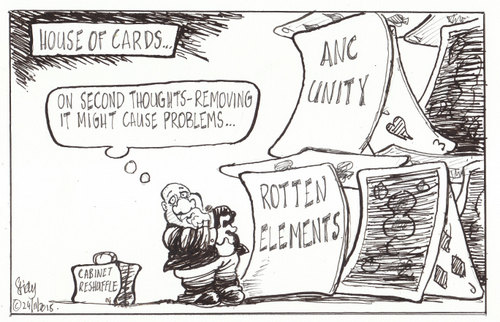
President Cyril Ramaphosa faces some big decisions…
I am not a man who
deliberately courts disaster or intentionally goes looking for bad
experiences. By the same token, I am not such a fool as to think the
odd mishap won’t occasionally befall me. And when you go travelling
with my birding partner, Ken, rotten luck does have a habit of
following you around.
For example: on a
recent trip to Marakele National Park we found ourselves being chased
down a narrow, twisting mountain pass by a very angry elephant who
clearly resented our presence in his private domain. Luckily – I
have a feeling some benevolent deity saw fit to intervene – we
survived that harrowing encounter. What I did not realise was that
more trouble with elephants lay ahead…
From Marakele we had
followed a circuitous route that took us to Blouberg Nature Reserve
and then cut east along the base of the Soutpansberg range to Punda
Maria in North Kruger. We planned to camp the night here and then
press on to Pafuri the next day, where we hoped to get in some good
birding.
Up until now the
weather had been kindly – more spring than summer and I had even
found myself wearing a jacket in the evenings and early mornings. In
Kruger, however, the hot weather we had been expecting all along,
finally caught up with us, with the temperature soaring up to 39
degrees. The air around us was heavy and listless and steamy, almost
tropical, perhaps hardly surprising since we had crossed over the
Tropic of Capricorn some days before.
Eager to be off I
was up early the next day although I had to first wait for Ken to
complete his complicated early-morning-ablution rituals. Once he was
done with that, we set off northwards through the familiar vastness
of flat grassland and mopane trees. On the way we stopped to allow
the biggest herd of elephants I have ever seen cross the road.
Shortly afterwards we were forced to repeat this exercise for an even
bigger herd of buffalo.
The common bird in this neck of the woods – or at least the most vocal – is the Rattling Cisticola. There seemed to be one trilling its silly head off on top of virtually every second tree we passed.
Rattling Cisticola – listening for elephant?
As you you draw
close to Pafuri, the terrain starts to break up and rearrange itself
and you are suddenly confronted by the arresting sight of Baobab Hill
with its commanding views over the Limpopo Valley. In the early days
this iconic hill served as both a landmark and sleepover point for
the ox-wagons travelling up from Mozambique.
By the time we got
to Pafuri the sun was high and blazing. There had obviously been no
rain here this season and the grass was pale and dry although the
trees had mostly come out in leaf.
At the crossroads we turned left down the Nyala Drive which takes you in to some wonderfully hilly country before taking a lazy loop back to the main road. Ken likes this less-used drive because, he says, it often throws up unexpected surprises.
There wasn’t much on offing this time around besides the usual suspects – Meves’s Starlings, Arrow-marked Babblers, White-fronted Bee-eaters and Emerald-spotted Wood- Dove. We passed a solitary elephant but he paid us no mind.
White-fronted Bee-eater
On the top of the
small, baobab-clad hillock, directly above where the road swings back
is the Thulamela archaeological site, a restored Zimbabwe-type ruin.
Unfortunately you can only go up with a guide and because of our
tight schedule we did not have time for that.
From the Nyala Drive
we crossed back over the main tar road and followed the dirt track
that takes you to Crooks Corner, where the brown waters of the
Luvuvhu collide with the blue of the Limpopo. The combination of
water, sun and rich alluvial soils has led to a proliferation of
vegetation along the rivers’ banks so that you drive through a
glittering tunnel of Sycamore Figs, Nyala trees, Jackal Berry, Ana
and Fever trees.
Crooks’ Corner, where you can get out of your cars, marks the border between South Africa, Mozambique and Zimbabwe. In the early 1900s this, remotest of places, gained its moniker and dodgy reputation with gun-runners, fugitives and others on the run from the law using it as a safe haven because it was easy to hop across the border whenever the police from one country approached.
Crooks’ Corner on Limpopo
Distinctly there was
a sense of a frontier on that lazy meandering river although I don’t
think the solitary Saddle-bill Stork, fishing in its waters gave a
fig where the international boundary lay or as to who held
sovereignty over the country he was standing in.
Normally, it feels
like you can’t get much further away from civilization than here but
we had chosen a busy weekend to visit so it was like a major
thoroughfare with a steady stream of traffic passing through. Many of
the visitors didn’t even bother to wind down their windows or get out
of their luxury 4 X 4s because it would mean switching off their
air-conditioners. They just drove in, stopped, glanced around and
drove out again, leaving me to wonder why they had bothered to come
all this way…
Needless to say Ken
– who, contrarily, makes it a rule to ALWAYS switch off his
air-conditioner when he enters a park because he likes to experience
Africa in all its extremes – and I did get out.
Rich plant life invariably means rich animal and bird life and Pafuri is no exception. In the past the storied riverine forest has provided both of us with some good sightings. It was here I saw my first Gorgeous Bush Shrike, Bohm’s Spinetail and Ayre’s Hawk Eagle. I have also recorded Lesser Jacana, Green-capped Eremomela, Hooded Vulture, Tropical Boubou and the palm-dwelling Lemon-breasted Canary. This time, we could hear both the Gorgeous Bush Shrike and a melodious White-browed Robin-Chat calling from the depth of a nearby thicket but could not entice either of them out. Instead we had to make do with a bunch of waders and a noisy party of Trumpeter Hornbills.
It was now well past lunch time so we doubled back to the Pafuri picnic site on the edge of the Luvuvhu. Feeling somewhat dehydrated, I was desperate for an ice-cold coke but had to wait patiently in queue behind an American who was explaining to the bemused coke seller-cum bird guide – who, I suspect, knew the answer but was too polite to say so – what a turkey is (“It’s a big black bird with a red head”).
At this juncture of its journey the Luvuvhu is always a ruddy brown colour such as might be achieved by mixing cans of tomato soup with cans of chicken soup. There was an enormous crocodile lying directly opposite us not, as one would expect, by the waters edge but high up on the bank under some trees. I had a feeling some unsuspecting animal was in for a nasty surprise.
The Luvuvhu River
On the way back to
Punda Maria, we took the short-cut via Klopperfontein dam, another
place which can throw up some unexpected treats even though the area
around the dam has been grazed as smooth as a billiard board. Sure
enough, we were rewarded with a wonderful sighting of a Painted Snipe
snooping around in the shallows of the nearby stream.
It was getting on
for late afternoon by now. Ken consulted Emily, his prissy,
admonishing, Satnav, and worked out how far we had to go and what
time we had to do it in. What neither factored in to their
calculations was our old nemesis, the elephant.
The first one, which we encountered just after Klopperfontein, kept us waiting for ages, while it feasted on the side of the road, before moving off in to the surrounding bush. A little later we passed him siphoning water by the trunk load out of the top of a reservoir.
Siphonining water near Klopperfontein Dam.
We ran in to the
second one on the home stretch with the hills around Punda Maria in
plain sight. Although this bull appeared much more amiable then the
one who had chased us down the mountain in Marakele he had obviously
decided he held all the rights to this road.
The whole thing
quickly degenerated in to a stage farce. We kept reversing and
reversing and he kept trundling on towards us. I suspect he was
headed for his evening sundowner at the same reservoir where the
other elephant was sloshing water around.
One of us had to
blink and we did so first. Muttering angrily to ourselves about the
beast’s poor road etiquette, we turned around and headed back to the
tar and took the much longer route home to Punda Maria.
In Kruger, as in
other parks, you are not supposed to arrive in camp after dark, which
we now did, finding the gate locked on us. Fortunately, the guard was
still at his post but Ken had to use all his silky skills as a sports
writer and commentator to try to convince him it wasn’t really our
fault. I am not sure he bought our explanation but he let us through
without imposing a fine.
So we drove in to camp feeling like a pair of naughty schoolboys who had just been caught bunking. But we were not done yet. We arrived to a scene of utter devastation – in our absence a troop of baboons had ransacked the place, flattening my tent, breaking its poles and ripping gaping holes in the fly-sheet (even though there was nothing inside but my bedding and clothes), as well as scattering our possessions far and wide
To tell you the
truth I was getting seriously tired of this. I had just bought the
tent to replace the one that got ripped by monkeys in Mapungubwe on
my last trip which, in turn, I had bought to replace the one that had
suffered a similar fate when I attended a wedding in De Hoop Nature
Reserve in the Western Cape. At the rate I was getting through tents
it would have been cheaper to have just booked in to a luxury lodge!
I am not sure what
one does about this menace. The problem is both monkeys and baboons
have become habituated to both human beings and human beings’ food.
We did discover
afterwards that there was supposed to be a guard on duty to stop
these opportunistic raids but, even though the camp site was
virtually booked out, he had decided to take the Sunday off…
I was still sulking about my poor tent the next morning when we drove out of the gate, destination Mapungubwe. There to wish us on our way was the scruffiest Ground Hornbill I have ever seen. It flew up in to a tree from where it regarded us quizzically through its girlishly-long eyelashes.
The scruffiest looking Ground Hornbill I ever saw…
For some reason the
sight of that lugubrious bird, peering around its branch cheered me
up no end. It made me realise that on the Richter Scale of Travel
Disasters we had got off relatively lightly compared to what other
great explorers, like David Livingstone or Scott’s Antarctic
expedition, had been forced to endure…
On the evening of
14th November, 2017, a phalanx of tanks rumbled into
Harare, Zimbabwe and sealed off Munuhumatapa Building and the
Parliament of Zimbabwe. Although the instigators would do there best
not to portray it as such, a military coup was under way that would
spell end of President Robert Mugabe’s long and ruinous grip on the
country.
His sudden demise
caught most of the world by surprise, especially as Mugabe had
previously proved so adept at dealing with any challenges to his
authority.
For any biographer there is plenty of meat here but Geoffrey Nyarota, a veteran of journalism in Zimbabwe, is exceptional in not only bringing his vast experience and insider knowledge but also an elegant style and a gift for narrative. Much of his story, especially the early parts, is inevitably familiar territory, but necessary to the completeness of the story.
Nyarota describes Mugabe’s upbringing in Kutama, his academic and political education, his rapid rise through the ranks which culminated in him becoming the first Prime Minister of an independent Zimbabwe. Initially, Mugabe preached a message of reconciliation but the hope his election engendered would gradually give way to disillusion as he turned from a Hero of the Struggle in to a vindictive bully with a taste for tyranny.
One of the defining moments in this transformation came with his marriage to the much younger Grace Marufu, his former typist. From here on it becomes the stuff of opera. Although Nyarota strives hard to be fair and even-handed, the picture that emerges is of a vain old man and a scheming diva whose political and social ambition, once ignited, burned furiously. In her quest for power the First Lady became every bit as ruthless as her husband, plotting against her rivals while grabbing vast tracts of land and amassing great wealth for herself and her children.
Emboldened by her
success in helping to get rid of one of Mugabe’s two Vice Presidents,
Joice Mujuru, Grace next set her sights on ousting Emmerson Mnangawa,
her remaining rival for the presidency. It would prove to be a bridge
too far and lead to her undoing.
Not for nothing was
Mnangawa nick-named “The Crocodile”. It what effectively amounted
to a Night of the Long Knives, the military, worried that their own
interests were being threatened, moved in, on his behalf, and seized
control of the country.
Nyarota’s account of
how this all happened is first rate. In describing the machinations
that went on behind the scenes and inside ZANU-PF itself, he shows a
party riven with intrigue and internal conflict, much of it
engineered and exploited by the former President himself. Despite
having trashed the economy, undermined the rule of law and inflicted
enormous damage and hardship on the country and its long-suffering
populace, though, Mugabe’s self-belief remained undented to the end.
Now his successor is faced with the difficulty of how to undo the consequences of all these years years of violence, misrule and policy blunders. How committed he is to achieving this is, of course, another question…
REVIEWER’S NOTE – This review was written several months ago – before the current troubles in Zimababwe
I think most editorial cartoonists will readily admit that they often find it difficult to send up politicians when they are making a so much better job of it themselves. This is, however, a problem that does not appear to faze South Africa’s best known caricaturist, Jonathan Shapiro (aka Zapiro), whose razor-sharp wit is on clear display in WTF: Capturing Zuma – A Cartoonist’s Tale, a book which demonstrates both his unerring eye for political failing and his powers of invention.
As
its title implies, the anthology provides a front row seat in to the
fractious – if at times almost symbiotic – relationship that
developed between the artist and his ever dodging target, our
erstwhile former Number One. The
years of Zuma’s presidency certainly proved to be fertile ground for
Zapiro which is perhaps hardly surprising, since, leaving aside the
question of his private morality, it is difficult to argue that his
effect on the country and its economy was anything other than
disastrous.
From
the outset Zapiro had the measure of his man. Five years before Zuma
took over the ANC leadership he was already portraying him as damaged
goods.
He
also realised that for such a compromised and controversial figure he
needed a far more hard-hitting, confrontational style of drawing than
he had employed with, for example, Nelson Mandela. Refusing to
recognise the limits imposed by decorum or good taste Zapiro hammered
away at him again and again.
His Rape of Justice cartoon, in particular, provoked a storm of outrage and moral indignation especially within the ranks of the ruling ANC. Undeterred, Zapiro continued to rip apart his prey.
In
the end his systematic and relentless caricature of Zuma probably did
as much to destroy the
President’s credibility than any number of columns, editorials or
speeches from the opposition benches.
What
Zapiro’s constant undermining of the president
also proved is that cartoons still matter – a lot. They certainly
mattered to Jacob Zuma who, in a misplaced attempt to silence him,
served Zapiro with two lawsuits, totalling R22million, claiming the
cartoons invaded his dignity.
Which begged the
obvious retort – one that the artist himself was quick to seize on
and make the subject of yet another witty, put-down, cartoon – what
dignity? Needless to say,
the matter never got to court.
Zapiro’s
drawings have always tended to dominate the pages on which they
appear. Wielding his pen like a scalpel, he manages to be both
extremely funny and serious at the same time. As with all good
satire, his cartoons are designed to entertain as well as to
convince. Behind the often mordant humour one senses the fire of
honest indignation that fuels all real political art.
Over
the years he has carefully recrafted and subtly changed his depiction
of Zuma. In doing so, he has, admittedly, been helped by the man
himself, whose physiognomy, facial features and nervous tics and
mannerisms have often unwittingly and unerringly betrayed his real
character (his habit of shoving his glasses up his nose with his
finger, his giveaway: “Heh, heh, heh”).
Probably
Zapiro’s most inspired moment came when he decided to place a
showerhead on Zuma’s oddly-shaped cranium after the then
Deputy-President famously stated that he had taken a shower,
following sex, because he believed it would reduce his chances of
getting HIV (Zapiro admits he got the idea from the brilliant English
cartoonist, Steve Bell, who delighted in drawing Prime Minister John
Major all the time with his underpants outside his trousers).
The
image was picked up and imitated by many. Even Julius Malema adopted
it as a visual gesture of constant mockery.
In that sense, his showerhead became the defining symbol of the Zuma era (or “error” as Zapiro so aptly puts it). Like an ever dripping crown of shame, it perfectly captured the rotten-ness and moral bankruptcy of his chaotic, corrupt and scandal-ridden administration.
Birds have historically exercised a peculiar hold over the human imagination. In part this no doubt stems from our fascination with flight. Deep down we envy them their freedom, their ability to climb, soar, hover and dive with such breath-taking speed. Which brings me on to my big confession. I am a ‘twitcher’.
Okay, so there is something a bit Victorian about birdwatching. It’s a throwback to that era’s mania for collecting and categorising except the prism binocular has now replaced the breach loader and dust-shot as a means of seeing birds up close. But there’s much more to it than that, as I will try to explain.
Avian behaviour is complex and even after centuries of study remains imperfectly understood. I am constantly amazed, for example, that the tiny, fragile looking, willow warbler hopping unobtrusively along the branch above me has just flown all the way over from Europe, braving extreme weather and predators along the way; or that that scruffy feral pigeon perched on top of a statue of some once important old dignitary has a magnet in its nose which helps it to navigate.
Hunting for signs of bird life in the Cape mountains
Then there
are the sheer numbers. We are lucky to still have a great variety of
animals in South Africa but we have far more birds. There are more
than 850 species.
Some of
them – the Ostrich, for example – anybody with even the most
cursory knowledge of birds can immediately identify; others are
virtually impossible to tell apart (the Pipits for example). Trying
to work out which is what, is where much of the fun comes in.
Birds have another attractive quality, as the English sport’s journalist Simon Barnes pointed out in his classic little tome, How to be a Bad Birdwatcher. Unlike their mammalian counterparts, birds are not obsessed with defecation and urination. They don’t mark out their territory with piles of dung or sniff each other’s orifices to find out whether they are ready to mate. They are much classier than that, relying on a combination of colour and song in their courtship rituals.
I also love the pure thrill of the chase. Twitching reignites that basic desire to track down and corner your quarry but without any subsequent spilling of blood.
There is yet another aspect to it: birding caters to my own migratory instincts. It’s like being given a passport to a different world or worlds. In pursuit of my passion I have travelled to some of the most beautiful parts of the country and beyond. I have flown south and summered in the Winterberg, I have torn off my clothes and jumped in to the Orange River where it passes through the Richtersveld, I have watched Bearded Vultures gliding in the thermals above Giant’s Castle, and I have sat in the pink afterglow of a Zambezi sunset, sipping wine and watching the river change colour as darkness descends.
Immature Bearded Vulture, Giant’s Castle
Way beyond
any scientific curiosity there is the sheer Zen-like joy of it all.
No other activity makes me feel so centred, so living in the moment,
so glad to be alive. Birdwatching is not something I do to fill in
the hours when I am not scribbling away at my desk. It’s an essential
part of the process, a way of uncluttering the mind and restoring my
inner calm.
We live in an age of
deliberate misinformation and disinformation in which it has become
increasingly difficult to tell where the truth lies or, indeed, if
there is such a thing as objective truth.
The new technology
has only added to the problem. The world wide web, which was
originally envisioned as a benign universal information system, has
turned in to something of a Frankenstein monster. It has been used,
most notoriously by the Russians, to spread propaganda and falsehoods
and erode voters faith in the democratic system. Rather than bring
people together the use of social media has amplified polarization.
In this relatively
short, sharp and utterly persuasive book, Michiko Kakutani – a
Pulitzer prize-winning literary critic and former chief book critic
of the New York Times – shows how the concept of truth has been
corrupted to such an extent that it threatens the very pillars on
which democracy has been built.
Drawing on the writings of the great critics of authoritarianism, such as George Orwell and Hannah Arendt, she shows a world in which the wisdom of crowds has usurped research and expertise and where people have been dumbed down and suckered in to accepting the most banal and irrational of beliefs.
Nowhere is the decline of reason better exemplified than in the rise of Donald Trump, a man who has proved an expert at sowing dissent and appealing to peoples base prejudices, rather than their intellects, with his simplistic, and mostly unachievable, utopian promises. Kakutani is clearly no admirer of the President. Self-serving, shallow, boastful, unreflective, sublimely ignorant of the outside world and unwilling to learn, she sees him as a man with few, if any, principles. The irony, as she so clearly shows, is that Trump, a man who is forever accusing the media of promoting “fake stories”, has done the exact same thing himself, on a mind-numbingly regular basis, throughout his career, both as a businessman and a politician. A further irony is that in pushing his populist, right-wing, message Trump has made use of tactics sharpened and perfected by the likes of Vladimir Lenin, who employed similar incendiary language and showed a similar disdain for the truth and reluctance to compromise. Small wonder then, that he is also an admirer of Putin, another master manipulator.
Elsewhere, other alt-right trolls (who share Trumps mania for tweeting) have employed relativistic arguments, once largely the domain of the post-modernists and the Left, to argue there are no objective truths any more – only different perceptions and different story lines. Kakutani makes short shrift of these arguments believing that they lead to the sort of cynicism and resignation that autocrats and power-hungry politicians depend on to subvert resistance.
Without commonly agreed-upon facts, she insists, “there can be no rational debate over policies, no substantive means of evaluating candidates for political office, and no way to hold elected officials accountable to the people.”
Having spent most of my working life as a professional cartoonist lampooning the powerful and corrupt and those that abuse their positions of trust, I recently decided that the time had perhaps come for me to expand my oeuvre. And so I took up oil painting.
The results so far
have been pretty hit and miss and I have come to realise I have a
long way to go before I achieve any level of technical mastery. The
whole exercise has, nevertheless, highlighted some interesting
differences between the two genres.
For a start, cartooning
is, essentially, a negative art form; its main purpose is to deflate
and ridicule through mockery and humour. As natural cynics we are not
meant to go easy on or be kind to our targets. We are not praise
singers; that job belongs to others.
As the British
humourist Sir Osbert Lancaster put it: “It is not the cartoonists
business to wave flags and cheer as the procession passes; his
allotted role is that of the small boy who points out the emperor is
wearing no clothes
In painting – at
least at the level I do it – a completely different set of emotions
and feelings come into play. Rather than having to draw what I
dislike I find myself instinctively attracted to scenes that give me
pleasure. In this respect, I have discovered, you do not really have
to choose your subject – in a way it calls you.
Painting at Kusane – picture courtesy of Mark Wing
For the most part my subject matter is, I suppose, pretty traditional – African landscapes in the shimmering heat haze, abandoned houses with sky filling their gaping windows, places I have visited and felt a strong spiritual connection to, views that meant a lot to me as a child.
From this perspective I am probably more a recorder than an artist. I like to look upon my paintings as precious keepsakes of the past, visual memories of places I have visited and loved.
Having said all that,
it probably needs admitting that I am under no illusions about the
quality of the work I am producing and am well aware it is hardly
likely to pass muster with all the conceptualists, neo- marxists,
post- modernists and other purists out there. No doubt the art police
will point to my wonky draughtsmanship or poor use of colour and have
some scathing things to say about my rather commonplace romantic
sensibility.
Frankly, I don’t
really care. I long ago gave up trying to keep up with the changing
trends in contemporary art and, at my age, am happy to paint for no
other reason than I enjoy it (although if other people do happen to
like my work that makes me happy too). I treasure the whole creative
process for its therapeutic value. I see it as is all part of a
meditative process, a counterbalance to my day job, the artistic yin
to my cartooning yang.
There is another side
benefit to it I also like and that is what I call I call “my
research”. This research invariably necessitates me absenting
myself from home and going for long, exhilarating, drives down dirt
roads and into the wilds and badlands. On such journeys I tend to
slam on my car brakes a lot, leaping out, camera in hand, to capture
some image which has caught my fancy – a line of cattle walking in
single file through the mielie stubble, rivers dwindling away to the
horizon, a weird rock formation. That sort of thing. Normally I
try to combine these excursions into the wilderness with my
ornithological interests so that if I am really lucky I return home
not only with a clear vision of what form my next masterpiece will
take but a couple of rare bird sightings as well.
Back home I sit in
front of my easel and try and coax my version of the sublime out of
the assortment of snapshots that lie scattered in front of me. The
trick here, of course, is to try and preserve a sense of that
freshness that made the subject seem so exciting in the first place.
It is not nearly as
easy as it looks and as a result my admiration for those artists who
can achieve this, seemingly without effort, has increased a
hundredfold.
I have to confess,
though, that I have fallen in love with the whole process. I love the
smell of linseed oil and turpentine, the scrunchy feel of canvas and
the beauty of paint applied by brush.
Indeed, the secret that
I almost dare not admit to – especially for someone whose job has
always been to castigate and demolish those in authority – is that
the pursuit of beauty has now become an overriding passion, my
embarrassing motivation in life.
Click on the images below to see a selection of my baobab paintings, inspired by my various trips in to the South African and Zimbabwe lowvelds:
Confluence of the Limpopo and Shashe rivers, Mapungubwe
When I was young I
wanted to go everywhere, anywhere: the Sahara, the Himalayas, Russia,
the Far East, the Antarctic. I yearned, to go to places no one else
had been. I wanted to climb mountains, cross deserts, hack my way
through jungles and brave blizzards and snowstorms.
I did eventually go
overseas but never did half the things I had planned.
Instead I opted for the
more predicable route taken by so many other young men escaping home
for the first time. I picked apples in Kent, plucked turkeys inside a
very cold shed in North London, hung around Carnaby Street (it was
still fashionable back then), visited a lot of country pubs and did a
whirlwind trip around Europe in a very old bus which bore, on its
front window, a brash logo proclaiming “We are are lost but we
don’t give a shit!”.
It kind of summed up my
state of mind at the time.
I have never quite outgrown this adolescent longing for adventure although, as I have grown older, I have come to realise that often the most beautiful places on earth are right there under your nose, on your own doorstep, so to speak. This has become particularly evident since I accepted my good friends, William Saunderson-Meyer and Karen MacGregor’s generous offer and moved up to their farm, Kusane, in the KwaZulu-Natal Midlands, with its panoramic views over the stunning Karkloof valley.
The view from my house across the Karkloof Valley
There are, of course,
various ways to experience these scenes although I still think it is
best done in the old fashioned manner, on foot. Its the perfect way
of moving if you really want to appreciate and take in the beauty of
a place.
In a car you are always
thinking of a myriad other things – how far is the next petrol
station? Am I exceeding the speed limit? Where do I turn? Why is that
police car following me?
I’m not so sure about
bicycles either – all that manic pumping of legs and furious
concentration on the road ahead and places flashing past you before
you have had a time to even look at them.
No – give me a good
pair of walking shoes, some sun cream and a pair of binoculars and I
am happy.
My current favourite local walk takes me up a rubble strewn road, through a saddle, past a protea field and then down into a valley where several rivers from the surrounding hills meet.
Rambling on Kusane
The chief stream comes for a long way through forest and soft deep meadowland. It is slow, quiet and unobtrusive. I usually stop for a cup of coffee in the exact centre of a wide saucer of land where the grass looks like it has been polished by the sunshine and the air is rich with the scent of bracken, eucalyptus and pine.
Minki, Kusane River
It is a lovely spot.
Here, in the deep water among the rocks, I am able to escape the
tensions that can sometimes make life so vexatious
The same river
eventually cuts its way past past a large hill, on the other side of
which lies the somewhat optimistically named Khyber Pass (which, at
this stage of my life, is probably about as close as I am ever likely
to get to the real thing). Tall, green and full of perspectives it is
not hard to imagine why this swell of land should have inspired
another young man, of an adventurous turn of mind, to attempt the
seemingly impossible. His name was John Goodman Houshold and between
the years 1871 and 1875 he allegedly undertook two flights in a
self-constructed glider somewhere in this area.
Whenever I pass
through this secluded bit of country nestling beneath the Karkloof
Hills, I pause to ponder the life of this ordinary farmer’s son who
decided he wanted to defy the laws of gravity.
Scanning the hill line,
with its deep clefts and valleys, I can imagine the ground shooting
away beneath him as he launched himself precariously into flight. I
find myself wondering about his emotions at the time and what
thoughts went rushing through his head once he became air borne. He
was going somewhere, he knew that, but quite how far and where, and
how it would all end up, he could only guess although sooner or later
he would most certainly find out.
According to the plaque
they have erected in the area, to commemorate his achievement, his
longest flight took him all of five hundred meters which, at that
time, was quite remarkable and really did represent a giant step for
mankind. Unfortunately, it also wrecked his ankle and his pious
mother, fearing his actions would bring the eternal fires down upon
their heads, managed to persuade him to abandon any further foolish
notions of flying free like a bird.
In an odd way I feel a
strong connection with Mr Household even though a hundred-odd years
of history separate us in time. Both of us, in a sense, wanted to be
the ploughmen of our own acre and went looking for the same thing –
adventure, space, nature and escape. I like to think that in our own,
peculiar, ways we both succeeded in finding it.
After two years in the artistic wilderness, I was invited back to work for the Witness newspaper in KwaZulu-Natal, in November 2017, producing one cartoon a week for the Weekend Witness.
My return coincided, quite fortuitously, with the sacking of Jacob Zuma as the President of South Africa and his replacement by the more pragmatic Cyril Ramaphosa, an appointment which caused the whole country to heave a huge sigh of relief.
Across the ocean, Donald Trump had been elected President of the United States, his wrecking ball approach to government causing much consternation across the whole world. Meanwhile Britain found itself increasingly tied up in knots over the whole Brexit debacle…
All these events provided ample ammuntion for cartoonists.
The following includes a selection of my best cartoons up until the end of 2018.
US President, Donald Trump, stirs up a hornet’s nest in the Middle East.
South African President Jacob Zuma gets the boot, just as the Zimbabwean President, Robert Mugabe had several months earlier.
Budget Day – the news is not good for ordinary South Africans.
The ANC moves towards the EFF over the question of land expropriation.
South Africa;s already battered economy faces the prospect of more crippling strikes
US President, Donald Trump, rides rough-shod over his traditional allies.
Police boss, Bheki Cele, battles to bring South Africa’s burgeoning crime rates under control.
King Zwelithini digs in his heels, causing President Ramaphosa to have a rethink.
Musunduzi’s increasingly frustrated residents are given the run-around by the local municipality.
EFF leader, Julius Malema, demands the expropriation of land – regardless of the cost to the country.
South African Airway’s debts continue to pile up…
South Africa once again faces the prospect of rolling black-outs and further load-shedding
British Prime Minister, Theresa May’s attempt to get her Brexit deal accepted is defeated in parliament. She vows to struggle on..
I am, by nature, a
wanderer. For me there is nothing quite like the thrill of departure,
the joy of being on the road again, of heading off to remote and
cut-off places.
As an antidote to
this restlessness I have travelled the length and breadth of South
Africa searching out new places I can claim as my own. In recent
years this has involved launching several expeditions up to the
Limpopo, along the way taking in Punda Maria and Pafuri in North
Kruger, Mapungubwe, Ratho on the Botswana border, Hans Merensky on
the Groot Letaba, the forests of Magoebaskloof, parts of the
Soutspanberg and that little known gem, Blouberg Nature Reserve near
Vivo.
Having explored and fallen in love with this sun-drenched landscape, my birding partner, Ken, and I recently took a notion to recreate these epic treks by heading back up there once again, only, this time, adding Marakele National Park which would be new country for me.
Kransberg, Marakele National Park
A Tswana word, aptly
meaning, “Place of Sanctuary”, Marakele falls within a
transitional zone between the dry western habitat, made up mostly of
Kalahari thornveld, and the typical bushveld country of the moister
eastern sections of South Africa. It also lies within the Waterberg
range of mountains, with an altitude ranging from 1050 metres on the
plains to 2088 metres at its highest point.
Because of this
broad range of vegetation types and its diverse topography the area
boasts a wide variety of game (including the Big Five and Wild Dog)
and an abundant bird life. Its biggest attraction, for birders
anyway, is the around 800 breeding pairs of Cape Vulture which nest
high up in the cliffs of the Kransberg
Arriving at the
park, which is situated about twenty kilometres north of the old
iron-ore mining town of Thabazimbi, we set up camp and then headed
off on our first drive. I was immediately rewarded with my first
lifer of the trip – a Grey-headed Kingfisher.
As we sat having a celebratory beer that night, listening to the clear, articulated noises of the bushveld at night, a tiny African Scops Owl landed on a branch above us and began its odd but strangely comforting, frog-like, “Prrrt…prrrt…prrrt…” call. This was more like it. My latest Excursion in to The Great Unknown had officially begun.
African Scops Owl
The next day we were
up at dawn and driving through heavy bush country towards the
impressive pass that leads up to the top of the Kransberg mountain. A
friend of ours had told us that her biggest concern, going up this
narrow, winding, precipitous road, was what she would do if she
encountered another vehicle coming down the other way as there is
little room to pass. That proved to be the least of our worries.
Rounding one
steep-sided corner we suddenly found ourselves coming face to face
with a young elephant bull that had stepped out on to the road.
Having been in this situation many times before, Ken immediately
pulled up short, stopping a sufficient distance from the animal so as
not to make it feel threatened or think that we were encroaching on
its space. It didn’t help.
Coming face to face
with a wild animal so much bigger than yourself can be a slightly
intimidating experience and this one decided to remind us of its size
advantage. Without even affording us the courtesy of a warning, mock
charge it let out an almighty bellow and came thundering down the
road.
There was nothing to
do but slam the car in to reverse and head back down the road with me
craning my head out of my window, shouting directions, while Ken did
the same on his side.
The kilometre or so
we drove in this manner was like a rapid ride through eternity. We
kept hoping that each time we rounded a corner and the elephant lost
sight of us it would lose interest. No such luck. The beast
definitely did not like the cut of Ken’s jib and was determined to
drive us clear off his mountain stronghold.
We went back down in
to the valley and somehow – and I shall never know how we did it –
managed to do so without plunging down the mountain side or getting
stomped on by the elephant. Once safely back on the flat we found a
turning point, backed in to it and sped off in the direction we had
earlier come from.
A half and hour or
so later we gingerly ventured back but, very bravely, decided to
allow another vehicle – that had coming driving up while we were
parked on the side of the road observing, of all things, a Neddicky
(the ultimate Little Brown Job), while considering the sagacity of
continuing on our journey – go up ahead of us. Once we had seen
they had safely cleared the ridge we sailed forth ourselves, this
time, thankfully, unmolested.
At the top of this
particular stretch the road evens out on to a trough through which
you drive before getting to tackle the final, most spectacular, stage
of the mountain. Here the road begins an even more torturous ascent.
On the one side rise the naked sandstone towers of the Kransberg
massif itself, weathered in to the shapes of fantastical beasts and
strange deformed reptiles. On the other side the slopes plunge
steeply down in to a treeless, meadowy, grassland in which several
more elephant and a herd of wildebeest were feeding.
As we advanced the
road got narrower and narrower. What got us perspiring heavily all
over again was that there were yet more fresh elephant droppings at
regular intervals all along its surface, virtually to the top.
On the summit it was
like another world. The view was colossal. Below us the mountain
stretched away in every direction before dropping down, in a series
of steps, to the plains, fading away in to the blue distance.
Immediately in front
was another castle-like knob, a labyrinth chaos of rock, fitted with
clefts and chimneys. It was here the vultures nested. There were many
of these large, endangered, raptors wheeling gracefully above us,
trailing their shadows on the ground beneath them.
The protea-covered
hillsides on top of the mountain also provide a home for some other
unusual species like the Gurney’s Sugarbird and the Buff-streaked
Chat, birds which I more commonly associate with the Natal Midlands,
where I live, and the foothills of the Drakensberg. Another occupant
is the Kransberg Widow, a very rare and beautiful butterfly which
puts in an appearance in November and early December and then, like
Cinderella, sheds its finery and disappears. This is the only place
in the world where it occurs.
We were reading all
about the insect on a large information board they have erected up
there, alerting us to its presence, when one came fluttering past. A
few minutes later it came fluttering back again… and again. It may
be scarce but it certainly wasn’t shy about showing off its beautiful
cream markings.
A cold wind was blowing across the mountain top and a storm was brewing in the distance and so, after a warming cup of coffee, which we shared with a pair of very tame Cape Buntings and a cheery Mocking Cliff-Chat, we made our way back down the same twisting road, this time without having to face down any elephants with murder on their minds. Heading in to camp I did, however, have another good sighting of two more Grey-headed Kingfishers, dive-bombing a family of Banded Mongoose
Grey-headed Kingfisher
Two days later, in
Blouberg, I had an even better view of the kingfisher sitting at the
end of a dead branch. This meant that after fruitlessly searching for
the elusive bird for years I had now seen four in four days…
The grumpy pachyderm
who had chased us down the Kransberg may have scared me witless but I
couldn’t help wondering afterwards if he hadn’t deliberately
engineered the whole encounter just to make sure I kept running in to
the bird!








 Stidy's Eye