In case you haven’t noticed I have a thing about baobabs.
Here are a few reasons why: I am awed by their size and the way they dominate the surrounding countryside and tower above all the other trees. I love the drama – all those tentacle-like branches spreading out laterally, as if they want to pluck passing birds from the sky.
I admire their tenacity, the fact that they thrive in the most harsh and arid of conditions. I am impressed by the huge age they can reach.
There is something very ancient and wise and holy about them. They seem to speak of the Old Way. They stir the spirit and the eye.
Baobabs are also very much part of my inheritance. Although some people might be surprised to hear this– the ones who associate Nyanga with mountains and bracing cool weather and therefore no baobabs – our old family farm, Nyangui, in Nyanga North, was littered with them.
Baobab with Nyangui mountain in backgound. Picture courtesy of Patrick Stidolph.
You passed by a whole grove when you drove through the farm gate. There were baobabs on the top of koppies and among the ancient ruins and there were baobabs growing in the middle of the old lands. My brother, Paul, sited his house next to one.
There was a baobab, across the river, which my brother, Pete, and I carved our initials in to when we were still schoolboys – hoping that, in centuries to come, some explorer would stumble upon them and wonder who we were? It was a wasted stab at immortality. When I went back to the old farm, many years later, the baobab had collapsed and died.
Since then, baobabs have continued to act as signposts in my life. One of my favourite stopping places in Zimbabwe is the lay-by you come to as you descend the Zambezi escarpment from Makuti to Chirundu (and Mana Pools). It has become a little ritual of mine – alas, not one I have done for years – to always pull over here and have a beer.
View over Zambezi Valley
From this perfect vantage point you have a magnificent view over the valley floor, stretching in to the blueness of distance with the hills of Zambia simmering in the heat haze on the horizon. In the mid-ground you can glimpse the glittering blue waters of the great river, snaking its way eastwards towards the Indian Ocean.
And no matter in which direction you gaze you will see baobabs poking up above the sunken contours of the far-reaching landscape.
As you continue driving down the escarpment, the heat comes up to meet you. You can smell it as well as feel it: a dry, punching, smell of dust and jessie bush and mopani leaves and elephant dung. And baobabs.
Makuti to Chirundu road with Zambezi escarpment in background.
Even now, thousands of kilometres away, sitting on top of my hill in the Karkloof, I still get misty-eyed when I recall that view.
Moving to South Africa I was able to renew my love affair with baobabs when I started going on my birding trips to the Limpopo valley.
North Kruger was where I first rekindled the romance. As you drive down from Punda Maria towards Pafuri, the terrain begins to break up in to a series of steep sided ridges which a have a tumbled, frenzied look, as if somebody had stirred them up in a giant pot and then left the contents to dry out under the baking sun. And dotted all over them are baobabs.
Undoubtedly, the most famous of these is the one that sits on top of Baobab Hill. This iconic tree served as a landmark on the early trade routes going through the area. Pioneer hunters used it as part of the famous “Ivory Trail” (some of them leaving their names carved on the tree). Between 1919 and 1927 it became the first overnight stopover for black workers recruited from Mozambique to work on the gold mines of the Witwatersrand.
Baobab Hill, Kruger National Park.
Mapungubwe, another preferred haunt of mine, has its fair share of baobabs too. Like old, petrified giants, they seems to anchor an immense sea of plain and bush and broken red koppies that falls away to the Limpopo river.
It is almost like a homecoming to be driving among them.
Mapungubwe.
My paintings, then, are my way of attempting to pay tribute to and glorify these most monumental of trees. I want them to be a celebration of the baobabs heroic scale.
Obviously I take certain artistic liberties. I often tweak them a bit, highlighting and simplifying features. Sometimes I move the baobabs position in the landscape, bringing them closer to, say, a hill I fancy to create a better sense of balance. I lob off odd branches so my canvas doesn’t look too cluttered or become mired in detail. I play around with light and colour in the hope of capturing a particular moment or mood.
I try and encapsulate the loneliness, the wildness and the spirit of the primeval world in which they have existed since time began, a world in which man is still very much the intruder.
In doing this, I know I can never pay full justice to these magnificent trees although I hope I do manage to convey something of my admiration and my awe.
Disdainful in their own majesty, serene in the mellow certainty that comes to the very old they are the very symbol and essence of a remote, half-mythical strangeness.
Driving up to
Zimbabwe, to visit my family, many years ago, I accidentally took a
wrong turning at Pietersberg (now Polokwane) and found myself
heading towards the Botswana border instead of my intended
destination – Beit Bridge. Fortunately, it was a mistake I was able
to easily rectify by turning right at the crossroads, at Vivo, and
following the Soutspanberg to Louis Trichardt where I rejoined the NI
Freeway.
While I was on this wrong road, though, I found my attention becoming distracted by the vista to my left where a big mountain had suddenly appeared in the far distance. There was something particularly dramatic about this compelling landmark, heaving itself up in a succession of steps out of the surrounding plain. As I watched it growing bigger and bigger, a determination to explore it began to take root. Then and there I decided I would come back one day.
It took me a long
time to act on this impulse but act on it I eventually did. My good
friend, Ken, had been planning a birding trip to the Limpopo and when
he asked me if there was any particular spot I wanted included in our
itinerary I suddenly remembered my mystery blue mountain. “Yes!”
I said “The Blouberg!” (I had done my homework).
Getting out of Johannesburg was not as easy as I had hoped. First, Ken’s car broke down when we were barely out of his front gate and took two days to repair. Then, just as we had started to pack the vehicle, there was an almighty cloud-burst which appeared to be centred directly upon his house and which sent us scurrying back inside until it was all over.
With Ken our trips are seldom incident-free so I found myself wondering what he had done to provoke the furies this time.
Eventually the rain cleared up and, leaving the sprawling metropolis behind us, we headed up the Great North Road that leads through to Zimbabwe, Zambia and into the hot African interior. Because we had been a bit slow in getting away we decided to take the freeway rather than the more interesting alternate route.
It still felt great.
Before us the road stretched out, flat and featureless, to the
horizon. Made up mostly of thornveld savannah, this area marks the
eastern most extension of the Kalahari and is a good place for
finding your typical dry-land species.
We did not have time to stop and look for any of them. While we were driving, clouds had been arranging themselves in a disturbing array, flocculent and still at first, then fidgety with summer lightning. The electricity dancing about amongst these heaps of vapour turned them dark purple and mauve and deep grey. Thick splatters of rain kept spiralling down the windscreen although, amazingly, we managed to dodge the main storm.
On the Great North Road… rain ahead.
At Polokwane we branched off The Great North Road and headed up the R521 towards Alldays, leaving the rain-scoured landscape and the flocks of clouds that had been following us for most of the way in our wake. The traffic was noticeably lighter on this route although we still found ourselves being slowed down by the occasional long haul truck and overloaded bakkie.
The Blouberg lies due west of the Soutspanberg and although separate from it appears, for all intents and purposes, to be an extension of that range. It starts off as a smudge on the horizon and then slowly metamorphoses until it most closely resembles some ancient beast crouching in isolation in the middle of nowhere.
The closer you get
to it, the more impressive it becomes.
Rising some 1200
metres above the surrounding veld, it has a certain weighty majesty,
a leonine grandeur. The precipitously sheer wall of rock on its
southern side is home to the world’s largest colony of Cape Vultures
with more than 1000 breeding pairs. A lone Ruppell’s Vulture, a
species otherwise little recorded in South Africa, has also bred here
in the past.
At the entrance gate to the Blouberg Nature Reserve, the first bird we both saw was the White-browed Sparrow Weaver. Extrovert, sociable and noisy they are difficult to miss.
White-browed Sparrow Weaver.
The check-in formalities completed we headed for the nearby camp site. Situated under some shade trees it is fairly basic but has a tidy, cared-for look. It has no electricity but there are ablutions with toilets and two showers which get their hot water from a donkey boiler. There is also a washing up area around the front.
Although, for the sake of form, I bitch about it, I love the whole process of setting up camp. For me it is an integral part of the process of assimilating yourself back into the ways of the bush.
I have never really
seen the point of travel where everything is organised for you and
all you have to do is turn up. I need space, solitude and silence
which is not something you are likely to get in some five star bush
resort.
I want to go and
look for my own birds and animals and not have them found for me,
otherwise it is not travel, it is tourism; it is not exploration, it
is sight-seeing.
With exploration very much in our minds, we set out early the next morning along the bumpy road that takes you along the northern flank of the mountain. As we jolted over the rough rocks we found ourselves objects of liveliest interest to a small family of giraffe. From their high vantage point they gazed down upon us, through long eye-lashes, with a mixture of idle curiosity and slight bemusement.
Giraffe.
At the bottom of a saddle the road splits left and right. We elected to turn left and follow the 4X4 track that takes you clear over the massif. If the road before had been bad, this one was infinitely worse and had us bouncing from rock to rock, dodging boulders and piles of scree as we went. As the track swerved over the edge of the ridge we had sensational views in both directions.
Safely emerging on the other side, we veered right along a dusty, red, road that ran along the fence line, towards the higher section of the mountain. We eventually stopped beneath some steep rocky cliffs and gullied slopes, stained with white droppings. It is here, on the dizzy-ling steep flanks of the mountain side that the vultures have made their home.
Blouberg – view from southern side.
Swirling around in the sky above the buttress we could make out what seemed like hundreds of these magnificent birds, their flight feathers fanning out and lifting at the tips. Watching them, floating in aloof companionship, brought a long moment of exaltation. Entranced, we sat on a fallen over log, admiring their languid circling.
Cape Vulture colony – Blouberg.
Back in camp that evening we plotted our next move. There were several options.
The reserve covers a wide variety of habitats and includes a small Sycamore forest – a remnant survivor, I assume, of some much larger aboriginal forest that may, at one time, have existed here – some patches of Tamboti woodland, baobabs and the Brak river floodplain. Veld types range from Kalahari sandveld in the north to sweet bushveld in the east and west.
Baobab and Thornveld, Blouberg Nature Reserve.
There is also a
small wetland that has a resident flock of Crested Guineafowl. The
latter came as a surprise to us as we would never normally have
expected to encounter this forest-frequenting bird so far west and in
such otherwise dry terrain.
Thanks to this varied topography the Blouberg has probably the largest selection of trees for any similar size reserve and with this selection of trees comes a prolific bird life with over 232 species recorded (we were convinced there must be more just waiting to be discovered).
Mixed woodland. Blouberg.
In the end we
decided to head for the fig forest because getting to it would take
us through an interesting mix of vegetation types ranging from
broad-leafed woodland, to acacia savannah and dry scrub-land.
As we drove a pair of very purposeful Honey Badgers scuttled across the road and disappeared in to the bush on the other side. A bit further on we passed a family of warthog, the male in front, with his bushy side whiskers and ferocious looking tusks, followed by by the slightly smaller female and then by a string of piglets, their tails erect like they were hoping to pick up a wi-fi signal.
Various birds popped
up and allowed themselves to be identified – Bearded Woodpecker,
Southern White-crowned Shrike, Jacobin Cuckoo, Red-billed
Helmet-Shrike, Marico Flycatcher, Martial Eagle.
Since it happened
to be nearby, we did a quick detour to the vulture restaurant but the
kitchen was closed and the birds had all gone home.
On the far side of
the park, we came to a small open space, surrounded by a mass of
twisted thorn trees, in which some derelict old buildings stood.
Abandoned and neglected, they presumably dated back to the days when
this was still farm-land rather than a nature reserve.
It proved to be a
good spot to do some birding and we picked up several dry-country
‘specials,’ including Black-faced Waxbill and Scaly-feathered Finch.
The fig forest lay
close to the base of the mountain and provided a completely different
type of landscape to that we had been travelling through. A
combination of fertile alluvial soil and the threads of water that
come cascading down the slopes after rain had coaxed the trees higher
and higher, creating a lush, green valley. Inside it, there was a
soft, damp, swampy smell of wet grass and earth.
There is a certain captivating enchantment to penetrating a secret corner of the world and getting in to the Fig Forest, felt just like that. Its cool, shady interior made it feel like an oasis in the otherwise dry landscape. With their massive trunk and root systems buttressing the trunk above ground like a series of girders.
Sycamore figs, Blouberg.
A circular path
runs through the forest. Although only a short walk, we managed to
see quite a few forest species here, including Yellow-bellied
Greenbul, White-throated Robin, Collared Sunbird, Lesser Honeyguide
and Eastern-bearded Robin-Chat. Through a gap in the canopy we also
had a wonderful sighting of an African Hawk-Eagle turning lazily
above us against a deep blue sky.
We spent at least
three hours in this leafy byre. Since we had bought the skottle with
us we decided to use the shade provided by the forest as an excuse to
cook breakfast.
During this time not another vehicle drove by. When we finally did encounter another visitor, as we were driving homewards later in the day, it seemed like an hallucination, a trick of the fading light. Indeed, this is one of the reasons I came to like Blouberg so much – because of how empty and uncrowded it is.
The problem here, of
course, is that by telling people where wild places, such as this,
are you risk encouraging visitation which, in turn, undermines what
makes them attractive destinations in the first place. You are making
them less wild.
On the other hand,
I am sure the park would benefit from the cash these extra visitors
bring.
It is a dilemma.
Despite – or perhaps because of – the scarcity of Homo sapiens the bush was alive with wild life and bird song. We stopped to admire the brilliant blue, black and chestnut of a Grey-headed Kingfisher, an elusive little individual who had led me on a merry dance over the years but who I had finally tracked down at Marakele Nature Reserve..
A bit further on, silhouetted against the sky, an immature Bateleur sat scanning the country side from his perch on top of a protruding dead branch. Closer to camp we got the bright feathered Crimson-breasted Bush-Shrike, to my mind one of the most striking and beautiful birds of this part of the world. It was a good way to end the days birding.
Immature Bataleur.
Since this visit I have returned to Blouberg several times and on each occasion I seem to fall deeper under its spell. Like some big and bold sort of castle, its walls gleaming, ghost-like in the sun, it has a slightly magical enchantment about it. It is a mountain to be looked at, contemplated and revered.
An old wildebeest was standing next to the entrance gate when my sister, Penny, and I drove out of her property that day. It looked like it had something on its mind.
I hoped it was a good news but – as I have learnt from hard experience on my various bush trips with my birding partner, Ken – you can never tell with this portent business…
We were headed for
Kaapsehoop, an old mining town, about an hour’s drive from Mbombela.
On my previous visit the hills had been covered in a layer of thick
mist so you couldn’t see anything but this time the sun was warm and
welcoming as we made our way up the winding road that leads to the
top of the Mpumalanga escarpment.
I am not from these parts. I’d come a long way because of a book called Adam’s Calendar. It was written by two amateur archaeologists, Johan Heine and Michael Tellinger, and in it they put forward the rather bold claim that there are a group of standing stones, on the top of the escarpment, that are the oldest man-made structure on earth. They claim they date back over 75 000 years.
They also believe the
stones were deliberately put into position, with precise astronomical
alignments, suggesting a knowledge and study of the stars.
It’s a theory which hasn’t gained much traction amongst the acdemic establishment who mostly dismiss it as conjecture and speculation, unproven by the facts.
For my part, I was determined to keep an open mind. Who is to say that professional archaeologists, with their overweening confidence in scientific methods, might not just occasionally be wrong? Also, I wanted to see what all the fuss was about.
Kaapsehoop is a small place. It is one of those little dorps for which the word “quaint” could have been invented. A strange, wonky, jumble of shops, quirky houses and old corrugated-iron buildings, it is somewhere you might want to get to if you felt a need to contemplate the great truths and the eternal mysteries.
Kaapsehoop
It has that sort of
setting. And gives off that sort of vibe. Back in old days, when it
was a bit of a boom town, folk had, of course, been lured here by
something far more venal – gold fever.
Which explained the old tin shacks.
The town’s inhabitants have obviously changed a lot since those rough-living, rumbustious, days. A lot of its present citizens are, I imagine, metropolitan types who dropped out of the rat race because they wanted to live rather than merely exist. As I wandered around, admiring their handsome homes and glancing in to their neat little gardens, I decided they could have chosen worse places in which to try and find the answer to Life.
Parking our car on the side of the road, just outside the village, we set off to find Adam’s Calendar, crunching along a dirt track that took us to the very edge of the cliffs. From here the path branched right across a gently undulating, tawny plain, mostly grass covered but with odd groupings of strangely weathered stones.
A gently undulating, tawny plain.
Despite the beautiful
day there was no one around but us.
As we ambled along with Zeus, the dog, bounding excitedly out in front, we found ourselves caught between two contrasting worlds. On the one side was typical high country, mistbelt grassland. Beyond that lay a dense forest of fir trees which came right up to the edge of the tar road. On our other side, several hundred feet below, was steamy, hothouse bushveld country.
I knew this because we had just driven up from there.
As always, I was on the
look-out for birds. I saw various drab, khaki-coloured pipits but
didn’t manage to identify any of them. A Jackal Buzzard circled
lazily above. Some crows sat around in one tree, now and then
exploding in to mocking guffaws, liked badly behaved
parliamentarians. Of which we have quite a few in South Africa.
This is Blue Swallow
country, too, or so a sign informed us, but I didn’t see any of them
(I had to wait until I got to Creighton in KwaZulu-Natal for that).
The day got hotter. A wind sprung up. Penny being Penny had had the good sense to have packed a thermos of tea and lots of tasty sandwiches so after we had walked a fair distance and worked up a healthy sweat we stopped for a break. From the edge of the escarpment, on which we perched, we could see clear over the spectacular Kaap valley to the Makhonjwa mountains and the town of Barberton with Swaziland beyond.
At the other end of the fertile plain lay the granite kopjes and mountains that surround Mbombela. In the far distance, we could just make out the great, protruding, castle-like knob of Legogote (or the “Sentinel of he Lowveld” as they call it in the tourist brochures) thrusting up in to the sky.
View towards Mbombela
Directly below us
several rivers tumbled out and then wound their way across the valley
floor, past bone-coloured rock outcrops. The knees of the mountains
and valley sides were well wooded with both indigenous and exotic
forest. In between that, was more grassy plain.
The serenity of it all
was quite magical.
Several kilometres on, we came across two sites that fitted the descriptions in Heine and Tellinger’s book. The first was smaller and contained fewer stones. The second one, which was actually quite impressive, was undoubtedly their Adam’s Calendar.
While Zeus the dog, who seemed to be really getting in to the spirit of the outing, posed on a strategically-angled rock, I circled around the site taking pictures (many of which you will see here). Then I climbed up on to one of the monoliths myself and also tried to get a feel for the place.
Zeus – feeling the vibes.
With the curious rocks in the foreground, a sheer-faced precipice below and a horizon which seemed to stretch off forever there was certainly something quite odd about it all. Even if the idea of a 75 000-year-old megalithic astronomical observatory does seem a little fantastical it looked like someone had done something with all those old stones although maybe a geologist could come up with a perfectly logical explanation as to why they were positioned like they are.
The so-called Adam’s Calendar
According to Heine and Tellinger there are other factors which suggest a human origin. The main standing stones/ monoliths, for example, are dolerite whereas the bedrock in which they are embedded is made up of black reef quartzite. They further claim that some of the stones show signs of possible carving although we did not find any sign of these.
Of course, you only have to think of Stonehenge on Salisbury Plain to realise that there is something about strange circles of stones, in the middle of nowhere, that induces people to take leave of their senses. Theories and explanations about that admittedly much more famous, monument proliferate. It was made by giants in Ireland and then transported by the wizard Merlin. Or it had something to do with King Arthur. Or with Joseph of Arimathea, in whose tomb Christ was buried, and who came to Britain after the resurrection of the disciples (stopping off at Glastonbury along the way). Or it was built by Hebrew-speaking Phoenicians, worshippers of Hercules. Or it was the tomb of Queen Boadicea. Or a Roman temple. And so on.
Still, I couldn’t help but feel they were on to something. There was a powerful, dreaming, mystical quality around those stones. It drifted with the wind blowing through the grass, into those ancient indigenous forests and up those steep-sided, lichen-stained, cliffs. You could hear it in the fluting calls and flapping wings of the longclaws. You could sense it the wild horses – another legacy of the early gold-mining days – we saw grazing unconcernedly on the high moorland as we headed back to the car.
Standing stones, Adam’s Calendar.
I wanted it all to mean
something. And why not? With these things imagination is sometimes
just as important as scientific certainty.
Maybe that was the message the old wildebeest had been trying to impart…
I
grew up in an era in which children were still expected to make
themselves useful. This was certainly the case on our farm where,
because of the financial slough we had fallen it to, my father had
been forced to go back to being a commercial pilot, based
in the Sudan,
leaving my mother behind to cope as best she could.
During the school holidays my brothers, Paul and Peter (the eldest, Patrick had already left for university), helped out, dipping and dosing the cattle, putting up fences and preparing the lands for the next seasons crops. Cut off from the world and heavily involved with the farm, we never got to do the things most teenagers take for granted – date girls, go to parties, hang out with the other kids.
Making ourselves useful – loading hay.
Because I was next to him in age I started tagging along with Pete, helping him out as best I could with his many duties (I drew the line at dissecting and examining the entrails of dead cows, many of which were maggoty and rotten, to see what they had expired of).
Even
back then it was obvious to me that Pete was going to grow up in to
one of those tough, shrewd, practical farmers who know how to make
money.
Meticulous
in his planning, he was nothing if not thorough. He also had a real
feel for and a connection with the land – he loved it and respected
it but, at the same time, he knew how to shape it and knead it and
alter it to his own understanding.
I think my parents were a little worried that I might feel left out in all of this but, because I was the youngest and least practical of the brothers, they were stuck on what to do with me. In the end they found a solution. They put me in charge of the chickens.
Off to feed the chickens with Bonzo the dog.
As
anyone who knows me well will tell you – I am nothing if not
obsessive! I threw myself with gusto in to the job. I insisted the
chickens be fed proper layers mash, not just mealies, so they would
lay better. I expanded the flock. I even managed to make a bit of
pocket money selling eggs to one of the teachers at the next door
mission station.
I used the cash to buy myself some colourful shirts which meant I could finally dispense with the boring old school-issue khaki ones I had always worn because my ever-frugal mother did not want to waste money on unnecessary frivolities. I was on my way to becoming trendy.
Being in charge of the chickens was a lot of work and not without its problems. One morning, when I went up to feed them, I discovered a python had slithered in during the night, and gobbled up most of the chicks I had put, for their protection, in to a special run. The resident mongoose also had my flock firmly in its sights.
Once
past my teenager years I gave up on my chickens. I went to
university, I got a job, I ended up drawing cartoons for a living. I
wasn’t really in a location that permitted having chickens either.
Fast
forward a good many years. I found myself on a farm again.
Even
then, living in the hills, it wasn’t really in my long-term plans to
return to my youthful vocation. Fate decreed otherwise. One day, a
lecturer friend of ours turned up unexpectedly with a box containing
six female pullets which he had appropriated from the Agriculture
faculty at the local University. Insisting I had the requisite set
of skills, I immediately volunteered to look after them,
And so it was that my life came full circle. I was back where it all began. I was in my old habitat.
The chooks checking out their new home. Michael in background.
I was very pleased with my six little hens especially as they were Rhode Island Reds, just like the ones I had on the farm. What I did not realise, though, was that there was an impostor amongst them!
Little clues and tell-tale signs began to emerge. It was bigger and bulkier and more aggressive than the other hens. It had a larger, very red, comb. Its tail kept growing and growing, until it resembled a cascading waterfall.
All doubt was finally removed when I was woken up early one morning by what sounded like a badly-played trumpet striking up in the Hen House. I realised immediately that the strangulated gurglings I was hearing was meant to be a cock-a-doodle-doo.
There was no longer any doubt – She was a He!
Once he had mastered his crow, there was no stopping this rooster. From way before sun-up to sunrise there was a non-stop, raucous cacophony, like a machine-gun going off – only the war he was involved in did not seem to have an end.
This I did not remember from my early days as a chicken whisperer…
He was a magnificent specimen, however: big and bumptious and swanky and incredibly self-assured. We could not find it within ourselves to do the obvious thing – turn him in to coq au vin. Rowdy – as we named him – was here to stay.
Rowdy, in all his puffed-up, self-importance.
Rowdy,
for all his puffed-up, self importance, was extremely protective of
his little harem. I often found myself having to ward him off with a
big stick when I went up to let them out in the morning. I think he
mistook my intentions towards his wives.
Rowdy had a nice dramatic sense, too, strutting out ahead of his hens when I let them out in to the garden, the very essence of a Modern Major-General.
Rowdy, leading his flock.
Since we appeared to be stuck with Rowdy – and his incessant racket – we decided we might as well go the whole hog and make use of his services. Karen, on whose farm, Kusane, I live, bought a cheap Chinese incubator so we could start hatching our eggs. It did not work very well so we up-scaled and got an American-made model instead.
It
was at this point, my life took another peculiar little twist.
When our neighbour, who was raising Dutch Quacker Ducks, heard we had an incubator he asked if we would mind trying to hatch an egg which one of his mother ducks had abandoned. So we put it in with all the chicken eggs and lo – it hatched!
From the outset the duckling, whom Karen named Plucky (because that is what he is) faced something of an identity crisis. Because he had been born amongst a whole batch of them he was firmly convinced he was a CHICKEN!
Plucky with his mates.
When
our neighbour offered us his two adult ducks and their three
ducklings because we had a big pond in which they could swim we saw
our chance to convince Plucky he wasn’t, in fact, a CHICKEN! We would
put him in the pond too.
This
is where our plan to re-intergrate him with his own kind began to
unravel…
On
being let out of their box, the two parent ducks panicked and charged
off up the hill immediately above the pond leaving their bewildered
offspring behind them. A great hue and cry followed.
The abandoned ducklings, in turn, saw Plucky floating on the water, on the other side of the pond, and decided he would make a good substitute parent, so went splashing after him. Plucky was having none of this and with a violent clattering of the wings, took off in the opposite direction, plainly terrified out of his, admittedly small, mind at the sight of this flotilla advancing, full-steam, towards him.
Plucky during his brief soujourn on the Big Pond.
Hoping the ducks would soon resolve their differences, arrive at an amicable understanding and settle down to live happily ever after in their spacious new home I decided to leave them to their own devices. It didn’t pan out that way. I hadn’t taken into account Plucky’s resolve or his loyalty to the only real family he had ever known.
When I went back, later, to check up on how they were all doing I discovered that Plucky was gone. Michael, our farm manager, and I spent the rest of the day scouring the countryside looking for him but to no avail. Plucky had simply vanished in to the ether.
Next morning, I was yet again woken in the early hours by a huge commotion in the hen house. When I went out in the freezing cold with my torch to investigate, I discovered one of the hens had accidentally laid an egg in her sleep and then worked herself up into a state about it.
I also found a very cold and forlorn Plucky huddled up against the gate. He had somehow got through the duck-pond fence and found his way home in the dark.
We made one more attempt to convince him he was a duck with the same end result. That settled it for us. Plucky could stay with the hens and Rowdy whom he hero-worshipped.
Plucky with his hero – Rowdy the Rooster.
In the mean time, the flock had expanded to almost fifty chickens. We had begun to experience a few logistical problems. There were a couple of unexplained deaths. The hatching rates in the incubator were still abysmally low. What were we going to do with all the eggs the hens were laying? Was it all worth the effort?
And so we did what the Government does whenever it hits an obstacle it is not sure how to overcome – we appointed a Commission of Enquiry in to the State of Kusane’s Chickens with additional reference to the Curious Case of Plucky-the-Duck-who-thinks-he-is-a-Chicken. We even brought in a vet who is an expert on poultry as a consultatant.
Provided the results don’t get fudged, ANC-style, I hope to report on the outcome in due course…
Rowdy – keeping a beady eye out for anyone who might be interested in his hens…
Rowdy facing temptationPlucky demontrating his skills as an aviator.
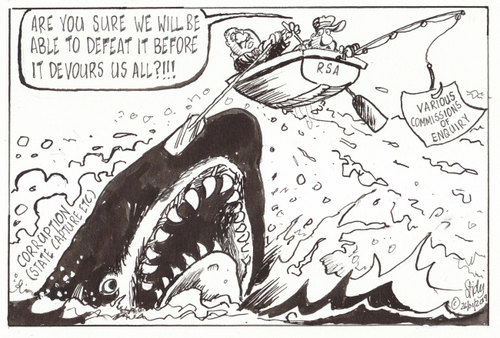
You didn’t need a crystal ball to predict how 2019 would begin – with yet more evidence of corruption and malevolent greed among the ruling elite being put before the Zondo Commission of Enquiry in to State Capture.
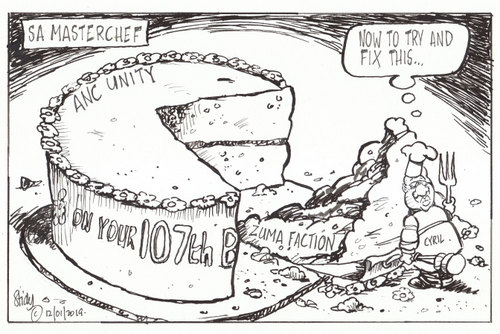
It was perhaps to try and deflect attention away from all the dirt being dished on them that the ANC decided to hold yet another big birthday bash for itself even though the anniversary being celebrated seemed, to some commentators anyway, a pretty arbitrary one – 107 (100 you could understand, or even 110).
Cyril Ramaphosa and Jacob Zuma used the occasion to make a big public show of solidarity but – again you didn’t need to be a psychic to predict this – it was too good to last. Within a few weeks Zuma was accusing Ramaphosa of being “defeatist” because of his comments about South Africa’s “lost years”.
Zuma and his disastrous legacy have, it would seem, become Ramaphosa’s albatross…
In neighbouring Zimbabwe, a brutal crackdown by the army and police on people protesting an enormous petrol price hike dashed any lingering hopes that the end of the 37-year old rule of the autocratic leader Robert Mugabe, 14-months earlier, would lead to significant political reform.
On the 7th February, President Cyril Ramaphosa delivered his much anticipated State of the Nation Address (SONA). While his plans to turn South Africa around were laudable, the jury is out on whether he will be able to deliver on his promises.
Within days of the speech the unions, led by COSATU, were throwing up obstacles in front of his proposed ESKOM reforms. As if to compound the general gloom over the future of the parastatal, this was immediately followed by more rolling black-outs.
The fact that this occurred so soon after SONA made some suspect deliberate sabotage. I certainly wondered if someone was trying to foil my plans – I had just sat down to draw a cartoon on the subject for the Weekend Witness when the lights went out…
The immediate and substantial risk ESKOM poses to the South African economy was also the main focus of Finance Minister, Tito Mboweni’s Budget Day speech. Promising “no free lunches” Mboweni said the Government would not bail-out the embattled power utility although he did allocate R23billion per annum for three-years as a support package with conditions.
Whether ESKOM can actually be fixed is open to question. So once again it is a case of “Watch this space…”
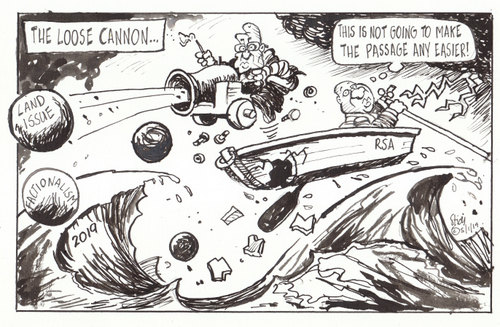
Jacob Zuma continues to rock the boat.
Not a very dainty dish…
Crackdown in Zimbabwe.
President Ramaphosa attempts to defeat the beast.
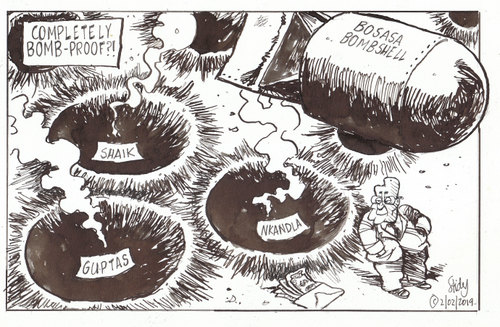
Jacob Zuma continues to live a charmed life.
President Ramaphosa promises to take action in his State of the Nation Address.
Eskom’s woes continue, impacting on the whole country.
Finance Minister, Tito Mboweni, promises to take action in his Budget Day speech.





 Stidy's Eye