“Walkies” With Whisky and Minki – a Homage

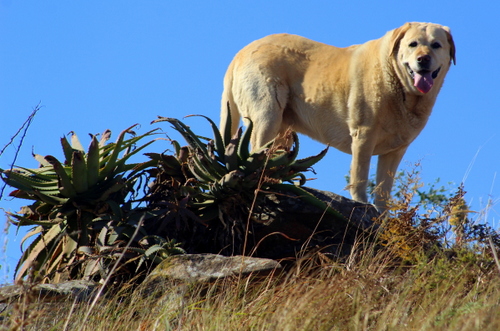
Minki was the first of us to come and live on the farm.

William, the owner, was busy supervising the construction of the new house so she joined him because she didn’t want him to be lonely all up there on his own. Sharing a solitary, bunker-like, room known, appropriately, as “The Bunker”, they became good chums.

Once the house was completed, though, it was decided Minki really ought to have a companion of her own kind and so her cousin, Whisky, was imported from the same Free State farm where Minki had been born.

At first, Minki was a little put out about this new arrangement but – being Minki – she didn’t kick up too much of a fuss. Whisky, for her part, was absolutely thrilled with not only her new home but her new auntie as well.
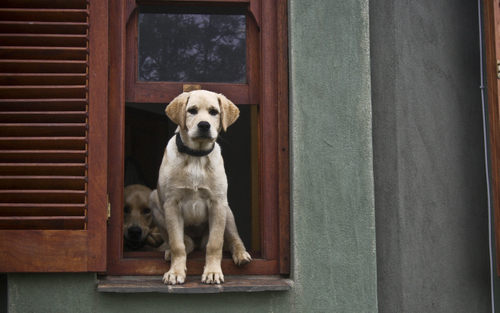
I turned up shortly after that and right away we all seemed to hit it off. They liked me even better when I started using the “walkies” word.

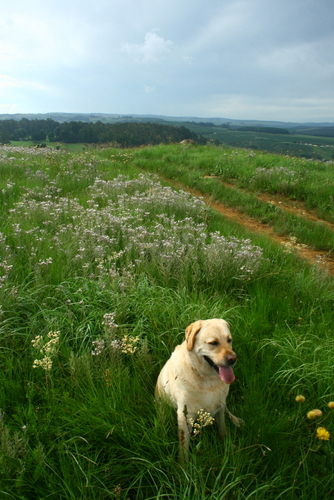
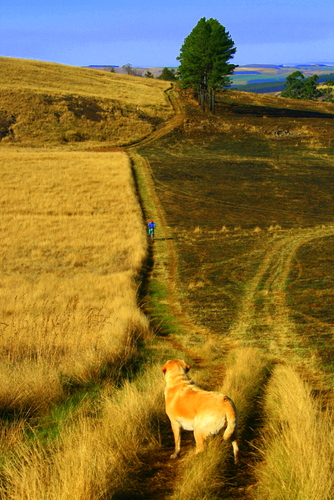
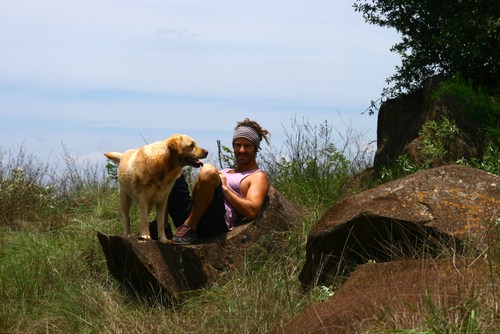
For me they became the most companionable of companions – easy-going, sweet-natured and loyal. We formed our own little pack, a democracy of three, although I pulled rank and declared myself the leader, deciding in which direction we would walk and when we would turn back

Being uncritical and accommodating by nature, they seemed happy to go along with that…

Over the following years the three of us built up an empathy and a camaraderie and a trust. All I had to do was turn up the doorstep with my binoculars and bird book and say the magic word and they would immediately start writhing and leaping in frenzies of delight.
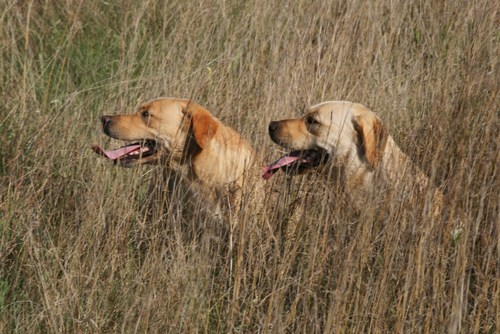
Whisky and Minki were mostly well-behaved on our outings in to the countryside. They quickly learnt that they were not allowed to chase the buck – as tempting as it always was – or bother the family of dassie that had one day decided to take up residence in the pile of rocks alongside Rubble Row.

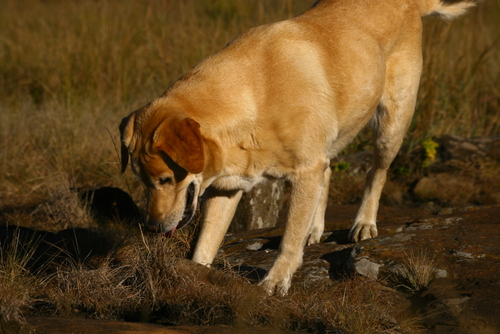
Being retrievers, they were both keen sniffers, their noses constantly close to the ground as they searched for clues and vital signs and tell-tale scents. Their attention span could be short however – a leaping grasshopper or a meandering butterfly would be enough distract them from the serious task at hand.
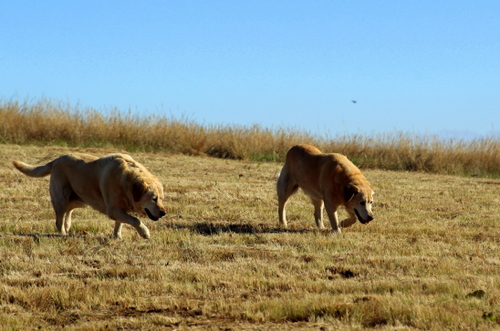
On the trail…

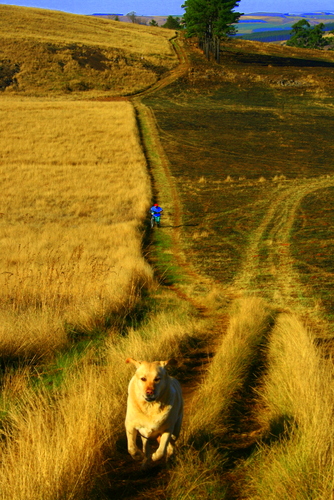
Of the two, Minki was the more energetic and adventurous, covering an enormous amount of ground as she dashed hither and thither. The only problen with this was that I never got to see many birds up close but that didn’t really matter. She was happy and that made me happy.

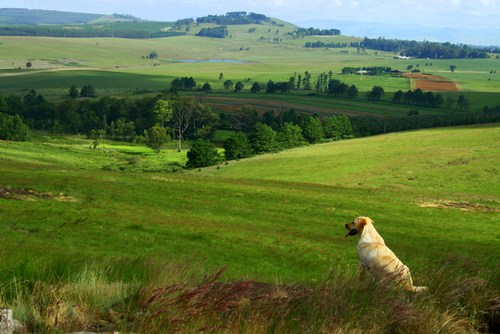
While this was going on, Whisky, was content just to trot along behind. She saw her role more as the observer, the eyes to Minki’s nose.
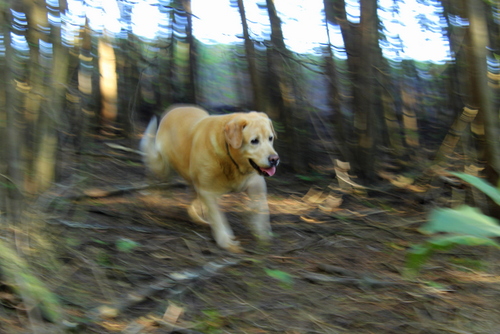
Minki in motion…

She loved nothing more than to just park off.

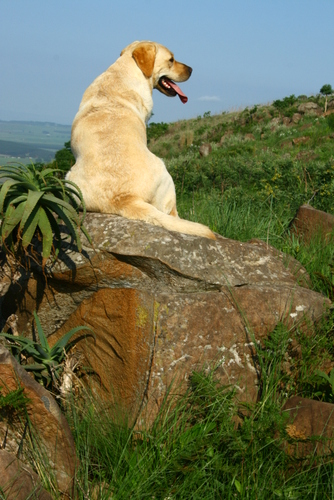
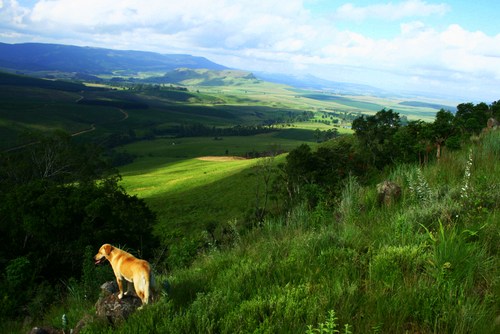
Nowhere was this more obvious than relaxing at our favourite resting spot – Lizard Rock. While Minki would scuttle over the exposed sheet of dolerite doing her best to catch the blue and orange little skinks as they darted between the rocks (to my knowledge she has never succeeded), Whisky preferred to just sit and take in the view.
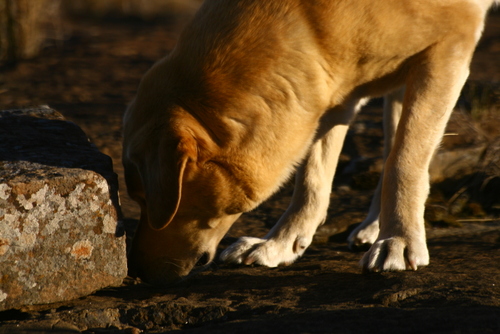
Conversely, Whisky was the more likely to bark at something. Our neighbour’s cows were a particular favourite. I noticed, however, that she always made sure there was a fence or some other form of barrier between her and them before launching in to her tirades of abuse.
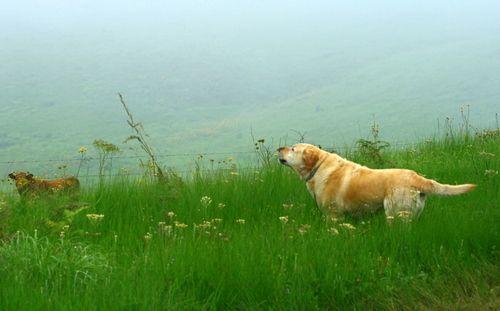
A very ferocious Whisky showing the neighbour’s cow who is boss. The cow kept on grazing…

She could be easily fooled – often mistaking, for example, a plastic bag fluttering in the wind for some sort of looming threat. And barking at it.

She was not a very brave dog as I have already intimated. The following sequence of photographs, which show her coming face to face with a man on a bicycle, provide a good demonstration of that:
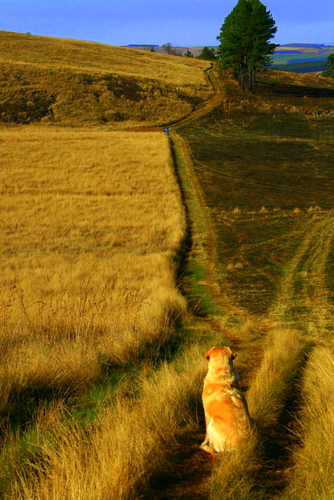
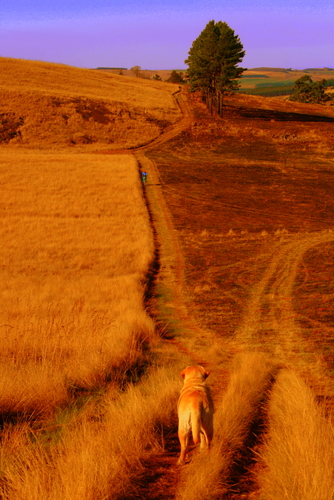
They were good days – in fact, some of the happiest of my life – the three of us ranging across the countryside with never a bad word or heated exchange between us.

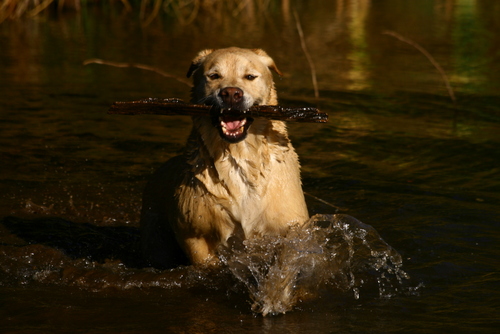
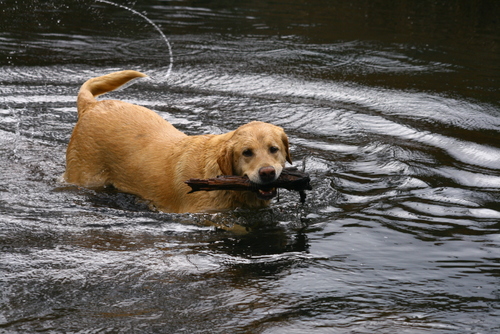
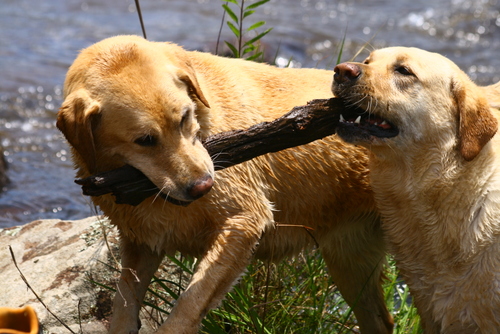
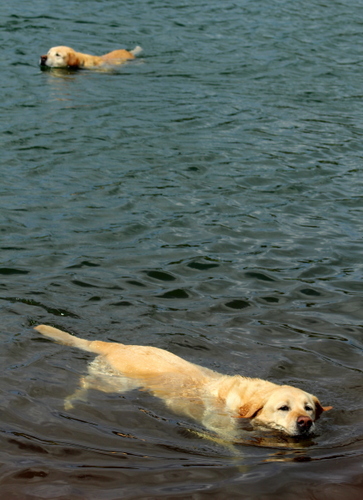
Our favourite walk was the one down to the river although it was always exhausting climbing back. Minki, in particular, loved flowing water and would immediately plunge in to the river once we got there, often emerging with a half-sunken log clamped triumphantly between her teeth.
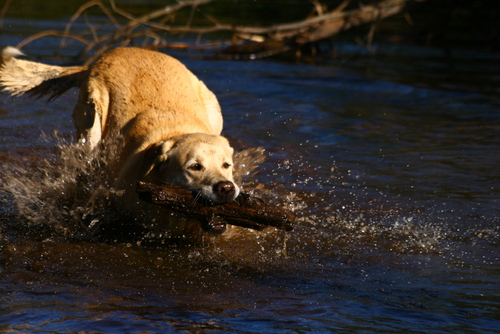
That, would be quickly be forgotten once I sat down and pulled my Thermos of hot coffee and packet of rusks out my backpack because, like all Labrador dogs, they have a highly evolved food gene. They also had a way of reminding me, without actually saying anything but by simply giving me “the look”, that we were a team. I always ended up sharing my food with them.

Sometimes we crossed the river and followed the road that ran along its forested margin. I named this road Porcupine Ridge because I have never been on it without finding quills scattered along its course.

At the point where our farm ends, the road – still following the line of the river – takes a sharp curve up a steep hill. About halfway up this we discovered a waterfall although we had to hack our way through a fair amount of skin-shredding bramble to get there.

It was well worth the effort, we all agreed. For Minki there was a deep pool to swim in at the top of the falls (even better there were logs in it) while Whisky thought the cliff edge spot provided another brilliant parking- off spot where she could simply sit and muse about life.
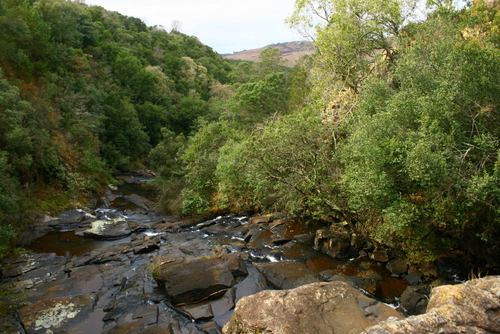
Above the falls the country opens up in to a grass-filled glade, mercifully free of those prickly brambles, while the river slides its way over a series of smooth rock fissures, with more pools in between. Along their margins tree ferns grow while the water itself is wonderfully clear.

Selecting a comfortable position on some rounded rocks, I would sit dangling my toes in the cool water while the girls lay spread-eagled in the grass, tongues lolling. It was all very peaceful, almost domestic, with the view down the valley providing a lovely, quieting effect.

As a rule, this series of pool was my turning point although there is a beautiful dam just a little bit further up I would loved to have carried on to but I was worried the owner might not want dogs trespassing on his property, even ones as friendly and as well brought up as Whisky and Minki.

So we returned home, the way we had come, crossing the Kusane River and climbing the steep hillside back to the house. I always got back from these excursions feeling tired but well satisfied and at peace with the world.
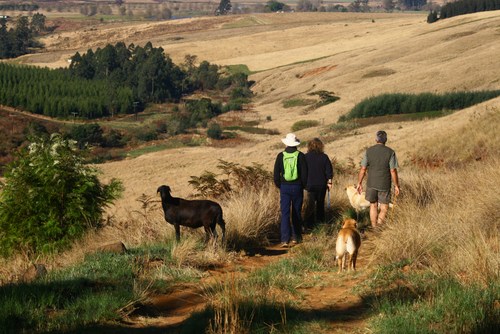
The road down to the river. The whole Kusane Gang including Mara and Harriet (not in picture), the two sheep. Plus Evan from Cape Town (in white hat), an honorary member of the pack..

Sadly, those days of exploration with Whisky and Minki have now become a thing of the past. Old age has caught up with them both. Minki has become so arthritic she battles to make it from one side of the room to the other. She is still unfailingly cheerful and although she doesn’t always get up to greet me when I come to visit she still manages to convey her pleasure at seeing me with a prolonged thumping of the tail on the floor.

For her part, Whisky has grown more matronly and home-comfort loving. When the guests arrive, she is still the model host doing the rounds of the cottages to make sure they have all settled in nicely (while, at the same time, casting a surreptitious glance in to what goodies they have inside their cool box).

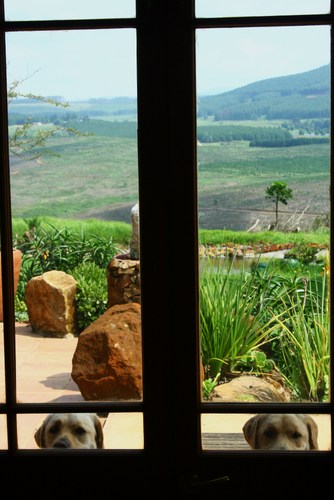
She also still wanders down to visit me in The Barn, especially when her owner is away because she knows the end of my balcony provides a good look-out over the farm gate through which Karen – she who Whisky adores above all others – will come driving.
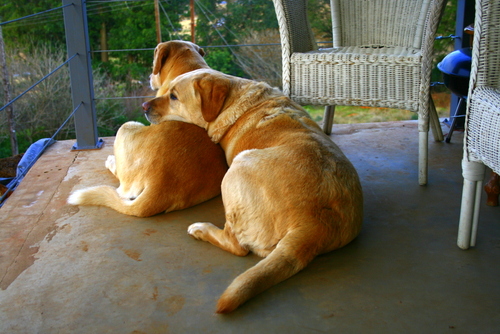
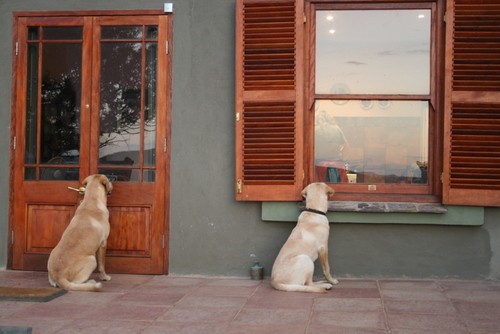
Two devoted girls, waiting for Mum to return home, at the end of my balcony. Whisky, as usual, using auntie as a pillow.

Where it counts they are still the same two dogs that I have watched grow up from puppies. They are not aggressive types but rather humble; they don’t demand affection but are grateful for it. Both still have warm, affectionate natures. Although they will obviously do their duty and bark at the sight of an unknown car coming up the driveway, I do not remember them ever showing ill-temper towards a human being.
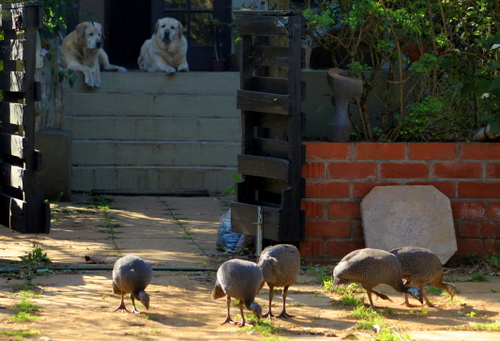
Guarding the guineafowl.

For me, life goes on. While I still try to walk on a regular basis, I have found that without the two girls to egg me on my enthusiasm levels aren’t what they once were and I don’t cover quite the same distance I used to. I hardly ever go down to the river any more although I suppose I ought to.

I still wander up to Lizard Rock but I miss having Whisky plonk herself down next to me and then lean up against my side, all friendly-like. I also miss watching Minki’s huge excitement when some lizard, with a death wish, decides to break cover.

It was a very special relationship. Through fair weather and foul, they proved the very best and most loyal of friends. I will always value and cherish and remember those times we had together, exploring Kusane Farm and the world just beyond…
Tiny Owls, Big Crocodile – a Short Trip to Shimuwini

The Letaba river at Shimuwini, Kruger

For me, there is always something spiritually cleansing about heading off in to the bush. You leave behind the worries, the strains, the irritations of day to day life, to embrace a sense of wonder and a buried instinct that reminds you that you are still one with nature.

That was certainly very much how I felt when I recently found myself, once again, driving through the gates at Punda Maria in northern Kruger.

I have come back to this spot numerous times and the enchantment never wanes, not only because of its beautiful bushveld setting but because of the promise it holds. There is always something new to discover.

Normally when I go to the bush I am focused on one main thing. It is all about looking for lifers and ticking as many birds off my list as possible.

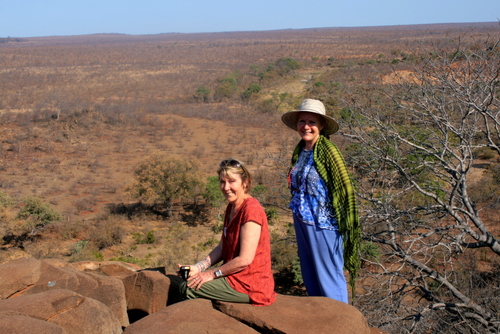
This time it was slightly different. I was travelling with my sisters, Sally, an artist, and Penny, a social anthropologist, and we had a broader goal. We were hoping to not only to recharge our spiritual batteries but also find inspiration – in my case for a series of paintings I had planned.

Travelling companions, my sisters Sally and Penny’

Any birds I saw would be an added bonus.

Our journey also differed from my normal ones in that we were doing it in much more style and luxury than I am accustomed to. Instead of having to sleep on the hard ground in my tiny tent, Penny had, as a special birthday treat for me, booked us in to hutted accommodation.

We spent our first two nights at Punda Maria with a day trip to Pafuri in between. I have described this area in a previous blog post so won’t repeat myself here.

Leaving Punda Maria, early on the second morning, we headed south towards Shingwedzi. As we drove the clouds came rolling ponderously towards us in never ending procession across an inimitable sky, although the sun never seemed to stop shining through them

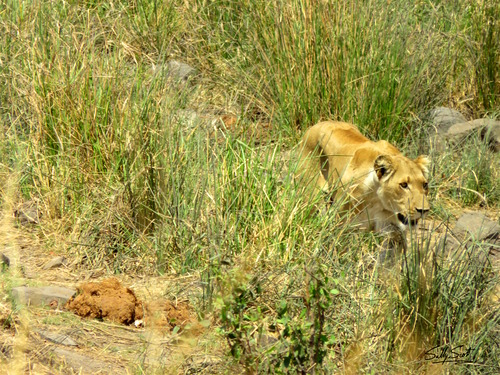
About fifteen kilometres into our journey we came across a pride of lion, lying in a gully alongside the road. Languid and completely unconcerned by our presence, they exuded an air of arrogant authority.

Lion, between Punda Maria and Shingwedzi, Kruger. Picture courtesy of Sally Scott.

Looking at them, dozing in the shade, made me glad I am, not a buck or a zebra. With predators like them around there is no way you can ever exactly nod off. When a lion roars you can imagine shadowy herds freezing in the darkness.

Leaving the snoozing lions to their day-dreams we continued on our way.

Reaching a crossroads, we branched off the tar and on to the Phongolo Loop. It turned out to be a good move because the loop is, to my mind, one of the most rewarding drives in the whole of Kruger.

There was game – and birds – a plenty.

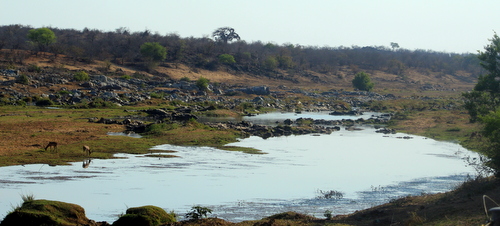
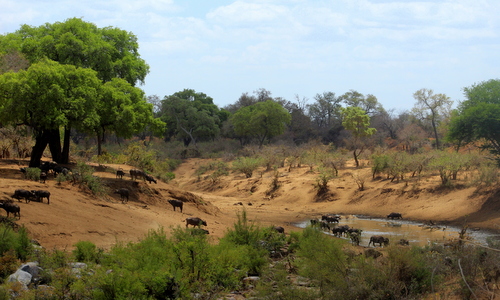
The tree-lined river, which the road follows, was mostly dry but every now and again there would be an isolated, mud-brown, pool.

Buffalo, Phongolo Loop

We stopped directly above one such pool. It had a steep-sided red-coloured cliff behind it. Down at the water’s edge lay a huge crocodile. With its hard, ugly, carbuncular skin and protruding eyes, it really did look like something from the early stages of creation.

Time and science may have removed much of our fear of the natural world but I still experience a slight tremor in my gut whenever I see these evil-looking reptiles…

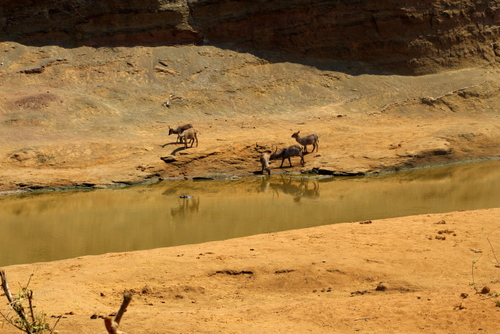
As we sat, in the safety of our car, watching this one, a small group of waterbuck came loping down the steep side of the gully. They drew up short when the lead male spotted the crocodile lying in the shallows. Strangely, the waterbuck seemed more curious than afraid, tentatively moving down to the water’s edge to examine the beast.

I kept waiting for the inevitable but it never happened. The crocodile continued to lie motionless and eventually the waterbuck lost interest and moved off.

Waterbuck meet crocodile, Phongolo Loop.

I was told afterwards – I have no idea how true this is – that waterbuck have a special gland, the odour from which repels crocodiles.

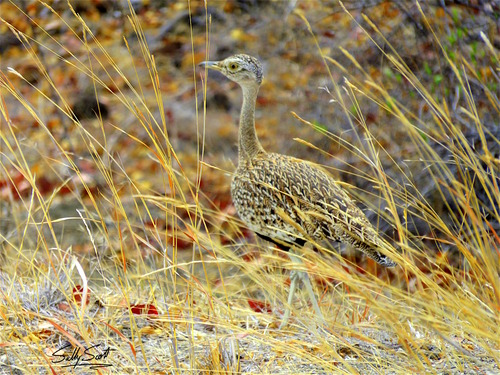
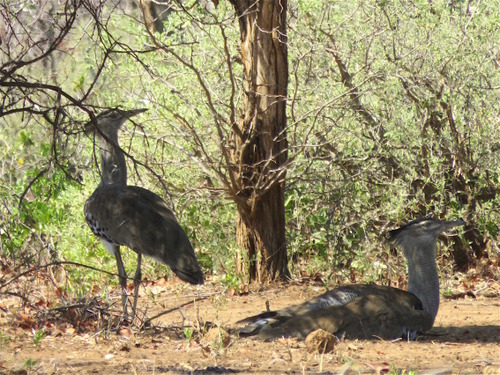
Back on the road we saw more elephant and several big herds of buffalo. We also came across a pair of Kori Bustard resting in the shade. The undoubted highlight was, however, a young leopard, walking down the dry, sandy river bed, swishing its tail as it went.

Getting to our nights accommodation at Bataleur Bushveld Camp proved to be no easy task. As we trekked up the dirt road bunches of elephant kept trundling across it, on the way to their watering holes. Often we had to brake and wait for them to pass.

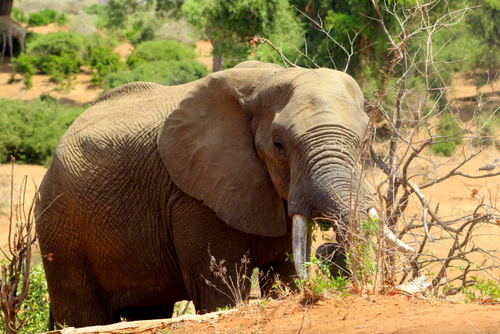
It is a strange thing when you think you are doing the looking, to find yourself being observed. Especially when the one doing the observing towers above you and doesn’t look exactly pleased to have you around. We had a few gulp moments…

Getting up close and personal

Petra, a friend of Penny and Sally, who was due to join us later, had even worse luck and was forced to turn around because of the elephant and take a much longer route eventually arriving at Bataleur just as they were shutting the entrance gates.

Bataleur is situated in thick, dry, riverine bush that stood waiting, expectantly, to be transformed by the arrival of the rains, still probably some months off.

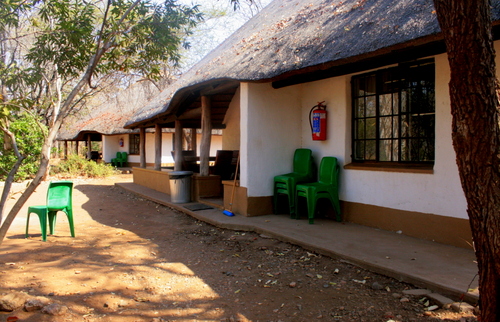
Bataleur Bush Camp

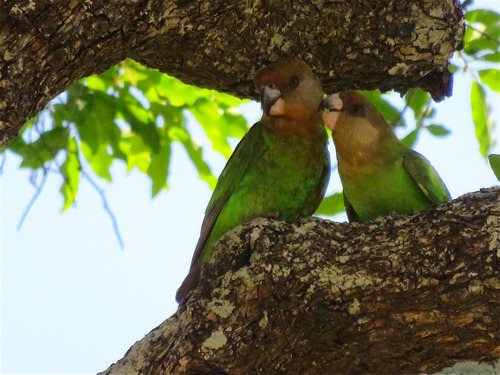
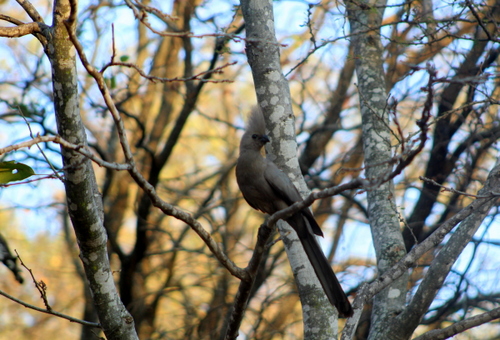
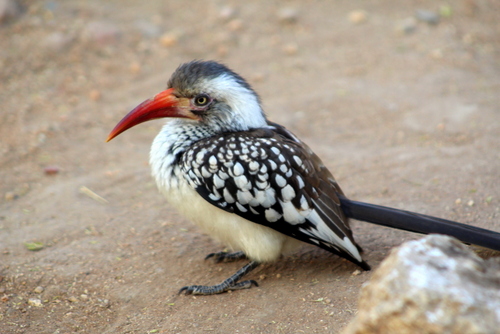
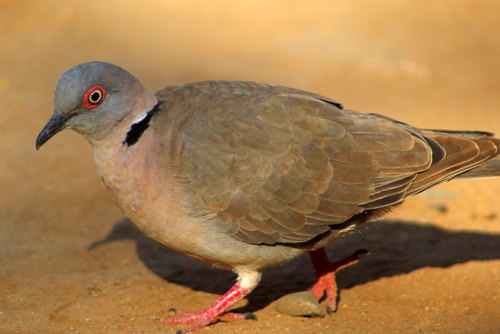
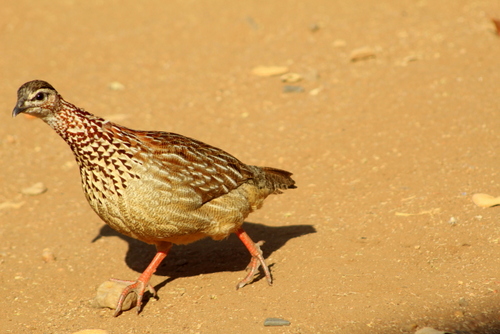
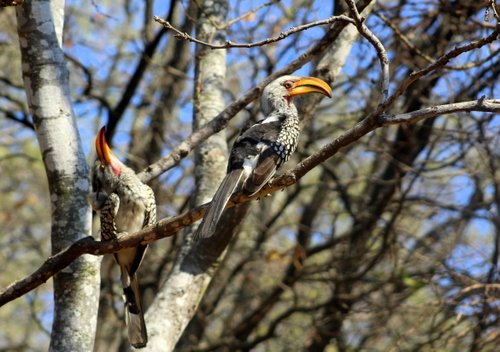
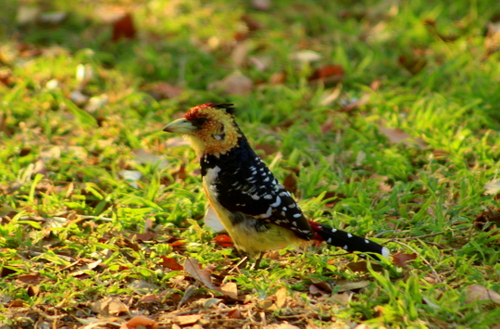
It, too, was alive with birds. There were some very tame hornbills (Red-billed, Yellow-billed and Grey), Crested Francolin, Go-Away Birds, Arrow-marked Babblers and African Mourning Doves. Also a very noisy party of screeching, acrobatic, Brown-headed Parrots feeding in a nearby wild-fruit tree

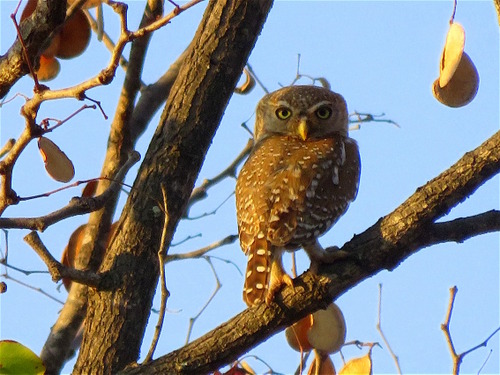
As the sun dipped behind the trees we were paid separate visits by South Africa’s two tiniest owls – first the Pearl-spotted Owlet and then the African Scops-Owl. Landing in a tree outside our chalet, the Scops immediately started signalling to all the other owls in the area with its soft, frog-like, “Prrrupp”.

Pearl-spotted Owlet. Picture courtesy of Sally Scott.

It was much hotter the following morning as we set off for our final destination, the Shimuwini Bush camp. Ahead of us lay miles and miles of more stunted mopani scrub, all bony trunks and sparse, spindly branches.

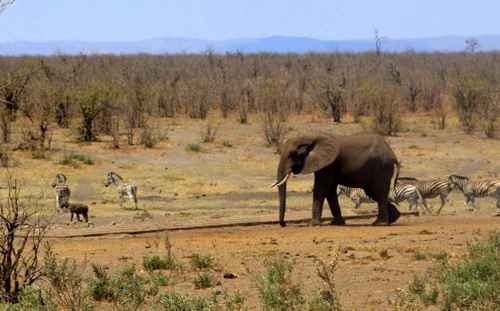
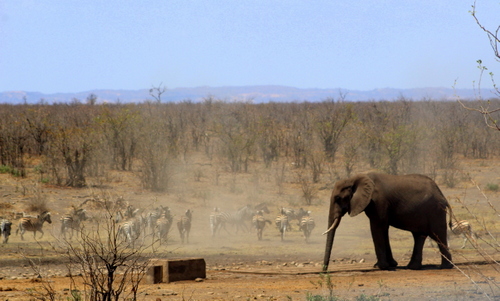
We stopped near a water point, where several elephant were siphoning water out of the top of a reservoir. There was also a solitary hyena, skulking around, like he was carrying some sort of guilty secret. When a nearby herd of zebra spotted it, they immediately charged, kicking up great clouds of dust behind them.

Hyena – about to be chased by zebra.

Caught unaware, the hyena did not need any prompting – it turned tail and fled with the zebra in hot haste behind.

Once they had sent the shame-faced animal scuttling off in to the surrounding bush the zebra halted, fanning out in to a half crescent-shaped phalanx, like a Zulu impi, to prevent it from returning. The hyena took the hint and did not return.

The hyena is seen off…

Shimuwini, when we got there, was a revelation. Situated on the banks of the Letaba, it seemed miles from anywhere. Across the river rolled plains seemingly endless, shimmering with heat, barren of landmarks save for the occasional baobab and small rocky outcrops. There seemed to be a presence here, a spirit, an atmosphere that had nothing to do with man. We were mere transitory callers, passing through.

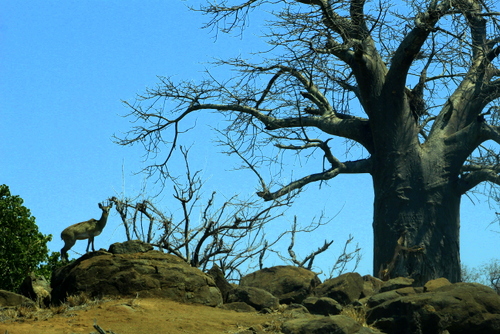
Klipspringer and baobab – near Shimuwini.

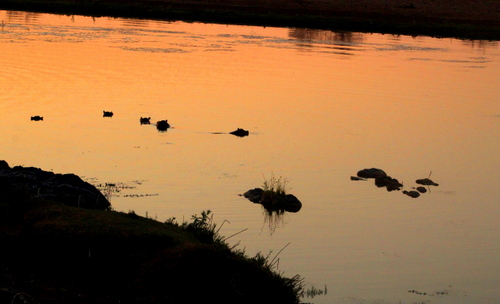
At this time of the year the Letaba provides one of the few sources of water in an arid land so you didn’t really have to go anywhere to look for game – you just need to sit out on a chair under the spreading trees, drink in hand, and wait for it to come to you. Immediately in front of us, in a large pool, a pod of hippo kept rising up, snorting out columns of bubbles and steam and then disappearing again, leaving behind a mass of ever-widening ripples on the waters surface.

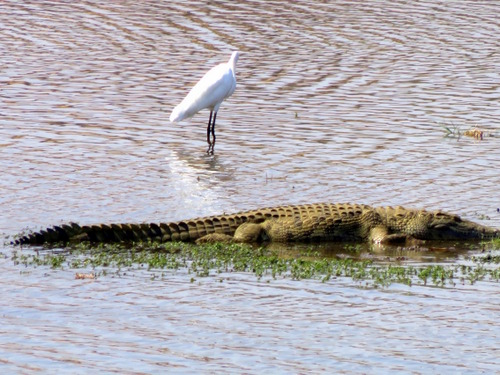
Several crocodiles lay silently in shallow inlets, only their nostrils showing. On the opposite bank a steady stream of animals kept coming down to drink.

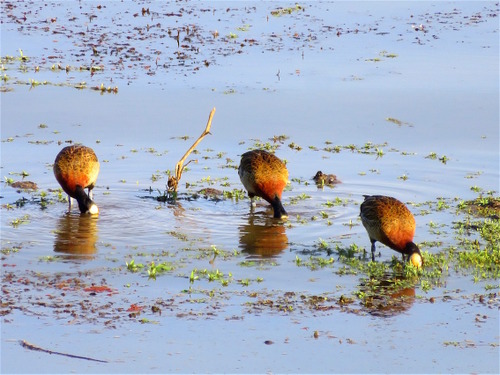
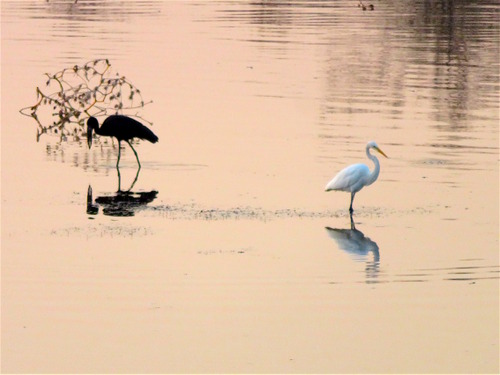
There were lots of water birds, including Fish Eagle, Saddle-billed Stork, Openbill Stork, Yellow-billed Stork, Egyptian Geese, White-faced Fulvous Whistling Duck, African Jacana, Water Dikkop and Black Crake.

As we sat watching them, the dusk seemed to creep up from the ground like a stalking animal. The whole sight before us was one of almost religious beauty, stirring to both the spirit and the eye.

Sunset over the Letaba river.

I like to think that it is to some such place my soul might return at the end of life.

As bewitching as it all was I eventually had to pull myself away to fulfil my allotted role as braai-master. After a delicious fillet steak and several glasses of red wine, which we consumed sitting on the verandah under a star-spattered sky, we retired to bed.

And then it was dawn; the sky turned red and apricot and orange and smoke-grey beyond the river. Light came flooding back in to the world.

Penny surprised us all by being the first one up, followed by Sally who wandered down to the water’s edge, cup of tea in hand, to watch the sun rise. Once it had lifted itself above the horizon, she decided to make the most of the time we had left and set off on a walk around the perimeter fence of the camp, taking lots of photographs as she went. Near its outer edges she heard lion grunting in the distance.

Driving in, on the previous day, we had seen an eddy of vultures, black specks circling high in the sky over what was presumably a fresh kill, which gave us some idea of what they had been up to.

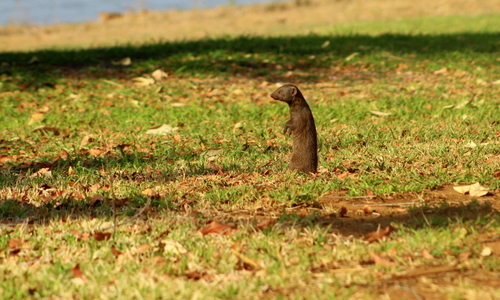
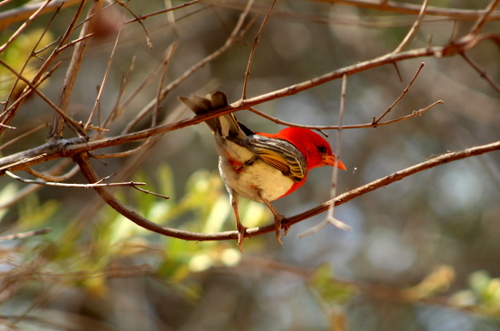
I was reluctant to leave Shimuwini but we had only booked in for one night and were due to exit the park that day. As if picking up on my mood a small family of Dwarf Mongoose came scampering on to the lawn in front of us, stopping every now and again to sit upright on their haunches as if to say farewell. A pair of Red-headed Weavers landed in a nearby mopani tree and immediately started chasing each other all over it.

Dwarf Mongoose, Shimuwini.

After breakfast we set off once more over the flat and now familiar country. Having driven what seemed like a fair distance we came around a corner and there was the Letaba again, flowing sedately east between low banks and a flutter of reeds.

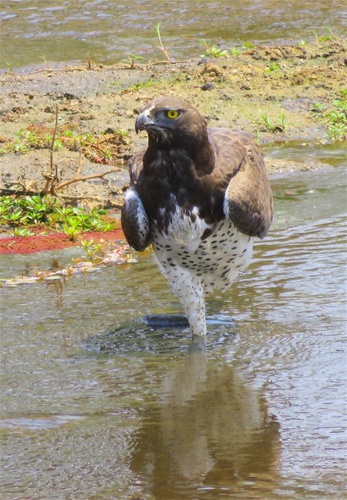
Stopping in the middle of the low-level bridge we were rewarded with a scene as unexpected as it was arresting – a magnificent Martial Eagle, one of the largest of all the African eagles (there numbers now, sadly, dwindling) standing, on one leg, in the middle of the river. It seemed quite happy to pose for photos and it was still there, still standing on one leg, when we finally drove off.

Martial Eagle. Picture courtesy Sally Scott.

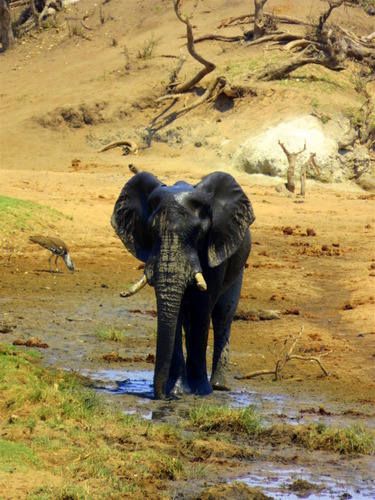
This was still perfect elephant country and we kept passing little groups of them especially where there was water. As we drove on, small maelstroms of dust and grass and dead leaves kept twirling up in to the hot sky around us. It was dust devil season.

Elephant and Kori Bustard. Picture courtesy Sally Scott.

Some faraway hills broke the flatness. We had been told there was an ancient smelting site at one of them so we decided to follow a short-cut 4X4 track that led directly towards it.

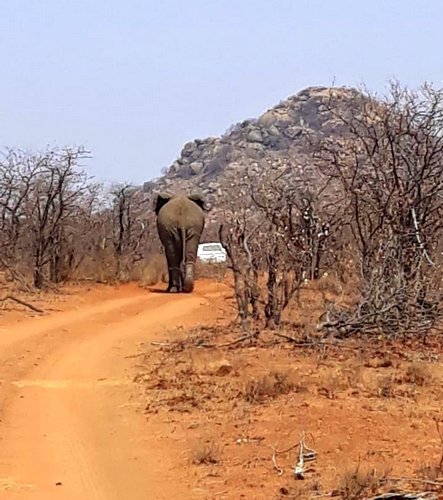
We had only travelled a short way down the rough road when another large elephant stepped out from behind some trees and started ambling down the road behind us, like it had been especially tasked to make sure we quit the park.

Getting escorted out of the park by an elephant.

We took the hint. After a quick stop off at the Masorini Archaeological Site, which dates back to the Iron Age, we headed out the gate, through the ugly sprawl of Phalaborwa, with its smoke stacks, enormous dumps and tacky tourist shops.

The air felt oppressively hot. It was hard to believe that in a few days time I would be back in the green, cold, mist and drizzle of Curry’s Post.

FOOTNOTE: Besides seeing lots of birds and animals the expedition suceeded in its other major objective which was to provide me with artistic inspiration. I have now completed four more baobab paintings with a couple more lined up.

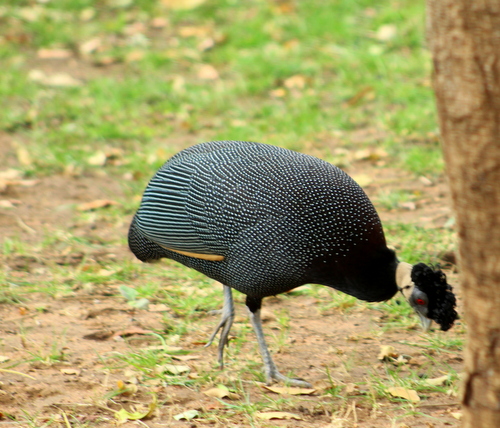
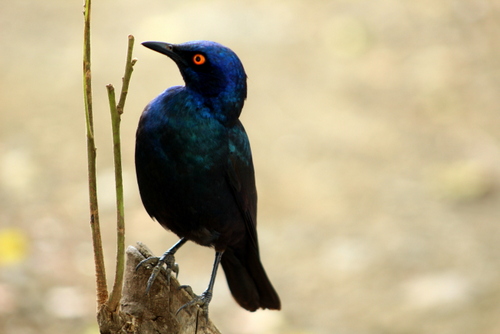
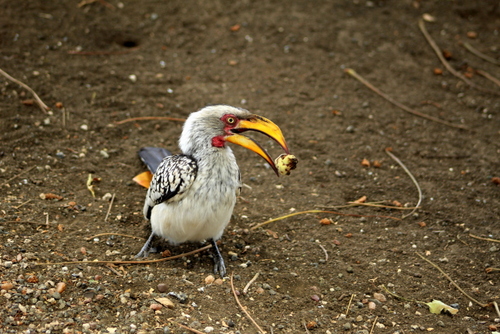
Here, also, are just a few of the birds we saw on the trip:

Between a Rock and a Badplaas

A quest to find the birthplace of my paternal grandmother, Josephine (Josie) Nesbitt, found me rattling along the road between Badplaas and Barberton. I had been told there was a house, now included in the local Barberton Heritage Walk, that had belonged to someone who shared her maiden name.

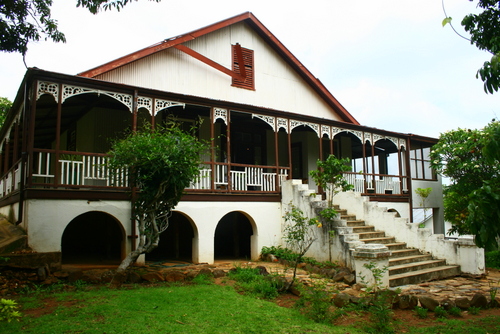
Belhaven House, Barberton

As it turned out it could not have been her home because she had been born on the 8th of August, 1888 and left shortly afterwards in an ox wagon bound for Gazaland whereas the beautiful old building I found myself admiring had only been erected in 1902.

Belhaven was, nevertheless, a very fine house furnished, according to a brochure I picked up in its rooms, in the style of the late Victorian and early Edwardian periods and depicted “the lifestyle of a wealthy middle class family”. No longer inhabited it has been curated and turned into a museum; become a tourist attractive ‘objet’, a slice of authentic gold mining town Africana.

Built of corrugated iron with a wrap around verandah and elaborately ornamented rooms it hearkened back to an era when family life was much more rigidly formalised than it is today. There was a smoking room where only men were allowed to gather and another room reserved exclusively for the use of the womenfolk. Children, presumably, were not allowed to enter either.

In terms of social status and breeding it’s original occupants were clearly a cut above a lot of the riff raff who had come pouring into the Barberton area hoping to strike it rich it what was to become South Africa’s first major gold rush. Their legacy can still be seen today in the numerous old diggings, abandoned shafts, prospecting trenches and slime dumps that litter the surrounding countryside

Starting off as a forlorn grid of dirt streets, grubby tents and mouldering shacks, Barberton quickly evolved, in classic Wild West style, into a bustling frontier town full of hotels and bars frequented by thirsty miners and prostitutes, the most notorious of whom was undoubtedly “Cockney Liz”. At the height of its boom years it even boasted its own Stock Exchange.

Although long gone the departed fortune seekers still continue to haunt the landscape in one important way, mapping it with names, evoking both hope and despair, such as Revolver Creek, Joe’s Luck, Honeybird, Fever Creek and Eureka.

Still rummaging around in the detritus of other people’s lives I stumbled upon yet another family link. The first major gold strike had, in fact, been found on a farm in the De Kaap Valley that had been granted to another very distant ancestor of mine, George Pigot-Moodie, by the Boer Republic Government as a reward for his abortive efforts to promote the construction of a railway line between Pretoria and Lourenco Marques.

At the time he had made himself highly unpopular by first offering a reward and generous terms to anyone who discovered gold on his farm and then attempting to forcibly eject the hordes of prospectors who had gathered on his property when they did just that.

Any lingering ill feelings his somewhat high-handed actions may have generated do not appear to have permanently harmed his reputation. He continued to prosper and double-barreled his parents’ name when he became Member for the West in the Cape Town Legislative Council and purchased Westbrooke in Rondebosch – destined to be the future Cape Town residence of the Governor-Generals of the Union of South Africa.

The fact that the area filled in a few missing entries in my own family history is not, of course, its sole claim to fame. In geological terms it is, literally and figuratively, a veritable gold mine, so much so that it has now been declared a World Heritage Site.

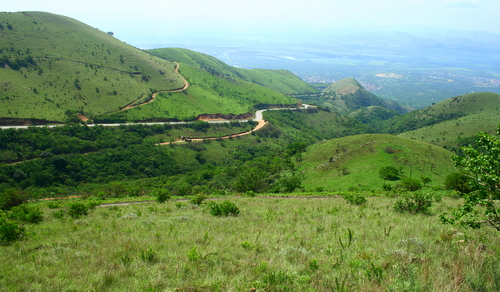
The Barberton-Makhonjwa Geotrail. Barberton in background.

Not only does it contain some of the world’s oldest known rocks but because the world’s oldest fossils have also been found there, the area has become a Mecca for scientists interested in how the young earth worked 3 500 000 millennia ago, and in searching for clues to the origins of life. Just in case you thought this was not enough to justify its elevated status the area also contains the earliest evidence of meteorite impact on earth, as well as the world’s earliest known gold deposits.

Cashing in on this impressive CV the local tourist authority have created the Barberton-Makhonjwa Geotrail which runs up into the mountains behind the town and eventually ends in Pigg’s Peak in Swaziland.

I took a drive up this road skirting buttock-like clefts and exposed rock faces striped with alternating shades of colour like a layered birthday cake. There are eleven marked stopping points along the way where you can get out and survey the folded masses of rock in front of you, each one telling a different geological story.

In places abandoned mine workings pock the hillsides like rodents burrows; long tongues of grey debris descending from their small black mouths. There had obviously been rain for the whole mountainside was a study in greens while the sky itself became an even more brilliant blue the higher up we got.

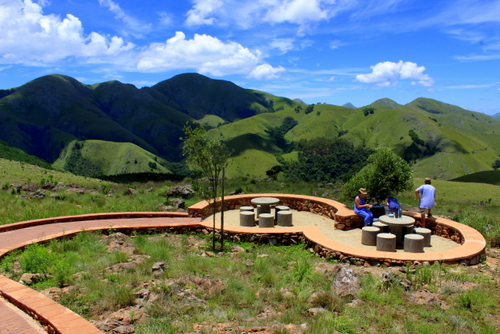
The picnic site, Makhonjwa Geotrail.

We stopped for lunch at the picnic site on the crest of a ridge. The view was superb – a lush and verdant, rolling green landscape stretching away as far as the eye could see. Puffs of white, cotton wool- like cloud floated overhead, in places blocking out the sun, so that some valleys were all alight and some sunk in dark shadow.

Even the name Makhonjwa has a magical ring. As with many mountains in Africa, local belief has it that you must never point your finger at them.

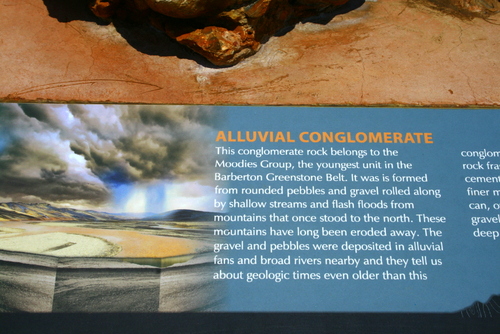
It was here I found one last link to my past – an entire layer of geological strata named after the same relative on whose farm gold had first been found in payable quantities.

Info on the Moodies Group.

As I headed homewards, well pleased with all my discoveries, I wondered how many other people could say they had had a pile of very old rocks named after one of their kinsfolk?

FOOTNOTE: Possibly attracted by the discovery of gold on “Moodies Concession” my great-grandfather, John Warren “Jack” Nesbitt, moved up to the Barberton district in 1888. It was here his young wife , Sarah, who was distantly related to George Pigot-Moodie, gave birth to my grandmother, “Josie”.

After a bit more research I discovered that she had spent the first few years of her life on a farm called White Hills, just off the main Barberton to Badplaas road, at the foot of the Nelsberg Pass. The farm – now part of a much larger timber plantation – gets its name from the prominent quartz outcrop in the area (funnily enough, the farm we settled on in the then Rhodesia was called Witte Koppies for the same reason).

We took a drive out there to see what we could find. Although we had a good look around we could not find any trace of the old homestead or anything else to remind us of their brief soujourn there.

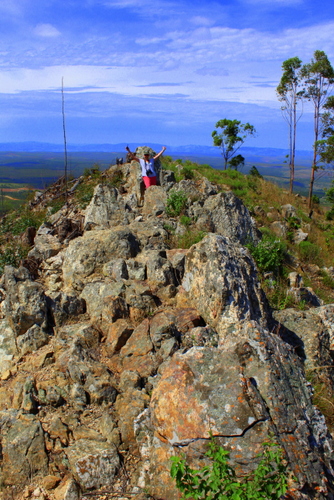
My sister, Penny, on the prominent quartz outcrop that gave a farm its name – White Hills.

Weathering the Seasons at Kusane – Part Two

As regular readers of this Blog should now be well aware, I decided, several years ago, to act on my extended mid-to-late-life-crisis by turning my back on the city and moving out in to the country. In a life riddled with bad judgement calls it turned out to be one of the best decisions I ever made.

My new home was spacious, filled with light; outside the windows and from the balcony I had stunning views over the Karkloof valley and hills and its surrounds. Here is the odd thing though. For some perverse reason I kept believing that I didn’t really deserve to live in such a beautiful place.

The Barn – my home at Kusane. I live in the upstairs portion. Note Zimbabwean sculptures.

I felt – and still feel – incredibly lucky.

Maybe it was due to the fact that I have never had much money and therefore didn’t expect the sort of things some rich folk (and their offspring) take as their God-ordained due. Or maybe it was because I had spent the previous twenty-five years of my life living behind razor wire in a cottage a little bigger than a dog kennel – and about as well kept – in the middle of Maritzburg’s CBD, and had come to assume this was my lot forever.

With a bit of self-therapy (in a probably misplaced attempt to attain a state of higher consciousness I took up oil painting. To try and unlock those repressed memories I began this blog) and lots of long, bracing, walks, I have slowly started to overcome this irrational and, it would seem, deeply ingrained hang-up

The views have helped. What I love most about living up here is that I feel so close to the sky. It has given me some idea of what it must be like to be a soaring eagle or a migrating stork.

The other thing is the weather. With the possible exception of the Nyanga farm, where I grew up, I don’t think I have ever been made to feel quite so aware of it.

Every morning, I can’t wait to get out of bed to see what it is up to. It has become my raison d’etre (it must be my Scottish/Irish/English ancestry). In the Karkloof you get an awful lot of it too: no two days are ever the same. Twenty-four hours can spin itself in to a lifetime of weather, a kaleidoscope of scene changes.

It can start off sunny and end up in pouring rain. On some mornings there is no dew, but mist wreathes the clefts and ravines of the hills across the way. A cold front can arrive in the time it takes me to stroll down to the river and get back home.

Mist in the Karkloof hills.

I love it all. I become deeply involved in the drizzly solitudes, I am bedazzled by the constantly changing cloud formations, I never tire of the bonfire sunsets.

Indeed, if there is one thing I have learnt from this endless cycle of weather is that I am its creature and to submit to it – be it hot, cold, dry, wet, windy or misty.

Here, then, are a selection of pictures I have taken showing the changing seasons on and around Kusane Farm.