The Circle of Life

Away to the north of Nyanga, in Zimbabwe, at the base of the range of mountains that forms its eastern wall, there was, once, an isolated group of farms. In a gesture which seemed quite out of character for a man who had never shown much sympathy for the Boer cause – and had, indeed, gone out of his way to thwart their political ambitions – they had been granted to a small party of Afrikaner farmers by the arch-imperialist, Cecil John Rhodes, himself.

In recognition of this fact, the dirt road that ran through the middle of them was known, in years gone by, as “The Old Dutch Settlement Road”.

The Old Dutch Settlement Road, looking from our farm towards Nyanga.

Although seldom visited by all the tourists who like to holiday in the more temperate Nyanga uplands (many staying at Rhodes’ old estate), it is an area I used to know well because it was here we had once farmed too.

When we arrived in the district, back in the 1950s, there was only one surviving remnant of this original group – Gert “Old Man” Mienie who farmed at Cream of Tartar Kops. A jovial giant of a man with twinkling eyes and invariably dressed in stained khaki, he had worked as a transport rider before ending up in Nyanga North where he grew mealies and farmed cattle.

Long before it became fashionable to do so Gert Mienie lived totally off the grid. He had a house generator that operated off a Pelton wheel with buckets on a water furrow. His wife made soap and candles from the fat stored in the tails of their Blackhead Persian sheep. They never bought medicines either, preferring to manufacture their own concoctions which they used to treat both man and beast.

He also had his own brandy still while his old ox-wagon remained parked around the back.

Mr and Mrs Gert Mienie with my parents, Reg and Monica Stidolph. Cream of Tartar Kops.

Although the rest of these pioneering farmers had either long since left or died, their presence still lingered on in the names of many of the properties – Witte Kopjes, Groenfontein, Summershoek, Doornhoek, Flaknek etc. Mount Pleasant, the farm to our immediate south, on which there stood the remains of some crumbling tobacco barns, was still referred to, in our day, as Bekker’s Place.

If you hunted around you could occasionally stumble upon the remains of their old homes (there was one on Witte Koppies, for example, which had been built out of white quartz quarried from the nearby hill) and even the odd graveyard. The two young Oosthuizen children who lay buried on our farm had both died of Black-water Fever back in the early 1900s, a common cause of death in those days.

There was something quite sepulchral about the mountain-fringed valley in which they had chosen to live. Maybe it had something to do with all the old ruins, perhaps it was the mountains themselves, with their constantly changing moods, but there seemed to be a presence here, a spirit. I sometimes felt I was walking among ghosts I could never see.

I had some idea who they belonged too. The original Afrikaners who had settled here, courtesy of Mr CJ Rhodes, had not been the first cultivators of this land to have suddenly packed up and left without explanation.

There had been others before them.

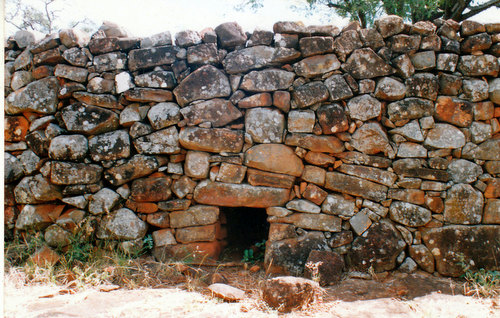
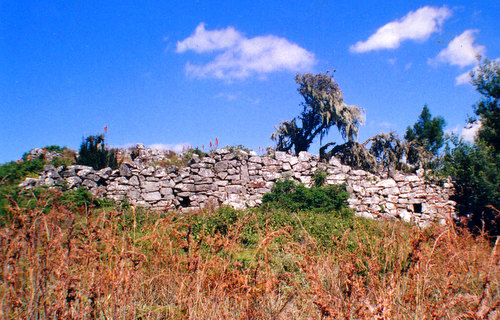
The whole country from the Nyanga uplands, north to the Ruenya River and westwards to the Nyangombe River, was strewn with relics from their stay – dozens and dozens of loopholed stone forts, look-out points, pit structures, furnace sites, grinding stones, monoliths and miles of terracing stretching along the mountain sides; the latter were often irrigated by means of furrows that carried water long distances from the streams.

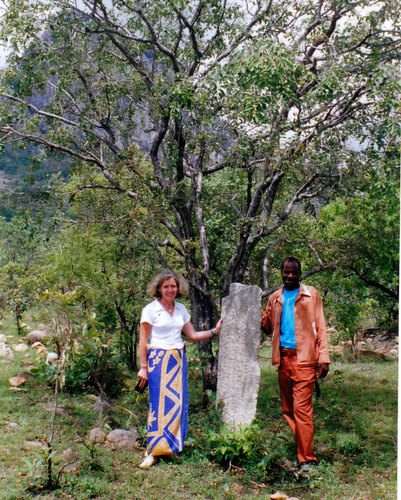
Nyahokwe Ruins with Sedze Mountain (the “Rhino mountain” as we called it) in background. Note monolith.

The amount of rock that had been moved to build all this was astonishing although, as Herculean as their labours had been, the stone fortifications tended to suggest that the ordinary villagers had lived in constant fear of attack. Clambering over the piles of rocks I had, in my youth, always imagined some fabulous Rider Haggard vision of lost mines and lost worlds but the sad reality is that the people were probably desperately poor (in his book The Shona and Zimbabwe 900-1850, the academic D.N.Beach describes it as a “culture of losers”. That is as maybe but they certainly appear to have been very hard-working ones!), because the soils they had cultivated were, for the most part, thin and infertile – although they probably supplemented them with kraal manure.

Our farm was no exception. From beacon to beacon it, too, was covered in a jumbled mass of ruins. Exploring them, I was seized by a kind of incredulity. It was impossible not to marvel at the intensity of the endeavour that went in to their construction.

My sister, Nicky, among ruins on Muchena mountain, old farm. Picture courtesy of John Louch.

And where had all that passion and effort gone? That was the mystery for me.

One of the aspects of this now abandoned civilisation which especially intrigued me were the endless piles of gathered stones that lay scattered all over the veld. What was their purpose? Why all the effort for so seemingly pointless a task? Again I was flummoxed.

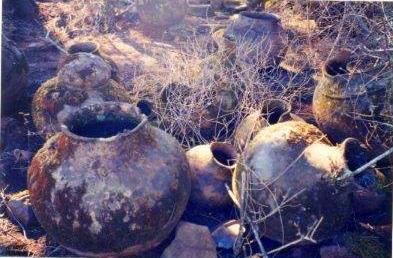
Endless piles of gathered stones. Picture courtesy of Paul Stidolph.

To me, the ruins seemed very old – none of the local tribes people we spoke to appeared to know much about who had constructed them – yet the consensus amongst the experts is that they were mostly built between the 16th and 19th Century by the Tonga people from Zambezi. Adding to the air of mystery, no one seems to be able to state with any degree of certainty why the whole complex was eventually abandoned.

Our own sojourn in this hot, dry, haunted valley came to an end during the Rhodesian Bush War. Remote, cut-off and situated close to the Mozambique border, our farm became an obvious target for the incoming liberation forces. Our only two neighbours were killed, the roads regularly mined, the few cattle we had which had survived drought and disease were rustled and we were eventually forced to move, our farm becoming part of, in the military parlance of the day, a “frozen” area.

Our old house.

It was twenty-years after the war ended before I got to go back to the farm again, only it was no longer a farm. In the interim it had become a black resettlement area.

There was not much left to remind me of the years we had spent there. Time – and the war – had taken its toll. Of our old house little remained. At the one end, where the lounge had been, the old fireplace still stood; elsewhere our former home, once so full of life, had been reduced to the cement squares and oblongs that marked our vanished rooms.

Here and there bits of the old wall survived but it no longer supported the roof which had completely vanished. Of my mother’s once extensive garden there was no trace other than one lone bougainvillea which still clung stubbornly to the hillside.
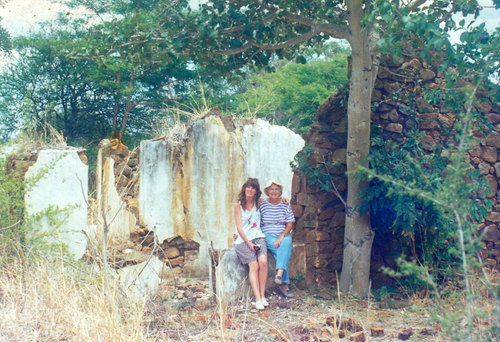
My sister, Nicky, and my mother, Monica, among the remains of our old home.

Everywhere else wild nature had come back and reclaimed its own.

As I wandered around looking at all the places that had once meant so much too me I could not help but reflect on the transitory nature of things. As a young boy I had been intrigued by the ancient ruins that lay scattered across the farm; now our old house had joined them.

I found myself thinking about those early Afrikaner settlers too. Like us, they had arrived here, full of innocent optimism and hope that they could create a future and yet few if any of the families had stayed beyond one generation. Now, all that remained of their hard work and industry were a few old bricks, stones and mortar and the occasional gum tree.

The same had happened to us.

What hadn’t altered were the mountains themselves. It is difficult to capture in words the feelings they engendered in me. Looking at them I realised it did not make any real difference what we did. They would live on without us, watching the next generation grow up in a place we had once called home. We had only been there for a few moments and all that mattered was that we had cherished the place and made the most of the time we had had there.

View of Nyanga range from north of farm, Nyangui mountain on left.

As I pulled over, onto the edge of the road, for one final look back, I realised it was not so much the fact that I had come back but rather that the farm had never left me.

FOOTNOTE:

For the sake of convenience the extensive Nyanga ruin system is often separated in to the Upland and Lowland Cultures. Because our farm lay in the Nyanga valley, the ruins on our farm obviously fell in the latter category.

Below are a selection of photographs showing examples of both types of ruin.

A special thanks to my brother, Paul Stidolph, for providing many of the old black and white pics. A semi-retired farmer still living in Zimbabwe, Paul has conducted an enormous amount of research of his own in to the early history of the country and unearthed a great deal of fascinating material on both its ruins and ancient mine-workings.

A Tale of Two Rivers. Part Two – The Limpopo

The Limpopo at Mapungubwe.

My love affair with the Limpopo began relatively late in life.

Although it forms the southern boundary of the country I grew up in, until I moved to South Africa in 1984, my sole acquaintance with the river had been crossing over it at the Beit Bridge border post.

In the back of my mind, though, I always had this strange feeling that it was waiting for me, beckoning me, and that I was duty bound to answer its call.

And so I did.

All rivers have their own personalities and the Limpopo is no exception. In his “Just So” stories, Rudyard Kipling famously characterised it as the “great, grey-green, greasy Limpopo, all set about with fever trees”.

Fever trees at Pafuri, Limpopo.

It is an apt description. There is something rather wild and romantic about the Limpopo; it is both a purveyor of adventure and a river which seems to have its origins in the realms of legend and folk lore.

Even the name sounds made up.

Approximately 1600 kilometres long, it flows in a huge arc after leaving its headwaters in the Krokodil (Crocodile) River in the Witwatersrand. Skirting the edges of the Kalahari it passes through some of the driest, least populated areas in South Africa before making a dog leg in to Mozambique and then disgorging itself in to the ocean near the port town of Xai Xai.

In its own way, it is the embodiment of both the sheer size and the mystery of Africa. The sky above it is huge, the horizon stretches out forever. Travelling towards that horizon you are always conscious of the distance between it and you.

Despite being the second largest river in Africa – next to the Zambezi – that flows in to the Indian Ocean, for a substantial part of the year it contains very little actual water. In dry years its upper reaches flow for 40 days or less.

This can change very rapidly. The one time I visited, a heavy rain storm somewhere up near its source had seduced the river in to breaking loose. Standing on the bank the raging torrent whooshed past us, the colour of caramel, swirling around rocks and eddying over tree roots.

It was a brute demonstration that the Limpopo was not to be messed with when aroused. The next day it had dwindled back to almost nothing…

For my first foray up to the drier western section of the river, I arranged to stay at Ratho, a large agricultural estate, just upstream from the Pontdrift Border Post with Botswana, which has camping facilities on its banks.

To get there you travel north from Jo’burg on the N1, branching off at Polokwane and heading towards Vivo. Beyond this tiny settlement, the road runs through open, rather lonely country. About 100 kilometres further on you reach the oddly named Alldays, a straggling, dusty town only a few streets deep from front to back.

Here you veer left.

As the horribly pot-holed road drops down to the border post at Pontdrift, a change suddenly takes place: at this point of its long journey to the sea, the Limpopo opens in to an immense valley hemmed in by sandstone cliffs, mesas and buttes that glow as if they were red hot. In places they have been honeycombed by erosion and blackened by fires. Out of the sides of the cliffs and the rocky outcrops grow fig trees with long, trailing, ghost-white roots. These are Large-leaved Rock Figs or Ficus abutilifolia.

There is something both wonderful and tantalising about this strange, eroded scenery.

The road to Ratho.

There was no water flowing in the river when we arrived at Ratho although, on our walk the next day, we did find a long, rather greasy-looking pool further upstream, concealed in a grove of tall, thorn trees. There was something a little scarifying about this shadowy section of the river.

I found myself wondering what dangers lurked beneath its placid surface. It looked like the sort of place where an elephant could have easily got his trunk, courtesy of an enormous crocodile.

There was plenty of evidence of elephant being about as well, which also made me a bit nervous…

Back in camp, dangerously untroubled by doubts, my birding colleague decided to take advantage of this absence of a liquid barrier in front of us and sallied forth across the dry river bed, disappearing in to foreign territory. More circumspect by nature, I declined to join him.

In the end I was rather glad he didn’t get trampled on by an elephant or eaten by a lion or carted off in irons because if he hadn’t made it back safely he would not have been able to find me the elusive Pel’s Fishing Owl, that evening. We heard it before we saw it, a strange, pig-like grunt which was then followed by a deep, booming ‘hoo-huuuum‘. Grabbing his binoculars and powerful spotlight my birding colleague eventually located it sitting in a tall thorn tree.

It was a bird I had long wanted to tick off my “Lifer” list. What made it all the more exciting was that we hadn’t needed a guide to find it for us which is usually the case with this bird, which Roberts describes as: “Vulnerable… largely confined to to protected areas, threatened by disturbance…” We were also lucky to find it because we were on the western-most extreme of its range.

From Ratho, we returned to the main tar road and then struck eastwards towards one of South Africa’s most important Stone Age archaeological sites – Mapungubwe.

I have a tenuous family link with this area. Somewhere between Pontdrift and Mapugubwe a bunch of my ancestors forded the Limpopo on the 1892 Moodie Trek to Gazaland. In the diary she kept of the journey, my great-grandmother, Sarah Susannah Nesbitt, describes the river as being “very rough and stormy” and says they crossed at a point called “Selika’s Wegdraii” (this could possibly be the old crossing which is today known as “Rhodes’ Drift”).

Every night they heard lion, sometimes close by, sometimes further off across the river. The sound sent chills through my great-grandmother because she had her two infant daughters (who included my grandmother, Josephine) with her and was worried for their safety as they lay there in their wagon.

This was not their only concern. Having crossed the river the trek-party found themselves faced with another problem when they got delayed at Macloutsie, in Bechuanand (now Botswana), by an outbreak of foot and mouth disease with many of their animals becoming so weak they fell easy prey to hyena.

Travel was a lot more difficult in those days.

Mapungubwe is one of those places I find myself drawn to like a pin to a magnet. Once a thriving city and important trade centre with links as far afield as China, India and Egypt, it was abandoned in the 14th Century for reasons largely unknown.


There is still a rather eerie feel to it. This is a place of secrets and questions…

Mapungubwe. A strangely puckered landscape…

Driving through its strangely puckered landscape, I found myself wondering why its original inhabitants had chosen to settle here. It seemed to me this wasn’t a country to live in at all with the heat and the desolation but – who know? – maybe the climate was different back then?

It is good country for birds, however, including yet more varieties of owl. At night you can regularly hear Wood Owl, Pearl-spotted Owl and African Scops Owl. Pel’s occurs here too although I haven’t seen it.

On the one occasion, driving out from camp, just before dark, we hadn’t got very far when we spotted a Giant Eagle Owl squatting on the ground, next to an old termite mound. It was so close I felt I could lean out and touch it. Perhaps suspecting I might actually attempt something so impertinent the huge bird suddenly rose in the air and flapped off to a nearby tree.

Giant Eagle-Owl, Mapungubwe.

In the half light of the forest it sat and regarded us from this perch. Relaxed, enormous, extraordinary with formidable talons, curved black beak, deep, luminous, saucer- like eyes and finely barred grey overalls it seemed quite unconcerned by our presence.

Every now and again it would blink at us, like a camera shutter going off, and tilt its head sideways as if trying to get a better angle to observe us from. Or maybe it was just sizing up my birding colleague as a potential meal.

It was difficult to tell.

Watching it, I could not help but reflect on what a marvellously well adapted creature it was. Shaped by millions of years of evolution everything about it is tuned to hunt and kill at night. In the dark it can see with precision things which for you and I are just a generalised blur.

Perhaps because it is such harsh and difficult country, the park is always a scene of restless, unremitting activity devoted to the purpose of staying alive. There is always something to see.

The Maroutswa Pan in the Western section of the Park is usually well worth a visit as there are invariably herds of animals and flocks of birds coming down to drink, especially in the dry season.

One of my special memories of the pan, is returning at dusk as the sun was touching the leaves of the tall Lala palms in the rectangular-shaped clearing nearby and golden sheets of silken light came pouring down. It was an extraordinarily beautiful scene.

Lala Palms. Western section, Mapungubwe.

The Eastern section is more broken country but is also full of scurrying, browsing and fluttering life. From a raised walkway that leads through the canopy you can view the river in both directions. There are usually elephant here. It is also a good place to get Meyer’s Parrot and Broad-billed Roller too.

A kilometre or so downstream from here there is hill top view point which once served as an old SANDF army base during Apartheid day because of the immense view it gave over the surrounding bush.

It has become a place of pilgrimage for me. It is here, at the confluence of the Shashe and Limpopo rivers, that the borders of the three countries – Zimbabwe, Botswana and South Africa – that have played such a pivotal role in shaping my life converge.

Confluence of Shashe and Limpopo rivers.

It is difficult to exaggerate the wild, romantic beauty of this spot with its great baobabs and fig trees growing out of a chaos of rocks. Standing on the edge of the cliff face I sometimes feel like I have been magicked into some parallel world. This is the ancient Africa of myth which the old writers and cartographers had heard about but weren’t too certain how to depict in their books and their maps.

Mapungubwe. Limpopo in mid-ground.

From Mapungubwe the Limpopo continues its long, leisurely loop along the border with Zimbabwe before crossing in to Mozambique at Pafuri. When I do this route I normally stop off at the town Musina to stock up with provisions.

The quickest way to get from Musina to Pafuri is probably to take the tar road that goes via the hot springs at Tschipise – but by using this route you miss out on seeing the Limpopo so we usually go on the old SANDF dirt road that runs alongside where the old minefield once was. In the past we have seen taxis parked here, picking up the Zimbabwean refugees fleeing across the river.

The Limpopo, east of Musina. View from old SANDF dirt road.

The road is in fairly good condition although, on the one trip, my birding colleague did manage to crack his car’s sump. Somehow we managed to get back to the tar and then limp all the to Tschipise without the engine seizing. At the local garage we gummed up the leak with soap and topped up the oil. That got us back to Musina where we were obliged to stay over while it got repaired.

Musina is an armpit of a place and not somewhere I would normally choose to stop for a night’s sleep on account of its perspiring proximity to the Limpopo river. It is definitely not the sort of town you want to get stuck in for any length of time especially in summer.

Apparently not everyone agrees with me. The copper mine which provided it with its reason for being might have closed but it is still a bustling, clamorous hub full of all the usual transients who ebb and flow around border towns – in this case mostly Zimbabweans come down to shop or escape that country’s collapsing economy and hoping to find employment in South Africa (the bush mechanic who fixed our car was one such refugee).

We checked in to a hotel on the main road. Towering cumulonimbus clouds were massing all around us and it looked like we were about to be inundated as fractious gusts of rain kept splattering against the windows of my room. The storm surge held back, however, as if it had had a sudden rethink, and then veered off to the West.

It had been a long day. Neither the sweltering heat, the music from the nearby bar nor the constant rumbling of trucks along the Great North Road, could disturb me. I fell instantly asleep.

Next morning, the car repaired, we resumed our journey along the Limpopo to Kruger.

Covering a huge swathe of the country Kruger is undoubtedly South Africa’s best known and most visited game park. Although most people are attracted by its animals – which includes the Big Five – it is also a Mecca for birders with over 500 recoded species.

One of the most popular of its birding spots, Pafuri, benefits from its proximity to the Mocambique coast and the Limpopo river that acts as a migration corridor to birds normally found further east and north. It was here, that I obtained my first sighting of the elusive Bohm’s Spinetail, a localised and uncommon species that favours riparian forest and is usually linked to baobab trees which this area has in abundance.

It is also where I saw my first Ayres Hawk Eagle, perched in a massive Jackalberry tree alongside the Luvuvhu River.

To get to Crooks Corner, another place I get a little sentimental about because it demarcates the meeting point of South Africa, Zimbabwe and Mozambique, you drive along the muddy Luvuvhu River, a tributary of the Limpopo. In the foreground the riverbank rises two to three metres and is capped by a flat plain whose edges are packed dense with tall Nyala, Jackalberry, Ana and Fever trees. Behind them, stretching away forever lies a sea of Mopani trees.

Luvuvhu river from bridge. Elephant below

I like to stop for lunch at the picnic site on the Luvuvhu where the sunlight is subdued and dappled by the trees, and the place is alive with birds.

Crook’s Corner – which is where the Luvuvhu (strangely enough I have never seen this river without water) and Limpopo meet – is another spot where it would be quite easy to slip across the border by just strolling over the often dry, river. In fact, this is how it actually got its odd moniker – because in the early days fugitives from the law used to do just that.

Here is another odd fact about it: in July 1950 a Zambezi Shark (Carcharinus lucas) was caught at the confluence of the Luvuvhu and Limpopo, hundreds of miles from the sea. Why it had decided to swim so far inland is a mystery.

Maybe, like me, it just responded to the river’s call…

A Tale of Two Rivers. Part One – the Zambezi

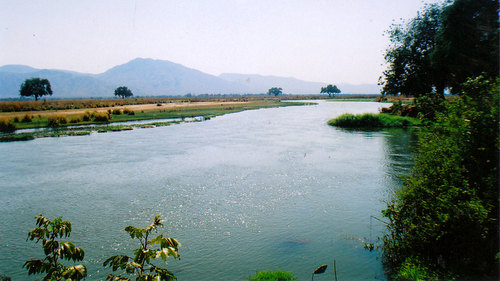
My soul river at Mana Pools.

Every now and again in my life I have found myself in a place that for some mysterious reason exerts a deep, personal pull on me. Such places insinuate their way in to one’s being; my need for them seems to come from the deepest recesses of my unconscious mind. The Nyanga farm, where I grew up, was one. The Zambezi Valley is another…

The first time I went to “The River” was as a very small child, way back in the 1950s. I flew up with my father, an airline pilot, in an old Viking, at a time when the future Kariba Dam was still under construction.

I don’t remember much about that trip other than the fact that the unfinished wall looked like a rash of scabby cement skyscrapers of uneven height sprouting out of the river bed. I also vaguely recall that we travelled downstream to the junction of the Kafue and Zambezi rivers but how we got there I have forgotten.

My next visit was with my brother, Peter, his best friend, Douglas Anderson and Doug’s then girlfriend whose name now escapes me. It was towards the end of the sixties when I was still at university and Pete had just started working as a CONEX officer in Karoi.

My memory of that trip is similarly hazy. I do remember we consumed quite a few beers along the way which might explain that.

I recall driving past the remains of the abandoned sugar mills near Chirundu but am not sure where we actually ended up. I also remember there was only the one shelter which Doug and his girlfriend slept in. Because we considered ourselves rugged, outdoor types, Pete and I just dossed down on a sandbank alongside the river.

Apart from the mosquitoes – tiny, winged, devils in paradise – we slept well enough although we were a little taken alarmed to discover, when we woke up the next morning, that a hippo had walked between our two prostrate forms.

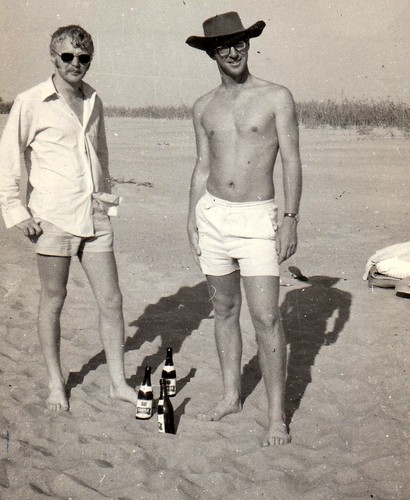
I still have an old black and white photograph of the two of us, taken back then. It is a picture I treasure because it reminds me of more carefree times and captures better than any other our contrasting personalities: Pete – practical, solid, no nonsense, his feet firmly planted in the soil. Me, the future cartoonist, slightly aloof and cynical, a bit of a poser with my sunglasses and ridiculous sideburns.

Pete and I at the Zambezi, circa 1969.

Standing on that sandbank with my brother, I do remember feeling that there was something that made this place special. I also knew I would return, one day, although, when I finally did so, it was not under the conditions or in the circumstances I desired.

I had left university at the end of 1971 and knew what lay ahead of me – 12 months of National Service. For a whole year I had been possessed by a growing sense of dread and the misery of anticipating the unavoidable.

My fears duly were duly realised. On the 3rd of January, 1973, I found myself conscripted in to the army as a member of Intake 129, “C” Company, the Rhodesia Regiment, based at Kariba.

It was now that I really began to get to know the river.

Our barracks, which had once provided a home for the Italian workers involved in the construction of the dam wall, were situated on top of a high hill – commonly referred to as the ‘Kariba Heights’ – with a panoramic view over the town, harbour and lake below. From here each platoon took it in turns patrolling the gomos ( army slang – from the Shona word for ‘mountains’), the flatlands and the town itself where our duties included guarding the dam wall which linked Rhodesia to Zambia

The gomos are what we called the rugged, inhospitable stretch of country that lie directly below the dam wall where the valley sides close in tightly, squeezing the river into a series of narrow, fast flowing rapids. At the end of the gorge the Zambezi slows down and widens as the land opens up with surprising abruptness into an enormous flood plain (hence army slang: flatlands) while the mountains re-arrange themselves along the horizon, growing further and further apart until finally petering out into nothingness.

For the most part we operated in small, six-man sticks, patrolling up and down the river as far as Chirundu by day and then returning to our base camps – old hunting camps – at night. It was a place of huge heat, a vast sky above and the sound and shimmer of the river below as it snaked its way along the county’s northern border.

Zambezi Master Chef class. Me on left, taking no part but writing a letter home like a good son did in those days…

At this early stage of the war this section of the Zambezi was still relatively quiet; most of the guerilla incursions were occurring further to the east, across the Mozambique rather than Zambian side of the border. If anything we had more to fear from the abundant wildlife.

At night we could often see and hear hyena lurking around and rooting amongst the rubbish left behind by countless intakes of soldiers before us. Under the cover of darkness hippo would emerge from the river to graze
on the grass that grew along the banks of the river.

Elephant, too, were frequent visitors although usually you could hear their stomachs rumbling long before they got anywhere near you. At other times I used to marvel at what silent creatures they could be and how an entire herd could materialise out of nowhere, as if by magic.

Black Rhino – surely the most cranky, foul–tempered, creatures on this planet (aside from man that is)? – were still relatively common. The sadistic South African helicopter pilots who flew us around used to take cruel delight in making us jump out near them. Because they held rank we couldn’t argue…

As a result, I spent more time retreating from their frontal assaults than I did dodging the other sides’ bullets (although that did change as the war intensified and I got despatched to the “Sharp End”).

Patrolling at night also had its own peculiar risks. There was always the chance of stumbling into herds of silent-standing buffalo concealed in the shadows, their presence usually given away by a sudden swish of a tail or an angry snort. Several large prides of lion also hunted in the area.

Elephant drinking in the Zambezi

Then there were the less visible dangers – tsetse fly, carriers of sleeping-sickness whose bite left a large welt on your skin, ticks, malaria-bearing mosquito and crocodile that lurked below the deceptively placid surface of the river.

At night we each took it in turn to do a stint on guard while the others slept. Strangely enough I learnt to savour such moments. I have never been much good at being one of the crowd, nor did I ever slot comfortably into the highly structured military hierarchy. Guard duty provided me with a brief, merciful respite; the time and silence to be alone with my thoughts, without being interrupted or pestered or ordered about.

Although I was always an extremely reluctant soldier, the army was not all bad. Indeed there were moments of unalloyed magic when it was possible, if only for a while, to forget we were fighting a war.

I loved sitting in the pink afterglow of the sunset, having my final brew-up of the day and watching the river change colour as darkness descended. As the sun sank still further the river and sky became one, the tree line and distant escarpment hanging in suspension between them. It was difficult not to be bewitched by the landscape, the massive, flat valley, the rim of mountains and hills. Often we would be joined, on either side of our position, by large troops of baboon or herds of impala or elephant coming down for their final drink.

Sunset over the Zambezi.

Apart from a short period in my youth when I tried to re-imagine myself as a St Francis of Assisi-figure I have never been a particularly religious person but I felt a strong spiritual connection with the place.

Even now, living in a different place, space and time I am still haunted by the grandeur of the Valley.

Since then I have been back to the Valley many times, alternating between Lake Kariba, Mana Pools and Mongwe Fishing Camp, below Chirundu.

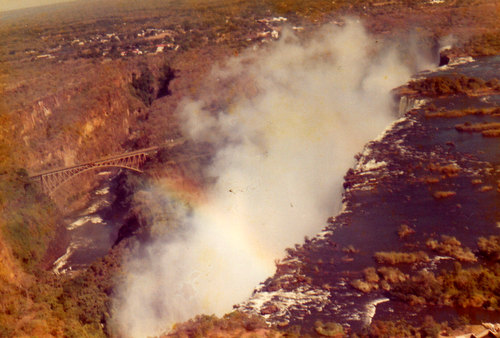
At the end of the Rhodesian Bush War, I took my English cousin, Rebecca, then just out of school and waiting to go to Oxford, on an epic road trip around Southern Africa. This included crossing Kariba by ferry and then driving through a mine field to get to Victoria Falls. I don’t think her parents would have so readily consented to the trip had they known about all the skull and crossbones signs and rusty barbed-wire demarcating where the mines were supposed to be.

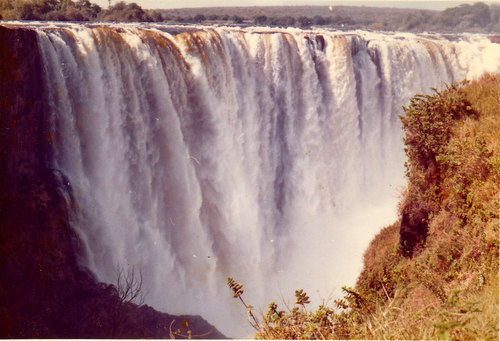
We couldn’t have picked a better time to see the Falls. Not only was the river flowing at full strength – which meant they were at their magnificent best – but because it was so close to the end of the Rhodesian Bush War the tourist hordes had not yet started returning in their thousands. Prices were cheap, accommodation easy to find (we stayed in the National Park chalets above the Falls) and there were none of the regulations and restrictions controlling movement in and around the main view points that you have now.

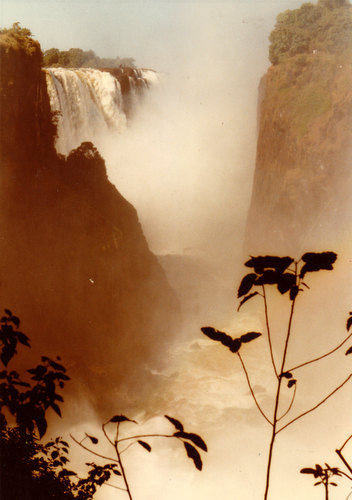
Seeing the Falls after a gap of several years, I was once again overwhelmed by their sheer size and scale. No matter how many pictures you see of them or documentaries you watch, nothing can quite prepare you for the sheer magnitude of this spectacle. It takes your breath away every time.

The one glorious evening Rebecca and I wandered down through the rain forest right up to the edge of the dizzying abyss. Standing there in the drenching spray, watching the never-ending torrent of water hurling down in to the cauldron below – while a orange- yellow full moon rose in to the night sky above it, gilding the water in a luminous glow as it did so – I felt like some would-be mystic. There was something incredibly transcendental about the scene.

What brought the whole experience even closer to the Romantic Age notion of the Sublime (beauty and terror combined) was that we had one of the world’s most awe-inspiring natural spectacles all to ourselves. We were the only ones there.

I doubt if you could do that now.

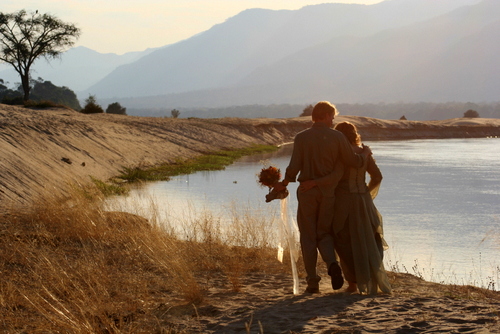
Another trip which sticks out in my mind is when my youngest sister, Nicky, got married. After the wedding, the reception for which was held in Cecil John Rhodes’ old house in Nyanga (now a hotel), we spent an idyllic few days on a houseboat on Kariba before driving on to Mongwe fishing camp. After all the other family members had headed back to Karoi, my companion, Mary-Ann, I and my nephew, James, elected to stay on for a few more days.

The Zambezi is a river which inspires all those who know it well with an infectious passion. James, who farms in Karoi and comes down regularly on fishing trips, is no exception…

James fishing in Zambezi.

As we sped up and down the river in his boat, past sandbars and reed covered islands on which groups of munching buffalo stood, he was full of lurid descriptions of its hazards as well as its attractions. Numerous types of fish swim in it of which the mighty tiger fish is undoubtedly the most famous (James has caught his fair share).

The bird life on the Zambezi is prolific. Its specials including African Skimmer, Lilian’s Lovebird, Livingstone’s Flycatcher, Western Banded Snake-Eagle, Dickinson’s Kestrel, Long-toed Lapwing, Grey-headed Parrot, Thick-billed Cuckoo, Racket-tailed Roller, Collared Palm-Thrush and many more besides.

In the middle of the river James found a shallow shelf where he cut the engine and we all leapt out in to the crystal-clear, cooling, water. Wanting to show I am capable of the odd romantic gesture I re-enacted the whole “Out of Africa” scene, washing Mary-Ann’s dust-coated hair while James, chuckling to himself, kept an eye-out for crocodiles.

The Zambezi from Mongwe Hill.

My last trip back to the Valley – which was also to attend a wedding (my nephew Alexander Stidolph) – was undoubtedly the most poignant and moving of them all because it happened at a particularly tumultuous and traumatic time in Zimbabwe’s history.

Driving up from Harare Airport the results of President Robert Mugabe’s recent chaotic and often violent land grab had been plain to see. For every surviving homestead, I passed at least a dozen whose occupants had been forced to up stakes and flee. Tobacco barns stood derelict, irrigation equipment and farm machinery lay strewn across the countryside. Uncontrolled bush fires blazed everywhere.

An entire industry, a whole way of life, appeared to be dissolving before my eyes.

Only the Zambezi Valley was as I remembered it.

Dropping down the other side of the escarpment I braked and pulled in to a familiar lay-bye – a favourite pit stop of mine. The air was thick with heat so I cracked open a cold beer and sat there while a pair of Bataleur – still relatively common in these parts – wheeled overhead; dwarfed by the immensity of it all.

For the first time since I started the journey I could feel my jangled city nerves starting to thaw. Sitting under an invincibly sunny sky, listening to the baboon arguing in the rock-faces above and the sound of the long-haulage trucks groaning up the steep incline, I felt I had found my spot in the universe. I was back in my true spiritual home.

I could have lingered there all day, lost in that hypnotic trance, but I had a wedding to get to and ahead of me stretched the long, dusty, rutted track to Mana Pools.

Crossing the Rukomeche on the road to Mana Pools. The Zambezi escarpment in far distance.

There was something comfortably familiar about the scene that greeted me at the river. Pick-up trucks were backed up in a line alongside the road and under a cluster of trees a makeshift wedding reception area had been cordoned off.

Beyond all the activity, on the river below, a small herd of elephant sloshed through the shallows completely unmoved by all the comings and goings around them.

Elephant – completely unmoved by wedding preparations.

The next morning I sat out under a huge Natal Mahogany tree and watched the passing parade as the sun rose up over the mighty river. Looking at the scenery and the animals and the myriad of bird-life, I felt I had been let loose among a prodigality of marvels, a feeling made even stronger by the illusion that I had it all to myself.

The wedding ceremony itself was held further upstream, under a large, spreading tree whose branches had conveniently arranged themselves in to the form of a natural altar, through which one could take in the broad sweep of the river and the mountains beyond.

The setting could hardly have been more perfect. Threading his way carefully through pods of dozing hippo, the bridegroom came paddling down the river in a canoe while the bride arrived in a cloud of dust in an old Model T Ford, especially trucked in for the occasion.

The bride arrives in a cloud of dust…
The bridal couple depart. Note raptor in tree. Picture courtesy of Craig Scott

Considering how severely depleted the ranks of the local farming community had become there was a surprisingly large turnout although among the guests were many who had lost their farms and livelihoods or joined the great diaspora. Try as I might I found it very difficult to escape the palpable air of sadness, the feeling I was witnessing a last hurrah.

This feeling of loss was made even more acute by the fact I had also come to pay my last respects to my adored brother, Pete, who had died of a brain tumour just days before his farm was seized (my brother, Paul, who farmed nearby also lost his) and whose ashes his wife, Tawny, had placed in an old sausage tree growing on the bank of his favourite section of the river.

My brother Pete’s final resting place (sausage tree on right). My sister, Nicky, in foreground.

As I and the other members of my family gathered around the tree, it occurred to me I was bidding farewell not only to my brother but also the country of my birth.

The memories churned up by this unspeakably beautiful river will, however, continue to flow through my soul until the day I die…

And Then The Lights Went Out – Cartoons for March and April, 2019

SUMMARY OF EVENTS:

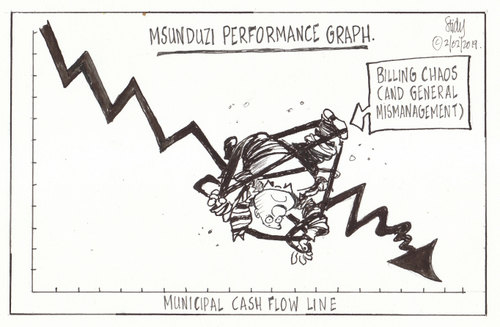
Other than the fact he fainted while delivering it, there was nothing especially memorable about KZN premier Willies Mchunu’s State of the Province Address so instead of going with that as my cartoon topic I decided to kick off March, 2019, by tackling a subject that has really got the long suffering residents of Pietermaritzburg blowing their fuses – the city’s chaotic electricity billing system.

They had good reason for concern. Shortly after the latest fiasco the Auditor General issued a damning report warning that the city was on the brink of collapse.

As if this was not bad enough the situation was then made worse when workers in the crucial Finance Department, who administer the billing system, suddenly downed tools and embarked on a strike. According to sources within the ANC itself the pro-Zuma faction – who else? – had encouraged these labour ructions as part of a grand plan to make the city’s management look incompetent.

Meanwhile, at the national level, a bombshell report recommended that the self-same Jacob Zuma and others be prosecuted or disciplined after finding that he oversaw the creation of parallel structures within the intelligence services to serve his personal and factional ANC interests.

If there is one thing the former Number One has proved singularly adept at doing it is avoiding going to jail so don’t be surprised if he does so again…

South Africans then found themselves back in the dark with Eskom power supply becoming increasingly erratic, and blackouts often inexplicable. The sudden wave of Stage Four outages brutally brought home the true severity of the mess South Africa has been dumped in by the kleptocrats.

The gloom continued with President Cyril Ramaphosa’s anti-corruption campaign getting tainted by the revelation that his son, Andile, was paid R2Million by Bosasa/African Global Operations. Andile’s exploitation of his connections drew immediate comparisons with the dodgy dealings of Zuma and his family during the previous presidency.

We were not the only ones sinking deeper in to the mire. With her Brexit deal having been rejected three times by the House of Commons, embattled British PM, Theresa May, decided to reach out to the Leader of the Labour opposition, Jeremy Corbyn, in an effort to resolve the impasse. It was hard not to take the cynical view that she had only done so because she realised she had run out of road.

Having insisted, through her spokesperson, that she had no plans to place the Msunduzi Municipality under administration because of the awful mess it had got itself in to the MEC for Co-operative Governance and Traditional Affairs, Nomusa Dube-Ncube, then went ahead and did just that. Whether this belated “intervention”, as Dube-Ncube called it, will save the sinking ship is open to debate but the fact the beleaguered municipality has been placed under administration before – in 2010 – is not exactly an encouraging omen…

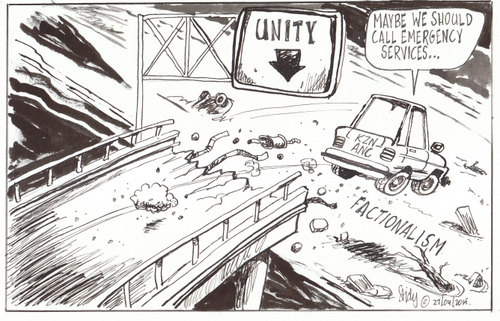
A tough task got made even more difficult for Sibusiso Sithole, the newly appointed administrator, when a group of ANC rebels then threatened to close down Msunduzi and other municipalities if their demands are not met before the election of May 8.

Since this occurred in the same week as Durban and the KZN coastline experienced some of the worst flooding in decades, I made the inevitable connection between the two events…