Book Review – The Empty Planet: The Shock of Global Population Decline

Conventional wisdom has it that one of the biggest threats facing the planet is is our burgeoning population. No less a body than the United Nations has forecast that it will increase from seven billion to eleven billion before levelling off after 2100.

In this provocative book, authors, Darrell Bricker and John Ibbitson take a contrary view, insisting that this is simply not true. Rather than continuing to increase exponentially, they maintain, the global population is, conversely, headed for a steep decline.

At the heart of their argument is the world wide trend towards rapid urbanization. The more a society urbanizes, they believe, and the more control women exert over their bodies, the fewer babies they choose to have.

This declining birth rate will, in turn, produce its own set of challenges – an ageing society, fewer workers, a smaller tax base. These forces will compel people to put off retirement; they’ll force them to spend more time and energy looking after their parents than they had planned.

One of the obvious ways to offset a declining population is through immigration. Far from posing a threat, they maintain immigration may actually help save some countries economies: these migrants fill gaps in demand for high skilled workers, create jobs through their entrepreneurial drive and rarely generate competition for jobs between immigrants and the native-born.

In this respect, they argue that Donald Trump is fighting a lost cause with his divisive policies and hard line stance on immigration. Contrary to what he believes, the only way for America to remain great is to continue welcoming immigrants.

Not that the USA is in any way unique in its position. Most Asian countries accept virtually no refugees at all and many are now paying the consequences. Japan’s population, for example, is not only ageing but shrinking, leaving a much smaller work force. This is, in turn, has lead to a weakening of their economy.

They cite Canada as an example of a country whose more progressive immigration laws have worked in its favour.

With regard to Africa the UN doesn’t hold out much hope either, believing that the fertility rates will remain high for decades to come. Again the authors don’t agree, predicting a slightly more encouraging scenario. While acknowledging the huge problems the continent faces they believe the commingling of capitalist and traditional values will very likely slow the massive population growth that most modern modelers are projecting.

While careful not to overstate their case, Bricker and Ibbitson’s central thesis is quite different to the bleak world view and dismal remedies of the neo-Malthusians. Nor is it just wish-thinking either; they have obviously put in a great of research in to the subject and marshalled a great deal of material together with commendable skill.

With immigration and population-control both hot political topics at the moment, the book’s arrival is perfectly timed. Its conclusions will certainly warm the hearts of the increasingly beleaguered multiculturalists and those who oppose isolationism.

Book Review – Arabia: A Journey Through the Heart of the Middle East

published by Hodder and Stoughton

There is a class of travel writer who seem to delight in deliberately seeking out danger and are at their happiest when the going is manifestly not good. For them such journeys can be redemptive. They escape feeling a little wiser and – equally important – they have an exciting story to tell.

Levison Wood clearly belongs to this group: a man who is not one to flinch in the face of adversity.

Ignoring the advice of the pundits and the doom-sayers he, in 2017, embarked on an epic 5000 mile journey through the Mid-East, knowing full well that much of it was in turmoil and that as a Westerner he could have easily found himself a target..

Travelling sometimes on foot, at other times by camel, mule, donkey and battle tank, his 13-country odyssey would take in such hotspots as Syria, Iraq (where he would find himself witness to a battle between its Government forces and ISIS) Yemen and the pirate-infested waters of the Gulf of Aden.

The Arab world he journeyed through has, of course, long exerted a mysterious fascination on a certain type of English adventurer; in part because its landscape is so dramatically different from the one back home and partly because its people seemed to embody strengths and virtues that challenged European arrogance.

The world that these classic “British Arabists” – Richard Burton, TE Lawrence, C.M Doughty, St John Philby, Wilfrid Thesiger, Gertrude Bell etc – wrote about has, of course, been radically transformed by the discovery of oil, with even the Bedu now swapping their camels for the latest 4 X 4s. Part of Wood’s self-imposed mission was to discover just how much it had, in fact, changed.

Following in the footsteps of Thesiger he crossed the waterless Empty Quarter. He also retraced the route taken by his idol, Colonel T.E.Lawrence, along the old Hejaz railway line.

Rich in character and anecdote Wood’s book conveys with unusual immediacy both the stark beauty and the volatility of the Middle-East. While the scale of the problems that beset the region defies anything that could be dignified as solutions, he finds its people stoical in the face of adversity and not without hope.

Book Review – The Last Hurrah: South Africa and the Royal Tour of 1947


published by Jonathan Ball Publishers

In 1947 South Africa welcomed King George VI and Queen Elizabeth and their two daughters, Princess Elizabeth (the future Queen) and Princess Margaret on a Royal Tour which the then Prime Minister, General Jan Smuts, hoped would put a positive spin on the country and its achievements. For their part the British saw the visit as an opportunity to not only thank South Africa for their contribution to the war effort but also to reinforce the concept of a constitutional monarchy as the binding force behind the Commonwealth.

As the author of The Last Hurrah: South Africa and the Royal Tour of 1947, Graham Viney, shows, in his persuasive and beguiling guide, not all went quite to script. Indeed, the whole lengthy and carefully planned shindig proved to be something of a double-edged sword.

While most English-speaking, white South Africans greeted their Royal Guests with an enthusiasm and patriotic fervour that is now hard to imagine, others saw it as a golden opportunity to highlight their various causes. Many Afrikaners, still smarting from their treatment during the Boer War, were deeply resentful and used the visit as a platform from which to push their conservative, pro-republic, agenda. At the other end of the political spectrum, the ANC saw it as a chance to expose the evils of racial segregation

Although it brought the world’s focus on to South Africa and it policies, the Royal Tour of 1947 was not able to stall the country’s massive lurch to the right. Shortly afterwards, Smut’s government was defeated at the polls and the National Party took over the reins of power. The apartheid era was about to begin.

Reading about it all, seventy-odd years on, it is hard not to be impressed by the sheer stamina of the Royal Party as they travelled 11 000 miles, mostly by train, visited hundreds of out of the way dorps, shook hands with over 25 000 people, attended countless boring functions, and were seen by 60-70 per cent of the country’s population. Queen Elizabeth, in particular, proved a fine ambassador. Gracious, friendly, beautiful and reassuringly normal, she seems to have charmed everyone she met.

Very much a blast from the past, Viney’s book offers a revealing snapshot into a now all but vanished world. Shrewd and absorbing in the way it captures the complicated politics of the time, his fast-paced account pedals along with never a dull paragraph as facts, events, characters and period photographs flash by.

The Elections and After: Cartoons for May and June, 2019

SUMMARY:

With only a few days to go before the May 8 general election, all South Africa’s political parties were in a final push to woo citizens. Among those visiting KwaZulu-Natal were President Cyril Ramaphosa, former president Jacob Zuma and former deputy president Kgalema Mothlanthe.

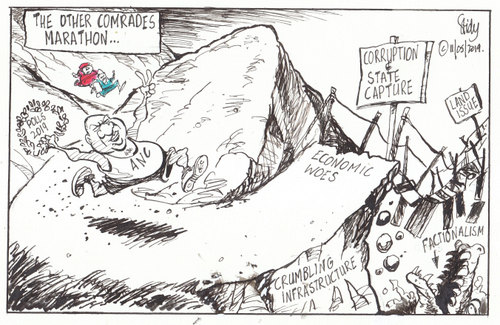
As expected, the elections were won by the ANC, although the official results – which saw the party down to a 57% share of the votes from 62% in the 2014 elections – underlined the huge task which faces President Cyril Ramaphosa as he tries to push through his reformist agenda. For their part, the official opposition, the Democratic Alliance, failed to make any gains while the radical Left, Economic Freedom Front, led by firebrand Julius Malema, was in third place – up four per cent from 2014. Reflecting a world-wide growth in nationalism, the Afrikaner-rights FF+ and the Zulu-orientated IFP also made substantial gains.

With the elections over, speculation next turned to what changes President Ramaphosa would make to his cabinet and whether he would cut the number of Ministries. Hopes were also expressed that he would use the pending cabinet reshuffle as an excuse to get rid of some of his more controversial ministers such as Bathabile Dlamini and Nomvula Mukonyane.

Cyril Ramaphosa was duly elected unopposed as president by the National Assembly. In a unifying speech in Parliament he promised to be “a President for all South Africans and not just the African National Congress”.

His message of inclusivity was not, unfortunately, picked up by all members of the party. In his inaugural address to the provincial legislature, the newly appointed premier of KZ-N, Sihle Zikalala, declined to pay tribute to the new official opposition, the IFP, by neglecting to mention that party’s previous premiers when he praised previous ANC premiers..

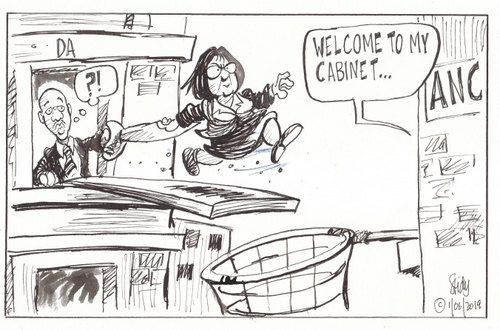
On the 29th May, President Cyril Ramaphosa finally announced his new cabinet in the process downsizing his number of ministers from 35 under Zuma to 28.The big surprise was his appointment of Good Party leader, Patricia de Lille, who had quit the DA after months of acrimony, as Minister of Public Works and Infrastructure.

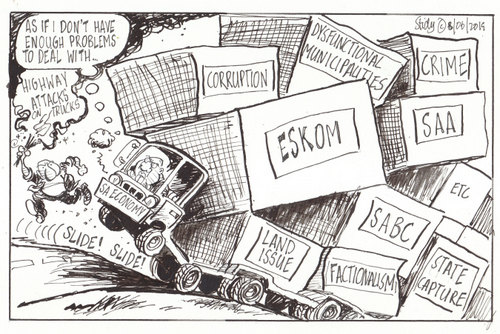
Underlining the huge problems facing Ramaphosa, was the news that South Africa’s economy had shrunk by more than three percent in the first quarter of 2019 – as load-shedding, a strike on the gold mines and a dire lack of investment hit growth. In KZN there was another fiery weekend on the roads with 17 truck-and-rigs being torched on the N3 between Johannesburg and Durban. To date over 200 people have been killed, 1400 vehicles damaged and R1,2billion lost as result of these ongoing incidents – losses the country can ill-afford with its economy under huge economic strain.

The divisions within the ANC once again came under the spotlight when it was announced that the ANC would launch a probe, chaired by Kgalema Mothlanthe, in to claims that its Secretary-General, Ace Magashule, was involved in the formation of the African Transformation Movement (ATM) – a rival political party – ahead of the previous month’s election. Former President Jacob Zuma’s confidante, Bishop Timothy Ngobo, who had aggressively campaigned for the new party, to which Zuma had also been linked, immediately rubbished the probe as being a “witch-hunt”.

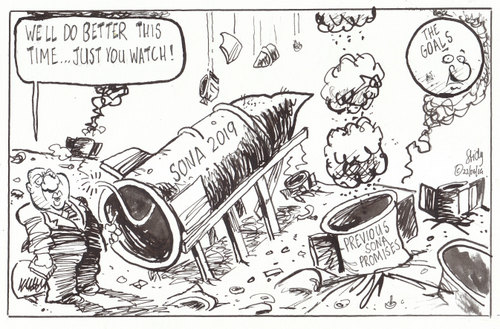
Delivering his State of the Nation (SONA) speech in parliament, President Cyril Ramaphosa announced a number of measures to grow the economy, tackle poverty and unemployment and fight corruption. Whether the ambitious targets he set – such as halving violent crime in the next 10-years and creating two million jobs for youth over the same period – are achievable remains to be seen.

The following week, his predecessor, Jacob Zuma, confirmed he would testify before the Zondo Commission in to State Capture even though he believed it is “prejudiced” against him and “lacks requisite impartiality”. According to his lawyer the former president “can’t wait to attend…he is relishing the moment.”