SUMMARY:
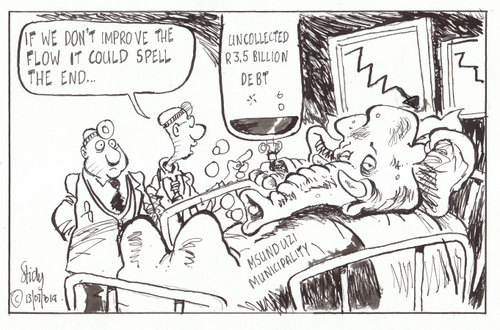
Pietermaritzburg’s woes continued with the municipality calling for
urgent action to be taken to deal with the City’s runaway debtor’s
book, which has run to more than R3,5 billion.
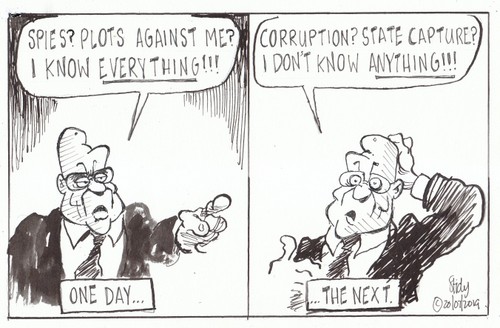
Former president,
Jacob Zuma, made his underwhelming appearance before the Zondo
Commission of Inquiry in to state capture, largely repeating what he
has been saying for years – it is all a plot, there are spies
afoot, there is no such thing as state capture.
Across the sea,
Boris Johnson, the Brexiteer who has promised to lead Britain out of
the European Union with or without a deal by the end of October, was
elected to replace Theresa May as prime minister after winning the
leadership of the Conservative Party.
The eThekwini
Municipality finally owned up to the fact that Durban’s R170 million
infrastructure projects have been wrecked by so-called “business
forums” who have been extorting businesses for years. The MEC for
Economic Development, Tourism and Environment Affairs, Nomusa
Dube-Ncube told the legislature that the government will “deal”
with these business forums – many of whom were allies of the state
capture faction of the ANC.
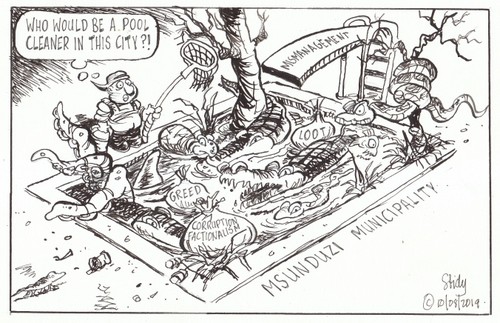
Even closer to home,
a task team set up by the ANC to investigate the ongoing shenanigans
in the Msunduzi Municipality, recommended the entire municipal top
brass be axed including Mayor Themba Njilo. As if to emphasise the
extent of the rot, the very next day it was revealed that the KZN
Hawks were investigating a case of fraud against City officials over
a R45 million swimming pool tender.
The following week
the Msunduzi Municipality found itself without political leadership
as the ANC Provincial Executive Committee (PEC), acting on its task
team’s recommendation, duly removed the mayor and the entire
executive committee (Exco).
The gap was later filled when the ANC KwaZulu-Natal leadership announced former Msunduzi councillor Mzimkulu Thebola as the new mayor of the municipality. The appointment of the relatively unknown Thebola was made on the back of speculation that the problems with the region and Msunduzi ANC caucus had resulted in high profile candidates declining to take the Msunduzi mayoral position.
I decided to end the month by tackling a subject very close to my heart – the environment. In this respect, it was a bad week for Pietermaritzburg with toxic effluent being spilled in to the Duzi river, toxic fumes being discharged in to the air from the burning municipal landfill site and uncollected rubbish left lying on the streets.
For the purposes of my cartoon, however, I chose to have a go at the denialist-in-chief, US President Donald Trump…
When it comes to mountains I am with the ancient Greeks – I believe they are the right and proper dwelling place for the Gods. My own sense of awe and wonderment when in their presence stems, in large part, from my childhood experiences on our farm, Nyangui, which lay at the very end of The Old Dutch Settlement Road, in Nyanga North, Rhodesia (now Zimbabwe).
The mountain range which ran along our eastern boundary was shrouded in legend and was dominated by Mt Muozi, a steep, semi-detached peak attached to the main Nyanga plateau by a narrow saddle. Looking like some great fortress and frequently masked by cloud, it played a pivotal role in local belief system.
To the Saunyama people, who live nearby, Muozi had always been an extremely sacred site, harbouring a protective, if somewhat touchy, deity through whom all life was cycled and who had an important influence over both their lives and the weather. Upset it and you would be punished with the curse of no rain; give it the proper respect and make the right offerings, your crops would flourish and all would be well.
In an area where every stream, knoll, rock, cranny, glade, cleft and grove seemed to have its own special spiritual connection, it was the most revered of them all, the epicentre of an important rain-making cult, a mountain whose significance extended way beyond the mere physical. It was a gateway to another dimension, a bridge between past, present and future.
Muozi – the centre of an imporant rain-making cult.
When we were still on the farm a new chief was chosen for the Saunyama people and was then led by an ox up the mountain as tradition dictated. The fact that it rained, as he proceeded up its slopes, was taken as a sign that the ancestors had given their blessing to his appointment.
It may or may not have been coincidental that the three mission stations established in our area – St Mary’s, Mount Mellary and Marist Brothers – had all been built in the long shadow cast by Muozi (or Rain God Mountain as my father liked to call it).
To the bringers of light in a great darkness, carriers of the word of God to a heathen race, such beliefs and superstitions must have provided ready proof that their presence was urgently required. Here were souls in need of salvation!
One of the taboos concerning the mountain was that ordinary tribes-people were forbidden from climbing it. Determined to prove, once and for all whose God, was the more omnipotent, a local missionary decided to lead a party of school children to its summit.
The summit of Muozi with my sister Sally sitting on cliff edge. Nyangui mountain in background. Picture courtesy of Sally Scott.
Again, it may or may not have been a coincidence, but that year the whole region experienced a devastating drought.
Depending on what angle you tackle it from, it would, admittedly, have been a fairly tough climb. Vaguely volcanic in outline, although that is not how it was formed back in early geological time, the mountain has, at its top, a massive tower of square-sided, near vertical, rock. The easiest way to reach the summit would, in fact, be to double back to Nyanga and drive along the old road that runs along the top of the range and then walk over the saddle that links Muozi to the main plateau. That, however, would probably have felt like a cop-out – far better the little children suffer for their sins by making them slog their way up from the bottom!
Muozi – connected by a saddle to the main Nyanga plateau. Nyangui in background. Picture courtesy of Paul Stidolph.
Another legend concerning Muozi was that if there was ever a cloud in the sky, there would always be one hovering over it. We were constantly amazed by how often this proved to be true although I suppose a meteorologist may be able to come up with a perfectly logical and reasonable scientific explanation about precisely why this should be so.
It was easy to see why Muozi should have become an object for such devotion. Although by no means the highest peak in the range (neighbouring Nyangui, for example, exceeded it in height), its magnificence consisted of something else. With its dramatic cliffs and crags it was more sharply formed and was much more striking to look at than any of the other mountains in the Nyanga range
I was always fascinated by this mountain amongst whose vapours both good and bad spirits seem to have learnt how to co-exist. One moment it could seem dark and threatening, the next it was as welcoming as some benevolent old giant.
Cranky, changeable, a totem for our more fearful imaginings, it has, for me, come to symbolise an Africa that has increasingly become consigned to the world of books, banished by the rising tide of humanity and economic development. Here, something of the old magic still clings to the earth.
From this point of view, I, too, felt the mountains should be treated with circumspection – it was a deity to be wooed and won over and then revered and respected; its was not one you wanted to trifle with or cross.
The original Summershoek house. Mt Muozi in background.
When we were still in the process of moving out to the farm, way back in the early 1960s, we had often stayed in the cottage that J.Bekker, one of the original Afrikaner settlers in the district, had built, in the traditional Dutch-style, at its base. When we moved out there, Summershoek, the farm on which it stood, was owned by Marshall Murphree, an American missionary who in 1970 would become Rhodesia’s inaugural Professor of Race Relations. He and his family did not live there permanently but used it as a holiday home.
At night, with its peak washed white in the moonlight and a gentle wind sighing down from the slopes, I often used to feel like I had crossed through some portal into another world, one that was both a little scary and also unimaginably beautiful – a feeling that only intensified as more stars appeared and the nightjars started calling.
Adding to its allure was the fact that there were still leopard living on it. One of them attacked old Charlie, the aged caretaker of the property, as he was out rounding up cattle and was then swiftly despatched by his equally ancient wife who brought an axe down on its skull. Displaying still more commendable fortitude – as well as devotion to her spouse – she then staggered back home, carrying Charlie, so that my mother could attend to his wounds.
I was not the only one who felt Muozi’s strange power. Our Malawian gardener, Devite, who we had bought out with us from Salisbury (now Harare), lived in such fear of the mountain – he talked about seeing white, ghostly figures going in and out of it – that after a few months he decided he had had enough. Packing his few possessions in a battered old suitcase, he caught a train and headed ‘Down South’ to Jo’burg, to look for a job on the gold mines.
A couple of years later – by which stage we had moved to our new house on the neighbouring Witte Kopjes farm – we were astonished to see his thin, skeletal figure hobbling up the road. For him at least, South Africa had not proved to be the land of money and opportunity. He also appeared to have had a rethink and decided he could live with the ghouls and malign spirits that inhabited the mountain for he carried on working for us for the rest of his remarkably long life.
All that remained of the old Summershoek house when I went back to visit it twenty-years after the Rhodesian bush war ended.
When we were forced off the farm during the Rhodesian Bush War, I was sad to say goodbye to that great brooding mountain and the wild country at its feet.
Looking back on those days I realise what a pivotal role it played in my life. No other landmark has affected me as deeply or had such influence on my imaginative development or provided me with such a rich vein of memories. Living in its shadow, imaginative doors were opened, creative juices started to flow, ways of seeing begun.
The link between paintings and journeys is a close one. Both are forms of exploration.
Every painting involves a plunge in to the unknown and brings forth its own set of challenges. You have to choose a scene and then decide on your composition. You have to select the right colours so they express the mood or feeling you want to convey. You have to train your eye to perceive tones in order to get the right balance in your painting. You have to find a way to connect the different elements to create a pleasing effect..
Having said that, if
I have learnt one thing from my own dabbling it is that much of art
is in the process. You can start out with one set of ideas and then
see them evolve in to something completely different. Without even
planning it, for example, I sometimes find my paintings take on a
whiff of the supernatural or even the surreal.
Rather than fight these wellsprings from the deep, I find it best just to do what I do on my travels and that is go with the flow. Your muse usually knows what is best…
Travel with its association with adventure and discovery and the allure of the new has always proved irresistible to me – and, in the back of my mind, there is always the hope that I will be sufficiently inspired by the scenes I see to want to come back home and paint them (there are other reasons I seek out changes of place, of course, many of them anthropological. I want to study the flora and fauna although I tend to look at even this through the eyes of an artist marvelling, for example, at the beauty of a particular bird I have just successfully identified).
Such journeys by
car, or even by foot, can produce insights and perceptions you would
not get if you just sat at home all your life. They can provide
stimulus, enrichment and a sense of achievement.
The urge to record
these new discoveries are part of my motivation.
I try not to over
plan my trips or put myself under the guidance of others (although,
occasionally one needs to do just that) but, rather, just follow my
nose and see where it leads me.
As Lawrence Durrell put it, so beautifully, in his book, Bitter Lemons:
“Journeys, like artists, are born and not made. A thousand differing circumstances contribute to them, few of them willed or determined by the will – whatever we may think. They flower spontaneously out of the demands of our nature – and the best of them lead us not only outwards in space, but inwards as well. Travel can be one of the most rewarding forms of introspection….”
Here are some paintings inspired by my own voyages of discovery…
When I moved up to Kusane Farm I made two resolutions: I would enjoy a glass of red wine every evening for the rest of my days to celebrate my lucky escape from poor, sad, decaying Pietermaritzburg; and – released in to space, sky, clean air and a land with horizons – I would not to waste any more time than necessary. Obeying my own questing instinct I would immediately set out to explore the countryside around me and get to know the birds that shared it with me.
There was a lot to see. Beyond the ridge, immediately above my house, the land rolled and sloped in its own emphatic way down to the Kusane River.
This area became my
initial focus of interest.
As dawn was breaking, on the first morning, I set off along the road that zig-zaggs its way down to the swampy ground at the bottom of the valley. The whole landscape was alert with life although you couldn’t always see it.
It took me while to twig on, for example, that the strange, fluting, bird-like call I kept hearing was not actually a bird at all but a reedbuck male communicating with its mate – and that there was no point continuing to scan the sky trying to locate it. There was no mistaking, however, the plaintive calls of Yellow-throated Longclaws as they rose high in the air in front of me or the raucous screeching of a pair of Natal Spurfowl in their hideout down by the river.
Not a bird calling…although it took me a while to figure it out.
Yellow-throated Longclaw.
Over the following
months I repeated this walk again and again. Slowly, patiently I
began to build up a picture of who I was sharing my new home with.
Like any good explorer I started to keep a record of my sightings and
observations.
My bird list has now passed the 160-mark which is, I like to think, not at all bad considering that, with the exception of the river line and the area around the house, the farm consists entirely of mist-belt grassland. Because of this lack of variation in habitat you would not normally expect to find a huge selection of birds although, being in a transitional zone between the hot coastal lowlands and the more temperate mountains, a lot of the Drakensberg “specials” do move down here at various times of the year.
Among the more interesting of these is the Sentinel Rock Thrush, Red-winged Francolin, Drakensberg Prinia and Gurney’s Sugarbird.
Sentinel Rock Thrush.
Gurney’s Sugarbird.
Drakensberg Prinia.
These specials are
not, of course, the only species which draw birders to the KZN
Midlands. The Karkloof valley’s biggest attraction is, undoubtedly,
its cranes; a bird which has, since antiquity, exerted a peculiar
pull on the human imagination. Beautiful, graceful, stately, with
their elegant courting rituals, fidelity and haunting calls, they
seem to be the physical and spiritual embodiment of some sort of
Utopian ideal.
All three South
African species – The Blue Crane (endemic to the country and its
national bird), the Grey Crowned Crane and the regal Wattled Crane –
occur here although sadly, like their counterparts elsewhere around
the globe, they have become victims of the environmental consequences
of human activity. With their natural habitat shrinking and their
numbers rapidly declining, no fewer than 11 of the world’s 15 species
are now threatened with extinction.
In South Africa, the Wattled Crane is especially vulnerable with only 2000 birds left in the entire country.
Wattled Crane.
Wattled Crane.
Grey Crowned Crane.
Ritual display. Grey Crowned Crane.
Another large bird I
have seen here – twice – is Denham’s Bustard (formerly Stanley’s
Bustard. I have no idea why the experts, who decide these things,
chose to take away the first honorific title and award it to someone
else). Although big in stature, they are extremely timid in nature
and I found it impossible to get close enough to take a photograph of
one.
Like the cranes and the bustards – birds dependant on wide open spaces – South Africa’s raptors are also having a hard time of it. Of the eagles, the striking Long-crested Eagle – a regular in the Midlands – is one of the few (the Fish Eagle is another) that seems to have been able to adapt to human encroachment in to their traditional territory. Another common raptor, one that seems to favour hilly country like ours, is the Jackal Buzzard. I often see a pair of them circling overhead, calling to each other, on my walks.
Long-crested Eagle. The common eagle of KZN Midlands.
Long-crested Eagle.
Jackal Buzzard. A common resident in KZN Midlands.
Jackal Buzzard – preparing to launch.
Both are resident
all-year round on Kusane.
The Steppe Buzzard
also likes to come calling but because it is a migrant you only see
it in summer. The same applies to the Yellow-billed Kite. It is
usually the first bird to return at the end of the cold season.
For farming folk
and those dependant on the land, its arrival confirms that spring is
on its way and it is time to plant.
Another species you
occasionally see gliding low over the vleis, wetlands and open
grassland, are the harriers. Of these the most common is the African
Marsh Harrier although I have also recorded Black and – even more
unusual – Pallid.
Then there is the
Lanner Falcon. Not only are they beautiful birds to look at, they are
incredible to watch in motion. Like their close cousin, the Peregrine
Falcon, evolution has shaped their wings to supply the particular
combination of speed, stamina and agility that suits their lifestyle.
As hunting/ flying machines they are about as perfect as you can get.
Our smallest raptor
is the russet-coloured Rock Kestrel, one of whom lives near the twin
hillock, I pass by on my daily walk, which we have named “Big
Women’s Blouse” for self-explanatory reasons. The kestrel can be
spotted, fairly often, cruising along the rocky hill sides looking
for mice, lizards and such like.
The similarly small Black-shouldered Kite is likewise a rodent specialist. We have a resident pair who nest in a tree not too far from the main farm gate and can regularly be seen perched on top of a nearby dead gum tree.
Rock Kestrel.
Black-shouldered Kite.
There are also several types of game birds. Besides the Natal Spurfowl we get the Red-necked Spurfowl and the Red-winged Francolin. Unlike the Natal Spurfowl, who prefer riparian thicket, the Red-winged Francolin is essentially a mountain grassland species with a softer, more, melodious piping call. When you disturb them they rise at your feet with a loud whirr and hurtle in to sky leaving a trail of feathers and bitching noise behind them.
Natal Spurfowl.
Red-necked Spurfowl.
Another bird I
frequently find myself almost treading on is the Common Quail which,
similarly, all but knocks your socks off as it shoots out the grass
like a tiny, but big-sounding, missile.
At the other end of
the scale are the LBJs (Little Brown Jobs). Not surprisingly, given
the preponderance of grass, Kusane is great cisticola country. On the
one hand this is a good thing, on the other it can be extremely
frustrating as they are notoriously difficult to identify.
So far I have recorded Le Vaillant’s, Ayres (or Wing-snapping), Pale-crowned, Zitting (formerly Fan-tailed), Wailing, Lazy and Croaking Cisticola. And Neddicky (one of the Plain-backed Cisticolas). They may all be of uniform appearance but they do, at least, have lovely, descriptive, names!
LeVaillant’s Cisticola.
Wailing Cisticola.
Zitting Cisticola.
Ayres Cisticola.
If the cisticolas are hard to differentiate, the pipits are well nigh impossible. My list so far includes African and Plain-backed and a bunch I am still trying to make my mind up about…
African Pipit.
Plain-backed Pipit.
It would help a lot if they did what there neighbours, the Widow Birds and Bishop Birds, do and that is shed their drab costumes as soon as the rains break and go through a miraculous transformation which turn them in to beaus of the Ball! This only happens to the males, of course; the poor female has to continue to make do with what little she has in terms of finery (most widow birds are polygamous, having a whole harem of dowdy little wives).
Quarreling female Widow Birds of some sort (possibly female Long-tailed).
Southern Red Bishop
Red-collared Widowbird.
Long-tailed Widowbird.
Long-tailed Widowbird in flight.
Although I see pipits most of the year around their numbers always seem to multiply when we start burning fire-breaks which, as a mostly ground-dwelling species, makes it much easier for them to forage around. Another bird that seems to like it when we burn are the neat little Black-winged Lapwing with their slender legs and piercing call.
Black-winged Lapwing.
Pair of Black-winged Lapwing.
For different
reasons, the more aerial Fork-tailed Drongo also likes to seize this
opportunity to hawk the insects fleeing the life-destroying flames.
Another grassland
variety I was pleased to discover on my early morning walks was the
Broad-tailed Warbler. Up until then, I had only seen it once before
(In Queen Elizabeth Park in Pietermaritzburg courtesy of veteran
birder, Mike Spain). Suddenly I was seeing them everywhere, in summer
at least (it is another migrant) although for the last couple of
years they seem to have stayed away.
I have a suspicion
this may be because they are birds, who are quite fussy about how
high they like the grass to be, have decided it is now too short
because we have taken to burning large sections of the farm at the
end of each winter. What pleases some, displeases others.
Perhaps the best
way to describe the bird is to say that with its rather large,
un-warbler-like tail, it most closely resembles a miniature coucal.
These are just some
of the birds I have observed since I came to live at Kusane. In my
future postings I hope to mention a few more.
What I have also discovered, in the course of my tramping across the countryside, is that, in the world of birds, the more you understand, the more wonderful it gets. And so, armed with nothing more than a boundless curiosity and an imaginative sympathy with the natural world, I intend to continue with my explorations, my binoculars and a well-thumbed copy of the SASOL Birds of Of Southern Africa hanging by my side.
Who knows what more
surprises lie in store?
In the mean time here, in no particular order, are my top ten specials for the Kusane Farm area:
I sometimes think that when I travel what I am really looking for is proof that the world is at varied as I want it to be. That is certainly the case when I drive between my home in Kwa Zulu-Natal and Grahamstown, in the East Cape, where my sister, Sally, lives. It is a journey I have made many times and on each occasion I am struck by just how different the two provinces are even though they border on to one another.
Once you get past
Queenstown and descend the Nico Malan Pass, near Seymour, an entirely
new geography asserts itself.
You are now on the
fringes of the Karoo, that immense, dry, sun-scorched, almost
mythical, landscape that was once part of a vast, shallow lake. In
ancient times all sorts of strange reptilian creatures and other
odd-looking beasts roamed this area, thoughtfully leaving their bones
behind, embedded in the rocks, for the scientists to study.
The air here is
drier, the distances much clearer; the more you travel in to it, the
more the sky asserts itself. I can think of nowhere else where it
seems so big and blue and empty.
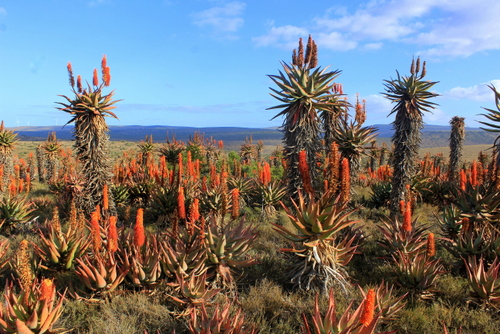
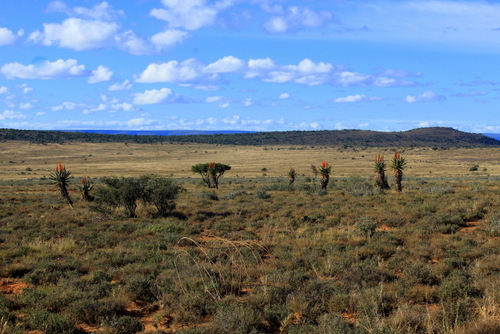
The weather can be extreme, the summers blazing hot, the winters freezing cold. The rainfall is patchy and unreliable and the vegetation has adapted to meet its capriciousness. There are lots of succulents and aloes and squat, low bushes with tiny, tough leaves. Here, almost no tree grows higher than a man’s head except in the mountain valleys and along the river lines.
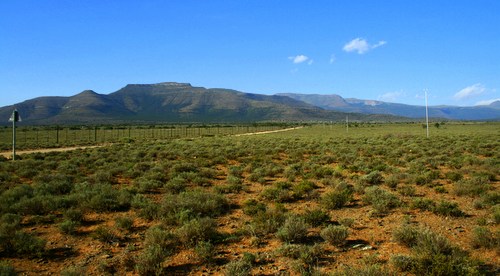
Typical Karoo Country.
There is a spirit too, a presence, an unseen power that is very old and has little to do with man. After a while the sheer breadth and weight of the land gets to you. You begin to forget the world you have just come from existed, you can’t help thinking that the whole country looks like this.
The Karoo has the capacity to inspire wonder in all who behold it.
Perhaps not surprisingly, many famous South African writers and artists haled from here. Olive Schreiner, author of the early South African classic, Story of an African Farm, grew up in Cradock. So, too, did the poet and writer Guy Butler.
Schreiner House, Cradock.
Thomas Pringle, who came to the Cape as leader of the Scottish party of British settlers of 1820, was allocated land in the valley of the Baviaans River near present-day Bedford. It is still known locally as “Pringle Country”. Eve Palmer who wrote that other classic book about the Karoo, The Plains of Camdeboo, grew up on the farm, Cranemere, down the road from the Bruintjeshoogte and between the towns of Somerset East and Graaf-Reinet. The artist, Walter Battiss, also spent his childhood years in Somerset East (you can see his work in the local gallery dedicated to him).
Even members of my
own family have found themselves succumbing to the insistent blue
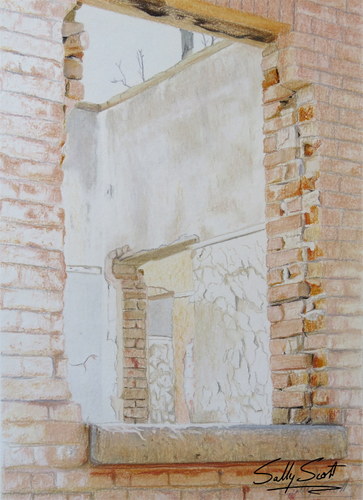
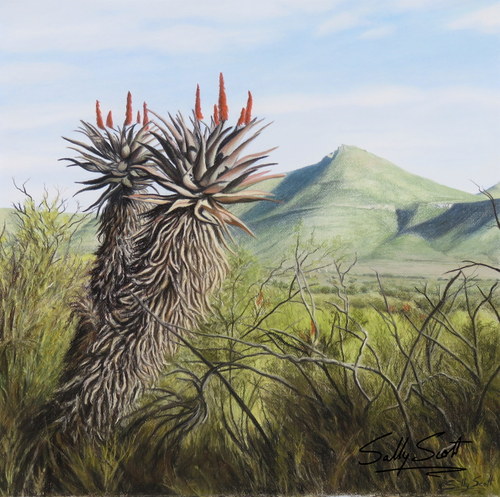
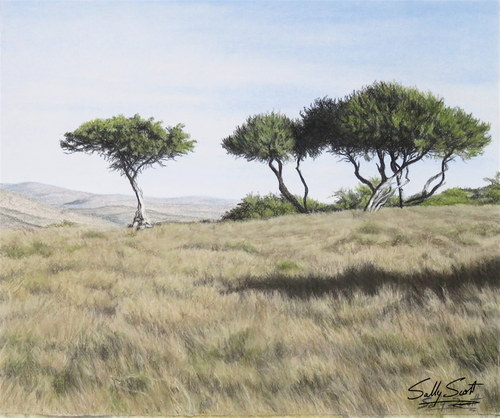
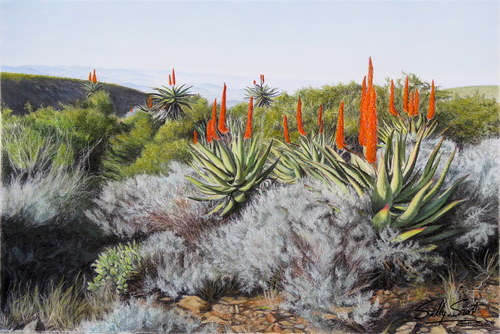
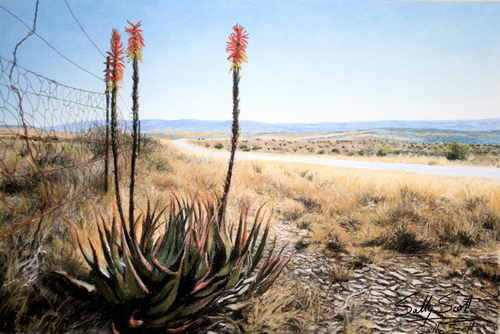
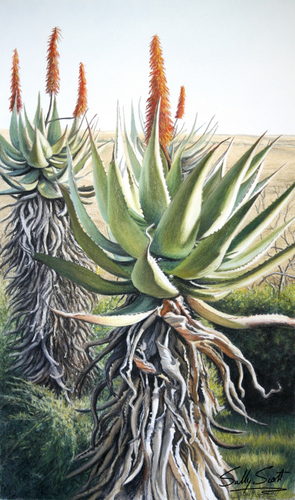
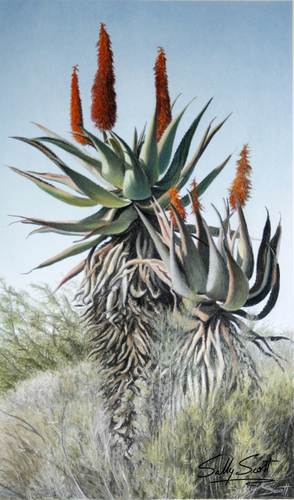
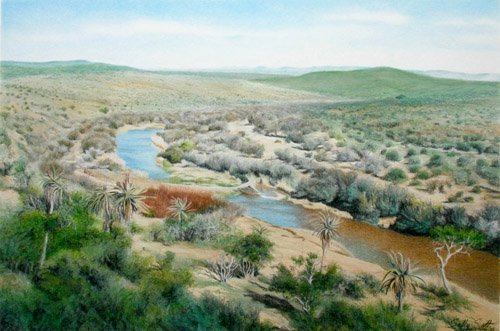
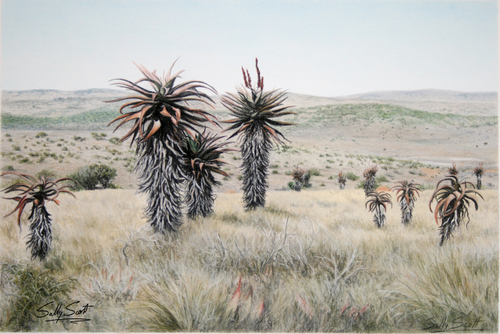
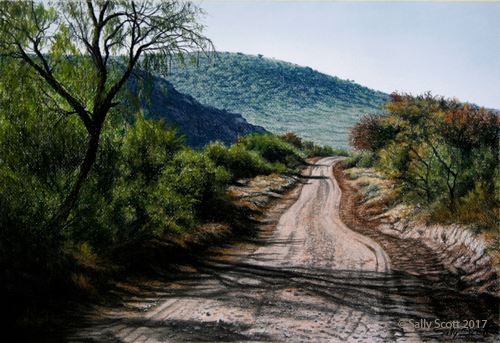
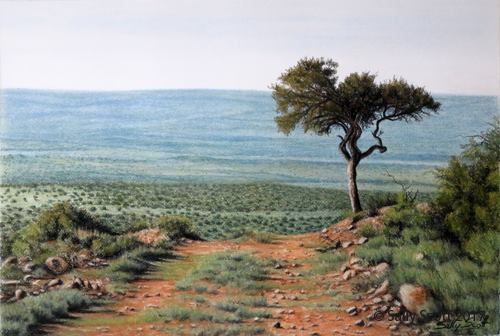
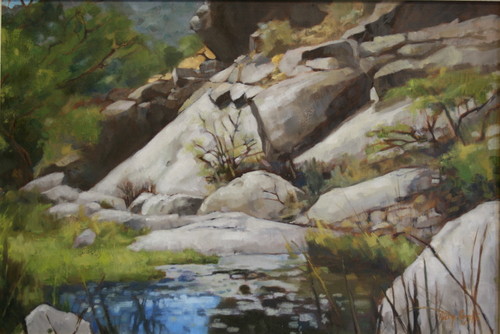
skies and lyrical qualities of the Karoo. Sally, an art teacher, has
built up a big following with her East Cape landscapes which often
have, as their focal point, the aloes which are such a feature of
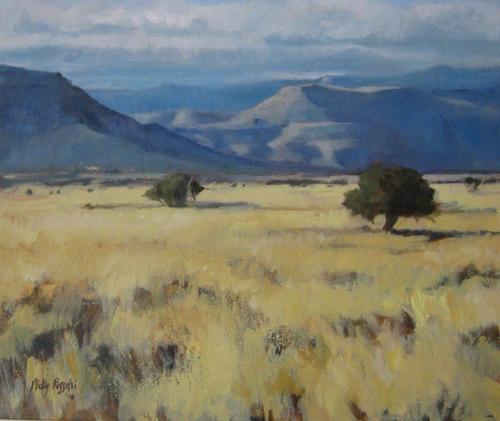
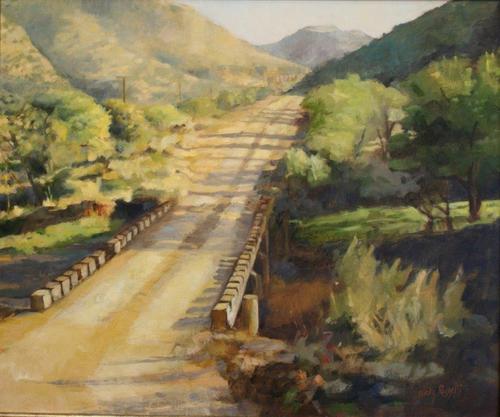
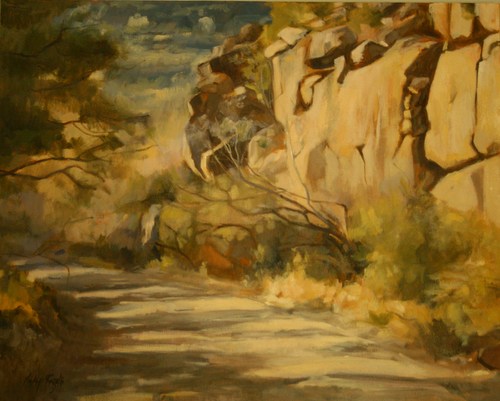
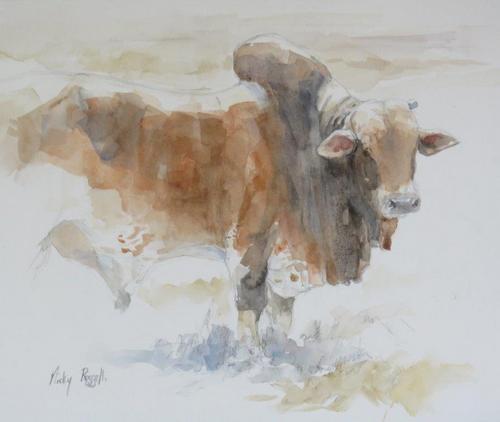
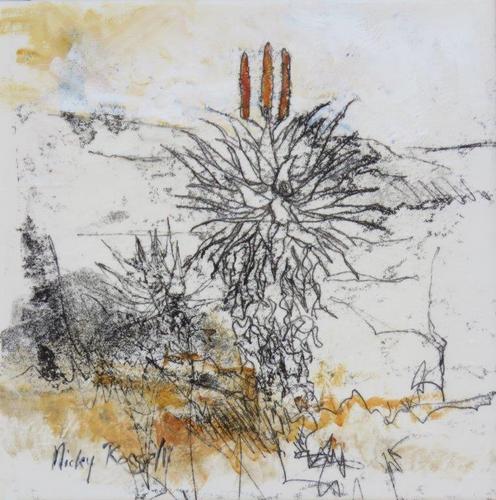
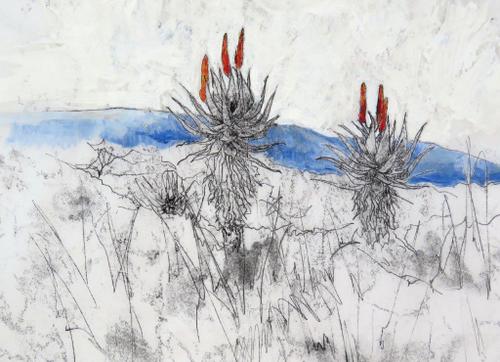
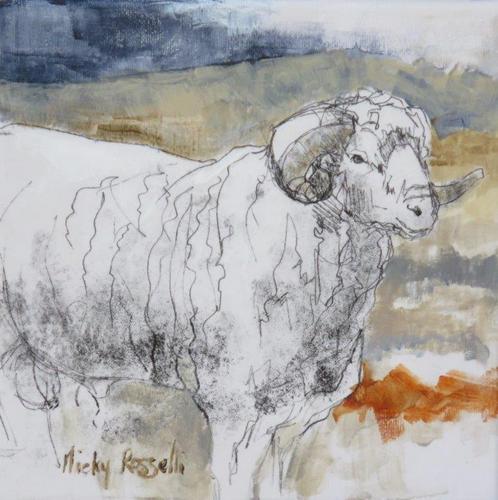
this region. My other, Nicky, also an art teacher, who lived in
Somerset East for a while, also felt the urge to record the
unchanging strength of the countryside.
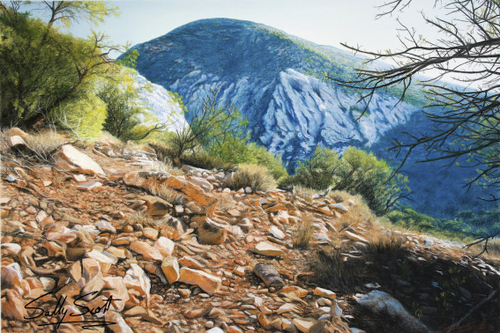
How strong this
influence has proved can be seen in the examples of their work I have
included in the gallery below.
The area around
Grahamstown, to which I recently returned, used to be known as the
Zuurveld, and later as the Albany district. It is also known as
“Settler Country” for it was to this part of the Cape Colony that
the early 1820 British settler party came.
To these early settlers this harsh, dry country also marked the beginning of the hinterland, that half-known, half-feared region that stretched endlessly onwards. The further west you travel the wider and emptier it seemed to get. In the far distance stretched ranges of mountains. What lay beyond them was just a rumour, a region of fancy and conjecture.
Karoo Mountains beyond Plains of Camdeboo.
Even today the land
still feels like frontier country, wild and sparsely populated. Far
more than in Kwa-Zulu-Natal, where, I come from, you get a real feel
of what it must have been like for those early settlers, struggling
to eke out a living in these remote and isolated outposts.
In KZN development
after development has blighted the province: holiday homes,
retirement homes, bungalows, duplexes, massive walled complexes that
stretch for miles. Factories belch out smoke, power lines criss-cross
the countryside, an endless stream of traffic pours down its main
arteries, the urban sprawl and shack-towns seems to grow bigger by
the day.
Aside from its coastal areas, you don’t get that feel at all in the East Cape. You can travel for miles through the Karoo without seeing another vehicle. It is like you have the universe all to yourself.
Every time I pass
through it, I find myself trying to imagine the feelings of those
early arrivals. How alien the harsh landscape must have seemed after
the soft green of England.
Many of them must have felt they had been hoodwinked. The pamphlets that had been dangled in front of their faces, back home, promised the prospect of great self-improvement, a land of milk and honey, an amazing opportunity. The reality was completely different with many of them finding themselves stuck in the middle of the no-man’s-land between the white settlers moving north from the Cape and black settlers moving southwards. The Fish River which winds its way through this area was often seen as the dividing line with the British authorities building a line of defensive forts along its banks. In places you can still see the remains of these.
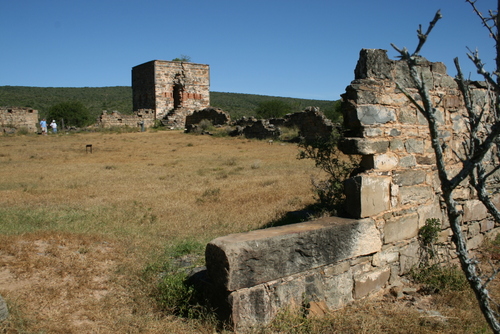
Old British fort, Fish River.
Some settlers stayed
on on these outlying farms, braving the dangers and determined to
make a go of it; others found the country uninhabitable, packed up
their belongings and headed off, blazing a trail of retreat that
others would follow.
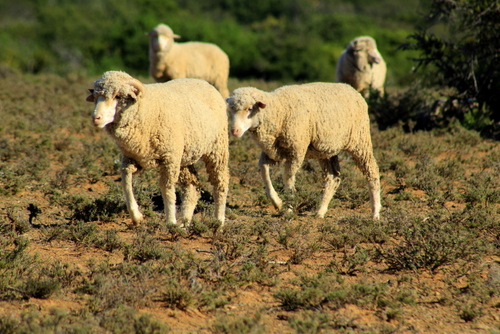
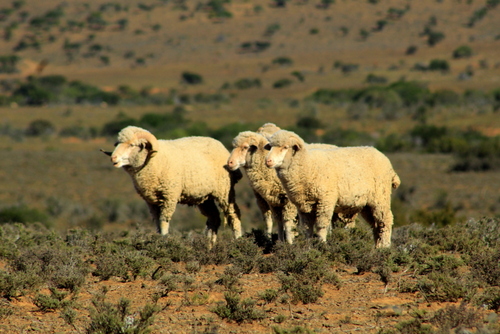
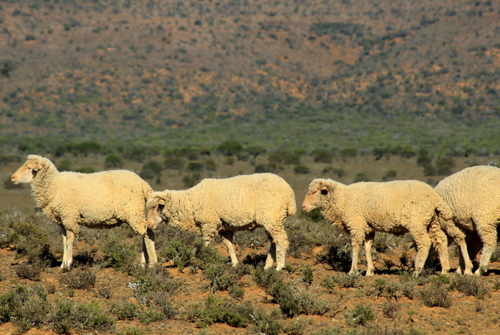
Every so often you come upon a solitary farmhouse, each one part of a narrow stream of civilization that wound itself through the wilderness. Sometimes there will be a steel wind pump and a circular water tank around which some cattle have listlessly gathered. Mostly, though, this is sheep country.
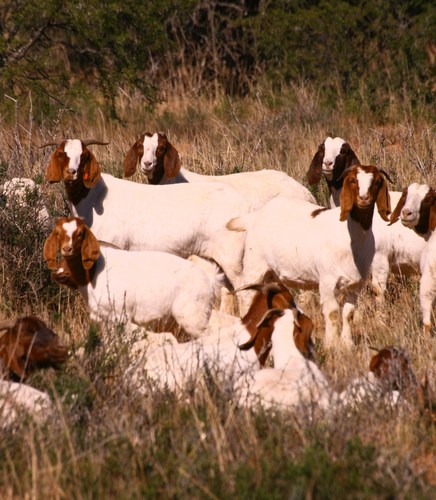
And goat country. There are lots of goats in the Karoo.
Angora Goats.
Boer Goats.
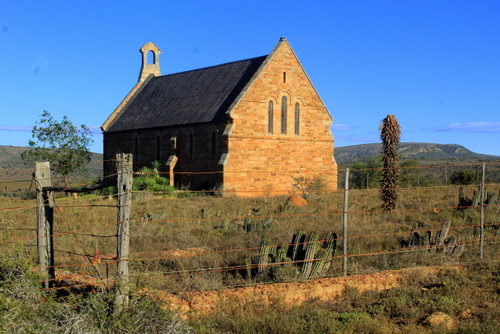
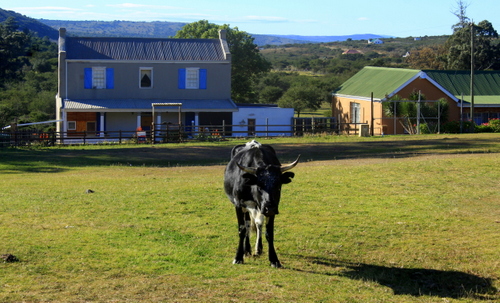
We did a day trip out of Grahamstown, taking the road, which leads past Table Farm with its wonderful old, double-story settler house and small stone church, and ends up in Riebeek East. Situated in some hilly country, the town – if such it can be called – was founded in 1842 and initially named Riebeek after Jan van Riebeek, one year after the local church was built. It was erected on part of the farm Mooimeisjesfontein that was subdivided and sold by the subsequent Voortrekker leader, Piet Retief. His old home is situated just east of the town and has been declared a national heritage site.
Old Settler home, Table Farm.
Old Church, Table Farm.
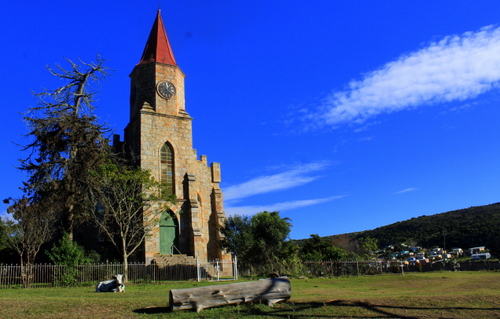
As in most small South African dorps, the church dominates the town. When we stopped outside it the only sign of a congregation was a herd of cattle grazing in its grounds. It was a very impressive structure, nevertheless, which seemed far too large and grand for such a sleepy little hamlet.
Church in Riebeek East.
Old settler home, Riebeek East.
Maybe it had once
been different around here. Indeed, visiting many of these old Karoo
towns, one gets the feeling that at one time they supported much
larger populations, especially when the wool industry was in its
heyday. With the boom years gone most of the young folk trekked off
to the cities and towns.
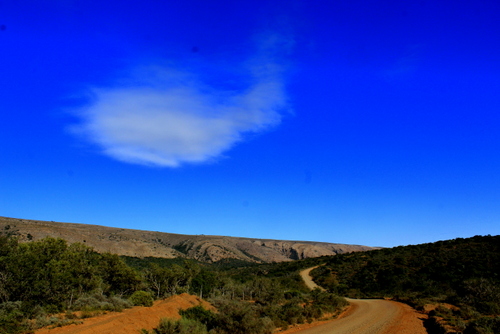
From Riebeek East we
followed the dirt road that eventually leads to the main Port
Elizabeth highway although we planned to turn off before that.
To our left, ran a long, low range of hills where you could see how the exposed rock had been buckled and folded, like a carpet you have just shoved with your foot. In front of us the road rose in to crests and sank in to hollows.
Eventually we came
to a junction where we branched off down another dirt road leading to
the curiously named, Kommadagga. It was a place I was keen to see.
Kommadagga (the
name is believed to be Khoekoen meaning “ox land” or “ox hill”)
was a small, purpose-built, settlement constructed by the South
African Railways, in the early 1950s, to house the workers involved
in the construction of the nearby railway line. At the time it had
over 1 000 residents, with an elementary school and a recreation
hall. Once their work was finished, its population was uprooted and
moved further north to the next section of the new railway line.
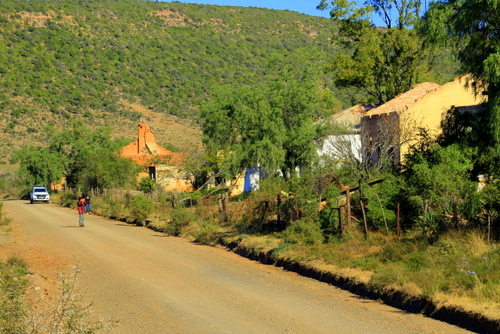
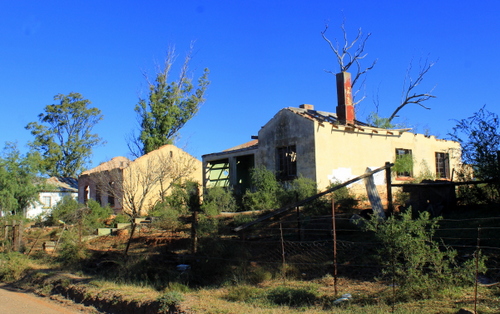
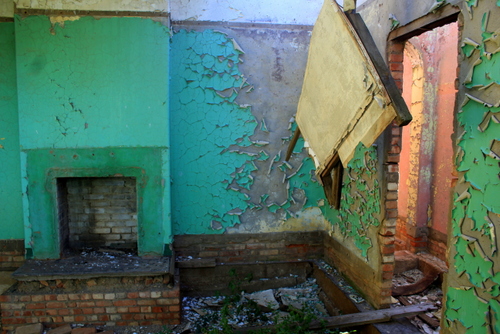
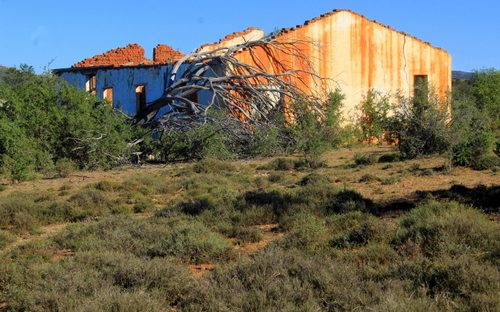
Now it is a ghost town, its reason for existence long since vanished. The houses are just shells. You can see right through them, the sunlit, empty rooms with their peeling walls; windowless, door-less, their roofs caved in. In places they had broke clean in half, the bricks scattered over the veld.
Old buildings, Kommadagga.
Across the road, a
couple of hundred yards away, crowning a low hill is an old water
tower and to the side of that some concrete pillars whose former
purpose I could not fathom although I imagined it had something to do
with the railway line..
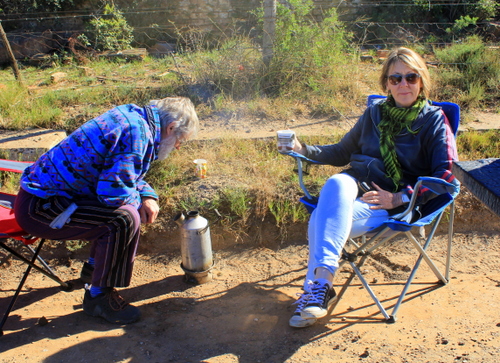
We pulled up beside one of the wrecked houses and while Professor Goonie Marsh, our amiable driver, long-time Grateful Dead fan and expert on matters local, fired up his volcano for coffee on the side of the road, I set off to explore. I made my way through the remains of gardens, past rusting fences, auto parts, old cement water storage tanks and all the other scattered detritus that suggested a civilisation of sorts.
Goonie fires up his Volcano. Sally plays Lady of the Manor.
There was one house which was in better shape than the rest, an empty wine glass on the verandah wall suggesting it might still be occupied but by whom I had no idea. Near another house there was an outbuilding full of old shoes, in another a collection of goat skulls which got me wondering just how they had passed their time around here.
In such a place, one
can imagine there was not much to do. They probably smoked, played
cards, drank too much. On Sundays, the more God-fearing among them
most likely trekked off to that fine-looking church in nearby Riebeek
East.
From Kommadagga, we followed the old rail bed until we reached the Kommadagga Station, some distance away, where the railway line and the road diverged. Cresting a rise we found ourselves looking over a vast basin through which the Fish River flowed, its presence marked by a line of trees.
Along its edge a large expanse of land had been cleared and bought under irrigation, the verdant green contrasting sharply with the surrounding dry bush. To the south and the west, glowing in the morning light, the thin, distant, blue outline of the Bosberg rose through the haze.
View towards Bosberg.
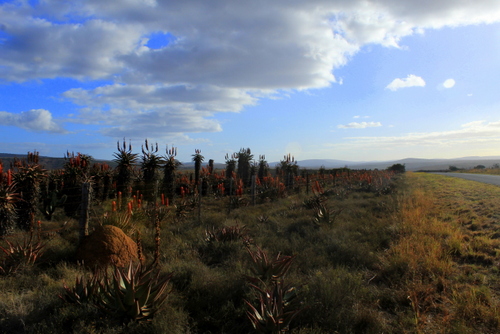
We drove on, stopping every now and again to take photos of the aloes which grow is such profusion around here. Their candelabra of flowers were aflutter with sunbirds (mostly Malachite and Greater Double-collared with a few Amethyst) – such a bright, fragile, flowering of plants and birds in this hot, dry, khaki and grey landscape.
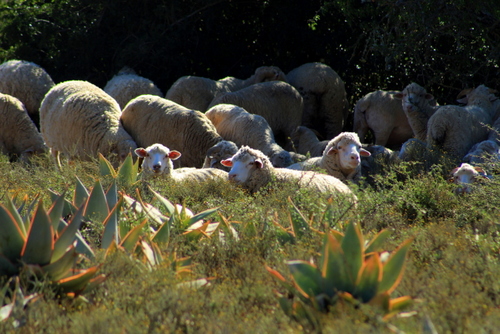
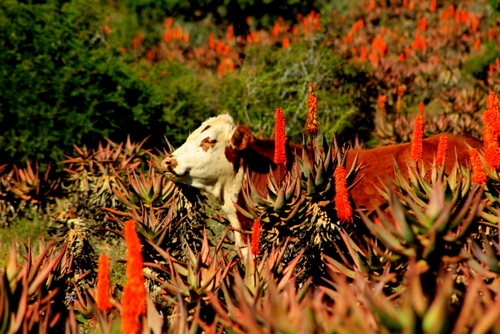
Out here, one gets the feeling no one seems to be in a hurry. Flocks of lazing sheep gaze at you from underneath the shrubbery. Small groups of cattle pose amongst the aloes, nonchalantly chewing the cud. They give the feel of being completely cut off from the world and not minding a bit.
Sheep with Aloe striata in foreground.
Cow in Aloe ferox.
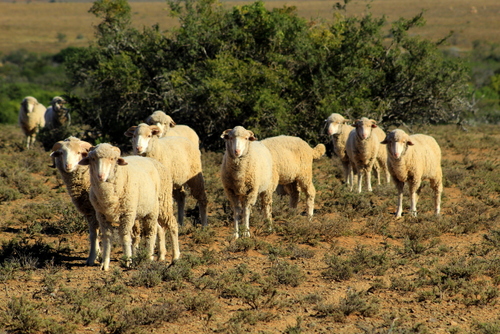
This, we discovered, was not altogether true. Crime – the curse of modern South Africa – has spread its tentacles even to out here in the boon-docks. When we stopped to take pictures of some sheep, grazing in a field, the local farmer came hurtling up in a cloud of dust with a bakkie full of security guards. He was worried we were rustlers!
Karoo rush hour traffic jam…
Having convinced the farmer we had no ill-intentions, we continued on our way. As we drove the views changed but not suddenly or sharply. Nearing the main Grahamstown to Bedford road more mountains hove in to view – the Winterberg, the Katberg, the Hogsback. Between them and us there was yet another huge, aloe-dotted, plain.
Aloe ferox next to Grahamstown to Bedford road.
Katie finds a view point.
Despite its timeless
feel, some things are changing. In this harsh environment, many
farmers have discovered that tourists pay better than sheep, cattle
and crops. As a result they have started restocking their properties
with many of the same game species their ancestors so casually shot
out.
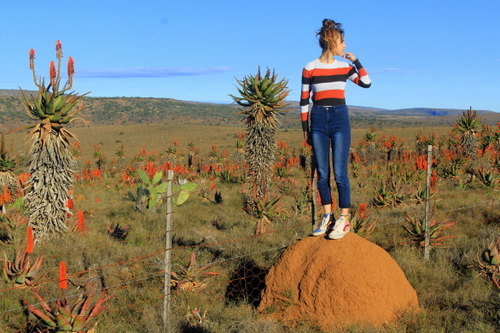
Back on the tar I
continued to study the ground topology. To me it looked like the
worst soil imaginable but the termites obviously liked it because the
veld was littered with their pinkish-yellow, nipple-shaped mounds. In
between their habitations were yet more flowering aloes full of
twittering sunbirds.
Then we were driving
back through the outskirts of Grahamstown, past the municipal dump
out of which much of the rubbish had been blown and now lay piled up
along the side of the road. Or had been left hanging on the fences
like some sort of weird, welcome-to-town, decoration.
There had obviously
been a big fire in the dump recently, too judging, by its burnt
colouring and the pungent smell in the air.
At this point, I found myself wishing we could turn around and head back the way we had just come. Then I remembered I had an appointment at the local craft beer brewery, in the hills outside town, and changed my mind again…
GALLERY:
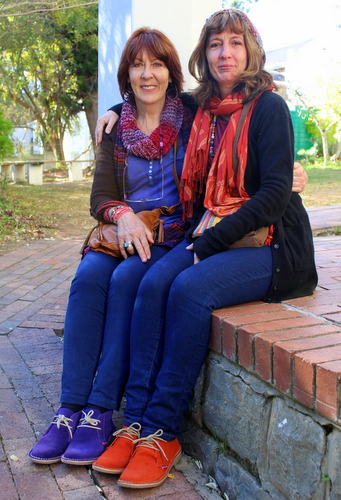
My two talented artist sisters, Sally Scott (on left) and Nicky Rosselli.













 Stidy's Eye