As the Australian bush-fires continued to rage across large tracts of the continent – by early January an estimated 5 million hectares had been destroyed (as opposed to 906 000 hectares in the Amazon fires) – its governments initial tepid response and refusal to acknowledge the true extent of the crisis attracted widespread criticism. Prime Minister Scott Morrison’s own inability to utter the words “climate change” without breaking in to a cold sweat also showed a woeful reluctance to engage with the issues presented.
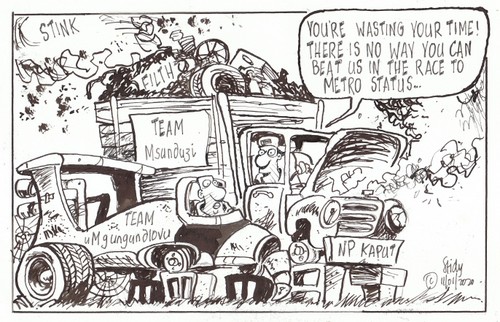
In the same week that it was reported that the two big KZ-N municipalities, Msunduzi and uMgungdlovu, were muscling up against each other to become a regional metro, Pietermaritzburg was visited by two ANC heavyweights, Zweli Mkhize and Blade Nzimande. They were both blunt in their assessment. The city is filthy, it stinks and its leadership is useless.
Eskom continued to be in the news for all the wrong reasons with the embattled power utility now saying that if it is not granted the substantial tariff increases it wants from March, its finances might collapse, triggering a national crisis, as both the state’s credit ratings and consumers’ well being would suffer. Responding to this, Melanie Veness, CEO of the Pietermaritzburg and Midlands Chamber of Business, warned that the proposed increases would be the final nail in the coffin for local businesses and would lead to retrenchments and a greater strain on the already struggling business sector.
Under pressure from detractors and enemies both inside and outside government and the ANC, Public Enterprises Minister, Pravin Gordhan, said he was following a mandate given to him by President Cyril Ramaphosa and that he must be left alone to complete the task he was given. With load-shedding costing the country between R59billion and R118billion in 2019, one can only hope he succeeds with his Eskom turnaround strategy.
After several years of acrimonious debate, the United Kingdom officially left the European Union on the 31st January, 2020. The country’s exit will undoubtedly prove to be British Prime Minister, Boris Johnson’s, biggest victory. At the same time it is very much a leap in to the dark and whatever happens in the coming stages of the Brexit process things look set to get more, not less, tricky.
The University of KwaZulu-Natal shut its doors after a week of violent protests which saw several buildings set alight on both the Pietermaritzburg and Durban campuses. Condemning, the incidents, the Minister of Higher Education, Blade Nzimande, said “These attacks look like well-orchestrated acts of sabotage and criminality meant to undermine and reverse the already achieved milestones reached with the South African Union of Students.”
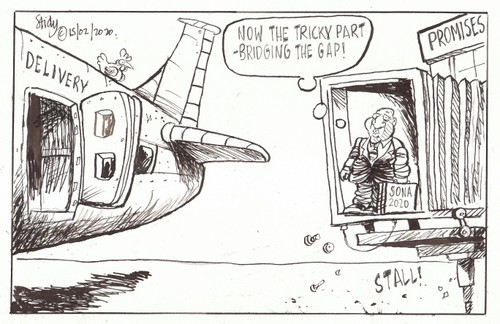
Ignoring the loutish behaviour of Julius Malema and the EFF, President Cyril Ramaphosa implored South Africans to “…not allow fear to stand in our way” in his annual State of the Nation Address (SONA) to Parliament. While his national call to action contained some positive announcements, the fear remains that with state finances in dire straits, the economy all but ground to a halt and state companies floundering, the president will allow himself to remain captured by party dogma and constrained by indecision.
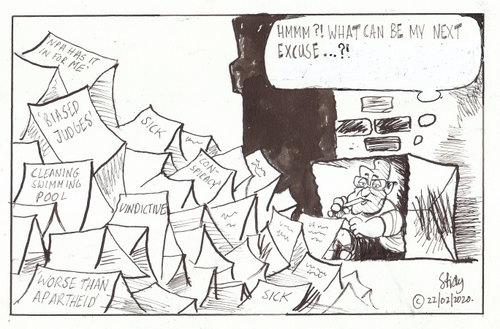
Former President, Jacob Zuma, continued to use every trick in the book to avoid his day of reckoning in court, charged with corruption. Having presented a sick note to excuse his absence – it was rejected by Judge Dhaya Pillay of the Supreme Court because the dates appeared to have been altered – Zuma then went on to accuse the National Prosecuting Authority (NPA) of employing Apartheid-era tactics against him.
He also insisted that these were not deliberate delaying tactics on his part…
A proposal to cut the state’s wage bill by R160,2 billion over the next three years as Treasury warns of ever-rising debt repayments, was one of the key announcements of the 2020 budget, presented by Finance Minister, Tito Mboweni. The move was immediately opposed by the Public Services Union (PSA) who vowed to fight any threat to freeze public servants’ salary increases.
With the Rhodesian Bush War intensifying and many whites leaving the country because they saw no future for themselves, it was probably not the wisest of times to be considering such an investment – some might even have called it foolhardy – but my father was never one to doubt his own judgement and went ahead anyway.
He had recently come
in to some money, as a result of finally selling our long abandoned
Nyanga ranch to the new (and destined to be short- lived)
Zimbabwe-Rhodesia Government who wanted it for resettlement.
With the proceeds my
father bought a 1500 acre property adjoining my brother Paul’s
cattle ranch in the Battlefields area (so named because many of the
old gold mines and farms in the area had been named after famous
battles) in the Rhodesian Midlands.
Situated in a
marginal rainfall area about halfway between the towns of KweKwe and
Kadoma the farm consisted mostly of mixed mopani woodland. Although
there were some crops grown in the area (mainly cotton and wheat),
usually where there was irrigation available to supplement the
unreliable rainfall, this was mostly cattle country.
The ranches tended
to be large, each one separated from its neighbour by miles and miles
of rough, ribbed, ungoverned country. If I stood on top of the low
range of hills that ran immediately behind the old homestead I could
see no other sign of human settlement in all directions other than
the cooling towers of the Umniati Power Station which protruded above
the tree line and the electricity pylons that marched like an army of
ungainly giants alongside the main Salisbury-Bulawayo Road.
There was already a house built on the farm, simple but comfortable in the old settler style. It consisting of whitewashed brick with a corrugated iron roof, big, bare rooms and a wide veranda which jutted forward over what remained of a lawn.
Bowmont house with vlei.
It had been built
on a small shoulder of land, in front of which was a vlei that
sometimes flooded in the rainy season but for the most part consisted
of a series of potholes caked with cracked mud. On the other side of
this stood a thin belt of thorn trees and beyond that a fenced
enclosure that had once been a cultivated field but was now slowly
being reclaimed by the bush.
Although my first
loyalty will always be to the Nyanga farm, where I grew up, Bowmont
came to exert a similar hold over me; it had the same haunting and
mysterious familiarity although, on the surface, its attractions were
a whole lot less obvious.
On the Inyanga farm
our horizons had been ringed by mountains and no matter where you
stood you were more or less guaranteed a great view. On Bowmont once
you left the Big Vlei, the trees closed in around you and your vision
became restricted to a few hundred metres on every side.
Whereas I had fallen
for the Inyanga landscape almost on sight, Bowmont revealed its
beauty in a more subtle, slower way.
Having bought the farm, my parents had to decide what to do with it. In her usual quiet, methodical way my mother immediately set about creating a garden, one that would provide a bright, colourful oasis in the middle of the dry veldt.
The house when we first arrived.
The house after my mother had created a garden.
For his part my father decided that Bowmont was good sheep farming country. Unfortunately he could never persuade the sheep themselves to accept this fact. For some reason they didn’t like the area at all and despite my father best efforts to convince them otherwise they persisted in growing thin and dying with a monotonous regularity.
It soon became more
than obvious that we would be hard-pressed to earn a living this way.
In a letter to my English cousin, Rebecca, I noted somewhat despairingly: “August is our cruellest month: the nights are still cold but the days are hot and we are pestered by an angry dry wind that blows dust into everything and slowly frazzles out the landscape. The grass turns harsh and tough and stubbly and in between the soil is dry and cracked, the blood sucked out of it; waiting to get whipped up along with the dead leaves and other winter-time debris and carried away by the meandering dust-devils. It is also the month when the sheep driven on by visions of green begin to stray and get preyed on by the equally hungry jackal…”
Our sheep herder.
My nephew has a go at being a sheep herder…
The advent of the
rains – which could happen any time between October and December –
always marked the turning point of the year. For weeks beforehand I
would find myself anxiously panning the skies for the first tell-tale
signs that they were on their way. Normally there would be a few
false starts before the day would come when the dark storm clouds
would start banking over head and the air became charged and tense
and then suddenly you would hear the first big, shiny drops falling
and hissing as they hit the sun-parched ground.
Living in a dry
country, there was no nicer sound than lying in my bed at night
listening to the rain drumming down on the corrugated iron roof while
the old mango tree outside my bedroom window heaved and swung and the
thunder rolled along the line of kopjes.
At his stage of my
life I was – in between my numerous army call-ups – six weeks in,
two months out – employed at the Mining Commissioner’s office in
Gwelo. Built somewhat optimistically in 1896 as a Stock Exchange the
building which housed our offices had that air of beguiling
shabbiness one so often associates with government departments –
especially those banished to the sub-regions. The work itself was of
a fairly dull and routine nature – issuing prospectors’ licences,
registering mining claims and trying to sort out disputes between
farmers and miners over land rights. Most weekends I would jump into
my battered old Datsun 1200 and together with my border collie,
Bruce, head off to Bowmont.
In the meantime the
war ground inexorably on towards its inevitable conclusion. The
advent of majority rule finally gave me the excuse I needed to quit
my government job and to move to the farm to help out my father who
was becoming increasingly ill.
He eventually died in Harare on the 3rd February, 1983. After his death and with my mother now working during the weekdays at a boarding school just outside Chegutu I lived alone in the farm. During the holidays I would be joined by my young sister, Nicola, who was a boarder at Queen Elizabeth in Harare.
The solitude suited
me. During the preceding years, my double life as as part-time
civilian, part-time soldier had taken its toll. After seven years of
fighting for a cause I had never really believed in I had found
myself consumed by an increasing sense of futility.
When the war
finally ended, I had left the army with a feeling of moral blankness
but now I had plenty of time on my hands to think about my
experiences and get back in touch my feelings.
Just being there and going for long tramps with the dogs through the bush was a therapy of sorts, a way of clearing the cobwebs out of my mind. I enjoyed fixing up the farm which when we had taken it over had been in a fairly dilapidated state. I planted lots of fruit trees and grape vines; I fenced off paddocks and built drinking troughs for the sheep. I even started making my own wines which, although they were unlikely to win any awards, were at least drinkable.
Cooling off in the trough…
I particularly liked
the early mornings before the heat tired and numbed one and sapped
out all your energy. I also loved sitting on the veranda in the
evenings drinking gin-and tonics and listening to the comforting
“kuk-cooo-kuks” (“Work harder, work harder”) of the Cape
Turtle Doves while the francolin called from Kwali Corner and the
guinea fowl clinked softly in the old lands. Sometimes, especially in
summer, I would sit out there with my feet propped up on the veranda
wall until way after dark, gazing at the large yellow moon as it rose
above the tree line and listening to the jackal calling and the
insects shrilling in the encircling gloom.
Two large tributaries of the Zambezi – the Umniati (corrupted from sanyati meaning “many buffalo in the area”) and the Umsweswe (derived from the onomatopoeic word sweswe – meaning “the sound of dragging feet”) – flowed through the area.
The Umniati River.
The Umsweswe River with my nephew, Alex.
The former provided the southern boundary of my brother Paul’s next door property, Thetis. It provided a favourite walk. When I was not working the land, it was to here I often headed, a shotgun slung over my shoulder just in case of I was not sure what. I just felt comfortable with it. A hangover from the war, I suppose.
I would pick my way
along the river’s bank, my senses alert to any sounds, my eyes peeled
for a flicker of movement. Although there were no longer any menacing
buffalo to worry about, the countryside still had a wild and
uncultivated look.
There was other game about. I often saw kudu, and every now and again a male warthog would come trotting out in to the open with an impudent air, followed, shortly, afterwards by the rest of the family. Despite the shotgun, I was never interested in shooting at anything. The war had cured me of that.
Exploring the bush. Brother Paul and myself.
On some days I took
a rod with me but although there were plenty of promising looking
pools to fish in I never caught much. That was not really the
purpose. I was content just to sit on the hot rocks, listening to the
birds and watching the shreds of cloud drifting overhead
As happy as I
thought I was it became increasingly apparent to me that I could not
carry on indefinitely like this, that this was only a temporary
stopping- off point.
I began to wonder
what on earth I was going to do with the rest of my life. As much as
I enjoyed the outdoors I didn’t really feel I was cut out to be a
farmer; even if I had the farm was too small to be economical and I
had no capital of my own to invest in it.
I had no idea what
other form of employment lay open to me. Neither my qualifications
nor my inclination fitted me for the few jobs on offer.
Indeed, I was no
longer even sure if an independent Zimbabwe was the place for me. I
was beginning to feel that I had come to the end of this particular
road. My innate restlessness also played a part, a taste for change
and new adventures, a fresh start in a place where I was not bogged
down by memories.
The time had come
for me to move on. But to where?
It was my sister,
Sally, who suggested a way out of my predicament. After the war had
ended she and her husband had emigrated to South Africa, settling
first in Phalaborwa and then, later, Durban.
I had always been an
inveterate scribbler, filling the margins of my exercise books at
both school and university with drawings when I should have been
listening to what the person in front of the blackboard was saying.
It probably explains why so many of my exam results were not as good
as they could have been.
Remembering this and
believing in my talent – at that stage she had far more faith in it
than I did – Sally set me up with a couple of interviews in Durban.
So, at the end of 1983, I drove down to South Africa, feeling very
sceptical about whether anybody would actually want to employ me.
Much to my surprise
they did. In fact, I was offered a job by the first person who
interviewed me – the MD of Scope Magazine.
That settled the
matter. There could be no more dragging of feet. A new chapter of my
life had begun.
The day before I left Bowmont for good, I set out for my last walk along the farm boundary fence, trying to memorise all the sights and scenes and take in all the scents and feelings in the hope I could carry them away with me. After that I went back to the old house, packed up my few possessions in to the boot of my car and early next morning set off down the familiar dusty road that crosses the railway track by the old Battlefields General Dealer store.
Then I branched off down the tar towards the border, desperately trying to keep the lid down on all my choked-up emotions as I did.





 Stidy's Eye