When lockdown was first introduced in South Africa I went along with received opinion. I washed my hands thoroughly. I practiced social distancing. Realising I was in the at risk category, I only left the farm twice in the first seventy-eight days and when I did I wore a mask. I made sure I got in to town just as the shops were opening and didn’t spend any more time in them than I needed to.
In the same spirit, I tried to make lockdown a positive experience. Over the months I found different things to focus on. I developed interests I never had before. I re-established my connection with the living world.
Indeed, with hindsight, I think one of the most important things lock-down – and retirement for that matter – gave me was time to slow down and start noticing things. The sheer scale of the global catastrophe forced me in to a kind of retreat, a moment of reflection.
I began studying my immediate surroundings with an even greater interest.
For example: each day, since lockdown began, found me patrolling my garden forensically, in the manner of an East German border guard back in the Cold War era, except what I was on the look-out for was not defectors but butterflies. Instead of an assault rifle, I carried my old Canon.
As winter progressed so their numbers dwindled but every now and again I would come across one, fluttering along in all its flowery grace and fragile beauty. With every new butterfly I identified I felt a mounting sense of elation and achievement.

Steel-blue Ciliate Blue 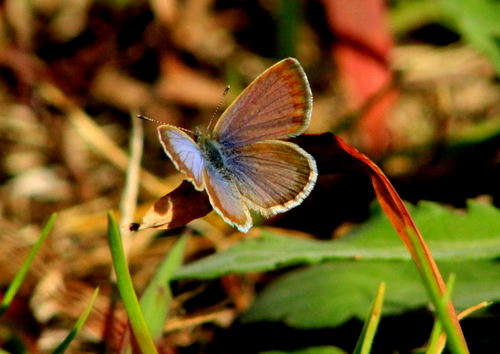
Africa Grass Blue 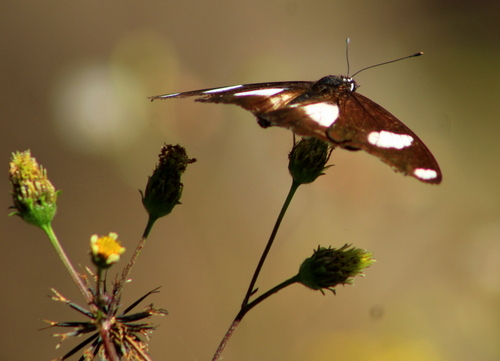
Common Diadem 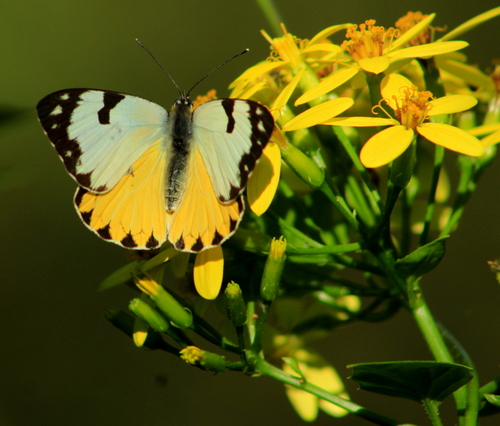
Forest Caper White.
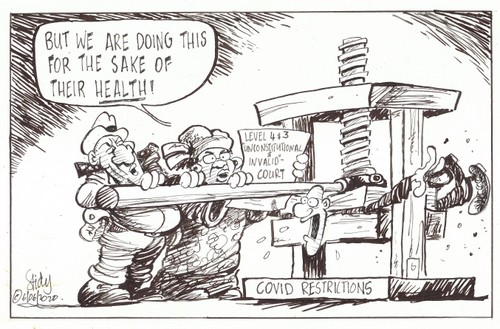
Determined to remain upbeat, in spite of the grim trajectory the virus was taking, I deliberately limited my intake of news to what I deemed necessary for me to be able to produce my one topical weekly cartoon. It wasn’t always easy. At times the line between tragedy and farce grew very fine.
Like most people, I accepted the logic and rationale behind the initial lockdown but as the weeks stretched in to months I found my faith beginning to waiver. Having done its best to scare us in to staying indoors the ANC government began to flounder on some of its own draconian rules.
These included a ban on the sale of cigarettes and alcohol, both of which were based on a rather convoluted logic, as well as some sloppy and outdated science. Many of the other regulations – like what sort of clothes you could or couldn’t buy under Level 4 of the lockdown – were just plain nonsensical, verging on Kafka-like.
My suspicions that there was something both insidious and wrong with the handling of the pandemic was reinforced when the Judge in the High Court of Pretoria declared that many of the regulations failed the “rationality test” – and were also unconstitutional and invalid. Indeed, as the crisis dragged on, it became increasingly apparent that many of the government ministers were using the pandemic as a cover to pursue their own hidden agendas and conduct their own personal crusades – and that these often had very little to do with our health.
As so often happens in South Africa, ideology had trumped common sense…
Not that our problems were necessarily worse than anywhere else. The US, for example, was typically overconfident in its exceptional-ism and paid the price.
When the news seemed overwhelming, however, nature provided a balm. It became my escape. My therapy. My reminder of how much I have to be thankful for.
I am lucky to live in the country. In many ways my life carried on as it had before lockdown; there was no real adjustment required. I could still go for daily walks. There was my garden to work. My chickens to feed.
Nor was I all that bothered about being cut-off from the rest of society. As a cartoonist I am used to the solitary life. I have always worked from home so self-isolation is a habit for me.
I won’t pretend there weren’t things I missed – a cup of coffee with a friend, a simple hug, the freedom to drive where I liked.
By way of companions, I had the birds. There is not a day in my life that is not improved by seeing my resident pair of Boubous bouncing along or hearing the Cape Turtle Doves calling from the trees.
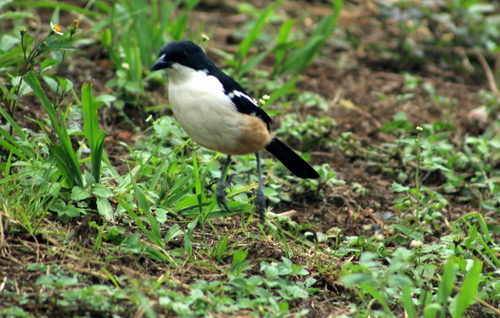
The migrants were, of course, long gone. I missed them but we still had our regulars in my garden. Each morning I would wake up to the Cape Robin and the Olive Thrush singing outside my window. If I got up early enough I sometimes caught our skittish pair of Natal Francolin making a dash for it across my lawn.
With the breeding season over the weavers had lost their masks but still gathered on my food table every morning chattering away like excited schoolboys. They would be joined by the rock pigeons, doves and sparrows.
The South African lockdown officially started just as autumn was giving way to winter. I love winter. With the rains over everything begins to dry out and a smoky haze veils the sky, dulling the light and robbing the landscape of contrasts. Dust coats everything near the road, even the trees and houses.
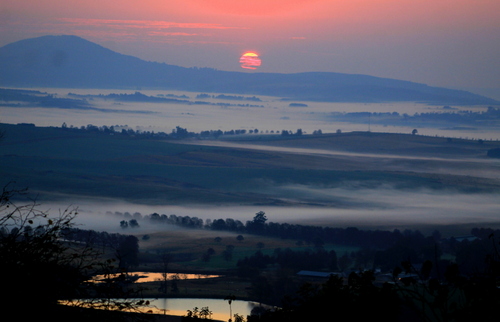
There is a stark, minimalist beauty to the countryside at this time of the year. Sometimes Jack Frost comes calling overnight, leaving little patches of white icicles clenching the ground. On other occasions, a chill wind blows in the mornings and as I set off to take stock of the local state of nature the leaves that autumn stripped from the trees crunch and snap beneath my feet.
Across the valley thin sheets of mist hang suspended above the hollows. On the saddle path, the sun’s rays catch the dew drops hanging on the funnel spiders’ webs.


You can smell the crisp, frosty, dryness in the air.
It is my favourite time of the year for walking. The icy cold appeals to the Spartan in me. I find it invigorating and oddly purifying. It sharpens my senses.
In the afternoon the light and temperatures fade early. By five-thirty the chickens have already put themselves to bed.
Sitting on my balcony, at twilight, sipping one of my hard-to-come-by-beers I could feel the breath of winter on my neck. It was cold. The soft evening skies at this time of year are beautiful though.
Below me I could sometimes hear the jackal calling as they set off on another night of hunting for food. In the moonlight the defoliated trees are silhouettes. The wind blowing up the rocky slopes rattle their branches.
There were other pleasures. Winter is also aloe season and with their beautiful orange-red flowers came the sunbirds (mostly Amethyst, Malachite and Greater Double- collared). It is also the time when the Wild Dagga (Leonotis leonorus) bushes flower, another sunbird favourite. I deliberately planted both species to try and seduce birds in to my garden and it has done the trick.

Winter is not all good. It can also be a time of violent drama. From where we are, safe in my sanctum overlooking the valley, you can often see huge fires sweeping across its floor, destroying countless creatures as it goes. I cannot imagine how many insects, reptiles and rodents must get enveloped and killed in the flames. This, in turn, impacts on the raptors that hunt them because it means less food. Winter can be hard on predator and prey alike.
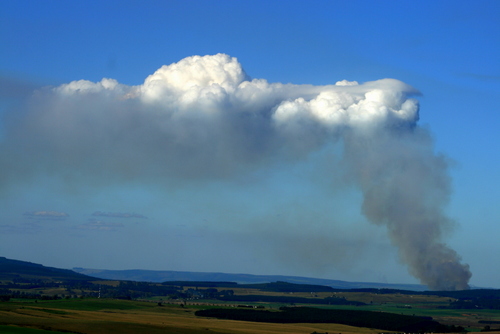
At such times the sun turns a pale yellow behind the plumes of smoke and the air is bitter with the smell of ash and burning debris.
This got me thinking about conservation, loss of biodiversity and what we are doing to the world. Thanks to agribusiness, agrochemicals, artificial fertilizer, farm mechanization and an intensification of arable farming much of our natural fauna and flora is being destroyed. Looking out over our urban landscapes, too, I see an ever-expanding mass of railway tracks, petrol stations, cement blocks, pylons and factories pumping effluent in to our streams and poison in to the air. And piles of plastic.
As a keen twitcher, I have noticed the steady decline of wildlife over the years. I grew up, for instance, with guineafowl abundant and all around; after harvesting, the fields were fill of them, pecking their way through the stubble in search of dropped mielie seeds. In the decades since there numbers seem to have grown less and less. It is like someone came along and removed them all.

It makes me very sad. And angry. Far too much of our wildlife is teetering on the edge of the ecological cliff.
Paralleling that has been the steady spread of invasive plants. Vast acreages have been given over to sterile pine, wattle and gum plantations inside which very little lives.
Nor is it confined to that. One of the biggest problems we face on Kusane is eradicating the bramble, an alien, invasive, species that creeps over the grasses and crawls over the plants. It is like a cancer and a nightmare to fight your way through because its thorns shred your legs.
Likewise bugweed. Our neighbour has a veritable forest of these and the seeds are picked up by the birds and dropped on our farm where they easily germinate and spread.
Invading our grasslands, all these plants reduce water run-off, and increase the severity of wildfires. It has been estimated that alien trees consume 5% of our scarce water and are a direct threat to almost half of the 1600 natural species listed in South Africa’s Red Data List.
Ruminating on this, I find my mind returning to lockdown. I can’t help but see the Covid-19 pandemic as a portent, an omen, a warning and a reminder of how much our economies, our livelihoods and our well-being depend on the health of nature. That seems to me to be our problem – we have become alienated from the natural world.
We need to re-learn that we are part of nature, not above it. Destroy it, in our blind pursuit of profit, and we destroy ourselves…
I will do my little bit to try and stop that. I am a tree man. To help make a greener world, I have opened up a new patch of ground, alongside Rubble Row, where I have already planted yet more indigenous species (Paperbark thorn, Tree Fuschia, Cheesewood, Ouhout). I know I won’t live long enough to see them mature but that is not the point. I am doing it for the next generation, a generation who face a far scarier future than ours did.
Lockdown has taught me other lessons. Being forced to stay at home made me realise that – as frugal as I like to think I am – I used to waste a lot of money on unnecessary shopping trips in to town.
It has also induced the waste not want not attitude of my parent’s generation. With the supermarket shelves rapidly emptying because of panic-buying I decided I needed to resurrect my vegetable garden. Luckily I have a source of manure both from our chickens and sheep, as well as the stables down the road. We also have our own compost heap.
There is something very comforting and rewarding about tending your own vegetables and eating the result. Growing your own food reminds you that you are part of a system and that everything we eat comes – in one way or another – out of the earth.
That is something we need to keep in mind long after lockdown ends. Or else we may face an even worse environmental and human catastrophe…
 Stidy's Eye
This is a great read Ant and so good to know that not much has changed for you during lock down. You still live in paradise and your appreciation for it is as strong as ever. Enjoy every moment of it and continue to hold our politicians accountable. I look forward to returning to Kusane when all this is over…
LikeLike
Thanks, Sal. Good to see you about and about so early and getting ready for another productive day! I, too, look forward to your next visit and being able to share my paradise with you…
LikeLike
Really enjoyed reading this. There is much to be said about this simple but profound wisdom. I agree with your sentiments. Best wishes, Graeme
LikeLike
Thanks so much, Greaeme. As you can see lockdown has forced me to spend a lot of time inside my head but I am also lucky in that I have still been able to get outdoors as well!
LikeLike
Thanks Sid your voice speaks for the Valley 🙏
LikeLike
Good to hear!
LikeLike
Another fabulous insightful reflection on the beauties and wonders of our natural world, tempered with equally keen observations of humanity’s dismal threat to it all. So good that Kusane’s natural delights are being recorded in this way and are definitely not wasted on you!
LikeLike
Thanks, Pen. I think we are both lucky to live where we do!
LikeLike
As Usual a good read and I envy you being naturally isolated from events. I have learnt a little of butterflies from you as well as opposed to just admiring THEM.
LikeLike
Thanks, Hugh. Suddenly there seem far few butterflies around but hopefully they will return when it starts warming up again..
LikeLike
Sorry to hear that. Hopefully you will be able to reschedule some rime?
LikeLike
Hi Ant, Taken from a microlite a few years ago. We were going to do a book of sorts of Midlands from the air until my pilot friend was grounded, Regards, Hugh
LikeLike
Great blog post Ant. Lots to ruminate on here. I hope humankind will learn a few lessons from this pandemic but I fear they won’t.
LikeLike
Thanks, Nic. That is my fear too – it will soon be back to business as usual…
LikeLike
Beautifully written and full of so much vital truth! As usual accompanied by lovely photographs … Stidy, that photo of sunrise over the valley is exquisite! One of the best I’ve seen.
I agree that this pandemic is a message to the world that we need to re-set … things cannot carry on like before, it is not sustainable.
I would agree that the two big challenges in your part of the world are the encroachment of alien vegetation and destructive fire regimes. Burning has its place but I worry that some pieces of land are just burnt over and over again, turning them into sterile wastelands.
LikeLike
Thanks, Ken. I would like to find out what studies have been done on the effects of regular burning on wildlife and the environment.
I am hoping I got another good sunrise photo this morning.
LikeLike