“Somewhere, deep down in the heart of each one of us, something yearns for the old land, and the old kindly people”
R.L.Stevenson
Maybe it has something to do with the current uncertainty, the depth of longing for all to be well again, but as lockdown drags on I find my thoughts drifting back, more and more often, to my youth. Right now, it seems a much safer place to be. At least you have the comfort of knowing what happened and how it all worked out.
I think there is more to it, though, than a mere desire to retreat to the warmth and innocence of childhood. All our lives are an amalgam of past, present and future. Trying to see clearly and to record what has been seen helps me work out how I got from there to here.
It is also a chance to meet my parents again, back the way they used to be. Each generation passes on something to the next and by looking afresh at what they did and thought is a way of discovering how they have lived on through me.
The difficulty of doing this is, of course, being able to gain access to one’s past. Over the years my memories have grown hazy and dim. The further back I go, the more fragmentary they become.
Sometimes they takes on the aura of a dream, a few tangible threads emerge from the miasma that is my brain. I clutch at their dim outline. At other times, just looking at an old photograph or reading an old letter, will bring long-forgotten things back to the surface.
What I am certain of is that the pivotal event of my early life occurred when I was about nine-years old. It was the year my father decided to relocate us from our smallholding outside of Salisbury to a remote farm in the Eastern Highlands of Nyanga. If anything can be termed a life-changing experience for me, this was it.
The property he purchased was in an incredibly beautiful part of the world.
I can still recall, with pin-point clarity, the journey there, driving up through the granite hills and miombo woodland, along a winding road to a crest where the small Nyanga Village lay. From here, the trail dropped down, with sudden abruptness, in to a huge valley, speckled with rocks, bushes and shadows, shimmering in the parchment dry heat as it receded in to the far haze.

Along its eastern flank rose the solid wall of the main Nyanga range. Running parallel to it, on the other side of the enormous valley, ran the Nyangombe River, which would later join the Ruenya which, in turn, flowed in to the mighty Zambezi. Beyond that lay more hills and mountains.
In contrast to the sweltering valley, the plateau on top of the mountains was cool and covered in open moorland and icy streams and seemed hardly Africa. In the rainy season, waves of multi-shadowed clouds would come rolling ponderously over them in never-ending processions.
For a boy of my romantic disposition it was like entering an enchanted world. All was mysterious, unexplored, rich with infinite possibilities. I loved the wildness, the sense of freedom.
Years later, as an undergraduate, I would read Wordsworth’s poem, “The Prelude”. It struck an immediate chord in me:
“Fair seed-time had my soul, and I grew up
Foster’d alike by beauty and by fear;
Much favour’d in my birthplace, and no less
In that beloved Vale to which, erelong,
I was transplanted. Well I call to mind
(‘Twas at an early age, ere I had seen
Nine summers) when upon the mountain slope
The frost and breath of frosty wind had snapp’d…”
The mountains Wordsworth was writing about were those of the English Lake District. Mine were distinctly African ones.
There were many of them. On the Eastern side of the farm, the great brooding presence of Mount Muozi rose abruptly up from the plain to its castle-like knob. Even when covered in cloud you could feel its presence; its spirit seemed to permeate the very air. There was something ancient and troubling and mysterious about it which undoubtedly explained why it was held in awe by the locals and had become the focal point for an important rain-making cult.
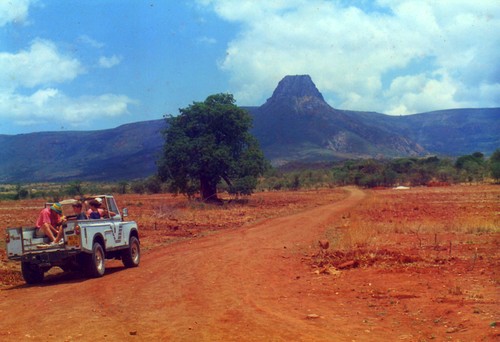
The closer you got to it, the higher it towered above you. Again, the words of Wordsworth’s “The Prelude” seemed to fit:
“…growing still in stature, the huge Cliff
Rose up between me and the stars, and still,
With measured motion, like a living thing,
Strode after me…”
Looking north, from the top of the castle, the main range surged away to Nyangui (“The Place of Shouting”), the big, bulky, colossus that marked the end of the Nyanga range, as well as serving as our corner boundary. It was also the mountain from which our farm took its name.

If Muozi looked like a vessel striving to break loose of its moorings than Nyangui was the bulwark that anchored it back.
Like Muozi, though, it could, when the mood took it, get quite spooky, radiating an air of almost tangible menace, especially when the skies grew sullen and arbitrary bolts of lightning started slashing through the sky. At certain times of the year the wind would grow wild and angry and come hurling down its slopes with an almost end-of-the world fury.
The other mountain which looms large in my childhood memories is Sedze although it was not actually on our farm but situated further back, towards the Nyanga village.
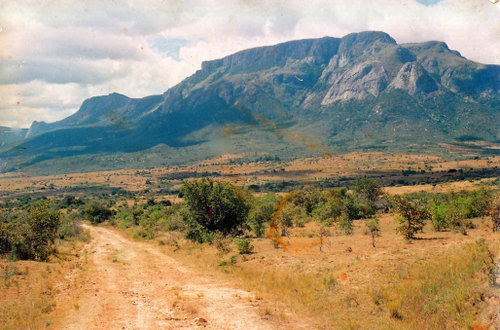
At the one end of it, just above Bende Gap, rose two great rock pinnacles, steeper and more pronounced than any others in the range. From the innermost of the two towers, the mountain sloped upwards in to a massive, domed, bulky, behemoth of rock fitted with clefts and rib-like fissures that gave it the appearance of some ancient animal afflicted by a strange lethargy.
Because of its resemblance to a sleeping pachyderm we always called it the “Rhino” mountain.
Returning from boarding school I always felt elated and light-headed to see the “Rhino” and yet at the same time near to tears because it meant I was almost home again.
Although it slopes were steep and uninhabited, the valley floor below was littered with scores of thatched huts and cattle kraals and patches of cultivated lands. Straggling along the top of one ridge, along which the road traversed, was a cluster of little shops with corrugated iron roofs. This was the Sedze Business Centre. For some reason these old buildings imprinted themselves in my mind; so much so that years later I felt compelled to do a painting of them.

Our own house was a low rambling affair, close to a stream that ran down from Muozi. Later, my one brother, Paul, would build a slightly more elaborate and stylish homestead near a rocky outcrop, using white quartz for the walls and thatch for the roof. Positioned next to an old baobab, it commanded tremendous views over the surrounding mountains
Having laid idle for years, turning this stretch of Africa back in to a farm was hard work. There was plenty of bush to clear, furrows to dig, fences to put up. Because we were always short of cash, all the children were expected to chip in during the school holidays.
We were always a close family. The bond between us all, already strong, was strengthened during the Nyanga years.
In some ways it was a cloistered childhood. Outside my siblings and the farm mutts I had no companions or acquaintances to share it with. This did not make me unhappy or fretful. Nor did it bother me that I was not able to participate in all the entertainments and amusements – movies, parties, dating, sport – that other teenagers took as a matter of course.
Being so restricted and yet so active actually had its benefits even if I didn’t always fully appreciate them at the time. I developed an early love of nature which has never left me. I created a world of my own in to which I could slip away unnoticed. I learnt how to fall back on my own resources.
When I was not on the farm, I was away at boarding school, an institution I hated because it took me away from my beloved mountains. What strikes me now is the narrowness of life in it.

At boarding school. 
Palmer House Rugby Team (UBHS).
Ours was, of course, a segregated society and only white boys were allowed to attend the school. Beyond the cleaners, the ground staff and the kitchen workers we had little personal contact with the local African population.
It was a life, into which the great affairs of the world seemed hardly to intrude. Nor did any of us ever really bother to question the racial and quasi-Imperial doctrines of the time or the fairness of the system in to which we had, as relatively privileged white children, been born.
It was only during my final years at boarding school that the world of politics began to force its way in to my life.
In elections held in December, 1962, the right-wing Rhodesian Front, who had promised to deal ruthlessly with the nationalist menace and to entrench white rule permanently, had swept to power. One of their first demands was that the country be granted independence.
For the next three years the RF Government would be engaged in a series of fruitless negotiations with the British. With the situation at stalemate, it had become more and more obvious that we were headed for some sort of showdown. As young and ill-informed as I was, even I had become aware that, beneath the carefree surface of my life, the political sands were shifting fast.
On the 11th November, 1965, it finally happened. For weeks beforehand there had been much talk and speculation and an atmosphere of considerable excitement had built up, even among us schoolboys. Now, before a hushed nation, Smith made his big announcement – Rhodesia had declared its independence from Britain.
The effect was dramatic. Suddenly, politics occupied the minds of everybody in the country from the remote farms to the government offices, from prospector to priest.
It was an epochal event. Not only did it change the course of all our lives but it would eventually trigger a lot of soul-searching for me.
Caught in the same fusion of fear and excitement as everybody else, slowly, hesitantly, my attitudes began to change. Over the following years I would increasingly find myself wondering about the wisdom of the course of action the RF government had embarked on, especially once the Rhodesian Bush War began to exact its heavy toll.
I also started to look more critically at the society I had grown up in. Cut off as I was from the mainstream, even I could see that Rhodesia was not exactly a centre of cosmopolitan artistic energy and progressive thinking.
My family background, no doubt, played a factor in this growing awareness of the world around me. As a pilot, my father had travelled the length and breadth of the continent, as well as working in Arabia and Europe. Unlike many of his fellow countrymen who were hidebound, conformist and set in their ways of thinking (little realising they represented an age that was passing) his exposure to other people and cultures had left him relatively open-minded and tolerant about politics and race.

Although he exuded a natural authority, my father was also at heart, something of an outsider, a maverick, a free thinker. While I may not have inherited his unwavering self-confidence, I like to think I did get a dose of his individualism, curiosity and refusal to be pigeon-holed.
In other areas we were different. I was the fourth son in a family of seven children and this undoubtedly impinged on my temperament. Whereas my three elder brothers were practical like my father I took after my mother, inheriting her artistic side. Unlike my brothers, too, I had no aptitude for the sciences.
Looking back at it all now, from the perspective of old age, I realise how much of my character and how many of my views and attitudes were forged back then. It also makes me realise how lucky I was to have the childhood I did.
Living in those beautiful surroundings helped foster my imagination. It taught me to see things and to value solitude and worship the ordinary dirt that sustains us. It also showed me that without peace and quiet you can miss your inner voice.
In that sense, those early years of deprivation and isolation helped prepare me for life under lockdown. I grew up used to keeping my own counsel and finding my way through the thickets.
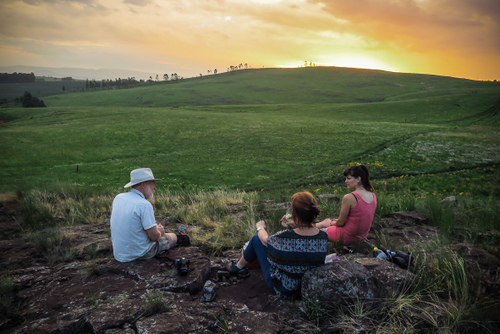
Of course, the fact that I now live in one of the most breathtakingly scenic parts of the KwaZulu-Natal Midlands – the Karkloof – also made my incarceration a lot easier to bear…







 Stidy's Eye