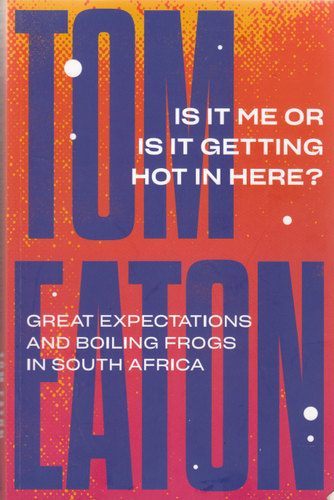
Tom Eaton is undoubtedly one of South Africa’s most witty and erudite commentators with a brand of humour that manages to be both razor-sharp and wryly tongue-in-cheek at the same time.
His latest collection, still fresh despite being mostly written before the Covid-19 pandemic struck, rails against current political shibboleths to entertaining and pointed effect. As is only to be expected, Eaton pulls no punches as he takes satirical swipes at a number of rather large and obvious targets – the ANC, Eskom, the SABC – but with his slightly skewed, off-centre approach he manages to illuminate this familiar territory with sharp flashes of novel insight..
Of course, no book about South Africa’s recent history would be complete without a dissection of the rotting cadaver of state capture that was the hallmark of Jacob Zuma’s time in office and Eaton duly obliges with a typically excellent, if typically depressing, essay on the man and the damage he inflicted on the country
In places, it is not at all a comfortable read. Eaton has a habit of shredding many of our common self-deceptions and irrational beliefs, as well as the sort of deluded wish-thinking that often characterises public debate. He includes, for example, a very thoughtful and balanced piece on the role of politics in sport in South Africa, arguing that it is naïve to think you can separate the two. In a chapter dealing with another vexed, contentious South Africa issue – the re-imposition of the death penalty – he puts forward a similarly persuasive argument, showing how we often allow our heated feelings on the subject to override common sense.
Eaton does not confine himself just to local matters. Elsewhere, he includes a perceptive essay on what is happening in the United States, a nation which seems to have been dumbed down to the extent where responsible and informed policy has largely ceased to exist under a regime that denies the reality of global warming and which has a president who advocates drinking bleach as a cure for Covid-19..
Eaton’s writing can be pithy. It can also be deadpan. Underpinning it all, though, is a deep vein of seriousness which forces you reconsider and look again at many of your own assumptions about the sort of society we live in. Or, as Eaton himself puts it, the book is “about trying to resist the knee-jerk responses that professional manipulators want us to have…”
Intelligent, well written and extremely funny, Is it Me or is Something Getting Hot in Here? is a terrific compendium of the incompetence and occasionally appalling behaviour of those in whom we have entrusted our vote. It also holds up a not always flattering mirror to ourselves…
Published by Bantam Press
With his blend of sardonic humour and noble integrity, Lee Childs’ laconic hero, Jack Reacher, is one of crime fictions most likeable and engaging characters.
In his latest outing we find him sitting on board a Greyhound bus, heading along the interstate highway, with no particular destination in mind. Across the aisle an old man sits asleep with a fat envelope of money hanging out of his pocket.
Reacher is not the only one who has spotted it. When the old man gets off, at the next stop, he is followed by another passenger with slicked-back, greasy, hair and a goatee beard. Naturally Reacher, his suspicions aroused, decides he better disembark as well, just in case the other guy has bad thoughts on his mind….
He has. Needless to say, by the time Reacher has finished with him he has good reason to regret ever harbouring them. While obviously grateful for Reacher’s intervention the old man is clearly reluctant to explain who the cash is intended for or to let him get further involved in his affairs.
This merely serves to pique Reacher’s interest further. Having insisted on accompanying the old man home, he eventually gets him to admit that he and his similarly elderly wife are the victims of an ugly extortion racket.
For a loner like Reacher who only becomes sociable when he meets good people in a jam, this goes against the grain and he immediately decides that the time has come to mete out his own particular brand of retributive justice against those who are making the old folks life a misery.
It takes Reacher little time to flush out the enemy but he also discovers he is vastly outnumbered. Despite finding himself caught up in the middle of a particularly vicious turf war, however, between two nasty rival gangs – the one Albanian, the other Ukrainian – he never seems to be in danger of losing his head.
Author, Lee Child, is a reliable performer and once again delivers an enjoyably familiar, violent, pacey, caper. The action sequences are handled with his customary elan while, at the same time, he convincingly manages to convey the sleazy, menacing, underbelly of modern city life.
Whatever happened to the small town hotel? When I was growing up they were all over the place. Now, they seem to have become an endangered species.
This is, of course, a rhetorical question and one which has an obvious answer. Their demise became inevitable once they started having to compete with all the cheaper bed and breakfasts and self-catering establishments that suddenly began springing up across the sub-continent like a contagious rash.
Others found themselves replaced by up-market, chain hotels or, because of a decline in bookings, were converted into slightly run-down-looking shops and boutiques. Or else they were simply knocked down to make way for something else.
Such is the nature of progress. I find it all rather sad because so many of those old hotels were architectural gems which gave the small towns both character and definition. Often they were the most distinctive buildings in them.
The ones, I remember, from my Rhodesian and Zimbabwe days, were invariably situated alongside the main road. Tall palms or blue-gums with peeling bark and rustling leaves cast pools of shadow over them.
Most had large wrap-around verandahs with arches and pillars and a few pot plants strategically scattered about to create the right ambience. Also an assortment of old wicker chairs and a few tables to put your drinks on. The roofs were steeply pitched and made of corrugated iron, often painted red or green. The outside walls were white.
Inside, the lounge
would be equipped with a tired-looking, over-stuffed couch and a few
mismatched, broken-backed chairs. Often there was a slightly strange
smell – a weird combination of stale beer, frying odours from the
kitchen and dust. Even the ancient looking fans that whirled from the
ceiling above you couldn’t disperse it…
I was always scared of those fans. Too often, they looked like they could, at any moment, come spinning off their bearings, decapitating some unfortunate soul in the process.
The rooms, themselves, were not exactly posh. The furnishings were minimal, the curtains gauzy, the carpets threadbare. A few pictures, often reprints depicting snow-capped Alpine mountains, would hang on the wall while the beds, with their lumpy mattresses, would sag in the middle. If there was a wash basin in the room, the tap often leaked. More often than not there was no en-suite bath; you were obliged to use the communal one at the end of the passage.
The walls were like matchwood. Through them you could hear the radio or TV (if they were lucky enough to have such modern contrivances back then) being played next door or people murmuring in low but hard-edged voices. Upstairs it sometimes sounded like there were platoons of soldiers practising their drills in hob-nail boots on the wooden floor boards.
Their departure
from the room would often be followed by a wall-shivering door slam..
Lying in bed, trying to get to sleep, you could hear engines throbbing, brakes screeching or cars thundering along outside. If you were near the railway line – again, many of these hotels were – your sleep would invariably be disturbed by the blast of a train horn as it came puffing grandly in to the station, before stopping with a loud squealing of brakes.
In the dining room,
the food, served by turbaned waiters, although edible would hardly
qualify as haute cuisine especially by today’s high culinary
standards. Mostly, it was meat and two vegetables, over-cooked, a bit
like the mush they dished up at boarding school
Invariably, the most well-frequented part of the hotel would be the bar. There were usually two kinds of these – the swanky cocktail bar which women (this was before the MeToo Movement) were allowed to frequent and men were expected to wear a tie; and the saloon bar which was Men Only.
The latter were spit n’ sawdust affairs and there was no real ‘dress code’ here except you had to wear long trousers after 6pm. If you wanted an insight into White Rhodesian “culture” this was the place to go. Easily identifiable were the regulars: a sad-eyed collection of red-nosed, old misfits staring gloomily in to their drinks. Most of them turned up as soon as the pub opened and stayed until it closed.
There wasn’t much talking, just a lot of guzzling. Having frequented the place for years most of them had exhausted their personal lives as conversational topics. Occasionally they would try some other subject.
Something like “Nice
weather we’re having,” might be tried as an opening gambit.
“Yeah – very
nice,” the grunted reply.
In stark contrast
you would get the groups of young bucks, throwing darts and playing
pool and yelling at each other about what a good time they were
having.
In my early twenties I rather liked frequenting these bars although I was never one of the dancing on the tables sort. When I was based in Sinoia (now Chinoyi), working for the District Commissioners Office (my penance for letting the Government pay part of my varsity fees), I practically lived in the local bar.
There was not much else to do…
The Specks Hotel in Gatooma (now Kadoma) was another one I got to know during my Mines Department days and which perfectly fulfilled all my expectations of it.
Specks Hotel, Gatooma (now Kadoma).
Not that all of
these small town hotels were tatty and down-at-heel and fallen- on-
hard- times.
The Cecil Hotel in Umtali (now Mutare) was a rather grand old lady until it got taken over by the army, during the Rhodesian Bush War, and converted in to an HQ. So was the Midlands Hotel in Gwelo (now Gweru), another period hotel which stood directly opposite the Boggie Clock Tower, a rather strange edifice erected in the middle of Main Street for no other reason, it often seemed, than to confuse out-of-town motorists ( it was actually built in 1928 to commemorate Major William James Boggie, an early big-wig in the town).
Boggie Clock Tower with Midlands Hotel on right. Gwelo (now Gweru).
After independence there were suggestions the Boggie Clock be pulled down. I am not sure whether that was because of its unfortunate colonial associations or because it was a traffic hazard. As far I am aware, it is still there, still bamboozling out of town motorists.
For me the most stylish and grandiose of all these hotels was the Old Meikles Hotel in Salisbury. Some might quibble, here, as to whether it actually qualifies as a small town hotel but since Salisbury was still in its adolescent stage when the hotel was built, back in 1915, I am including it.
Overlooking the gardens of Cecil Square where the first British settlers raised the Union Jack, it was a study in Victorian elegance and old world charm. Again there was a wonderful old verandah in the front where you could collapse in to a comfy seat and sip your gin and tonics and watch the folk passing by. Inside it was pleasantly dim, high-ceilinged and paved with cool tiles.
On Saturday mornings it would be packed solid with wealthy tobacco farmers come to town. Often there would be a man tinkling away on the piano in the background of the lounge where the farmers had congregated, with another man playing the double bass next to him, partly concealed by a potted palm tree.
In what can only be
counted as a resounding victory for the cultural philistines – and
an unmitigated disaster for the rest of us – the Old Meikles was
demolished in the mid-1970s and replaced by a functional, modern but
utterly character-less structure.
Having grown up with
it always being there, like a comforting blanket, I felt bereft. I
was never able to look at Salisbury through the same eyes after that.
When I moved to
South Africa in 1984 – the demolition of the Old Meikles was but
one of my reasons for taking this step – I found the situation very
much the same down here although here and there a few of the old
hotels still survived.
There is still one in Howick, the town nearest to where I now live, whose doors continue to remain open although how well it is doing I have no idea. It is just around the corner from the Howick Falls so is, not too surprisingly, called the Falls Hotel.
Howick Falls Hotel.
Somerset East, where my sister Nicky and her husband, John, moved to, around 2009, has one on its main street named – you guessed it – the Somerset Hotel.
My pub-crawling days were long over when I came drifting in to town so I never actually went inside but I am sure it would meet all the criteria for a small town hotel. The outside certainly does except it is painted a garish yellow instead of my preferred white, a black mark in my eyes.
The one morning, when I was staying with my sister, an almighty hullabaloo suddenly erupted from outside it which had me thinking the end of the world was upon us. When we went out to investigate we found ourselves confronted by a scene that looked like something from the set of a Mad Max movie. The bikers had come to town.
Bikers outside Somerset Hotel
Biker, strutting his stuff.
There seemed to be hundreds of them hurtling up and down the main drag, revving their engines, spinning their wheels and kicking up huge clouds of blue smoke, hydrocarbons and testosterene in to the air. Others were leaning from the balcony upstairs, clutching their brandy and cokes and shouting boozy instructions.
Folk thronged the street, some still in their Sunday finery, others in filthy T shirts and shorts. Kids dodged in and out of the traffic. There was so much haze and noxious gas and so many people you could barely make out the Dutch Reformed Church down the road.
It all kind of made sense. If the first thing you need in a small town is a kerk for your prayers, a mart for selling food and a pub where you can commit the sort of sins that would warrant praying about, than Somerset East filled the bill.
It was a classic Southern African dorp with a marvellous old hotel…


 Stidy's Eye