According to the opposition Democratic Alliance, Msunduzi is far worse now than it was before it was placed under the “selective” and “ineffective administration, which served only to placate ratepayers rather than deal with the problems that had bought the city to its knees”. It is a view shared by many ordinary citizens who continue to voice their concerns over the ever-increasing signs of neglect and poor maintenance.
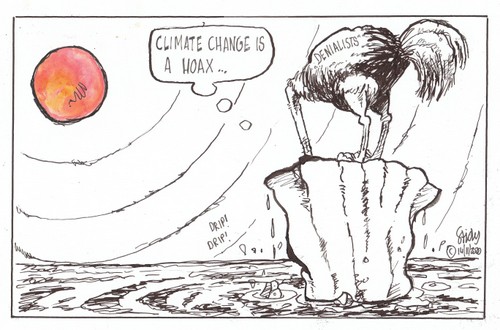
The Arctic is unravelling faster than anyone could have imagined just a few decades ago. Scientists have warned that the Greenland Ice Sheet, for example, is no longer growing. Instead of gaining new ice every year, it has begun to lose roughly 51billion metric tons annually, discharged into the ocean as melt-water and icebergs.
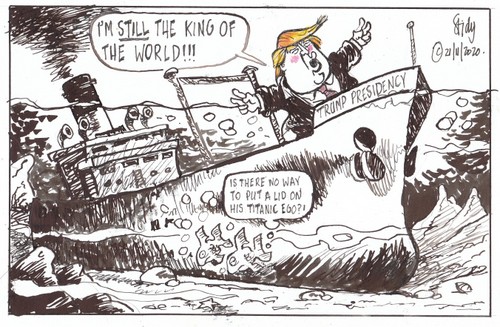
In the United States, President Donald Trump was condemned by opponents for firing the senior official who disputed his baseless claims of election fraud as the president pressed on with his his increasingly desperate battle to overturn Joe Biden’s victory. This despite the fact that officials declared 3 November’s contest between Trump and Biden the most secure US election ever.
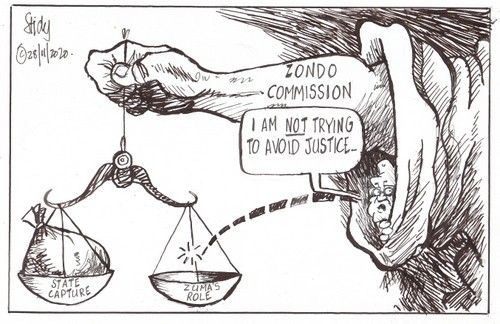
Former President Jacob Zuma continued to duck and dive and do everything thing he could to avoid facing justice. Having briefly appeared before the state capture commission to hear whether his recusal application for commission chair Ray Zondo had been granted he disappeared, without being excused, during the tea break. The commission adjourned to reflect on what to do next.
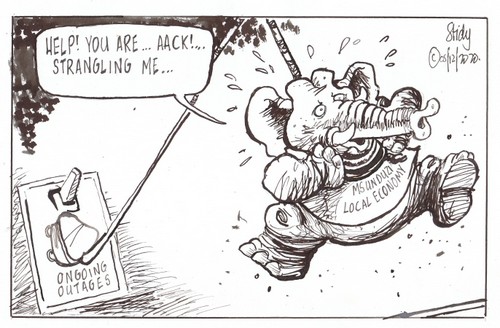
There were mounting fears that Msunduzi could face a massive blackout if the municipality does not urgently deal with the persistent outages that have severely compromised the network. The City’s electricity problems was also strangling the local economy and some businesses were even considering leaving Pietermaritzburg for towns with more stable power supply.
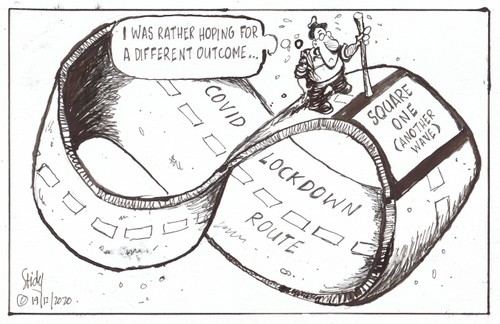
South Africa has entered a second wave of Covid infections, breaching 6 000 new cases, Health Minister Zweli Mkhize said in a special television broadcast. The peak age bracket is now between 16 and 19. “It’s believed to be due to a large number of parties involving young people drinking alcohol with no adherence to non-pharmaceutical interventions, wearing of no masks and social distancing and hand sanitising not taking place,” Mkhize said.
In an address to the nation, President Cyril Ramaphosa, announced a tightening of Covid-19 restrictions, including the closure of KZN beaches during the main days of the festive season. He attributed part of the cause of the second wave of infections to a lack of compliance with safety measure such as social distancing.
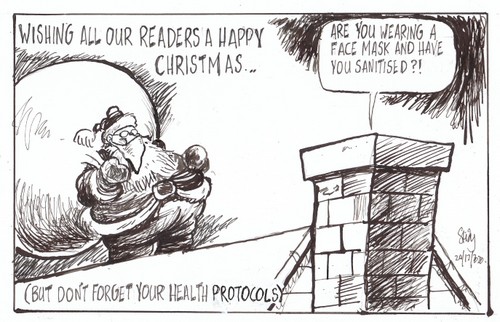
In the wake of a year dominated by Covid-19, being cautious is probably the best thing you could do over the festive period so I decided to make that the subject of my Christmas cartoon.
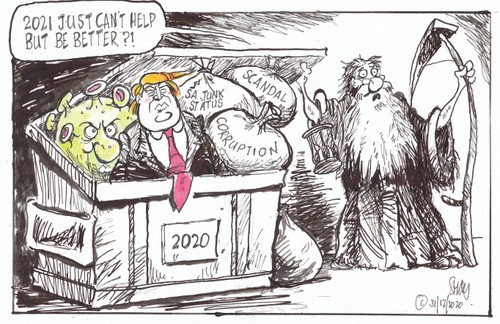
2020 was a truly terrible year and I think most people were glad to see the back of it – hence my New Year cartoon…
I am, by nature, a bit of a wanderer. Even though I live in one of the most beautiful parts of the country and am mostly satisfied with my lot every now and again my questing instinct begins to reassert itself and I feel obliged to follow where it leads me.
There are good reasons for this. By evolution we are hunters and gatherers. It is an underlying drive. It is part of that sense of excitement and privilege which comes from finding something special – be it a landscape, animal or bird.
Thus, when my sister asked me if I would like to join her on a trip through Mpumalanga and Limpopo Provinces there was no way I could say no…
With the Mapungubwe leg of our expedition behind us, we have now just passed through the Pafuri Gate and driven in to Kruger National Park. It is still dry season and what little grass there is has been grazed to the ground. Although we don’t see them, there are signs of elephant everywhere. Their droppings litter the road. Hundreds of tiny dung beetles are busy mining the excreta, turning it in to compact balls, often a lot bigger than themselves, and then rolling them away. Elsewhere, broken trees and branches lie strewn across the landscape. The closer we get to Pafuri and the Limpopo and Luvuvhu river, the worse the carnage gets.
Just over the Luvuvhu Bridge we turn left down the road that leads to Crook’s Corner where the borders of South Africa, Zimbabwe and Mozambique meet. In the cool of the morning this route, with its lush riverine forest, is one of South Africa’s prime birding drives but because of the intense heat there is not much activity now.
We stop for lunch at the picnic area on the banks of the Luvuvhu. Sitting in the cooling shade of the massive, spreading, Nyala and Jackal-berry trees my thoughts drift back to the Battle of the Somme-like scenes I have just witnessed.
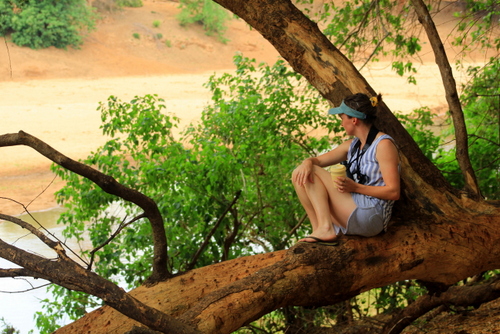
Pafuri picnic site, Luvuvhu River. My niece, Kelly.
Elephants have, of course, been destroying woodlands for thousands of years. In the process, they consume vast amounts of pods which they then deposit elsewhere so, in that sense, this is all part of a natural process of regeneration. The problem now, of course, is that the elephants movements have been restricted to certain protected areas and park which puts added pressure on the environment.
Kruger is probably big enough to absorb the damage but you do feel a solution needs to be found in some of the more worse hit areas. It is a controversial subject, of course, although there is one thing I am certain of. It is no good saying we mustn’t interfere with nature. We already have.
At Pafuri there is another factor which has led to the destruction of the riverine forest. If extreme weather still counts as natural, than the severe floods that have hit the area in recent years, uprooting or flattening hundreds of trees, overnight, changed much of the landscape. Again, it could be argued that this nature’s way of replenishing the precious top soil and allowing new plants to emerge, although such thoughts also, invariably, lead to the question of climate change.
What effect is it having? Will it have a significant impact on bird-life and mammals? Will they be able to adapt? These are questions which go around and around in my brain and end up nowhere, so I go back to munching my sandwich.
The subject of climate change still weighs heavily on my mind, later that day, as we sit on the verandah of our chalet at Mopani Camp, overlooking a dam studded with dead tree trunks. The temperatures are in the low-forties. I feel like I am drowning in the heat. Everywhere animals and birds lie spread-eagled in the shade. Even the usually noisy, hyper-active, Greater-eared Starlings sit panting in the shrubbery.
In this breathless air, the normal sounds of the bush have become eerily muted. The birds have stopped singing, the butterflies have grown lethargic and abandoned their search for nectar, the lizards cease scurrying, the hippos sink deeper in to their watery homes.
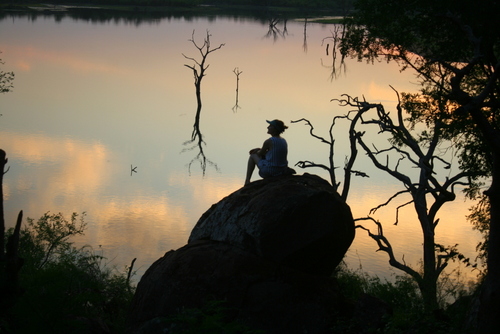
Even the coming of night fails to sooth it. As the sun sinks, the water of the dam turns the colour of cauldron flames. Along it edges, duck, geese, heron, egrets, cormorants, darter, stints and little waders stand motionless, frozen in the moment like figures in a painting. Suddenly a family of White-faced Fulvous Whistling Duck rise, in spumes of spray, and head off across the dam. Their rallying whistle is a sound like no other. Hearing it, the years flash back, through my childhood, to the days when I used to go out exploring with my brother, Pete, or went fishing with my Dad for bream in the farm dams.
Sunset over dam. Mopani Camp.
On the edge of darkness, flocks of Red-billed Quelea come swirling through the evening sky in massive, rolling, waves, to their roosting spots in the trees along the water’s edge. Suddenly a much larger, darker form swoops out of nowhere at breath-taking speed and veers down towards them. Then – another. And another! Three Bat Hawk, each one the essence of distilled cunning, are out hunting. The Quelea immediately become vigilant and shoot up in another massive wave of movement. One bird is not so lucky. Having seized the tiny bird in it talons, the Bat Hawk wheels off victoriously. Still flying in synchronised formation, the rest of the Quelea continue with their evasive action before returning to their roosting spots, to live to fly another day.
There has been no let up in the temperature the next day. In fact, it has got worse.
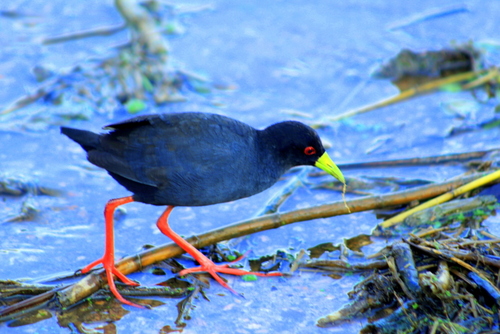
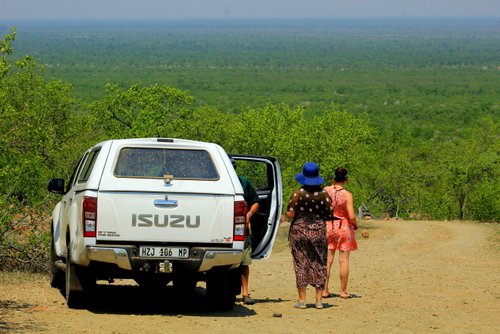
Exhausted by the heat my sister elects to remain at home but the rest of us head off in the Isuzu bakkie along the Tshongololo Loop. We stop at the ford below the Pioneer dam. Scampering alongside it are a pair of Black Crake. They are normally the shyest of birds but these ones have grown so accustomed to the steady flow of traffic across the bridge that they barely give us a sideways glance.
Black Crake.
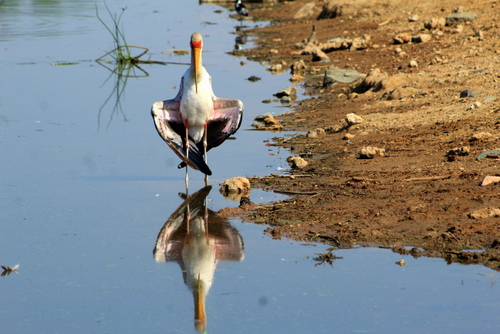
In the shallows on the other side of the bridge there are some Spoonbill and a Great White Heron. A lone Yellow-billed Stork stands with his wings outstretched, gazing intently into the water. Like the Narcissus of legend, it seems to have fallen in love with its own reflection although I am not sure why because they are curious-looking birds. Or maybe it is just hoping to spear some fish…
Yellow-billed Stork.
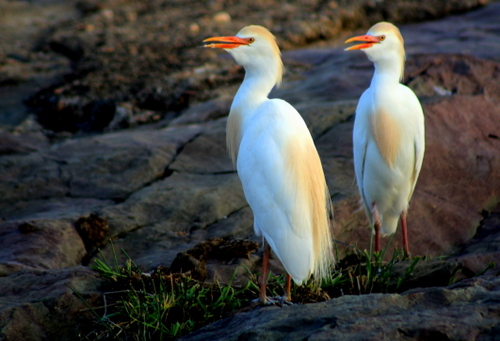
A family of Cattle Egret stand amongst the rocks on the banks of the river. There are yawning hippo in the pool. Crocodile too.
Cattle Egret.
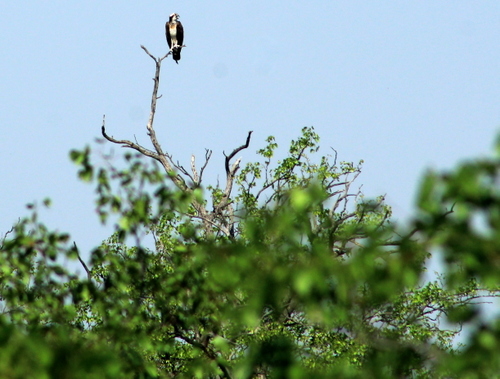
Leaving the river behind us we find ourselves rapidly encircled by a sea of low Mopani scrub, just come out in leaf. Sitting in the front seat, I feel like I am on the bridge of a battleship pounding through waves of green. Suddenly, above this leafy expanse, I see a tall, dead branch protruding like a submarine’s periscope. On it sits a raptor. It takes a while for the different components of my brain to start working in unison before I finally figure out what it is – an Osprey. I go through various stages of disbelief. Really?! What is it doing out here in the boondocks? It is totally out of its normal habitat. Then I remember the Pioneer Dam is not all that far away. I take a photo of the bird even though it is just a speck in my viewfinder.
Osprey.
There are lots of Brown-hooded Kingfishers in the woodland. This kingfisher, like the Wooded, Striped and Pygmy Kingfishers, is an oddity of evolution in that it doesn’t actually fish or hang out near water but prefers to hunt for insects deeper inland.
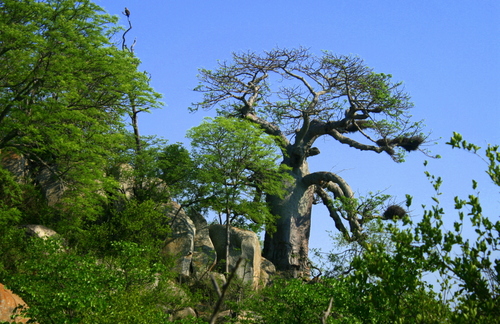
Further on, we come to a rock kopje. Growing amongst its elephant hide-coloured boulders is a massive baobab, in which a colony of Red-billed Sparrow Weaver’s nest. The birds are agitated. We soon discover why. A rufous-form, Tawny Eagle sits on one of the branches, a study in regal elegance. I decide the whole scene will make a good painting so take another photograph. The eagle flies off and lands on top of a nearby dead tree.
Baobab. A Tawny Eagle can just be seen on high branch to the left.
We plough on through miles and miles of similar looking country before returning home later that day.
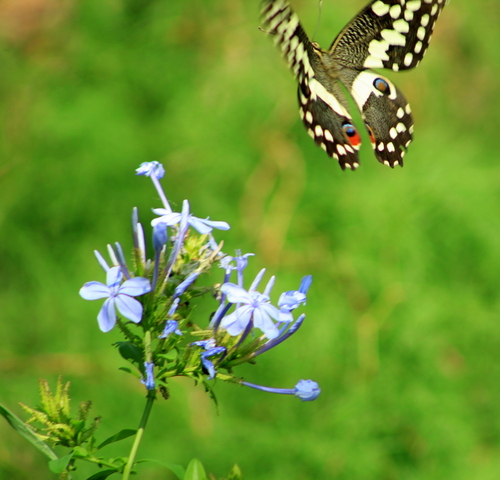
Eating breakfast on the verandah, the next morning, we are visited by two of the larger reptiles who seem to have made their homes amongst the tumble of rocks in front of our chalet – a Plated Lizard and a Water Monitor (or Leguuan) Then some butterflies flutter by. Among them, I recognise the Citrus Swallowtail, African Monarch, Blue Pansy. My brother-in-law says there don’t seem to be as many birds scrounging around the chalet as there was the last time he visited. He wonders if this is because lockdown had deprived them of their most reliable food source – the stuff discarded by humans – forcing them to move away?
Citrus Swallowtail alighting on blue Plumbago...
After breakfast, we decide to brave the heat once more and head off along the Tropic of Capricorn loop road that takes you through yet more of the flat, savannah plains that stretch out as far as the eye can see, in every direction, As we drive through this familiar landscape, I feel that old sense of connection I always get when I am in Kruger. It is like I have become part of something much larger than myself but which somehow includes me. It is an almost spiritual – some might say, religious – connection with the bush.
On the road directly in front of us a large shadow silently steals so I direct my gaze upwards through the windscreen of the car. With its stubby tail and striking colours there is no mistaking a Bataleur. Later we will see one squatting on the ground. Parks, like this one, have become one of the last bastions for this majestic eagle.
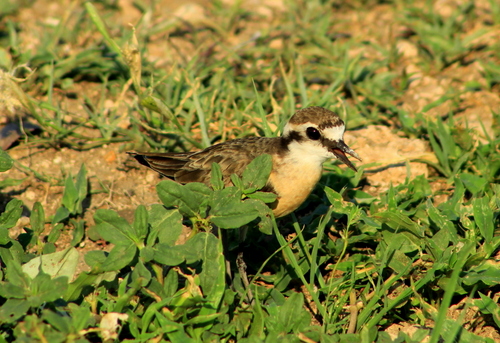
A bit farther on we come to a place where a recent thunderstorm storm has flooded part of the plain, leaving an extended puddle of water in which are several small waders – White-fronted Plover, Kittlitz’s Plover, Marsh Sandpiper, Wood Sandpiper, Ruff. We drive on. Just around the corner, in the same open expanse of ground, I discover a flock of birds I had failed to find in Mapungubwe – the Chestnut-backed Sparrowlark (formerly Finchlark). Although there are plenty of trees they could fly to, they have chosen to seek refuge from the sun by huddling up in the shadow cast by a few stones. Just beyond them I spot one of my favourite songsters – the Rufous-naped Lark. A Black-chested Snake Eagle wings overhead.
Kittlitz’s Plover.
The temperature rises by a degree, then another. It is nudging towards forty-five. As it does so everything begins to slacken: the restless searching for food, the browsing, the fluttering about. Buffalo, Wildebeest, Tsessebe, Kudu, Impala, Waterbuck lie idle in the torpid heat. Birds seek shelter in trees and under bushes, their beaks agape desperately tying to keep cool.
A car has drawn up on the side of the road up in front of us. We stop to see what its occupants are looking at. A shape suddenly comes in to view high up in a tree. There is a leopard drowsing in a fork between several branches, its tail twitching as if trying to fan itself.
We move on, leaving it in peace. Despite the heat, there is still game in plenty even if most of it is resting. As we drive, I search with hopeful eyes for lion or – even better – Wild Dog but other than the solitary leopard there doesn’t seem to be a predator for miles around. Nor do I see any vultures circling high in the sky, indicating a possible kill. (a good friend of mine, the bird artist Penny Meakin, will pass through this part of the world a few weeks later and have much better luck – she will see seven lion, several leopard, a pack of Wild Dog, a cheetah, plus a host of vultures squabbling over the carcase of a recently killed buffalo).
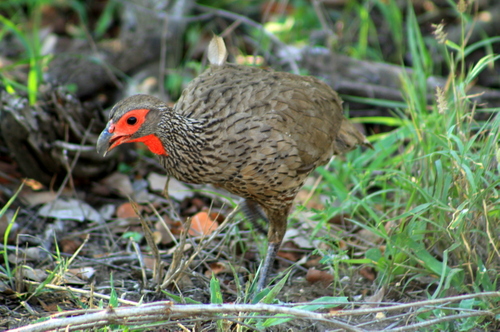
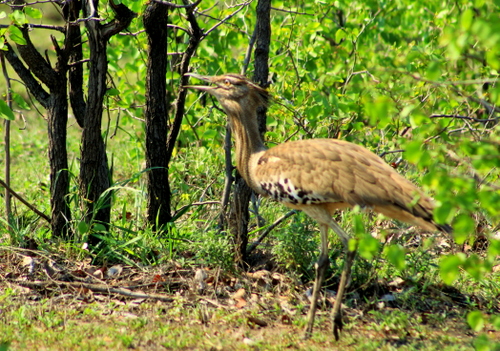
Undeterred, I keep scanning the sides of the road, picking up several birds as I do so – African Pipit, Wattled Starling, Double-banded Sandgrouse, Swainson’s Spurfowl, Brown-crowned Tchagra, Red-headed Finch, Red-breasted Swallow, Kori Bustard, Jacobin Cuckoo and, most special of all, a family of Ground Hornbill who regard us quizzically through long eye-lashes before ambling off.
Swainson’s Spurfowl
Kori Bustard.
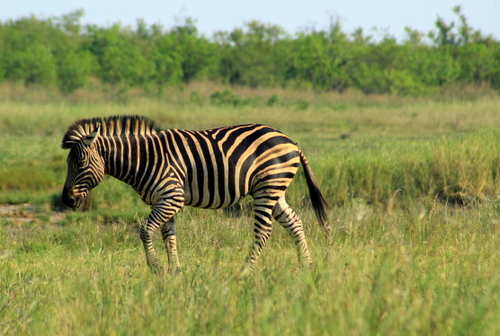
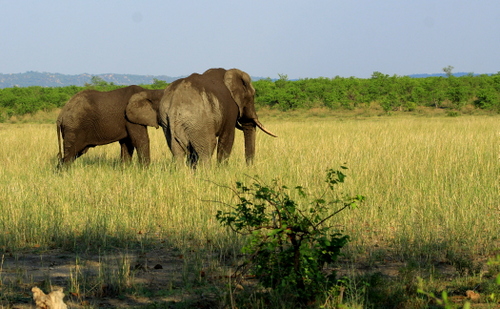
Running roughly parallel to the distant Lebombo mountains is a long, thin, shallow depression where grass, reeds and rushes grow in course clumps, almost like moorland. Later in the season I can imagine it will be completely flooded bringing in scores of waterfowl but at the moment there are only a few pools of water. It looks like ideal lion – or even cheetah – country to me but still no luck.
Zebra in vlei.
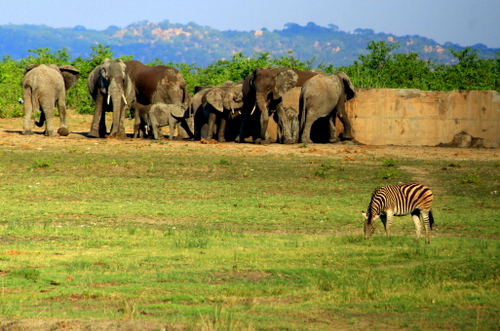
Elephant in vlei
By an old concrete reservoir, a herd of elephant queue patiently, waiting to take their turn to drink. There is no other animal in the wild that elicits quite the same emotions in me as an elephant. I love them but I fear them too. They are huge but delicate, powerful but surprisingly gentle. They can shatter the sky with their angry trumpeting and yet are also able to move through the bush as silently as ghosts…
Elephant. Lebombo in background.
Elephants travel in matriarchal groups, ordinarily the leader is the oldest cow. There are several new calves with this group. Yet again, I am struck by the strong sense of family the herd exhibits. You can feel the kinship, loyalty and respect for the matriarch. I wish human society was as well-ordered and peaceful. If elephants bear ill-will towards us it is hardly surprising for we have harried, tormented and hunted them for so long that the memories of man-inflicted terror must be ingrained deep inside their cavernous skulls.
A little further down the long vlei, the road abruptly veers right, heading up to the Shibavantsengele lookout point in the Lebombo range. We decide to go there. Stepping out the car is like stepping in to a furnace but the view makes it worthwhile. The Lebombo – which begin in Zululand and then stretch up through Swaziland to provide Kruger with its spine – are not particularly high at this point, but are still high enough to make you appreciate the enormity of the land, stretching away in to the blue distance and simmering in the thickening heat haze. There is a magic to this place. A spirit seems to haunt the air, ancient and impassive.
View over Kruger.
That evening, as I help myself to another generous glass of my brother-in-law’s very expensive single-malt whisky, I am aware of a changing of the guard. One set of living animals is going off to slumber, while another comes to life.
The surface of the dam turns a fiery gold again. The Quelea are returning to their roosts but although I search the skies with my binoculars I see no sign of the Bat Hawk. Maybe they have decided to do what Bat Hawks are supposed to do and gone off looking for bats (my brother-in-laws bat detector has picked up hundreds of their calls).
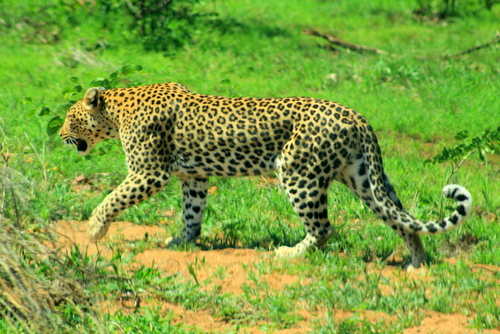
‘The next day we set off home, unaware that Kruger is saving up its best for last. As we are driving, my eagle-eyed sister spots a pair of ears protruding just above some low-lying scrub. For a while the ears remain where they are, then a magnificent female leopard slowly rises to her feet, stretches and ambles across the road directly in front of us. For a few minutes she stands in the middle of it, coolly observing us. Then, with a dismissive whisk of the tail, she strolls on.
She has performed her royal duty – provided us with a classic tourist photo-opportunity. Now we must buzz off.
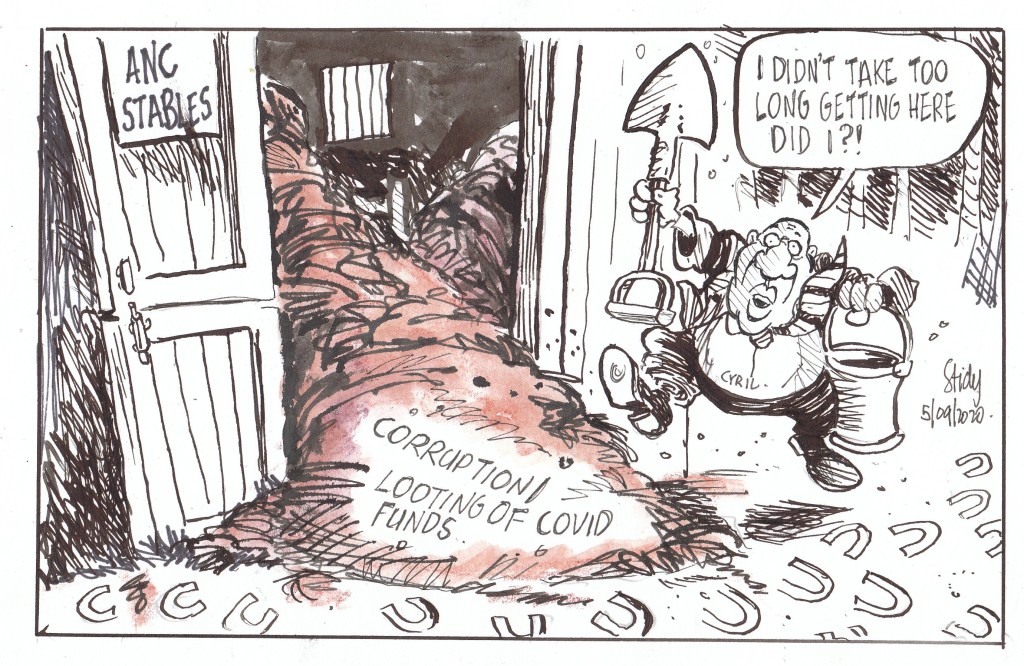
In the face of a fierce and vitriolic fightback by the agents of corruption in the ANC, President Cyril Ramaphosa appeared to achieve a tactical victory at a meeting of the NEC with members finally committing to act against comrades accused of corruption. He now faced the challenge, however, to give effect to the resolution, no easy task in a party riddled by factionalism and internal power plays.
The Democratic Part (DA) wrapped up its annual policy conference by adopting numerous policies, including one that said race was not a proxy of disadvantage when dealing with issues of redress. This was followed by reports that the party risked yet another exodus of senior members after opening investigations against several leaders with the intention of charging them, while others were planning to leave because they were disillusioned with the direction the official opposition has taken.
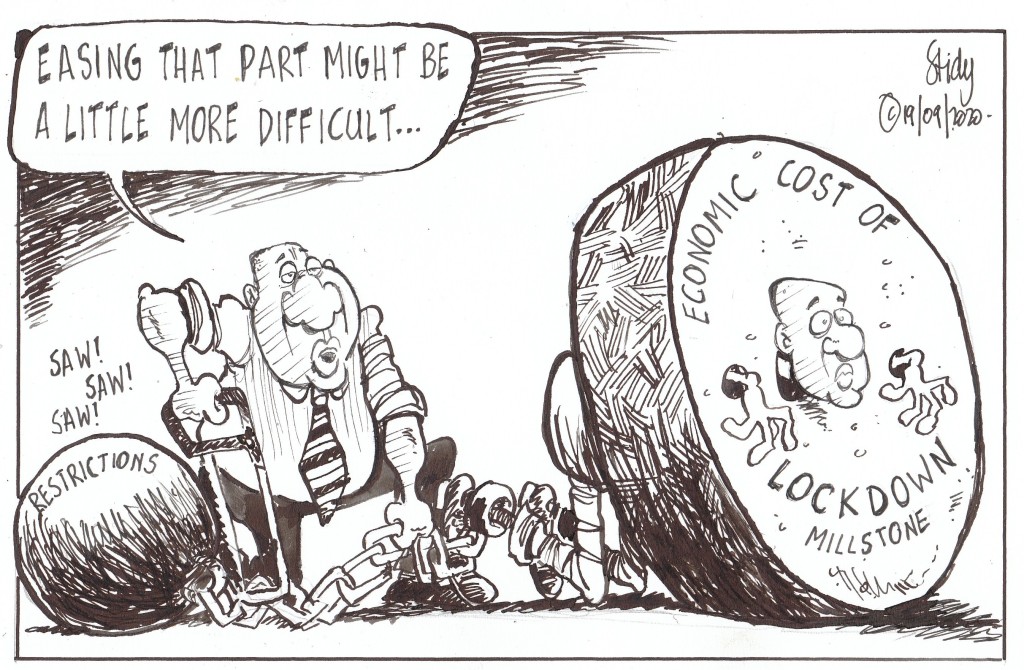
Six months after lockdown measures were imposed, President Cyril Ramaphosa announced that the country would move to lockdown level 1 from Monday September 21. He also announced that an Economic Rescue Plan was being fast-tracked which was only to be expected given the contraction in the economy and the fact that the country was, by his own admission, now effectively bankrupt…
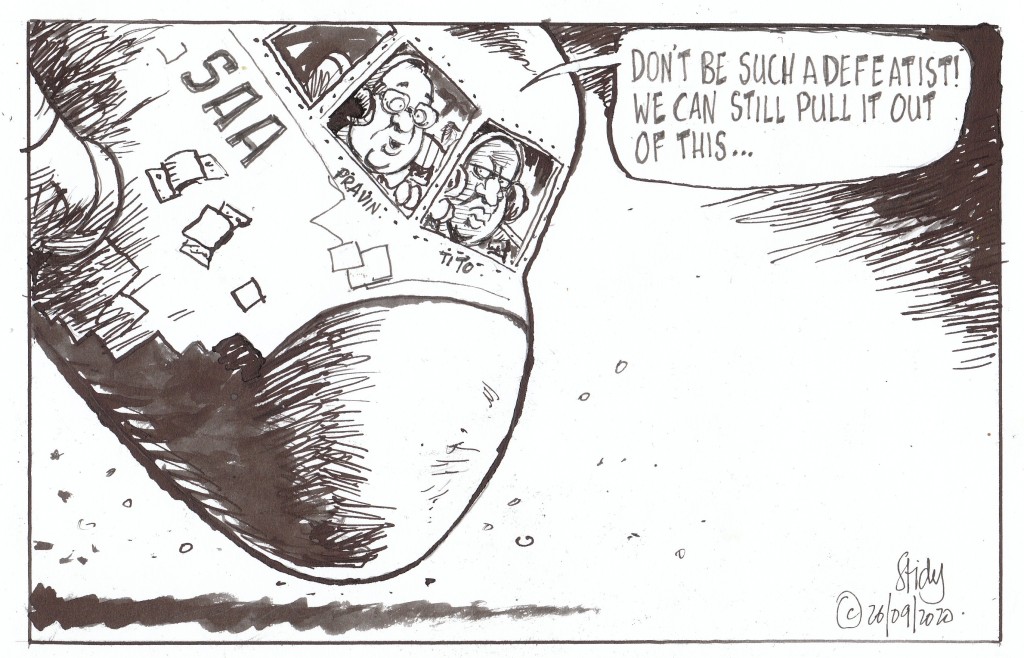
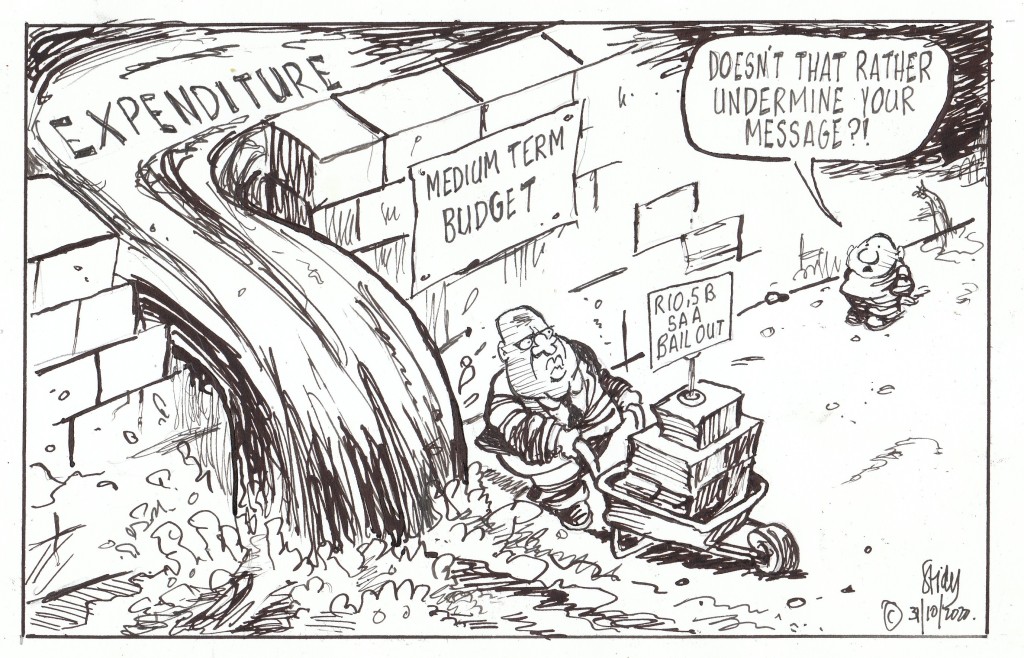
According to various sources, South African National Treasury officials reluctantly complied with orders to find funds to bail out the state airline, fearing they may erode the nation’s fiscal credibility. Finance Minister Tito Mboweni had long argued that the government can’t continue funding the national carrier, putting him at odds with the top leadership of the ruling ANC and Public Enterprises Minister Pravin Gordhan, who insist it must keep flying,
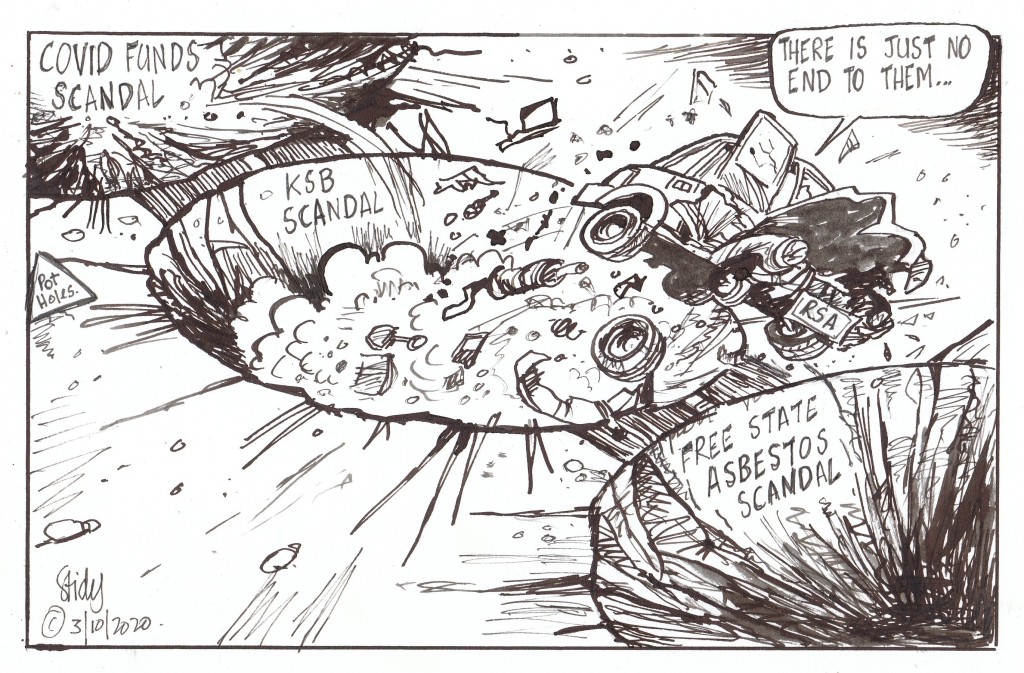
The high profile sweep on officials and businesspeople implicated in the R255 Million Free State asbestos audit deal scandal was universally welcomed because there has been an overwhelming perception among the public that thievery, as the modus operandi of the tenderpreneurs, would remain unchecked. According to opposition parties, however, the arrests marked just the tip of the iceberg and further investigations were needed to bring all those involved to book.
Meanwhile, the Evangelical Alliance of South Africa said that the practices at the KwaSizabantu – which involved allegations of human rights abuses and money laundering – were damaging to the reputation of other churches…
Msunduzi administrator Scelo Duma described the SAP financial system as “the Achilles heal of Msunduzi”. The top-of-the-range software package, installed in 2016 to integrate the management of finances, had already cost the municipality over R251 Million and had continued to be plagued with problems.
South Africa wouldn’t be able to meet its finance ministry’s debt targets and it may be undesirable for it to attempt to do so at a time when the economy is being battered by the fallout from lockdown, according to an advisory panel appointed by President Cyril Ramaphosa. In a more than 100-page document advising the government on an economic recovery programme that Ramaphosa was due to unveil the Presidential Economic Advisory Council said spending cuts would hold back growth and have adverse consequences.
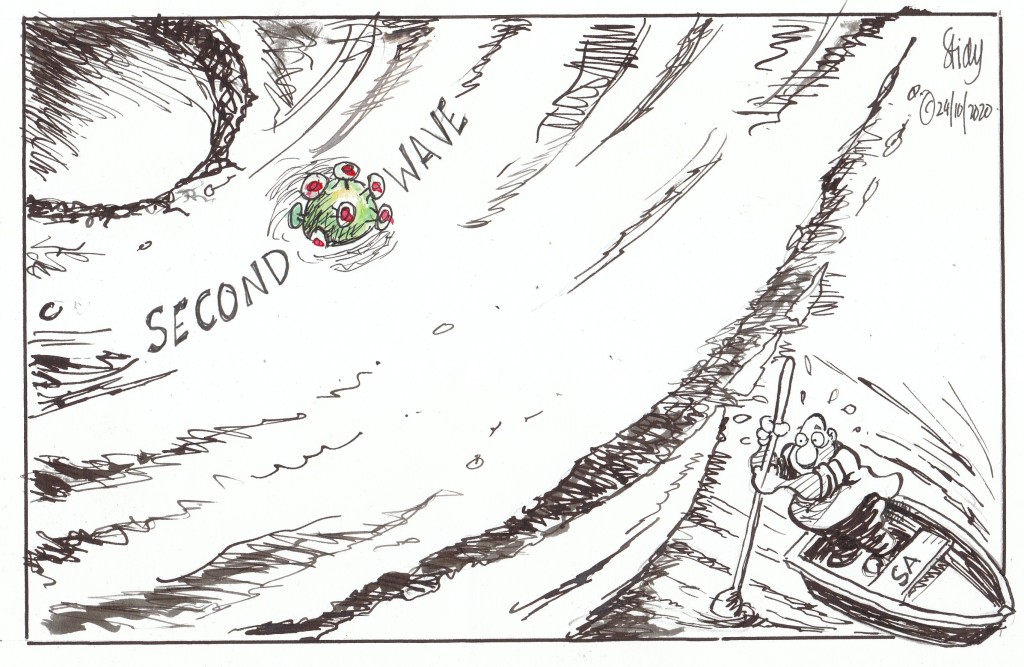
The news that Health Minister Zweli Mkhize and his wife May have tested positive for Covid-19 was a reminder that people are still vulnerable despite the diminishing rate of infection in South Africa. It was especially sobering considering what is happening in the US and Europe where infection rates have begun to soar again as part of the ‘Second Wave’ of the pandemic.
Tabling his mid-term budget Finance Minister Tito Mboweni stressed the country was in trouble and that something needed to be done. Acknowledging that there was “no room for slippage” he promised to put a break on expenditure and rein in civil service salaries – something that would have to be seen to be believed, given that he lost his SAA arguments and had been forced to extend a R10,5billion lifeline to the bankrupt national airline.





 Stidy's Eye