At the start of World War Two, the British lagged way behind the Germans in the aerial arms race. The primitive Whitleys, Hapdens and Wellingtons, that formed the backbone of Bomber Command, were inadequately equipped and prone to technical failure. For the most part, they proved no match for their German counterparts. This all changed with the advent of the most famous and iconic four- engined bomber of the conflict – the legendary Avro Lancaster.
When British Prime Minister Winston Churchill could see no other road open to victory, it was to this form of strategic air-power that he turned, the Commander in Chief of Bomber Command, Air Marshall Arthur Harris, having all but convinced him that the Third Reich could be bombed into submission. The cost of the campaign would prove high with Bomber Command’s casualties amounting to almost one-seventh of all British deaths in action by land air, and sea from 1939-1945. While 55 573 aircrew, almost all officers and NCOs, were killed, the German losses were far higher. It is estimated that somewhere between 300 000 and 600 000 people, many of them civilians, were killed by the bombs of the RAF and USAAF.
As effective as the strategy was, it was not without its critics. While many questioned its morality, especially where it involved significant civilian casualties, what is unquestionable is the patient courage of the bomber crews. Packed into their cramped flying metal tubes, they faced the strain of constant operations night after night, forging out into the empty darkness, knowing that the German gunners, probing searchlights and fighter planes would most likely be waiting for them and that their chances of returning were not good. Of the aircrew who served in Bomber Command, a staggering 44.4 per cent lost their lives.
This book is very much a monument to the gallantry, fortitude and endurance of these men. It is based on a series of interviews the author had with Ken Clark, the only surviving member of his crew and one of the very last witnesses of the Allied bombing campaign. Like many young men of his generation, he had been swept up by the whole romance of flying (my father, who also served in Bomber Command, was another), enrolling in flying school as soon as he was able to. He failed to make it as a pilot but was offered and accepted the role of bomb aimer, for which he was eventually awarded the DFC.
Thereafter he took part in countless missions over Germany and the rest of Europe and was also heavily involved in the Normandy D Day invasion. A mixed bag of personalities, the men he flew with were drawn from all over the Commonwealth. His pilot, Flying Officer Jim Comans, for instance, was Australian, another crew member was a Canadian.
Written with remarkable factual authenticity, The Crew captures the terror and exhilaration, the comradeship and self-sacrifice that, for the duration of the war, was at the heart of these men’s experiences. Author Price handles the big political set pieces, that formed the background to the bombing campaign, superbly but his narrative is also consistently enlivened by his ability to telescope in on the small and telling details that reveal what the life of an ordinary Lancaster crewman was like.
published by Jonathan Ball Publishers.
Although located far from the main theatres of conflict, South Africa’s strategic global position, because of the Cape sea route, was considered of vital importance to both the Allied and Axis powers throughout the Second World War.
Determined to disrupt Allied shipping, the Germans quickly dispatched packs of U Boats into South African waters. Initially, at least, they enjoyed some success with a considerable tonnage of shipping being sunk. Hoping to encourage sedition within the country itself, as well as gather valuable military and naval intelligence, the Germans also set up an espionage network – commonly referred to as the Trompke network – operating out of Lourenco Marques in Portuguese-held Mozambique.
They found willing accomplices on South African soil. The decision by the Smuts government to declare war on Germany had not been a universally popular one with a substantial segment of the Afrikaner community still harbouring deeply anti-British feelings as a result of the Boer War. Their opposition to South Africa’s participation in the war crystallised around support for the Ossewabrandwag, a cultural organisation founded in September 1939 and led by the defiantly anti-Imperial Hans Van Rensburg. At first, the contact between Germany and this group of disgruntled South Africans was fairly haphazard but as the war progressed more secure lines of communication were established, particularly through the enigmatic Felix Network.
Alerted to the threat, the British and South African authorities retaliated in kind by establishing their counter-intelligence units although their effort to track down the enemy was often bedevilled by inter-service rivalry and the fact that some local government officials were not entirely committed to the Allied cause. Although a wealth of evidence would be gathered after the war pointing to the fact that Van Rensburg and his cohorts had committed wartime acts of high treason the election of the National Party in 1948 and a changing political climate would ensure they were never prosecuted and got off scot-free.
In writing about this period of our turbulent history, Kleynhans – a senior lecturer in the Department of Military History at the Faculty of Military Science at Stellenbosch University – gained much material from the Ossewabrandwag Archive, an under-appreciated, and largely unknown, archival collection containing key source material detailing the nature and operation of the German intelligence networks in Southern Africa. As well as uncovering a great deal of factual information, his excellent study includes vivid stories about would be German spies crossing crocodile-infested rivers to gain access to South Africa, daring escapes from internment camps and the setting up of transmitter stations, which could communicate directly with Berlin, in remote parts of the Highveld.
As Kleynhans readily acknowledges much of the intelligence gathered for transmission by these isolated cells seems to have been of questionable value. In his view, however, they did serve “a definite propaganda purpose among antiwar segments of South African society”.
What they also did was show up the deep divisions within South Africa society. Undoubtedly the most thorough, even-handed and detailed account of this now mostly forgotten chapter of our history written so far, Hitler’s War admirably captures this schizophrenic state, as well as filling in some crucial gaps in the historiography of the war.
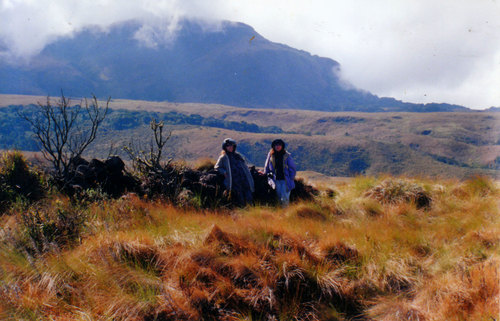
The foothills of Mt Nyangani. Nicky Rosselli and Sally Scott.
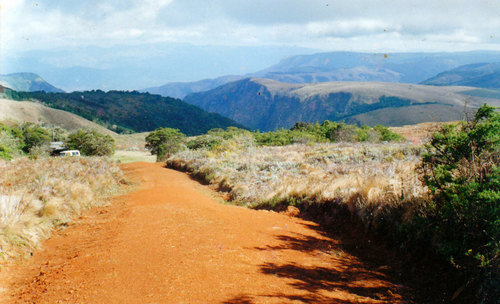
The weather was warm and welcoming as we bounced along the track that led up to Robin’s Nest cottage, nestling in the southern foothills of Mt Nyangani, at 2 592 metres (8 504 feet) Zimbabwe’s highest peak. There were three of us in the old bakkie – my two artist sisters, Sally Scott and Nicky Rosselli, and I – and we were finally making a journey we had often fantasized about. Below us the land rolled and sloped in an emphatic way, criss-crossed by streams and patches of plantation and jumbles of granite hills which reflected silver in the bright sunshine. It was good to be back. There was a healing magic in the air and I could have all but shouted out with joy, I was so excited to be in the landscape of my youth.
The Road to Robin’s Nest. ,Nyazengu Gorge in mid-distance. Honde Valley behind.
It was here I had made my first real discovery of that intangible sense of mystery some mountains have in abundance.
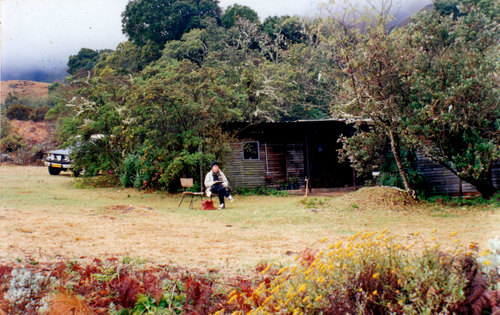
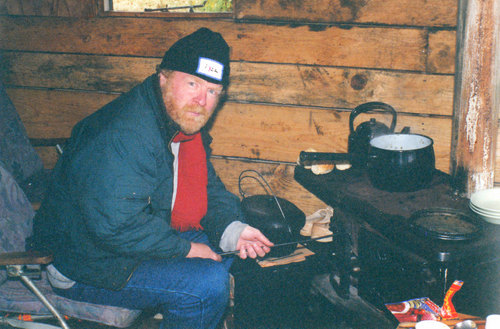
Sparse, rustic and startling basic, our windswept accommodation, could hardly have seemed more remote. Tucked away in a small grove of trees, it consisted of two wooden sheds linked by a roof of corrugated iron. It was like a hermits cell or the sort of place monks might have used when they wanted to get close to God. The two bedrooms with their rickety bunks were both extremely small. The kitchen area-cum- lounge, in the other section, contained a couple of battered, much-used, old chairs and a tiny wood stove which, I would soon learn, had a mind of its own.
Sally sketching atRobin’s Nest.
As I dumped my gear on the bed, I knew I was going to fall in love with the place. I have always been a bit of an ascetic with a taste for the Spartan. Robin’s Nest fitted my needs perfectly.
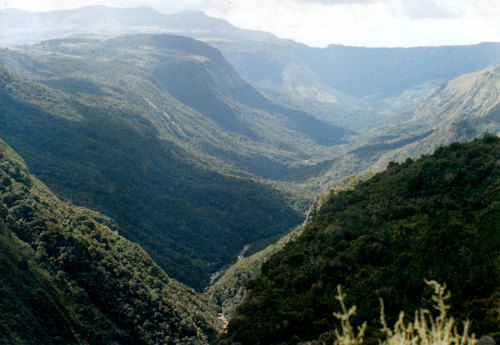
And if the building was on the ramshackle side, this, in no way, detracted from the magnificence of its setting. Directly behind us, the mist-shrouded mountain rose into steep pillars of rock, in front of us the land sloped away, gently at first, before suddenly plunging into a steep-sided, gaping abyss. The Nyazengu Gorge is not as well known as the Pungwe Gorge, into which it opens out, but, although of a smaller scale, it is equally beautiful. Protected from the worst of the winds but benefiting from the moisture-laden clouds they bring, it supports a profusion of plant life.
The morning sun was breaking through the cloud as we set out, early the next day, following a meandering path that led us over the downs. Everything about the morning was lovely. The call of the birds, the great blue sky, the sound of the river gurgling through the green hills. We hadn’t got too far when we came across some overgrown old stone-walled fortifications, remnants of what is now known as the Nyanga Uplands Culture. It seemed a bleak and lonely spot to have lived.
Old Ruins with Mt Nyangani in background.
Still glorying in the voluptuous sunlight we pressed on along the path. Now and again we would find ourselves entering patches of dark remnant forest. Scattered through the undergrowth were numerous large, mossy boulders that looked like sleeping animals while, in other places, the trail was almost overgrown with ferns and low foliage.
Wherever we went there was that rich, yeasty smell of damp and decomposing matter. Adding to the slightly Middle Earth atmosphere was the wispy- white streams of Old Man’s Beard hanging down from some of the trees. Faraway from the shrieking commotion of city life, I felt like I had entered a very secret and enchanted place.
There were all sorts of birds here although, because of the gloom of the forest, they were not always easy to see. I did manage to get one “lifer”- the White-tailed Crested Flycatcher, a beautiful little bird with a penchant for fanning its handsome tail. Something of a rarity, its distribution in Southern Africa is restricted to the montane forests of Zimbabwe’s the Eastern Highlands and adjacent Mozambique. The even rarer Blue Swallow is also supposed to occur in the surrounding grasslands but I did not see any.
We emerged out of the cool shadows of the forest to find ourselves on the very lip of the gorge, at a point where a high waterfall plunged down its side and into the gloom below. Taking off my hiking boots, I dipped my big toe into the water and took it out very quickly indeed. It was every bit as cold as I feared it would be but at least it gave me the excuse to boil some tea to warm ourselves up.
Where the waterfall plunges into Nyazengu Gorge.
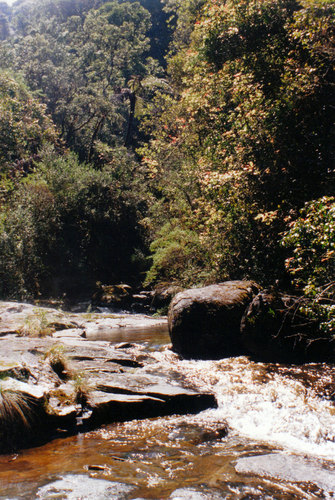
Upstream of the waterfall.
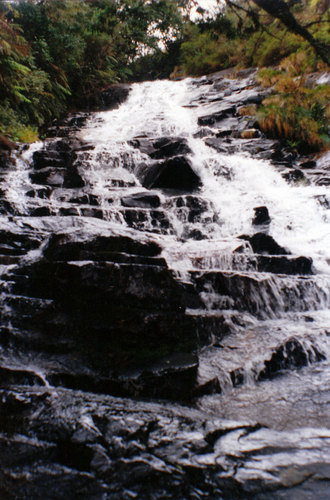
Later we squelched down a valley that was half bog, half rock until we came to another waterfall that tumbled down a massive sheet of exposed rock. It was hard to imagine anywhere more unvisited, wild and sublime. There was something about the way the sunlight sparkled on the beautiful, clear water, the way the light and water bubbled and swam together, the pure energy of the current flowing over the smooth grey rock that made us want to stop and tarry there. It was as if the water spoke best of the passion of the place.
More waterfalls…
This was, of course, the other reason we had wanted to come back. All three of us are artists and we were looking for inspiration. There was no shortage of it here.
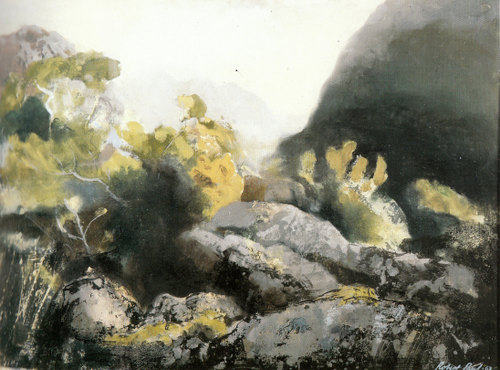
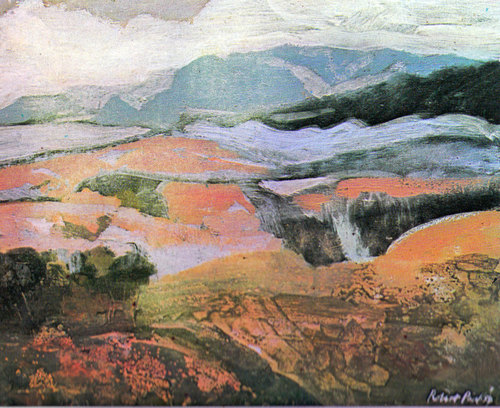
With its endless vistas and ever-changing moods and atmosphere, Nyanga has been a favourite venue for many painters including, most notably, Robert Paul. A friend of the British artist John Piper, Paul (1906-1980) – who has been described by Brian Bradshaw, the former director of the National Gallery in Salisbury (now Harare), as “a ‘genuine’ whose artistic dimensions exist not only in Rhodesia but would be recognised anywhere the values and evidence of art are understood” – returned to paint in Nyanga many times.
Deceptively slapdash in his brushwork, Paul had an uncanny ability to strip a scene down to its basics and select from nature only those elements which seemed to capture its essential spirit and feel. There is a perennial freshness about his work; in it. you immediately see a man who is comfortably at home in this scenery. It is why, whenever I am feeling homesick and want to reconnect with the landscape that exerted such a force on me in my childhood, I haul out a book* I have of his paintings.
Inyangani 1967. By Robert Paul. Oil.
Inyanga Landscape 1950. By Robert Paul. Oil.
By the time we eventually tore ourselves away from this hallowed spot and headed home to Robin’s Nest, the cloud had begun to build up again along the mountain. We had barely made it back to the cabin when the whole area was engulfed in a thick tablecloth of mist. As night fell it grew intensely cold. Alone in our chilly hut, on the edge of that imposing mountain, it felt we had the universe all to ourselves.
Poking the wood stove to get more warmth, listening to the murmurings of the mountain and the soft conversation between the wind and the trees, I could not have been happier. I felt I had found a place set apart, one with that quality of isolated purity that helped restore the soul.
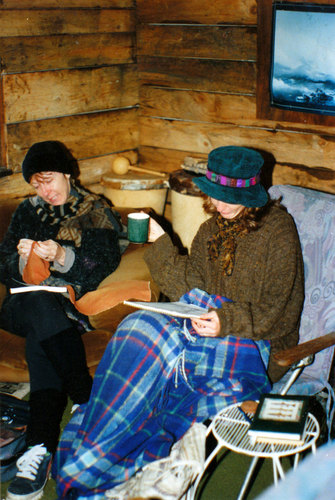
Sally and Nicky full of inspiration…
The keeper of the flame.
Although I had grown up in the area, I had never actually climbed Mt Nyangani. So I decided I was going to stir my old bones and make my way up to its summit. My sister Sally elected to join me.
Mt Nyangani from far side of Nyazengu Gorge.
Although it is Zimbabwe’s highest mountain, the hike to the top only takes a few hours. The first section is the steepest to climb. Thereafter it opens up into a lush, gorse-covered, sprawling moors and undulating plateau.
When the going gets tough. My sister Sally Scott pausing for a breather.
We were the only ones on the mountain that day which only added to the seremity of it all, the feeling of pure solitude.
It was well worth the initial slog, too, because the view from the top is one of the most beautiful I have ever beheld. Sitting on the apex of grey-green rock, with the sun shining through the clouds and anointing our heads, I really did feel like I was amongst the gods.
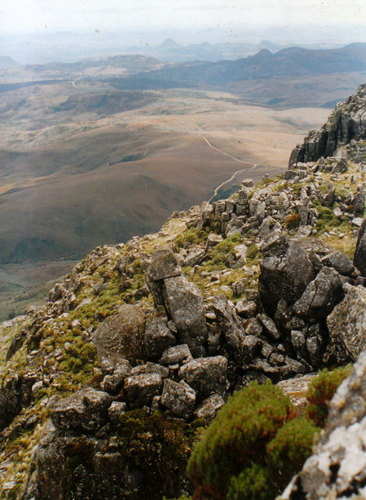
Geologically, Mt Nyangani is composed of an upper sill of dolerite and sandstone with the harder dolerite forming the cliffs on top of which, having reached the highest point, we now sat celebrating our achievement with a hot cup of tea (it’s my British ancestry). This, in turn, intrudes out of a sub-strata of ancient granite – the extensive Basement Complex that makes up much of the country’s geology and which has been gradually weathered away and exposed over the aeons.
On the eastern side of this high exposed ridge, lies the hot, humid Honde Valley, into which the countries highest waterfall, the 762 metre Mutarazi Waterfall, drops. It was also the scene of much fierce fighting during the Rhodesian Bush War. Extending from the border of Zimbabwe into Mozambique, its unusual position and topography cause it to have the highest rainfall in the country.
This is because moisture-laden clouds coming in from Mozambique are blown smack into the mountain wall and as they rise they cool and the rain comes. The constant watering has created a mini eco-system and the cliffs and crags here are covered in dense forest – making it quite distinct from the western side slopes which are mostly grassland, with only the odd tree hunched down again the bitter winter winds.
As one turns one’s eyes around further, the vast V-shaped Pungwe Gorge, with its tumbling, two-channel, waterfall, sweeps into view, followed by the entire Nyanga National Park and its environs. Beyond, that, shrouded in mystery lie, the ruin-strewed hills of Ziwa, and Nyahokwe and then, silhouetted, against the skyline, the massive granite dome of Mt Dombo. Crane your head still further and you will find yourself looking down the broad spine of the Nyanga escarpment to where both Mt Mouzi and the twin peaks of Nyangui mountain – whose beacon marked the edge of our old farm – jut out in the far distance.
View down to Nyazengu Gorge and Honde Valley.
View towards Ziwa and Nyahowe
Three main rivers have their source on Mt Nyangani – the Nyamaziwa, the Gaerezi and the Pungwe. The first two are tributaries of the Mazowe which eventually flows north into the Zambezi. The Pungwe, which grows steadily wider as it follows its eastwards course, has its mouth in the Indian Ocean, at the port city of Beira in Mozambique.
Despite the relative ease of the climb Mt Nyangani has an ominous reputation. One local newspaper even went so far as to label it, in bold type, as “A MOUNTAIN WHICH SWALLOWS PEOPLE”. Others have, in equally dramatic terms, compared it to the Bermuda Triangle and Japan’s Devil’s Triangle. To some extent, its reputation as some sort of dark, hungry, malfeasant, force is well deserved for numerous hikers have indeed disappeared on the mountain never to be seen again.
Back in colonial times the word “Nyanga” was usually interpreted as meaning “place of the witchdoctor” which added further to the reputation of the mountain for being a bit of a scary, forbidden, place although the correct translation of the word is ‘herbalist ‘which has far less sinister connotations.
Like other sacred mountains in Southern Africa, Mt Nyangani has its prohibitions and taboos, including the fairly common stricture against pointing at it. No laughter is permitted either. The mountain is, also, subject to sharp weather changes particularly mist-build-up which make it easy to get disorientated and lost in. Hence, presumably, all those missing hikers who got ‘swallowed’ by the mountain.
We got first- hand experience of how quickly this can happen. I was posing for the obligatory Hail-the-All-Conquering-Mountaineer photo when I noticed a slight drop in temperature and a sudden jab of wind against the back of my neck. Pivoting around, I saw, to our immediate north, a low bank of cloud, glistening white in the sunshine. I think something about this sort of weather breeds an anxious hyper-alertness of the senses for I realised instantly it was time to get off the mountain.
As we hastened back down the track, more thin wisps of cloud began chasing one another along the mountain top towards us. I felt tiny splashes of rain. By the time we had got back to the parking area, the whole mountain, which had previously seemed so benign, had taken on a more sinister aspect.
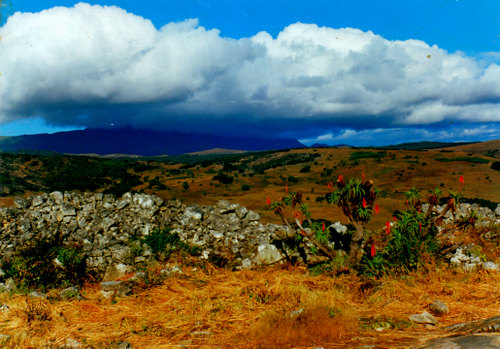
We retreated down the road to the Nyangwe fort, just above Mare Dam, and sat on the rock walls watching the drama unfold. In the blink of an eyelid, Mt Nyangani was engulfed under a massive cumulonimbus cloud which, just kept growing and growing in size.
The angry mountain, seen from Nyangwe Fort.
I was very glad we had got down in time to avoid being caught up in that vast, vortex of rising air. Awed by the spectacle, I found myself succumbing to all sorts of nagging, corrosive doubts. Maybe we had angered the mountain? Had I made a big mistake being so cheerful and upbeat as I posed for my vanity photographs? Was it some ill-humoured, demonic spirit that had sent that towering storm cloud?
I was not the only one with concerns about the mountain’s temperamental nature and sudden mood swings. Since we got to the summit, the park’s management has decided that you can now only climb it in the company of a guide.
And with a reputation like that who would not want to climb it?
Pungwe Gorge and river, leading up to Mt Nyangani.
*Robert Paul by Colette Wild, Brian Bradshaw, Francois Roux, Patricia Broderick and Martin Van der Spuy. Printed by Grillford Limited.
GALLERY:
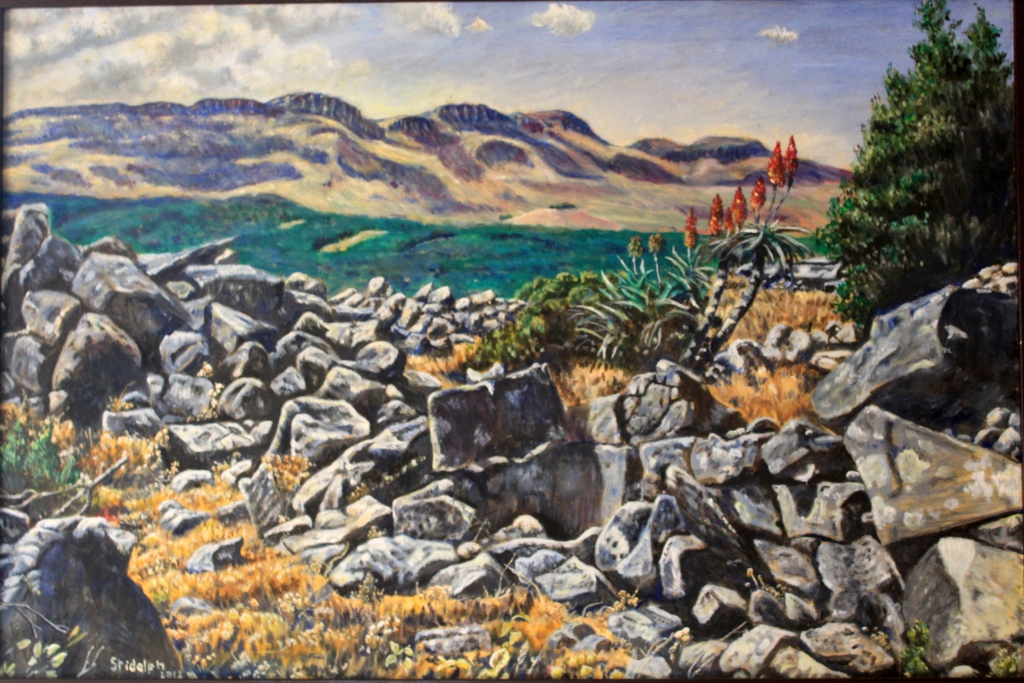
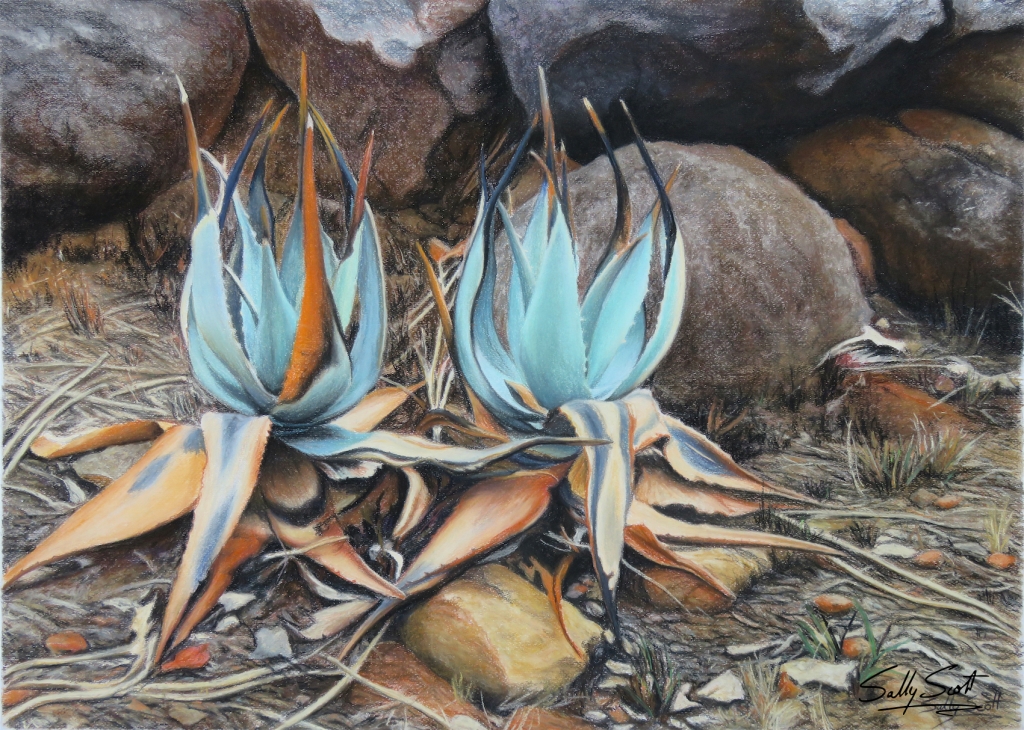
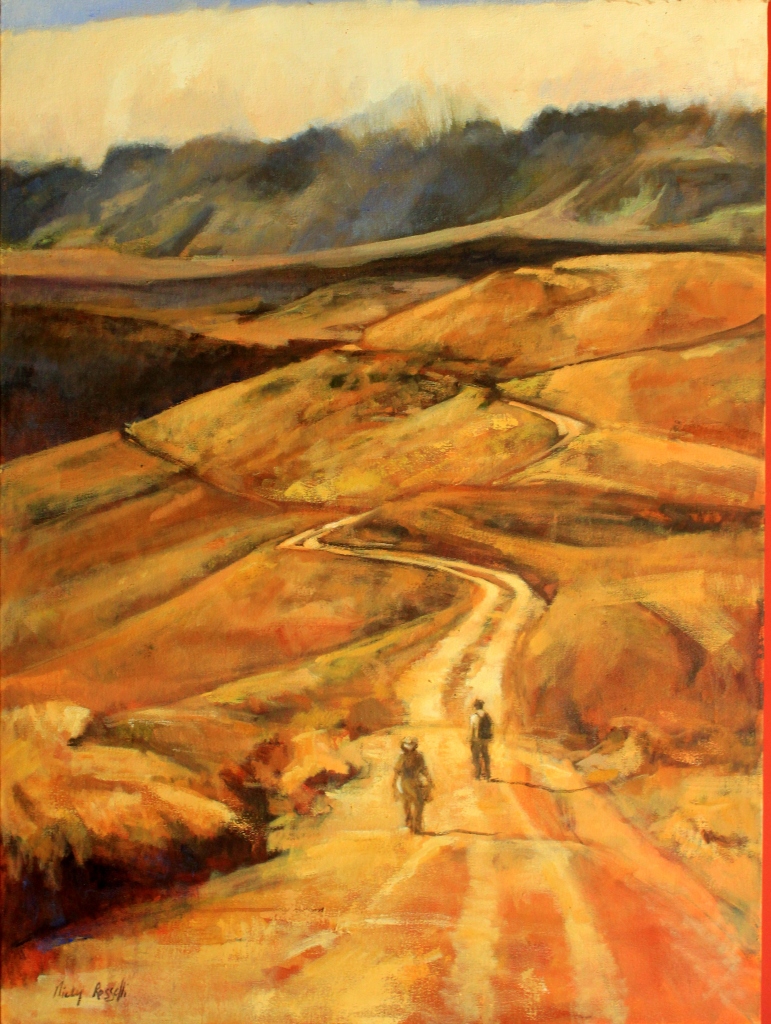
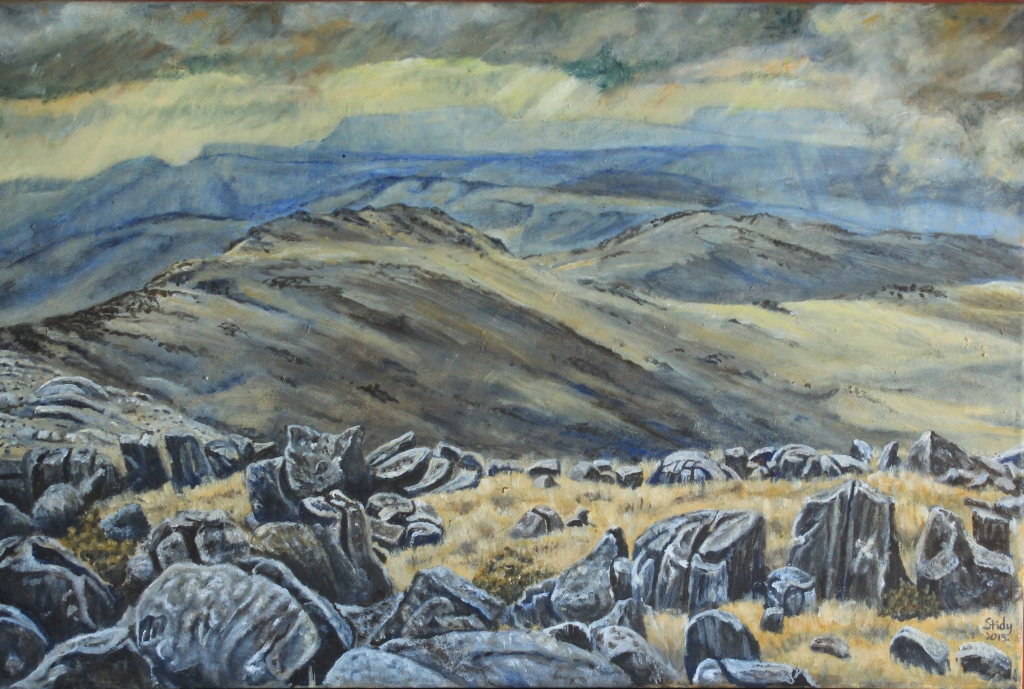
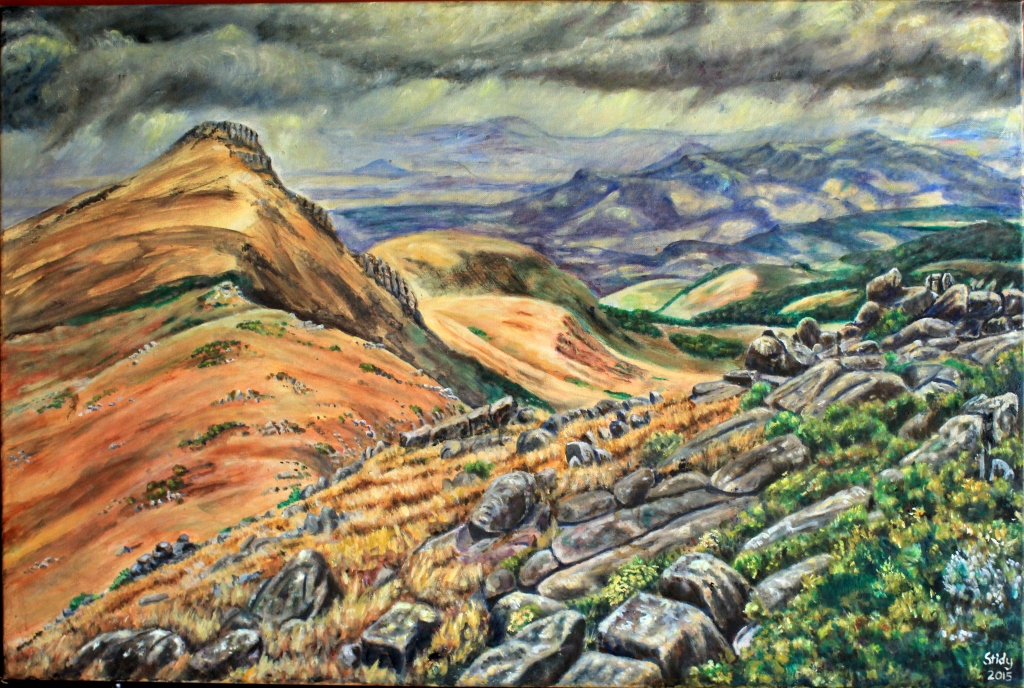
Some artwork inspired by our trip:
Mt Nyangani from Nyangwe Fort. Artwork by Anthony Stidolph. Oil.
Nyangui aloes. Artwork by Sally Scott. Pastel.
The Climb. Artwork by Nicky Rosselli. Oil. The two figures in the foreground are Sally and myself…
Summit of Mt Nyangani, looking North. Artwork by Anthony Stidolph. Oil.
Summit of Mt Nyangani, looking South. Artwork by Anthony Stidolph. Oil.
A lack of financial controls and consequence management had resulted in the KwaZulu-Natal conservation entity, Ezemvelo KZN Wildlife, incurring more than R48 million in irregular expenditure, it was revealed during a virtual KZN Scopa meeting. Ezemvelo – currently struggling to find R100million to fix its porous fences, which have seen wild animals escaping from its facilities – is battling to comply with Treasury supply guidelines due to the entity’s weak financial unit.
Despite the ANC leaders describing their meeting with former president Jacob Zuma as “positive and constructive”, political analysts described the gathering as a waste of time. In the meeting, the ANC top brass led by President Cyril Ramaphosa could not convince Zuma to change his mind on his decision to defy the Constitutional Court order that he should appear before the Zondo Commission.
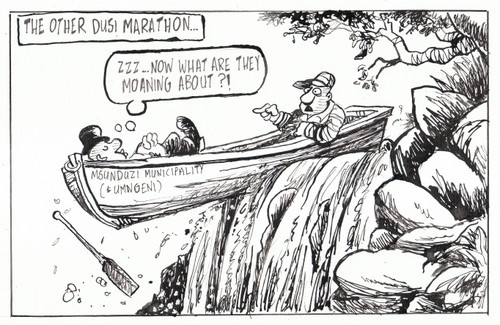
Msunduzi Municipality’s financial reserves continued to be a huge source of concern, with the City’s December accounts showing it owed a whopping R500 million to its suppliers. Further evidence of the general malaise gripping the municipality was then provided when large parts of the city were again plunged into darkness, for up to twenty-four hours, as two Eskom breakers tripped. This was in addition to the normal Stage Two load-shedding being implemented by Eskom.
On a happier note, the 70th MyLife Dusi Canoe Marathon got underway in Pietermaritzburg although, because of the Covid restrictions, there weren’t the usual large crowd of fans to cheer the canoeists on…
As South Africa acknowledged the first anniversary of the start of the Covid-19 pandemic, the maladministration in the Msunduzi municipality once more came into focus. In a two-part package devoted to the failing city, the Witness provided a range of stories showing how ordinary residents (and city workers) felt they had been abandoned by the uncaring administration. The newspaper’s report also captured the frustration of the business, real estate, tourism and other sectors of the local economy who had suffered as a result of bad management, bad choices and lack of consequences.
Following a heated ANC meeting over the weekend, former president Jacob Zuma’s supporters, who had come out second best in the battle to control the party, were now at risk of being expelled from the party should they continue with their campaign against President Cyril Ramaphosa and the judiciary. Meanwhile, the election of mostly white males to key leadership positions, at the DA’s KZN provincial congress, seemed to suggest the party had ditched its “inclusive” policy, according to some political analysts.
At a time when he needed to be busying himself with the urgent business of running the country and fighting the Covid-19 pandemic, President Cyril Ramaphosa found himself having to ward off more attacks from former president Jacob Zuma and his supporters within the ANC. In 23 pages of speaking notes, Zuma complained that his comrades had left him high and dry and attacked Ramaphosa for stopping the state from paying his legal fees. Zuma also launched a broadside at the independence of the judiciary, questioning the legitimacy and credibility of South Africa’s constitutional democracy.
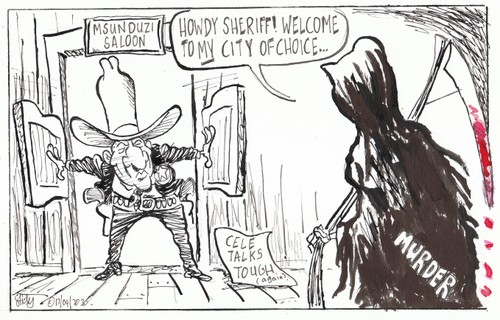
Plessislaer is now one of South Africa’s murder capitals. This was revealed by the country’s Minister of Police, Bheki Cele, who urged police to get tougher on criminals following a spate of murders in and around Pietermaritzburg. Cele said KwaZulu-Natal had become a problem area along with the Western Cape and more police would be deployed to the area to try and curb the violence that has been spiraling out of control.
While fires raged on in Cape Town and emergency services battled blazes around the clock, it was revealed that KwaZulu-Natal’s fire-fighting capacity had heavy shortfalls. Not only did it lack over 550 fire-fighters but it did not have enough Urban Search and Rescue (USAR) equipment or personnel. The problem was not confined to KZN alone with a Daily Maverick report revealing similar shortcomings throughout the country.









 Stidy's Eye