Another week, another book about the chaotic, cataclysmic Donald Trump presidency and the tumultuous fallout from it. The author of this one has probably jumped the gun in rushing to print, since his analysis focuses on the investigation into January 6th investigation whose findings have yet to be published, but it obviously felt it was important to get in early with his take on the proceedings.
As is now common knowledge, the 2020 United States presidential election held on November 3rd, saw the former Democratic vice-president Joe Biden defeat the incumbent president Donald Trump with Biden receiving more than 81 million votes, the most votes ever cast in a US presidential election. Unable to accept the reality of his defeat the soon-to-be ex-president would go on to insist the election results had been rigged although he had next to no proof to back his claims up. It didn’t matter. The doubts he cultivated ultimately led to a rampage inside the US Capitol by an angry mob of pro-Trump supporters, as well as giving birth to the Stop the Steal movement.
Undoubtedly, one of the low-water marks in recent American history, the attempted coup rocked the very foundations on which American democracy was built. It also led to a great deal of soul-searching and heated debate. As a former Republican congressman, as well as the senior technical advisor to the House select committee tasked with investigating the attack, Denver Riggelman, has some claim to know of what he speaks when it comes to the subject. He had access to much of the correspondence and documentation which passed between the various parties and was privy to a lot of privileged information. As such, his book is full of revealing insights and sheds a great deal of light on precisely what happened during those fateful few days. What becomes plain from reading it is that the insurrection was not a spontaneous act nor an isolated one but was part of a deliberate campaign aimed at keeping Trump in office. It is also hard to ignore that much of the culpability lies with Trump himself.
Equally disturbing is the fact that the effort to overturn the result of the election involved officials from all levels of government (including the military – Riggelman claims that at least one hundred of the rioters who stormed into the building that day had military experience), as well as many members of the Republican Party.
In addition to showing how Trump deluded the American people, and probably himself, Riggelman’s book is also a part memoir. By his admission, he grew up in the conservative edge of the Bible Belt “among the true believers” and it took many years to shake off the yoke religion had placed on his worldview. This gives him an insider’s take on how the far right and extremist groups like QAnon operate. Fed a combustible brew of fire and brimstone Biblical tub-thumping, biased TV and, more recently, the sort of delusional mob group-think that characterises the darker recesses of the internet it has led to a conspiratorial mindset which has, in turn, now seeped into the mainstream.
Frighteningly, there is every likelihood that in the future the system could produce more tenants in the White House just like Trump: shallow, dishonest, opportunistic, vicious and at times almost comically incompetent.
There are lessons to be learnt from all of this…
published by Bantam
There is something enjoyably familiar about sitting down with another book featuring Lee Child’s iconic hero, Jack Reacher. It is like being reacquainted with an old friend after a gap in time. One of crime fiction’s more engaging creations, the latest book featuring the laconic drifter differs from all the previous ones in that it has been co-written with his younger brother Andrew Child to whom Lee intends to hand over the reins of the franchise.
Not that any difference in style is immediately apparent. No Plan B begins in a predictable fashion with Reacher turning up in yet another remote, dusty, fly-blown mid-American town only to find himself once more at the centre of all the action. In this case, a young woman appears to throw herself under an approaching us. Naturally, all is not as it seems with the sharp-eyed Reacher, alone among the various on-lookers, noticing what everybody else has failed to see – the woman was deliberately pushed by a man in a hood. The police don’t buy his version of events, the death is ruled a suicide and the case is closed. For an avenging angel like Reacher, who sees it as his mission to battle injustice, this obviously goes against the grain and immediately decides to carry out his own investigation. The deeper he digs, the more he realises this wasn’t just a random act of violence but is part of a much larger and more sinister conspiracy that has its centre in a supposedly model prison in a small Mississippi town. Once they get wind of the fact Reacher is hot on their trail, the conspirators do their best to stop him from reaching his destination but they fail to factor in his unique talents or his relentless determination.
In many ways, No Plan B is vintage Lee Child. The theme is tackled cleverly with well-concealed sub-plots and several strong set-piece action sequences. If there is a slight difference in the form it lies in the dialogue. When it comes to cynical, snappy one-liners and put-downs – usually delivered as – Reacher despatches, in suitably violent fashion, yet another villain – Child is normally a reliable performer but here the writing seems oddly underpowered with few of the memorable quips that have proved such a feature of his best books in the series.
A young schoolboy’s infatuation with and uncontrollable feelings for his music teacher (and hers for him) and the impact it has on the rest of his life is at the heart of Ian McEwan’s latest book, a tale of sullied yearnings and unrealised hopes scanning one man’s lifetime.
Beginning with his parent’s wartime romance and not especially happy marriage, the book takes us through his boarding school days during the suffocating vestiges of 1950s morality and the embryonic promiscuity of the 1960s. Along the way, it also touches on such burning historic events as the Suez Crisis, the Cuba Missile Crisis, Chernobyl, the fall of the Berlin Wall and – even more up to date – the Covid pandemic. Recounted in chronological order, as well as with the occasional flashbacks, it gives the book a raw episodic quality that, at times, makes it feel more like a biography than fiction.
Dropping out of school early. the protagonist leads a life in which he never seems able to connect or realise his true potential. He takes on a number of unpleasant and unremunerative jobs eventually settling for the slightly dead-end job as a lounge pianist. While obviously intelligent and talented, his literary projects don’t quite take off, and his relationships are fragmentary and not always satisfying. In a reversal of the traditional order where it is usually the man who puts his selfish emotional needs first, his first wife abandons him and their infant son to pursue a solitary career as a writer, Later, he has an on/off relationship with a married woman who at first leaves, then returns to and finally leaves her husband. All this is played out against events in the wider world.
Combining quick social observation with a profound understanding of our troubled times, Lessons beautifully captures the warp and weft of our often messy, unfulfilled lives while, at the same time, providing a richly nuanced portrait of a man who suffers his share of abuse and loss while never really achieving his ambitions. Somehow he endures them all and winds up with a measure of peace and understanding at the end.
Published by Struik Nature
The distinguished naturalist, William John Burchell is generally regarded as one of the greatest of the early African explorers. Making up in enthusiasm and tenacity what he then lacked in experience, his bold expedition deep into the South African interior laid the groundwork for much subsequent scientific research and has added considerably to our understanding of the country’s natural history in the nineteenth century. Equipped with a custom-built ox-wagon but none of the expensive equipment which modern science requires he managed to amass an astonishing 63 000 specimens of plants, bulbs, insects, reptiles and mammals on his 7000-kilometre journey which took him through some of the driest parts of the sub-continent, as far north as Kuruman. It is a mark of both his considerable achievements and the esteem in which is still held that so many species still bear his name (Burchell’s Zebra, Burchell’s Coucal etc)
Among Burchell’s many strengths were an indefatigable curiosity and imaginative sympathy with the natural world, coupled with openness towards the people he encountered on his arduous four-year expedition. In this, he was atypical of the day.
Burchell described his outbound trek in his famous Travels in the Interior but never got around to completing the volume describing his return trip via the more lush and densely vegetated eastern coast of South Africa even though it proved every bit as productive and as fruitful in terms of what he discovered as what had gone before. The authors, Roger Stewart and Marion Whitehead, have sought to fill this gap in the narrative by delving back into the records and revisiting many of the places he passed through.
Fortunately, Burchell was a painstaking note-taker and prolific letter writer and this intriguing, well-researched biography is brought to life by the many extracts from his correspondence. In addition, he was also an accomplished artist and his delicate watercolours add immeasurable value and vividness to the text. From downs to mountains, from dunes to semi-desert, they provide a comprehensive microcosm of the country as it appeared back then as seen through the eyes of a highly observant and intrepid young explorer.
: If you are in a bad mood go for a walk, if you are still in a bad mood, go for another walk.”-Hippocrates
Pic courtesy of Sally Scott.
I can feel the sun on my back, already warm as toast, as I set out through the farm gate following the road that leads down to the protea field and then past the tall pines where a clamorous row of black crows are having a huge argument over which direction to fly. I know in a general way where I am headed and what I will most likely encounter along the way although each day always brings its subtle differences. I don’t, normally, wonder too deeply about my motivations for doing what I am doing. Going for a walk is just something I do and enjoy. I find it healing. Outdoor therapy. It helps me to think. It is my form of meditation. If I am feeling down in the dumps it gets me – mostly – back on the right track.
There are no limits to where I walk. I am quite happy to keep exploring the same patch of ground because over time you develop a sense of intimacy with it that comes from an accumulation of particular observations. Likewise, there is a special fascination in testing one’s expectations in less familiar backgrounds. The important point, I think, is to be able to relish both the ordinary and the extraordinary.
The habit of walking manifested itself at a very early age. When I was about three years old my father, an airline pilot with a yen for country life, decided to relocate us from our house in the then Salisbury (now Harare) to a smallholding in Umwindsidale, about thirty kilometres outside town. He chose to call our new home “Dovery” after the crooning Cape Turtle Doves that were such a feature of the place. For me, their call remains one of Africa’s most beautiful, evocative and comforting sounds.
My main memory of the property is the view which was spectacular. From our front verandah, we looked over an open stretch of land, extensively cultivated, along whose edges the Umwindsi (now Mvinzi) River flowed, its path marked by an outline of dark green. Beyond this fertile plain stretched a further succession of hills and valleys, blue and hazy, each one becoming successively paler, in turn, as they rose to meet the sky. From an early age, I liked to create worlds of my own, in which I could slip away unnoticed and undisturbed and the countryside that surrounded our home provided plenty of places where I could do just that.
Umwindsi (Mvinzi) river with my brothers and sister. I am on the left.
The Umwindsi was a lovely little rivulet that tumbled and crawled and blundered its way through a network of rocks, roots and tall shady trees. For a young child, it was a magical place and I spent a lot of time adventuring up and down it, playing in the pools and exploring its secret places to see what lay hidden there.
It was also the ideal preparation ground for our next grand adventure – a move to a remote farm at the northern extreme of the Nyanga mountain range.
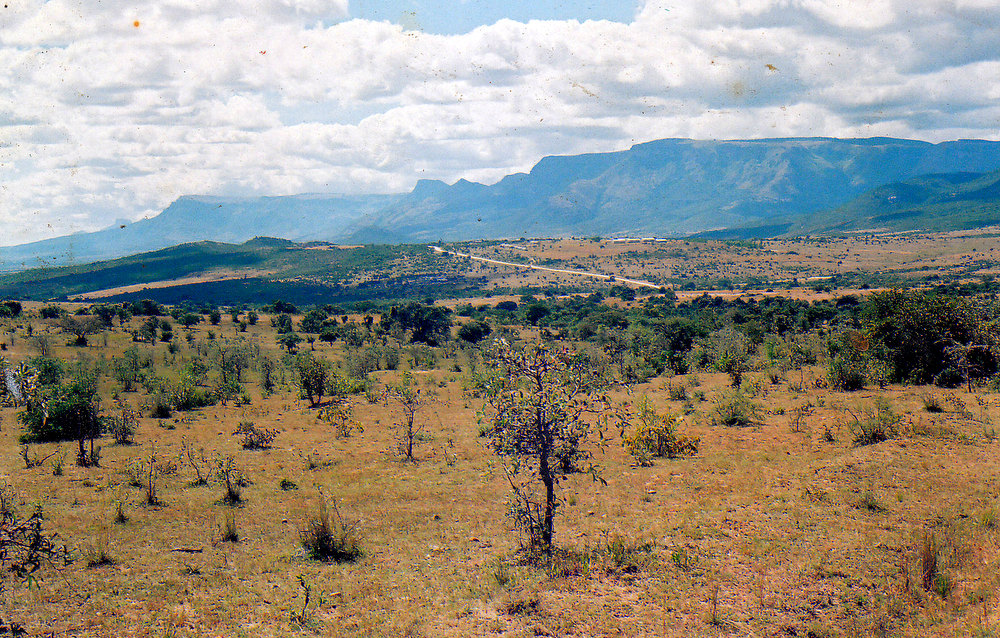
The farm occupied a broad stretch of land, mostly valley but bordered on two sides by mountains. Jutting out from the main range were several castellated buttresses which stood like imperious guardians, mute witnesses to the goings on below. Along the floor of the valley stretched miles of grassland with woody patches, winding rivers which fed into one another and soft hills inset with elephant-coloured boulders, many covered with old stone walls, left behind by some forgotten people. Over it hung the intense blue sky of Africa.
The Old Dutch Settlement Road, Nyanga. Our farm was at the end of the range.
The land on our farm hadn’t been worked for many years and felt wild and untamed. At the night the wind would howl down from the mountains and the very air seemed to seethe with phantoms, both good and bad. They whispered to me as I lay in my bed with only a flickering candle, on the table next to me, to keep the shadows at bay. In the moonlight, the whole landscape beyond my window seemed to possess a strange alchemy all of its own, a spirit ancient and impassive permeating the land.
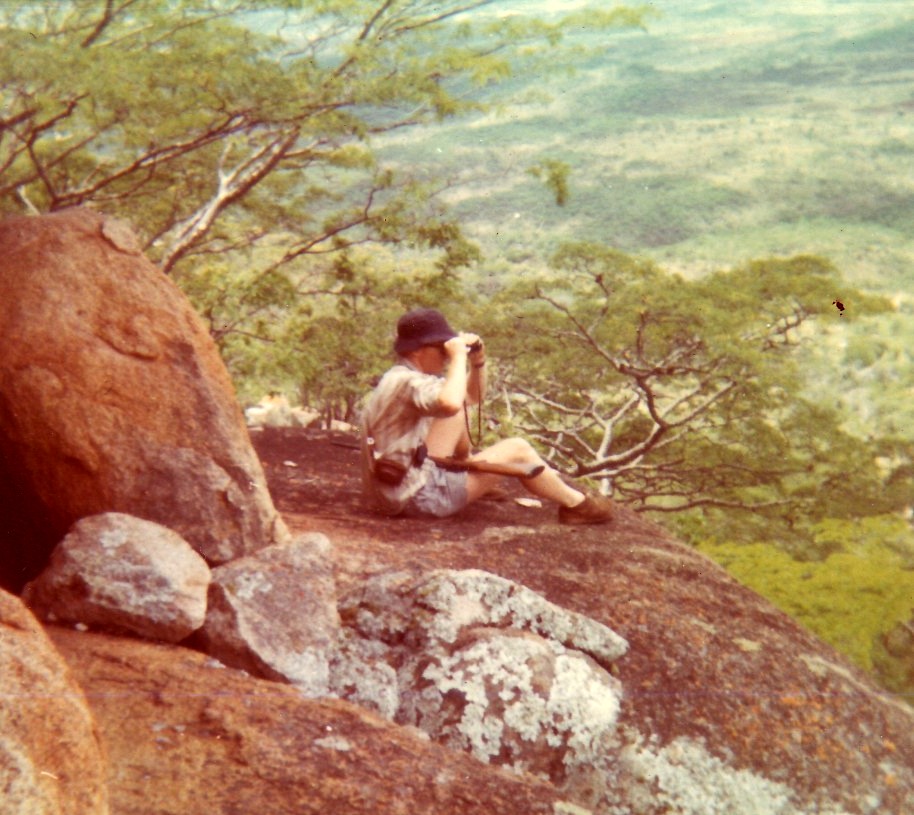
My brother Pete, bird-watching on Muchena Mountain…Granite mountains on west side of farm. Pic courtesy of Patrick Stidolph.
There was much to discover and endless opportunities for exploration. Most mornings when the sky was clean and ready for whatever lay ahead I would set out into the wilderness to see what I could find. I learnt to watch, wonder and recognise all the landmarks: the curves in the road, the shape of the hills, the twists and turns of the mountain streams, the outlines of the fields, the size and weird contortions of the baobab trees. No horizon seemed too far away. The more I saw, the more the place insinuated its way into my soul. It deepened my love for Africa. Sometimes I would go with my elder brother Pete – an avid birder even back then – mostly I would go on my own with just the farm dogs for company. My memory of these walks and the years on the farm have never left me.
It wasn’t just at home that I walked. Bastions of robust sportsmanship, all three of the boarding schools I attended -REPS in the Matopos, Plumtree on the Botswana border and UBHS in the Eastern Highlands – encouraged healthy outdoor activities, seeing it as an essential element in character-building. Most weekends would find me exploring the surrounding countryside.
On the summit of Cecil Kop, Umtali (now Mutare). I am in the middle. My brother Pete is on the left and my friend Stu Taylor is on the right.
Eventually, the idyll came to an end. My life took a turn for the worse. Bad replaced good. War broke out. I got called up.
As an ordinary foot soldier in the army, I got to do a great deal of walking although most of it was not voluntary or even pleasant. Having bullets and mortar bombs whizz past me didn’t add to the enjoyment.
Getting shot at or mortared was not the only thing which occupied my mind patrolling in the stupefying heat of the Zambezi valley. On foot in Africa, one will sooner or later have a hair-raising experience with a wild animal. Of them all, I think it was the lone Black Rhino I was most scared of. To have one suddenly come crashing through the bushes is not an experience I want to repeat too often although I had my fair share of scrapes with this cantankerous character.
On patrol in the Zambezi Valley
Still, the army toughened me up, got me superbly fit and introduced me to some wonderful new scenery so I mustn’t grumble.
The Rhodesian Bush War finally dragged on to its inevitable conclusion. I got discharged. Like all wars, the conflict marked our lives. It left a lasting legacy. In my case, I don’t think I emerged from it suffering from Post Combat Stress Syndrome or anything as dramatic or personality-changing as that. Still, it did leave me with a vague sense of melancholy, restlessness and an inability to settle down. Unsure what to do, the horizons seemed to close in around me. I felt trapped and constricted.
Bored stiff with my office job in the Mining Commissioner’s office in Gweru, I resigned and moved onto my parent’s new farm at Battlefields, near the Midlands town of Kadoma. Needing time to think, I walked and walked. By the end of it, there was hardly an inch of the farm I didn’t know. Walking had, once again, become my solace, my cure. It also made me realise it was time to move on. To go somewhere new. To start my life again in a place where I wasn’t surrounded by the constant reminders of the futility of what I had been through.
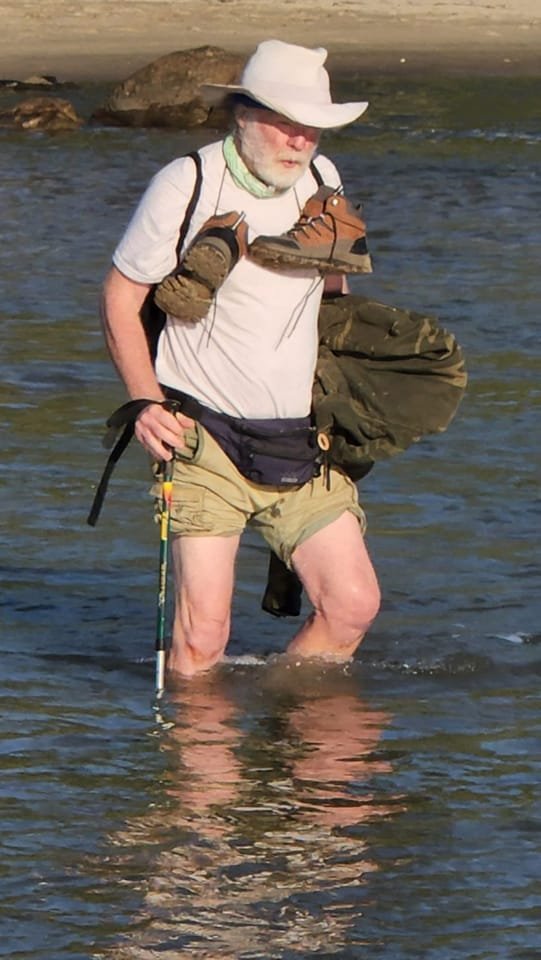
And so I packed my bags and moved to South Africa. With me went my nostalgia for landscape which I quickly transferred to my new surroundings. I set about exploring the country. I went on birding expeditions to Marakele, Mapungubwe, Kruger and the Richtersveld. I trundled through the Little Karoo and Baviaanskloof. I walked on the Wild Coast to the sound of crashing breakers. With my sister, the artist Sally Scott, and her family I made countless trips to the Drakensberg. We slept in caves, hiked along numerous mountain trails and plunged into icy rivers.
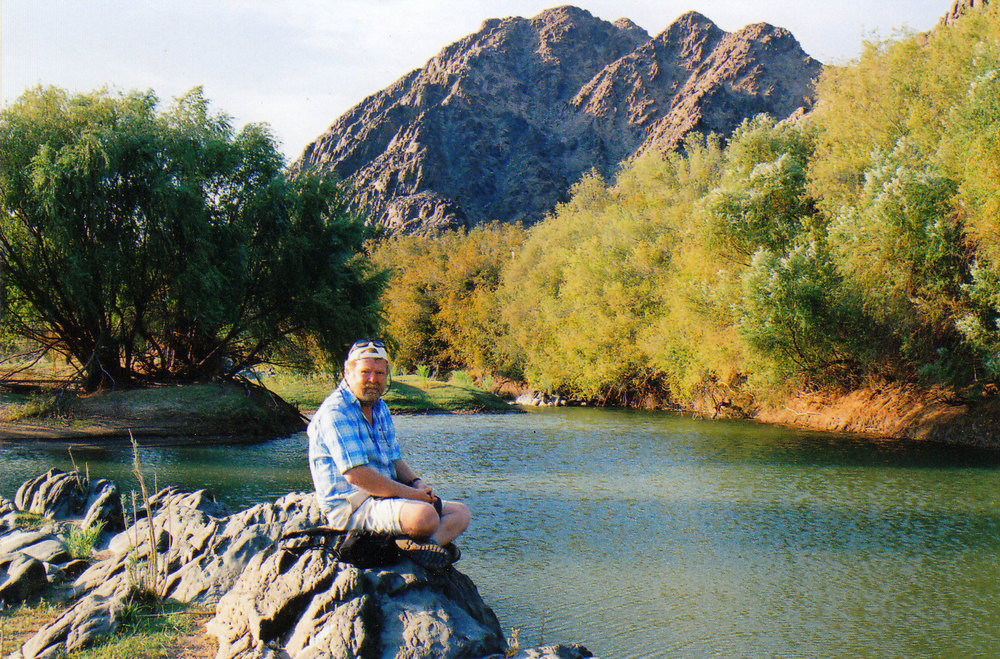
Orange River, Richtersveld.Hiking the Wild Coast…
The Drakensberg had a different feel from the mountains I had grown up amongst in Nyanga. Higher, more precipitous, austere, jagged, cold and with fewer trees they were inhabited by a different set of gods and mountain deities. I loved it all the same. Climbing them, I always felt I had risen above the material plane and entered another, more enchanted, realm. The scenery and views left me breathless.
Mont-aux-Sources, Drakensberg, with my nephew Craig Scott.
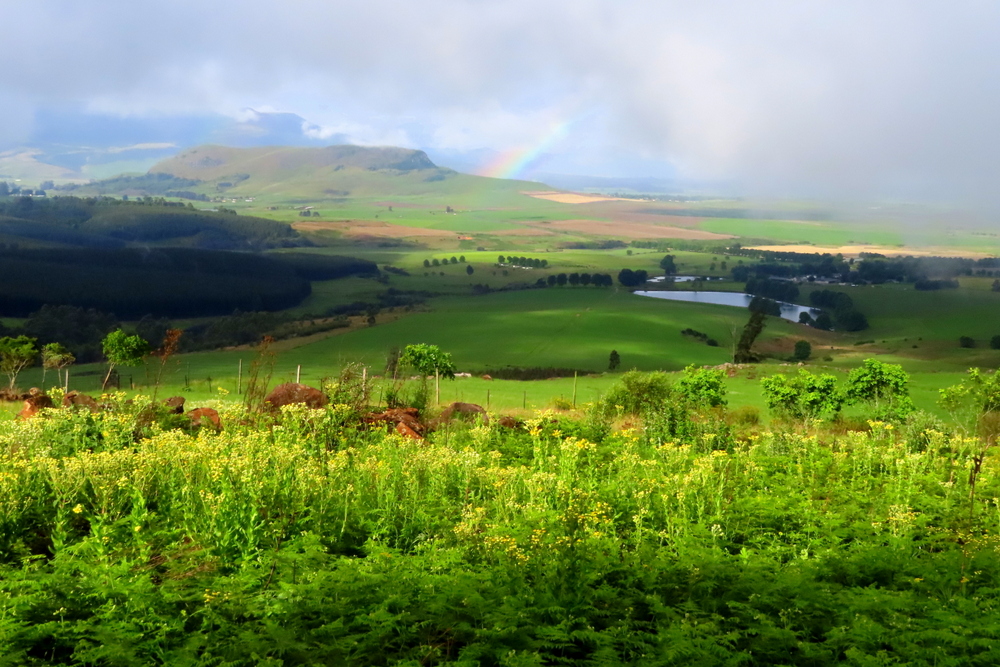
When I wasn’t out walking, I worked as a political cartoonist in Pietermaritzburg. As I got older, I grew increasingly disenchanted with city living. Some friends suggested I move up to their farm, high on a hill overlooking the Karkloof Valley. Viewed through the soft, filtered light of the swirling mist, there was something dream-like about its beauty; my heart was immediately smitten with delight. I accepted.
The Karkloof Valley. The view from our farm.
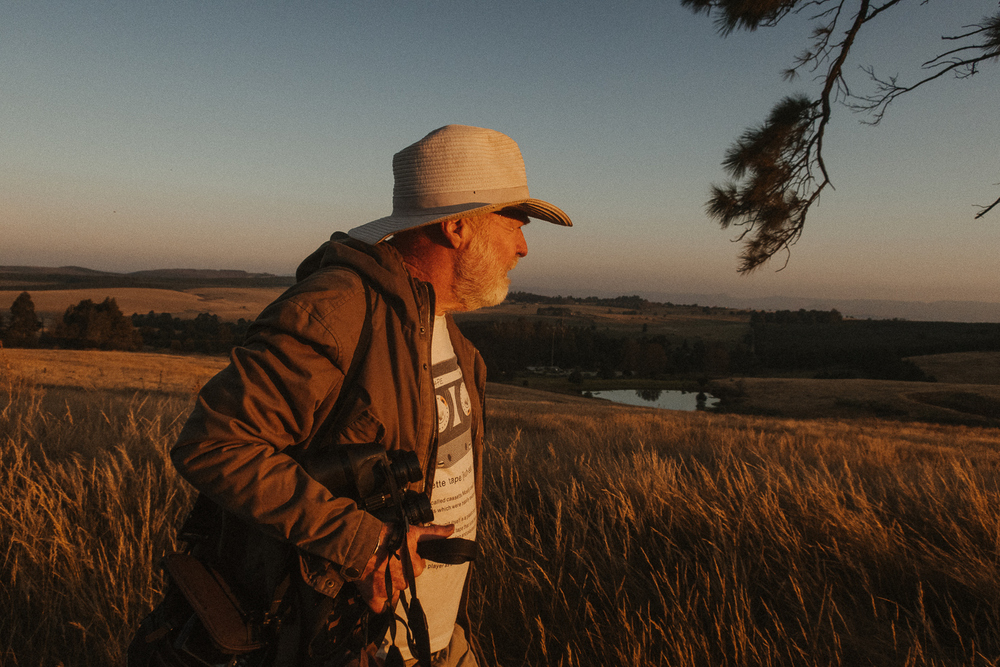
Moving into the country changed the shape of my life. It helped renew my sense of deep connection with the natural world. I spent many happy hours tramping over a familiar circuit of paths, seldom meeting a single person en route. Revelling in the sense of discovery and freedom that comes with this, I developed an increasingly close and intimate relationship with the local flora and fauna. However, nature still managed to spring surprises on me. Lockdown came. I had always thought that the advances in modern medicine would provide a solution for everything but Covid, at least initially, proved me wrong. The virus transported us all back to the fear-ridden, helpless days of the Great Plague. It reminded us of just how vulnerable we still are and demonstrated that we are still at the mercy of the whims of nature.
Over the next two years my life – like many others – took on a slightly surreal aspect. As part of the locked-down community, I found the days blurring together. Whether it was Monday or Friday came to hold no interest for me. Alone in the house, isolated from the world, I lived in silence and solitude, with only the sound of birdsong, the whistle of a reedbuck, the howl of a jackal and the croaking frogs to sustain me. When I went to town, which was not often, I talked through a mask to other people wearing masks. It felt a little weird and dehumanising at first but I got used to it.
The national confinement stretched on through the months that followed with intermittent breaks. In the end, I learnt to get used to a world with little direct communication, so much so that I almost began to prefer it that way. Again, it was my walks which brought me the most relief, gave meaning to my life, helped me feel less trapped and provided me with a sense of quietude which conquered despair. I was lucky living in the country because the people living in town weren’t permitted to go beyond their front gates whereas I had our entire farm to roam over.
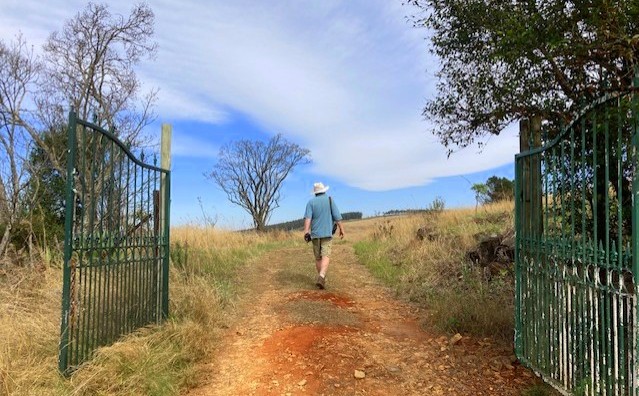
Heading out…Pic courtesy of Craig Scott.
If you had to ask me then why I walk so much, I would have to concede that – apart from the obvious health benefits – it stems back to a longing to be the boy I once was, innocent again and seeing the world for the first time. My walks remind me of a more carefree period of my life. More than that, though, they have become part of a growing awareness of myself, an increasing reflectiveness and a developing sense of my place in the world and the environment. It nourishes my sense of self-sufficiency. It makes it easier to exist in these tumultuous times.
Time has, of course, dissipated some of my innate restlessness but while I still have the energy in my legs and air in my lungs I intend to keep walking…






 Stidy's Eye