A Compulsion to Paint: Travels in the Karoo

The Timeless Karoo

I am heading south, from my home at Curry’s Post, in the cool, misty KwaZulu-Natal Midlands, towards the eastern Karoo. I am a man on a mission, in search of stimulating scenes and artistic inspiration. I am confident I’ll find what I seek down there.

It is a journey I have made many times but the suddenness of the change in the countryside always surprises me. You cross over the border and the pine plantations and green pastures of KZN disappear out of sight in the rearview mirror. The rivers are fewer, the trees become small, stunted and windswept, and the veld is dry, earthy and dotted with grey scrub, cactus-like plants, aloes and succulents. It is an enormous, dramatic landscape that completely dwarfs you and makes you feel very small. Vast sun-baked, plains stretch out on either side, blue mountains shimmer in the midday heat; krantzes, kloofs and flat-topped kopjes dance by. The dorps and settlements get smaller, the traffic lighter, and there is less and less sign of human occupation.

The Plains of Camdeboo.

As you drive, you are constantly aware of the vast horizons and the space between them and you.`It is strange to think this area was once a vast lake inhabited by giant reptiles, who left their bones behind for palaeontologists to puzzle over millions of years later.

The deeper I penetrate, the more the Karoo begins to work its magic. There is something about this empty, quiet, timeless landscape that eats into my soul. Although it is very different to the country I grew up in, I still feel an instinctive connection with the dry Karoo. Maybe it is because it feels so ancient and exudes such an air of mystery. Like the sedimentary rocks that dominate much of its geology, layers and layers of history lie embedded here, dating back to the beginning of time. If you choose the right spot, you can find yourself looking at more or less the same scene someone thousands of years ago would have seen. Perhaps this gives the Karoo its unique atmosphere, the sense that you are moving amongst ancient spirits. Plus, that huge blue-domed sky which dominates everything and the slightly ethereal quality of the light.

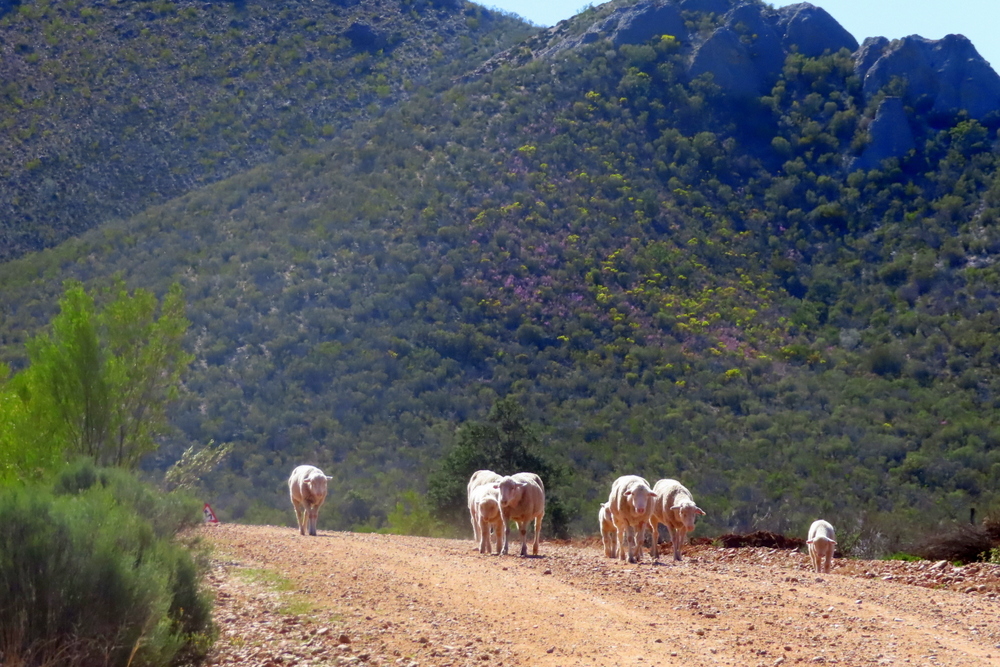
I drive on through a dry, rocky, mountainous country. Hills lead to more hills, the road rises and drops and rises again. The sun is shining straight on the windscreen. The occasional farm roads, grey and rutted, branch off the main road I’m on. I call it a main road but there is so little traffic it is almost a ghost road. Travelling down these side roads the clouds of dust you are kicking up behind you mix with the medicinal-like smell of the plants that grow on the stony slopes.
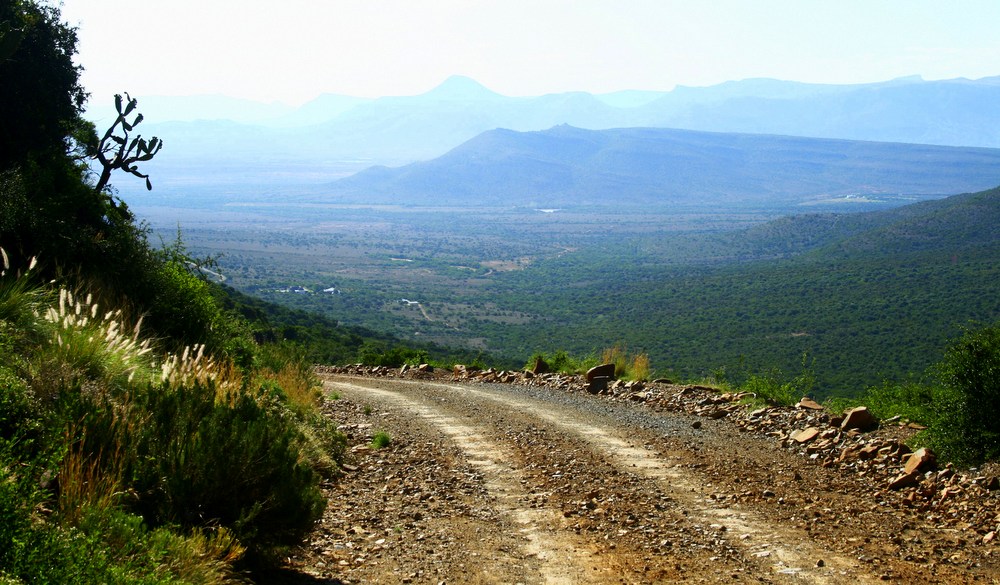
It is like travelling back in time, you still get a glimpse of what life must have been like centuries ago, back in the days of the trekboers and the travellers, farmers and townsfolk. And before that Khoekoi and San whose demise is one of the great tragedies of Africa.

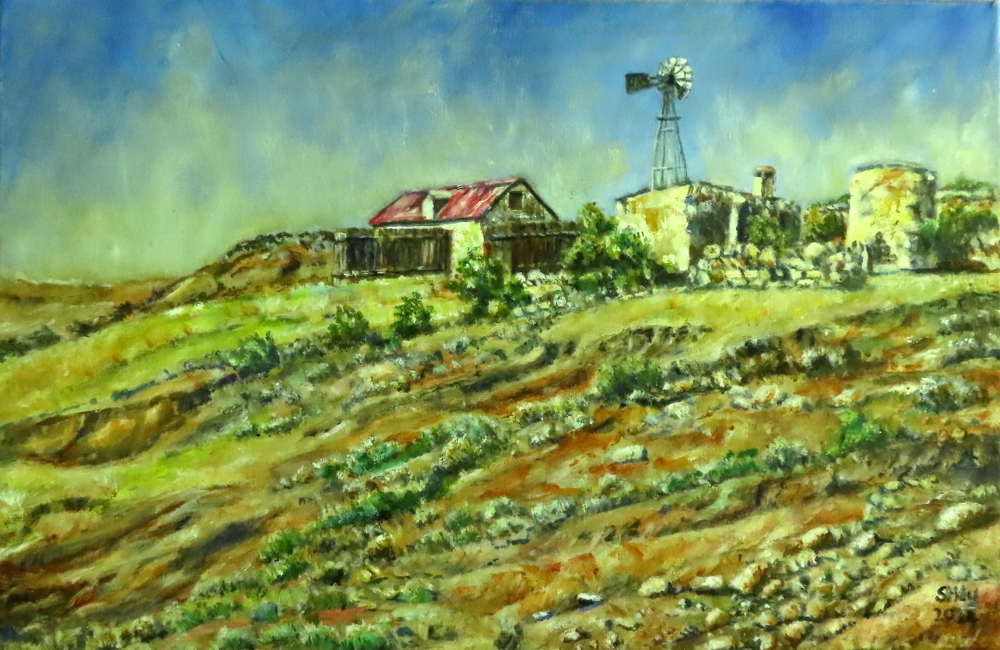
Every now and again a lonely farmhouse swims into view. Most of these old homesteads follow a fairly simple structure with a few outbuildings scattered around the back. Usually, there is a clanking windmill, a cement reservoir in which life-preserving water is stored, a few fruit trees, some drystone enclosures, a sheep kraal, possibly a chicken coop and a collection of labourers cottages situated some distance away. Often there is a graveyard where generations of the same family lie buried.
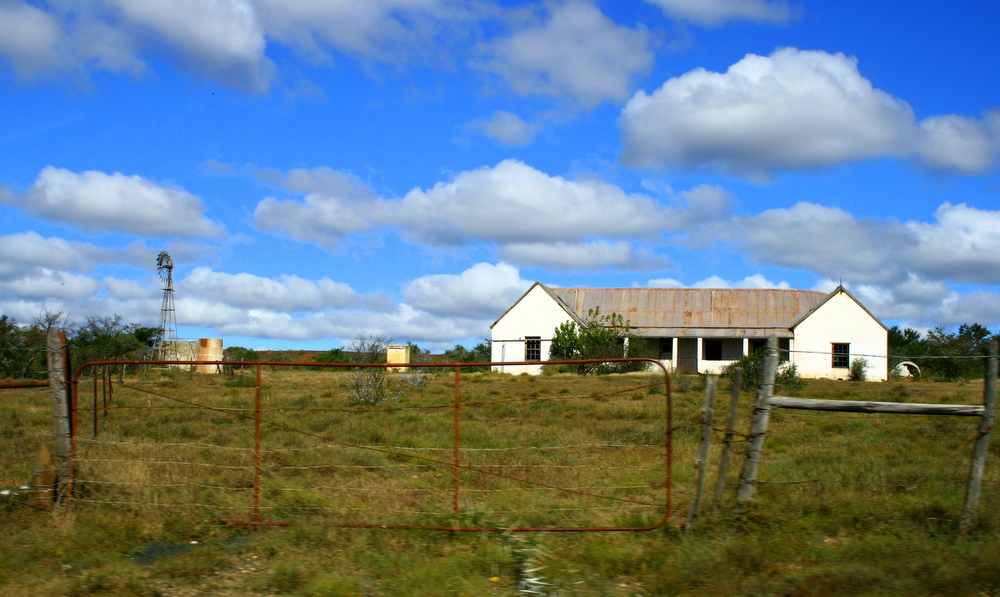
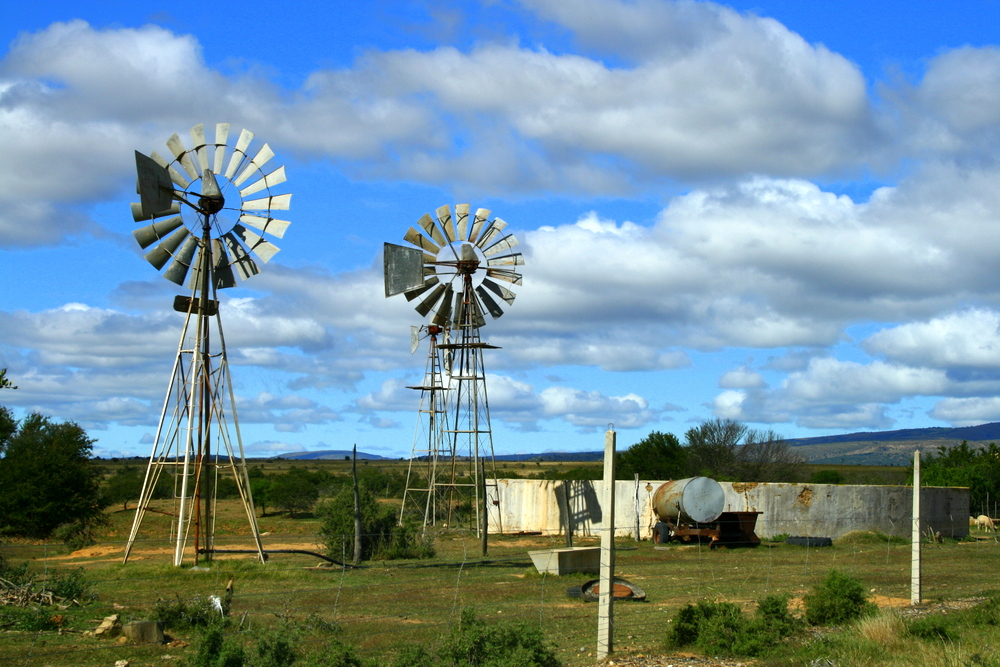
The farmhouse has always occupied an iconic place in white South African mythology (especially Afrikaner). Wanting land they could call their own, many of the early Dutch settlers, believing it was God’s will that they should do so, packed up their possessions and pushed on deeper and deeper into the interior. If conquest was their questionable motive, they were still, undoubtedly, courageous. Trekking across the dry wasteland, under a burning sun, in their creaking wagons and spans of puffing oxen, they would come to be seen by their descendants, as heroic figures, tough and resourceful, pioneering individualists who helped forge a new nation, giving it an identity rooted in the soil. As each farm was pegged out, it became a further outreach of civilisation, another step in the taming of the land, a further extension of the frontier and of European domination and influence – not that such a harsh environment could ever be truly mastered or contained. The elements always had the final say.

Nevertheless, their love affair with the country and its wild landscape had begun. Perhaps not too surprisingly, the stark beauty of the Eastern Cape has evoked a lot of literary (and artistic) responses (to get some idea of how influential it has been see The Literary Guide to the Eastern Cape: Places and the Voices of Writers by Jeanette Eve). The Cradock area, just up the road, for example, provided the backdrop to one of South Africa’s first and greatest novels – Olive Schreiner’s classic The Story of an African Farm.

It was not always so empty here. From the number of abandoned farmhouses I see on my journey, I can tell a lot of these areas once supported bigger (white) populations than they do now. Poor soils, years of unremitting drought, isolation, poverty, the extremes of temperature, and changing social and economic circumstances – all have taken their toll on the farming community. Other farms have been amalgamated and turned into larger wildlife ranches, partly restoring the land to the way it once was, except there is still a profit motive behind it.
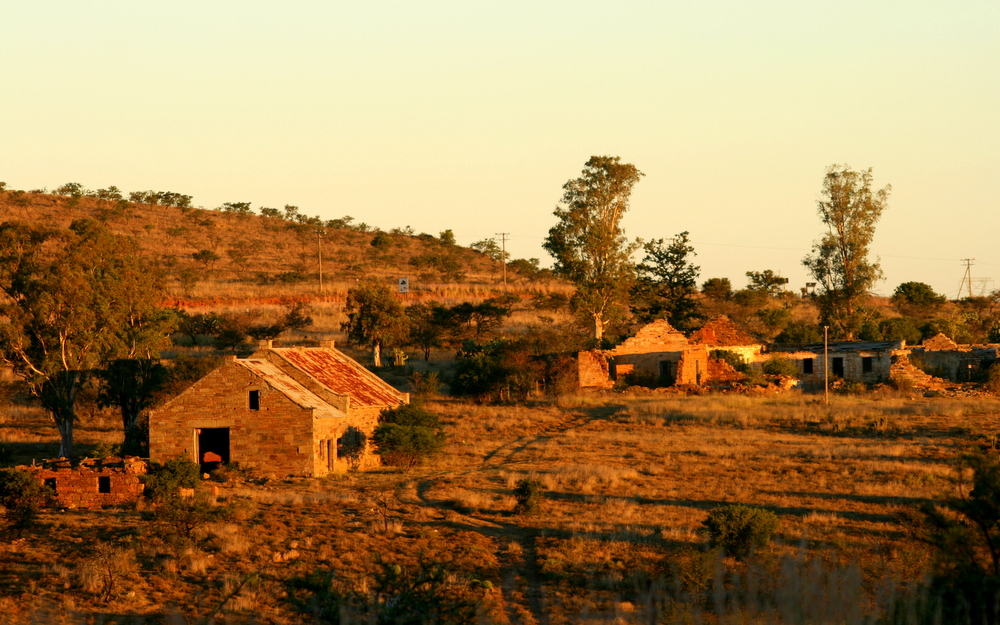
Nowadays, a new factor has come into play. The political winds have changed and are now blowing in the opposite direction. With white ownership of the land becoming increasingly tenuous under the post-apartheid government there has been a steady migration away from the land generations of farmers once assumed was their birthright. With the passing years there will, no doubt, be fewer and fewer of them.

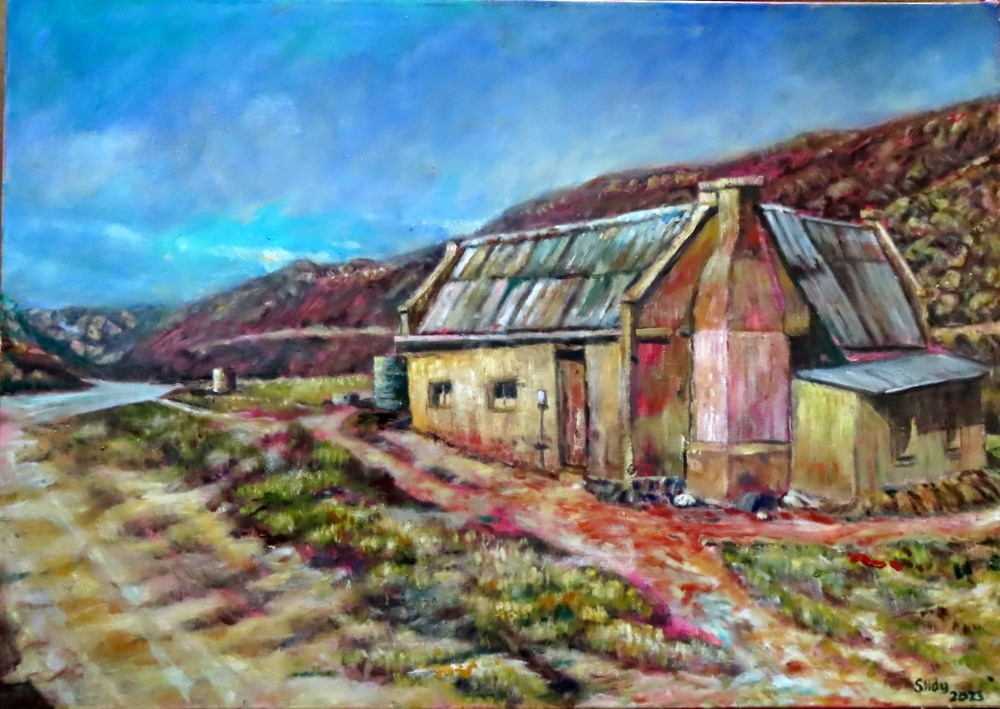
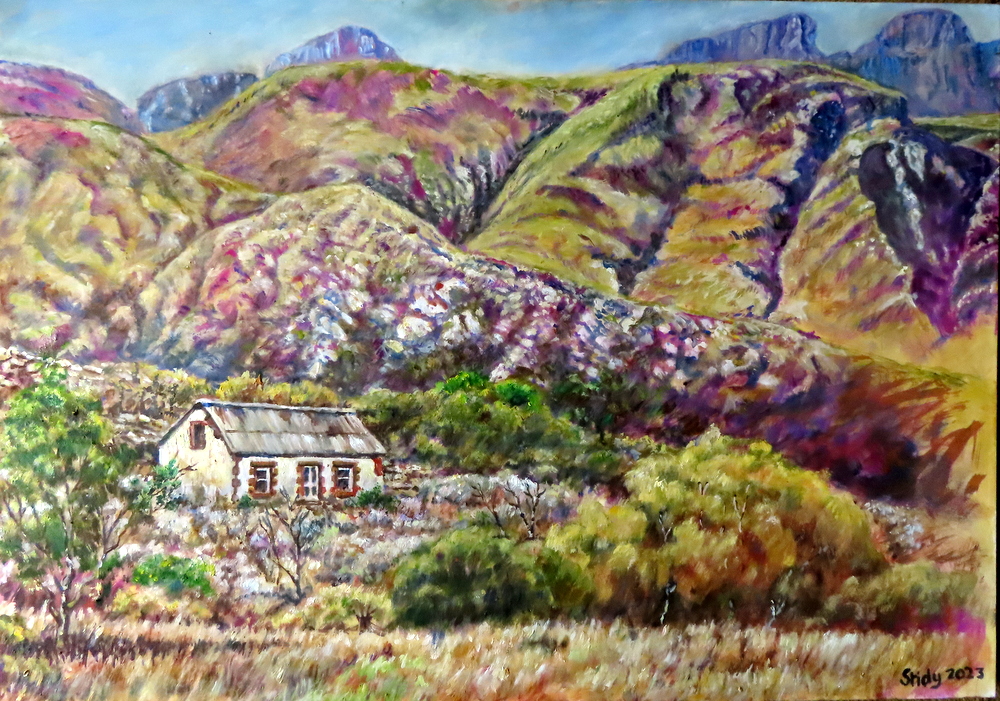
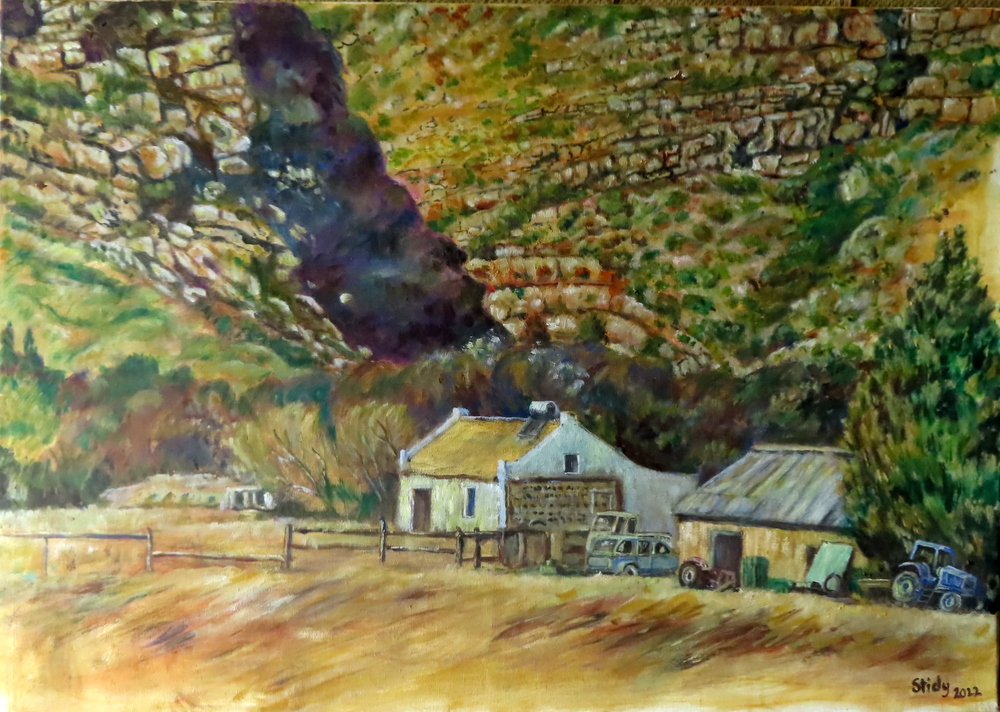
Maybe that is why I feel this compulsion to try and capture on canvas the unique feel of some of these lizard-haunted old buildings before they melt back into the ground from which they were created. Irrespective of how you see the past, they are part of it, a memorial to a particular time in South Africa’s history, now fast fading. What also impresses me, from an artist’s point of view, is how harmoniously these old houses blend into their backgrounds and become part of the land. They have character. They have souls. They have paid their dues. In this respect, they differ greatly from much of our ugly, intrusive, modern architecture.

Rounding a sharp corner, I spot a solitary homestead which fits my artistic needs perfectly. I pull over onto the side of the road and step out to take a few photographs of it. Like a deserted ship marooned in a vast ocean of rock, there is a melancholy, a haunting sadness about it as it stands alone and neglected, completely dwarfed by a huge slab of mountainside behind it. I find myself wondering about who its owners were and what drove them to carve out a life in such an isolated spot? And why did they leave? Even though it is no longer physically inhabited you can still feel their shadowy presence. Once there was life here, it housed not only people but hopes and dreams. Now, it stands deserted and empty, a humbling reminder of life’s impermanence and time’s inexorable march.
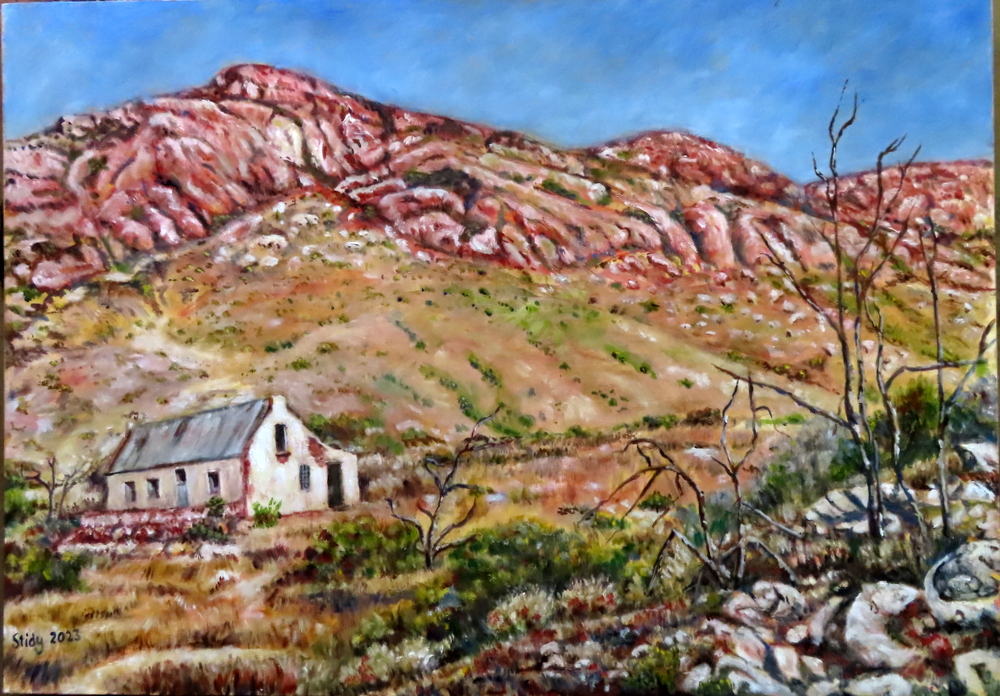
Another abandoned homestead, the Kouga Mountains area.

Having, for the sake of my painting, tried to absorb as much of the spirit of the place (the genii loci) as possible in such a ridiculously short time, I jump back into the car and drive down the winding road. As the car’s wheels crunch along the gravel, I find my mind drifting back to the farm (subsequently part of a black resettlement scheme) I was raised on, in Nyanga North, in Zimbabwe’s Eastern Highlands. It was also situated in a stunningly beautiful part of the world. It, too, imprinted itself on my youthful mind and remains forever locked in my heart. It was here my obsession with mountainscapes and remote places began.

It is never easy to leave a place, a home with its familiar sights and sounds, its rhythms and associations, its flowers and trees, its birds and animals, its daily routines. Sometimes, however, one has no choice but to love and let go. Although one is physically no longer present it is never a complete break. Every person takes their experiences and memories away with them, They lodge themselves in our psyche, become part of who we are, and affect the way we see and understand the world.

One’s love of the land can also find expression in paintings…
The Third Way

There are three ways,” he said at last, “by which a very ordinary person like me can improve himself – or at least partly rise above insignificance. Through religion, through public service, or through study and reflection on the natural world”.

The Ten Thousand Things by John Spurling ( published by Duckworth Overlook).

Pic courtesy of Sally Scott

As a professional political cartoonist, working to a deadline, I have always done the bulk of my drawing at my studio desk. Sketching out in the open, direct from nature – en plein air as the French call it – I left to the Fine Artists (who I have always regarded as a separate species from me.) That changed on holiday in Mpumalanga. Watching my sister, the landscape artist Sally Scott, sitting down by a river drawing – a study in intense focus and concentration – got me thinking I wanted to try my hand at what she was doing.

And so I did.

I found it a singularly liberating exercise. I have always liked to think of myself as a fairly observant person but you don’t realise how much you are not seeing until you try and draw it. Drawing, in situ, trains the eye wonderfully. It forces you to concentrate your mind on what is happening in front of you.

Sitting there, on a rock or a log, with the swallows wheeling overhead like World War Two fighter planes, you come to view the natural world differently. You start to see your surroundings in a minute and comprehensive detail, noticing all sorts of little things you had overlooked before. The jagged shape of a rock, the dark texture of a strip of bark, and the rumpled sky overhead – all excite.

There is also spontaneity, fluency and freshness about drawings done like this; that is something which you often lose in a cartoon or a painting you have laboured over for a long time. There are, I was further pleased to discover, other benefits. I have always believed in the value of physical exercise and sketching outdoors has allowed me to combine my two passions – walking and art.

Armed with a satchel containing my sketchpad and pencils, a boyish exuberance reasserts itself. My old passion for ‘expeditions’ and boarding school-style ‘exeats’ comes to the fore again. I am like an excited schoolboy with a secret.

Already I can notice the difference. As a cartoonist, confined to my kitchen/studio I grew flabby and pallid. Since I started walking, the surplus kilos have melted away and I have picked up something resembling a tan. I feel as fit as the ubiquitous fiddle.

Moving up to Kusane Farm, in the KwaZulu-Natal Midlands, has, of course, helped me in all of this. There is something to draw at every turn of the path – a gappy stone wall, a stream, a tumbling waterfall, a few ancient pine trees, a collection of farm buildings. Kusane has become my new heartland. It is beautiful country to walk in and also to draw. The views take your breath away. The land rises and falls in long swells and because it has not been farmed for years you can still get a glimpse of its beautiful past.

Kusane – beautiful country to walk in...

In pursuing this new way of life I have anointed myself with the title of gentleman artist although I still bristle at any suggestion that what I do is a ‘hobby’. That strikes me as a strange and utterly inappropriate description for an intensely felt passion. Extending my range has made me more conscious of my lack of experience in outdoor drawing. While each completed drawing brings its particular feeling of triumph there is invariably some detail I am not happy about.

There is nothing unusual in any of this, of course. I have been a newspaper cartoonist for over thirty years and I still obsess over the small imperfections in my technique and seek ways to improve my style.

Such is the nature of art. A ratio of failures is built into it.

What I strive for, above all, is a naturalness of style; I don’t want my work to be overly-intellectual, too-clever, pretentious or contrived. By the same token, I don’t want it to look like it was done by some amateurish Sunday dabbler. One of the important lessons I have finally learnt is not to get too anxious about mistakes. For this reason, I no longer carry a rubber with me. If a drawing does not work out, I will scrap it and start again.

I have also had to break the habits of a lifetime. As a cartoonist, hunched over my drawing, I have always worked with a fairly controlled line. Now I am deliberately trying to loosen up my style, ignoring the superfluous and working as quickly and as intuitively as possible. Remembering what my Scottish art teacher, Jock Forsyth, told me at school, all those years ago, about squinting enabling you to make out the key points more clearly, I sometimes try that. Often it is only on the third or fourth attempt that the picture begins to take a coherent shape.

All of which leads back to a fundamental question – why draw? I obviously can’t speak for others but in my case, it has always felt like it was something that was passed down to me. It is an in-built compulsion. A trust bestowed upon me. My vocation.

There is a blank piece of paper in front of me and I must fill it.

Like Wang Meng, the famous Chinese artist who lived during the last days of the Mongol occupation – and is the central character in the book quoted above – early on in my life I decided I did not want to follow the paths that led to either religion or public service. That left art and the contemplation of nature as the only way open to me if I wanted to rise above my insignificance. Like Wang Cheng, too, I don’t do this primarily for commercial reasons (although I am happy to accept payment!). For me, it is about solitude, contemplation, observation and the sheer joy of self-expression.

It is a reminder of what makes life precious…

Dusting my Soul

Art washes away from the soul the dust of everyday life”

Pablo Picasso

Confession time (in case it isn’t obvious): my name is Anthony Stidolph (aka Stidy) and I am an art addict. It is my form of DIY therapy, my way of coping with what seems an increasingly dangerous and dysfunctional world. I am a believer in art’s healing properties, and its ability to refresh and reinvigorate. It can help the head, mend the heart (and – when it is not going the way you want it to – drive you to distraction).

When I studied art at school – obtaining a distinction at Ó’ Level – I always found myself naturally attracted to drawing rather than painting. I was certainly more proficient in it. My early attempts at putting paint (back then this was limited to prehistoric powder paints which I never got the hang of) on paper were mostly an unmitigated mess. And so pencil, pen and ink became my chosen instruments and when I decided to make a career out of my art, it was to cartooning I turned.

It was only later, with the prospect of retirement looming, that I finally plucked up the courage to venture into colour once more. Thinking big, I decided to go the whole hog and start with oils, which I had never used before. I did this mostly because I knew oil can stand much more abuse in its handling than other mediums (such as watercolour). Any mistakes or errors can be easily covered. You can constantly construct and reconstruct, at leisure.

My first efforts were very tentative and not too successful. Expanding my range made me only more conscious of my lack of experience in this field. I went through periods of doubt and self-questioning. Had I left it too late in my creative life to indulge my craving for colour and pick up the necessary skills to be any good at it? Held on a leash for so long, I did not know quite how to channel my creative energy.

I am nothing if not obsessive, however. I battled on doggedly. My moods continued to alternate between youthful enthusiasm and discouragement. Finally, I began to enjoy it. I discovered that if you are more relaxed, you can concentrate better.

Although I did not take up painting until the middle years of my life, intimations of a desire to do so appeared much earlier. In some ways, my long career as a cartoonist laid the groundwork for what followed. For a start, I had learnt that it is not necessarily part of the job to copy nature exactly as it is and that by simplifying it and omitting the superfluous you could signal just as much and also make your art more immediately accessible.

As with cartooning, too, you begin to develop your own style over time too, almost unconsciously. It is like a signature, your personal handwriting, something that develops without you having to think too much about it. Aspects of your personality, preoccupations and predispositions begin to shine through.

Having decided to take the plunge into oils, it was almost inevitable that I should be drawn to landscape painting. I grew up on a remote but beautiful farm in Zimbabwe’s Eastern Highlands. It was situated in a wilderness of mountains, kopjes and hills. In every distance stood strange shrouded landscapes, dotted with baobabs and inset with rivers and fleeting pools. Mysterious, unmortared, stone ruins, scarcely touched by archaeologists, stretched for miles upon miles along the valley floors and right up onto the mountain slopes into the narrowest of crevasses and the steepest cliff faces.

These magical scenes provided a treasury of wonders for a lively, enquiring mind.

To take up landscape painting – or at least be successful – I think you have to have this inherent sensitivity or “feel” for scenery. This is the unteachable part of it. In my lifetime, I have seen way too many landscape paintings which, while technically competent, just lack this intrinsic thrill – or SOUL. It is merely painting by formula, there is no sense of an aesthetic experience, they lack the understanding that comes from constant association with a scene. It is landscape done through a tourist’s rather than a painter’s eye.

Over the succeeding years, I have continued to plug away at my painting, trying hard to establish a balance between seeing and imagining while exploring the possibilities and harmonies of colour and form. I lay no claim to having in any way mastered the subject. I am only too aware of my limitations and shortcomings (I battle with my greens, for example). However, I am not yet ready to throw in the towel or toss away my paintbrushes. I plan to carry on looking and thinking and experiencing and practising, knowing that in art, knowledge assists invention and helps you overcome creative obstacles.

The alternative – which I don’t fancy – is to do an “art detox” and quit…

PORTFOLIO:

Herewith is a selection of my paintings which I have divided into sections.

NYANGA SCENES

I have cherished my memories of the Nyanga landscape all my life so it was inevitable they should insinuate their way into my painting and that I should try to recapture the warm feelings I had about them.

BAOBAB PAINTINGS

With its gigantesque bulk and primitive appearance, the baobab is undoubtedly the tree of Africa. I also love painting them…

KZN SCENES

These days I don’t have to stray to find too far to find scenes to paint. The beautiful Karkloof Valley, where I live, is full of them…

OTHER PAINTINGS

I still love travelling further afield though. The Bushveld and the Karoo are two favourite destinations…

Paintings and Travel

The link between paintings and journeys is a close one. Both are forms of exploration.

Every painting involves a plunge in to the unknown and brings forth its own set of challenges. You have to choose a scene and then decide on your composition. You have to select the right colours so they express the mood or feeling you want to convey. You have to train your eye to perceive tones in order to get the right balance in your painting. You have to find a way to connect the different elements to create a pleasing effect..

Having said that, if I have learnt one thing from my own dabbling it is that much of art is in the process. You can start out with one set of ideas and then see them evolve in to something completely different. Without even planning it, for example, I sometimes find my paintings take on a whiff of the supernatural or even the surreal.

Rather than fight these wellsprings from the deep, I find it best just to do what I do on my travels and that is go with the flow. Your muse usually knows what is best…

Travel with its association with adventure and discovery and the allure of the new has always proved irresistible to me – and, in the back of my mind, there is always the hope that I will be sufficiently inspired by the scenes I see to want to come back home and paint them (there are other reasons I seek out changes of place, of course, many of them anthropological. I want to study the flora and fauna although I tend to look at even this through the eyes of an artist marvelling, for example, at the beauty of a particular bird I have just successfully identified).

Such journeys by car, or even by foot, can produce insights and perceptions you would not get if you just sat at home all your life. They can provide stimulus, enrichment and a sense of achievement.

The urge to record these new discoveries are part of my motivation.

I try not to over plan my trips or put myself under the guidance of others (although, occasionally one needs to do just that) but, rather, just follow my nose and see where it leads me.

As Lawrence Durrell put it, so beautifully, in his book, Bitter Lemons:

“Journeys, like artists, are born and not made. A thousand differing circumstances contribute to them, few of them willed or determined by the will – whatever we may think. They flower spontaneously out of the demands of our nature – and the best of them lead us not only outwards in space, but inwards as well. Travel can be one of the most rewarding forms of introspection….”

Here are some paintings inspired by my own voyages of discovery…

More Paintings of Baobabs

In case you haven’t noticed I have a thing about baobabs.

Here are a few reasons why: I am awed by their size and the way they dominate the surrounding countryside and tower above all the other trees. I love the drama – all those tentacle-like branches spreading out laterally, as if they want to pluck passing birds from the sky.

I admire their tenacity, the fact that they thrive in the most harsh and arid of conditions. I am impressed by the huge age they can reach.

There is something very ancient and wise and holy about them. They seem to speak of the Old Way. They stir the spirit and the eye.

Baobabs are also very much part of my inheritance. Although some people might be surprised to hear this– the ones who associate Nyanga with mountains and bracing cool weather and therefore no baobabs – our old family farm, Nyangui, in Nyanga North, was littered with them.

Baobab with Nyangui mountain in backgound. Picture courtesy of Patrick Stidolph.

You passed by a whole grove when you drove through the farm gate. There were baobabs on the top of koppies and among the ancient ruins and there were baobabs growing in the middle of the old lands. My brother, Paul, sited his house next to one.

There was a baobab, across the river, which my brother, Pete, and I carved our initials in to when we were still schoolboys – hoping that, in centuries to come, some explorer would stumble upon them and wonder who we were? It was a wasted stab at immortality. When I went back to the old farm, many years later, the baobab had collapsed and died.

Since then, baobabs have continued to act as signposts in my life. One of my favourite stopping places in Zimbabwe is the lay-by you come to as you descend the Zambezi escarpment from Makuti to Chirundu (and Mana Pools). It has become a little ritual of mine – alas, not one I have done for years – to always pull over here and have a beer.

View over Zambezi Valley

From this perfect vantage point you have a magnificent view over the valley floor, stretching in to the blueness of distance with the hills of Zambia simmering in the heat haze on the horizon. In the mid-ground you can glimpse the glittering blue waters of the great river, snaking its way eastwards towards the Indian Ocean.

And no matter in which direction you gaze you will see baobabs poking up above the sunken contours of the far-reaching landscape.

As you continue driving down the escarpment, the heat comes up to meet you. You can smell it as well as feel it: a dry, punching, smell of dust and jessie bush and mopani leaves and elephant dung. And baobabs.

Makuti to Chirundu road with Zambezi escarpment in background.

Even now, thousands of kilometres away, sitting on top of my hill in the Karkloof, I still get misty-eyed when I recall that view.

Moving to South Africa I was able to renew my love affair with baobabs when I started going on my birding trips to the Limpopo valley.

North Kruger was where I first rekindled the romance. As you drive down from Punda Maria towards Pafuri, the terrain begins to break up in to a series of steep sided ridges which a have a tumbled, frenzied look, as if somebody had stirred them up in a giant pot and then left the contents to dry out under the baking sun. And dotted all over them are baobabs.

Undoubtedly, the most famous of these is the one that sits on top of Baobab Hill. This iconic tree served as a landmark on the early trade routes going through the area. Pioneer hunters used it as part of the famous “Ivory Trail” (some of them leaving their names carved on the tree). Between 1919 and 1927 it became the first overnight stopover for black workers recruited from Mozambique to work on the gold mines of the Witwatersrand.

Baobab Hill, Kruger National Park.

Mapungubwe, another preferred haunt of mine, has its fair share of baobabs too. Like old, petrified giants, they seems to anchor an immense sea of plain and bush and broken red koppies that falls away to the Limpopo river.

It is almost like a homecoming to be driving among them.

Mapungubwe.

My paintings, then, are my way of attempting to pay tribute to and glorify these most monumental of trees. I want them to be a celebration of the baobabs heroic scale.

Obviously I take certain artistic liberties. I often tweak them a bit, highlighting and simplifying features. Sometimes I move the baobabs position in the landscape, bringing them closer to, say, a hill I fancy to create a better sense of balance. I lob off odd branches so my canvas doesn’t look too cluttered or become mired in detail. I play around with light and colour in the hope of capturing a particular moment or mood.

I try and encapsulate the loneliness, the wildness and the spirit of the primeval world in which they have existed since time began, a world in which man is still very much the intruder.

In doing this, I know I can never pay full justice to these magnificent trees although I hope I do manage to convey something of my admiration and my awe.

Disdainful in their own majesty, serene in the mellow certainty that comes to the very old they are the very symbol and essence of a remote, half-mythical strangeness.

Sketching in Zimbabwe

Not long ago, in the course of clearing some of the excess junk out of my studio, I came across a box I haven’t looked inside for years. In it I found several old sketch books containing a series of drawings I made in Zimbabwe, when I went back up there to visit my family in 1998.

While I will leave it to others to decide on their artistic merit, what did strike me about the Karoi ones, in particular, is how they capture a time, place and way of life that has now all but vanished.

Sangalolo Farm, Karoi

Four of them were drawn on the spot, at my brother Peter Stidolph’s farm, Sangalolo, only a year or two before President Robert Mugabe launched his chaotic and often violent land grab which gutted the once thriving agricultural sector. Both of my brothers lost their farms even though they were legally acquired, on terms approved by the government, after independence

What adds to the poignancy of these sketches – for me anyway – is that Pete succumbed to a brain tumour just before he lost his farm. Growing up, in the then Rhodesia, I had always hero-worshipped him – strong, humourous, practical, caring, eminently sensible and a very good farmer to boot, he was a man you could always depend on or turn to in a crisis. There is another reason I am so admiring of him – it was he who introduced me to the wonderful world of birds.

His death affected me deeply. All these years later, I still can’t quite accept that he has gone.

Pete Stidolph, Mukwichi River, Karoi.

Both Sangalolo and my other brother Paul’s old farm, Grand Parade, which is also in the Karoi district, are places I have strong feelings for and have many happy memories of. After I left the country and settled in South Africa, they became, in a sense, places of comfort for me – somewhere I could escape to when I needed to regain my bearings or wanted to recoup. It was almost as if, by going back to them, I was looking for clues to my future.

Going back – Chimanimani Mountains

I feel the same about Bushmead, outside Masvingo, which is where my youngest sister, Nicky, and her husband, John Rosselli, built their dream house, overlooking Lake Mutirikwe (formerly Lake Kyle) before they, too, were forced to move to South Africa. Also, the Chimanimani Mountains ( where my ancestors, the Moodies, settled after trekking up from Bethlehem in South Africa) and Gona-re-Zhou in the South-East Lowveld – the subjects of my other drawings.

Like Nyangui, the Nyanga farm I grew up on, they are all places which helped shape who I am. They are a slice of my life.

Oddly enough, I have done very little outdoor sketching since my 1998 trip although living where I now do, at Kusane in the KwaZulu-Natal Midlands, I am beginning to think it is perhaps time I returned to the habit. Sifting through the same box of old junk, I also came across this quote which I had written down at the time because it seemed so pertinent and captured what I felt:

A sketch is generally more spirited than a picture. It is the artist’s work when he is full of inspiration and ardour, when reflection has toned down nothing: it is the artist’s soul expressing itself freely” Denis Diderot, 1765.

Hopefully, you will see something of this reflected in these sketches. If not, I certainly think it applies to the preparatory drawings I do for my cartoons (my “roughs”), many of which have been purloined by my nephew, Craig Scott, a professional photographer, for precisely this reason…


A Passion for Landscape

Having spent most of my working life as a professional cartoonist lampooning the powerful and corrupt and those that abuse their positions of trust, I recently decided that the time had perhaps come for me to expand my oeuvre. And so I took up oil painting.

The results so far have been pretty hit and miss and I have come to realise I have a long way to go before I achieve any level of technical mastery. The whole exercise has, nevertheless, highlighted some interesting differences between the two genres.

For a start, cartooning is, essentially, a negative art form; its main purpose is to deflate and ridicule through mockery and humour. As natural cynics we are not meant to go easy on or be kind to our targets. We are not praise singers; that job belongs to others.

As the British humourist Sir Osbert Lancaster put it: “It is not the cartoonists business to wave flags and cheer as the procession passes; his allotted role is that of the small boy who points out the emperor is wearing no clothes

In painting – at least at the level I do it – a completely different set of emotions and feelings come into play. Rather than having to draw what I dislike I find myself instinctively attracted to scenes that give me pleasure. In this respect, I have discovered, you do not really have to choose your subject – in a way it calls you.

Painting at Kusane – picture courtesy of Mark Wing

For the most part my subject matter is, I suppose, pretty traditional – African landscapes in the shimmering heat haze, abandoned houses with sky filling their gaping windows, places I have visited and felt a strong spiritual connection to, views that meant a lot to me as a child.

From this perspective I am probably more a recorder than an artist. I like to look upon my paintings as precious keepsakes of the past, visual memories of places I have visited and loved.

Having said all that, it probably needs admitting that I am under no illusions about the quality of the work I am producing and am well aware it is hardly likely to pass muster with all the conceptualists, neo- marxists, post- modernists and other purists out there. No doubt the art police will point to my wonky draughtsmanship or poor use of colour and have some scathing things to say about my rather commonplace romantic sensibility.

Frankly, I don’t really care. I long ago gave up trying to keep up with the changing trends in contemporary art and, at my age, am happy to paint for no other reason than I enjoy it (although if other people do happen to like my work that makes me happy too). I treasure the whole creative process for its therapeutic value. I see it as is all part of a meditative process, a counterbalance to my day job, the artistic yin to my cartooning yang.

There is another side benefit to it I also like and that is what I call I call “my research”. This research invariably necessitates me absenting myself from home and going for long, exhilarating, drives down dirt roads and into the wilds and badlands. On such journeys I tend to slam on my car brakes a lot, leaping out, camera in hand, to capture some image which has caught my fancy – a line of cattle walking in single file through the mielie stubble, rivers dwindling away to the horizon, a weird rock formation. That sort of thing.
Normally I try to combine these excursions into the wilderness with my ornithological interests so that if I am really lucky I return home not only with a clear vision of what form my next masterpiece will take but a couple of rare bird sightings as well.

Back home I sit in front of my easel and try and coax my version of the sublime out of the assortment of snapshots that lie scattered in front of me. The trick here, of course, is to try and preserve a sense of that freshness that made the subject seem so exciting in the first place.

It is not nearly as easy as it looks and as a result my admiration for those artists who can achieve this, seemingly without effort, has increased a hundredfold.

I have to confess, though, that I have fallen in love with the whole process. I love the smell of linseed oil and turpentine, the scrunchy feel of canvas and the beauty of paint applied by brush.

Indeed, the secret that I almost dare not admit to – especially for someone whose job has always been to castigate and demolish those in authority – is that the pursuit of beauty has now become an overriding passion, my embarrassing motivation in life.

Click on the images below to see a selection of my baobab paintings, inspired by my various trips in to the South African and Zimbabwe lowvelds: