The Legend of Plucky-the-Duck

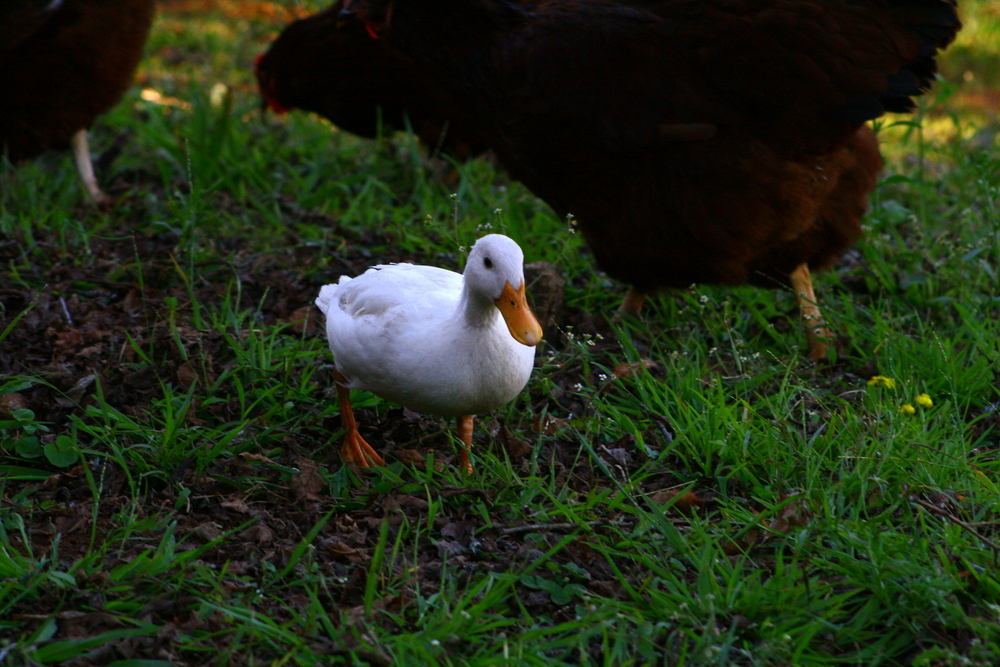
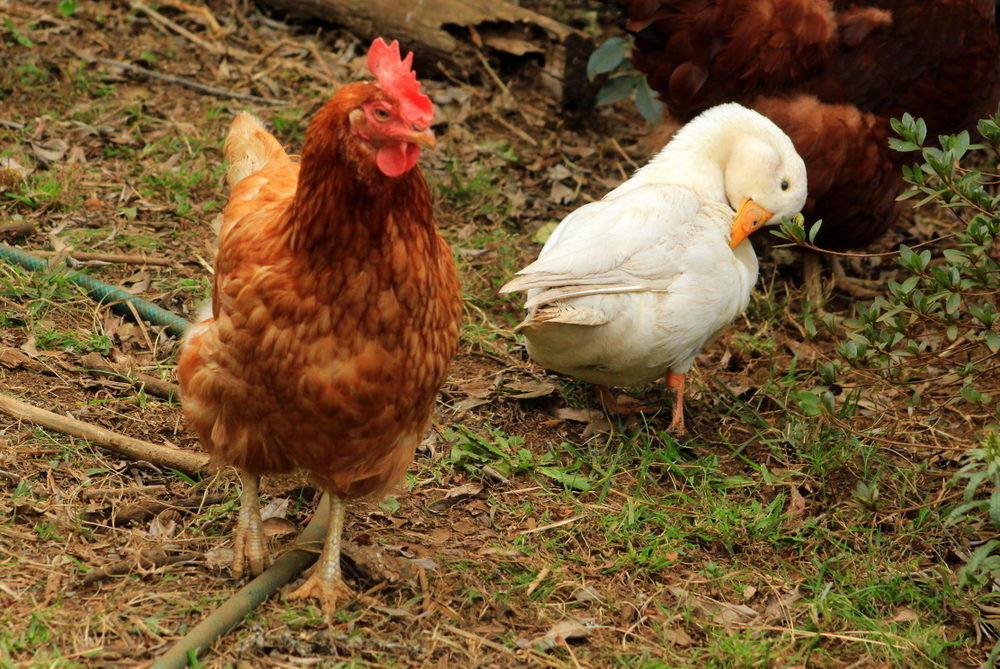
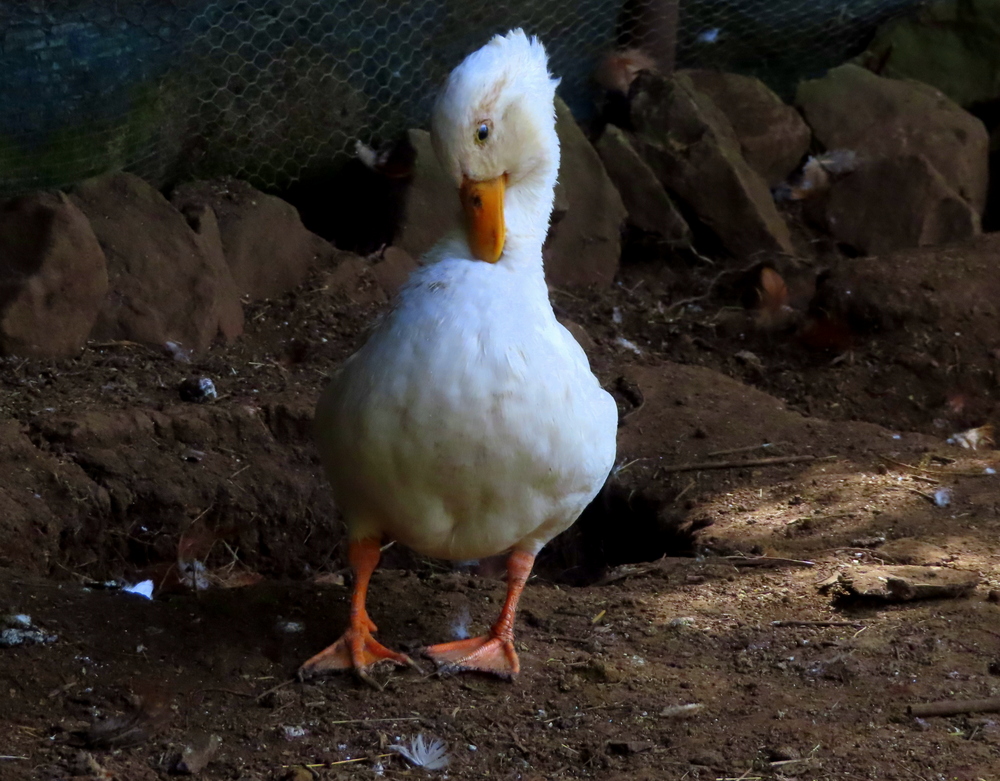
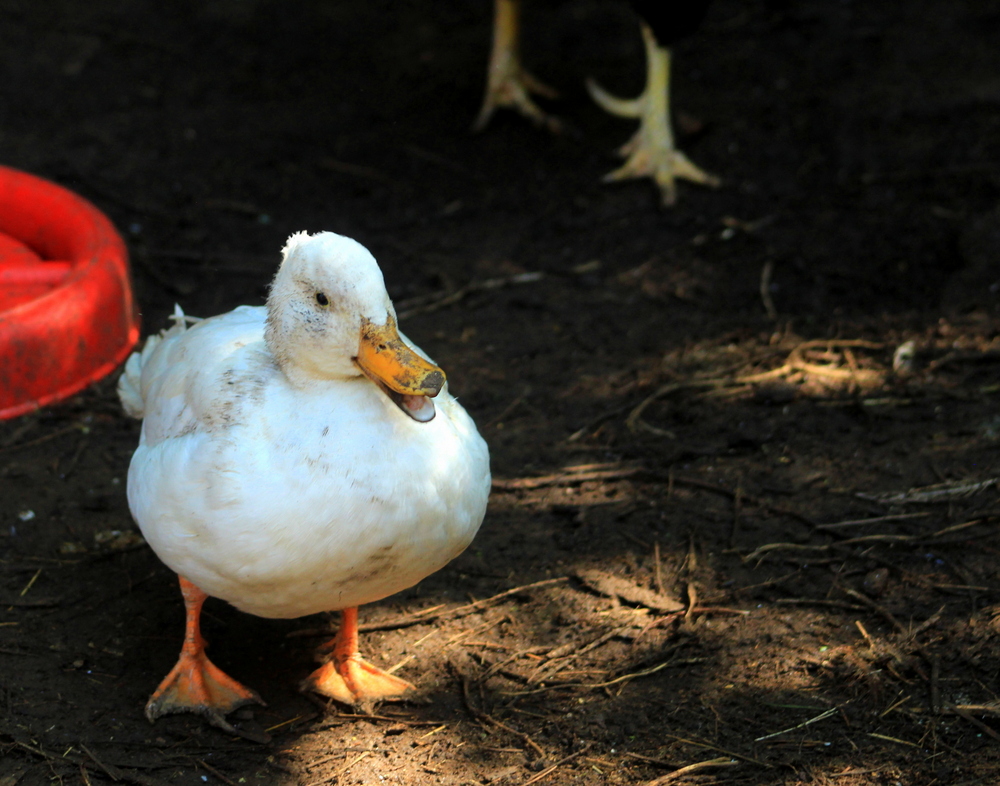
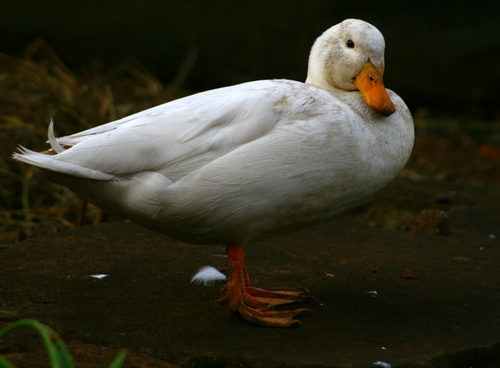
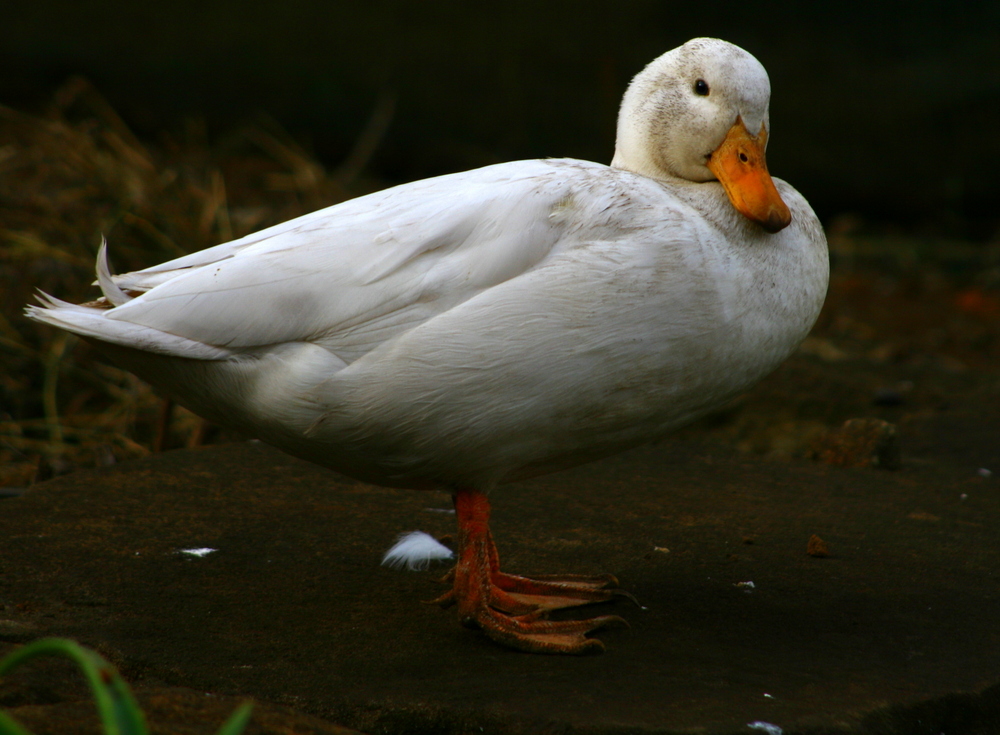
This is the story of a little duck – although I would caution you against calling him that to his face. It would most likely deeply offend him. For as far as this particular waterfowl is concerned he is not a duck, he is a CHICKEN! The fact that he is relatively small, short-necked, large-billed, web-footed and has a distinctive waddling gait is of no account to him. So what if his ancestors branched off on their own separate evolutionary tree way back in the mists of time? Likewise, why should he be bothered by all that Linnaeus terminology about classes, family, genera and species?

For this little duck, it all boils down to a question of “belonging” and he knows precisely where his true home is. In the chicken run, surrounded by all his chicken friends.

To understand how Plucky-the-Duck-Who-Thinks-He-Is-A-Chicken (which is his full name but from here on, I will simply refer to him as Plucky) came to identify so strongly with a type of bird whose size, form, shape, patterning, colour and habits of behaviour do not quite match his own it is necessary to go back to the curious circumstances surrounding his birth.

Plucky’s parents were two normal Dutch Quacker Ducks and like many happy couples, they decided to raise a family. Eggs were laid. The mother dutifully sat on them. After the requisite period of incubation, the eggs hatched – all except one which the mother then abandoned, presumably believing it to be infertile. Or maybe after twenty-eight days, she just got bored of sitting. I am sure I would have done the same if placed in a similar predicament.

On the odd chance that she might have quit her parenting duties a little too soon, we decided to place the one remaining Dutch Quacker egg in an incubator full of chicken eggs. Amazingly, there was, indeed, a life form in it who then proceeded to bludgeon his way through the shell. This happened at more or less the same time as all the chicken eggs commenced hatching.

The act of identification seems fundamental in such situations and since the first thing Plucky saw, when he emerged into the light was a whole batch of hatching chickens it is perhaps hardly surprising that is what he decided he must be.
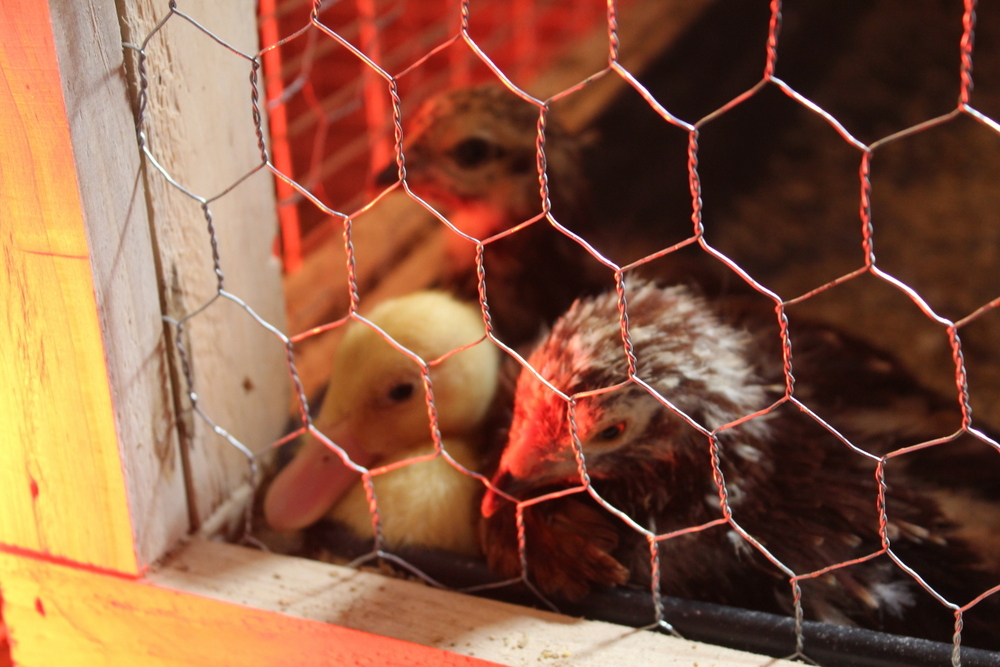
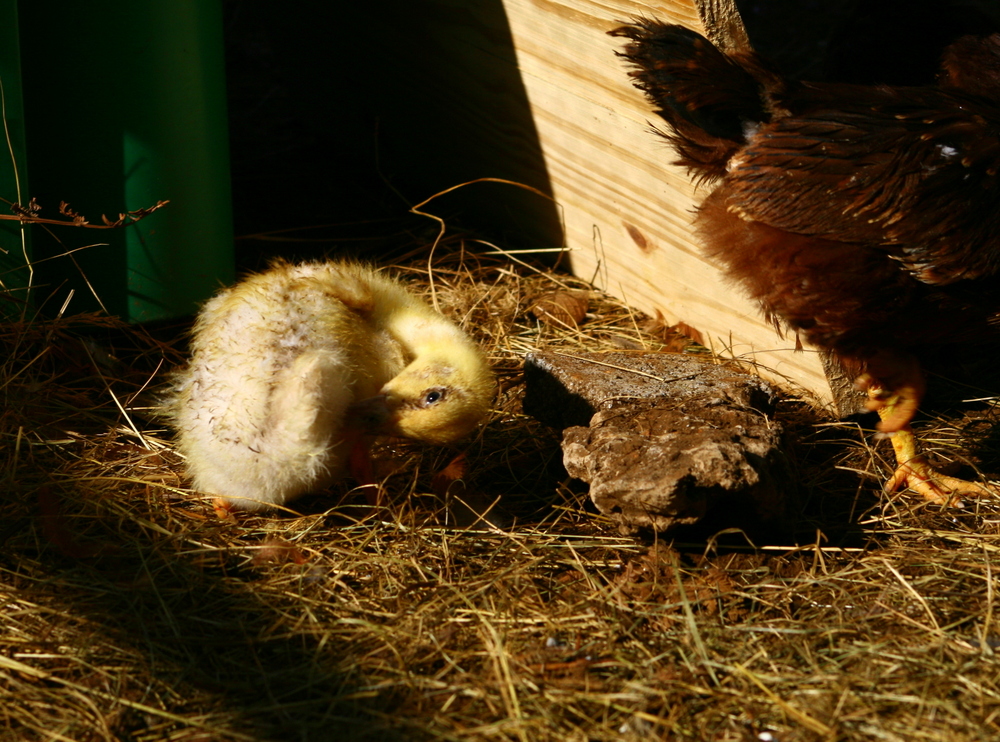
Despite their evident differences, it would probably have been better for all if we had let the whole matter rest there. Instead, once he got a little older, we decided to be hard-nosed about it. A little human intervention was called for. Because of Plucky’s obvious confusion over who and what and why he is, it seemed to us some psychological counselling was in order. A little friendly guidance, a nudge in the right avian direction. A course in Duck Deep Therapy.

It so happened that our neighbour had a pair of Quacker Ducks and three ducklings, the latter more or less Plucký’s age. When he offered them to us, knowing we had a big pond on which they could cavort and play and do other duck things whereas he did not, we saw this as a perfect opportunity to integrate Plucky with his own kind.

We would put him in the pond with them.

Two boxes were duly placed on the water’s edge, the one containing the family of ducks, the other, a bewildered Plucky. We released him first. Some deep-rooted instinct obviously did kick in for he took to his new environment like a…well… proverbial duck to water. Once he seemed comfortably established in his new liquid home, we released the inmates of the other box.
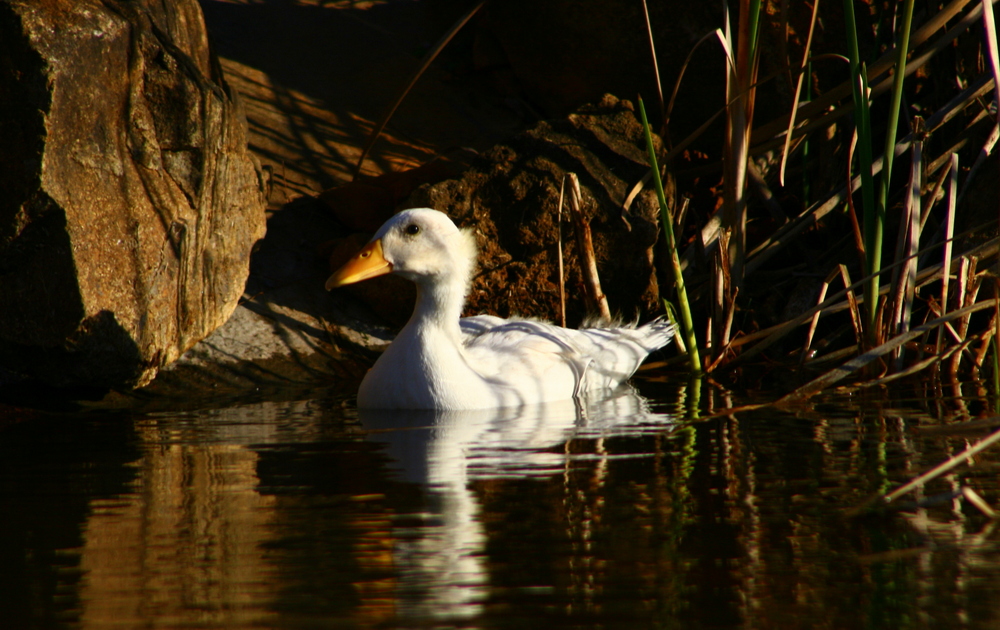
Like a duck to water…Plucky in his new home.

It was at this point that our plan to re-integrate Plucky with his kind began to unravel…

On being released from their box, the two parent ducks panicked and charged off into the surrounding shrubbery, leaving their confused offspring behind. The abandoned ducklings, in turn, saw Plucky floating on the other side of the pond, and, recognising him as one of their own kind, went paddling in his direction. Clearly appalled by the sight of this small flotilla advancing, full steam towards him, Plucky went into escape mode With a violent clattering of wings, he launched himself over the sheep enclosure fence, gained altitude, hovered briefly and then tumbled, out of sight, down into the valley below.
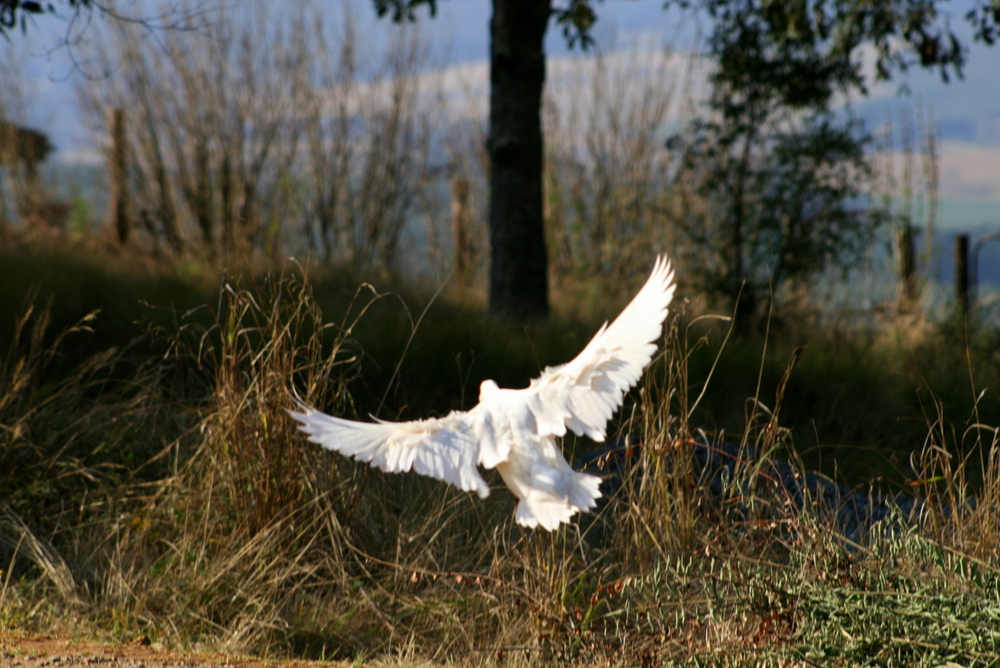
…with a violent clattering of wings.

Where he landed I had no idea. With a dull foreboding, I set off with Michael Ndlovu, our farm manager, to scour the countryside, kicking through leaves, looking under bushes, clambering over rocks and staring until my neck ached. To no avail. The little duck had simply vanished into the ether. Feeling both a little teary and angry with myself for being so presumptuous as to assume I understood Plucky’s needs better than he did, I trudged back home.
The next morning, I was woken in the early hours by a huge commotion in the hen house. When I stumbled out in the freezing cold with my torch to investigate, I discovered one of the hens had accidentally laid an egg in her sleep and then worked herself up into a state about it. Miracle of miracles, I also found a very cold and forlorn Plucky huddled up against the outside gate to the enclosure. As I approached he looked up at me beseechingly and uttered a few feeble ‘quacks’. He had somehow found his way home in the dark. It seemed pretty clear we had not taken into account Plucky’s resolve or his loyalty to the only real family he had ever known.
Again, this is where we should have left it but in the same perverse fashion, we made the snobbishly human mistake of thinking we knew best. If we tried one more time maybe it just might do the trick.

It didn’t.

They say birds of a feather flock together but that was definitely not the case here. Clearly traumatised by the thought of sharing the pond with these feathered imposters, Plucky took to the air again, disappearing into the same valley. A fruitless search followed. Twenty-four hours later I found him curled up outside the hen house door.

That settled it. Plucky could stay with the hens.
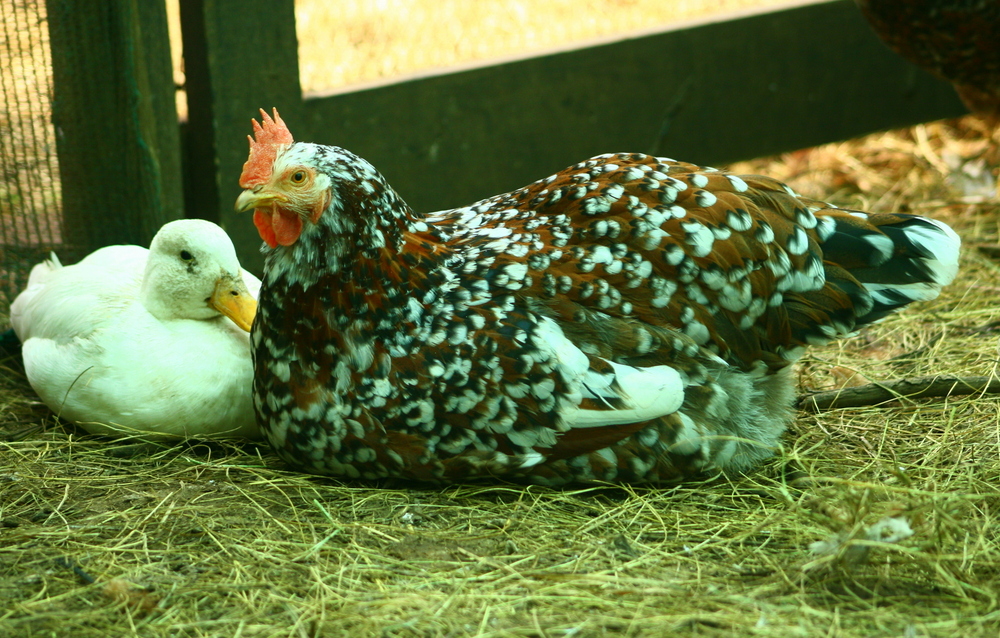
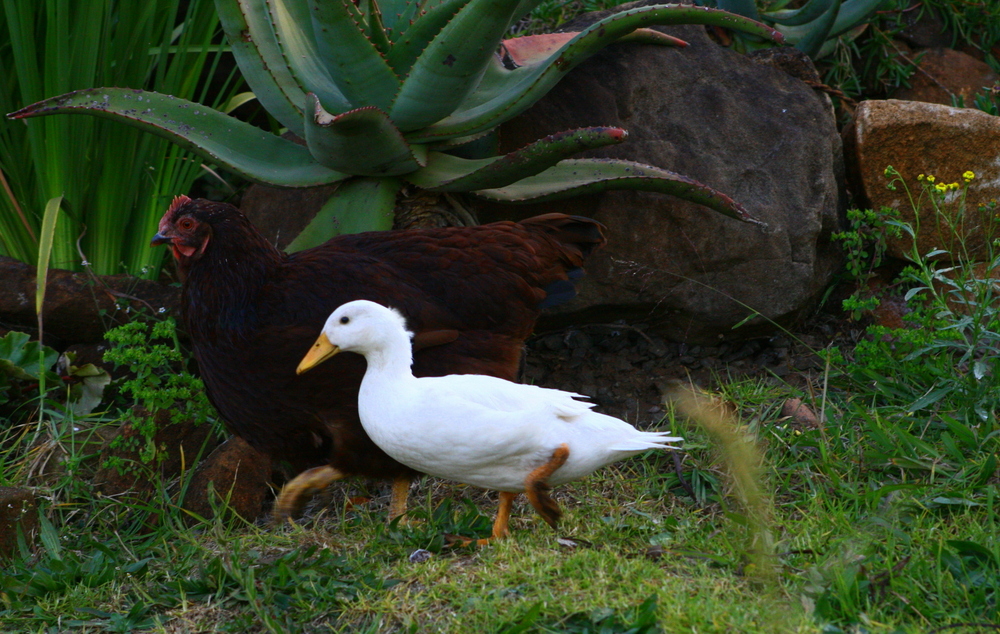
Where he most wants to be…Plucky with a friend.

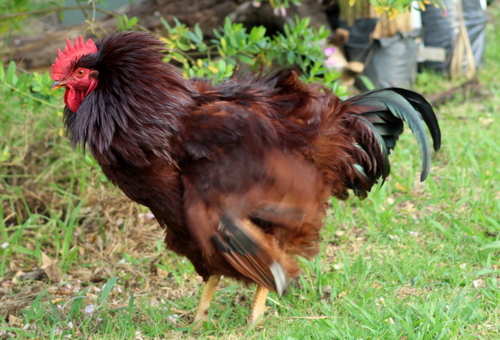
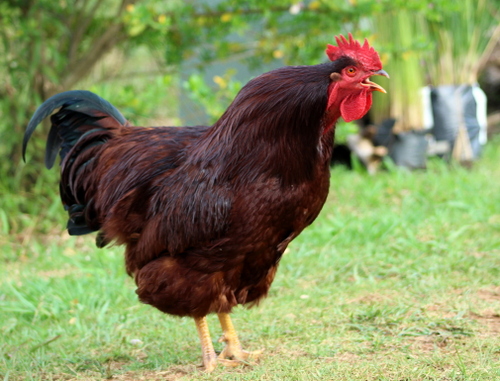
Although it didn’t enter our reckoning at the time there is another reason Plucky’s decision to remain in the hen house proved a wise one. Within six months of his return, all the other ducks had disappeared, either killed off by local predators or migrating to new pastures. Not so Plucky. He has continued to prosper and flourish. He has now outlived three successive Rhode Island Red roosters (Rowdy, Randy and Rufous) and I suspect he may outlast the fourth (Randolph).

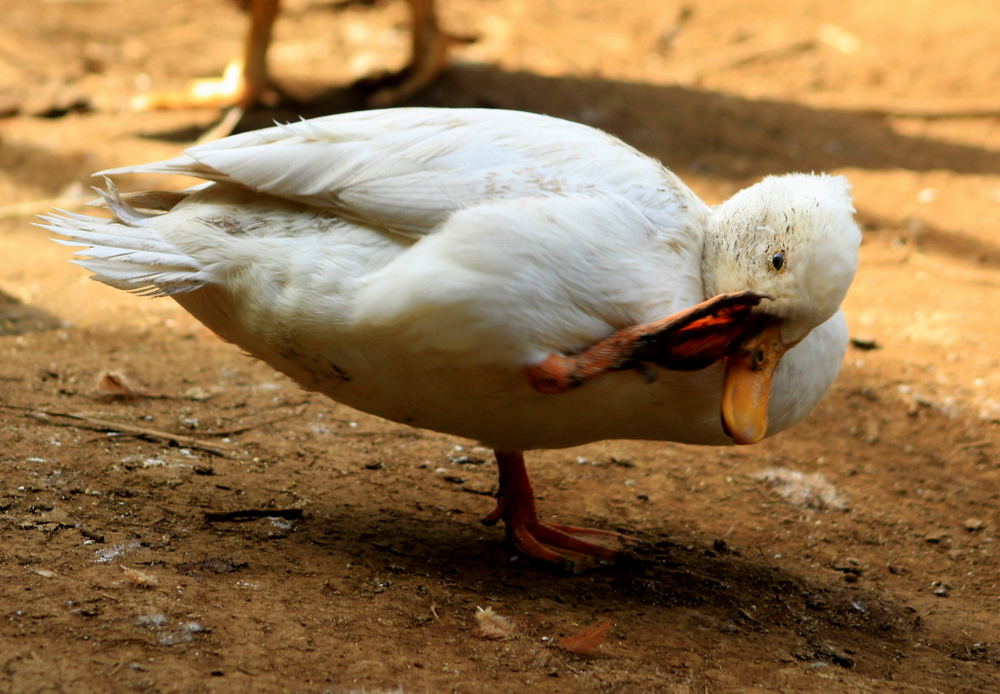
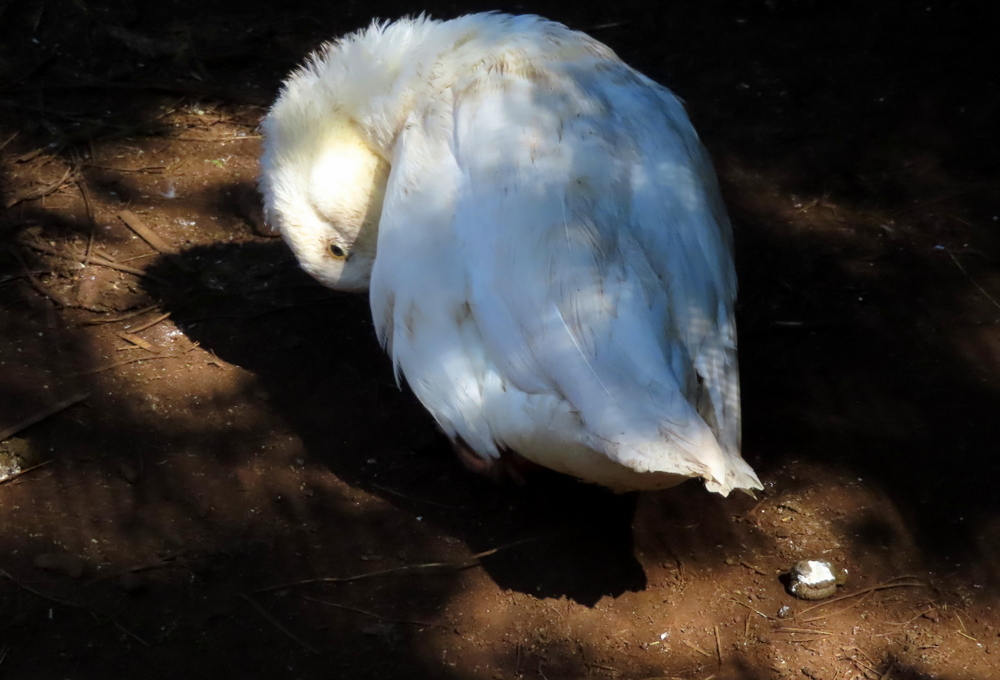
Happily ensconced in his home, he continues to charm us in many ways: the earnest bumbling walk, the body shape, the head scrunched down, the gentle eyes so full of understanding, the endless preening, the look of sleepy disgruntlement when I shine my torch into the hen house late at night to make sure they are all okay, his dogged insistence on flying from the top perch when I open the same house each morning and crash-landing, in a maelstrom of dust, into the ground below.

To bring some variation into their existence, I used to open the hen house gate every afternoon and allow the motley band to free range through the garden. Plucky came to love these big adventures. Jaunty but resolute, he would stride off, along with the rest of the gang, like he was David Livingstone searching for the source of the Nile. Sadly, the resident predators soon got wind of this daily routine and when one of our prize Bosvelder roosters got snatched, in mid-cock-a-doodle-do, by a lurking Caracal I was forced to put an end to their little outings into nature.
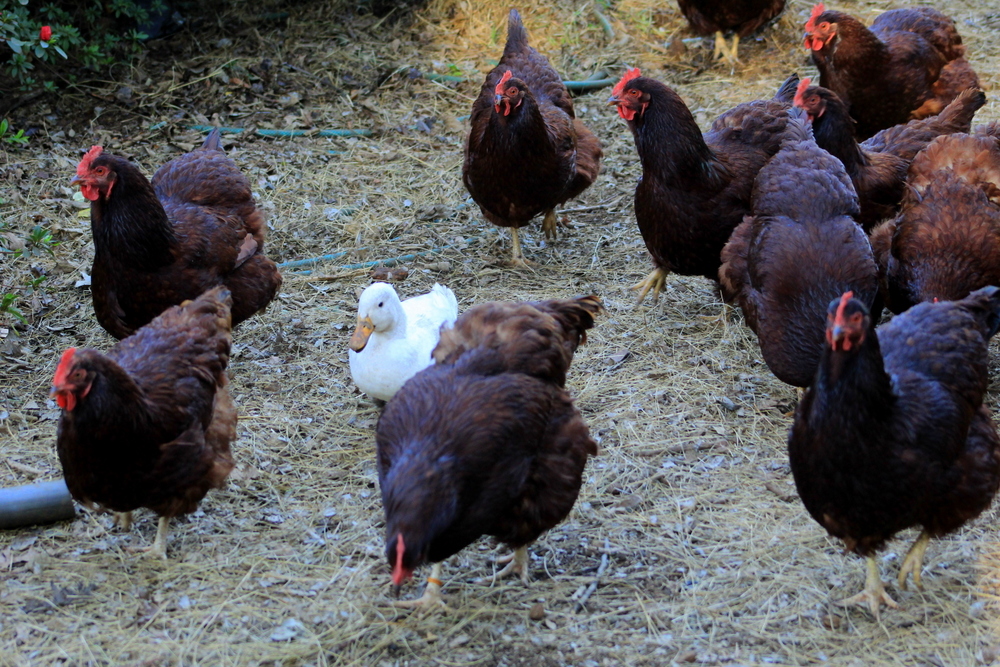
Plucky heads off on another awfully big adventure

Of the three it was our original rooster, the larger-than-life and boisterous Rowdy who Plucky developed the closest bond. They became inseparable friends. He has kept a much lower profile with his two successors, Randy and Rufus, and initially treated Randolph with a deep suspicion bordering on active dislike.

Rowdy-the-Rooster and Plucky-the-Duck having a deep discussion

Maybe it was a male domination/territorial thing. A need to assert himself. Show who is the head honcho in this yard. For a while, it even appeared that Plucky held the upper hand. Each morning, just after sunrise, I would open the henhouse door. Out would shoot the burly Big Red Rooster, with the determined little Dutch Quacker Duck in hot pursuit. Around and around the run they would go until, tiring from the effort, Plucky would suddenly stop and go for a drink of water and then perform his ablutions with a self-satisfied air.

I think a peace conference – presided over by a panel of senior hens – must have been called because suddenly a truce was declared. All hostilities ceased. Individual egos were set aside in the interests of the flock. While they haven’t become exactly close friends, Plucky and Randolph now treat each other with wary respect.

Plucky also went through a brief but rather trying period when his sexual urges got the better of him. He began to emanate a discernible lustiness and became obsessed with the idea of finding a mate. In this case: a chicken mate.

He is at a serious disadvantage in this respect because he is much smaller than the hens. Undeterred, he waited until one hen was happily flapping around in a dust bath and then leapt on her and had his wicked way. Later, Plucky developed a hopeless fixation on another Rhode Island Red hen, trailing around after her with a moonstruck look on his face. He even insisted on sharing the nesting box with her whenever she wanted to lay an egg, getting very excited when it appeared.

I think he secretly hoped there might be the embryo of another little Plucky inside…

Plucky has his wicked way...

Alas, his attempt at courtship was a dismal failure. The hen obviously considered him an unsuitable paramour and grew increasingly agitated with his unwanted advances. In the end Plucky began to make such a nuisance of himself I was forced to put him in his own separate run for a few days to allow his passion to cool. Luckily, it did…

As he has matured and grown older, Plucky has adopted a more fatherly, protective, proprietorial attitude towards the hens. As a long-serving member of the Parliament of Fowls, I think he now sees his role as that of a senior statesman whose job is to lend a guiding hand. He takes his duties very seriously. As the sun is abdicating each day, he stands at the hen-house door and waits until he has been able to mark off every hen as present and accounted for, before entering the chamber himself. Usually, with much pleased-as-punch quacking and a wagging of his curly tail…

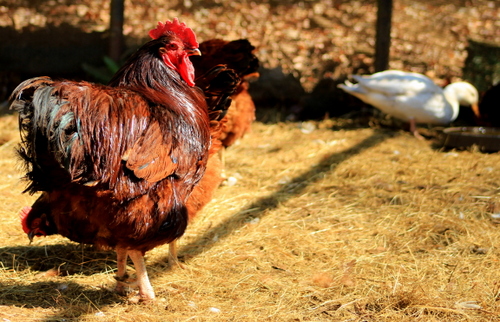
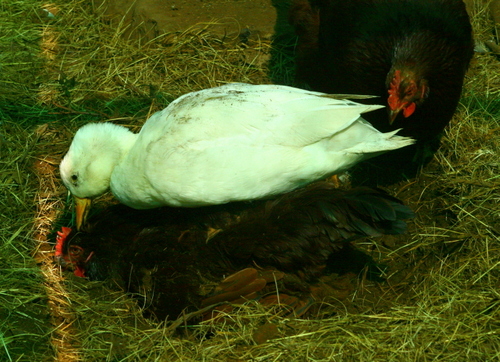
Despite the fact he is not a chicken (I must insist – do not tell him that!), the rest of the flock have accepted Plucky’s presence with equanimity and good grace. For his part, Plucky is quite happy to go on living in his totally deluded state. I envy him for that ability. Every night when I go to lock them up I see him huddled up happily amongst all his chicken pals…

There is obviously some sort of moral fable in all of this. Taken together, the inmates of the hen house provide a shining lesson in tolerance towards foreigners and acceptance of social diversity. I am only too happy to admit to a degree of anthropomorphism – an impulse to identify with him – in my attitude towards Plucky.

He reminds me of the humans I love best – the ones who don’t quite fit in but find their own quiet space in society nevertheless…

GALLERY:
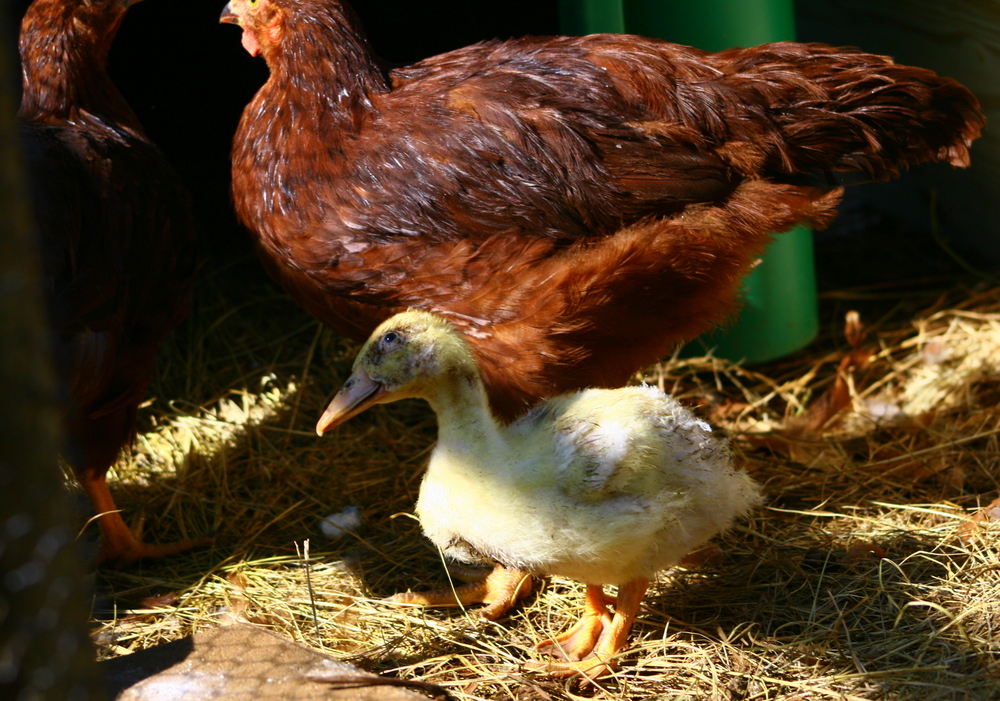
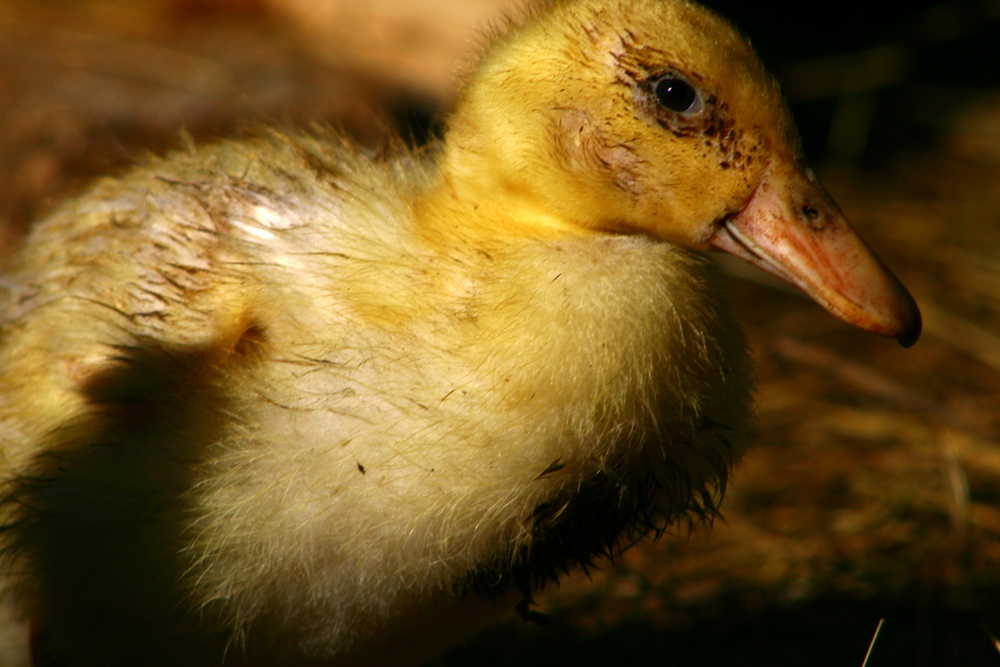
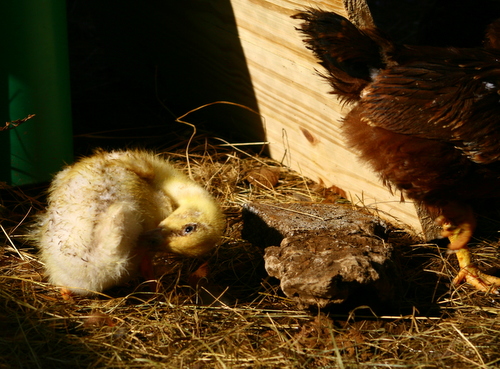
A young Plucky…
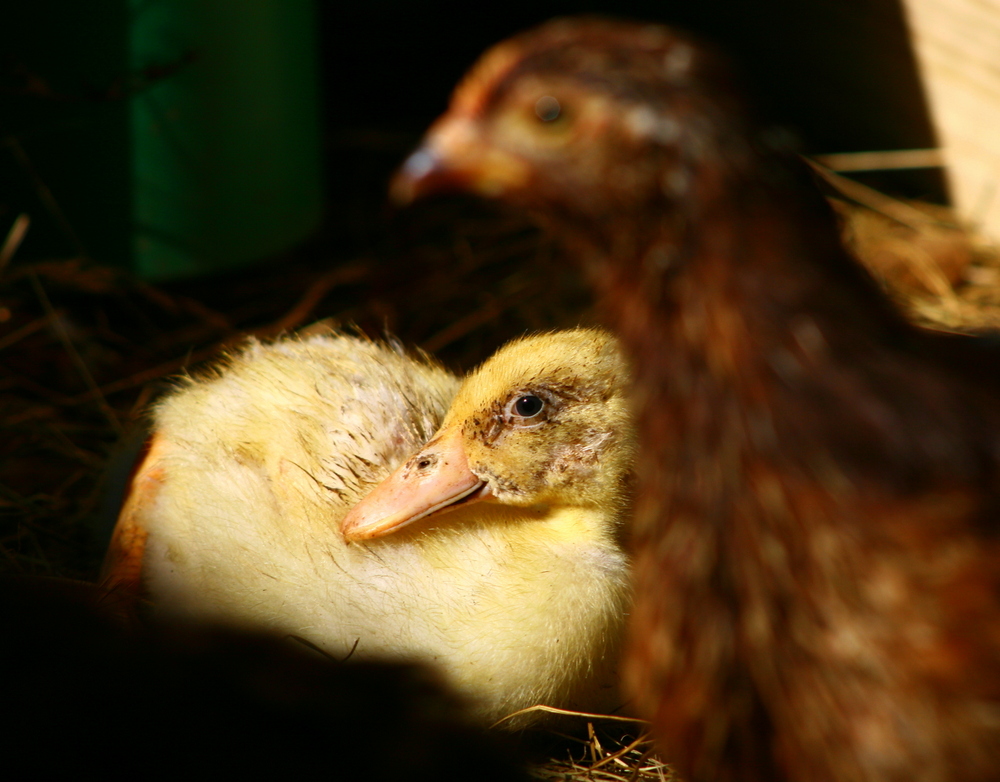
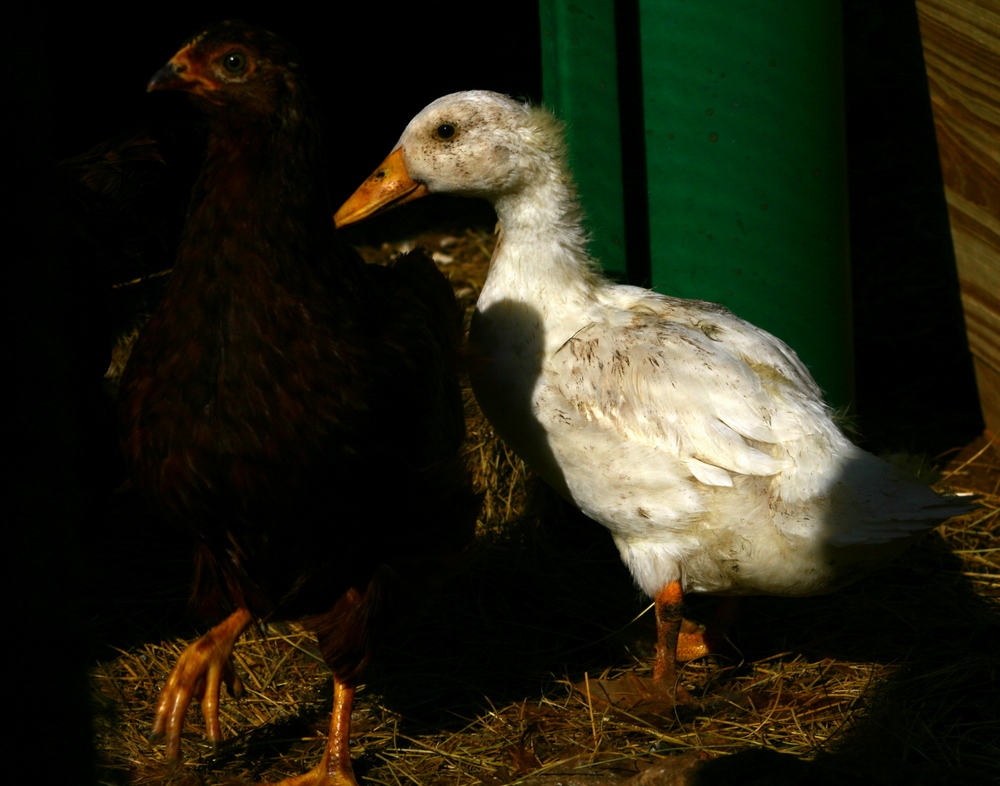
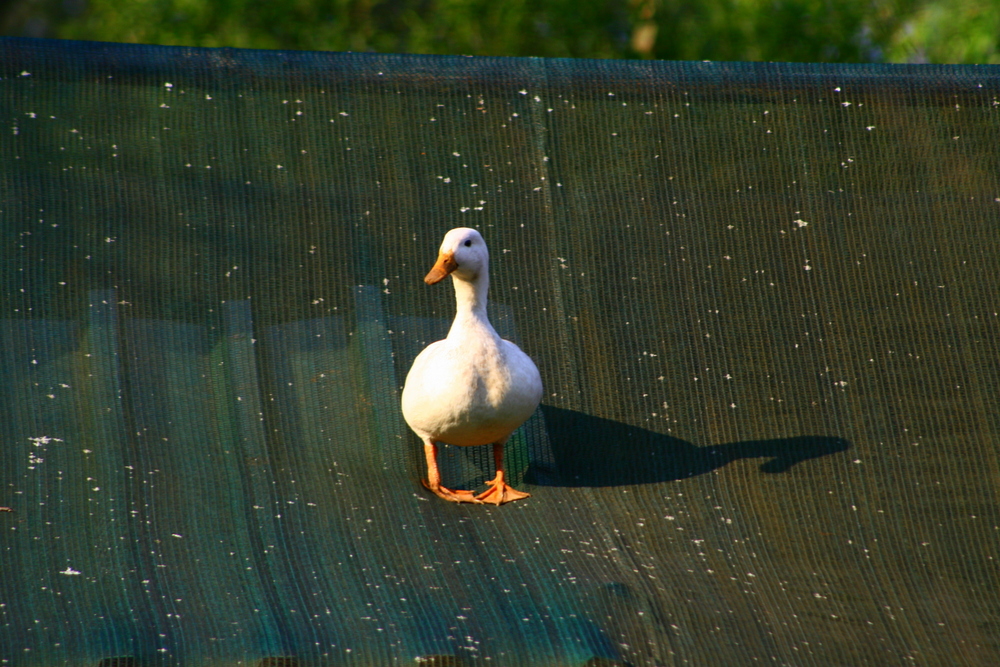
Fully grown, Plucky starts to explore his known universe…
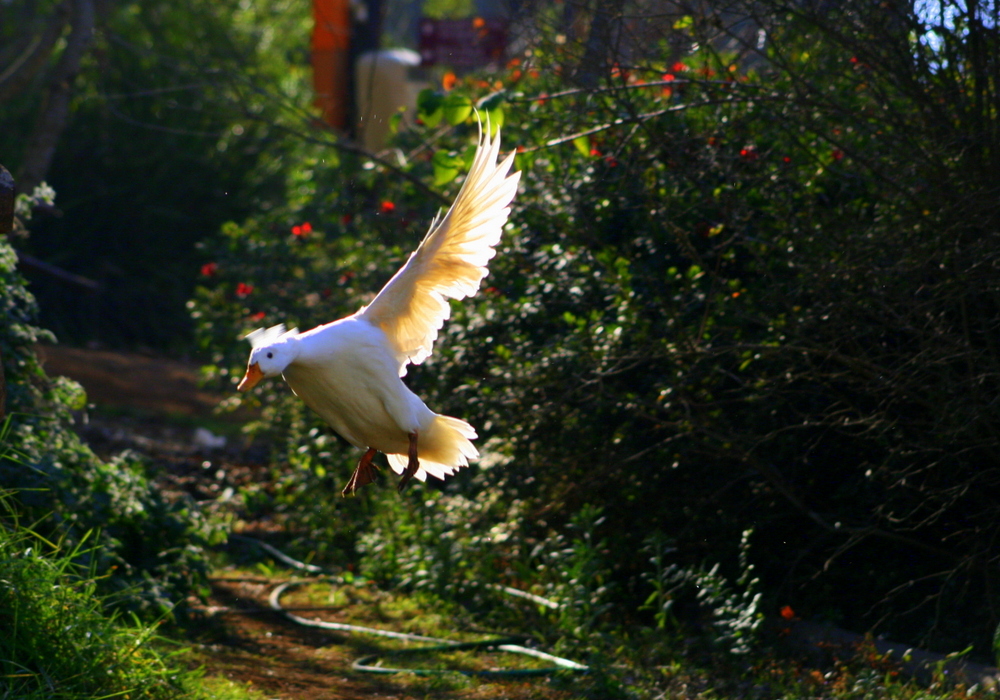
Plucky is very conscious of his appearance and spends an inordinate amount of time preening himself…
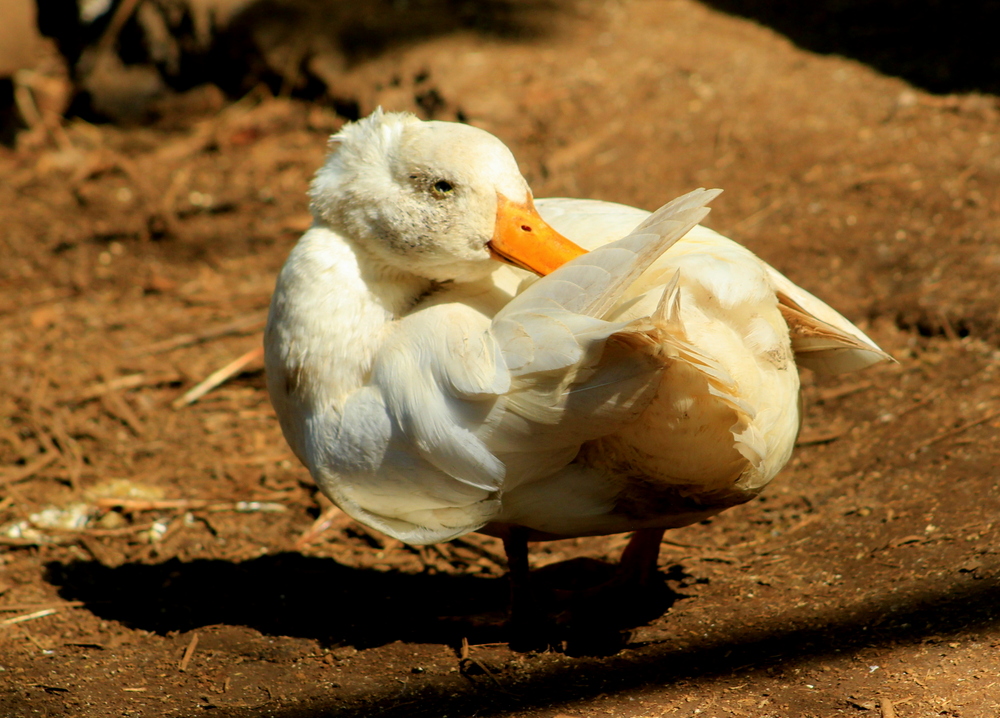
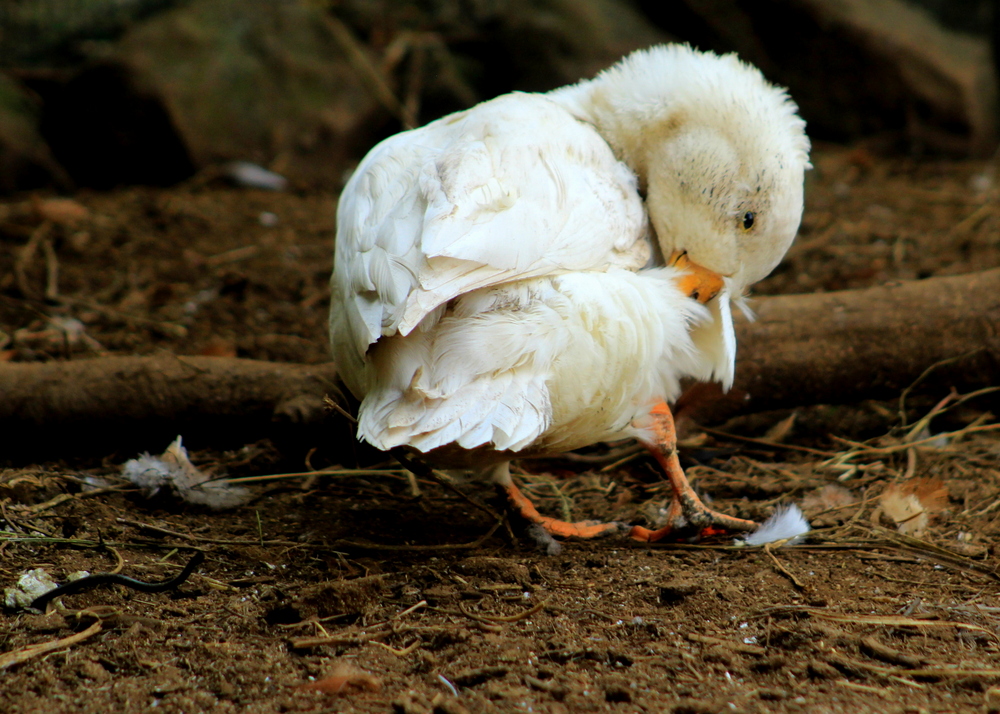
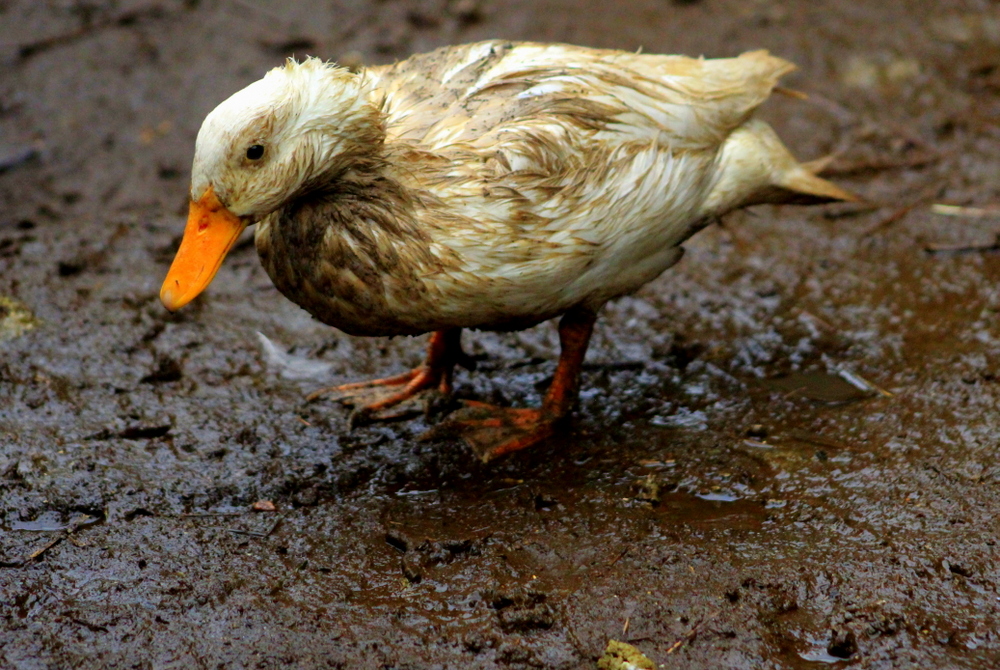
…but he still often ends up a muddy mess…
As a Dutch Quacker Duck, Plucky has opinions about a lot of things and is not afraid to express them…
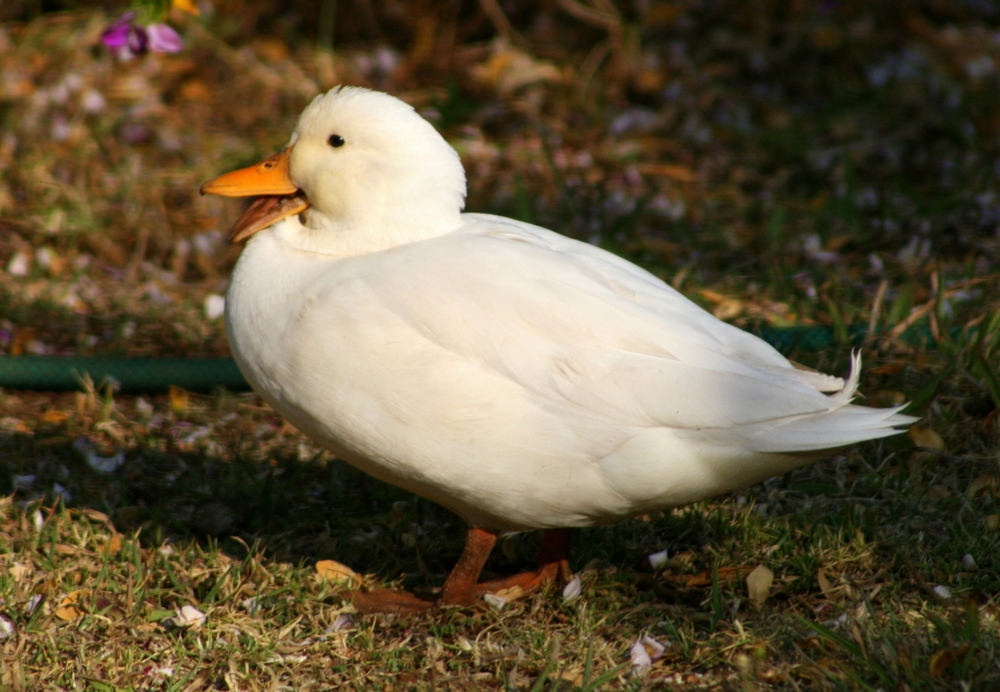
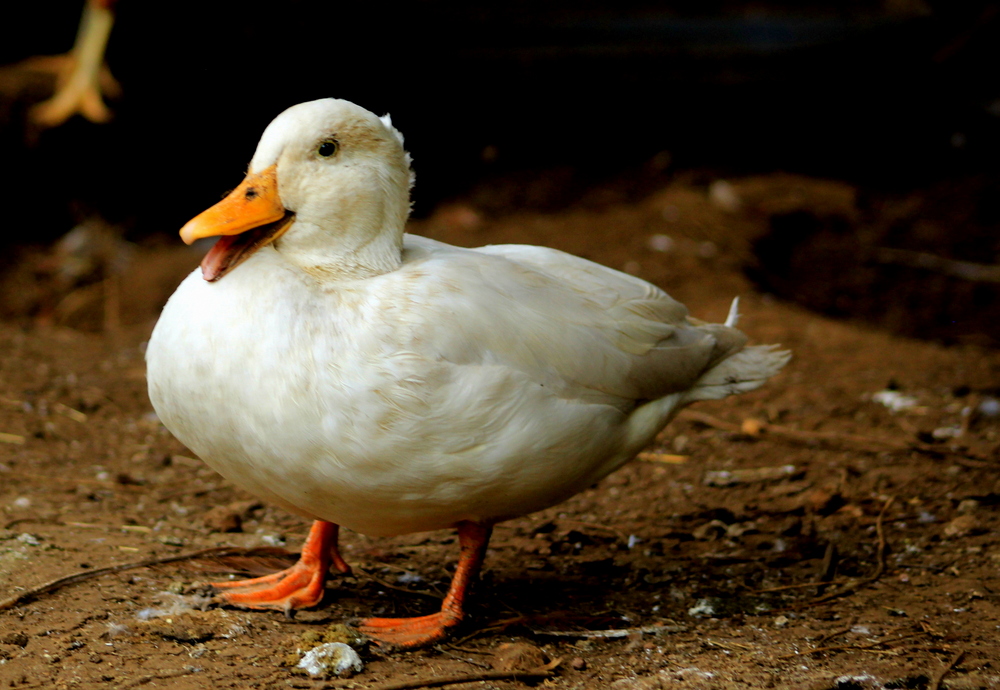
“Alright!” quacks Plucky the Duck, “That’s enough about me for now…”

THE END

A Love Letter to Kusane

“If a man does not keep pace with his companions, perhaps it is because he hears a different drummer. Let him step to the music which he hears, however measured or far away.”

Henry David Thoreau

It is probably my British heritage but there is nothing I love more than dashing madly about the countryside, in all types of weather – sunny, showery, cool, breezy – with a pair of binoculars in one hand and a camera in the other. Given this genetic predisposition of mine, it is perhaps just as well I live in an area where it is very easy to feed the habit.

A rambling man...Pic courtesy of Sally Scott.

Kusane is a farm with a commitment to conservation. All I have to do is step out of my front door, skip around the corner of the balcony and then slip across the gangplank that connects it to the ground beyond and I am into the unspoilt, open, pristine countryside. In a moment everything is altered. Any cares or worries I may have quickly get left behind. All my senses come alive. I am agog with anticipation. Another day of happy rambling awaits…

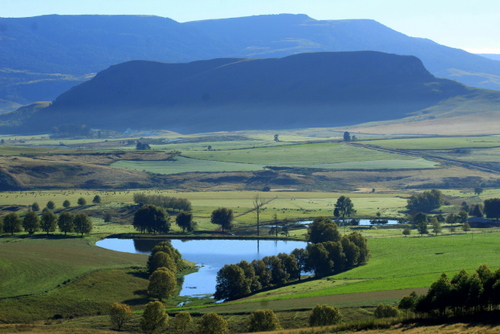
View from Kusane over Karkloof Valley

I never tire of these walks. The countryside is breathtakingly beautiful. There are subtle changes to it every day and every season. These become more pronounced after the first spring rains fall. The colours become more vivid and intense, wildflowers burst through the earth. As the summer storms intensify, the greater the profusion around me. In what seems like the blink of an eye, the deciduous trees start unfurling their new leaves. As sun and rain come together, the lengthening grass shimmies all around me. Great idle puddles lie across my path.

The first Yellow-billed Kites swoop over Kusane. Then swallows and other migrants arrive. They seem happy to be back and they let you know it. The cuckoos start calling, none more so than the ubiquitous ‘ Piet-my-Vrou‘ (Red-chested Cuckoo) who drones on for hours on end, often way into the night. In the dense canopy of trees up by the main house the Village Weavers go into a frenzy of nest-building as if operating according to some unconscious internal calendar.

While all this activity is erupting around me I ramble on. Amongst the comforting familiarity of everyday landmarks, I still stumble on the unexpected. One day, I might stop and watch a female Spurfowl emerge from a thicket with her stripey chicks in tow and scuttle over the road in front of me. Or a kestrel will skim across the edge of my vision, hover, then slip forward again, its head rock still, its sharp eyes scanning the wide landscape for the luckless rats, mice and moles that form its staple diet. On another day, I might see a regal Reedbuck ram, silhouetted against the outline of some rocky ridge, lord of all he surveys, Sometimes, too, in the magic of twilight, I will hear the plaintive, heart-wrenching call of a flock of cranes flying above me, wings gracefully waving. My heart soars out to reach them. They have become my spirit birds.

Living up here, close to the sky and the elements, nature has become both my solace and my passion. Nor is my love affair confined just to the boundaries of Kusane Farm. It extends down into the valley, laid out below as in a view from an aeroplane window, then stretches out across the plains to the Karkloof hills beyond – taking in, as it goes, the iconic Loskop hill which stands alone in the middle of it all like some ancient, all-knowing, sentinel. Local lore has it that this dominant feature once served as an important rain-making site. Judging by the tumultuous storms that get magically conjured up around it, I can believe that…

A mini-storm conjured out of nowhere. Note lighting striking Loskop hill, once a rain-making site.

This, then, has become my heartland.

By going out each day and covering the same patch – or patches – I am slowly building up a permanent record of it. In the course of my exploring, I have taken hundreds and hundreds of photographs. I am not a professional photographer but I love taking pictures because they help me to remember. The ones below are but a small selection of these…

They represent a year in a life. They are my act of homage and recognition, my salutation, my love letter to this extraordinarily beautiful valley and the creatures who inhabit it.

GALLERY:

Nature is all circles and cycles and living up at Kusane you soon feel yourself becoming part of the ever-changing seasons. Winter, for example, is a time of low temperatures and dryness in which the animals and birds have to go searching for food…

This year (2021), it snowed for the first time since I moved up to Kusane. Hailing originally from Zimbabwe, I haven’t had much exposure to this white winter wonderland experience beloved of newspaper headline writers but standing on my balcony, in the silvery half-light, it felt quite magical…

The strange white stuff that fell from the sky didn’t seem to bother most of the weavers at Kusane who carried on with their daily routines. A few were not so sanguine…

Winter is also the firebreak-burning season at Kusane. It is a busy time of the year for the farm manager, Michael Ndlovu, our one-man fire brigade…

As the weather begins to warm up, the first wildflowers appear. I did not plant them. Their seeds get harboured safely in the earth ready to burst forth when the first spring showers fall…

The flowers, in turn, bring in butterflies, bees and other winged insects. Soon, there is a whole world of life in the fields…

Summer is storm season. Sometimes, when I am out walking, I will spot a deep purple wall coming towards me. The next thing I know I will be engulfed in hissing water and rumbling thunder. I get back home drenched to the core…

The real drama is often in the skies; an ever-shifting vista shot through with blue and rippling with an energy that can quickly turn explosive and jagged, even become slightly apocalyptic – a foreboding of mayhem…

A regular routine of mine, throughout the year, is to drive through the valley to the Karkloof Farmer’s Market on a Saturday morning. I go there, mostly, because I like browsing around Huddy’s second-hand books where there are regularly literary gems to be found. The journey can often be as rewarding as the destination…

African Spoonbill feeding in a dam in the Karkloof Valley.

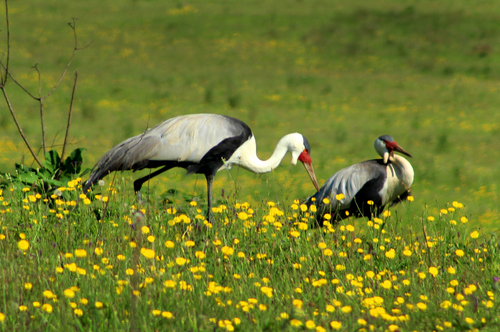
The Karkloof is a good place to spot cranes. Cranes are becoming increasingly rare everywhere so we are lucky to have all three South African species (including the critically endangered Wattled Crane. There are only around 260 left) occurring here. There is not a day in my life that is not improved by seeing them…

Occasionally, driving through the farmlands, you come across other unusual birds like these two…

The road to the Karkloof Farmer’s Market takes me past the iconic Loskop, a hill that continues to exert a strange pull on my imagination…

The Karkloof area is good cycling and running country too…

The hour after dawn is nature’s happy hour, a moment when the world still belongs to animals such as this regal Reedbuck ram, surveying his domain…

It is also a good time to see birds because they are usually at their most active then…

To try and seduce birds to come and live at my home I have erected two bird tables on either side of the building. By far the most regular and numerous visitors are the Village Weavers but a host of other birds have taken to frequenting it…

This Cape Sparrow and African Firefinch like to drop in as well…

Seasons of mist and mellow fruitfulness. Kusane lies in the KwaZulu-Natal mistbelt. In summer the mist comes drifting in most evenings engulfing the countryside in a blanket of damp grey…

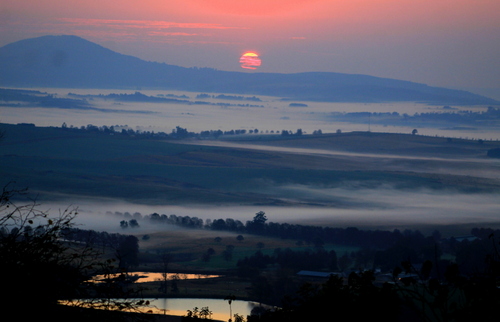
The sunrises at Kusane can be spectacular…

The sunsets equally so…

Pic courtesy of Craig Scott.

Counting my Blessings on Longclaw Lane

How sweet I roam’d from field to field,

And tasted all the summer’s pride,

‘Til I the prince of love beheld,

Who in the sunny beams did glide.”

William Blake

The Field – upper portion.

To say we have had little to cheer about over the last few years would be an understatement. As a political cartoonist, whose jobs involves trawling through the daily news headlines looking for somebody or something to lampoon, I can safely vouch for this. Faced with the endless litany of woes – climate change, Covid-19, lockdown, a collapsing economy, state capture, rampant crime, decaying municipalities, crumbling infrastructure and corrupt, venal, and singularly inept politicians – it is often very difficult to see the funny side of it all.

In my doubting mind, it sometimes feels like I will never escape the dark shadows closing in on me on all sides.

But there is hope even if it is fleeting and ephemeral. A country mouse at heart, I continue to search for and find solace in nature and simple delights. Don’t get me wrong! I am well aware that my love affair with the wilderness may not be reciprocated and that it includes a degree of anthropomorphism, the great bogey of science.

That doesn’t stop it from having meaning for me. I see no need to expunge these feelings from my interaction with nature.

I don’t have to go far to look for this alternative world. Since I moved up to Kusane Farm and started planting lots of indigenous trees and bushes and flowering shrubs – my contribution to saving the planet– I have gathered a flourishing population of birds and other wildlife in my garden.

Every morning the Village Weavers gather in noisy, scraggly groups at the bird feeder. They are, in turn, joined by several varieties of sparrow, pigeons and doves. Plus, in summer, the very tiresome, testosterone-loaded male Pin-tailed Whydah who makes a nuisance of himself by trying to drive all the other birds away from the food table – just so he can claim it for his wife (in winter he loses his beautiful plumage and his stroppy attitude and becomes a submissive little nobody you barely notice).

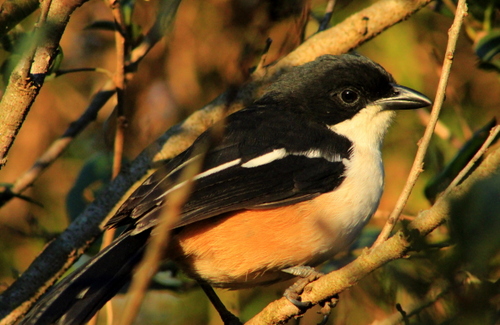
As part of my daily routine, I also put out a little grated cheese on a rock that brings in the Red-winged Starlings, the Cape Robin, the Cape Wagtail, the Southern Boubous, the Black-capped Bulbul, the Olive Thrush and the Speckled Mousebirds. In winter, I sometimes add a little Jungle Oats porridge to go along with it, just to warm them up.

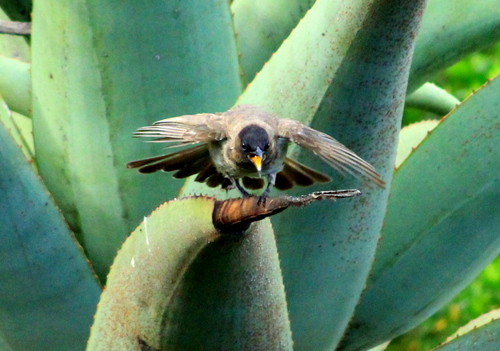
The news about the easy pickings has swiftly spread and other birds have started pulling into my roadhouse. A much-welcomed newcomer has been the Sombre Greenbul. Its name is something of a mystery to me for its call (described by SASOL Birds of Southern Africa as “a piercing ‘weeeewee’, followed by a liquid chortle…”) is one of the most cheerful you will hear. Colour-wise it is perhaps a little on the drab side but no more so than a host of other dull-coloured birds. Preferring to call from deep within the canopy of a tree, it is a bird you hear more often than see.

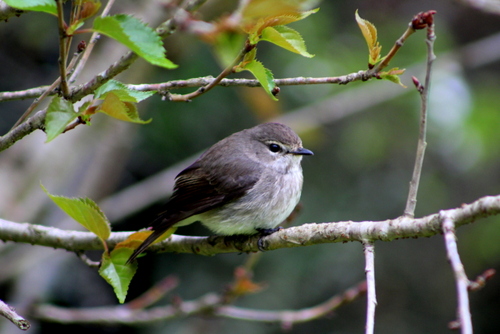
It has been joined in recent months by a Dusky Flycatcher, a tiny bird with the typical flycatcher behaviour of making short dashes up into a cloud of gnats or other flying insects before returning to its favourite perch. Endearingly happy little characters they can, over time, become quite tame.

Dusky Flycatcher

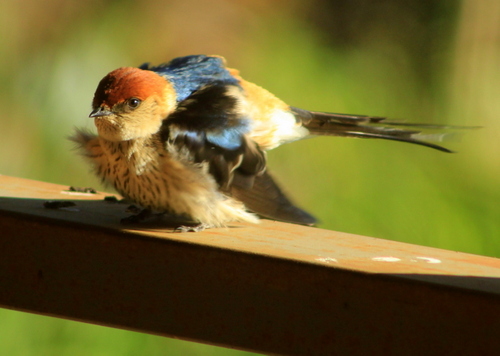
The large corrugated-iron barn I live in has also provided the right sort of habitat for a host of other birds to call home. In the cold weather, the Rock Pigeons like to sit and warm themselves on the pipes that lead to the solar panel and geyser on the roof (they also nest in the rafters). Wagtails strut past them, tails endlessly bobbing. The sparrows make a home in all the nooks and crannies. In summer our resident pair of Greater-striped Swallows like to sit on the railings and twitter away, especially just before they are about to undertake their perilous journey North.

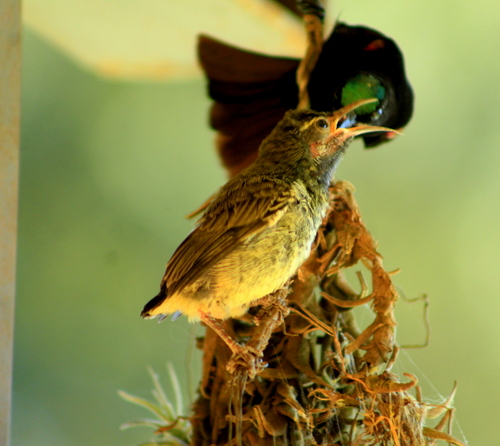
For the last three seasons, I have also had an Amethyst Sunbird nesting on the Air Plant which hangs on my balcony. I feel a distinct sense of triumph that it has elected to live and raise its family with me. I like to think of it as a blessing from the gods, a portent of happiness (that’s me getting all anthropomorphic again!)

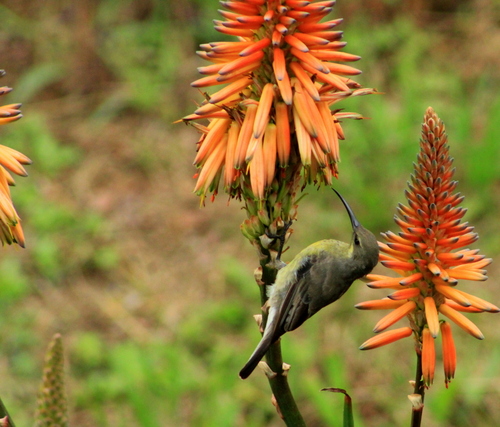
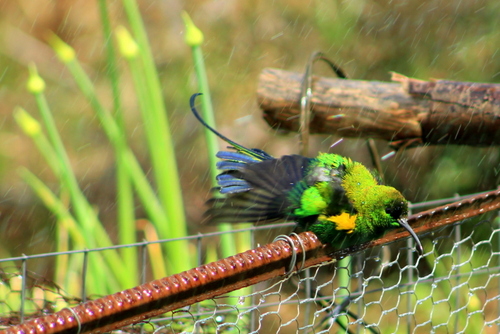
The beautiful Malachite Sunbird is the other common sunbird in my garden, especially in winter when the aloes I planted are in bloom. This dashing, shiny bird often chooses to sit on some prominent point from where it twitters happily away while keeping a sharp eye out for any rival male which it will quickly chase off.

My birding is not, of course, confined to the garden. I have several particular patches of ground I like to visit regularly throughout the year.

Today, I elect to head down the familiar route that takes me through our front gate and past the house with the gumtrees and horde of barking dogs. At the next gate, I come to, just past the cattle crush and sorting pens, I take an abrupt left turn down Nicholson Highway. Despite the name we have bestowed on it, is not a highway, just a nondescript, muddy, farm road that leads through a large, cow-inhabited, rectangular field to a slightly better maintained road on the other side.

Going for a stroll down Nicholson Highway.

The big field slopes upward, South to North, from the old stone wall built by the Italian POWs during WW2 for purposes unknown – other than giving them something to do, I suppose. At the top of it, one has a breathtaking view over the entire Karkloof Valley with its regularised grid of big fields, forests and dams. The very distinctive, leonine-shaped Loskop and the purple-tinged Karkloof hills provide a suitably dramatic backdrop to this ever pleasing vista.

There are subtle changes here, every day and every season. Close your eyes in summer and you could almost imagine you are in Ireland because of all the vibrant greens, low scudding clouds and mysterious mists. In winter, when the fields are covered in stubble and the colours are more subdued, there is a stark, minimalist beauty to the landscape.

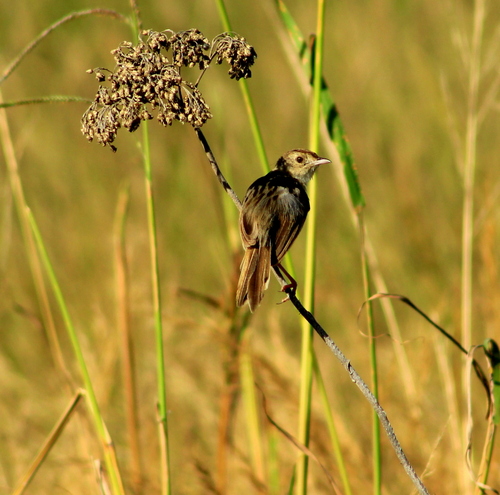
As I enter the field, via Nicholson Highway, I scan the grass with my binoculars. A bird flies up calling, a plaintive, drawn-out ‘wheeee…’ It is the appropriately named Wailing Cisticola. A little further on I see another Cisticola. A smaller one with a slightly fanned-out tail. It is known as the Zitting (formerly Fantailed) Cisticola because – you guessed it – of the ‘zit’ it makes at the crest of each undulation during its display flight…

It is open country here and – I suspect because the cattle who sometimes graze here provide good manure – the grass is longer and more luxuriant than our wiry, unpalatable, stuff next door. Because of this, it has become a haven for grass-loving species. They like it because it has ground cover and it has food.

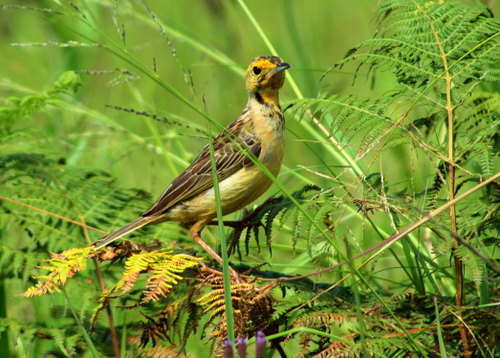
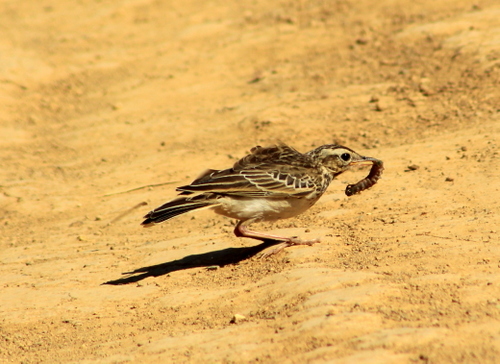
My alternate name for Nicholson Highway is Longclaw Lane because this is very much their kind of country (the Yellow-throated is our common Longclaw). The bird’s plaintive, fugitive call, as it lifts into the sky, always sets my veins a-tingle. Likewise, several varieties of the Pipit have staked their claim along the road. I have seen both African and Plain-backed on many occasions.

Widely but locally dispersed across South Africa, the Secretary Bird makes the odd stop-over in the field. Taking its name from the long, quill-like, feathers protruding from its head, the Secretary bird is, in fact, an eagle with very long legs. It puts these legs to good use. My battered old copy of Roberts Birds of South Africa describes this succinctly: “After landing runs for some distance with wings outstretched. Snakes are attacked with violent blows from the feet while the wings are held outspread as a shield. Great care is taken to make certain the snake is dead before it is swallowed, whole if it is small...”

Secretary Bird

In the past, the field has yielded some other surprises. Bustards are very shy and wary, so it is a privilege to encounter them anywhere in the wild. You can imagine my excitement, then, when I came across not one but THREE Denham’s Bustard, feeding in the upper end of the field. The Denham’s is the second-largest bustard in South Africa (prime honours go to the Kori Bustard, the largest flying bird in the world) and is listed as NEAR THREATENED.

Cranes are equally rare across the world so I also consider myself lucky to have seen all three of the South African species (the Wattled, the Grey-crowned and the Blue), at various times, here. They are special. Stately, regal and a little otherworldly, their elegant courtship rituals are one of the great wildlife spectacles.

Having made a mental count of all the birds I have seen so far, I continue down the winding road until it comes to a T Junction. On the opposite side, in a paddock, a couple of horses are being put through their paces at the local riding academy. Another noisy dog lives here too. A big black one. We didn’t hit it off when we first met so I prefer to avoid it.

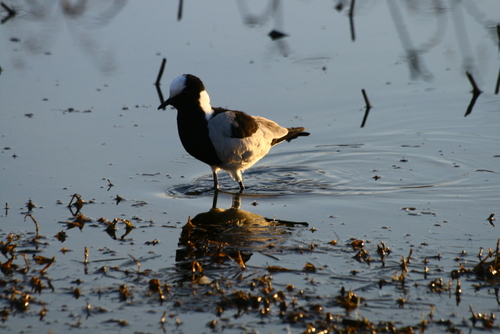
I accordingly turn and follow the fence line down to a farm dam (and away from the big, black dog). The grease-gleen of the early morning sunlight glitters romantically on its water, as three dabchicks create patterned artworks as they swim away from me towards the far shore. A large White-breasted Cormorant lifts itself out of the water and flaps noisily off. The Blacksmith Plovers, I saw earlier, are now patrolling the edge of the water. As soon as they see me they give their characteristic loud, ringing, metallic ‘tink, tink, tink’ alarm call, from which they derive their name.

They don’t seem to want me around either. They are not alone in their antipathy.

On the far side, partly concealed in the long grass, a pair of male reedbuck follow my movements with worried eyes. An uninvited intruder in their private domain, not wanting to scare them, I high tail it along the dam wall, hoping they won’t take fright. They retreat a little further up the inlet but don’t runoff.

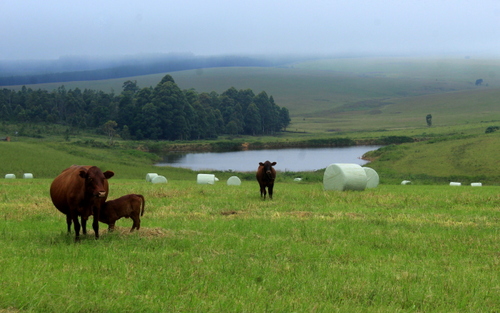
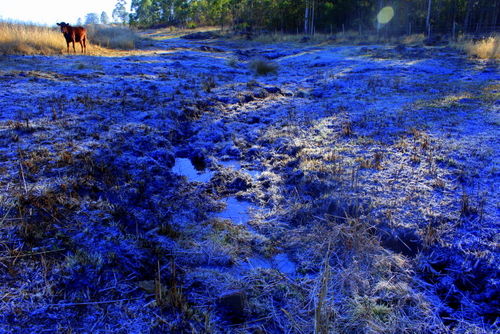
There is another panoramic view from the wall, one that shows more dams and more fields full of hay bales and groups of contented cows grazing on the sloping hillside you look across to. In winter frost often clenches the ground below the wall, the relentless summer rain can turn it into a muddy quagmire in which animals get stuck.

Frost below dam

Once over the wall, I follow the now faded path that leads back to our side of the field. The path used to lead to a farm shebeen on the next door property but that was closed down for security reasons.

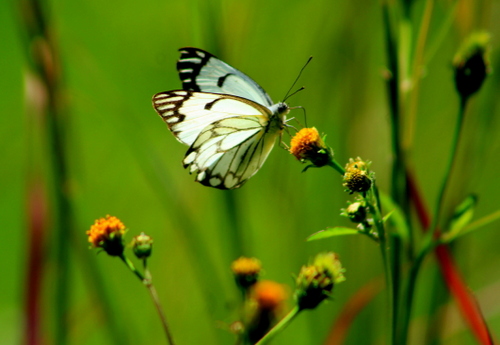
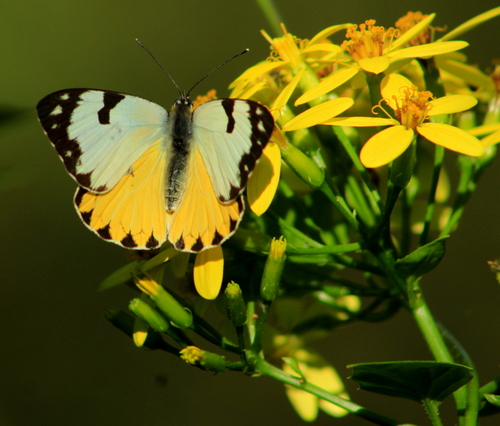
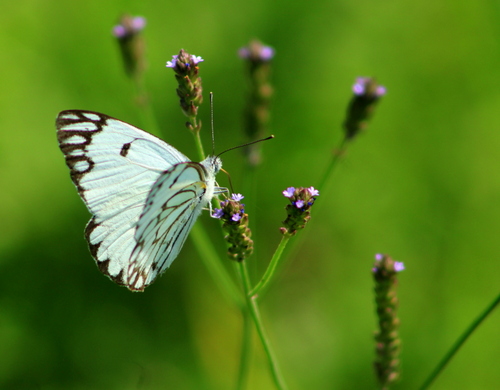
Although now cropped low, the grass is still plentiful at this end of the field. At certain times of the year, there are eruptions of flowers amongst it which draw the insects in. Bees and flower-visiting wasps buzz about. Butterflies too. For three days, two-years ago, this area was alive with flickering wings as the annual midsummer migration of the thousands upon thousands of Brown-veined White Butterfly (also known as Pioneer Caper White) took place.

The distance these tiny creatures cover on this epic trek (depending on climatic conditions their numbers vary each year. This year it didn’t seem to happen or, if it did, I missed it) are mind-boggling. Starting on the cold shores of the South-west Cape, they fly as far as sub-tropical Mozambique.

Walking along the fire break that leads back home I keep my eyes peeled. I have seen Serval here twice before, returning home from a night out hunting. I don’t see one today but it doesn’t bother me. The fact they are so seldom spotted only adds to their mystery and allure.

For the rest, I am happy to just be wandering along this path, enjoying this small moment of fleeting time. Out here I can get a kind of feeling of belonging and recognition, a level of engagement, a sense of purpose, an appreciation of beauty that has absolutely nothing to do with the latest news stories or the world beyond these hills.

And for that, I feel blessed…

Morning Birdsong and a Little Poetry

‘Hope’ is the thing with feathers –

That perches in the soul –

And sings the tune without the words –

And never stops – at all

Emily Dickinson.

Does life hold any greater pleasure than lying in bed, soaking up the early morning melody of bird song? I tend to think not! With the dawn comes enchantment.

It was certainly one of my main reasons for wanting to quit city life and return to my rural roots.

Setting up home on Kusane Farm, overlooking the Karkloof, I had to, first, try and get to know all the local birds and familiarise myself with their repertoire of songs. The more I grew accustomed to their various calls, the more I began to feel a part of things.

My view over the Karkloof Valley.

Birds sing most in spring because that is usually when they are courting and nesting. Of course, they don’t only vocalise because they are trying to attract a mate. They also call to warn of predators, defend their territory and distinguish between friend or foe.

Most species have highly distinctive songs so this is often a good way of identifying them. Even within a particular species it can help as, for example, with all the dun-coloured Cisticolas who are otherwise often extremely difficult to tell apart.

Birds like to sing early in the morning because that is when sound travels best and furthest. To avoid interference they will often – but not always – sing from a perch above ground level. Sometimes there are a few false starts. A dove starts to coo, changes its mind and goes back to sleep. This is followed by a lull as the whole feathered choir shuffles to their seats, clear their throats and stretch their vocal chords.

And then the joyous symphony begins…

The listing habit has an old and honourable pedigree dating back to ancient Sumeria, so I take some pride in being able to add my little tally of bird calls to it. My list is short, incomplete and contains no rarities because I have confined it, for the most part, to the more common garden birds of my area.

For me, the most bewitching of all these calls belongs to the Southern BouBou, the male of which, can be seen here taking a shower under my garden spray. The resident female (also shown) is sweet to his sound, invariably answering it with a tune of her own.

My old, much-thumbed and annotated, copy of Roberts Birds of South Africa describes their voice this way: “A duet of ‘ko-ko’ replied by ‘kweet’ or ‘boo-boo’ replied to by ‘whee oo’; often reversed thus ‘too, whee’ answered by ‘boo-boo’” The alarm note a guttural ‘cha-chacha’ or ‘bizykizzkizz’”.

In other words, it is a rather long, idiosyncratic and complex love song…

Another regular member of my dawn chorus is the Cape Robin-Chat, seen here sitting in a Sneezewood tree (Ptaeroxylon obliquum) I planted when I first came up to Kusane.

Cape Robin-Chat.

Friendly and inquisitive, he may lack the grandmaster skills of his cousin, the White-browed Robin-Chat (formerly Heuglin’s Robin) – whose song is complex, subtle and piercingly beautiful – but he sings his little heart out and for that he gets full marks. He is also, invariably, the first bird up and the last to go to bed.

What William Blake observed about the English robin, could just as much apply to his free-spirited African equivalent:

A Robin Red breast in a Cage

Puts all Heaven in a Rage.”

Number Three on my list is the Olive Thrush. Like the robin, he is one of the first birds to break the tension of waiting for sunrise, bursting in to song just before the first streaks of light appear in the East.

In a poem dedicated to this common garden bird, the Grahamstown poet, Harry Owen, describes it, rather beautifully, as an “Avian Buddha…hunched up in ruffled chestnut gentleness…”

His emotional and aesthetic reaction differs somewhat from that of the English poet, Ted Hughes, who wrote:

Terrifying are the attent sleek thrushes on the lawn,

More coiled steel than living – a poised

Dark deadly eye…”

Cold killing machine or not – and he is an effective hunter as this photograph shows – I am still happy to wake up every morning to its uplifting, fluty call.

Olive Thrush.

If I had to name the Joker in the Kusane pack, my vote would go to the Dark-capped Bulbul (formerly Black-eyed Bulbul) – or Toppie as it is more affectionately known.

Black-capped Bulbul (or’Toppie’).

One of the most common and widespread birds in South Africa, the fruit-loving Toppie is more to be admired for his persistence and effort than the quality of his singing – but he is unfailingly cheerful and upbeat and that makes him all the more loveable.

It would also take a very sneaky snake to slither by without a Toppie spotting it and notifying the universe!

As something of a nomad, a bird who comes and goes seemingly on whim, the Black-headed Oriole is an infrequent participant in the Kusane Farm Dawn Chorus.

Few birds, however, are so dramatically beautiful and it would take a very cold heart indeed not to thrill to its wonderfully liquid call. It is like listening to the bird-world equivalent of Mozart’s Magic Flute.

As one of the more charismatic bird species, the oriole has been co-opted in to the name and logo of various sports teams. In America, for example, there are the Baltimore Orioles. Closer to home, the Zulu name impofana has been given to the Eurasian Oriole because of the nick-name “Mpofana”of the Kaiser Chief’s Football Club. The name refers to the striking yellow and black colours worn by the teams’ players (see Zulu Bird Names and Bird Lore by Adrian Koopman).

Although it is a highly subjective question, I suspect most South Africans, if asked, would name the African Fish Eagle as the bird whose call best cptures the spirit of wild Africa.

While I, too, am always deeply moved by its haunting evocative, cry, I would, if forced to do so, choose a different bird as my favourite – the humble, common Cape Turtle Dove. Maybe it is a question of association as much as call. For me, the Turtle Doves familiar, comforting coo ( rendered, in English, as: “How’s father, how’s father” or, if your conscience is bothering you: “Work harder! Work harder!”,) carries all sorts of echoes and evoacations of a childhood spent amongst the beautiful Nyanga mountains and deep in my beloved bushveld.

With the possible exception of the Fiery-necked Nightjar it touches a depth in me no other bird does.

The English poet William Blake, who seems to have spent as much time conversing with Angels and Demons as ordinary mortals and knew a bit about these things, had something to say about doves in captivity as well:

A Dove house fill’d with Doves & Pigeons

Shudders Hell thro’ all its regions.”

Although they stay mostly down in the valley, I think I can safely add cranes to my list because their sound drifts up to me as I sit on my verandah sipping my early morning cup of rooibos waiting for the sun to come up. With their elegant courtship rituals, fidelity and haunting calls, cranes have, since antiquity, exerted a peculiar hold on the human imagination.

Greek and Roman myths portrayed their dance as love of joy and a celebration of life and associated them with Apollo and Hephaestus. In Chinese myths, cranes were symbolically connected with the idea of immortality.

In South Africa, the Zulu King Shaka reputedly wore a single Blue Crane feather.

They are special. On the ground they are exceptionally regal, elegant in stature and stately in bearing. In flight, they are equally impressive, thrusting forward with powerful wing beats, their heads and necks fully extended in front of them.

In his book, The Birds of Heaven, the author Peter Matthiessen saw cranes as “striking metaphors for the vanishing wilderness of our once bountiful earth.”

We are very fortunate in that all three of South Africa’s resident cranes – the Blue, the Grey Crowned and the Wattled – occur on our door step. They are also shy and wary so I was quite lucky to get as close as I did to this pair of endangered Wattled Cranes without disturbing them.

Wattled Crane.

My list would not be complete without a migrant although they only call in summer. The sound of the cuckoo’s call, for instance, is so familiar and so much part of our inherited sonic landscape that we mark our seasons by its appearance.

The most obvious of these, because he is so vocal and so well known, would be the Red-chested Cuckoo (the ubiquitous Piet-my Vrou) but since he tends to stay down on the river line I have opted for the Dideric Cuckoo instead. As his brood host is the weaver, of which we have many, he is the common cuckoo in our garden.

Perched on top of the uppermost branches of a dead pine, bill arrowed skywards, he cuts a conspicuous figure in his striking green and white tunic. Throwing his whole body into the effort, he trills out his clear, persistent ‘dee-dee-deederick‘. His female, if he has one, may choose to respond with a plaintive ‘deea deea deea‘.

Diederic Cuckoo (right), plus Cape Sparrow.

Like all cuckoos, it is very swift in flight. John Clare, who has been described as the “finest poet of Britain’s minor naturalists and the finest naturalist of Britain’s major poets” called it perfectly when he wrote:

‘The cuckoo, like a hawk in flight,

With narrow pointed wings

Whews over our heads – soon out of sight

And as she flies she sings…

Another bird whose call captures something of the presence, the spirit, the essence of the old Africa is, for me anyway, the Natal Spurfowl. Preferring thick cover, it more often than not remains invisible. It is just a loud, agitated, scoffing, scolding noise deep in the foliage.

Having scoped out the situation, my resident pair will sometimes explode out the bushes and streak across the lawn lawn, a fleeting chaos of orange bills, feathers and moving legs, heading for the thick bramble on the other side of the fence where they like to hide from the prying eyes of predators.

Natal Spurfowl – a loud, agitated,scoffing, scolding noise

The Zulu name inkwali gives some indication of is call. To quote Roberts again: “The bird is more often to be heard at sunrise and sunset, sounding like ‘kwaali, kwaali, kwaali’ …” Newman’s gives a similar rendering: “The call is a harsh ‘kwali, KWALI, kwali‘; when alarmed utters a raucous cackling…”

Sasol gives a slightly different interpretation: “Raucous, screeching ‘krrkik-ik-ik”. They all agree on the main point though – they kick up quite a fuss…

I hesitated about including the Hadedah Ibis because its similarly deafening ‘ha-ha-da-da’ is not a song. It is is a din. A rioutos cacophony, far more effective as a wake-up call than any alarm clock, gong or bugle.

Having happily transplanted itself in to our cities and towns, it has become such an iconic bird, its familiar call so much part of our everyday lives, I decided in the end it would be a travesty to leave it out…

An unmistakeable, almost prehistoric-looking creature, the Hadedah’s name is, of course, onomatopeic; it’s a sort of phonetic reminder of its most obvious attribute – so extraordinary a noise as to be once heard and never forgotten. As they fly it seems to get louder and quicker and more excited, ending in a burst of dirty hilarity, as if one of them cracked an off-colour joke…

Hadedah Ibis.

My former Witness colleague (and good friend), the poet Clive Lawrance, devoted three poems to the Hadedah in his wonderfully wry and whimsical little compendium, Butterflies & Blackjacks: Poems from A Maritzburg Garden (to which I contributed the illustrations).

He captured something of the birds unruly character and strange charm with these lines:

‘Every day three hadedas swoop

into my garden; they come

in turquoise-brown-metallic coats

that glow in the sun; or they come

bedraggled with drizzle; even, sometimes,

plastered with rain and muck;

but

always they come…’

The numerous members of our ever-expanding Village Weaver colony don’t so much sing as keep up an excited, incessant, day-long chatter between themselves, especially at nest building time. It is the male who builds the nest and he has to be fully on his game because his bride to be is a very exacting arbiter of what does and doesn’t constitute a highly desirable piece of real estate.

It is a taxing business, requiring considerable skill and mental acumen, and he has to work his tail feathers off to please his partner. If the nest fails to meet the female’s high standard, he will tear it down and start all over again.

As a result the drive-way up to the house is regularly strewn with discarded homes.

When we first came up to Kusane there was no resident Helmeted Guineafowl flock on the farm. We tried to rectify this by importing a batch of guineafowl chicks and raising them, with mixed results for they frequently fell victim to our local predators.

Besides being highly vocal – Roberts’ describes their clattering, machine gun-style of delivery as ‘a grating, rapidly stuttered “kekekekekek”’ – they are also very jittery birds. If suddenly disturbed or frightened by anything, real or imagined (it is often the latter), they all take to the air, their wings making a whooshing noise as they alternatively flap and sail, labour and glide either on to the top of the farm owners’ vegetable tunnel, the roof of the house or the topmost branches of the surrounding trees.

This habit of fleeing at the first hint of trouble has given rise to a Zulu proverb: Impangel’ enhle ngekhal’ igijima (a good guineafowl is one that calls while running) – meaning, to put it in Shakesperian terms, that discretion IS the better part of valour…

The Zulu name for guineafowl, impangele, was also given to one of Mzilikazi’s regiments because they wore its black and white spotted feathers and also, presumably, because of the active way this bird moves in packs through the undergrowth.*

Most people respond positively to all birdsong. Whole anthologies of poetry and prose have been devoted to the subject, celebrating it as some sort of natural miracle.

Alas, I can see nothing poetic or anywhere near miraculous about the incredibly noisy sideshow my two strutting, foolish roosters – Rowdy and Motley – with their Chauntecleer-size inflated egos, produce each morning.

Determined to shame each other – and all the other roosters in the district – in the high-decibel stakes, they like to do a short practice run around 0130am, just as I am getting in to my deepest sleep. Then, with military precision, at exactly 0430am, the floodgates open and they don’t close until late in the day.

As I bury my head under my pillow, desperately trying to shut out the racket, the voice of the poet Sir Charles Sidley (1639-1701) speaks down the centuries to me:


“Thou cursed Cock, with thy perpetual noise,

Mayst thou be capon* made, and lose thy Voice,

Or on a dunghill mayst thou spread thy blood,

And Vermin prey upon thy craven brood…”

But then I remember the lines from Robert Frost:

The fault must partly have been in me.

The bird was not to blame for his key.

And of course there must be something wrong

In wanting to silence any song.”

(*A ‘capon’,for those not familiar with the word, is a castrated chicken fattened for eating)

REFERENCES:

Newman’s Birds of South Africa by Kenneth Newman (1983 edition, published by SAPPI)

Roberts Birds of South Africa by McLaghlan & Liversidge (1970 edition, published by Cape & Transvaal Printers Ltd)

Sasol Birds of Southern Africa (2011 edition, published by Struik Nature)

The Genius of Birds by Jennifer Ackerman (published by Penguin)

The Penguin Book of Animal Verse (1965 edition)

*Zulu Bird Names and Bird Lore by Adriaan Koopman (2019 edition, published by UKZN Press)

SPECIAL THANKS to Harry Owen and Clive Lawrance for allowing me to quote from their poems and my brother, Patrick, and his wife, Marie, for giving me my first bird book thus triggering off a life-long passion……

Smoothing Ruffled Feathers: The Charm of Chickens (and a small Dutch Quacker Duck)

Now that I look back on it, I see the one thing that has stopped me from sinking too deeply in to the Slough of Despond during the long, lonely, months of lockdown has been my chickens. At a time when the whole world seems to be going to hell in a hand-basket, they have continued to provide me with a sense of normality, comfort and reassurance. Quite indifferent to the great human drama being played out around them they have stuck to their daily routines – eating, drinking, sleeping, fornicating, scratching around in the straw, attending to their ablutions, egg-laying, crowing, clucking – with cheerful insouciance.

In fact, you can take it from me: kooky, sassy, loveable and sometimes just plain hilarious, chickens make wonderfully entertaining companions. Chickens are cool! Chickens rock (why else would one of my favourite old British Blues groups call themselves Chicken Shack?)!

Okay, so they may lack some of the attributes and superior skills possessed by other members of the bird world. They are not as big and strong as an Ostrich. They are not as stately and graceful or have the elaborate courtship rituals of the Grey-crowned Crane. They can’t sing like a White-browed Robin-Chat, nor do they possess the exquisite beauty of Narina Trogon. They can’t suck nectar out of flowers while hovering like sunbirds. They can’t fly or dive as fast as a Peregrine (in fact they are downright clumsy aviators who should be prohibited from taking off unless in an emergency) and – unlike the fierce, regal, Eagle – you probably won’t find them featured on any countries’ coat of arms. Nor can I imagine any Roman legion marching in to battle with their standard bearer carrying a stylised replica of a chicken mounted on a metal pole.

On the other hand, they do do make excellent weather forecasters which is why you often find them positioned on top of wind vanes. Chickens have other virtues and talents that might have escaped your notice – they are easy-going, respond to kindness, produce high-quality garden fertiliser and have an unmatched ability to lay prodigious quantities of healthy, wholesome eggs.

A lot of folk think chickens are stupid, with beady eyes and pea-sized brains. That is not my opinion at all. In their domestic arrangements and social gatherings they are actually remarkably organised. Like humans, there is a clear-cut, ladder-like, social hierarchy with the ones on top enjoying clear advantages and special privileges denied to the others – like prime position at the food trough and first choice of roosting spot.

The order of dominance is usually established by one hen giving another hen a quick peck. Hence the term “pecking order” coined, back in 1921, by the Norwegian ornithologist Thorlief Schjrelderup-Ebbe, a man who spent a lifetime immersing himself in barnyard politics.

When you introduce new members to an existing flock they usually spend couple of days sizing each other up. Once they have worked out who fits in where, they live in surprising harmony thereafter. President Donald Trump could learn a few lessons from a chickens ability to accept strangers and integrate with one other.

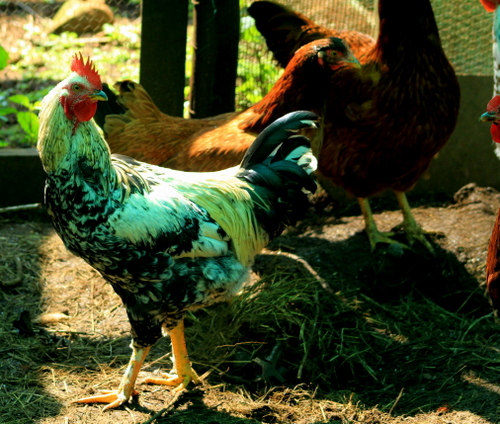
Top of the pecking order – Rowdy the Rooster...

Chickens form alliances and cultivate social networks. They learn who to avoid and who to cosy up to. They pick special individuals to sit close to. My two beautiful Bosvelder hens, for example, always roost together in the same spot every night. They are clearly very fond of each other, affectionately huddling together and clucking contentedly before falling asleep.

It is very easy to slip in to the anthropomorphic trap of attributing birds with human emotions but I do think they are capable of friendship, empathy and grief. And who cares if the scientists don’t agree with you or look with scorn on such misdirected displays of sentimentality? I sometimes think the boffins would benefit from getting away from their test tubes and cold laboratories and getting a little more romantic in their theories…

Of course, I am talking exclusively about hens here. Roosters are another matter altogether.

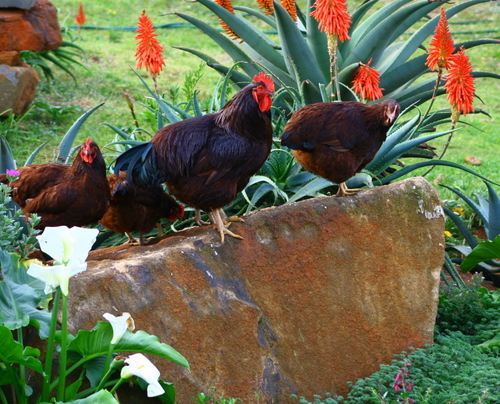
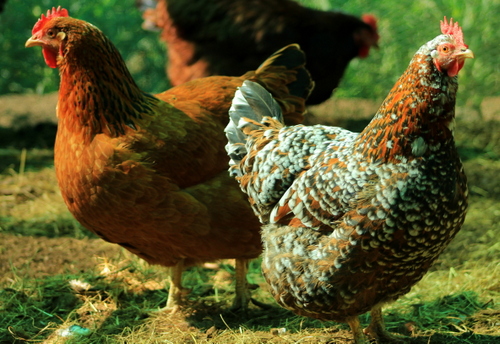
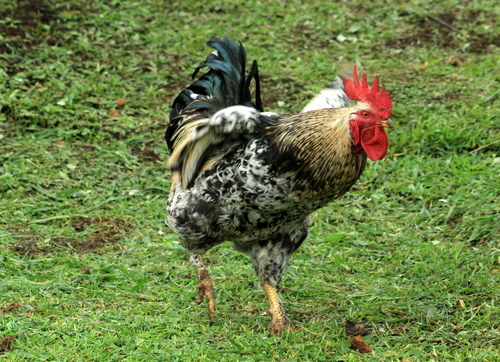
I actually have two chickens runs. The first is the domain of The Red Brigade – the descendants of the Rhode Island Reds who formed the nucleus of my original flock. The second belongs to The Motley Crew – the non- Rhode Island Reds (although a few Reds have infiltrated their ranks).

Originally each run had it own rooster but in the end the combined racket became more than I – and our guests – could stand. Roosters can be incredibly competitive in their attempts to outshout each other. The principle function of this non-stop crowing is, of course, the proclamation and defence of territory, as well as impressing their multitude of wives. More than that, they seem to take an aesthetic pleasure in their own performances, always looking immeasurably pleased with themselves after another ear-shattering outburst.

Vain, pompous and boastful – and definitely not as smart as their female counterparts – it is very easy to see why many authors have chosen to satirise human society by endowing roosters with human qualities. In Geoffrey Chaucer’s The Nun’s Priest Tale, for example, the fox plays on Chanticleer the Rooster’s inflated ego and overcomes his instinct to run by insisting he would love to hear him crow, just as his amazing father did, standing on tip-toe with neck outstretched and eyes closed. Although he succumbs to this flattery, Chanticleer finally manages to outwit the fox by playing his own trick back on him.

Alas, Motley-Fool Too, the son of the original Motley Crew Bosvelder rooster, Motley-Fool One, was not nearly as crafty or as lucky as Chanticleer.

It happened like this. I had chosen to let the Motley Crew out to forage in the garden one glorious, sunny, afternoon. While all the hens were doing sensible hen-like things – hunting for seeds, chasing grasshoppers, pecking at invertebrates – Motley-Fool Too, as every bit as raucous as his late father, was staging his own concert under the Avocado Pear tree. Suddenly, there was an almighty commotion which cut him short right in the middle of what would turn out to be his Requiem to Himself

By the time I got to where he had been standing, all that remained was a few fluttering feathers and a lingering cloud of dust demarcating the spot that Motley-Fool Too had just claimed as his own. After a search, Michael Ndlovu, our farm manager, found his lifeless body crumpled up in a nearby rock outcrop.

If I was a nature detective I would say the perpetrator of this violent crime was probably a Caracal as I have seen them around the chicken run before. Or maybe a Serval. We get them too. They like chickens in whatever shape or form they come.

Although he had plenty of good examples to learn from – including Maestro Rufus in the adjoining run and Nicholson’s noisy rooster, down the road, on the next door farm – Motley-Fool Too never quite mastered the signature Cock-a-Doodle-Do of his species. What we got instead was an abnormal, strangulated, high-pitched, almost unrecognisable version. Repeated again and again ad nauseum

After Motley-Fool Too got himself snuffed out, in the very prime of his life, I often found myself wondering whether the culprit – whatever it was – found his hysterical banshee wailing as irritating as I did and decided to put a stop to them once and for all. Or maybe it just got sick and tired of Motley- Fool Too’s overweening vanity. Hubris and falls, and all that…

Having discovered a ready source of fast food, the predator kept returning to the scene of the crime putting my entire flock of some forty-odd hens and one remaining rooster in huge panic. This left me with no other choice but to place my chickens in Level Five lockdown, banning all movement outside their designated runs.

Unlike the late, unlamented, Motley-Fool Too, I must confess I have a real soft spot for Rufus the Rhode Island Red rooster, mostly because he is sufficiently comfortable in his own manhood not to feel the need to constantly assert himself (President Trump could learn from him too). Which means I get to sleep at night. He is also very protective of his harem. I approve of that too.

Holding up my end of the deal, I provide my little work-force of breakfast manufacturers with amusement as well as food. I relish my role as Chicken-Whisperer. It is very satisfying and helps keep me grounded, especially in the midst of the current anxiety. Way back in time – before the river of life started hitting all the jagged rocks and tree trunks and whirlpools and waterfalls – my parents handed me the responsibility of looking after their chickens. Thus there is a nice sense of continuity and coming home about what I am doing now. This is my heartland. I have returned to my farming roots.

Two of the hens in the Motley Crew run were acquired in rather unusual circumstances. My sister, a Social Anthropologist living in Mpumalanga, had been invited to attend a Xhosa ritual in Grahamstown. As part of her contribution to it, she purchased two bush hens from a seller on the side of the road, just outside Mbombela. While she was overnighting with me they laid two eggs. I decided to put them in the incubator. Abracadabra – 21days later out hatched two chicks who I promptly named Penny and Susan.

Like my sister, I can not help but think they were a gift from the ancestors (I am sure my parents had a hand in the selection). They both grew up to be exceptionally good mothers, forever going broody, so whenever I want to hatch a clutch of eggs, in the natural manner, I invariably use them.

There is another oddity in my flock and that is Plucky-the-Duck-Who-Thinks-He- is-a-Chicken. How he came to be in my run is a story in itself – his was the only duck egg to hatch in an incubator full of hatching chicken eggs. Chicken is all Plucky has ever known and all he wants to be. A brief attempt to reunite him with his own kind ended in dismal failure (completely traumatised by the experience, he flew off and hid in the bush for 24-hours before making his way back to the chicken run. When we repeated the experiment, he did the same).

Plucky hero-worshipped our original rooster, the larger-than-life and boisterous Rowdy, and followed him around with all the devotion of a religious convert. He has kept a much lower profile, however, with his two successors, Randy and Rufus. I think he is a little wary of them or else he thinks they don’t have quite quite the same charisma.

Plucky went through a brief but rather trying period when his hormones suddenly got the better of him. He became obsessed with the idea of finding a mate with whom he could mate. In his case: a chicken mate.

He is at a serious disadvantage in this respect because, being a Dutch Quacker, he is much smaller than the hens. Undeterred, he waited until one hen was flapping around in a dust-bath and then leapt on her and had his wicked way. He also developed a hopeless crush on another hen, trailing around after her with a moonstruck look on his face. He even insisted on sharing the nesting box with her whenever she wanted to lay an egg, getting very excited when she did so.

Plucky has his wicked way. Note hens look of utter humiliation…

For her part the hen grew increasingly agitated with his unwanted affections. In the end Plucky began to make such a nuisance of himself I was forced put him in the other run to give his passion time to cool off. Luckily, it did…

As he has matured and grown older, Plucky has adapted a more fatherly, protective, proprietorial attitude towards the hens. As a long-serving member of the Parliament of Fowls, I think he now sees his role as that of an elderly senior statesman whose job is to lend a guiding hand. He takes his duties very seriously. As the sun is abdicating each day, he stands at the hen-house door and waits until he has been able to mark off every hen, as present and accounted for, before entering the chamber himself. Usually, with much pleased-as-punch quacking…

Plucky as wise senior statesman...

Despite the fact he is clearly not a chicken (but don’t tell him that!), the rest of the flock have accepted Plucky’s presence with equanimity and good grace. For his part, Plucky is quite content to go on living in his totally deluded state. I envy him that ability. Every night when I go to lock them up I see him huddled up happily amongst all his chicken pals.

Living in perfect harmony

Once again, they provide a shining example of interspecies bonding and acceptance of social diversity. Chickens may not be as intelligent as some other birds – crows for one – but flock life has propelled the evolution of bright, adaptable creatures, teaching them how to co-exist peacefully, smooth ruffled feathers, gauge the consequences of their own actions (apart from Motley- Fool Too), manage relationships, care for their young, and share their space.

Chickens and Helmeted Guineafowl- no xenophobia here…

Chickens may be descended from slow-witted dinosaurs but that doesn’t mean they haven’t adapted to varying circumstances or learnt a few tricks along the way. Happily ensconced in their cooperative colonies, fed and cared for by humans (although I am not sure I would want to be a battery hen), in some ways they are smarter and more tractable then we are…

Slowing Down in Lockdown

When lockdown was first introduced in South Africa I went along with received opinion. I washed my hands thoroughly. I practiced social distancing. Realising I was in the at risk category, I only left the farm twice in the first seventy-eight days and when I did I wore a mask. I made sure I got in to town just as the shops were opening and didn’t spend any more time in them than I needed to.

In the same spirit, I tried to make lockdown a positive experience. Over the months I found different things to focus on. I developed interests I never had before. I re-established my connection with the living world.

Indeed, with hindsight, I think one of the most important things lock-down – and retirement for that matter – gave me was time to slow down and start noticing things. The sheer scale of the global catastrophe forced me in to a kind of retreat, a moment of reflection.

I began studying my immediate surroundings with an even greater interest.

For example: each day, since lockdown began, found me patrolling my garden forensically, in the manner of an East German border guard back in the Cold War era, except what I was on the look-out for was not defectors but butterflies. Instead of an assault rifle, I carried my old Canon.

As winter progressed so their numbers dwindled but every now and again I would come across one, fluttering along in all its flowery grace and fragile beauty. With every new butterfly I identified I felt a mounting sense of elation and achievement.

Determined to remain upbeat, in spite of the grim trajectory the virus was taking, I deliberately limited my intake of news to what I deemed necessary for me to be able to produce my one topical weekly cartoon. It wasn’t always easy. At times the line between tragedy and farce grew very fine.

Like most people, I accepted the logic and rationale behind the initial lockdown but as the weeks stretched in to months I found my faith beginning to waiver. Having done its best to scare us in to staying indoors the ANC government began to flounder on some of its own draconian rules.

These included a ban on the sale of cigarettes and alcohol, both of which were based on a rather convoluted logic, as well as some sloppy and outdated science. Many of the other regulations – like what sort of clothes you could or couldn’t buy under Level 4 of the lockdown – were just plain nonsensical, verging on Kafka-like.

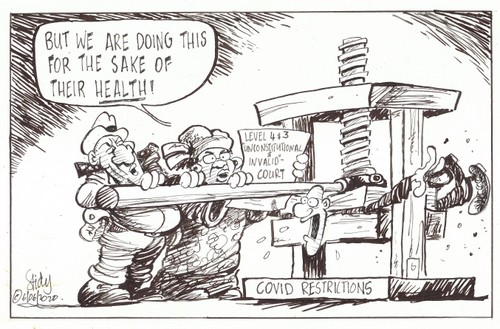
My suspicions that there was something both insidious and wrong with the handling of the pandemic was reinforced when the Judge in the High Court of Pretoria declared that many of the regulations failed the “rationality test” – and were also unconstitutional and invalid. Indeed, as the crisis dragged on, it became increasingly apparent that many of the government ministers were using the pandemic as a cover to pursue their own hidden agendas and conduct their own personal crusades – and that these often had very little to do with our health.

As so often happens in South Africa, ideology had trumped common sense…

Police Minister Bheki Cele and COGTA Minister Nkosana Dlamini-Zuma applying the screws

Not that our problems were necessarily worse than anywhere else. The US, for example, was typically overconfident in its exceptional-ism and paid the price.

When the news seemed overwhelming, however, nature provided a balm. It became my escape. My therapy. My reminder of how much I have to be thankful for.

I am lucky to live in the country. In many ways my life carried on as it had before lockdown; there was no real adjustment required. I could still go for daily walks. There was my garden to work. My chickens to feed.

Nor was I all that bothered about being cut-off from the rest of society. As a cartoonist I am used to the solitary life. I have always worked from home so self-isolation is a habit for me.

I won’t pretend there weren’t things I missed – a cup of coffee with a friend, a simple hug, the freedom to drive where I liked.

By way of companions, I had the birds. There is not a day in my life that is not improved by seeing my resident pair of Boubous bouncing along or hearing the Cape Turtle Doves calling from the trees.

Resident male Southern Boubou, bouncing along...

The migrants were, of course, long gone. I missed them but we still had our regulars in my garden. Each morning I would wake up to the Cape Robin and the Olive Thrush singing outside my window. If I got up early enough I sometimes caught our skittish pair of Natal Francolin making a dash for it across my lawn.

With the breeding season over the weavers had lost their masks but still gathered on my food table every morning chattering away like excited schoolboys. They would be joined by the rock pigeons, doves and sparrows.

The South African lockdown officially started just as autumn was giving way to winter. I love winter. With the rains over everything begins to dry out and a smoky haze veils the sky, dulling the light and robbing the landscape of contrasts. Dust coats everything near the road, even the trees and houses.

Sunrise over the valley with pockets of mist.

There is a stark, minimalist beauty to the countryside at this time of the year. Sometimes Jack Frost comes calling overnight, leaving little patches of white icicles clenching the ground. On other occasions, a chill wind blows in the mornings and as I set off to take stock of the local state of nature the leaves that autumn stripped from the trees crunch and snap beneath my feet.

Across the valley thin sheets of mist hang suspended above the hollows. On the saddle path, the sun’s rays catch the dew drops hanging on the funnel spiders’ webs.

You can smell the crisp, frosty, dryness in the air.

It is my favourite time of the year for walking. The icy cold appeals to the Spartan in me. I find it invigorating and oddly purifying. It sharpens my senses.

In the afternoon the light and temperatures fade early. By five-thirty the chickens have already put themselves to bed.

Sitting on my balcony, at twilight, sipping one of my hard-to-come-by-beers I could feel the breath of winter on my neck. It was cold. The soft evening skies at this time of year are beautiful though.

Below me I could sometimes hear the jackal calling as they set off on another night of hunting for food. In the moonlight the defoliated trees are silhouettes. The wind blowing up the rocky slopes rattle their branches.

There were other pleasures. Winter is also aloe season and with their beautiful orange-red flowers came the sunbirds (mostly Amethyst, Malachite and Greater Double- collared). It is also the time when the Wild Dagga (Leonotis leonorus) bushes flower, another sunbird favourite. I deliberately planted both species to try and seduce birds in to my garden and it has done the trick.

Malachite sunbird in aloe.

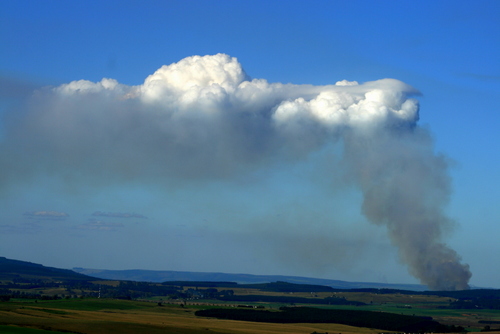
Winter is not all good. It can also be a time of violent drama. From where we are, safe in my sanctum overlooking the valley, you can often see huge fires sweeping across its floor, destroying countless creatures as it goes. I cannot imagine how many insects, reptiles and rodents must get enveloped and killed in the flames. This, in turn, impacts on the raptors that hunt them because it means less food. Winter can be hard on predator and prey alike.

Fire in the valley...

At such times the sun turns a pale yellow behind the plumes of smoke and the air is bitter with the smell of ash and burning debris.

This got me thinking about conservation, loss of biodiversity and what we are doing to the world. Thanks to agribusiness, agrochemicals, artificial fertilizer, farm mechanization and an intensification of arable farming much of our natural fauna and flora is being destroyed. Looking out over our urban landscapes, too, I see an ever-expanding mass of railway tracks, petrol stations, cement blocks, pylons and factories pumping effluent in to our streams and poison in to the air. And piles of plastic.

As a keen twitcher, I have noticed the steady decline of wildlife over the years. I grew up, for instance, with guineafowl abundant and all around; after harvesting, the fields were fill of them, pecking their way through the stubble in search of dropped mielie seeds. In the decades since there numbers seem to have grown less and less. It is like someone came along and removed them all.

Our resident guineafowl flock. We raised them from chicks.

It makes me very sad. And angry. Far too much of our wildlife is teetering on the edge of the ecological cliff.

Paralleling that has been the steady spread of invasive plants. Vast acreages have been given over to sterile pine, wattle and gum plantations inside which very little lives.

Nor is it confined to that. One of the biggest problems we face on Kusane is eradicating the bramble, an alien, invasive, species that creeps over the grasses and crawls over the plants. It is like a cancer and a nightmare to fight your way through because its thorns shred your legs.

Likewise bugweed. Our neighbour has a veritable forest of these and the seeds are picked up by the birds and dropped on our farm where they easily germinate and spread.

Invading our grasslands, all these plants reduce water run-off, and increase the severity of wildfires. It has been estimated that alien trees consume 5% of our scarce water and are a direct threat to almost half of the 1600 natural species listed in South Africa’s Red Data List.

Ruminating on this, I find my mind returning to lockdown. I can’t help but see the Covid-19 pandemic as a portent, an omen, a warning and a reminder of how much our economies, our livelihoods and our well-being depend on the health of nature. That seems to me to be our problem – we have become alienated from the natural world.

We need to re-learn that we are part of nature, not above it. Destroy it, in our blind pursuit of profit, and we destroy ourselves…

I will do my little bit to try and stop that. I am a tree man. To help make a greener world, I have opened up a new patch of ground, alongside Rubble Row, where I have already planted yet more indigenous species (Paperbark thorn, Tree Fuschia, Cheesewood, Ouhout). I know I won’t live long enough to see them mature but that is not the point. I am doing it for the next generation, a generation who face a far scarier future than ours did.

Part of my self-planted indigenous forest.

Lockdown has taught me other lessons. Being forced to stay at home made me realise that – as frugal as I like to think I am – I used to waste a lot of money on unnecessary shopping trips in to town.

It has also induced the waste not want not attitude of my parent’s generation. With the supermarket shelves rapidly emptying because of panic-buying I decided I needed to resurrect my vegetable garden. Luckily I have a source of manure both from our chickens and sheep, as well as the stables down the road. We also have our own compost heap.

There is something very comforting and rewarding about tending your own vegetables and eating the result. Growing your own food reminds you that you are part of a system and that everything we eat comes – in one way or another – out of the earth.

That is something we need to keep in mind long after lockdown ends. Or else we may face an even worse environmental and human catastrophe…

The Hunt for the Karkloof Blue

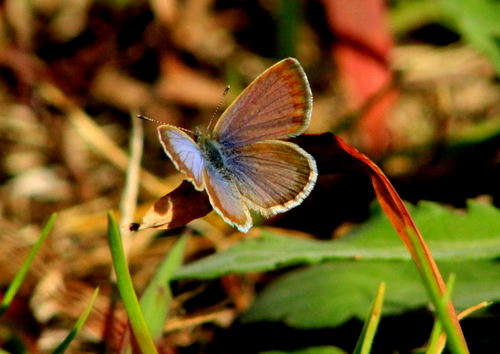
The Karkloof Blue

As part of my plan of self-improvement to fill in the days I was stuck in lock-down, I decided to develop a new interest – butterfly spotting.

I make no bones about it. When I fixate on something, I don’t like to let go. As a political cartoonist, Robert Mugabe, Jacob Zuma and Donald Trump have all, in turn, become objects for both my anger and relentless scorn.

The flip side to this is my obsessive quest to find beauty and it is here the butterflies come in.

I like to hunt things not because I have any desire to capture or kill them but because of the sense of discovery it brings. Through acquaintance and experience comes knowledge.

I don’t know enough about butterflies to know if my local patch is a particularly good spot for them or not but they are here and this is where we both play out the daily drama of our lives. Like astronauts in a spaceship we are fellow-travellers, co-habitants in this capsule we call Earth. My joy stems from the search, the exercise of a skill and the intense pleasure that comes finding out who I share my space with..

I always enjoy these field excursions. There is a comforting familiarity about this countryside. I have walked it many times. Over the years I have got to know all the landmarks and a lot of the wildlife.

I know this stretch of grasslands is home to a little group of Wailing Cisticolas and that, on misty mornings, the Black Crows like to call from the top of those three pines. That odd-shaped cluster of rocks is the playground for a family of cheery, chatty, Buff-streaked Chats.

The Yellow Warblers prefer the boggy patch down by the river. Invariably there will be a wagtail or two there as well where the stream runs fastest over the rocks.

And that cluster of pines over there? That is where the Long-crested Eagle has its nest.

It is not just the birds. Oribi and reedbuck are sometimes to be seen in that valley on the other side of the fence. There is an old Bushbuck ram who sometimes emerges from our small indigenous forest.

I have also stumbled on several puff-adders, lying doggo on this path. Them, I give a wide berth.

I have not been specifically studying them for all that long but already I have discovered that a surprising number of butterflies live here too.

As I walk along the path they come flapping and gliding, undulating and all but loop-the-looping. They can be difficult to get near even when they have settled on the ground. I wonder whether they have some sort of in-built sonar system that alerts them to my presence or whether they just pick up the vibrations of my boots hitting the ground?

There is still a lot to learn. With birds you can refine your focus by what you know about their preferences and behaviour. With butterflies I don’t have that sort of accumulated knowledge and experience. I am coming in half blind. I have to slowly feel my way.

I have no ‘hit list’ of butterflies I expect to see (other than the one who inspired this piece). I will accept whatever comes along.

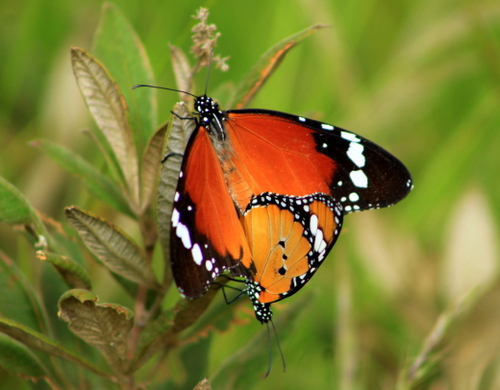
I am beginning to make some progress. I now recognise an assortment of garden specials like the Garden Inspector (Precis ceryne ceryne), the Garden Acraea (Acraea horta), the Rainforest Brown (Cassionyympha cassius) and the Polka Dot (Pardopsis punctatissima). On Rubble Row there are usually African Monarchs (Danaus chrysippus) and Yellow Pansies (Junonia hierta cebrene).

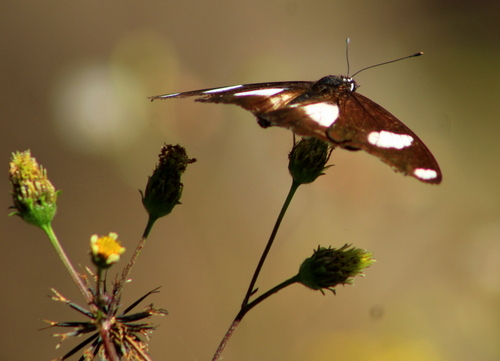
A bit further down the path – almost half-way to the river – there is a bank where the African Jokers (my spirit butterfly, I have decided) like to hangout. This is where I also recorded my first Bush Bronze (Cacyreus lingeus), a small but beautifully patterned butterfly.

Betwixt and between are a whole assortment of other butterflies, large, medium and small. And mostly colourful. Many are as stunning as their names suggest…

By constantly checking my butterfly field book* to identify the ones I am unfamiliar with I am slowly beginning to learn more about their characteristics, behaviour and preferred habitat.

I have also discovered the Karkloof, where I live, is home to one of the rarest of them all – the Karkloof Blue (Orachrysops ariadne. Also known as the Karkloof Cupid).

It is so rare that when ESKOM threatened to run a line of massive electricity pylons through our pristine, beautiful, valley, a group of concerned local conservationists and farmers banded together and used its highly threatened status as one of their arguments to oppose the construction.

Indeed the Karkloof Blue is so rare, the Midland Meander Association have adopted it as their symbol and made saving it part of their mission statement.

Flipping a little further through the pages of my book I discovered it is not the only butterfly that takes its name from the area. There is also the Karkloof Charanx (Charaxes karkloof. Also known as the Karkloof Emperor) and the Karkloof Russet (Aloeides susanae. Also known as Susan’s Copper).

Now I am getting in to this butterfly thing, I must look out for them too.

I decided to devote my main focus, however, to tracking down the Karkloof Blue, transferring the same obsessions I normally employ when birding. Its flight period is March-April which cuts down my window of opportunity considerably.

Before setting out to look for it, though, I needed to know more about my quarry.

The Field Guide describes it as “Colonial in steep-sided grass gullies near Afromontane forest.” That sounded a bit like our part of the world. Especially the ‘colonial’ bit…

Wanting to find out more I turned, next, to the University of Google:

Endemic to the mist-belt grassland of KwaZulu-Natal, the Karkloof Blue is on the IUCN Red List of Endangered Species.

Extensive burning, alien encroachment and livestock have all led to its decline as its habitat has been systematically destroyed. With only only three known colonies, one of which is in the Karkloof, it is now regarded as an indicator species.

Fires and alien encroachment

The statistics make grim reading: due to afforestation and cultivation at least 92% of the Mist-belt grassland has been transformed, with only 1% in good condition remaining.

It seems pretty obvious to me that the Karkloof Blue is not the only creatures whose habitat is being destroyed in these ways. I am sure countless other insects, reptiles and rodents are experiencing a similar fate and this, in turn, must be having a ripple effect on the birds and animals that prey on them.

It is worrying. I suppose it all comes down to that spaceship analogy I used earlier on. We need to realise we only have limited resources and the more we destroy or pollute them, the more we threaten our own future survival.

As sad and distressing as I find this, I intend to persist in my efforts to track down the Karkloof Blue. So far, I have come across a few blue butterflies that come close but don’t quite fit the bill. There is the African Grass (or Sooty) Blue (Zizzeeria knysna), the Common Zebra Blue (Leptotes pirithous pirithous) and the Pea Blue (Lampides boeticus).

But no Karkloof Blue.

With winter fast approaching and its flight period closing down, I decided to postpone my search until next season. Then, I intend to look harder, thinking about the best likely habitat and hoping for that lucky break and familiar surge of excitement that comes from finding something new.

I can feel it. I can sense it. I know it is out there somewhere in the rolling green ocean of grass, just waiting to be found.

It is the lure of the rare. The Karkloof Blue has become my Moby Dick. My White (Blue?) Whale.

*Field Guide to the Butterflies of South Africa by Steve Woodhall (published by Struik Nature).

Some Notes on Watching a Butterfly Flutter by…

Literature and butterflies are the two sweetest passions known to man.

Vladimir Nabokov.

A host of butterflies. I took this pic near Barberton, Mpumalanga.

It is 7.30 am and I am taking my usual nosey wander down the path that leads from my house to the Kusane river. It is a beautiful, balmy, sun-filled, day. Suddenly a butterfly – or rather a butterfly and its passenger – alights on a plant just to my right.

In the past I would have just cast a cursory glance in their direction and then proceeded on my way.

This time I stop, grab my old Canon out of its bag and start snapping away. The reason for this is that I have recently been given a field guide to the butterflies of South Africa* to review and suddenly I have become enamoured with the subject.

I circle around the butterfly, trying to get closer and closer, angling in for the perfect shot. I have no idea what the butterfly is but as soon as I get home I will get out the book and try and identify it, looking for its most distinctive features (as a political cartoonist I have had a lot of experience in this – it is what I do when a new president or other public figure appears). I will also look at the butterflies habits and distribution, hunting for those tell-tale clues that might aid me in my search.

African Monarch (Danaus chrysippus), Kusane Farm.

Then I will add it to my list.

As an artist my approach to nature has always been more sentimental than scientific. I am attracted by the lyrical rather than the factual. I look for beauty and seek solace in my natural surroundings. I love the intense intimacy you can develop with your local landscape over time.

All of which makes it strange that I have neglected – although not completely ignored – butterflies for so long because if anything inspires a sense of wonder in nature they do.

I am determined to remedy this. I have probably left it rather late in life to ever become anything like an expert but you have to start somewhere. And, because it is so open, Kusane Farm seems a good place to begin. Also, I live here.

A Pirate Butterfly (Catacroptera cloanthe cloanthe) about to take off. Note small beetles. Kusane.

In spring and summer we get lots of wild flowers coming up in the mist-belt grasslands, especially after a burn. That serves as a magnet for the nectar-loving insect.

It is 7.30 am again and I am back on the familiar path hoping to carry on where I left off before. Around me the swallows are diving and swooping with quick forward thrusts. There is a strong impression of activity and movement everywhere.

I home in on a butterfly which has landed in a cluster of flowers.

As I approach it, it glides off, stalls, hovers and drops down on to another flower with closed wings. Out comes its long, thin, tube-like proboscis and inserting it in to the flower it proceeds to feed. Once it has sated itself, off it goes in search of the next flower.

Citrus Swallowtail (Papilio demodocus demodocus). Note proboscis. Kusane.

Everywhere I look there are other butterflies doing the same.

Their flight paths seem wildly erratic, they keep making continual adjustments to their speed, direction and angle of flight. Unlike most birds or bees, you don’t get that sense they know where they are going.

And yet they obviously do.

Sometimes – as happens in the annual migration of the Brown-veined White Butterfly (Belenois aurota) which takes place at midsummer each year – they come floating by in straggly groups for days on end. There are thousands and thousands of them in seemingly endless flight. I was amazed to read, in my guide, that this particular species originate in the dry Karoo and Kalahari where they gather in their millions and take to the sky heading in a southerly to easterly direction up through the East Cape and Kwa Zulu – Natal to the Mozambique coastline.

That is a long way to fly for something so fragile and small.

What makes this mass migration even more astonishing is that the butterflies need precisely timed stopovers for feeding – which means they need to find flowers growing at regular intervals.

This can’t be easy since to fuel this epic marathon they probably have to harvest hundreds of flowers a day.

The other question which kept whizzing around my brain, as I stood watching them zig-zagging their way across the farm, was this – how can a creature with such a pin-size brain navigate and keep track of its position?! I must confess I have no explanation. As happens everywhere in nature, there still are many unanswered questions, which intrigue amateurs at least as much as scientists.

My butterfly list, so far, is not very long and includes no rarities, just your common varieties (although back in 2018, when I was in Marakele, I did see a Kransberg Widow, a very rare and beautiful butterfly which briefly appears during November and early-December and only occurs on this particular mountain. Unfortunately, I did not get a photograph of it).

I hope to rectify that.

To an outsider this making of lists probably seems like a strange passion, one bordering on obsession. Almost a perversion. They may be right. I don’t care. For me it is all part of the thrill of the chase.

As a long-standing twitcher, I have experienced the sense of excitement and privilege which comes from finding something special (a Pel’s Fishing Owl, Narina Trogon, African Broadbill, Rudd’s Apalis, Southern Banded Snake Eagle, Palm-nut Vulture, a pale, female, morph form of the Eurasian Honey Buzzard – to name a few). That thrill grows even stronger when you come across what we interpret as a “rarity” or a “vagrant” (my list is probably topped by the Gull-billed Tern which I got at Nyamithi Pan in Ndumo Game Reserve in Zululand).

Already I am picking up some valuable tips and learning some important life-lessons as I pursue my quarry and record my sightings.

I have discovered, for example, that while we humans may abhor them in our gardens, butterflies simply love weeds. The irritating black jack, which you find so annoying because it sticks to your clothes when you brush past it, seems to be a particular favourite of theirs.

Garden Acraea (Acraea horta) on blackjack flower, Kusane.

This in turn has caused a major rethink on my part. Suddenly I am far more reluctant to pull these bothersome plants out of my flower garden and toss them to the chickens to turn in to mulch. They fulfil a role. They feed the butterflies who I want to attract to my garden. I want the butterflies to look upon my home as their home.

With climate change already taking its toll, one wonders what will happen to the humble, unassuming, butterfly in the future? Will they be able to evolve or adjust their behaviour?

Rising temperatures, associated with climate change, have already begun to change birds schedules. Many have started moving south.

When I first arrived in KwaZulu-Natal, for example, it was unusual to see the Wooly-necked Stork south of the Zululand parks. An uncommon resident they were regarded as a wetland species associated with lagoons, ponds and rivers. In recent years they have started showing up in increasing numbers in cities such as Pietermaritzburg and Durban, in a sense swapping one habitat for another.

A Wooly-necked Stork in Pietermaritzburg suburbia, ignoring metal imposters. Picture courtesy of Mark Wing.

Some plants are also making this latitudinal shift.

I would imagine the same is happening to butterflies although I don’t know enough about them to be sure. Assuming that tree and flower-blossoming times are also changing it seems likely though.

What I do know for certain, is that I hope they will always be around. If the ancient Greek Goddess, Gaea – the first deity to be born after Chaos, the gaping emptiness – is seen as the personification of the earth and the Mother of Everything Beautiful, then the unassuming butterfly must, surely, be one of her most potent and miraculous symbols?

GALLERY:

Herewith a selection of photographs, showing some of the butterflies in our area:

.

* Field Guide to Butterflies of South Africa by Steve Woodhall (published by Struik Nature).

Reflections in the Mist

I am a bushveld addict.

Having grown up and lived in it for most of my youth it is where I always felt most settled and where my heart belonged. No other environment has affected me the way it did nor created the same feeling of mystical bond. Recalling that early period of my life never fails to excite the deepest nostalgia.

It is the romantic in me, I guess.

The true bushveld has a spirit, ancient and impassive. It is a spirit which lives on; I know it, I feel it. It lives on despite the ripple of human effects. It lives on despite our attempts to tame and domesticate it. It lives on despite our plans to commercialise and exploit it and turn it to profit. It lives on despite the encroachment of farms and cities…

Typical bushveld country, South Kruger.

Even when I am not in it, I can still imagine it: the dust, the heat, the dryness. It is a place of extremes. In the bushveld the sun is brighter, the full moon seems bigger than anywhere else.

Its summer storms are a wonder to behold. The high, piled, whipped cream clouds. The gradual darkening to an intense blue. The sudden ragged bolts of lightning.

And then the rain drumming down and getting soaked up by the parched ground. There is no smell on earth quite like the liberated scents of dust, grass and vegetation released after the first bushveld storm of the season.

Summer storm in the bushveld.

Immediately you feel a new energy, a new hope. A quickening of the blood. A rising excitement.

Everything suddenly seems to come alive. The buck start leaping and cavorting, the birds become a flutter of activity, twittering and chirping in the trees.

In next to no time the grass starts sending up new green shoots, the trees break out in bud.

And such trees! What can be more African then the Baobabs, Kiaats, Mopani, Leadwood, Tamboti, Marula, Jackalberry, Nyala trees, Sausage trees, Acacias, Bushwillow, Silver Cluster-leaf, Sycamore Figs and all the other, seemingly infinite, variety trees you associate with it.

These feelings did not diminish when I moved from Zimbabwe to South Africa. Although I elected to live far from the bushveld, in Pietermaritzburg, in KwaZulu-Natal, my heart still lay to the North. On my birding trips you would invariably find me heading up towards the crocodile-infested, fever tree-lined, pans of Ndumo, the broken, granite country around the Crocodile River in Mpumalanga, the enormous sun-drenched plains of Kruger, the red cliffs of Mapungubwe and the mopani-covered Limpopo Valley.

When I wanted to get even further away there was the Matobo Hills, Kariba, Mana Pools, Mangwe and Gona-re-Zhou in Zimbabwe, on the other side of the border.

My kind of country: Gona-re-Zhou, Zimbabwe.

Although I had done the KwaZulu-Natal Midlands Meander many times, I had never really thought about living there. For me it was just a green, pretty, tranquil, place to escape to when I needed a break from the bedlam and noisy confusion of city life. I liked sticking my nose in to its arts studios. I liked sampling the fare at its numerous food outlets, pubs and restaurants. I enjoyed soaking up the slightly bucolic, Surrey-in-Africa, atmosphere.

That all changed when my friends, William and Karen, bought Kusane Farm in the Curry’s Post area, on a hill overlooking the Karkloof Valley, and asked me if I would like to come and live on it.

Having reached an age where I felt my life needed a change of direction I duly motored up to check it out.

Like William and Karen I loved Kusane from first sight. Staring over the valley below I just stopped and whispered “Oh boy!” softly to myself.
It had just rained and everything about the day was lovely. The pleasing tidiness of the fields below. The tree-clad slopes of the Karkloof Hills stretching along the one side of it and, near the centre of valley, the oddly leonine shape of Loskop hill thrusting itself out of the earth. The Kusane river – from which the farm took its name – passing through a belt of trees and then snaking its way in a series of bends across the wide plain towards the edge of an escarpment.

View over Karkloof Valley after rain.

There was a freshness in the air, an exhilarating quality to the light. The grass underfoot was soft and green and moist with life.

It was clear I had found a place set apart; one which also had its own special isolation of spirit. Relocating to it became, in its own paradoxical way, a kind of homecoming.

I was surprised by my reaction because anything less like my beloved bushveld in Southern Africa would be hard to find.

Curry’s Post is mostly mist-belt grassland with pockets of remnant indigenous forest (or at least it was until the timber companies discovered its potential and despoiled the countryside by planting miles and miles of sterile fir trees).

In summer the mist comes drifting in most evenings, reducing visibility and creating as slightly unreal radiance as it gets hit by the dying embers of the sun.

Unreal radiance: Karkloof Valley.

As the winter cold fronts move through they often bring mist too. From my upstairs balcony I watch it with curiosity as it rolls closer, like a grey wave, until it suddenly enfolds me in a blanket of cold damp.

It is strangely disorienting but also oddly comforting, even as it obliterates all the familiar visual landmarks that surround me and provide me with a frame of reference.

In the end, I did not have to consult any crystal-gazers or soothsayers of some kind to find out why I so quickly fell under its spell. It was my sister, Penny (who is, admittedly, a soothsayer of sorts), who pointed out the obvious.

“It is wired in to your DNA,” she explained.

Originally of Viking descent, my Scottish ancestors, the Moodies, had dwelt for centuries among the heather and bleak, rain-swept hills of the Isle of Hoy on the Orkney Islands. Another branch came from Ireland, the original ‘Misty Isles’. Such scenes would have been familiar to both. Accustomed to the mist and rain, they, too, would have felt quite at home here.

I have always been very proud of my Norsemen roots although I fear that something must have gone wrong with me because although I may have inherited the complexion and hair, I completely lack the marauding temperament! On the contrary, I am a very friendly, peaceful, law-abiding sort of chap, quite happy to let my neighbours keep what is rightfully theirs.

In this respect, maybe I take after my mother’s side of the family.

I do like to roam though. One of the pleasures of being in the autumn of my years is that I am now a man of (limited) independent means, beholden to no one.

I get to decide when I want to be active and when I want to be passive. Should I dig a hole and plant a tree, or just sit and look at a tree?

Or should I be both active and passive and go for a walk? It on these daily ambles that I get to delight in my new found sense of freedom.

Walking in the mist with Minki and Whisky.

I especially like walking in the mist. Something about the half gloom brings out an ancient instinct, a memory buried deep in the back of my brain. There is a healing magic about such weather, it is very evocative of the mysteries, it induces a feeling of solitude in me. It is like having the whole universe to myself.

The Kusane, after which the farm is named, is a small stream but has a waterfall and pool further up, closer to its source. To get to it you follow the path that runs along the ridge that forms the backbone of the farm. Near its highest point is a bald expanse of rock, Lizard Rock, which on a sunny day offers a clear 360-degree view but that window closes down altogether when the mist drifts in. I often like to pause and sit here, alone with my thoughts.

From the top of the ridge the path zig-zags its way down from the one end of the valley all the way to the other. As it winds along you can hear the river but you cannot see it.

The route down to the Kusane River.

Sometimes, if I am lucky, the vague shape of a reedbuck will emerge out of the dripping greyness. Momentarily startled, we will both stand and stare at each other before it bounds away, out of sight.

Reedbuck in the mist, Kusane Farm.

Other times I will hear the strange whooshing sound of a gaggle of Spurwing geese winging overhead.

Spurwing Geese, Karkloof Valley.

The half light can play tricks with your eyes. Even the rocks can take on the appearance of something living: a crouched lion, a sleeping hippo or some sort of dragon-creature, the fissures on the surface of the stone becoming its hide.

At the path’s lowest point you reach a river crossing near where the old pump-house used to be.

Once I get here, I like to sit on the river bank and listen to the sounds: the conversation between rock and flowing water; the plaintiff call of the Longclaw as it rises high in the air; the thin beleaguered cries of the plovers flying overhead and the wind whispering in the grass.

To the ancient folk such sounds carried meaning. I like to think they still do, it is just that our busy, modern minds have forgotten how to hear.

For some reason our local black crows become more vocal on these grey, overcast days. They, too, speak a language which comes from a remote, mysterious time. Their raucous yet eerie sound-shifts, echoing through the swirling mist, conjures up both the natural and the supernatural, magic and wizardry.

You can understand why they were associated with the dark arts in traditional European folklore.

In Zulu society, too, crows and ravens are seen as an omen of misfortune and death (although in New Mexico, as I discovered, the native Americans believe the exact opposite. They see them as bearers of good tidings).

White-necked Raven.

Crows are also, arguably the world’s smartest bird so perhaps it is a little unfair to cast them in such terms. Maybe our irrational fears and prejudices say more about our own morbid thought patterns and preoccupations than it does those of these maligned and often misunderstood birds?

The Black Cuckoo, a summer visitor to our parts, is another wisp of a figure, barely glimpsed but often heard. His mournful call ‘hoo hooee’ is sometimes rendered as “I am so siiiiick!” With climate change casting its grim spectre over our lives, it is a sound which, for me at least, seems to capture some mystical truth about the state of the natural world.

Sitting in the grey gloom I find myself imagining something else – what if one day there were no birdsong at all? What if, in our hard-nosed materialism and clumsy efforts to dominate the planet, we drove all the other species to the edge of extinction?

I do not think I could live in a world where their beautiful cacophony of sounds exist only in memory.

For me there is an important truth to be acknowledged here. While the misty landscape invariably infuses me with a sense of well-being, this feeling is, at times, tinged with a touch of melancholy. I am only too aware that what I am enjoying offers only a temporary escape from the troubles of the rest of the world, lying just over the hill. Yet, in a strange way, this awareness only sharpens one sense of momentary pleasure. It makes you enjoy it all the more because you realise how transitory it is.

And so, as I continue to totter along the straight, stony, path to old age and beyond I intend to keep glorying in the mist.

KARKLOOF GALLERY:

Out of the Ashes – Birds of Kusane

When William and Karen , the current owners of Kusane Farm, first came up to check out the property that would ultimately become their home it was not looking at its bounteous best. One of the worst fires to hit the KZN Midlands in decades had just swept through the area leaving behind it a black expanse of desolation.

The Kusane house and farm outbuildings had been completely guttered and reduced to a smouldering ruin. Little remained of the once extensive garden. There was hardly a good tree left.

As a result, many of the birds, like the previous owners, had departed. When I first started coming up to visit them at weekends, all I remember seeing is a solitary Amethyst (formerly Black) Sunbird, a pair of Cape Robins, some cheery Bluff-streaked Chat – hopping among the rocks around the side of the house – and a few Village (formerly Spotted-backed) Weavers, still living in their swinging homes amongst the branches.

William and Karen are not ones to shrink from a challenge or let a little adversity stand in their way. Undeterred, they started rebuilding from scratch. Slowly a phoenix emerged out of the ashes.

A very beautiful phoenix too.

While they were busy rebuilding, I took it upon myself to start planting lots of indigenous trees, flowers, aloes and shrubs in the area where a shed had once stood and which they had now been designated as my new home.

As the garden expanded and boomed, so the birds started to return.

The most noticeable – and voluble – increase has been the Village Weaver population. With the arrival of the rains each year our ever-growing flock go in to a frenzy of nest building and egg-hatching. From dawn to dusk you can see them hurtling back and forth chattering excitedly as they construct their wondrously crafted homes – many of which prove useless because, after a cursory inspection, the exacting female declares them to be unsuitable habitation.

Life can be full of thwarted hopes and disappointments when you are a male Village Weaver.

Anxious male Village Weaver – waiting to see if his wife is satified with the new house.

With the weavers came the cuckoos, in particular the Diderick’s Cuckoo, who parasites on the weavers’ nests, driving them in to a protective frenzy. The Red-chested (Piet-my-Vrou) and Black Cuckoos also pass through the garden although they mostly seem to prefer the wooded country down by the river.

On my very first day living up here, sitting in my studio working on my cartoon, I was stunned to see a Jacobin Cuckoo in the Tree Fuchsia (Halleria lucidia) outside the window. It is a bird I more commonly associate with dry bushveld. I saw it exactly a year later in more or less the same spot.

Over the years which have followed, I have grown accustomed to the daily rhythm of the birds lives. In the cold light of dawn they come venturing out looking for food, browsing and scurrying and fluttering about. The food table I have erected in the middle of my lawn is always a scene of restless, unremitting activity with the highly aggressive male Pin-tailed Whydah doing his best to protect his food source – and impress his inscrutable little wife – by constantly trying to drive away the other birds which have gathered there.

The very territorial and aggressive male Pin-tailed Whydah.

Again, it is a thankless task because he is vastly outnumbered and as soon as he moves away the other birds come back.

Sun-up is also the time when the birds do most of their calling (the infernal rooster starts much earlier) and courtship rituals. I especially love hearing the Southern Boubous with their double-call: the cock calling and the female answering with a different tune. Most comforting of all is the endless coo-ing of the Cape Turtle Doves.

My resident male (left) and female Southern Boubou.
Cape Turtle Dove.

Waking up to its familiar “Work harder! Work harder!”, I rejoice in the fact I live in Africa.

The morning mists and our relatively high rainfall (by South African standards anyway) mean that maintaining a garden is not a constant battle as it can be elsewhere in this arid, water-challenged country. Most shrubs and flowers grow relatively easy, a fact which does not go unnoticed by the birds.

Sunbirds with their long curved beaks and quivering wings are always busy in the wild dagga (Leonotis leonorus) bushes and the ever-flowering Cape Fuchsia (Phygelius capensis) I have planted next to the fish pond and (in the winter months) the aloes. So too are the little Cape White-eyes.

Cape White-eye in Cape Fuchsia.

As the garden has grown, our resident Ameythst Sunbird has been joined by others types of sunbird, including the gorgeous Malachite Sunbird with its pencil-long tail. A translucent, iridescent green, as they fly they glitter in the sunlight like some precious sapphire.

Malachite Sunbird in Cape Fuchsia.

In a sense, they are like an eager labour force, helping keep all the plants pollinated.

Besides the boubou and the sunbirds there are two other birds I deem essential for any proper, self-respecting garden: the robin and the thrush. We get the cheerful little Cape Robin and the ever-busy Olive Thrush.

There is one other bird I would also consider adding to this list – a wagtail. Our pair of Cape Wagtails have become very tame, frequently joining me on the verandah when I have my morning cup of coffee. There is something both comical and endearing about their ever-moving, constantly bobbing little bodies, as they parade themselves in front of me.

Cape Wagtail.

My home has also become a home for various other birds. I have a pair of Rock Pigeons nesting on my verandah who never seem to tire of breeding, producing batch after batch of chicks.

My resident pair of Rock Pigeons.

The persistent female Amethyst Sunbird had less luck. First, she tried building her elaborately constructed little nest on both of the air-plants hanging from the beams.

Then she changed her plan. Maybe she wanted more privacy or perhaps she was just not happy with the view but she relocated around the corner and attached her home to the TV satellite dish.

Unfortunately, even though she did manage to hatch her eggs a couple of times, in every instance some mysterious creature either killed the chicks or ripped the nest to shreds.

I also have pair of Red-winged Starlings living around the back of The Barn. They may make an attractive-looking couple but they are also very bold, noisy and aggressive birds and highly protective of their turf. I am often woken up by them in the early hours of the morning banging things on my corrugated-iron roof.

The one year a pair of Cape Sparrows also successfully raised a clutch of chicks on the other end of the verandah to the pigeons’ apartment although, for some reason, they did not return after that even though I still see both birds regularly at my bird feeder.

Brighter than any illustration could ever be, the Black-headed Oriole is another regular in the garden. For a long time there just seemed to be the one. All day you would hear its beautifully liquid song echoing from tree to tree as it tried to attract a mate. Eventually it did just that and then it became an even lovelier duet.

Black-headed Oriole in fig tree outside my bedroom.

Another bird I frequently hear calling from the fringes of the property but don’t always see is the Red-throated Wryneck, a rather odd bird that looks like a cross between a woodpecker and a cuckoo. Its squeaky “kweeek!”, urgent and relentless, is not nearly as melodious as the oriole.

Red-throated Wryneck

Sometimes I find it easier to bird by ear. I often hear the lonely, heart-piercing call of the African Fish Eagle as it passes down the valley on its scheduled flight between the dams (the male who is slightly smaller than the female has a higher pitched call). I keep hoping it will land in a tree up here but so far it never has.

Because we inherited a very old orchard with the farm, we also inherited several species of fruit-eating birds along with it. The two most common of these are the ebullient, ever-cheerful, Black-eyed Bulbul and the comical, clumsy Speckled Mousebird. These two species are definitely the comedians of Kusane.

Then there are the free and independent spirits, who breeze in, hang around for a while and then move on. The beautiful African Hoopoe, with his magnificent crest and odd, dipping flight, is one such bird; so, too, is the small Cardinal Woodpecker who every once in a while I will hear hammering away on some dead branch.

Finally you get the rarities and vagrants.

Working in my garden the one day I was thrilled to see the dainty little Fairy Flycatcher with its distinctive grey, black and white plumage creeping through the undergrowth. Although they are not uncommon in the high-lying areas (and also the Karoo) it is the only time I have seen one here.

At the other end of the spectrum you get the big guys. The one afternoon I was lying on my bed, reading a book when I heard something loud and flappy crashing clumsily in to the topmost branches of the tall fir tree around the back. The moment it started its extraordinary, high-pitched, screaming – just like a baby throwing a tantrum – I knew instantly what it was: a Trumpeter Hornbill.

The day was heavy with mist, so I can only assume it had got separated from the main flock and then got hopelessly lost. Whatever the reason, the resident Fort-tailed Drongo wasn’t having it to stay and immediately started furiously dive-bombing the confused and very distressed hornbill.

Fork-tailed Drongo.

The last I saw of it, the cumbersome bird was still flapping and sailing, labouring and gliding towards the distant Karkloof Hills, closely pursued by the much smaller drongo.

Returning to my book and bed, I offered up a silent prayer of thanks that he has not been able to chase me off the farm – yet…