The Gardening Bug

You know you are getting a little long in the tooth when you start referring to your youth as “back in those days” – as if they were, somehow, inherently different to the present. In some ways they were.

For a start, the country I was born in had a different name and we were still living in the ‘British Colonial Era’, an era now rapidly becoming distant history. Because we lived before the modern age of mass consumerism our attitude to the subject of food wasn’t quite the same either.

Waste was frowned on so we were more careful about what we did with what we ate. We planned ahead. We paid attention to the little things. We made the most of what we had and were thankful for what we got.

Thrifty to a fault, my parents, for example, did not believe in paying good money for what we could produce or grow ourselves. Because of this, one of their first priorities when we moved out to our farm, Nyangui, in Nyanga North, was to establish a vegetable garden. From its unpromising, heavy clay soils Devite, our gardener who had come with us from Salisbury (now Harare), would do his best to coax cabbages, cauliflower, spinach, radish, carrots, lettuces, rhubarb, beans, peas, onions, asparagus, strawberries, gooseberries etc.

Our garden at Nyangui. Veg garden in front, house and flower garden (concealed) behind. Mt Muozi in background.

I also planted lots of fruit trees including citrus, guavas, peach and mangoes. Later, I would go on to create my own vineyard on the other side of the river.

Bent on self-sufficiency, we would further supplement the table by keeping chickens for eggs and for eating and a small herd of dairy cows which Devite’s other duty was to milk. The manure they provided was, in turn, used to fertilise our garden.

We were practising permaculture before the term was even thought of.

I think my mother would have disapproved of today’s throwaway society. Bought up in an era of war-time rationing and austerity, she did not believe in letting anything go to waste. Everything that could not be used immediately had to be preserved.

Our bathroom doubled up as a pantry with shelf upon shelf packed solid with bottled fruit and vegetables, pickles, home-made jams etc. Some of these bottles would remain unopened for years.

Besides growing our own fruit (mostly sub-tropical) we also had easy access to the Nyanga orchards. My father quickly became friends with Bud Payne, who was in charge of the Nyanga Experimental Station. He kept us well supplied with the most delicious, mouth-watering, deciduous fruit and charged us next to nothing for it.

Maybe my taste buds have dulled down over the years but the fruit you buy in the shops these days just doesn’t seem to have the same taste it did back then (although I suspect it may have to do something with the fact that the fruit is now mostly picked before it is properly ripe and then kept in cold storage). There also seem to be fewer varieties available – what has happened, for example, to all the Muscat types of grape with their excitingly aromatic taste? Is it that these particular species just don’t produce enough fruit and are therefore deemed economically unsuitable?

With so much modern fruit carefully bred to appeal to consumers reared on a sugary diet, I even find myself wondering if it is as nutritious as it used to be?

Busy as she always was there was one other thing my mother always found time to do – create and maintain a flower garden. She was quintessentially English in this respect, believing that wherever she went a large, well-tended garden was an essential part of the family.

The one she designed at Nyangui sprawled over the side of the hill near the front our house and contained a mixture of exotic and indigenous plants. It was watered by the same furrow that fed our hydraulic ram.

On my walks across the countryside I would always be on the lookout for orchids and wild lilies and aloes and other wild flowers I could bring home for her.

My close relationship with the earth changed when I decided to become a city-dweller. I stopped growing my own food or raising it in the form of an animal or a bird. Instead I started going to the place the food is – mostly the local supermarket

I didn’t hoard stuff like my mother and father did in the event of what they liked to call “a rainy day”. I lost my connection with the dirt and the dust.

Life has a funny habit, though, of not letting you forget your roots.

In 2017 I found myself living on a farm overlooking the Karkloof. I suddenly had the two things my adult life had previously lacked – time and lots of land. The temptation was too great to resist. I felt that old familiar stirring. My gardening bug was back!

The gardens I created weren’t exact carbon copies of those of my youth. There was a slight shift in emphasis.

Unlike the reckless, uncaring, denialist-in-chief who sits in the Oval Office I do believe in climate change – or at least I am not willing to take the chance it is all a hoax. I wanted to do my bit to counter it. I planted lots of indigenous trees on the hillside above my house – stinkwood, bushwillow, yellowwood, sneezewood, boer-bean, wild pear, cat thorn, knobwood, tree fuschia, fever trees, paper-barked thorn, sweet thorn and a lot more besides.

I wanted to create a light ecological footprint, as the Greens folk say.

Probably the greatest difference between now and then was that, for the first time in my life, I decided to venture in to my mother’s domain by creating a full-scale flower garden (rather than just having a few pot plants scattered on my verandah). Taking my cue from her I tried to make it as natural and informal as possible blending the plants and shrubs and flowers in with the copious amounts of rock we have (mostly dolerite) scattered all over the property.

My flower garden

In addition to the indigenous trees, I put in lots of aloes (including Aloe ferox, marlothi, cooperii and arborscens) to give colour to the garden in winter and provide a food source for the sunbirds and other nectar-lovers. The owners of Kusane farm, William and Karen, also built a few ponds, in one of which I put some Banded Tilapia (Tilapia sparrmanii) which Michael, the farm manager had caught in a local dam.

Black-headed Oriole in Aloe ferox.

There were other areas in which my approach to gardening underwent a fundamental change.

When we started farming in Rhodesia (now Zimbabwe), the age of full blown pesticides had just arrived. Not knowing any better I happily sprayed the muck all over my vines and fruit trees.

The effect of these poisons on humans – and the whole environment for that matter – was, of course, not fully understood back in those days (yes! I’ve said it again!).

Now I know better. I am aware of the dangers and avoid using them. This was another reason I wanted to grow my own vegetables. I wanted to be sure I was not shovelling carcinogens and other poisonous chemicals down my gullet.

My first onion crop.

For similar reasons, I also chose not to use inorganic fertilizer but instead made use of all the manure produced by the chickens and William and Karens two sheep, Harriet and Mara.

The Kusane hens – examining the effects their manure has on plant growth.

It has been a lot of hard work but I have found it very satisfying, even therapeutic.

Although I haven’t got around to bottling any fruit just yet, I like to think my parents, if they were alive, would approve….

Flights of Fancy – Birding in Kusane

When I moved up to Kusane Farm I made two resolutions: I would enjoy a glass of red wine every evening for the rest of my days to celebrate my lucky escape from poor, sad, decaying Pietermaritzburg; and – released in to space, sky, clean air and a land with horizons – I would not to waste any more time than necessary. Obeying my own questing instinct I would immediately set out to explore the countryside around me and get to know the birds that shared it with me.

There was a lot to see. Beyond the ridge, immediately above my house, the land rolled and sloped in its own emphatic way down to the Kusane River.

This area became my initial focus of interest.

As dawn was breaking, on the first morning, I set off along the road that zig-zaggs its way down to the swampy ground at the bottom of the valley. The whole landscape was alert with life although you couldn’t always see it.

It took me while to twig on, for example, that the strange, fluting, bird-like call I kept hearing was not actually a bird at all but a reedbuck male communicating with its mate – and that there was no point continuing to scan the sky trying to locate it. There was no mistaking, however, the plaintive calls of Yellow-throated Longclaws as they rose high in the air in front of me or the raucous screeching of a pair of Natal Spurfowl in their hideout down by the river.

Over the following months I repeated this walk again and again. Slowly, patiently I began to build up a picture of who I was sharing my new home with. Like any good explorer I started to keep a record of my sightings and observations.

My bird list has now passed the 160-mark which is, I like to think, not at all bad considering that, with the exception of the river line and the area around the house, the farm consists entirely of mist-belt grassland. Because of this lack of variation in habitat you would not normally expect to find a huge selection of birds although, being in a transitional zone between the hot coastal lowlands and the more temperate mountains, a lot of the Drakensberg “specials” do move down here at various times of the year.

Among the more interesting of these is the Sentinel Rock Thrush, Red-winged Francolin, Drakensberg Prinia and Gurney’s Sugarbird.

These specials are not, of course, the only species which draw birders to the KZN Midlands. The Karkloof valley’s biggest attraction is, undoubtedly, its cranes; a bird which has, since antiquity, exerted a peculiar pull on the human imagination. Beautiful, graceful, stately, with their elegant courting rituals, fidelity and haunting calls, they seem to be the physical and spiritual embodiment of some sort of Utopian ideal.

All three South African species – The Blue Crane (endemic to the country and its national bird), the Grey Crowned Crane and the regal Wattled Crane – occur here although sadly, like their counterparts elsewhere around the globe, they have become victims of the environmental consequences of human activity. With their natural habitat shrinking and their numbers rapidly declining, no fewer than 11 of the world’s 15 species are now threatened with extinction.

In South Africa, the Wattled Crane is especially vulnerable with only 2000 birds left in the entire country.

Another large bird I have seen here – twice – is Denham’s Bustard (formerly Stanley’s Bustard. I have no idea why the experts, who decide these things, chose to take away the first honorific title and award it to someone else). Although big in stature, they are extremely timid in nature and I found it impossible to get close enough to take a photograph of one.

Like the cranes and the bustards – birds dependant on wide open spaces – South Africa’s raptors are also having a hard time of it. Of the eagles, the striking Long-crested Eagle – a regular in the Midlands – is one of the few (the Fish Eagle is another) that seems to have been able to adapt to human encroachment in to their traditional territory. Another common raptor, one that seems to favour hilly country like ours, is the Jackal Buzzard. I often see a pair of them circling overhead, calling to each other, on my walks.

Both are resident all-year round on Kusane.

The Steppe Buzzard also likes to come calling but because it is a migrant you only see it in summer. The same applies to the Yellow-billed Kite. It is usually the first bird to return at the end of the cold season.

For farming folk and those dependant on the land, its arrival confirms that spring is on its way and it is time to plant.

Another species you occasionally see gliding low over the vleis, wetlands and open grassland, are the harriers. Of these the most common is the African Marsh Harrier although I have also recorded Black and – even more unusual – Pallid.

Then there is the Lanner Falcon. Not only are they beautiful birds to look at, they are incredible to watch in motion. Like their close cousin, the Peregrine Falcon, evolution has shaped their wings to supply the particular combination of speed, stamina and agility that suits their lifestyle. As hunting/ flying machines they are about as perfect as you can get.

Our smallest raptor is the russet-coloured Rock Kestrel, one of whom lives near the twin hillock, I pass by on my daily walk, which we have named “Big Women’s Blouse” for self-explanatory reasons. The kestrel can be spotted, fairly often, cruising along the rocky hill sides looking for mice, lizards and such like.

The similarly small Black-shouldered Kite is likewise a rodent specialist. We have a resident pair who nest in a tree not too far from the main farm gate and can regularly be seen perched on top of a nearby dead gum tree.

There are also several types of game birds. Besides the Natal Spurfowl we get the Red-necked Spurfowl and the Red-winged Francolin. Unlike the Natal Spurfowl, who prefer riparian thicket, the Red-winged Francolin is essentially a mountain grassland species with a softer, more, melodious piping call. When you disturb them they rise at your feet with a loud whirr and hurtle in to sky leaving a trail of feathers and bitching noise behind them.

Another bird I frequently find myself almost treading on is the Common Quail which, similarly, all but knocks your socks off as it shoots out the grass like a tiny, but big-sounding, missile.

At the other end of the scale are the LBJs (Little Brown Jobs). Not surprisingly, given the preponderance of grass, Kusane is great cisticola country. On the one hand this is a good thing, on the other it can be extremely frustrating as they are notoriously difficult to identify.

So far I have recorded Le Vaillant’s, Ayres (or Wing-snapping), Pale-crowned, Zitting (formerly Fan-tailed), Wailing, Lazy and Croaking Cisticola. And Neddicky (one of the Plain-backed Cisticolas). They may all be of uniform appearance but they do, at least, have lovely, descriptive, names!

If the cisticolas are hard to differentiate, the pipits are well nigh impossible. My list so far includes African and Plain-backed and a bunch I am still trying to make my mind up about…

It would help a lot if they did what there neighbours, the Widow Birds and Bishop Birds, do and that is shed their drab costumes as soon as the rains break and go through a miraculous transformation which turn them in to beaus of the Ball! This only happens to the males, of course; the poor female has to continue to make do with what little she has in terms of finery (most widow birds are polygamous, having a whole harem of dowdy little wives).

Quarreling female Widow Birds of some sort (possibly female Long-tailed).

Although I see pipits most of the year around their numbers always seem to multiply when we start burning fire-breaks which, as a mostly ground-dwelling species, makes it much easier for them to forage around. Another bird that seems to like it when we burn are the neat little Black-winged Lapwing with their slender legs and piercing call.

For different reasons, the more aerial Fork-tailed Drongo also likes to seize this opportunity to hawk the insects fleeing the life-destroying flames.

Another grassland variety I was pleased to discover on my early morning walks was the Broad-tailed Warbler. Up until then, I had only seen it once before (In Queen Elizabeth Park in Pietermaritzburg courtesy of veteran birder, Mike Spain). Suddenly I was seeing them everywhere, in summer at least (it is another migrant) although for the last couple of years they seem to have stayed away.

I have a suspicion this may be because they are birds, who are quite fussy about how high they like the grass to be, have decided it is now too short because we have taken to burning large sections of the farm at the end of each winter. What pleases some, displeases others.

Perhaps the best way to describe the bird is to say that with its rather large, un-warbler-like tail, it most closely resembles a miniature coucal.

These are just some of the birds I have observed since I came to live at Kusane. In my future postings I hope to mention a few more.

What I have also discovered, in the course of my tramping across the countryside, is that, in the world of birds, the more you understand, the more wonderful it gets. And so, armed with nothing more than a boundless curiosity and an imaginative sympathy with the natural world, I intend to continue with my explorations, my binoculars and a well-thumbed copy of the SASOL Birds of Of Southern Africa hanging by my side.

Who knows what more surprises lie in store?

In the mean time here, in no particular order, are my top ten specials for the Kusane Farm area:

Wattled Crane (and Blue and Crowned)

Denham’s (formerly Stanley’s) Bustard

Red-winged Francolin

Black-winged Lapwing

Southern Bald Ibis

Broad-tailed Warbler

Buff-streaked Chat

Olive Woodpecker

Sentinel Rock Thrush

Gurney’s Sugarbird

Walking the Wall

In the area where I live we have something US President Donald Trump desperately wants but so far hasn’t been able to get – a wall. Okay, so our wall is not nearly as long or as high or as strong or as illegal-immigrant proof as the one he is after but it is still a wall.

In fact, it is reputed to be the longest stretch of dry stone walling in the whole of Southern Africa.

The longest stretch of dry-stone walling in South Africa?

I am kind of fond of walls myself. One of my favourite poems is Robert Frost’s Mending Wall although, conversely, its theme is about why walls are not necessarily a good thing:

“Before I built a wall I’d ask to know

What I was walling in or walling out,

And to whom I was likely to give offence.

Something there is that doesn’t love a wall,

That wants it down…”

He has a point – one that Trump, with his self-reverence, isolationist views and divisive politics, should perhaps ponder – although that hasn’t stopped me developing my own fixation with our wall.

The first thing I wanted to know was – who built it? It looks very old and, like Frost’s wall, many of the stones have ‘spilled’ so my immediate thought was that it must have been erected by the early white settlers to prevent their stock from straying.

Not so, says our neighbour whose farm is one of those it runs through – it was built by Italian POWS during the Second World War. Wanting to find out if this was indeed true and why they had built it in the first place I popped in to see our local museum in Howick but drew a blank because the curator knew nothing about it.

So I reverted to my standard fall-back position when I am stuck for information – I sent an email to my ex- Witness work colleague, journalist Stephen Coan. He is a man who seems to know something about everything and if he doesn’t he can invariably point you in the right direction.

Sure enough, back came an article, written by Val Woodley and Marthanett Valentini, that he just happened to have stored away in his files on the subject of Italian POWS incarcerated in Pietermaritzburg and environs during the Second World War.

Reading it made me realise our next-door-neighbour could be right. According to the authors, the Italians, many of whom were sent to work on local farms, were among thousands captured when Tobruk fell to the Allied Forces. Some of these POWS also participated in the building of the Italian church at Epworth from 1943 to 1944.

The Italians evidently preferred working on the farms because the nosh was better and they were treated as employees rather than as inmates to be lorded over. After the war many of them chose to remain behind in South Africa. Our local TV repair man is descended from one.

Unfortunately, I have not been able to discover why they went to so much trouble to build the wall although, I suspect, it was partly to give the Italians something to do while they waited for the war to end. In some sections it does run along farm boundaries so that could be a reason although I would have thought a barbed wire fence would probably have worked just as well and required far less sweat and toil.

All that remained for me now was to go out and take a good look at the wall. I had no idea – and still don’t – how long the wall actually is although my neighbour seem to think it stretches from the Karkloof to Nottingham Road, which would, indeed, make it a very long wall.

It was still early morning but already the sun was boiling the brains out of the land when I set off to explore the western section. My goal was to follow it to the top of a high hill on which there was a trigonometrical beacon and then check-out what lay beyond that.

As I toiled up the slope I wondered what it must have been like for those Italian prisoners having to cart all those stones up here. Hot, gut-busting work, I decided, pausing to gather my breath and rest before I had got even a quarter of the way up.
You could also tell the blood of their ancient Roman forebears still coursed through their veins because the wall travels in a dead straight line, up hill, down dale, through watercourses and rivers and patches of marsh and forest and other natural obstacles with only one minor kink in its entire length (at least in the part I have explored).

Travelling in a dead straight line…

By the time I got to the top of the hill my face was as pink as a prawn but I had no regrets because the view made it all worth while. Directly below me there was a small stream rolling lazily between meadowy green fields dotted with trees and farms and dams and fir plantations. Beyond that I could make out the outline of World’s View and Table Mountain. Between those two distinctive features, concealed under a pall of white haze, lay Pietermaritzburg.

For a while I sat on the wall drinking a cup of coffee and munching a rusk watching a few Common Reedbuck staring back at me from the opposite hill. Surveying the tranquil scene in front of me I could understand why many of the POWS decided to remain behind.

Having finished my coffee, I considered carrying on with my mission but the wall disappeared in to a tangled confusion of trees so I figured it would be simpler to just drive around to the Old Halliwell Inn and pick it up there.

For my next outing I headed in the opposite direction, following the wall over sprawling moors and through a stretch of exotic gum plantation until I came to a beautiful deep-blue pool with a waterfall trickling in to it. It was a magical spot and I would love to have lingered but I didn’t exactly have permission to be there so after a quick look around I headed back.

The waterfall.

The air was as warm as toast so, on the way, I did a quick detour down to a nearby stream for a dunk in its cold waters before resuming my walk along the wall. The most impressive part of it is in this section. If ever I had to defend the Karkloof against an invading army this is where I would make my stand.

The most impressive section of the Wall.

Back home, I sat at my desk and plotted my next strategic move.

Of course, walking the length of the wall in the full glare of the sun was never going to be enough for me. Now I wanted to photograph it. And then do a painting of it. In fact, quite a few paintings.

Which I did.

I am pleased to report that Stephen Coan actually bought one of them although I suspect he only did so because it showed Otto’s Bluff in the far distance. He has a sentimental attachment to Otto’s Bluff although I have forgotten the exact reason why. I think someone may have made an important historical film there once. Stephen is also a movie buff. And a history buff.

My painting of the wall.

I am probably kidding myself but I like to think my painting reminds Stephen of better views as he huddles behind his own high wall in his new home amongst the ugly sprawl of gated villages that have spread, like a cancer, all over Johannesburg.

Living where I do, I don’t need a wall to repel invaders of my privacy so it doesn’t really matter that the one I do have can easily be breached.

So far, I haven’t been slapped with any harsh, punitary, tariffs either for hopping over it at will. For which I am truly thankful because it means I can go on walking the wall…

“Walkies” With Whisky and Minki – a Homage

Minki was the first of us to come and live on the farm.

William, the owner, was busy supervising the construction of the new house so she joined him because she didn’t want him to be lonely all up there on his own. Sharing a solitary, bunker-like, room known, appropriately, as “The Bunker”, they became good chums.

Once the house was completed, though, it was decided Minki really ought to have a companion of her own kind and so her cousin, Whisky, was imported from the same Free State farm where Minki had been born.

At first, Minki was a little put out about this new arrangement but – being Minki – she didn’t kick up too much of a fuss. Whisky, for her part, was absolutely thrilled with not only her new home but her new auntie as well.

I turned up shortly after that and right away we all seemed to hit it off. They liked me even better when I started using the “walkies” word.

For me they became the most companionable of companions – easy-going, sweet-natured and loyal. We formed our own little pack, a democracy of three, although I pulled rank and declared myself the leader, deciding in which direction we would walk and when we would turn back

Being uncritical and accommodating by nature, they seemed happy to go along with that…

Over the following years the three of us built up an empathy and a camaraderie and a trust. All I had to do was turn up the doorstep with my binoculars and bird book and say the magic word and they would immediately start writhing and leaping in frenzies of delight.

Whisky and Minki were mostly well-behaved on our outings in to the countryside. They quickly learnt that they were not allowed to chase the buck – as tempting as it always was – or bother the family of dassie that had one day decided to take up residence in the pile of rocks alongside Rubble Row.

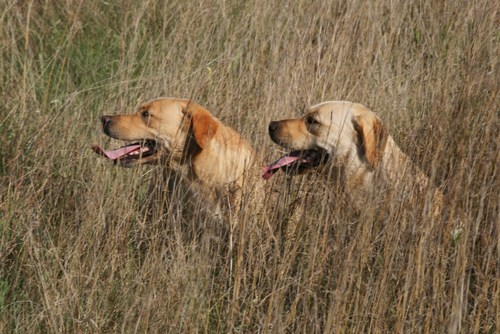
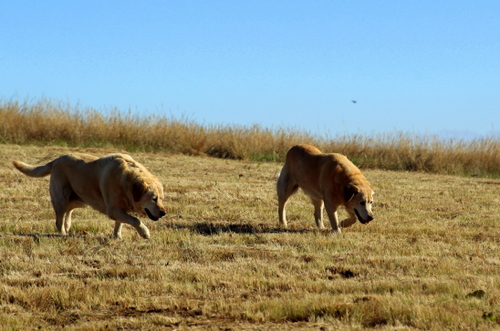
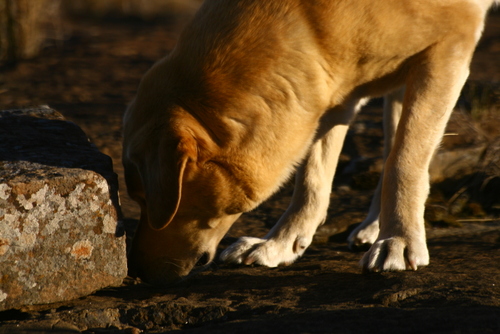
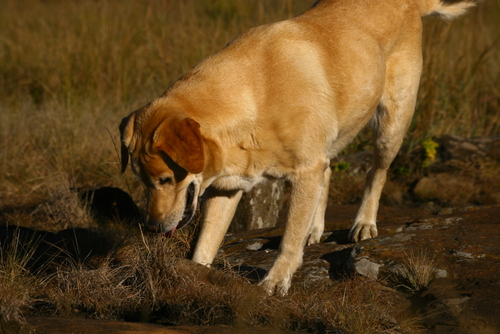
Being retrievers, they were both keen sniffers, their noses constantly close to the ground as they searched for clues and vital signs and tell-tale scents. Their attention span could be short however – a leaping grasshopper or a meandering butterfly would be enough distract them from the serious task at hand.

On the trail…

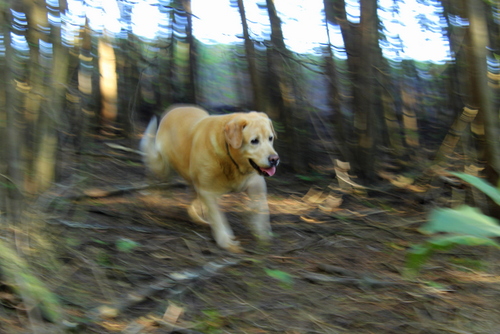
Of the two, Minki was the more energetic and adventurous, covering an enormous amount of ground as she dashed hither and thither. The only problen with this was that I never got to see many birds up close but that didn’t really matter. She was happy and that made me happy.

While this was going on, Whisky, was content just to trot along behind. She saw her role more as the observer, the eyes to Minki’s nose.

Minki in motion…

She loved nothing more than to just park off.

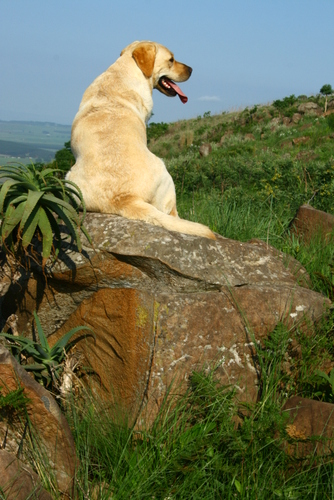
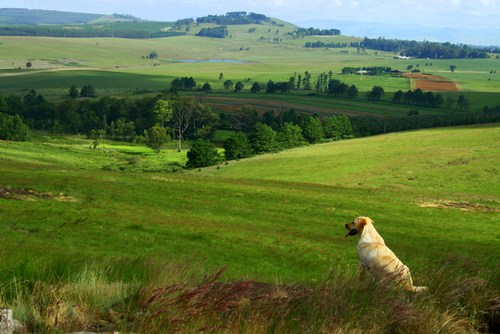
Nowhere was this more obvious than relaxing at our favourite resting spot – Lizard Rock. While Minki would scuttle over the exposed sheet of dolerite doing her best to catch the blue and orange little skinks as they darted between the rocks (to my knowledge she has never succeeded), Whisky preferred to just sit and take in the view.

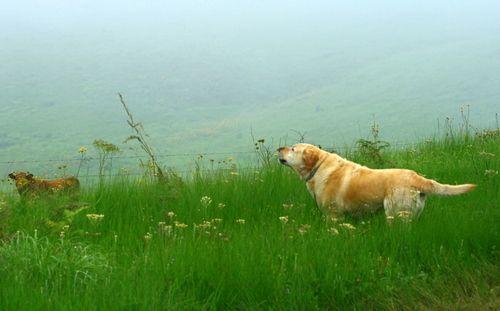
Conversely, Whisky was the more likely to bark at something. Our neighbour’s cows were a particular favourite. I noticed, however, that she always made sure there was a fence or some other form of barrier between her and them before launching in to her tirades of abuse.

A very ferocious Whisky showing the neighbour’s cow who is boss. The cow kept on grazing…

She could be easily fooled – often mistaking, for example, a plastic bag fluttering in the wind for some sort of looming threat. And barking at it.

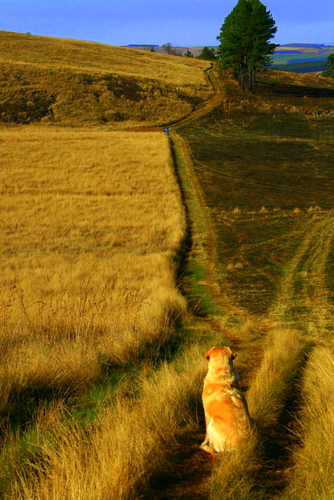
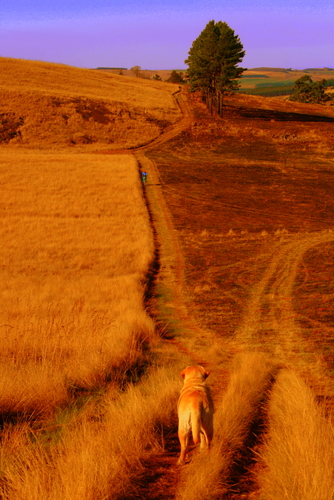
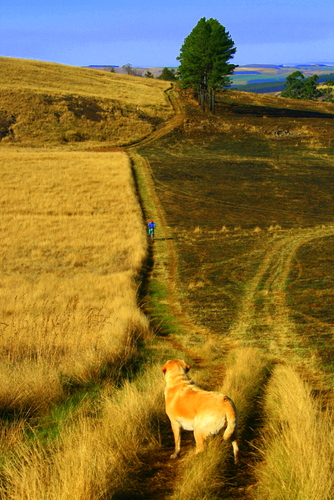
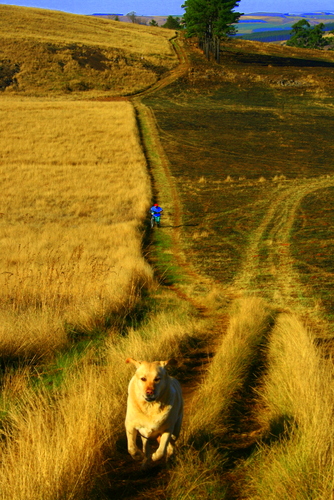
She was not a very brave dog as I have already intimated. The following sequence of photographs, which show her coming face to face with a man on a bicycle, provide a good demonstration of that:

They were good days – in fact, some of the happiest of my life – the three of us ranging across the countryside with never a bad word or heated exchange between us.

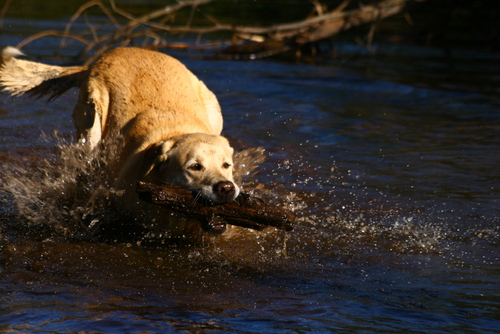
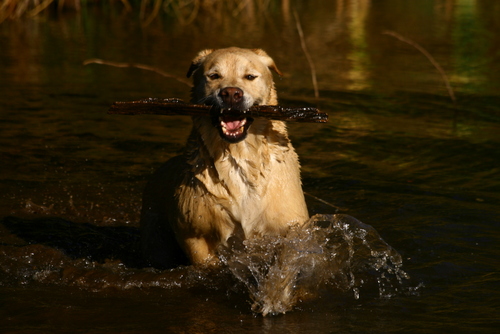
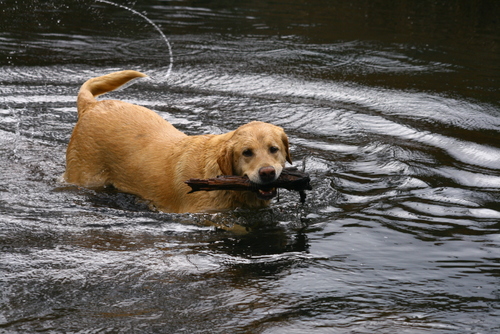
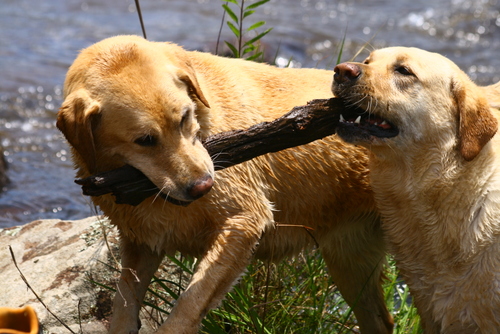
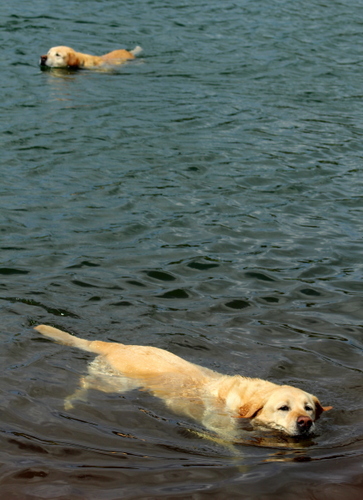
Our favourite walk was the one down to the river although it was always exhausting climbing back. Minki, in particular, loved flowing water and would immediately plunge in to the river once we got there, often emerging with a half-sunken log clamped triumphantly between her teeth.

That, would be quickly be forgotten once I sat down and pulled my Thermos of hot coffee and packet of rusks out my backpack because, like all Labrador dogs, they have a highly evolved food gene. They also had a way of reminding me, without actually saying anything but by simply giving me “the look”, that we were a team. I always ended up sharing my food with them.

Sometimes we crossed the river and followed the road that ran along its forested margin. I named this road Porcupine Ridge because I have never been on it without finding quills scattered along its course.

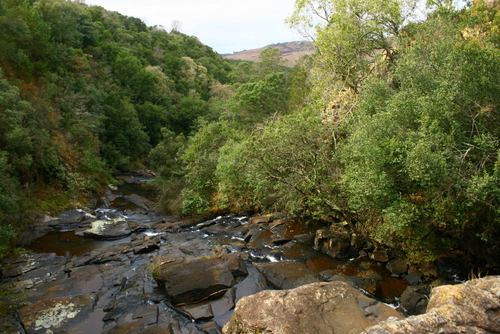
At the point where our farm ends, the road – still following the line of the river – takes a sharp curve up a steep hill. About halfway up this we discovered a waterfall although we had to hack our way through a fair amount of skin-shredding bramble to get there.

It was well worth the effort, we all agreed. For Minki there was a deep pool to swim in at the top of the falls (even better there were logs in it) while Whisky thought the cliff edge spot provided another brilliant parking- off spot where she could simply sit and muse about life.

Above the falls the country opens up in to a grass-filled glade, mercifully free of those prickly brambles, while the river slides its way over a series of smooth rock fissures, with more pools in between. Along their margins tree ferns grow while the water itself is wonderfully clear.

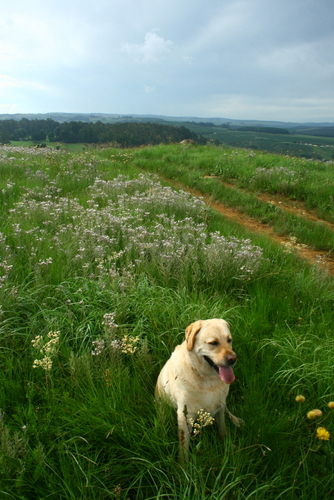
Selecting a comfortable position on some rounded rocks, I would sit dangling my toes in the cool water while the girls lay spread-eagled in the grass, tongues lolling. It was all very peaceful, almost domestic, with the view down the valley providing a lovely, quieting effect.

As a rule, this series of pool was my turning point although there is a beautiful dam just a little bit further up I would loved to have carried on to but I was worried the owner might not want dogs trespassing on his property, even ones as friendly and as well brought up as Whisky and Minki.

So we returned home, the way we had come, crossing the Kusane River and climbing the steep hillside back to the house. I always got back from these excursions feeling tired but well satisfied and at peace with the world.

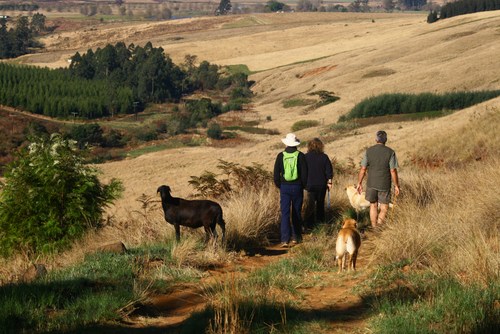
The road down to the river. The whole Kusane Gang including Mara and Harriet (not in picture), the two sheep. Plus Evan from Cape Town (in white hat), an honorary member of the pack..

Sadly, those days of exploration with Whisky and Minki have now become a thing of the past. Old age has caught up with them both. Minki has become so arthritic she battles to make it from one side of the room to the other. She is still unfailingly cheerful and although she doesn’t always get up to greet me when I come to visit she still manages to convey her pleasure at seeing me with a prolonged thumping of the tail on the floor.

For her part, Whisky has grown more matronly and home-comfort loving. When the guests arrive, she is still the model host doing the rounds of the cottages to make sure they have all settled in nicely (while, at the same time, casting a surreptitious glance in to what goodies they have inside their cool box).

She also still wanders down to visit me in The Barn, especially when her owner is away because she knows the end of my balcony provides a good look-out over the farm gate through which Karen – she who Whisky adores above all others – will come driving.

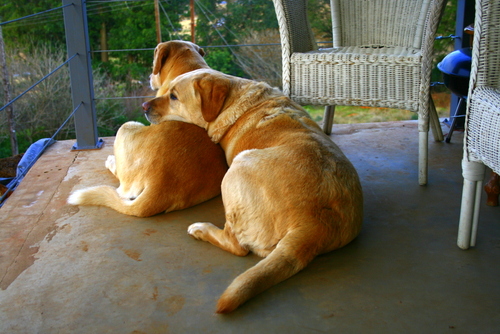
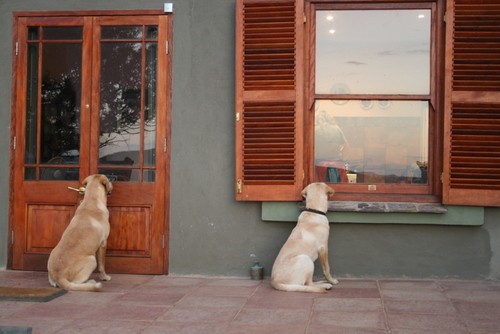
Two devoted girls, waiting for Mum to return home, at the end of my balcony. Whisky, as usual, using auntie as a pillow.

Where it counts they are still the same two dogs that I have watched grow up from puppies. They are not aggressive types but rather humble; they don’t demand affection but are grateful for it. Both still have warm, affectionate natures. Although they will obviously do their duty and bark at the sight of an unknown car coming up the driveway, I do not remember them ever showing ill-temper towards a human being.

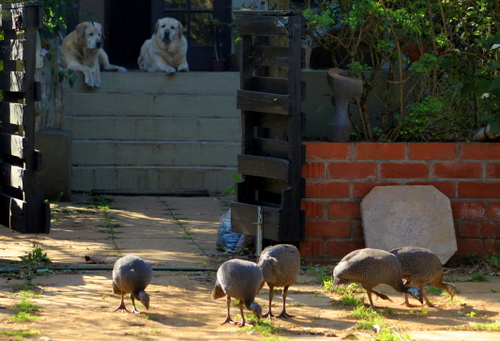
Guarding the guineafowl.

For me, life goes on. While I still try to walk on a regular basis, I have found that without the two girls to egg me on my enthusiasm levels aren’t what they once were and I don’t cover quite the same distance I used to. I hardly ever go down to the river any more although I suppose I ought to.

I still wander up to Lizard Rock but I miss having Whisky plonk herself down next to me and then lean up against my side, all friendly-like. I also miss watching Minki’s huge excitement when some lizard, with a death wish, decides to break cover.

It was a very special relationship. Through fair weather and foul, they proved the very best and most loyal of friends. I will always value and cherish and remember those times we had together, exploring Kusane Farm and the world just beyond…

Weathering the Seasons at Kusane – Part Two

As regular readers of this Blog should now be well aware, I decided, several years ago, to act on my extended mid-to-late-life-crisis by turning my back on the city and moving out in to the country. In a life riddled with bad judgement calls it turned out to be one of the best decisions I ever made.

My new home was spacious, filled with light; outside the windows and from the balcony I had stunning views over the Karkloof valley and hills and its surrounds. Here is the odd thing though. For some perverse reason I kept believing that I didn’t really deserve to live in such a beautiful place.

The Barn – my home at Kusane. I live in the upstairs portion. Note Zimbabwean sculptures.

I felt – and still feel – incredibly lucky.

Maybe it was due to the fact that I have never had much money and therefore didn’t expect the sort of things some rich folk (and their offspring) take as their God-ordained due. Or maybe it was because I had spent the previous twenty-five years of my life living behind razor wire in a cottage a little bigger than a dog kennel – and about as well kept – in the middle of Maritzburg’s CBD, and had come to assume this was my lot forever.

With a bit of self-therapy (in a probably misplaced attempt to attain a state of higher consciousness I took up oil painting. To try and unlock those repressed memories I began this blog) and lots of long, bracing, walks, I have slowly started to overcome this irrational and, it would seem, deeply ingrained hang-up

The views have helped. What I love most about living up here is that I feel so close to the sky. It has given me some idea of what it must be like to be a soaring eagle or a migrating stork.

The other thing is the weather. With the possible exception of the Nyanga farm, where I grew up, I don’t think I have ever been made to feel quite so aware of it.

Every morning, I can’t wait to get out of bed to see what it is up to. It has become my raison d’etre (it must be my Scottish/Irish/English ancestry). In the Karkloof you get an awful lot of it too: no two days are ever the same. Twenty-four hours can spin itself in to a lifetime of weather, a kaleidoscope of scene changes.

It can start off sunny and end up in pouring rain. On some mornings there is no dew, but mist wreathes the clefts and ravines of the hills across the way. A cold front can arrive in the time it takes me to stroll down to the river and get back home.

Mist in the Karkloof hills.

I love it all. I become deeply involved in the drizzly solitudes, I am bedazzled by the constantly changing cloud formations, I never tire of the bonfire sunsets.

Indeed, if there is one thing I have learnt from this endless cycle of weather is that I am its creature and to submit to it – be it hot, cold, dry, wet, windy or misty.

Here, then, are a selection of pictures I have taken showing the changing seasons on and around Kusane Farm.

The Chicken Whisperer

I grew up in an era in which children were still expected to make themselves useful. This was certainly the case on our farm where, because of the financial slough we had fallen it to, my father had been forced to go back to being a commercial pilot, based in the Sudan, leaving my mother behind to cope as best she could.

During the school holidays my brothers, Paul and Peter (the eldest, Patrick had already left for university), helped out, dipping and dosing the cattle, putting up fences and preparing the lands for the next seasons crops. Cut off from the world and heavily involved with the farm, we never got to do the things most teenagers take for granted – date girls, go to parties, hang out with the other kids.

Making ourselves useful – loading hay.

Because I was next to him in age I started tagging along with Pete, helping him out as best I could with his many duties (I drew the line at dissecting and examining the entrails of dead cows, many of which were maggoty and rotten, to see what they had expired of).

Even back then it was obvious to me that Pete was going to grow up in to one of those tough, shrewd, practical farmers who know how to make money.

Meticulous in his planning, he was nothing if not thorough. He also had a real feel for and a connection with the land – he loved it and respected it but, at the same time, he knew how to shape it and knead it and alter it to his own understanding.

I think my parents were a little worried that I might feel left out in all of this but, because I was the youngest and least practical of the brothers, they were stuck on what to do with me. In the end they found a solution. They put me in charge of the chickens.

Off to feed the chickens with Bonzo the dog.

As anyone who knows me well will tell you – I am nothing if not obsessive! I threw myself with gusto in to the job. I insisted the chickens be fed proper layers mash, not just mealies, so they would lay better. I expanded the flock. I even managed to make a bit of pocket money selling eggs to one of the teachers at the next door mission station.

I used the cash to buy myself some colourful shirts which meant I could finally dispense with the boring old school-issue khaki ones I had always worn because my ever-frugal mother did not want to waste money on unnecessary frivolities. I was on my way to becoming trendy.

Being in charge of the chickens was a lot of work and not without its problems. One morning, when I went up to feed them, I discovered a python had slithered in during the night, and gobbled up most of the chicks I had put, for their protection, in to a special run. The resident mongoose also had my flock firmly in its sights.

Once past my teenager years I gave up on my chickens. I went to university, I got a job, I ended up drawing cartoons for a living. I wasn’t really in a location that permitted having chickens either.

Fast forward a good many years. I found myself on a farm again.

Even then, living in the hills, it wasn’t really in my long-term plans to return to my youthful vocation. Fate decreed otherwise. One day, a lecturer friend of ours turned up unexpectedly with a box containing six female pullets which he had appropriated from the Agriculture faculty at the local University. Insisting I had the requisite set of skills, I immediately volunteered to look after them,

And so it was that my life came full circle. I was back where it all began. I was in my old habitat.

The chooks checking out their new home. Michael in background.

I was very pleased with my six little hens especially as they were Rhode Island Reds, just like the ones I had on the farm. What I did not realise, though, was that there was an impostor amongst them!

Little clues and tell-tale signs began to emerge. It was bigger and bulkier and more aggressive than the other hens. It had a larger, very red, comb. Its tail kept growing and growing, until it resembled a cascading waterfall.

All doubt was finally removed when I was woken up early one morning by what sounded like a badly-played trumpet striking up in the Hen House. I realised immediately that the strangulated gurglings I was hearing was meant to be a cock-a-doodle-doo.

There was no longer any doubt – She was a He!

Once he had mastered his crow, there was no stopping this rooster. From way before sun-up to sunrise there was a non-stop, raucous cacophony, like a machine-gun going off – only the war he was involved in did not seem to have an end.

This I did not remember from my early days as a chicken whisperer…

He was a magnificent specimen, however: big and bumptious and swanky and incredibly self-assured. We could not find it within ourselves to do the obvious thing – turn him in to coq au vin. Rowdy – as we named him – was here to stay.

Rowdy, in all his puffed-up, self-importance.

Rowdy, for all his puffed-up, self importance, was extremely protective of his little harem. I often found myself having to ward him off with a big stick when I went up to let them out in the morning. I think he mistook my intentions towards his wives.

Rowdy had a nice dramatic sense, too, strutting out ahead of his hens when I let them out in to the garden, the very essence of a Modern Major-General.

Rowdy, leading his flock.

Since we appeared to be stuck with Rowdy – and his incessant racket – we decided we might as well go the whole hog and make use of his services. Karen, on whose farm, Kusane, I live, bought a cheap Chinese incubator so we could start hatching our eggs. It did not work very well so we up-scaled and got an American-made model instead.

It was at this point, my life took another peculiar little twist.

When our neighbour, who was raising Dutch Quacker Ducks, heard we had an incubator he asked if we would mind trying to hatch an egg which one of his mother ducks had abandoned. So we put it in with all the chicken eggs and lo – it hatched!

From the outset the duckling, whom Karen named Plucky (because that is what he is) faced something of an identity crisis. Because he had been born amongst a whole batch of them he was firmly convinced he was a CHICKEN!

Plucky with his mates.

When our neighbour offered us his two adult ducks and their three ducklings because we had a big pond in which they could swim we saw our chance to convince Plucky he wasn’t, in fact, a CHICKEN! We would put him in the pond too.

This is where our plan to re-intergrate him with his own kind began to unravel…

On being let out of their box, the two parent ducks panicked and charged off up the hill immediately above the pond leaving their bewildered offspring behind them. A great hue and cry followed.

The abandoned ducklings, in turn, saw Plucky floating on the water, on the other side of the pond, and decided he would make a good substitute parent, so went splashing after him. Plucky was having none of this and with a violent clattering of the wings, took off in the opposite direction, plainly terrified out of his, admittedly small, mind at the sight of this flotilla advancing, full-steam, towards him.

Plucky during his brief soujourn on the Big Pond.

Hoping the ducks would soon resolve their differences, arrive at an amicable understanding and settle down to live happily ever after in their spacious new home I decided to leave them to their own devices. It didn’t pan out that way. I hadn’t taken into account Plucky’s resolve or his loyalty to the only real family he had ever known.

When I went back, later, to check up on how they were all doing I discovered that Plucky was gone. Michael, our farm manager, and I spent the rest of the day scouring the countryside looking for him but to no avail. Plucky had simply vanished in to the ether.

Next morning, I was yet again woken in the early hours by a huge commotion in the hen house. When I went out in the freezing cold with my torch to investigate, I discovered one of the hens had accidentally laid an egg in her sleep and then worked herself up into a state about it.

I also found a very cold and forlorn Plucky huddled up against the gate. He had somehow got through the duck-pond fence and found his way home in the dark.

We made one more attempt to convince him he was a duck with the same end result. That settled it for us. Plucky could stay with the hens and Rowdy whom he hero-worshipped.

Plucky with his hero – Rowdy the Rooster.

In the mean time, the flock had expanded to almost fifty chickens. We had begun to experience a few logistical problems. There were a couple of unexplained deaths. The hatching rates in the incubator were still abysmally low. What were we going to do with all the eggs the hens were laying? Was it all worth the effort?

And so we did what the Government does whenever it hits an obstacle it is not sure how to overcome – we appointed a Commission of Enquiry in to the State of Kusane’s Chickens with additional reference to the Curious Case of Plucky-the-Duck-who-thinks-he-is-a-Chicken. We even brought in a vet who is an expert on poultry as a consultatant.

Provided the results don’t get fudged, ANC-style, I hope to report on the outcome in due course…

Rowdy – keeping a beady eye out for anyone who might be interested in his hens…

Rowdy facing temptation
Plucky demontrating his skills as an aviator.

Weathering the Seasons at Kusane

Living up here, at Kusane Farm, I never tire of looking at the distant Karkloof hills and the valley below us, with its constant changing moods, under sun or cloud, in various weathers, at moonrise and sunrise and when shrouded in mist. The quietness, the sense of green beatitude brings with it an overflowing sense of peace – a feeling that often seems to be in very short supply in both South Africa and the rest of this confusing modern world.

I get excited, too, when I see my first Yellow-billed Kite of the season because, for me, it always signals new beginnings…

Yellow-billed Kite.

When it comes to the seasons I prefer to take my cue from the Zulu. Unlike ours, their calendar begins in July which is usually when the bird returns from its annual migration.

One of their names for that month is uNhloyile which refers to this phenomenon. The other name is uNdewaloor “new grass moon” – indicating the appearance of green grass after the burning of the veld.

The Zulu months are dated from the appearance of the new moon. Consequently the months are 28-days long and there are 13 in the year. It makes perfect sense to me. I don’t know why we don’t adopt it.

Kusane is always at its best on the cusp of spring. Casting my eye around I can see the landscape changing before me. After the first light showers the grass miraculously starts to green up, the hillsides erupt in a mass of wild flowers.

Spring flowers at Kusane.

One of the first things I start looking for, on my early morning walks, are the widow birds. I want to see whether they have slipped in to their bright-coloured breeding finery. The frogs also strike up their summer chorus – some might call it a racket – with even the little Natal River Frog that has taken up residence in my fish-pond tuning in. The returning swallows begin building their nests.

A little green frog…

Often, in the morning, especially when it is misty, you can hear the trumpeting flight calls of the Crowned Cranes rising up from the patchwork of meadowland in the valley below, as well as the noisy calling of the Fish Eagle as they fly between dams.

Walking out at night under a sky brilliant with stars I like to stop to listen for the curiously bird-like whistle of our resident reedbuck male or the howling of the jackal. Later, I fall asleep to the sound of wind rustling the fir trees outside my bedroom window.

Another of my other great pleasures, at this time of the year, is watching the hordes of the Village (or Spotted-backed) Weavers, that have colonised our garden, going through their courtship rituals: each male desperately trying to convince the available females that the house he has built meets all their domestic requirements. If they fail to respond to his sales pitch, he is forced to rip the nest down and start all over again.

Village (or Spotted-back) Weaver

It seems a thankless task but they are not easily put off. I guess there is a lesson in there for us all…

Summer means storms. Living on top of a hill you really get to appreciate the unfolding drama. At times it gets curiously biblical as the sky blackens and curdles on the distant horizon and then great draughts of thunderous blue cloud come sweeping across the valley, bringing with it the rain.

An approaching thunderstorm, Karkloof.

These storms can create an amazing spectacle of light and noise. I often sit on my balcony and watch the whole drama unfold, the echoing roll of the thunder alternating with a rapid series of brilliant flashes that show up the whole landscape in rugged silhouette.

As the din grows louder and the weather became more threatening you begin to feel like you are watching the prelude to Armageddon. Even after it stops, the sky often stays leaden with wisps of mist chasing each other across the hills.

Sometimes these storms are followed by days of light drizzle with the whole valley lying draped in a blanket of stone grey mist.

Seasons of mist…

The onset of the rains turns the valley below me a lush emerald green. It is so green, you could think you were in somewhere like Ireland or Thomas Hardy country. Which is why I suspect God (or evolution. Take your pick) created Hadedahs – to remind you, very noisily, that you are living in Africa…

Autumn forecloses on the summer with the dark nights drawing in. The rains taper off.

At this time of the year, even in a bad season, the dominant colour is still green but already you can feel that change is in the air. The sky turns a pearly blue and there is the faintest breath of coolness, stirring across the pine trees and ruffling them. In places the veld begins to take on its winter ochre tones.

Each day I try to get up as near to sunrise as possible in order to verify the appositeness of the adjective ‘rosy-fingered’ dawn. Luxuriating in the sense of space and solitude, I have come to realise that Homer’s simple yet elegant description of this daily miracle has never been bettered.

‘Rosy-fingered’ dawn.

And then winter comes galloping down on us. The trees shed their leaves and on my morning walks I notice that there are suddenly far fewer birds around then there were just a few weeks earlier. There are still some swallows but the Yellowbilled Kites, Steppe Buzzards, White Storks, Amur Falcons, various warblers and other migrants have all gone and the hills no longer echo to the sound of the Red-chested (or “Piet-my-vrou”), Diederick and Black Cuckoos. The Bishop birds and Widow Birds turn back in to drab little brown things, indistinguishable from their surroundings.

If it wasn’t for the comforting call of the Cape Turtle Doves I would probably feel quite bereft

Before you know it, the first cold front has arrived, often bringing with it icy rain, plummeting temperatures and a cutting wind. Sometimes snow falls on the Berg. In really cold winters it can blanket the rest of the KwaZulu-Natal Midlands as well. The one year – unfortunately I wasn’t there to see it – it covered the Karkloof hills and valley.

Snow in the Valley. Picture courtesy of Karen MacGregor.

It is the wind that is worst, slicing through your trousers and making you grit your teeth. In the mornings there is frost in the valleys.

Frost in the valleys.

May, June and July also mark the beginning of the fire and fire-break burning season. It is the time of the year when the smoke from these fires thickens in to a sulphurous haze that dims the colours of the countryside.

Fire-break burning season.

Kusane is a perfect place to wait out winter. It is also the best time of the year for going on really long walks, to stretch legs and spirits grown stiff and feel the ineffable pure cold of winter strike my face as I sit down by the river and drink from my Thermos of hot steaming coffee.

Gradually, with winter running its course, the temperatures begin to rise again. It is time to get my binoculars out and start panning the skies for the returning Yellow-billed Kites….

Living up here, with the consolation of Nature, has given me a different perspective on things. I have become quite content with my own counsel and the more time passes, the less enamoured I am with the noisy, suffocating, outside world.

It is a simple but satisfying life and I want nothing here ever to change, not a leaf or a pebble. Except, of course, the seasons…

Karkloof Ramblings

When I was young I wanted to go everywhere, anywhere: the Sahara, the Himalayas, Russia, the Far East, the Antarctic. I yearned, to go to places no one else had been. I wanted to climb mountains, cross deserts, hack my way through jungles and brave blizzards and snowstorms.

I did eventually go overseas but never did half the things I had planned.

Instead I opted for the more predicable route taken by so many other young men escaping home for the first time. I picked apples in Kent, plucked turkeys inside a very cold shed in North London, hung around Carnaby Street (it was still fashionable back then), visited a lot of country pubs and did a whirlwind trip around Europe in a very old bus which bore, on its front window, a brash logo proclaiming “We are are lost but we don’t give a shit!”.

It kind of summed up my state of mind at the time.

I have never quite outgrown this adolescent longing for adventure although, as I have grown older, I have come to realise that often the most beautiful places on earth are right there under your nose, on your own doorstep, so to speak. This has become particularly evident since I accepted my good friends, William Saunderson-Meyer and Karen MacGregor’s generous offer and moved up to their farm, Kusane, in the KwaZulu-Natal Midlands, with its panoramic views over the stunning Karkloof valley.

The view from my house across the Karkloof Valley

There are, of course, various ways to experience these scenes although I still think it is best done in the old fashioned manner, on foot. Its the perfect way of moving if you really want to appreciate and take in the beauty of a place.

In a car you are always thinking of a myriad other things – how far is the next petrol station? Am I exceeding the speed limit? Where do I turn? Why is that police car following me?

I’m not so sure about bicycles either – all that manic pumping of legs and furious concentration on the road ahead and places flashing past you before you have had a time to even look at them.

No – give me a good pair of walking shoes, some sun cream and a pair of binoculars and I am happy.

My current favourite local walk takes me up a rubble strewn road, through a saddle, past a protea field and then down into a valley where several rivers from the surrounding hills meet.

Rambling on Kusane

The chief stream comes for a long way through forest and soft deep meadowland. It is slow, quiet and unobtrusive. I usually stop for a cup of coffee in the exact centre of a wide saucer of land where the grass looks like it has been polished by the sunshine and the air is rich with the scent of bracken, eucalyptus and pine.

Minki, Kusane River

It is a lovely spot. Here, in the deep water among the rocks, I am able to escape the tensions that can sometimes make life so vexatious

The same river eventually cuts its way past past a large hill, on the other side of which lies the somewhat optimistically named Khyber Pass (which, at this stage of my life, is probably about as close as I am ever likely to get to the real thing). Tall, green and full of perspectives it is not hard to imagine why this swell of land should have inspired another young man, of an adventurous turn of mind, to attempt the seemingly impossible. His name was John Goodman Houshold and between the years 1871 and 1875 he allegedly undertook two flights in a self-constructed glider somewhere in this area.

Whenever I pass through this secluded bit of country nestling beneath the Karkloof Hills, I pause to ponder the life of this ordinary farmer’s son who decided he wanted to defy the laws of gravity.

Scanning the hill line, with its deep clefts and valleys, I can imagine the ground shooting away beneath him as he launched himself precariously into flight. I find myself wondering about his emotions at the time and what thoughts went rushing through his head once he became air borne. He was going somewhere, he knew that, but quite how far and where, and how it would all end up, he could only guess although sooner or later he would most certainly find out.

According to the plaque they have erected in the area, to commemorate his achievement, his longest flight took him all of five hundred meters which, at that time, was quite remarkable and really did represent a giant step for mankind. Unfortunately, it also wrecked his ankle and his pious mother, fearing his actions would bring the eternal fires down upon their heads, managed to persuade him to abandon any further foolish notions of flying free like a bird.

In an odd way I feel a strong connection with Mr Household even though a hundred-odd years of history separate us in time. Both of us, in a sense, wanted to be the ploughmen of our own acre and went looking for the same thing – adventure, space, nature and escape. I like to think that in our own, peculiar, ways we both succeeded in finding it.