Book Reviews

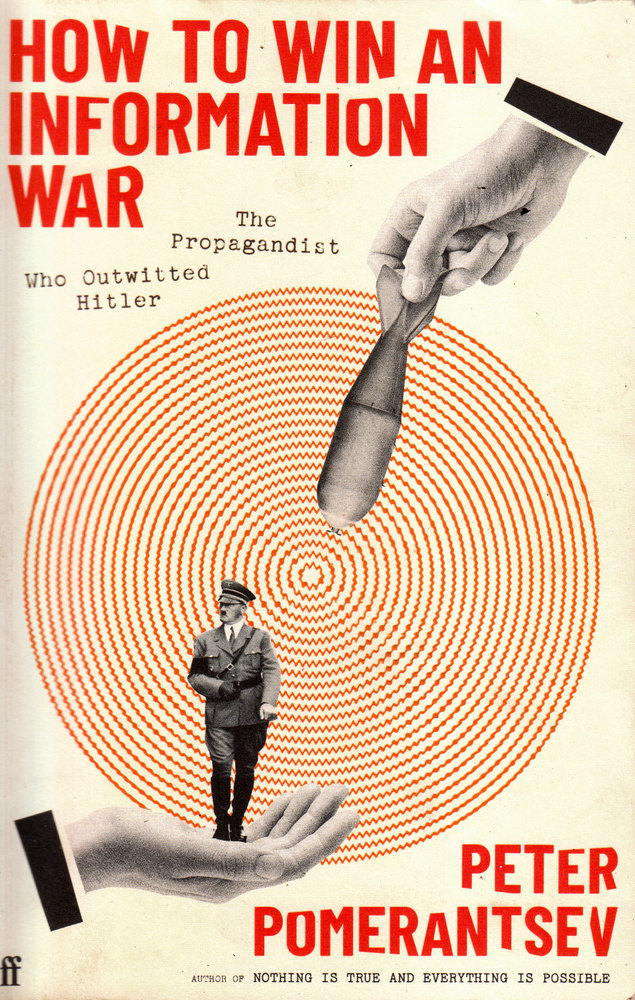
In these turbulent times, where salesmen-cum-saviours of the Donald Trump sort have taken to positioning themselves as champions of the “real people” (even though their rich-man lifestyles suggest otherwise) while attempting to impose their own versions of reality on us, the need to find a way to counter the torrent of misinformation spewed out regularly from both politicians and countless other, often conspiracy-based, outlets has never been more urgent. The question, of course, is how do we do this? In this fascinating book, Peter Pomerantsev, an expert on contemporary propaganda, gives materials to help answer this.

He starts by travelling back in history where he finds a fascinating example of how one man, now almost forgotten, set about undermining the Nazis during World War Two..

The son of an Australian academic, Sefton Delmer was born in Berlin and grew up speaking fluent German, although the fact that he was always perceived as a foreigner prevented him from ever becoming completely accepted. As the correspondent for the Daily Express, before the war broke out, he won the trust of the Nazi hierarchy, who, at that stage, were still eager to curry favour with and impress the British. He was invited to attend their militaristic mass rallies; he also got to meet the Fuhrer, Adolph Hitler.

With his wide experience as a journalist and his understanding of Gernam – and in particular Nazi – culture, Delmer was, in many ways, the ideal man to take on the Nazi propaganda machine and in so doing help undermine the German war effort. Operating with his team from Aspley Guise, a village near London, Delmer chose to do this by attempting to outplay Joseph Goebbels, the German Minister of Propaganda, at his own game.

Just as modern-day populists and tyrants have happily jumped onto the social media bandwagon, Goebbels quickly realised how powerful a medium of communication radio was and how it could be harnessed to serve the Nazi cause. In this battle for people’s minds – as Delmer came to realise – hard facts, reasoned arguments and evidence play only a secondary role. The emphasis is on making people feel they are special, that they are a part of a common destiny. In other words, propaganda works not because it convinces or even confuses; it works because it creates a sense of belonging. There is no effective way to counter it which does not take into account the need to belong that propaganda satisfies.

Delmer also realised there was little point in trying to make his broadcasts appeal to the “Good German” because that would be a case of preaching to the already converted. His aim was to win over the ordinary citizens, those who considered it their duty to do what their government demanded even if they did not fully understand the implications. He did this by tapping into their lack of idealism, rather than any high-minded ideals they might possess.

Deliberately employing the course, salty language of the streets – and going out of his way not to appear in anyway pro-British – Delmer, used his broadcasts, to discredit the German leadership in the eyes of ordinary Germans by portraying them as well-fed parasites leading lives of amoral excess while they suffered. Later he would subtly adjust his approach to meet the evolving needs of the situation.

While it is still a matter of debate among historians as to just what extent this anti-propaganda helped turn the tide of the war against Hitler, Delmer’s broadcasts do appear to have been listened to by a remarkably wide audience inside Germany. In unpacking his life story, Pomerantsev also shows that there is still much we can learn from his insights and observations in the fight against authoritarian propaganda.

Indeed, one of the strengths of his quietly inspiring book is that it hums with contemporary relevance. In our polarised world of “us and them”, Donald Trump’s self-pitying speeches contain obvious echoes of Hitler’s in their emphasis on victimhood – America is exploited by immigrants and bled dry by foreign countries. He will change that if elected – make America great again.

A Ukrainian by birth, Pomrrantsev has also witnessed, first-hand, how Vladimir Putin – another self-serving character with grandiose dreams of recasting world affairs – employs similar tricks to manipulate the media and keep the Russian people in thrall of him. Following Putin’s brazen invasion of Ukraine, the author returned home to find a country, once more, under siege, where the barriers between the past and present had dissolved. Not only was Ukraine under military attack but the same patterns of propaganda, justifying the invasion, were being used – only this time Putin’s troops are insisting they have come to free their fellow Russian speakers from annihilation by the Nazis in Kviv…

What this all clearly demonstrated to him was that the need to find ways of offsetting these new versions of old propaganda put out by bullies and dictators while nudging people towards the truth remains as important now as it did back in Delmer’s time

published by Profile Books

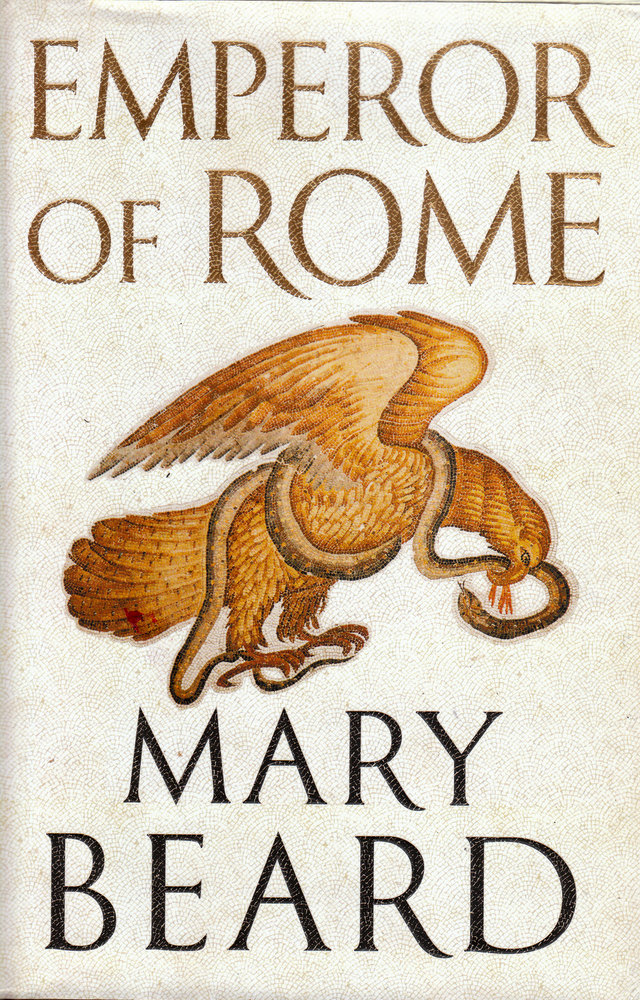
At its height, the Roman Empire – which replaced the old Roman Republic in 27BCE when Julius Caesar’s adopted son, Augustus, set himself up as the sole ruler of Rome – was the most extensive political and social structure in Western civilisation. It left an enduring mark on the history and culture of the West; its legacy lives on with us today in areas such as government, law, architecture, engineering and religion while the antics, intrigues and supposedly bizarre behaviour of the various emperors (Nero, Caligula, Elegabalus and Commodus being the more infamous examples) continue to provide an inexhaustible source of material for writers (and film-makers).

In this highly entertaining read, Mary Beard, the Professor Emeritus of Classics at Cambridge University, re-enters this familiar territory but comes at it from a slightly different angle.

While careful not to fall into the revisionist trap of completely rewriting history, she warns that many of the stories that have been passed down to us from the days of the Roman Empire should be taken with a pinch of salt because they often emanated from hostile historians who wanted to curry favour with the deposed emperor’s successors. As such, they can amount to little more than gossip, slander, hearsay and urban myth, sometimes written long after the events described.

Rather than concentrate on his individual foibles and failings, Beard is more interested in building up a picture of what the emperor actually did, the challenges he faced managing a vast empire and how he addressed imperial problems. In so doing she creates a colourful and impressionistic panorama of the ancient Roman world, with thematic chapters on how one-man rule worked, where the emperors lived, what his job entailed, what they did abroad, the role of women etc

Beard does not entirely ignore the juicy stuff or leave out the more scandalous bits that most ordinary readers might find interesting. She is interested in how many of the stories about the emperors arose as it is unlikely the empire would have been as mighty as it was and survived as long as it did if it was ruled by a series of deranged despots. Included in her text are many familiar tales of anxious rulers, artful poisoners, assassins, ambitious heirs, scheming mothers and wives, as well as loyal and disloyal servants.

While cautioning that we shouldn’t necessarily judge the Roman emperors’ behaviour by today’s standards, Beard also shows how they still provide us with important lessons on how to rule and a warning on how not to.

With the rise of autocrats in our age and with an emperor in the making – in the form of one Donald Trump – threatening to turn America into a dictatorship, the parallels between then and now become strikingly obvious…

Book Reviews

Published by William Collins

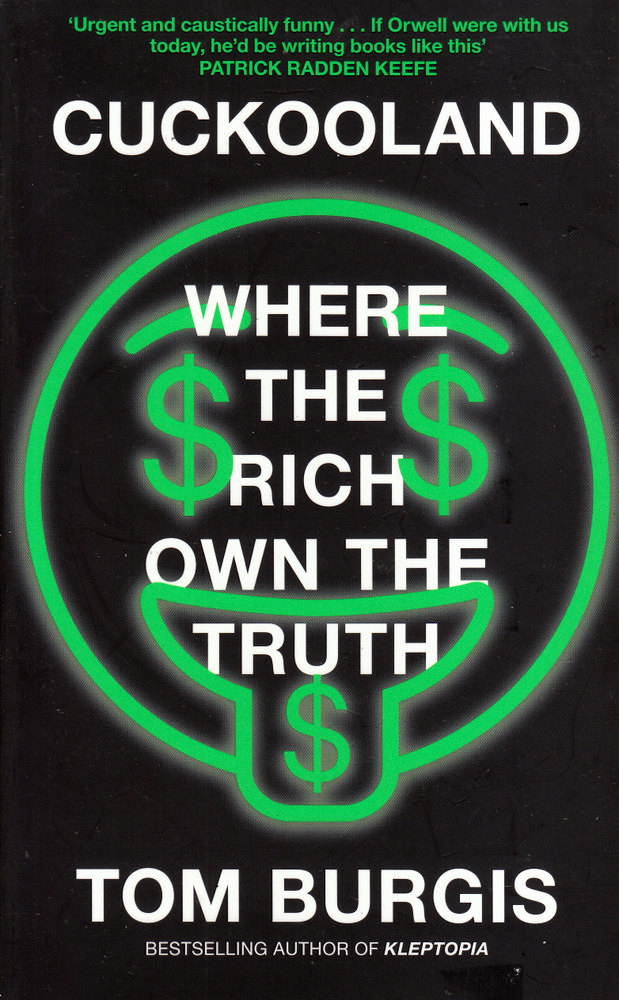
“The rich,” Scott Fitzgerald remarked “are different from you and me”. Reading Tom Burgis’s caustic, witty and, frequently, chilling, book which lays bare the control the super-rich now have, one can only but ruefully agree with the veracity of that observation.

Over the last several decades, the gap between the rich and the poor has, of course, grown even wider despite many governments’ empty promises to do something about it. This, in turn, has placed more and more power and influence in the hands of the extremely wealthy. All too often, the malign influence of their actions on the rest of the population and on the political and social fabric has gone unchecked.

In his meticulously researched expose Burgis, an award-winning investigative journalist, focuses on one man who believes his immense wealth has not only bought him immunity but the power to choose what he wants reality to be and impose it on the world – the Mombasa-born millionaire “dealmaker”, Mohamed Amersi. Determined to figure out who he really is, Burgis has dug into his business dealings, following a tawdry trail that leads him to countries run by criminals where liberal reforms have been blocked and corruption has condemned generation after generation to penury and strife.

Nor has Amersi just confined his dealings to repressive regimes in Russia, Kazakhstan and Uzbekistan. He has done his best to insinuate himself into favour in the supposed liberal democracies. As his fortune has multiplied and his list of (often unsavoury) contacts has grown so, too, has Amersi been studiously careful to reposition himself as a caring philanthropist and thought leader, intent on helping humanity. From his various estates in rural England, he continues to declare himself firmly against corruption. He has even been invited to deliver a lecture on the subject to Oxford’s School of Government.

His wealth has also bought him access to Britain’s elected rulers with the Conservative Party, in particular, being a major recipient of Amersi’s beneficence. Just how powerful a figure he has become in the land was confirmed when he was invited to Dumfries in Scotland to have dinner with the then Prince Charles where he undertook to support his various charitable causes. Impressed by Amersi’s character, the two continued to meet.

With his high self-regard and big fortune, it is hardly surprising that Amersi is openly contemptuous of journalists of the Burgis sort. In their interviews he not only constantly belittles the writer’s intelligence – Burgis faithfully records many of his put-downs – but he tosses out incriminating evidence confident the journalist would back off from using it when faced with his veiled threats, as well as access to expensive top-notch lawyers who specialise in libel cases.

In this, he seems to have misjudged Burgis who went ahead and published his account, despite the threats of very expensive legal action. The resultant book reads like a real-life thriller. Full of deft observations and dry, sardonic humour, it opens the lid on a world where rich, often amoral, businessmen – aided by self-serving politicians -think they can use their vast fortunes to intimidate others into silence while moulding the truth in a way that best suits them; what the author refers to as the “privatisation of reality”. Hopefully, as long as there are good investigative journalists in the Burgis mould around, they will never completely succeed.

Published by Atlantic Books

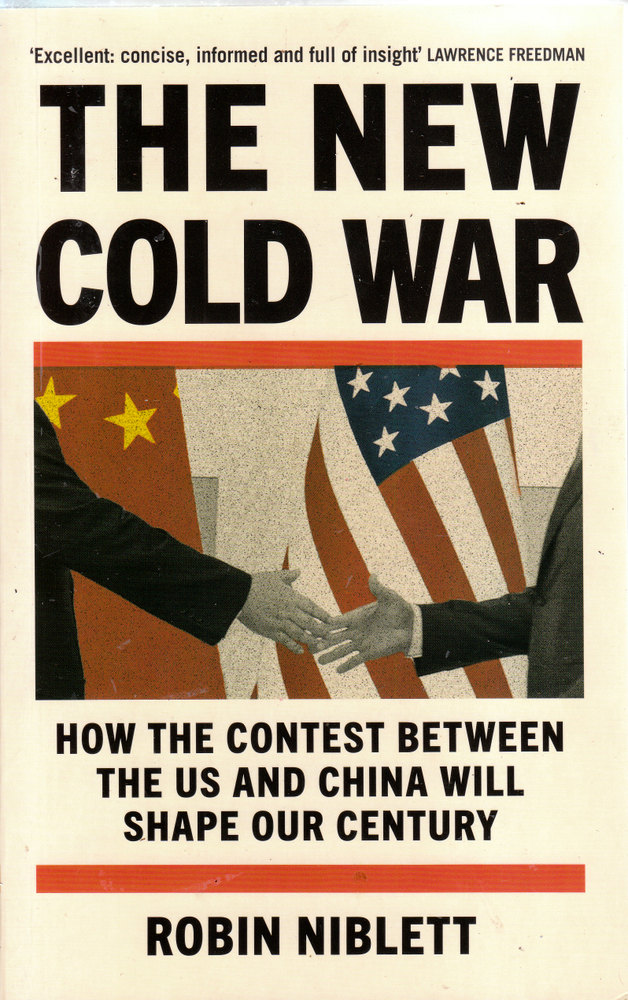
America may now be the greatest colossus in history but the tectonic plates are shifting and its status as the world’s dominant superpower is increasingly being challenged by the rise of China as an economic and political force. This, in essence, is the subject matter of Sir Robin Niblett’s latest book The New Cold War: How the Contest Between the US and China Will Shape our Century. The author’s central thesis is that the West has entered a new Cold War, one in which the rules are very different to those that applied in the days of the old Soviet Union.

With two diametrically opposed systems of government – the one opaque, state-controlled and intent on imposing uniformity of thought and action; the other based on free market economics, capitalist entrepreneurship, personal freedoms and the rights of the individual – it was seemingly inevitable that tensions should have escalated between the two nations in recent years.

In this growing contest, it has not helped that America has become a deeply divided, strife-torn nation full of self-doubt and no longer sure of what its status is or how best to manage it relationships with the rest of the world. The gridlock in America’s politics has, for example, caused a great deal of anxiety among its traditional allies with Trump’s threats and actions, during his presidency, reawakening European fears of abandonment just when a combined strategy on China is most urgently needed.

Although they no longer share the same communist ideology, Vladimir Putin’s own mounting tensions with the West – especially since his invasion of Ukraine – has driven him to align Russia more closely with China although his country is no longer the powerhouse it once was. Both countries are now actively seeking to draw others into their orbit of influence (as we have seen only too clearly in South Africa under the ANC). Linked to this is another factor affecting the future balance of world power – the growing role and economic clout of those nations which, formerly, used to constitute the non-aligned movement but are now more commonly referred to as the Global South.

Looming large over the whole picture and complicating matters still further is the growing awareness that the amazing human progress enabled by economic globalization came with an ominous downside: climate change. The implications are huge. If we breach 2 degrees C of global warming above pre-industrial levels, as is distinctly possible, it will trigger catastrophic environmental damage. As the author warns – it “is a systematic problem that does not respect international boundaries…It will require a system-level response to which all countries contribute.”

To negotiate this highly polarised world with its “us versus them” mindset and averting the risk of outright conflict with China from becoming a self-fulfilling prophecy, will require great skill and understanding. In his concluding chapter, Niblett, a leading expert on international relations, makes numerous suggestions as to how we can best achieve this. Thoroughly researched and written with great fluency and skill, his book is as useful a guide as you would want to understand the great challenges facing our age.

Landscape of my Youth

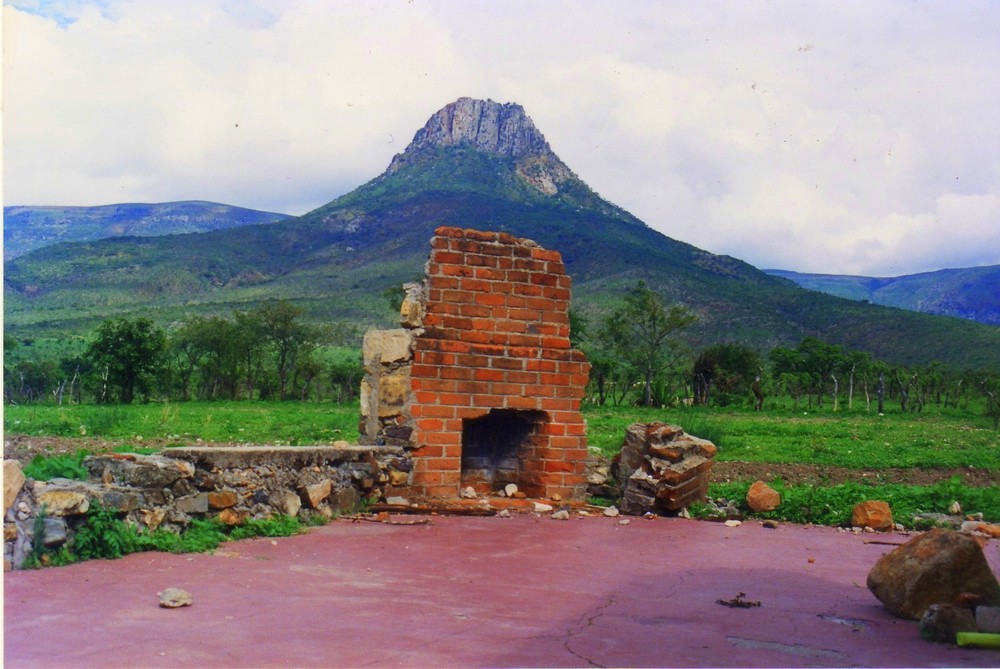
Mt Muozi from the remains of the old Somershoek house.

I have often wondered what it is that attracts one to a particular place? Why one would feel such a deep connection to it but not feel the same connectedness to somewhere else, even though it is an equally beautiful spot. How and where do these sensual tastes generate themselves? Like one’s attraction to a particular woman, it is not easy to explain – and perhaps it is best it remains that way – although, in my case, I suspect it may have something to do with the farm where I grew up.

The farm, which my father was determined to bully into productiveness (it had sat, virtually unused, since the original Dutch settlers, who had been granted the land by Cecil Rhodes, had abandoned it many years before) was situated at the northern end of the Nyanga valley, just where the European-designated farmland gave way to Tribal Trust Land. The first few years on the farm were, accordingly, spent erecting fences, clearing bush, digging furrows, cultivating the land and erecting buildings. During my school holidays – when I was not being roped into helping with all of this – I set about familiarising myself with my surroundings.

Towering above our end of the valley, the great brooding presence of Mount Muozi rose sharply. Behind it lay the main Nyanga range which was connected to it by a saddle. Back then, no one lived in this mountain fastness. In my youth, I liked to explore these mountains (and the plains and kopjes below). I loved the sense of freedom and discovery that came with it, knowing I was alone in a place where hardly anyone had set foot in years. As you climbed upwards, the terrain and flora began to change, becoming less African, almost Alpine. There were springs, mountain pools, waterfalls and rocky cascades. Sometimes I stripped off my clothes and plunged into these or simply scooped my hands down in it to have a drink. It was cold, crisp, clear and tasted wonderful. Coming straight out of the mountain you did not run the risk of contracting bilharzia, the debilitating disease that required long and tiresome treatment and was – and still is – the scourge of so many rivers and dams in Africa.

Refreshed, I would continue my climb. Patches of forests and glades of trees clung to the more protected spots; eagles, hawks, kites, falcons and kestrels circled overhead. There were kudu, duiker and klipspringer that would stand outlined on the crest of the big boulders, regarding this odd, blond-haired, fair-skinned intruder with curious eyes before bounding away. Leopards still lived in the mountains. I never saw one but they did occasionally come down from their lofty lookout points to kill the odd calf (one actually mauled the elderly black caretaker on the next farm, Somershoek, He survived, thanks to the intervention, with an axe. of his equally elderly wife but he was never quite the same afterwards).

Shrouded in legend and mystery, no matter where you went on the farm, you could never quite escape Muozi’s magnetic pull. It always seemed to be there, hovering watchfully on the horizon, inviting attention to itself, like some ancient giant turned to stone. Shreds of cumulus cloud hung around its summit, as if they, too, had been summoned by its unseen inner denizens. It is little wonder that the mountain played such an important role in the local inhabitants’ religious and spiritual beliefs and was considered a powerful rain-making site.

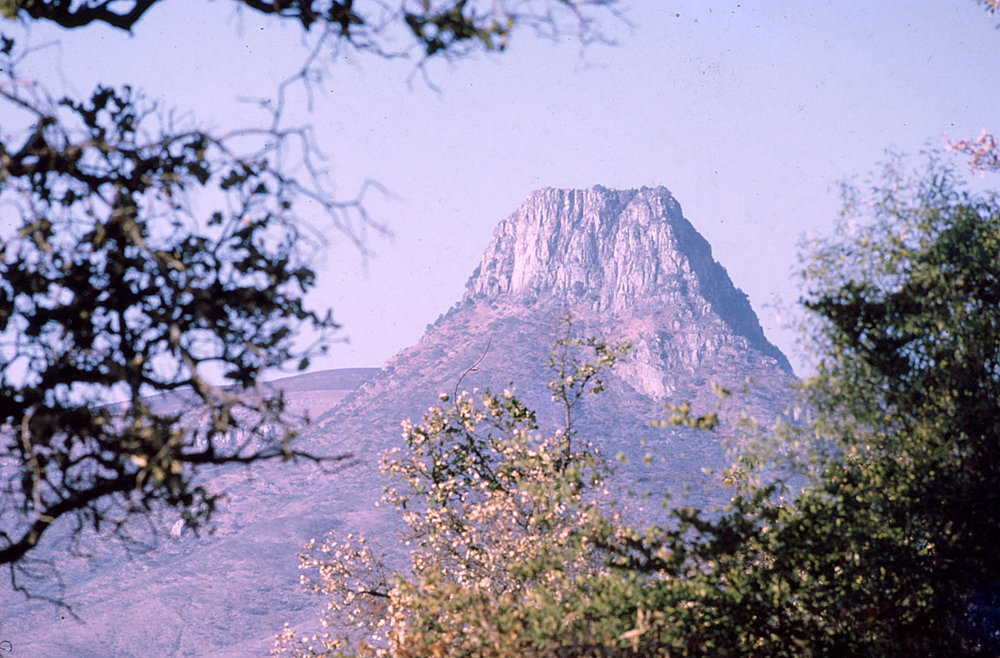
Mt Muozi – always hovering in the background and inviting attention to itself

There is only one stony track, which, after a hot climb, will bring you to the summit. On the flat plateau, atop the soaring rock, where the winds howl, the mists gather and lightning strikes, are the lichen-stained remains of many old clay pots and other detritus – reminders that this is hallowed ground where offerings to the spirits of the mountain in exchange for rain, were (and I suspect still are) made. The view from the top is breathtaking. Down below the country rolls away seemingly endless, patterned with shadows, shimmering with heat, until it eventually merges into the distant blue haze.

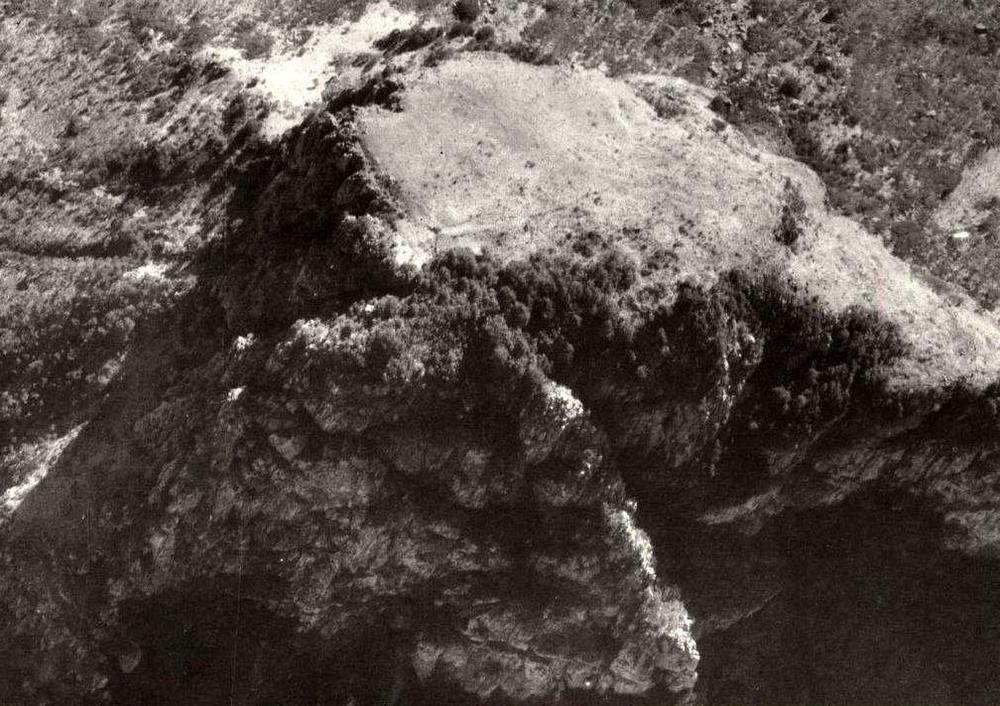
Aerial photo of the summit of Mt Mouzi. Notice the saddle on the right of the picture, plus signs of human activity. Pic provided by Paul Stidolph

Our farm lay directly beneath Muozi. The northernmost section (Wheatlands and Barrydale) was covered mostly with treeless vleis and waving grassland that glowed gold in the late afternoon sun. Elsewhere it changed gradually to woodland out of which the odd baobab thrust itself, bulbous and ancient – who knows how much history they had witnessed? Many of them must have been fully grown when the area’s earlier inhabitants had arrived for, in many cases, they had been incorporated into their stone walls.

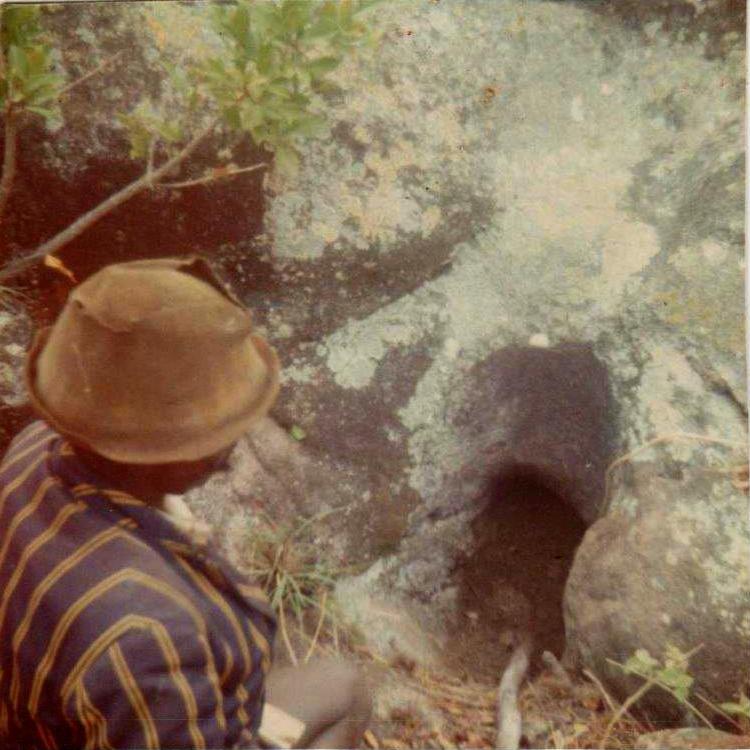
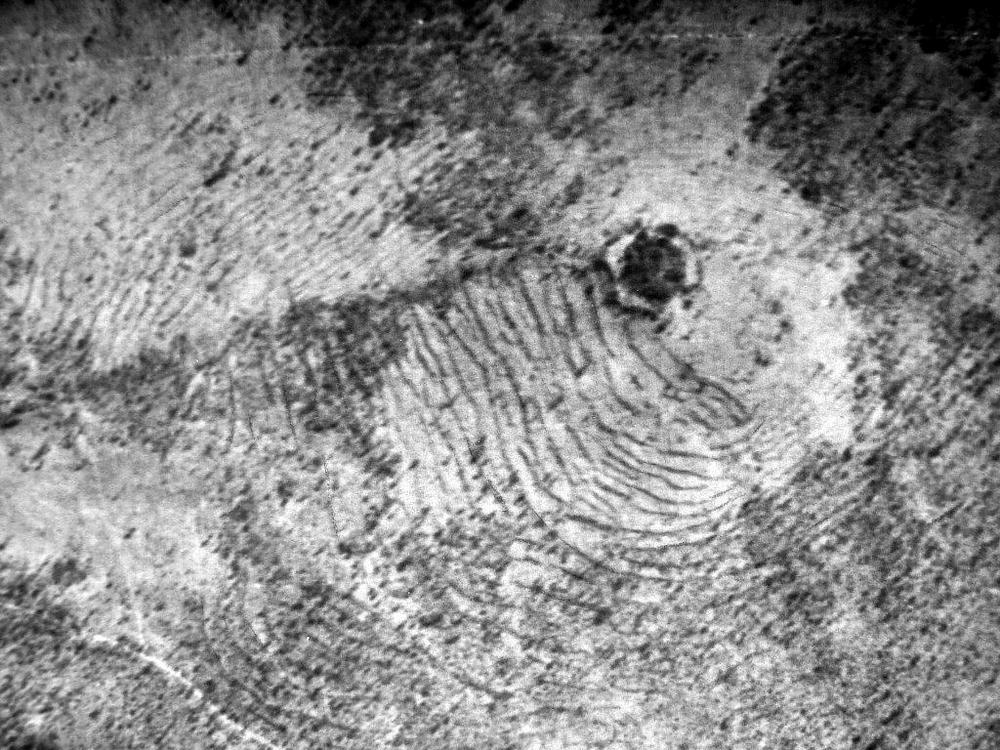
At the base of the mountain, we discovered a hole, with a large rock wedged into its entrance, bored into a solid slab of rock. What purpose it had served, how deep it went, when and how it had been made and by whom we had no idea. A hive of bees had now made it their home. This was but one of the mountain’s many enigmas.

Picture provided by Paul Stidolph.

There were also terraces along the entire mountain range, row after row after row, ascending upwards to the uppermost ramparts. Covering thousands and thousands of kilometres, these terraces are considered to be one of the largest and most impressive concentrations of stone structures in Africa. Further evidence of this vast agricultural complex – which dates from the 14th to early 19th century – can be found in the innumerable lined pit structures, hill-top fort settlements, stoned-wall enclosures and track-ways that dot the area. Although a fair amount of research had been conducted on the uplands sites and around the Ziwa/Nyahowe complex, the extensive ruins in our area had been scarcely touched by the archaeologists. I imagine that is probably still the case today.

The locals, we spoke to, seemed to know very little about their origins and so – in the absence of any other evidence (although my father did later obtain a copy of Roger Summers’s Inyanga, Prehistoric Settlements in Southern Rhodesia, considered a ground-breaking book on the subject at the time) – I had a lot of youthful, unscientific, fun trying to imagine who the vanished race was who had built them? My mind still uncluttered by the matter of reason, I would clamber along the fort walls, stare through the loopholes, and let my imagination run unhindered and free, picturing spear-waving armies sweeping across the veld while the anxious defenders huddled inside the walls.

I was not the only member of the family to be intrigued by the archaeology of the region. In my elder brother Paul’s case, it would become an all-consuming, lifelong passion which would see him travelling the length and breadth of modern-day Zimbabwe, searching for little-known ruins and other places of historical interest.

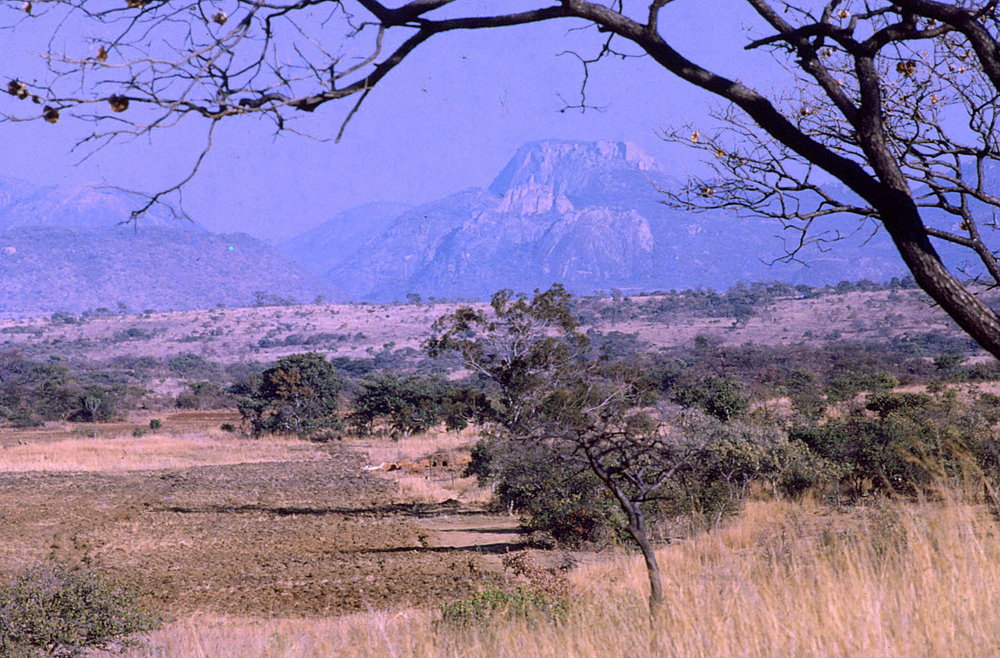
There was, indeed, something wonderfully mystical about the whole Nyanga North landscape. On the western side of the farm, the geology changed, the solid bank of the eastern mountain wall replaced by a mass of granite “dwalas” (of which Mt Nani, which lay between our farm and the Ruenya River, and Mt Dombo, on the other side of the Nyangombe River, are probably the most striking examples although there were many more), mountains, hills and kopjes that seemed to tumble haphazardly on forever. There were San paintings in some of them; for some reason, they occurred mostly on the west of the Nyangombe (or so Paul had deduced).

Mt Nani, Nyanga North.

The rains usually arrived towards the end of October. Each day soaring thunderclouds would gather on the horizon and the wind would fling dead leaves and wild grasses at us as we scurried for shelter. The cattle would grow restless, sniffing the air in anxious anticipation. Often, the huge build-up would peter out into nothing but every now and again the malevolence of the heavy air would be shattered by a bolt of lightning, followed by a roll of thunder and huge drops of welcome rain would come pelting down on our corrugated iron roof. The din would often be so loud we could barely hear ourselves speak.

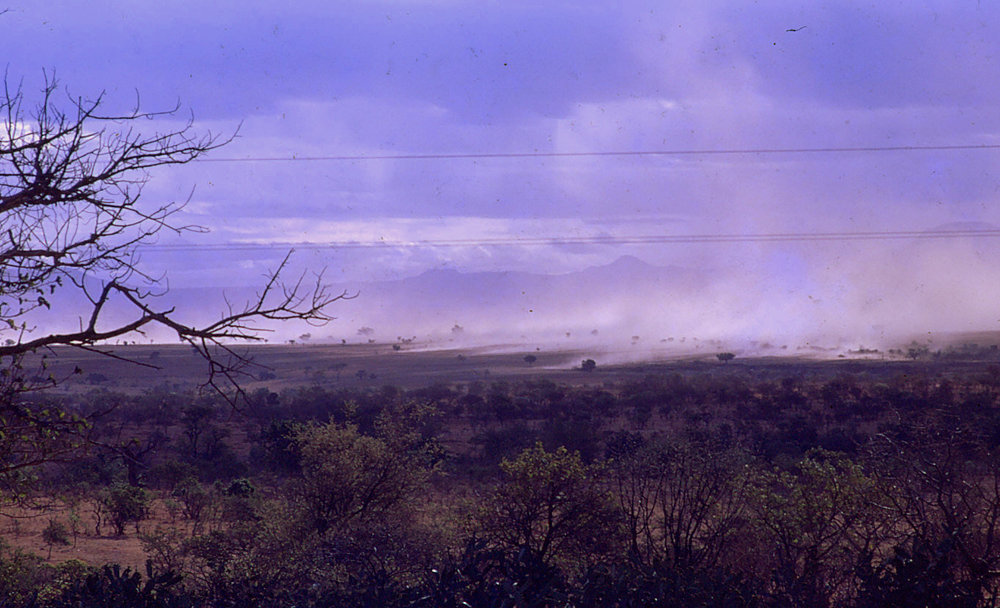
By the end of March, the rains had waned, and the grass become dry and dead. Wildfires scoured the countryside, leaving behind heavy plumes of smoke that half-obscured the valley. At night, their flickering flames created meandering, zigzag patterns on the mountainside and winked at you in in the dark.

Picture supplied by Patrick Stidolph.

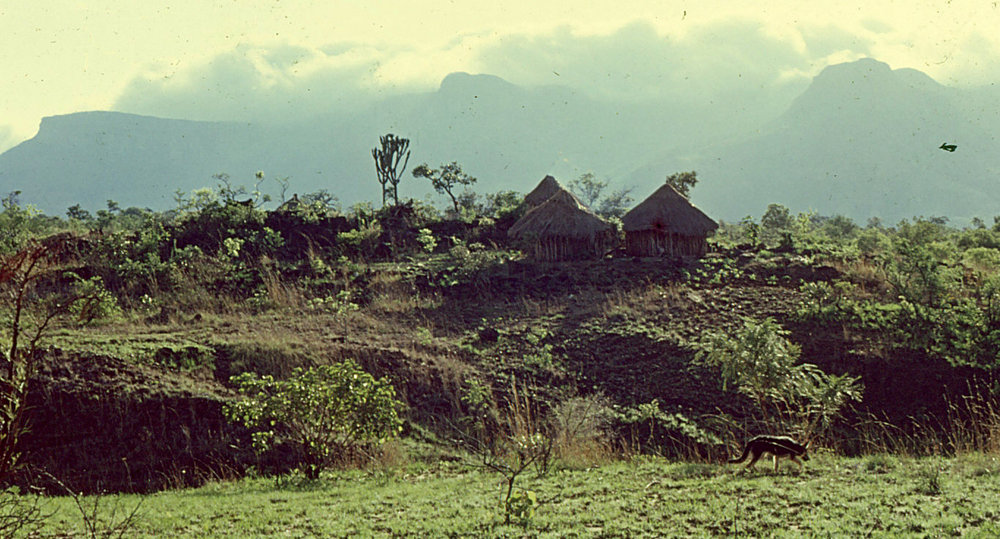
Lying in my bed at night, reading, a small tongue of candlelight quivering quietly on the table next to me, the wind would, on weekends, bring a chant and the thump of drums from our worker’s huts across the other side of the main Nyanga to Katerere road (a sound, unfortunately, you seldom hear today). Schooled, from the earliest age, in the modes of European thought, the spirit world, which they were summoning up, was a place I could never really access but the rhythmic pounding of the drums still exerted a strange fascination over me. At times like this, I realised I would never fully understand Africa on the level they did.

Our worker’s huts alongside the Pendeke River. Picture provided by Patrick Stidolph.

The night was alive with other furtive calls and noises. Owls hooted from the trees, and from various points around the house, came the plaintive, quavering call (usually rendered as “good lord deliiiiiver us,,,”)of the Fiery-necked Nightjar, surely one of the most iconic sounds of the African night which touches a depth in me virtually no other bird call can. Concealed from sight, the crickets chirruped out their messages in stuttering cricket Morse code. From the reed-fringed edges of the weir below our house, a motley assortment of croaking frogs vibrated their nightly courtship serenades. In the moonlight, the horizon would occasionally be crossed by the cringing, bear-like silhouette of a hyena with its bone-chilling howl. It was easy to believe the widely held superstition that witches rode on their backs and sometimes even took their form.

Every now and again, the dogs would rush out barking in the dark at what they perceived to be the threatening noise of a potential intruder. On one occasion, this turned out to be a massive python which had slithered up from the reed-beds and had coiled itself around one of our geese and was proceeding to squeeze the life out of it. The rest of the flock had retreated into the corner of the run, cursing and cackling furiously at this unwanted intrusion into their private goose space.

This, then, was my boyhood domain, my fiefdom. Over time, the farm and its environs became more and more my refuge. Its wide open spaces and emptiness provided an escape, if only a temporary one, from the conventions, the restrictions and the monotonous routines of boarding school life. I think that is why I never invited any of my school friends to stay there. It would have felt like an invasion, an intrusion into my richly imagined, intensely private world.

It was – and, in a sense, still remains – a sacred place for me. I have never again felt such a connection with a landscape, even though it could be a little frightening at times. There was an otherness about it, a sense of mystery. Its beauty imprinted itself on my brain, became part of my psychic makeup, helped shape my personality and profoundly influenced the way I came to see the world. Equally important, it taught me about the redemptive power of nature.

Granite mountains on the western boundary of our farm. Our freshly cleared lands are in the foreground. Picture provided by Patrick Stidolph.

Part of my father’s vision, when he bought the farm, had been that his sons would, one day. inherit and work the land but that was never to be. Like many other whites, we failed to read the writing on the wall. We didn’t fully appreciate we were living at the tail-end of an era. Just over a decade later, the whole country would become plunged into a vicious Bush War. With guerilla forces pouring over the Mozambique border, our isolated farm became an all too obvious target; we had little alternative but to abandon it to its fate or face the dire consequences. In the short-lived Zimbabwe-Rhodesia, it became part of a black resettlement scheme. We were amongst the fortunate few who received some compensation for our loss. When Robert Mugabe subsequently came to power he just seized the white-owned farms, under the pretext he was liberating them for the “povo” (people), but, in reality, he mostly parcelled them out amongst his corrupt senior cronies and cohorts, a reward for their participation in The Struggle.

In an eerie coincidence, my brother Pete happened to be on army patrol in the adjacent tribal lands when he received a report that our empty house had been attacked by a guerilla force, the night before, and reduced to a smouldering rubble.

Later, I would come to realise, that when those rockets exploded into the walls of our much-loved home where we had all spent so many happy times, the innocent world of my childhood had ended. I also knew that I would never live there again.

I often wonder if my subsequent restless quests and wanderings, searching for scenes and places that provoke a similar passion, the same intense love, do not form part of my grieving for this lost landscape of my youth?

Book Reviews

published by Jonathan Ball Publishers

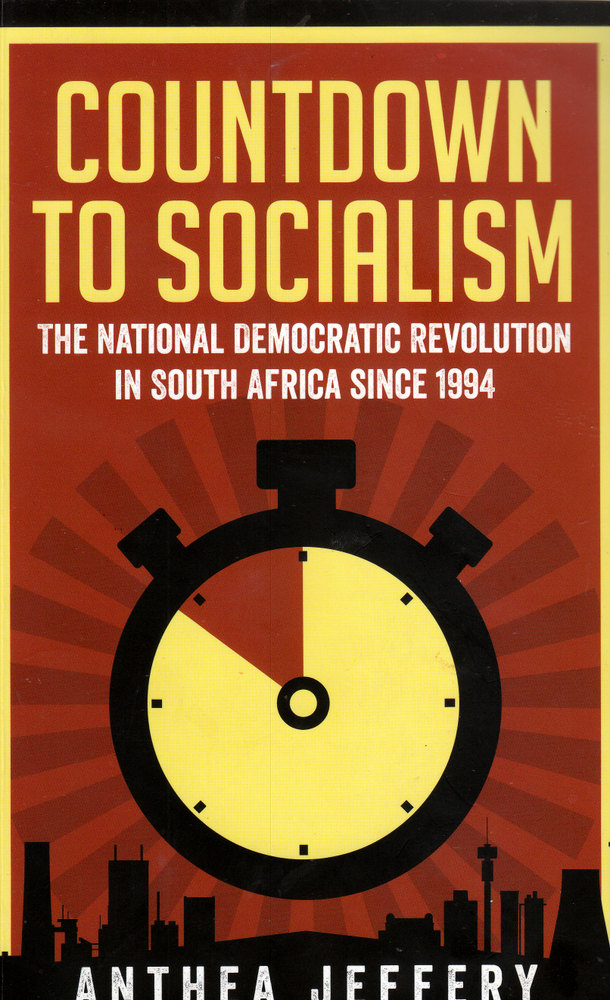
At the time of South Africa’s independence, many observers were lulled into thinking that the ANC was committed to a free and open liberal democracy in which state power would be constrained and the government would be accountable to the individuals who voted it into office. Given the role the party had played in deliberations for South Africa’s much-lauded new constitution such optimism was, in the circumstances, perhaps understandable.

It was also, in the view of the author of this, at times, rather unsettling book, wrong. Far from embracing the neo-liberal narrative with its focus on individuals rather than classes and its built-in system of checks and balances, Jeffery maintains the ANC was only paying lip service to these ideals to buy itself time while it set about strengthening and consolidating its power. For them, the attainment of majority rule marked the first step in a zero-sum game aimed at extending government power and control over every aspect of South African life, while at the same time expanding dependence on the state. Egged on by their alliance party, the SACP, they have remained committed to their mission of “progressive transformation”, the goal of which is to turn South Africa from a capitalist into a socialist country and, ultimately, a communist one. The key to understanding all of this is spelt out in their ‘national democratic revolution’ (NDR) which displays a latent Marxist contempt for liberty and conveniently means that, once the ANC has won the battle of ideas, you won’t need other parties or an independent press because they will have become ideologically redundant.

Throughout the course of her book, Jeffery shows how many of these NDR ‘interventions’ have, in effect, already been implemented. Instrumental to it all, has been the ANC’s policy of cadre deployment – whereby people are promoted to important positions because of their ideological leanings and loyalty to the party rather than their competency, relevant qualifications or ability to perform the job. The effects of this policy, coupled with a now extensive patronage system, have become only too apparent – a bloated, dysfunctional bureaucracy, collapsing infrastructure (think Eskom, Transnet, SAA etc.) and an economy heading towards the edge of the fiscal cliff.

In spite of the negative impact on the country, the prospects of the party changing policy direction, at this stage, appear remote. Jeffery believes that those who hoped that Cyril Ramaphosa would introduce business-friendly reforms when he replaced Jacob Zuma as president of the country badly misjudged the man and that he, too, remains steadfastly committed to the NDR. She also argues that it is a misconception to think that there is a deep ideological divide within the ANC between the Ramaphosa faction and the Zuma RET one.

Jeffery, Head of Policy Research at the Institute of Race Relations, appears vastly well-informed on the subject. Her scholarly, well-paced and unblinkered analysis of our current situation serves as a timely reassessment of where we might be headed under ANC rule. Adding credence to her arguments is that much of her material is taken directly from the ANC’s and SACP’s policy documents and statements.

Published by Penguin Random House

South Africa is a country of great natural beauty with a rich, if turbulent, history. Needless to say, its landscape has evoked a variety of responses from a whole medley of writers. Wanting to taste their experiences, as well as see the land through the eyes of these writers, author Justin Fox decided to set off in the footsteps of some of the big guns of South African literature, exploring those parts of the country which the particular author’s name has become associated with.

Packed solid with vivid chapters and fascinating vignettes, the resultant book is very much a spirited celebration, an elegy to South Africa itself.

Fox’s quest begins, appropriately enough, in the Eastern Cape, the province which provided a home to one of the pioneering giants of South African literature – Olive Schreiner. Her book, The Story of African Farm, which manages to convey both the vastness and the special quality of the arid Karoo and the sense of solitude and insignificance which came from living in it, has gone on to assume the status of a South African classic.

A compilation of this nature could also, obviously, not overlook a writer of the stature of JM Coetzee, the winner of the Nobel Prize for Literature and (twice) the Booker. Using his Life & Times of Michael K as a rough guide Fox undertakes an insightful and movingly described journey back to the farm in the Moordenaars Karoo where Coetzee spent part of his youth.

The other notable authors he includes in his survey are Herman Charles Bosman (the Groot Marico), Eugene Marais (Waterberg), Dalene Matthee (the Knysna forests), Zakes Mda (the Transkei), Sir Percy Fitzpatrick (of Jock of the Bushveld fame) and Deneys Reitz’s accounts of his experiences in the Cape interior during the Anglo-Boer War.

Fox who received his doctorate in English at Oxford and was a research fellow at the University of Cape Town, is an exceptional writer with an ability to draw readers into his experiences with the precision and exact observation of his prose. Wonderfully pictorial, his prose catches with sketch-like deftness the particular feel and spirit – the genii loci – of the places he visits. Like the authors he admires, his passion for the South African landscape shines through on every page.

There is a flip side to this, an emotional sub-text. Amid the beauty, Fox also finds a country beset with crime, corruption and vanishing services where the initial optimism engendered by Nelson Mandela’s release has long since faded, The rural areas have not escaped this spreading malaise and many modern writers also find themselves confronted with the same difficult question that so many other South Africans do – whether to leave or stay? The reactions among them have differed. Coetzee, whose writings have explored the themes of guilt and shame which come from living in a country with a history of apartheid, elected to immigrate to Australia. The poet Stephen Watson, on the other hand, found the thought of severing links with his beloved Cederberg too great an ask and stayed on (although he has since died).

Book Review

Published by Bookstorm

At its peak, the British Empire was the largest formal empire the world had ever seen. For better or worse it had a massive impact on history and helped shape the international order as we know it today. We still live in its shadow.

Amongst its many exports were its people. It is estimated that between the early 1600s and the 1950s, more than 20 million people left the British Isles and settled across the globe. The majority did not return.

Author Bryan Rostrom’s ancestors were part of this mass exodus like many English-speaking white South Africans. Lured by the promise of adventure or hoping to find a better life they scattered across the globe. One branch ended up in China during the Boxer Rebellion. His great-grandfather settled in Australia where he made a fortune in business, gathering, in the process, what appeared to be a priceless collection of paintings by the old masters – only for it to emerge, later, that he had been duped and they were mostly good forgeries. Alas, his vast wealth was quickly squandered by his offspring,

Fusing history with memoir, Rostrom uses his ancestor’s lives as the central plank in a fascinating study of 18th and 19th-century globalisation and an all-but vanished world, where colonial politics is interspersed with striking personalities and some entertaining anecdotes. A cherished family legend had it, for example, that a distinguished seafaring ancestor of his was eaten alive by a queen on the island of Tahiti. His subsequent research revealed a slightly less gruesome but no less fascinating tale

Both Rostrom’s grandparents opted to try their luck in South Africa although they were separated from each other by what the author refers to as “an abyss of class”. As editor of several influential papers, Lewis Rose got to rub shoulders with some of the richest, most powerful and most influential people in society. His views were heavily patronising (especially on the issue of race), decidedly jingoistic and very much representative of the British establishment at that time. His other grandfather, Bill Rostrom, was a more elusive character who became deeply involved in trade union activities. As a printer, he helped produce the financially strapped Communist Party “organ”.

The media business appears to have run in the family blood. An ex-South African amateur middleweight boxing champion and former war correspondent, Rostrom’s father lived a peripatetic life as a journalist, travelling the globe. His son followed in his footsteps. Coming of age under apartheid, in a society in which discrimination was still rife, he began to find his political views diverging from those of his ancestors (his father had also been an enthusiast of the Empire). At university, he became an activist although he happily admits he wasn’t very good at it. Like many (white) rebels at the time he experienced some uncertainty as to his real aims, especially as he was only too aware of the privileged status his skin colour afforded him. Unwilling to serve in the army he skipped the country and was later stripped of his South African citizenship for doing so.

He returned, after independence, to find a country grappling with a whole new set of challenges.

In trawling back through his family history, Rostrom does a brilliant job holding a mirror up to the social conventions and political beliefs of the day. Written with veteran assurance and brimming with believable characters and rich social detail, his concise, pithy and fast-paced narrative pedals along with never a dull paragraph.

Published by Jonathan Ball

The Anglo-Boer War, fought between the British Empire and the two Boer Republics, was one of the pivotal events in South African history. At the time, the Boers lacked a formal army but didn’t need one. They were tough and self-sufficient, they were excellent shots, skilled horsemen and they knew the country. The British, convinced of their natural superiority to these supposedly rough and unsophisticated farmers, would soon discover just how badly they had underestimated their opponents The conflict, most in Britain had believed would quickly and easily be won, would drag on for years as the Boers resorted to stubborn guerilla tactics.

Amongst those who answered the call to arms were four Free State farmers – the Moolman brothers, Michael, Chris, Pieter and Lool. Believing that God and justice were on their side, their decision to take up arms has not been a difficult one. Full of youthful enthusiasm and excited by the prospect of adventure, they marched off to battle with little idea of the ordeal that awaited them.

They would soon find themselves in the thick of battle. Chris, for example, would find himself fighting in the legendary Battle of Magersfontein – which turned out to be a stunning Boer victory although many of those participating in it had not realised it at the time – and Lool in Colesberg. In the end, though, all four were captured and sent to internment camps: Michael to Bermuda, Chris and Peter were exiled to Ceylon while Lool was held in Green Point Camp in Cape Town where he subsequently died.

For the Boers, used to a life of freedom and wide open spaces, life in the camps proved a humiliating experience, especially for the married men who suffered the most, separated from their loved ones. What saved those who did not succumb to disease was their pride and determination not to be crushed by the conditions.

Remarkably, three of the Moolman brothers kept diaries, the only known instance of this happening in the Boer War. These were passed down through the generations and eventually came into the hands of the author (whose husband is the grandson of Michael) who has used them as the basis for a stirring narrative of what turned out to be a courageous but doomed military endeavour.

In rescuing from obscurity the lives of these four ordinary Boer soldiers, she has managed to throw new light on both familiar and not-so-familiar events. Such an account was needed especially as most of the English-language books written after the war have tended to reflect the Anglophile position.

Book Reviews

published by Jonathan Ball

The battle of Blood River, fought at Ncome on 16th December 1838, was an event that has come to assume great symbolic importance for both Boer and Zulu. Given the political hinterland, it is perhaps hardly surprising that certain generic preoccupations can be identified and that there should be a wide divergence in opinion as to the significance of the battle. To justify their expansionism and territorial ambitions, the Boers took it as a sign that they were indeed a chosen people and God wanted them to have the land. In addition, their triumph against a much larger force was seen as just retribution for, what they regarded as, the treachery of the Zulu king, Dingane (who had earlier ordered the killing of the Boer leader Piet Retief and his companions).

In the eyes of the Zulu nation, the battle had different connotations. Far from being the villain of the piece, many came to regard Dingane, in the words of the author, as “an African king who strove as best he could to preserve his kingdom and his people from invading white settlers.” Today, there are many who continue to honour him as an important early liberation hero.

Historian John Laband, who has earned a reputation for his painfully meticulous research and commitment to the pursuit of historical truth, deserves much admiration for the way he has sifted through the conflicting versions and accounts to present a compelling and convincing narrative of what actually transpired. In performing this delicate balancing act, he has produced the first book in English that engages with the war between the Boers and the Zulu in its wider context or takes the Zulu evidence into proper account.

For the sake of completeness and coherence, he travels back in time to show how the conflict had its origins in the breakdown of security during the Frontier wars and also came about because of the desire of the Dutch settlers to escape British rule in the Cape. This dissatisfaction resulted in another important historical saga which came to loom large in Afrikaner consciousness and myth-making – the Great Trek. The northward movement of these ’emigrant farmers’ into the interior of South Africa led to growing tensions and conflict as they came into contact with the various tribes already settled on the land. Laband gives a gripping account of the desperate stratagems employed by the powerful Ndebele under their charismatic leader Mzilikazi as they attempted to halt the advance of the trekkers. Having ultimately defeated the warlike tribe, a section of the trek, under Piet Retief, hived off eastwards towards the rich green pastures of what is now modern-day KwaZulu-Natal.

Even after they had decisively beaten Dingane’s Zulu army, the Boers continued to regard him as an existential menace which partly explains why they decided to back Mpande in his plot to overthrow his half-brother and seize the throne. Throughout all of this, the British Government was reluctant to support the Boer campaign because it threatened the stability of the entire region although, paradoxically, they would later go on to wage their own war against the Zulu kingdom.

No mere military narrative, Laband’s account of this chain of events provides a crisp and vivid introduction to the subject and is inter-dispersed with striking personalities (like King Shaka) and intriguing eyewitness accounts, Along the way, there are some interesting digressions with the author revelling in explaining fascinating things that most readers will know little about – for example, the type of weapons favoured by the settlers in Southern Africa.

Overall, the book should appeal to both the general reader and the academic community, not just for its encyclopaedic nature but for the obvious quality of the scholarship.

published by Viking

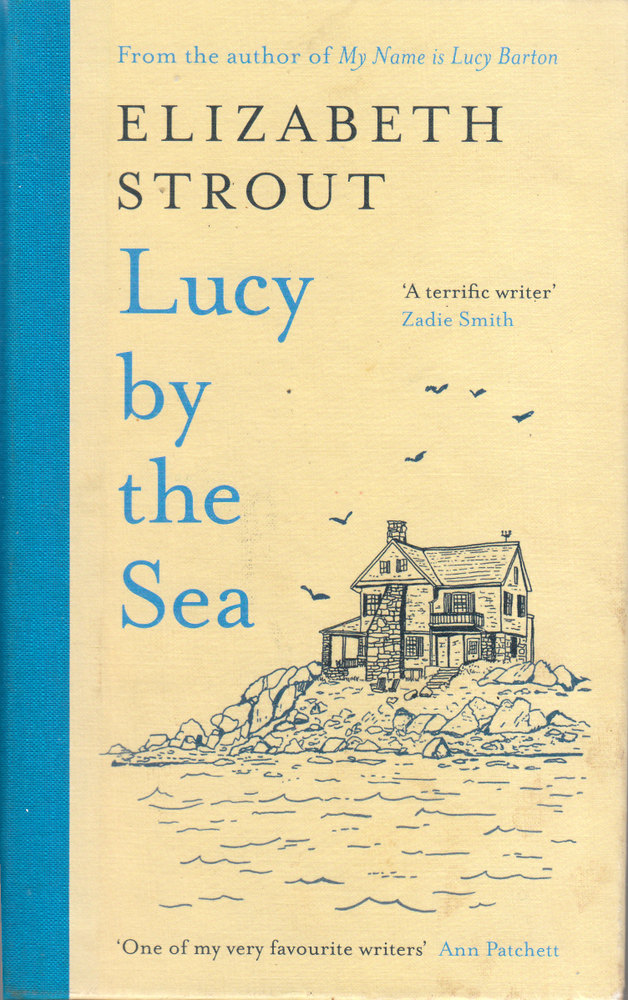
Lucy, the heroine of Elizabeth Strout’s new novel is an elderly writer living alone in New York. Out of the blue, she receives a call from her ex-husband, William, who suggests she leave her apartment and join him in a house he has rented on the coast of Maine. After some hesitation – and on the understanding, it will only be for a few weeks – she agrees. Although his reasons for wanting her to spend time with him are not immediately spelt out, it soon becomes apparent it is because he is concerned about the approaching Covid-19 pandemic and the effect it could have on her safety, health and well-being. There is also obviously still some residual affection lurking in the background.

At first, Lucy feels a bit out of place in her new environment. The social and physical restrictions put in place because of the virus make it difficult to interact with others or meet new people. There is widespread fear and panic. Lucy encounters some initial hostility from a few of the locals who are instinctively suspicious of outsiders, especially ones from New York.

Slowly, however, she finds herself succumbing to the daily routines and the sleepy charm of the place. When her romance with William rekindles, she decides to sell her New York apartment and move in full-time.

Written in the first person, Lucy by The Sea has a raw episodic quality which, at times, makes it feel more like an autobiography than fiction. Failed romance is the slow pulse that beats underneath the placid surface of much of it. As the novel carefully unfolds, we learn more not only about Lucy’s two past marriages past but the complicated relationships between her family and children. The joys of friendship, the slight betrayals and the changes that events in the larger world can enforce on it are all meticulously observed. Strout portrays their interconnectedness and intertwined variety with warmth of understanding and delicacy of touch.

Book Reviews

Published by William Collins

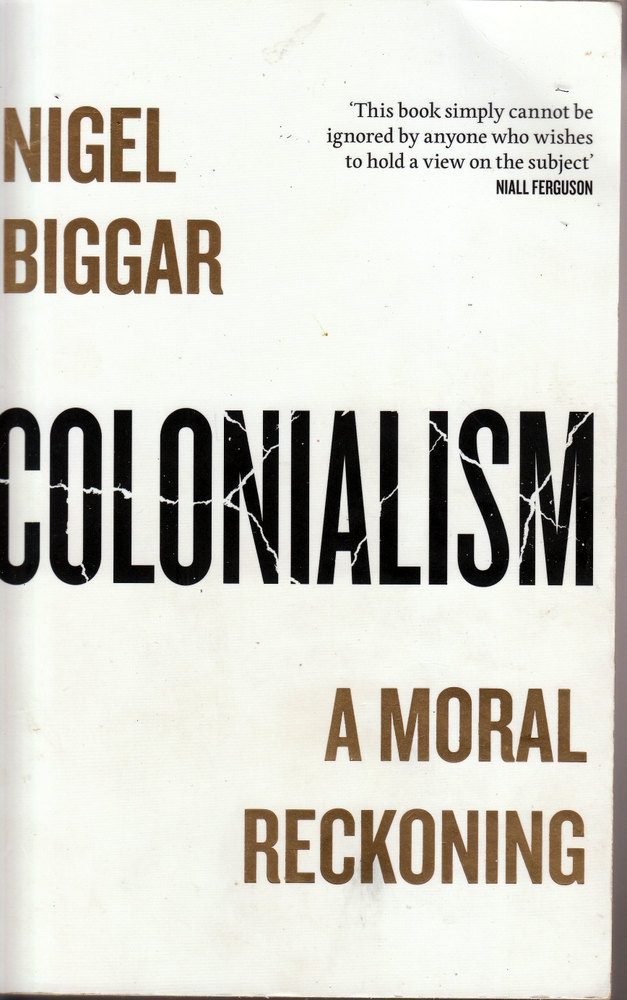
In this era of post-colonial guilt it has become commonplace in the West – and elsewhere – to see the legacy of the British Empire in essentially negative terms and to, likewise, dismiss those who took part in it as mostly brutes and racists intent on economic plunder and exploitation, with little regard for the welfare of the local inhabitants. While this view may satisfy certain ideological prejudices, the truth, author Nigel Biggar argues in this wide-ranging study of the subject, is more complicated and somewhat more forgiving.

As Regis Professor Emeritus of Moral and Pastoral Theology at the University of Oxford. Biggar is only too aware of the hazards of tackling such a fraught subject but thankfully he is not the sort of writer to be easily knocked off course. While his book does not spare us Empire’s failings, he is quick to correct a lot of the more erroneous, simplistic and dogmatic assumptions that have been made about it, as well as give praise where he feels it is due. Combining micro-details with a macro sweep, his scholarly, well-paced and critical overview contributes brilliantly to a reasoned reassessment of the subject.

What were the motives behind Empire? Was there a connection between colonialism and slavery? Are the claims of genocide justified? Did the colonial government fail to prevent settler abuse? Was excessive force used in quelling rebellions? These are just some of the questions he poses and then proceeds to examine in careful detail. In so doing, he attempts to redress what he perceives to be the biased and one-sided views of the more virulent “anti-colonialists” and alternative historians who he accuses of “allowing their condemnation to run out ahead of the data”.

Biggar appears vastly well-informed on the subject and his reading has been prolific. Behind the narrative lies a muscular, analytic mind that is not afraid to confront uncomfortable truths.

Some of the issues raised in this book will most likely prove contentious. Readers, however, do not necessarily need to accept all the author’s conclusions to enjoy his erudition, insights and the thoroughness with which he presents his case. Colonialism: A Moral Reckoning indeed serves as a corrective to the shallowness and superficiality that dogs so much supposedly “progressive” thinking these days.

published by Hodder & Stoughton

It is no secret that democracies around the world are in deep crisis with public trust and belief in elected officials at an all-time low. There are good reasons for this. In its ideal form, democracy is a system of government that exists not to protect privileges but to advance the equal rights and freedoms of the people. Increasingly, this no longer seems to be the case.

As most South Africans know only too well, service delivery has all but ground to a halt, our infrastructure is falling apart, corruption and incompetence seem to go unpunished and there is little accountability. As a result, many ordinary voters feel betrayed and excluded from the process.

This diminishing lack of confidence in the values on which Western society is supposedly based has, unfortunately, seen a lot of voters turning to authoritarian strongmen in the hope that they can fix it – think Donald Trump and his promise to “drain the swamp” (as his chaotic time in office only too clearly showed, he couldn’t. Indeed, he made it worse.).

In addition to this disturbing trend, democracy faces another existential threat from the growing number of autocracies around the world and, in particular, from China’s push for global supremacy. These countries seek to refashion the existing international order in their image and are intent on destroying everything democracy stands for. Elsewhere, leaders like Hungary’s Victor Orban are trying to undermine democracy from within.

For all its current failings, Dunst still believes that democracy offers the best form of government, not only because of the emphasis it places on the rights of the individual but because creativity and innovation have traditionally flourished in relatively open societies (as he points out, of the world’s twenty-five richest countries all but seven are democracies). What is required is for us to get our house in order.

Humming with contemporary relevance, Defeating the Dictators is his road map to how we can do this. Ironically, Dunst begins his journey by looking at the one autocracy that really does seem to work – Singapore. Unlike most autocratic states (and indeed many democracies), its system of government system is based on meritocracy – the notion that people should advance on their ability rather than because of political affiliations, personal connections or loyalty to the party in power. It is also relatively corruption-free, thanks to the strict enforcement of the laws, no matter how powerful you are or where you stand in the pecking order.

Elsewhere, Dunst proposes a variety of practical solutions to the problems confronting democracy. He stresses the importance of spending on infrastructure (especially digital infrastructure) as a way of improving the growth and functionality of the economy. He also believes in the importance of boosting our human capital capabilities by investing more in education.

A fundamental flaw he identifies in modern democracy is that too many politicians tend to put short-term politics before long-term strategic planning. In other words, too many leaders make decisions not on practical merits, but with the next election in mind. Some of his suggestions run counter to more conservative thinking. He believes, for example, that defeating autocracy hinges, in no small part, on welcoming immigrants because of their innovative spirit and willingness to work.

Dunst concludes his book with an extended warning against the way in which our hard-won liberties are being steadily eroded. It is something we need to act against if we want to stop the worldwide slide into dictatorship.

Book Reviews

published by MacMillan

Few British prime ministers have generated more scandal and controversy in such a short time as Boris Johnson. Campaigning on a promise to leave the EU with or without a deal he led the Tories to a historic 80-seat majority in Parliament. Having achieved his ultimate goal, his time in Number 10 was to prove tumultuous.

Johnson had earlier shown himself to be a much more attractive, sellable figure than his rather grey predecessor, Theresa May. He possessed charm and charisma in abundance. With his tousled appearance, boisterous humour and unflappable demeanour he became a regular crowd-pleaser despite his habit of playing fast and loose with the truth. Like many a politician, he had an eye for the effective quotation (“Get Brexit Done”) and was always quick to spot a good photo opportunity even if he often came over more as an affable rogue than a serious public figure.

Once in office, however, his fortunes began to change as his running of the country was quickly reduced to a series of crises, mostly of his own making. Previously, Johnson had always displayed a genius for turning potentially hostile events to his personal advantage but as his true political character began to emerge and the blunders mounted up, the act began to wear thin with both the public and many of his fellow party members. It was also his unfortunate lot to assume office just as the full horrors of the Covid pandemic began to hit and his handling of the crisis was initially characterised by a series of crass misjudgements and abrupt U-turns in policy. Although he could later claim justified success for his vaccination programme, he and his team squandered further public trust when it emerged they had breached their own lockdown regulations (like his counterpart across the ocean, Donald Trump, Johnson often acted as if the rules didn’t apply to him). A series of damning media revelations about illegal gatherings for drinks (including one get-together at the time of Prince Phillip’s death) culminated in what became known as “Partygate” and – along with his mishandling of the scandal involving the alleged sexual harasser, Chris Pincher – ultimately precipitated his resignation, leaving his party’s popularity and reputation at a catastrophic all-time low.

Johnson was equally poor in his judgement of people. His choice of the somewhat spooky Dominic Cummings as his chief advisor backfired when the latter left in a huff and then proceeded to release damning information against his erstwhile employer. His misjudged attempts to protect disgraced party members and colleagues further counted against him.

Sebastian Payne, an award-winning Whitehall editor and columnist for the Financial Times appears very well informed on the subject and has obviously had access to many of those who were closely involved with the former prime minister during the dying days of his premiership. While well aware of his subject’s psychological flaws and foibles, he goes out of his way to present a balanced picture of Johnson’s time in office. He makes a reasonably convincing case, for example, that the prime minister displayed true leadership in his handling of the Ukraine crisis and that it was largely due to his efforts that the West could display a united front against Putin’s invasion plans. As the author notes, it was the one occasion when he did come close to emulating his hero Winston Churchill.

For the rest though, it seems mostly to have been a case of Boris being good as Boris but not so good as prime minister. Like Trump again, though, it might be unwise to write him off just yet as he continues to lurk in the background, waiting to stage his comeback…

Published by Struik Travel & Heritage

In the increasingly difficult and troubled times, we live in there is probably no better stress burner than escaping into the wilderness, far from the clamour of civilisation and the burden of load-shedding. Getting into nature soothes and clears the mind, it offers silence and clarity. Many studies have, indeed, proved the beneficial effects of exercise on both physical and mental health but what sets hiking apart is that it is done outdoors and in a natural setting.

In South Africa, we are extremely lucky to not only enjoy a climate that is most conducive to open-air activities but to live in a country that is renowned for its diverse landscapes and magnificent scenery. Whether you are a casual rambler or a serious hiker there is a huge range of options available for everyone, be it the peaks of the Drakensberg, the fynbos-clad Cape, the Limpopo bushveld or the haunting beauty of the dry Karoo.

For those wanting to find out more about just what is on offer, Willie Olivier – an intrepid explorer who has covered thousands of kilometres throughout southern Africa both on foot and by road – is the perfect go-to man. Featuring over 500 trails, including 60 new trails, this fully updated fifth edition of his well-known Hiking Trails of South Africa is a treasure trove of information. As one would expect with such a pro, his book is accessibly written but packed with information and authoritative advice all mouth-wateringly presented. Grouped into broad geographic areas, it provides a brief overview of the flora, fauna, geology, climate and other relevant information, including the length and duration of the hike. Lushly illustrated, it also includes much sensible advice on planning, preparation, nutrition, equipment, first aid and general safety.

Book Reviews

published by Pan MacMillan.

Another week, another book about the chaotic, cataclysmic Donald Trump presidency and the tumultuous fallout from it. The author of this one has probably jumped the gun in rushing to print, since his analysis focuses on the investigation into January 6th investigation whose findings have yet to be published, but it obviously felt it was important to get in early with his take on the proceedings.

As is now common knowledge, the 2020 United States presidential election held on November 3rd, saw the former Democratic vice-president Joe Biden defeat the incumbent president Donald Trump with Biden receiving more than 81 million votes, the most votes ever cast in a US presidential election. Unable to accept the reality of his defeat the soon-to-be ex-president would go on to insist the election results had been rigged although he had next to no proof to back his claims up. It didn’t matter. The doubts he cultivated ultimately led to a rampage inside the US Capitol by an angry mob of pro-Trump supporters, as well as giving birth to the Stop the Steal movement.

Undoubtedly, one of the low-water marks in recent American history, the attempted coup rocked the very foundations on which American democracy was built. It also led to a great deal of soul-searching and heated debate. As a former Republican congressman, as well as the senior technical advisor to the House select committee tasked with investigating the attack, Denver Riggelman, has some claim to know of what he speaks when it comes to the subject. He had access to much of the correspondence and documentation which passed between the various parties and was privy to a lot of privileged information. As such, his book is full of revealing insights and sheds a great deal of light on precisely what happened during those fateful few days. What becomes plain from reading it is that the insurrection was not a spontaneous act nor an isolated one but was part of a deliberate campaign aimed at keeping Trump in office. It is also hard to ignore that much of the culpability lies with Trump himself.

Equally disturbing is the fact that the effort to overturn the result of the election involved officials from all levels of government (including the military – Riggelman claims that at least one hundred of the rioters who stormed into the building that day had military experience), as well as many members of the Republican Party.

In addition to showing how Trump deluded the American people, and probably himself, Riggelman’s book is also a part memoir. By his admission, he grew up in the conservative edge of the Bible Belt “among the true believers” and it took many years to shake off the yoke religion had placed on his worldview. This gives him an insider’s take on how the far right and extremist groups like QAnon operate. Fed a combustible brew of fire and brimstone Biblical tub-thumping, biased TV and, more recently, the sort of delusional mob group-think that characterises the darker recesses of the internet it has led to a conspiratorial mindset which has, in turn, now seeped into the mainstream.

Frighteningly, there is every likelihood that in the future the system could produce more tenants in the White House just like Trump: shallow, dishonest, opportunistic, vicious and at times almost comically incompetent.

There are lessons to be learnt from all of this…

published by Bantam

There is something enjoyably familiar about sitting down with another book featuring Lee Child’s iconic hero, Jack Reacher. It is like being reacquainted with an old friend after a gap in time. One of crime fiction’s more engaging creations, the latest book featuring the laconic drifter differs from all the previous ones in that it has been co-written with his younger brother Andrew Child to whom Lee intends to hand over the reins of the franchise.

Not that any difference in style is immediately apparent. No Plan B begins in a predictable fashion with Reacher turning up in yet another remote, dusty, fly-blown mid-American town only to find himself once more at the centre of all the action. In this case, a young woman appears to throw herself under an approaching us. Naturally, all is not as it seems with the sharp-eyed Reacher, alone among the various on-lookers, noticing what everybody else has failed to see – the woman was deliberately pushed by a man in a hood. The police don’t buy his version of events, the death is ruled a suicide and the case is closed. For an avenging angel like Reacher, who sees it as his mission to battle injustice, this obviously goes against the grain and immediately decides to carry out his own investigation. The deeper he digs, the more he realises this wasn’t just a random act of violence but is part of a much larger and more sinister conspiracy that has its centre in a supposedly model prison in a small Mississippi town. Once they get wind of the fact Reacher is hot on their trail, the conspirators do their best to stop him from reaching his destination but they fail to factor in his unique talents or his relentless determination.

In many ways, No Plan B is vintage Lee Child. The theme is tackled cleverly with well-concealed sub-plots and several strong set-piece action sequences. If there is a slight difference in the form it lies in the dialogue. When it comes to cynical, snappy one-liners and put-downs – usually delivered as – Reacher despatches, in suitably violent fashion, yet another villain – Child is normally a reliable performer but here the writing seems oddly underpowered with few of the memorable quips that have proved such a feature of his best books in the series.

Book Reviews

published by Jonathan Cape

A young schoolboy’s infatuation with and uncontrollable feelings for his music teacher (and hers for him) and the impact it has on the rest of his life is at the heart of Ian McEwan’s latest book, a tale of sullied yearnings and unrealised hopes scanning one man’s lifetime.

Beginning with his parent’s wartime romance and not especially happy marriage, the book takes us through his boarding school days during the suffocating vestiges of 1950s morality and the embryonic promiscuity of the 1960s. Along the way, it also touches on such burning historic events as the Suez Crisis, the Cuba Missile Crisis, Chernobyl, the fall of the Berlin Wall and – even more up to date – the Covid pandemic. Recounted in chronological order, as well as with the occasional flashbacks, it gives the book a raw episodic quality that, at times, makes it feel more like a biography than fiction.

Dropping out of school early. the protagonist leads a life in which he never seems able to connect or realise his true potential. He takes on a number of unpleasant and unremunerative jobs eventually settling for the slightly dead-end job as a lounge pianist. While obviously intelligent and talented, his literary projects don’t quite take off, and his relationships are fragmentary and not always satisfying. In a reversal of the traditional order where it is usually the man who puts his selfish emotional needs first, his first wife abandons him and their infant son to pursue a solitary career as a writer, Later, he has an on/off relationship with a married woman who at first leaves, then returns to and finally leaves her husband. All this is played out against events in the wider world.

Combining quick social observation with a profound understanding of our troubled times, Lessons beautifully captures the warp and weft of our often messy, unfulfilled lives while, at the same time, providing a richly nuanced portrait of a man who suffers his share of abuse and loss while never really achieving his ambitions. Somehow he endures them all and winds up with a measure of peace and understanding at the end.

Published by Struik Nature

The distinguished naturalist, William John Burchell is generally regarded as one of the greatest of the early African explorers. Making up in enthusiasm and tenacity what he then lacked in experience, his bold expedition deep into the South African interior laid the groundwork for much subsequent scientific research and has added considerably to our understanding of the country’s natural history in the nineteenth century. Equipped with a custom-built ox-wagon but none of the expensive equipment which modern science requires he managed to amass an astonishing 63 000 specimens of plants, bulbs, insects, reptiles and mammals on his 7000-kilometre journey which took him through some of the driest parts of the sub-continent, as far north as Kuruman. It is a mark of both his considerable achievements and the esteem in which is still held that so many species still bear his name (Burchell’s Zebra, Burchell’s Coucal etc)

Among Burchell’s many strengths were an indefatigable curiosity and imaginative sympathy with the natural world, coupled with openness towards the people he encountered on his arduous four-year expedition. In this, he was atypical of the day.

Burchell described his outbound trek in his famous Travels in the Interior but never got around to completing the volume describing his return trip via the more lush and densely vegetated eastern coast of South Africa even though it proved every bit as productive and as fruitful in terms of what he discovered as what had gone before. The authors, Roger Stewart and Marion Whitehead, have sought to fill this gap in the narrative by delving back into the records and revisiting many of the places he passed through.

Fortunately, Burchell was a painstaking note-taker and prolific letter writer and this intriguing, well-researched biography is brought to life by the many extracts from his correspondence. In addition, he was also an accomplished artist and his delicate watercolours add immeasurable value and vividness to the text. From downs to mountains, from dunes to semi-desert, they provide a comprehensive microcosm of the country as it appeared back then as seen through the eyes of a highly observant and intrepid young explorer.