Escape to the High Country: Travels in the Karoo

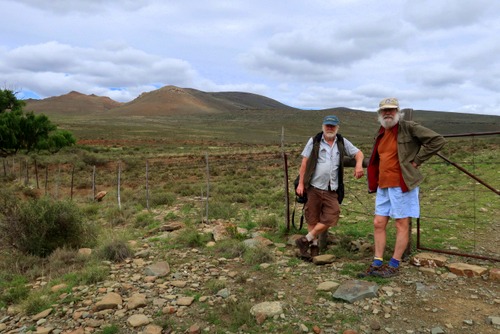
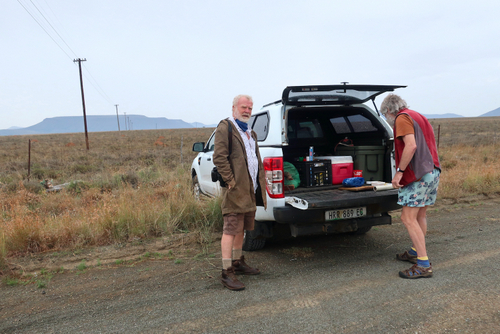
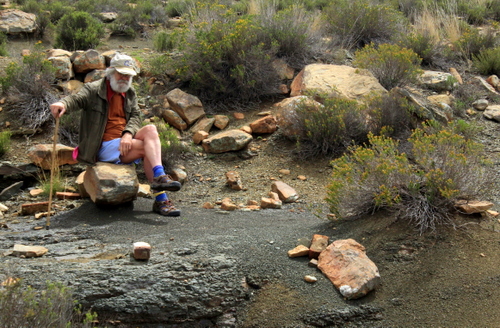
Two High Plains Drifters: the author and Prof Goonie Marsh. Pic courtesy of Sally Scott.

There is no risk of overstating it: 2020 was a horrible year. With levels of worry, anxiety and depression reaching a new high level mark, I finally realised emergency solutions were called for. After puzzling it over, I decided the best thing to do would be to try and end the year on a high note by escaping – if only briefly – from all the mania and talk surrounding Covid-19.

And so we took to the hills, heading up into one of the more remote and isolated areas of the country – the Great Karoo, which forms part of South Africa’s vast, high-lyng central plateau. Here, I hoped, I would be able to rid my mind of the ever-looming spectre of the pandemic and reboot my soul.

Officially, there were three of us on the expedition – myself, my artist sister, Sally Scott, and Professor Goonie Marsh, the former-head of the Department of Geology Department at Rhodes University and a very useful man to have around because of his extensive knowledge of all things Karoo. Also, he is very good company.

The route Goonie had plotted for us, took us through the tiny hamlet of Riebeek East where the famous Voortrekker leader Piet Retief once owned the farm, Mooimeisefontein. Retief would later go on to negotiate land deals for his people in what is now my home turf, KwaZulu Natal, before his unexpected assassination at the hands of King Dingaan of the Zulu.

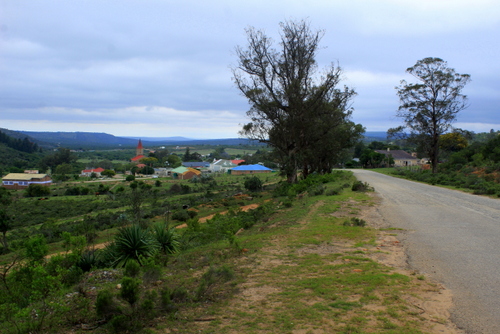
There was another reason I wanted to check out Riebeek-East. An ancestor of mine, on my father’s mother’s side, Lt Colonel Richard Athol Nesbitt, had served here as a sub-inspector with the Frontier Armed and Mounted Police (FAMP) back in 1866. Besides a few drowsing cows lying on the side of the road, there was not much sign of life. Cruising down the town’s empty streets, I tried to visualise what it must have been like when the sub-inspector came riding into town, correct and erect in his policeman uniform, on top of his handsome horse. It must, I concluded, have felt like some sort of banishment because, even today, Riebeek-East feels cut off from the outside world.

This point notwithstanding, I found I was developing a bit of a kinship with Richard Athol. It was almost like he was along with us for the ride. On my way down to Grahamstown, where Sally lives, I had stopped for a breather at Fort Brown, on the Great Fish River, another nondescript outpost of Empire where he had served. This was not the only place where we were to dog each others shadows. In 1872 Nesbitt was promoted to Acting Inspector and despatched to the next town on our journey, the more substantial Somerset East, nestling under the massive bulwark of the Bosberg.

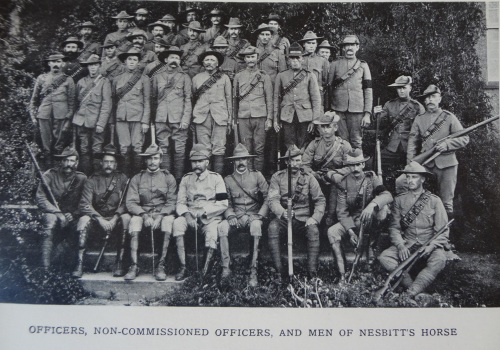
In 1878 the FAMP were militarised, as a unit of the Colonial Forces, and renamed Cape Mounted Riflemen (CMR). The unit would go on to play a prominent role in the numerous conflicts that broke out within the Cape Colony and around its borders, as a result of the Cape government’s expansionist policies. Later, Richard Athol would come out of retirement and – at the request of the Colonial Government – raise and command Nesbitt’s Horse which, in his own clipped words, “served in most of the principal events of the [Anglo-Boer) war, with Lord Robert’s march – Paardeburg, capture of Bloemfontein, Johannesburg, Pretoria and in clearing the colony of rebels.”

The Lt Col was obviously not one for uneccessary sentiment or wasting words…
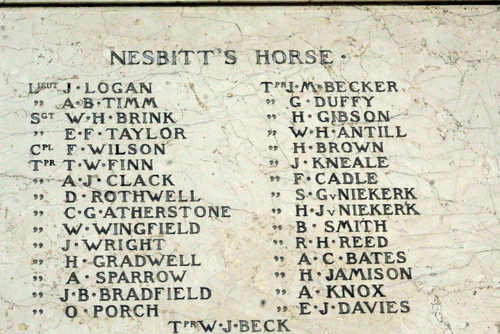
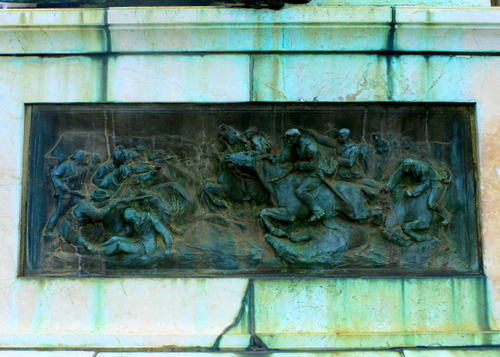
1902 found him resident in Grahamstown. His military exploits are commemorated in the impressive monument which stands in front of the town’s old Methodist Church. An entire side-panel is devoted to those members of his unit who lost their lives in this bitter conflict.

We finally parted company with our ghost passenger somewhere up on the Bruintjeshooghte, just south of Somerset East. We were now travelling in less familiar territory. Ahead lay the vast Plains of Cambdeboo, immortalised by the author Eve Palmer in her classic book of the same name. You actually pass by the farm – Cranemere – where she grew up and lived and you can still see the same dam that provided them with their lifeblood – water.

The small town of Pearston, where the great palaeontologist Dr Robert Broom once lived, is also on the road although, like many of these Karoo dorps, it now looks a little fly blown and past its best. Of Broom himself, more later.

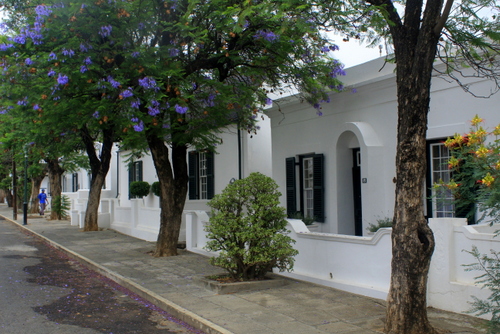
Beyond that the world lay wide and empty around us until we finally got to Graaff Reinet – or the “gem of the Karoo” as it is sometimes called because of its neat, shaded streets and beautiful period houses – set in a mass of wild-looking hills with the Valley of Desolation to the west and, overlooking the town, the prominent landmark of Spandau Kop. Established in 1786, it is South Africa’s fourth oldest town and has its origins as a far flung frontier settlement on the very edges of the old Cape Colony.

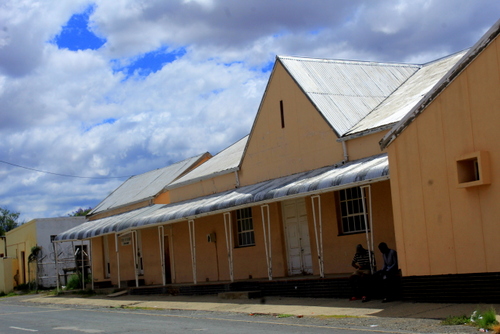
Street scene, Graaff Reinet.

Just outside of town, on the road to Murraysburg, there is a stark, simple monument to Gideon Scheepers, the Boer military leader who was court-martial-led and shot here on the 18th June 1902, by the British authorities. It was – according to Goonie (who also has a solid grasp of the region’s history) – a severe punishment which turned him into an instant martyr for the Afrikaner cause. As opponents in the Anglo-Boer War, I wondered if Gideon and Richard Athol had ever crossed paths?

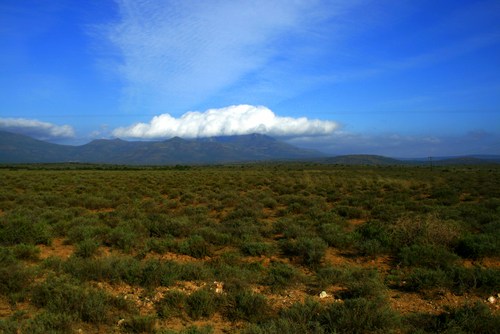
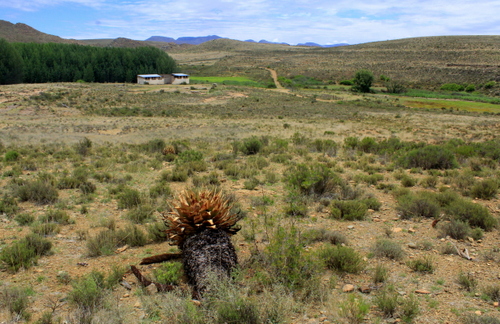
Beyond that, the road climbed steeply up the Oudeberg Pass. Before I knew it the Plains of Camdeboo were below us, then out of sight. At the turn-off, to Nieu-Bethesda we stopped for lunch on the side of the road, under one of those abrupt, flat-topped, mountains that rise out of the plains, like talismanic guardians, throughout the Karoo…
Lunchbreak in the Karoo.

The Karoo is a land of sun, heat, and stillness although, as if to defy my expectations, a light drizzle began to fall as we unpacked our picnic basket on the tail-gate of the bakkie. The summers can be scorchingly hot, in winter the night temperatures regularly drop well below freezing point. Rainfall is erratic, drought common.

It was not always so. There was a time when ceaseless rains poured down upon this ancient land, leaving it covered with inland seas, lakes, and swamps. Millions of strange-looking reptiles and amphibians roamed around and then died here; in our era, their fossilised remains have made the Karoo world-famous for palaeontologists. This brings us back to that pioneer of the profession, Dr Robert Broom, who did so much to uncover their secrets.

As we drove deeper into the interior the hills became barer, even more silent. There was little sign of habitation although, every now and again there was the occasional windmill or wind pomp just to remind you that people lived here. The road wound on and on, empty and devoid of traffic, so much so that driving along it eventually became like a form of meditation.

Originally this vast area was occupied by the San, aboriginal hunters, small in size and few in number, who drifted with the seasons and the herds of game. Of these animals the springbok is, undoubtedly, the most emblematic of the Karoo, their bodies evolving, over time, to deal with the hardships of life in this arid country. Despite the devastation wreaked by the early white hunters, which saw this beautiful animal being exterminated over much of its range, the springbok population has begun to rise again, now that their commercial value has become appreciated.

Later, the San themselves were hunted down or driven into the swamps and deserts. In their place came trekkers, traders, missionaries, and explorers, who braved the fierce heat, moving with their wagons and animals into the harsh dry interior. With them, they bought their religion. Nearby Murraysburg, named to honour the Reverend Andrew Murray, was originally a church town resorting under the full control of the Dutch Reformed Church up until June 1949 when it was placed under the control of the local municipality.

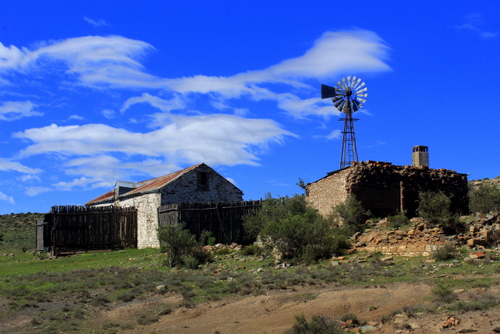
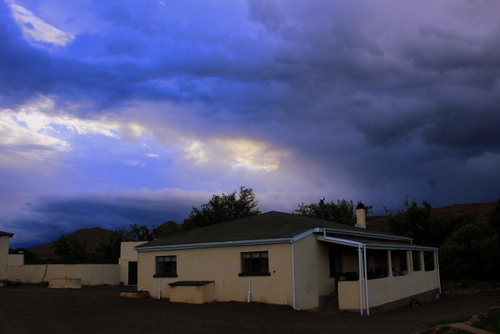
Just beyond the spot where a large sign announced that we were leaving the East and entering the West Cape, we came to an imposing white-pillared gate with a sign “Oudeland” next to it. Here we swung right, driving down a dirt road dotted with caramel-brown rain puddles. In every distance, the plain was sparse and bare although we did pass the crumbling ruins of an old barn and kraal with the inevitable wind pomp standing like a sentinel behind it. Moving fast, the clouds cast a storm light across the buildings. I wanted to look for the species of lark that had these scrub-strewn grasslands all to themselves but with more rain threatening now wasn’t the time for it so we plugged on.

Old barn and windmill. Pic taken after storm clouds had blown away.

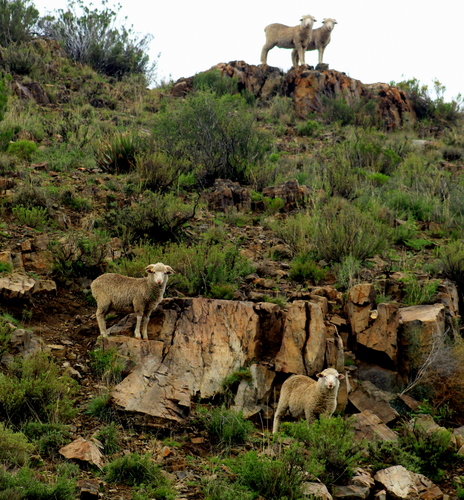
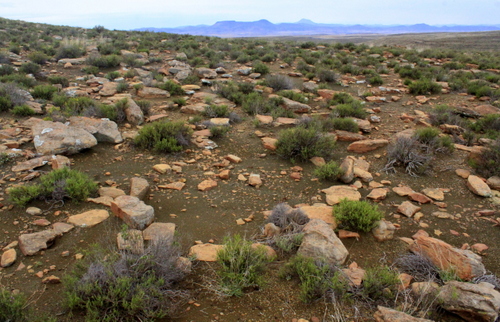
Cresting a rise, the farmhouse and outbuildings came in to view in a valley below where – Goonie explained – a sill of hard, erosion-resistant, dolerite had cut through the softer sedimentary rocks. A small, seasonal, stream ran through the middle of it. The main farm complex was situated on the one side amongst a mass of poplar, gum, and willow trees and fields of grazing merino sheep; the lush green colour of the lucerne pastures, in which they were feeding, contrasting sharply with the stark, elemental beauty of the semi-desert that surrounded them.

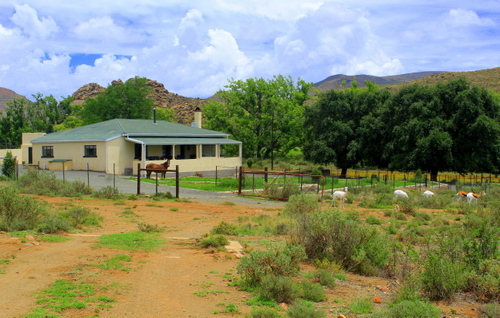
Our house lay on the opposite bank, just above a belt of prickly pears. As we drove into the fenced yard we were greeted by a brown horse and a small herd of multi-coloured springbok. Such colour morphs are extremely rare in the wild (in fact, they are so unusual they were venerated by the San) but these white, or leucistic, forms are mostly the result of selective breeding to meet the needs of hunters seeking exotic trophies. It is a practice that has caused some controversy because the genes which cause these colour variants are actually recessive and so could weaken the species.

I am not a hunter and I get no joy in taking life, so I was delighted to share the animals’ company just for its own sake, especially when – every now and again and for seemingly no particular reason – its various members started leaping in stiff-legged bounces known as “pronking”, in which all four hooves hit the ground at the same time. The small herd was, the owner’s wife explained, all orphans who had been hand-reared and loved to the point where they had become family pets. Each one had its own name. I was especially taken with the one very friendly individual who had one blue eye and one green.

The house itself was built in the usual airy Karoo style with white-washed walls and a wide verandah on which you could sit and gaze out over the distant lonely blue mountains. Inside the appliances were all modern although the stuffed head of a large buffalo bull, as well as that of a puzzled-looking Zebra, added a slightly incongruous touch.

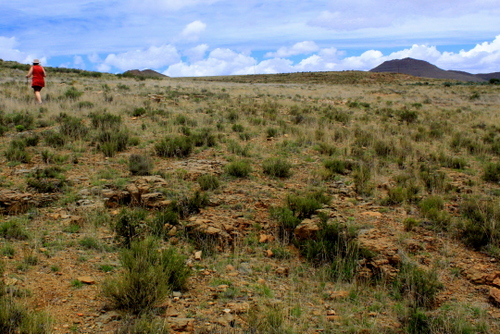
I was up at daybreak. We were lucky that morning. Overnight, the rain clouds had all blown away. The sky above us was a strange intense blue, wind-cleaned, limitless, and crisscrossed with lazy scrawls of thin cloud. There was a lovely lyrical quality to the landscape, to my eyes, it all seemed intoxicatingly clean and remote. Although I am not from these parts, I felt totally at home in this indivisible, self-contained world.

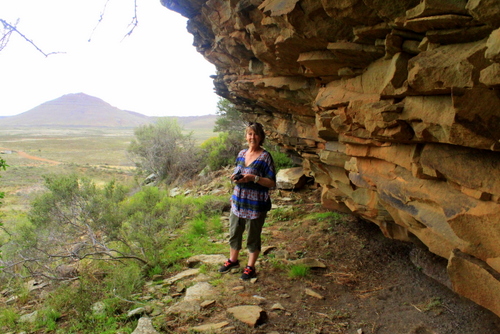
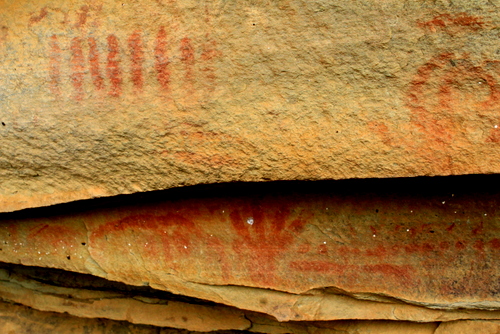
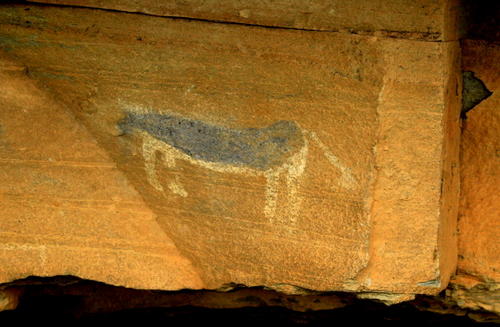
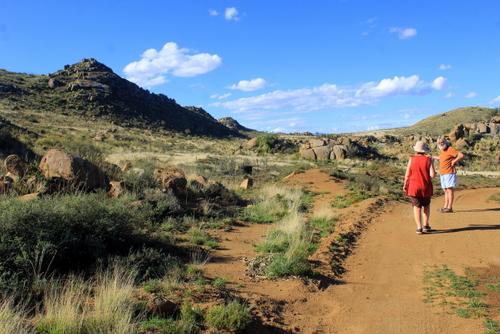
In this sort of country, there is almost no shade or protection from the elements although our morning walk did take us up to a stony ridge in which there was an overhang with bushes growing at its mouth. On its walls, we were excited to discover several faded examples of San rock art. I had no way of knowing how old they were – possibly thousands of years?

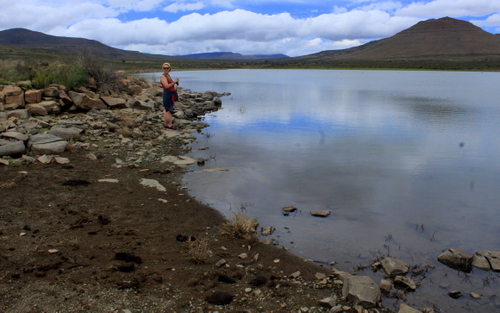
From the cave entrance we looked down over a large dam which reflected the changing weather in the sky above. Water lines of geese and duck and dabchick cracked its surface. Such open stretches of water always come as a surprise in this thirst-land. For the birds it must indeed seem like manna from heaven..

Back on the path, Goonie came to an abrupt stop, pointed his walking stick in the direction of an exposed sheet of unsuspecting, layered, grey rock and declared: “That looks like just the spot for a fossil!”. Sure enough, when we went down to investigate, we found several tiny fragments of fractured fossilised bone. With my untrained eye I would never have suspected they were there and would have passed the site by without a sideways glance.

Leaving them undisturbed we continued down to the dam wall. From its top we stood, awed by the view, as the escarpment retreated away; each ridge exposing new gullies and rough broken ground and more valleys until finally reaching the horizon, where the pale ramparts of the distant range of mountains raised themselves. Then we walked on, feeling buoyant and light and energised. Sally, with her artists eye (as opposed to Goonie’s more scientific one) was struck by all the strange patterns and details in the landscape and regularly stopped to record them.

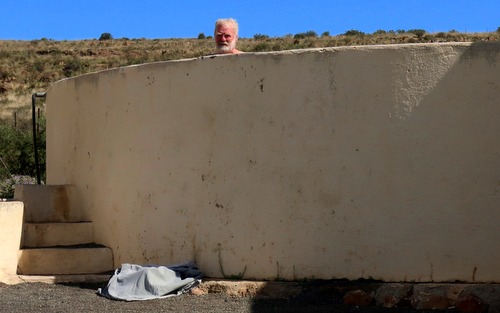
Later, when it got too hot for walking, Goonie and I climbed in to the circular reservoir around the back of the house and had a swim. It felt good, splashing around like I was a young boy again…

A refreshing dip

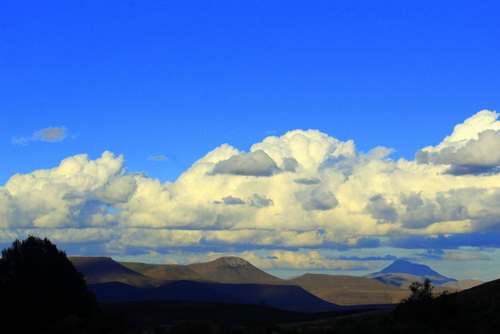
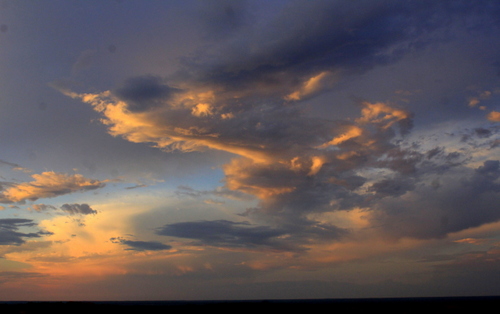
That evening we sat with our drinks out on the verandah. The earth was still in twilight shadow. In the distance massed, bulging, cumulonimbus clouds gathered above the mountain tops. As the sun sank so they changed shape, form and colour.

All felt well with the world. Far from the madding crowds, I finally began to get some sort of harmony between body and mind. Looking back over the journey, I also felt I had established another link with my past, learnt a little bit more about how I got to be who and where I am…

Harmony in nature...

My sense of contentment did not last. Back in Grahamstown all the talk still centred on the pandemic and the overcrowded hospitals and the beach and liquor ban. I couldn’t help but feel a little deflated. The happy little bubble I had created for myself in the wilds of the Karoo suddenly seemed far away. That is the problem with fantasies – sooner or later they get punctured and you are back with harsh reality.

GALLERY:

.

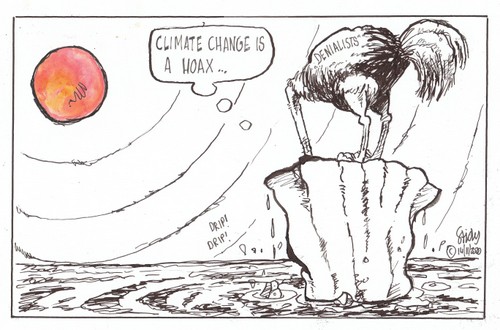
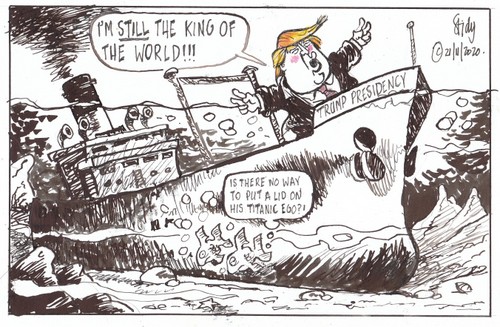
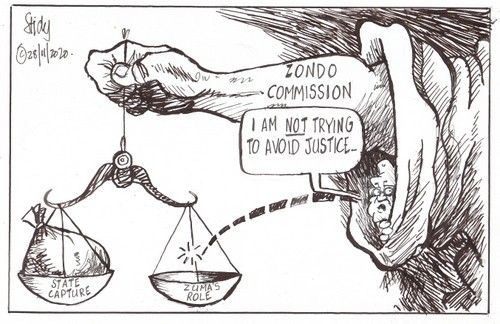
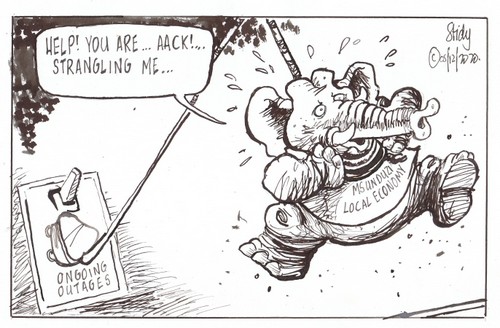
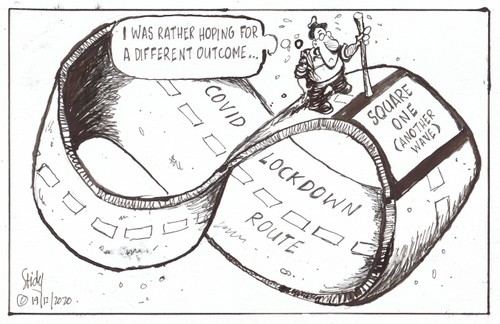
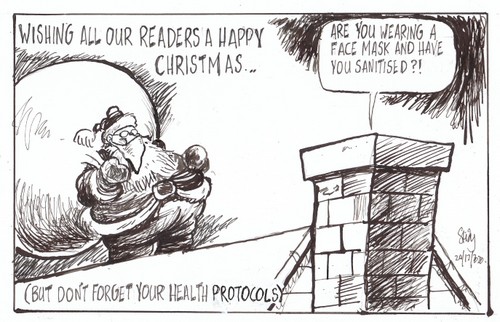
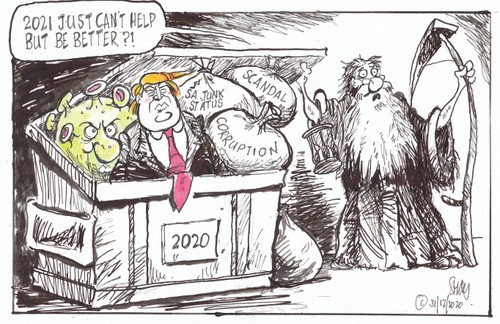
Bracing for a Second Wave: Cartoons for November & December, 2020

According to the opposition Democratic Alliance, Msunduzi is far worse now than it was before it was placed under the “selective” and “ineffective administration, which served only to placate ratepayers rather than deal with the problems that had bought the city to its knees”. It is a view shared by many ordinary citizens who continue to voice their concerns over the ever-increasing signs of neglect and poor maintenance.

The Arctic is unravelling faster than anyone could have imagined just a few decades ago. Scientists have warned that the Greenland Ice Sheet, for example, is no longer growing. Instead of gaining new ice every year, it has begun to lose roughly 51billion metric tons annually, discharged into the ocean as melt-water and icebergs.

In the United States, President Donald Trump was condemned by opponents for firing the senior official who disputed his baseless claims of election fraud as the president pressed on with his his increasingly desperate battle to overturn Joe Biden’s victory. This despite the fact that officials declared 3 November’s contest between Trump and Biden the most secure US election ever.

Former President Jacob Zuma continued to duck and dive and do everything thing he could to avoid facing justice. Having briefly appeared before the state capture commission to hear whether his recusal application for commission chair Ray Zondo had been granted he disappeared, without being excused, during the tea break. The commission adjourned to reflect on what to do next.

There were mounting fears that Msunduzi could face a massive blackout if the municipality does not urgently deal with the persistent outages that have severely compromised the network. The City’s electricity problems was also strangling the local economy and some businesses were even considering leaving Pietermaritzburg for towns with more stable power supply.

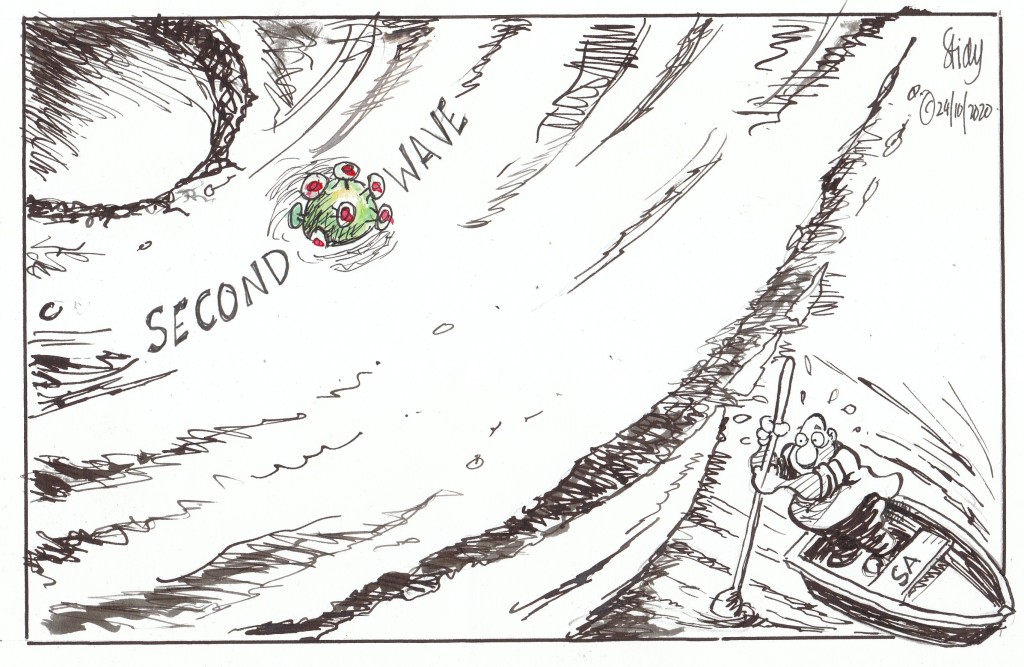
South Africa has entered a second wave of Covid infections, breaching 6 000 new cases, Health Minister Zweli Mkhize said in a special television broadcast. The peak age bracket is now between 16 and 19. “It’s believed to be due to a large number of parties involving young people drinking alcohol with no adherence to non-pharmaceutical interventions, wearing of no masks and social distancing and hand sanitising not taking place,” Mkhize said.

In an address to the nation, President Cyril Ramaphosa, announced a tightening of Covid-19 restrictions, including the closure of KZN beaches during the main days of the festive season. He attributed part of the cause of the second wave of infections to a lack of compliance with safety measure such as social distancing.

In the wake of a year dominated by Covid-19, being cautious is probably the best thing you could do over the festive period so I decided to make that the subject of my Christmas cartoon.

2020 was a truly terrible year and I think most people were glad to see the back of it – hence my New Year cartoon…

Into The Furnace: Adventures In Kruger

I am, by nature, a bit of a wanderer. Even though I live in one of the most beautiful parts of the country and am mostly satisfied with my lot every now and again my questing instinct begins to reassert itself and I feel obliged to follow where it leads me.

There are good reasons for this. By evolution we are hunters and gatherers. It is an underlying drive. It is part of that sense of excitement and privilege which comes from finding something special – be it a landscape, animal or bird.

Thus, when my sister asked me if I would like to join her on a trip through Mpumalanga and Limpopo Provinces there was no way I could say no…

With the Mapungubwe leg of our expedition behind us, we have now just passed through the Pafuri Gate and driven in to Kruger National Park. It is still dry season and what little grass there is has been grazed to the ground. Although we don’t see them, there are signs of elephant everywhere. Their droppings litter the road. Hundreds of tiny dung beetles are busy mining the excreta, turning it in to compact balls, often a lot bigger than themselves, and then rolling them away. Elsewhere, broken trees and branches lie strewn across the landscape. The closer we get to Pafuri and the Limpopo and Luvuvhu river, the worse the carnage gets.

Just over the Luvuvhu Bridge we turn left down the road that leads to Crook’s Corner where the borders of South Africa, Zimbabwe and Mozambique meet. In the cool of the morning this route, with its lush riverine forest, is one of South Africa’s prime birding drives but because of the intense heat there is not much activity now.

We stop for lunch at the picnic area on the banks of the Luvuvhu. Sitting in the cooling shade of the massive, spreading, Nyala and Jackal-berry trees my thoughts drift back to the Battle of the Somme-like scenes I have just witnessed.

Pafuri picnic site, Luvuvhu River. My niece, Kelly.

Elephants have, of course, been destroying woodlands for thousands of years. In the process, they consume vast amounts of pods which they then deposit elsewhere so, in that sense, this is all part of a natural process of regeneration. The problem now, of course, is that the elephants movements have been restricted to certain protected areas and park which puts added pressure on the environment.

Kruger is probably big enough to absorb the damage but you do feel a solution needs to be found in some of the more worse hit areas. It is a controversial subject, of course, although there is one thing I am certain of. It is no good saying we mustn’t interfere with nature. We already have.

At Pafuri there is another factor which has led to the destruction of the riverine forest. If extreme weather still counts as natural, than the severe floods that have hit the area in recent years, uprooting or flattening hundreds of trees, overnight, changed much of the landscape. Again, it could be argued that this nature’s way of replenishing the precious top soil and allowing new plants to emerge, although such thoughts also, invariably, lead to the question of climate change.

What effect is it having? Will it have a significant impact on bird-life and mammals? Will they be able to adapt? These are questions which go around and around in my brain and end up nowhere, so I go back to munching my sandwich.

The subject of climate change still weighs heavily on my mind, later that day, as we sit on the verandah of our chalet at Mopani Camp, overlooking a dam studded with dead tree trunks. The temperatures are in the low-forties. I feel like I am drowning in the heat. Everywhere animals and birds lie spread-eagled in the shade. Even the usually noisy, hyper-active, Greater-eared Starlings sit panting in the shrubbery.

In this breathless air, the normal sounds of the bush have become eerily muted. The birds have stopped singing, the butterflies have grown lethargic and abandoned their search for nectar, the lizards cease scurrying, the hippos sink deeper in to their watery homes.

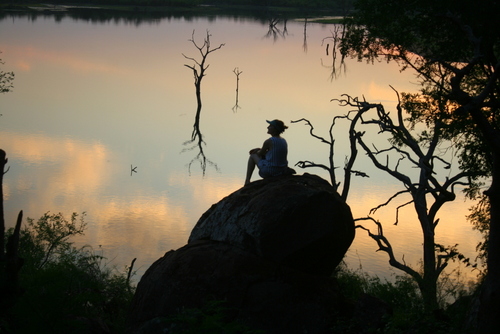
Even the coming of night fails to sooth it. As the sun sinks, the water of the dam turns the colour of cauldron flames. Along it edges, duck, geese, heron, egrets, cormorants, darter, stints and little waders stand motionless, frozen in the moment like figures in a painting. Suddenly a family of White-faced Fulvous Whistling Duck rise, in spumes of spray, and head off across the dam. Their rallying whistle is a sound like no other. Hearing it, the years flash back, through my childhood, to the days when I used to go out exploring with my brother, Pete, or went fishing with my Dad for bream in the farm dams.

Sunset over dam. Mopani Camp.

On the edge of darkness, flocks of Red-billed Quelea come swirling through the evening sky in massive, rolling, waves, to their roosting spots in the trees along the water’s edge. Suddenly a much larger, darker form swoops out of nowhere at breath-taking speed and veers down towards them. Then – another. And another! Three Bat Hawk, each one the essence of distilled cunning, are out hunting. The Quelea immediately become vigilant and shoot up in another massive wave of movement. One bird is not so lucky. Having seized the tiny bird in it talons, the Bat Hawk wheels off victoriously. Still flying in synchronised formation, the rest of the Quelea continue with their evasive action before returning to their roosting spots, to live to fly another day.

There has been no let up in the temperature the next day. In fact, it has got worse.

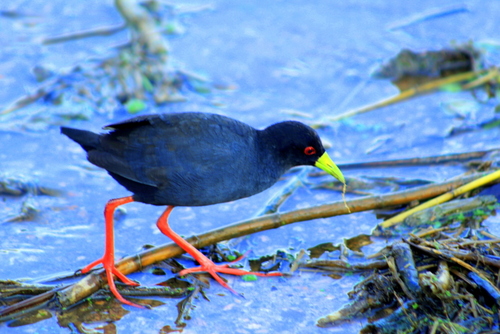
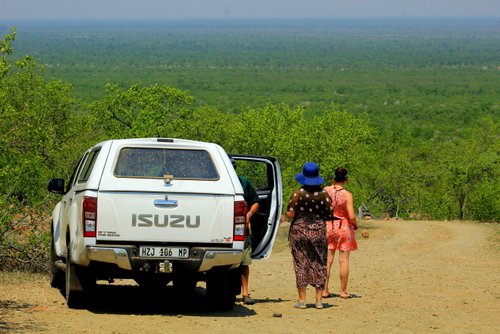
Exhausted by the heat my sister elects to remain at home but the rest of us head off in the Isuzu bakkie along the Tshongololo Loop. We stop at the ford below the Pioneer dam. Scampering alongside it are a pair of Black Crake. They are normally the shyest of birds but these ones have grown so accustomed to the steady flow of traffic across the bridge that they barely give us a sideways glance.

Black Crake.

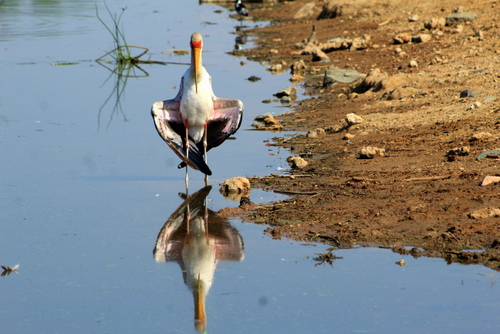
In the shallows on the other side of the bridge there are some Spoonbill and a Great White Heron. A lone Yellow-billed Stork stands with his wings outstretched, gazing intently into the water. Like the Narcissus of legend, it seems to have fallen in love with its own reflection although I am not sure why because they are curious-looking birds. Or maybe it is just hoping to spear some fish…

Yellow-billed Stork.

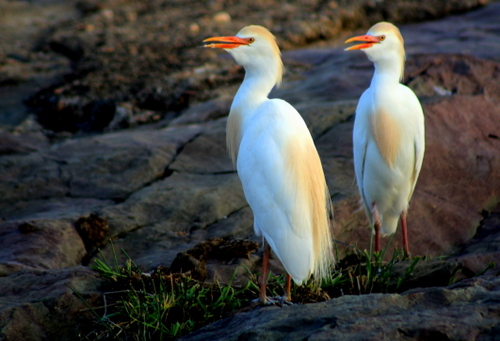
A family of Cattle Egret stand amongst the rocks on the banks of the river. There are yawning hippo in the pool. Crocodile too.

Cattle Egret.

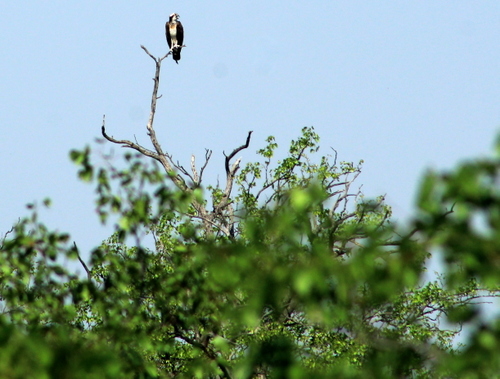
Leaving the river behind us we find ourselves rapidly encircled by a sea of low Mopani scrub, just come out in leaf. Sitting in the front seat, I feel like I am on the bridge of a battleship pounding through waves of green. Suddenly, above this leafy expanse, I see a tall, dead branch protruding like a submarine’s periscope. On it sits a raptor. It takes a while for the different components of my brain to start working in unison before I finally figure out what it is – an Osprey. I go through various stages of disbelief. Really?! What is it doing out here in the boondocks? It is totally out of its normal habitat. Then I remember the Pioneer Dam is not all that far away. I take a photo of the bird even though it is just a speck in my viewfinder.

Osprey.

There are lots of Brown-hooded Kingfishers in the woodland. This kingfisher, like the Wooded, Striped and Pygmy Kingfishers, is an oddity of evolution in that it doesn’t actually fish or hang out near water but prefers to hunt for insects deeper inland.

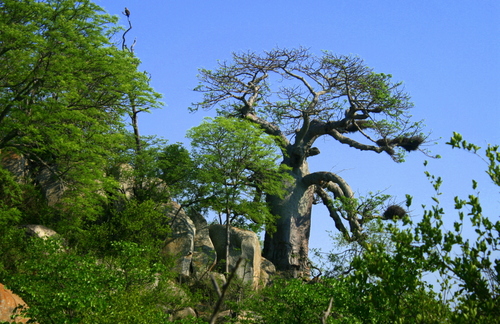
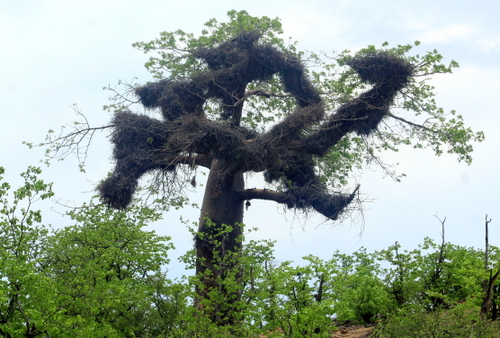
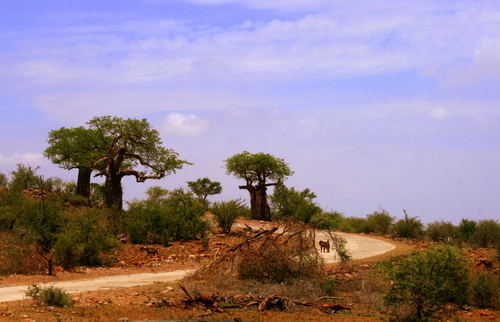
Further on, we come to a rock kopje. Growing amongst its elephant hide-coloured boulders is a massive baobab, in which a colony of Red-billed Sparrow Weaver’s nest. The birds are agitated. We soon discover why. A rufous-form, Tawny Eagle sits on one of the branches, a study in regal elegance. I decide the whole scene will make a good painting so take another photograph. The eagle flies off and lands on top of a nearby dead tree.

Baobab. A Tawny Eagle can just be seen on high branch to the left.

We plough on through miles and miles of similar looking country before returning home later that day.

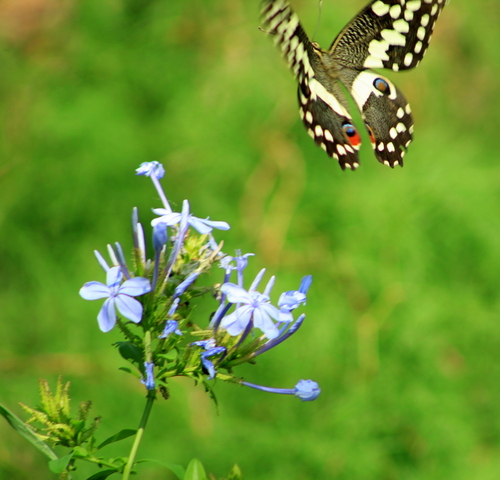
Eating breakfast on the verandah, the next morning, we are visited by two of the larger reptiles who seem to have made their homes amongst the tumble of rocks in front of our chalet – a Plated Lizard and a Water Monitor (or Leguuan) Then some butterflies flutter by. Among them, I recognise the Citrus Swallowtail, African Monarch, Blue Pansy. My brother-in-law says there don’t seem to be as many birds scrounging around the chalet as there was the last time he visited. He wonders if this is because lockdown had deprived them of their most reliable food source – the stuff discarded by humans – forcing them to move away?

Citrus Swallowtail alighting on blue Plumbago...

After breakfast, we decide to brave the heat once more and head off along the Tropic of Capricorn loop road that takes you through yet more of the flat, savannah plains that stretch out as far as the eye can see, in every direction, As we drive through this familiar landscape, I feel that old sense of connection I always get when I am in Kruger. It is like I have become part of something much larger than myself but which somehow includes me. It is an almost spiritual – some might say, religious – connection with the bush.

On the road directly in front of us a large shadow silently steals so I direct my gaze upwards through the windscreen of the car. With its stubby tail and striking colours there is no mistaking a Bataleur. Later we will see one squatting on the ground. Parks, like this one, have become one of the last bastions for this majestic eagle.

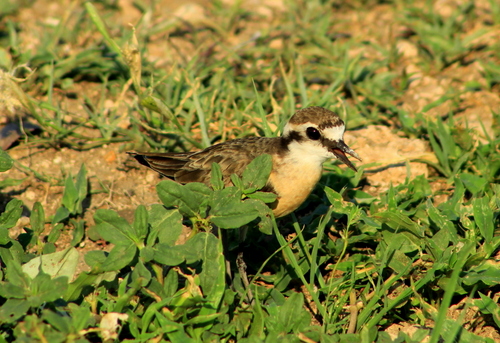
A bit farther on we come to a place where a recent thunderstorm storm has flooded part of the plain, leaving an extended puddle of water in which are several small waders – White-fronted Plover, Kittlitz’s Plover, Marsh Sandpiper, Wood Sandpiper, Ruff. We drive on. Just around the corner, in the same open expanse of ground, I discover a flock of birds I had failed to find in Mapungubwe – the Chestnut-backed Sparrowlark (formerly Finchlark). Although there are plenty of trees they could fly to, they have chosen to seek refuge from the sun by huddling up in the shadow cast by a few stones. Just beyond them I spot one of my favourite songsters – the Rufous-naped Lark. A Black-chested Snake Eagle wings overhead.

Kittlitz’s Plover.

The temperature rises by a degree, then another. It is nudging towards forty-five. As it does so everything begins to slacken: the restless searching for food, the browsing, the fluttering about. Buffalo, Wildebeest, Tsessebe, Kudu, Impala, Waterbuck lie idle in the torpid heat. Birds seek shelter in trees and under bushes, their beaks agape desperately tying to keep cool.

A car has drawn up on the side of the road up in front of us. We stop to see what its occupants are looking at. A shape suddenly comes in to view high up in a tree. There is a leopard drowsing in a fork between several branches, its tail twitching as if trying to fan itself.

We move on, leaving it in peace. Despite the heat, there is still game in plenty even if most of it is resting. As we drive, I search with hopeful eyes for lion or – even better – Wild Dog but other than the solitary leopard there doesn’t seem to be a predator for miles around. Nor do I see any vultures circling high in the sky, indicating a possible kill. (a good friend of mine, the bird artist Penny Meakin, will pass through this part of the world a few weeks later and have much better luck – she will see seven lion, several leopard, a pack of Wild Dog, a cheetah, plus a host of vultures squabbling over the carcase of a recently killed buffalo).

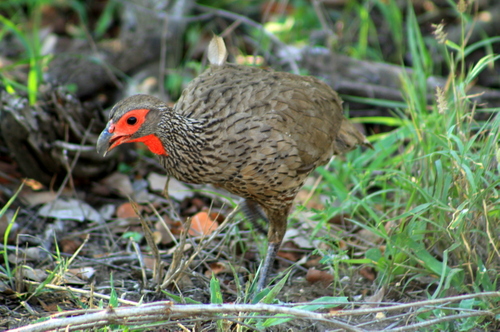
Undeterred, I keep scanning the sides of the road, picking up several birds as I do so – African Pipit, Wattled Starling, Double-banded Sandgrouse, Swainson’s Spurfowl, Brown-crowned Tchagra, Red-headed Finch, Red-breasted Swallow, Kori Bustard, Jacobin Cuckoo and, most special of all, a family of Ground Hornbill who regard us quizzically through long eye-lashes before ambling off.

Running roughly parallel to the distant Lebombo mountains is a long, thin, shallow depression where grass, reeds and rushes grow in course clumps, almost like moorland. Later in the season I can imagine it will be completely flooded bringing in scores of waterfowl but at the moment there are only a few pools of water. It looks like ideal lion – or even cheetah – country to me but still no luck.

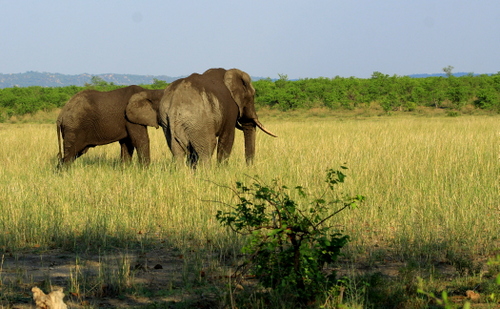
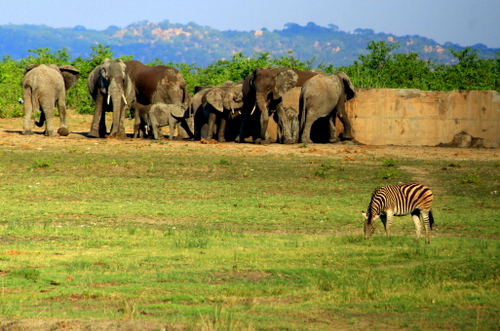
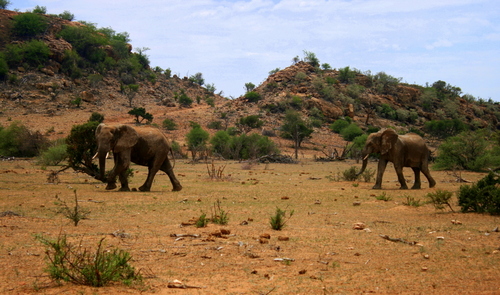
By an old concrete reservoir, a herd of elephant queue patiently, waiting to take their turn to drink. There is no other animal in the wild that elicits quite the same emotions in me as an elephant. I love them but I fear them too. They are huge but delicate, powerful but surprisingly gentle. They can shatter the sky with their angry trumpeting and yet are also able to move through the bush as silently as ghosts…

Elephant. Lebombo in background.

Elephants travel in matriarchal groups, ordinarily the leader is the oldest cow. There are several new calves with this group. Yet again, I am struck by the strong sense of family the herd exhibits. You can feel the kinship, loyalty and respect for the matriarch. I wish human society was as well-ordered and peaceful. If elephants bear ill-will towards us it is hardly surprising for we have harried, tormented and hunted them for so long that the memories of man-inflicted terror must be ingrained deep inside their cavernous skulls.

A little further down the long vlei, the road abruptly veers right, heading up to the Shibavantsengele lookout point in the Lebombo range. We decide to go there. Stepping out the car is like stepping in to a furnace but the view makes it worthwhile. The Lebombo – which begin in Zululand and then stretch up through Swaziland to provide Kruger with its spine – are not particularly high at this point, but are still high enough to make you appreciate the enormity of the land, stretching away in to the blue distance and simmering in the thickening heat haze. There is a magic to this place. A spirit seems to haunt the air, ancient and impassive.

View over Kruger.

That evening, as I help myself to another generous glass of my brother-in-law’s very expensive single-malt whisky, I am aware of a changing of the guard. One set of living animals is going off to slumber, while another comes to life.

The surface of the dam turns a fiery gold again. The Quelea are returning to their roosts but although I search the skies with my binoculars I see no sign of the Bat Hawk. Maybe they have decided to do what Bat Hawks are supposed to do and gone off looking for bats (my brother-in-laws bat detector has picked up hundreds of their calls).

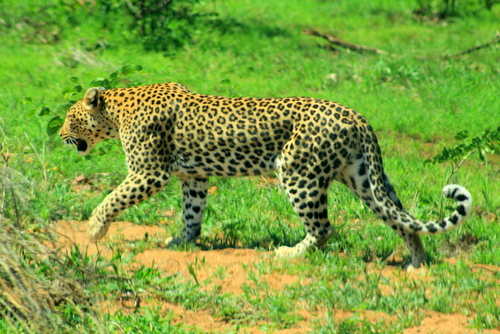
‘The next day we set off home, unaware that Kruger is saving up its best for last. As we are driving, my eagle-eyed sister spots a pair of ears protruding just above some low-lying scrub. For a while the ears remain where they are, then a magnificent female leopard slowly rises to her feet, stretches and ambles across the road directly in front of us. For a few minutes she stands in the middle of it, coolly observing us. Then, with a dismissive whisk of the tail, she strolls on.

She has performed her royal duty – provided us with a classic tourist photo-opportunity. Now we must buzz off.

We do…

No Room for Slippage: Cartoons for September and October, 2020

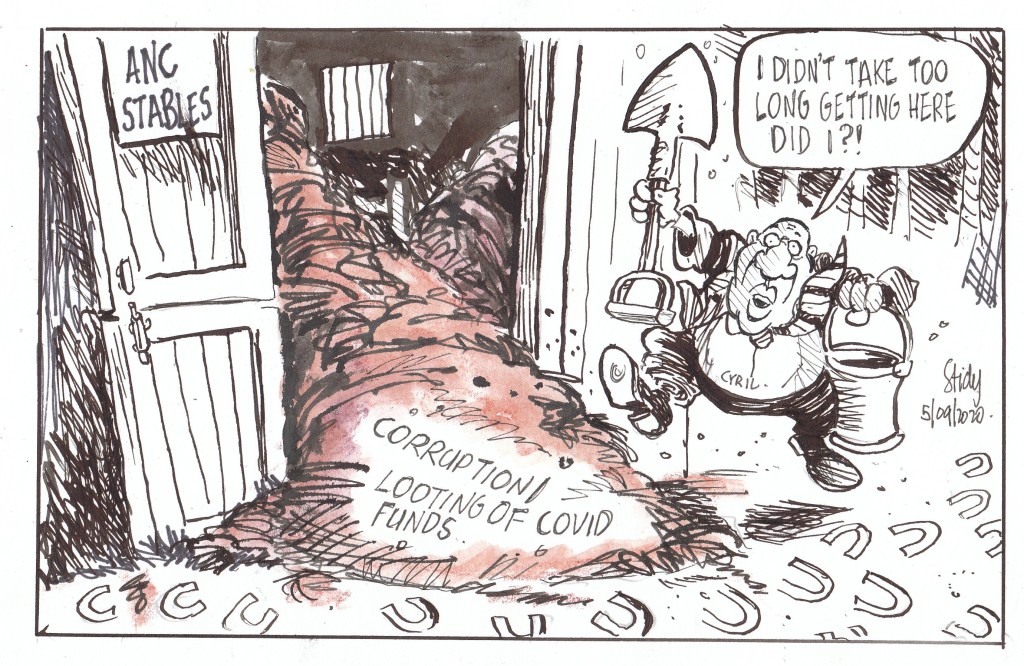
In the face of a fierce and vitriolic fightback by the agents of corruption in the ANC, President Cyril Ramaphosa appeared to achieve a tactical victory at a meeting of the NEC with members finally committing to act against comrades accused of corruption. He now faced the challenge, however, to give effect to the resolution, no easy task in a party riddled by factionalism and internal power plays.

The Democratic Part (DA) wrapped up its annual policy conference by adopting numerous policies, including one that said race was not a proxy of disadvantage when dealing with issues of redress. This was followed by reports that the party risked yet another exodus of senior members after opening investigations against several leaders with the intention of charging them, while others were planning to leave because they were disillusioned with the direction the official opposition has taken.

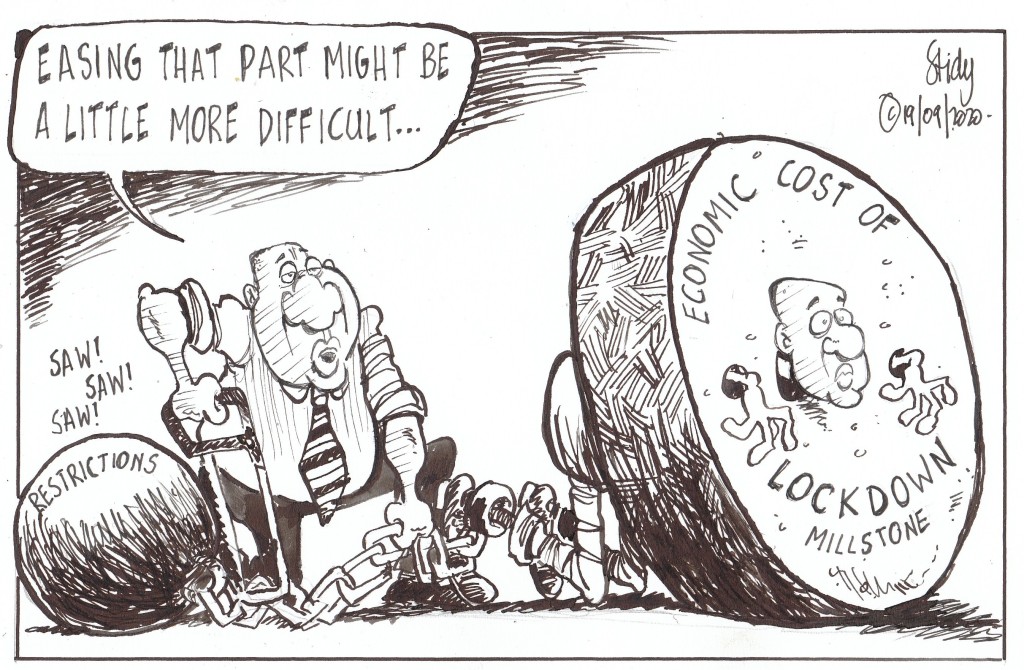
Six months after lockdown measures were imposed, President Cyril Ramaphosa announced that the country would move to lockdown level 1 from Monday September 21. He also announced that an Economic Rescue Plan was being fast-tracked which was only to be expected given the contraction in the economy and the fact that the country was, by his own admission, now effectively bankrupt…

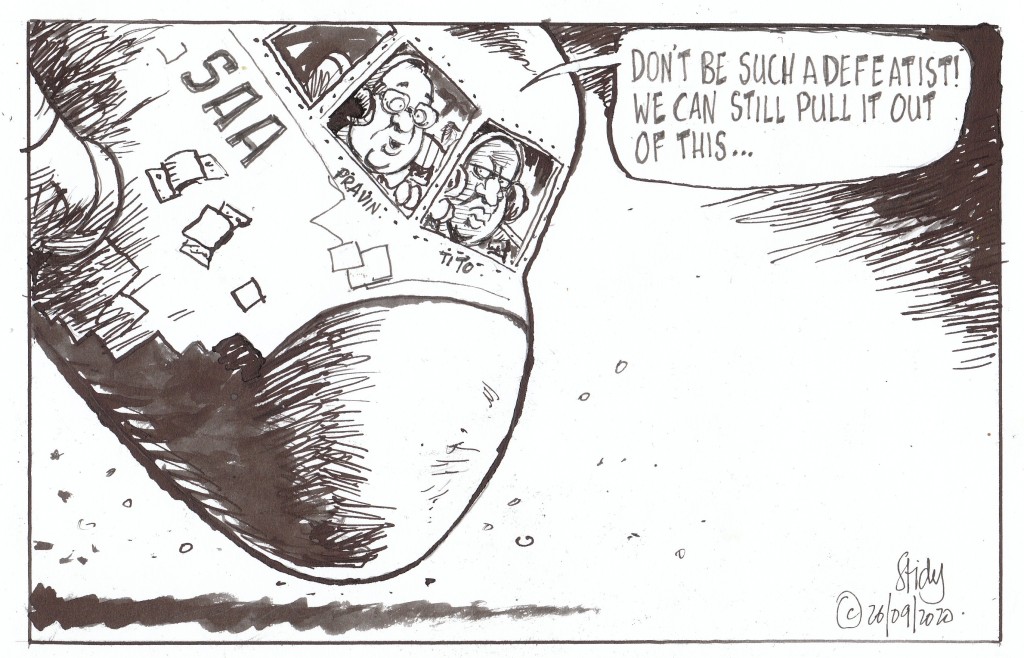
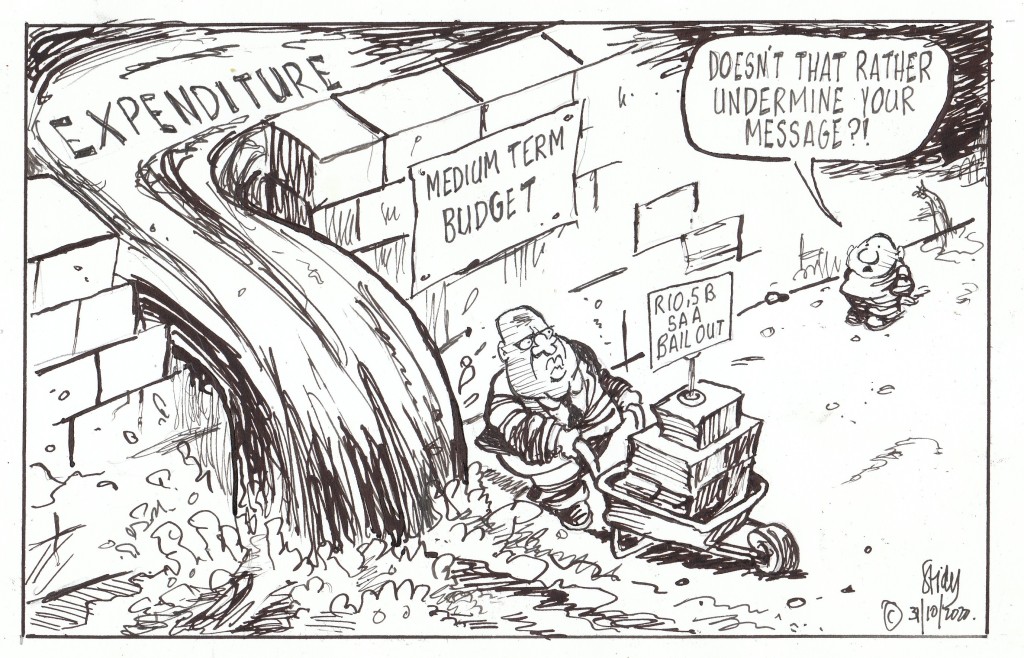
According to various sources, South African National Treasury officials reluctantly complied with orders to find funds to bail out the state airline, fearing they may erode the nation’s fiscal credibility. Finance Minister Tito Mboweni had long argued that the government can’t continue funding the national carrier, putting him at odds with the top leadership of the ruling ANC and Public Enterprises Minister Pravin Gordhan, who insist it must keep flying,

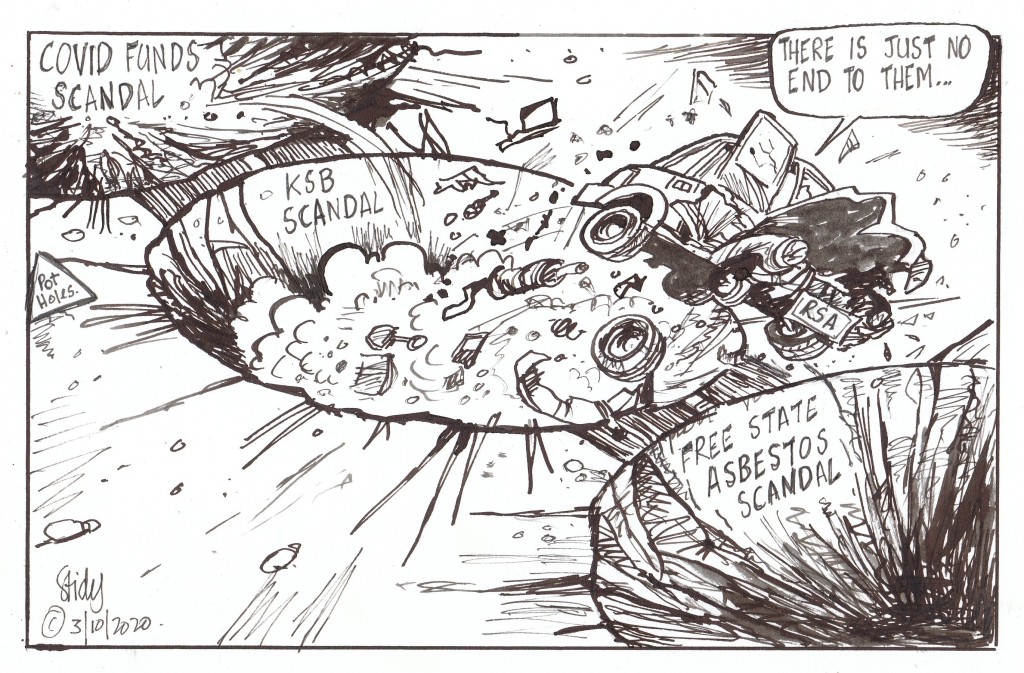
The high profile sweep on officials and businesspeople implicated in the R255 Million Free State asbestos audit deal scandal was universally welcomed because there has been an overwhelming perception among the public that thievery, as the modus operandi of the tenderpreneurs, would remain unchecked. According to opposition parties, however, the arrests marked just the tip of the iceberg and further investigations were needed to bring all those involved to book.

Meanwhile, the Evangelical Alliance of South Africa said that the practices at the KwaSizabantu – which involved allegations of human rights abuses and money laundering – were damaging to the reputation of other churches…

Msunduzi administrator Scelo Duma described the SAP financial system as “the Achilles heal of Msunduzi”. The top-of-the-range software package, installed in 2016 to integrate the management of finances, had already cost the municipality over R251 Million and had continued to be plagued with problems.

South Africa wouldn’t be able to meet its finance ministry’s debt targets and it may be undesirable for it to attempt to do so at a time when the economy is being battered by the fallout from lockdown, according to an advisory panel appointed by President Cyril Ramaphosa. In a more than 100-page document advising the government on an economic recovery programme that Ramaphosa was due to unveil the Presidential Economic Advisory Council said spending cuts would hold back growth and have adverse consequences.

The news that Health Minister Zweli Mkhize and his wife May have tested positive for Covid-19 was a reminder that people are still vulnerable despite the diminishing rate of infection in South Africa. It was especially sobering considering what is happening in the US and Europe where infection rates have begun to soar again as part of the ‘Second Wave’ of the pandemic.

Tabling his mid-term budget Finance Minister Tito Mboweni stressed the country was in trouble and that something needed to be done. Acknowledging that there was “no room for slippage” he promised to put a break on expenditure and rein in civil service salaries – something that would have to be seen to be believed, given that he lost his SAA arguments and had been forced to extend a R10,5billion lifeline to the bankrupt national airline.

When Two Troops Go To War: Adventures in Mapungubwe

I am returning to one of my favourite places, after a gap of several years. It is where I love to go birdwatching although that is only one of its many attractions.

The tarred road we use to get there, as is the norm in Limpopo Province, is a nightmare to drive on and my brother-in-law is a study in intense concentration as he tries to navigate the countless gaping potholes. We bump along the section that runs along the southern base of the Soutspanberg, then crawl up, via Vivo, to All Days. Here we branch off right.

The fact that the journey ends up taking twice as long as it should have doesn’t dent my enthusiasm for we are headed to Mapungubwe. It is somewhere along here my grandmother also travelled, as a very young member of the Moodie Trek, on her way up to the then Southern Rhodesia. Unlike us, she travelled by ox-wagon, not in an air-conditioned Isuzu bakkie…

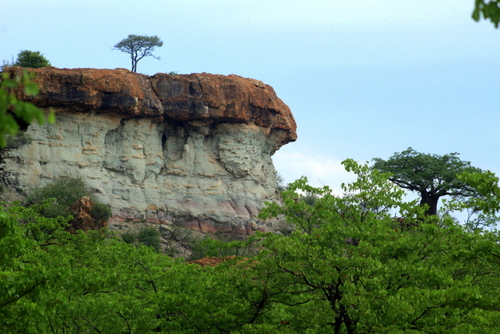
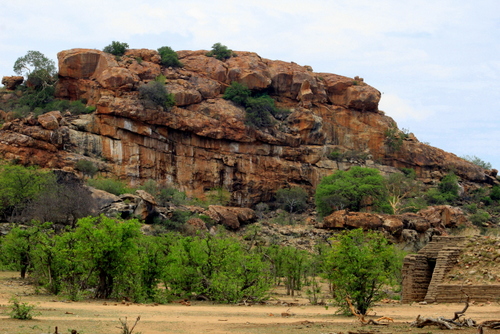
There is a stark minimalist, beauty to the landscape around here. The miles and miles of stunted mopani, the sudden, jagged outlines of ochre and strawberry-pink, rock outcrops and cliffs, the barrenness of the earth, all give it a slightly strange, almost mystical, atmosphere.

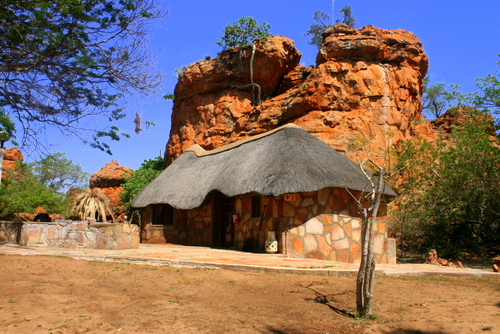
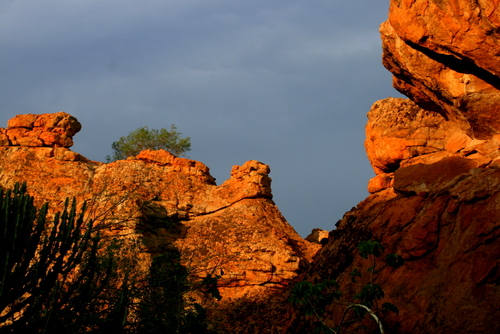
Returning to Mapungubwe is like a homecoming to me. Clambering out the car after the long drive, I stand, look and listen and let myself become part of the place again. Tshugulu Lodge, where we have booked in, is surrounded on all sides by towers of red, sandstone rock, eroded by the wind and rain and sun in to all sorts of weird, fantastical shapes.

Tshugulu Lodge

We are thrilled to find we have it all to ourselves

On the first morning, I get up at 0530 and go outside with my mug of tea. My brother-in-law has, as usual, beaten me to it and is already sitting outside but my sister is still asleep in her room.

As I plop down in the chair next to him, he points to the soft, wet sand in front of us and says “We had a visitor during the night!”. I immediately see what he is talking about. The huge footpads of a solitary elephant lead from the lodge gate to the swimming pool and then head out again along a slightly different path. There has been much testimony as to the silence of elephants so I hadn’t heard a thing but my niece, Kelly, whose cottage was much closer, had listened to it siphoning up vast quantities of heavily chlorinated water.

It is a perfect African morning, a time when the world still belongs to the animals. Above us I can hear the European Bee-eaters calling as they soar and glide in the thermals. When the breeze blows I catch the smell of Wildebeest, grazing not far from the perimeter fence of the lodge. Somewhere in the unseen distance I can imagine carnivores finishing a kill before heading off to lie in the shade,

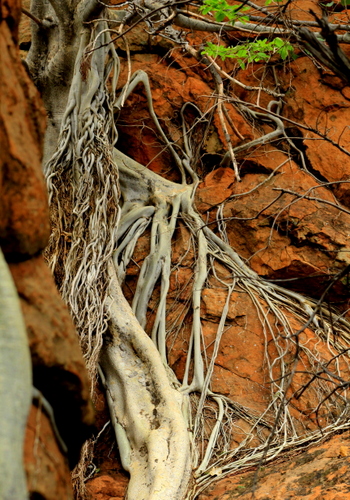
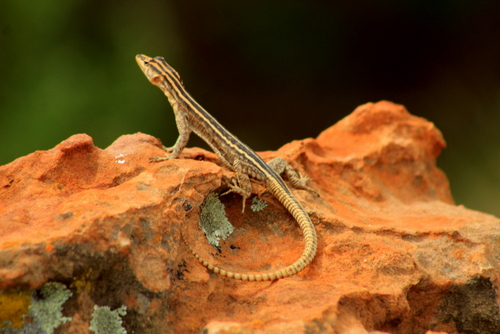
The rock cliffs, that hem us in like an old-fashioned castle wall, glow orange-red from the rays of the early morning sun. As I do a quick scan through my binoculars I see a snapshot of birds and other small creatures. Amongst the cracks and crevasses, the resident gang of Red-winged Starlings play hide-and-seek. In the shade of a Large-leafed Rock Fig which has sent its ghost-white roots burrowing down through the cracks and fissures, I hear the soft hooting of a Laughing Dove. Near it a skink, with brown stripes along its back, raises its head out of the rocks as if to smell for rain.

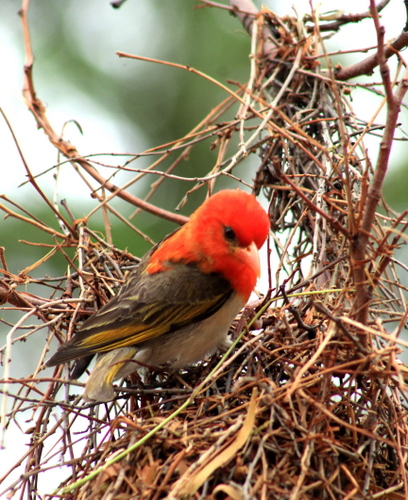
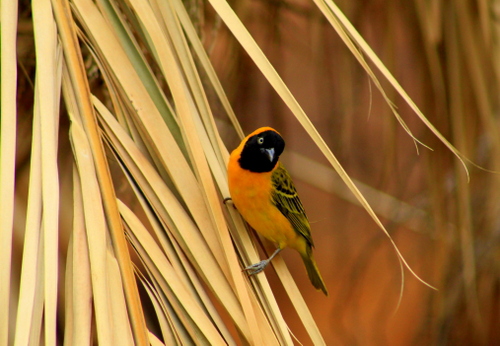
Down on the ground, not far from where we are sitting, a pair of Natal Francolin scurry past on some unknown errand. In the tree above us the beautiful Red-headed Weavers sway and dangle before flying off to bring back beak-load after beak-load of carefully selected twigs with which they construct their nests. Their pain-staking industry is more than matched by all the activity in the Lala Palm where a small colony of Lesser-masked Weavers have opted to build. They prefer to use grass and palm shards.

After a breakfast of fruit, muesli and yoghurt, we head off to the Eastern Section of Park. This arid area occupies a unique position in the country’s history for it was here that South Africa’s first important kingdom was established between 1200 and 1290 AD. Ruins left behind by Africa’s early civilizations are almost invariably found in hill country (Great Zimbabwe and Thulamela in Kruger are other obvious examples) and the Mapungubwe Hill site is no exception. From the summit of this steep-sided bute, its rulers would have been in a good position to keep an eye out out for enemy warriors, as well as greet traders coming up the Limpopo – for it is known they kept extensive links with the east, including the Chinese and Indians, the sails of whose ships were swept over to Africa on the winds of the monsoons.

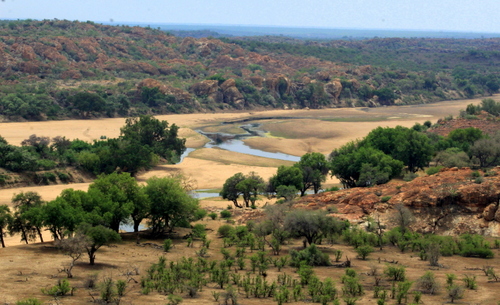
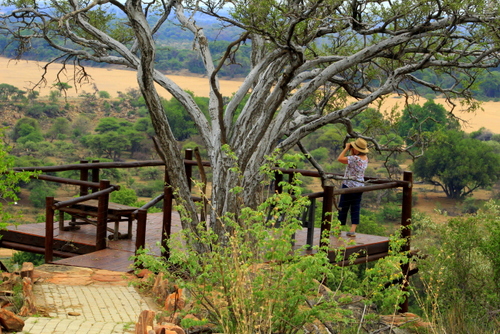
We do not have time to visit the hill that marked the centre of their civilisation but from the top of the lookout site, at the confluence of the Limpopo and Shashe Rivers (where the borders of Zimbabwe, Botswana and South Africa meet), we can just make out its red ramparts rising out of the dusty earth. From here, the road, ostensibly for 4×4 usage only, takes us along the Limpopo River as far as Poacher’s Corner before branching off through yet more oddly-shaped hills and balancing rocks.

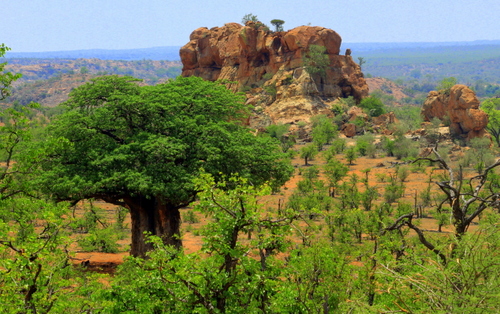
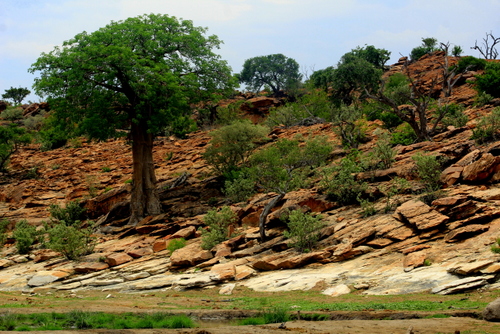
More hills and baobabs...

We return to the lodge, later that day, to find the local squirrel has taken advantage of our absence and made merry in the kitchen. Rusks have been chewed on, a bottle of honey lies open, its contents spewed all over the table and floor…

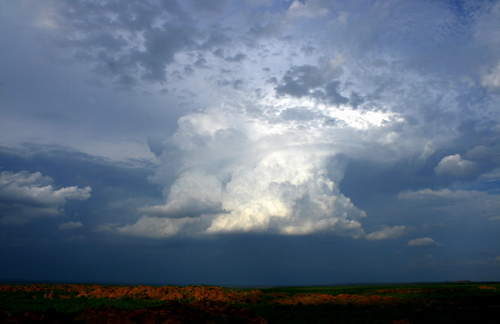
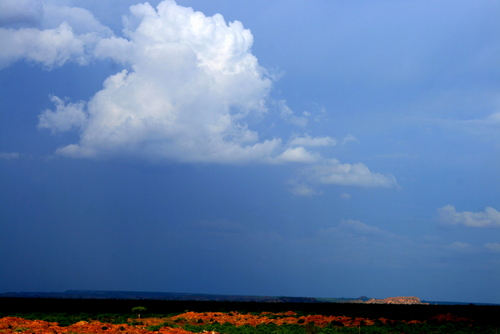
That evening, deciding to take advantage of the balmy summer light, we climb up one of the kopjes behind the lodge for sundowners. The view is astonishing. To our north, on the other side of the Limpopo, a massive storm is brewing. Soaring thunder heads rise above the plains casting the world beneath it in an unholy purplish light. There are bolts of jagged lightning, followed by the drum-like roll of thunder. You can feel the malevolence in the heavy air and smell the rain although it never actually reaches us.

Storm clouds over the Limpopo.

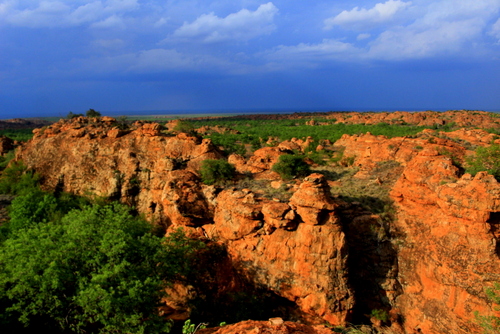
There seems to be no limit to our vision. One our right side, a labyrinth of glowing, sun-burnished, bare rock, pock-marked and twisted and looking like it could be guarding the entrance to the underworld, stretches away from us. Somewhere, in the ultimate distance, land and sky merge. It feels like we have the universe all to ourself.

A labyrinth of rock…

Anxious to transcript so great a mystery, I pull my camera out of its bag and start snapping. Then I just sit still for a long time watching the unfolding drama until eventually the fading light sweeps it all away…

That night I lie content beneath my mosquito net as the air conditioner – a novelty for me since I mostly camp on these adventures – drones away. Outside the crickets call.

I rise even earlier, the next morning, but it does no good. My brother-law-law has beaten me to the kettle again. He tells me we have had more visitors. These ones are much smaller than the formidable old behemoth who visited us the previous night. In the magic of twilight they had come flying out from their hidey-holes and roosting nooks.

They are bats.

Bats have always received a bad rap. Some time, back in history, perhaps around the period the when the church started persecuting perceived witches, they were turned in to creatures of ill-omen, along with crows, owls and – oddly enough – hares (it was thought that witches could shape-shift in to them). Later they came to be associated with vampires and Count Dracula and sharpened stakes and bundles of garlic. It is a label and an association they manifestly do not deserve for these nocturnal wanderers are marvels of evolutionary engineering..

I don’t know much about bats but my brother-in-law does. An Emeritus Professor, he is an expert on the subject. The reason he knows they have been active while we slept is because – like some Cold War spy – he has been secretly recording their chatter on two metal Bat Detectors he has attached to some trees. I listen raptly as he explains their workings. Because they mostly fly around at night bats can be difficult to identify but science – and technology – has found a way around that by tuning in to the ultrasonic sounds the bats emit.

My brother-in-law’s findings from this and subsequent recordings are, to my mind anyway, amazing, revealing a secret night-time world in which the bats are completely at home (see Acknowledgement below).

The bat puzzle solved, we next set out to explore our corner of the park, a lot of which is new to me.

The day is hot but bearable because the heat is mostly dry. Our route takes us through a badlands of arid hills and trees that are, for the most part, low and barren. In marked contrast, every now and again, we come across a baobab rising like some ancient monument, sometimes in the middle of nowhere, some times next to the stone face of a kopje.

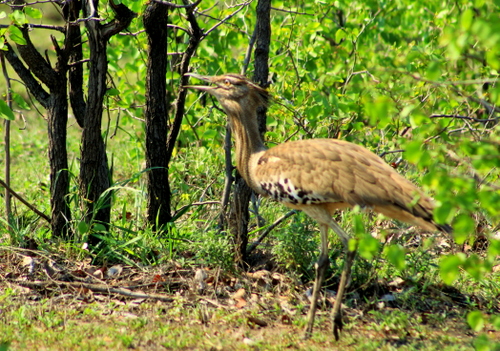
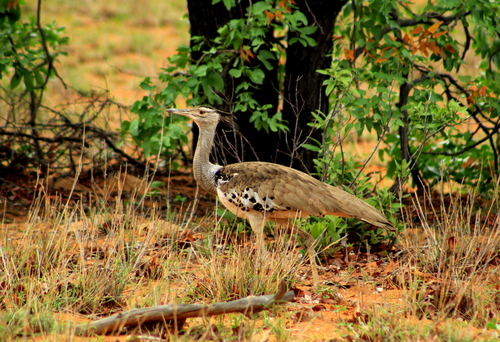
This is good raptor country. In no time I have added Martial Eagle, Black Eagle, African Hawk Eagle, White-backed Vulture, Common Buzzard, Brown Snake-Eagle and Gabar Goshawk (black form) to my bird list. Plus a Kori Bustard and a Red-crested Korhaan. Later, we will see the male Korhaan performing its strange courtship ritual, flying straight up in to the air and then closing its wings and tumbling to the ground, as if shot, before gliding in to land.

Kori Bustard.

After taking us through more rough, broken, terrain, the road starts winding down in to a rock-strewn valley which, in turn, opens up on to an immense plain, on the one edge of which lies the Limpopo. As you approach the river, the Mopani scrub abruptly gives way to a green line of tall trees – Nyala Berry, Jackal Berry, Natal Mahogany, Ana Trees, Apple Leaf.

I am a little taken back by the state of the Mazhou camp site which has altered much since I stayed there last. The electric fence that protects it no longer seems functional and everywhere there are scenes of devastation. I know who the culprits are. As in Kruger, elephant are presently destroying the acacia thorn (and many other species of tree) that also grow along the river bank at a rate regeneration can’t keep pace with. Those not knocked down have been stripped of their bark and are dying that way. In ten-years time I doubt if there will be many of these beautiful trees left to see.

One can only hope this is part of nature’s cycle although I am not convinced. In former times, elephants herds were scattered and nomadic which helped minimise the damage they cause; now their movements have been confined to restricted habitats, such as the one we are driving through. The results of this loss of freedom to wander at will are plain to see…

From the camp site we follow the river for a short distance, through the tall trees that provide favourite perches (and nests) for the vultures, before branching off to the Maloutswa Pan Hide.

As the main rains have still not arrived there is not much water in the pan. The mud that occupies the place where liquid should be is black and cracked and caked and pitted like the moon’s surface. Numerous hoof-marked tracks lead down through it.

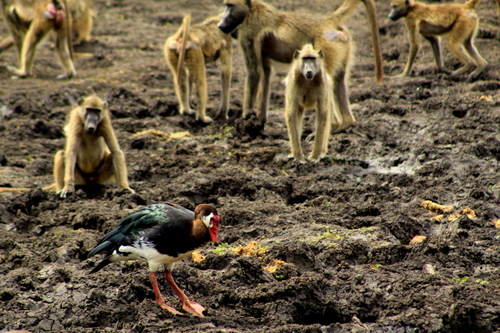
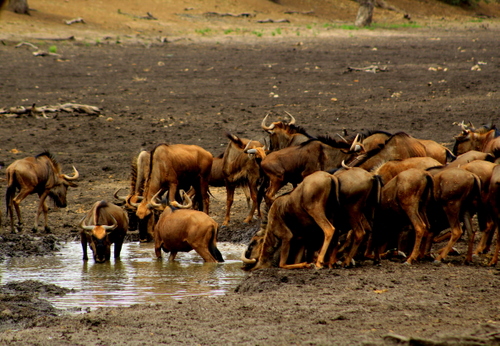
Obviously fans of the formula that there is safety in numbers, we find an immense gathering of baboon squatting by the water side. It is the biggest troop I have ever seen. As we sit watching them, another, even larger, troop suddenly emerges out of the tree line.

As they draw closer to one another, I can scarcely believe my eyes or my ears. It is like a clash between two medieval armies. There is an immediate outbreak of barking and a hurling of wild manic howlings. This is followed by lots of jumping up and down, chest-thumping and angry gesticulating. The baboons are doing it, I soon realise, only for dramatic effect. It is a mock call-to-arms and does not signal the start of an all-out war.

Realising they are outnumbered, the troop already at the waterhole stages a strategic withdrawal, yelling parting taunts and trying desperately to preserve their dignity and not show any loss of face. They retreat to a position a hundred metres or so downstream where they sit down and mutter conspiratorially amongst themselves. For our part, we find it a rather an impressive performance and feel like clapping but the solitary, bored-looking, Spurwing Goose who was in the middle of the battlefield remains completely unmoved. He has obviously seen and heard it all countless times before…

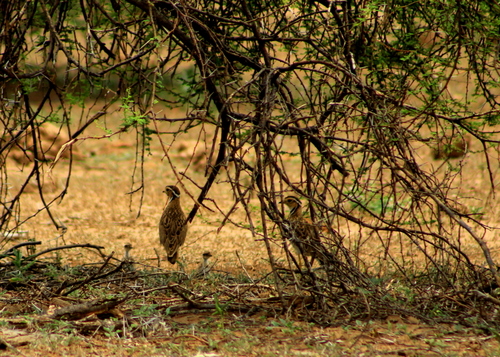
On the way back from the pan my sister sees two Crowned Lapwing in an open patch of ground and then, a bit further down the road, says “Look – two more of them under that tree!”. Although, I am on the wrong side of the car to see them, a little bell goes off in my head. Maybe they are not plovers at all! I urge my brother-in-lay to stop and reverse back to them. I am very glad I do for it turns out to be a pair of Triple-banded Coursers which are extremely unusual in South Africa. I am even more amazed when I see they have two chicks. In Africa, all game birds suffer high rates of nesting loss. There open homes are highly vulnerable to a whole host of predators – caracal, serval, jackal, civet cat, genet cat mongoose, raptors, various egg-eating snakes.

Triple-banded Courser, with chicks.

The chicks are lucky to have survived so far.

Returning home we take a slight detour to Little Muck which lies on a ridge below which a seasonal stream bed runs. How it got its odd name I have not been able to ascertain but it is a good place to see elephant. There are also several San rock-painting sites in the area but I imagine you have to get permission to see them. There are more baobab standing here in heraldic silence, their branches covered in the sprawling nests of the Red-billed Sparrow Weaver. With the exception of those in more inaccessible positions, they too, have been badly gored, stripped and desecrated by the elephant. I suspect many of these ancient, symbolic trees won’t survive either.

Which would be sad because, standing under them, I felt overwhelmed by the age and might of this old continent and realised – yet again – what an important part of it they are…

GALLERY:

ACKNOWLEDGEMENT

I am extremely grateful to my brother-in-law, Emeritus Professor Ric Bernard, for organising this trip and for his many kindnesses, information and assistance. To help me understand the world of bats better he also kindly prepared the following notes:

Studying bats is not easy because they are active at night and spend the days in often inaccessible places. They are hard to see in flight at night and almost impossible to identify even when they are seen. However, in the same way that birds can be identified based on their calls, so too can bats – with the same proviso that identification based on call alone is not always accurate. However, unlike birds where the call can be heard, the calls of bats are at a frequency that is far too high to be heard by us. This makes studying bats very different from studying birds. The ultrasonic calls of bats can be detected and recorded and on a recent trip to Mapungubwe and Mopani we used two Song Meter bat detectors to record the bats in the area. Over 6 nights, we recorded more than 16000 bat calls. Analysing these calls manually would be very time consuming and we used software to do this and to group calls into clusters. We were then able to examine the clusters and based on previous work to identify most of the calls.

The ultrasonic calls of bats are used to detect their prey and their surroundings (echolocation) and typically not to communicate with other bats. The call of each species is characterised by a particular frequency or range of frequencies and it is based on this that they can be identified. Calls fall into one of three groups, being Constant frequency (CF) where the call is relatively long and at a single frequency, Quasi Constant frequency (QCF) where the call is long and covers a very small range of frequencies, and Frequency Modulated (FM) where the call is shaped like a hockey stick and covers a range of frequencies from high to low at the bend of the hockey stick.

The CF bats are all horseshoe bats and we recorded six different constant frequency calls at 35, 47, 76, 81, 105 and 114 KHz (kilohertz). The likely species were the cape horseshoe bat, Geoffroy’s horseshoe bat, Darling’s horseshoe bat, Hildebrandt’s horseshoe bat, Lander’s horseshoe bat, Swinny’s horseshoe bat.

Amongst the FM bats, we identified the Cape serotine, long tailed serotine, banana bat, rusty pipistrelle, Natal long fingered bat, and Temminck’s myotis.

The vast majority of the recorded calls came from the QCF group. These are bats that often inhabit the roofs of houses and which SANParks are trying to attract into bat houses that we saw at both Mapungubwe and Mopani. The species included Midas free tailed bat, Angolan free tailed bat, Egyptian free tailed bat, Mauritian tomb bat, large eared giant mastiff bat and the little free tailed bat.

All of these bats fall within their known distribution ranges.

All the species are insectivores and will be feeding on both flying and sedentary insects.

I would also like to thank my sister, Penny, for the wonderful food and – along with her daughter, Kelly – being such good company.

Book Reviews

Since its first appearance in 1993, the SASOL Birds of Southern Africa has gained a reputation as one of South Africa’s best bird books, unsurpassed for its excellence as an all-round guide to identification. To my mind, its illustrations, which have been stripped down to exclude extraneous and distracting features of animation and context, are the most accurate and revealing of the current crop of field guides.

The revised 5th Edition edition, contains some real advances on its predecessors in the series. Probably the most novel of these is the inclusion a “bird call” feature which enables you to access calls by scanning barcodes with a free downloadable call app. It also contains calendar bars depicting species’ occurrence and breeding periods.

Very much a team effort, the book now has six contributing authors with new input from Dominic Rollinson and Niall Perrins, both well-known for their birding expertise. In addition to this, it has more than 800 new illustrations, including all-new plates for raptors and seabirds

As one would expect of a field guide of this sort the accompanying text has been simplified and limited to the essential differentia but should be more than enough to help with immediate bird identification. For the full treatment you can always turn to the comprehensive reference work, Roberts Birds of South Africa.

If you want to plunge even deeper in to the subject of bird identification, than Birds of Southern Africa and their Tracks & Signs by Lee Gutteridge might be another worthwhile addition to your birding library.

Normally when one attempts to identify a bird in the field one starts with its physical appearance – its size, shape, patterning and colour. One also looks at their movement – how they hop, run or jump on the ground; how they move through bushes and trees; how they fly in the air; how they swim or dive in the water.

This book approaches the subject from a slightly different perspective, one that doesn’t even require the bird to be present – by teaching you to identify its spoor or tracks and its dropping, as well as picking up other little tell-tale signs.

It is a slightly unusual approach, granted, but it is yet another way of celebrating bird diversity and of expanding our own range of experience of the natural world.

Adding to its appeal, the book is handsomely produced with a bibliography and index, plus hundreds of colour illustrations depicting not only the spoor and droppings but the birds themselves.

With the world in the grip of the Covid-19 pandemic hysteria and the economic climate as gloomy as the burning Msunduzi landfill site, getting out in to the country is the one thing we can still do which makes everything seem all right again. It is like a passport to a more ordered and contented world.

And perhaps no other creature better exemplifies this reassuring image of bucolic calmness than the humble butterfly.

I love birds, always have, but it is only since I moved up to the Karkloof area that I have begun to develop a deeper interest in these delicate but wonderfully self-contained insects, perhaps because there are so many of them active in our area at the moment, feeding on the spring and summer wild flowers. The more you watch and get to understand them the more wonderful they get.

South Africa is, indeed, singularly lucky in having over 671 species of butterfly which, as Steve Woodhall, the author of Field Guide to Butterflies of South Africa, points out, is an impressive number for a country outside the Tropics.

Anyone who, like me, wants to be able to identify and know more about them would do well to keep his handy field guide in close reach for it is a treasure trove of useful information.

First published in 2005 it has been fully revised and updated to reflect the most recent taxonomic changes. Taking full advantage of the rise in the use and quality of digital cameras, the book is also stuffed fill of beautiful images of butterflies in all their colourful variety.

For this edition a full two-thirds of the images have been replaced with new material showing both male and female forms – where they differ – as well as upper and undersides. The species accounts have also been comprehensively updated and expanded, covering identification, habits, flight periods, broods, typical habitat, distribution and larval food sources.

Like all the best field guides it is a book which inspires adventure, improvisation and the learning that comes from discovery. Since getting my copy I have managed to photograph and identify the Southern Gaudy Commodore, the African Blue Pansy, the Yellow Pansy, the Common Diadem, the Painted Lady, the Forest Swallowtail and the Green-banded Swallowtail.

Rife with similarly enticing names, Woodhall’s well organised guide brings home just how astonishingly refined and varied these creatures are. Hopefully it will, in this time of self-isolation and rampant gloom, reignite your own desire to escape in to the wild…

Book Reviews

Published by Tafelberg.

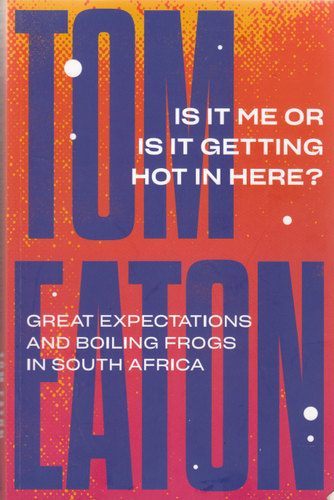
Tom Eaton is undoubtedly one of South Africa’s most witty and erudite commentators with a brand of humour that manages to be both razor-sharp and wryly tongue-in-cheek at the same time.

His latest collection, still fresh despite being mostly written before the Covid-19 pandemic struck, rails against current political shibboleths to entertaining and pointed effect. As is only to be expected, Eaton pulls no punches as he takes satirical swipes at a number of rather large and obvious targets – the ANC, Eskom, the SABC – but with his slightly skewed, off-centre approach he manages to illuminate this familiar territory with sharp flashes of novel insight..

Of course, no book about South Africa’s recent history would be complete without a dissection of the rotting cadaver of state capture that was the hallmark of Jacob Zuma’s time in office and Eaton duly obliges with a typically excellent, if typically depressing, essay on the man and the damage he inflicted on the country

In places, it is not at all a comfortable read. Eaton has a habit of shredding many of our common self-deceptions and irrational beliefs, as well as the sort of deluded wish-thinking that often characterises public debate. He includes, for example, a very thoughtful and balanced piece on the role of politics in sport in South Africa, arguing that it is naïve to think you can separate the two. In a chapter dealing with another vexed, contentious South Africa issue – the re-imposition of the death penalty – he puts forward a similarly persuasive argument, showing how we often allow our heated feelings on the subject to override common sense.

Eaton does not confine himself just to local matters. Elsewhere, he includes a perceptive essay on what is happening in the United States, a nation which seems to have been dumbed down to the extent where responsible and informed policy has largely ceased to exist under a regime that denies the reality of global warming and which has a president who advocates drinking bleach as a cure for Covid-19..

Eaton’s writing can be pithy. It can also be deadpan. Underpinning it all, though, is a deep vein of seriousness which forces you reconsider and look again at many of your own assumptions about the sort of society we live in. Or, as Eaton himself puts it, the book is “about trying to resist the knee-jerk responses that professional manipulators want us to have…”

Intelligent, well written and extremely funny, Is it Me or is Something Getting Hot in Here? is a terrific compendium of the incompetence and occasionally appalling behaviour of those in whom we have entrusted our vote. It also holds up a not always flattering mirror to ourselves…

Published by Bantam Press

With his blend of sardonic humour and noble integrity, Lee Childs’ laconic hero, Jack Reacher, is one of crime fictions most likeable and engaging characters.

In his latest outing we find him sitting on board a Greyhound bus, heading along the interstate highway, with no particular destination in mind. Across the aisle an old man sits asleep with a fat envelope of money hanging out of his pocket.

Reacher is not the only one who has spotted it. When the old man gets off, at the next stop, he is followed by another passenger with slicked-back, greasy, hair and a goatee beard. Naturally Reacher, his suspicions aroused, decides he better disembark as well, just in case the other guy has bad thoughts on his mind….

He has. Needless to say, by the time Reacher has finished with him he has good reason to regret ever harbouring them. While obviously grateful for Reacher’s intervention the old man is clearly reluctant to explain who the cash is intended for or to let him get further involved in his affairs.

This merely serves to pique Reacher’s interest further. Having insisted on accompanying the old man home, he eventually gets him to admit that he and his similarly elderly wife are the victims of an ugly extortion racket.

For a loner like Reacher who only becomes sociable when he meets good people in a jam, this goes against the grain and he immediately decides that the time has come to mete out his own particular brand of retributive justice against those who are making the old folks life a misery.

It takes Reacher little time to flush out the enemy but he also discovers he is vastly outnumbered. Despite finding himself caught up in the middle of a particularly vicious turf war, however, between two nasty rival gangs – the one Albanian, the other Ukrainian – he never seems to be in danger of losing his head.

Author, Lee Child, is a reliable performer and once again delivers an enjoyably familiar, violent, pacey, caper. The action sequences are handled with his customary elan while, at the same time, he convincingly manages to convey the sleazy, menacing, underbelly of modern city life.

The Small Town Hotel – a Vanishing Icon

Whatever happened to the small town hotel? When I was growing up they were all over the place. Now, they seem to have become an endangered species.

This is, of course, a rhetorical question and one which has an obvious answer. Their demise became inevitable once they started having to compete with all the cheaper bed and breakfasts and self-catering establishments that suddenly began springing up across the sub-continent like a contagious rash.

Others found themselves replaced by up-market, chain hotels or, because of a decline in bookings, were converted into slightly run-down-looking shops and boutiques. Or else they were simply knocked down to make way for something else.

Such is the nature of progress. I find it all rather sad because so many of those old hotels were architectural gems which gave the small towns both character and definition. Often they were the most distinctive buildings in them.

The ones, I remember, from my Rhodesian and Zimbabwe days, were invariably situated alongside the main road. Tall palms or blue-gums with peeling bark and rustling leaves cast pools of shadow over them.

Most had large wrap-around verandahs with arches and pillars and a few pot plants strategically scattered about to create the right ambience. Also an assortment of old wicker chairs and a few tables to put your drinks on. The roofs were steeply pitched and made of corrugated iron, often painted red or green. The outside walls were white.

Inside, the lounge would be equipped with a tired-looking, over-stuffed couch and a few mismatched, broken-backed chairs. Often there was a slightly strange smell – a weird combination of stale beer, frying odours from the kitchen and dust. Even the ancient looking fans that whirled from the ceiling above you couldn’t disperse it…

I was always scared of those fans. Too often, they looked like they could, at any moment, come spinning off their bearings, decapitating some unfortunate soul in the process.

The rooms, themselves, were not exactly posh. The furnishings were minimal, the curtains gauzy, the carpets threadbare. A few pictures, often reprints depicting snow-capped Alpine mountains, would hang on the wall while the beds, with their lumpy mattresses, would sag in the middle. If there was a wash basin in the room, the tap often leaked. More often than not there was no en-suite bath; you were obliged to use the communal one at the end of the passage.

The walls were like matchwood. Through them you could hear the radio or TV (if they were lucky enough to have such modern contrivances back then) being played next door or people murmuring in low but hard-edged voices. Upstairs it sometimes sounded like there were platoons of soldiers practising their drills in hob-nail boots on the wooden floor boards.

Their departure from the room would often be followed by a wall-shivering door slam..

Lying in bed, trying to get to sleep, you could hear engines throbbing, brakes screeching or cars thundering along outside. If you were near the railway line – again, many of these hotels were – your sleep would invariably be disturbed by the blast of a train horn as it came puffing grandly in to the station, before stopping with a loud squealing of brakes.

In the dining room, the food, served by turbaned waiters, although edible would hardly qualify as haute cuisine especially by today’s high culinary standards. Mostly, it was meat and two vegetables, over-cooked, a bit like the mush they dished up at boarding school

Invariably, the most well-frequented part of the hotel would be the bar. There were usually two kinds of these – the swanky cocktail bar which women (this was before the MeToo Movement) were allowed to frequent and men were expected to wear a tie; and the saloon bar which was Men Only.

The latter were spit n’ sawdust affairs and there was no real ‘dress code’ here except you had to wear long trousers after 6pm. If you wanted an insight into White Rhodesian “culture” this was the place to go. Easily identifiable were the regulars: a sad-eyed collection of red-nosed, old misfits staring gloomily in to their drinks. Most of them turned up as soon as the pub opened and stayed until it closed.

There wasn’t much talking, just a lot of guzzling. Having frequented the place for years most of them had exhausted their personal lives as conversational topics. Occasionally they would try some other subject.

Something like “Nice weather we’re having,” might be tried as an opening gambit.

“Yeah – very nice,” the grunted reply.

In stark contrast you would get the groups of young bucks, throwing darts and playing pool and yelling at each other about what a good time they were having.

In my early twenties I rather liked frequenting these bars although I was never one of the dancing on the tables sort. When I was based in Sinoia (now Chinoyi), working for the District Commissioners Office (my penance for letting the Government pay part of my varsity fees), I practically lived in the local bar.

There was not much else to do…

The Specks Hotel in Gatooma (now Kadoma) was another one I got to know during my Mines Department days and which perfectly fulfilled all my expectations of it.

Specks Hotel, Gatooma (now Kadoma).

Not that all of these small town hotels were tatty and down-at-heel and fallen- on- hard- times.

The Cecil Hotel in Umtali (now Mutare) was a rather grand old lady until it got taken over by the army, during the Rhodesian Bush War, and converted in to an HQ. So was the Midlands Hotel in Gwelo (now Gweru), another period hotel which stood directly opposite the Boggie Clock Tower, a rather strange edifice erected in the middle of Main Street for no other reason, it often seemed, than to confuse out-of-town motorists ( it was actually built in 1928 to commemorate Major William James Boggie, an early big-wig in the town).

Boggie Clock Tower with Midlands Hotel on right. Gwelo (now Gweru).

After independence there were suggestions the Boggie Clock be pulled down. I am not sure whether that was because of its unfortunate colonial associations or because it was a traffic hazard. As far I am aware, it is still there, still bamboozling out of town motorists.

For me the most stylish and grandiose of all these hotels was the Old Meikles Hotel in Salisbury. Some might quibble, here, as to whether it actually qualifies as a small town hotel but since Salisbury was still in its adolescent stage when the hotel was built, back in 1915, I am including it.

Overlooking the gardens of Cecil Square where the first British settlers raised the Union Jack, it was a study in Victorian elegance and old world charm. Again there was a wonderful old verandah in the front where you could collapse in to a comfy seat and sip your gin and tonics and watch the folk passing by. Inside it was pleasantly dim, high-ceilinged and paved with cool tiles.

On Saturday mornings it would be packed solid with wealthy tobacco farmers come to town. Often there would be a man tinkling away on the piano in the background of the lounge where the farmers had congregated, with another man playing the double bass next to him, partly concealed by a potted palm tree.

In what can only be counted as a resounding victory for the cultural philistines – and an unmitigated disaster for the rest of us – the Old Meikles was demolished in the mid-1970s and replaced by a functional, modern but utterly character-less structure.

Having grown up with it always being there, like a comforting blanket, I felt bereft. I was never able to look at Salisbury through the same eyes after that.

When I moved to South Africa in 1984 – the demolition of the Old Meikles was but one of my reasons for taking this step – I found the situation very much the same down here although here and there a few of the old hotels still survived.

There is still one in Howick, the town nearest to where I now live, whose doors continue to remain open although how well it is doing I have no idea. It is just around the corner from the Howick Falls so is, not too surprisingly, called the Falls Hotel.

Howick Falls Hotel.

Somerset East, where my sister Nicky and her husband, John, moved to, around 2009, has one on its main street named – you guessed it – the Somerset Hotel.

My pub-crawling days were long over when I came drifting in to town so I never actually went inside but I am sure it would meet all the criteria for a small town hotel. The outside certainly does except it is painted a garish yellow instead of my preferred white, a black mark in my eyes.

The one morning, when I was staying with my sister, an almighty hullabaloo suddenly erupted from outside it which had me thinking the end of the world was upon us. When we went out to investigate we found ourselves confronted by a scene that looked like something from the set of a Mad Max movie. The bikers had come to town.

There seemed to be hundreds of them hurtling up and down the main drag, revving their engines, spinning their wheels and kicking up huge clouds of blue smoke, hydrocarbons and testosterene in to the air. Others were leaning from the balcony upstairs, clutching their brandy and cokes and shouting boozy instructions.

Folk thronged the street, some still in their Sunday finery, others in filthy T shirts and shorts. Kids dodged in and out of the traffic. There was so much haze and noxious gas and so many people you could barely make out the Dutch Reformed Church down the road.

It all kind of made sense. If the first thing you need in a small town is a kerk for your prayers, a mart for selling food and a pub where you can commit the sort of sins that would warrant praying about, than Somerset East filled the bill.

It was a classic Southern African dorp with a marvellous old hotel…

My Days at SCOPE

Once upon a time long ago, I found myself a very reluctant conscript in the Rhodesian Army. After I had completed my basic training in Bulawayo I was despatched to what the military hierarchy liked to call The Sharp End where I ended up patrolling with a curious mix of half-trained soldier-civilians in the hot, tsetse fly-infested, Zambezi Valley.

In my platoon was a stocky, jovial, young, former rugby-player who carried in his back-pack a centrefold he had torn out of SCOPE magazine. For him it was a ritual. Every night he would unfold the picture and pin it to the nearest tree; every morning he would take it down again, refold it and return in to his back-pack.

By the end of our tour poor Marilyn Cole – for that was the model’s name – had become so stained and crumpled and yellowed by the rain and the sun and the wind you could barely make out her shapely figure any more. It didn’t really matter. For us her ongoing presence was about more than mere sexual titillation. She had become a symbol of defiance, a link to the world we had left behind..

That was one thing the army did to you – it helped concentrate your desire for something you once took for granted into a craving that narrowed your focus intensely. Deprived of so much, the army taught me to take nothing for granted: a bottle of good wine, a meal in a restaurant, a hot shower, clean clothes, a comfortable bed.

Time passed. The war ended. I found myself at a crossroads, uncertain which way to turn. Worn out by seven-years of war, I decided, in the end, that I wanted another life, somewhere else. Scraping together what little money I had, I piled my few belongings in to my old Datsun 1200 and headed to South Africa.

The truth is that I didn’t have much idea what I wanted to do. I had studied English literature at university and held a BA degree so I had some notion of finding something where I could finally put that to use.

My sister, Sally, who had recently moved from Zimbabwe to Durban herself, kindly set up several interviews for me. The first of these was with Republican Press, at that stage, the biggest magazine publishers in South Africa. One of their publications was the self-same SCOPE Magazine.

I was not confident. As a virtual unknown, with no previous experience in journalism, I thought it would be virtually impossible for me to break in to this highly competitive field. In the interview I probably did everything the career advisers would caution you against – I arrived ill-prepared, I stammered, I was apologetic, I could barely string a coherent sentence together.

Oddly enough, this seemed to endear me to the company’s then MD, Leon Bennett. He told me I made a refreshing change from the usual spoilt, rich, presumptuous, white kids he had to interview.

As amateurish as they then were, he also saw potential in my cartoons.

I got the job. And so, by a strange twist of fate, I found myself working for the same magazine whose centrefold had helped buoy up my mood throughout my otherwise dispiriting National Service year.

These days some people, younger ones, don’t know about SCOPE but back then it had attained an iconic status in South Africa with it raunchy, irreverent, anti-establishment style of journalism, so at odds with the repressive morality of the times.

Describing itself, somewhat euphemistically as a “Men’s Lifestyle Magazine”, it had been launched in 1966 by Winston Charles Hyman with Jack Shepherd-Smith as its first editor. At the time, most of the magazines in South Africa were typically staid in tone, conservative it outlook, and anything but bold in design. SCOPE changed all that by pushing its maverick status and going where none had gone before.

Starting off as a newsy pictorial magazine it steadily ramped up its sexual content, then very much a taboo subject in the country. It began to publish lots of pictures of bikini clad girls. Later, it became famous for its nudes with strategically placed nipple stars.

In the first flush of its glory days, the magazine sailed pretty close to the wind, constantly challenging the country’s strict censorship laws to see what it could get away with. It was routinely banned which only added to its allure and popularity.

Its circulation soared, advertising revenue increased. At its peak SCOPE was the largest selling magazine in the country reaching a staggering peak of 250 000 copies sold a week.

Shepherd Smith was succeeded as editor by a former Rhodesian, Dave Mullany. A tough, uncompromising figure not disposed to blind obeisance or toeing the line, he pushed the boundaries still further increasing the pin-up content and encouraging an even wider-ranging, freer style of reporting.

With his zippy and acerbic retorts, he turned the Letters Page in to one of the most popular and well-read sections of the magazine. Similarly reflective of his rebellious outlook was the space he devoted to rock music reviews.

In Richard Haslop – a lawyer by profession but as equally at home writing about music as playing it – he obtained the services of probably the most talented and knowledgeable rock scribe of his generation. Having grown up in an era of some of the giants of the music industry, what made Haslop’s reviews so appealing was his verve, insight and his eagerness to get you to listen to records as attentively as he did.

It wasn’t all just sex, big boobs, nipple stars and rock ‘n roll however. SCOPE treated serious matters seriously and produced a lot of good quality journalism.

One of the biggest scoops we got, while I was there, was an exclusive interview with wanted bank robber, Allan Heyl, a member of the notorious Stander Gang who had captured the popular imagination and achieved an almost folk hero status in South Africa. At the time Heyl, the only surviving member of the gang, was holed up in London (Stander himself had been shot dead by police in Fort Lauderdale, Florida).

Another notable story which caused a huge furore, during my time, involved the pioneering heart surgeon, Chris Barnard, who had just returned from a big hunting safari in Botswana. One of the video operators, who had accompanied the group, had been so appalled by the cruelty she had witnessed on this hunt she leaked the story to SCOPE. We immediately published it. Very protective of his high public profile, an angry Barnard threatened to sue but the editor stood firm and he eventually backed away.

SCOPE’s vigour, humour, occasional vulgarity, big headlines and pin-ups gave it immense appeal with the young and, just as it had with my generation, it became a staple for South African ‘troopies’ serving on the border.

Ownership of the magazine changed hands when it was bought out by the Afrikaner-owned Republican Press. Because of their close connections with the government, its new corporate owners were never comfortable with the magazine’s perceived permissiveness but because of its big profit margins they were restrained from interfering too much. They did, however, fire Mullany when he chanced his arm, once too often.

With his departure something fundamental changed in the magazine. Deprived of its distinctive, self confident editorial identity it drifted, by default, in to the hands of lesser editors. It lost some of its sparkle and wit. Attempts were made to turn it in to an upmarket magazine for males but its old image had become too entrenched in the public’s mind for that to ever work.

As its circulation began to drop, management were eventually forced to eat humble pie and recall Mullany.

My four-year sojourn at the magazine fell in between his firing and rehiring.

As one would expect, the staff, when I arrived, were made up of a suitably ragtag group of disparate individuals. It was the heyday of “Gonzo” journalism and many journalists, inspired by the likes of Hunter S. Thompson, wore their outsider status as a badge of honour, galloping away from the sort of respectability and convention that was the hallmark of life in South Africa under the National Party (although this didn’t stop the government from implementing some pretty inhumane policies).

Tall, laid-back and laconic, Quentin – “Kanga” – Roux, the deputy-editor, moonlighted as a beach-bum, surfer and lifeguard at Winklespruit on the South Coast. He eventually married a beautiful young lady selected by SCOPE to sail around Mauritius as part of a tourist promotion and went to live on an island off Florida.

Chris Marais, our Jo’burg editor, played in a rock band before deciding that a small town in the dry Karoo was where he wanted to be (he now writes for South African Country Life). Bad boy Franci Henny, a feature editor, lived a borderline life of dissolution while nurturing an ambition to write the Great South African Novel.

Franci Henny (left) and Jo’burg editor, Chris Marais.

Irony was the stock-in-trade of in-house humourist, Robin Hood, both in his writing and conversation. An ex-BSAP policeman with a wonderfully dry world view his weekly summary of the “Dallas” TV show plot line and acting was, for me anyway, far more entertaining than the show itself (which had a huge South African following).

My time at SCOPE also coincided briefly with that of Frank Bate, another brilliant and funny writer, whose booze and drug-fuelled escapades made him something of a SCOPE legend. He died at the relatively young age of fifty but managed to pack two lifetimes worth of living in to those years.

I also struck up an immediate and long-lasting friendship with Karen MacGregor, the first woman reporter to be employed full-time by the magazine. A highly-respected, award-winning, journalist, Karen would go on to work for the Times Higher Education Supplement in London, write for Newsweek and London newspapers such as The Independent and The Sunday Times, and later become the founding editor of the on-line publication, University World News.

Where she led, others followed: Esther Waugh, Ann Jones and – another good friend – Mandy Thompson (now resident in Majorca) all worked at the magazine while I was there.

As a misfit-of-sorts myself I enjoyed the living-on-the-edge work ethic and environment and felt quite at home with SCOPE’s slightly disreputable image.

My plug in the 20th anniversary edition of SCOPE.

I was given my own column, PERISCOPE, a mix of quirks and oddities gleaned from around the world which I illustrated as well. I also worked as a re-write man taking stories we had got from elsewhere and converting them in to a more racy “SCOPE style”.

In 1988, I allowed myself to be lured away when I got offered a job on the Jo-burg-based Laughing Stock, a sort of local version of Britain’s Private Eye. Although it employed some highly gifted humourists (among them Gus Silber, Jeff Zerbst, Harry Dugmore, Arthur Goldstuck and the creators of South Africa’s most successful ever comic strip, Madam & Eve, Stephen Francis and Rico), the market wasn’t ready for us and the magazine folded after a year.

Back in Mobeni, Durban, SCOPE had also been having a hard time of it.

In a way it was responsible for its own plight. For years it had campaigned against the country’s censorship laws but when, after independence, these were relaxed it found it could not compete with the more heavyweight overseas girlie magazines such as Playboy and Penthouse which had been allowed to enter the South African market.

The magazine continued to be published but it had gone in to terminal decline. In an effort to boost sales they messed around with the formula, it went through several incarnations but none of them worked because, in a sense, it couldn’t make up its mind whether it was one thing or the other – an unpardonable sin in the industry. Time had also dulled its edge, values had changed, society moved on.

It continued to slide inexorably, a hollow shadow of its former rumbustious, controversial, self.

The plug was finally pulled in 1996 by which time I had long since moved away and was happily ensconced as the first-ever, full-time political cartoonist for the Witness newspaper in Pietermaritzburg.

But that is a story for another day….

A Pall of Gloom: Cartoons for July and August, 2020.

SUMMARY:

In the same week that Minister of Health, Zweli Mkhize, warned that South Africa was on the verge of a spike in Covid-19 cases, the Auditor-General (AG), Kim Makwetu, issued yet another damning report of incompetency and thievery in Kwa Zulu-Natal’s municipalities. According to Makwetu: “There was little change in the audit outcome of the province, accountability was not adequately practiced or enforced by leadership, and the failure of key controls continued.”

Most of the municipalities, including Msunduzi, remained in “dire financial health.”

According to a report tabled before the KwaZulu-Natal legislature’s portfolio committee on economic development, tourism and environmental affairs, the Covid-19 pandemic and national lockdown has had a devastating effect on Ezemvelo KZN Wildlife. Reporting a shortfall of R34,5 million for April and May, they also estimated that they would lose R199 million from tourist-related revenue, and another R9.8million from other revenue streams.

As a result of this shortfall the already embattled agency may be forced to limit or even stop some of its conservation work unless they get a significant cash injection.

For the most part, President Cyril Ramaphosa’s announcement of steps in reaction to the sharp increase in Covid-19 infections appeared realistic and unavoidable. However, the decision to allow taxis to fill to capacity seemed bizarre if the object of the regulations was to break the chain of infections by, among other things, limiting the number of people in close proximity to each other. The ban on booze, while a logical way of combating drunken violence and in the process keeping health staff and beds free for Covid-19 cases, betrays governments incapacity to maintain law and order.

Pietermaritzburg was once again left choking when the New England Land Fill site caught alight. As a result, schools and businesses were forced to close early while those living by the dump complained of sore throats and nose bleeds.

Ironically, the inferno erupted just hours after the environmental consultancy company, Surg Sut, had spoken to The Witness about the measures they had put in place since being appointed to turn the situation around at the site and address environmental issues…

Adding to the pall of gloom hanging over the city, was city boss Mahodu Kathide’s frank admission that Msunduzi is broke and can’t even pay creditors on time. He was responding to questions related to the city’s financial situation as council expressed concerns about the runaway debtors book, theft of municipal services and the lack of movement on the indigent register.

With continued electricity outages over and above load-shedding, many residents were left wondering the point of the city being under administration, when they are being subjected to a deterioration of life.

The Covid-19 pandemic continued to exact a heavy toll on the country with South Africa ranked fifth globally in the number of infections with 493183 and 8005 deaths as at the 31st July. This traumatic and tragic situation was compounded by increasing levels of government corruption, fraud and maladministration in relation to the amelioration of the virus.

The ANC’s faux apology and claim that it “hangs its head in shame” over the conduct of some of its members was greeted with overwhelming cynicism by a largely disillusioned public…

If further proof was needed that the ANC was slightly less that sincere in its commitment to fighting nepotism, cronyism and corruption it was provided by a City Press report that the party’s Secretary-General Ace Magashule and his family and allies continued to benefit from contracts awarded by the current Free State administration. Expressing their concerns as to what was happening in the country, the South African Council of Churches (SACC) committed itself to mobilising all sectors of society against government corruption which had been recently highlighted by the looting of Covid funds.

Meanwhile, KwaZulu-Natal premier Sihle Zikalala attributed a surge in Covid cases in the province to complacency and a general disregard for lockdown regulations.

More evidence that South Africans were staring in to the abyss was then provided by researchers at the Council for Scientific and Industrial who warned that 2020 is shaping up to be worse than 2019 in terms of load-shedding. As if to confirm their prognosis, ESKOM promptly announced it was reintroducing Level 2 load-shedding with immediate effect…

It got worse. In the same week KZN premier Sihle Zikalala pledged to fight corruption within government, the ANC went ahead and deployed the thuggish, corruption-accused ex-mayor of eThekwini, Zandile Gumede, who is out on R50 000 bail, to the KZN legislature.

Approached for comment, Gumede said “All I am prepared to say is that I’m grateful that the ANC used Women’s Month to honour me by deploying me to the legislature.” Not many shared her sentiments, her appointment proving, once again, that the ANC acted only in its own interests and that public malfeasance was no impediment to advancing your career.

The ANC went on the defensive following comments by former finance minister Trevor Manuel that the party had squandered its achievements and that “the ‘Zuma Years’ were for South Africa a period of regression” and that “We’re a country that has lost its moorings and it is a tragedy.” In a statement, ANC spokesperson Pule Mabe said there was absolutely no basis to portray a doom-laden picture of the country to the media and to the outside world. He said Manuel should not fall in to the trap of an “ongoing onslaught” against the party, which he claimed was being choreographed on various social media platforms…