Roughing it in the Bush in South Africa and Canada

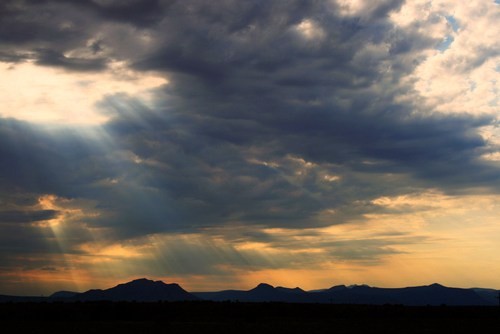
Sunset over the Langeberg. Looking towards Swellendam.

The sun was slanting away behind me sending long thin shadows down the slopes of the Langeberg as I drove past the sign post to Groot Vader’s Bosch.

I had jetted in to Cape Town from Durban that morning on a return pilgrimage to the farm, near Swellendam, where my ancestors, the Moodies, had first settled after their departure from the Orkney Islands, way back in the early 1800s. Ostensibly the purpose of my visit was to celebrate an important milestone birthday in my life with family and friends.

This was not, however, the only object of my journey.

I wanted to know more about the Moodies. I wanted to get a glimpse in to their lives and their thoughts and their feelings. I wanted to experience the sublime landscape they had settled in and try and see it through their eyes as well as my own.

The older I get the more fascinated I become with this stuff. It gives me a link, however tenuous, with my past and a society in some ways like ours, in other respects manifestly different.

On the trail of the Moodies – various family members and friends. Picture courtesy of Craig Scott.

I suspect there was another motive too. Maybe it was because, when the whole world seems under threat, it feels comforting to escape backwards.

Of course, things were not necessarily any safer or better back in those days. You only have to read any contemporary account of life in nineteenth century South Africa to realise they, too, faced their own peculiar set of challenges.

There were, for example, none of the comforts of modern travel. The sea voyage from Britain to Cape Town was a stomach-churning, gruelling, ordeal in those leaky, old, wooden, wave-tossed, sail boats, especially for those of a delicate constitution. In a letter home, dated August 1775, the Hon. Sophia Pigot (whose daughter would go on to marry an ancestor of mine) wrote “Lud! How weary one grows of salted meat. And of the Ocean too, I swear I am enamoured even of this monstrous queer-shaped Mountain flat as a Board after near four months of nothing but Water on every side”.

And if you were travelling on to India, like Sophia was, you still faced many more exhausting months at sea. The possibility of getting shipwrecked was something else you had to factor in to your calculations…

India was not, however, my area of concern. On this trip I wanted to follow up on a story which I had just scratched the surface of and which involved another ancestor of mine: John Wedderburn Moodie whose arrival in South Africa, exactly 200-years ago, I wanted to celebrate along with my own birthday. Even though I am descended from his elder brother, Benjamin, I have always felt a strange emotional bond with John Wedderburn.

Reading his book, Ten Years in South Africa I kept seeing bits of his character in myself. We even looked vaguely alike. In his struggle to create a new life on the African frontier, I also saw echoes of my parent’s attempts to tame their own wilderness back home in Rhodesia (now Zimbabwe).

Ten Years in South Africa is a delight to read. It is one of those books that appear as fresh and vivid now as on the day it was published. John was a gifted, observant, writer; intelligence and kindness go hand in hand with a keen sense of humour and a sharp – even satirical – eye.The book is full of interesting vignettes and insights in to the South Africa of the time.

Illustration from Ten Years in South Africa. Falling foul of an elephant.

While he obviously shared some of the prejudices of his class and era, he seems to have also possessed an instinctive feeling for the other side, displaying an almost anthropological interest in the country and its people which further endeared him to me.

John had originally joined his brother at Groot Vader’s Bosch in 1819. He was clearly taken with his new home among the mountains.

In front of the old, thatched, Dutch-style house, beyond a trim garden shaded by some towering trees, several fields of lush, green pasture-land shelved gently down to a small spruit concealed behind a wild tangle of briers, shrubbery and trees. Upstream the country grew increasingly hilly until, through a narrow cleft, the jagged blue outline of the Langeberg suddenly soared in to view.

Standing there, the day before my own birthday, I could easily see why the countryside had appealed to a man of John’s romantic sensibilities:

As may be supposed, amid scenes of such novelty and attraction to a young mind, many weeks elapsed before I felt much disposed to apply myself to any serious occupation. My brother, whose zest for the amusements of the country was renewed from sympathy, and not a little from the pleasure of showing his own proficiency in the language and manners of the colony, cordially entered in to my feelings, and scarcely a day passed that we did not ride out on some shooting excursion among the hills...”

They also paid courtesy calls on some of their Dutch neighbours, including one old Afrikaner towards whom John adapts a teasing, ironic tone:

Among the neighbours who we visited in the course of our rides in the vicinity of Groot Vader’s Bosch was an old man of the name of Botha. His house stood in a plain surrounded on all sides by high hills; and in front, towards the mountains, a scene met the eye which for wild and savage magnificence could hardly be exceeded in nature…Never was a man less live to the enjoyment of such scenery than Martinus Botha; nor could he conceive what pleasure we experienced in our contemplation. All that he knew or cared for was, that he had a constant run of water for his mill; but whether it came from a romantic chasm, or from a muddy lake, was to him a matter of the greatest indifference.”

A scene met they eye which for wild and savage magnificence could hardly be exceeded in nature…View from Groot Vader’s Bosch, looking in opposite direction to Swellendam.

Always on the look out for new opportunities, Benjamin and his two brothers would later trek up to the Eastern Frontier. Sir Rufane Donkin, who was Acting-Governor of the Cape in the absence of Lord Charles Somerset, had granted them land in the ceded territory between the Beka and Fish rivers, as well as a stake in the proposed new settlement of Fredericksburg which was to be situated just north of the present day Peddie.

When Somerset returned he took umbrage to these plans which had been made without his blessing and conflicted with his own ideas for the region. He immediately scuppered them.

By way of compensation the Moodie brothers were granted three farms in the Zuurveld, just south of the Bushmen’s River, namely: Long Hope (Benjamin), Kaba and Groot Vlei (John and Donald).

Kaba, the southernmost-property, is situated in a long, cigar-shaped valley which runs diagonally down to the sea. Standing on the apron of land between two hills, the turf as thick and spongy as a tended lawn, the two brothers could not believe their luck at having stumbled on this happy patch of ground. They were quick to appreciate its agricultural worth:

I have never met with any soil bearing such indisputable tokens of fertility as that of the Kaba, as this alluvial valley is called…” John enthused, “The level bottom was everywhere covered with rich vegetable mould, from one to three feet thick, containing land and sea shells in considerable quantities…Highly delighted with the appearance of this rich but lonely spot, we returned through the wood the same way we came, guiding ourselves by the tracks of our horses.”

The Kaba.

Groot Vlei, their other property, lies just to the north of this valley. Running parallel to the coastline between a sheltering ridge of hills on the one side and the large, active, Alexandria dune field on the seaward side, it consists of a series of wave-cut platforms which form a staircase-like feature down to the sea. As the sea-level has dropped relative to the land so the water table has dropped with it, leaving the whole valley dry except during rain.

Groot Vlei

Because of this problem John and Donald elected to build their home at Kaba which they nostalgically renamed Hoy after the island in the Orkney’s they had come from (it has since reverted to its original name) where there was a more plentiful supply of running water.

For a while the two brothers farmed together but then Donald began to spend more and more time away. The reason for his continued absences soon became apparent. While on a trip inland he had met and fallen in love with Eliza Sophia Pigot, daughter of one of the principal 1820 settlers. The two were married in 1824.

Thereafter Donald gave up farming, making use of his new family connections to secure the position of magistrate and Government Resident at the mouth of the Cowie river. In 1842 he and his family moved to Natal where he entered a career in politics eventually rising to the position of Colonial Secretary under Martin West, Natal’s first Lieutenant-Governor.

With Donald gone, John soldiered on alone first at Kaba and then Groot Vlei, to which he moved because he considered it a healthier spot.

Here he lived what he described as “a kind of Robinson Crusoe-life”. Separated by many miles from his nearest English-speaking neighbours, his farming operations limited by a lack of capital and the distance from the markets, the loneliness eventually got to him. Hungering for companionship he decided to return to England to look for a wife.

In England he met and married Susanna Strickland, one of six daughters in a close-knit, genteel, literary, if not very well-off Suffolk family who could have stepped out of the pages of a Jane Austen novel. With no career prospects in England, John was keen to return to Africa but his new bride had been put off by all his tales of lions, elephants and snakes and so the two eventually opted to settle in Canada, a place where the ever-optimistic John hoped “my exertions will meet with greater success”.

A young Susannna Moodie.

The reality was altogether different.

The most ‘English’ land had already been taken and so they were forced to head further north. The Canada they encountered here, in 1832, was a land of vast, gloomy, almost impenetrable forests broken up by swamps, rocky outcrops and clearings created by forest fires. In its own way it was every bit as wild and lonely as the African bush he had left behind.

The winters were bitterly cold and often the only sound they could hear in the icy dead of night was the howling of wolves. From the start their life was one long, exhausting struggle to survive in a harsh, unforgiving climate.

Susanna’s background, in particular, had hardly prepared her for such a life. She was painfully aware of her own inexperience, she made countless mistakes. Watching her trying to make the best of it, there must have been times when John longingly recalled the magnificent scenery and more agreeable climate of Groot Vader’s Bosch.

Eventually, like other rainbow-chasers before them, the Moodies would abandon the farming life and return to the comparative comforts of the streets.

Susanna Moodie would go on to become a Canadian literary icon. Her book Roughing it in the Bush, which described her experiences in the bleak north, is considered a classic. She and her sister, Catherine, are also the subject of author Charlotte Grey’s double biography Sisters in the Wilderness: The Lives of Susanna Moodie and Catherine Parr Trail which won the 2000 Libris award and became a national best-seller.

Among Susanna Moodie’s other admirers is Margaret Atwood, the author of a Handmaid’s Tale, who contributed an introduction to the 1986 edition of the book. Placing her with three other women writers, who were the first to produce much of anything resembling literature in Upper Canada, Attwood shrewedly observes that:“If Catherine Par Traill with her imperturbable practicality is what we would like to think we would be under the circumstances, Susanna Moodie is what we secretly suspect we would have been instead.”

Atwood also published a book of poetry, in 1970, titled The Journals of Susanna Moodie in which she adopted the voice of Moodie and attempted to imagine and convey Moodie’s feelings about life in the Canada of her era. It is regarded by many as her most fully realised volume of poetry and one of the great Canadian and feminist epics.

Back in the present, I decided I would pay my own little homage to John and his kin by immersing myself in the water – stained to the colour of a dark, red wine by all the fynbos it had passed through – of the same spruit he had described so lovingly in his book. It was icy cold. One dip and I felt my skin goosepimpling riotously.

Me – trying to purify my soul. Picture courtesy of Craig Scott.

I didn’t mind. There was something quite magical about the experience. I felt like I was being baptised in some sort of purifying, healing, sacred pool.

Standing there, shivering, in that hallowed spot, under the lowering majesty of the Langeberg range I felt a special linking of the spirits – that of the land, John Wedderburn’s and mine….

GALLERY:

Some more scenes from Groot Vader’s Bosch:

Below are some pics of us celebrating my birthday, as well as the 200th anniversary of the arrival of John Wedderburn Moodie in South Africa. The party was held at Honeywood Farm which adjoins Groot Vader’s Bosch and also belongs to the Moodies. While I was there I managed to spot some unusual birds as well (the theme of the celebration was Birds of a Feather):

BIBLIOGRAPHY:

Burrows, Edmund H – Overberg Outspan.

Burrows, Edmund H – The Moodies of Melsetter.

Miller, Maskew – Dark Bright Land.

Moodie, John Wedderburn – Ten Years in South Africa.

The Gardening Bug

You know you are getting a little long in the tooth when you start referring to your youth as “back in those days” – as if they were, somehow, inherently different to the present. In some ways they were.

For a start, the country I was born in had a different name and we were still living in the ‘British Colonial Era’, an era now rapidly becoming distant history. Because we lived before the modern age of mass consumerism our attitude to the subject of food wasn’t quite the same either.

Waste was frowned on so we were more careful about what we did with what we ate. We planned ahead. We paid attention to the little things. We made the most of what we had and were thankful for what we got.

Thrifty to a fault, my parents, for example, did not believe in paying good money for what we could produce or grow ourselves. Because of this, one of their first priorities when we moved out to our farm, Nyangui, in Nyanga North, was to establish a vegetable garden. From its unpromising, heavy clay soils Devite, our gardener who had come with us from Salisbury (now Harare), would do his best to coax cabbages, cauliflower, spinach, radish, carrots, lettuces, rhubarb, beans, peas, onions, asparagus, strawberries, gooseberries etc.

Our garden at Nyangui. Veg garden in front, house and flower garden (concealed) behind. Mt Muozi in background.

I also planted lots of fruit trees including citrus, guavas, peach and mangoes. Later, I would go on to create my own vineyard on the other side of the river.

Bent on self-sufficiency, we would further supplement the table by keeping chickens for eggs and for eating and a small herd of dairy cows which Devite’s other duty was to milk. The manure they provided was, in turn, used to fertilise our garden.

We were practising permaculture before the term was even thought of.

I think my mother would have disapproved of today’s throwaway society. Bought up in an era of war-time rationing and austerity, she did not believe in letting anything go to waste. Everything that could not be used immediately had to be preserved.

Our bathroom doubled up as a pantry with shelf upon shelf packed solid with bottled fruit and vegetables, pickles, home-made jams etc. Some of these bottles would remain unopened for years.

Besides growing our own fruit (mostly sub-tropical) we also had easy access to the Nyanga orchards. My father quickly became friends with Bud Payne, who was in charge of the Nyanga Experimental Station. He kept us well supplied with the most delicious, mouth-watering, deciduous fruit and charged us next to nothing for it.

Maybe my taste buds have dulled down over the years but the fruit you buy in the shops these days just doesn’t seem to have the same taste it did back then (although I suspect it may have to do something with the fact that the fruit is now mostly picked before it is properly ripe and then kept in cold storage). There also seem to be fewer varieties available – what has happened, for example, to all the Muscat types of grape with their excitingly aromatic taste? Is it that these particular species just don’t produce enough fruit and are therefore deemed economically unsuitable?

With so much modern fruit carefully bred to appeal to consumers reared on a sugary diet, I even find myself wondering if it is as nutritious as it used to be?

Busy as she always was there was one other thing my mother always found time to do – create and maintain a flower garden. She was quintessentially English in this respect, believing that wherever she went a large, well-tended garden was an essential part of the family.

The one she designed at Nyangui sprawled over the side of the hill near the front our house and contained a mixture of exotic and indigenous plants. It was watered by the same furrow that fed our hydraulic ram.

On my walks across the countryside I would always be on the lookout for orchids and wild lilies and aloes and other wild flowers I could bring home for her.

My close relationship with the earth changed when I decided to become a city-dweller. I stopped growing my own food or raising it in the form of an animal or a bird. Instead I started going to the place the food is – mostly the local supermarket

I didn’t hoard stuff like my mother and father did in the event of what they liked to call “a rainy day”. I lost my connection with the dirt and the dust.

Life has a funny habit, though, of not letting you forget your roots.

In 2017 I found myself living on a farm overlooking the Karkloof. I suddenly had the two things my adult life had previously lacked – time and lots of land. The temptation was too great to resist. I felt that old familiar stirring. My gardening bug was back!

The gardens I created weren’t exact carbon copies of those of my youth. There was a slight shift in emphasis.

Unlike the reckless, uncaring, denialist-in-chief who sits in the Oval Office I do believe in climate change – or at least I am not willing to take the chance it is all a hoax. I wanted to do my bit to counter it. I planted lots of indigenous trees on the hillside above my house – stinkwood, bushwillow, yellowwood, sneezewood, boer-bean, wild pear, cat thorn, knobwood, tree fuschia, fever trees, paper-barked thorn, sweet thorn and a lot more besides.

I wanted to create a light ecological footprint, as the Greens folk say.

Probably the greatest difference between now and then was that, for the first time in my life, I decided to venture in to my mother’s domain by creating a full-scale flower garden (rather than just having a few pot plants scattered on my verandah). Taking my cue from her I tried to make it as natural and informal as possible blending the plants and shrubs and flowers in with the copious amounts of rock we have (mostly dolerite) scattered all over the property.

My flower garden

In addition to the indigenous trees, I put in lots of aloes (including Aloe ferox, marlothi, cooperii and arborscens) to give colour to the garden in winter and provide a food source for the sunbirds and other nectar-lovers. The owners of Kusane farm, William and Karen, also built a few ponds, in one of which I put some Banded Tilapia (Tilapia sparrmanii) which Michael, the farm manager had caught in a local dam.

Black-headed Oriole in Aloe ferox.

There were other areas in which my approach to gardening underwent a fundamental change.

When we started farming in Rhodesia (now Zimbabwe), the age of full blown pesticides had just arrived. Not knowing any better I happily sprayed the muck all over my vines and fruit trees.

The effect of these poisons on humans – and the whole environment for that matter – was, of course, not fully understood back in those days (yes! I’ve said it again!).

Now I know better. I am aware of the dangers and avoid using them. This was another reason I wanted to grow my own vegetables. I wanted to be sure I was not shovelling carcinogens and other poisonous chemicals down my gullet.

My first onion crop.

For similar reasons, I also chose not to use inorganic fertilizer but instead made use of all the manure produced by the chickens and William and Karens two sheep, Harriet and Mara.

The Kusane hens – examining the effects their manure has on plant growth.

It has been a lot of hard work but I have found it very satisfying, even therapeutic.

Although I haven’t got around to bottling any fruit just yet, I like to think my parents, if they were alive, would approve….

Looking for Connections at Groot Vader’s Bosch

As a child growing up in the late fifties and early sixties, I remember being told stories about my Scottish ancestors, the Moodies. At the time they didn’t have much meaning for me. My youthful eyes and mind were saturated with the world I saw immediately around me. The family tree could wait until later.

Later came, sooner than expected. Suddenly those stories began to gain resonance. I guess it is an age thing. When you are a child knowing who fits in where or how you got from there to here is of no real consequence.

That changes as you grow older. Suddenly aware that time is breathing down your neck, you start feeling this urge to go back and delve in to the past, to rediscover your roots and to explore your ancestry in all its intricate twists and turns.

It is certainly a subject which appears to have occupied my sister Penny’s mind, perhaps because she is a Social Anthropologist with an interest in ancestor belief. While lecturing at Rhodes University, in Grahamstown, she did some research in to our family line and discovered the location of the farm where the Moodies had first settled when they arrived in the Western Cape.

How they got to be there happened like this. In 1815 Benjamin Moodie, the eldest son of James, the 9th Laird of Melsetter on the Orkney Islands, had inherited the family manor house and estate and, with it, all the accumulated family debts. There seemed no way of extricating himself from this financial mess other than by selling off the ancestral seat. This he reluctantly decided to do.

The ancestral seat of the Moodies at Melsetter, Isle of Hoy, Orkney Islands. Picture courtesy of Penny Bernard.

Having performed this sorrowful duty he felt the need to make a fresh start. Casting his his eyes around for a new country to light out to he settled on the Cape of Good Hope because it seemed “the most likely colony in which he could attain an independent livelihood with a less violent alteration in his habits than might be expected of most persons.”

Benjamin arrived in the Cape full of ideas on how to create a new society on the empty land. In his mind he seems to have imagined a reborn feudal Scotland rising out of the dry African veld with himself restored to his rightful role of Lord of the Manor.

It didn’t turn out quite like that.

No sooner had he landed then all his grandiose plans began to unravel. Most of the 200-odd artisans he had bought over with him to form the nucleus of his new community promptly deserted him, the help he had countered on receiving from the government was not forthcoming and his business partner let him down. For their part local Cape community greeted his whole emigration scheme with bemused scepticism.

There was something rather romantic and audacious and wildly impractical about Benjamin Moodie’s dream, so when Penny announced that she intended to make a journey to the farm on which he settled in the Overberg and asked if I would like to join her I signed up on the dot.

Captain Benjamin Moodie, 9th Laird of Melsetter, Orkney Islands.

On one level my pilgrimage – if it can be called that – was undertaken for my parents, two pioneering individualists in their own right. I wanted to go where they had been unable to go, stand where they had never stood and then bring back some sort of relic or memento to prove that I had honoured their memory (in the end, I settled for a bottle of farm honey).

Tumbled cloud occupied much of the sky as we set out from Cape Town, with rain threatening. For much of our journey we found ourselves chasing a large rainbow which arched over the road like some sort of welcoming celestial escort. Penny was quick to see the significance: “It’s the ancestral spirits come to guide us home!”. Even I, a man of no fixed faith or conviction, wanted to believe this was true.

Back in 1817 the journey from Cape Town to the farm had been a long, hot, dusty, arduous, one, taking many days and involved scaling, on horseback, the ragged peaks of the Hottentot’s Holland mountain range. Today it take three-hours on the N3.

Groot Vader’s Bosch (literally “Grandfather’s Wood”. It was named in honour of Roelof Oelofse who owned the land in 1723), where Benjamin Moodie first settled, is situated about 25 kilometres east of Swellendam on the slopes of the Langeberg. John Wedderburn Moodie, who followed his elder brother out to South Africa, described this last leg of the journey in his book Ten Years in South Africa

Our course skirted the base of these mountains which in height, as well as beauty of form, exceeded anything we had yet witnessed in African scenery. I had already noticed the progressive improvement in the verdure of the country the further we advanced eastwards. The tract between Swellendam and Groot Vader’s Bosch suddenly assumed a new character; and the grass that clothed the narrow valley between the mountains and the lower range of hills to the right of the road, though far inferior to that of our English pastures, was of a fresher green and a more succulent description than any we had yet seen.

The Langeberg. View towards Swellendam.

As we crossed over the farm boundary I could feel a sudden heightening of my own emotions. An emigrant to South Africa myself, I had often felt short of roots and reasons. Coming to Groot Vader’s Bosch was my way of trying to find a point of connection. I hoped to lay a few old ghosts to rest – and perhaps stir up a few new ones – and come to terms with my own belated movement south.

Benjamin Moodies’ farm originally consisted of over 20 000 acres of land and stretched clear to the top of the Langeberg. Over the years it has, however, been subdivided and parcelled off among his descendants while other parts have been sold off to stave off the creditors.

Through a peculiar accident of geology, the upper portions are covered by a thick pelt of indigenous forest, a characteristic which renders it quite distinct from the rest of the range which is mostly treeless. The ready supply of timber made it a very attractive destination for the early Trek Boers. If you hunt around you can still find the remains of their simple, sun-baked clay brick houses, some dating back to the 1720s.

Now protected, this forest – the largest west of Knysna – forms part of the Groot Vader’s Bosch Reserve and Wilderness Area and is, among other things, a popular destination for birders. The Knysna Woodpecker, Victorin’s Warbler, Cape Siskin and Orange-bellied Sunbird all occur here.

The Langeberg at Groot Vader’s Bosch. The indigenous forest is in the valley below.

Penny had arranged for us to stay on Honeywood Farm a sub-division of the original estate – whose present owner, John Moodie, keeps bees and cattle, as well as renting out holiday cottages. She had put in a special request to him that we be allowed to stay in Quince Cottage because its name reminded her of our mother, Monica.

John, himself, turned out to be the most obliging of hosts, taking time off to show us around the farm and arranging for us to visit the original Groot Vader’s Bisch homestead on the next door farm which belonged to his cousin, Keith.

His father, then a remarkably sprightly 92-year old who everybody simply referred to as “The General”, still lived on the farm at that stage.
An interesting person in his own right, he had once served as SA Army Chief of Staff and as a military attaché in Switzerland. The treasured family heirlooms had been entrusted to his care.

These included a “silver headed double gilt and richly ornamented Turkish scimitar, stiletto and a Field Marshall’s baton of some quality and style” (Burrows) presented to James, Seventh Laird of Melsetter, by a grateful King Charles of Spain for his role in relieving the siege of Diena during the Spanish War of Succession. There is also the original letter of commendation which King Charles sent to Queen Anne telling her of James services.

Another treasured possession was a large studio portrait of the venerable James, executed on orders of the Queen herself by the royal court painter. With his this, aquiline features, I could see a strong family resemblance between him and “The General”.

The gathering clouds eventually disgorged themselves during the night bringing much needed relief after a long, dry, spell, in the district. I rose early the next morning and went for a walk. On my right the mountains stretched off in to the blue distance. Above them ragged slivers of light cut through the clouds; below them the whole Swellendam Valley was laid out like a relief map in brilliant acrylic colours.

When John Wedderburn Moodie came riding up this valley he had also been enraptured by the scenes that greeted him, describing, in poetic detail, how he had encountered numerous groups of Khoikhoi maidens bathing in the tree-lined pools along the river.

The stream which caught JW Moodie’s fancy…

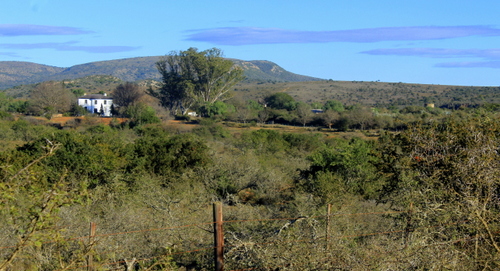
There were no such scenes to greet us when we followed the same river but our first view of the house in which Benjamin lived was, however, no less exciting for that.

Built in the latter half of the 18th century by Jacobus Steyn, Groot Vader’s Bosch is reputed to be the oldest original farmhouse still standing in tthe Overberg. In a departure from the norm it was built without the usual elaborate end-gables, so typical of the period and so beloved by generations of South African landscape painters. It is a distinction it shares with only two other buildings in the district – the famous Drostdy in Swellendam and Westfield, Benjamin Moodie’s other property near Port Beaufort which he built in 1820 and which he modelled on Groot Vader’s Bosch..

Groot Vader’s Bosch. Front view.

Constructed largely from local materials, it was a house built to last; to be handed down to grandchildren to grow up in and farm in turn. Its posts, beams and floorboards came from the hardwood forests in the nearby hills, its roof was shaggily thatched with local grass, the mud bricks for its walls manufactured on site.

Despite its strictly utilitarian character design, it is still an imposing building, one which must have seemed a worthy successor to the old manor house the Moodie’s left behind in Scotland.

Inside the old co-existed convivially with the new. Although there were plenty of reminders of its history there was none of that self-conscious reverence for the past you get in some stately old homes. This was still a working house on a working farm and exuded a warm, comfortable, unassuming, lived-in feel.

Groot Vader’s Bosch. Side view.

In the front of the house, beyond a trim garden shaded by some towering trees, several fields of lush pasture-land shelved gently down to a small spruit concealed behind a wild tangle of briers. Upstream the country grew increasing broken and hilly until, through a narrow cleft, the mountains soared in to view.

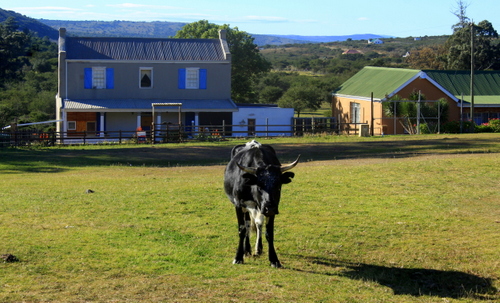
Only a few metres from the house is a long, low-roofed sprawling where they milk their herd of dairy cows. As we rounded the building we were met by a scurry of wings: swallows had built their mud nests under the eaves. Some of them looked like they had been there as long as the dairy which is even older than the main house.

Dairy cows. Groot Vader’s Bosch.

In Benjamin Moodie’s time there had evidently been been an orchard and a vineyard which yielded “seven or eight leaguers of indifferent wine, and about a leaguer of tolerable brandy”. Above the house there is a little hilltop cemetery in which generations of Moodies lie buried.

Later, back at Quince Cottage, I wandered outside under the clear night sky and thought about the happy impulse which had brought me here. Although this was my first visit there was a familiarity about the surroundings I found slightly disconcerting. Perhaps it was because the mountains seemed to echo the ones I had grown up amongst in Nyanga; perhaps it had something to do with a deeper, collective, memory. I wasn’t quite clear myself.

Whatever the answer was to this conundrum I was glad I had come. It was good to be able to add a bit of flesh to the bare bones of family history; to have gone back and seen where our African adventure started…

Footnote: my family is descended, on my father’s mother’s side, from Benjamin’s first-born son, James. For some reason, lost in the mists of time, he was disinherited which meant Groot Vader’s Bosch was inherited by the second son and was passed down to his descendants.

Remembering Reg – A Tribute to my Father, Wing Commander R.N.Stidolph DFC

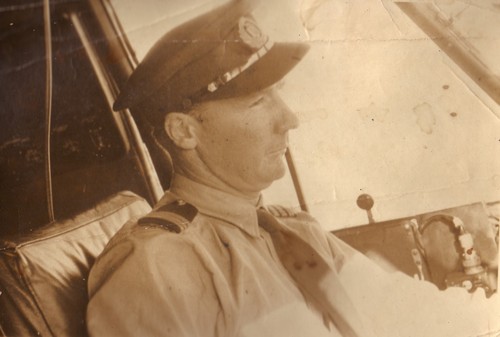
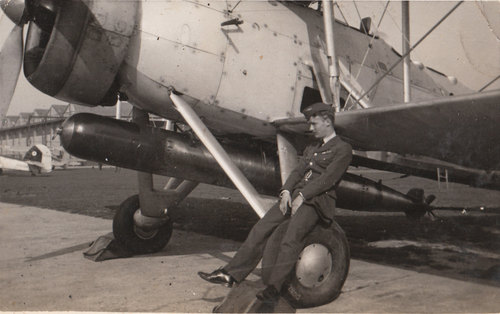
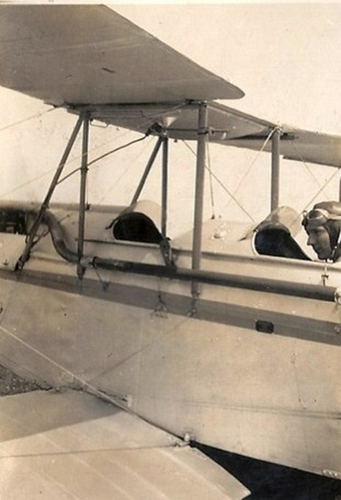
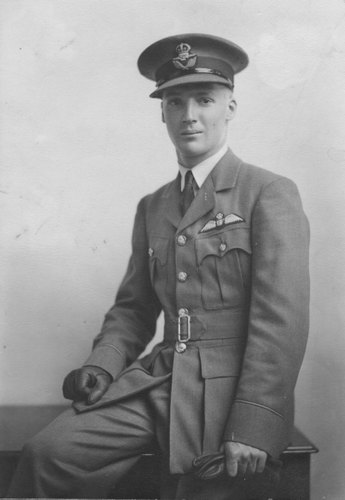
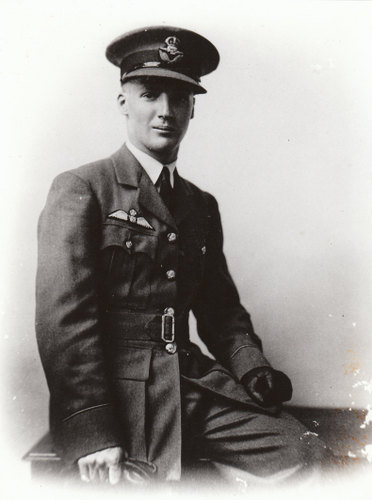
My father, Wing Commander Reginald Neville Stidolph, in RAF.

QUOTE: I could ask, ‘Why risk it?’ as I have been asked since, and I could answer, ‘Each to his element.’ By his nature a sailor must sail, a flyer must fly.

Beryl Markham on why she flew across the Atlantic to America (West With the Night)

xxx

During my teenage years, when we were living in the back of beyond, in Nyanga North, my father was seldom at home.

This was because the small amount of capital he had used to establish our farm was nearly exhausted. After several years of struggle against drought, disease, crop failure, packs of ravenous hyena, a pride of lion and the Land Bank, he had come to the realization that the only way to avoid getting deeper in to debt was for him to return to his old job – flying aeroplanes – leaving my mother behind to struggle on as best she could without him.

For the next seven-years my father all but disappeared out of our lives; the only communication, besides a monthly cheque, being the occasional scribbled letter from such exotic, far-off locations as the Persian Gulf, Sudan and Sierra Leone.

Although he was not present in the flesh, he was always there in spirit. The farm had been his dream and by working it, my mother and the rest of us children were, in a sense, living it for him.

By the time he finally returned home, I had already left school and gone to university. Because of this I still did not see a great deal of him although I did sometimes go and stay with him during my holidays when he was working for WENELA, based in Francistown, Botswana.

I came to love these visits especially because my father would usually arrange to take me up in the air with him. I would take an old camp chair and a Thermos of tea and sit up in the cockpit of the old DC3 or DC4 where I had an eagle’s view over the ground below.

Botswana is a country in which distances seem endless. Flying across the sparsely inhabited landscape, the plains stretch out for miles and miles and you really get to see how huge the Kalahari, Makgadikgadi Pans and Okavango Swamps are.

The droning engines. Flying over the Okavango Swamps in December 1970. Picture courtesy of Pete Stidolph.

There was something wonderful about flying in those jolting, rickety, oil-leaking old planes with their loud, droning engines. This was air travel before they took the edge and excitement out of it.

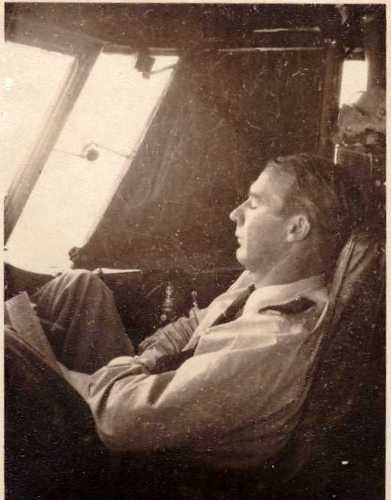
Being at the controls was so second nature to my father that he used to switch on to auto-pilot and sleep for most of the journey. Amazingly, he always knew exactly when to wake up.

Snooze time…


Not every flight went according to schedule. I remember the one time we had to change direction because a solid wall of angry, dark, rain clouds was advancing towards us at rapid speed with huge bolts of lightning slashing angrily out below them.

Storm over Botswana. Picture courtesy of Pete Stidolph.

We managed to outrun the full force of the storm, landing in Francistown just as it hit us. “I think we need a beer after that!” my father said, once we were safely inside the hangar, so we jumped in to his car and sped off to the Horseshoe Bar, just opposite the station in to which the old steam trains came puffing.

Flying in such conditions certainly provided its own unique set of challenges. On another occasion, a rhino came thundering on to the dirt airstrip, in a maelstrom of dust, just as we were about to touch down at Shakawe, at the northern tip of the Swamps, forcing my father to pull the plane’s nose back up in to the air.

It is not something I could imagine happening at, say, Heathrow or JFK Airport…

Sadly, it was only right at the end of his life that I began to spend a lot of time with my father and got to understand him better. He was retired and living with my mother on Bowmont, a small farm in the Midlands area. In the years that remained to him he was to suffer agonies from multiple myeloma (or myelomatosis), a particularly vicious strain of cancer that attacked his bones and caused them to disintegrate.

I had a job in nearby Gwelo (now Gweru) so I used to motor up most weekends to make sure they were okay. Eventually, I resigned and moved on to the farm full time.

In a strange way his illness brought us closer together.

As a child I had always been slightly in awe of my father. To me he was this outgoing, glamorous, figure who flew aeroplanes and for large tracts of time had been absent from my life, working in distant locations that I only knew as places on a map.

His life had all the ingredients an impressionable young boy could ask for – plot, action, adventure, a dashing hero. What I didn’t realise back then was that he never saw it quite like that. Nor did I fully understand the impact the war had on him.

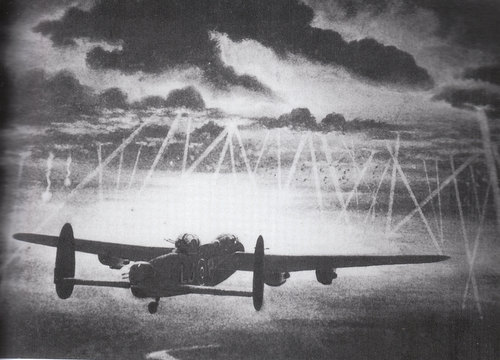
Perhaps it was his awareness that he would not last much longer or maybe it was the fact that I was now a serving soldier myself but for the first time in his life he began to open up about his experiences as a bomber pilot during the war. He talked about what it was like flying at night in slow, heavy bombers and being picked up in the lattice of searchlights and being strafed by the German anti-aircraft guns. He told me about the fear and how he had always tried to fly higher than everybody else in the hope that it would make it more difficult for the Germans to shoot him down.

He had served in all the major theatres of the war.

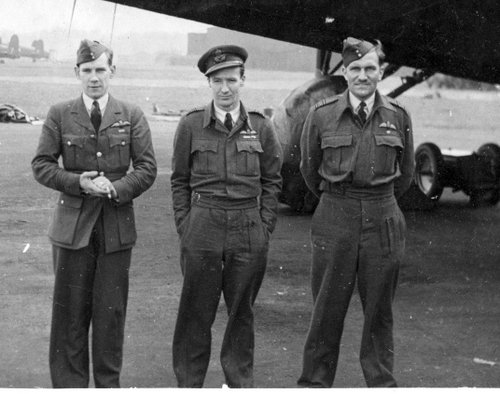
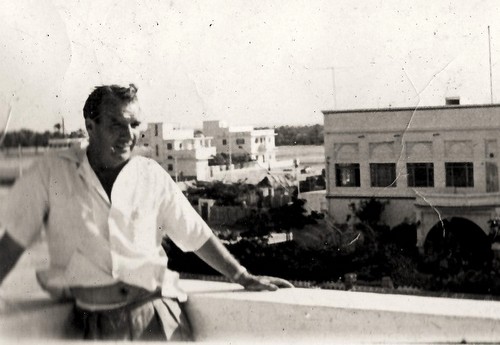
Starting off as a Flight Lieutenant he was promoted to Wing Commander in August 1941, an enormous responsibility to be placed on the shoulders of a young man still in his early twenties and one which must have forced him to mature at a very rapid rate. As the officer commanding 113 Squadron he saw action in North Africa and was also stationed, for a while, on Malta. At Giarabub (Italian for Jarabub), a remote oasis in the eastern Libyan desert, he got a taste of what it was like to be on the receiving end when his squadron and ground crew were bombed by the Luftwaffe while they were living among the gullies and wadis (see pic below).

In December 1941, he led the first group of bomber planes on the long flight to Burma, arriving there just as the unstoppable Japanese army was about to begin its long sweep through Malaya, Singapore and Hong Kong; even crossing the borders of India itself.

The road to Mandalay, Burma. My father seated.

His exploits in the area did not go unnoticed. He gets a mention in the book Retreat in the East by O.D.Gallagher, who was the London Daily Express’s war correspondent in Malaya and Burma (published by George Harrop, 1942). The author flew with my father on one of his missions. He also appears, together with other members of 113 Squadron, in a 22nd February, 1942, British Paramount newsreel (“Burma Blenheim Bomber Boys Part 1”) covering the retreat.

I only recently got to see this news clip. It felt quite strange looking down the long passage of time and seeing my father as a young man, surrounded by his crew. They all looked tanned and fit in their khaki outfits and surprisingly relaxed, given the hammering the British were taking, but also a little self-conscious, pinning their smiles on for the benefit of the cameraman.

After his stint in the Far East he returned to Bomber Command and took part in some of the big raids over Europe. Among them was one which the Times of London, on November 20, 1943, described as the largest ever over Berlin: “In half an hour a great force of Lancasters dropped more than 350 4,000lb block-busters on the German capital, in addition to a great weight of incendiary bombs”. A total of 32 bombers were lost.

One of the many planes he flew was the legendary “Just Jane” which would go on to complete a total of 123 sorties. It was only one of 35 Lancasters to achieve the “Ton-Up” mile-stone during the war. It is included in the book Ton-up Lancs: A Photographic History of the 35 Lancasters That Each Completed 100 Sorties by Norman Franks (Published by Bounty Books).

He is also mentioned in Bruce Barrymore Halpenny’s Action Stations 2: Military airfields of Lincolnshire and the East Midlands while the same author devotes an entire chapter – headed A Rhodesian’s adventure over Stettin – to his exploits in To Shatter the Sky: Bomber Airfield at War (Published by Patrick Stephens Cambridge).

There is another, later, film by British Pathe (“Berlin Raids 1943”) which features an interview with my father, this one taken after he had just returned from leading a huge bombing raid on Berlin. It tells a different story to the earlier newsreel. You can see from his eyes that the strain of the war has begun to take its toll, the smiles have all gone and there is a faint tremor in his voice as he talks.

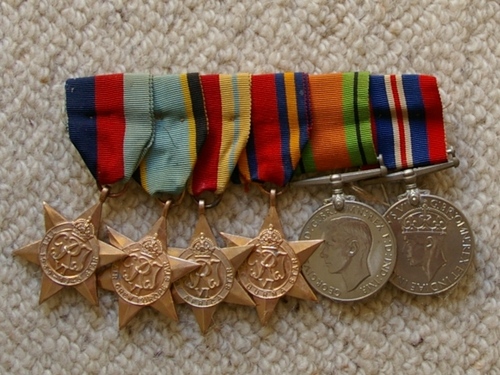
He was awarded the Distinguished Flying Cross for bringing his badly shot-up Lancaster safely back to England (see citation below*) after a bomb drop over Stettin. It warranted a story in the Rhodesia Herald back home.

Sitting listening to him talking about those times I began to get a glimpse of what it must have been like, piloting a four-engined Lancaster, taxi-ing down the runway and then lurching off into the dark, rainy night and heading out across the channel to drop thousands of tons worth of bombs on some heavily defended target. In the back of his mind there must have always been the fear he might not return or see his family again.

He was, in fact, one of the exceptionally luck ones who did survive the war – virtually every other pilot on his officers’ training course was killed in action.

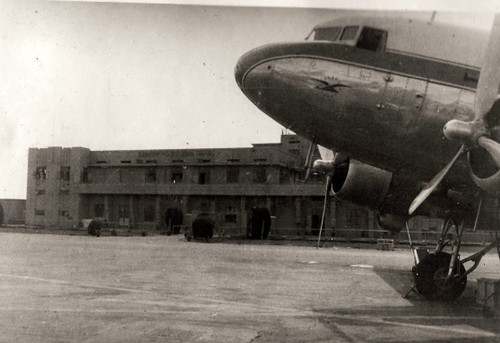
By any standards he lived a full life. At the end of the war, as part of the Berlin Airlift, he started flying a plane that was already a legend and remains so today – the DC3 or Douglas Dakota. Considered a reliable old warhorse it was a plane that would play a large part in and shape his future.

After demobilisation he returned to Southern Rhodesia and become a commercial pilot working for Central African Airways flying both inside and outside the country.

In those days the flight from Salisbury to London took six-days and by the end of it a strong sense of comradeship had invariably developed between passengers and crew.

He resigned from CAA in 1956 after a dispute and joined Hunting Clan Airways, principally flying within Southern Rhodesia and further afield to Tanzania, Kenya, Mozambique and South Africa. My main memory of those days is him returning home from Vilanculos in Mozambique weighed down with big demijohns of Portuguese wine, coconuts and apple boxes full of fresh crab.

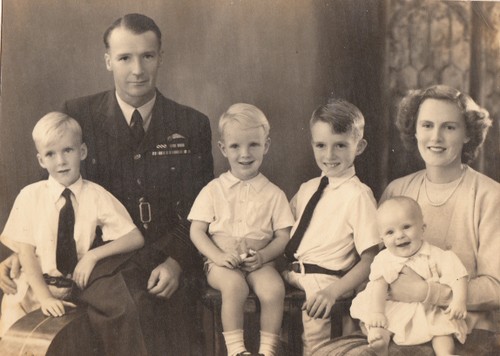
With young family – from left: Paul, Peter, Patrick, Anthony.

As an airman he lived in a more swashbuckling era when commercial aviation was still in its infancy and few people thought of going by plane, the majority opting to travel by ship. Flying in and out of dusty, fly-infected airfields in those rattling, bouncy, propeller-driven crates with a minimum of on-board comforts and only limited navigation aids it was an adventure.

It was a lifestyle which certainly suited my father. A non-conformist in a uniform, who somehow managed to combine a strong sense of duty with an inate rebelliousness, he never cared much for the rigidly scheduled, heavily regulated industry flying was to become with planes cruising in the stratosphere with hundreds of passengers, air-conditioning, on-flight movies and pre-prepared meals.

He was, however, very excited by his late conversion to flying jets.

As a pilot he had gone where he wanted, he had travelled the length and breadth of the continent in the days before Rhodesia had become a pariah state, cut off from the rest of the world and when Africa was still accessible to all. Equally at home gambling in a casino on the French Riviera or marooned on some remote frontier, he liked solitude and rough living but also good company, friends, good food and drink and laughter.

You never knew who you might find breakfasting in the kitchen after a night out at the local pub. One such person was an engineer named John Louch who needed a place to stay for the night and ended up living in our Francistown house for two-years.

He was good at what he did and his colleagues always talked with reverence of Dad’s flying skills. It was easy to understand why my mother had been so attracted to him when she had first met him as a young flight officer fresh out from Rhodesia. In her memoirs, she recalls how she had lived all her life in country villages “not knowing any boys, let alone glamorous young men”.

Equally smitten with the shy but beautiful young English rose, my father went out of his way to impress, even going so far as to swoop down low over her school in his open cockpit bi-plane – a highly illegal act – while she was playing netball, causing her to fall and graze her knee. Handsome, ebullient and full of life, he was a born optimist with a natural talent for minimising life’s problems and a great faith in his own ability to get a job done.

My father (briefly sporting a moustache) and mother, Wing Commander and Mrs Stidolph.

He had charm, wit and sparkle. He could also be irritable, quick tempered, impetuous, tactless and impatient – personality traits which, I suspect, could be partly traced back to the accumalative stress of flying on so many dangerous missions during the war.

Beneath his jovial, practical, no nonsense, manner and intolerance of dull people and wishy-washy thinking, lay a vein of creativeness which found expression in his, at times, rather Heath Robinson inventions and in fixing up dilapidated old cars (he didn’t buy second hand, more like – tenth hand).

His creativity did not end there. In his early years he had dabbled in oil paintings – one of his pictures (of a demijohn of wine) hung on the wall of every house we ever lived in. It was rather good.

I didn’t realise until after he died and I got to read some of the poignant letters he had written home to my mother that he had also once harboured ambitions to be a writer. That he had a talent for it is certainly born out in a wonderfully evocative piece he wrote titled: A Trip from Muscat through Oman to Qatar in the Persian Gulf.

Despite his foray in to farming he remained first and last a pilot. From an early age he had been obsessed with the romance of flying and the sound of humming propellors – even defying his father’s orders by signing up with the RAF before the war– and it was here he really made his mark. During his career he completed 23,817 hours of flying over 42-years, including over 20,000 hours in command. He flew 48 types of aircraft for eight organisations on three continents in 44 countries. He landed in over 350 different airfield.

To the end he remained very much his own man and, despite his illness, still retained something of his old zest for life and vitality. He was larger-than-life, one of a kind, a bit of a legend.

Like his beloved Dakotas, they don’t make them like that any more…

* The award was gazetted on the 25 January 1944 (Issue 36346, pages 481 – 482) and reads:

Distinguished Flying Cross.

Wing Commander Reginald Neville Stidolph (375I3). Reserve of Air Force Officers, No. 61 Squadron.
One night in January, 1944, this officer was the pilot of an aircraft detailed to attack Stettin. Soon after bombing the target the aircraft was attacked by a fighter. The enemy aircraft was eventually driven off, however, and was seen to dive steeply smoke pouring from one of its engines. In the encounter, Wing Commander Stidolph’s aircraft sustained extensive damage, making it extremely hard to control; 1 engine was also rendered useless and had to be feathered. In spite of this Wing Commander Stidolph flew the disabled aircraft to an airfield in this country and effected a safe landing. He displayed skill, courage and resolution of a high order. This officer has completed very many attacks against targets such as Berlin, Hamburg and Dusseldorf.

The above are three of the squadrons my father served in and whose badges hang on my wall. There were others…

GALLERY:

(1) My father joined the RAF, before the war, in November 1935 and served right through to its end in 1945. Here are more some photographs from that period.

(2) From March, 1960, to about February, 1966 my father worked outside the country, based, in turn, at Bahrein in the Persian Gulf, Sierra Leone and in Khartoum where he was employed by Sudan Airways.The following photos come from this period of his life:


ACKNOWLEDGEMENTS: A special thanks to my brother, Patrick, whose extensive research in to my father’s flying career I have been able to draw on here. Pat’s research now forms part of the No50 and No61 Squadron Association official record.It was Patrick who also drew my attention to an article written by Ross Dix-Peek about my father’s war-time career.

Something Rotten in Msunduzi: Cartoons For July and August, 2019:

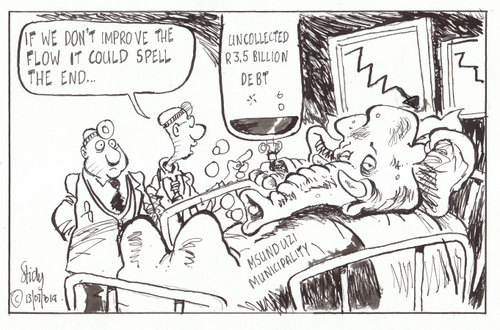
SUMMARY: Pietermaritzburg’s woes continued with the municipality calling for urgent action to be taken to deal with the City’s runaway debtor’s book, which has run to more than R3,5 billion.

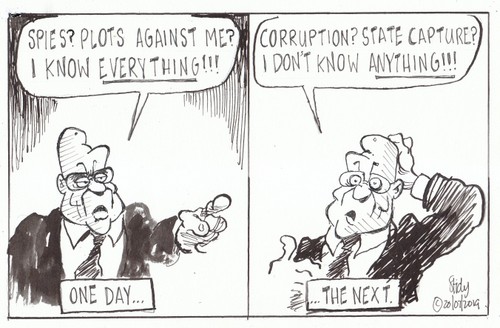
Former president, Jacob Zuma, made his underwhelming appearance before the Zondo Commission of Inquiry in to state capture, largely repeating what he has been saying for years – it is all a plot, there are spies afoot, there is no such thing as state capture.

Across the sea, Boris Johnson, the Brexiteer who has promised to lead Britain out of the European Union with or without a deal by the end of October, was elected to replace Theresa May as prime minister after winning the leadership of the Conservative Party.

The eThekwini Municipality finally owned up to the fact that Durban’s R170 million infrastructure projects have been wrecked by so-called “business forums” who have been extorting businesses for years. The MEC for Economic Development, Tourism and Environment Affairs, Nomusa Dube-Ncube told the legislature that the government will “deal” with these business forums – many of whom were allies of the state capture faction of the ANC.

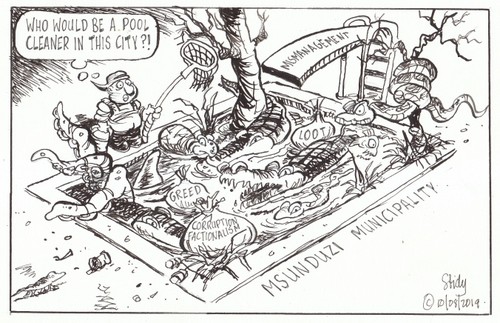
Even closer to home, a task team set up by the ANC to investigate the ongoing shenanigans in the Msunduzi Municipality, recommended the entire municipal top brass be axed including Mayor Themba Njilo. As if to emphasise the extent of the rot, the very next day it was revealed that the KZN Hawks were investigating a case of fraud against City officials over a R45 million swimming pool tender.

The following week the Msunduzi Municipality found itself without political leadership as the ANC Provincial Executive Committee (PEC), acting on its task team’s recommendation, duly removed the mayor and the entire executive committee (Exco).

The gap was later filled when the ANC KwaZulu-Natal leadership announced former Msunduzi councillor Mzimkulu Thebola as the new mayor of the municipality. The appointment of the relatively unknown Thebola was made on the back of speculation that the problems with the region and Msunduzi ANC caucus had resulted in high profile candidates declining to take the Msunduzi mayoral position.

I decided to end the month by tackling a subject very close to my heart – the environment. In this respect, it was a bad week for Pietermaritzburg with toxic effluent being spilled in to the Duzi river, toxic fumes being discharged in to the air from the burning municipal landfill site and uncollected rubbish left lying on the streets.

For the purposes of my cartoon, however, I chose to have a go at the denialist-in-chief, US President Donald Trump…

In The Shadow of Mount Muozi

Mount Muozi, in whose shadow I grew up.

When it comes to mountains I am with the ancient Greeks – I believe they are the right and proper dwelling place for the Gods. My own sense of awe and wonderment when in their presence stems, in large part, from my childhood experiences on our farm, Nyangui, which lay at the very end of The Old Dutch Settlement Road, in Nyanga North, Rhodesia (now Zimbabwe).

The mountain range which ran along our eastern boundary was shrouded in legend and was dominated by Mt Muozi, a steep, semi-detached peak attached to the main Nyanga plateau by a narrow saddle. Looking like some great fortress and frequently masked by cloud, it played a pivotal role in local belief system.

To the Saunyama people, who live nearby, Muozi had always been an extremely sacred site, harbouring a protective, if somewhat touchy, deity through whom all life was cycled and who had an important influence over both their lives and the weather. Upset it and you would be punished with the curse of no rain; give it the proper respect and make the right offerings, your crops would flourish and all would be well.

In an area where every stream, knoll, rock, cranny, glade, cleft and grove seemed to have its own special spiritual connection, it was the most revered of them all, the epicentre of an important rain-making cult, a mountain whose significance extended way beyond the mere physical. It was a gateway to another dimension, a bridge between past, present and future.

Muozi – the centre of an imporant rain-making cult.

When we were still on the farm a new chief was chosen for the Saunyama people and was then led by an ox up the mountain as tradition dictated. The fact that it rained, as he proceeded up its slopes, was taken as a sign that the ancestors had given their blessing to his appointment.

It may or may not have been coincidental that the three mission stations established in our area – St Mary’s, Mount Mellary and Marist Brothers – had all been built in the long shadow cast by Muozi (or Rain God Mountain as my father liked to call it).

To the bringers of light in a great darkness, carriers of the word of God to a heathen race, such beliefs and superstitions must have provided ready proof that their presence was urgently required. Here were souls in need of salvation!

One of the taboos concerning the mountain was that ordinary tribes-people were forbidden from climbing it. Determined to prove, once and for all whose God, was the more omnipotent, a local missionary decided to lead a party of school children to its summit.

The summit of Muozi with my sister Sally sitting on cliff edge. Nyangui mountain in background. Picture courtesy of Sally Scott.

Again, it may or may not have been a coincidence, but that year the whole region experienced a devastating drought.

Depending on what angle you tackle it from, it would, admittedly, have been a fairly tough climb. Vaguely volcanic in outline, although that is not how it was formed back in early geological time, the mountain has, at its top, a massive tower of square-sided, near vertical, rock. The easiest way to reach the summit would, in fact, be to double back to Nyanga and drive along the old road that runs along the top of the range and then walk over the saddle that links Muozi to the main plateau. That, however, would probably have felt like a cop-out – far better the little children suffer for their sins by making them slog their way up from the bottom!

Muozi – connected by a saddle to the main Nyanga plateau. Nyangui in background. Picture courtesy of Paul Stidolph.

Another legend concerning Muozi was that if there was ever a cloud in the sky, there would always be one hovering over it. We were constantly amazed by how often this proved to be true although I suppose a meteorologist may be able to come up with a perfectly logical and reasonable scientific explanation about precisely why this should be so.

It was easy to see why Muozi should have become an object for such devotion. Although by no means the highest peak in the range (neighbouring Nyangui, for example, exceeded it in height), its magnificence consisted of something else. With its dramatic cliffs and crags it was more sharply formed and was much more striking to look at than any of the other mountains in the Nyanga range

I was always fascinated by this mountain amongst whose vapours both good and bad spirits seem to have learnt how to co-exist. One moment it could seem dark and threatening, the next it was as welcoming as some benevolent old giant.

Cranky, changeable, a totem for our more fearful imaginings, it has, for me, come to symbolise an Africa that has increasingly become consigned to the world of books, banished by the rising tide of humanity and economic development. Here, something of the old magic still clings to the earth.

From this point of view, I, too, felt the mountains should be treated with circumspection – it was a deity to be wooed and won over and then revered and respected; its was not one you wanted to trifle with or cross.

The original Summershoek house. Mt Muozi in background.

When we were still in the process of moving out to the farm, way back in the early 1960s, we had often stayed in the cottage that J.Bekker, one of the original Afrikaner settlers in the district, had built, in the traditional Dutch-style, at its base. When we moved out there, Summershoek, the farm on which it stood, was owned by Marshall Murphree, an American missionary who in 1970 would become Rhodesia’s inaugural Professor of Race Relations. He and his family did not live there permanently but used it as a holiday home.

At night, with its peak washed white in the moonlight and a gentle wind sighing down from the slopes, I often used to feel like I had crossed through some portal into another world, one that was both a little scary and also unimaginably beautiful – a feeling that only intensified as more stars appeared and the nightjars started calling.

Adding to its allure was the fact that there were still leopard living on it. One of them attacked old Charlie, the aged caretaker of the property, as he was out rounding up cattle and was then swiftly despatched by his equally ancient wife who brought an axe down on its skull. Displaying still more commendable fortitude – as well as devotion to her spouse – she then staggered back home, carrying Charlie, so that my mother could attend to his wounds.

I was not the only one who felt Muozi’s strange power. Our Malawian gardener, Devite, who we had bought out with us from Salisbury (now Harare), lived in such fear of the mountain – he talked about seeing white, ghostly figures going in and out of it – that after a few months he decided he had had enough. Packing his few possessions in a battered old suitcase, he caught a train and headed ‘Down South’ to Jo’burg, to look for a job on the gold mines.

A couple of years later – by which stage we had moved to our new house on the neighbouring Witte Kopjes farm – we were astonished to see his thin, skeletal figure hobbling up the road. For him at least, South Africa had not proved to be the land of money and opportunity. He also appeared to have had a rethink and decided he could live with the ghouls and malign spirits that inhabited the mountain for he carried on working for us for the rest of his remarkably long life.

All that remained of the old Summershoek house when I went back to visit it twenty-years after the Rhodesian bush war ended.

When we were forced off the farm during the Rhodesian Bush War, I was sad to say goodbye to that great brooding mountain and the wild country at its feet.

Looking back on those days I realise what a pivotal role it played in my life. No other landmark has affected me as deeply or had such influence on my imaginative development or provided me with such a rich vein of memories. Living in its shadow, imaginative doors were opened, creative juices started to flow, ways of seeing begun.

,

Paintings and Travel

The link between paintings and journeys is a close one. Both are forms of exploration.

Every painting involves a plunge in to the unknown and brings forth its own set of challenges. You have to choose a scene and then decide on your composition. You have to select the right colours so they express the mood or feeling you want to convey. You have to train your eye to perceive tones in order to get the right balance in your painting. You have to find a way to connect the different elements to create a pleasing effect..

Having said that, if I have learnt one thing from my own dabbling it is that much of art is in the process. You can start out with one set of ideas and then see them evolve in to something completely different. Without even planning it, for example, I sometimes find my paintings take on a whiff of the supernatural or even the surreal.

Rather than fight these wellsprings from the deep, I find it best just to do what I do on my travels and that is go with the flow. Your muse usually knows what is best…

Travel with its association with adventure and discovery and the allure of the new has always proved irresistible to me – and, in the back of my mind, there is always the hope that I will be sufficiently inspired by the scenes I see to want to come back home and paint them (there are other reasons I seek out changes of place, of course, many of them anthropological. I want to study the flora and fauna although I tend to look at even this through the eyes of an artist marvelling, for example, at the beauty of a particular bird I have just successfully identified).

Such journeys by car, or even by foot, can produce insights and perceptions you would not get if you just sat at home all your life. They can provide stimulus, enrichment and a sense of achievement.

The urge to record these new discoveries are part of my motivation.

I try not to over plan my trips or put myself under the guidance of others (although, occasionally one needs to do just that) but, rather, just follow my nose and see where it leads me.

As Lawrence Durrell put it, so beautifully, in his book, Bitter Lemons:

“Journeys, like artists, are born and not made. A thousand differing circumstances contribute to them, few of them willed or determined by the will – whatever we may think. They flower spontaneously out of the demands of our nature – and the best of them lead us not only outwards in space, but inwards as well. Travel can be one of the most rewarding forms of introspection….”

Here are some paintings inspired by my own voyages of discovery…

Flights of Fancy – Birding in Kusane

When I moved up to Kusane Farm I made two resolutions: I would enjoy a glass of red wine every evening for the rest of my days to celebrate my lucky escape from poor, sad, decaying Pietermaritzburg; and – released in to space, sky, clean air and a land with horizons – I would not to waste any more time than necessary. Obeying my own questing instinct I would immediately set out to explore the countryside around me and get to know the birds that shared it with me.

There was a lot to see. Beyond the ridge, immediately above my house, the land rolled and sloped in its own emphatic way down to the Kusane River.

This area became my initial focus of interest.

As dawn was breaking, on the first morning, I set off along the road that zig-zaggs its way down to the swampy ground at the bottom of the valley. The whole landscape was alert with life although you couldn’t always see it.

It took me while to twig on, for example, that the strange, fluting, bird-like call I kept hearing was not actually a bird at all but a reedbuck male communicating with its mate – and that there was no point continuing to scan the sky trying to locate it. There was no mistaking, however, the plaintive calls of Yellow-throated Longclaws as they rose high in the air in front of me or the raucous screeching of a pair of Natal Spurfowl in their hideout down by the river.

Over the following months I repeated this walk again and again. Slowly, patiently I began to build up a picture of who I was sharing my new home with. Like any good explorer I started to keep a record of my sightings and observations.

My bird list has now passed the 160-mark which is, I like to think, not at all bad considering that, with the exception of the river line and the area around the house, the farm consists entirely of mist-belt grassland. Because of this lack of variation in habitat you would not normally expect to find a huge selection of birds although, being in a transitional zone between the hot coastal lowlands and the more temperate mountains, a lot of the Drakensberg “specials” do move down here at various times of the year.

Among the more interesting of these is the Sentinel Rock Thrush, Red-winged Francolin, Drakensberg Prinia and Gurney’s Sugarbird.

These specials are not, of course, the only species which draw birders to the KZN Midlands. The Karkloof valley’s biggest attraction is, undoubtedly, its cranes; a bird which has, since antiquity, exerted a peculiar pull on the human imagination. Beautiful, graceful, stately, with their elegant courting rituals, fidelity and haunting calls, they seem to be the physical and spiritual embodiment of some sort of Utopian ideal.

All three South African species – The Blue Crane (endemic to the country and its national bird), the Grey Crowned Crane and the regal Wattled Crane – occur here although sadly, like their counterparts elsewhere around the globe, they have become victims of the environmental consequences of human activity. With their natural habitat shrinking and their numbers rapidly declining, no fewer than 11 of the world’s 15 species are now threatened with extinction.

In South Africa, the Wattled Crane is especially vulnerable with only 2000 birds left in the entire country.

Another large bird I have seen here – twice – is Denham’s Bustard (formerly Stanley’s Bustard. I have no idea why the experts, who decide these things, chose to take away the first honorific title and award it to someone else). Although big in stature, they are extremely timid in nature and I found it impossible to get close enough to take a photograph of one.

Like the cranes and the bustards – birds dependant on wide open spaces – South Africa’s raptors are also having a hard time of it. Of the eagles, the striking Long-crested Eagle – a regular in the Midlands – is one of the few (the Fish Eagle is another) that seems to have been able to adapt to human encroachment in to their traditional territory. Another common raptor, one that seems to favour hilly country like ours, is the Jackal Buzzard. I often see a pair of them circling overhead, calling to each other, on my walks.

Both are resident all-year round on Kusane.

The Steppe Buzzard also likes to come calling but because it is a migrant you only see it in summer. The same applies to the Yellow-billed Kite. It is usually the first bird to return at the end of the cold season.

For farming folk and those dependant on the land, its arrival confirms that spring is on its way and it is time to plant.

Another species you occasionally see gliding low over the vleis, wetlands and open grassland, are the harriers. Of these the most common is the African Marsh Harrier although I have also recorded Black and – even more unusual – Pallid.

Then there is the Lanner Falcon. Not only are they beautiful birds to look at, they are incredible to watch in motion. Like their close cousin, the Peregrine Falcon, evolution has shaped their wings to supply the particular combination of speed, stamina and agility that suits their lifestyle. As hunting/ flying machines they are about as perfect as you can get.

Our smallest raptor is the russet-coloured Rock Kestrel, one of whom lives near the twin hillock, I pass by on my daily walk, which we have named “Big Women’s Blouse” for self-explanatory reasons. The kestrel can be spotted, fairly often, cruising along the rocky hill sides looking for mice, lizards and such like.

The similarly small Black-shouldered Kite is likewise a rodent specialist. We have a resident pair who nest in a tree not too far from the main farm gate and can regularly be seen perched on top of a nearby dead gum tree.

There are also several types of game birds. Besides the Natal Spurfowl we get the Red-necked Spurfowl and the Red-winged Francolin. Unlike the Natal Spurfowl, who prefer riparian thicket, the Red-winged Francolin is essentially a mountain grassland species with a softer, more, melodious piping call. When you disturb them they rise at your feet with a loud whirr and hurtle in to sky leaving a trail of feathers and bitching noise behind them.

Another bird I frequently find myself almost treading on is the Common Quail which, similarly, all but knocks your socks off as it shoots out the grass like a tiny, but big-sounding, missile.

At the other end of the scale are the LBJs (Little Brown Jobs). Not surprisingly, given the preponderance of grass, Kusane is great cisticola country. On the one hand this is a good thing, on the other it can be extremely frustrating as they are notoriously difficult to identify.

So far I have recorded Le Vaillant’s, Ayres (or Wing-snapping), Pale-crowned, Zitting (formerly Fan-tailed), Wailing, Lazy and Croaking Cisticola. And Neddicky (one of the Plain-backed Cisticolas). They may all be of uniform appearance but they do, at least, have lovely, descriptive, names!

If the cisticolas are hard to differentiate, the pipits are well nigh impossible. My list so far includes African and Plain-backed and a bunch I am still trying to make my mind up about…

It would help a lot if they did what there neighbours, the Widow Birds and Bishop Birds, do and that is shed their drab costumes as soon as the rains break and go through a miraculous transformation which turn them in to beaus of the Ball! This only happens to the males, of course; the poor female has to continue to make do with what little she has in terms of finery (most widow birds are polygamous, having a whole harem of dowdy little wives).

Quarreling female Widow Birds of some sort (possibly female Long-tailed).

Although I see pipits most of the year around their numbers always seem to multiply when we start burning fire-breaks which, as a mostly ground-dwelling species, makes it much easier for them to forage around. Another bird that seems to like it when we burn are the neat little Black-winged Lapwing with their slender legs and piercing call.

For different reasons, the more aerial Fork-tailed Drongo also likes to seize this opportunity to hawk the insects fleeing the life-destroying flames.

Another grassland variety I was pleased to discover on my early morning walks was the Broad-tailed Warbler. Up until then, I had only seen it once before (In Queen Elizabeth Park in Pietermaritzburg courtesy of veteran birder, Mike Spain). Suddenly I was seeing them everywhere, in summer at least (it is another migrant) although for the last couple of years they seem to have stayed away.

I have a suspicion this may be because they are birds, who are quite fussy about how high they like the grass to be, have decided it is now too short because we have taken to burning large sections of the farm at the end of each winter. What pleases some, displeases others.

Perhaps the best way to describe the bird is to say that with its rather large, un-warbler-like tail, it most closely resembles a miniature coucal.

These are just some of the birds I have observed since I came to live at Kusane. In my future postings I hope to mention a few more.

What I have also discovered, in the course of my tramping across the countryside, is that, in the world of birds, the more you understand, the more wonderful it gets. And so, armed with nothing more than a boundless curiosity and an imaginative sympathy with the natural world, I intend to continue with my explorations, my binoculars and a well-thumbed copy of the SASOL Birds of Of Southern Africa hanging by my side.

Who knows what more surprises lie in store?

In the mean time here, in no particular order, are my top ten specials for the Kusane Farm area:

Wattled Crane (and Blue and Crowned)

Denham’s (formerly Stanley’s) Bustard

Red-winged Francolin

Black-winged Lapwing

Southern Bald Ibis

Broad-tailed Warbler

Buff-streaked Chat

Olive Woodpecker

Sentinel Rock Thrush

Gurney’s Sugarbird

Aloes in Albany, Coffee in Kommadagga: an East Cape Odyssey.

I sometimes think that when I travel what I am really looking for is proof that the world is at varied as I want it to be. That is certainly the case when I drive between my home in Kwa Zulu-Natal and Grahamstown, in the East Cape, where my sister, Sally, lives. It is a journey I have made many times and on each occasion I am struck by just how different the two provinces are even though they border on to one another.

Once you get past Queenstown and descend the Nico Malan Pass, near Seymour, an entirely new geography asserts itself.

You are now on the fringes of the Karoo, that immense, dry, sun-scorched, almost mythical, landscape that was once part of a vast, shallow lake. In ancient times all sorts of strange reptilian creatures and other odd-looking beasts roamed this area, thoughtfully leaving their bones behind, embedded in the rocks, for the scientists to study.

The air here is drier, the distances much clearer; the more you travel in to it, the more the sky asserts itself. I can think of nowhere else where it seems so big and blue and empty.

The weather can be extreme, the summers blazing hot, the winters freezing cold. The rainfall is patchy and unreliable and the vegetation has adapted to meet its capriciousness. There are lots of succulents and aloes and squat, low bushes with tiny, tough leaves. Here, almost no tree grows higher than a man’s head except in the mountain valleys and along the river lines.

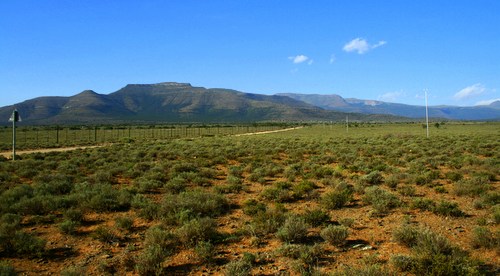
Typical Karoo Country.

There is a spirit too, a presence, an unseen power that is very old and has little to do with man. After a while the sheer breadth and weight of the land gets to you. You begin to forget the world you have just come from existed, you can’t help thinking that the whole country looks like this.

The Karoo has the capacity to inspire wonder in all who behold it.

Perhaps not surprisingly, many famous South African writers and artists haled from here. Olive Schreiner, author of the early South African classic, Story of an African Farm, grew up in Cradock. So, too, did the poet and writer Guy Butler.

Schreiner House, Cradock.

Thomas Pringle, who came to the Cape as leader of the Scottish party of British settlers of 1820, was allocated land in the valley of the Baviaans River near present-day Bedford. It is still known locally as “Pringle Country”. Eve Palmer who wrote that other classic book about the Karoo, The Plains of Camdeboo, grew up on the farm, Cranemere, down the road from the Bruintjeshoogte and between the towns of Somerset East and Graaf-Reinet. The artist, Walter Battiss, also spent his childhood years in Somerset East (you can see his work in the local gallery dedicated to him).

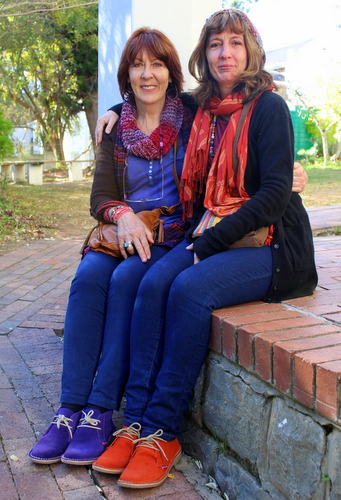
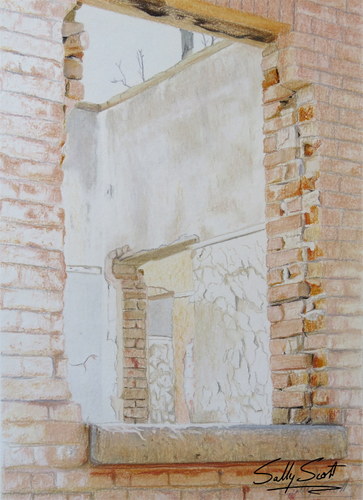
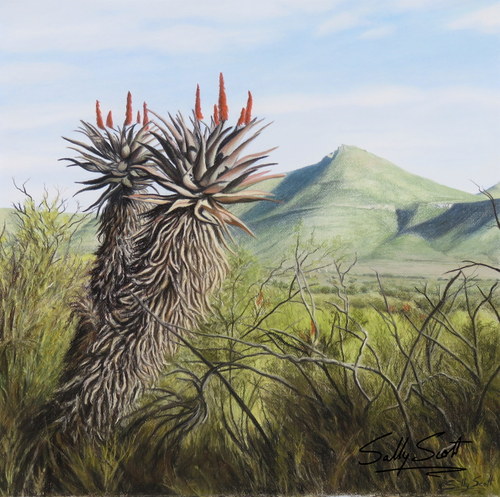
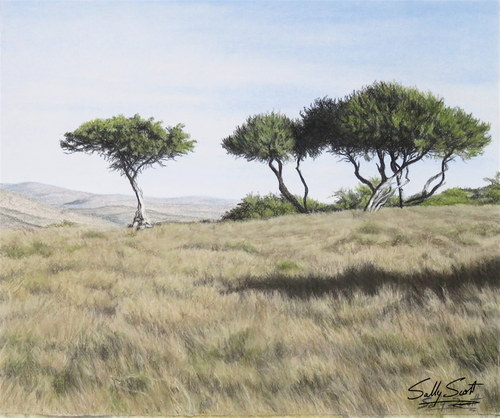
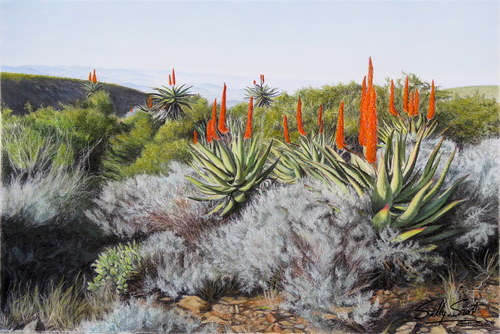
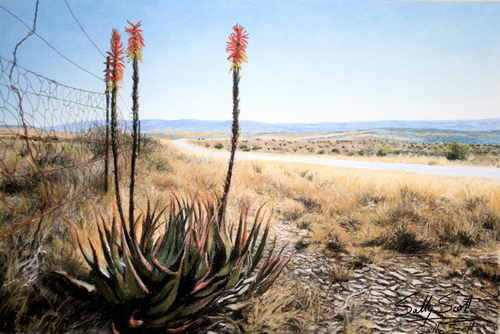
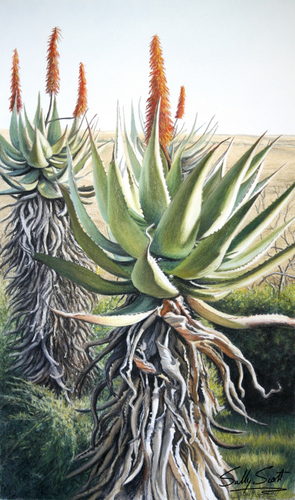
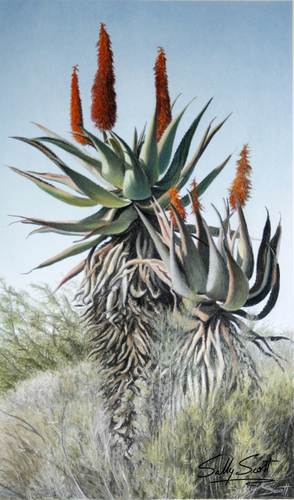
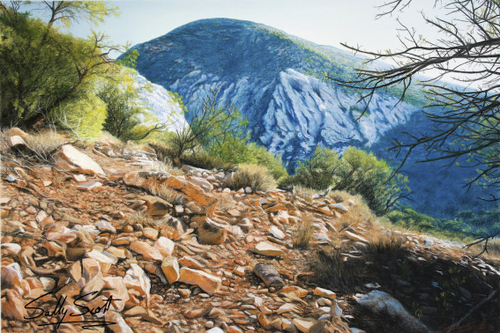
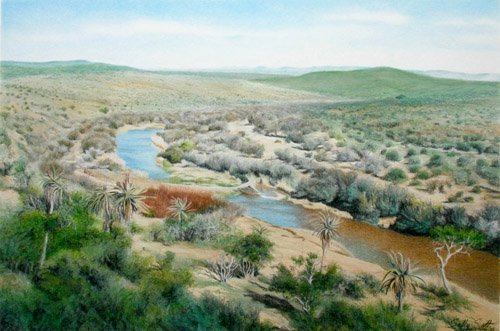
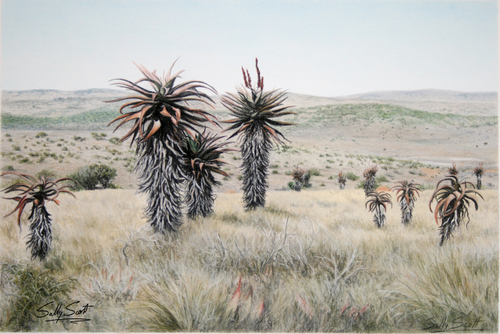
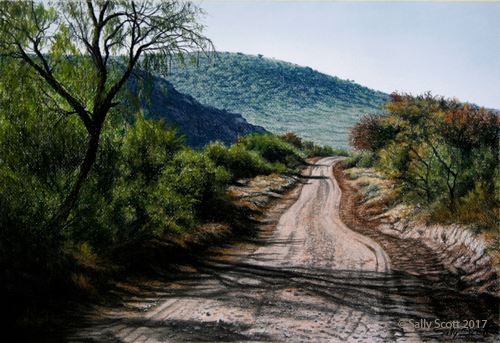
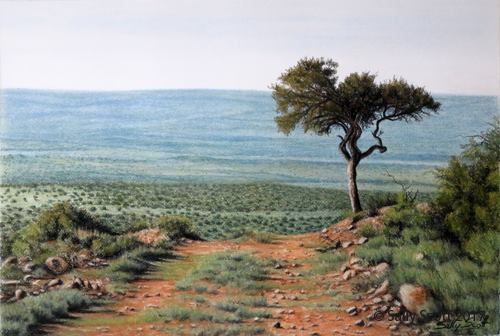
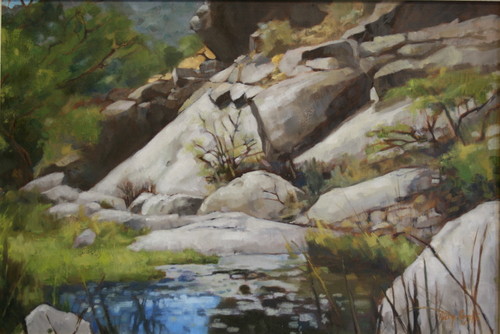
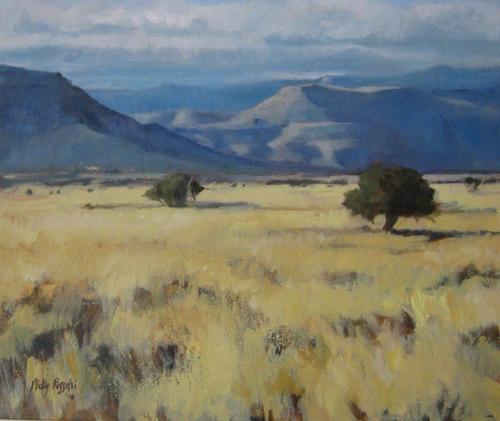
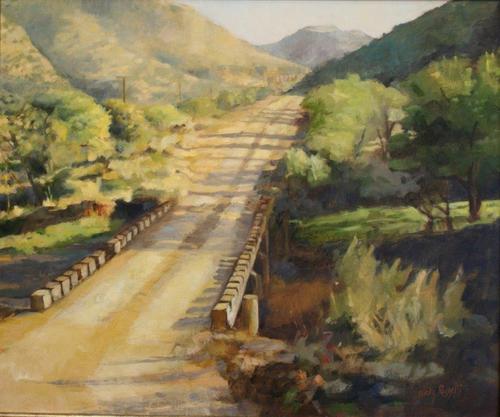
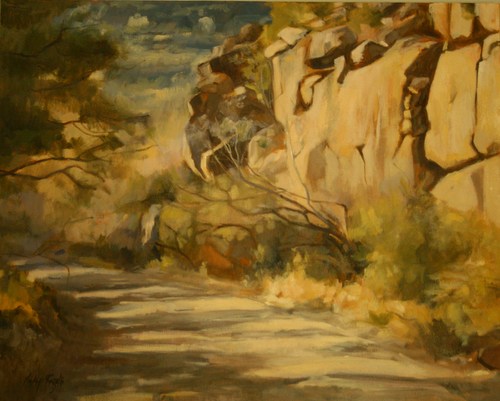
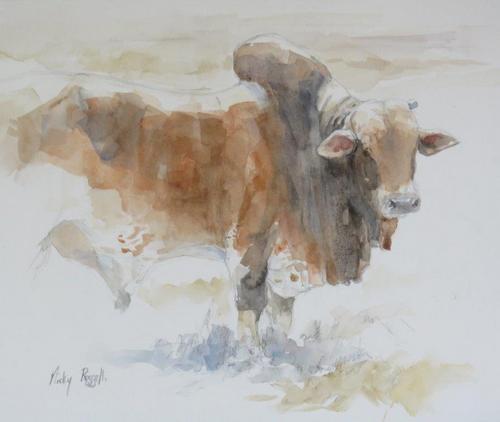
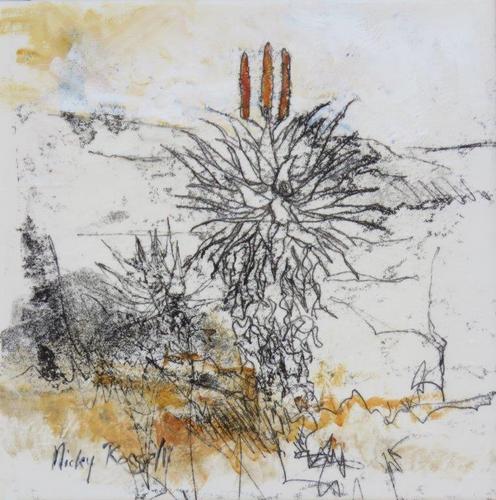
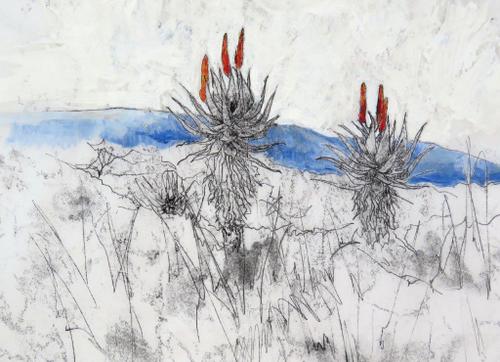
Even members of my own family have found themselves succumbing to the insistent blue skies and lyrical qualities of the Karoo. Sally, an art teacher, has built up a big following with her East Cape landscapes which often have, as their focal point, the aloes which are such a feature of this region. My other, Nicky, also an art teacher, who lived in Somerset East for a while, also felt the urge to record the unchanging strength of the countryside.

How strong this influence has proved can be seen in the examples of their work I have included in the gallery below.

The area around Grahamstown, to which I recently returned, used to be known as the Zuurveld, and later as the Albany district. It is also known as “Settler Country” for it was to this part of the Cape Colony that the early 1820 British settler party came.

To these early settlers this harsh, dry country also marked the beginning of the hinterland, that half-known, half-feared region that stretched endlessly onwards. The further west you travel the wider and emptier it seemed to get. In the far distance stretched ranges of mountains. What lay beyond them was just a rumour, a region of fancy and conjecture.

Karoo Mountains beyond Plains of Camdeboo.

Even today the land still feels like frontier country, wild and sparsely populated. Far more than in Kwa-Zulu-Natal, where, I come from, you get a real feel of what it must have been like for those early settlers, struggling to eke out a living in these remote and isolated outposts.

In KZN development after development has blighted the province: holiday homes, retirement homes, bungalows, duplexes, massive walled complexes that stretch for miles. Factories belch out smoke, power lines criss-cross the countryside, an endless stream of traffic pours down its main arteries, the urban sprawl and shack-towns seems to grow bigger by the day.

Aside from its coastal areas, you don’t get that feel at all in the East Cape. You can travel for miles through the Karoo without seeing another vehicle. It is like you have the universe all to yourself.

Every time I pass through it, I find myself trying to imagine the feelings of those early arrivals. How alien the harsh landscape must have seemed after the soft green of England.

Many of them must have felt they had been hoodwinked. The pamphlets that had been dangled in front of their faces, back home, promised the prospect of great self-improvement, a land of milk and honey, an amazing opportunity. The reality was completely different with many of them finding themselves stuck in the middle of the no-man’s-land between the white settlers moving north from the Cape and black settlers moving southwards. The Fish River which winds its way through this area was often seen as the dividing line with the British authorities building a line of defensive forts along its banks. In places you can still see the remains of these.

Old British fort, Fish River.

Some settlers stayed on on these outlying farms, braving the dangers and determined to make a go of it; others found the country uninhabitable, packed up their belongings and headed off, blazing a trail of retreat that others would follow.

Every so often you come upon a solitary farmhouse, each one part of a narrow stream of civilization that wound itself through the wilderness. Sometimes there will be a steel wind pump and a circular water tank around which some cattle have listlessly gathered. Mostly, though, this is sheep country.

And goat country. There are lots of goats in the Karoo.

We did a day trip out of Grahamstown, taking the road, which leads past Table Farm with its wonderful old, double-story settler house and small stone church, and ends up in Riebeek East. Situated in some hilly country, the town – if such it can be called – was founded in 1842 and initially named Riebeek after Jan van Riebeek, one year after the local church was built. It was erected on part of the farm Mooimeisjesfontein that was subdivided and sold by the subsequent Voortrekker leader, Piet Retief. His old home is situated just east of the town and has been declared a national heritage site.

As in most small South African dorps, the church dominates the town. When we stopped outside it the only sign of a congregation was a herd of cattle grazing in its grounds. It was a very impressive structure, nevertheless, which seemed far too large and grand for such a sleepy little hamlet.

Maybe it had once been different around here. Indeed, visiting many of these old Karoo towns, one gets the feeling that at one time they supported much larger populations, especially when the wool industry was in its heyday. With the boom years gone most of the young folk trekked off to the cities and towns.

From Riebeek East we followed the dirt road that eventually leads to the main Port Elizabeth highway although we planned to turn off before that.

To our left, ran a long, low range of hills where you could see how the exposed rock had been buckled and folded, like a carpet you have just shoved with your foot. In front of us the road rose in to crests and sank in to hollows.

Eventually we came to a junction where we branched off down another dirt road leading to the curiously named, Kommadagga. It was a place I was keen to see.

Kommadagga (the name is believed to be Khoekoen meaning “ox land” or “ox hill”) was a small, purpose-built, settlement constructed by the South African Railways, in the early 1950s, to house the workers involved in the construction of the nearby railway line. At the time it had over 1 000 residents, with an elementary school and a recreation hall. Once their work was finished, its population was uprooted and moved further north to the next section of the new railway line.

Now it is a ghost town, its reason for existence long since vanished. The houses are just shells. You can see right through them, the sunlit, empty rooms with their peeling walls; windowless, door-less, their roofs caved in. In places they had broke clean in half, the bricks scattered over the veld.

Across the road, a couple of hundred yards away, crowning a low hill is an old water tower and to the side of that some concrete pillars whose former purpose I could not fathom although I imagined it had something to do with the railway line..

We pulled up beside one of the wrecked houses and while Professor Goonie Marsh, our amiable driver, long-time Grateful Dead fan and expert on matters local, fired up his volcano for coffee on the side of the road, I set off to explore. I made my way through the remains of gardens, past rusting fences, auto parts, old cement water storage tanks and all the other scattered detritus that suggested a civilisation of sorts.

Goonie fires up his Volcano. Sally plays Lady of the Manor.

There was one house which was in better shape than the rest, an empty wine glass on the verandah wall suggesting it might still be occupied but by whom I had no idea. Near another house there was an outbuilding full of old shoes, in another a collection of goat skulls which got me wondering just how they had passed their time around here.

In such a place, one can imagine there was not much to do. They probably smoked, played cards, drank too much. On Sundays, the more God-fearing among them most likely trekked off to that fine-looking church in nearby Riebeek East.

From Kommadagga, we followed the old rail bed until we reached the Kommadagga Station, some distance away, where the railway line and the road diverged. Cresting a rise we found ourselves looking over a vast basin through which the Fish River flowed, its presence marked by a line of trees.

Along its edge a large expanse of land had been cleared and bought under irrigation, the verdant green contrasting sharply with the surrounding dry bush. To the south and the west, glowing in the morning light, the thin, distant, blue outline of the Bosberg rose through the haze.

View towards Bosberg.

We drove on, stopping every now and again to take photos of the aloes which grow is such profusion around here. Their candelabra of flowers were aflutter with sunbirds (mostly Malachite and Greater Double-collared with a few Amethyst) – such a bright, fragile, flowering of plants and birds in this hot, dry, khaki and grey landscape.

Out here, one gets the feeling no one seems to be in a hurry. Flocks of lazing sheep gaze at you from underneath the shrubbery. Small groups of cattle pose amongst the aloes, nonchalantly chewing the cud. They give the feel of being completely cut off from the world and not minding a bit.

This, we discovered, was not altogether true. Crime – the curse of modern South Africa – has spread its tentacles even to out here in the boon-docks. When we stopped to take pictures of some sheep, grazing in a field, the local farmer came hurtling up in a cloud of dust with a bakkie full of security guards. He was worried we were rustlers!

Having convinced the farmer we had no ill-intentions, we continued on our way. As we drove the views changed but not suddenly or sharply. Nearing the main Grahamstown to Bedford road more mountains hove in to view – the Winterberg, the Katberg, the Hogsback. Between them and us there was yet another huge, aloe-dotted, plain.

Despite its timeless feel, some things are changing. In this harsh environment, many farmers have discovered that tourists pay better than sheep, cattle and crops. As a result they have started restocking their properties with many of the same game species their ancestors so casually shot out.

Back on the tar I continued to study the ground topology. To me it looked like the worst soil imaginable but the termites obviously liked it because the veld was littered with their pinkish-yellow, nipple-shaped mounds. In between their habitations were yet more flowering aloes full of twittering sunbirds.

Then we were driving back through the outskirts of Grahamstown, past the municipal dump out of which much of the rubbish had been blown and now lay piled up along the side of the road. Or had been left hanging on the fences like some sort of weird, welcome-to-town, decoration.

There had obviously been a big fire in the dump recently, too judging, by its burnt colouring and the pungent smell in the air.

At this point, I found myself wishing we could turn around and head back the way we had just come. Then I remembered I had an appointment at the local craft beer brewery, in the hills outside town, and changed my mind again…

GALLERY:

My two talented artist sisters, Sally Scott (on left) and Nicky Rosselli.

Here are some examples of Sally’s artwork:

And here are some examples of Nicky’s work:

To see more examples of Sally’s work visit:

Website: www.sallyscott.co.za

Blog: http://sallyscottsart.wordpress.com/

To see more examples of Nicky’s work visit her website: http://www.rosselli.co.za

Book Review – The Empty Planet: The Shock of Global Population Decline

Conventional wisdom has it that one of the biggest threats facing the planet is is our burgeoning population. No less a body than the United Nations has forecast that it will increase from seven billion to eleven billion before levelling off after 2100.

In this provocative book, authors, Darrell Bricker and John Ibbitson take a contrary view, insisting that this is simply not true. Rather than continuing to increase exponentially, they maintain, the global population is, conversely, headed for a steep decline.

At the heart of their argument is the world wide trend towards rapid urbanization. The more a society urbanizes, they believe, and the more control women exert over their bodies, the fewer babies they choose to have.

This declining birth rate will, in turn, produce its own set of challenges – an ageing society, fewer workers, a smaller tax base. These forces will compel people to put off retirement; they’ll force them to spend more time and energy looking after their parents than they had planned.

One of the obvious ways to offset a declining population is through immigration. Far from posing a threat, they maintain immigration may actually help save some countries economies: these migrants fill gaps in demand for high skilled workers, create jobs through their entrepreneurial drive and rarely generate competition for jobs between immigrants and the native-born.

In this respect, they argue that Donald Trump is fighting a lost cause with his divisive policies and hard line stance on immigration. Contrary to what he believes, the only way for America to remain great is to continue welcoming immigrants.

Not that the USA is in any way unique in its position. Most Asian countries accept virtually no refugees at all and many are now paying the consequences. Japan’s population, for example, is not only ageing but shrinking, leaving a much smaller work force. This is, in turn, has lead to a weakening of their economy.

They cite Canada as an example of a country whose more progressive immigration laws have worked in its favour.

With regard to Africa the UN doesn’t hold out much hope either, believing that the fertility rates will remain high for decades to come. Again the authors don’t agree, predicting a slightly more encouraging scenario. While acknowledging the huge problems the continent faces they believe the commingling of capitalist and traditional values will very likely slow the massive population growth that most modern modelers are projecting.

While careful not to overstate their case, Bricker and Ibbitson’s central thesis is quite different to the bleak world view and dismal remedies of the neo-Malthusians. Nor is it just wish-thinking either; they have obviously put in a great of research in to the subject and marshalled a great deal of material together with commendable skill.

With immigration and population-control both hot political topics at the moment, the book’s arrival is perfectly timed. Its conclusions will certainly warm the hearts of the increasingly beleaguered multiculturalists and those who oppose isolationism.