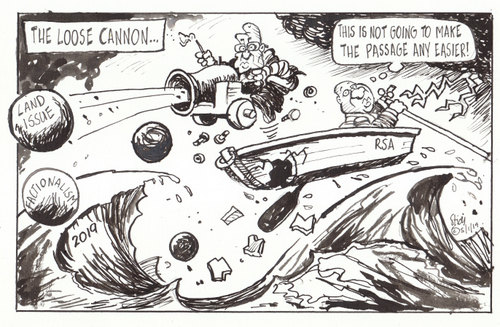
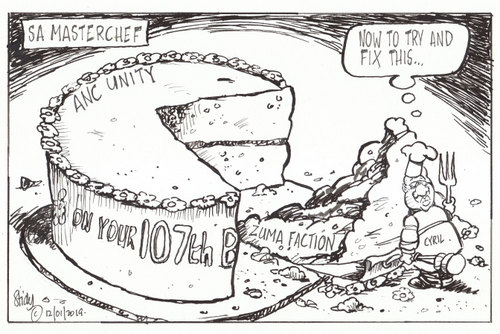
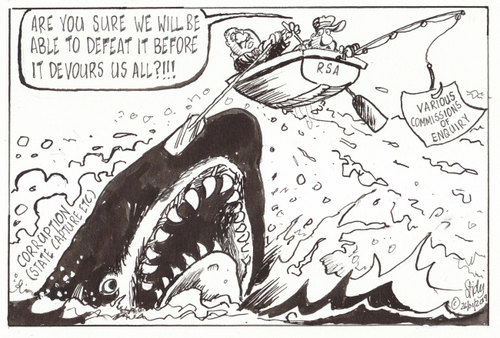
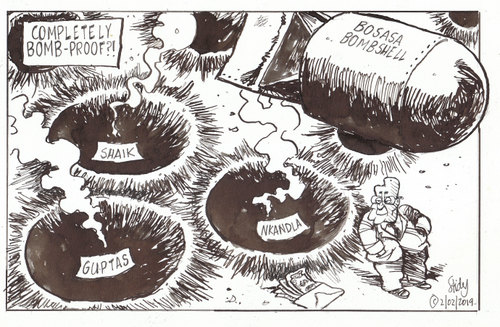
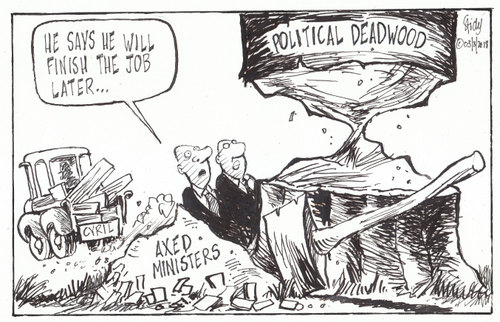
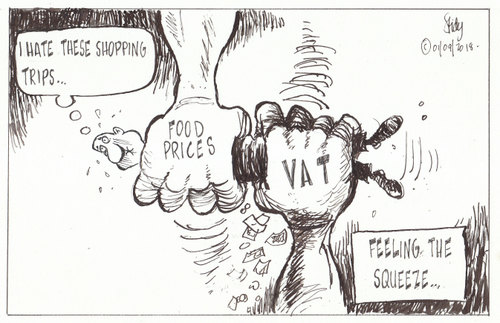
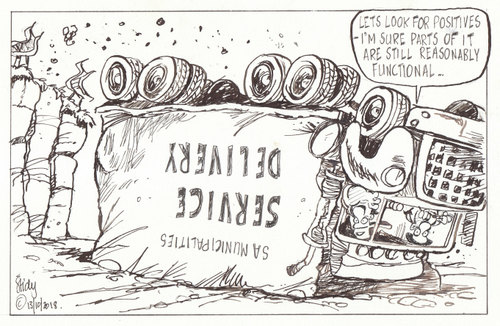
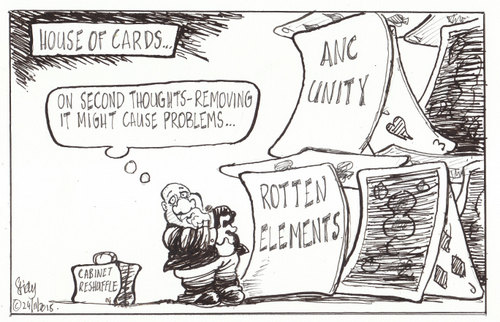
Off to a Bad Start – Cartoons for January and February, 2019

You didn’t need a crystal ball to predict how 2019 would begin – with yet more evidence of corruption and malevolent greed among the ruling elite being put before the Zondo Commission of Enquiry in to State Capture.

It was perhaps to try and deflect attention away from all the dirt being dished on them that the ANC decided to hold yet another big birthday bash for itself even though the anniversary being celebrated seemed, to some commentators anyway, a pretty arbitrary one – 107 (100 you could understand, or even 110).

Cyril Ramaphosa and Jacob Zuma used the occasion to make a big public show of solidarity but – again you didn’t need to be a psychic to predict this – it was too good to last. Within a few weeks Zuma was accusing Ramaphosa of being “defeatist” because of his comments about South Africa’s “lost years”.

Zuma and his disastrous legacy have, it would seem, become Ramaphosa’s albatross…

In neighbouring Zimbabwe, a brutal crackdown by the army and police on people protesting an enormous petrol price hike dashed any lingering hopes that the end of the 37-year old rule of the autocratic leader Robert Mugabe, 14-months earlier, would lead to significant political reform.

On the 7th February, President Cyril Ramaphosa delivered his much anticipated State of the Nation Address (SONA). While his plans to turn South Africa around were laudable, the jury is out on whether he will be able to deliver on his promises.

Within days of the speech the unions, led by COSATU, were throwing up obstacles in front of his proposed ESKOM reforms. As if to compound the general gloom over the future of the parastatal, this was immediately followed by more rolling black-outs.

The fact that this occurred so soon after SONA made some suspect deliberate sabotage. I certainly wondered if someone was trying to foil my plans – I had just sat down to draw a cartoon on the subject for the Weekend Witness when the lights went out…

The immediate and substantial risk ESKOM poses to the South African economy was also the main focus of Finance Minister, Tito Mboweni’s Budget Day speech. Promising “no free lunches” Mboweni said the Government would not bail-out the embattled power utility although he did allocate R23billion per annum for three-years as a support package with conditions.

Whether ESKOM can actually be fixed is open to question. So once again it is a case of “Watch this space…”

Weathering the Seasons at Kusane

Living up here, at Kusane Farm, I never tire of looking at the distant Karkloof hills and the valley below us, with its constant changing moods, under sun or cloud, in various weathers, at moonrise and sunrise and when shrouded in mist. The quietness, the sense of green beatitude brings with it an overflowing sense of peace – a feeling that often seems to be in very short supply in both South Africa and the rest of this confusing modern world.

I get excited, too, when I see my first Yellow-billed Kite of the season because, for me, it always signals new beginnings…

Yellow-billed Kite.

When it comes to the seasons I prefer to take my cue from the Zulu. Unlike ours, their calendar begins in July which is usually when the bird returns from its annual migration.

One of their names for that month is uNhloyile which refers to this phenomenon. The other name is uNdewaloor “new grass moon” – indicating the appearance of green grass after the burning of the veld.

The Zulu months are dated from the appearance of the new moon. Consequently the months are 28-days long and there are 13 in the year. It makes perfect sense to me. I don’t know why we don’t adopt it.

Kusane is always at its best on the cusp of spring. Casting my eye around I can see the landscape changing before me. After the first light showers the grass miraculously starts to green up, the hillsides erupt in a mass of wild flowers.

Spring flowers at Kusane.

One of the first things I start looking for, on my early morning walks, are the widow birds. I want to see whether they have slipped in to their bright-coloured breeding finery. The frogs also strike up their summer chorus – some might call it a racket – with even the little Natal River Frog that has taken up residence in my fish-pond tuning in. The returning swallows begin building their nests.

A little green frog…

Often, in the morning, especially when it is misty, you can hear the trumpeting flight calls of the Crowned Cranes rising up from the patchwork of meadowland in the valley below, as well as the noisy calling of the Fish Eagle as they fly between dams.

Walking out at night under a sky brilliant with stars I like to stop to listen for the curiously bird-like whistle of our resident reedbuck male or the howling of the jackal. Later, I fall asleep to the sound of wind rustling the fir trees outside my bedroom window.

Another of my other great pleasures, at this time of the year, is watching the hordes of the Village (or Spotted-backed) Weavers, that have colonised our garden, going through their courtship rituals: each male desperately trying to convince the available females that the house he has built meets all their domestic requirements. If they fail to respond to his sales pitch, he is forced to rip the nest down and start all over again.

Village (or Spotted-back) Weaver

It seems a thankless task but they are not easily put off. I guess there is a lesson in there for us all…

Summer means storms. Living on top of a hill you really get to appreciate the unfolding drama. At times it gets curiously biblical as the sky blackens and curdles on the distant horizon and then great draughts of thunderous blue cloud come sweeping across the valley, bringing with it the rain.

An approaching thunderstorm, Karkloof.

These storms can create an amazing spectacle of light and noise. I often sit on my balcony and watch the whole drama unfold, the echoing roll of the thunder alternating with a rapid series of brilliant flashes that show up the whole landscape in rugged silhouette.

As the din grows louder and the weather became more threatening you begin to feel like you are watching the prelude to Armageddon. Even after it stops, the sky often stays leaden with wisps of mist chasing each other across the hills.

Sometimes these storms are followed by days of light drizzle with the whole valley lying draped in a blanket of stone grey mist.

Seasons of mist…

The onset of the rains turns the valley below me a lush emerald green. It is so green, you could think you were in somewhere like Ireland or Thomas Hardy country. Which is why I suspect God (or evolution. Take your pick) created Hadedahs – to remind you, very noisily, that you are living in Africa…

Autumn forecloses on the summer with the dark nights drawing in. The rains taper off.

At this time of the year, even in a bad season, the dominant colour is still green but already you can feel that change is in the air. The sky turns a pearly blue and there is the faintest breath of coolness, stirring across the pine trees and ruffling them. In places the veld begins to take on its winter ochre tones.

Each day I try to get up as near to sunrise as possible in order to verify the appositeness of the adjective ‘rosy-fingered’ dawn. Luxuriating in the sense of space and solitude, I have come to realise that Homer’s simple yet elegant description of this daily miracle has never been bettered.

‘Rosy-fingered’ dawn.

And then winter comes galloping down on us. The trees shed their leaves and on my morning walks I notice that there are suddenly far fewer birds around then there were just a few weeks earlier. There are still some swallows but the Yellowbilled Kites, Steppe Buzzards, White Storks, Amur Falcons, various warblers and other migrants have all gone and the hills no longer echo to the sound of the Red-chested (or “Piet-my-vrou”), Diederick and Black Cuckoos. The Bishop birds and Widow Birds turn back in to drab little brown things, indistinguishable from their surroundings.

If it wasn’t for the comforting call of the Cape Turtle Doves I would probably feel quite bereft

Before you know it, the first cold front has arrived, often bringing with it icy rain, plummeting temperatures and a cutting wind. Sometimes snow falls on the Berg. In really cold winters it can blanket the rest of the KwaZulu-Natal Midlands as well. The one year – unfortunately I wasn’t there to see it – it covered the Karkloof hills and valley.

Snow in the Valley. Picture courtesy of Karen MacGregor.

It is the wind that is worst, slicing through your trousers and making you grit your teeth. In the mornings there is frost in the valleys.

Frost in the valleys.

May, June and July also mark the beginning of the fire and fire-break burning season. It is the time of the year when the smoke from these fires thickens in to a sulphurous haze that dims the colours of the countryside.

Fire-break burning season.

Kusane is a perfect place to wait out winter. It is also the best time of the year for going on really long walks, to stretch legs and spirits grown stiff and feel the ineffable pure cold of winter strike my face as I sit down by the river and drink from my Thermos of hot steaming coffee.

Gradually, with winter running its course, the temperatures begin to rise again. It is time to get my binoculars out and start panning the skies for the returning Yellow-billed Kites….

Living up here, with the consolation of Nature, has given me a different perspective on things. I have become quite content with my own counsel and the more time passes, the less enamoured I am with the noisy, suffocating, outside world.

It is a simple but satisfying life and I want nothing here ever to change, not a leaf or a pebble. Except, of course, the seasons…

Ann’s Villa: A Journey Back in Time

Maybe it was in the name but somewhere around Kommadagga I started to get a little paranoid.

I had just turned off the N10, where it runs between Cradock and Port Elizabeth, and was bouncing along a dirt track when, ahead of me, a sudden scurry of wind lifted the dust from the surface, making a bank of pink fog. As I peered through the windscreen I was overcome by this strange notion that I had somehow transcended the highway hyper-reality of speeding taxis and long-haulage trucks and was now travelling down a ghost road, although, when I emerged from that cloud of swirling sand, the scenery appeared little changed from what had gone before -miles and miles of rough, ribbed, ungoverned country, tapering off towards infinity.

The road led on. I followed it. A white speck suddenly appeared on the horizon, got bigger and solidified through the heat shimmer.

Reaching an isolated crossroads I pulled over onto the side, although with the amount of traffic I had seen that didn’t seem strictly necessary, and consulted my map. I was right. The spectre I had been chasing was indeed my destination.

Enfolded in a shallow, winding valley, with a commanding view over the surrounding plains, Ann’s Villa lies on the Karoo side of the old Suurberg Pass. Built in 1864, it once served as a stopover point for ox-wagons full of romantics and day-dreamers heading upcountry, all hoping to strike it rich in the diamond fields of Kimberley.

The construction of the national highway some 20-odd kilometres to the north robbed Ann’s Villa of its reason for existence but it has somehow managed to survive its growing isolation and the march of time, preserved in its own little time capsule and not much changed from when it was originally built. As the crow flies it is not all that far from Port Elizabeth. And yet it feels remote.

Ann’s Villa, Suurberg.

As I crested the final rise I got my first proper view of it – a big, white-washed, double-storied Victorian house with a weather vane, upstairs balcony and a corrugated iron roof that glittered silver in the sunlight.

In its day it must have been one of the most proudly posh buildings in the area, attracting a polyglot crowd of farmers, hunters, adventurers and fortune seekers, all gathering to slake their thirst and exchange gossip. Even now one can still feel the pride of its owners in their creation.

The Shop and Post Office

Besides the inn itself there was a shop, post office, blacksmith, a barn that doubled as a dance hall and even a small school which has now been colonised by an army of dassies. There is also a little hilltop graveyard, fenced off with barbed wire whose individual graves lie untended.

As I carried my luggage up the front steps my arm brushed against the tangled bush in which, the Zimbabwean caretaker cheerfully informed me, the resident boomslang lived, but not to worry “he’s very friendly”. I decided not to put it to the test. Inside, the building had that unmistakeable, reassuring quality of an old, well-lived in home.

On the first floor landing there are a collection of black and white photos of the previous owners – the Websters, the Halls and the Shaws – which I stopped to peer at, hunting for clues in the shadows that would reveal what their lives must have been like. With their stiff body postures and pinned on smiles, it was hard to judge but one thing I knew for certain: it seemed like my kind of place – warm, tranquil and very laid-back.

Old photos – picture courtesy of Craig Scott.

The closet-sized rooms smell of dust and the lawns are covered in sheep droppings. Across the road, at the foot of the pass, there is a collection of old gum trees from which the doves call; beyond that lies wild county, mostly dry scrub-land and aloes, rutted and rocky. After the barbered green of the Natal Midlands the tumbled surge of rocks, sand and shale served as a somewhat peremptory reminder of just what an arid place so much of South Africa is.

During the Boer War, Ann’s Villa was transformed into a hospital for wounded British troops and was allegedly raided for food by a commando led by Jan Smuts himself. Later on it was advertised as a ‘health resort”, prompting one wit at the time to quip that you would need to be pretty healthy to survive its climate.

View over the Suurberg from the Old Pass.

The Pass that was its lifeblood is nowadays little used although it takes in some classic South African scenery. At the top of it, I stopped and gazed back down over the road I had just travelled. If the purpose of any journey is to keep progressing until you find somewhere worth getting to, I was where I was supposed to be.

POSTSCRIPT: My sister, Sally Scott, a well known Eastern Cape fabric and landscape artist, was so taken with Ann’s Villa that she decided to have her 60th birthday celebrations there. In keeping with the personality of the place we felt we should dress up in period costume. This was the result:

Dressed up in regulation “mufti”. Picture courtesy of Craig Scott.

Her son, Craig Scott, a professional photographer, also took this picture of the whole birthday group.

A very serious occasion. Picture courtesy of Craig Scott.

Sketching in Zimbabwe

Not long ago, in the course of clearing some of the excess junk out of my studio, I came across a box I haven’t looked inside for years. In it I found several old sketch books containing a series of drawings I made in Zimbabwe, when I went back up there to visit my family in 1998.

While I will leave it to others to decide on their artistic merit, what did strike me about the Karoi ones, in particular, is how they capture a time, place and way of life that has now all but vanished.

Sangalolo Farm, Karoi

Four of them were drawn on the spot, at my brother Peter Stidolph’s farm, Sangalolo, only a year or two before President Robert Mugabe launched his chaotic and often violent land grab which gutted the once thriving agricultural sector. Both of my brothers lost their farms even though they were legally acquired, on terms approved by the government, after independence

What adds to the poignancy of these sketches – for me anyway – is that Pete succumbed to a brain tumour just before he lost his farm. Growing up, in the then Rhodesia, I had always hero-worshipped him – strong, humourous, practical, caring, eminently sensible and a very good farmer to boot, he was a man you could always depend on or turn to in a crisis. There is another reason I am so admiring of him – it was he who introduced me to the wonderful world of birds.

His death affected me deeply. All these years later, I still can’t quite accept that he has gone.

Pete Stidolph, Mukwichi River, Karoi.

Both Sangalolo and my other brother Paul’s old farm, Grand Parade, which is also in the Karoi district, are places I have strong feelings for and have many happy memories of. After I left the country and settled in South Africa, they became, in a sense, places of comfort for me – somewhere I could escape to when I needed to regain my bearings or wanted to recoup. It was almost as if, by going back to them, I was looking for clues to my future.

Going back – Chimanimani Mountains

I feel the same about Bushmead, outside Masvingo, which is where my youngest sister, Nicky, and her husband, John Rosselli, built their dream house, overlooking Lake Mutirikwe (formerly Lake Kyle) before they, too, were forced to move to South Africa. Also, the Chimanimani Mountains ( where my ancestors, the Moodies, settled after trekking up from Bethlehem in South Africa) and Gona-re-Zhou in the South-East Lowveld – the subjects of my other drawings.

Like Nyangui, the Nyanga farm I grew up on, they are all places which helped shape who I am. They are a slice of my life.

Oddly enough, I have done very little outdoor sketching since my 1998 trip although living where I now do, at Kusane in the KwaZulu-Natal Midlands, I am beginning to think it is perhaps time I returned to the habit. Sifting through the same box of old junk, I also came across this quote which I had written down at the time because it seemed so pertinent and captured what I felt:

A sketch is generally more spirited than a picture. It is the artist’s work when he is full of inspiration and ardour, when reflection has toned down nothing: it is the artist’s soul expressing itself freely” Denis Diderot, 1765.

Hopefully, you will see something of this reflected in these sketches. If not, I certainly think it applies to the preparatory drawings I do for my cartoons (my “roughs”), many of which have been purloined by my nephew, Craig Scott, a professional photographer, for precisely this reason…


Book Review – Vietnam: An Epic Tragedy 1945-75

published by William Collins

Coming at the apex of the cold -war rivalry, the American withdrawal from Vietnam marked one of the more humiliating moments in its history. Believing that they could succeed where the French had so ignominiously failed in Indo-China, the country had put its immense might, power, prestige and reputation on the line and ended up being outsmarted and out-thought by a half-starved, rag-tag army of sandal-wearing peasants.

Acute analysis and fair-mindedness inform veteran war correspondent Max Hasting’s exhaustive study of the origins and course of the conflict. Drawing imaginatively on many personal testimonies and eye witness accounts from both sides, Vietnam: An Epic Tragedy provides a powerful panorama of a war that went horribly wrong.

Ignorance is a running theme in the book. It is extraordinary that America, with its vast resources, miscalculated so badly and often had little idea what was happening in the Far East. Decisions were made based on confused thinking and a misunderstanding of how Vietnamese society worked.

From the outset the communists in the North appeared better motivated and more skilled. Their Chinese and Russian backers also remained prudently in the background so it did not appear they were the aggressors or the ones calling the shots – as the Americans were doing in the south.

Indeed, as Hastings shows, successive American administrations ignored any claim by the people who inhabited the battlefield to a voice in determining their own fate. Instead they chose to concentrate on their own strategic interests – in this case countering the spread of communism.

Having committed themselves to the cause, the Americans found themselves mired down in a protracted war from which there appeared to be no escape – their commanders’ initial confident predictions of an early victory gradually replaced by a growing realisation that they could never win.

Hastings meticulously charts the failure of successive presidential peace initiatives. He also shows how, as the war dragged on, the morale and commitment of the US forces serving in Vietnam began to flag. Drug abuse, racial strife and a decline of discipline became rife. The growing anti-war movement back home further added to the pressure being piled on the American administration.

In the end, the inevitable happened and the Americans were forced to pull out, abandoning their former allies to communist retribution. The final irony, as Hastings notes, is that having lost the war militarily the United States has since seen its economic and cultural influence reverse this outcome as Vietnam increasingly moves away from the more repressive aspects of communist rule….

Mapungubwe: Where History meets Nature

History and nature come together and harmonise in Mapungubwe. A land of fierce but tantalising beauty, situated on our northern border, it now lies near empty although this was not always so. It was here, during the tenth and twelfth centuries, that an important, early Southern African kingdom came in to being as a major centre of power and then, for reasons which are still not absolutely clear, collapsed.

The main Mapungubwe settlement was built around the base of a steep-sided sandstone hill that arises abruptly from the valley floor. At its summit, various burial mounds and the remnants of old houses have been found. It was here that the nobility lived and it was here, too, where South Africa’s most famous archaeological artefact – a gold-plated rhino – was found.

The modern park, in which it lies, was inscribed as a UNESCO World Heritage Site on the 5th July, 2003. The National Park bearing its name was officially opened, amidst much fanfare, in September, 2004.

The Park is divided in to a Western and Eastern section which are separated by the Den Staat farm.

The Western section is mostly flat and forms part of the Limpopo flood plain. Along the river is a thin, deep green, jumble of riparian forest, which gradually thins out as it gives way to thornveld and then miles upon miles of mopane scrub that somehow manages to survive despite the complete absence of anything resembling real top soil.

The Eastern section is more broken country. Here nature has created its own unique architecture, one that is dominated largely by rock.

Rock, red earth and river – Eastern section Mapungubwe.

The Mazhou camping-site, which is one of my favourites in South Africa, is situated in the Western section. Positioned close to the Limpopo, it is well thicketed with enormous Nyala Berry and Apple Leaf Trees which interlock overhead to provide some relief from the worst of the sun.

It was here I found myself sitting, sipping wine, one glorious, crystalline, summer’s night. Somewhere out there, beyond the horizon, was a half-remembered world of big cities and busy highways but I found it very difficult to bring it back in to focus.

The sky was heavy with stars. Amongst them was one which caught our eye because it was much bigger and brighter than the rest and was moving slowly across the heavens. We decided this must be the International Space Station.

For a few paranoid moments I wondered if it had had been sent to spy on us and tried to recall if I had done anything to warrant such scrutiny (although, given his reputation, it was much more likely it was keeping its beady eye firmly fixed on my birding partner, Ken).

Natal Spurfowl, Mazhou camping site

The next morning I crawled out my sleeping bag to find a family of Natal Spurfowl pecking in the dirt outside my tent. They were joined, a little later by some noisy blue-black Meves’s Starlings and a curious Crested Barbet. In the branches above us a pair of striking blue Woodland Kingfishers stirred.

Woodland Kingfisher

Because it was such a glorious day, we decided to head in to the more heavily forested Western section first. We had barely got on to the stretch of road that runs along the Limpopo when a whole convoy of 4 X 4s came roaring up our rear. Their vehicles were fitted with metal spades and spare jerrycans of petrol, spotlights and winches. Driving the front one was a barrel-chested guy in a camouflage T-Shirt with sunglasses and a baseball cap pulled low over his eyes. The other men all sported similar going-on-safari mufti, while the women folk looked like they were headed off to audition for bit parts in the next Tarzan remake.

These were Very Serious Explorers.

In less trying circumstances – like when we were not attempting to birdwatch – I would have found them fascinating. Now they were just plain annoying because we had to pull over and let them pass and then watch them go clattering down the track, with their TVs, micro-waves, ice-dispensers, up-to-the-minute navigational aids and all the other modern conveniences and gizmos that seem to be required these days before you can go Roughing it in the Bush – scaring away all the rare birds we had been hoping to see.

Such distractions aside, this is usually a good place to get up close and personal with White-backed Vultures who, unlike their cliff-dwelling Cape relatives, like to nest in the tall trees that grow along the river. Through gaps in the canopy we kept getting glimpses of these magnificent birds, circling overhead. When the sun caught them their back feathers flashed a brilliant white.

Lala Palms, Western section of Mapungubwe

We continued driving through this rich mantle of trees before emerging in to a clearish, flat stretch, on the one side of which ran a line of tall Lala Palms. It was here, under a clump of thorn, I had got a lifer on my last trip – a Three-banded Courser, an uncommon, largely nocturnal bird, very much confined to the Northern parts of South Africa.

A bit further down this road is the Maroutswa Pan which is usually an excellent birding spot, especially for water birds (on our last trip we saw a Honey Buzzard here as well). Despite all the evidence of recent good rain there was very little water in the pan itself.

Common Sandpiper, Maroutswa Pan.

We, nevertheless, lucked out and got another rarity – a Green Sandpiper – or at least Ken, who has seen one before, was convinced that was what it was. I, as usual, was confused. The bird looked like a cross between a Wood and Common Sandpiper. I was still mulling over the true identity of this mystery bird when a real Wood Sandpiper turned up and helped solve the puzzle.

Wood Sandpiper, Maroutswa Pan.

My elation at being able to add another lifer to my list turned to anger when we got back to camp, later that afternoon, and I found the resident monkey gang – hardened criminals every one – had, for good measure, punched a few more holes in to my tent. What added to my irritation was that once again I had no food inside and I had used up all Ken’s duct tape patching up the holes the baboons had ripped in it in Kruger a few days before!

That night, curled up in my sleeping bag, I heard lion. They sounded like they were only a kilometre or so downstream, although Ken was convinced they were across the river, deep inside Botswana.

Another scorcher was forecast when we set off to explore the Eastern section the next day. Passing through the main gate, the road curved left towards the edge of the park and then dropped down through a rocky bluff. All around was evidence of nature’s erosive powers at work: cliffs undercut, niches hollowed out, old river courses altered. In places the rock was fissured and rotten, large chunks of it sliced away like a cake, revealing the layers buried underneath.

Elephant crossing, Limpopo

At the point where the road swings right along the Limpopo they have constructed a raised wooden walkway which takes you, at bird’s eye level, through the leafy tree tops and provides excellent views. The river at this point is fat, sluggish and wide but as this was the dry season, it was not quite so wide or deep as it is during the rains.

Elephant, Limpopo

Along the foreshore ambled a family of elephant. Perhaps because there are no immigration formalities required, they like to use this spot to ford the river between South Africa and Botswana. Later we were to see some Zimbabwe fishermen doing the same thing further down the river.

We stopped for brunch at the view point on top of a hill which once served as an SANDF army base and observation point. It is here, at the confluence of the Shashe and Limpopo that the three countries that have played such a pivotal role in my life – South Africa, Zimbabwe and Botswana – meet.

Confluence of Limpopo and Shashe

It was almost like a homecoming to be standing on top of that promontory looking over that vast, shimmering, seemingly uninhabited, landscape. I felt almost totally isolated from the outside world.

The whole place gave off an aura of romance. I felt like I had been magicked back in time. This was the ancient Africa of myth, which the old cartographers had heard about but weren’t too sure how to depict in their books or their maps.

For all its harsh beauty and important cultural links with the past, Mapungubwe is, however, a park with problems. That this is so became apparent when we set off down the road that leads from the viewpoint to Poachers’ Corner.

As we rounded the bend that takes you in to this wonderfully scenic part of the river, we found ourselves encircled by a vast herd of cattle. They had obviously crossed over the Limpopo from Zimbabwe. There must have been several hundred of them, their bells tinkling merrily as they wandered around munching the grass or masticating nonchalantly like they had every right in the world to be here, in what is supposed to be South Africa’s showcase park.

As an undoubted consequence of this we did not see a single wild animal in this section other than a few bored-looking baboon chewing on some roots they had just dug up. All the kudu and nyala and other game that had been here on our previous visits had, presumably, been forced to move up in to the more arid parts of the park.

If the monkeys were not bothersome enough this only added to my annoyance. Having travelled a considerable distance, at big expense (to say nothing of close shaves with elephants and being forced to listen to Emily, Ken’s Satnav – a merciless pedant if ever there was one – continuously telling us we were on the wrong road) to get here, both Ken and I felt we were entitled to demand a refund because we reckoned we hadn’t gone to all this trouble just to finish up looking at a bunch of cows.

I can do that from my bedroom window at home.

In the end, we thought better of it and just reported our concerns to the camp manager. He admitted it was an ongoing problem but said the matter was politically sensitive since it involved citizens from another country and had to be handled diplomatically. To me it sounded like the sort of soft-soap, fudging-of-the-issue, claptrap PR people use to calm down folk, like us, who had got worked up in to a state. I can’t say I drove out of the park gate feeling more sanguine about the matter or thinking they had a clear-cut plan in place to deal with the problem.

You never know though. I was wrong about the Green Sandpiper so maybe I have allowed myself to over-think this too…

And I still love Mapungubwe – although I am not sure these feelings extend to those primates who keep trashing my tents…

More Cartoons from 2018

Here is another selection of my political cartoons from 2018. Besides providing a pictorial history of some of the people, ideas and events that helped shape the year they will also, hopefully, give some clues as to where we may be headed in 2019.

Our erstwhile Number One, for example, has shown little inclination to emulate his predecessor, Thabo Mbeki, by fading quietly in to the background – so it almost inevitable we will be hearing a lot more about Jacob Zuma. You can take it as read, too, that Julius Malema and the EFF will continue to push the boundaries of acceptable political behaviour and that Eskom will make the news for all the wrong reasons. Likewise, SAA, SABC and all our cash-strapped, disintegrating municipalities.

There will also be more stories about corruption and the misuse of public funds.

Another opportunity to practice my craft…

Internationally, you can rely on US President Donald Trump to keep banging on about his wretched Wall with Mexico while Britain will still be foundering on the rocks of Brexit.

If nothing else they will all provide abundant material for political cartoonists to practice their art…

So watch this space…

The Trouble With Elephants

I am not a man who deliberately courts disaster or intentionally goes looking for bad experiences. By the same token, I am not such a fool as to think the odd mishap won’t occasionally befall me. And when you go travelling with my birding partner, Ken, rotten luck does have a habit of following you around.

For example: on a recent trip to Marakele National Park we found ourselves being chased down a narrow, twisting mountain pass by a very angry elephant who clearly resented our presence in his private domain. Luckily – I have a feeling some benevolent deity saw fit to intervene – we survived that harrowing encounter. What I did not realise was that more trouble with elephants lay ahead…

From Marakele we had followed a circuitous route that took us to Blouberg Nature Reserve and then cut east along the base of the Soutpansberg range to Punda Maria in North Kruger. We planned to camp the night here and then press on to Pafuri the next day, where we hoped to get in some good birding.

Up until now the weather had been kindly – more spring than summer and I had even found myself wearing a jacket in the evenings and early mornings. In Kruger, however, the hot weather we had been expecting all along, finally caught up with us, with the temperature soaring up to 39 degrees. The air around us was heavy and listless and steamy, almost tropical, perhaps hardly surprising since we had crossed over the Tropic of Capricorn some days before.

Eager to be off I was up early the next day although I had to first wait for Ken to complete his complicated early-morning-ablution rituals. Once he was done with that, we set off northwards through the familiar vastness of flat grassland and mopane trees. On the way we stopped to allow the biggest herd of elephants I have ever seen cross the road. Shortly afterwards we were forced to repeat this exercise for an even bigger herd of buffalo.

The common bird in this neck of the woods – or at least the most vocal – is the Rattling Cisticola. There seemed to be one trilling its silly head off on top of virtually every second tree we passed.

Rattling Cisticola – listening for elephant?

As you you draw close to Pafuri, the terrain starts to break up and rearrange itself and you are suddenly confronted by the arresting sight of Baobab Hill with its commanding views over the Limpopo Valley. In the early days this iconic hill served as both a landmark and sleepover point for the ox-wagons travelling up from Mozambique.

By the time we got to Pafuri the sun was high and blazing. There had obviously been no rain here this season and the grass was pale and dry although the trees had mostly come out in leaf.

At the crossroads we turned left down the Nyala Drive which takes you in to some wonderfully hilly country before taking a lazy loop back to the main road. Ken likes this less-used drive because, he says, it often throws up unexpected surprises.

There wasn’t much on offing this time around besides the usual suspects – Meves’s Starlings, Arrow-marked Babblers, White-fronted Bee-eaters and Emerald-spotted Wood- Dove. We passed a solitary elephant but he paid us no mind.

White-fronted Bee-eater

On the top of the small, baobab-clad hillock, directly above where the road swings back is the Thulamela archaeological site, a restored Zimbabwe-type ruin. Unfortunately you can only go up with a guide and because of our tight schedule we did not have time for that.

From the Nyala Drive we crossed back over the main tar road and followed the dirt track that takes you to Crooks Corner, where the brown waters of the Luvuvhu collide with the blue of the Limpopo. The combination of water, sun and rich alluvial soils has led to a proliferation of vegetation along the rivers’ banks so that you drive through a glittering tunnel of Sycamore Figs, Nyala trees, Jackal Berry, Ana and Fever trees.

Crooks’ Corner, where you can get out of your cars, marks the border between South Africa, Mozambique and Zimbabwe. In the early 1900s this, remotest of places, gained its moniker and dodgy reputation with gun-runners, fugitives and others on the run from the law using it as a safe haven because it was easy to hop across the border whenever the police from one country approached.

Crooks’ Corner on Limpopo

Distinctly there was a sense of a frontier on that lazy meandering river although I don’t think the solitary Saddle-bill Stork, fishing in its waters gave a fig where the international boundary lay or as to who held sovereignty over the country he was standing in.

Normally, it feels like you can’t get much further away from civilization than here but we had chosen a busy weekend to visit so it was like a major thoroughfare with a steady stream of traffic passing through. Many of the visitors didn’t even bother to wind down their windows or get out of their luxury 4 X 4s because it would mean switching off their air-conditioners. They just drove in, stopped, glanced around and drove out again, leaving me to wonder why they had bothered to come all this way…

Needless to say Ken – who, contrarily, makes it a rule to ALWAYS switch off his air-conditioner when he enters a park because he likes to experience Africa in all its extremes – and I did get out.

Rich plant life invariably means rich animal and bird life and Pafuri is no exception. In the past the storied riverine forest has provided both of us with some good sightings. It was here I saw my first Gorgeous Bush Shrike, Bohm’s Spinetail and Ayre’s Hawk Eagle. I have also recorded Lesser Jacana, Green-capped Eremomela, Hooded Vulture, Tropical Boubou and the palm-dwelling Lemon-breasted Canary. This time, we could hear both the Gorgeous Bush Shrike and a melodious White-browed Robin-Chat calling from the depth of a nearby thicket but could not entice either of them out. Instead we had to make do with a bunch of waders and a noisy party of Trumpeter Hornbills.

It was now well past lunch time so we doubled back to the Pafuri picnic site on the edge of the Luvuvhu. Feeling somewhat dehydrated, I was desperate for an ice-cold coke but had to wait patiently in queue behind an American who was explaining to the bemused coke seller-cum bird guide – who, I suspect, knew the answer but was too polite to say so – what a turkey is (“It’s a big black bird with a red head”).

At this juncture of its journey the Luvuvhu is always a ruddy brown colour such as might be achieved by mixing cans of tomato soup with cans of chicken soup. There was an enormous crocodile lying directly opposite us not, as one would expect, by the waters edge but high up on the bank under some trees. I had a feeling some unsuspecting animal was in for a nasty surprise.

The Luvuvhu River

On the way back to Punda Maria, we took the short-cut via Klopperfontein dam, another place which can throw up some unexpected treats even though the area around the dam has been grazed as smooth as a billiard board. Sure enough, we were rewarded with a wonderful sighting of a Painted Snipe snooping around in the shallows of the nearby stream.

It was getting on for late afternoon by now. Ken consulted Emily, his prissy, admonishing, Satnav, and worked out how far we had to go and what time we had to do it in. What neither factored in to their calculations was our old nemesis, the elephant.

The first one, which we encountered just after Klopperfontein, kept us waiting for ages, while it feasted on the side of the road, before moving off in to the surrounding bush. A little later we passed him siphoning water by the trunk load out of the top of a reservoir.

Siphonining water near Klopperfontein Dam.

We ran in to the second one on the home stretch with the hills around Punda Maria in plain sight. Although this bull appeared much more amiable then the one who had chased us down the mountain in Marakele he had obviously decided he held all the rights to this road.

The whole thing quickly degenerated in to a stage farce. We kept reversing and reversing and he kept trundling on towards us. I suspect he was headed for his evening sundowner at the same reservoir where the other elephant was sloshing water around.

One of us had to blink and we did so first. Muttering angrily to ourselves about the beast’s poor road etiquette, we turned around and headed back to the tar and took the much longer route home to Punda Maria.

In Kruger, as in other parks, you are not supposed to arrive in camp after dark, which we now did, finding the gate locked on us. Fortunately, the guard was still at his post but Ken had to use all his silky skills as a sports writer and commentator to try to convince him it wasn’t really our fault. I am not sure he bought our explanation but he let us through without imposing a fine.

So we drove in to camp feeling like a pair of naughty schoolboys who had just been caught bunking. But we were not done yet. We arrived to a scene of utter devastation – in our absence a troop of baboons had ransacked the place, flattening my tent, breaking its poles and ripping gaping holes in the fly-sheet (even though there was nothing inside but my bedding and clothes), as well as scattering our possessions far and wide

To tell you the truth I was getting seriously tired of this. I had just bought the tent to replace the one that got ripped by monkeys in Mapungubwe on my last trip which, in turn, I had bought to replace the one that had suffered a similar fate when I attended a wedding in De Hoop Nature Reserve in the Western Cape. At the rate I was getting through tents it would have been cheaper to have just booked in to a luxury lodge!

I am not sure what one does about this menace. The problem is both monkeys and baboons have become habituated to both human beings and human beings’ food.

We did discover afterwards that there was supposed to be a guard on duty to stop these opportunistic raids but, even though the camp site was virtually booked out, he had decided to take the Sunday off…

I was still sulking about my poor tent the next morning when we drove out of the gate, destination Mapungubwe. There to wish us on our way was the scruffiest Ground Hornbill I have ever seen. It flew up in to a tree from where it regarded us quizzically through its girlishly-long eyelashes.

The scruffiest looking Ground Hornbill I ever saw…

For some reason the sight of that lugubrious bird, peering around its branch cheered me up no end. It made me realise that on the Richter Scale of Travel Disasters we had got off relatively lightly compared to what other great explorers, like David Livingstone or Scott’s Antarctic expedition, had been forced to endure…

Book Review – The Graceless Fall of Robert Mugabe.


Published by Penguin

On the evening of 14th November, 2017, a phalanx of tanks rumbled into Harare, Zimbabwe and sealed off Munuhumatapa Building and the Parliament of Zimbabwe. Although the instigators would do there best not to portray it as such, a military coup was under way that would spell end of President Robert Mugabe’s long and ruinous grip on the country.

His sudden demise caught most of the world by surprise, especially as Mugabe had previously proved so adept at dealing with any challenges to his authority.

For any biographer there is plenty of meat here but Geoffrey Nyarota, a veteran of journalism in Zimbabwe, is exceptional in not only bringing his vast experience and insider knowledge but also an elegant style and a gift for narrative. Much of his story, especially the early parts, is inevitably familiar territory, but necessary to the completeness of the story.

Nyarota describes Mugabe’s upbringing in Kutama, his academic and political education, his rapid rise through the ranks which culminated in him becoming the first Prime Minister of an independent Zimbabwe. Initially, Mugabe preached a message of reconciliation but the hope his election engendered would gradually give way to disillusion as he turned from a Hero of the Struggle in to a vindictive bully with a taste for tyranny.

One of the defining moments in this transformation came with his marriage to the much younger Grace Marufu, his former typist. From here on it becomes the stuff of opera. Although Nyarota strives hard to be fair and even-handed, the picture that emerges is of a vain old man and a scheming diva whose political and social ambition, once ignited, burned furiously. In her quest for power the First Lady became every bit as ruthless as her husband, plotting against her rivals while grabbing vast tracts of land and amassing great wealth for herself and her children.

Emboldened by her success in helping to get rid of one of Mugabe’s two Vice Presidents, Joice Mujuru, Grace next set her sights on ousting Emmerson Mnangawa, her remaining rival for the presidency. It would prove to be a bridge too far and lead to her undoing.

Not for nothing was Mnangawa nick-named “The Crocodile”. It what effectively amounted to a Night of the Long Knives, the military, worried that their own interests were being threatened, moved in, on his behalf, and seized control of the country.

Nyarota’s account of how this all happened is first rate. In describing the machinations that went on behind the scenes and inside ZANU-PF itself, he shows a party riven with intrigue and internal conflict, much of it engineered and exploited by the former President himself. Despite having trashed the economy, undermined the rule of law and inflicted enormous damage and hardship on the country and its long-suffering populace, though, Mugabe’s self-belief remained undented to the end.

Now his successor is faced with the difficulty of how to undo the consequences of all these years years of violence, misrule and policy blunders. How committed he is to achieving this is, of course, another question…

REVIEWER’S NOTE – This review was written several months ago – before the current troubles in Zimababwe

Book Review: wtf-Capturing Zuma- A Cartoonist’s Tale


I think most editorial cartoonists will readily admit that they often find it difficult to send up politicians when they are making a so much better job of it themselves. This is, however, a problem that does not appear to faze South Africa’s best known caricaturist, Jonathan Shapiro (aka Zapiro), whose razor-sharp wit is on clear display in WTF: Capturing Zuma – A Cartoonist’s Tale, a book which demonstrates both his unerring eye for political failing and his powers of invention.

As its title implies, the anthology provides a front row seat in to the fractious – if at times almost symbiotic – relationship that developed between the artist and his ever dodging target, our erstwhile former Number One. The years of Zuma’s presidency certainly proved to be fertile ground for Zapiro which is perhaps hardly surprising, since, leaving aside the question of his private morality, it is difficult to argue that his effect on the country and its economy was anything other than disastrous.

From the outset Zapiro had the measure of his man. Five years before Zuma took over the ANC leadership he was already portraying him as damaged goods.

He also realised that for such a compromised and controversial figure he needed a far more hard-hitting, confrontational style of drawing than he had employed with, for example, Nelson Mandela. Refusing to recognise the limits imposed by decorum or good taste Zapiro hammered away at him again and again.

His Rape of Justice cartoon, in particular, provoked a storm of outrage and moral indignation especially within the ranks of the ruling ANC. Undeterred, Zapiro continued to rip apart his prey.

In the end his systematic and relentless caricature of Zuma probably did as much to destroy the President’s credibility than any number of columns, editorials or speeches from the opposition benches.

What Zapiro’s constant undermining of the president also proved is that cartoons still matter – a lot. They certainly mattered to Jacob Zuma who, in a misplaced attempt to silence him, served Zapiro with two lawsuits, totalling R22million, claiming the cartoons invaded his dignity.

Which begged the obvious retort – one that the artist himself was quick to seize on and make the subject of yet another witty, put-down, cartoon – what dignity? Needless to say, the matter never got to court.

Zapiro’s drawings have always tended to dominate the pages on which they appear. Wielding his pen like a scalpel, he manages to be both extremely funny and serious at the same time. As with all good satire, his cartoons are designed to entertain as well as to convince. Behind the often mordant humour one senses the fire of honest indignation that fuels all real political art.

Over the years he has carefully recrafted and subtly changed his depiction of Zuma. In doing so, he has, admittedly, been helped by the man himself, whose physiognomy, facial features and nervous tics and mannerisms have often unwittingly and unerringly betrayed his real character (his habit of shoving his glasses up his nose with his finger, his giveaway: “Heh, heh, heh”).

Probably Zapiro’s most inspired moment came when he decided to place a showerhead on Zuma’s oddly-shaped cranium after the then Deputy-President famously stated that he had taken a shower, following sex, because he believed it would reduce his chances of getting HIV (Zapiro admits he got the idea from the brilliant English cartoonist, Steve Bell, who delighted in drawing Prime Minister John Major all the time with his underpants outside his trousers).

The image was picked up and imitated by many. Even Julius Malema adopted it as a visual gesture of constant mockery.

In that sense, his showerhead became the defining symbol of the Zuma era (or “error” as Zapiro so aptly puts it). Like an ever dripping crown of shame, it perfectly captured the rotten-ness and moral bankruptcy of his chaotic, corrupt and scandal-ridden administration.