When the First World War broke out, there were few, amongst the thousands who enlisted who could have foreseen the new type of modern warfare they would face. Chlorine gas, explosive artillery shells, rapid-fire machine guns and other heavy weapons were to inflict carnage on a scale never witnessed before. By the end of the first year, the war had become more or less static with the opposing armies facing each other in trenches which stretched from the Belgium Coast, across France, to the Swiss border. Numerous massive offences were launched, by both sides, but the toll of human life and suffering was out of all proportion to any gains made
As the war dragged on, many soldiers, living in appalling conditions and forced to the limits of their endurance, developed “shell shock”(known today as PTSD). Crippled in mind and body, some were sent back to Britain for treatment. Amongst them, were two men who would become renowned for their war poems, Siegfried Sassoon and Wilfred Owen. The story of the friendship that sprang up between them while receiving treatment at Craiglockhart War Hospital, in Scotland, has been told before (not least in Pat Barker’s superb re-imagining Regeneration, which won the Booker Prize), but Glass both broadens the scope and provides new insights into it.
Outwardly, the two were very different. Tall, aristocratic, athletic and a keen huntsman, Sassoon had been born with a silver spoon in his mouth. His reckless bravery in the face of the enemy had earned him a Military Cross, as well as his nickname “Mad Jack”. For his part, Owen was a good foot shorter, shy, hesitant and with a stammer. He also came from a much more humble, lower middle-class, background than the patrician Sassoon.
Despite his heroics, Sassoon, would, as the war progressed, develop an increasing ambivalence to both the nature of the conflict and the direction it was taking. Invalided back to England, with a sniper’s bullet through his chest, he decided to make an act of ‘wilful defiance’ by refusing to return to military duties. Worried by what he saw as his friend’s naivete, the poet Robert Graves intervened and used his influence to get Sassoon declared ‘mentally unbalanced’, thus avoiding the possibility of seeing him imprisoned for his actions. Eager to avoid a scandal, the military authorities were only too happy to go along.
At the time of their meeting, Sassoon was already an established poet and it took Owen – who was a big admirer – some time to pluck up the courage to show his poems to him. A warm friendship would grow out of this initial encounter. Under Sassoon’s creative and constructive criticism, Owen’s genius flourished. Both refused to glorify the war, as so many civilian poets, were doing but insisted on showing it in all its harsh reality. As Owen wrote: “My subject is War and the pity of War. The poetry is in the pity.”
The two poets were fortunate to be sent to Craiglockhart, an enlightened institution not dominated by the antiquated and hidebound thinking that characterised much of the military hierarchy (it is shocking to think of the number of men who were shot by firing squad for supposed cowardice}. Both Doctor William Rivers (who treated Sassoon) and Doctor Arthur Brock (Owen) disapproved of painful practices like electric shock therapy, cold-water ducking and convulsion-producing drugs. Instead, they relied on Freudian forms of analysis. Rather than indicating a lack of moral character or being a sign of weakness, they realised that the men’s mental breakdowns were often a normal reaction to an abnormal situation. In many cases, their treatments were successful but they then found themselves in the morally ambiguous situation of being forced to send the men back to the very conditions that had caused their breakdown in the first place.
In this compelling and captivating account, author Glass shows, with a novelistic vividness, how the initial patriotism and idealism the war engendered soon lost its edge, as the soldiers, who fought in it, came to terms with a new style of war fought on an unprecedented scale. More than a straight biography, he uses the lives of the main characters (and those of others who were treated at the hospital, such as the author and journalist,s Max Plowman) as a plank in a fascinating study of the war that was supposed to end all wars.. His telling characterisations evoke not only the agony and seeming pointlessness of much of it, but the profound effect it had on both the men who fought in it and those who tried to help them deal with the trauma and the emotional scars it left.
Published by Yale University Press
At the time of the collapse of the old Soviet Union, there was a general mood of optimism in the West, coupled with a belief that democracy and market capitalism had triumphed over one-party states and socialism and would, in future, prevail against any autocratic challenges. And with more democratic elections being held than ever before that certainly did appear to be the case. Alluring as this assumption is, the evidence actually points in the opposite direction – over the last decade or so our hard-won liberties have become steadily eroded and the world has become less, not more free. Everywhere, democracy is on the back foot.
One of the reasons for this – as the authors demonstrate in this carefully researched, sharp and utterly convincing book – is because the despots have adapted their strategies and learnt how to use democracy against itself, finding ways to manipulate and “win” elections even though they may not enjoy majority support. In so doing, they are able to give themselves a veil of legitimacy while reinforcing their grip on the countries they rule. As such, elections have become a useful tool for them – “…so long as autocrats can tightly control the political process, their regimes have a better chance of survival if they hold elections and rig them than if they avoid holding elections altogether.”
Russia’s Vladimir Putin is the past master at this. The various methods he and other power-hungry world leaders have used to hold onto their positions form the core subject matter of this book. Many of the tactics (gerrymandering, voter-buying, political violence, ballot-box stuffing etc) have been around for a long time (although they have become far more fine-tuned) but the new digital tools of hacking, spreading misinformation online and social media manipulation have all presented fresh opportunities to play dirty, especially as it is often hard to track down the sources. The Cambridge Analytica scandal and the allegations of Russian involvement in Donald Trump’s first election campaign are but two recent high-profile examples of rigging through the control of information. There is an irony in this – the digital revolution was initially widely hailed as a great democratising force.
Probably the most worrying aspect of all this is that these “counterfeit democracies” are not a minority – rather, they now constitute the majority of states. The implications are obvious. Once elections become corrupted, political rights collapse, civil liberties decline, and responsive government disappears. Instead of advancing the equal rights and freedoms of the people, those in high office come to regard government as a means to preserve their own status and privileges.
We should be under no illusions as to the scale of the problem. With America (especially under Trump) less willing to promote democracy abroad, and Europe focusing on its own problems, China is increasingly setting the world agenda, and they are certainly not committed to pushing pro-democracy reform.
There is still some hope though. Having clearly laid out the dangers facing democracy, the authors marshal practical evidence from across the globe to show ways we can push back against the rising tide of authoritarianism and restore, protect and strengthen the electoral system. It is advice we can ill afford to ignore.
Mkhuze with the Lebombo Mountains in the distance. Picture courtesy of Ant Williamson
The N2 to Pongola, in Zululand, is packed solid with coal trucks, heading to and from the port of Richard’s Bay. As I carefully weave my way in and out of them, I find myself cynically wondering what fat-cat politicians are benefiting from all these exports? Then, I wrench my mind back to the more important mission at hand. I am on my way from Bonamanzi to Mkhuze Game Reserve. I am not here to do my day job, lampooning politicians in my cartoons. I am here to find birds.
The human brain is hard-wired to seek answers. That is why I have spent so much of my life exploring nature and looking for birds in all their multitudes and colours. Like a detective searching for clues, I want to gather information that will lead to the unveiling of my quarry’s true identity. I want to find rare species too.
I am well aware not everyone shares my passion. You can walk through the bush with a companion and they just do not register the sights and sounds that are so evident to you; nor do they make the same judgements and connections. They do not know what they are missing out on.
One of the most obvious advantages a birdwatcher enjoys over an ordinary tourist who only visits a Game Reserve to see the wild animals is that the countryside becomes alive in many new ways. There is so much more to see and enjoy. Each bird has its own quality, habits, characteristics and behavioural patterns. Also, there is much more and a far greater variety of them.
For a birder, there can be a special satisfaction from testing one’s expectations in a less-than-familiar location which is why I am glad to be back in Mkhuze after a gap of many years. Lying on the eastern side of the Lebombo mountains, it is is mostly flat country, with the Nsumo Pan and several major river sources dominating the southeast. There is a wide variety of woodland, thornveld, open savannah, sand thicket and other vegetation types. It is home to the Big Five and – thanks to its varied habitats – enjoys an abundant bird life (over 450 species have been recorded), making it a popular destination for twitchers.
I get off to a good start. Driving on my own, behind the other two cars, I spot what they have clearly missed – a Dark Chanting Goshawk sitting, in plain sight, on a dead tree. A scarce resident, it is not a raptor I have often seen.
As I drive, I look and listen, feel the air, and let myself become part of the place again. It is always a risk to go back to a place you haven’t been to for some time but which you retain fond memories of, but, from what I can see, not much has changed. I am aware, however, that, like many other reserves in South Africa, it is under siege. Poaching is an increasingly serious problem. We get grim evidence of this when, rounding a corner on a loop road, on our first day out, we come across a Giraffe lying prostrate across the road. It has lost part of one leg to a snare and someone or something has gouged out its one eye.
The problem with poaching is that it is not just done by the local rural people, looking for a bit of “free meat”, as was probably the case here. It is also being conducted by highly organised, professional gangs with sophisticated weapons, sponsored by wealthy syndicates, who want Rhino horns and elephant ivory. Often underfunded, the game rangers and conservationists have their work cut out countering this scourge. And game reserves, such as this one, are now the last refuge of these big animals, which in most of Africa is almost gone.
We also come across a dead Fiery-necked Nightjar on the road. We surmise that some speeding tourist, who has stayed out too late and is in a hurry to get back to the camp before gate-closing time, must have not seen in until too late and driven over the bird. It saddens me to think this will mean one less beautiful call (one of the most evocative and iconic in Africa) lighting up the night.
There are plenty of other birds to see and our tally is soon mounting. Overhead sail vultures (White-backed), eagles (Bateleur, Tawny, Wahlbergs, Black-breasted Snake Eagle, Long-crested Eagle), Yellow-billed kites, looking for carrion, and amongst the trees we catch a glimpse of a much smaller raptor, not much bigger than a pigeon, a Little Sparrohawk.
Having already seen two at Bonamanzi, we are lucky to come across more Black-bellied Bustards, including a group of three who we pick up in our headlights coming back one evening. They appear to be involved in some weird courtship display.
After my good start – and success at Bonamanzi – I seem to have gone slightly off my game though. I am not the one finding the interesting birds. Carl, a relative birding novice, is putting me to shame in the front car. His camera barely leaves his hands as he snaps picture after picture of all the birds he is coming across. I can see he has been bitten by the birding bug, which helps compensate for my lack of success.
In the evening, we sit outside around a glowing campfire. A beautiful bright full moon rises through the twisted boughs of the acacia tree in front of us, casting mysterious shapes on the fringes of my vision. In the deep bush, the various night noises blend into a lulling night symphony. More irritating, mosquitoes keep pinging in my ears. No matter how much I swat or slap at them they keep coming back, like tiny Messchersmidts attacking a target. I apply more repellent and do my best to ignore them.
Ant is in charge of the braai and what a cordon-bleu-style meal it will turn out to be. As he cooks, we talk about birds, animals and our past experiences in the bush. We talk about rugby (the Boks are due to play England). We drink more beer and laugh a lot.
Suddenly, we become aware we are being watched and – sure enough – we see, as relaxed as a domestic tabby, a Large-spotted Genet lying in the grass, watching us. No doubt it has been attracted by the delicious aromas emanating from Ant’s braai. It is also hunting geckos, which, in turn, are hunting bugs under the outdoor lights. Displaying incredible speed and agility. it suddenly launches itself high up the wall and grabs one. “Spiderman would be envious!” comments Ken.
Thereafter, the Genet turns up every night, at more or less the same time.
Taking advantage of the early morning crispness and purity of light, we drive off into the flats around 0530. The fragrance of the acacia blooms floats in the air. I can hear a Rain Bird (Burchell’s Coucal) rolling its soft notes from its throat, like water from a bottle.
Ant wants to go to the viewing platform which offers a panoramic, 360-degree, survey of the surrounding countryside. From where we stand, awed by the view, the plains stretch out to the gullied slopes of the Lebombo in the west. To the east, they eventually modulate into the wetlands and sand dunes of the Greater St Lucia Park.
At the Viewing Platform. Picture courtesy of Ant Williamson
It feels like we are all alone, in a landscape oblivious to man. I feel overwhelmed by the age and might of this old continent, its primordial magic. Its apparent emptiness gives me an idea of how it must have once been, although in the distance, to the north and south of the reserve boundary fence, you can just make out where the sun is twinkling on hundreds of metal roofs.
During our stay, we make several visits to the Nsumo Pan, normally a prime birding spot. The water level is surprisingly high and because there are no exposed mud banks I do not see any of the waders I was hoping for. But there are other water birds: Goliath Heron, Openbill Stork, Great White Heron, Pied Kingfisher, Little Egret, White-winged Terns, Whiskered Terns, African Darter and several Great White Pelicans.
One of the pelicans is fishing. I think it is the power of flight we most envy and admire in our daydreams and watching this large bird, with its black flight feathers, flapping heavily over the waters, stalling and then plunging down, with a galumphing splosh, to gobble up some unsuspecting fish (tilapia?) in its large yellow bill pouch, only reinforces that envy.
Great White Pelican
There is not much game around either, but through my binoculars, I can make out the surfaced snout and eyes of a large crocodile. The brute sinks slowly out of sight, only to re-emerge a little later. Signs are warning us of their presence at the water’s edge although, as Ant points out, they should probably have been placed further in. A crocodile can leap out of water at considerable speed and cover a big distance. Suitably cautioned, we decide to heed his warning and keep our distance.
After a cooked breakfast, in which Ant once again excels himself, we move on to another spot of the pan. Even the most experienced birders can make spectacular mistakes of identification based on misperceptions, wishful thinking or ludicrous misreadings of size and distance. Here, the normally dependable, Ken misreads his visual cues and confuses his cormorants – insisting the much larger White-breasted Cormorant is a Reed cormorant, not in its breeding plumage – until the latter bird lands on the same branch and the size difference becomes only too apparent. Later, I make my own comical mistake when looking at a photograph, I misidentify a Schimitarbill Hoopooe as a Purple-banded Sunbird. In my defence, I maintain it is a blurry picture.
White-breasted Cormorant.
We also visit the various hides, dotted around the reserve. The main Mantuma Camp, where we are staying, has a fairly run-down feel. Many of the chalets need repairs and renovation, but the hides at Mkhuze are amongst the best I’ve seen anywhere – excellently located and extremely well-built with all sorts of thoughtful little additional touches. Apart from the first one we visit ( the water has dried up) where we only see a large Water Monitor, they all prove highly productive with abundant game and birds visiting them.
We arrive at the Kamasinga Hide at the crack of dawn, in time to witness a seemingly endless procession of Nyala coming down to the water to drink. It seems to be something of a social gathering point. While the rams, young and old, joust with each other the females tiptoe down in little groups. They are joined by a giraffe, an impala, a lone Wildebeest and even a very gnarled old Leopard Tortoise. And plenty of birds.
On our first few drives, most of the animals had remained largely invisible, so it is good to see so much.
That afternoon, the rest come out of hiding. They are everywhere. Giraffes sway in the feathery limbs of tall acacias; Wildebeest, with their long, doleful faces, troop across the veld. Sleek Zebra cavort, Kudu stop and stare. With the arrival of the rains, many of the impala have given birth and, in places tottery calves, only a few hours old, sway and collapse and get to their feet again. In a few days, they will be running strongly.
Nor is the activity confined to the ungulates. Tiny Dung Beetle come churning along the road, rolling their balls, containing the recent droppings of hundreds of animals. in front of them. We are careful not to run over any. Once they find a suitable location they will bury their treasure, enriching the soil in the process.
With all this activity, I search with hopeful eyes for a lion or even a leopard, but they are obviously lying low or keeping just out of sight.
We pull in at the Kwamalibala Hide situated on the main road back to Emshopi Entrance Gate. It proves another good decision. There are two rare White rhinos at it.
The White Rhino is a grazing animal that lacks the long upper lip of the Black Rhino, which is more of a browser and is usually confined to the thick bush. They are also more gentle and less inclined to charge than their notoriously bad-tempered cousin. These two could hardly have looked less threatening as they lie, eyes closed, half-submerged in the mud. It makes a heart-warming sight but it also leaves me feeling sad. There was a time when these magnificent animals roamed over large chunks of Africa. Now they are confined to a few isolated pockets, such as this one, and their numbers are rapidly dwindling because of poaching.
It has been a hot day and there are lots of birds coming down to the water’s edge to drink – a variety of doves (including Namaqua), weavers, sparrows, waxbills and Cattle Egrets, It is not often you see both types of Thicknee together (old name: Dikkop. It will always be the monitor I use because I love the sound of the word and the images it conjures up) – the Spotted and the Water. I note the marked difference in height between the two species, something I hadn’t really appreciated before.
Spotted (left) and Water ThickneeCattle Egret
As I scan the waterhole, I see a terrapin’s shadow moving across the pool, just its bug-eyed head above water. Then it sinks and vanishes. They are everywhere, lying on mud piles and protruding logs. Some of them are doing things which make me think they should post a sign, warning sensitive viewers to divert their eyes.
Warning: Not for Sensitive Viewers...
We have barely covered a couple of kilometres from the hide when Ken wheels to a stop and points excitedly to where a solitary Black Rhino stands, out in the open, just in front of a tangled, thorn thicket. The sun glints on the moisture on its nostril, and the animal faces us like it means business. It is taking mute note of us. Unlike buffalo, the Black Rhino suffers from poor vision and its short-sightedness makes it very nervous and twitchy. A sudden movement or a slight disturbance can be enough to trigger a charge. This one had that belligerent, challenging, don’t cross me look about it. To reassure it we have no such intention we snap a few photos and move on.
As we drive away, we marvel at our good luck. What are the chances of seeing the two species so close to one another, especially in this day and age when their numbers have dramatically dropped?
Ahead of us, Ant, Carl and Gavin are having their close encounters of a venomous kind. There are several species of very dangerous snakes that occur in Mkhuze and driving through the sand forest, they meet two of them within a kilometre of each other – a massive Black Mamba that stretches almost across the road and a large Green Mamba hanging, sinisterly, from a branch on the verge. The Black Mamba has a reputation for being an aggressive snake, although some of the stories about it have probably been exaggerated. Still, I have no intention of putting it to the test having seen how fast they can strike…
They also see a Side-striped Jackal. They are far less common than the more widespread Black-backed Jackal (which we hear calling virtually every night where I live in the Midlands).
Side-striped Jackal. Picture courtesy of Ant Williamson.
As the sun begins to sink in the West, a great company of elephants looms out of the trees, flowing together in seamless motion like grey lava, ears blowing as they move. They look full of purpose and intent, determined to reach their destination. We pull up further down the road to not block their path. After Ant’s story, the night before, about one goring his vehicle when he was a rookie ranger, we have no intention of getting into an argument with them.
We see more giraffes, peering down at us through quizzical, long, eye-lashes. Where a small stream crosses the road, one of them moves in elegant, slow motion and then pauses, stretching out its long legs and lowering its head to drink.
A flock of Crested Guineafowl comes scuttling nervously down the road, keeping a cautious eye on us. In the late afternoon sun, their feathery crests are a medley of changing velvety blacks, dancing purples and blues. Further on, a large herd of milling buffalo, agitated about an unseen something, snort loudly and go cracking and crashing through the trees, leaving a trail of dust and startled birds behind them.
By now, the sun is sending up long shafts of golden light as it drops behind the Lebombo, so we pull over and crack open some beers. Our final sundowner, in a perfect setting.
The trip ends on a high note. Returning to the dead giraffe, early on the final morning, Ant and Carl find two magnificent male lions at the carcase. Upset by what I had seen earlier, the news makes me feel a little less so. At least, the two predators got a free meal out of the poor animal.
Picture courtesy of Ant WilliamsonPicture courtesy of Carl Williamson
On our way out of the Reserve, we – that is all of us except Ken, a man who rushes for no one and is still trying to get his act together, back at camp – pull into `Kwamalibala Hide for one last look. I am glad we do. The two White Rhino have returned although now they are quietly snoozing under the shade of an acacia tree on the far side of the waterhole. Several giraffes peruse the waterhole from a distance. Satisfied it is safe to do so, they come down to drink.
There are not as many birds as yesterday but, like an animated emerald, a Diederik Cuckoo flashes past and lands on top of a nearby tree. Puffing out its creamy chest, it begins to call, a loud persistent “dee-dee-deedereek”. A relatively common summer visitor (like most cuckoos, more often heard, than seen) seen), it parasites on weavers’ nests.
Next on the programme, a large male Warthog, with its ferocious tusks and wiry mane, its tail as erect as a car aerial, trots down. Several Red-billed Oxpeckers are hitching a ride on its back, The hog stops, scratches its raspy hide with a sharpened hoof, and then drinks. Its thirst slated, it selects a muddy patch and has a good wallow. Wanting no part of this activity, the annoyed oxpeckers fly off. Its hide caked with mud (a protection against pests and parasites) the Warthog ambles off, the way it came, and is soon swallowed up in the surrounding bush.
Sadly, time is marching on. I need to leave the reserve and take the dusty road back to the N2. As I head out, I let my eyes make one final sweep of this timeless landscape. For a brief while, I have become totally immersed in it. I have always felt the need for wilderness, for remote places beyond the urban/industrial sprawl that have been spared the relentless march of “progress.” For me, journeys like this one are redemptive. They offer spiritual fulfilment, help unclutter my mind and get my heart, body and soul back into alignment.
We have a farewell breakfast at the Wimpy in Mkhuze town. Ken has finally caught up with us, bringing various items I left behind. Then I get in my car and head home, dodging the coal trucks as I go…
GALLERY:
GiraffeGreat White PelicanBreakfast at Nsumo PanLeopard TortoisePied WagtailRed-billed OxpeckerEmerald-spotted Wood DoveRed-billed Oxpecker on ImpalaThree-banded PloverCattle EgretWhite RhinoCattle EgretViolet-backed StarlingDiederik Cuckoo. Picture courtesy of Carl WilliamsonWhite Rhino
As I grow older, I sense I am becoming increasingly out of touch with the times. Perhaps this is an inevitable part of the ageing process, a reaction to a fast-changing world in which many of the comforting old familiarities have gone. Perhaps I have become just another stick in the mud, rooted in another era, destined for the scrap heap.
But I think it is more than just a symptom of querulous old age..
There is a spiritual aridity to modern life. Increasingly we live a virtual existence, our lives driven and controlled by computer technology. Information is disseminated at extraordinary speed and in enormous quantities. Smartphones, the internet and AI have transformed our everyday routines in ways that are not always good. It is hard to escape the feeling we are being pushed into an uncritical passivity, our lives manipulated by massive Big Tech companies who claim to have our best interests at heart but are pushing their own agendas.
While our technology progresses at a staggering rate, we have regressed in other ways. With the collapse of the old Soviet Union, we were supposed to have moved into a brand new era with liberal democracy emerging triumphant. Instead, we face a rising tide of authoritarianism, our freedoms are under threat, society has become more polarised, the rich-poor divide has widened, and autocracy is on the rise. Fed on a diet of algorithms and poor TV, the dumbness of the many has played into the hands of a scheming few, as never before.
All of this is my way of explaining why I am on the N2 heading northwards, through squalls of coastal rain, towards Zululand. I am in full-flight mode. The US election results are out and, having been booted out four years previously, the truculent Man-Child, Donald Trump, has somehow convinced a majority of Americans, dissatisfied with their standard of living, that he is the one to lead them to the Promised Land, to make America Great Again. The fact that he is a serial liar, a grifter, a sexual offender and a convicted felon and fraudster doesn’t seem to have made one iota of difference.
For me, his election to the most powerful position in the world defies rational belief. I need a break from the freak show, from a man whose craziness seemed to have rubbed off on millions. What I am searching for is peace and restoration. I’m hoping I’ll find it up there, in nature.
I am not an especially religious person (more agnostic) but there are certain places— be it the soaring cragginess of the Drakensberg, the stark beauty, barrenness and silence of the Karoo, the untamed wilderness of Kruger – where I still get a glimpse of the divine, a sense of the ineffable and mystical.
Zululand fits that bill. This is where I hope to find salvation. It is a part of the country I react instinctively towards, another landscape that exerts a magnetic pull on me and feeds my soul. Not that this trip is solely about my quest for meaning and transcendence. It is also an excuse to hang out with a bunch of friends and have a… well… jolly good time.
And find birds.
Birds are beautiful. They inspire a sense of wonder in me. I enjoy the hunt and the pleasure of learning their ways. They are like us in some ways and different in others. The more I watch them, the more I realise how little I understand them and yet somehow being with them makes me feel more connected to myself.
I will link up with my regular birding sidekick, Ken, in Bonamanzi. We will spend a few days there and then travel on to Mkhuze Game Reserve where we will be joined by three others.
They have booked us into a lodge, which is a step up from our usual way of doing business. Some of my friends can’t understand why I camp. To them, it is a dirty, uncomfortable, unnecessary, and pointless business, especially when, if you shell out a bit more, you can stay somewhere that comes with all the modern comforts.
Admittedly, my motivation is partly driven by frugality—usually, all my limited budget will stretch to—but I like camping. It gets me close to the earth. It is somehow more real and authentic if you are after a proper bush experience.
I feel a homely affection for the warm comfort of my dome tent, as small and cramped as it is. Closing the fly sheet behind me at night, I place my water bottle, various pills (I’ve got to that age), and torch beside my pillow, and then crawl into my sleeping bag. Snuggled up inside, I always feel wonderfully secure. Relishing the sense of aloneness and solitude I lie in the darkness, listening to the wind, the comforting creature sounds and all the other peculiar noises of the night.
The rain has stopped by the time I reach Mkhuze Village and my turn off. It is not far from my destination, Bonamanzi, a privately owned game reserve, about 4000 hectares in extent, with the Hluhluwe River forming its eastern boundary. It supports a diverse range of habitats, including sand forest, savannah and wetlands, making it an excellent place for birders.
Having checked in at reception, I head to our campsite where I pitch my tent, get out my cooler box and organise the rest of my camping gear, such as it is. Then I sit down in my chair, place my binoculars on my lap, and wait for Ken to arrive.
Much to my surprise, he arrives earlier than I had anticipated.
Later, with darkness fallen, Ken unpacks his cooking equipment and fires up the skottle. Chicken, potatoes, rice and cabbage are on the menu.
After dinner, we sit talking into the night. A light drizzle has started falling when it suddenly dawns on me that Ken is no longer listening to my conversation. Peering through the night gloom, I see he is fast asleep (the next morning he has no recollection of rain). Leaving him gently snoring in his camp chair, I climb inside my tent and settle down for the night.
I awake to the dawn chorus. By 0500 I have pretty much the full orchestra playing. Amidst the great press of unseen birds, I hear Red-capped Robin-Chat, Yellow-bellied Bulbul, Sombre Greenbul, Eastern Nicator, Diederik Cuckoo, Red-chested cuckoo, Black Cuckoo, Gorgeous Bush-Shrike, Purple-crested Turaco and Kurrichane Thrush. By 0600, the peak of the noise is past and the excitement of seeing the dawn of another day has begun to subside. The various birds drift off on their feeding expeditions, to resume their mating rituals or build nests.
Yellow-bellied Greenbul
As a low golden sun burns its way through the trees, I unzip myself from my nylon womb and stick my head out, tortoise-like. Satisfied that all is well, I emerge into the light. My first order of business is to get out my gas cylinder and perform the all-important early morning ritual of making a brew. Without it I can’t function. As I wait for the kettle to slowly heat, I familiarise myself with the surroundings, scanning my binoculars around the campsite for signs of activity.
Life always seems much simpler and somehow more real
I can hear Ken fumbling around in his tent, trying to find his bearings while doing something that sounds improbably industrious (he is not the early morning person, I am). Finally, he stumbles out, clutching a huge towel, and, with a bleary glance in my direction, heads off to the shower room. I know, from long experience, that it may be a considerable time before he re-emerges, so I make another cup of tea and continue birdwatching.
For breakfast, we make do with a rusk and a small tub of yoghurt. We can’t afford to waste crucial early morning birding time cooking. While we are sitting there, though, I catch a glimpse of the Robin, who was singing earlier, hopping through the undergrowth.
Feeling that delicious sense of anticipation that always comes on the opening day of a new bird trip, we head East down towards the Hluhluwe River and, just beyond it, the vast Isimangaliso Wetland Park, with its band of vegetated dunes running along the far side (this system of lakes and interlocking waterways is actually part of the Hluhluwe River estuary). Past that, lies the warm waters of the Indian Ocean..
Although it is still cloudy and overcast there is a strong impression of activity and movement everywhere. We are soon rewarded with our first sighting and what a sighting it is – the aptly named Gorgeous Bush Shrike (possibly the same one I heard this morning, lying in my tent). Few birds are so dramatically beautiful. Although its distinctive, penetrating “kong…kon…kooit” can be heard virtually everywhere in these low-lying coastal forests they are usually difficult to locate because of their habit of hiding deep inside dense, tangled thickets.
We plug on through the forest, ticking off more birds as we go. Driving down the southern boundary fence, we make our next good find. A Southern-banded Snake Eagle swoops out of a tree in front of us, flies a short distance and then perches on the top of a gum tree on the neighbouring farm, where it stares down at us through luminous yellow, accusatory eyes. Some birds only belong in certain distinctive habitats and this uncommon resident is one of them – in South Africa, it only occurs in these eastern lowlands adjoining Mozambique.
As the land begins to level out, we come across a bird which has a wider distribution but is also not often seen, a male Black-bellied Bustard with its long thin neck and boldly mottled back. Impressive-looking birds, it is always a privilege to encounter any sort of Bustard or Korhaan in the wild.
The forest is now opening into glades, where the grass has been mowed short by the buffalo. We come across a lazing herd, stretched out, chewing the cud and idly contemplating us as we stop to look at them. The buffalo is said to be the most dangerous animal in Africa, much more dangerous than a rhino, a beast that will often thunder past its target and keep going (an experience I have had but which I have no desire to repeat) whereas the buffalo will stick doggedly to your tail until it has inflicted some form of retribution. These ones looked peaceful enough although the fact they had calves meant they probably wouldn’t stand for any nonsense.
We are now in open country. The reed beds, alongside the river, are alive, with Barn Swallows. They are wonderful to watch in flight, swooping and diving through the air with astonishing agility. I sit and watch as they bank and fall, barely decelerating, to skim the surface of the river, making all sorts of micro-second calculations and adjustments, so that their beaks just touch the water. The Bee-eaters – especially the European are equally acrobatic in flight. More than any other bird, they seem to enjoy the freedom of the air, the buoyancy of flight, and the unalloyed pleasure that comes from being able to mediate between the earthly realm and the heavenly world.
As we drive further, we scan the grassy plain that runs along the side of the river. Something flies up calling a loud, whistling “phooooeeet”. It is a Yellow-throated Longclaw. Soon we are seeing a lot more, plus several pairs of Wattled Plovers. They stand up erect and stare at us as we drive by, uninvited interlopers in their territory. What we are actively looking for is the very rare, habitat-specific Rosy-throated Longclaw, that is restricted to such moist grasslands and in South Africa occurs only here, in Zululand.
Yellow-throated LongclawWattled Plover
Although we have been told where to look, we do not find any.
We do, however, see a few Brown-throated Weavers, another Zululand “special”, a bit further down the road. They are part of a huge, swirling vortex of Swallows, Bee-eaters, Southern Mask weavers, Yellow Weavers, Thick-billed Weavers and Common Waxbills feasting on the flying ants that are poring out a hole on the side of the road.
Brown-throated Weaver
An equally extraordinary sight greets us a bit further on. In the far distance, we spot a solitary elephant heading towards us. There is something not quite right about the shape of this particular elephant. We examine it through our binoculars. Is that some weird growth or perhaps mud around the back of its head? As it draws nearer, we realise what it is – the elephant has a tractor back-tyre around its neck. How it got there, we have no idea.
Fortunately, we come across a ranger. He has also just seen it and tells us they are arranging to dart it and remove the necklace.
After a full day of birding, we arrive back at camp after dark. Ken lights the lamps he has hung from some overhanging branches. Then, with the enthusiasm of the true scientist absorbed in the fine details of his work, sits down – a beer next to him – to write up the day’s notes, except he doesn’t have a proper bound notebook, just a collection of random, scruffy, pages that look like he has scrounged out of a dustbin. Far less conscientious, I open a beer too and sit back to enjoy the huge, luminous, moon rising through the trees. With the arrival of the rains, the frogs have found their voices and from the trees, river and the nearby ponds I can hear an amorous compendium of croaks and trills as they settle down to the serious business of mating. In the distance, a pair of Wood Owls are conversing with each other from different trees. The haunting call of Fiery-necked Nightjar quavers through the still night air.
The next two days are spent exploring the rest of the park. We drive through the extensive coastal forest where the trees and bush crowd together, pressing over the road to form an arch, as they strive to gather direct and reflected sunlight. In places, the thick trees have the atmosphere of a jungle.
Typical coastal forest at Bonamanzi
We can hear the Eastern Nicator calling everywhere. Like the Gorgeous Bushshrike, the Nicator is a shy, unobtrusive bird resident in dense riverine and coastal forests, more often seen than heard. Sasol describes its call as “a short, explosive, liquid jumble of notes that includes snatches of mimicry”. It takes a lot of looking but finally, on our last day, we locate one. It’s another good bird to get.
On a little used road through the forest, we finally get our first ‘lifer’. It is not a bird as I was eagerly anticipating (the Green Makoha is top of my list)– it is a Bell’s Hinged Tortoise (as opposed to the more common Leopard Tortoise which we have already seen several of). I take a few photos, so Ken will have a record of it.
Bell’s Hinged Tortoise
In the northern and westernmost sections of the park, the coastal forest subsides into Acacia woodland/scrub and riverine vegetation, which includes a beautiful patch of Fever Tree forest. There are also numerous Lala Palms scattered about which makes this good country to look for Lemon-breasted Canary, yet another Zululand ‘special’ (there is also an isolated population in the Pafuri area of Kruger). We are excited to see our first one but, in the end, see so many we begin to get a little blasé about the fact.
Heading back to our campsite, on the one day, we pull in at the Reception and Main Camp area. We know, from experience, that you often find lots of interesting birds around such habitations. Ken immediately goes trundling off, as is his wont, down a path that exists only in his imagination. It leads past a colony of Thick-billed, Yellow and Southern Masked weavers nesting in a reed bed. While initially reluctant to follow, I am glad he does because, in crashing through the shrubbery he flushes three Black-crowned Night Herons, one of which, obligingly lands in a nearby tree. I can get a good photo of it – my first ever of this elusive bird.
Black-crowned Night Heron
In the quiet, backwaters of the dam in front of the camp, we come across several other water birds, including two White-faced Whistling Duck, feeding among the water lilies. I feel a strong, sentimental affection for this duck. They are high up on my list of most “charismatic” birds. They are such alert, earnest, amusing little characters. They don’t say quack like ducks are supposed to; instead, their characteristic three-note whistle is one of those much-loved sounds I’ll always associate with Africa.
Twilight is coming. Floating along, in the orange glow of the setting sun, the ducks look like little, painted ornaments. Elsewhere, the Egrets, Herons and Ibis head off to their roosting spots.
White-faced Duck
Before we pack up camp on our final day, we have a celebratory coffee. As we are sitting there, Ken on his huge camp chair (“The Throne”), me on my cool box (my aged camp chair collapsed on me earlier), I suddenly become aware of movement above me. I look up. Perched on an exposed branch, in clear view and some five metres up is a largish, brilliant emerald-green bird with a crimson lower breast. It is a Narina Trogon, a furtive, forest-dwelling species which has the odd habit of sitting with its back to the observer. I can’t believe it has decided to grace us with its presence. A few seconds later, its mate swoops in and the two birds fly off. What a way to end the Bonamanzi section of our trip! I decide that the sighting of this striking bird partly makes up for my failure to locate the one I had set my heart on finding this trip – the Green Makoha.
Then we drive out of Bonamanzi, heading North. Our next destination – Mkhuze.
Agriculture Minister (and leader of the Democratic Alliance) John Steenhuisen’s decision to appoint the controversial right-wing podcaster Roman Cabanac as his Chief of Staff attracted widespread criticism including from its GNU partner, the ANC. The DA also distanced itself from the matter…
Jacob Zuma’s lawyers unsuccessfully protested over his corruption trial date remaining set for April 2024, as the state confirmed it would fight for the former president to finally go to trial – regardless of his latest appeal to force prosecutor Downer’s removal
The former Public Enterprises minister, Pravin Gordhan, died at the age of 75 after a battle with cancer. Speaking on behalf of the Gordhan family, the executive director of the Ahmed Kathrada Foundation, Neeshan Balton, accused the ANC of employing double standards saying the party wished to portray itself as championing everything Gordhan stood for while it had ‘crooks in parliament’ who represent everything he stood against.
The good news about an interest rate cut and drop in the fuel price was offset by the bad news that Eskom had submitted an application to Nersa for a proposed 36.15% hike during its 2026 financial year.
After more than a decade of consultations, Msunduzi Municipality, together with nearby towns such as Richmond, could soon be amalgamated into a metropolitan area, a move that promises a significant boost in national funding. While welcoming this news, various stakeholders said the municipality must first address its ongoing service delivery problems and allegations of maladministration.
The KwaZulu-Natal Government of Provincial Unity (GPU) marked its 100-day anniversary in office by highlighting its achievements and presenting a united political front amid concerns about the stability of the coalition government. Within the ANC, speculation had been rife that some members, especially in Gauteng, were unhappy at the party’s decision to work with the Democratic Alliance (DA).
Just days after Msunduzi Municipality and uMngeni-Thukela Water announced city-wide water restrictions, the region was plunged into a major water crisis, leaving large parts without water or experiencing drastically reduced water pressure. Ethekwini Municipality and various parts of Gauteng also faced water restrictions exacerbated, in part, by failing infrastructure.
Some of Russia’s key allies rallied around President Vladimir Putin on the first day of a major summit that the Kremlin hoped would show Western attempts to isolate it over Ukraine had failed. While urging an end to the conflict, South Africa’s President Cyril Ramaphosa praised Moscow as a “valued ally” during his meeting with Putin.
Shuffling between past, present and an uncertain future, Exit Wounds is a follow-on from Peter Godwin’s previous three books. Where his coming-of-age memoir, Mukiwa. excelled at capturing a child’s eye view of growing up in a war-torn country and When a Crocodile Eats the Sun and The Fear captured the newly independent Zimbabwe’s descent into violence and misgovernment, this richly imagined and absorbing sequel takes a candid look at the life Godwin has created in exile.
It has obviously not all been plain sailing. Like many Zimbabweans, thrust into the diaspora, Godwin’s early wounds have never completely healed. His desire to fit in with his adopted culture is continually disturbed by his longing for and strong attachment to the country of his birth and the first place he learned to love (Chimanimani in Zimbabwe’s rugged and beautiful Eastern Highlands). At the same time, he accepts the inevitable reality that he will never live there again.
Living a roving war correspondent’s unsettled and unsettling existence, reporting on conflicts worldwide has only added to his sense of dislocation. Over time, Godwin has come to view himself as a bird of passage, perhaps a White Stork or a swallow – “Born in Africa, served time in England, washed up in America”.
Flying over from New York to visit his ageing mother, now living in his sister’s apartment in London, Godwin is astonished to discover she has gone through a late-life metamorphosis and has started speaking in an awfully posh voice that out-Queens the Queen’s. She is also dying. Growing up, his relationship with her had not always been easy. As a hard-working rural doctor, she was often too distracted or busy to devote much time to her children’s well-being or emotional needs. At an early age Godwin – like many children living in the farming districts of Rhodesia – was despatched to boarding school at an early age. Often lonely, homesick and suffering from a sense of abandonment, he has few happy memories of the time he spent there.
As well as having to come to terms with his mother’s impending death, Godwin also has to deal with the unexpected collapse of his long-time marriage. This also means he will have to sell his rural home where he has finally developed some sense of belonging.
Written with a considerable artistry of pace and construction, Exit Wounds is, in a sense, an attempt at catharsis, a coming to terms with exile, grief, bereavement and loss, All of this could make a bleak read (as The Fear is) but the author skilfully avoids that with some deft touches of wry humour. In a clear, measured and often affectionate tone, he negotiates the ups and downs of human relationships. As his story, intertwines with those of his family and the places he has lived, it becomes clear how effortlessly Godwin captures the warp and weft of life.
Published by Profile Books
There was a time when many – but certainly not all – aspiring politicians from more privileged backgrounds (the “good chaps” of the title) entered politics out of a sense of public duty and because they felt they had an obligation to serve the country they were born in. Those innocent days are long gone as author Simon Kuper makes clear in his eye-opening book which details the way corruption has increasingly eaten into public life. Rather than being motivated by a commitment to the common good. he shows a world where politicians lie, dissemble and pretend to be what they are not in order to get into high office. Once there, they quickly forget their earlier promises and become open to the highest bidder.
In the author’s view, one of the most direct causes of this has been the rise in donations to political parties. In the UK, the Tories have been particularly susceptible to this form of political leverage since they and their donors often share a common affinity, being mostly privately educated, right-wing men.
During Boris Johnson’s time in office, this cynical policy of cash-for-access reached unprecedented levels, with few questions being asked as to where the money was coming from and whether the donors always had the county’s best interests at heart? Many of them expected rewards from their investments. Indeed, such was the influence that these “libertarian buccaneers” came to yield, that they would eventually get their way on the UK’s biggest recent policy decision: a malleable Johnson dutifully delivered the hard Brexit they wanted. The nation is still counting the cost of that reckless gamble.
The dispensing of multi-million-pound gifts by the super-rich becomes even more problematic when they have ties to dangerous and corrupt autocracies such as Russia. Relentless digging by British journalists has shown that many did have deep connections inside the ruling Russian elite and other hostile powers.
In his concluding chapter, Kuper tackles the obvious question of where to go from here? The problem, as he acknowledges, is immense and not helped by the politicians themselves. In another era, anybody caught up in a scandal would be expected to do the principled thing and resign, but now they tend to just brazen it out, Trump-style, hoping the public will either forgive them or quickly forget about it. And, given the number of scandals, it is perhaps hardly surprising the public has become cynical, jaded and inured to corruption or that faith in political institutions continues to sink.
Although the author’s analysis and solutions focus mostly on Britain, the situation he describes applies to many other countries across the globe, including South Africa (think Guptas and State Capture). Well-informed, broadly convincing, and certainly alarming, Good Chaps should be read by anyone who values clean governance and wants to regain democracy.
Fifty-odd years on, the Rhodesia Bush War has become a mere footnote in history. Outside of a few grizzled old veterans, whose numbers continue to dwindle each year, it is no longer a subject on which most people bother to dwell. For a substantial part of my early adulthood, however, it cast a deep shadow over my life. It still, periodically, comes back to haunt me.
National Service (Intake 129), Makuti, 1973About to head off on yet another call-up, mid-seventies.
As fate would have it, I got called up to do my National Service on the 3rd of January 1973, barely a month after the opening shots of the war (in its new phase) were fired. For every able-bodied white boy in Rhodesia over the age of 18 years going to Llewellyn Barracks, just outside Bulawayo, for basic training, was considered an important rite of passage, part of the painful process of growing up and developing discipline, a test by fire, an initiation into adulthood. You went in there a boy and – so the reasoning went – came out a man.
It was a piece of mythologising I never completely bought into.
On one level, I suppose I was lucky in that my schooling had partly prepared me for the rigours and discipline of military life. In a sense, its conventions were all familiar to me.
At the tender age of seven, I had been despatched by train to boarding school on the other side of the country, first at Rhodes Estate Preparatory School (REPS) in the Matopos Hills, and then, later, to Plumtree and Umtali Boys High School, three institutions of learning modelled, to varying degree, on the UK public school system and reproducing many of the features of its English prototype – an emphasis on sporting prowess (especially cricket and rugby), healthy outdoor activities, house masters, prefects and fags and a curriculum which affirmed the values and virtues of European culture.
Having spent eleven years of life at boarding school I had some inkling of what awaited me in the army but that knowledge did not bring me any comfort. Contrary to popular belief my school days were not the happiest of my life and I had been mightily relieved to finally escape the narrow confines of hostel life. Having tasted a measure of freedom at university I now had no desire to return to the bottom of the pecking order or become part of a culture in which once again I would find myself in a subordinate position, unable to answer back and where I could expect to be shouted at and belittled.
The day before I was due to enlist I shaved off my moustache and sideburns, which I had cultivated at university as a declaration of independence, and went to my local barber for the obligatory short, back and sides, army-style haircut. As I stood staring into the mirror, afterwards I realised it was not just my hair that had got flushed down the plughole – with it had gone my freedom. I was about to become official government property with an army number that would, henceforth, always appear before my rank (rifleman) and name. These I would be required to yell out, in a thunderous voice, on parade (my “thunderous” voice failed to impress).
And so, feeling once again like a new boy on his first day at school – anxious, apprehensive and slightly queasy (but doing my best not to show it) – I stood on the platform of Salisbury station waiting for the night train (the same train that used to take me to boarding school) that would deliver me to my fate. As I sat staring out the window as we clattered off into the surrounding gloom, I had a frightened sense of being in the wrong place and that this was not supposed to be happening to me. At some point on our journey down the tracks, I fell asleep, lulled by the methodical, rocking motion of the train. I awoke around 5 o’clock the next morning just as the train pulled into Heany Junction, a nondescript railway siding stuck in the middle of the veldt, just north of Bulawayo. Here, a convoy of Bedford RL trucks stood lined up on the side of the road. There were cries, lurchings and trampings in the corridor as all the young conscripts came stumbling out of their compartments.
Before we properly knew what had hit us, we were standing on a dark platform, clutching our suitcases. At the same time, the regular sergeants who had been sent to greet us, disdainfully barked out a string of orders: As I stood there with all the others, clutching my suitcase, I realised that my life as I knew it was about to change and not in a way I wanted.
The drive from the siding to Llewellyn Barracks did little to dispel the feeling of emptiness of this place, nor my growing sense of apprehension. Everywhere around us, dry, dusty thornveld rolled out across the sun-baked plain.
Our barracks were not exactly five-star accommodation. Originally built to serve as a World War 2 air training base, they had been converted to their present use with the establishment of 2 Rhodesia Regiment. Climbing off the truck I stood for a moment, trying to get a feel for the place. Metal is not the medium of passion and the ugly array of prefabricated corrugated iron buildings that greeted us did little to revive my rapidly flagging spirits. The place was as Spartan as I had expected and grim beyond belief.
Standing before my allocated bed, I realised I was going to need a strategy to survive and decided the best way was to try and blend unobtrusively into the background.
For the next two-and-a-half months I would make it my business to try to keep out of the way as much as I possibly could but despite my best intentions, I somehow always managed to end up being noticed (maybe it was the blond hair), especially on the parade ground where my inability to keep in step (a lifelong problem for me, in more ways than one)) proved a distinct handicap. Nor did it help that I have always been deplorably untidy. Try as I might I could never get my boots and buckles shiny enough, my beret was always at the wrong angle and, most damning of all, I could never get the correct spacing between the layers of my puttees.
Indeed, any hopes I might have entertained of being cut out for the military life were quickly dispelled by the Company Sergeant-Major who informed me, in front of the whole barrack room that I was the most unsoldier-like soldier he had ever had the displeasure to encounter in all his years in the army. That was fine by me. I had no designs on turning myself into a goose-stepping automaton. If he had meant it as a criticism, I took it as a compliment.
It was this disinclination to give every part of myself to the cause that, in a sense, disqualified me from ever becoming a good soldier, for in the army you were expected to think and act as one. To this end, I soon realised, that the basic point of training is to strip you down and then build you in its mould, to get you to a point where you trust those around you with your life. In such an environment there is no place for difference or diversity.
All this I understood. My problem was that I had already spent more than five years out of school, during which I had worked and also been to university. There, I was encouraged to think for myself and began to question some of my most basic assumptions about the society in which I had grown up. In short, I had got used to being treated like an adult.
Some people actually love military life because of the sense of order and structure it brings to their lives. They like the feeling of brotherhood, of being part of a large family. For them there is something galvanising about the lifestyle, it gives them a sense of identity and purpose and makes them feel alive.
I was not one of those. The endless drills, inspections, being forced to do everything at the double, the menial tasks, the constant ridicule, bawling outs and being punished for the most modest of dress imperfections, the expectation of blind obedience, all combined to wear me out.
Short of going AWOL and spending the rest of my life in exile there was not much I could do about it. I had not reached a position where I was prepared to risk alienating family and friends by taking such drastic action. And so I just gritted my teeth and settled in for the long haul.
After our basic training was completed, our company was despatched first to the Kariba Dam area and then, later, to the sharp end in the North-East section of the country.
Although I was only too aware that there could well be someone out there carrying a bullet with my name on it, I felt happier in the bush. As someone who had grown up on a farm, I found it far more my natural medium than the parade square. I still wasn’t sure I was ready for combat but at least the discipline wasn’t as strict and the distinction between officer and men began to gradually erode. Not that our conditions were cause for much cheer. Sapped by the physical demands of life on patrol, we were hot, cold, filthy, hungry, thirsty and very weary for large chunks of the time. Trapped in this semi-animal existence, my world shrank. Mostly, I was stuck with just the six men in my “stick”. I would depend on them if I found myself coming under unfriendly fire. Facing an invisible enemy most of the time, it was inevitable that our lives would become deeply intertwined and that a strong bond developed between us.
My year’s national service finally came to an end but my life as a reluctant conscript did not. At the beginning of hostilities, the politicians were serenely confident we could easily defeat the enemy. I was not so sure. As the conflict dragged on and the nationwide security situation continued to deteriorate, it seemed increasingly unlikely that there would be a good end. The unpalatable reality was that our battlefield successes were not winning us the war
And so, for the next seven years, I was obliged to put my future on hold, as I found myself subject to an increasing number of call-ups.. Like many others, I came to view these as an unwelcome but necessary duty. A grind. We did not get much recognition. As an ordinary territorial foot soldier, our lives lacked the exotic flourishes that characterised the more glamorous regular units like the Selous Scouts (with their shaggy beards and matted hair), the secretive SAS and the Rhodesia Light Infantry (RLI).
A letter (dated 3rd March 1979), I wrote to my sister in South Africa, just before the elections that ushered in the short-lived Zimbabwe-Rhodesia government captured my mood at the time:
“I just hope it [the six-week call-up II was on] is worth it and that something concrete comes out of the election although I am sceptical. Unless there is a massive change of heart on the part of Britain, the US and the OAU I can see no withdrawal of sanctions, no end of the war and no recognition…the only difference will be that we will no longer have an exclusively white government.”
My fears proved correct.
Running out of options and boxed into a corner, the once obdurate Rhodesian Prime Minister, Ian Smith, was eventually forced to the negotiation table. The subsequent peace agreement led to an election which – despite a lot of wishful thinking on the part of many whites – resulted in Robert Mugabe’s ZANU-PF inevitable victory. Tired, unsettled and emotionally exhausted, I handed in my weapon at the Drill Hall and walked out of its gates for the last time – a free man. I won’t pretend I wasn’t glad it was over. Having finally received my discharge, I had one main thought in mind – to put the war behind me and move on.
And so I got up, brushed myself off, and set about rebuilding my life. I headed south to the port city of Durban, hoping to recover some degree of normality even though I was only too aware that White South Africa still had to face its own day of reckoning. I deliberately chose a job – cartooning – where I knew there would be little regimentation and I could be as rebellious against authority as I liked (and not have to fear the consequences). With a few exceptions, I didn’t bother to keep in contact with any of my former comrades. I didn’t attend any military reunions, nor did I join any of the groups that sprung up all over the place, lamenting the passing of the old White Rhodesia. I tried to blank it all out. I had no wish to become a prisoner of the past, locked in perpetual bitterness and regret, still harping on about how the politicians had betrayed us…
Possibly that was a mistake. Perhaps it would have been cathartic to share memories with those who had been through similar experiences. Maybe it could have helped with the healing and provided a comfort blanket of familiarity and support.
Certainly, the passing of two of my close friends, Kevin Ekblad and Graham “Big Bert” Lancaster, from my National Service days, brought the war back into abrupt focus for me. Although I hadn’t seen either of them for several years, their deaths hit me unexpectedly hard. Deeply saddened, I found myself sifting through old memories, searching for salient images that reminded me of our time together in the deep bush.
Kevin Ekblad (left) and Graham Lancaster (on radio).
We all had different perspectives on the war. Mine are probably more cynical than most. What was it all about? Had the sacrifices of those who had died, believing they were doing the right thing by fighting, been worth it? Was ours a lost cause, doomed to end in tears? Could there have been a different outcome had we settled earlier? By refusing to make meaningful concessions to more moderate leaders, right at the beginning, did we not cede the moral high ground to Robert Mugabe? Would the birth of independence not have been smoother and more amicable had we not gone on fighting as long as we did?
It is narrowly possible that there could have been a more positive ending although we shall never really know.
Compounding the tragedy, for me at least, was what happened after the guns stopped firing. With ‘liberation’ duly achieved, the incoming revolutionary government soon forgot the lofty ideals and talk of reconciliation. As so often happened in post-independent Africa, power became concentrated in the hands of a corrupt and incompetent elite, backed up by a brutal security apparatus. Despite the economy going into free fall and basic services collapsing, many of them became spectacularly wealthy
For good or ill, though, the war happened and I was part of it. As pointless and futile as it now often seems, it wasn’t a completely wasted experience. Having to survive in that sweat-soaked, dust-clinging, hostile environment taught me things about myself I probably would not have otherwise known. It made me appreciate the small things we take for granted – a comfortable bed, a hot bath, a good meal, and female company.
In life, there are times when we are faced with nothing but hard choices. In the army, I learnt how to cope and just keep soldiering on. It gave me a deeper understanding of who I am. I had seen only too clearly how war can coarsen one’s sensibilities. I emerged from it with a clearer idea of what sort of man I wanted to be and what I did not. In the aftermath, I became much more wary, too, about what causes I supported. It left me with an abiding distrust of politicians and institutions which I have been able to fashion into an emotionally satisfying career – political cartooning…
Adolf Hitler is today a justly reviled figure. It wasn’t always so. Indeed, one of the abiding questions that remains partially unanswered about the Second World War is how one of the most educated societies on earth allowed themselves to get taken in by the fear-mongering and fomenting of a single man? With the current worldwide resurgence of right-wing populism and with many countries now openly flirting with authoritarianism, it is a question that has taken on an added relevancy.
Like Vladimir Putin, who seeks to rehabilitate the memory of Stalin, the 20th century’s other great mass murderer, Hitler’s aim was, from the outset, to destroy democracy through the democratic process and then impose a one-party dictatorship. In other words, his plan was to pursue the legal path to power by getting himself elected to high office.
Just how he set about doing this, in those crucial few years before he assumed total control of Germany, is the subject matter of this deeply researched, illuminating book. Ryback describes, in fascinating detail, the political circumstances, and the schizophrenic state of Germany at the time. the personalities, the behind-the-scenes manoeuvrings and machinations, the double-dealing and endless intrigue, the back-stabbing, the violence, the messianic self-belief that Hitler possessed in abundance, the temper tantrums, the lies and the deceits.
Capitalising on the financial turmoil and political unrest that was dogging Germany and had left so many Germans disillusioned with the system, Hitler’s plan was to first get himself elected Reich Chancellor. In this, however, he was not to have it all his own way. When he suffered a massive drop off in electoral support, there was a brief while when it looked like Hitler was finished as a force. As one writer wryly observed: “Hitler is a man with a great future behind him’…”
Hitler faced another formidable obstacle in the form of Reich President Paul von Hindenberg. The two men came from different worlds. As the hero of the victory at Tannenberg, the tall, imposing aristocratic former field marshall was openly disdainful of the man he contemptuously referred to as the “Austrian corporal” and only too aware of the danger he posed. He feared that a “presidial cabinet led by you [Hitler] would inevitably lead to a party dictatorship with all the attendant consequences of a dangerous exacerbation of all the polarization among the German people”. This, in good conscience, he could not countenance; Hindenberg was determined to prevent it from happening under his watch.
Despite having publicly humiliated Hitler on several occasions, the ageing and increasingly frail Hindenberg had, in the end, little option but to appoint his despised nemesis Chancellor. The consequences of this action would soon be plain to see with Hitler plunging the world into the biggest and most brutal war in history.
Ryback’s account of Hitler’s ascension to power may be familiar but he has unearthed new information and has filled in some important gaps. The events he relates serve as a good cautionary tale about why we should be careful about who we elect to power; it also serves as a reminder as to why histories like this one must continue to be written and read.
published by Jonathan Ball
This is the second in a series featuring South African author Justin Fox’s protagonist, Lieutenant Jack Pembroke. Set against the backdrop of World War Two, it focuses on a now little-remembered theatre of operations during the international conflict – the U Boat attacks on the British convoys sailing around the southern tip of Africa.
As the commander of a small anti-submarine flotilla operating out of Cape Town, Pembroke is tasked with escorting an important convoy to Durban. Lining up against them is a deadly German wolf pack under the command of the experienced and wily Captain Wolfgang Brand, who had dropped off a South African-born spy on the West Coast. His mission had been to launch a mission of sabotage and rebellion bent on toppling Jan Smut’s government whilst, at the same time, relaying critical information to aid the German cause.
Fox has obviously taken enormous, almost obsessive, care to get the background to his story just right. Displaying a remarkable factual authenticity, The Wolf Hunt, vividly portrays what life must have been like not only for the sailors on their vulnerable ships, pushed to exhaustion and often operating in extreme weather conditions, but also for the Germans confined within the cramped, claustrophobic interior of a U Boat who are equally aware that their lives are at risk. While it recalls the war-time thrillers of Nicholas Montserrat and Alistair Maclean, the storyline does not, in any way, feel borrowed. Powerful in its physical descriptions and evocation of another era, one finishes the book looking forward to the next one in the series.
After much waiting, debating, and negotiating, the President announced an expanded GNU cabinet consisting of 32 ministers and 43 deputy ministers. Meanwhile, the country braced itself for a rocky ride, with the president having to navigate a landscape of competing interests while striving to maintain balance, coherence, and unity within his own party.
In the first contentious vote in the National Assembly since the formation of the Government of National Unity (GNU), the DA, FF and several smaller parties broke ranks with their ANC partner over the election of the disgraced Judge John Hlophe to serve on the Judicial Services Commission (JSC).
South Africa felt the impact of global warming as large parts of KwaZulu-Natal were devastated by severe fires while Cape Town was hit by heavy rain, gale-force winds and flooding. According to climate modelling studies and research, the country will become prone to more heat waves, drought and heavy rainfall.
MPs aligned to the Government of National Unity grouping, which includes the ANC, DA and IFP, rallied behind President Cyril Ramaphosa amid attacks from the progressive caucus composed of MPs from the uMkhonto we Sizwe Party (MK) and the EFF.
The Gauteng Division of the High Court ruled that health legislation requiring doctors and health practitioners to obtain a çertificate of need before being allowed to practice in a particular area was unconstitutional. The requirement had been a cornerstone of the proposed National Health Insurance.
The seemingly fragile KwaZulu-Natal government of national unity proved to be resilient in face of speculations that the uMkhonto we Sizwe Party’s (MK Party) dominance in the KZN Provincial Legislature would undermine it.
Maritzburg United, the oldest professional football team in Pietermaritzburg, decided to relocate to Durban, drawing to a close an era and a long-standing battle to secure a “home ground” at the Harry Gwala Stadium.
EFF Deputy-President Floyd Shivambu defected to the recently-formed MK Party, led by Jacob Zuma, causing its biggest rupture since the party was launched eleven years before. Shivambu, who had been implicated in the VBS scandal, had been promised a senior position in the party alongside several state-capture suspects whom Zuma had recently appointed as MPs.
An investigation revealed that Justice Minister Thembi Simelane took a loan of more than a half million rand from an organisation that brokered unlawful investments into the VBS Bank by the Polokwane Municipality – while she was mayor of the city in 2016. Amongst those calling for her to step down were the EFF who had also been implicated in the VBS scandal.
A lone Bateleur, with its short stubby tail and stiffly-held wings, was spiralling lazily in the thermals, as we drove through the Phalaborwa Gate into Kruger National Park. My first bird. I took it as a good omen, a sign that the God, gods, deity, ancestral spirits, shade, cosmic guardian angel or whatever other natural or universal force it is that governs my destiny and gives my life a semblance of direction had given blessing to my latest expedition. Not that I required much convincing. I have yet to go into Kruger – and I have now been many times – and not have a good experience.
The day was overcast and wintry but I soon had several other raptor sightings to scribble down in my battered notebook. Within the space of two hours – the time it took for us to drive from the Gate to our night stop at Mopani – I had ticked off a Brown Snake Eagle, a Martial Eagle, a White-backed Vulture, a Tawny Eagle and an African Hawk Eagle.
Tawny Eagle.
The rains had petered out much earlier than usual that summer. It had been a long, dry winter, with higher-than-normal temperatures There was not much surface water and the landscape was bleached and parched, crying out for rain. The dryness didn’t put me off. I can think of nothing more satisfying than driving miles for no other reason than to take in an accumulation of trees, grasses, endless plains, rivers, rocks, animals, birds, ant-heaps, insects, reptiles, sunrises and sunsets. It is a powerful and fundamental experience.
More to the point, I was back in my beloved bushveld. I grew up in a country like this. It wormed into my consciousness when I was still a little boy, became part of my cultural identity, and imprinted on my personality. It is my myth country.
And now here I was once more in familiar territory. I had a pair of binoculars in one hand, and a camera in the other. It wasn’t just good to be back. It felt spectacular.
Once you have crossed the low-level bridge across the Letaba the road begins to veer south. The mixed woodland gives way to Mopani scrubland. It is by far the most dominant tree in the hot lowveld. Where there are mopani trees, you find elephants. Loads of them.
I guess the dominance of the tree provided the rather predictable name for the camp we had booked into for the night – Mopani. We checked in at the reception and then headed to our chalet. The camp was crowded with tourists. Since I consider myself a genuine Bushveld person, I assumed an air of lofty superiority. I wanted them to know I was not of their lowly rank. Keen to put some distance between myself and them, I jumped at my brother-in-law’s suggestion that we drive down to the causeway to watch the sun setting over the dam.
Great Egret+
The sky was still grey and overcast when we set off the next morning but as we drove the clouds began to disentangle themselves from one other and slowly drift apart, By afternoon, it had cleared up completely,
Beyond Shingwedzi the mopane veld continued flat, brown and dusty. Many visitors find this section of the road boring because there is seldom much to see and the scenery is so repetitive. My main purpose for going to Kruger is not to record the “Big Five” (although I am happy if I do), I just go to immerse myself in nature. So, I don’t mind driving through this stuff. It is part of Kruger’s charm…
As it turned out, we did see a few interesting things, including a small group of Roan Antelope, at a watering hole. Because of their low numbers (there are only around 100 in the park), they are not often spotted.
Roan Antelope.
We passed the turn-off to Punda Maria camp, built on the slopes of a low, dry hill with Pod Mahogany trees growing on it. Beyond it lie more hills, marking the eastern extreme of the Soutspanberg Mountains. The next landmark is the Klopperfontein Dam built by Stephanus Cecil Rutgart ‘Bvekenya” Barnard, a legendary elephant hunter and poacher who later turned conservationist, as an overnight stopping point and to provide water for the thirsty labourers trudging wearily towards the City of Gold (of which, more later).
The geography started transforming itself before our eyes, breaking up into a wild rocky country. The hills grew closer and larger, and beyond them rose other, steeper, hills. Then we dropped down into the hot Limpopo Valley. Here, the temperatures can hover, in summer, above forty degrees for days on end. Dominating the skyline on either side of the road are huge, ancient, baobabs. The most well-known of these is the one on Baobab Hill, a prominent landmark, just next to the road, rising above its surroundings like an outstretched hand, grasping at the sky. For centuries the hill has served as a prominent beacon and was the first outspan for the Witwatersrand Native Labour Association’s (WNLA but colloquially known as Wenela) route to the Soutspanberg, 1919 – 1937.
Turning off just before the bridge over the Luvuvhu Rives, the dirt road led along the edge of the same river. Its steep banks are multi-coloured and criss-crossed by game paths. Huge trees grow along its sides. Unlike many of Kruger’s other large rivers, the Luvuvhu flows all year around, making it a magnet for all the thirsty animals (and birds) at this time of the year.
In places it opened into glades where the grass, cropped short, was littered with elephant dung. A Ground Hornbill was making his way, methodically, through the piles, picking up balls of it and then tossing them as it went.
At our first pullover, a small herd of eland took mute note of us and carried on drinking. Around the next bend, a family of elephants was funnelling up gallons of water from the sluggish river below. As I stood watching, a bull elephant, perhaps angered by the sound of a rival, emitted an air-splitting scream of agitation and then went thundering through the water, trumpeting loudly as it stormed up the opposite bank.
We stopped at the beautifully shady Pafuri Picnic Site with its magnificent Nyala Berry and Jackalberry trees,
My sister suggested a cup of tea. She got no argument from me. Then, I went looking for birds. Birding is my passion. It is like gaining access to a world that exists parallel to ours, full of amazements and surprises and delights. In next to no time I had seen a Bearded Scrub-Robin, a Red-capped Robin-Chat, a Grey-backed Camaroptera, a Black-throated Wattle-Eye and several other furtive forest dwellers.
Beyond the Picnic Site lie more massive trees that have benefited from the heat, fertile soil and abundant water available to their roots. Some trees are hundreds of years old (the baobabs run to thousands). Every now and again, we pulled over under the leafy branches of these, to see what might be lurking below. When I first visited Pafuri, many years ago, the forest extended even further away from the river than it does now but severe flooding and elephants, with their tree-splitting propensities, have destroyed many of the tall acacia and fever trees that grew along its outer rim.
We reached another intersection and then, turning left, made the short drive to Crook’s Corner, the most northeastern section of the park. Although the Luvuvhu was still flowing, the much larger Limpopo was, at this point anyway, completely dry. Where the two met, a large hippo pod lay asleep on the sand. From their leathery backs, Oxpeckers gazed quizzically about. A pair of White-crowned Plovers – confined to large river systems like this one – kicked up a huge fuss as they swooped angrily over our heads. Maybe they had a nest nearby.
In this harsh country, you really do feel you are on the edge of the frontier, worlds away from anywhere, although, before becoming a park, the area had been traversed and occupied for thousands of years. In venturing deep into the interior, the early traders had followed the river systems, like the Limpopo, exchanging their goods for items such as ivory and gold which they would then take back to the Arab trading stations established along the African shoreline. In response to this burgeoning trade, several important mercantile centres sprung up in the region, of which the most prominent and famous was Mapungubwe, located several hundred kilometres to the west of the park, near the junction of the Shashe and Limpopo (which also happens to form the modern meeting point between South Africa, Botswana and Zimbabwe). Its capital city was centred around a distinctive, flat-topped hill, on the southern side of the Limpopo, on which lived the king and his more important followers.
For reasons which are still not completely clear the Mapungubwe civilisation collapsed around 1290. Many of its people moved north and east where they joined another iron-age centre that came to be known as Great Zimbabwe.
Between 1450 and 1550 another wealthy trading centre grew up at Thulamela Hill, which is on the right as you leave the main road and turn down towards Crooks Corner. Its inhabitants also established trading links with the Muslim traders at Sofala, in modern-day Mozambique, as well as indigenous settlements in southern and central Africa. You can see why they chose the hill. Strategically located right at the eastern edge of a long line of rocky hills (the direction from which the traders would come), from its summit it provides a miles-wide, panoramic view over the surrounding floodplain.
Later, with the arrival of the white settlers, Crooks Corner gained a more notorious reputation. A big signboard, erected under a large Ana tree, tells you all about it. A well-known stop on the infamous “Ivory Trail “, it became a natural refuge for poachers, illegal black labourer recruiters, gun runners and other scoundrels eager to evade the law. Because it was situated right at the point where three countries meet all they had to do was hop behind the conveniently located border beacon and they were safe from arrest.
Junction of Luvuvhu and Limpopo Rivers at Crook’s Corner.
On this particular trip the area’s long and, more recently, dubious history was not my main focus of interest. I was in hot pursuit of an unusual vagrant that had caused a bit of a stir in South African birding world circles – the sighting of a lone Collared Palm Thrush at this very location. This bird, with its distinctive black necklace, normally occurs much further to the north, especially along the Zambezi River.
We hunted high and low for it but no luck. Reluctantly concluding that it was not our day for Palm Thrushes, we headed south, out of the belt of riverine forest, to a small group of hills on the one side of which stood the Pafuri Border Post into Mozambique.
Although I had never been here before, I experienced a curious mixture of pleasure, surprise and familiarity when we got there, because the buildings and setting contained so many echoes from my youth.
Even in this Eden-like wilderness, though, one cannot escape South Africa’s fractured past, its old injustices and its history of exploitation.
Regarded, by the new administration, as a symbol of colonial oppression, the one-time Theba Recruitment Station, which was to be our base for the next few nights, had served as a gathering point for Mozambican workers making their way to the gold mines of the Witwatersrand, part of the Wenela labour route. Originally established in 1919 it was finally closed down in 1976, more or less when Frelimo came to power.
The old Wenela Office.
I have a connection with its now officially frowned-on history. My father, a professional pilot who, during his forty-odd-year career, had flown all over Africa, had ended up working for the company. He, however, had been based in Francistown in Botswana, flying in labour from the Okavango Delta region, Angola and Malawi – all very far from the spot where I now stood, but the old houses, with their period furniture and room layout, were very similar in design to the one he had lived in, next to the airport. Our residence – formerly “The Doctor’s Residence” – with its wide verandahs built for air, and sun and to help keep the house cool (no air-conditioning in those days) at the height of summer. As an additional protection, it was fully enclosed in gauze, a defence against the malaria-bearing mosquitoes and other undesirable guests who might be out there.
The old “Doctor’s Residence”.
Standing amongst the familiar-looking buildings, I felt the ghosts of my own parents. I remembered our Wenela days, my father, with his lackadaisical stroll, heading home in his uniform, jacket slung over his shoulder, his pilot’s cap slightly cocked on his head, after a long day’s flying. My mother fussing away in the kitchen, preparing a meal for his return.
More fragments from my past. I remembered sitting high up in the air traffic control tower, on the hangar roof, watching the long queues of mine workers, snaking across the runway, heading to or returning from the mines. As exploitive as the system undoubtedly was, there were obvious material benefits for both the workers and the countries they lived in because they invariably returned laden with goods, decked out in fashionable, new clothes and with a lot more cash in their pockets than when they set off to the mines.
That evening I went for a walk. The ground with its covering of crusted leaves crackled underfoot. Outside the perimeter fence, this would, no doubt, make it more difficult for any hunter – man or animal – to stalk its prey. All around me stretched the bush, real bush, vast, unapproachable, moving to its own music, waiting for rain…
The sun, now a bloated orange disc, was sinking through a reddish-gold wash towards the horizon. The trees had still not shed all their summer finery and their water-starved leaves were a kaleidoscope of yellows, oranges and ochres. From our hilly vantage point, they glowed like ambers in the setting sun. All around me, the birds were making their farewell to the day calls.
With the sinking of the sun the bats came swirling out, followed, by a hunting Bat Hawk, burnt black against the western sun. Then, the sky started darkening, disclosing its first stars, and a cool, evening breeze sprang up and helped lift the heavy air.
The next day, we drove back down the same road as we had come in by, scanning the roadside for the Palm-Thrush. It was still playing hard to get.
At Crook’s Corner, the same hippo lay in the same position on the sand (although I was sure they had been active during the night). Not far from where they lay, a solitary Hamerkop stood, motionless, in the shallows, staring intently at its reflection in the water. In local African tradition, the Hamerkop is known as the “Lightning Bird” because it is seen as the herald of a thunderstorm. Maybe the hippo were aware of this association with the supernatural, its slightly sinister reputation in local myth and legend, as a few of them – having resolved to go for a morning dip -, were eyeing it warily, as if worried it might put a spell on them if they proceeded further. The crocodiles were of a less susceptible mind. Several drifted past the feathered narcissist, single-focused, completely unconcerned…
Our disappointment at not finding the Palm Thrush was partly offset, a little later on, by the sighting of a Peregrine Falcon, with its kill, on a stretch of open land on the edge of the forest. Back on the tar, we drove to the Luvuvhu bridge where I hopped out and scanned the river for Spinetail. I have never seen the Mottled Spinetail and this is, reputedly, a good place for them but – like the Palm Thrush and the creature at the heart of Lewis Carrol’s classic nonsense poem, The Hunting of the Snark (“Just the place for a Snark! I have said it twice: That alone should encourage the crew.”) – it proved very elusive.
View upstream, from Luvuvhu Bridge.
A Raquet-tailed Roller had also been spotted on the road to Pafuri Gate so, with Beaver-like determination, I next went off hunting for it – with an equal lack of success. Such is the nature of birding…
Recrossing the bridge (still no Spinetail) we turned right down the Nyala Loop, at the end of which stands Thulamela Hill. An archaeologist friend, currently working at the site, had offered to take us up (you can’t go unescorted) but unfortunately, his timings didn’t fit in with ours. Instead of exploring the wonders of this ancient kingdom, I had to make do with a troop of baboons, examining each other for fleas on the flat land below the hill.
On the way back home, we made the obligatory detour to Crook’s Corner but the Palm Thrush was still pulling a no-show although a young twitcher, we spoke to, had seen it earlier that day so there was good reason to persevere.
The next day we drove the exact same route, again with a detour to Crook’s Corner, again hoping the find the Palm Thrush. It was becoming a bit of an obsession on my part. I don’t know a great deal about the bird’s habits but they do seem to have a flair for the dramatic because finally, on our last attempt, we found it. It was feeding on the ground, in the company of a pair of Tambourine Doves. At first, all we could see was its back. Then it turned around and with a great flourish presented its chest, putting any doubts we might have had as to its correct identity beyond question! I had found the Snark of Crook’s Corner!
Collared Palm Thrush, Pafuri. Pic courtesy of Ric Bernard.
Mission complete, we headed homewards, the next day, through the same landscape, thinned by dryness and dimmed by smoke. Nearing Babalala Picnic Site, we found the responsible culprit – a huge bush fire, pushing up great columns of acrid, grey smoke, was billowing towards us. We had planned a slight detour via the Mphangolo Loop, usually a very rewarding drive with some attractive river scenery. Suspecting it might now be closed to traffic we stopped and asked a ranger. He gave us a thumbs up and flagged us on..
I am not sure who it was who gave them the all-clear sign, but we passed a small herd of elephants, seemingly unconcerned by all the action taking place around the picnic site, trudging towards the waterhole beyond which raged the fire. I love elephants. I love the way they inhabit their space, the relaxed rhythm of their walk, and the pattern and purpose with which they move through the bush. These were no different. They had used this track countless times before and saw no good reason to deviate from it now.
Or maybe they had greater confidence in the firefighter’s ability to contain the blaze than we had shown..
Because the area was so dry. with little water in the rivers. we saw fewer animals than I had on previous trips. In certain places, where it still lay close to the surface, the elephants had dug wells into the sand and were drinking from them. Once they had gone, other creatures would tentatively come down and drink from them too. Most animals are territorial and there appeared to be some sort of dispute going on, at the one well, between a crazy-tailed old Wildebeest and a family of warthogs about who had priority when it came to drinking from it.
When they are not seeing off indignant warthogs, the lone Wildebeest bulls like to station themselves under a shady tree, defending their territory against intruders in the hope of a chance to mate. I’m a Wildebeest fan too.
A stand-off between a Wildebeest and Warthog.The scene later provided me with an idea for a cartoon.
Driving through Kruger can be a bit like running an obstacle course. True to form, we hit a sudden roadblock – a herd of elephants had found a spot for a good browse and midday snooze and showed no signs of wanting to budge. Our exit route had been barred. It became a game of patience, an old-fashioned stare-down, a test to see who would blink first. We did. After about half an hour of waiting for them to move off the road, we turned the car around and headed back the way we had come until we found a side road leading us back to the tar. Unlike the elephant, we were on a tight schedule.
Back at Mopani. we had booked a chalet with a view over the dam. Instead of going for an evening drive, we chose to sit on its verandah (in my case, beer in hand) and watch the sunset from there. As it sank in the west, it turned the water’s surface a burnished gold. Right on schedule, several waves of Red-billed Quelea swept past, darkening the sky as they went, heading for their nightly roosting sites. On a previous visit, I had actually seen a Bat Hawk swoop into one such flock, seizing the one unlucky bird among the many thousands available to be seized.
As sometimes happens in Kruger, we got our best predator sightings when we thought it was probably too late. ‘On the way out, the next day, we saw, first, a hyena, lying alongside the road. It appeared completely unafraid of us, briefly opening one eye to give us a look over and then going back to sleep. Some people think hyenas are foul creatures, ugly beyond redemption. I am not one of them. I find them quite likeable, almost handsome with their odd, bear-like lope even though, in local belief, these fearsome beasts of the night are often associated with evil. Nature is not a democracy. It operates according to its own rules and as objectionable as some of the hyena’s manners and feeding habits may be to our more refined sensibilities they are just fulfilling their allotted role in the natural order of things.
Then, a bit further on, by the side of a river, we came across a pride of lions who had just finished feasting on a buffalo kill and were now lying sprawled out, belly to the sun. As we sat, the one male rose to his feet and sniffed his female partner’s hindquarters. Then, he raised his shaggy head, flared his teeth and let out an aroused triumphant roar.
One of Africa’s most primordial sounds, it was a fitting finale to our trip…
GALLERY:
Birds:
Kori BustardBrown-crowned TchagraGolden-breasted BuntingGiant KingfisherMalachite KingfisherBrown-hooded KingfisherNamaqua Dove (male)Yellow-billed StorkFish EagleYellow-billed HornbillBlue Waxbill and African Firefinch (?)White-crowned LapwingSaddle-billed StorkRed-capped Robin-ChatWhite-fronted Bee-eaterFish EaglesLilac-breated RollerSabota LarkAfrican Jacana
Storks have always been great birds of myth and legend. Perhaps the most common and widely held of these, is that they deliver babies in a cloth hanging from their long beaks. The origins of this belief are very old and obscure although common to many cultures. In Norse mythology, for example, storks were seen as symbols of family values. The fact that they traditionally returned from their migration in spring, a time when many babies, are born, undoubtedly fed into the legend, especially as their colour – white – is also linked to purity.
The myth garnered new traction in the 19th Century when Hans Christian Anderson used it in one of his children’s stories. In prudish Victorian England, where parents were often reluctant to discuss the facts of life with their children, it became a useful way of obscuring the realities of sex and birth.
In Southern Africa, the bird has a slightly different association. To the English speakers in colonial Natal, as well as many of the local tribes, it was known as the Locust Bird because the insect was one of its main food sources. Thus, the S.Sotho name for the White Stork is mokotatsie, derived from kota ‘peck’ plus tsie ‘locust’ (see Zulu Bird Names and Bird Lore by Adrian Koopman). The White Stork is not, in fact, utterly white although that is its predominant colour. It also has a smattering of black. “White” is just a quick shorthand description. The bird is a migrant, flying from its nesting sites in Central and Southern Europe all the way down to the southern tip of Africa.
How on earth do they find their way? How can they complete a feat most humans wouldn’t be able to do without a GPS or compass? It is a question that has long intrigued people. Scientists are still not completely sure although they think the storks, like other migrants, rely on available compass cues from visual landmarks, the sun (and, at night, the stars) and magnetic fields.
I have always been fascinated by storks. For me, it is a privilege to encounter them in the wild. On the ground, they deport themselves with quiet dignity and style. They are gracefully proportioned with elegant necks and legs to match. Although shy and wary they also seem to have an affinity for human settlement. As a child, I had pored over the pictures of them in my storybooks, intrigued about how they were able to live parallel lives, one in Europe, one in Africa. I would always get very excited when they mysteriously appeared out of nowhere
White Stork, KZN Midlands.
Hitherto, the only link I had been able to make between the two places had been in my imagination. This changed, back in 1989, when my English cousin invited me to join her on a car trip through the three countries that formed the main part of the old Hapsburg Empire – Austria, Hungary and Czechoslovakia. I had made other pilgrimages in my life. I had been to Wordsworth’s house in the Lake District, and I had seen where the Bronte sisters had lived in Yorkshire. So why not go to where storks go when they leave Southern Africa?
I won’t pretend that this was my only reason for undertaking this pilgrimage to the Eastern bloc but it was certainly a compelling one. I decided to do it.
The journey proceeded. Unlike the storks, I took the easy route and flew by Jumbo jet to Heathrow. Landing in the country, I soon realised I had another problem – I didn’t have enough money to finance the remainder of my trip. So I went looking for a job. I was lucky. My English cousin, who ran a catering business, had just secured a contract at Wimbledon and was looking for extra staff.
And so for the duration of the event, I became a lowly dishwasher.
The hours were incredibly long and it was mind-bending, back-breaking work but, in a strange way, it was educational. It made me see life through a different lens and from a slightly altered perspective. For the two weeks, I was there, I didn’t get to watch a single match of tennis although I did see a few of its stars (and actually had a long chat with tennis legend Billie Jean King as I was carrying a dustbin out the dining area to empty it), as well as a lost-looking David Hasselhoff, of Night Rider fame, who – assuming I was a local – stopped to ask me directions. I concluded his clever car which could no doubt have told him which way to go must have been in for repairs.
While working at Wimbledon, I stayed with another cousin, Julian, who lived on an old boat moored on the banks of the Thames about half a mile upstream from Greenwich. Built in 1895, in the yard of Ferdinand Schibau in Eibling, Germany, and named the Aegir, it had originally operated as a steam-driven tug pulling ships down the Kaiser Wilhelm Canal. Since then it has survived two World Wars and numerous changes of ownership and now went by the name Sabine.
My cousin’s boat on the Thames.My cousin’s boat is on the left of the barge.
Over the years its body, paintwork and furnishings had deteriorated but Julian was busy renovating it with the intention of turning it back into a working vessel. In the interim, it served as a sort of comfortable, floating cottage cluttered with thumbed books and maps, old furniture and an extensive collection of rock albums which very much reflected my taste. It is hard to explain why – I had no previous experience living on a boat in the middle of a huge, bustling, cosmopolitan, city – but I felt completely at home.
I found the smell of brine, oil and damp sand, as well as its creaks and groans, oddly comforting. Secluded in an old boatyard, it was the perfect place for thinking and remembering and wondering about my forthcoming expedition to find out where the storks go. I loved sitting on its deck, sipping coffee, with the mud foreshore below and the forlorn gulls circling above and the odd barge and a warship and even an old sailboat drifting past.
The view up the Thames, from the boat.
With Wimbledon over (Boris Becker beat the defending champion, Stefan Edburg) and having raised enough cash I embarked on the second leg of my adventure. This took me across the English Channel, through Germany and Austria and then into Hungary.
We holed up in Budapest for a week, trying to get a sense of what life was like in a communist country. As a more open one, I got the feeling that Hungary was a generally more agreeable place to live than those hard-line states – Rumania and Albania for example – where a purer, more primitive form of communism prevailed (although that didn’t exclude party officials from enjoying a better lifestyle than the workers), One got the sense there was less of the prying and repression to which the proletariat of other Soviet-bloc countries was subjected.
Budapest looking across the Danube River towards Royal Palace.
At the end of our stay in this beautiful, if somewhat run-down, city we drove out along the E7, heading towards the westernmost end of the country.
Our route took us through some of the hilly parts of Hungary, which is rather flat. There are numerous old fortresses, limestone caves, dark, gloomy woods and charming old baroque towns along this road, including Eger, famed for its fruity red wine known as Egri Bikaver or Bull’s Blood of Eger.
Not all the country was so attractive. There was also Hungary’s second-largest city to contend with – Miskolc.
I had been pleasantly surprised by Budapest but Miskolc is everything awful you have heard about communism and more – a bleak, sci-fi fantasy landscape that could have served as an alternative setting for Blade Runner. Row upon row of uniform, ugly grey apartment blocks dominate the horizon, all linking together to create a picture of unremitting dreariness and gloom – not improved by all the dust and smoke and poisonous chemicals being belched out of the local factories.
Driving past Miskolc…
We spent the night in Szerencs in a castle-cum- hotel, surrounded by rubble and uncut grass, which had featured in several battles against the Turks in the 17th century and also served as a home for Ferenc Rackoczi, a Hungarian nobleman who led a nearly successful uprising against the Hapsburg Empire. He is now regarded as a national hero.
The next day, in the small village of Tokay, I finally found where the storks go. There they sat in their nests built on top of street lamps and chimney pots or on wire platforms thoughtfully provided by the local citizenry who regard them as good omens. It is difficult to describe how excited I was to see them. It was like suddenly finding yourself among old, familiar, friends after a long absence.
Where the storks go…
The storks seemed equally bemused to see me, staring quizzically down their beaks at me while I photographed them. I wondered if they could tell, by my accent, who I was and where I had come from.
Pretty in the sunshine, the countryside around Tokay was wonderfully unspoilt. There was a slow unchanging, almost medieval feel to it. Bees buzzed in the air. Flowering shrubs ran wild on the common ground. In the fields, we saw grizzled old peasants with scythes, and ancient black-frocked old crones with headscarves and gumboots, hunched over their hoes. As we drove into town we had to give way to horse-drawn carts.
The bucolic rural atmosphere was partly offset when, from the centre of town, came a sudden blast of rock music. We soon found its source – several youths were erecting a rather crude wooden stage there, urged on by a group of long-haired hippies, sitting on the steps of the local church, surrounded by empty wine bottles.
What Tokay is famous for – another reason I wanted to go there – is its wines. Often referred to as “the king of wines, the wine of kings” this beautiful, gold-coloured wine is supposed to be able to restore a dying emperor. It certainly resuscitated me…
Tokay comes in three different forms: Tokaji Furmint (Dry), Tokaji Szamorodini (medium-sweet) and Tokaji Aszu (full-blooded, very sweet). Its excellence is attributed to the properties of the local soil, the mineral content of the water, the production methods and – some say – the peculiar quality of the sunshine.
Several privately owned cellars were open for tasting, or one could visit the large, state-run consortium at the neighbouring village of Tolcsva. Alternatively, one could pop into a borozo and drink with the locals.
Glazed with alcohol, I took a stroll, that afternoon, up through the graveyard and into the hills above town. From here I had a panoramic view of the surrounding countryside. Directly below lay Tokay itself with its quaint, twisting, cobblestone streets, bright, orange-red, church spires and the rather melancholy shell of an old synagogue – a tragic and haunting reminder of the fact that over 80% of Hungary’s Jews perished in the last World War.
Beyond that stretched the Great Plains of Hungary with the oddly named Bodrog River curving off to the one side. It was easy to imagine the Ottoman army sweeping across this landscape, scattering all in their wake. To the East, beyond a mist-covered ridge of hills, lay the USSR. Directly behind me was Czechoslovakia, my destination for the next day. To my south lay the mysterious Transylvania, best known for its blood-thirsty vampires and howling wolves.
View over Tokay with Bodrog River in the background. Somewhere in the distance lies Transylvania...
Sitting up there with only the occasional shouts of children or the barking of a dog to disturb the eerie stillness and silence of the place, I felt I was on the edge of the known world.
Then, reality barged back in: I glanced at my watch and realised it was time to head down.
That evening we had supper in the local hotel, whose drab grey walls had been partly offset by the roof, painted in brilliant rainbow colours. The interior was oppressively dark but the mood was partially offset by a cheerful gipsy violinist who wandered from table to table, serenading us.
I left Tokay the next day feeling the perplexity of irreconcilable differences: the old way of life versus the new cult of Marxist-style progress which had been so clumsily superimposed upon it. There was nothing unusual in any of this I suppose. Countless cultures have waxed and waned.
And at least the storks were still there to provide a sense of continuity and remind us where babies come from…


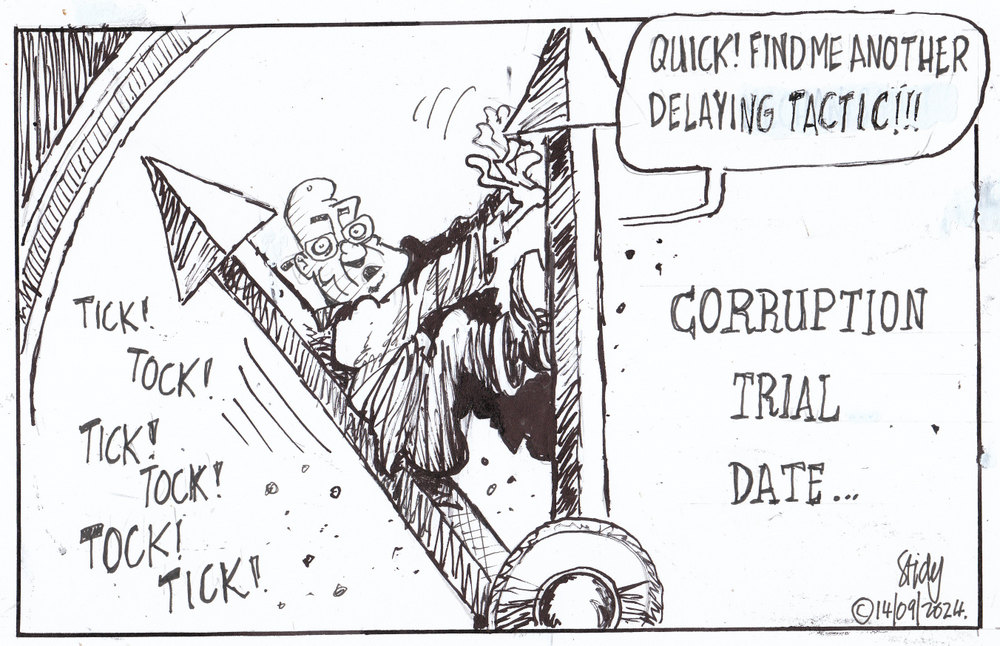
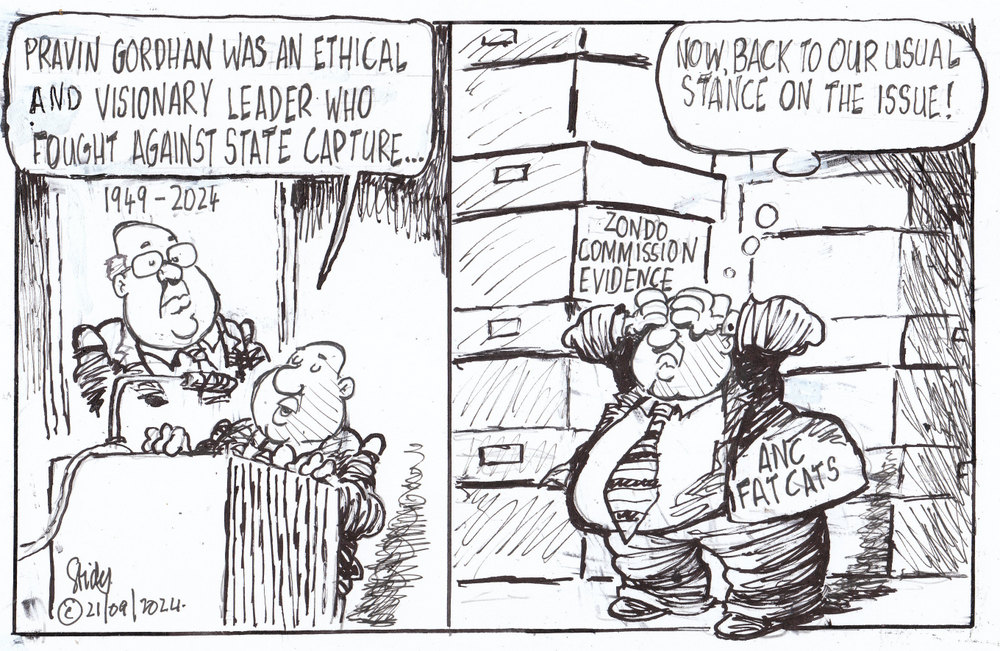


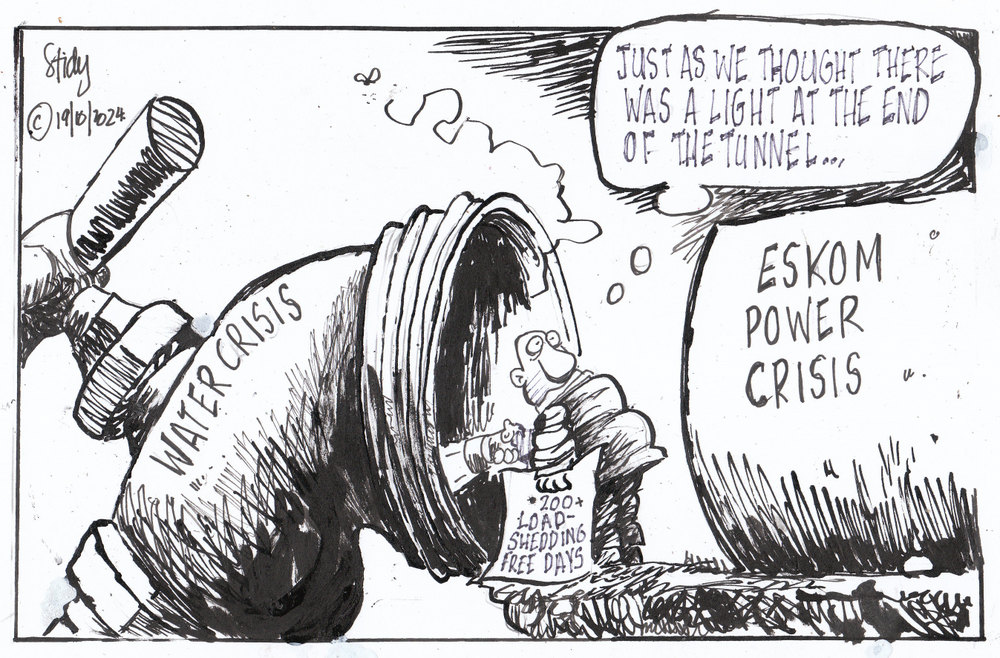
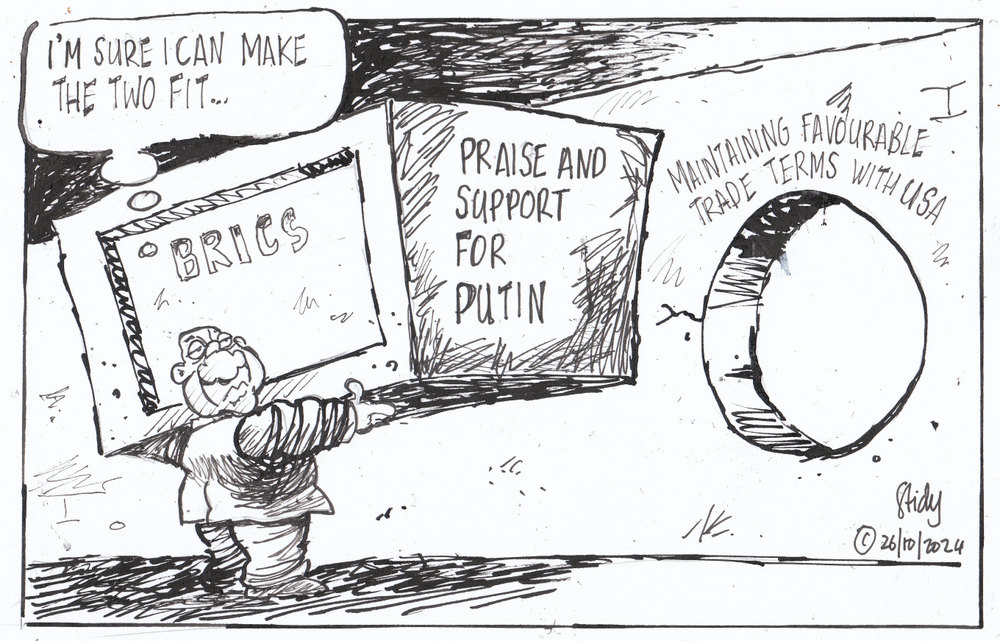


 Stidy's Eye