The Third Way

There are three ways,” he said at last, “by which a very ordinary person like me can improve himself – or at least partly rise above insignificance. Through religion, through public service, or through study and reflection on the natural world”.

The Ten Thousand Things by John Spurling ( published by Duckworth Overlook).

Pic courtesy of Sally Scott

As a professional political cartoonist, working to a deadline, I have always done the bulk of my drawing at my studio desk. Sketching out in the open, direct from nature – en plein air as the French call it – I left to the Fine Artists (who I have always regarded as a separate species from me.) That changed on holiday in Mpumalanga. Watching my sister, the landscape artist Sally Scott, sitting down by a river drawing – a study in intense focus and concentration – got me thinking I wanted to try my hand at what she was doing.

And so I did.

I found it a singularly liberating exercise. I have always liked to think of myself as a fairly observant person but you don’t realise how much you are not seeing until you try and draw it. Drawing, in situ, trains the eye wonderfully. It forces you to concentrate your mind on what is happening in front of you.

Sitting there, on a rock or a log, with the swallows wheeling overhead like World War Two fighter planes, you come to view the natural world differently. You start to see your surroundings in a minute and comprehensive detail, noticing all sorts of little things you had overlooked before. The jagged shape of a rock, the dark texture of a strip of bark, and the rumpled sky overhead – all excite.

There is also spontaneity, fluency and freshness about drawings done like this; that is something which you often lose in a cartoon or a painting you have laboured over for a long time. There are, I was further pleased to discover, other benefits. I have always believed in the value of physical exercise and sketching outdoors has allowed me to combine my two passions – walking and art.

Armed with a satchel containing my sketchpad and pencils, a boyish exuberance reasserts itself. My old passion for ‘expeditions’ and boarding school-style ‘exeats’ comes to the fore again. I am like an excited schoolboy with a secret.

Already I can notice the difference. As a cartoonist, confined to my kitchen/studio I grew flabby and pallid. Since I started walking, the surplus kilos have melted away and I have picked up something resembling a tan. I feel as fit as the ubiquitous fiddle.

Moving up to Kusane Farm, in the KwaZulu-Natal Midlands, has, of course, helped me in all of this. There is something to draw at every turn of the path – a gappy stone wall, a stream, a tumbling waterfall, a few ancient pine trees, a collection of farm buildings. Kusane has become my new heartland. It is beautiful country to walk in and also to draw. The views take your breath away. The land rises and falls in long swells and because it has not been farmed for years you can still get a glimpse of its beautiful past.

Kusane – beautiful country to walk in...

In pursuing this new way of life I have anointed myself with the title of gentleman artist although I still bristle at any suggestion that what I do is a ‘hobby’. That strikes me as a strange and utterly inappropriate description for an intensely felt passion. Extending my range has made me more conscious of my lack of experience in outdoor drawing. While each completed drawing brings its particular feeling of triumph there is invariably some detail I am not happy about.

There is nothing unusual in any of this, of course. I have been a newspaper cartoonist for over thirty years and I still obsess over the small imperfections in my technique and seek ways to improve my style.

Such is the nature of art. A ratio of failures is built into it.

What I strive for, above all, is a naturalness of style; I don’t want my work to be overly-intellectual, too-clever, pretentious or contrived. By the same token, I don’t want it to look like it was done by some amateurish Sunday dabbler. One of the important lessons I have finally learnt is not to get too anxious about mistakes. For this reason, I no longer carry a rubber with me. If a drawing does not work out, I will scrap it and start again.

I have also had to break the habits of a lifetime. As a cartoonist, hunched over my drawing, I have always worked with a fairly controlled line. Now I am deliberately trying to loosen up my style, ignoring the superfluous and working as quickly and as intuitively as possible. Remembering what my Scottish art teacher, Jock Forsyth, told me at school, all those years ago, about squinting enabling you to make out the key points more clearly, I sometimes try that. Often it is only on the third or fourth attempt that the picture begins to take a coherent shape.

All of which leads back to a fundamental question – why draw? I obviously can’t speak for others but in my case, it has always felt like it was something that was passed down to me. It is an in-built compulsion. A trust bestowed upon me. My vocation.

There is a blank piece of paper in front of me and I must fill it.

Like Wang Meng, the famous Chinese artist who lived during the last days of the Mongol occupation – and is the central character in the book quoted above – early on in my life I decided I did not want to follow the paths that led to either religion or public service. That left art and the contemplation of nature as the only way open to me if I wanted to rise above my insignificance. Like Wang Cheng, too, I don’t do this primarily for commercial reasons (although I am happy to accept payment!). For me, it is about solitude, contemplation, observation and the sheer joy of self-expression.

It is a reminder of what makes life precious…

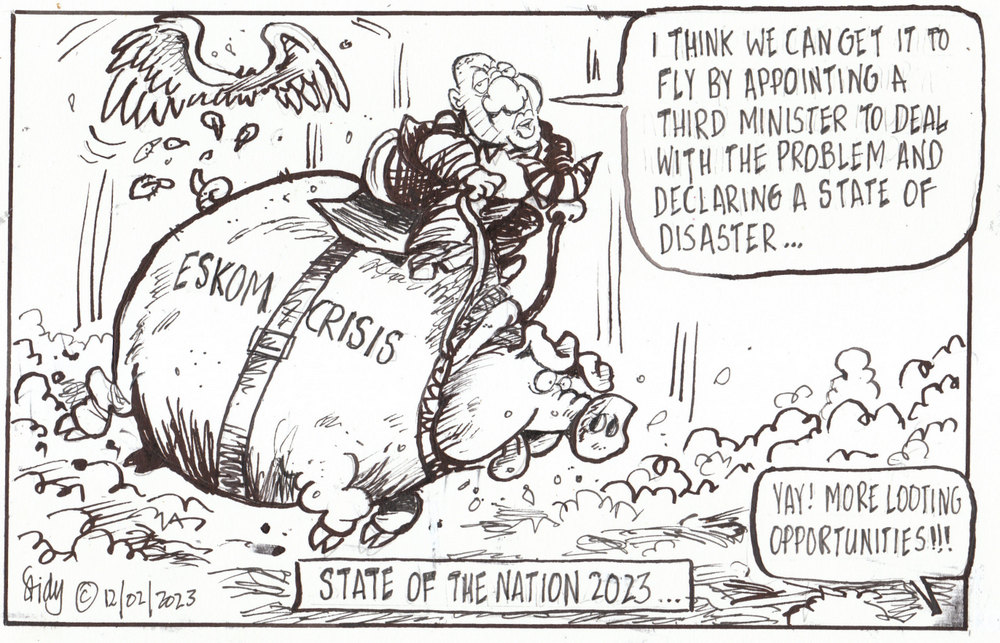
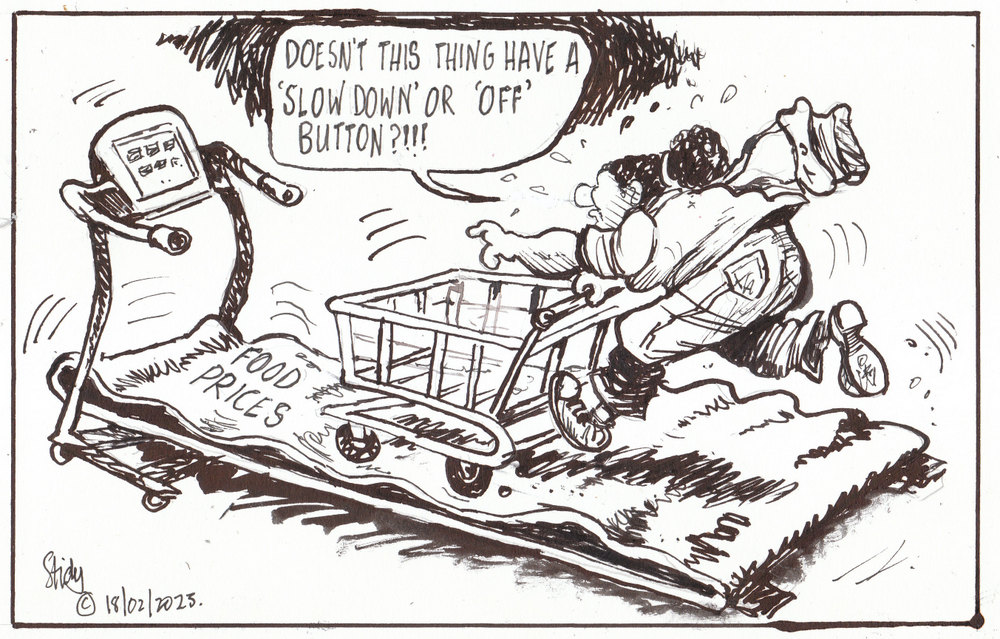
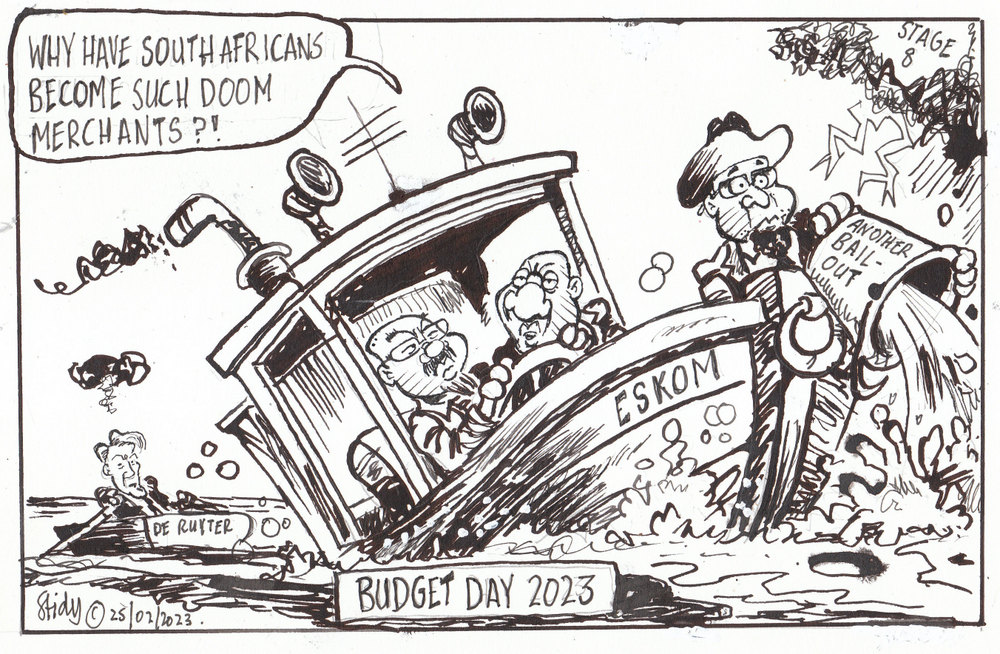
If Pigs Could Fly: Cartoons for January and February 2023

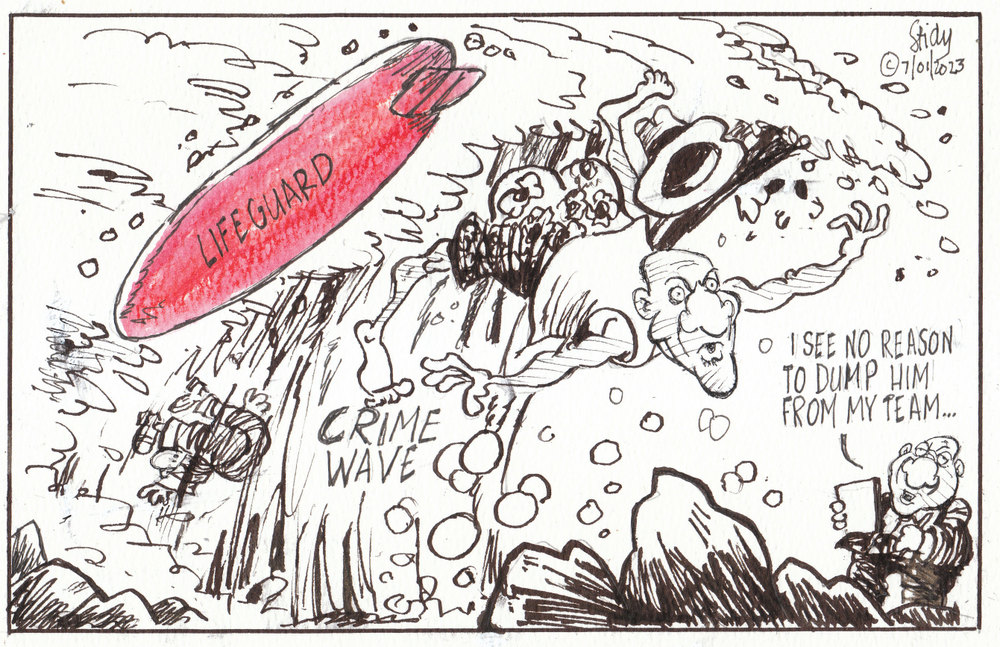
President Cyril Ramaphosa continued to back his police minister Bheki Cele amid continued calls for him to be sacked due to the country’s crime statistics.

Ailing state-owned parastatal, Eskom announced it was ramping up load-shedding to stage 6 until further notice. The power utility said the higher stage of the deliberate power cuts was necessary due to severe capacity restraints.

The South African government called for calm amid heightened tensions in many communities about service failings and the continued crippling load shedding.

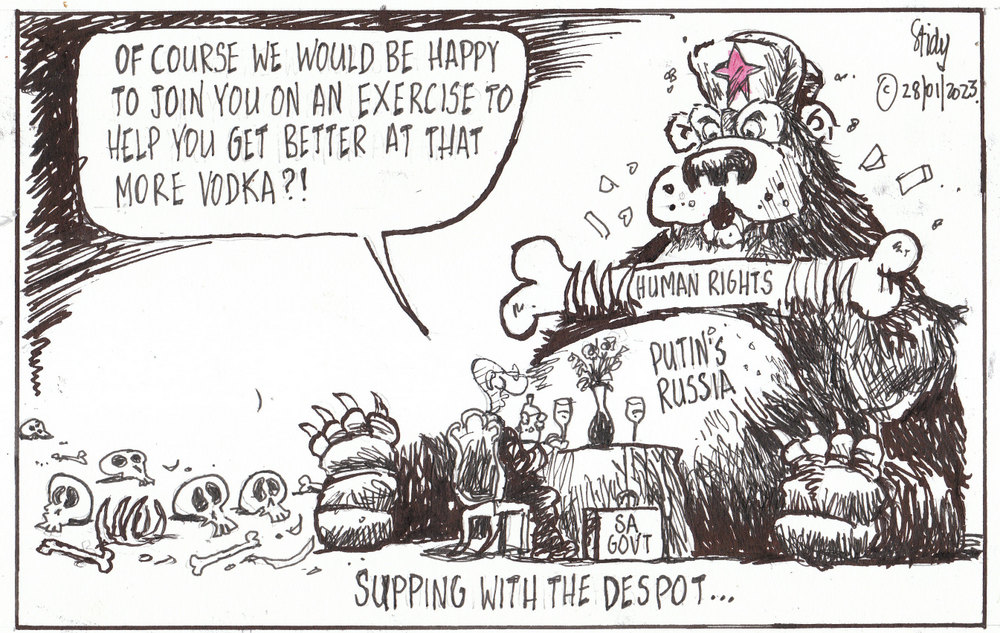
International relations and co-operation minister Naledi Pandor dismissed criticism of joint military drills with China and Russia saying hosting exercises with “friends” was the “natural course of relations.

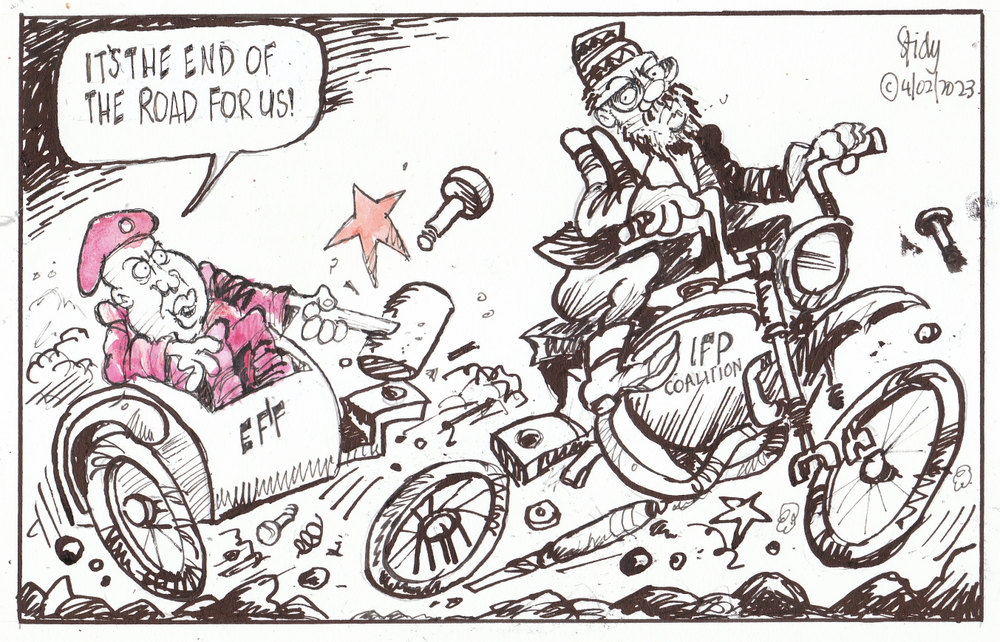
The Economic Freedom Front president Julius Malema announced that his party had instructed EFF deputy mayors in eight hung KwaZulu-Natal Councils to resign immediately and that the co-governance agreement between the two parties was over.

President Cyril Ramaphosa delivered his State of the Nation (SONA) Address declaring a State of Disaster for the electricity crisis and saying a minister of electricity would be appointed.

Annual consumer inflation cooled to 6.9% in January but food inflation hit its highest levels since 2009.

Tabling his 2023 Budget, Finance Minister Enoch Godongwana announced that the National Treasury will relieve the struggling parastatal Eskom of R254 Million of its debt over the next three years but said that strict conditions would be attached to this. Shortly after his speech, Eskom CEO Andre de Ruyter left the power utility “with immediate effect” after launching a stunning attack on the government and the ANC.

Book Reviews

published by MacMillan

Few British prime ministers have generated more scandal and controversy in such a short time as Boris Johnson. Campaigning on a promise to leave the EU with or without a deal he led the Tories to a historic 80-seat majority in Parliament. Having achieved his ultimate goal, his time in Number 10 was to prove tumultuous.

Johnson had earlier shown himself to be a much more attractive, sellable figure than his rather grey predecessor, Theresa May. He possessed charm and charisma in abundance. With his tousled appearance, boisterous humour and unflappable demeanour he became a regular crowd-pleaser despite his habit of playing fast and loose with the truth. Like many a politician, he had an eye for the effective quotation (“Get Brexit Done”) and was always quick to spot a good photo opportunity even if he often came over more as an affable rogue than a serious public figure.

Once in office, however, his fortunes began to change as his running of the country was quickly reduced to a series of crises, mostly of his own making. Previously, Johnson had always displayed a genius for turning potentially hostile events to his personal advantage but as his true political character began to emerge and the blunders mounted up, the act began to wear thin with both the public and many of his fellow party members. It was also his unfortunate lot to assume office just as the full horrors of the Covid pandemic began to hit and his handling of the crisis was initially characterised by a series of crass misjudgements and abrupt U-turns in policy. Although he could later claim justified success for his vaccination programme, he and his team squandered further public trust when it emerged they had breached their own lockdown regulations (like his counterpart across the ocean, Donald Trump, Johnson often acted as if the rules didn’t apply to him). A series of damning media revelations about illegal gatherings for drinks (including one get-together at the time of Prince Phillip’s death) culminated in what became known as “Partygate” and – along with his mishandling of the scandal involving the alleged sexual harasser, Chris Pincher – ultimately precipitated his resignation, leaving his party’s popularity and reputation at a catastrophic all-time low.

Johnson was equally poor in his judgement of people. His choice of the somewhat spooky Dominic Cummings as his chief advisor backfired when the latter left in a huff and then proceeded to release damning information against his erstwhile employer. His misjudged attempts to protect disgraced party members and colleagues further counted against him.

Sebastian Payne, an award-winning Whitehall editor and columnist for the Financial Times appears very well informed on the subject and has obviously had access to many of those who were closely involved with the former prime minister during the dying days of his premiership. While well aware of his subject’s psychological flaws and foibles, he goes out of his way to present a balanced picture of Johnson’s time in office. He makes a reasonably convincing case, for example, that the prime minister displayed true leadership in his handling of the Ukraine crisis and that it was largely due to his efforts that the West could display a united front against Putin’s invasion plans. As the author notes, it was the one occasion when he did come close to emulating his hero Winston Churchill.

For the rest though, it seems mostly to have been a case of Boris being good as Boris but not so good as prime minister. Like Trump again, though, it might be unwise to write him off just yet as he continues to lurk in the background, waiting to stage his comeback…

Published by Struik Travel & Heritage

In the increasingly difficult and troubled times, we live in there is probably no better stress burner than escaping into the wilderness, far from the clamour of civilisation and the burden of load-shedding. Getting into nature soothes and clears the mind, it offers silence and clarity. Many studies have, indeed, proved the beneficial effects of exercise on both physical and mental health but what sets hiking apart is that it is done outdoors and in a natural setting.

In South Africa, we are extremely lucky to not only enjoy a climate that is most conducive to open-air activities but to live in a country that is renowned for its diverse landscapes and magnificent scenery. Whether you are a casual rambler or a serious hiker there is a huge range of options available for everyone, be it the peaks of the Drakensberg, the fynbos-clad Cape, the Limpopo bushveld or the haunting beauty of the dry Karoo.

For those wanting to find out more about just what is on offer, Willie Olivier – an intrepid explorer who has covered thousands of kilometres throughout southern Africa both on foot and by road – is the perfect go-to man. Featuring over 500 trails, including 60 new trails, this fully updated fifth edition of his well-known Hiking Trails of South Africa is a treasure trove of information. As one would expect with such a pro, his book is accessibly written but packed with information and authoritative advice all mouth-wateringly presented. Grouped into broad geographic areas, it provides a brief overview of the flora, fauna, geology, climate and other relevant information, including the length and duration of the hike. Lushly illustrated, it also includes much sensible advice on planning, preparation, nutrition, equipment, first aid and general safety.

Swimming in the Wild

As a child, growing up in the Eastern Highlands of Zimbabwe, I used to spend an awful lot of time jumping into all sorts of streams, waterfalls, rivers and lakes.

Having been boxed up at boarding school for thirteen weeks at a stretch there was something peculiarly liberating about this odd habit of mine. It was like my own little unilateral declaration of independence, my response to all those schoolboy pressures to conform.

Swimming in the wild. My sisters, Penny and Nicky, the Pendeke river, Nyanga.

As soon as I got back to our farm, which was situated at the very end of the Old Dutch Settlement Road in Nyanga North, the first thing I would do was rip off my tie, toss away my blazer, basher and anything else that reminded me of the grim monster Conventionality and sprint down to the swift-running stream that flowed past the front of our house with the dogs barking with excitement behind me. Once I felt the water sluicing around me I knew I was home.

The great thing about wild swimming is, of course, that you aren’t usually surrounded by lots of other wild bathers all thrashing about and making a nuisance of themselves (although, in my quest to find the perfect pool, I have been forced to share my space with the odd water snake and river leguaan). Sitting in the shallow end of a heavily chlorinated swimming pool, fighting off hordes of screaming toddlers and being watched over by twitchy lifeguards does not, somehow, generate quite the same feelings of freedom or joy at being alive. Evolutionists would, no doubt, put this fascination with water down to some buried, primaeval, memory, the fact that this is where all life originated, but for me, there was also a spiritual element to it.

Most of the rivers that ran through our farm had their source in Mount Muozi, a striated, sphinx-like peak that jutted out from the Nyanga plateau. Flat-topped, steep-sided and seemingly impregnable the mountain served as the centre of a powerful rain-making cult.

Mount Muozi

This association added an element of both the holy and the supernatural to the whole cleansing ritual. Every time I sat under a waterfall I felt like the water I was immersing myself in had both come from and been blessed by the mountain spirits. Exulting in the freedom and solitude I would lie there, allowing the river to grow around me until nothing existed but me, it and that towering, mysterious mountain.

The day came, however, when, like many a country boy before and after me I succumbed to the lure of the big city and set off to seek my fame and fortune (I’m still looking). My days of running – and swimming – free were over and, out in the big world, I found myself being swept along by a different current, one which, by some strange quirk of fate, eventually landed me in Pietermaritzburg.

Perhaps it has something to do with the current mood of ecological apocalypse or maybe it’s a growing feeling that the present, heavily digitalised, world we live in has just got a little too disconnected from nature for my liking or maybe it’s just my age but in recent years I have found that the old call of the wild has begun to grow stronger again. In fact, you could say the condition has become almost psycho-pathological – at least once a year, preferably more, I have to get away.

In responding to this summons from the Deep I have covered thousands of kilometres, in all four seasons, and in many kinds of weather, searching for uninterrupted sight-lines and views that will feed my unbridled enthusiasm for torrents, cliffs and precipices. While I am easily swayed by scenes of bucolic calmness, I generally prefer a more chaotic and edgy version of nature, the more wild, rugged and unpopulated the better.

A great place to swim is the Orange River which passes through the Richtersveld.

For me such journeys into the unknown are both broadening and restorative, they provide a means of escape from the crowded streets and the routine of everyday life. On the road difficulties are resolved, possibilities open up and, as the horizons widen around me, I can feel my mind expanding to meet them. Indeed, I can think of nothing more bracing for the soul than turning one’s back on duties, following one’s nose and seeing where it leads. Therein lie stimulus, enrichment and a sense of achievement.

In opting, once again, to tread this solitary path I have found there have been other, more practical, benefits as well; all the physical exercise I have got from this endless pursuit of the sublime has given me the strength and endurance to continue sniping away at our, sometimes disheartening and unredeemable, bunch of politicians. And for that, I am truly thankful.

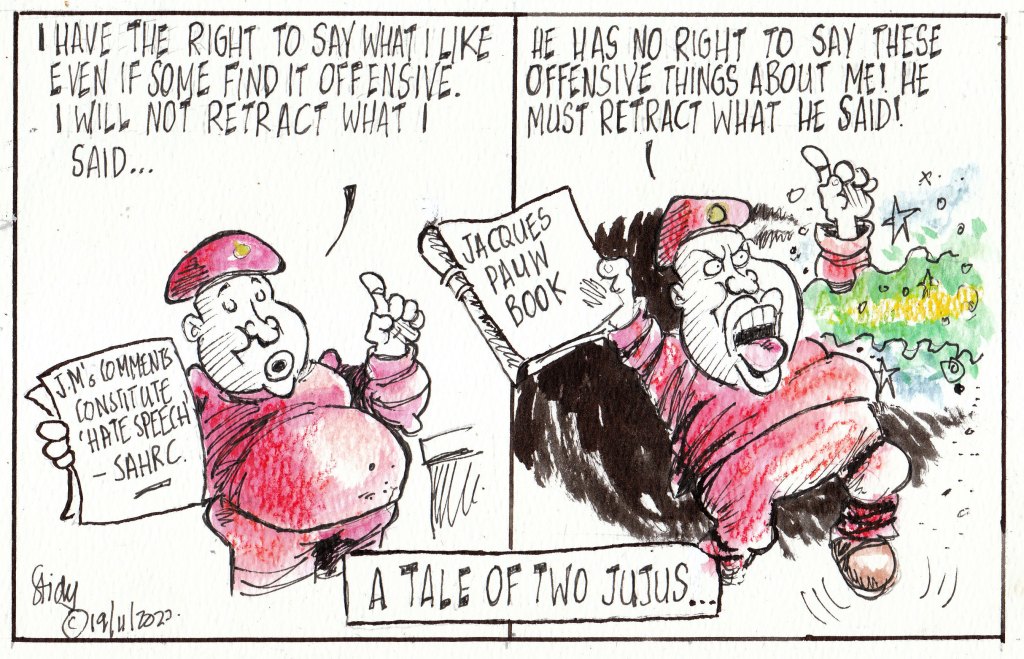
A Multitude of Crises: Cartoons for November and December 2022

With the latest fuel hikes, the already beleaguered South African consumer would have to find even more wriggle room in their monthly budgets to fill their tanks. They would also have to accommodate the rise in the cost of goods that would inevitably follow these price increases.

With the presidential race hotting up the probe into President Cyril Ramaphosa’s Phala Phala farm robbery reached a crucial stage. At this stage. the two front-runners appeared to be Ramaphosa and Dr Zweli Mkhize although an adverse finding against the president could affect his chances of being re-elected.

The SAHRC found that comments made by EFF leader Julius Malema constituted incitement to violence and hate speech and requested he retracts them. Having refused to do so, Juju, later in the same week, went on to demand that copies of Jacques Pauw’s Our Poisoned Land be removed from all bookstores because of specific allegations it made against him.

Responding to criticism in parliament over the ongoing Eskom crisis, Public Enterprises Minister Pravin Gordhan said government intervention, including President Cyril Ramaphosa’s energy plan and Integrated Resource Plan (IRP), should be given a chance to take effect.

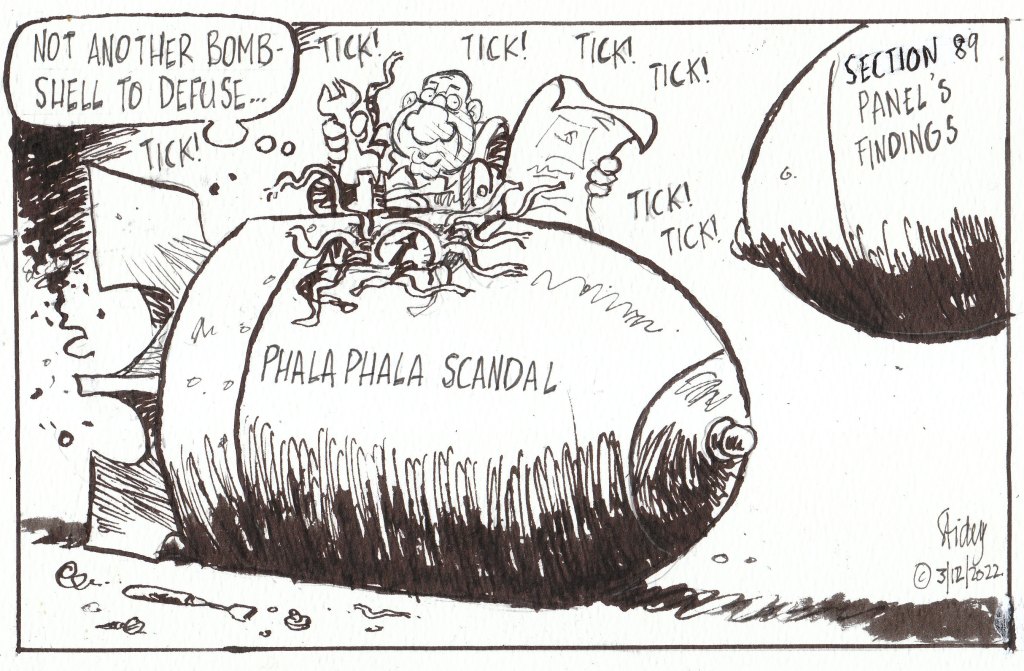
The country was plunged into crisis as the section 89 panel set up to investigate the Phala Phala scandal found that President Cyril Ramaphosa had an impeachment case to answer over serious violations of the constitution for exposing himself to conflict of interest, doing outside paid work and contravening the Corruption Activities Act.

President Cyril Ramaphosa secured the political support of the majority of his party as the delay in the vote for his impeachment gave him respite for a week. The president slammed the Section 89 panel for relying on the Fraser accusations in their findings.

The ANC’s acting Secretary-General, Paul Mashatile, referred Nkosazana Dlamini-Zuma to the ANC’s disciplinary committee. This came after she went against party instructions to vote against adopting the Section 89 report on Phala Phala.

With Christmas fast approaching, South Africa continued to suffer relentless load shedding. Eskom was thrown into further disarray with the resignation of its CEO, Andre de Ruyter.

Cyril Ramaphosa was re-elected leader of South Africa’s ruling ANC Party despite being badly damaged by a cash-heist scandal that has dogged him for months. His re-election came at a time when the country was being beset on all sides by a multitude of crises – crises that threatened to get worse with every passing moment of indecision or inaction by Ramaphosa and his government.

Book Reviews

published by Pan MacMillan.

Another week, another book about the chaotic, cataclysmic Donald Trump presidency and the tumultuous fallout from it. The author of this one has probably jumped the gun in rushing to print, since his analysis focuses on the investigation into January 6th investigation whose findings have yet to be published, but it obviously felt it was important to get in early with his take on the proceedings.

As is now common knowledge, the 2020 United States presidential election held on November 3rd, saw the former Democratic vice-president Joe Biden defeat the incumbent president Donald Trump with Biden receiving more than 81 million votes, the most votes ever cast in a US presidential election. Unable to accept the reality of his defeat the soon-to-be ex-president would go on to insist the election results had been rigged although he had next to no proof to back his claims up. It didn’t matter. The doubts he cultivated ultimately led to a rampage inside the US Capitol by an angry mob of pro-Trump supporters, as well as giving birth to the Stop the Steal movement.

Undoubtedly, one of the low-water marks in recent American history, the attempted coup rocked the very foundations on which American democracy was built. It also led to a great deal of soul-searching and heated debate. As a former Republican congressman, as well as the senior technical advisor to the House select committee tasked with investigating the attack, Denver Riggelman, has some claim to know of what he speaks when it comes to the subject. He had access to much of the correspondence and documentation which passed between the various parties and was privy to a lot of privileged information. As such, his book is full of revealing insights and sheds a great deal of light on precisely what happened during those fateful few days. What becomes plain from reading it is that the insurrection was not a spontaneous act nor an isolated one but was part of a deliberate campaign aimed at keeping Trump in office. It is also hard to ignore that much of the culpability lies with Trump himself.

Equally disturbing is the fact that the effort to overturn the result of the election involved officials from all levels of government (including the military – Riggelman claims that at least one hundred of the rioters who stormed into the building that day had military experience), as well as many members of the Republican Party.

In addition to showing how Trump deluded the American people, and probably himself, Riggelman’s book is also a part memoir. By his admission, he grew up in the conservative edge of the Bible Belt “among the true believers” and it took many years to shake off the yoke religion had placed on his worldview. This gives him an insider’s take on how the far right and extremist groups like QAnon operate. Fed a combustible brew of fire and brimstone Biblical tub-thumping, biased TV and, more recently, the sort of delusional mob group-think that characterises the darker recesses of the internet it has led to a conspiratorial mindset which has, in turn, now seeped into the mainstream.

Frighteningly, there is every likelihood that in the future the system could produce more tenants in the White House just like Trump: shallow, dishonest, opportunistic, vicious and at times almost comically incompetent.

There are lessons to be learnt from all of this…

published by Bantam

There is something enjoyably familiar about sitting down with another book featuring Lee Child’s iconic hero, Jack Reacher. It is like being reacquainted with an old friend after a gap in time. One of crime fiction’s more engaging creations, the latest book featuring the laconic drifter differs from all the previous ones in that it has been co-written with his younger brother Andrew Child to whom Lee intends to hand over the reins of the franchise.

Not that any difference in style is immediately apparent. No Plan B begins in a predictable fashion with Reacher turning up in yet another remote, dusty, fly-blown mid-American town only to find himself once more at the centre of all the action. In this case, a young woman appears to throw herself under an approaching us. Naturally, all is not as it seems with the sharp-eyed Reacher, alone among the various on-lookers, noticing what everybody else has failed to see – the woman was deliberately pushed by a man in a hood. The police don’t buy his version of events, the death is ruled a suicide and the case is closed. For an avenging angel like Reacher, who sees it as his mission to battle injustice, this obviously goes against the grain and immediately decides to carry out his own investigation. The deeper he digs, the more he realises this wasn’t just a random act of violence but is part of a much larger and more sinister conspiracy that has its centre in a supposedly model prison in a small Mississippi town. Once they get wind of the fact Reacher is hot on their trail, the conspirators do their best to stop him from reaching his destination but they fail to factor in his unique talents or his relentless determination.

In many ways, No Plan B is vintage Lee Child. The theme is tackled cleverly with well-concealed sub-plots and several strong set-piece action sequences. If there is a slight difference in the form it lies in the dialogue. When it comes to cynical, snappy one-liners and put-downs – usually delivered as – Reacher despatches, in suitably violent fashion, yet another villain – Child is normally a reliable performer but here the writing seems oddly underpowered with few of the memorable quips that have proved such a feature of his best books in the series.

Book Reviews

published by Jonathan Cape

A young schoolboy’s infatuation with and uncontrollable feelings for his music teacher (and hers for him) and the impact it has on the rest of his life is at the heart of Ian McEwan’s latest book, a tale of sullied yearnings and unrealised hopes scanning one man’s lifetime.

Beginning with his parent’s wartime romance and not especially happy marriage, the book takes us through his boarding school days during the suffocating vestiges of 1950s morality and the embryonic promiscuity of the 1960s. Along the way, it also touches on such burning historic events as the Suez Crisis, the Cuba Missile Crisis, Chernobyl, the fall of the Berlin Wall and – even more up to date – the Covid pandemic. Recounted in chronological order, as well as with the occasional flashbacks, it gives the book a raw episodic quality that, at times, makes it feel more like a biography than fiction.

Dropping out of school early. the protagonist leads a life in which he never seems able to connect or realise his true potential. He takes on a number of unpleasant and unremunerative jobs eventually settling for the slightly dead-end job as a lounge pianist. While obviously intelligent and talented, his literary projects don’t quite take off, and his relationships are fragmentary and not always satisfying. In a reversal of the traditional order where it is usually the man who puts his selfish emotional needs first, his first wife abandons him and their infant son to pursue a solitary career as a writer, Later, he has an on/off relationship with a married woman who at first leaves, then returns to and finally leaves her husband. All this is played out against events in the wider world.

Combining quick social observation with a profound understanding of our troubled times, Lessons beautifully captures the warp and weft of our often messy, unfulfilled lives while, at the same time, providing a richly nuanced portrait of a man who suffers his share of abuse and loss while never really achieving his ambitions. Somehow he endures them all and winds up with a measure of peace and understanding at the end.

Published by Struik Nature

The distinguished naturalist, William John Burchell is generally regarded as one of the greatest of the early African explorers. Making up in enthusiasm and tenacity what he then lacked in experience, his bold expedition deep into the South African interior laid the groundwork for much subsequent scientific research and has added considerably to our understanding of the country’s natural history in the nineteenth century. Equipped with a custom-built ox-wagon but none of the expensive equipment which modern science requires he managed to amass an astonishing 63 000 specimens of plants, bulbs, insects, reptiles and mammals on his 7000-kilometre journey which took him through some of the driest parts of the sub-continent, as far north as Kuruman. It is a mark of both his considerable achievements and the esteem in which is still held that so many species still bear his name (Burchell’s Zebra, Burchell’s Coucal etc)

Among Burchell’s many strengths were an indefatigable curiosity and imaginative sympathy with the natural world, coupled with openness towards the people he encountered on his arduous four-year expedition. In this, he was atypical of the day.

Burchell described his outbound trek in his famous Travels in the Interior but never got around to completing the volume describing his return trip via the more lush and densely vegetated eastern coast of South Africa even though it proved every bit as productive and as fruitful in terms of what he discovered as what had gone before. The authors, Roger Stewart and Marion Whitehead, have sought to fill this gap in the narrative by delving back into the records and revisiting many of the places he passed through.

Fortunately, Burchell was a painstaking note-taker and prolific letter writer and this intriguing, well-researched biography is brought to life by the many extracts from his correspondence. In addition, he was also an accomplished artist and his delicate watercolours add immeasurable value and vividness to the text. From downs to mountains, from dunes to semi-desert, they provide a comprehensive microcosm of the country as it appeared back then as seen through the eyes of a highly observant and intrepid young explorer.

Walking Back to Happiness…

: If you are in a bad mood go for a walk, if you are still in a bad mood, go for another walk.”-Hippocrates

Pic courtesy of Sally Scott.

I can feel the sun on my back, already warm as toast, as I set out through the farm gate following the road that leads down to the protea field and then past the tall pines where a clamorous row of black crows are having a huge argument over which direction to fly. I know in a general way where I am headed and what I will most likely encounter along the way although each day always brings its subtle differences. I don’t, normally, wonder too deeply about my motivations for doing what I am doing. Going for a walk is just something I do and enjoy. I find it healing. Outdoor therapy. It helps me to think. It is my form of meditation. If I am feeling down in the dumps it gets me – mostly – back on the right track.

There are no limits to where I walk. I am quite happy to keep exploring the same patch of ground because over time you develop a sense of intimacy with it that comes from an accumulation of particular observations. Likewise, there is a special fascination in testing one’s expectations in less familiar backgrounds. The important point, I think, is to be able to relish both the ordinary and the extraordinary.

The habit of walking manifested itself at a very early age. When I was about three years old my father, an airline pilot with a yen for country life, decided to relocate us from our house in the then Salisbury (now Harare) to a smallholding in Umwindsidale, about thirty kilometres outside town. He chose to call our new home “Dovery” after the crooning Cape Turtle Doves that were such a feature of the place. For me, their call remains one of Africa’s most beautiful, evocative and comforting sounds.

My main memory of the property is the view which was spectacular. From our front verandah, we looked over an open stretch of land, extensively cultivated, along whose edges the Umwindsi (now Mvinzi) River flowed, its path marked by an outline of dark green. Beyond this fertile plain stretched a further succession of hills and valleys, blue and hazy, each one becoming successively paler, in turn, as they rose to meet the sky. From an early age, I liked to create worlds of my own, in which I could slip away unnoticed and undisturbed and the countryside that surrounded our home provided plenty of places where I could do just that.

Umwindsi (Mvinzi) river with my brothers and sister. I am on the left.

The Umwindsi was a lovely little rivulet that tumbled and crawled and blundered its way through a network of rocks, roots and tall shady trees. For a young child, it was a magical place and I spent a lot of time adventuring up and down it, playing in the pools and exploring its secret places to see what lay hidden there.

It was also the ideal preparation ground for our next grand adventure – a move to a remote farm at the northern extreme of the Nyanga mountain range.

The farm occupied a broad stretch of land, mostly valley but bordered on two sides by mountains. Jutting out from the main range were several castellated buttresses which stood like imperious guardians, mute witnesses to the goings on below. Along the floor of the valley stretched miles of grassland with woody patches, winding rivers which fed into one another and soft hills inset with elephant-coloured boulders, many covered with old stone walls, left behind by some forgotten people. Over it hung the intense blue sky of Africa.

The Old Dutch Settlement Road, Nyanga. Our farm was at the end of the range.

The land on our farm hadn’t been worked for many years and felt wild and untamed. At the night the wind would howl down from the mountains and the very air seemed to seethe with phantoms, both good and bad. They whispered to me as I lay in my bed with only a flickering candle, on the table next to me, to keep the shadows at bay. In the moonlight, the whole landscape beyond my window seemed to possess a strange alchemy all of its own, a spirit ancient and impassive permeating the land.

There was much to discover and endless opportunities for exploration. Most mornings when the sky was clean and ready for whatever lay ahead I would set out into the wilderness to see what I could find. I learnt to watch, wonder and recognise all the landmarks: the curves in the road, the shape of the hills, the twists and turns of the mountain streams, the outlines of the fields, the size and weird contortions of the baobab trees. No horizon seemed too far away. The more I saw, the more the place insinuated its way into my soul. It deepened my love for Africa. Sometimes I would go with my elder brother Pete – an avid birder even back then – mostly I would go on my own with just the farm dogs for company. My memory of these walks and the years on the farm have never left me.

It wasn’t just at home that I walked. Bastions of robust sportsmanship, all three of the boarding schools I attended -REPS in the Matopos, Plumtree on the Botswana border and UBHS in the Eastern Highlands – encouraged healthy outdoor activities, seeing it as an essential element in character-building. Most weekends would find me exploring the surrounding countryside.

On the summit of Cecil Kop, Umtali (now Mutare). I am in the middle. My brother Pete is on the left and my friend Stu Taylor is on the right.

Eventually, the idyll came to an end. My life took a turn for the worse. Bad replaced good. War broke out. I got called up.

As an ordinary foot soldier in the army, I got to do a great deal of walking although most of it was not voluntary or even pleasant. Having bullets and mortar bombs whizz past me didn’t add to the enjoyment.

Getting shot at or mortared was not the only thing which occupied my mind patrolling in the stupefying heat of the Zambezi valley. On foot in Africa, one will sooner or later have a hair-raising experience with a wild animal. Of them all, I think it was the lone Black Rhino I was most scared of. To have one suddenly come crashing through the bushes is not an experience I want to repeat too often although I had my fair share of scrapes with this cantankerous character.

On patrol in the Zambezi Valley

Still, the army toughened me up, got me superbly fit and introduced me to some wonderful new scenery so I mustn’t grumble.

The Rhodesian Bush War finally dragged on to its inevitable conclusion. I got discharged. Like all wars, the conflict marked our lives. It left a lasting legacy. In my case, I don’t think I emerged from it suffering from Post Combat Stress Syndrome or anything as dramatic or personality-changing as that. Still, it did leave me with a vague sense of melancholy, restlessness and an inability to settle down. Unsure what to do, the horizons seemed to close in around me. I felt trapped and constricted.

Bored stiff with my office job in the Mining Commissioner’s office in Gweru, I resigned and moved onto my parent’s new farm at Battlefields, near the Midlands town of Kadoma. Needing time to think, I walked and walked. By the end of it, there was hardly an inch of the farm I didn’t know. Walking had, once again, become my solace, my cure. It also made me realise it was time to move on. To go somewhere new. To start my life again in a place where I wasn’t surrounded by the constant reminders of the futility of what I had been through.

And so I packed my bags and moved to South Africa. With me went my nostalgia for landscape which I quickly transferred to my new surroundings. I set about exploring the country. I went on birding expeditions to Marakele, Mapungubwe, Kruger and the Richtersveld. I trundled through the Little Karoo and Baviaanskloof. I walked on the Wild Coast to the sound of crashing breakers. With my sister, the artist Sally Scott, and her family I made countless trips to the Drakensberg. We slept in caves, hiked along numerous mountain trails and plunged into icy rivers.

The Drakensberg had a different feel from the mountains I had grown up amongst in Nyanga. Higher, more precipitous, austere, jagged, cold and with fewer trees they were inhabited by a different set of gods and mountain deities. I loved it all the same. Climbing them, I always felt I had risen above the material plane and entered another, more enchanted, realm. The scenery and views left me breathless.

Mont-aux-Sources, Drakensberg, with my nephew Craig Scott.

When I wasn’t out walking, I worked as a political cartoonist in Pietermaritzburg. As I got older, I grew increasingly disenchanted with city living. Some friends suggested I move up to their farm, high on a hill overlooking the Karkloof Valley. Viewed through the soft, filtered light of the swirling mist, there was something dream-like about its beauty; my heart was immediately smitten with delight. I accepted.

The Karkloof Valley. The view from our farm.

Moving into the country changed the shape of my life. It helped renew my sense of deep connection with the natural world. I spent many happy hours tramping over a familiar circuit of paths, seldom meeting a single person en route. Revelling in the sense of discovery and freedom that comes with this, I developed an increasingly close and intimate relationship with the local flora and fauna. However, nature still managed to spring surprises on me.
Lockdown came. I had always thought that the advances in modern medicine would provide a solution for everything but Covid, at least initially, proved me wrong. The virus transported us all back to the fear-ridden, helpless days of the Great Plague. It reminded us of just how vulnerable we still are and demonstrated that we are still at the mercy of the whims of nature.

Over the next two years my life – like many others – took on a slightly surreal aspect. As part of the locked-down community, I found the days blurring together. Whether it was Monday or Friday came to hold no interest for me. Alone in the house, isolated from the world, I lived in silence and solitude, with only the sound of birdsong, the whistle of a reedbuck, the howl of a jackal and the croaking frogs to sustain me. When I went to town, which was not often, I talked through a mask to other people wearing masks. It felt a little weird and dehumanising at first but I got used to it.

The national confinement stretched on through the months that followed with intermittent breaks. In the end, I learnt to get used to a world with little direct communication, so much so that I almost began to prefer it that way. Again, it was my walks which brought me the most relief, gave meaning to my life, helped me feel less trapped and provided me with a sense of quietude which conquered despair. I was lucky living in the country because the people living in town weren’t permitted to go beyond their front gates whereas I had our entire farm to roam over.

Heading outPic courtesy of Craig Scott.

If you had to ask me then why I walk so much, I would have to concede that – apart from the obvious health benefits – it stems back to a longing to be the boy I once was, innocent again and seeing the world for the first time. My walks remind me of a more carefree period of my life. More than that, though, they have become part of a growing awareness of myself, an increasing reflectiveness and a developing sense of my place in the world and the environment. It nourishes my sense of self-sufficiency. It makes it easier to exist in these tumultuous times.

Time has, of course, dissipated some of my innate restlessness but while I still have the energy in my legs and air in my lungs I intend to keep walking…

Book Reviews

published by 4th Estate

The 1994 Rwanda genocide, conducted mainly against the Tutsi minority ethnic group, was one of the great traumas of the twentieth century. During roughly 100 days between 500 000 to 662 000 people were killed. The scale and brutality of the genocide sent shock waves around the world although no country intervened in the slaughter.

The immediate trigger for the massacre was the downing of the jet carrying not only the Rwandan President Habyarimana but also his Burundian counterpart, Cyprian Ntarymira. Determined to avenge the slaying of their president, thousands of youth militia went on the rampage, bent on exterminating not only Tutsis but any Hutu deemed as being hostile to the regime. The long-standing tension and resentment between the two cultures provided the combustible fuel that sparked a raging riot.

In the aftermath of the genocide the rebel Tutsi-led Rwandan Patriotic Front (RPF), who swept through the country and restored some degree of order, was originally seen as the good guys – or at least the more virtuous of the various warring factions. It is a reputation which does not always stand up to scrutiny as author Michela Wrong shows in her often chilling but always compelling account of what transpired.

Wrong, who won deserved plaudits for her book about the rise and fall of Mobutu Sese Seko, In the Footsteps of My Kurtz, and who, as a reporter, witnessed many of the massacres that took place in Rwanda, is perfectly placed to write about the genocide.

In her introduction, she admits, however, the difficulties she had obtaining accurate and reliable information in a society where duplicity and lying are seen as a political virtue but her book nevertheless contains much intriguing anecdotage from many of the principal characters involved. It also has the ring of authenticity.

Opening her account with the assassination in South Africa, of the popular but now exiled Patrick Karegeya, the former Rwandan chief of Intelligence and one-time close friend of President Kagame (the book’s title comes from the sign the assassins left hanging on the door of his hotel room while they went about their grisly business), she then moves back in time, tracing the trajectory of the RPF from its origins in the Ugandan conflict of the 1980s to its present-day position as the ruling party in Rwanda. In the process, she strips away the carefully constructed façade and shows how a rebel movement that once inspired awe and respect and pitched itself as the party of ethnic reconciliation, has become, in true Orwellian tradition, as corrupt, autocratic, vindictive, ruthless and power-hungry as the regime it overthrew – and equally guilty of its own atrocities.

One of the many questions that springs to mind on reading the book is how ordinary people, people such as you and me, were able to act with such barbarity? In part, this can be explained by the country’s toxic history which allowed one side to dehumanise the other and consider them less than human. As Wrong observes “brutality is contagious” and the whole Great Lakes area has a long history of violence. Another interesting question that emerges from the book is just who shot down the jet carrying the two heads of state? Although the truth has never been completely established, much of the evidence points in one direction

Blended with vivid descriptions of place and character, Wrong manages to weld together all the myriad strands of this difficult and shocking period of recent African history in a language that is simultaneously poetic and down-to-earth. The result of much painstaking research, Do Not Disturb demonstrates with terrible clarity the ultimate potential consequences of racism, militarism and authoritarianism.

published by Melinda Ferguson Books

South African journalist, academic and former anti-apartheid activist, Malcolm Ray has set himself an epic challenge with this book – to attempt to explain how the social and economic turmoil that has engulfed so many post-colonial African states came about. This was always going to be a tough task but it is one he tackles with determination and enthusiasm and backs up with a great deal of hard research and careful analysis.

Fundamental to his argument is the whole concept of Growth Domestic Product (GDP) which has become the core creed of most countries’ financial planning. Ray devotes much of the earlier part of the book to explaining how it evolved and how an obsession with it has come to dominate economic thinking.

As originally conceived, the drive to identify and prioritise GDP had its merits. At the end of the Second World War, for example, the United States, as the world’s leading economic power, launched what became known as the Marshal Plan whose purpose was the revival of the world economy after the devastation caused by the conflict. As US Secretary of State George C Marshall, after whom the plan was named, made plain when discussing it, the doctrine was not directed against any country but against “hunger, poverty, desperation and chaos”. Noble in intention the plan initially worked well enough although by the 1970s (and thereafter) those innocent days were long gone. Since then, a growth-at-any-cost-doctrine and unchecked free-market economics have resulted in what Ray calls bandit capitalism which, in turn, has often gone hand in hand with bolstering up repressive regimes – like Zaire’s kleptocrat Mobutu Sese Seko. Poor countries have found themselves coming increasingly under the control of mostly American multinationals.

Perhaps hardly surprisingly, Ray examines the role played in all of this by organisations like the International Monetary Fund (IMF) and the World Bank, who were tasked with monitoring developing countries’ finances and whose extremely unpopular austerity measures had plunged many countries into seemingly intractable debt traps. He also shows how the whole aid for trade doctrine pushed by the US and its subsidiaries has in many cases been a tragic, epic failure.

South African readers will find the chapters devoted to this country especially interesting. Ray provides a compelling and convincing narrative to explain how President Thabo Mbeki’s ambitious economic reform programme came undone, paving the way for the rise of the opportunistic, predatory, Jacob Zuma whose “oligarchy was a populist manoeuvre to seize the ill-gotten gains of an old oligarchy, not for the benefit of the people who made it, but for himself.”

Well-informed, broadly convincing and certainly alarming, Tyranny of Growth is a timely and important book. The strength of Ray’s argument lies in his humanising Africa’s descent into economic chaos and also his posing of the all-important question – who exactly does the growth at all costs doctrine benefit when it has led to the marginalization of the continent and produced not only growing joblessness but an almost obscene inequality in the distribution of wealth?

The answer, he suggests, lies in the flawed economic model we are using…

And the Word is…LOAD-SHEDDING: Cartoons for September and October 2022

In scenes reminiscent of former president Jacob Zuma in the dying days of his presidency, President Cyril Ramaphosa again refused to answer questions in Parliament about the robbery at his Phala Phala farm citing “due process” as a number of law enforcement agencies were investigating the matter. Opposition members remained equally determined to not let him off the hook.

Former president Jacob Zuma summoned state attorney Billy Downer SC, who is the lead prosecutor in his fraud case, and News 24 journalist Karyn Maughan to court for allegedly disclosing his medical records. The case was expected to affect and cause more delays in Zuma’s corruption matter.

Six months into its financial year struggling power entity Eskom had spent R7.7 billion on diesel for emergency generators – far in excess of the budgeted amounts. The news came as the state-owned enterprise implemented yet more power cuts across the country.

Worsening power cuts forced President Cyril Ramaphosa to cut short his overseas visit to deal with the ongoing problems. Back home, he once again listed a number of solutions to fix Eskom and improve its fleet of power stations.

Former president Jacob Zuma’s home province decided not to support his bid to be elected the next ANC national chairman. The KZN provincial executive committee said it had resolved to throw its weight behind Limpopo Premier, Stanley Mathabatha, for the position.

It was a case of another day, another crash as a runaway truck lost control on the N3 at Townhill and crashed into a barrier blocking the main Jo’burg to Durban artery for hours. The problems on this dangerous section of the highway have been exacerbated by the ongoing roadworks near the Peter Brown off-ramp which had caused huge snarl-ups.

As the country endured yet another extended wave of load-shedding, President Cyril Ramaphosa signed an amendment to the ministerial handbook which would have seen taxpayers forking out for ministers’ water and electricity – as well as other benefits. After a vociferous public backlash, the new perks were later scrapped.

The term load-shedding was announced as the 2022 South African Word of the Year by the Pan South African Language Board (PanSALB). The announcement came as Eskom painted another grim picture of the load-shedding schedule for the week…

Opposition parties slammed President Cyril Ramaphosa for failing to take decisive action against Cabinet ministers implicated in state capture. Among those listed in the Zondo Commission Report were Mineral and Energy Resources Minister Gwede Mantashe and Deputy State Security Minister Zizi Kodwa.