‘Hope’ is the thing with feathers –
That perches in the soul –
And sings the tune without the words –
And never stops – at all
Emily Dickinson.

Does life hold any greater pleasure than lying in bed, soaking up the early morning melody of bird song? I tend to think not! With the dawn comes enchantment.
It was certainly one of my main reasons for wanting to quit city life and return to my rural roots.
Setting up home on Kusane Farm, overlooking the Karkloof, I had to, first, try and get to know all the local birds and familiarise myself with their repertoire of songs. The more I grew accustomed to their various calls, the more I began to feel a part of things.

Birds sing most in spring because that is usually when they are courting and nesting. Of course, they don’t only vocalise because they are trying to attract a mate. They also call to warn of predators, defend their territory and distinguish between friend or foe.
Most species have highly distinctive songs so this is often a good way of identifying them. Even within a particular species it can help as, for example, with all the dun-coloured Cisticolas who are otherwise often extremely difficult to tell apart.
Birds like to sing early in the morning because that is when sound travels best and furthest. To avoid interference they will often – but not always – sing from a perch above ground level. Sometimes there are a few false starts. A dove starts to coo, changes its mind and goes back to sleep. This is followed by a lull as the whole feathered choir shuffles to their seats, clear their throats and stretch their vocal chords.
And then the joyous symphony begins…
The listing habit has an old and honourable pedigree dating back to ancient Sumeria, so I take some pride in being able to add my little tally of bird calls to it. My list is short, incomplete and contains no rarities because I have confined it, for the most part, to the more common garden birds of my area.
For me, the most bewitching of all these calls belongs to the Southern BouBou, the male of which, can be seen here taking a shower under my garden spray. The resident female (also shown) is sweet to his sound, invariably answering it with a tune of her own.

Southern Boubou (male) 
Southern Boubou (female)
My old, much-thumbed and annotated, copy of Roberts Birds of South Africa describes their voice this way: “A duet of ‘ko-ko’ replied by ‘kweet’ or ‘boo-boo’ replied to by ‘whee oo’; often reversed thus ‘too, whee’ answered by ‘boo-boo’” The alarm note a guttural ‘cha-chacha’ or ‘bizykizzkizz’”.
In other words, it is a rather long, idiosyncratic and complex love song…
Another regular member of my dawn chorus is the Cape Robin-Chat, seen here sitting in a Sneezewood tree (Ptaeroxylon obliquum) I planted when I first came up to Kusane.

Friendly and inquisitive, he may lack the grandmaster skills of his cousin, the White-browed Robin-Chat (formerly Heuglin’s Robin) – whose song is complex, subtle and piercingly beautiful – but he sings his little heart out and for that he gets full marks. He is also, invariably, the first bird up and the last to go to bed.
What William Blake observed about the English robin, could just as much apply to his free-spirited African equivalent:
“A Robin Red breast in a Cage
Puts all Heaven in a Rage.”
Number Three on my list is the Olive Thrush. Like the robin, he is one of the first birds to break the tension of waiting for sunrise, bursting in to song just before the first streaks of light appear in the East.
In a poem dedicated to this common garden bird, the Grahamstown poet, Harry Owen, describes it, rather beautifully, as an “Avian Buddha…hunched up in ruffled chestnut gentleness…”
His emotional and aesthetic reaction differs somewhat from that of the English poet, Ted Hughes, who wrote:
“Terrifying are the attent sleek thrushes on the lawn,
More coiled steel than living – a poised
Dark deadly eye…”
Cold killing machine or not – and he is an effective hunter as this photograph shows – I am still happy to wake up every morning to its uplifting, fluty call.

If I had to name the Joker in the Kusane pack, my vote would go to the Dark-capped Bulbul (formerly Black-eyed Bulbul) – or Toppie as it is more affectionately known.

One of the most common and widespread birds in South Africa, the fruit-loving Toppie is more to be admired for his persistence and effort than the quality of his singing – but he is unfailingly cheerful and upbeat and that makes him all the more loveable.
It would also take a very sneaky snake to slither by without a Toppie spotting it and notifying the universe!
As something of a nomad, a bird who comes and goes seemingly on whim, the Black-headed Oriole is an infrequent participant in the Kusane Farm Dawn Chorus.
Few birds, however, are so dramatically beautiful and it would take a very cold heart indeed not to thrill to its wonderfully liquid call. It is like listening to the bird-world equivalent of Mozart’s Magic Flute.

Black-headed Oriole in Aloe Ferox 
Black-headed Oriole in fig tree
As one of the more charismatic bird species, the oriole has been co-opted in to the name and logo of various sports teams. In America, for example, there are the Baltimore Orioles. Closer to home, the Zulu name impofana has been given to the Eurasian Oriole because of the nick-name “Mpofana”of the Kaiser Chief’s Football Club. The name refers to the striking yellow and black colours worn by the teams’ players (see Zulu Bird Names and Bird Lore by Adrian Koopman).
Although it is a highly subjective question, I suspect most South Africans, if asked, would name the African Fish Eagle as the bird whose call best cptures the spirit of wild Africa.
While I, too, am always deeply moved by its haunting evocative, cry, I would, if forced to do so, choose a different bird as my favourite – the humble, common Cape Turtle Dove. Maybe it is a question of association as much as call. For me, the Turtle Doves familiar, comforting coo ( rendered, in English, as: “How’s father, how’s father” or, if your conscience is bothering you: “Work harder! Work harder!”,) carries all sorts of echoes and evoacations of a childhood spent amongst the beautiful Nyanga mountains and deep in my beloved bushveld.

Cape Turtle Dove 
Cape Turtle Dove
With the possible exception of the Fiery-necked Nightjar it touches a depth in me no other bird does.
The English poet William Blake, who seems to have spent as much time conversing with Angels and Demons as ordinary mortals and knew a bit about these things, had something to say about doves in captivity as well:
“A Dove house fill’d with Doves & Pigeons
Shudders Hell thro’ all its regions.”
Although they stay mostly down in the valley, I think I can safely add cranes to my list because their sound drifts up to me as I sit on my verandah sipping my early morning cup of rooibos waiting for the sun to come up. With their elegant courtship rituals, fidelity and haunting calls, cranes have, since antiquity, exerted a peculiar hold on the human imagination.
Greek and Roman myths portrayed their dance as love of joy and a celebration of life and associated them with Apollo and Hephaestus. In Chinese myths, cranes were symbolically connected with the idea of immortality.
In South Africa, the Zulu King Shaka reputedly wore a single Blue Crane feather.
They are special. On the ground they are exceptionally regal, elegant in stature and stately in bearing. In flight, they are equally impressive, thrusting forward with powerful wing beats, their heads and necks fully extended in front of them.
In his book, The Birds of Heaven, the author Peter Matthiessen saw cranes as “striking metaphors for the vanishing wilderness of our once bountiful earth.”
We are very fortunate in that all three of South Africa’s resident cranes – the Blue, the Grey Crowned and the Wattled – occur on our door step. They are also shy and wary so I was quite lucky to get as close as I did to this pair of endangered Wattled Cranes without disturbing them.

My list would not be complete without a migrant although they only call in summer. The sound of the cuckoo’s call, for instance, is so familiar and so much part of our inherited sonic landscape that we mark our seasons by its appearance.
The most obvious of these, because he is so vocal and so well known, would be the Red-chested Cuckoo (the ubiquitous Piet-my Vrou) but since he tends to stay down on the river line I have opted for the Dideric Cuckoo instead. As his brood host is the weaver, of which we have many, he is the common cuckoo in our garden.
Perched on top of the uppermost branches of a dead pine, bill arrowed skywards, he cuts a conspicuous figure in his striking green and white tunic. Throwing his whole body into the effort, he trills out his clear, persistent ‘dee-dee-deederick‘. His female, if he has one, may choose to respond with a plaintive ‘deea deea deea‘.

Like all cuckoos, it is very swift in flight. John Clare, who has been described as the “finest poet of Britain’s minor naturalists and the finest naturalist of Britain’s major poets” called it perfectly when he wrote:
‘The cuckoo, like a hawk in flight,
With narrow pointed wings
Whews over our heads – soon out of sight
And as she flies she sings…‘
Another bird whose call captures something of the presence, the spirit, the essence of the old Africa is, for me anyway, the Natal Spurfowl. Preferring thick cover, it more often than not remains invisible. It is just a loud, agitated, scoffing, scolding noise deep in the foliage.
Having scoped out the situation, my resident pair will sometimes explode out the bushes and streak across the lawn lawn, a fleeting chaos of orange bills, feathers and moving legs, heading for the thick bramble on the other side of the fence where they like to hide from the prying eyes of predators.

The Zulu name inkwali gives some indication of is call. To quote Roberts again: “The bird is more often to be heard at sunrise and sunset, sounding like ‘kwaali, kwaali, kwaali’ …” Newman’s gives a similar rendering: “The call is a harsh ‘kwali, KWALI, kwali‘; when alarmed utters a raucous cackling…”
Sasol gives a slightly different interpretation: “Raucous, screeching ‘krrkik-ik-ik”. They all agree on the main point though – they kick up quite a fuss…
I hesitated about including the Hadedah Ibis because its similarly deafening ‘ha-ha-da-da’ is not a song. It is is a din. A rioutos cacophony, far more effective as a wake-up call than any alarm clock, gong or bugle.
Having happily transplanted itself in to our cities and towns, it has become such an iconic bird, its familiar call so much part of our everyday lives, I decided in the end it would be a travesty to leave it out…
An unmistakeable, almost prehistoric-looking creature, the Hadedah’s name is, of course, onomatopeic; it’s a sort of phonetic reminder of its most obvious attribute – so extraordinary a noise as to be once heard and never forgotten. As they fly it seems to get louder and quicker and more excited, ending in a burst of dirty hilarity, as if one of them cracked an off-colour joke…

My former Witness colleague (and good friend), the poet Clive Lawrance, devoted three poems to the Hadedah in his wonderfully wry and whimsical little compendium, Butterflies & Blackjacks: Poems from A Maritzburg Garden (to which I contributed the illustrations).
He captured something of the birds unruly character and strange charm with these lines:
‘Every day three hadedas swoop
into my garden; they come
in turquoise-brown-metallic coats
that glow in the sun; or they come
bedraggled with drizzle; even, sometimes,
plastered with rain and muck;
but
always they come…’
The numerous members of our ever-expanding Village Weaver colony don’t so much sing as keep up an excited, incessant, day-long chatter between themselves, especially at nest building time. It is the male who builds the nest and he has to be fully on his game because his bride to be is a very exacting arbiter of what does and doesn’t constitute a highly desirable piece of real estate.
It is a taxing business, requiring considerable skill and mental acumen, and he has to work his tail feathers off to please his partner. If the nest fails to meet the female’s high standard, he will tear it down and start all over again.

Village Weaver in early nest-building stage. 
Almost complete – next to get his mate’s approval!
As a result the drive-way up to the house is regularly strewn with discarded homes.
When we first came up to Kusane there was no resident Helmeted Guineafowl flock on the farm. We tried to rectify this by importing a batch of guineafowl chicks and raising them, with mixed results for they frequently fell victim to our local predators.
Besides being highly vocal – Roberts’ describes their clattering, machine gun-style of delivery as ‘a grating, rapidly stuttered “kekekekekek”’ – they are also very jittery birds. If suddenly disturbed or frightened by anything, real or imagined (it is often the latter), they all take to the air, their wings making a whooshing noise as they alternatively flap and sail, labour and glide either on to the top of the farm owners’ vegetable tunnel, the roof of the house or the topmost branches of the surrounding trees.


This habit of fleeing at the first hint of trouble has given rise to a Zulu proverb: Impangel’ enhle ngekhal’ igijima (a good guineafowl is one that calls while running) – meaning, to put it in Shakesperian terms, that discretion IS the better part of valour…
The Zulu name for guineafowl, impangele, was also given to one of Mzilikazi’s regiments because they wore its black and white spotted feathers and also, presumably, because of the active way this bird moves in packs through the undergrowth.*
Most people respond positively to all birdsong. Whole anthologies of poetry and prose have been devoted to the subject, celebrating it as some sort of natural miracle.
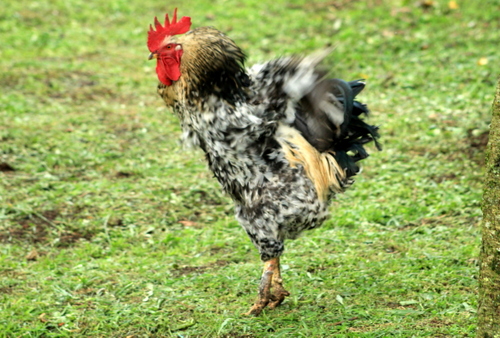
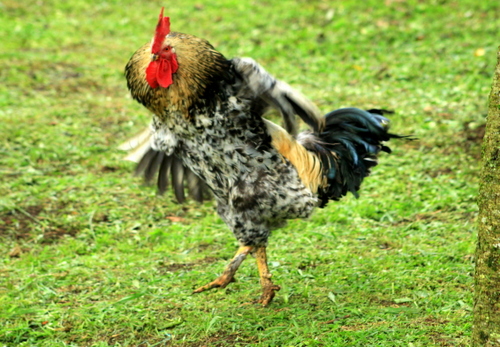
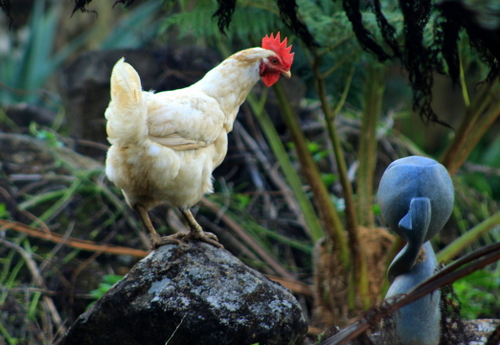
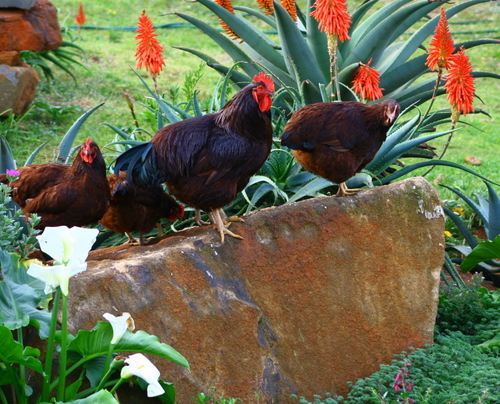
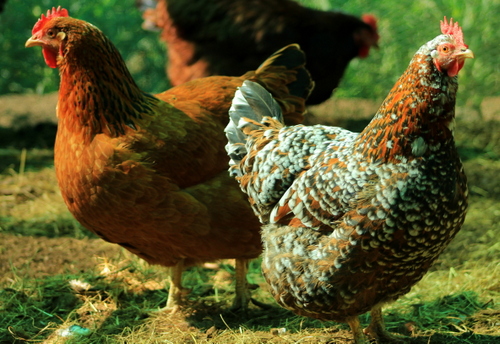
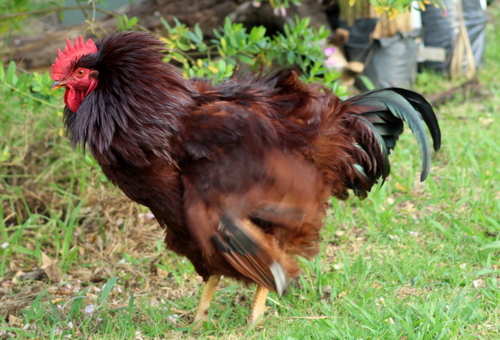
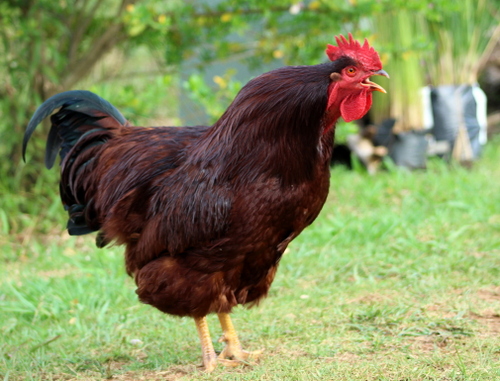
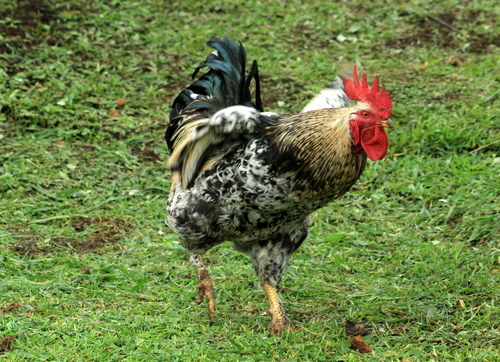
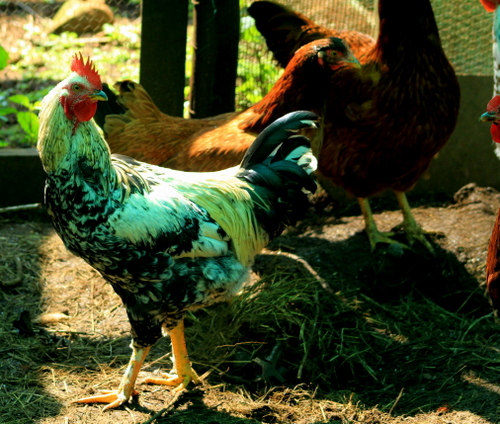
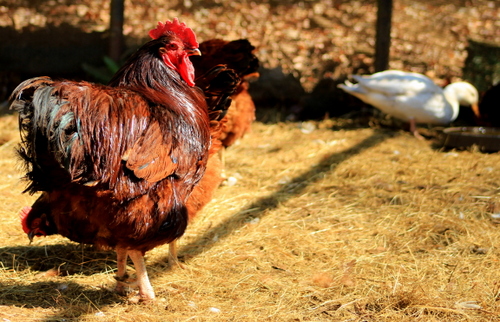
Alas, I can see nothing poetic or anywhere near miraculous about the incredibly noisy sideshow my two strutting, foolish roosters – Rowdy and Motley – with their Chauntecleer-size inflated egos, produce each morning.
Determined to shame each other – and all the other roosters in the district – in the high-decibel stakes, they like to do a short practice run around 0130am, just as I am getting in to my deepest sleep. Then, with military precision, at exactly 0430am, the floodgates open and they don’t close until late in the day.

Rowdy, the Rhode Island Red 
Motley the Bosvelder
As I bury my head under my pillow, desperately trying to shut out the racket, the voice of the poet Sir Charles Sidley (1639-1701) speaks down the centuries to me:
“Thou cursed Cock, with thy perpetual noise,
Mayst thou be capon* made, and lose thy Voice,
Or on a dunghill mayst thou spread thy blood,
And Vermin prey upon thy craven brood…”

But then I remember the lines from Robert Frost:
“The fault must partly have been in me.
The bird was not to blame for his key.
And of course there must be something wrong
In wanting to silence any song.”
(*A ‘capon’,for those not familiar with the word, is a castrated chicken fattened for eating)
REFERENCES:
Newman’s Birds of South Africa by Kenneth Newman (1983 edition, published by SAPPI)
Roberts Birds of South Africa by McLaghlan & Liversidge (1970 edition, published by Cape & Transvaal Printers Ltd)
Sasol Birds of Southern Africa (2011 edition, published by Struik Nature)
The Genius of Birds by Jennifer Ackerman (published by Penguin)
The Penguin Book of Animal Verse (1965 edition)
*Zulu Bird Names and Bird Lore by Adriaan Koopman (2019 edition, published by UKZN Press)
SPECIAL THANKS to Harry Owen and Clive Lawrance for allowing me to quote from their poems and my brother, Patrick, and his wife, Marie, for giving me my first bird book thus triggering off a life-long passion……





 Stidy's Eye