Going Where the Storks Go

Storks have always been great birds of myth and legend. Perhaps the most common and widely held of these, is that they deliver babies in a cloth hanging from their long beaks. The origins of this belief are very old and obscure although common to many cultures. In Norse mythology, for example, storks were seen as symbols of family values. The fact that they traditionally returned from their migration in spring, a time when many babies, are born, undoubtedly fed into the legend, especially as their colour – white – is also linked to purity.

The myth garnered new traction in the 19th Century when Hans Christian Anderson used it in one of his children’s stories. In prudish Victorian England, where parents were often reluctant to discuss the facts of life with their children, it became a useful way of obscuring the realities of sex and birth.

In Southern Africa, the bird has a slightly different association. To the English speakers in colonial Natal, as well as many of the local tribes, it was known as the Locust Bird because the insect was one of its main food sources. Thus, the S.Sotho name for the White Stork is mokotatsie, derived from kota ‘peck’ plus tsie ‘locust’ (see Zulu Bird Names and Bird Lore by Adrian Koopman). The White Stork is not, in fact, utterly white although that is its predominant colour. It also has a smattering of black. “White” is just a quick shorthand description. The bird is a migrant, flying from its nesting sites in Central and Southern Europe all the way down to the southern tip of Africa.

How on earth do they find their way? How can they complete a feat most humans wouldn’t be able to do without a GPS or compass? It is a question that has long intrigued people. Scientists are still not completely sure although they think the storks, like other migrants, rely on available compass cues from visual landmarks, the sun (and, at night, the stars) and magnetic fields.

I have always been fascinated by storks. For me, it is a privilege to encounter them in the wild. On the ground, they deport themselves with quiet dignity and style. They are gracefully proportioned with elegant necks and legs to match. Although shy and wary they also seem to have an affinity for human settlement. As a child, I had pored over the pictures of them in my storybooks, intrigued about how they were able to live parallel lives, one in Europe, one in Africa. I would always get very excited when they mysteriously appeared out of nowhere

White Stork, KZN Midlands.

Hitherto, the only link I had been able to make between the two places had been in my imagination. This changed, back in 1989, when my English cousin invited me to join her on a car trip through the three countries that formed the main part of the old Hapsburg Empire – Austria, Hungary and Czechoslovakia. I had made other pilgrimages in my life. I had been to Wordsworth’s house in the Lake District, and I had seen where the Bronte sisters had lived in Yorkshire. So why not go to where storks go when they leave Southern Africa?

I won’t pretend that this was my only reason for undertaking this pilgrimage to the Eastern bloc but it was certainly a compelling one. I decided to do it.

The journey proceeded. Unlike the storks, I took the easy route and flew by Jumbo jet to Heathrow. Landing in the country, I soon realised I had another problem – I didn’t have enough money to finance the remainder of my trip. So I went looking for a job. I was lucky. My English cousin, who ran a catering business, had just secured a contract at Wimbledon and was looking for extra staff.

And so for the duration of the event, I became a lowly dishwasher.

The hours were incredibly long and it was mind-bending, back-breaking work but, in a strange way, it was educational. It made me see life through a different lens and from a slightly altered perspective. For the two weeks, I was there, I didn’t get to watch a single match of tennis although I did see a few of its stars (and actually had a long chat with tennis legend Billie Jean King as I was carrying a dustbin out the dining area to empty it), as well as a lost-looking David Hasselhoff, of Night Rider fame, who – assuming I was a local – stopped to ask me directions. I concluded his clever car which could no doubt have told him which way to go must have been in for repairs.

While working at Wimbledon, I stayed with another cousin, Julian, who lived on an old boat moored on the banks of the Thames about half a mile upstream from Greenwich. Built in 1895, in the yard of Ferdinand Schibau in Eibling, Germany, and named the Aegir, it had originally operated as a steam-driven tug pulling ships down the Kaiser Wilhelm Canal. Since then it has survived two World Wars and numerous changes of ownership and now went by the name Sabine.

Over the years its body, paintwork and furnishings had deteriorated but Julian was busy renovating it with the intention of turning it back into a working vessel. In the interim, it served as a sort of comfortable, floating cottage cluttered with thumbed books and maps, old furniture and an extensive collection of rock albums which very much reflected my taste. It is hard to explain why – I had no previous experience living on a boat in the middle of a huge, bustling, cosmopolitan, city – but I felt completely at home.

I found the smell of brine, oil and damp sand, as well as its creaks and groans, oddly comforting. Secluded in an old boatyard, it was the perfect place for thinking and remembering and wondering about my forthcoming expedition to find out where the storks go. I loved sitting on its deck, sipping coffee, with the mud foreshore below and the forlorn gulls circling above and the odd barge and a warship and even an old sailboat drifting past.

The view up the Thames, from the boat.

With Wimbledon over (Boris Becker beat the defending champion, Stefan Edburg) and having raised enough cash I embarked on the second leg of my adventure. This took me across the English Channel, through Germany and Austria and then into Hungary.

We holed up in Budapest for a week, trying to get a sense of what life was like in a communist country. As a more open one, I got the feeling that Hungary was a generally more agreeable place to live than those hard-line states – Rumania and Albania for example – where a purer, more primitive form of communism prevailed (although that didn’t exclude party officials from enjoying a better lifestyle than the workers), One got the sense there was less of the prying and repression to which the proletariat of other Soviet-bloc countries was subjected.

Budapest looking across the Danube River towards Royal Palace.

At the end of our stay in this beautiful, if somewhat run-down, city we drove out along the E7, heading towards the westernmost end of the country.

Our route took us through some of the hilly parts of Hungary, which is rather flat. There are numerous old fortresses, limestone caves, dark, gloomy woods and charming old baroque towns along this road, including Eger, famed for its fruity red wine known as Egri Bikaver or Bull’s Blood of Eger.

Not all the country was so attractive. There was also Hungary’s second-largest city to contend with – Miskolc.

I had been pleasantly surprised by Budapest but Miskolc is everything awful you have heard about communism and more – a bleak, sci-fi fantasy landscape that could have served as an alternative setting for Blade Runner. Row upon row of uniform, ugly grey apartment blocks dominate the horizon, all linking together to create a picture of unremitting dreariness and gloom – not improved by all the dust and smoke and poisonous chemicals being belched out of the local factories.

Driving past Miskolc

We spent the night in Szerencs in a castle-cum- hotel, surrounded by rubble and uncut grass, which had featured in several battles against the Turks in the 17th century and also served as a home for Ferenc Rackoczi, a Hungarian nobleman who led a nearly successful uprising against the Hapsburg Empire. He is now regarded as a national hero.

The next day, in the small village of Tokay, I finally found where the storks go. There they sat in their nests built on top of street lamps and chimney pots or on wire platforms thoughtfully provided by the local citizenry who regard them as good omens. It is difficult to describe how excited I was to see them. It was like suddenly finding yourself among old, familiar, friends after a long absence.

Where the storks go…

The storks seemed equally bemused to see me, staring quizzically down their beaks at me while I photographed them. I wondered if they could tell, by my accent, who I was and where I had come from.

Pretty in the sunshine, the countryside around Tokay was wonderfully unspoilt. There was a slow unchanging, almost medieval feel to it. Bees buzzed in the air. Flowering shrubs ran wild on the common ground. In the fields, we saw grizzled old peasants with scythes, and ancient black-frocked old crones with headscarves and gumboots, hunched over their hoes. As we drove into town we had to give way to horse-drawn carts.

The bucolic rural atmosphere was partly offset when, from the centre of town, came a sudden blast of rock music. We soon found its source – several youths were erecting a rather crude wooden stage there, urged on by a group of long-haired hippies, sitting on the steps of the local church, surrounded by empty wine bottles.

What Tokay is famous for – another reason I wanted to go there – is its wines. Often referred to as “the king of wines, the wine of kings” this beautiful, gold-coloured wine is supposed to be able to restore a dying emperor. It certainly resuscitated me…

Tokay comes in three different forms: Tokaji Furmint (Dry), Tokaji Szamorodini (medium-sweet) and Tokaji Aszu (full-blooded, very sweet). Its excellence is attributed to the properties of the local soil, the mineral content of the water, the production methods and – some say – the peculiar quality of the sunshine.

Several privately owned cellars were open for tasting, or one could visit the large, state-run consortium at the neighbouring village of Tolcsva. Alternatively, one could pop into a borozo and drink with the locals.

Glazed with alcohol, I took a stroll, that afternoon, up through the graveyard and into the hills above town. From here I had a panoramic view of the surrounding countryside. Directly below lay Tokay itself with its quaint, twisting, cobblestone streets, bright, orange-red, church spires and the rather melancholy shell of an old synagogue – a tragic and haunting reminder of the fact that over 80% of Hungary’s Jews perished in the last World War.

Beyond that stretched the Great Plains of Hungary with the oddly named Bodrog River curving off to the one side. It was easy to imagine the Ottoman army sweeping across this landscape, scattering all in their wake. To the East, beyond a mist-covered ridge of hills, lay the USSR. Directly behind me was Czechoslovakia, my destination for the next day. To my south lay the mysterious Transylvania, best known for its blood-thirsty vampires and howling wolves.

View over Tokay with Bodrog River in the background. Somewhere in the distance lies Transylvania...

Sitting up there with only the occasional shouts of children or the barking of a dog to disturb the eerie stillness and silence of the place, I felt I was on the edge of the known world.

Then, reality barged back in: I glanced at my watch and realised it was time to head down.

That evening we had supper in the local hotel, whose drab grey walls had been partly offset by the roof, painted in brilliant rainbow colours. The interior was oppressively dark but the mood was partially offset by a cheerful gipsy violinist who wandered from table to table, serenading us.

I left Tokay the next day feeling the perplexity of irreconcilable differences: the old way of life versus the new cult of Marxist-style progress which had been so clumsily superimposed upon it. There was nothing unusual in any of this I suppose. Countless cultures have waxed and waned.

And at least the storks were still there to provide a sense of continuity and remind us where babies come from…

Travels Back (Part Two): A Postcard from Budapest

“Asia,” declared Metternich, “begins at the Landstrasse” – that is the road that runs out of Vienna to the East. And it certainly felt like we had crossed some sort of frontier when, back in 1989, my three travelling companions and I found ourselves marooned among the milling mob at the Hungarian border post.

It was my first introduction to Communist-style bureaucracy and I can’t say it created a favourable impression. Indeed, my immediate reaction was to turn and flee back the way we had come.

Finally on the road again, after what seemed a nightmarish eternity, the first thing I noticed were the cars – strange, box-like little contraptions belching carbon monoxide and emitting a most curious noise. Compared to all the top-of-the-range Mercedes Audis and BMWs we had passed by on the other side of the border they seemed positively prehistoric. It certainly gave you some idea of just how far behind the West the Soviet-bloc countries were in terms of living standards. That didn’t stop their drivers from travelling at death-defying speeds though.

We finally got to Budapest. Before we could book our accommodation we had to check in with the authorities, explaining who we were and our reasons and intentions, a routine formality wherever you visited communist countries. Thereafter we were left in peace, free to go where we liked.

This surprised me. It was not at all what I had anticipated.

I had expected to find myself succumbing to a mood of creeping paranoia like I was participating in some third-rate spy-thriller. I kept checking to make sure but no one was trailing us, their hat pulled low over their eyes. As far as I was aware there were no bugs in our room, nor were they searched while we were out. Contrary to expectation, I didn’t feel deeply guilty, like I was alone and powerless in a world profoundly, morally hostile. Quite the reverse in fact.

I liked Budapest immediately. I thought it was a most handsome city.

Straddling the Danube (saturated in blood, grime, phosphates and mud, the river was anything but blue), it is divided into two parts – the hilly sections to the West of the Danube River from Buda while Pest lies on the flat side on the opposite bank. Of the two Buda, with its royal palace looked the older but is, in fact, the later settlement.

View across the Danube to Buda with its royal castle.

Pest, whose name is taken from the Slav word for ‘oven’ (don’t ask me why), has been razed to the ground several times, thus precipitating the move to the hillier, more defendable, side of the river. It didn’t do much good. Hungary came under Turkish rule after the disastrous battle of Mohacs in 1526.

The Turks were finally driven out in 1686.

The two towns were only properly linked in 1840 with the construction of the Great Chain Bridge across the Danube. This famous landmark was the work of William Tierney Clark, a Scotsman who was also responsible for the Hammersmith Bridge in London. The British connection goes further. The Hungarian Parliament, lying along the banks of the Danube on the Pest side, is partly modelled on the neo-Gothic Palace of Westminster.

View across the Danube to Pest with Houses of Parliament.

During the 1848 uprising against Austria, British opinion was very much on the Hungarian side. Combine this with a mutual love of horses and you begin to understand why, when Hungary decided to open up its links with the West, Margaret Thatcher was the first NATO leader they invited to visit.

As a former capital of the Hapsburg Empire, Budapest is full of reminders of a more regal past.

The skyline on the Buda side is dominated by the Matthias Church, an impressive Gothic structure which takes its name from Matthias Corvinus (ruled 1458-90), who established Buda as one of the great Renaissance courts of Europe.

Immediately to the south of it lies another set of imposing buildings – the old royal palace, another legacy of the days when Hungary formed part of the ‘Dual Monarchy’ with Austria, governing an area which included parts of present-day Czechoslovakia and Romania, as well as Transylvania which, at the time of my visit, still remained a thorn of contention because of the Romanian government’s treatment of the ethnic Hungarians living there.

The Magyars, who make up the bulk of Hungary’s population fiercely proud and independent. While nominally part of the Warsaw Pact, its government was always regarded as the most liberal of the communist regimes, allowing private enterprise and developing links with the West. Their nationalism found its physical outlet at the Hosack or Heroes Square erected at the turn of the century in Pest to commemorate the Kingdom of Hungary’s survival into the new century and the thousandth anniversary of the Magyar conquest.

This reverence for a more glorious past also finds expression in the National Museum which houses the country’s most treasured relic – the royal crown of Hungary. This crown – with its famous crooked cross – lies in full state in its own darkened chamber, zealously guarded over by several fierce-looking policemen. That so much importance should be attached to a symbol of imperialism and vanished pomp struck me as ironic given the country’s supposed commitment to egalitarianism..

The Magyar language is one of the most impenetrable in Europe which made communication difficult. Unlike most other languages in Europe, it is not of Indo-European origin but is more closely related to Estonian and Finnish. The word for “Cheers”, for example, was a real tongue-twister: “egeszsegedre”. I found it helped to have had a few beers before attempting to pronounce it…

Having visited all these famous sites, and a few more, we were in dire need of refreshment, so popped into Gerbeauds in Pest, one of the most famous coffee houses in Hungary whose confectionery rivalled the best in Paris and Vienna – at a fraction of the price. In this august old establishment with its elaborate art-nouveau furniture, heavy wallpaper and eighteenth-century prints you could get an idea a glimpse of what life must have been like at the turn of the century when Budapest still formed part of aristocracy’s playground.

In a similar vein, the Café Hungaria is also still known by its pre-communist name – Café New York. For a brief period of its history, when Stalin was still calling the shots, this glittering example of Baroque/Rococo/Art Nouveau/Eclectic and any other art form you care to name was actually converted into a warehouse. Since then, the building has been restored to its former glory and is very much like it must have been when it was a favourite gathering place for artists and intellectuals. The cuisine here, as in other restaurants in Hungary, was excellent and again relatively cheap.

The inconsistencies between the theory and practice of communism also manifested themselves in the Rozsadomb, the exclusive Rose Hill section of Buda, where the original middle-class victims of Marxist socialism found themselves replaced by the new Party elite who had quickly realised that power meant little unless converted to wealth. With their manicured lawns, their lavish lifestyle contrasted sharply with the poorer classes forced to eke out an existence across the river, in the more shabby, run-down, commercial Pest.

As Orwell showed in Animal Farm, revolutions all too often end up with those who have risen from the bottom assuming the habits and trappings of the oppressive power they have just replaced. Africa has proved no exception to this rule…

It was equally obvious, too, that many people had given up on the dream. Rather than pouring over their copies of Das Kapital, the youth seemed more obsessed with Western-style pop culture. Most of the movies being shown were of American origin and many Hungarians tuned in to Western radio and TV stations rather than their own which was, admittedly, easy to understand if you watched the fare being dished up on Russian TV. Most of the graffiti I saw was pro-pop rather than anti-imperialist (Duran Duran and Queen seemed to have been particular favourites).

The weirdest of all, for me at least, was to discover a “Rhodesia is Super” sticker stuck to the windscreen of a car parked down a side street in Pest. What, I wondered, would Robert Mugabe have made of that?

Nor had Communist contribution to local architecture been distinguished by its display of good taste. Budapest, like most other Soviet-bloc countries, has its share of dreary, dehumanised, soul-less grey apartment blocks although these, along with the factories, were mostly confined to the outskirts of town. There seemed to be few pollution controls in this grim, industrial wasteland. The air reeked of dust and smoke and chemicals and the water had a strange metallic taste.

I imagined some grim-faced apparatchik explaining the rationale behind it thus: “We need the factories to produce the cement required to build the apartment blocks that house the workers who work in the factories who produce the cement…”

This dreary uniformity was more than compensated for by the bustle of inner-city life. There was a vibrancy, a sense of the Orient, a dishevelled charm about Budapest. Unlike neighbouring Czechoslovakia, which I also visited, they didn’t browbeat you with ideology. There were very few of those familiar symbols of totalitarian dictatorship – the red stars, the statues of workers in heroic poses, the weird sculptures representing international socialist solidarity, the pictures of the party faithful (all stony-faced and irredeemably ugly), the hammers and sickles.

While the Hungarian version of communism was by no means as extreme or nasty as the jack-booted versions practised elsewhere, it did leave me wondering why people opt for these authoritarian forms of government!

Margaret Atwood, who wrote the dystopian Handmaid’s Tale, provided a probable reason when she wrote; “True dictatorships do not come in in good times. They come in in bad times when people are ready to give up some of their freedoms to someone – anyone – who can take control and promise them better times”

This certainly seems equally true of our own morally confused and uncertain times…

Travels Back: A Postcard from Prague

INTRODUCTORY NOTE

In late 1989 I made a journey through parts of Austria, Hungary and Czechoslovakia, taking in the three main cities of the old Hapsburg Empire – Vienna, Budapest and Prague. Hungary and Czechoslovakia, at that stage, were still nominally under Soviet rule and forty years of Communism had obviously left its imprint but you could still get a sense of their shared cultural and historical heritage and old links.

Shortly after I returned, I wrote several articles about my experiences which I never did anything with at the time but which – having tightened them up a little – I have now decided to post as a Blog in the hope they will provide a brief glimpse into what life was like in that fascinating part of the world back then.

I begin with my impressions of Prague even though that was, in fact, the last of the three cities I visited.

Prague, with the Vitava River in the foreground. Hradcany Castle on the other side.

1989 found me at a loose end.

I had previously resigned from my job as features editor at SCOPE to take up a position at the newly formed Laughing Stock Magazine in Johannesburg. After barely nine months, I quit that too because all the signs were telling me I was on a doomed ship.

I did not feel inclined to go down with it.

I didn’t feel like facing the grind of walking the streets again looking for work. So, I did what I often do when in an awkward spot – I bought an air ticket and headed overseas. I had already been to Britain and the continent several times. This time I wanted to undertake a different journey. I wanted to go somewhere that entailed an element of risk.

As it turned out, my English cousin, Rebecca, who had just graduated from Oxford, and two of her friends were planning a car trip through three of the countries that constituted the old Hapsburg Empire – Austria, Hungary and Czechoslovakia. One of the places on their must-visit wish- list was Prague.

Despite the fact it was still under repressive Soviet rule, the city was becoming a chic place to visit. Even though I am probably an unlikely candidate in the eyes of others, I decided I could do chic.

First, I had to go through the tiresome business of getting my papers.

It was probably a coincidence but the day after I visited the Czechoslovakian Embassy in Kensington Gardens to obtain my visa the British government expelled three Czech diplomats from the country. As it was I was too busy marvelling over the fact a communist country was prepared to have me – an unfashionable White South African – as their guest to pay much attention to this West-East spat! As a member of a pariah state, I had expected to be immediately shown the door. Instead, I was treated with an indifference that seemed almost indecent.

We entered the country, at the Slovakian end, via Hungary. The contrast between the two countries was sobering. If our first border crossing had been a lesson in bureaucracy at its most bewildering this one was an education in power. With pistols strapped to their wastes, the Czech border guards were cold and officious, demanding our passports and then taking them away for a sufficiently long time to make one realise how extraordinarily helpless one can feel.

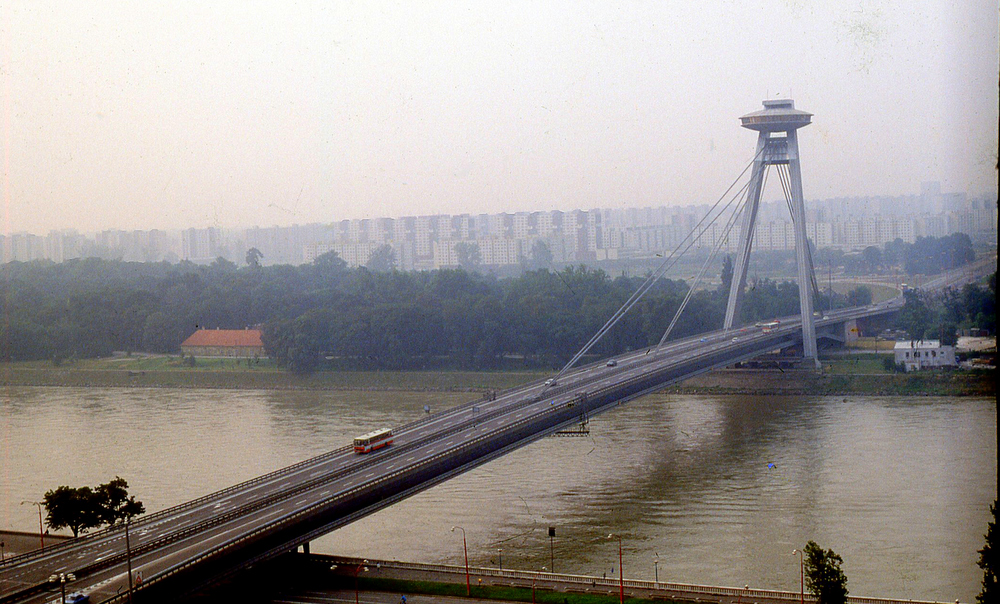
Brno, en-route to Prague. There was something little sinister about the tower at the end of the bridge. Note grey tenement blocks behind…

This was more the Le Carre country I had expected.

Having given us this crude reminder of what might lie in store for us, they waved us through the border post. As we drove into Slovakia, I wondered what lay ahead. The countryside we passed through did little to reassure me or allay my fears. Parts of it were badly polluted, the forests dying from acid rain. Elsewhere, great concrete blocks marched higgledy-piggledy, mile after mile.

My anxiety eased a little once we got to our destination.

Prague, or at least the old parts of it, is one of the handsomest cities in Europe. When we visited it still possessed a decaying grandeur, a faded old-world charm. Having escaped bombing during the Second World War, virtually every epoch of European architecture was still splendidly represented.

With its constant surveillance of its citizens and intolerance of public opposition, the Czech Government may not have been the most open-minded or benevolent in the world but they at least recognised what Prague represented and had been remarkably sensitive when it came to preserving the unique heritage of the city. There had been no mad-cap Ceausecu-style leadership here, bulldozing down beautiful, historic, buildings and displacing whole communities in pursuit of some nightmare vision of a Marxist Utopia. Nor had the city been swamped by Western-style consumerism and kitsch. There were no burger joints or trendy boutiques. No neon lights nor flashy advertising had been allowed to impugn the city’s ancient dignity.

Even the display of communist symbols, so common elsewhere, had been kept to a minimum.

We arrived to find a city not really geared towards tourism. Although they welcomed the money we brought with us (in our case English pounds), the authorities were still highly suspicious of foreigners. We were not allowed to choose our own hotel to stay in, the state had its own special ones reserved for us suspect Westerners.

There were not many of these and the one they selected for us must have been the worst of the lot. Situated in a filthy, run-down, seedy part of town, it looked semi-derelict and was covered in grime and soot. My companions were appalled but we had no choice. The hotel would have to do. We signed the miles of paperwork and regulations the police required because we were suspect Westerners and carted our bags inside.

There was a young Czech soldier staying in the room next to mine. He had a woman with him. She may just have been his girlfriend but I doubted it. She seemed much more worldly-wise and older than the fresh-faced youth who was barely out of his teens. It tended to confirm my suspicions the establishment doubled up as a house of ill-repute

After a barely edible dinner, we headed for Charles Bridge (Karluv Most).

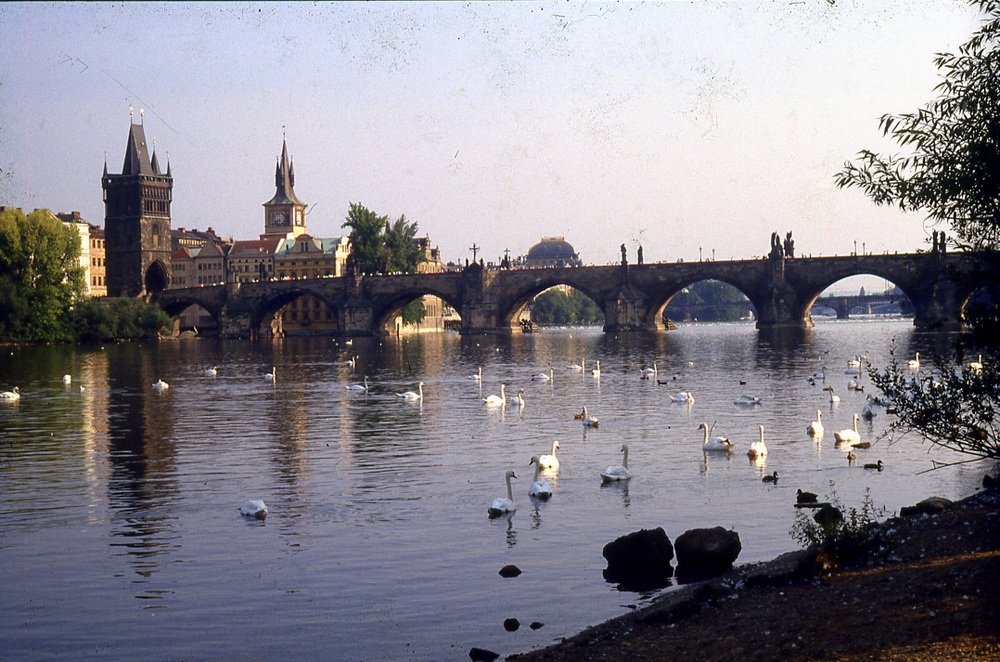
Charles Bridge.

Just as anybody who spends time in London inevitably winds up at Tower Bridge so, too, does Charles Bridge provide a focal point for Prague. With its slightly curved and cobbled surface, this famous pedestrian bridge was begun in the 1300s but not completed for some 50 years. At a later date, 26 statues depicting St Francis Xavier and his pious companions were erected along the sides. Perhaps the most interesting of these is St John Nepomuk, the patron saint of Bohemia, who, legend has it, was flung from the bridge by order of Wenzel IV for refusing to reveal what his wife, the empress, had said in confession.

His body is said to have floated for a considerable time in the river with five brilliant stars hovering above his head.

The bridge links the two most interesting quarters of the city. On the one side lies the old town and Jewish Quarter (Josefov); on the other lies the Hradcany Castle. Protestant nobles threw two Catholic counsellors out of the window of this castle on 23rd May 1618, thus precipitating the Thirty Years War, one of the bloodiest conflicts in European history (the counsellors, who landed in a dung heap, survived)

During the day the bridge thronged with tourists, at night a different atmosphere prevailed: it had become a rallying point for protest against the ruling regime. Soapbox politicians held forth about the evils of the system while long-haired hippies strummed guitars and sang Dylan’s “The Times They Are A-Changin’” and John Lennon’s “Imagine”.

It took me back to the anti-Vietnam protests of the Sixties and Seventies.

Standing in the misty moonlight with the silent, silvery, river flowing underneath, I got the impression that the younger generation, in particular, no longer cared about what they said or did. The fact that such dissent was now tolerated did, at least, indicate the old climate of fear and silence was beginning to thaw.

I struck up a conversation with an English-speaking Czech who turned out to be a lecturer at the local university. When I remarked on the beauty of the city, he shrugged his shoulders and said: “Yes, it is pretty but it would be even prettier without the communists!”

The next morning, I wanted to see more of it. I started at Wenceslas Square which is not really a square but a very broad boulevard that forms the neo-classical part of town above the older parts of Prague. The far end of the square is dominated by the theatre while along its sides were numerous shops, hotels (including the Art-Nouveau Hotel Europa) and restaurants – although we found the cuisine a disappointment after Budapest.

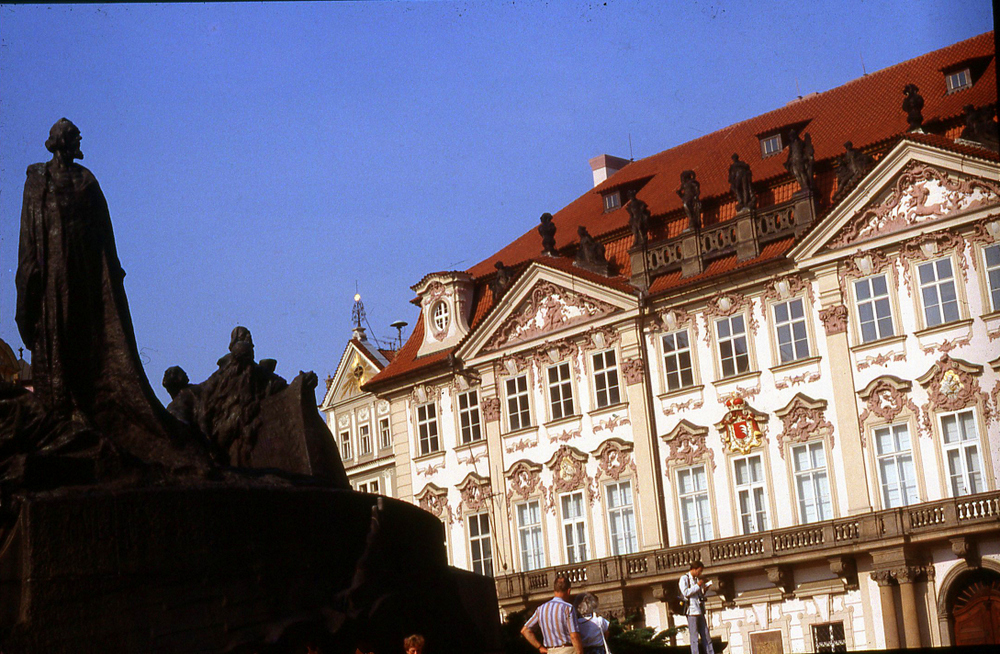
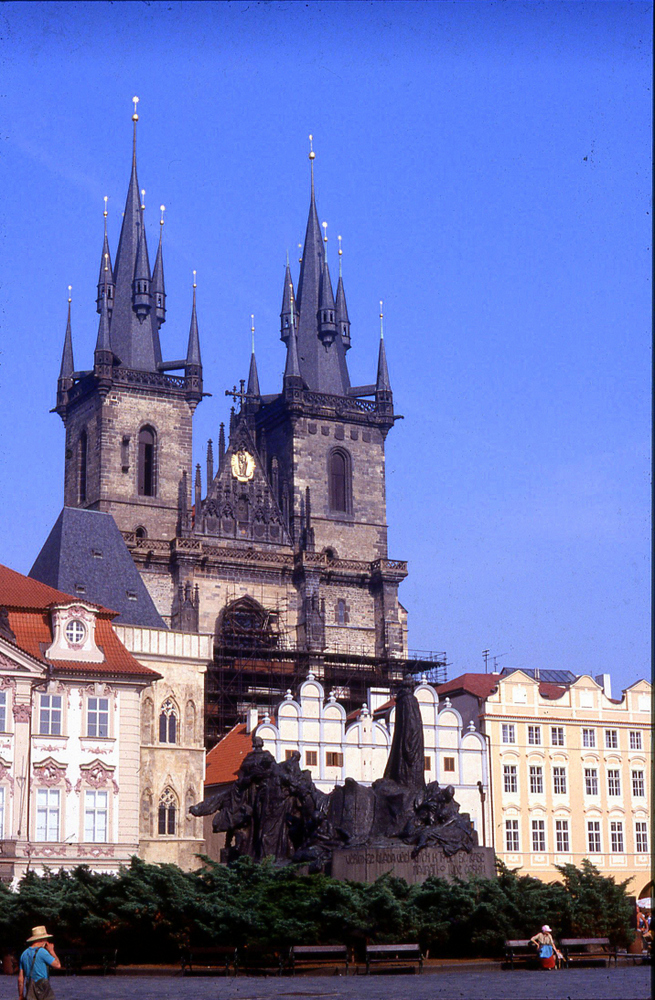
From Wenceslas Square, I headed, via the old Powder Tower, to Staromestke Namesti in the Old Quarter. With its rich Baroque facades, this square is one of the most stunning sights in Prague. It includes the Town Hall with its tower and astronomical clock dating from the 1400s, the glorious twin-towered Teyn Church and – in the middle of the square – a straggling mass of statues erected in 1915 to commemorate the 500th anniversary of the death of John Hus, the celebrated orator, reformer and champion of Czech nationalism whose execution at the hands of the Germans led to the Hussite Wars.

Starometski Namesti.

Not far from here is the old Jewish Quarter which dates back from the 10th Century and is one of the oldest ghettoes in Europe. It also contains surely one of the oddest sights in Central Europe – over 20,000 graves piled one behind one another with hardly a gap in between.

Near the entrance to the cemetery is a small museum which houses a collection of drawings and poems by Jewish children, many of whom died in the concentration camps of Terezin and Auschwitz. Drawn in the art classes the Nazis allowed the children to attend – mostly for propaganda purposes – they show how conflicting realities can co-exist. While some paintings capture innocent childhood preoccupations, others depict far more painful scenes as the children become increasingly aware of the grim reality of their circumstances and the horrors being perpetrated around them. Poignant and intensely moving, they serve as a grim reminder of how easily people can lapse into barbarism and cruelty when ideology gets twisted to serve the most awful of ends.

Indeed, it is hard to believe Franz Kafka died ten years before the first concentration camp was built because if anybody understood oppressive bureaucracy and the true nature of totalitarianism, in the marrow of their bones, it was surely he. A native of Prague, he was born and brought up in the Jewish Quarter and also lived along the Zlata ulicka (Golden Lane) up by the castle.

I was a little disappointed to discover, though, that the one museum I had specifically wanted to visit was closed. This was the Museum of the National Security Corps and the Army of the Ministry of Interior where you got to see how the authorities previously dealt with those who disagreed with their policies. The prize exhibit was the stuffed remains of the dog famous for having caught more people trying to escape to the West than any other mutt on the military payroll.

A little later on, I was to get my own small lesson on how the authoritarian propaganda machine in communist countries worked. Tired from all the tramping, I was sitting at a pavement café, sipping a cup of sickly sweet coffee when a loud, disembodied voice suddenly started barking out worked instructions directly above my head. The effect was startling in the extreme, especially when it was picked up and parroted from the top of virtually every street light in the vicinity. It took a few terrifying seconds for me to figure out the sound had come from a series of loudspeakers rigged around the city. For me, this was Big Brother come to life, not that it seemed to have the slightest effect on the ordinary citizenry around me who simply ignored it and carried on with their lives. I found their response oddly reassuring.

Used to the living standards of the West, I quickly came to realise how unnaturally difficult all the rules, regulations, excessive formalities and mountainous and highly inefficient bureaucracy made life for such ordinary folk. The currency, for example, was surreal with a huge difference between the official rate (16 korunas) and what you could exchange it for on the black market (between 40 and 50 korunas)if you were prepared to take the risk. In Prague, everybody seemed to be in on the game. You could hardly take two steps without somebody sidling up to you and whispering in your ear “Tauschen? Change money?”

Several years later, I would experience the same sort of thing in that other socialist paradise – Zimbabwe.

The next day I headed up to the castle, passing several dagger-thrusting titans who looked like they would slice your head off if you so much as dropped an ice cream or said anything derogatory about the state. This feeling was more than offset when I came to the magnificent Gothic cathedral of St Vitus with its soaring pinnacles and towers. Inside is the impressive Monument of the Kings, the hereditary burial place of the Bohemian monarchs.

Wandering around the interior, noticing all the devotees and worshippers and how lavishly the church had been restored, I realised that the bad old days when Communism persecuted the Church had largely gone.

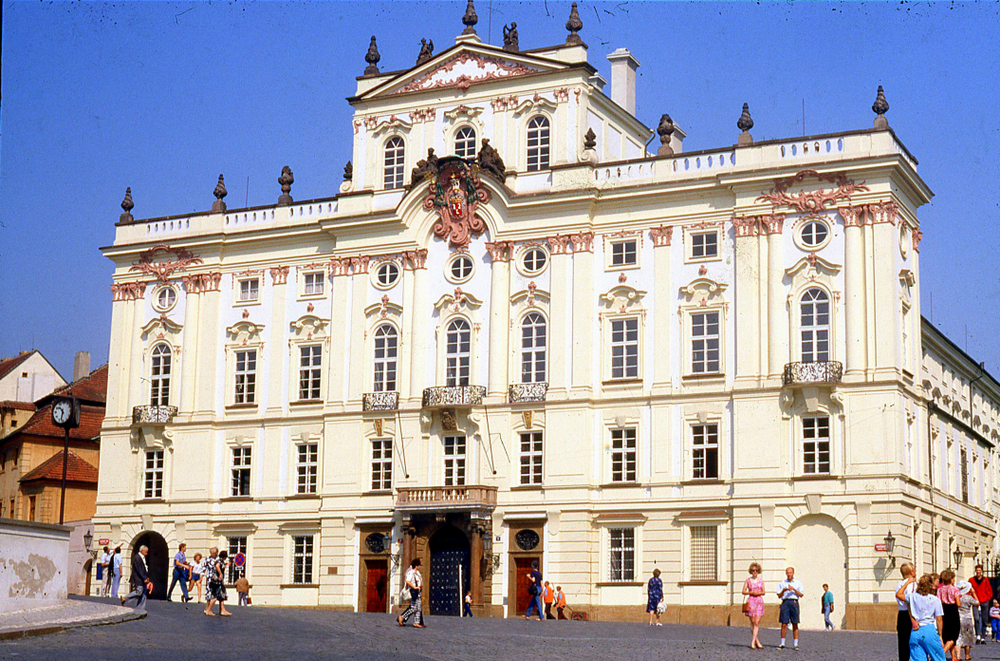
The next stop on my itinerary was the Hradcanske namesti which had been preferred as a location to Vienna for much of the filming of Amadeus because it was considered more authentic of the period. Besides providing a panoramic view over the city, this area contains many fine old buildings, churches and beautiful Baroque facades.

One of the beautiful buildings where the film Amadeus was shot.

On my way down from the castle, I ducked into the U Bonaparta on the Nerudova, a large, vaulted, cellar covered in Napoleonic paraphernalia and with long wooden tables where they serve beer with a good, frothy head. Grabbing my tankard of excellent Czech Pilsener (the Czech food may have been lousy but the beer made up for it), I sat down at a table next to one occupied by a gang of ageing bikers sporting colourful bandannas, presided over by a large, patriarchal figure with shoulder length hair and a flowing white beer.

They were all in high spirits, a stark contrast to a group of gloomy conscripts in uniform sitting at another table near mine. I got the distinct feeling that national service in the U.S.S.R. was not proving to be the high point of their lives. Having been forced to serve in the military back home, they had my sympathy.

Indeed, it hadn’t taken me more than a few days behind the Iron Curtain to realise that Communism had not resulted in the ‘classless’ society of model of proletarians it was supposed to produce. On the contrary, it seemed to have brought about a great deal of unhappiness, shirking, cynicism and distrust in the all-powerful machine.

Another protester I had met that evening on Charles Bridge had summed it up this way: “There are three types of Czechs – the ones who only live to drink and fiddle the system; the ones who listen and care but do nothing. Finally, there are people like us who try to make a difference but, alas, we are in a minority. And the secret police know their business!”

Later that night, in yet another stuffy, smoke-filled, tavern, I got chatting to a young artist trying to sell his paintings (if I had the spare cash I would have bought one). Marvelling at his felicity in both English and German, I asked him if he spoke Russian as well. He gave that same apologetic grin I had come to recognise during my brief stopover in Prague and said: “Yes – I am sorry to say!”

Safely back in South Africa, several months later, I thought of him and those unhappy conscripts and the protesters on the bridge, when I switched on the news and heard that the Soviet Union – and its satellite states – that had once looked like it was due to last for some time yet, had come tumbling down.

That was not the only momentous world event to take place back then. It was followed, shortly afterwards, by the collapse of the once seemingly indestructible Apartheid regime. For a brief while there was a feeling of euphoria., a hope that this was the beginning of a brand-new era. Sadly, it was not destined to last…

GALLERY:

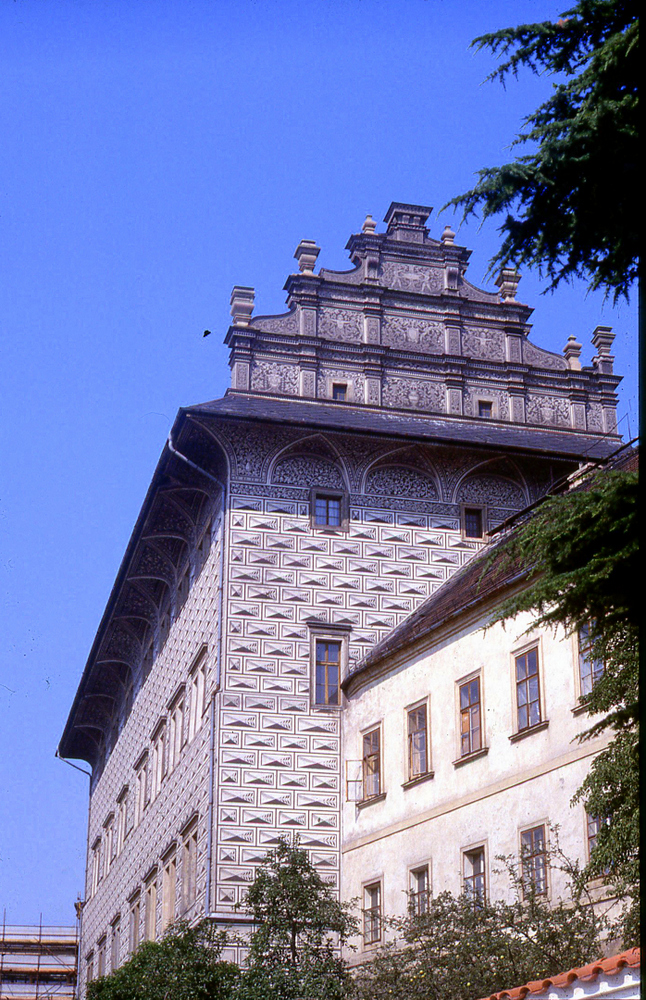
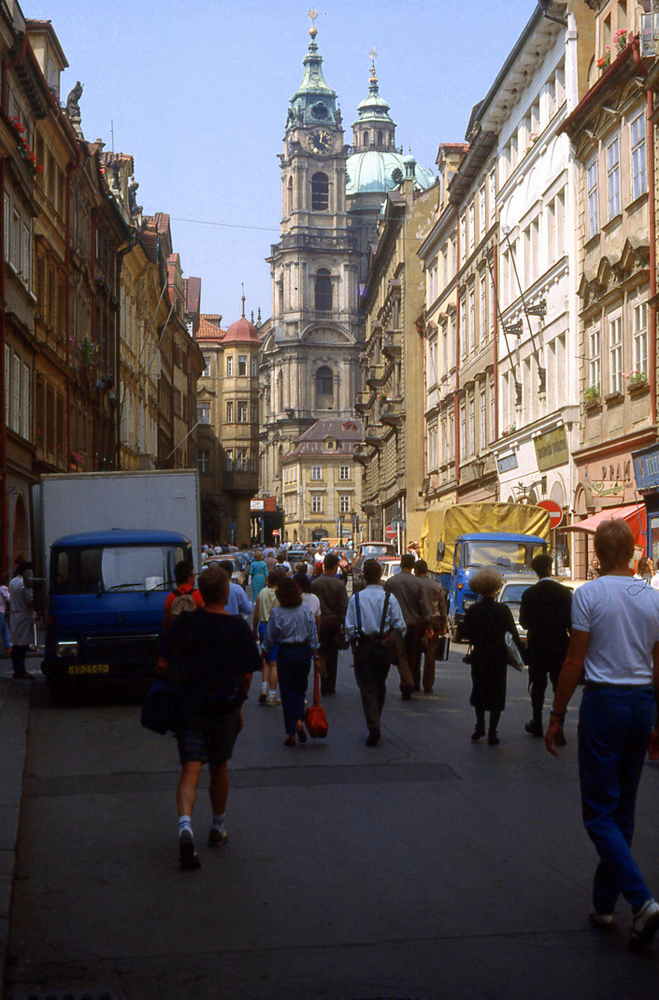
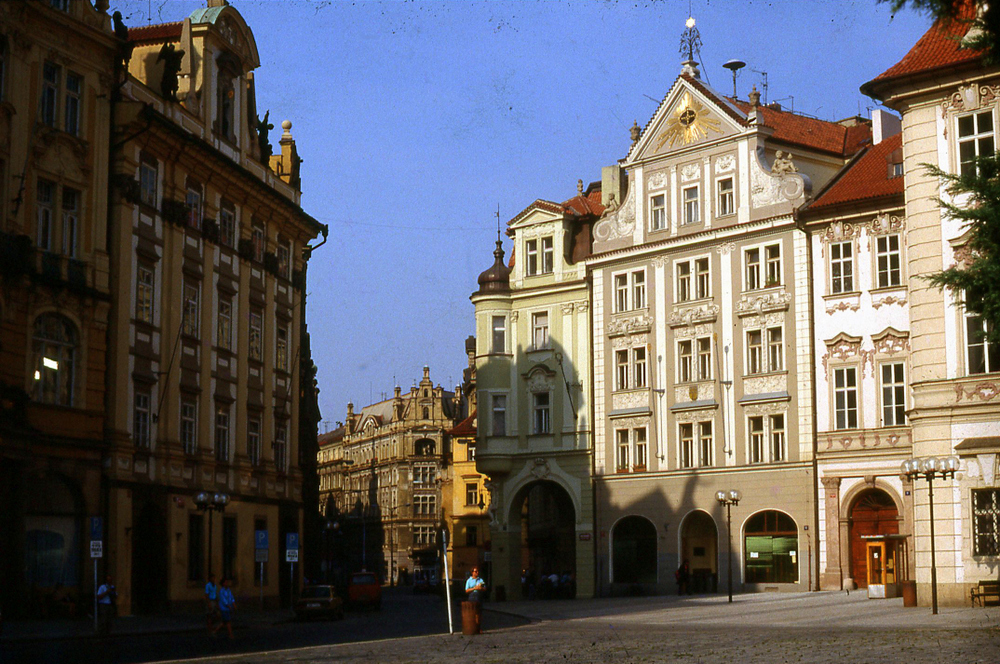
Some more Prague scenes:

REFERENCES:

A Guide to Central Europe by Richard Bassett (Published by Viking)

Travellers Soviet Union & Eastern Europe Survival Kit by Simon Calder (Published by Vacation Work)