Reflections in the Mist

I am a bushveld addict.

Having grown up and lived in it for most of my youth it is where I always felt most settled and where my heart belonged. No other environment has affected me the way it did nor created the same feeling of mystical bond. Recalling that early period of my life never fails to excite the deepest nostalgia.

It is the romantic in me, I guess.

The true bushveld has a spirit, ancient and impassive. It is a spirit which lives on; I know it, I feel it. It lives on despite the ripple of human effects. It lives on despite our attempts to tame and domesticate it. It lives on despite our plans to commercialise and exploit it and turn it to profit. It lives on despite the encroachment of farms and cities…

Typical bushveld country, South Kruger.

Even when I am not in it, I can still imagine it: the dust, the heat, the dryness. It is a place of extremes. In the bushveld the sun is brighter, the full moon seems bigger than anywhere else.

Its summer storms are a wonder to behold. The high, piled, whipped cream clouds. The gradual darkening to an intense blue. The sudden ragged bolts of lightning.

And then the rain drumming down and getting soaked up by the parched ground. There is no smell on earth quite like the liberated scents of dust, grass and vegetation released after the first bushveld storm of the season.

Summer storm in the bushveld.

Immediately you feel a new energy, a new hope. A quickening of the blood. A rising excitement.

Everything suddenly seems to come alive. The buck start leaping and cavorting, the birds become a flutter of activity, twittering and chirping in the trees.

In next to no time the grass starts sending up new green shoots, the trees break out in bud.

And such trees! What can be more African then the Baobabs, Kiaats, Mopani, Leadwood, Tamboti, Marula, Jackalberry, Nyala trees, Sausage trees, Acacias, Bushwillow, Silver Cluster-leaf, Sycamore Figs and all the other, seemingly infinite, variety trees you associate with it.

These feelings did not diminish when I moved from Zimbabwe to South Africa. Although I elected to live far from the bushveld, in Pietermaritzburg, in KwaZulu-Natal, my heart still lay to the North. On my birding trips you would invariably find me heading up towards the crocodile-infested, fever tree-lined, pans of Ndumo, the broken, granite country around the Crocodile River in Mpumalanga, the enormous sun-drenched plains of Kruger, the red cliffs of Mapungubwe and the mopani-covered Limpopo Valley.

When I wanted to get even further away there was the Matobo Hills, Kariba, Mana Pools, Mangwe and Gona-re-Zhou in Zimbabwe, on the other side of the border.

My kind of country: Gona-re-Zhou, Zimbabwe.

Although I had done the KwaZulu-Natal Midlands Meander many times, I had never really thought about living there. For me it was just a green, pretty, tranquil, place to escape to when I needed a break from the bedlam and noisy confusion of city life. I liked sticking my nose in to its arts studios. I liked sampling the fare at its numerous food outlets, pubs and restaurants. I enjoyed soaking up the slightly bucolic, Surrey-in-Africa, atmosphere.

That all changed when my friends, William and Karen, bought Kusane Farm in the Curry’s Post area, on a hill overlooking the Karkloof Valley, and asked me if I would like to come and live on it.

Having reached an age where I felt my life needed a change of direction I duly motored up to check it out.

Like William and Karen I loved Kusane from first sight. Staring over the valley below I just stopped and whispered “Oh boy!” softly to myself.
It had just rained and everything about the day was lovely. The pleasing tidiness of the fields below. The tree-clad slopes of the Karkloof Hills stretching along the one side of it and, near the centre of valley, the oddly leonine shape of Loskop hill thrusting itself out of the earth. The Kusane river – from which the farm took its name – passing through a belt of trees and then snaking its way in a series of bends across the wide plain towards the edge of an escarpment.

View over Karkloof Valley after rain.

There was a freshness in the air, an exhilarating quality to the light. The grass underfoot was soft and green and moist with life.

It was clear I had found a place set apart; one which also had its own special isolation of spirit. Relocating to it became, in its own paradoxical way, a kind of homecoming.

I was surprised by my reaction because anything less like my beloved bushveld in Southern Africa would be hard to find.

Curry’s Post is mostly mist-belt grassland with pockets of remnant indigenous forest (or at least it was until the timber companies discovered its potential and despoiled the countryside by planting miles and miles of sterile fir trees).

In summer the mist comes drifting in most evenings, reducing visibility and creating as slightly unreal radiance as it gets hit by the dying embers of the sun.

Unreal radiance: Karkloof Valley.

As the winter cold fronts move through they often bring mist too. From my upstairs balcony I watch it with curiosity as it rolls closer, like a grey wave, until it suddenly enfolds me in a blanket of cold damp.

It is strangely disorienting but also oddly comforting, even as it obliterates all the familiar visual landmarks that surround me and provide me with a frame of reference.

In the end, I did not have to consult any crystal-gazers or soothsayers of some kind to find out why I so quickly fell under its spell. It was my sister, Penny (who is, admittedly, a soothsayer of sorts), who pointed out the obvious.

“It is wired in to your DNA,” she explained.

Originally of Viking descent, my Scottish ancestors, the Moodies, had dwelt for centuries among the heather and bleak, rain-swept hills of the Isle of Hoy on the Orkney Islands. Another branch came from Ireland, the original ‘Misty Isles’. Such scenes would have been familiar to both. Accustomed to the mist and rain, they, too, would have felt quite at home here.

I have always been very proud of my Norsemen roots although I fear that something must have gone wrong with me because although I may have inherited the complexion and hair, I completely lack the marauding temperament! On the contrary, I am a very friendly, peaceful, law-abiding sort of chap, quite happy to let my neighbours keep what is rightfully theirs.

In this respect, maybe I take after my mother’s side of the family.

I do like to roam though. One of the pleasures of being in the autumn of my years is that I am now a man of (limited) independent means, beholden to no one.

I get to decide when I want to be active and when I want to be passive. Should I dig a hole and plant a tree, or just sit and look at a tree?

Or should I be both active and passive and go for a walk? It on these daily ambles that I get to delight in my new found sense of freedom.

Walking in the mist with Minki and Whisky.

I especially like walking in the mist. Something about the half gloom brings out an ancient instinct, a memory buried deep in the back of my brain. There is a healing magic about such weather, it is very evocative of the mysteries, it induces a feeling of solitude in me. It is like having the whole universe to myself.

The Kusane, after which the farm is named, is a small stream but has a waterfall and pool further up, closer to its source. To get to it you follow the path that runs along the ridge that forms the backbone of the farm. Near its highest point is a bald expanse of rock, Lizard Rock, which on a sunny day offers a clear 360-degree view but that window closes down altogether when the mist drifts in. I often like to pause and sit here, alone with my thoughts.

From the top of the ridge the path zig-zags its way down from the one end of the valley all the way to the other. As it winds along you can hear the river but you cannot see it.

The route down to the Kusane River.

Sometimes, if I am lucky, the vague shape of a reedbuck will emerge out of the dripping greyness. Momentarily startled, we will both stand and stare at each other before it bounds away, out of sight.

Reedbuck in the mist, Kusane Farm.

Other times I will hear the strange whooshing sound of a gaggle of Spurwing geese winging overhead.

Spurwing Geese, Karkloof Valley.

The half light can play tricks with your eyes. Even the rocks can take on the appearance of something living: a crouched lion, a sleeping hippo or some sort of dragon-creature, the fissures on the surface of the stone becoming its hide.

At the path’s lowest point you reach a river crossing near where the old pump-house used to be.

Once I get here, I like to sit on the river bank and listen to the sounds: the conversation between rock and flowing water; the plaintiff call of the Longclaw as it rises high in the air; the thin beleaguered cries of the plovers flying overhead and the wind whispering in the grass.

To the ancient folk such sounds carried meaning. I like to think they still do, it is just that our busy, modern minds have forgotten how to hear.

For some reason our local black crows become more vocal on these grey, overcast days. They, too, speak a language which comes from a remote, mysterious time. Their raucous yet eerie sound-shifts, echoing through the swirling mist, conjures up both the natural and the supernatural, magic and wizardry.

You can understand why they were associated with the dark arts in traditional European folklore.

In Zulu society, too, crows and ravens are seen as an omen of misfortune and death (although in New Mexico, as I discovered, the native Americans believe the exact opposite. They see them as bearers of good tidings).

White-necked Raven.

Crows are also, arguably the world’s smartest bird so perhaps it is a little unfair to cast them in such terms. Maybe our irrational fears and prejudices say more about our own morbid thought patterns and preoccupations than it does those of these maligned and often misunderstood birds?

The Black Cuckoo, a summer visitor to our parts, is another wisp of a figure, barely glimpsed but often heard. His mournful call ‘hoo hooee’ is sometimes rendered as “I am so siiiiick!” With climate change casting its grim spectre over our lives, it is a sound which, for me at least, seems to capture some mystical truth about the state of the natural world.

Sitting in the grey gloom I find myself imagining something else – what if one day there were no birdsong at all? What if, in our hard-nosed materialism and clumsy efforts to dominate the planet, we drove all the other species to the edge of extinction?

I do not think I could live in a world where their beautiful cacophony of sounds exist only in memory.

For me there is an important truth to be acknowledged here. While the misty landscape invariably infuses me with a sense of well-being, this feeling is, at times, tinged with a touch of melancholy. I am only too aware that what I am enjoying offers only a temporary escape from the troubles of the rest of the world, lying just over the hill. Yet, in a strange way, this awareness only sharpens one sense of momentary pleasure. It makes you enjoy it all the more because you realise how transitory it is.

And so, as I continue to totter along the straight, stony, path to old age and beyond I intend to keep glorying in the mist.

KARKLOOF GALLERY:

A Tale of Two Rivers. Part One – the Zambezi

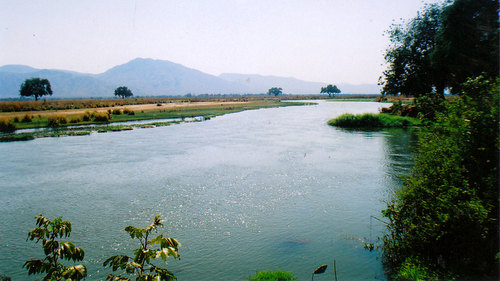
My soul river at Mana Pools.

Every now and again in my life I have found myself in a place that for some mysterious reason exerts a deep, personal pull on me. Such places insinuate their way in to one’s being; my need for them seems to come from the deepest recesses of my unconscious mind. The Nyanga farm, where I grew up, was one. The Zambezi Valley is another…

The first time I went to “The River” was as a very small child, way back in the 1950s. I flew up with my father, an airline pilot, in an old Viking, at a time when the future Kariba Dam was still under construction.

I don’t remember much about that trip other than the fact that the unfinished wall looked like a rash of scabby cement skyscrapers of uneven height sprouting out of the river bed. I also vaguely recall that we travelled downstream to the junction of the Kafue and Zambezi rivers but how we got there I have forgotten.

My next visit was with my brother, Peter, his best friend, Douglas Anderson and Doug’s then girlfriend whose name now escapes me. It was towards the end of the sixties when I was still at university and Pete had just started working as a CONEX officer in Karoi.

My memory of that trip is similarly hazy. I do remember we consumed quite a few beers along the way which might explain that.

I recall driving past the remains of the abandoned sugar mills near Chirundu but am not sure where we actually ended up. I also remember there was only the one shelter which Doug and his girlfriend slept in. Because we considered ourselves rugged, outdoor types, Pete and I just dossed down on a sandbank alongside the river.

Apart from the mosquitoes – tiny, winged, devils in paradise – we slept well enough although we were a little taken alarmed to discover, when we woke up the next morning, that a hippo had walked between our two prostrate forms.

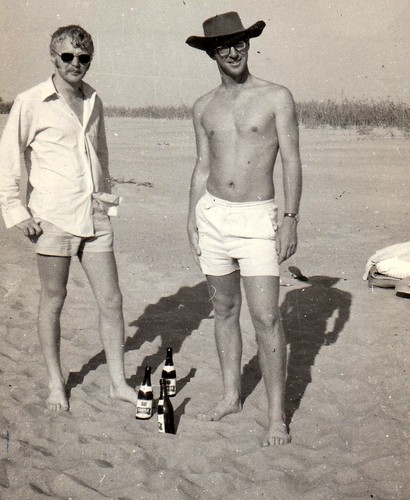
I still have an old black and white photograph of the two of us, taken back then. It is a picture I treasure because it reminds me of more carefree times and captures better than any other our contrasting personalities: Pete – practical, solid, no nonsense, his feet firmly planted in the soil. Me, the future cartoonist, slightly aloof and cynical, a bit of a poser with my sunglasses and ridiculous sideburns.

Pete and I at the Zambezi, circa 1969.

Standing on that sandbank with my brother, I do remember feeling that there was something that made this place special. I also knew I would return, one day, although, when I finally did so, it was not under the conditions or in the circumstances I desired.

I had left university at the end of 1971 and knew what lay ahead of me – 12 months of National Service. For a whole year I had been possessed by a growing sense of dread and the misery of anticipating the unavoidable.

My fears duly were duly realised. On the 3rd of January, 1973, I found myself conscripted in to the army as a member of Intake 129, “C” Company, the Rhodesia Regiment, based at Kariba.

It was now that I really began to get to know the river.

Our barracks, which had once provided a home for the Italian workers involved in the construction of the dam wall, were situated on top of a high hill – commonly referred to as the ‘Kariba Heights’ – with a panoramic view over the town, harbour and lake below. From here each platoon took it in turns patrolling the gomos ( army slang – from the Shona word for ‘mountains’), the flatlands and the town itself where our duties included guarding the dam wall which linked Rhodesia to Zambia

The gomos are what we called the rugged, inhospitable stretch of country that lie directly below the dam wall where the valley sides close in tightly, squeezing the river into a series of narrow, fast flowing rapids. At the end of the gorge the Zambezi slows down and widens as the land opens up with surprising abruptness into an enormous flood plain (hence army slang: flatlands) while the mountains re-arrange themselves along the horizon, growing further and further apart until finally petering out into nothingness.

For the most part we operated in small, six-man sticks, patrolling up and down the river as far as Chirundu by day and then returning to our base camps – old hunting camps – at night. It was a place of huge heat, a vast sky above and the sound and shimmer of the river below as it snaked its way along the county’s northern border.

Zambezi Master Chef class. Me on left, taking no part but writing a letter home like a good son did in those days…

At this early stage of the war this section of the Zambezi was still relatively quiet; most of the guerilla incursions were occurring further to the east, across the Mozambique rather than Zambian side of the border. If anything we had more to fear from the abundant wildlife.

At night we could often see and hear hyena lurking around and rooting amongst the rubbish left behind by countless intakes of soldiers before us. Under the cover of darkness hippo would emerge from the river to graze
on the grass that grew along the banks of the river.

Elephant, too, were frequent visitors although usually you could hear their stomachs rumbling long before they got anywhere near you. At other times I used to marvel at what silent creatures they could be and how an entire herd could materialise out of nowhere, as if by magic.

Black Rhino – surely the most cranky, foul–tempered, creatures on this planet (aside from man that is)? – were still relatively common. The sadistic South African helicopter pilots who flew us around used to take cruel delight in making us jump out near them. Because they held rank we couldn’t argue…

As a result, I spent more time retreating from their frontal assaults than I did dodging the other sides’ bullets (although that did change as the war intensified and I got despatched to the “Sharp End”).

Patrolling at night also had its own peculiar risks. There was always the chance of stumbling into herds of silent-standing buffalo concealed in the shadows, their presence usually given away by a sudden swish of a tail or an angry snort. Several large prides of lion also hunted in the area.

Elephant drinking in the Zambezi

Then there were the less visible dangers – tsetse fly, carriers of sleeping-sickness whose bite left a large welt on your skin, ticks, malaria-bearing mosquito and crocodile that lurked below the deceptively placid surface of the river.

At night we each took it in turn to do a stint on guard while the others slept. Strangely enough I learnt to savour such moments. I have never been much good at being one of the crowd, nor did I ever slot comfortably into the highly structured military hierarchy. Guard duty provided me with a brief, merciful respite; the time and silence to be alone with my thoughts, without being interrupted or pestered or ordered about.

Although I was always an extremely reluctant soldier, the army was not all bad. Indeed there were moments of unalloyed magic when it was possible, if only for a while, to forget we were fighting a war.

I loved sitting in the pink afterglow of the sunset, having my final brew-up of the day and watching the river change colour as darkness descended. As the sun sank still further the river and sky became one, the tree line and distant escarpment hanging in suspension between them. It was difficult not to be bewitched by the landscape, the massive, flat valley, the rim of mountains and hills. Often we would be joined, on either side of our position, by large troops of baboon or herds of impala or elephant coming down for their final drink.

Sunset over the Zambezi.

Apart from a short period in my youth when I tried to re-imagine myself as a St Francis of Assisi-figure I have never been a particularly religious person but I felt a strong spiritual connection with the place.

Even now, living in a different place, space and time I am still haunted by the grandeur of the Valley.

Since then I have been back to the Valley many times, alternating between Lake Kariba, Mana Pools and Mongwe Fishing Camp, below Chirundu.

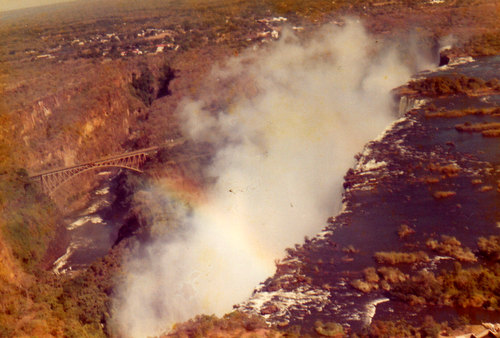
At the end of the Rhodesian Bush War, I took my English cousin, Rebecca, then just out of school and waiting to go to Oxford, on an epic road trip around Southern Africa. This included crossing Kariba by ferry and then driving through a mine field to get to Victoria Falls. I don’t think her parents would have so readily consented to the trip had they known about all the skull and crossbones signs and rusty barbed-wire demarcating where the mines were supposed to be.

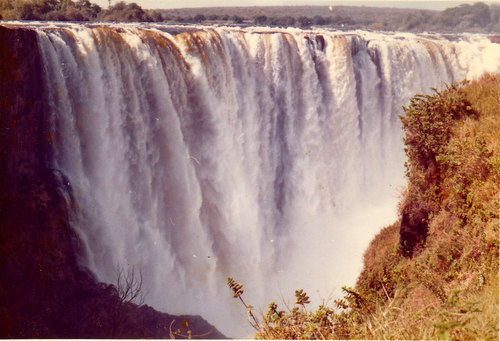
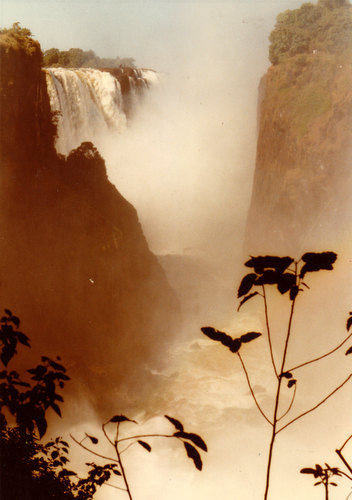
We couldn’t have picked a better time to see the Falls. Not only was the river flowing at full strength – which meant they were at their magnificent best – but because it was so close to the end of the Rhodesian Bush War the tourist hordes had not yet started returning in their thousands. Prices were cheap, accommodation easy to find (we stayed in the National Park chalets above the Falls) and there were none of the regulations and restrictions controlling movement in and around the main view points that you have now.

Seeing the Falls after a gap of several years, I was once again overwhelmed by their sheer size and scale. No matter how many pictures you see of them or documentaries you watch, nothing can quite prepare you for the sheer magnitude of this spectacle. It takes your breath away every time.

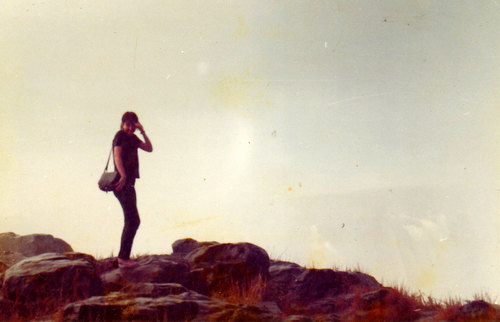
The one glorious evening Rebecca and I wandered down through the rain forest right up to the edge of the dizzying abyss. Standing there in the drenching spray, watching the never-ending torrent of water hurling down in to the cauldron below – while a orange- yellow full moon rose in to the night sky above it, gilding the water in a luminous glow as it did so – I felt like some would-be mystic. There was something incredibly transcendental about the scene.

What brought the whole experience even closer to the Romantic Age notion of the Sublime (beauty and terror combined) was that we had one of the world’s most awe-inspiring natural spectacles all to ourselves. We were the only ones there.

I doubt if you could do that now.

Another trip which sticks out in my mind is when my youngest sister, Nicky, got married. After the wedding, the reception for which was held in Cecil John Rhodes’ old house in Nyanga (now a hotel), we spent an idyllic few days on a houseboat on Kariba before driving on to Mongwe fishing camp. After all the other family members had headed back to Karoi, my companion, Mary-Ann, I and my nephew, James, elected to stay on for a few more days.

The Zambezi is a river which inspires all those who know it well with an infectious passion. James, who farms in Karoi and comes down regularly on fishing trips, is no exception…

James fishing in Zambezi.

As we sped up and down the river in his boat, past sandbars and reed covered islands on which groups of munching buffalo stood, he was full of lurid descriptions of its hazards as well as its attractions. Numerous types of fish swim in it of which the mighty tiger fish is undoubtedly the most famous (James has caught his fair share).

The bird life on the Zambezi is prolific. Its specials including African Skimmer, Lilian’s Lovebird, Livingstone’s Flycatcher, Western Banded Snake-Eagle, Dickinson’s Kestrel, Long-toed Lapwing, Grey-headed Parrot, Thick-billed Cuckoo, Racket-tailed Roller, Collared Palm-Thrush and many more besides.

In the middle of the river James found a shallow shelf where he cut the engine and we all leapt out in to the crystal-clear, cooling, water. Wanting to show I am capable of the odd romantic gesture I re-enacted the whole “Out of Africa” scene, washing Mary-Ann’s dust-coated hair while James, chuckling to himself, kept an eye-out for crocodiles.

The Zambezi from Mongwe Hill.

My last trip back to the Valley – which was also to attend a wedding (my nephew Alexander Stidolph) – was undoubtedly the most poignant and moving of them all because it happened at a particularly tumultuous and traumatic time in Zimbabwe’s history.

Driving up from Harare Airport the results of President Robert Mugabe’s recent chaotic and often violent land grab had been plain to see. For every surviving homestead, I passed at least a dozen whose occupants had been forced to up stakes and flee. Tobacco barns stood derelict, irrigation equipment and farm machinery lay strewn across the countryside. Uncontrolled bush fires blazed everywhere.

An entire industry, a whole way of life, appeared to be dissolving before my eyes.

Only the Zambezi Valley was as I remembered it.

Dropping down the other side of the escarpment I braked and pulled in to a familiar lay-bye – a favourite pit stop of mine. The air was thick with heat so I cracked open a cold beer and sat there while a pair of Bataleur – still relatively common in these parts – wheeled overhead; dwarfed by the immensity of it all.

For the first time since I started the journey I could feel my jangled city nerves starting to thaw. Sitting under an invincibly sunny sky, listening to the baboon arguing in the rock-faces above and the sound of the long-haulage trucks groaning up the steep incline, I felt I had found my spot in the universe. I was back in my true spiritual home.

I could have lingered there all day, lost in that hypnotic trance, but I had a wedding to get to and ahead of me stretched the long, dusty, rutted track to Mana Pools.

Crossing the Rukomeche on the road to Mana Pools. The Zambezi escarpment in far distance.

There was something comfortably familiar about the scene that greeted me at the river. Pick-up trucks were backed up in a line alongside the road and under a cluster of trees a makeshift wedding reception area had been cordoned off.

Beyond all the activity, on the river below, a small herd of elephant sloshed through the shallows completely unmoved by all the comings and goings around them.

Elephant – completely unmoved by wedding preparations.

The next morning I sat out under a huge Natal Mahogany tree and watched the passing parade as the sun rose up over the mighty river. Looking at the scenery and the animals and the myriad of bird-life, I felt I had been let loose among a prodigality of marvels, a feeling made even stronger by the illusion that I had it all to myself.

The wedding ceremony itself was held further upstream, under a large, spreading tree whose branches had conveniently arranged themselves in to the form of a natural altar, through which one could take in the broad sweep of the river and the mountains beyond.

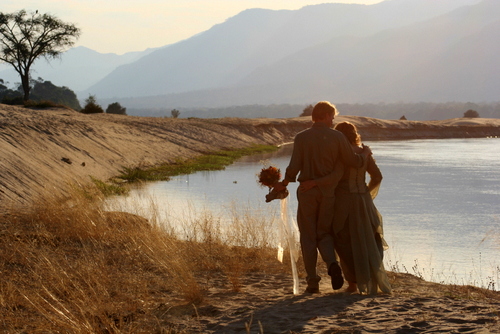
The setting could hardly have been more perfect. Threading his way carefully through pods of dozing hippo, the bridegroom came paddling down the river in a canoe while the bride arrived in a cloud of dust in an old Model T Ford, especially trucked in for the occasion.

The bride arrives in a cloud of dust…
The bridal couple depart. Note raptor in tree. Picture courtesy of Craig Scott

Considering how severely depleted the ranks of the local farming community had become there was a surprisingly large turnout although among the guests were many who had lost their farms and livelihoods or joined the great diaspora. Try as I might I found it very difficult to escape the palpable air of sadness, the feeling I was witnessing a last hurrah.

This feeling of loss was made even more acute by the fact I had also come to pay my last respects to my adored brother, Pete, who had died of a brain tumour just days before his farm was seized (my brother, Paul, who farmed nearby also lost his) and whose ashes his wife, Tawny, had placed in an old sausage tree growing on the bank of his favourite section of the river.

My brother Pete’s final resting place (sausage tree on right). My sister, Nicky, in foreground.

As I and the other members of my family gathered around the tree, it occurred to me I was bidding farewell not only to my brother but also the country of my birth.

The memories churned up by this unspeakably beautiful river will, however, continue to flow through my soul until the day I die…

More Paintings of Baobabs

In case you haven’t noticed I have a thing about baobabs.

Here are a few reasons why: I am awed by their size and the way they dominate the surrounding countryside and tower above all the other trees. I love the drama – all those tentacle-like branches spreading out laterally, as if they want to pluck passing birds from the sky.

I admire their tenacity, the fact that they thrive in the most harsh and arid of conditions. I am impressed by the huge age they can reach.

There is something very ancient and wise and holy about them. They seem to speak of the Old Way. They stir the spirit and the eye.

Baobabs are also very much part of my inheritance. Although some people might be surprised to hear this– the ones who associate Nyanga with mountains and bracing cool weather and therefore no baobabs – our old family farm, Nyangui, in Nyanga North, was littered with them.

Baobab with Nyangui mountain in backgound. Picture courtesy of Patrick Stidolph.

You passed by a whole grove when you drove through the farm gate. There were baobabs on the top of koppies and among the ancient ruins and there were baobabs growing in the middle of the old lands. My brother, Paul, sited his house next to one.

There was a baobab, across the river, which my brother, Pete, and I carved our initials in to when we were still schoolboys – hoping that, in centuries to come, some explorer would stumble upon them and wonder who we were? It was a wasted stab at immortality. When I went back to the old farm, many years later, the baobab had collapsed and died.

Since then, baobabs have continued to act as signposts in my life. One of my favourite stopping places in Zimbabwe is the lay-by you come to as you descend the Zambezi escarpment from Makuti to Chirundu (and Mana Pools). It has become a little ritual of mine – alas, not one I have done for years – to always pull over here and have a beer.

View over Zambezi Valley

From this perfect vantage point you have a magnificent view over the valley floor, stretching in to the blueness of distance with the hills of Zambia simmering in the heat haze on the horizon. In the mid-ground you can glimpse the glittering blue waters of the great river, snaking its way eastwards towards the Indian Ocean.

And no matter in which direction you gaze you will see baobabs poking up above the sunken contours of the far-reaching landscape.

As you continue driving down the escarpment, the heat comes up to meet you. You can smell it as well as feel it: a dry, punching, smell of dust and jessie bush and mopani leaves and elephant dung. And baobabs.

Makuti to Chirundu road with Zambezi escarpment in background.

Even now, thousands of kilometres away, sitting on top of my hill in the Karkloof, I still get misty-eyed when I recall that view.

Moving to South Africa I was able to renew my love affair with baobabs when I started going on my birding trips to the Limpopo valley.

North Kruger was where I first rekindled the romance. As you drive down from Punda Maria towards Pafuri, the terrain begins to break up in to a series of steep sided ridges which a have a tumbled, frenzied look, as if somebody had stirred them up in a giant pot and then left the contents to dry out under the baking sun. And dotted all over them are baobabs.

Undoubtedly, the most famous of these is the one that sits on top of Baobab Hill. This iconic tree served as a landmark on the early trade routes going through the area. Pioneer hunters used it as part of the famous “Ivory Trail” (some of them leaving their names carved on the tree). Between 1919 and 1927 it became the first overnight stopover for black workers recruited from Mozambique to work on the gold mines of the Witwatersrand.

Baobab Hill, Kruger National Park.

Mapungubwe, another preferred haunt of mine, has its fair share of baobabs too. Like old, petrified giants, they seems to anchor an immense sea of plain and bush and broken red koppies that falls away to the Limpopo river.

It is almost like a homecoming to be driving among them.

Mapungubwe.

My paintings, then, are my way of attempting to pay tribute to and glorify these most monumental of trees. I want them to be a celebration of the baobabs heroic scale.

Obviously I take certain artistic liberties. I often tweak them a bit, highlighting and simplifying features. Sometimes I move the baobabs position in the landscape, bringing them closer to, say, a hill I fancy to create a better sense of balance. I lob off odd branches so my canvas doesn’t look too cluttered or become mired in detail. I play around with light and colour in the hope of capturing a particular moment or mood.

I try and encapsulate the loneliness, the wildness and the spirit of the primeval world in which they have existed since time began, a world in which man is still very much the intruder.

In doing this, I know I can never pay full justice to these magnificent trees although I hope I do manage to convey something of my admiration and my awe.

Disdainful in their own majesty, serene in the mellow certainty that comes to the very old they are the very symbol and essence of a remote, half-mythical strangeness.