The Hunting of the Palm Thrush: More Travels in Kruger

A lone Bateleur, with its short stubby tail and stiffly-held wings, was spiralling lazily in the thermals, as we drove through the Phalaborwa Gate into Kruger National Park. My first bird. I took it as a good omen, a sign that the God, gods, deity, ancestral spirits, shade, cosmic guardian angel or whatever other natural or universal force it is that governs my destiny and gives my life a semblance of direction had given blessing to my latest expedition. Not that I required much convincing. I have yet to go into Kruger – and I have now been many times – and not have a good experience.

The day was overcast and wintry but I soon had several other raptor sightings to scribble down in my battered notebook. Within the space of two hours – the time it took for us to drive from the Gate to our night stop at Mopani – I had ticked off a Brown Snake Eagle, a Martial Eagle, a White-backed Vulture, a Tawny Eagle and an African Hawk Eagle.

Tawny Eagle.

The rains had petered out much earlier than usual that summer. It had been a long, dry winter, with higher-than-normal temperatures There was not much surface water and the landscape was bleached and parched, crying out for rain. The dryness didn’t put me off. I can think of nothing more satisfying than driving miles for no other reason than to take in an accumulation of trees, grasses, endless plains, rivers, rocks, animals, birds, ant-heaps, insects, reptiles, sunrises and sunsets. It is a powerful and fundamental experience.

More to the point, I was back in my beloved bushveld. I grew up in a country like this. It wormed into my consciousness when I was still a little boy, became part of my cultural identity, and imprinted on my personality. It is my myth country.

And now here I was once more in familiar territory. I had a pair of binoculars in one hand, and a camera in the other. It wasn’t just good to be back. It felt spectacular.

Once you have crossed the low-level bridge across the Letaba the road begins to veer south. The mixed woodland gives way to Mopani scrubland. It is by far the most dominant tree in the hot lowveld. Where there are mopani trees, you find elephants. Loads of them.

I guess the dominance of the tree provided the rather predictable name for the camp we had booked into for the night – Mopani. We checked in at the reception and then headed to our chalet. The camp was crowded with tourists. Since I consider myself a genuine Bushveld person, I assumed an air of lofty superiority. I wanted them to know I was not of their lowly rank. Keen to put some distance between myself and them, I jumped at my brother-in-law’s suggestion that we drive down to the causeway to watch the sun setting over the dam.

The sky was still grey and overcast when we set off the next morning but as we drove the clouds began to disentangle themselves from one other and slowly drift apart, By afternoon, it had cleared up completely,

Beyond Shingwedzi the mopane veld continued flat, brown and dusty. Many visitors find this section of the road boring because there is seldom much to see and the scenery is so repetitive. My main purpose for going to Kruger is not to record the “Big Five” (although I am happy if I do), I just go to immerse myself in nature. So, I don’t mind driving through this stuff. It is part of Kruger’s charm…

As it turned out, we did see a few interesting things, including a small group of Roan Antelope, at a watering hole. Because of their low numbers (there are only around 100 in the park), they are not often spotted.

Roan Antelope.

We passed the turn-off to Punda Maria camp, built on the slopes of a low, dry hill with Pod Mahogany trees growing on it. Beyond it lie more hills, marking the eastern extreme of the Soutspanberg Mountains. The next landmark is the Klopperfontein Dam built by Stephanus Cecil Rutgart ‘Bvekenya” Barnard, a legendary elephant hunter and poacher who later turned conservationist, as an overnight stopping point and to provide water for the thirsty labourers trudging wearily towards the City of Gold (of which, more later).

The geography started transforming itself before our eyes, breaking up into a wild rocky country. The hills grew closer and larger, and beyond them rose other, steeper, hills. Then we dropped down into the hot Limpopo Valley. Here, the temperatures can hover, in summer, above forty degrees for days on end. Dominating the skyline on either side of the road are huge, ancient, baobabs. The most well-known of these is the one on Baobab Hill, a prominent landmark, just next to the road, rising above its surroundings like an outstretched hand, grasping at the sky. For centuries the hill has served as a prominent beacon and was the first outspan for the Witwatersrand Native Labour Association’s (WNLA but colloquially known as Wenela) route to the Soutspanberg, 1919 – 1937.

Turning off just before the bridge over the Luvuvhu Rives, the dirt road led along the edge of the same river. Its steep banks are multi-coloured and criss-crossed by game paths. Huge trees grow along its sides. Unlike many of Kruger’s other large rivers, the Luvuvhu flows all year around, making it a magnet for all the thirsty animals (and birds) at this time of the year.

In places it opened into glades where the grass, cropped short, was littered with elephant dung. A Ground Hornbill was making his way, methodically, through the piles, picking up balls of it and then tossing them as it went.

At our first pullover, a small herd of eland took mute note of us and carried on drinking. Around the next bend, a family of elephants was funnelling up gallons of water from the sluggish river below. As I stood watching, a bull elephant, perhaps angered by the sound of a rival, emitted an air-splitting scream of agitation and then went thundering through the water, trumpeting loudly as it stormed up the opposite bank.

We stopped at the beautifully shady Pafuri Picnic Site with its magnificent Nyala Berry and Jackalberry trees,

My sister suggested a cup of tea. She got no argument from me. Then, I went looking for birds. Birding is my passion. It is like gaining access to a world that exists parallel to ours, full of amazements and surprises and delights. In next to no time I had seen a Bearded Scrub-Robin, a Red-capped Robin-Chat, a Grey-backed Camaroptera, a Black-throated Wattle-Eye and several other furtive forest dwellers.

Beyond the Picnic Site lie more massive trees that have benefited from the heat, fertile soil and abundant water available to their roots. Some trees are hundreds of years old (the baobabs run to thousands). Every now and again, we pulled over under the leafy branches of these, to see what might be lurking below. When I first visited Pafuri, many years ago, the forest extended even further away from the river than it does now but severe flooding and elephants, with their tree-splitting propensities, have destroyed many of the tall acacia and fever trees that grew along its outer rim.

We reached another intersection and then, turning left, made the short drive to Crook’s Corner, the most northeastern section of the park. Although the Luvuvhu was still flowing, the much larger Limpopo was, at this point anyway, completely dry. Where the two met, a large hippo pod lay asleep on the sand. From their leathery backs, Oxpeckers gazed quizzically about. A pair of White-crowned Plovers – confined to large river systems like this one – kicked up a huge fuss as they swooped angrily over our heads. Maybe they had a nest nearby.

In this harsh country, you really do feel you are on the edge of the frontier, worlds away from anywhere, although, before becoming a park, the area had been traversed and occupied for thousands of years. In venturing deep into the interior, the early traders had followed the river systems, like the Limpopo, exchanging their goods for items such as ivory and gold which they would then take back to the Arab trading stations established along the African shoreline. In response to this burgeoning trade, several important mercantile centres sprung up in the region, of which the most prominent and famous was Mapungubwe, located several hundred kilometres to the west of the park, near the junction of the Shashe and Limpopo (which also happens to form the modern meeting point between South Africa, Botswana and Zimbabwe). Its capital city was centred around a distinctive, flat-topped hill, on the southern side of the Limpopo, on which lived the king and his more important followers.

For reasons which are still not completely clear the Mapungubwe civilisation collapsed around 1290. Many of its people moved north and east where they joined another iron-age centre that came to be known as Great Zimbabwe.

Between 1450 and 1550 another wealthy trading centre grew up at Thulamela Hill, which is on the right as you leave the main road and turn down towards Crooks Corner. Its inhabitants also established trading links with the Muslim traders at Sofala, in modern-day Mozambique, as well as indigenous settlements in southern and central Africa. You can see why they chose the hill. Strategically located right at the eastern edge of a long line of rocky hills (the direction from which the traders would come), from its summit it provides a miles-wide, panoramic view over the surrounding floodplain.

Later, with the arrival of the white settlers, Crooks Corner gained a more notorious reputation. A big signboard, erected under a large Ana tree, tells you all about it. A well-known stop on the infamous “Ivory Trail “, it became a natural refuge for poachers, illegal black labourer recruiters, gun runners and other scoundrels eager to evade the law. Because it was situated right at the point where three countries meet all they had to do was hop behind the conveniently located border beacon and they were safe from arrest.

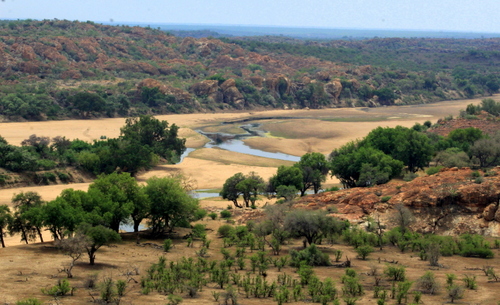
Junction of Luvuvhu and Limpopo Rivers at Crook’s Corner.

On this particular trip the area’s long and, more recently, dubious history was not my main focus of interest. I was in hot pursuit of an unusual vagrant that had caused a bit of a stir in South African birding world circles – the sighting of a lone Collared Palm Thrush at this very location. This bird, with its distinctive black necklace, normally occurs much further to the north, especially along the Zambezi River.

We hunted high and low for it but no luck. Reluctantly concluding that it was not our day for Palm Thrushes, we headed south, out of the belt of riverine forest, to a small group of hills on the one side of which stood the Pafuri Border Post into Mozambique.

Although I had never been here before, I experienced a curious mixture of pleasure, surprise and familiarity when we got there, because the buildings and setting contained so many echoes from my youth.

Even in this Eden-like wilderness, though, one cannot escape South Africa’s fractured past, its old injustices and its history of exploitation.

Regarded, by the new administration, as a symbol of colonial oppression, the one-time Theba Recruitment Station, which was to be our base for the next few nights, had served as a gathering point for Mozambican workers making their way to the gold mines of the Witwatersrand, part of the Wenela labour route. Originally established in 1919 it was finally closed down in 1976, more or less when Frelimo came to power.

The old Wenela Office.

I have a connection with its now officially frowned-on history. My father, a professional pilot who, during his forty-odd-year career, had flown all over Africa, had ended up working for the company. He, however, had been based in Francistown in Botswana, flying in labour from the Okavango Delta region, Angola and Malawi – all very far from the spot where I now stood, but the old houses, with their period furniture and room layout, were very similar in design to the one he had lived in, next to the airport. Our residence – formerly “The Doctor’s Residence” – with its wide verandahs built for air, and sun and to help keep the house cool (no air-conditioning in those days) at the height of summer. As an additional protection, it was fully enclosed in gauze, a defence against the malaria-bearing mosquitoes and other undesirable guests who might be out there.

Standing amongst the familiar-looking buildings, I felt the ghosts of my own parents. I remembered our Wenela days, my father, with his lackadaisical stroll, heading home in his uniform, jacket slung over his shoulder, his pilot’s cap slightly cocked on his head, after a long day’s flying. My mother fussing away in the kitchen, preparing a meal for his return.

More fragments from my past. I remembered sitting high up in the air traffic control tower, on the hangar roof, watching the long queues of mine workers, snaking across the runway, heading to or returning from the mines. As exploitive as the system undoubtedly was, there were obvious material benefits for both the workers and the countries they lived in because they invariably returned laden with goods, decked out in fashionable, new clothes and with a lot more cash in their pockets than when they set off to the mines.

That evening I went for a walk. The ground with its covering of crusted leaves crackled underfoot. Outside the perimeter fence, this would, no doubt, make it more difficult for any hunter – man or animal – to stalk its prey. All around me stretched the bush, real bush, vast, unapproachable, moving to its own music, waiting for rain…

The sun, now a bloated orange disc, was sinking through a reddish-gold wash towards the horizon. The trees had still not shed all their summer finery and their water-starved leaves were a kaleidoscope of yellows, oranges and ochres. From our hilly vantage point, they glowed like ambers in the setting sun. All around me, the birds were making their farewell to the day calls.

With the sinking of the sun the bats came swirling out, followed, by a hunting Bat Hawk, burnt black against the western sun. Then, the sky started darkening, disclosing its first stars, and a cool, evening breeze sprang up and helped lift the heavy air.

The next day, we drove back down the same road as we had come in by, scanning the roadside for the Palm-Thrush. It was still playing hard to get.

At Crook’s Corner, the same hippo lay in the same position on the sand (although I was sure they had been active during the night). Not far from where they lay, a solitary Hamerkop stood, motionless, in the shallows, staring intently at its reflection in the water. In local African tradition, the Hamerkop is known as the “Lightning Bird” because it is seen as the herald of a thunderstorm. Maybe the hippo were aware of this association with the supernatural, its slightly sinister reputation in local myth and legend, as a few of them – having resolved to go for a morning dip -, were eyeing it warily, as if worried it might put a spell on them if they proceeded further. The crocodiles were of a less susceptible mind. Several drifted past the feathered narcissist, single-focused, completely unconcerned…

Our disappointment at not finding the Palm Thrush was partly offset, a little later on, by the sighting of a Peregrine Falcon, with its kill, on a stretch of open land on the edge of the forest. Back on the tar, we drove to the Luvuvhu bridge where I hopped out and scanned the river for Spinetail. I have never seen the Mottled Spinetail and this is, reputedly, a good place for them but – like the Palm Thrush and the creature at the heart of Lewis Carrol’s classic nonsense poem, The Hunting of the Snark (“Just the place for a Snark! I have said it twice: That alone should encourage the crew.”) – it proved very elusive.

View upstream, from Luvuvhu Bridge.

A Raquet-tailed Roller had also been spotted on the road to Pafuri Gate so, with Beaver-like determination, I next went off hunting for it – with an equal lack of success. Such is the nature of birding…

Recrossing the bridge (still no Spinetail) we turned right down the Nyala Loop, at the end of which stands Thulamela Hill. An archaeologist friend, currently working at the site, had offered to take us up (you can’t go unescorted) but unfortunately, his timings didn’t fit in with ours. Instead of exploring the wonders of this ancient kingdom, I had to make do with a troop of baboons, examining each other for fleas on the flat land below the hill.

On the way back home, we made the obligatory detour to Crook’s Corner but the Palm Thrush was still pulling a no-show although a young twitcher, we spoke to, had seen it earlier that day so there was good reason to persevere.

The next day we drove the exact same route, again with a detour to Crook’s Corner, again hoping the find the Palm Thrush. It was becoming a bit of an obsession on my part. I don’t know a great deal about the bird’s habits but they do seem to have a flair for the dramatic because finally, on our last attempt, we found it. It was feeding on the ground, in the company of a pair of Tambourine Doves. At first, all we could see was its back. Then it turned around and with a great flourish presented its chest, putting any doubts we might have had as to its correct identity beyond question! I had found the Snark of Crook’s Corner!

Collared Palm Thrush, Pafuri. Pic courtesy of Ric Bernard.

Mission complete, we headed homewards, the next day, through the same landscape, thinned by dryness and dimmed by smoke. Nearing Babalala Picnic Site, we found the responsible culprit – a huge bush fire, pushing up great columns of acrid, grey smoke, was billowing towards us. We had planned a slight detour via the Mphangolo Loop, usually a very rewarding drive with some attractive river scenery. Suspecting it might now be closed to traffic we stopped and asked a ranger. He gave us a thumbs up and flagged us on..

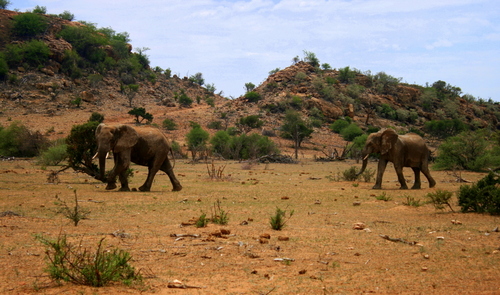
I am not sure who it was who gave them the all-clear sign, but we passed a small herd of elephants, seemingly unconcerned by all the action taking place around the picnic site, trudging towards the waterhole beyond which raged the fire. I love elephants. I love the way they inhabit their space, the relaxed rhythm of their walk, and the pattern and purpose with which they move through the bush. These were no different. They had used this track countless times before and saw no good reason to deviate from it now.

Or maybe they had greater confidence in the firefighter’s ability to contain the blaze than we had shown..

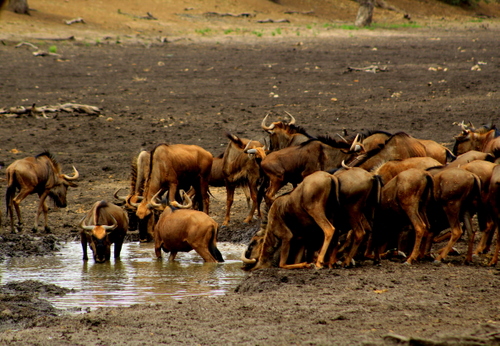
Because the area was so dry. with little water in the rivers. we saw fewer animals than I had on previous trips. In certain places, where it still lay close to the surface, the elephants had dug wells into the sand and were drinking from them. Once they had gone, other creatures would tentatively come down and drink from them too. Most animals are territorial and there appeared to be some sort of dispute going on, at the one well, between a crazy-tailed old Wildebeest and a family of warthogs about who had priority when it came to drinking from it.

When they are not seeing off indignant warthogs, the lone Wildebeest bulls like to station themselves under a shady tree, defending their territory against intruders in the hope of a chance to mate. I’m a Wildebeest fan too.

Driving through Kruger can be a bit like running an obstacle course. True to form, we hit a sudden roadblock – a herd of elephants had found a spot for a good browse and midday snooze and showed no signs of wanting to budge. Our exit route had been barred. It became a game of patience, an old-fashioned stare-down, a test to see who would blink first. We did. After about half an hour of waiting for them to move off the road, we turned the car around and headed back the way we had come until we found a side road leading us back to the tar. Unlike the elephant, we were on a tight schedule.

Back at Mopani. we had booked a chalet with a view over the dam. Instead of going for an evening drive, we chose to sit on its verandah (in my case, beer in hand) and watch the sunset from there. As it sank in the west, it turned the water’s surface a burnished gold. Right on schedule, several waves of Red-billed Quelea swept past, darkening the sky as they went, heading for their nightly roosting sites. On a previous visit, I had actually seen a Bat Hawk swoop into one such flock, seizing the one unlucky bird among the many thousands available to be seized.

As sometimes happens in Kruger, we got our best predator sightings when we thought it was probably too late. ‘On the way out, the next day, we saw, first, a hyena, lying alongside the road. It appeared completely unafraid of us, briefly opening one eye to give us a look over and then going back to sleep. Some people think hyenas are foul creatures, ugly beyond redemption. I am not one of them. I find them quite likeable, almost handsome with their odd, bear-like lope even though, in local belief, these fearsome beasts of the night are often associated with evil. Nature is not a democracy. It operates according to its own rules and as objectionable as some of the hyena’s manners and feeding habits may be to our more refined sensibilities they are just fulfilling their allotted role in the natural order of things.

Then, a bit further on, by the side of a river, we came across a pride of lions who had just finished feasting on a buffalo kill and were now lying sprawled out, belly to the sun. As we sat, the one male rose to his feet and sniffed his female partner’s hindquarters. Then, he raised his shaggy head, flared his teeth and let out an aroused triumphant roar.

One of Africa’s most primordial sounds, it was a fitting finale to our trip…

GALLERY:

Birds:

Animals:

Book Review

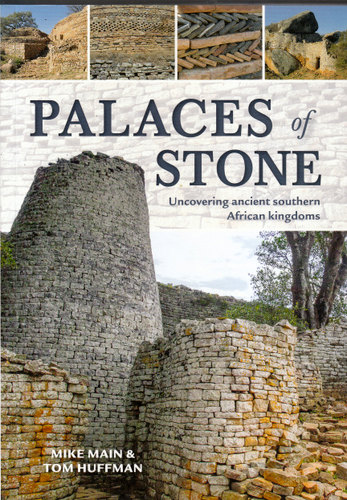
Published by Struik Travel and Heritage

Scattered over substantial portions of northern South Africa, Zimbabwe, Botswana and Mozambique are a series of, often beautifully decorated, palaces and citadels whose existence points to a chain of once highly developed and flourishing city-states, each with clear rankings of authority and concern for all citizens. To date, over 560 of these unique stone structures have been found, many of which were only the central feature of a much larger urban sprawl.

In the case of Great Zimbabwe, in particular, all sorts of wild theories and explanations proliferated among the early white explorers (and later) as to who built them, with some linking them to the biblical land of Ophir, others to King Solomon’s Mines and the Phoenicians.

In this marvellously panoramic overview, authors Mike Main and Tom Huffman put these romantic notions firmly to rest by drawing on the latest research, discoveries and excavations to explain how and why they were constructed, as well as their subsequent rise and fall.

Although there had been earlier settlements, Mapungubwe, on the Limpopo flood plain was probably the first one that could be classified as a full, pre-colonial state. Built around the base of a steep-sided sandstone hill that rises abruptly from the valley floor, it was strategically placed on an important trading network. What may come as a surprise to some readers is just how extensive and far-reaching these trade links were, stretching, as they did, as far as the Indian Ocean and then to the Middle East and Asia.

It certainly puts a lie to the notion that Africa remained largely “undiscovered” until the first Europeans arrived.

The reasons for Mapungubwe’s sudden demise are still not fully understood although the authors proffer various possible scenarios including the most obvious one – changing climatic conditions. This would explain the subsequent expansion and consolidation of communities on the highveld plateau to the north, close to the greenstone belt and gold – besides cattle rearing another important source of wealth.

The most famous of these was, of course, Great Zimbabwe and it was here the local stone-building skills reached their zenith. Ruled by a succession of kings its influence would spread, making it an important power in the sub-region. Because they were often situated in drought-prone areas, rainfall and the supply of water played a critical role in these societies, so it is hardly surprising that rain-making became an essential part of this political power.

Vasco da Gama’s circumnavigation of Africa was, however, to have major repercussions for these once-powerful kingdoms by bringing to an end the golden age of Islam. The loss of this regular and organised outlet for trade had a disastrous impact on the prosperous African economy based, and dependent on it. Zimbabwe would subsequently be occupied by new invaders who did not know the purpose of the vast buildings. Eventually, they would become overgrown and fall into disuse. The myth of a large golden empire would, however, persist.

Lavishly illustrated and eminently readable, Palaces of Stone provides an excellent introduction to this fascinating chapter of Southern African history.

When Two Troops Go To War: Adventures in Mapungubwe

I am returning to one of my favourite places, after a gap of several years. It is where I love to go birdwatching although that is only one of its many attractions.

The tarred road we use to get there, as is the norm in Limpopo Province, is a nightmare to drive on and my brother-in-law is a study in intense concentration as he tries to navigate the countless gaping potholes. We bump along the section that runs along the southern base of the Soutspanberg, then crawl up, via Vivo, to All Days. Here we branch off right.

The fact that the journey ends up taking twice as long as it should have doesn’t dent my enthusiasm for we are headed to Mapungubwe. It is somewhere along here my grandmother also travelled, as a very young member of the Moodie Trek, on her way up to the then Southern Rhodesia. Unlike us, she travelled by ox-wagon, not in an air-conditioned Isuzu bakkie…

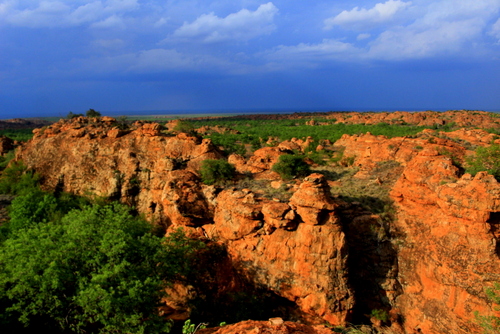
There is a stark minimalist, beauty to the landscape around here. The miles and miles of stunted mopani, the sudden, jagged outlines of ochre and strawberry-pink, rock outcrops and cliffs, the barrenness of the earth, all give it a slightly strange, almost mystical, atmosphere.

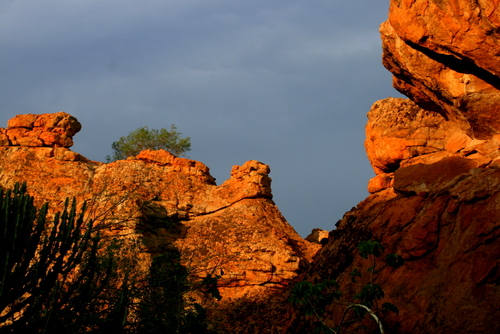
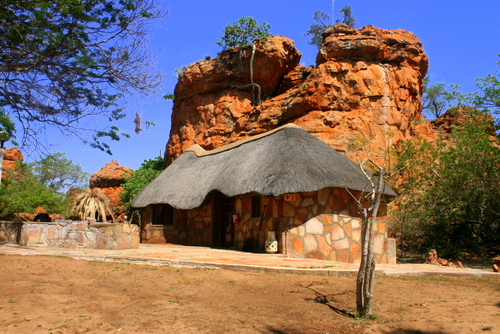
Returning to Mapungubwe is like a homecoming to me. Clambering out the car after the long drive, I stand, look and listen and let myself become part of the place again. Tshugulu Lodge, where we have booked in, is surrounded on all sides by towers of red, sandstone rock, eroded by the wind and rain and sun in to all sorts of weird, fantastical shapes.

Tshugulu Lodge

We are thrilled to find we have it all to ourselves

On the first morning, I get up at 0530 and go outside with my mug of tea. My brother-in-law has, as usual, beaten me to it and is already sitting outside but my sister is still asleep in her room.

As I plop down in the chair next to him, he points to the soft, wet sand in front of us and says “We had a visitor during the night!”. I immediately see what he is talking about. The huge footpads of a solitary elephant lead from the lodge gate to the swimming pool and then head out again along a slightly different path. There has been much testimony as to the silence of elephants so I hadn’t heard a thing but my niece, Kelly, whose cottage was much closer, had listened to it siphoning up vast quantities of heavily chlorinated water.

It is a perfect African morning, a time when the world still belongs to the animals. Above us I can hear the European Bee-eaters calling as they soar and glide in the thermals. When the breeze blows I catch the smell of Wildebeest, grazing not far from the perimeter fence of the lodge. Somewhere in the unseen distance I can imagine carnivores finishing a kill before heading off to lie in the shade,

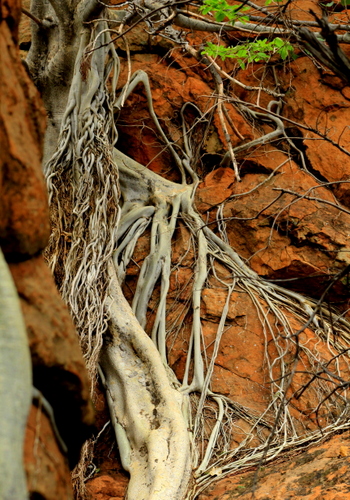
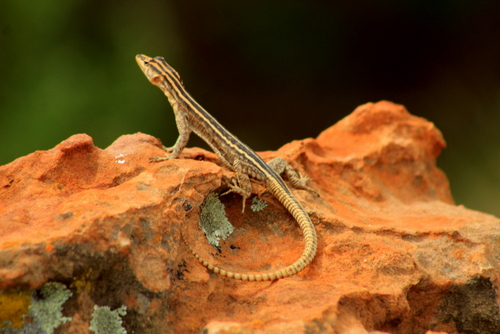
The rock cliffs, that hem us in like an old-fashioned castle wall, glow orange-red from the rays of the early morning sun. As I do a quick scan through my binoculars I see a snapshot of birds and other small creatures. Amongst the cracks and crevasses, the resident gang of Red-winged Starlings play hide-and-seek. In the shade of a Large-leafed Rock Fig which has sent its ghost-white roots burrowing down through the cracks and fissures, I hear the soft hooting of a Laughing Dove. Near it a skink, with brown stripes along its back, raises its head out of the rocks as if to smell for rain.

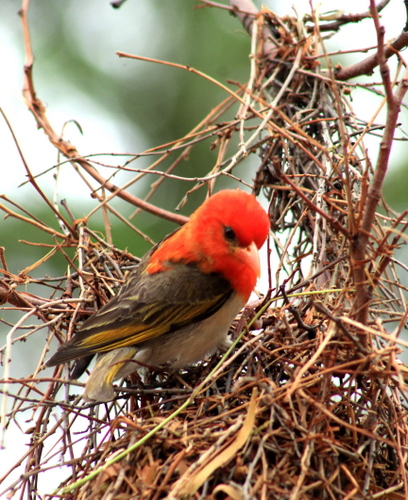
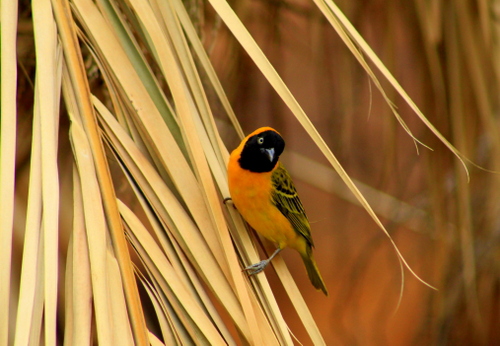
Down on the ground, not far from where we are sitting, a pair of Natal Francolin scurry past on some unknown errand. In the tree above us the beautiful Red-headed Weavers sway and dangle before flying off to bring back beak-load after beak-load of carefully selected twigs with which they construct their nests. Their pain-staking industry is more than matched by all the activity in the Lala Palm where a small colony of Lesser-masked Weavers have opted to build. They prefer to use grass and palm shards.

After a breakfast of fruit, muesli and yoghurt, we head off to the Eastern Section of Park. This arid area occupies a unique position in the country’s history for it was here that South Africa’s first important kingdom was established between 1200 and 1290 AD. Ruins left behind by Africa’s early civilizations are almost invariably found in hill country (Great Zimbabwe and Thulamela in Kruger are other obvious examples) and the Mapungubwe Hill site is no exception. From the summit of this steep-sided bute, its rulers would have been in a good position to keep an eye out out for enemy warriors, as well as greet traders coming up the Limpopo – for it is known they kept extensive links with the east, including the Chinese and Indians, the sails of whose ships were swept over to Africa on the winds of the monsoons.

We do not have time to visit the hill that marked the centre of their civilisation but from the top of the lookout site, at the confluence of the Limpopo and Shashe Rivers (where the borders of Zimbabwe, Botswana and South Africa meet), we can just make out its red ramparts rising out of the dusty earth. From here, the road, ostensibly for 4×4 usage only, takes us along the Limpopo River as far as Poacher’s Corner before branching off through yet more oddly-shaped hills and balancing rocks.

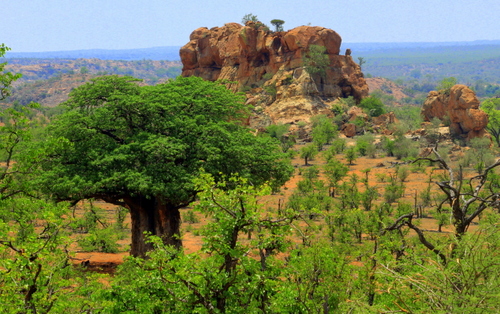
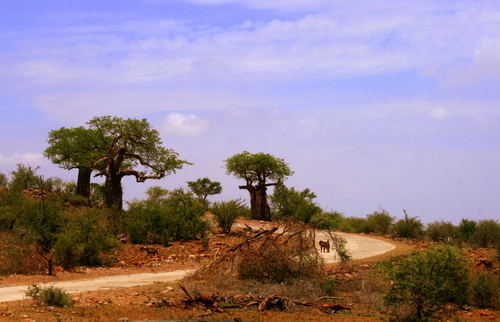
More hills and baobabs...

We return to the lodge, later that day, to find the local squirrel has taken advantage of our absence and made merry in the kitchen. Rusks have been chewed on, a bottle of honey lies open, its contents spewed all over the table and floor…

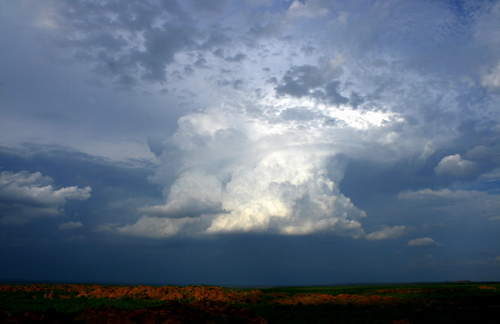
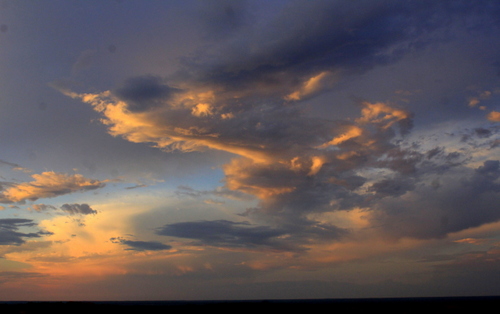
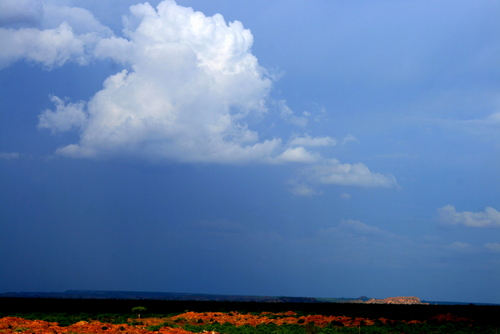
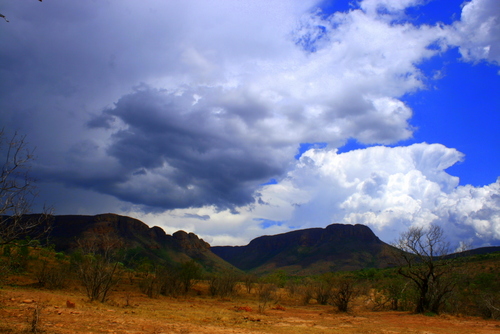
That evening, deciding to take advantage of the balmy summer light, we climb up one of the kopjes behind the lodge for sundowners. The view is astonishing. To our north, on the other side of the Limpopo, a massive storm is brewing. Soaring thunder heads rise above the plains casting the world beneath it in an unholy purplish light. There are bolts of jagged lightning, followed by the drum-like roll of thunder. You can feel the malevolence in the heavy air and smell the rain although it never actually reaches us.

Storm clouds over the Limpopo.

There seems to be no limit to our vision. One our right side, a labyrinth of glowing, sun-burnished, bare rock, pock-marked and twisted and looking like it could be guarding the entrance to the underworld, stretches away from us. Somewhere, in the ultimate distance, land and sky merge. It feels like we have the universe all to ourself.

A labyrinth of rock…

Anxious to transcript so great a mystery, I pull my camera out of its bag and start snapping. Then I just sit still for a long time watching the unfolding drama until eventually the fading light sweeps it all away…

That night I lie content beneath my mosquito net as the air conditioner – a novelty for me since I mostly camp on these adventures – drones away. Outside the crickets call.

I rise even earlier, the next morning, but it does no good. My brother-law-law has beaten me to the kettle again. He tells me we have had more visitors. These ones are much smaller than the formidable old behemoth who visited us the previous night. In the magic of twilight they had come flying out from their hidey-holes and roosting nooks.

They are bats.

Bats have always received a bad rap. Some time, back in history, perhaps around the period the when the church started persecuting perceived witches, they were turned in to creatures of ill-omen, along with crows, owls and – oddly enough – hares (it was thought that witches could shape-shift in to them). Later they came to be associated with vampires and Count Dracula and sharpened stakes and bundles of garlic. It is a label and an association they manifestly do not deserve for these nocturnal wanderers are marvels of evolutionary engineering..

I don’t know much about bats but my brother-in-law does. An Emeritus Professor, he is an expert on the subject. The reason he knows they have been active while we slept is because – like some Cold War spy – he has been secretly recording their chatter on two metal Bat Detectors he has attached to some trees. I listen raptly as he explains their workings. Because they mostly fly around at night bats can be difficult to identify but science – and technology – has found a way around that by tuning in to the ultrasonic sounds the bats emit.

My brother-in-law’s findings from this and subsequent recordings are, to my mind anyway, amazing, revealing a secret night-time world in which the bats are completely at home (see Acknowledgement below).

The bat puzzle solved, we next set out to explore our corner of the park, a lot of which is new to me.

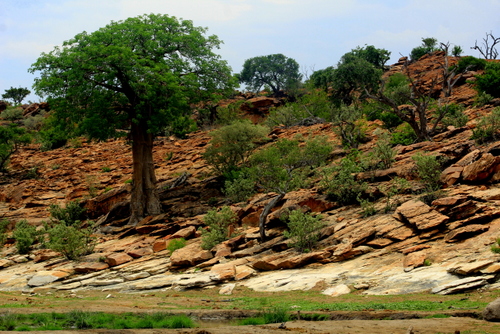
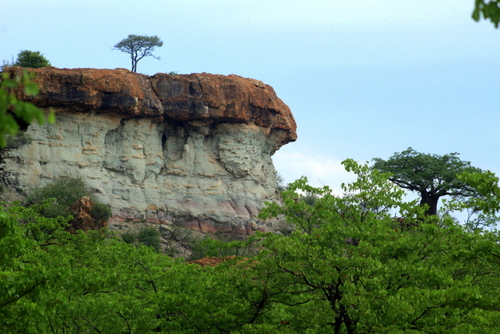
The day is hot but bearable because the heat is mostly dry. Our route takes us through a badlands of arid hills and trees that are, for the most part, low and barren. In marked contrast, every now and again, we come across a baobab rising like some ancient monument, sometimes in the middle of nowhere, some times next to the stone face of a kopje.

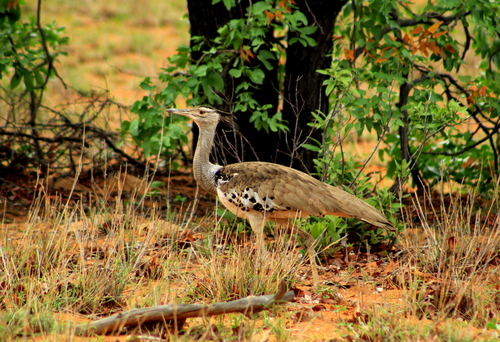
This is good raptor country. In no time I have added Martial Eagle, Black Eagle, African Hawk Eagle, White-backed Vulture, Common Buzzard, Brown Snake-Eagle and Gabar Goshawk (black form) to my bird list. Plus a Kori Bustard and a Red-crested Korhaan. Later, we will see the male Korhaan performing its strange courtship ritual, flying straight up in to the air and then closing its wings and tumbling to the ground, as if shot, before gliding in to land.

Kori Bustard.

After taking us through more rough, broken, terrain, the road starts winding down in to a rock-strewn valley which, in turn, opens up on to an immense plain, on the one edge of which lies the Limpopo. As you approach the river, the Mopani scrub abruptly gives way to a green line of tall trees – Nyala Berry, Jackal Berry, Natal Mahogany, Ana Trees, Apple Leaf.

I am a little taken back by the state of the Mazhou camp site which has altered much since I stayed there last. The electric fence that protects it no longer seems functional and everywhere there are scenes of devastation. I know who the culprits are. As in Kruger, elephant are presently destroying the acacia thorn (and many other species of tree) that also grow along the river bank at a rate regeneration can’t keep pace with. Those not knocked down have been stripped of their bark and are dying that way. In ten-years time I doubt if there will be many of these beautiful trees left to see.

One can only hope this is part of nature’s cycle although I am not convinced. In former times, elephants herds were scattered and nomadic which helped minimise the damage they cause; now their movements have been confined to restricted habitats, such as the one we are driving through. The results of this loss of freedom to wander at will are plain to see…

From the camp site we follow the river for a short distance, through the tall trees that provide favourite perches (and nests) for the vultures, before branching off to the Maloutswa Pan Hide.

As the main rains have still not arrived there is not much water in the pan. The mud that occupies the place where liquid should be is black and cracked and caked and pitted like the moon’s surface. Numerous hoof-marked tracks lead down through it.

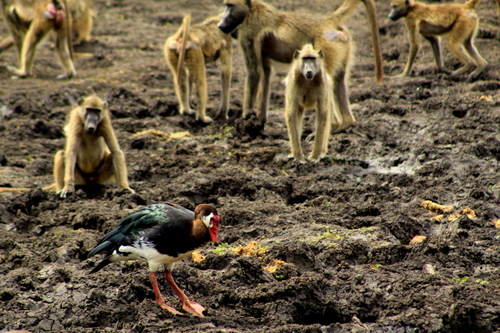
Obviously fans of the formula that there is safety in numbers, we find an immense gathering of baboon squatting by the water side. It is the biggest troop I have ever seen. As we sit watching them, another, even larger, troop suddenly emerges out of the tree line.

As they draw closer to one another, I can scarcely believe my eyes or my ears. It is like a clash between two medieval armies. There is an immediate outbreak of barking and a hurling of wild manic howlings. This is followed by lots of jumping up and down, chest-thumping and angry gesticulating. The baboons are doing it, I soon realise, only for dramatic effect. It is a mock call-to-arms and does not signal the start of an all-out war.

Realising they are outnumbered, the troop already at the waterhole stages a strategic withdrawal, yelling parting taunts and trying desperately to preserve their dignity and not show any loss of face. They retreat to a position a hundred metres or so downstream where they sit down and mutter conspiratorially amongst themselves. For our part, we find it a rather an impressive performance and feel like clapping but the solitary, bored-looking, Spurwing Goose who was in the middle of the battlefield remains completely unmoved. He has obviously seen and heard it all countless times before…

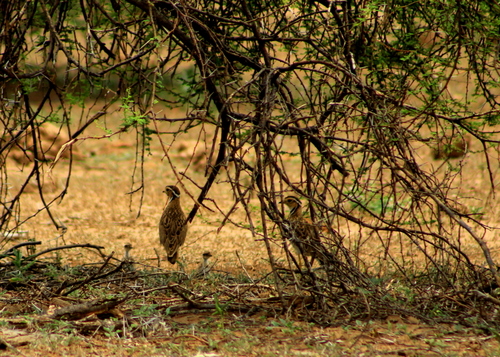
On the way back from the pan my sister sees two Crowned Lapwing in an open patch of ground and then, a bit further down the road, says “Look – two more of them under that tree!”. Although, I am on the wrong side of the car to see them, a little bell goes off in my head. Maybe they are not plovers at all! I urge my brother-in-lay to stop and reverse back to them. I am very glad I do for it turns out to be a pair of Triple-banded Coursers which are extremely unusual in South Africa. I am even more amazed when I see they have two chicks. In Africa, all game birds suffer high rates of nesting loss. There open homes are highly vulnerable to a whole host of predators – caracal, serval, jackal, civet cat, genet cat mongoose, raptors, various egg-eating snakes.

Triple-banded Courser, with chicks.

The chicks are lucky to have survived so far.

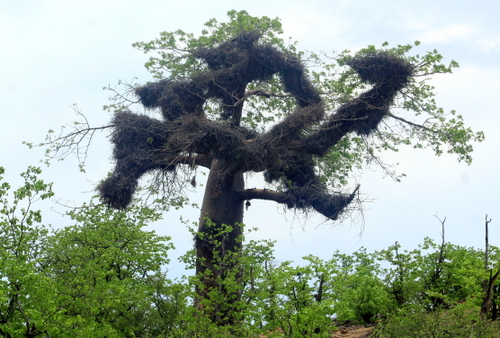
Returning home we take a slight detour to Little Muck which lies on a ridge below which a seasonal stream bed runs. How it got its odd name I have not been able to ascertain but it is a good place to see elephant. There are also several San rock-painting sites in the area but I imagine you have to get permission to see them. There are more baobab standing here in heraldic silence, their branches covered in the sprawling nests of the Red-billed Sparrow Weaver. With the exception of those in more inaccessible positions, they too, have been badly gored, stripped and desecrated by the elephant. I suspect many of these ancient, symbolic trees won’t survive either.

Which would be sad because, standing under them, I felt overwhelmed by the age and might of this old continent and realised – yet again – what an important part of it they are…

GALLERY:

ACKNOWLEDGEMENT

I am extremely grateful to my brother-in-law, Emeritus Professor Ric Bernard, for organising this trip and for his many kindnesses, information and assistance. To help me understand the world of bats better he also kindly prepared the following notes:
Studying bats is not easy because they are active at night and spend the days in often inaccessible places. They are hard to see in flight at night and almost impossible to identify even when they are seen. However, in the same way that birds can be identified based on their calls, so too can bats – with the same proviso that identification based on call alone is not always accurate. However, unlike birds where the call can be heard, the calls of bats are at a frequency that is far too high to be heard by us. This makes studying bats very different from studying birds. The ultrasonic calls of bats can be detected and recorded and on a recent trip to Mapungubwe and Mopani we used two Song Meter bat detectors to record the bats in the area. Over 6 nights, we recorded more than 16000 bat calls. Analysing these calls manually would be very time consuming and we used software to do this and to group calls into clusters. We were then able to examine the clusters and based on previous work to identify most of the calls.

The ultrasonic calls of bats are used to detect their prey and their surroundings (echolocation) and typically not to communicate with other bats. The call of each species is characterised by a particular frequency or range of frequencies and it is based on this that they can be identified. Calls fall into one of three groups, being Constant frequency (CF) where the call is relatively long and at a single frequency, Quasi Constant frequency (QCF) where the call is long and covers a very small range of frequencies, and Frequency Modulated (FM) where the call is shaped like a hockey stick and covers a range of frequencies from high to low at the bend of the hockey stick.

The CF bats are all horseshoe bats and we recorded six different constant frequency calls at 35, 47, 76, 81, 105 and 114 KHz (kilohertz). The likely species were the cape horseshoe bat, Geoffroy’s horseshoe bat, Darling’s horseshoe bat, Hildebrandt’s horseshoe bat, Lander’s horseshoe bat, Swinny’s horseshoe bat.

Amongst the FM bats, we identified the Cape serotine, long tailed serotine, banana bat, rusty pipistrelle, Natal long fingered bat, and Temminck’s myotis.

The vast majority of the recorded calls came from the QCF group. These are bats that often inhabit the roofs of houses and which SANParks are trying to attract into bat houses that we saw at both Mapungubwe and Mopani. The species included Midas free tailed bat, Angolan free tailed bat, Egyptian free tailed bat, Mauritian tomb bat, large eared giant mastiff bat and the little free tailed bat.

All of these bats fall within their known distribution ranges.

All the species are insectivores and will be feeding on both flying and sedentary insects.

I would also like to thank my sister, Penny, for the wonderful food and – along with her daughter, Kelly – being such good company.

Mind-travelling in Lockdown

If there is one thing lockdown has done it is to force us to redraw the parameters of our lives. Suddenly, everything has shifted, the familiar signposts have been removed, the old sense of continuity has gone. Instead, I am faced with the difficulty of navigating differences over such issues as the wearing of masks, social distancing, how much contact to have with others and whether I can risk eating out?

In short, every decision I make is weighted in moral ambiguity. Cast adrift from my usual moorings, I find myself torn between the need to stay safe and a desire to escape.

It is not the being alone that bothers me so much as having my freedom taken away from me. I have always been happy to embrace solitude provided it was on my terms. With lockdown that has all changed. Now it is being imposed by decree from above with the government taking increasing control over things and placing limits on our movements

While I can understand the need for some of them, being bogged down in this murky mire of regulations has bought out all my anti-authoritarian tendencies, as well as my fear of being trapped. Suddenly it is like I am back at boarding school where all the rules are designed with the naughty boys in mind. For example: because there are quite a few delinquent drinkers in south Africa, a blanket ban is imposed on alcohol sales which means all of us are collectively punished irrespective of own behaviour.
With the pandemic shrinking our horizons, my fear is finding myself confined to a cramped, parochial lifestyle. I worry about sliding in to passivity.

I have always lived a fairly nomadic life, ready to hit the road whenever I have felt that familiar build up of stress and anxiety, like a smoldering fire, inside me. I think this restlessness can be attributed, in part, to a childhood spent among the beautiful Nyanga mountains and a deep-rooted urge to retrieve that part of myself in a far-off place. Also, I like to feel I still have some control over my life. That I am able to exercise my skill in being free.

As lockdown progresses I have found myself fantasising about trips I want to make, as well as recalling some of the ones I have made in the past. I play them over and over again in my imagination, remembering bits I had forgotten.

I pour over my old AA maps planning possible new routes. I formulate plans which will probably never come to fruit. I look at photographs of trips I have made in the past. Because of the circumstance I now find myself in, their memory suddenly seems more precious than ever. There is a sadness too. In some cases the pristine places the photographs have captured are disappearing. Others I will never see again.

It is hard to pick a favourite journey but, if forced to do so, I would probably settle for the Great South African Traverse, I undertook in September, 2003, with my birding partner, Ken, just because of the sheer diversity of countryside we passed through.

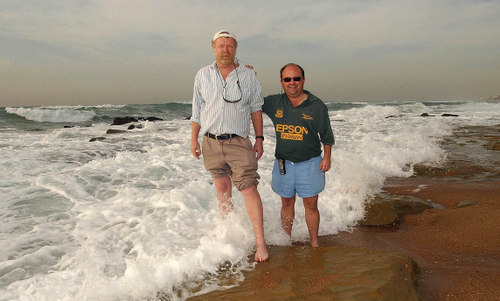
Wanting to do it by the book, we started off by dipping our feet in to the warm waters of the Indian Ocean, at Umhlanga Rocks, and then drove across the breadth of South Africa and did the same in the freezing Atlantic, at Alexander Bay. Along the way we stopped at Vaalbos National Park near Kimberley and also at the Augrabies Falls.

I had never been to the Northern Cape before but the first thing that struck me about it was how straight and long and empty the roads are. Much of the landscape between Kakamas and Springbok is flat and featureless too but the N17 does take you through Pofadder which is a place I have always wanted to visit because of its quintessential South African name. There is not much to the town apart from all the huge communal nests of Sociable Weavers on either sides of it but I did buy a lump of rose quartz, in the local café, just to prove I had been there. I still have it.

Sociable Weavers nest near Pofadder.

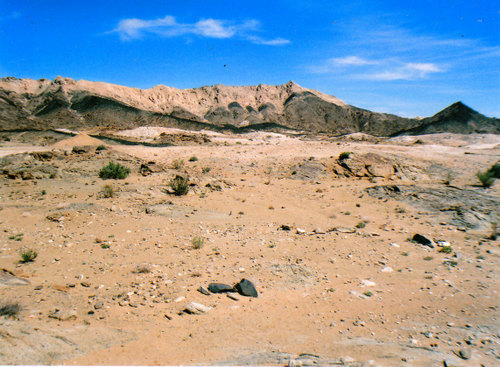
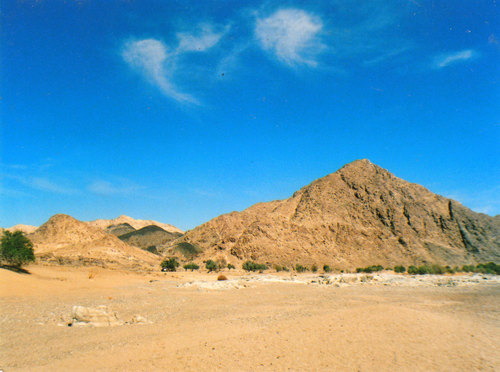
The further west we drove the drier the countryside became and the fewer trees there were until, finally, we entered a landscape that consisted mostly of stones. This was the Richtersveld, South Africa’s only true desert – or rather mountain desert.

Wedged right up in the north-western most corner of the country along the border with Namibia it is a wondrous place, a truly mystical landscape of moulded, multi-coloured, rock and drifting sand. The sky is a strange intense blue, limitless and criss-crossed with lazy scrawls of thin, vaporous, cloud.

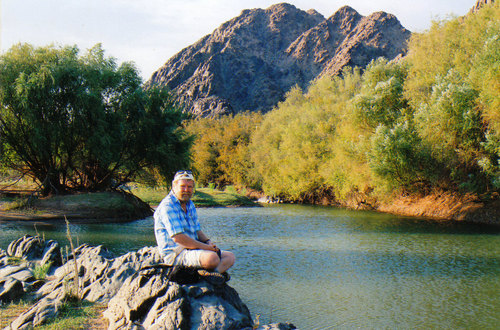
For our first few days we camped at Pokkiespram on the Orange River. It is an enchanting spot with the water idling languidly past while the mountains on either side rise up to naked peaks of rock.

Pokkiespram, Richtersveld.

Next on our itinerary was Kokerboomkloof. The road to it was marked on our map as 4X4 only but we decided to risk it in our small blue Ford sedan, heading up through the Helskloofpas – the name should have tipped us off as to what we could expect – in to Tatasberg mountains. We were probably foolish. It is not the sort of country you want to break down in because there is no water, no communications and you never know when the next traveller might chance along.

Also, our spare tyre had a puncture.

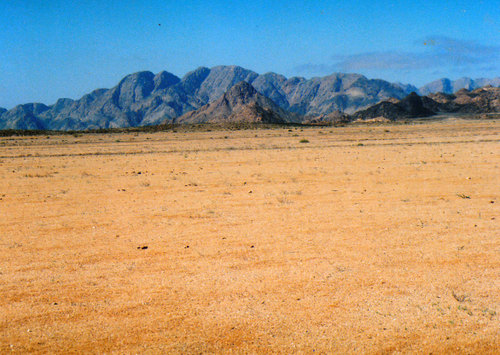
The road snaked its way between colossal boulders, around cliffs, ravines and barren gullies until, finally, on the other side, we found ourselves looking out across a vast, pale, plain, that appeared devoid of all vegetation. Along its horizon stretched another range, perhaps even higher that the one we had just crossed. Certainly the peaks seemed steeper and more pronounced and as desolate and devoid of life as anything we had seen. I was obviously not the only one to find them scary and intimidating. Consulting the map, I discovered some early cartographer had named them Mount Terror.

Mt Terror, Richtersveld.

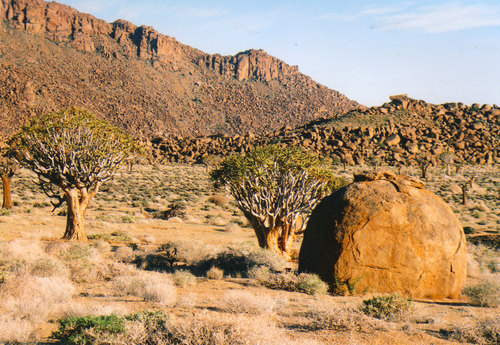
The road skirted the edge of the plain before winding its way up a rock-strewn kloof amongst which grew the strange-looking Kokerbooms – or Quiver Tree – that had given the place its name. Because of all the twists and turns and the numerous humps which, for some reason, had been put across the road our progress continued to be heartbreakingly slow. When we finally reached the top I felt a mixture of relief and exhilaration and was only too happy to stand there, absorbing the silence and sense of solitude.

With its dead, dry, moonscape setting, Kokerboomkloof is as about as far as you can get away from the cooped-up space of the cities. When the night closed in around us, I really did begin to comprehend my own insignificance in the vast scheme of things. Curled up in our sleeping bags under an enormous star-studded sky, you could hear no sound other than the occasional gust of wind blowing from nowhere to nowhere.

Another journey I would rank high in my hierarchy of ones to be remembered is the trip I made with my sisters and their kids, across the arid, thorny badlands of the Great Karoo and then down the West Coast to the mountain wilderness of the Cedarsberg.

Once a vast lake, the Karoo is now a place of extremes, hard and waterless. The early Trekboers who settled here – and those who followed – had of necessity to be tough for it is a harsh, unforgiving part of the world.

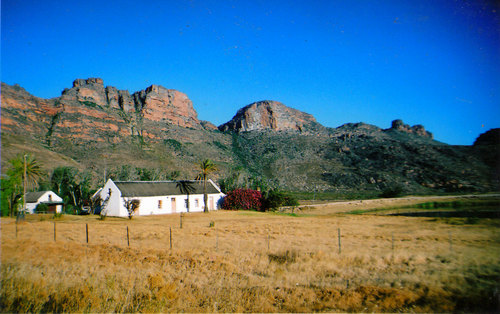
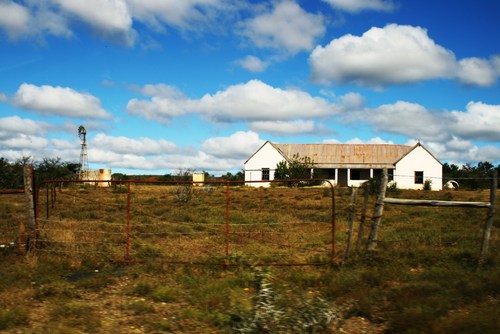
Typical Karoo homestead.

The white population has thinned out over the years, as the younger generations has drifted off to the cities. Many of the old farmhouses stand abandoned, there presence demarcated by a few ancient gumtrees, the skeletal remains of a windmill and the rusty wrecks of cars.

This particular trip was to have a spiritual dimension to it. My sister, who was then working on her Ph.D. in Social Anthropology, was keen to visit the Doring River, hoping to find out about the local belief systems, especially those pertaining to water. I volunteered to join her, driving on the dusty road that crosses the Pakhuis pass and then descends through ever drier country down to the river.

On the road to Doring River.

Strangely enough, there was a donkey dutifully waiting for us when we arrived on its banks, like he had been ordained as our designated guide. As soon as we got out the bakkie it turned, as if signaling us to follow, and proceeded to lead us down a hoof-pocked track, past fleeting pools that reflected the blue sky above until we came to one large, reed-lined one where it stopped. This, my sister decided, must be the spot.

Leaving her to make contact with the mythical giant snake and the mermaids that might inhabit its depths, I set off to explore the surrounding sun-blasted, cave- riddled cliffs.

On a knoll overlooking the river I came across one that had several faded San paintings on its wall.

Sitting in this ancient cave where, a few hundred-years ago, members of a vanished race of hunter-gatherers also hunched up I could feel the great stillness of this African landscape seeping in to me. A sense of place is often bound up with the history of the people who once lived there so it was saddening to think of the areas former occupants who had been hunted down or driven to even harsher climes.

In a continent the size of Africa you would have expected there would be space for all.

The Little (or Klein) Karoo, which falls mostly on the eastern side of the imposing Swartberg – and which I am much more familiar with – has a similar lonely, sparse, windswept feel. Like its larger neighbour, it is a haunting landscape of low trees, flat plains and ranges of lavender and purple mountains.

Back in the times when the Karoo was mostly lake and swamp, millions of reptiles lived and died here leaving their fossilised remains behind in the shale to give the palaeontologists lots to argue about much later. The Karoo is manna to such scientists.

Although I am not from these parts I have always felt a strong connection with this parched and ancient land too. It fills some unarticulated need in my soul.

I get a similar feeing whenever I visit the Langeberg, in the Western Cape, although, in this case, it could be imprinted in my DNA since my Orkney Island ancestors settled here back in 1817 and their descendants still farm the land.

The Richtersveld, Boesmanland, the Hantam Karoo, the Plains of Camdeboo, the Valley of Desolation, the Suurveld, the Langeberg – all have lodged themselves inside me. There is one other place, though, that has prior claim to my heart – the Bushveld. Each time I go there it is like a nostalgic journey in to my past.

Opinions differ as to where it actually begins. Some say it is where you start seeing Marula trees. Others, a particular bird (in my case it’s the White-crested Helmet-shrike). Mostly, it is just an instinctive, gut thing.

Marakele, where I also went with my friend Ken, certainly feels like it is in it. The park falls in part of the Waterberg and is dominated by the pyramid-shaped Kransberg. An interesting fact about this mountain is that the architect Gerard Moerdijk, who had a farm nearby, is said to have based the Voortrekker Monument on it. There is also a butterfly that occurs only on this mountain.

You can actually drive to the summit via a narrow, twisting road, the views from which are superb. It is a road you need to go carefully on. We had the harrowing experience of being chased down it, in reverse gear, by an enraged elephant bull. How we didn’t end up, a crumpled wreck, at the bottom of the valley I shall never know.

When I go seeking the Bushveld, my favourite escape route is, however, the Great North Road although we usually skip the freeway and take the old main road. This way you don’t miss out on the old platteland towns.

If you branch off at Polokwane on to the R521 you follow roughly the same route the Pioneer Column took on its way up to what would become Rhodesia (now Zimbabwe). When you reach Vivo, my advice is to take a left turn at the crossroad, taking the road that leads to one of South Africa’s hidden gems, the Blouberg Nature Reserve. If you love plants as well as birds this is the place to for not only do its step mountain slopes contain the biggest colony of nesting Cape Vultures in the country but also probably the widest variety of trees for a reserve of its comparative size.

Here, as much as anywhere, you feel you are in the true heart of the Bushveld.

Rejoining the R521 we then usually head north through Alldays to Mapungubwe where an isolated stone-working community once lived amongst the red sandstone cliffs that border the Limpopo river. Their civilisation was linked to trade routes that stretched all the way to the Indian Ocean and beyond. Mapungubwe is now a game reserve but driving through the hot, dry, strangely eroded countryside you still get a fleeting sense of its former inhabitants ghostly presence.

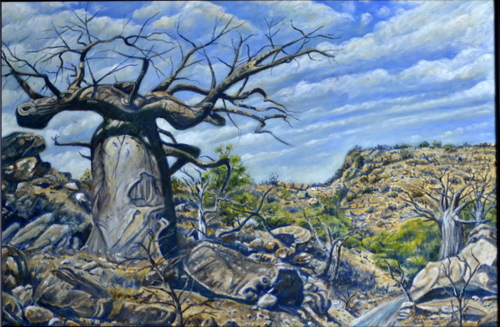
Mapungubwe scene. Painting by author.

There are many tall, beautifu,l trees along the Limpopo as well, but move a few hundred yards inland and they are replaced by miles and miles of scrubby mopani, that accompany you eastwards all the way to Pafuri and beyond.

But the Kruger, the rest of Limpopo province and Mpumalanga, where I also often go, are a story in themselves, a tale for another time…

Sentenced to no more travel for the duration, it often feels those journeys were undertaken by someone else; or perhaps it is my life in some parallel universe. Longing for beautiful scenery (not that there is anything wrong with the view from my balcony) but unable to take a holiday because of Covid-19, I am forced to do the next best thing. I delve in to my collection of travel books.

I gain a lot of comfort from them. The older I get, the more it occurs to me that I am not going to to be around forever. I no longer have the time to visit a fraction of the places on my bucket list. This is my way of short-circuiting that. Reading about other peoples travels and adventures, is a fun way to live vicariously through them by snooping on journeys you are probably never going to be able to make.

Plus it is a lot cheaper and you don’t have to worry about leaving any carbon footprint…

Reflections in the Mist

I am a bushveld addict.

Having grown up and lived in it for most of my youth it is where I always felt most settled and where my heart belonged. No other environment has affected me the way it did nor created the same feeling of mystical bond. Recalling that early period of my life never fails to excite the deepest nostalgia.

It is the romantic in me, I guess.

The true bushveld has a spirit, ancient and impassive. It is a spirit which lives on; I know it, I feel it. It lives on despite the ripple of human effects. It lives on despite our attempts to tame and domesticate it. It lives on despite our plans to commercialise and exploit it and turn it to profit. It lives on despite the encroachment of farms and cities…

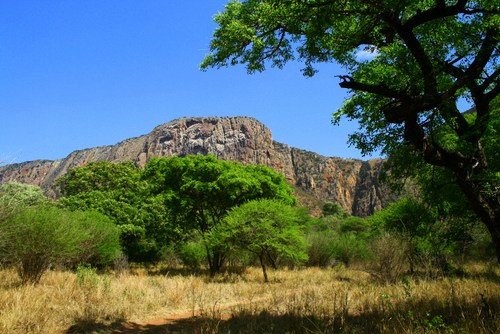
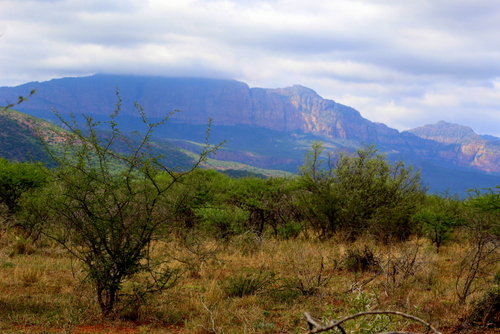
Typical bushveld country, South Kruger.

Even when I am not in it, I can still imagine it: the dust, the heat, the dryness. It is a place of extremes. In the bushveld the sun is brighter, the full moon seems bigger than anywhere else.

Its summer storms are a wonder to behold. The high, piled, whipped cream clouds. The gradual darkening to an intense blue. The sudden ragged bolts of lightning.

And then the rain drumming down and getting soaked up by the parched ground. There is no smell on earth quite like the liberated scents of dust, grass and vegetation released after the first bushveld storm of the season.

Summer storm in the bushveld.

Immediately you feel a new energy, a new hope. A quickening of the blood. A rising excitement.

Everything suddenly seems to come alive. The buck start leaping and cavorting, the birds become a flutter of activity, twittering and chirping in the trees.

In next to no time the grass starts sending up new green shoots, the trees break out in bud.

And such trees! What can be more African then the Baobabs, Kiaats, Mopani, Leadwood, Tamboti, Marula, Jackalberry, Nyala trees, Sausage trees, Acacias, Bushwillow, Silver Cluster-leaf, Sycamore Figs and all the other, seemingly infinite, variety trees you associate with it.

These feelings did not diminish when I moved from Zimbabwe to South Africa. Although I elected to live far from the bushveld, in Pietermaritzburg, in KwaZulu-Natal, my heart still lay to the North. On my birding trips you would invariably find me heading up towards the crocodile-infested, fever tree-lined, pans of Ndumo, the broken, granite country around the Crocodile River in Mpumalanga, the enormous sun-drenched plains of Kruger, the red cliffs of Mapungubwe and the mopani-covered Limpopo Valley.

When I wanted to get even further away there was the Matobo Hills, Kariba, Mana Pools, Mangwe and Gona-re-Zhou in Zimbabwe, on the other side of the border.

My kind of country: Gona-re-Zhou, Zimbabwe.

Although I had done the KwaZulu-Natal Midlands Meander many times, I had never really thought about living there. For me it was just a green, pretty, tranquil, place to escape to when I needed a break from the bedlam and noisy confusion of city life. I liked sticking my nose in to its arts studios. I liked sampling the fare at its numerous food outlets, pubs and restaurants. I enjoyed soaking up the slightly bucolic, Surrey-in-Africa, atmosphere.

That all changed when my friends, William and Karen, bought Kusane Farm in the Curry’s Post area, on a hill overlooking the Karkloof Valley, and asked me if I would like to come and live on it.

Having reached an age where I felt my life needed a change of direction I duly motored up to check it out.

Like William and Karen I loved Kusane from first sight. Staring over the valley below I just stopped and whispered “Oh boy!” softly to myself.
It had just rained and everything about the day was lovely. The pleasing tidiness of the fields below. The tree-clad slopes of the Karkloof Hills stretching along the one side of it and, near the centre of valley, the oddly leonine shape of Loskop hill thrusting itself out of the earth. The Kusane river – from which the farm took its name – passing through a belt of trees and then snaking its way in a series of bends across the wide plain towards the edge of an escarpment.

View over Karkloof Valley after rain.

There was a freshness in the air, an exhilarating quality to the light. The grass underfoot was soft and green and moist with life.

It was clear I had found a place set apart; one which also had its own special isolation of spirit. Relocating to it became, in its own paradoxical way, a kind of homecoming.

I was surprised by my reaction because anything less like my beloved bushveld in Southern Africa would be hard to find.

Curry’s Post is mostly mist-belt grassland with pockets of remnant indigenous forest (or at least it was until the timber companies discovered its potential and despoiled the countryside by planting miles and miles of sterile fir trees).

In summer the mist comes drifting in most evenings, reducing visibility and creating as slightly unreal radiance as it gets hit by the dying embers of the sun.

Unreal radiance: Karkloof Valley.

As the winter cold fronts move through they often bring mist too. From my upstairs balcony I watch it with curiosity as it rolls closer, like a grey wave, until it suddenly enfolds me in a blanket of cold damp.

It is strangely disorienting but also oddly comforting, even as it obliterates all the familiar visual landmarks that surround me and provide me with a frame of reference.

In the end, I did not have to consult any crystal-gazers or soothsayers of some kind to find out why I so quickly fell under its spell. It was my sister, Penny (who is, admittedly, a soothsayer of sorts), who pointed out the obvious.

“It is wired in to your DNA,” she explained.

Originally of Viking descent, my Scottish ancestors, the Moodies, had dwelt for centuries among the heather and bleak, rain-swept hills of the Isle of Hoy on the Orkney Islands. Another branch came from Ireland, the original ‘Misty Isles’. Such scenes would have been familiar to both. Accustomed to the mist and rain, they, too, would have felt quite at home here.

I have always been very proud of my Norsemen roots although I fear that something must have gone wrong with me because although I may have inherited the complexion and hair, I completely lack the marauding temperament! On the contrary, I am a very friendly, peaceful, law-abiding sort of chap, quite happy to let my neighbours keep what is rightfully theirs.

In this respect, maybe I take after my mother’s side of the family.

I do like to roam though. One of the pleasures of being in the autumn of my years is that I am now a man of (limited) independent means, beholden to no one.

I get to decide when I want to be active and when I want to be passive. Should I dig a hole and plant a tree, or just sit and look at a tree?

Or should I be both active and passive and go for a walk? It on these daily ambles that I get to delight in my new found sense of freedom.

Walking in the mist with Minki and Whisky.

I especially like walking in the mist. Something about the half gloom brings out an ancient instinct, a memory buried deep in the back of my brain. There is a healing magic about such weather, it is very evocative of the mysteries, it induces a feeling of solitude in me. It is like having the whole universe to myself.

The Kusane, after which the farm is named, is a small stream but has a waterfall and pool further up, closer to its source. To get to it you follow the path that runs along the ridge that forms the backbone of the farm. Near its highest point is a bald expanse of rock, Lizard Rock, which on a sunny day offers a clear 360-degree view but that window closes down altogether when the mist drifts in. I often like to pause and sit here, alone with my thoughts.

From the top of the ridge the path zig-zags its way down from the one end of the valley all the way to the other. As it winds along you can hear the river but you cannot see it.

The route down to the Kusane River.

Sometimes, if I am lucky, the vague shape of a reedbuck will emerge out of the dripping greyness. Momentarily startled, we will both stand and stare at each other before it bounds away, out of sight.

Reedbuck in the mist, Kusane Farm.

Other times I will hear the strange whooshing sound of a gaggle of Spurwing geese winging overhead.

Spurwing Geese, Karkloof Valley.

The half light can play tricks with your eyes. Even the rocks can take on the appearance of something living: a crouched lion, a sleeping hippo or some sort of dragon-creature, the fissures on the surface of the stone becoming its hide.

At the path’s lowest point you reach a river crossing near where the old pump-house used to be.

Once I get here, I like to sit on the river bank and listen to the sounds: the conversation between rock and flowing water; the plaintiff call of the Longclaw as it rises high in the air; the thin beleaguered cries of the plovers flying overhead and the wind whispering in the grass.

To the ancient folk such sounds carried meaning. I like to think they still do, it is just that our busy, modern minds have forgotten how to hear.

For some reason our local black crows become more vocal on these grey, overcast days. They, too, speak a language which comes from a remote, mysterious time. Their raucous yet eerie sound-shifts, echoing through the swirling mist, conjures up both the natural and the supernatural, magic and wizardry.

You can understand why they were associated with the dark arts in traditional European folklore.

In Zulu society, too, crows and ravens are seen as an omen of misfortune and death (although in New Mexico, as I discovered, the native Americans believe the exact opposite. They see them as bearers of good tidings).

White-necked Raven.

Crows are also, arguably the world’s smartest bird so perhaps it is a little unfair to cast them in such terms. Maybe our irrational fears and prejudices say more about our own morbid thought patterns and preoccupations than it does those of these maligned and often misunderstood birds?

The Black Cuckoo, a summer visitor to our parts, is another wisp of a figure, barely glimpsed but often heard. His mournful call ‘hoo hooee’ is sometimes rendered as “I am so siiiiick!” With climate change casting its grim spectre over our lives, it is a sound which, for me at least, seems to capture some mystical truth about the state of the natural world.

Sitting in the grey gloom I find myself imagining something else – what if one day there were no birdsong at all? What if, in our hard-nosed materialism and clumsy efforts to dominate the planet, we drove all the other species to the edge of extinction?

I do not think I could live in a world where their beautiful cacophony of sounds exist only in memory.

For me there is an important truth to be acknowledged here. While the misty landscape invariably infuses me with a sense of well-being, this feeling is, at times, tinged with a touch of melancholy. I am only too aware that what I am enjoying offers only a temporary escape from the troubles of the rest of the world, lying just over the hill. Yet, in a strange way, this awareness only sharpens one sense of momentary pleasure. It makes you enjoy it all the more because you realise how transitory it is.

And so, as I continue to totter along the straight, stony, path to old age and beyond I intend to keep glorying in the mist.

KARKLOOF GALLERY:

A Tale of Two Rivers. Part Two – The Limpopo

The Limpopo at Mapungubwe.

My love affair with the Limpopo began relatively late in life.

Although it forms the southern boundary of the country I grew up in, until I moved to South Africa in 1984, my sole acquaintance with the river had been crossing over it at the Beit Bridge border post.

In the back of my mind, though, I always had this strange feeling that it was waiting for me, beckoning me, and that I was duty bound to answer its call.

And so I did.

All rivers have their own personalities and the Limpopo is no exception. In his “Just So” stories, Rudyard Kipling famously characterised it as the “great, grey-green, greasy Limpopo, all set about with fever trees”.

Fever trees at Pafuri, Limpopo.

It is an apt description. There is something rather wild and romantic about the Limpopo; it is both a purveyor of adventure and a river which seems to have its origins in the realms of legend and folk lore.

Even the name sounds made up.

Approximately 1600 kilometres long, it flows in a huge arc after leaving its headwaters in the Krokodil (Crocodile) River in the Witwatersrand. Skirting the edges of the Kalahari it passes through some of the driest, least populated areas in South Africa before making a dog leg in to Mozambique and then disgorging itself in to the ocean near the port town of Xai Xai.

In its own way, it is the embodiment of both the sheer size and the mystery of Africa. The sky above it is huge, the horizon stretches out forever. Travelling towards that horizon you are always conscious of the distance between it and you.

Despite being the second largest river in Africa – next to the Zambezi – that flows in to the Indian Ocean, for a substantial part of the year it contains very little actual water. In dry years its upper reaches flow for 40 days or less.

This can change very rapidly. The one time I visited, a heavy rain storm somewhere up near its source had seduced the river in to breaking loose. Standing on the bank the raging torrent whooshed past us, the colour of caramel, swirling around rocks and eddying over tree roots.

It was a brute demonstration that the Limpopo was not to be messed with when aroused. The next day it had dwindled back to almost nothing…

For my first foray up to the drier western section of the river, I arranged to stay at Ratho, a large agricultural estate, just upstream from the Pontdrift Border Post with Botswana, which has camping facilities on its banks.

To get there you travel north from Jo’burg on the N1, branching off at Polokwane and heading towards Vivo. Beyond this tiny settlement, the road runs through open, rather lonely country. About 100 kilometres further on you reach the oddly named Alldays, a straggling, dusty town only a few streets deep from front to back.

Here you veer left.

As the horribly pot-holed road drops down to the border post at Pontdrift, a change suddenly takes place: at this point of its long journey to the sea, the Limpopo opens in to an immense valley hemmed in by sandstone cliffs, mesas and buttes that glow as if they were red hot. In places they have been honeycombed by erosion and blackened by fires. Out of the sides of the cliffs and the rocky outcrops grow fig trees with long, trailing, ghost-white roots. These are Large-leaved Rock Figs or Ficus abutilifolia.

There is something both wonderful and tantalising about this strange, eroded scenery.

The road to Ratho.

There was no water flowing in the river when we arrived at Ratho although, on our walk the next day, we did find a long, rather greasy-looking pool further upstream, concealed in a grove of tall, thorn trees. There was something a little scarifying about this shadowy section of the river.

I found myself wondering what dangers lurked beneath its placid surface. It looked like the sort of place where an elephant could have easily got his trunk, courtesy of an enormous crocodile.

There was plenty of evidence of elephant being about as well, which also made me a bit nervous…

Back in camp, dangerously untroubled by doubts, my birding colleague decided to take advantage of this absence of a liquid barrier in front of us and sallied forth across the dry river bed, disappearing in to foreign territory. More circumspect by nature, I declined to join him.

In the end I was rather glad he didn’t get trampled on by an elephant or eaten by a lion or carted off in irons because if he hadn’t made it back safely he would not have been able to find me the elusive Pel’s Fishing Owl, that evening. We heard it before we saw it, a strange, pig-like grunt which was then followed by a deep, booming ‘hoo-huuuum‘. Grabbing his binoculars and powerful spotlight my birding colleague eventually located it sitting in a tall thorn tree.

It was a bird I had long wanted to tick off my “Lifer” list. What made it all the more exciting was that we hadn’t needed a guide to find it for us which is usually the case with this bird, which Roberts describes as: “Vulnerable… largely confined to to protected areas, threatened by disturbance…” We were also lucky to find it because we were on the western-most extreme of its range.

From Ratho, we returned to the main tar road and then struck eastwards towards one of South Africa’s most important Stone Age archaeological sites – Mapungubwe.

I have a tenuous family link with this area. Somewhere between Pontdrift and Mapugubwe a bunch of my ancestors forded the Limpopo on the 1892 Moodie Trek to Gazaland. In the diary she kept of the journey, my great-grandmother, Sarah Susannah Nesbitt, describes the river as being “very rough and stormy” and says they crossed at a point called “Selika’s Wegdraii” (this could possibly be the old crossing which is today known as “Rhodes’ Drift”).

Every night they heard lion, sometimes close by, sometimes further off across the river. The sound sent chills through my great-grandmother because she had her two infant daughters (who included my grandmother, Josephine) with her and was worried for their safety as they lay there in their wagon.

This was not their only concern. Having crossed the river the trek-party found themselves faced with another problem when they got delayed at Macloutsie, in Bechuanand (now Botswana), by an outbreak of foot and mouth disease with many of their animals becoming so weak they fell easy prey to hyena.

Travel was a lot more difficult in those days.

Mapungubwe is one of those places I find myself drawn to like a pin to a magnet. Once a thriving city and important trade centre with links as far afield as China, India and Egypt, it was abandoned in the 14th Century for reasons largely unknown.


There is still a rather eerie feel to it. This is a place of secrets and questions…

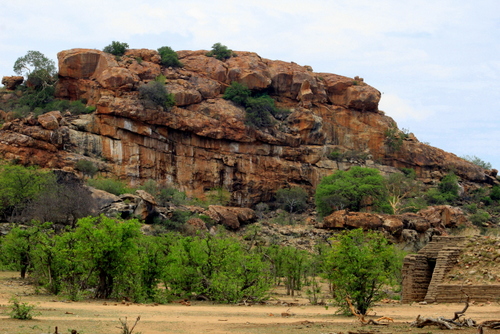
Mapungubwe. A strangely puckered landscape…

Driving through its strangely puckered landscape, I found myself wondering why its original inhabitants had chosen to settle here. It seemed to me this wasn’t a country to live in at all with the heat and the desolation but – who know? – maybe the climate was different back then?

It is good country for birds, however, including yet more varieties of owl. At night you can regularly hear Wood Owl, Pearl-spotted Owl and African Scops Owl. Pel’s occurs here too although I haven’t seen it.

On the one occasion, driving out from camp, just before dark, we hadn’t got very far when we spotted a Giant Eagle Owl squatting on the ground, next to an old termite mound. It was so close I felt I could lean out and touch it. Perhaps suspecting I might actually attempt something so impertinent the huge bird suddenly rose in the air and flapped off to a nearby tree.

Giant Eagle-Owl, Mapungubwe.

In the half light of the forest it sat and regarded us from this perch. Relaxed, enormous, extraordinary with formidable talons, curved black beak, deep, luminous, saucer- like eyes and finely barred grey overalls it seemed quite unconcerned by our presence.

Every now and again it would blink at us, like a camera shutter going off, and tilt its head sideways as if trying to get a better angle to observe us from. Or maybe it was just sizing up my birding colleague as a potential meal.

It was difficult to tell.

Watching it, I could not help but reflect on what a marvellously well adapted creature it was. Shaped by millions of years of evolution everything about it is tuned to hunt and kill at night. In the dark it can see with precision things which for you and I are just a generalised blur.

Perhaps because it is such harsh and difficult country, the park is always a scene of restless, unremitting activity devoted to the purpose of staying alive. There is always something to see.

The Maroutswa Pan in the Western section of the Park is usually well worth a visit as there are invariably herds of animals and flocks of birds coming down to drink, especially in the dry season.

One of my special memories of the pan, is returning at dusk as the sun was touching the leaves of the tall Lala palms in the rectangular-shaped clearing nearby and golden sheets of silken light came pouring down. It was an extraordinarily beautiful scene.

Lala Palms. Western section, Mapungubwe.

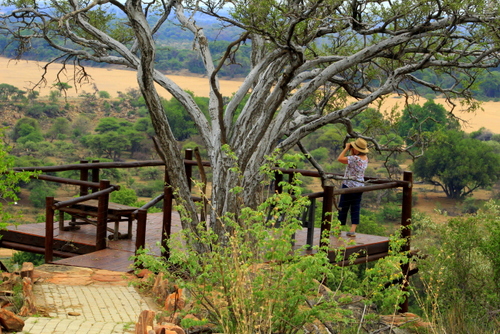
The Eastern section is more broken country but is also full of scurrying, browsing and fluttering life. From a raised walkway that leads through the canopy you can view the river in both directions. There are usually elephant here. It is also a good place to get Meyer’s Parrot and Broad-billed Roller too.

A kilometre or so downstream from here there is hill top view point which once served as an old SANDF army base during Apartheid day because of the immense view it gave over the surrounding bush.

It has become a place of pilgrimage for me. It is here, at the confluence of the Shashe and Limpopo rivers, that the borders of the three countries – Zimbabwe, Botswana and South Africa – that have played such a pivotal role in shaping my life converge.

Confluence of Shashe and Limpopo rivers.

It is difficult to exaggerate the wild, romantic beauty of this spot with its great baobabs and fig trees growing out of a chaos of rocks. Standing on the edge of the cliff face I sometimes feel like I have been magicked into some parallel world. This is the ancient Africa of myth which the old writers and cartographers had heard about but weren’t too certain how to depict in their books and their maps.

Mapungubwe. Limpopo in mid-ground.

From Mapungubwe the Limpopo continues its long, leisurely loop along the border with Zimbabwe before crossing in to Mozambique at Pafuri. When I do this route I normally stop off at the town Musina to stock up with provisions.

The quickest way to get from Musina to Pafuri is probably to take the tar road that goes via the hot springs at Tschipise – but by using this route you miss out on seeing the Limpopo so we usually go on the old SANDF dirt road that runs alongside where the old minefield once was. In the past we have seen taxis parked here, picking up the Zimbabwean refugees fleeing across the river.

The Limpopo, east of Musina. View from old SANDF dirt road.

The road is in fairly good condition although, on the one trip, my birding colleague did manage to crack his car’s sump. Somehow we managed to get back to the tar and then limp all the to Tschipise without the engine seizing. At the local garage we gummed up the leak with soap and topped up the oil. That got us back to Musina where we were obliged to stay over while it got repaired.

Musina is an armpit of a place and not somewhere I would normally choose to stop for a night’s sleep on account of its perspiring proximity to the Limpopo river. It is definitely not the sort of town you want to get stuck in for any length of time especially in summer.

Apparently not everyone agrees with me. The copper mine which provided it with its reason for being might have closed but it is still a bustling, clamorous hub full of all the usual transients who ebb and flow around border towns – in this case mostly Zimbabweans come down to shop or escape that country’s collapsing economy and hoping to find employment in South Africa (the bush mechanic who fixed our car was one such refugee).

We checked in to a hotel on the main road. Towering cumulonimbus clouds were massing all around us and it looked like we were about to be inundated as fractious gusts of rain kept splattering against the windows of my room. The storm surge held back, however, as if it had had a sudden rethink, and then veered off to the West.

It had been a long day. Neither the sweltering heat, the music from the nearby bar nor the constant rumbling of trucks along the Great North Road, could disturb me. I fell instantly asleep.

Next morning, the car repaired, we resumed our journey along the Limpopo to Kruger.

Covering a huge swathe of the country Kruger is undoubtedly South Africa’s best known and most visited game park. Although most people are attracted by its animals – which includes the Big Five – it is also a Mecca for birders with over 500 recoded species.

One of the most popular of its birding spots, Pafuri, benefits from its proximity to the Mocambique coast and the Limpopo river that acts as a migration corridor to birds normally found further east and north. It was here, that I obtained my first sighting of the elusive Bohm’s Spinetail, a localised and uncommon species that favours riparian forest and is usually linked to baobab trees which this area has in abundance.

It is also where I saw my first Ayres Hawk Eagle, perched in a massive Jackalberry tree alongside the Luvuvhu River.

To get to Crooks Corner, another place I get a little sentimental about because it demarcates the meeting point of South Africa, Zimbabwe and Mozambique, you drive along the muddy Luvuvhu River, a tributary of the Limpopo. In the foreground the riverbank rises two to three metres and is capped by a flat plain whose edges are packed dense with tall Nyala, Jackalberry, Ana and Fever trees. Behind them, stretching away forever lies a sea of Mopani trees.

Luvuvhu river from bridge. Elephant below

I like to stop for lunch at the picnic site on the Luvuvhu where the sunlight is subdued and dappled by the trees, and the place is alive with birds.

Crook’s Corner – which is where the Luvuvhu (strangely enough I have never seen this river without water) and Limpopo meet – is another spot where it would be quite easy to slip across the border by just strolling over the often dry, river. In fact, this is how it actually got its odd moniker – because in the early days fugitives from the law used to do just that.

Here is another odd fact about it: in July 1950 a Zambezi Shark (Carcharinus lucas) was caught at the confluence of the Luvuvhu and Limpopo, hundreds of miles from the sea. Why it had decided to swim so far inland is a mystery.

Maybe, like me, it just responded to the river’s call…

More Paintings of Baobabs

In case you haven’t noticed I have a thing about baobabs.

Here are a few reasons why: I am awed by their size and the way they dominate the surrounding countryside and tower above all the other trees. I love the drama – all those tentacle-like branches spreading out laterally, as if they want to pluck passing birds from the sky.

I admire their tenacity, the fact that they thrive in the most harsh and arid of conditions. I am impressed by the huge age they can reach.

There is something very ancient and wise and holy about them. They seem to speak of the Old Way. They stir the spirit and the eye.

Baobabs are also very much part of my inheritance. Although some people might be surprised to hear this– the ones who associate Nyanga with mountains and bracing cool weather and therefore no baobabs – our old family farm, Nyangui, in Nyanga North, was littered with them.

Baobab with Nyangui mountain in backgound. Picture courtesy of Patrick Stidolph.

You passed by a whole grove when you drove through the farm gate. There were baobabs on the top of koppies and among the ancient ruins and there were baobabs growing in the middle of the old lands. My brother, Paul, sited his house next to one.

There was a baobab, across the river, which my brother, Pete, and I carved our initials in to when we were still schoolboys – hoping that, in centuries to come, some explorer would stumble upon them and wonder who we were? It was a wasted stab at immortality. When I went back to the old farm, many years later, the baobab had collapsed and died.

Since then, baobabs have continued to act as signposts in my life. One of my favourite stopping places in Zimbabwe is the lay-by you come to as you descend the Zambezi escarpment from Makuti to Chirundu (and Mana Pools). It has become a little ritual of mine – alas, not one I have done for years – to always pull over here and have a beer.

View over Zambezi Valley

From this perfect vantage point you have a magnificent view over the valley floor, stretching in to the blueness of distance with the hills of Zambia simmering in the heat haze on the horizon. In the mid-ground you can glimpse the glittering blue waters of the great river, snaking its way eastwards towards the Indian Ocean.

And no matter in which direction you gaze you will see baobabs poking up above the sunken contours of the far-reaching landscape.

As you continue driving down the escarpment, the heat comes up to meet you. You can smell it as well as feel it: a dry, punching, smell of dust and jessie bush and mopani leaves and elephant dung. And baobabs.

Makuti to Chirundu road with Zambezi escarpment in background.

Even now, thousands of kilometres away, sitting on top of my hill in the Karkloof, I still get misty-eyed when I recall that view.

Moving to South Africa I was able to renew my love affair with baobabs when I started going on my birding trips to the Limpopo valley.

North Kruger was where I first rekindled the romance. As you drive down from Punda Maria towards Pafuri, the terrain begins to break up in to a series of steep sided ridges which a have a tumbled, frenzied look, as if somebody had stirred them up in a giant pot and then left the contents to dry out under the baking sun. And dotted all over them are baobabs.

Undoubtedly, the most famous of these is the one that sits on top of Baobab Hill. This iconic tree served as a landmark on the early trade routes going through the area. Pioneer hunters used it as part of the famous “Ivory Trail” (some of them leaving their names carved on the tree). Between 1919 and 1927 it became the first overnight stopover for black workers recruited from Mozambique to work on the gold mines of the Witwatersrand.

Baobab Hill, Kruger National Park.

Mapungubwe, another preferred haunt of mine, has its fair share of baobabs too. Like old, petrified giants, they seems to anchor an immense sea of plain and bush and broken red koppies that falls away to the Limpopo river.

It is almost like a homecoming to be driving among them.

Mapungubwe.

My paintings, then, are my way of attempting to pay tribute to and glorify these most monumental of trees. I want them to be a celebration of the baobabs heroic scale.

Obviously I take certain artistic liberties. I often tweak them a bit, highlighting and simplifying features. Sometimes I move the baobabs position in the landscape, bringing them closer to, say, a hill I fancy to create a better sense of balance. I lob off odd branches so my canvas doesn’t look too cluttered or become mired in detail. I play around with light and colour in the hope of capturing a particular moment or mood.

I try and encapsulate the loneliness, the wildness and the spirit of the primeval world in which they have existed since time began, a world in which man is still very much the intruder.

In doing this, I know I can never pay full justice to these magnificent trees although I hope I do manage to convey something of my admiration and my awe.

Disdainful in their own majesty, serene in the mellow certainty that comes to the very old they are the very symbol and essence of a remote, half-mythical strangeness.

Mapungubwe: Where History meets Nature

History and nature come together and harmonise in Mapungubwe. A land of fierce but tantalising beauty, situated on our northern border, it now lies near empty although this was not always so. It was here, during the tenth and twelfth centuries, that an important, early Southern African kingdom came in to being as a major centre of power and then, for reasons which are still not absolutely clear, collapsed.

The main Mapungubwe settlement was built around the base of a steep-sided sandstone hill that arises abruptly from the valley floor. At its summit, various burial mounds and the remnants of old houses have been found. It was here that the nobility lived and it was here, too, where South Africa’s most famous archaeological artefact – a gold-plated rhino – was found.

The modern park, in which it lies, was inscribed as a UNESCO World Heritage Site on the 5th July, 2003. The National Park bearing its name was officially opened, amidst much fanfare, in September, 2004.

The Park is divided in to a Western and Eastern section which are separated by the Den Staat farm.

The Western section is mostly flat and forms part of the Limpopo flood plain. Along the river is a thin, deep green, jumble of riparian forest, which gradually thins out as it gives way to thornveld and then miles upon miles of mopane scrub that somehow manages to survive despite the complete absence of anything resembling real top soil.

The Eastern section is more broken country. Here nature has created its own unique architecture, one that is dominated largely by rock.

Rock, red earth and river – Eastern section Mapungubwe.

The Mazhou camping-site, which is one of my favourites in South Africa, is situated in the Western section. Positioned close to the Limpopo, it is well thicketed with enormous Nyala Berry and Apple Leaf Trees which interlock overhead to provide some relief from the worst of the sun.

It was here I found myself sitting, sipping wine, one glorious, crystalline, summer’s night. Somewhere out there, beyond the horizon, was a half-remembered world of big cities and busy highways but I found it very difficult to bring it back in to focus.

The sky was heavy with stars. Amongst them was one which caught our eye because it was much bigger and brighter than the rest and was moving slowly across the heavens. We decided this must be the International Space Station.

For a few paranoid moments I wondered if it had had been sent to spy on us and tried to recall if I had done anything to warrant such scrutiny (although, given his reputation, it was much more likely it was keeping its beady eye firmly fixed on my birding partner, Ken).

Natal Spurfowl, Mazhou camping site

The next morning I crawled out my sleeping bag to find a family of Natal Spurfowl pecking in the dirt outside my tent. They were joined, a little later by some noisy blue-black Meves’s Starlings and a curious Crested Barbet. In the branches above us a pair of striking blue Woodland Kingfishers stirred.

Woodland Kingfisher

Because it was such a glorious day, we decided to head in to the more heavily forested Western section first. We had barely got on to the stretch of road that runs along the Limpopo when a whole convoy of 4 X 4s came roaring up our rear. Their vehicles were fitted with metal spades and spare jerrycans of petrol, spotlights and winches. Driving the front one was a barrel-chested guy in a camouflage T-Shirt with sunglasses and a baseball cap pulled low over his eyes. The other men all sported similar going-on-safari mufti, while the women folk looked like they were headed off to audition for bit parts in the next Tarzan remake.

These were Very Serious Explorers.

In less trying circumstances – like when we were not attempting to birdwatch – I would have found them fascinating. Now they were just plain annoying because we had to pull over and let them pass and then watch them go clattering down the track, with their TVs, micro-waves, ice-dispensers, up-to-the-minute navigational aids and all the other modern conveniences and gizmos that seem to be required these days before you can go Roughing it in the Bush – scaring away all the rare birds we had been hoping to see.

Such distractions aside, this is usually a good place to get up close and personal with White-backed Vultures who, unlike their cliff-dwelling Cape relatives, like to nest in the tall trees that grow along the river. Through gaps in the canopy we kept getting glimpses of these magnificent birds, circling overhead. When the sun caught them their back feathers flashed a brilliant white.

Lala Palms, Western section of Mapungubwe

We continued driving through this rich mantle of trees before emerging in to a clearish, flat stretch, on the one side of which ran a line of tall Lala Palms. It was here, under a clump of thorn, I had got a lifer on my last trip – a Three-banded Courser, an uncommon, largely nocturnal bird, very much confined to the Northern parts of South Africa.

A bit further down this road is the Maroutswa Pan which is usually an excellent birding spot, especially for water birds (on our last trip we saw a Honey Buzzard here as well). Despite all the evidence of recent good rain there was very little water in the pan itself.

Common Sandpiper, Maroutswa Pan.

We, nevertheless, lucked out and got another rarity – a Green Sandpiper – or at least Ken, who has seen one before, was convinced that was what it was. I, as usual, was confused. The bird looked like a cross between a Wood and Common Sandpiper. I was still mulling over the true identity of this mystery bird when a real Wood Sandpiper turned up and helped solve the puzzle.

Wood Sandpiper, Maroutswa Pan.

My elation at being able to add another lifer to my list turned to anger when we got back to camp, later that afternoon, and I found the resident monkey gang – hardened criminals every one – had, for good measure, punched a few more holes in to my tent. What added to my irritation was that once again I had no food inside and I had used up all Ken’s duct tape patching up the holes the baboons had ripped in it in Kruger a few days before!

That night, curled up in my sleeping bag, I heard lion. They sounded like they were only a kilometre or so downstream, although Ken was convinced they were across the river, deep inside Botswana.

Another scorcher was forecast when we set off to explore the Eastern section the next day. Passing through the main gate, the road curved left towards the edge of the park and then dropped down through a rocky bluff. All around was evidence of nature’s erosive powers at work: cliffs undercut, niches hollowed out, old river courses altered. In places the rock was fissured and rotten, large chunks of it sliced away like a cake, revealing the layers buried underneath.

Elephant crossing, Limpopo

At the point where the road swings right along the Limpopo they have constructed a raised wooden walkway which takes you, at bird’s eye level, through the leafy tree tops and provides excellent views. The river at this point is fat, sluggish and wide but as this was the dry season, it was not quite so wide or deep as it is during the rains.

Elephant, Limpopo

Along the foreshore ambled a family of elephant. Perhaps because there are no immigration formalities required, they like to use this spot to ford the river between South Africa and Botswana. Later we were to see some Zimbabwe fishermen doing the same thing further down the river.

We stopped for brunch at the view point on top of a hill which once served as an SANDF army base and observation point. It is here, at the confluence of the Shashe and Limpopo that the three countries that have played such a pivotal role in my life – South Africa, Zimbabwe and Botswana – meet.

Confluence of Limpopo and Shashe

It was almost like a homecoming to be standing on top of that promontory looking over that vast, shimmering, seemingly uninhabited, landscape. I felt almost totally isolated from the outside world.

The whole place gave off an aura of romance. I felt like I had been magicked back in time. This was the ancient Africa of myth, which the old cartographers had heard about but weren’t too sure how to depict in their books or their maps.

For all its harsh beauty and important cultural links with the past, Mapungubwe is, however, a park with problems. That this is so became apparent when we set off down the road that leads from the viewpoint to Poachers’ Corner.

As we rounded the bend that takes you in to this wonderfully scenic part of the river, we found ourselves encircled by a vast herd of cattle. They had obviously crossed over the Limpopo from Zimbabwe. There must have been several hundred of them, their bells tinkling merrily as they wandered around munching the grass or masticating nonchalantly like they had every right in the world to be here, in what is supposed to be South Africa’s showcase park.

As an undoubted consequence of this we did not see a single wild animal in this section other than a few bored-looking baboon chewing on some roots they had just dug up. All the kudu and nyala and other game that had been here on our previous visits had, presumably, been forced to move up in to the more arid parts of the park.

If the monkeys were not bothersome enough this only added to my annoyance. Having travelled a considerable distance, at big expense (to say nothing of close shaves with elephants and being forced to listen to Emily, Ken’s Satnav – a merciless pedant if ever there was one – continuously telling us we were on the wrong road) to get here, both Ken and I felt we were entitled to demand a refund because we reckoned we hadn’t gone to all this trouble just to finish up looking at a bunch of cows.

I can do that from my bedroom window at home.

In the end, we thought better of it and just reported our concerns to the camp manager. He admitted it was an ongoing problem but said the matter was politically sensitive since it involved citizens from another country and had to be handled diplomatically. To me it sounded like the sort of soft-soap, fudging-of-the-issue, claptrap PR people use to calm down folk, like us, who had got worked up in to a state. I can’t say I drove out of the park gate feeling more sanguine about the matter or thinking they had a clear-cut plan in place to deal with the problem.

You never know though. I was wrong about the Green Sandpiper so maybe I have allowed myself to over-think this too…

And I still love Mapungubwe – although I am not sure these feelings extend to those primates who keep trashing my tents…