Travels Back: The Lure of the Frontier

Although its importance has long since declined, the “Great North Road” was, in its time, one of South Africa’s most famous roads and considered of great strategic value, in spite of the fact it passed through some of the harshest, driest, least populated parts of the country. Skirting, for much of its length, the north-western border of the country, it was the original highway into the interior and favoured by many of the early traders, hunters, transport riders and missionaries. The significance of the road was not lost on the politicians either. The conniving arch-imperialist Cecil John Rhodes saw it as the key to British expansionism, and the opening up of the African continent. As part of his plan to outflank and contain the Boers (as well as ward off the threat posed by the Portuguese in the East and the Germans in the West), he sent his ‘Pioneer Column’ up it to annexe all the land north of the Limpopo.

Adding to its allure for me was the fact my ancestors also toiled up it in their ox-wagons, in 1892, as part of what became known as the Moodie Trek (see Travels Back: Trekking with the Moodies). Having received the blessing of Rhodes, they had set out with high hopes for their promised land but within a year of attaining it, their leader was dead. Unable to carve out a life there, many of the others drifted on.

A rebel group, who, on reaching Fort Victoria, had elected to continue on to Salisbury in the north rather than struggle on to their original destination – Gazaland in the east -, fared slightly better, in many cases finding a more permanent base to operate from.

After the demands and travails of their journey it must have felt good to be able to put down roots although, having only been established a few years earlier with the arrival of the Pioneer Column, Fort Salisbury was still barely a town. A few robust iron and wood structures, as well as mud-brick houses, had sprung up alongside the tents and grass-thatched, pole ‘n daga huts of the original settlement. It still had a frontier feel, a hint of the American Wild West with its wagons, stagecoaches, noisy bars and men on horseback with guns.

Stagecoach (Pic: Stidolph family collection)

Determined to establish their place in the sun, my ancestors wasted little time. Within months, another thatched hut had been added to all the others – a photograph from the time dutifully records it as “Moodies First House in Salisbury”. From an architectural standpoint, it wouldn’t have won any design awards but judging by their self-confident, languorous poses its occupants were pleased enough. It was a start. Wanting a place he could call his own my great-grandfather John Warren Nesbitt lit upon a happy patch of fertile agricultural land in the Mazoe Valley, just north of Salisbury – an area which would play a small part in my family annals as we shall see. Unfortunately, it was here the sins of his past caught up with him for he was told by the BSA Company that he could not register it because he had broken the terms he had agreed to when he signed up for the Moodie Trek. Undeterred he would go on to acquire two other farms, one in Goromonzi and one in Nyanga, both of which he duly named after himself (Warrendale)

Moodie’s first house in Salisbury.

Not too surprisingly, this willy-nilly parcelling out of land among the white settlers, at the expense of the local tribes, caused a certain amount of resentment and bitterness, as well as a desire to shake off the yoke of the invaders. In 1896, the Ndebele, who had occupied much of what came to be known as Matabeleland, launched the first sustained campaign against a colonial authority anywhere in Africa. Although a warlike people (they had conducted periodic raids into Shona country) with numbers on their side, they had no answer to the British Maxim Machine Gun and the revolt was eventually crushed. The settlers who had helped suppress it were rewarded with yet more land.

Salisbury laager. Note Maxim gun.

In Mashonaland, the white community was caught napping a little later on when – encouraged by the failure of the Jameson Raid in South Africa – the supposedly more docile, downtrodden Shona also rose up in a similar rebellion. My great-grandmother Marjorie Coleman and her two grand-daughters Josephine ( better known as Josie – my father’s mother) and Nora were to get a foretaste of what was to come when they narrowly escaped being killed as they were returning from Umtali to Salisbury and found themselves surrounded by an armed horde. Fortunately for them, the order to kill all white people would only come a few hours later and they were allowed to continue on unmolested.

In the short but bloody conflict which ensued another relative, Randolph Cosby Nesbitt – the brother of John Warren and uncle of my father – would distinguish himself as one of the heroes of the beleaguered white community holed up behind their defensive laager in Salisbury.

A captain in the Mashonaland Mounted Police during the rebellion, he led a patrol consisting of only 13 men to rescue a group of miners who had been surrounded by over a thousand rebels, armed with an assortment of Lee- Metfords, Martini-Henrys and old muzzle loaders, at the Alice Gold Mine in the Mazoe valley. J.W.Salthouse, the manager of the mine, had had the good sense to fit out a wagonette with bulletproof iron sheets to give protection to the women and one sick man. Riding alongside this, Randolph and his men succeeded in getting the beleaguered party – which included three women – back to Salisbury, some 27 miles away, despite coming under particularly heavy fire as they fought their way through the long grass and well wooded, hilly country that bordered the Tatagura river, on the side of which the road ran. Considering how outnumbered they were, their casualties were surprisingly light, with only three of the small rescue party being killed and five wounded. The arrival of the exhausted little group back at the Salisbury laager was greeted with gasps of astonishment as everybody had given them up as dead.

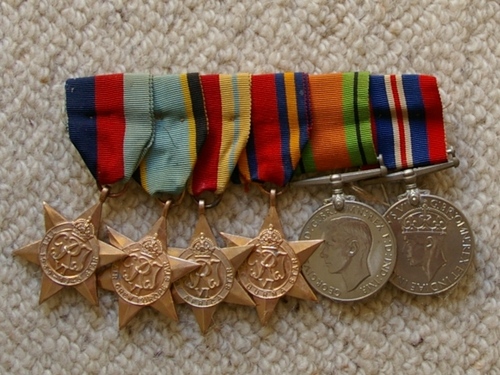
For his actions Randolph was awarded the Victoria Cross (see picture below), the first Rhodesian to receive Britain’s highest award for gallantry and combat. As a national hero, his medal used to be housed in the National Museum in Salisbury. The famous episode also became the subject of a popular book – Remember Mazoe by Geoffrey Bond.

There exists a snapshot of Randolph in officer’s regalia posing outside the old BSAP Mess in Nyanga, the same area where we would, much later, buy our own farm. Backdropped by a high mountain and a house that looks like it was built by elves, it is a study in contrasts and, somehow, captures an era.

With his snowy hair, military dress, spread-eagled legs and a mouth masked by a large moustache, he looks every inch an imperial officer. Handsome with something of a sportsman’s build, he comes over as a man who cannot imagine failure and who is clearly accustomed to being in a position of authority, command and living a life of discipline and order. From every pore, he projects purpose and certainty. Tough, resourceful and obviously used to leading from the front, one can easily imagine him remaining calm and collected in the face of overwhelming odds.

Sitting beside him, the loyal, supportive, spouse, his wife cuts a more demure, feminine figure although, in her own way, she, too, exudes an air of quiet competence. Calm, steady-eyed, in her sun hat and long dress, one can easily imagine her organising tea parties or quietly setting out to recreate the comforts and dignities of the Victorian upper-middle class in the depths of the African bush.

Standing behind them are two, uniformed black servants. They are staring dutifully at the camera but with looks, one can’t quite interpret. Whatever they are thinking, they are not letting on

In the light of history, there is a slightly surreal quality to the picture. Little could that imposing couple have foreseen or foretold that within eighty years their secure, timeless, confident world would be gone; the era of their mastery would be over, the colonial order they represented would be dismembered, their monopoly of political power lost or that White Rhodesia would have been swept away.

Within nationalist historiography, the African resistance of 1896-7 became popularly known as the First Chimurenga War and provided both an inspiration and a dress rehearsal for what was to come. Seventy years later the country would once again find itself facing an armed uprising as the ZANLA and ZIPRA forces led by Robert Mugabe and Joshua Nkomo clashed with the Rhodesian security forces of Ian Smith. This time around, the Shona – who would go on to become the dominant political group in an independent Zimbabwe – were better prepared and better equipped. They ensured they had plenty of weapons, something the Soviets, who were then involved in some Empire-building of their own, were only too happy to supply. Once they had replaced the white government they turned their attention to their former foe, the Ndebele, settling a few old scores with the help of some instructors from North Korea.

Largely ignorant of (or perhaps just indifferent to) the cataclysm of social change their arrival had unleashed on the local tribes and happily oblivious of what lay ahead, the whites carried on creating new urban centres and taming the land. Not without reason, they were immensely proud of what they were able to achieve in so short a period of time. The tribes who had been ejected from the more fertile, productive land, however, probably saw it through more jaundiced eyes. When her husband died, Marjorie Coleman opened the first boarding house in Salisbury which, although on a small two-room structure, was evidently able to accommodate 32 boarders at a time. Ironically my grandmother’s sister Nora, who achieved the rare distinction of living in the country longer than any other white, would survive to see both the first and second Chimurenga wars and the rapid dismantling of all of Rhodes’s dreams for the country.

Although Nora would live on to become the grand old lady of Rhodesia, her sister, Josephine, having given birth to four children, including my father, would die, while she was in confinement with her fifth, Joseph, on the 21st of August 1921. She was only 33. From the pictures I have seen of her, she was an attractive lady, with a smile both gentle and a little whimsical.

Sarah Susannah Nesbitt (centre) and her daughters Josephine and Nora.

Her husband, Alan Stidolph, a slightly more austere figure, later got remarried to Marion Hughes and around 1948 they moved to Broadlands Avenue on the Avondale Ridge, in Salisbury, where they built a double-storey house, named Badsel after the family home in Kent.

Alan Stidolph – lying in front, mysteriously clutching the end of the walking stick. I am not sure who the others are. (Pic: Stidolph family collection)

When Alan died he was buried in the nearby Avondale Church where my father’s ashes would, in turn, be interred.

There are numerous other black-and-white photos from these bygone eras stored away in my files under the heading ‘Family Mix’. And what a mix they are. Frozen in time and place with their peculiar hairstyles (the ladies’ abundant hair usually bobbed up on top), strange clothing, their starched and frilled dresses, their old-fashioned jackets, neck-ties and wide-brimmed hats, their pipes, their faithful mutts and gawky children (is that really my father in flannels with a tennis racket?), they provide a link to a now departed world of over-dressed Europeans and half-naked Africans, of conflicting cultures, class systems, languages and tribal differences. Precious keepsakes of the past, the pictures also help give these now long-dead relatives an identity, a sort of existence, a life of their own – although, since they left so little behind in the way of letters or memoirs, their stories must, sadly, remain forever incomplete, their inner lives mostly unknowable.

Spectres in a hazy, monotone landscape, they glitter on the edge of my imagination but I can never quite grasp them.

GALLERY

Some more photos from the Stidolph family collection:

This photo is titled ‘Picnic on the Shashe River’ although the surrounding trees, which look like Miombo woodland, suggest another location. I have no idea who any of the people are but they presumably have some connection with my family.
From the family collection. Again, I have no idea who the man with the pipe is but the photo does give you a good idea of the master/servant relationships of the time
Picnic time. My father, Reginald Neville Stidolph (top left), his mother, Josie (top left second) and father, Alan (top left third). Around 1920.
My father’s siblings: Phyllis, Jack (who later served in the RAF and was killed during WW2) and Harold at the wheel (who would go on to become the Provincial magistrate for Matabeleland). Kutema in the background.

My father’s Uncle Randolph’s medals.

ACKNOWLEDGEMENTS:

Many thanks to my eldest brother, Patrick Stdolph, whose research into our family history filled in many of the blanks…

Travels Back: Trekking with the Moodies

I grew up in the dying days of Empire, that now fast receding period in history when the British nation spread out across the globe and ended up laying claim to and governing a substantial portion of it. Their motives for doing so were numerous, their impact (both good and bad) enormous. In terms of size and influence, it was the greatest empire of all time. As the historian, Niall Ferguson put it, in his critically acclaimed book Empire: How Britain Made the Modern World: “No other country in the world came close to exporting so many of its inhabitants…The Britannic exodus changed the world.”

For better or worse, I am a product of this mass exodus. My father’s grandfather, Harold Edward Stidolph, a musician, organist, composer and writer of verse, was among the countless many who decided to try their luck in the colonies arriving in Cape Town around 1884, ship unknown. Patriotic and devout (if his verses are anything to go by) and very much a man of his time, he took to South Africa with enthusiasm – among other things, touring the Cape Colony with Ede Remenyi, a popular Hungarian violinist who had worked with Franz Liszt.

Harold Stidolph.

There are Scots and Irish in my ancestry on my father’s mother’s side and their connection to this country goes back even further. In 1817, Benjamin Moodie, the last Laird of Melsetter in the Orkney Islands, facing ruin and a drastic decline in social status, led a party of indentured Scotsmen out to South Africa, on the ship Brilliant, with the intention of establishing a settlement in the Cape where he hoped to recoup his position and fortune. For various reasons – a separate story in itself – Benjamin’s feudal visions were never fully realised but he did end up buying land at Groot Vader’s Bosch near Swellendam which his descendants still farm to this day.

Not my side of the family though. For reasons unclear, Benjamin disinherited his firstborn son, James – from whom I am descended – which meant Groot Vader’s Bosch was left to his second son. It was a decision I had good cause to regret the moment I first laid eyes on the farm with its magnificent old house sheltering on the slopes of the beautiful Langeberg.

What is known is that James equipped with a wagon and a load of either timber or of saleable mixed goods decided, to head inland towards the Orange river to seek his fortune. He fell ill near the northern borders of the Cape Colony, got taken in by a Boer family, and was then nursed back to health by Sara Van Zyl (whose South African family tree dates back to the days of Van Riebeek) who he subsequently married.

She bore him eleven children one of whom, Thomas – or Groot Tom as they called him because of his size and amazing strength – would also uproot his extended family and take them off in search of pastures new.

The trek that he would lead – the Moodie Trek – was an experiment, in that it marked the first organised attempt to establish a European settlement from the south in Gazaland. The inspiration for it had come from George Benjamin Dunbar Moodie, a young adventurer from Natal who, having explored the area and realised its potential, put the idea to his uncle Thomas, then a wheat and maize farmer in the Bethlehem district of South Africa. Taken in by Dunbar’s glowing descriptions (”the prettiest country I have ever seen”) Thomas agreed to lead the trek. Hoping, like his grandfather before him, to create a new Melsetter in the wilds, he led a small delegation of interested farmers, in January 1892, to see Cecil John Rhodes.

It must have been a relatively easy sell. Rhodes’s interest in the area was well known and had, over the years, grown even greater (to say nothing of his grand plan to attach the whole of the continent to Britain). Realising the importance of establishing a European settlement in Manicaland to act as a buffer against the Portuguese who were actively seeking to resuscitate their ancient claims to “Monomatapa”, as well as outflank the Boers of the ZAR by claiming the territory north of the Limpopo, he readily agreed to the proposal once suitable terms had been arranged.

Having obtained the necessary backing Groot Tom returned home. There was much to be done before they could set off. Most important, he needed people. To this end, Groot Tom set about recruiting a group of mostly Afrikaans-speaking farmers to join him. In the end, the party that set off on this long, arduous journey was made up of 29 families consisting of 37 men and 31 women, with 17 wagons and 350 horses and cattle. Where they paved the way, others would follow.

Dunbar Moodie did not join the trek party but instead sailed up to the port of Beira, in Mozambique, and then travelled via Umtali to Salisbury before linking up with the trek in Fort Victoria.

On the 8th May 1892, cheered on by a crowd, the trek rumbled out of Bethlehem “with a great lowing of cattle, whipping and whooping”. They were joined by an ox wagon in which rode John Warren Nesbitt (the Nesbitts were of Irish extraction), his wife, Sara, and their very young daughter, Josephine – my grandmother – who had been born on the farm of White Hills near the old gold-rush town of Barberton (in present-day Mpumalanga).

The seeds of my future life in Rhodesia/Zimbabwe had been laid.

Route taken by the Moodie Trek.

The wagon train struck out into the interior, heading across the open high plateau until they reached Zeerust. From there, they followed the route taken by the old hunters, missionaries, transport riders and, more recently, the Pioneer Column. For much of its length, it skirted the north-western border of South Africa, leading them across the dusty, flat plains until eventually, they sighted the waters of the Limpopo, glimmering in the distance. It is likely they crossed the river at a point, now known as Rhodes Drift, just west of its confluence with the Shashe River. From here they headed up into the Tati Concession area (now Botswana).

The Limpopo. The trek most likely crossed several kilometres upstream.

This is a harsh, arid country. In summer the sun hammers down relentlessly, and water is often hard to come by. Coming in fast, huge thunderstorms sweep across it, the lightning illuminating the landscape below in jagged flashes. There were other perils to be faced. Awareness of animals must have bought an awareness of details. One can imagine their senses growing attuned to lions, hyaenas and elephants, all of whom were common in these parts.

As often happened in these emigration stories, all did not go quite according to the script either. Groot Tom had hoped to complete the trek in four months but such were the hazards and hardships they encountered along the way it took them that amount of time just to reach Limpopo and then another four months to get to their final destination.

At Macloutsie, just over the border, there was an outbreak of foot and mouth disease amongst their cattle, many of whom grew so weak they were eaten alive by the hyena that prowled around their camp. This delayed them for another month. There were also attacks by lions and shortages of water. Snakes proved an ongoing problem with several of their dogs being killed by the fearsome, deadly, Black Mamba. Undeterred the party struggled on. Ahead of them lay more hills, more flatness.

They reached Fort Tuli on 12th September, Occupation Day where they were able to replenish their diminished supplies. They also organised a dance (“the jolliest I have ever attended” according to one of the trek members). One of their concerns for the next leg of the trek was the possible hostility of the Ndebele raiding parties who were active in the area. Apart from one or two small incidents, they got through unscathed.

They were to face more drama, however. Upon reaching the small settlement of Fort Victoria (modern-day Masvingo) a major falling-out occurred amongst the trek members when it was discovered in which direction their true destination lay. It would appear that a large number of the party had not been paying close attention when the objectives of the trek had originally been spelt out. Now they could not understand why, instead of following the wagon wheel marks up to Salisbury and the more healthy highveld, they were branching off into what looked like wild, untamed, malaria-ridden country. Or maybe they were just exhausted after months of trekking under the hot African sun and this caused some confusion in the mind…

Looming large amongst the group of dissidents was John Warren Nesbitt who, having been appointed correspondent of the trek, proceeded to pen an angry letter to the Tuli Chronicle, a newspaper, I must confess, I did not even know existed (considering that Tuli is in one of the most remote and isolated parts of modern-day Zimbabwe one wonders what its circulation figures were).

Unable to reach an agreement the party split up into two groups with one half continuing on to Salisbury while the other trekked on to their original goal, Gazaland and the Chimanimani Mountains.

Having written an equally indignant letter refuting John Nesbitt’s allegations, Dunbar Moodie decided to take advantage of the impasse by getting married to his cousin, Sarah Moodie. For their honeymoon, they chose the nearby, mysterious Zimbabwe Ruins, which were to become the subject of much contentious debate. They were, in all likelihood, the first European couple to choose this site to celebrate their nuptials…

Zimbabwe Ruins.

The Gazaland-bound group set off on the last leg of their journey. It proved every bit as challenging an ordeal as what they had already been through. Before them stretched yet more miles of wilderness, the initial terrain was rough and broken, then flat but extremely hot. The party was afflicted with malaria, and their animals succumbed to horse sickness and other ailments. Reaching the Sabie River, with the Eastern Highlands now in plain sight, Groot Tom decided to stop and celebrate. The party gathered together under a large baobab and a demijohn of brandy was produced. The ragged survivors beneath it must have seemed like some ghostly apparition. As one account, now in the National Archives in Harare, put it “Our stricken folk and wagons presented a pitiful sight. The enthusiasm of the men under the circumstances brought tears to the eyes of the owner of the demijohn of brandy (Mrs Dunbar Moodie). The demijohn was brought to the light of day and added considerably to the zest of celebrations.” Dunbar put it more pithily. In his diary, he simply recorded: “Got squiffy – all of us.”

They crossed the river at what would subsequently become known as Moodie’s Drift, just south of the present-day Birchenough Bridge, then headed up the final steep stretch. Eight months after they had set off, the loyal remnants of Tom Moodie’s original group finally reached the rolling green hills and mountains of what would become the new “Melsetter”, still full of high hopes and ideas about how they were going to create an ideal rural society on the land. For the Moses-like figure who had guided them, there was to be no happy ending of rippling crops and pasture lands full of fat sheep and contented cattle. Within a year of pegging his farm, Waterfall, Groot Tom had succumbed to malaria and blackwater fever and was dead. You can see his grave still there to this day, by the side of the main tar road. Above his name is inscribed the dedication “For Queen and Empire”.

The inscription is hardly surprising. The Moodies lived in an era when many of those who had gone out to the colonies were conservative by nature and loyal to the crown. They saw themselves as emissaries of established imperial power, the bearers of a universal, unquestioned, order, part of a civilising force whose duty was to uplift the rest of mankind. The fact that the people they subjugated in the process did not always see it in quite such heroically romantic terms did not occur to them or else was conveniently overlooked.

A memorial to the trek was later put up in the centre of Melsetter. Because of its unwanted associations with colonialism, it was dismantled after Robert Mugabe came to power. The village was renamed Chimanimani, after the nearby range of mountains.

Chimanimani Mountains

After Tom’s death, his wife Cecilia Moodie, returned to her relatives in South Africa where she died in 1905, She was buried on the farm of Rietvlei, today known as the Rietvlei Nature Reserve, south of Pretoria.

For many of the other emigrants, it would prove an equally, fragile, brief interlude. More died, others moved and moved on again leaving behind them an ominous hole. Soon there would be very few of the original trek members, or their descendants left.

For their part, the breakaway group had, in the interim, continued trundling their way towards Salisbury which, at that stage, consisted of little more than a village of tents, pole and dagga huts and a few brick homes sprawled around The Kopje. Bit by bit the town would spread out from this hill slowly engulfing the surrounding veld, vleis and acres of long, pale grass until eventually, it became the modern city of today with its concrete skyscrapers and buildings, just like metropolises all over the world.

The arrival of the dazed and travel-stained home-seekers amongst the bare scatter of buildings caused something of a stir. As was so often the case in frontier towns, the majority of the early white settler population was young and male, so this unexpected infusion of more women was a cause for great celebration (according to Sarah Susannah Nesbitt, who later wrote an account of her experiences, there were only eight women and a few children in the town when they arrived, not counting the Roman Catholic nuns and sisters).

Sarah’s daughter, Josephine Nesbitt, would go on to marry Alan Stidolph, the son of Harold, mentioned above. They had five children together, one of whom was my father, Reginald Neville Stidolph. Another piece in the family jigsaw had slotted into place.

During my youth, none of this meant much to me. It is only that I have reached an age when I am only too aware I am living on borrowed time and have started doing some serious stocktaking of my life it has assumed a much greater significance. Each generation passes something on to the other. If you want to understand the present, the best place to start is usually looking back.

I met none of the folk here described, not even my grandmother who died at a relatively young age, but – like my father before me (another adventurous spirit) – I think I have inherited a few of their traits. I possess something of their wanderlust, curiosity and desire to seek out new frontiers. I, too, like to test myself against nature by periodically returning to a harsher – and more simple – mode of existence than the more safe and sedentary one I live on a daily basis. I have never, admittedly, subjected myself to such an exhausting physical ordeal as they did on their long trek (in my case a hike in the Berg or along the Wild Coast usually suffices). For this reason, if no other, I find their achievements awe-inspiring.

I am aware, however, that not everyone views my ancestors’ achievements – their ‘opening up of the continent’ – in such a heroic light. I am equally aware that the legacy they left behind brings its own political, spiritual and psychological baggage. Through no particular fault of mine, I was born on the wrong side of history, under a now-defunct set of ideas and beliefs; a political system which denied basic political rights to others and led to an ever-widening turmoil in the sub-continent. A certain amount of guilt attaches itself to this, an awareness that British rule was not quite as enlightened as it often tried to present itself to be. It is not something that can be easily wished away; the best thing one can do is acknowledge, understand and learn from it.

History, as we know, abounds with ironies and this story has its little postscript too. The collapse of the former Rhodesia triggered a massive reverse trek as many whites, fearful of their future under Robert Mugabe’s hard-line, Marxist-style, regime, packed their bags and became part of a new diaspora. Many of their concerns appeared justified, too, when his government launched its chaotic and violent land grab which sent the economy into freefall.

I was part of this general exodus, swept along, by the turning tide from the country of my birth. In a sense, I had returned to the starting point, and the journey had gone full circle…

REFERENCES:

Many Treks Made Rhodesia by C.P. Olivier (Published by Howard B. Timmins)

The Scots in South Africa: Ethnicity, Identity, Gender and Race, 1772-1914 by John M. Mackenzie with Nigel R. Dalziel (published by Wits University Press)

Overberg Outspan by Edmund H. Burrows (published by Swellendam Trust)

Experiences of Rhodesia’s Pioneer Women by Jeannie M. Boggie (published by Philpot& Collins)

Many thanks to my eldest brother Patrick Stidolph whose research into our family tree I have also drawn on here.

Remembering Reg – A Tribute to my Father, Wing Commander R.N.Stidolph DFC

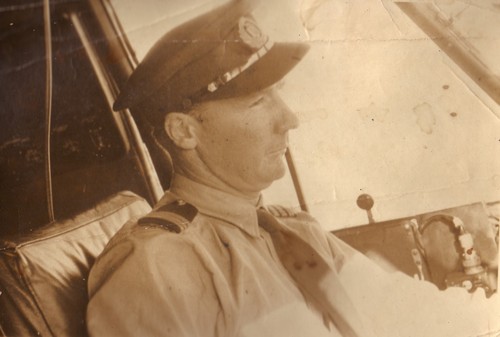
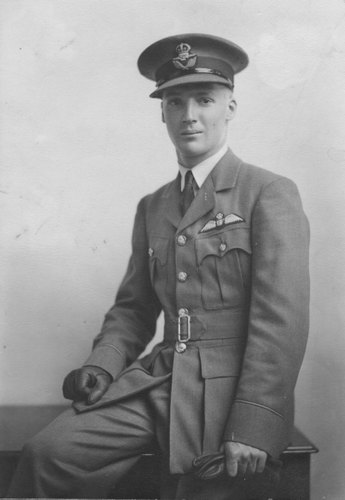
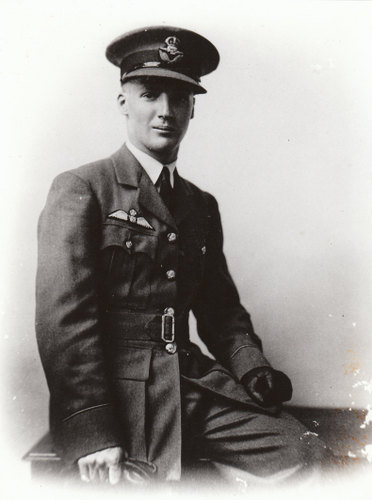
My father, Wing Commander Reginald Neville Stidolph, in RAF.

QUOTE: I could ask, ‘Why risk it?’ as I have been asked since, and I could answer, ‘Each to his element.’ By his nature a sailor must sail, a flyer must fly.

Beryl Markham on why she flew across the Atlantic to America (West With the Night)

xxx

During my teenage years, when we were living in the back of beyond, in Nyanga North, my father was seldom at home.

This was because the small amount of capital he had used to establish our farm was nearly exhausted. After several years of struggle against drought, disease, crop failure, packs of ravenous hyena, a pride of lion and the Land Bank, he had come to the realization that the only way to avoid getting deeper in to debt was for him to return to his old job – flying aeroplanes – leaving my mother behind to struggle on as best she could without him.

For the next seven-years my father all but disappeared out of our lives; the only communication, besides a monthly cheque, being the occasional scribbled letter from such exotic, far-off locations as the Persian Gulf, Sudan and Sierra Leone.

Although he was not present in the flesh, he was always there in spirit. The farm had been his dream and by working it, my mother and the rest of us children were, in a sense, living it for him.

By the time he finally returned home, I had already left school and gone to university. Because of this I still did not see a great deal of him although I did sometimes go and stay with him during my holidays when he was working for WENELA, based in Francistown, Botswana.

I came to love these visits especially because my father would usually arrange to take me up in the air with him. I would take an old camp chair and a Thermos of tea and sit up in the cockpit of the old DC3 or DC4 where I had an eagle’s view over the ground below.

Botswana is a country in which distances seem endless. Flying across the sparsely inhabited landscape, the plains stretch out for miles and miles and you really get to see how huge the Kalahari, Makgadikgadi Pans and Okavango Swamps are.

The droning engines. Flying over the Okavango Swamps in December 1970. Picture courtesy of Pete Stidolph.

There was something wonderful about flying in those jolting, rickety, oil-leaking old planes with their loud, droning engines. This was air travel before they took the edge and excitement out of it.

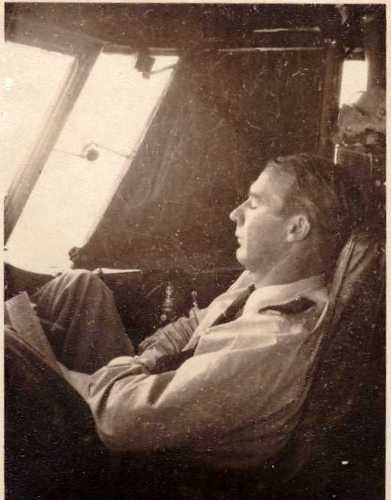
Being at the controls was so second nature to my father that he used to switch on to auto-pilot and sleep for most of the journey. Amazingly, he always knew exactly when to wake up.

Snooze time…


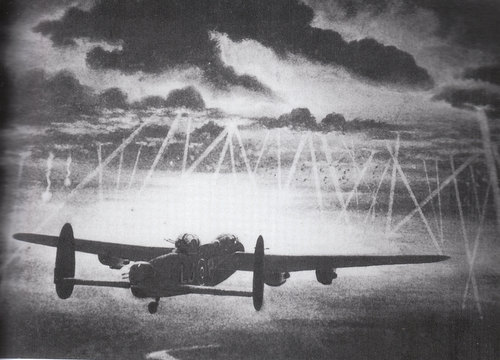
Not every flight went according to schedule. I remember the one time we had to change direction because a solid wall of angry, dark, rain clouds was advancing towards us at rapid speed with huge bolts of lightning slashing angrily out below them.

Storm over Botswana. Picture courtesy of Pete Stidolph.

We managed to outrun the full force of the storm, landing in Francistown just as it hit us. “I think we need a beer after that!” my father said, once we were safely inside the hangar, so we jumped in to his car and sped off to the Horseshoe Bar, just opposite the station in to which the old steam trains came puffing.

Flying in such conditions certainly provided its own unique set of challenges. On another occasion, a rhino came thundering on to the dirt airstrip, in a maelstrom of dust, just as we were about to touch down at Shakawe, at the northern tip of the Swamps, forcing my father to pull the plane’s nose back up in to the air.

It is not something I could imagine happening at, say, Heathrow or JFK Airport…

Sadly, it was only right at the end of his life that I began to spend a lot of time with my father and got to understand him better. He was retired and living with my mother on Bowmont, a small farm in the Midlands area. In the years that remained to him he was to suffer agonies from multiple myeloma (or myelomatosis), a particularly vicious strain of cancer that attacked his bones and caused them to disintegrate.

I had a job in nearby Gwelo (now Gweru) so I used to motor up most weekends to make sure they were okay. Eventually, I resigned and moved on to the farm full time.

In a strange way his illness brought us closer together.

As a child I had always been slightly in awe of my father. To me he was this outgoing, glamorous, figure who flew aeroplanes and for large tracts of time had been absent from my life, working in distant locations that I only knew as places on a map.

His life had all the ingredients an impressionable young boy could ask for – plot, action, adventure, a dashing hero. What I didn’t realise back then was that he never saw it quite like that. Nor did I fully understand the impact the war had on him.

Perhaps it was his awareness that he would not last much longer or maybe it was the fact that I was now a serving soldier myself but for the first time in his life he began to open up about his experiences as a bomber pilot during the war. He talked about what it was like flying at night in slow, heavy bombers and being picked up in the lattice of searchlights and being strafed by the German anti-aircraft guns. He told me about the fear and how he had always tried to fly higher than everybody else in the hope that it would make it more difficult for the Germans to shoot him down.

He had served in all the major theatres of the war.

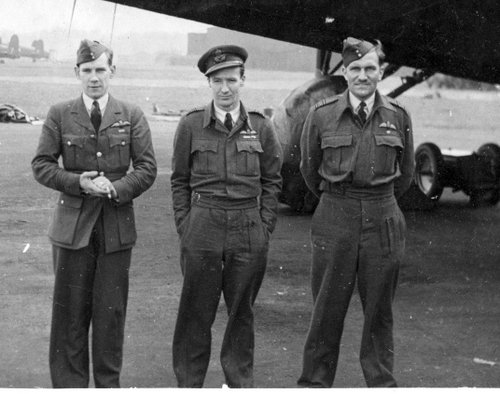
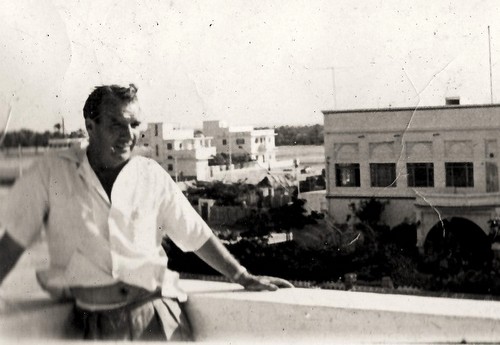
Starting off as a Flight Lieutenant he was promoted to Wing Commander in August 1941, an enormous responsibility to be placed on the shoulders of a young man still in his early twenties and one which must have forced him to mature at a very rapid rate. As the officer commanding 113 Squadron he saw action in North Africa and was also stationed, for a while, on Malta. At Giarabub (Italian for Jarabub), a remote oasis in the eastern Libyan desert, he got a taste of what it was like to be on the receiving end when his squadron and ground crew were bombed by the Luftwaffe while they were living among the gullies and wadis (see pic below).

In December 1941, he led the first group of bomber planes on the long flight to Burma, arriving there just as the unstoppable Japanese army was about to begin its long sweep through Malaya, Singapore and Hong Kong; even crossing the borders of India itself.

The road to Mandalay, Burma. My father seated.

His exploits in the area did not go unnoticed. He gets a mention in the book Retreat in the East by O.D.Gallagher, who was the London Daily Express’s war correspondent in Malaya and Burma (published by George Harrop, 1942). The author flew with my father on one of his missions. He also appears, together with other members of 113 Squadron, in a 22nd February, 1942, British Paramount newsreel (“Burma Blenheim Bomber Boys Part 1”) covering the retreat.

I only recently got to see this news clip. It felt quite strange looking down the long passage of time and seeing my father as a young man, surrounded by his crew. They all looked tanned and fit in their khaki outfits and surprisingly relaxed, given the hammering the British were taking, but also a little self-conscious, pinning their smiles on for the benefit of the cameraman.

After his stint in the Far East he returned to Bomber Command and took part in some of the big raids over Europe. Among them was one which the Times of London, on November 20, 1943, described as the largest ever over Berlin: “In half an hour a great force of Lancasters dropped more than 350 4,000lb block-busters on the German capital, in addition to a great weight of incendiary bombs”. A total of 32 bombers were lost.

One of the many planes he flew was the legendary “Just Jane” which would go on to complete a total of 123 sorties. It was only one of 35 Lancasters to achieve the “Ton-Up” mile-stone during the war. It is included in the book Ton-up Lancs: A Photographic History of the 35 Lancasters That Each Completed 100 Sorties by Norman Franks (Published by Bounty Books).

He is also mentioned in Bruce Barrymore Halpenny’s Action Stations 2: Military airfields of Lincolnshire and the East Midlands while the same author devotes an entire chapter – headed A Rhodesian’s adventure over Stettin – to his exploits in To Shatter the Sky: Bomber Airfield at War (Published by Patrick Stephens Cambridge).

There is another, later, film by British Pathe (“Berlin Raids 1943”) which features an interview with my father, this one taken after he had just returned from leading a huge bombing raid on Berlin. It tells a different story to the earlier newsreel. You can see from his eyes that the strain of the war has begun to take its toll, the smiles have all gone and there is a faint tremor in his voice as he talks.

He was awarded the Distinguished Flying Cross for bringing his badly shot-up Lancaster safely back to England (see citation below*) after a bomb drop over Stettin. It warranted a story in the Rhodesia Herald back home.

Sitting listening to him talking about those times I began to get a glimpse of what it must have been like, piloting a four-engined Lancaster, taxi-ing down the runway and then lurching off into the dark, rainy night and heading out across the channel to drop thousands of tons worth of bombs on some heavily defended target. In the back of his mind there must have always been the fear he might not return or see his family again.

He was, in fact, one of the exceptionally luck ones who did survive the war – virtually every other pilot on his officers’ training course was killed in action.

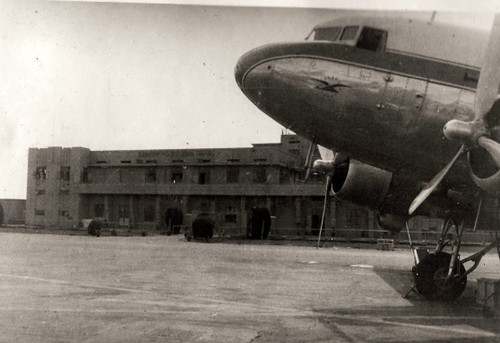
By any standards he lived a full life. At the end of the war, as part of the Berlin Airlift, he started flying a plane that was already a legend and remains so today – the DC3 or Douglas Dakota. Considered a reliable old warhorse it was a plane that would play a large part in and shape his future.

After demobilisation he returned to Southern Rhodesia and become a commercial pilot working for Central African Airways flying both inside and outside the country.

In those days the flight from Salisbury to London took six-days and by the end of it a strong sense of comradeship had invariably developed between passengers and crew.

He resigned from CAA in 1956 after a dispute and joined Hunting Clan Airways, principally flying within Southern Rhodesia and further afield to Tanzania, Kenya, Mozambique and South Africa. My main memory of those days is him returning home from Vilanculos in Mozambique weighed down with big demijohns of Portuguese wine, coconuts and apple boxes full of fresh crab.

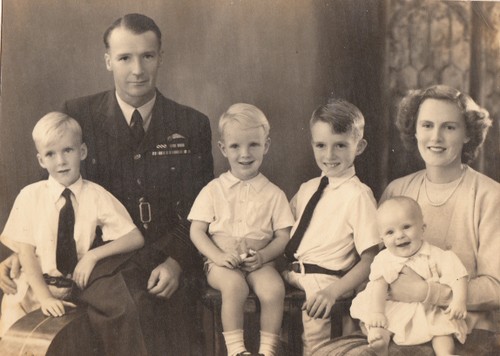
With young family – from left: Paul, Peter, Patrick, Anthony.

As an airman he lived in a more swashbuckling era when commercial aviation was still in its infancy and few people thought of going by plane, the majority opting to travel by ship. Flying in and out of dusty, fly-infected airfields in those rattling, bouncy, propeller-driven crates with a minimum of on-board comforts and only limited navigation aids it was an adventure.

It was a lifestyle which certainly suited my father. A non-conformist in a uniform, who somehow managed to combine a strong sense of duty with an inate rebelliousness, he never cared much for the rigidly scheduled, heavily regulated industry flying was to become with planes cruising in the stratosphere with hundreds of passengers, air-conditioning, on-flight movies and pre-prepared meals.

He was, however, very excited by his late conversion to flying jets.

As a pilot he had gone where he wanted, he had travelled the length and breadth of the continent in the days before Rhodesia had become a pariah state, cut off from the rest of the world and when Africa was still accessible to all. Equally at home gambling in a casino on the French Riviera or marooned on some remote frontier, he liked solitude and rough living but also good company, friends, good food and drink and laughter.

You never knew who you might find breakfasting in the kitchen after a night out at the local pub. One such person was an engineer named John Louch who needed a place to stay for the night and ended up living in our Francistown house for two-years.

He was good at what he did and his colleagues always talked with reverence of Dad’s flying skills. It was easy to understand why my mother had been so attracted to him when she had first met him as a young flight officer fresh out from Rhodesia. In her memoirs, she recalls how she had lived all her life in country villages “not knowing any boys, let alone glamorous young men”.

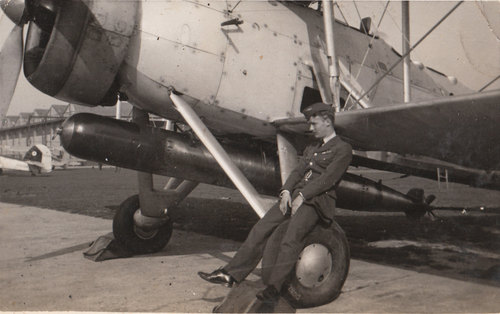
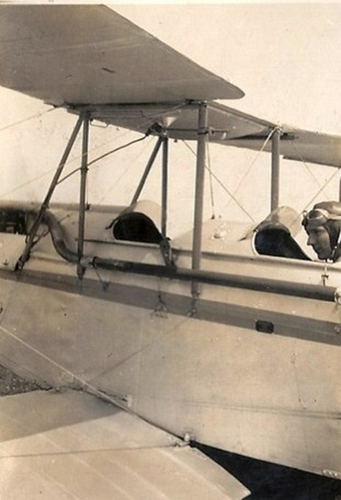
Equally smitten with the shy but beautiful young English rose, my father went out of his way to impress, even going so far as to swoop down low over her school in his open cockpit bi-plane – a highly illegal act – while she was playing netball, causing her to fall and graze her knee. Handsome, ebullient and full of life, he was a born optimist with a natural talent for minimising life’s problems and a great faith in his own ability to get a job done.

My father (briefly sporting a moustache) and mother, Wing Commander and Mrs Stidolph.

He had charm, wit and sparkle. He could also be irritable, quick tempered, impetuous, tactless and impatient – personality traits which, I suspect, could be partly traced back to the accumalative stress of flying on so many dangerous missions during the war.

Beneath his jovial, practical, no nonsense, manner and intolerance of dull people and wishy-washy thinking, lay a vein of creativeness which found expression in his, at times, rather Heath Robinson inventions and in fixing up dilapidated old cars (he didn’t buy second hand, more like – tenth hand).

His creativity did not end there. In his early years he had dabbled in oil paintings – one of his pictures (of a demijohn of wine) hung on the wall of every house we ever lived in. It was rather good.

I didn’t realise until after he died and I got to read some of the poignant letters he had written home to my mother that he had also once harboured ambitions to be a writer. That he had a talent for it is certainly born out in a wonderfully evocative piece he wrote titled: A Trip from Muscat through Oman to Qatar in the Persian Gulf.

Despite his foray in to farming he remained first and last a pilot. From an early age he had been obsessed with the romance of flying and the sound of humming propellors – even defying his father’s orders by signing up with the RAF before the war– and it was here he really made his mark. During his career he completed 23,817 hours of flying over 42-years, including over 20,000 hours in command. He flew 48 types of aircraft for eight organisations on three continents in 44 countries. He landed in over 350 different airfield.

To the end he remained very much his own man and, despite his illness, still retained something of his old zest for life and vitality. He was larger-than-life, one of a kind, a bit of a legend.

Like his beloved Dakotas, they don’t make them like that any more…

* The award was gazetted on the 25 January 1944 (Issue 36346, pages 481 – 482) and reads:

Distinguished Flying Cross.

Wing Commander Reginald Neville Stidolph (375I3). Reserve of Air Force Officers, No. 61 Squadron.
One night in January, 1944, this officer was the pilot of an aircraft detailed to attack Stettin. Soon after bombing the target the aircraft was attacked by a fighter. The enemy aircraft was eventually driven off, however, and was seen to dive steeply smoke pouring from one of its engines. In the encounter, Wing Commander Stidolph’s aircraft sustained extensive damage, making it extremely hard to control; 1 engine was also rendered useless and had to be feathered. In spite of this Wing Commander Stidolph flew the disabled aircraft to an airfield in this country and effected a safe landing. He displayed skill, courage and resolution of a high order. This officer has completed very many attacks against targets such as Berlin, Hamburg and Dusseldorf.

The above are three of the squadrons my father served in and whose badges hang on my wall. There were others…

GALLERY:

(1) My father joined the RAF, before the war, in November 1935 and served right through to its end in 1945. Here are more some photographs from that period.

(2) From March, 1960, to about February, 1966 my father worked outside the country, based, in turn, at Bahrein in the Persian Gulf, Sierra Leone and in Khartoum where he was employed by Sudan Airways.The following photos come from this period of his life:


ACKNOWLEDGEMENTS: A special thanks to my brother, Patrick, whose extensive research in to my father’s flying career I have been able to draw on here. Pat’s research now forms part of the No50 and No61 Squadron Association official record.It was Patrick who also drew my attention to an article written by Ross Dix-Peek about my father’s war-time career.