The Place of the Jackal

Like a migrating bird, responding to some deep-rooted and primal instinct, every now and again I get the urge to take off North (contrariwise, I sometimes go South). And so, it came to pass on a cloudy Tuesday morning. I found myself barrelling up the N1 freeway from Jo’burg. Destination – Mapungubwe National Park. The further we travelled from the concrete jungle, the happier I got. I began to get that old familiar sense of freedom and anticipation…

At Polokwane, we left the Great North Road and headed, in a North-Westerly direction, up the R521. The traffic grew lighter. Then, the thin blue outline of Soutpansberg came into view, silhouetted against the horizon. Once you have skirted its western edge, the country becomes flat, straight, wide, and so monotonous, driving becomes a form of meditation. Your eyes become glazed, fixed on the horizon. If it wasn’t for the potholes, you could almost switch to autopilot.

Occasionally, a large truck came rumbling through the heat-haze, towards us, on its way back from Botswana, on the other side of the Pontdrift border post. Ranchers roared past in their large bakkies, packed with goods or with their workers bouncing about in the back. More and more baobabs appeared. We were heading deep into Lowveld country, under an unyielding, intense blue sky.

At Alldays, the road forks. We turned right. As the miles slipped by, it began to finally feel like we were getting somewhere. A range of red hills came into view, followed by more hills, rock islands in a sea of stunted mopane trees. Snaking its way through it all ran the thin band of dark green, marking the course of the legendary Limpopo River.

Bushmen once lived in these hills and sandstone buttes, leaving behind a wonderful legacy in rock paintings. Sadly, they would be hunted down or driven into even more inhospitable country. Later, the Limpopo would become a major trading route, dealing in gold and ivory, linking the hinterland to the Indian Ocean coastline. Mapungubwe is also the most important Iron Age site in Southern Africa, and was the first powerful kingdom in southern Africa. Its royalty lived on Mapungubwe Hill. Those of a more common ilk lived and worked in the valleys below. Such is the nature of power.

The kingdom held sway from about AD 900-1300. It is thought, climate change and crop failure brought about its demise. Thereafter, the centre of power shifted north-east to Zimbabwe.

The area has a more troubled recent history. The Limpopo once marked the thin, dividing line between the White-ruled South and the Black-ruled North. Evidence of the suspicion and hostility with which they two viewed each other can still be seen in the remnants of the old, electrified, barbed-wire security fence, which was supposed to discourage any armed incursions, and the odd military bunker, heavily fortified with sandbags.

Old SADF bunker, Eastern Section, Mapungubwe.

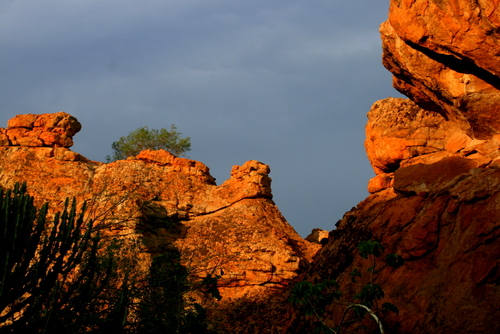
In the dusty afternoon light, however, the landscape, before me, exuded its own singular magic. Sculpted and weathered by rain, sun and wind, it stands as an incredible monument to nature’s powerful artistry. Here, you still get the feeling that the old Africa is not dead, just slumbering.

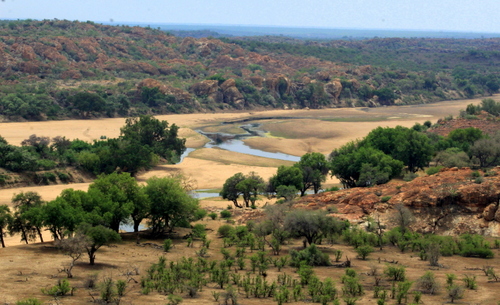
Heading towards Pontdrift. The dark green line marking the course of the Limpopo can be seen in the mid-distance.

Mapungubwe has become a special place for me, a place of the heart. Coming to this remote site is a form of pilgrimage, my way of paying homage to the three countries – South Africa, Zimbabwe and Botswana – where I have spent most of my life and that have helped shape who I am. Their borders meet here, at the confluence of the Shashe and Limpopo rivers. Although dried up at this time of the year, the Shashe has an immense width, making it look the bigger river.

There is another sentimental reason for my journey. It was near here (possibly Rhodes’s Drift on the edge of the park?) that my ancestors, as members of the 1892 Moodie Trek, having followed a route similar to the one I had just been on, crossed over the Limpopo, in their ox-wagons, on their way to Gazaland in what is now Eastern Zimbabwe. My Grandmother, Josie, who was on the trek, was only three years old at the time. Sadly, she would die relatively young, giving birth. Her grandmother, Marjorie Coleman, would grow into a venerable old lady. She opened the first boarding house in Salisbury (now Harare), at a time when the bustling modern capital city was nothing more than a scruffy collection of dusty shacks and tents with the Union Jack fluttering in the middle of it.

Finally, I am here for the birds. Studying birds is the closest thing I have to a religion. Nature is my temple, and birdwatching is my form of worship. Like my other passion, painting, I enjoy it because it forces me to notice things. You start off looking for a bird and end up noticing not only it but the ecosystem that supports it. You examine its habitat. You learn to anticipate where some birds might be, although there are always surprises, which is what makes it such a rewarding activity. Tuned to the environment, the birdwatcher can develop great acuity of sight and hearing. And then there is the sheer beauty and variety of our local birds, from the tiny Penduline Tit to the lugubrious Southern Ground Hornbill or the Kori Bustard, the largest flying bird in the world.

In twilight, we reached the campsite, not far from the river, made famous in Kipling’s poem. Its strength had now been sapped by months without rain. The site is dominated by several huge Natal Mahoganies and a cluster of tall thorn trees, which provide welcome shade in the intense heat, as well as a roost for the family of very noisy Natal Spurfowl that has taken up residence here.

One of the reasons I like travelling with my birding partner, Ken, is that we share a similar camping philosophy. We like to get off the beaten track and prefer to keep it simple. Mapungubwe campsite meets these needs. Besides its beautiful and isolated location, it has a minimal number of sites, so you don’t get the overwhelming amount of people you get in some of Kruger’s more popular camps.

“I did not order this for breakfast!”. This Crested Barbet was a regular visitor to our campsite.

That evening, a tiny Skops Owl started making its soft, frog-like “prrrup…prrrup” call from the nearby trees and was answered by another, further in the distance. With their huge eyes and striking physical appearance, owls are one of the most charismatic, yet mysterious, of birds. The fact that they operate in darkness and fly so quietly only adds to their air of mystique. I can understand why they feature so prominently in folk cultures and traditions across the world.

After supper, I fell asleep to its soft, reassuring call.

I was awoken early by a multitude of bird sounds. To get the full effect of the dawn chorus and not the muffled sound you hear in bed in your house, you really need to be outside. It is another reason I like camping. Lying in bed, listening through the thin sheeting of my tent, I could identify some of the sounds but not others. It had been a while since I’d been in the Bushveld, so I was a little rusty.

Rising above the great press of unseen birds came the manic chatter of the comical Red-billed Hornbills, one of the most characteristic sounds of the bushveld (the migrating Woodland Kingfisher is another). Over time, the birds have become very tame, and many hang around the campsite, scrounging for scraps. As far as I am concerned, their raucous call defies description, but my battered old 1970 edition of Roberts renders it thus: “tshu-tweetshwee”(three times), “tshutshutshu”(three times), “kukwee”(two times). Have fun trying to imitate that…

The manic chatter of the comical Red-billed Hornbill.

After a cup of tea and a rusk, we set off. By Limpopo summer standards, the weather was relatively cool. Away from the river, the trees diminish in size until they become stunted replicas. The surrounding planes are sparse and bare, with hardly a blade of grass visible. What there was tended to grow in clumps. The area, nevertheless, provide suitable habitat for several dry-land “specials”, including the Pied Babbler (which we would see here on this trip) and the highly unusual Three-banded Coarser who, in South Africa, only occur in a narrow stretch along this stretch of the Limpopo (which we didn’t see on this trip but which I have seen here several times before, once with chicks)). Both the Red-chested and Grey-chested Sparrow-Lark also like it here.

Entering the Eastern Section of the park (Mapungubwe is divided into two separate sections), we started off on a high note when we spotted three Lanner Falcons perched on top of a nearby tree, followed a bit later by a rare Ayre’s Hawk Eagle, which I had only seen once before.

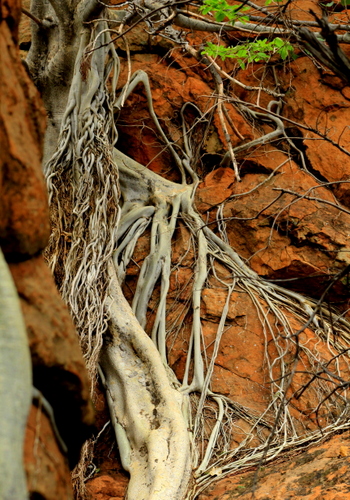
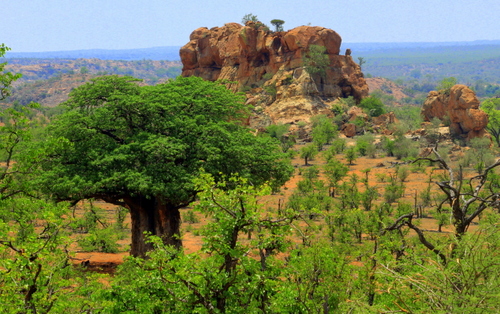
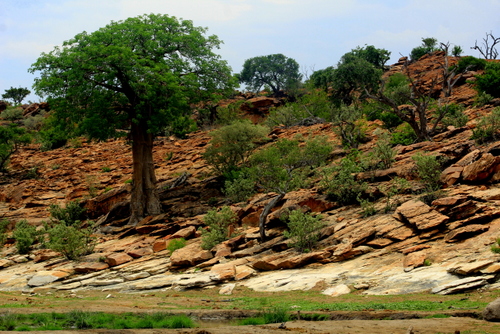
As the river swings into view, the road drops over a rocky ledge, dissected by dongas, ravines, large boulders, jagged outcrops and dry, sandy stream beds. It is dotted with bulbous baobabs, their branches clawing at the sky. There are also numerous Large-leafed Rock Figs, their long, tentacle-like, ghostly-white roots forcing their way down through the narrow wedges and cracks in the rocks (hence their other name – Rock-splitter Figs). Rounding a corner, a little later, our hearts sank. Ahead lay a herd of cattle, standing, chewing the cud, in the middle of the road. They had obviously crossed over the river from Zimbabwe.

Large-leafed Rock Figs.

We had previously complained about their presence, but despite the manager’s promises, it seemed that nothing had been done, as there were even more of them than before. Our objection to their presence is not so much that it spoils the wildlife experience and the general aesthetic of the park, but because the cattle tend to hog the more nutritious grazing along the river banks. This forces the wildlife, especially the more timid buck species, to move inland, to the barren fringes of the park. In a larger, less dry park, maybe this combination of domestic and wild animals might work. I am not convinced it does in Mapungubwe.

So, we complained again when we got back to the Reception, this time in front of a party of startled German tourists who were checking in, and got fobbed off with the same old excuses as before.

We were in for another disappointment. The raised canopy walkway, which provided a good view of the river, as well as an excellent birding spot, had been washed away. The road to it was now closed. It is usually a good place to find the Broad-billed Roller and Meyer’s Parrot, further “specials” of this western section of the Limpopo (in Kruger, the latter is replaced by the Brown-headed Parrot). Luckily, we picked up both later.

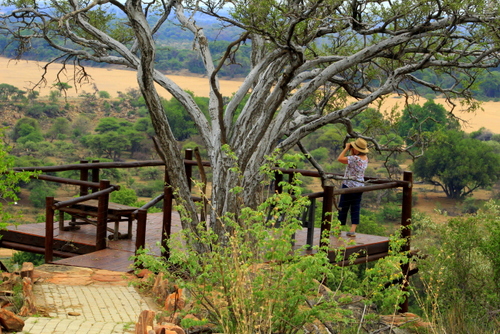
We pressed on to the nearby viewpoint at the confluence of the Shashe and Limpopo. You can see why the old SADF chose this prominent feature as a base camp because it provides a commanding view over what was then regarded as hostile territory.

View east from the lookout point. Zimbabwe is on the other side of the Limpopo.

On reaching the saddle between it and another rock-strewn ridge, Ken ordered a halt. It was time to get out the skottle and make brunch and coffee (the latter – my difficult assignment).

After our meal, we headed east into the broken, hilly, 4 X4 section, alongside the river. Here we encountered yet more cattle, their bells tinkling merrily, making it hard to argue, as we had been told, that they are difficult to find. There was no sign of any Kudu, Nyala or the other buck species I used to associate with this route – just a few baboons sitting on their haunches while scratching their crotches with an air of complete indifference. They are shameless creatures…

Next stop: Poachers’ Corner. We had been told by the ranger, back at camp, that the rare, much sought-after, Pel’s Fishing Owl had recently been seen in the massive Nyala Berry trees around here. We scanned the ground under them for the telltale fish scales, as well as the branches above, but we were out of luck.

Near Poachers, Limpopo River.

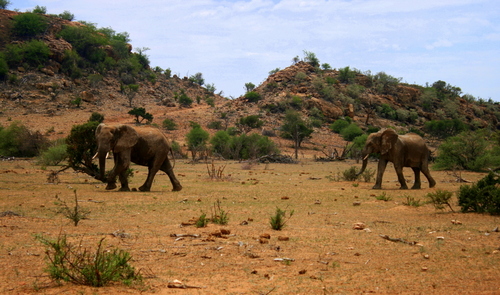
We soon found something else to occupy our attention. Not far from another old SANDF bunker, erected here, we came across two male and one female Klipspringer, who stood outlined against the hills. Not far from them, an elephant rubbed itself against a palm tree. Three more elephants siphoned up vast volumes of water from a nearby pool. They alone did not appear perturbed by the cattle (understandable, given their massive bulk and fearsome tusks). Another elephant had blocked our planned exit route. It showed no inclination to move, so we decided to take another road, which led into more hills inset with outcrops of ochre-coloured boulders and weather-stained cliffs..

Driving along it, I was saddened to see that the two distinctive baobabs I had once done a painting of had collapsed and disintegrated into piles of rotting fibre (the handiwork of the elephants?). My artwork had now become part of the park’s recorded history, an artefact from another time. I wondered if it would make it more valuable? I doubted it….

My painting of the Baobabs that Died. Now in the permanent collection of Prof Ric Bernard.

The road continued winding through the hills before making a huge loop at its easternmost end. Thereafter, it turned inland through vast acres of mopane scrub. Near the exit gate to the Eastern Section, there is a tiny dam with virtually no cover along its banks. Oddly enough, it has often yielded surprises, and this time proved no exception. Wading in its waters, right out in the open, was a beautiful male Greater-painted Snipe. It seemed an unlikely place to find this uncommon bird, which normally prefers to skulk around reed beds and is difficult to locate. Having only recorded it a few times previously, I excitedly jotted it down in my notebook. My Bird List was growing.

Then we drove back to camp.

The next morning, we decided to do the River Forest Drive, in the Western Section, which took us along the banks of the Limpopo. This is a good place to find the Senegal Coucal, common to the North but rare in South Africa. We didn’t find it, but did locate a Tropical Boubou, which shares a similar limited distribution in this country.

Having made sure the Limpopo River is where the mapmakers put it, the Great Explorer, Ken, sets off on the next leg of his Expedition to uncover the Mysteries of the Interior…

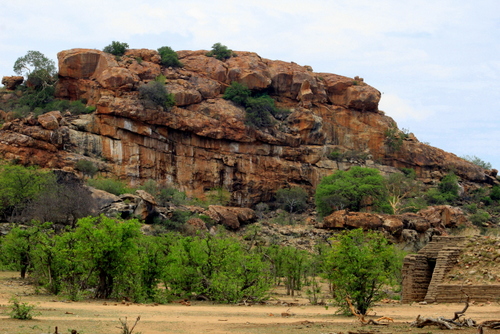
After brunch back at camp, we set off down the Den Staat road, which links the two sections of the park. The low rays of the afternoon sun had caused the sandstone cliffs, to which we were headed, to glow like fire embers, giving the whole landscape an ancient, otherworldly, mystical feel. As we got closer to the hills, we encountered a large herd of elephants feeding peacefully amongst the mopane trees.

Maybe it’s the layers of history that lie buried here, perhaps it’s the quality of light or the rugged contours of the land, but Mapungubwe is one of those places that provoke an instinctive response in me, a sense of connection, an inexplicable link, even though I grew up in a completely different environment. Its scenery holds me breathless.

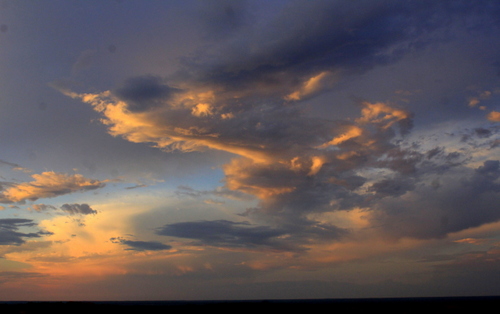
The quality of the light

Heading back to camp, we decided to do a detour and find a spot for a farewell sundowner. Sadly, the Maloutswa Hide, where I have spent many happy and productive birding hours, had also been partly destroyed in the floods and was closed. There was little sign that anything was being done to repair it.

To make up for it, we drove along the stream that feeds the pan. It proved well worth it. Mapungubwe means “the Place of Jackals”, and, sure enough, in the orange evening glow, we were greeted with one of the most delightful scenes of our short stay in the park. Five young Black-backed Jackal cubs, no doubt recently ejected from their den and sent off to fend for themselves, were scampering around in the open, playing games with each other. They seem unperturbed by our proximity. Many farmers would probably feel the opposite, but I love jackals. Their call, which I hear regularly at home too, does for the animal world what the Fish Eagle does for the birds. It captures the spirit of the place, the soul of unspoilt Africa.

These youngsters were too busy with their games, but later that night, lying in my sleeping bag, I heard the adults calling, not far away.

Next day, we headed on, down another pot-holed road, for Kruger, where I hoped to experience the same thrill…

When Two Troops Go To War: Adventures in Mapungubwe

I am returning to one of my favourite places, after a gap of several years. It is where I love to go birdwatching although that is only one of its many attractions.

The tarred road we use to get there, as is the norm in Limpopo Province, is a nightmare to drive on and my brother-in-law is a study in intense concentration as he tries to navigate the countless gaping potholes. We bump along the section that runs along the southern base of the Soutspanberg, then crawl up, via Vivo, to All Days. Here we branch off right.

The fact that the journey ends up taking twice as long as it should have doesn’t dent my enthusiasm for we are headed to Mapungubwe. It is somewhere along here my grandmother also travelled, as a very young member of the Moodie Trek, on her way up to the then Southern Rhodesia. Unlike us, she travelled by ox-wagon, not in an air-conditioned Isuzu bakkie…

There is a stark minimalist, beauty to the landscape around here. The miles and miles of stunted mopani, the sudden, jagged outlines of ochre and strawberry-pink, rock outcrops and cliffs, the barrenness of the earth, all give it a slightly strange, almost mystical, atmosphere.

Returning to Mapungubwe is like a homecoming to me. Clambering out the car after the long drive, I stand, look and listen and let myself become part of the place again. Tshugulu Lodge, where we have booked in, is surrounded on all sides by towers of red, sandstone rock, eroded by the wind and rain and sun in to all sorts of weird, fantastical shapes.

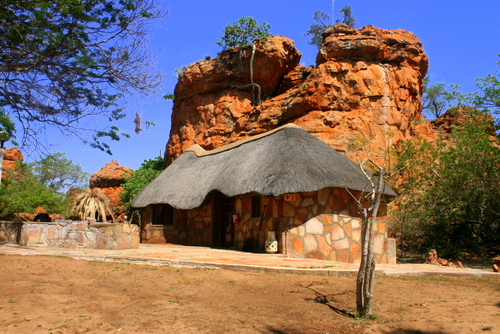
Tshugulu Lodge

We are thrilled to find we have it all to ourselves

On the first morning, I get up at 0530 and go outside with my mug of tea. My brother-in-law has, as usual, beaten me to it and is already sitting outside but my sister is still asleep in her room.

As I plop down in the chair next to him, he points to the soft, wet sand in front of us and says “We had a visitor during the night!”. I immediately see what he is talking about. The huge footpads of a solitary elephant lead from the lodge gate to the swimming pool and then head out again along a slightly different path. There has been much testimony as to the silence of elephants so I hadn’t heard a thing but my niece, Kelly, whose cottage was much closer, had listened to it siphoning up vast quantities of heavily chlorinated water.

It is a perfect African morning, a time when the world still belongs to the animals. Above us I can hear the European Bee-eaters calling as they soar and glide in the thermals. When the breeze blows I catch the smell of Wildebeest, grazing not far from the perimeter fence of the lodge. Somewhere in the unseen distance I can imagine carnivores finishing a kill before heading off to lie in the shade,

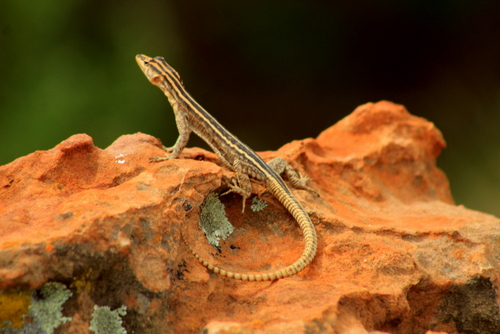
The rock cliffs, that hem us in like an old-fashioned castle wall, glow orange-red from the rays of the early morning sun. As I do a quick scan through my binoculars I see a snapshot of birds and other small creatures. Amongst the cracks and crevasses, the resident gang of Red-winged Starlings play hide-and-seek. In the shade of a Large-leafed Rock Fig which has sent its ghost-white roots burrowing down through the cracks and fissures, I hear the soft hooting of a Laughing Dove. Near it a skink, with brown stripes along its back, raises its head out of the rocks as if to smell for rain.

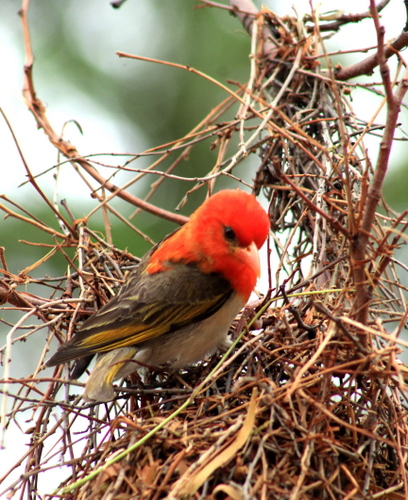
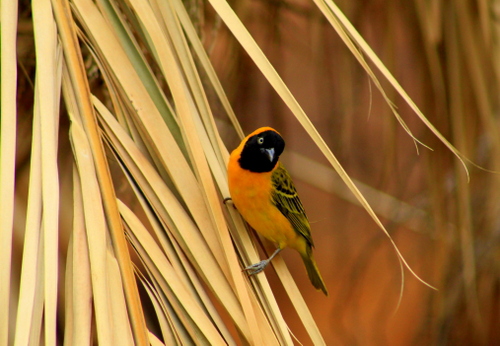
Down on the ground, not far from where we are sitting, a pair of Natal Francolin scurry past on some unknown errand. In the tree above us the beautiful Red-headed Weavers sway and dangle before flying off to bring back beak-load after beak-load of carefully selected twigs with which they construct their nests. Their pain-staking industry is more than matched by all the activity in the Lala Palm where a small colony of Lesser-masked Weavers have opted to build. They prefer to use grass and palm shards.

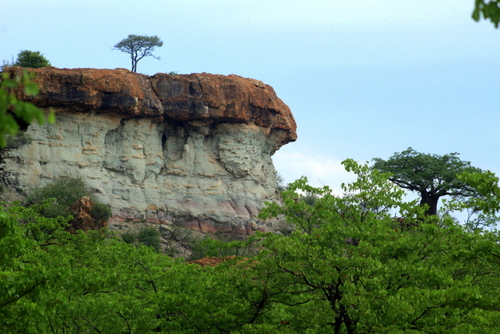
After a breakfast of fruit, muesli and yoghurt, we head off to the Eastern Section of Park. This arid area occupies a unique position in the country’s history for it was here that South Africa’s first important kingdom was established between 1200 and 1290 AD. Ruins left behind by Africa’s early civilizations are almost invariably found in hill country (Great Zimbabwe and Thulamela in Kruger are other obvious examples) and the Mapungubwe Hill site is no exception. From the summit of this steep-sided bute, its rulers would have been in a good position to keep an eye out out for enemy warriors, as well as greet traders coming up the Limpopo – for it is known they kept extensive links with the east, including the Chinese and Indians, the sails of whose ships were swept over to Africa on the winds of the monsoons.

We do not have time to visit the hill that marked the centre of their civilisation but from the top of the lookout site, at the confluence of the Limpopo and Shashe Rivers (where the borders of Zimbabwe, Botswana and South Africa meet), we can just make out its red ramparts rising out of the dusty earth. From here, the road, ostensibly for 4×4 usage only, takes us along the Limpopo River as far as Poacher’s Corner before branching off through yet more oddly-shaped hills and balancing rocks.

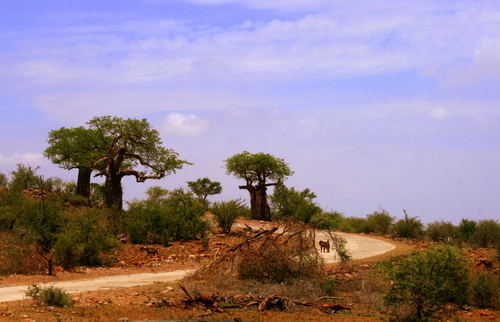
More hills and baobabs...

We return to the lodge, later that day, to find the local squirrel has taken advantage of our absence and made merry in the kitchen. Rusks have been chewed on, a bottle of honey lies open, its contents spewed all over the table and floor…

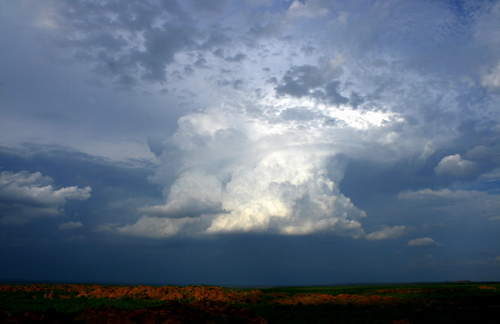
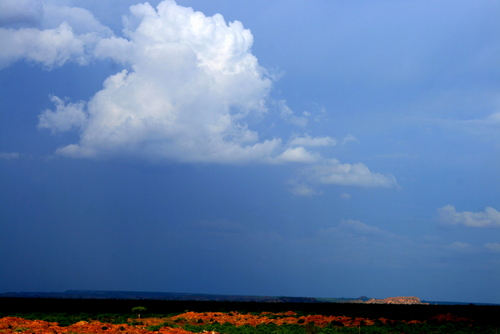
That evening, deciding to take advantage of the balmy summer light, we climb up one of the kopjes behind the lodge for sundowners. The view is astonishing. To our north, on the other side of the Limpopo, a massive storm is brewing. Soaring thunder heads rise above the plains casting the world beneath it in an unholy purplish light. There are bolts of jagged lightning, followed by the drum-like roll of thunder. You can feel the malevolence in the heavy air and smell the rain although it never actually reaches us.

Storm clouds over the Limpopo.

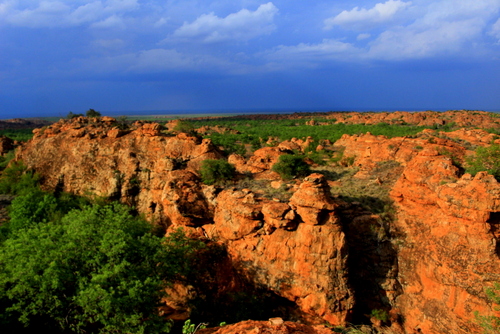
There seems to be no limit to our vision. One our right side, a labyrinth of glowing, sun-burnished, bare rock, pock-marked and twisted and looking like it could be guarding the entrance to the underworld, stretches away from us. Somewhere, in the ultimate distance, land and sky merge. It feels like we have the universe all to ourself.

A labyrinth of rock…

Anxious to transcript so great a mystery, I pull my camera out of its bag and start snapping. Then I just sit still for a long time watching the unfolding drama until eventually the fading light sweeps it all away…

That night I lie content beneath my mosquito net as the air conditioner – a novelty for me since I mostly camp on these adventures – drones away. Outside the crickets call.

I rise even earlier, the next morning, but it does no good. My brother-law-law has beaten me to the kettle again. He tells me we have had more visitors. These ones are much smaller than the formidable old behemoth who visited us the previous night. In the magic of twilight they had come flying out from their hidey-holes and roosting nooks.

They are bats.

Bats have always received a bad rap. Some time, back in history, perhaps around the period the when the church started persecuting perceived witches, they were turned in to creatures of ill-omen, along with crows, owls and – oddly enough – hares (it was thought that witches could shape-shift in to them). Later they came to be associated with vampires and Count Dracula and sharpened stakes and bundles of garlic. It is a label and an association they manifestly do not deserve for these nocturnal wanderers are marvels of evolutionary engineering..

I don’t know much about bats but my brother-in-law does. An Emeritus Professor, he is an expert on the subject. The reason he knows they have been active while we slept is because – like some Cold War spy – he has been secretly recording their chatter on two metal Bat Detectors he has attached to some trees. I listen raptly as he explains their workings. Because they mostly fly around at night bats can be difficult to identify but science – and technology – has found a way around that by tuning in to the ultrasonic sounds the bats emit.

My brother-in-law’s findings from this and subsequent recordings are, to my mind anyway, amazing, revealing a secret night-time world in which the bats are completely at home (see Acknowledgement below).

The bat puzzle solved, we next set out to explore our corner of the park, a lot of which is new to me.

The day is hot but bearable because the heat is mostly dry. Our route takes us through a badlands of arid hills and trees that are, for the most part, low and barren. In marked contrast, every now and again, we come across a baobab rising like some ancient monument, sometimes in the middle of nowhere, some times next to the stone face of a kopje.

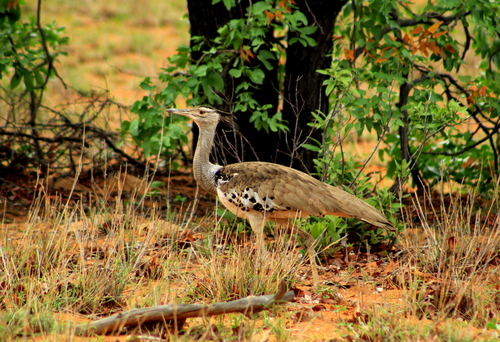
This is good raptor country. In no time I have added Martial Eagle, Black Eagle, African Hawk Eagle, White-backed Vulture, Common Buzzard, Brown Snake-Eagle and Gabar Goshawk (black form) to my bird list. Plus a Kori Bustard and a Red-crested Korhaan. Later, we will see the male Korhaan performing its strange courtship ritual, flying straight up in to the air and then closing its wings and tumbling to the ground, as if shot, before gliding in to land.

Kori Bustard.

After taking us through more rough, broken, terrain, the road starts winding down in to a rock-strewn valley which, in turn, opens up on to an immense plain, on the one edge of which lies the Limpopo. As you approach the river, the Mopani scrub abruptly gives way to a green line of tall trees – Nyala Berry, Jackal Berry, Natal Mahogany, Ana Trees, Apple Leaf.

I am a little taken back by the state of the Mazhou camp site which has altered much since I stayed there last. The electric fence that protects it no longer seems functional and everywhere there are scenes of devastation. I know who the culprits are. As in Kruger, elephant are presently destroying the acacia thorn (and many other species of tree) that also grow along the river bank at a rate regeneration can’t keep pace with. Those not knocked down have been stripped of their bark and are dying that way. In ten-years time I doubt if there will be many of these beautiful trees left to see.

One can only hope this is part of nature’s cycle although I am not convinced. In former times, elephants herds were scattered and nomadic which helped minimise the damage they cause; now their movements have been confined to restricted habitats, such as the one we are driving through. The results of this loss of freedom to wander at will are plain to see…

From the camp site we follow the river for a short distance, through the tall trees that provide favourite perches (and nests) for the vultures, before branching off to the Maloutswa Pan Hide.

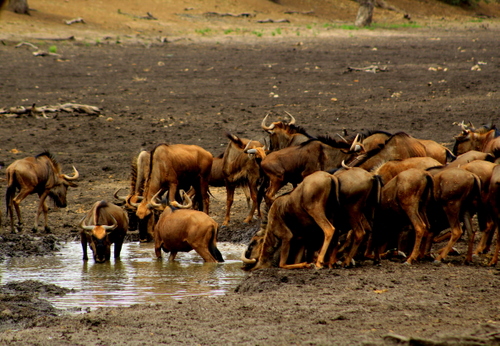
As the main rains have still not arrived there is not much water in the pan. The mud that occupies the place where liquid should be is black and cracked and caked and pitted like the moon’s surface. Numerous hoof-marked tracks lead down through it.

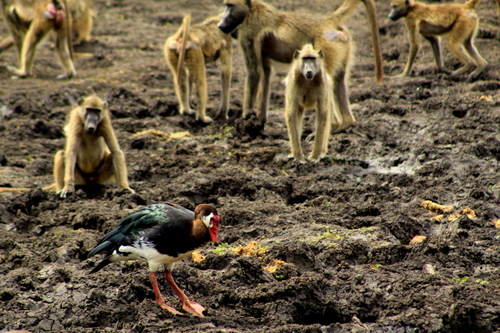
Obviously fans of the formula that there is safety in numbers, we find an immense gathering of baboon squatting by the water side. It is the biggest troop I have ever seen. As we sit watching them, another, even larger, troop suddenly emerges out of the tree line.

As they draw closer to one another, I can scarcely believe my eyes or my ears. It is like a clash between two medieval armies. There is an immediate outbreak of barking and a hurling of wild manic howlings. This is followed by lots of jumping up and down, chest-thumping and angry gesticulating. The baboons are doing it, I soon realise, only for dramatic effect. It is a mock call-to-arms and does not signal the start of an all-out war.

Realising they are outnumbered, the troop already at the waterhole stages a strategic withdrawal, yelling parting taunts and trying desperately to preserve their dignity and not show any loss of face. They retreat to a position a hundred metres or so downstream where they sit down and mutter conspiratorially amongst themselves. For our part, we find it a rather an impressive performance and feel like clapping but the solitary, bored-looking, Spurwing Goose who was in the middle of the battlefield remains completely unmoved. He has obviously seen and heard it all countless times before…

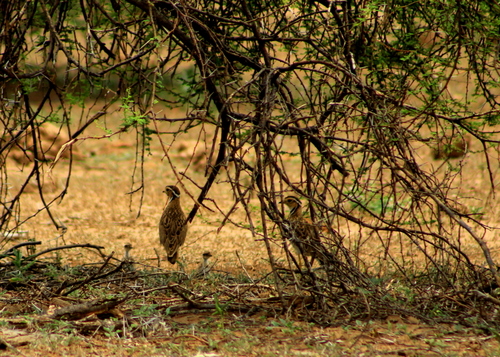
On the way back from the pan my sister sees two Crowned Lapwing in an open patch of ground and then, a bit further down the road, says “Look – two more of them under that tree!”. Although, I am on the wrong side of the car to see them, a little bell goes off in my head. Maybe they are not plovers at all! I urge my brother-in-lay to stop and reverse back to them. I am very glad I do for it turns out to be a pair of Triple-banded Coursers which are extremely unusual in South Africa. I am even more amazed when I see they have two chicks. In Africa, all game birds suffer high rates of nesting loss. There open homes are highly vulnerable to a whole host of predators – caracal, serval, jackal, civet cat, genet cat mongoose, raptors, various egg-eating snakes.

Triple-banded Courser, with chicks.

The chicks are lucky to have survived so far.

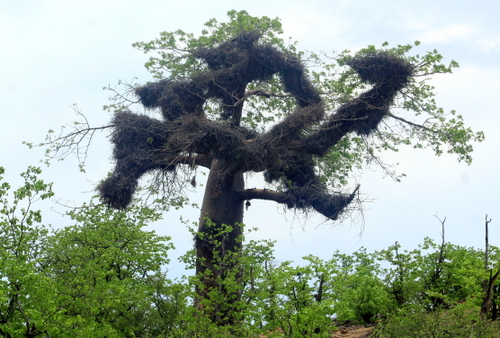
Returning home we take a slight detour to Little Muck which lies on a ridge below which a seasonal stream bed runs. How it got its odd name I have not been able to ascertain but it is a good place to see elephant. There are also several San rock-painting sites in the area but I imagine you have to get permission to see them. There are more baobab standing here in heraldic silence, their branches covered in the sprawling nests of the Red-billed Sparrow Weaver. With the exception of those in more inaccessible positions, they too, have been badly gored, stripped and desecrated by the elephant. I suspect many of these ancient, symbolic trees won’t survive either.

Which would be sad because, standing under them, I felt overwhelmed by the age and might of this old continent and realised – yet again – what an important part of it they are…

GALLERY:

ACKNOWLEDGEMENT

I am extremely grateful to my brother-in-law, Emeritus Professor Ric Bernard, for organising this trip and for his many kindnesses, information and assistance. To help me understand the world of bats better he also kindly prepared the following notes:

Studying bats is not easy because they are active at night and spend the days in often inaccessible places. They are hard to see in flight at night and almost impossible to identify even when they are seen. However, in the same way that birds can be identified based on their calls, so too can bats – with the same proviso that identification based on call alone is not always accurate. However, unlike birds where the call can be heard, the calls of bats are at a frequency that is far too high to be heard by us. This makes studying bats very different from studying birds. The ultrasonic calls of bats can be detected and recorded and on a recent trip to Mapungubwe and Mopani we used two Song Meter bat detectors to record the bats in the area. Over 6 nights, we recorded more than 16000 bat calls. Analysing these calls manually would be very time consuming and we used software to do this and to group calls into clusters. We were then able to examine the clusters and based on previous work to identify most of the calls.

The ultrasonic calls of bats are used to detect their prey and their surroundings (echolocation) and typically not to communicate with other bats. The call of each species is characterised by a particular frequency or range of frequencies and it is based on this that they can be identified. Calls fall into one of three groups, being Constant frequency (CF) where the call is relatively long and at a single frequency, Quasi Constant frequency (QCF) where the call is long and covers a very small range of frequencies, and Frequency Modulated (FM) where the call is shaped like a hockey stick and covers a range of frequencies from high to low at the bend of the hockey stick.

The CF bats are all horseshoe bats and we recorded six different constant frequency calls at 35, 47, 76, 81, 105 and 114 KHz (kilohertz). The likely species were the cape horseshoe bat, Geoffroy’s horseshoe bat, Darling’s horseshoe bat, Hildebrandt’s horseshoe bat, Lander’s horseshoe bat, Swinny’s horseshoe bat.

Amongst the FM bats, we identified the Cape serotine, long tailed serotine, banana bat, rusty pipistrelle, Natal long fingered bat, and Temminck’s myotis.

The vast majority of the recorded calls came from the QCF group. These are bats that often inhabit the roofs of houses and which SANParks are trying to attract into bat houses that we saw at both Mapungubwe and Mopani. The species included Midas free tailed bat, Angolan free tailed bat, Egyptian free tailed bat, Mauritian tomb bat, large eared giant mastiff bat and the little free tailed bat.

All of these bats fall within their known distribution ranges.

All the species are insectivores and will be feeding on both flying and sedentary insects.

I would also like to thank my sister, Penny, for the wonderful food and – along with her daughter, Kelly – being such good company.