Literature and butterflies are the two sweetest passions known to man.
Vladimir Nabokov.

It is 7.30 am and I am taking my usual nosey wander down the path that leads from my house to the Kusane river. It is a beautiful, balmy, sun-filled, day. Suddenly a butterfly – or rather a butterfly and its passenger – alights on a plant just to my right.
In the past I would have just cast a cursory glance in their direction and then proceeded on my way.
This time I stop, grab my old Canon out of its bag and start snapping away. The reason for this is that I have recently been given a field guide to the butterflies of South Africa* to review and suddenly I have become enamoured with the subject.
I circle around the butterfly, trying to get closer and closer, angling in for the perfect shot. I have no idea what the butterfly is but as soon as I get home I will get out the book and try and identify it, looking for its most distinctive features (as a political cartoonist I have had a lot of experience in this – it is what I do when a new president or other public figure appears). I will also look at the butterflies habits and distribution, hunting for those tell-tale clues that might aid me in my search.
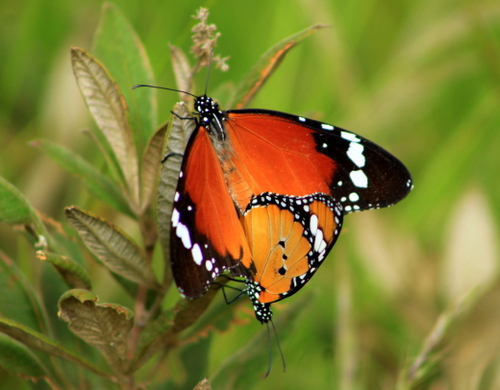
Then I will add it to my list.
As an artist my approach to nature has always been more sentimental than scientific. I am attracted by the lyrical rather than the factual. I look for beauty and seek solace in my natural surroundings. I love the intense intimacy you can develop with your local landscape over time.
All of which makes it strange that I have neglected – although not completely ignored – butterflies for so long because if anything inspires a sense of wonder in nature they do.
I am determined to remedy this. I have probably left it rather late in life to ever become anything like an expert but you have to start somewhere. And, because it is so open, Kusane Farm seems a good place to begin. Also, I live here.
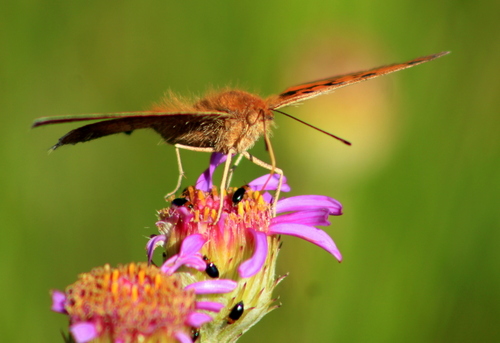
In spring and summer we get lots of wild flowers coming up in the mist-belt grasslands, especially after a burn. That serves as a magnet for the nectar-loving insect.
It is 7.30 am again and I am back on the familiar path hoping to carry on where I left off before. Around me the swallows are diving and swooping with quick forward thrusts. There is a strong impression of activity and movement everywhere.
I home in on a butterfly which has landed in a cluster of flowers.
As I approach it, it glides off, stalls, hovers and drops down on to another flower with closed wings. Out comes its long, thin, tube-like proboscis and inserting it in to the flower it proceeds to feed. Once it has sated itself, off it goes in search of the next flower.

Everywhere I look there are other butterflies doing the same.
Their flight paths seem wildly erratic, they keep making continual adjustments to their speed, direction and angle of flight. Unlike most birds or bees, you don’t get that sense they know where they are going.
And yet they obviously do.
Sometimes – as happens in the annual migration of the Brown-veined White Butterfly (Belenois aurota) which takes place at midsummer each year – they come floating by in straggly groups for days on end. There are thousands and thousands of them in seemingly endless flight. I was amazed to read, in my guide, that this particular species originate in the dry Karoo and Kalahari where they gather in their millions and take to the sky heading in a southerly to easterly direction up through the East Cape and Kwa Zulu – Natal to the Mozambique coastline.
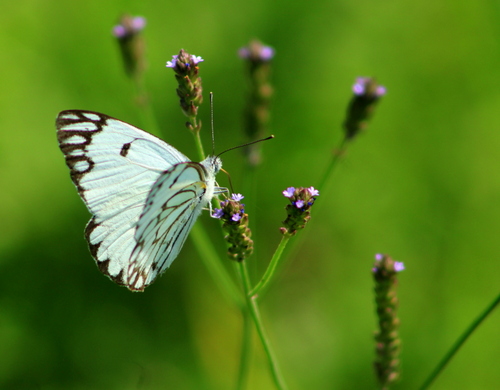
Brown-veined White (aka Pioneer Caper White)… 
…on mid-summer migration. Kusane.
That is a long way to fly for something so fragile and small.
What makes this mass migration even more astonishing is that the butterflies need precisely timed stopovers for feeding – which means they need to find flowers growing at regular intervals.
This can’t be easy since to fuel this epic marathon they probably have to harvest hundreds of flowers a day.
The other question which kept whizzing around my brain, as I stood watching them zig-zagging their way across the farm, was this – how can a creature with such a pin-size brain navigate and keep track of its position?! I must confess I have no explanation. As happens everywhere in nature, there still are many unanswered questions, which intrigue amateurs at least as much as scientists.
My butterfly list, so far, is not very long and includes no rarities, just your common varieties (although back in 2018, when I was in Marakele, I did see a Kransberg Widow, a very rare and beautiful butterfly which briefly appears during November and early-December and only occurs on this particular mountain. Unfortunately, I did not get a photograph of it).
I hope to rectify that.
To an outsider this making of lists probably seems like a strange passion, one bordering on obsession. Almost a perversion. They may be right. I don’t care. For me it is all part of the thrill of the chase.
As a long-standing twitcher, I have experienced the sense of excitement and privilege which comes from finding something special (a Pel’s Fishing Owl, Narina Trogon, African Broadbill, Rudd’s Apalis, Southern Banded Snake Eagle, Palm-nut Vulture, a pale, female, morph form of the Eurasian Honey Buzzard – to name a few). That thrill grows even stronger when you come across what we interpret as a “rarity” or a “vagrant” (my list is probably topped by the Gull-billed Tern which I got at Nyamithi Pan in Ndumo Game Reserve in Zululand).
Already I am picking up some valuable tips and learning some important life-lessons as I pursue my quarry and record my sightings.
I have discovered, for example, that while we humans may abhor them in our gardens, butterflies simply love weeds. The irritating black jack, which you find so annoying because it sticks to your clothes when you brush past it, seems to be a particular favourite of theirs.

This in turn has caused a major rethink on my part. Suddenly I am far more reluctant to pull these bothersome plants out of my flower garden and toss them to the chickens to turn in to mulch. They fulfil a role. They feed the butterflies who I want to attract to my garden. I want the butterflies to look upon my home as their home.
With climate change already taking its toll, one wonders what will happen to the humble, unassuming, butterfly in the future? Will they be able to evolve or adjust their behaviour?
Rising temperatures, associated with climate change, have already begun to change birds schedules. Many have started moving south.
When I first arrived in KwaZulu-Natal, for example, it was unusual to see the Wooly-necked Stork south of the Zululand parks. An uncommon resident they were regarded as a wetland species associated with lagoons, ponds and rivers. In recent years they have started showing up in increasing numbers in cities such as Pietermaritzburg and Durban, in a sense swapping one habitat for another.

Some plants are also making this latitudinal shift.
I would imagine the same is happening to butterflies although I don’t know enough about them to be sure. Assuming that tree and flower-blossoming times are also changing it seems likely though.
What I do know for certain, is that I hope they will always be around. If the ancient Greek Goddess, Gaea – the first deity to be born after Chaos, the gaping emptiness – is seen as the personification of the earth and the Mother of Everything Beautiful, then the unassuming butterfly must, surely, be one of her most potent and miraculous symbols?
GALLERY:
Herewith a selection of photographs, showing some of the butterflies in our area:

African Blue Pansy, Kusane 
Angled Grass Yellow, Kusane. 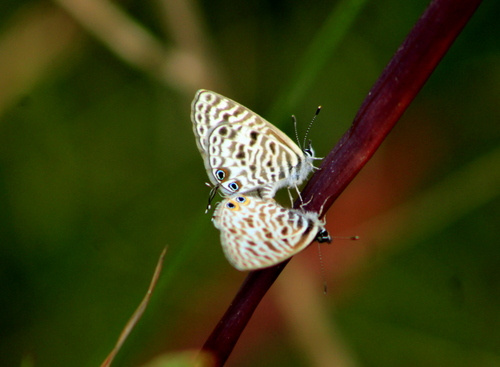
Common Zebra Blue, Kusane 
Dark Blue Pansy, Kusane. 
Forest Swallowtail (aka Bush Kite), Karkloof Forest. 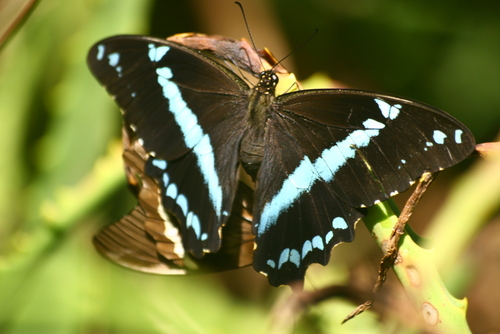
Narrow Green-banded Swallowtail, Kusane 
Painted Lady, Kusane 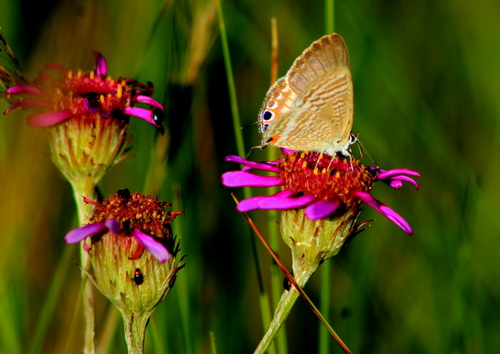
Pea Blue, kusane. 
Pirate, Kusane 
Polka Dot, Kusane 
Rainforest Brown, Kusane. 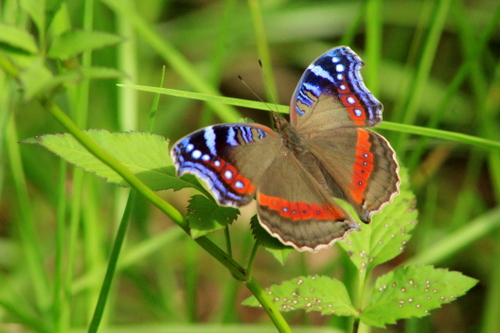
Garden Inspector, Kusane. 
Southern Gaudy Commodore, Kusane. 
Vine Leaf Vagrant, Kusane. 
Yellow Pansy, Kusane
.
* Field Guide to Butterflies of South Africa by Steve Woodhall (published by Struik Nature).
 Stidy's Eye
Wow! What a magical world you have led us into Ant. Your story and accompanying photos are fantastic. I love the colours. Who would have guessed that there were so many variations of butterfly at Kusane? Now I must go out into my garden and have a look at what species I have. I’ve noticed lots around, but haven’t looked close enough. At least this is something that I can do during lock down!
LikeLike
Thanks, Sal. As I said, I can’t believe I have neglected them for so long! I got quite a few in my garden (including, obviously, the Garden Inspector – it seemed to like what it saw) so good luck hunting…
LikeLike
Wonderful Inspiring post Ant! Nature’s wonder in all its glory, and something that often goes unnoticed. Thanks for helping us appreciate this wondrous creation
LikeLike
Thanks, Penny. I am just grateful to be living where I do and that I have the time to go out and explore it. I hope you are finding time to do the same with yours?
LikeLike
Thank you for this Stidy… I am very happy to say I have seen many of those butterflies when walking at Kusane… but not all of them – so that means I have to come back soon!!! I really do think they’re amazing and am sure you will be an expert in no time. it’s lovely to know you are out there spotting them. I am going to check my photos now and see which ones I’ve caught – definitely the painted lady and southern gaudy, the forest swallow tail and the polka dot. but not the pansies… I need to see them -they’re stunning. xxx
LikeLike
Thanks, Kerry. I didn’t realise you were keeping a sharp eye out for butterflies on your walks but it is good to hear. We will be able to compare notes (and pics) when you come out here again. Stay safe.
LikeLike
Very beautiful pictures….they are such fragile creatures. A breath of fresh air in these frightening times, thank you so much.
LikeLike
Thank you so much, Sue. There is solace to be found in nature…
LikeLike
That’s a beautiful world you’ve discovered and I can’t believe what a variety of butterflies you have at Kusane. I love your blogs, they’re so sensitively written and so descriptive
LikeLike
Thanks, Mary-Ann. I can’t believe that such a beautiful world existed right under my nose and I hadn’t paid it much attention. Too busy looking for birds, I guess…
LikeLike
Lovely Stidy, what a beautiful, interesting blog. And your photos are superb! Jeepers there are some stunning butterflies you’ve captured brilliantly!
LikeLike
Thanks, Ken. I have always thought I was fairly observant but the fact I have overlooked these beautiful creatures for so long makes me realise I have been a bit of a sleep-walker. Since I wrote my blog I have photographed some new ones too. Like birding, it is quite a challenge to get a good picture as they seem to pick up your vibrations and fly off. Now for the Karkloof Blue!
LikeLike
I know how hard it is because I’ve tried to photograph a few myself, which is why I’m so impressed by your photos! Looks like you have the makings of your own field guide there …
Does the Karkloof Blue occur in the habitat around you or do you have to go to the forest?
LikeLike
From what I have been able to discover (via Google) he is a Midlands grassland butterfly whose numbers have declined because of burning, alien plant encroachment and livestock – so you would think he would occur on Kusane. I see my new book calls it the Karkloof Cupid. I also see there is a butterfly called the Karkloof Emperor who occurs on forest edges and rocky outcrops. Looks beautiful, so I must look out for it as well!
LikeLike