The history of war art has an ancient pedigree dating back to before early Egyptian times while the importance of this art form has long been recognised, not least by governments who have sought to utilise artists’ skills specifically for the furtherance of the war effort.
In Britain, for example, an official war art scheme was set up during the 1914-18 war which continued right up to the Falklands war, a unique experiment in Government patronage that has produced an unrivalled national collection of paintings, drawings and pieces of sculpture. Although theoretically employed by their governments as propagandists, many of these official war artists would go way beyond their original brief, producing work of genuine artistic merit.
An obvious example of this is the artist Paul Nash who joined the Artist’s Rifles in the First World War. Initially motivated by a straightforward patriotism, his belief in the rightness of war would, in time, begin to crumble as he was exposed to the horrors of trench warfare. His subsequent paintings of ravaged landscapes with trees shattered by shellfire bear comparison with the best of the war poems in their depiction of the nightmarish conditions in which the soldiers were forced to fight.
(Needless to say, Nash’s employers were less than enthusiastic about his work.)
Not all war artists are, of course, engaged in this capacity. Many self-employed ones take up the practice for more personal reasons – an interest in war from an emotional, social and psychological point of view or simply to produce a pictorial record that can be studied and interpreted by posterity, a mirror of the times.
The well-known Southern African war artist, Peter Badcock slots comfortably into this latter role. Having grown up in the region he fell into the business of war art almost by chance when he found himself serving in the Rhodesian security forces and decided to put his skill as an illustrator, working in an animation studio, to good use by producing a book about the conflict. The gamble paid off. Published in 1978, Shadows of War was an immediate success. Encouraged by its reception he would go on to bring out two more bestsellers covering the conflicts in white-ruled Southern Africa– Faces of War (Rhodesia – now Zimbabwe)and Images of War (South West Africa – now Namibia).
His latest book, A War Artist’s Diary, is essentially a distillation of these three books but also includes a realistic appraisal of the two wars – as well as his involvement in them – written from the vantage point of hindsight. Beautifully produced, and including 100 of Badcock’s best drawings, as well as a selection of his evocative poems, it provides a vivid, almost documentary-style, account of life in a war zone.
In his art, Badcock aims for a scrupulous integrity, although it is obvious that his association with the army necessarily influenced the subject matter available to him. As he writes in his introduction, the drawings are “not intended to eulogise or defend either side in the tumultuous history of these events but to capture the human dimension of men and women at war”.
Badcock deserves full credit for achieving just this. His drawings have an almost photographic accuracy of representation. They record not only the conflicts themselves but the life going on around the fighting, a sort of behind-the-scenes view of people going about their ordinary work in extraordinary circumstances.
Published by Simon & Schuster
Over 150 000 years ago mankind diverged from the cradle of the African plains and began spreading over the globe. This trend has continued until the present day and has been followed by “convergence” as disparate communities re-established contact with each other. What this ought to tell us is that migration is not an aberration or something you only undertake under duress. It is an essential component of the human condition, a natural urge, part of our make-up. It is, as it has always has been, about the pull of opportunity.
Despite this, there has been, especially in recent years, a great deal of nativist, anti-immigrant sentiment, much of it stirred up by populists of the Donald Trump ilk who insist on referring to it as “foreign invasion”. In this fascinating and thought-provoking book, author Felix Marquardt takes issue with such views arguing that, in many cases, it is in our best interests to welcome newcomers and share our spaces. As he points out, a new generation of migrants, well-educated, tuned in through their smartphones to global events, entrepreneurial and full of ideas have come into being and we would be foolish to turn them away.
Also, contrary to popular belief, most of these immigrants don’t sink into poverty or live in dingy apartments in high crime neighbourhoods. Rather, they have contributed to and flourished in their new countries because of their work ethic and determination to carve out a new life. Others have taken hazardous or poorly paid jobs shunned by the native-born and helped grow the economy that way.
Nor are all migrations necessarily about poor people heading to richer countries. The author cites many examples of the reverse – where young people, stifled or not seeing a future for themselves in the country of their birth, have moved to places like Africa where they are still trying to develop and modernise their economies and it easier to build something up from scratch. Technological advances have also led to increased mobility. These days you can, with a computer, do your work anywhere. For the author, these acts of migration can be transformative, it can teach you to open your eyes and ears to other people and grow from the experience.
Writing, in part, from his own experiences as a person of mixed heritage who has called many different countries ‘home’, the author has made an important contribution to the whole migration debate. Going beyond the usual headline cliches about helpless refugees, he finds a far more complex and, in the end, positive story. Amid the thought-provoking broad-brush picture, Marquardt also wields a vivid miniaturist’s pen as he describes the people involved in these modern- day migrations – those he calls the New Nomads.
That morning, I was woken by the alarm of bird calls; the sky was turquoise, becoming lighter close to the pencil-line horizon. I levered myself upright and began putting on my boots. Motionless, the land lay stretched out below me.
Charged with the army’s acrid coffee, I was sitting up against a large boulder enjoying the cool, morning air when the quiet was punctured by the dry snapping of rifle fire on the valley floor below. It didn’t take me long to grasp what had happened. One of our patrols had got caught up in what sounded like a very serious firefight.
Almost immediately our radio crackled into life. ZANLA forces had been encountered in large numbers. Our orders were to sweep down from our OP (Observation Point) in the foothills of the Mavuradonha Mountains and attempt to engage them from the rear (they had fled by the time we got there but they came back later and found us).
As I grabbed my rifle and webbing and slung on my backpack I found myself thinking, once again, about the weird unreality of it all. How in the hell had I, a pacifist by nature, managed to get myself mixed up in this vicious bush war? Landed in this strange situation where the unfamiliar had suddenly become familiar?
It was not a war of my choosing, nor one I particularly wanted to be part of. Even today I still cannot adequately explain why I stuck it out until the bitter end of the conflict and carried on fighting long after many of those who had believed far more passionately in the cause than I had decided to call it quits – “gapped it” to use the slang of the day – and left the country. It is also no use pretending I was anything else but an extremely reluctant soldier or that I showed any real aptitude or talent for military life. Indeed, for the most part, I never felt I was anything more than a resentful, inadequate, half-trained civilian.
Looking back across the years I sometimes have difficulty recognising that man in the grubby camouflaged kit as myself; there is an abiding strangeness about it all. It is as if I am looking into a broken mirror and all those experiences happened to someone who looked like me but was in fact an impostor. For me, the past is, indeed, another country.
An abiding strangeness. At Marymount Mission, in the extreme North-East of thecountry, near where the Mazowe River crosses into Mozambique. This was on my last call-up.
And yet, now that I reflect back on it, I realise the army was not all bad. It had some value. Firstly, it tested me in ways I would never have otherwise known. I learnt about physical and mental hardship, about dealing with extremes and staring into the abyss. I discovered what it was like being stripped down to my most basic self. At various stages, I was the hottest, coldest, most tired, thirstiest, hungriest, terrified, angry and miserable (but not the happiest) I have ever been in my life.
The fact that I survived these in extremis tribulations and emerged from it frayed, disenchanted and proud afterwards was, I suppose, an achievement of sorts.
Secondly, the army took me into areas I would have not otherwise seen and in so doing heightened my appreciation and love of the African landscape. In some perverse way, all the discomfort, fatigue and fear I experienced during those war days became a form of mini catharsis; it made me feel more part of the bush. We even had a term for it, one that suggested a temporarily disarranged self – one became “bush happy”.
The landscape affected me in other ways. Not sure whether my role was that of the hunter or the hunted I found my senses becoming sharpened to the sounds and smells of the bush. Far from the comforting normality of civilian life, I became increasingly feral in my habits, always watching and listening for anything that might threaten my chances of getting out alive.
For much of my initial national service – and in the subsequent seven years of military call-ups – the regiment I was with operated in the extreme North-East of the country, an area where civil administration, outside a few sandbagged strong points, had all but broken down. Not too far from the border with Mozambique, it was among the harshest and most rugged landscapes in all of the then Rhodesia and, along the escarpment itself, virtually uninhabited.
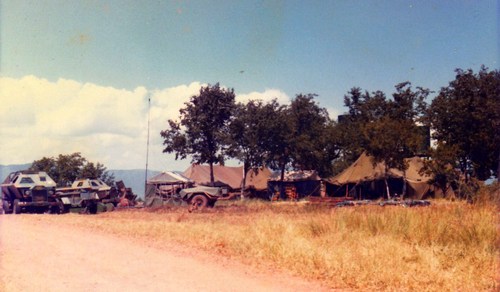
Assembly Point Alpha, Hoya, near Mozambique border, 1980. Mavuradonha is in the background. It was here my war came to an end…
What always struck me most about this landscape – apart from the heat and general sense of discomfort – was the feeling of immensity it evoked. Behind us, the Mavuradonha Mountains rose in a steep pitch from the Zambezi valley floor while ahead of us a vast plain stretched out almost without undulation. And beyond that lay more of the same, hundreds and hundreds of kilometres of raw, unspoilt, and untrammelled country leading up through Mozambique and then into the rest of Africa.
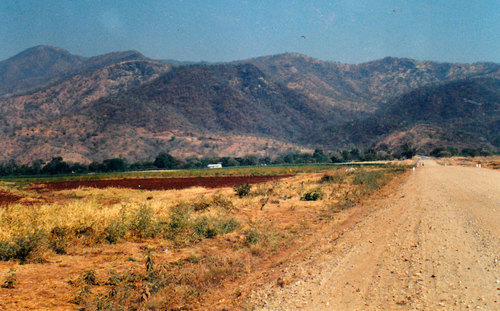
Mavuradonha, near Mzaribani. I took this pic on a return trip several years after the war ended.
The more time I spent in it the more I began to see the beauty in the timelessness and silence and hugeness of the land. The sheer vastness of it seemed to be immeasurably increased by the dryness. Then there was the silence, broken only by the occasional bird song or jackal howl at night or a sudden gust of wind blowing in waves of warm air. It is a kind of silence you just don’t get in the normal, urban world with its bustle and false pleasures.
This, in turn, brought with it a vague feeling of loneliness, a sense of being cast off from familiar moorings, an awareness that there was no one else within easy reach. Strangely enough, this only added to its appeal.
Operating in this sort of country was never easy. In summer the heat could be stupefying. Weighed down by my heavy pack and ammo I could feel the sweat trickling down my back and soaking my shirt. It chafed between my thighs.
On patrol.The bicycle we found abandoned in the middle of nowhere…
Thirst could plague us like a nagging toothache. We had to develop the will to endure it. Because we only carried a couple of bottles each, I was forced to restrict it to little sips. On several occasions, I suffered from severe leg cramps. Most awful of all was the time I collapsed from heat exhaustion and complete dehydration. My legs refused to function, my tongue became dry and swollen, like an old piece of leather while my throat felt like it was coated with fur.
If it wasn’t for a spotter plane that picked up our distress call and later returned to drop water, I often wonder if I might ever have got out…
The heat was not the only thing we had to contend with. The Shona word Mavuradonha roughly translates as Land of Falling Water and as the season progressed you could understand how it got its name. After months of nothing but sun and dust, the weather would begin to change. It would grow more unsettled and windy, moving smells around. Tall, purple-bottomed clouds would build-up to the north.
Once the rains broke we were put through the whole gamut: heavy rains, moist, intermittent rains, a half-hour sprinkle, a thundershower, drizzle. Our clothes and equipment became cold, damp, smelly. At night we had to endure all the discomforts as it poured down on us. Now and again, especially in the early stages of the storm, the darkness would be torn away for a second by a dazzling flash of lightning which would bathe the surrounding bush in a strange, otherworldly light. Then the thunder would roll, like the sound of cannon fire, and we would lie there dazed and stupefied and shivering in our sopping wet sleeping bags while the rain came pelting down around us.
Usually, the storm would pass as quickly as it came, the wind would die down and we would do our best to get back to sleep. In the morning the sun would shine through the wet leaves to where we lay sodden and miserable. Once we had dried out our gear and re-oiled our rifles we would continue on our patrol.
We couldn’t drop our guard. Such is the nature of guerilla warfare that we never really knew who we could trust – if, indeed, we could trust anyone – amongst the local civilian population. In most villages we visited the response was usually muted – neither friendly nor unfriendly. It was difficult to know, too, who the locals were more scared of offending – us or the other side. Many, accused of being “sell-outs”, had been arbitrarily killed by the guerillas as a warning of what would happen to those who chose to betray them. Others had been caught in cross-fire between the opposing forces and died that way.
While the more cautious hedged their bets, I am sure many did want to see a more representative government, one not made up solely of whites. For all we knew they could be in direct contact with the ZANLA forces, maybe even feeding them and passing on information about our movements.
In this sense, the war had already begun to highlight something of considerable political significance – it provided the ultimate test of the black “povos” ( English translation: the masses, the common people) real feelings. Although it helped, of course, to be armed we could never quite escape this sense of hidden danger or that, outside of our fellow soldiers, there was no one we could rely on.
Mavuradonha, view from the infamous Alpha Trail, scene of many ambushes and – before it was tarred – landmines.
For the most part, we operated in five-man ‘sticks’ sometimes linking up with another stick at night for added security. Patrolling in such small groups through a potentially hostile country, where the loyalty of the locals could not be relied on, I did my best to keep my eyes open, my mind alert to my surroundings or any movement in my peripheral vision. Alone like that, it was easy to feel eyes watching us, indeed the suspicions of being followed and watched became a constant companion. The uncertainty weighed on our minds.
Towards evening we would usually stop for one last brew-up before moving into our final position for the night. It was the time of day I liked most. There is something about the dissipating violet light as the sun sinks which makes everything seem, holy, natural and familiar. It is a time when earth, rock and sky seem to marry, a time when surrounded by the great wall of the mountain the landscape seemed to acquire an uplifting, transcendental quality. I could feel its beauty penetrating my soul. It made me feel grateful for being alive, grateful for having survived another day, grateful that I would shortly be able to sleep.
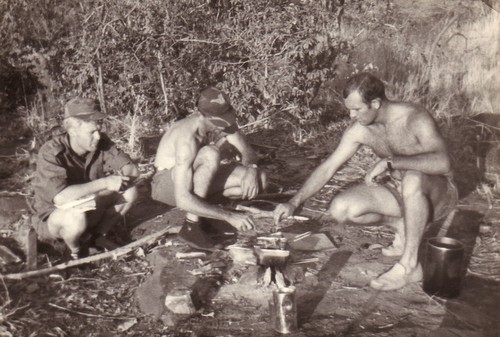
Cook-up time in Zambezi Valley.
Far from the big city lights or man-made pollution, the night swarmed with stars while the sky above us seemed bigger than any I had ever seen before. Sitting in the middle of nowhere, staring into the enormity of space and feeling, in the most animal sense, my infinite littleness it was often hard to make sense of all. Perhaps that was the point of it. To make us feel very small, to remind us that we are just a speck and that our time on earth is short and fleeting.
Of what importance was I, caught up in this forgotten, war, in the grand scheme of things? Like many a soldier before me, I was forced to acknowledge the helplessness and insignificance of my lot – while at the same time cursing the old folk who had got us into this jam.
Not that these moments of philosophical introspection lasted long. Where, the night before, the world had seemed ethereal, dream-like, in the morning light I was only too aware of its hard contours, its physicality and my sense of discomfort.
One experience, in particular, still haunts my memory. It was our first major cross-border excursion into Mozambique, an exhausting march not made easier by the fact I was suffering from severe diarrhoea during the high summer heat and only had a limited amount of water to drink. There was something strange and spellbinding about crossing into an enemy country. It was like we had been passed through more than just a physical boundary. We had entered another dimension, reached the very edge of the known world. Civilisation, as I knew it, seemed a very long way away.
The further we penetrated, the more cracked, bleached, and wild the country became. The heat left me breathless. After days of tramping through the dry, Mopani-dominated scenery the vegetation suddenly began to green up and thicken and in the distance, we could make out the unmistakable sound of flowing water. We had reached the Zambezi.
The broadening river was full of cigar-shaped islands covered with reeds. Tall vegetable ivory palm trees, massive Ana trees and Natal Mahogany’s dotted the far shore under which grew a mass of riotous vegetation. Fed by several additional large tributaries the river had grown even wider and more powerful and imposing than the one I was familiar with, stretching out before us like a rumpled sheet of blue vinyl and measuring a good kilometre or two from side to side.
The emptiness of the country we had passed through was reflected in the emptiness of the river and its banks. There were no signs of human activity: no men polling along in dugouts, no fishermen, no women washing, no children playing on the water’s edge and no domestic animals. Indeed, the scene before us had probably changed little since David Livingstone and his mutinous crew came steaming up the river in the Lady Nyassa all those years ago.
The landscape itself – aside from the river – was similarly devoid of feature. No cliffs nor distant mountains were framing the river valley. There were few roads or paths to follow and the odd villages we passed through had long since been deserted. It all seemed strangely peaceful. For all intents and purposes, it appeared to be uninhabited although we knew were not alone. Somewhere out there was not only ZANLA but the Mozambique resistance movement, Frelimo, as well.
That thought kept us on our toes.
Reluctant to leave the cooling shade of the river we lingered as long as we could before turning around and heading back to our extraction point where we were due to be picked up and choppered back to our military base in Musengezi, just across the Rhodesian border. We could see no sign of life from the air either as we flew over the baked, engulfing landscape; just trees and more trees stretching from horizon line to horizon line.
Helicopter pick-up in typical dry season Zambezi Valley bush.
So undifferentiated was the landscape that if not for the occasional baobab, I would have lost all sense of perspective. Looking like prehistoric animals with enormous bodies and a multitude of limbs spreading out laterally, as if they wanted to pluck us from the sky, they towered above the surrounding trees.
As we skimmed over their outstretched branches, I remember thinking to myself that winning a war in this sort of country would be virtually impossible. All the enemy had to do was stage hit and run attacks and then allow themselves to be swallowed up by the empty space where no one was likely to notice them because there were so few people to notice anything and those that there were would be unlikely to be in any hurry to trek to the nearest Security Force outpost to report what they had seen.
Time, the Great Revealer, would prove me correct on this point…
With the effects of climate change becoming more and more apparent, the need to shift to new “green” technologies has become a mantra and a rallying call for a generation. In the rush to embrace these supposedly cleaner and more efficient inventions what is often overlooked, however, is that many of them come with their own ecological cost.
Just as the disruptive effects of fossil fuel on the climate threaten our continued existence so, too, does this new revolution present its dangers. This is because so many of the items we now consider indispensable to modern living – wind turbines, electric batteries, solar panels, as well as smartphones computers and the like – are dependant for their manufacture on a cluster of little known rare metals found in terrestrial rocks in infinitesimal quantities.
Already, in some countries, most notably China, the mad rush to mine these metals has had dire consequences on the environment, as vast tracts of land are ripped up and rendered virtually uninhabitable by the extraction and refining methods. This pattern is being repeated elsewhere in the world – the DRC (Cobalt mining) and South America (Lithium) for example.
There are, of course, important geopolitical reasons for all of this. By capturing the lion’s share of the rare metal market China has been able to consolidate its growing global power, as well as gain greater economic and military leverage.
In short, rare metals have become the “new oil”.
One of the more worrying aspects of these developments is that the West seems to have been happy to allow China – in part because it means less pollution in their backyards, in part because of a poor assessment of China’s competitive streak – to develop its stranglehold on world production. Only now is the West waking up to the fact that they are lagging seriously behind in this new energy race – a case of closing the stable door after the horse has bolted – and that it could leave them very vulnerable.
In this extensively researched investigation into the subject, Guillame Petron, a French Award-winning journalist and documentary maker, has talked to many experts as well as travelled around the world gathering information. The amount of data he has collated is vast, yet he succeeds in making it (mostly) comprehensible to the lay reader.
The book’s timely message may make jarring reading for those pinning their hopes on a greener future. As the author writes: “The energy and digital transition is sending humanity on a quest for rare metals, and is doomed to aggravate divergence and dissent. Rather than abate the geopolitics of energy, it will compound them.” Petron also argues that we need to be more sceptical about how many of the new technologies are produced.
For all this, The Rare Metals War is by no means a hatchet job intended to reveal the evils of the new technological order. Instead, it’s a careful analysis that sets out to both pose and answer some pressing questions, as well as suggest possible solutions and alternatives.
Published by Manilla Press
This book tells the incredible true story of nine women resistance fighters during World War Two who find themselves imprisoned in a country that has itself become a criminal conspiracy. Having been captured while fighting against their German occupiers, they were interrogated, tortured and sent east into Greater Germany to a concentration camp at Leipzig where their lives were made a living hell.
What comes over with striking force, on reading about their experiences here, is, once again, the sheer barbarity and depravity of the SS and the Gestapo, as well as a Nazi government that saw fit to licence mass slaughter as a political process.
Not all the German soldiers were complicit in this almost unimaginable cruelty. In the Leipzig camp, for example, there was, one kindly older guard who, realising the game was up, smuggled in a pair of wire-cutters for the prisoners.
They never got to use it.
With the allies closing in on all sides, the women, already badly malnourished, were forced out onto the open road. The German plan seems to have been to march them to their deaths since there was no longer any food at Leipzig and they had no gas chambers or efficient ways to execute them en-masse. Many were indeed slaughtered by machine guns along the way.
Determined that this would not be their fate, the nine women, by now close friends, made plans to escape. Led by the indomitable, well-educated, Helene they finally seized their chance.
Gwen Strauss, the author, is the great-niece of Helene and in this riveting, impeccably researched and extremely moving story of hope and courage in the face of seemingly impossible odds, she tells the harrowing tale of their capture, imprisonment and subsequent flight to freedom.
Nor did problems end when they finally got back to their homes. At the time, the population was urged to put the war behind them as quickly as possible and get on with their lives. This was easier said than done. Damaged and changed forever by their traumatising experiences in the German camps, they suffered from depression, shame, rage, helplessness and guilt and found it hard to settle back into a peacetime existence they hardly recognised at all.
Written from the viewpoints of each of the women involved, The Nine is always absorbing, frequently horrifying but with odd unexpected moments of humour to lighten the load.
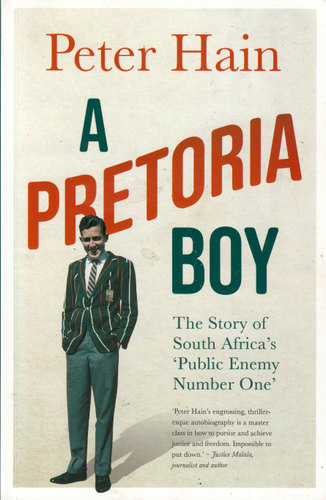
With the benefit of hindsight, it is strange to think that there was a time when the mere mention of the name ‘Peter Hain’ was enough to send the average sports-loving, white South African into an apoplectic fit. Reading his well-written, unflinchingly candid memoir, however, certainly brings it all back home.
From the start, Hain was nothing but contrary. Both of his parents were active members of the South African Liberal Party and as a young schoolboy, growing up in Pretoria, he found himself rubbing shoulders with the likes of Allan Paton and other such luminaries. Inspired by their core principles and selfless example, he rebelled against the country’s official policies at an early age learning, in the process, what it was like to live under constant state surveillance.
Later, Hain’s fierce opposition to Apartheid would see him become not only an irritating thorn in the flesh of the National Party government but also a loathed figure in the eyes of a large portion of their supporters (and a few liberals as well), who saw him as nothing more than a grandstanding, young upstart.
In 1963 Hain’s parents were served with a five-year banning order which restricted their movements and prevented them from entering certain areas. Faced with a ruthless regime that crushed all peaceful protest, many other anti-Apartheid activists began calling for a rethink of tactics. Hain’s parents, however, remained steadfast in their commitment to change through non-violent means but their close friendship with the Johannesburg station bomber, John Harris, brought them under increasing scrutiny by the country’s security services. They were harassed to the point where his father was unable to find employment and although reluctant to do so his family were eventually forced to leave the country.
Exiled to Britain, Hain did not forget his roots nor his steadfast opposition to the South African government and its policies. Mad about sport himself, he knew only too well how important this was to the white South African sense of self. He began organising militant campaigns in the UK against touring South African rugby and cricket sides as his contribution to the struggle. It had the desired effect. In no time Hain found himself dubbed ‘Public Enemy Number One’ by the South African media.
As successful as his tactics were they did not go unchallenged. In 1972 he was hauled before the court on conspiracy charges in a trial that would become something of a cause celebre. After that got thrown out, he would be maliciously framed for a bank robbery. Behind all of this, he sees the malignant hand of the South African Bureau of State Security (BOSS) – with some assistance from elements within MI5 – who wanted to both discredit and neutralise him.
With the release of Nelson Mandela from Victor Verster prison on 11th February 1990, the public perception of Peter Hain underwent a startling metamorphosis. No longer the despised young firebrand of yore (‘Hain the Pain’), his formerly controversial views now became part of – in his words – ‘mainstream opinion.’ To his bemusement, he even had people apologising to him for previously dismissing him as nothing more than a troublemaker.
A career in British politics followed, culminating in him becoming a minister in the Labour government and then getting elevated to the House of Lords.
Wishing only what is best for the country of his birth, Hain has remained true to the values his parents instilled in him. When President Jacob Zuma’s malfeasance was becoming harder and harder to ignore he returned to South Africa and at the behest of several senior ANC members went on to use British Parliamentary privilege to expose the extent of the looting and money laundering. He also testified against Zuma and the Gupta brothers before the Zondo Commission. Nor did he confine his condemnation of wrongdoing to South Africa. As Britain’s Africa minister, he publicly castigated President Robert Mugabe of Zimbabwe for betraying the ideals of democracy and human rights they had both ostensibly fought for.
Part autobiography, part history primer, A Pretoria Boy serves as a salutary reminder, at a time when memories of those dark days have taken on a rosier tint, of just how grim and brutal life was under a regime that used fear to mould human behaviour and where people could be driven into exile – or, in some cases, killed – for expressing dissenting beliefs.
Although Hain displays little rancour or ill will towards his one time adversaries, his book will make uncomfortable reading to many of those he holds to account across the political spectrum.
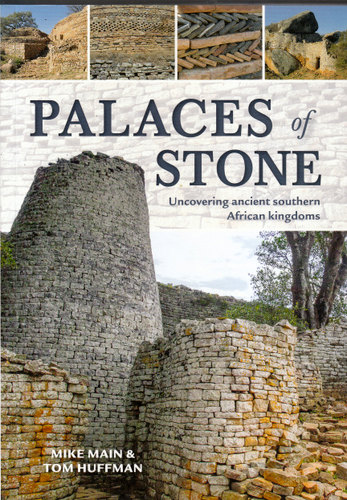
Scattered over substantial portions of northern South Africa, Zimbabwe, Botswana and Mozambique are a series of, often beautifully decorated, palaces and citadels whose existence points to a chain of once highly developed and flourishing city-states, each with clear rankings of authority and concern for all citizens. To date, over 560 of these unique stone structures have been found, many of which were only the central feature of a much larger urban sprawl.
In the case of Great Zimbabwe, in particular, all sorts of wild theories and explanations proliferated among the early white explorers (and later) as to who built them, with some linking them to the biblical land of Ophir, others to King Solomon’s Mines and the Phoenicians.
In this marvellously panoramic overview, authors Mike Main and Tom Huffman put these romantic notions firmly to rest by drawing on the latest research, discoveries and excavations to explain how and why they were constructed, as well as their subsequent rise and fall.
Although there had been earlier settlements, Mapungubwe, on the Limpopo flood plain was probably the first one that could be classified as a full, pre-colonial state. Built around the base of a steep-sided sandstone hill that rises abruptly from the valley floor, it was strategically placed on an important trading network. What may come as a surprise to some readers is just how extensive and far-reaching these trade links were, stretching, as they did, as far as the Indian Ocean and then to the Middle East and Asia.
It certainly puts a lie to the notion that Africa remained largely “undiscovered” until the first Europeans arrived.
The reasons for Mapungubwe’s sudden demise are still not fully understood although the authors proffer various possible scenarios including the most obvious one – changing climatic conditions. This would explain the subsequent expansion and consolidation of communities on the highveld plateau to the north, close to the greenstone belt and gold – besides cattle rearing another important source of wealth.
The most famous of these was, of course, Great Zimbabwe and it was here the local stone-building skills reached their zenith. Ruled by a succession of kings its influence would spread, making it an important power in the sub-region. Because they were often situated in drought-prone areas, rainfall and the supply of water played a critical role in these societies, so it is hardly surprising that rain-making became an essential part of this political power.
Vasco da Gama’s circumnavigation of Africa was, however, to have major repercussions for these once-powerful kingdoms by bringing to an end the golden age of Islam. The loss of this regular and organised outlet for trade had a disastrous impact on the prosperous African economy based, and dependent on it. Zimbabwe would subsequently be occupied by new invaders who did not know the purpose of the vast buildings. Eventually, they would become overgrown and fall into disuse. The myth of a large golden empire would, however, persist.
Lavishly illustrated and eminently readable, Palaces of Stone provides an excellent introduction to this fascinating chapter of Southern African history.
At the start of World War Two, the British lagged way behind the Germans in the aerial arms race. The primitive Whitleys, Hapdens and Wellingtons, that formed the backbone of Bomber Command, were inadequately equipped and prone to technical failure. For the most part, they proved no match for their German counterparts. This all changed with the advent of the most famous and iconic four- engined bomber of the conflict – the legendary Avro Lancaster.
When British Prime Minister Winston Churchill could see no other road open to victory, it was to this form of strategic air-power that he turned, the Commander in Chief of Bomber Command, Air Marshall Arthur Harris, having all but convinced him that the Third Reich could be bombed into submission. The cost of the campaign would prove high with Bomber Command’s casualties amounting to almost one-seventh of all British deaths in action by land air, and sea from 1939-1945. While 55 573 aircrew, almost all officers and NCOs, were killed, the German losses were far higher. It is estimated that somewhere between 300 000 and 600 000 people, many of them civilians, were killed by the bombs of the RAF and USAAF.
As effective as the strategy was, it was not without its critics. While many questioned its morality, especially where it involved significant civilian casualties, what is unquestionable is the patient courage of the bomber crews. Packed into their cramped flying metal tubes, they faced the strain of constant operations night after night, forging out into the empty darkness, knowing that the German gunners, probing searchlights and fighter planes would most likely be waiting for them and that their chances of returning were not good. Of the aircrew who served in Bomber Command, a staggering 44.4 per cent lost their lives.
This book is very much a monument to the gallantry, fortitude and endurance of these men. It is based on a series of interviews the author had with Ken Clark, the only surviving member of his crew and one of the very last witnesses of the Allied bombing campaign. Like many young men of his generation, he had been swept up by the whole romance of flying (my father, who also served in Bomber Command, was another), enrolling in flying school as soon as he was able to. He failed to make it as a pilot but was offered and accepted the role of bomb aimer, for which he was eventually awarded the DFC.
Thereafter he took part in countless missions over Germany and the rest of Europe and was also heavily involved in the Normandy D Day invasion. A mixed bag of personalities, the men he flew with were drawn from all over the Commonwealth. His pilot, Flying Officer Jim Comans, for instance, was Australian, another crew member was a Canadian.
Written with remarkable factual authenticity, The Crew captures the terror and exhilaration, the comradeship and self-sacrifice that, for the duration of the war, was at the heart of these men’s experiences. Author Price handles the big political set pieces, that formed the background to the bombing campaign, superbly but his narrative is also consistently enlivened by his ability to telescope in on the small and telling details that reveal what the life of an ordinary Lancaster crewman was like.
published by Jonathan Ball Publishers.
Although located far from the main theatres of conflict, South Africa’s strategic global position, because of the Cape sea route, was considered of vital importance to both the Allied and Axis powers throughout the Second World War.
Determined to disrupt Allied shipping, the Germans quickly dispatched packs of U Boats into South African waters. Initially, at least, they enjoyed some success with a considerable tonnage of shipping being sunk. Hoping to encourage sedition within the country itself, as well as gather valuable military and naval intelligence, the Germans also set up an espionage network – commonly referred to as the Trompke network – operating out of Lourenco Marques in Portuguese-held Mozambique.
They found willing accomplices on South African soil. The decision by the Smuts government to declare war on Germany had not been a universally popular one with a substantial segment of the Afrikaner community still harbouring deeply anti-British feelings as a result of the Boer War. Their opposition to South Africa’s participation in the war crystallised around support for the Ossewabrandwag, a cultural organisation founded in September 1939 and led by the defiantly anti-Imperial Hans Van Rensburg. At first, the contact between Germany and this group of disgruntled South Africans was fairly haphazard but as the war progressed more secure lines of communication were established, particularly through the enigmatic Felix Network.
Alerted to the threat, the British and South African authorities retaliated in kind by establishing their counter-intelligence units although their effort to track down the enemy was often bedevilled by inter-service rivalry and the fact that some local government officials were not entirely committed to the Allied cause. Although a wealth of evidence would be gathered after the war pointing to the fact that Van Rensburg and his cohorts had committed wartime acts of high treason the election of the National Party in 1948 and a changing political climate would ensure they were never prosecuted and got off scot-free.
In writing about this period of our turbulent history, Kleynhans – a senior lecturer in the Department of Military History at the Faculty of Military Science at Stellenbosch University – gained much material from the Ossewabrandwag Archive, an under-appreciated, and largely unknown, archival collection containing key source material detailing the nature and operation of the German intelligence networks in Southern Africa. As well as uncovering a great deal of factual information, his excellent study includes vivid stories about would be German spies crossing crocodile-infested rivers to gain access to South Africa, daring escapes from internment camps and the setting up of transmitter stations, which could communicate directly with Berlin, in remote parts of the Highveld.
As Kleynhans readily acknowledges much of the intelligence gathered for transmission by these isolated cells seems to have been of questionable value. In his view, however, they did serve “a definite propaganda purpose among antiwar segments of South African society”.
What they also did was show up the deep divisions within South Africa society. Undoubtedly the most thorough, even-handed and detailed account of this now mostly forgotten chapter of our history written so far, Hitler’s War admirably captures this schizophrenic state, as well as filling in some crucial gaps in the historiography of the war.
The granite of the ancient north. A return visit to the Matopos hills with my English cousin, Rebecca.
When I was seven-years-old I was despatched, by train, to a boarding school on the other side of the then Southern Rhodesia and my world changed. From a life of being surrounded by family and a familiar, comforting, routine, I found myself thrust into a society whose mores, customs and rules were all terra incognita to me. Caught in a fusion of fear and fascination I didn’t know quite what to expect from this new arrangement. Whether I was ready for whatever challenges lay ahead of me only time would tell.
My departure, by train, on that balmy summer’s evening, would set the pattern for the next six years of my life. Three times a year my parents would drop me off at Salisbury station and three times a year they would be waiting at the same station to collect me.
The all-boy boarding school I found myself clanking towards in that old, coal-fired, steam train was named Rhodes Estate Preparatory School (REPS), after the man whose devious machinations laid the groundwork for the seizure of a country: Cecil John Rhodes. Overlooking the glorious Matopos Hills, the school specialised, as its name implied, in preparing impressionable young white boys for the rigours of life in the colony, and fostering a simple pride in the country. It also served as the main feeder school for Plumtree High, one of the oldest and most prestigious schools in Southern Rhodesia, situated alongside the main railway line to South Africa, near where it crossed the border into Botswana.
REPS Hostel
REPS Church
The headmaster of REPS, when I got there, was a Scotsman, Mr McClaren, a strict disciplinarian who was nevertheless loved by the boys for his dry, depreciating, wit. In my mind, I can still hear him thundering at me in his thick Scottish brogue when I had messed up an answer: “You are up the pole boy – COME DOWN!!!”
I was always a fairly shy child and, initially at least, I found the forced gregariousness, regimentation and lack of privacy difficult to deal with. I suppose I was lucky in that my one brother, Pete, a couple of years my senior, was already at R.E.P.S. Unlike me, however, he had faced his separation from home in a manner entirely consistent with his straightforward, practical approach to life. He had taken it all in his stride. Determined that I, too, should learn to stand on my own two feet he made a point of leaving me to my own devices for the first couple of weeks.
Fortunately, I think my easy-going nature and innate cheerfulness helped here, for I soon managed to acquire a circle of friends, was never really picked on or bullied and ended up enjoying my days at R.E.P.S. It that sort of setting it would have been hard not to.
Made up of labyrinthine chaos of granite rocks, kopjes, domes, whale-backs and other formations*, pushed out of the earth aeons ago, the Matopos Hills are an area of breath-taking beauty. Both the Shona and, later, the Ndebele believed them to be the residence of their high God – Mwari for the Shona, Mlimo for the Ndebele – and regarded them as sacred. Mzilikazi, the first king of the Ndebele, was buried there. Eager to stamp his authority on the land, Cecil John Rhodes also chose World’s View (or Marindidzuma – the haunt of the ancestral spirits) as the site of his grave, so impressed was he by “The peacefulness of it…the chaotic grandeur of it all”.
Worlds View.
In his funeral poem, “The Burial”, Rudyard Kipling, who had been Rhodes house guest in Cape Town, refers to the hills in his oft-quoted line “The Granite of the ancient North, Great spaces washed with sun.” Whether Rhodes was worthy of all the praise Kipling lavished on him in the poem (“The immense and brooding spirit…Living he was the land, and dead, His soul shall be her soul”.) is, of course, a matter open to debate…
World’s View
Grave of Cecil John Rhodes
View from World’s View
During the Matabele Rebellion, Rhodes had, indeed, shown considerable bravery by riding unarmed in to the Matopos, with a small group of companions, to negotiate a peace deal with the Matabele leaders. Also interred at World’s View are the remains of his sidekick, Doctor Leander Starr Jameson, whose impetuous and ill-considered Jameson Raid into the Transvaal, had precipitated the Boer War. Encouraged by its failure and the absence of so many white troops outside the country, the Matabele (or Ndebele) – a northern offshoot of the warlike Zulu – launched the first sustained campaign against colonial authority in Africa. Many of Matabele impi would subsequently operate from and seek refuge amongst the hills where even the likes of Colonel Robert Baden – Powell, despite all his scouting experience, would be hard-pressed to flush them out.
On the same smooth granite batholith on which the two lies buried there is another, larger monument, erected, on Rhodes’ instructions, in memory of the ill-fated Shangani Patrol.
Memorial to Shangani Patrol
Memorial – detail.
On the afternoon of December 3rd, 1893, Major Allan Wilson had led a patrol of 16 volunteers across the rising Shangani River in pursuit of Lobengula, king of the Matabele. Cut off from the main force under Major Forbes by the swollen waters, Wilson found himself surrounded, the next day, by an estimated 3 000 Matabele warriors. Fighting to the last round he and his men were all eventually killed.
Before they met their death, the final six reputedly took off their hats and sang “God Save the Queen”. Because of his brave actions – although some historians consider his pursuit of the much larger Matabele force to have been a reckless gamble, on par with General Custer’s last stand at Little Bighorn – Wilson would be elevated to the level of national hero and have a school named in his honour. For his part, Lobengula, protected by the remnants of his loyal impi, continued northwards. He died, by taking poison, when he heard his army had surrendered and was buried, sitting up, in a cave. Disciplined as it was by pre-colonial standards, his forces were no match for the lethal British Maxim gun, which was used for the first time here.
It was a sad ending for a man who, by all accounts, had been an impressive figure and a shrewd opponent.
In the school dining room there was, in my time (I imagine it has long since been removed), a reproduction of the 1896 painting by Allan Stewart depicting this famous episode (the painting would go on to inspire two films: the 1899 short silent war film, Major Wilson’s Last Stand and The Shangani Patrol (1970)). Also hanging from the dining room walls was a large portrait of Rhodes, himself. It used to spook us at mealtimes because his penetrating, pale-looking eyes appeared to follow you around no matter where you sat…
Shangani Patrol by Allan Stewart.
It was at R.E.P.S. that I was to commit one of those life-defining, acts of stupidity that I seem to have a peculiar talent for.
It happened like this. At the centre of the school, there was a swimming pool, below which was a small room that was always locked. Returning from classes one day, I noticed there was a pipe protruding from under its door out of which a strange yellow-green cloud of gas was rising. Intrigued, I wandered over to it, lifted it up and took a good whiff. Words cannot describe the searing pain that engulfed my whole chest. I felt like my lungs had caught fire. I broke out in an immediate fit of non-stop coughing.
The gas I had inhaled was chlorine, one of the weapons of choice in the trenches of the First World War until its usage was banned by international treaty. It is also used, in diluted quantities, to keep swimming pools clean and sparkling but I was too young to know about either of this. Another boy, I don’t remember who, saw me staggering around like a crazy person and realising I was in serious trouble led me, choking and gagging, off to see the sickbay matron. In between further fits of coughing I spluttered out the story of what had happened. I was rushed to Bulawayo Central Hospital, injected and fed all sorts of medicine, and placed in an oxygen tent.
When I got back to school, a week or so later, the pipe was gone. In my absence, I had also become something of a local legend – Chlorine Stidolph was but one of the many names I would be remembered by – attracting a lot of sympathy and solicitude and some good-natured ribbing as well. Later in life, the consequences of my inhalation of poisonous gas would come back to haunt me, my scarred lungs making me susceptible to a variety of respiratory problems.
This moment of madness notwithstanding, I don’t think my parents could have chosen a more right school for me than R.E.P.S.
Based on the British models, it was a school that believed firmly in the importance of open-air life. The headmaster and staff placed great emphasis on physical exercise and besides playing lots of sport, which I was never much good at, we were encouraged to go for long hikes – or “exeats” as they were called – into the country over the weekends. I, for one, needed little prompting. Walking is a pleasure I have always enjoyed for its own sake and I exulted in the freedom of escaping the school’s bounds and getting out into the natural world.
Reliving old memories. A return trip to the Matopos hills. Pic courtesy of Nicky Rosselli.
All three of my brothers, who had been at REPS before me, had been keen egg collectors, a hobby I also took up (the older me is strongly disapproving). We were always very careful to only take one egg from the nest, leaving the others for the birds to hatch and rear.
With over 50 species of raptor being recorded in the nearby Rhodes Matopos National Park , it was certainly a birder’s paradise. The park was especially famous for its number of Black (Verreaux’s) Eagles. It still contains the most concentrated population of an eagle species anywhere in the world. The Ndebele believe these magnificent birds are the spirits of the departed dead. Watching them soaring in the thermals it is not difficult to understand why.
Wildlife was also plentiful in the park. There were leopards lurking in the hills while herds of round-haunched zebras, sable, giraffe and fidgety wildebeest grazed in the plains below. White Rhinos were still relatively common. This was classic klipspringer country as well and on our hikes, we would often see them standing outlined on a rock’s crest, like some sort of spirit guardians, as we tramped below.
Balancing rocks. We used to call this formation Rhodes’s Chair.
In such idyllic surroundings, there was certainly enough to satisfy both my curiosity and spirit of adventure. It was in the Matopos that I really began to develop an eye for the detail of country life and nature’s endless variety and mystery. Like many a schoolboy before me, I had that peculiarly – although not exclusively – British desire to explore the unknown and amongst the Matopos kopjes there was more than enough to keep me occupied.
Each term was thirteen weeks broken by a half-term holiday (more when there were public holidays such as Easter and Rhodes and Founders Day). Because my parents lived so far away I never got to go home during these breaks but had to stay at school with a few other, similarly unlucky, boys. To soften the blow, the master who had been left on weekend duty would usually organise a whole day outing for us, often taking us, by vehicle deep, into the hills. Once we reached our destination, we would be left free to climb the kopjes and summit such imposing domes as Mount Efifi. On their top we would stand, awed by the view, with endless roves of monumental granites, of all shapes and sizes, radiating out in every direction, seemingly forever. Sculpted by a millennia of erosion, it was certainly a vista fit for any re-incarnate god.
After rain, the rocks and domes glimmered silver, which added a slightly supernatural quality to the landscape and contributing to my sense of privilege at being able to observe these ancient forms.
There were also numerous dams – the Matopos, Maleme, Mtshelele, Toghwana among others – bordered by rocks and dense thickets where we would often go to picnic and explore. There was plenty of fish in them while fast swimming duck jinked along the surface and weavers and widow birds chattered in the reed beds. As beautiful and as inviting as the water looked, especially on a hot day, it also concealed a hidden menace – bilharzia, a parasitic worms that penetrates human skin and enters the bloodstream and migrates to the liver, intestines and other organs.
Mtshelele Dam
Toghwana Dam
The cure for this back then (I speak from first-hand experience having been treated several times while I was at REPS) was almost worse than the infection – a large pill that turned your skin a weird yellowish colour, made you feel nauseous and sick and often induced vomiting.
Even in paradise, it seems, there is evil…
In the past, other people had inhabited this wilderness. The first had been the San Bushmen, peaceful hunter-gatherers who had used the outcrops of elephant-coloured boulders as a canvas on which to record both the physical and spiritual aspects of their lives. Often, after hours of clambering and squeezing your way through huge boulders and vines, you would stumble across their beautiful paintings on the under-surfaces of the rock, exquisitely executed in red, cream and ochre-coloured silhouettes. Indeed, the Matopos contain the highest concentration of rock paintings in southern Africa with many dating back to the Late Stone Age.
Rock Art, Inanke Cave, Matopos. Pics courtesy of Nicky Rosselli.
In other cases, we used to find clay pots, iron smelters and grain bins, often very well preserved, although these were probably of more recent origin.
Sitting up there, amongst the encircling piles of boulders, in the heat and silence, alone with my lazy thoughts, it was easy to see why the Bushmen had chosen the Matopos as a site for their enigmatic outdoor art galleries and why both the Shona and Ndebele continued to revere these mysterious hills.
They certainly cast their unique grip upon me.
Stables erected on instructions of C.J.Rhodes.
Rhodes’s Summer- house, Matopos. His coffin rested here on the night before its final trek to the grave-site…
NOTE: In my day, the area I write about was still known as the Rhodes Matopos National Park so, for this story, I have retained the old spelling. Since then it has been renamed the Matobo National Park and become a UNESCO World Heritage Cultural Site. For similar reasons, I have used the old word Matabele rather that Ndebele.
I grew up in an era in which there was still a certain romance attached to train travel although, at my first encounter, its charms were not immediately apparent to me.
I was seven-years-old at the time and at the end of that railway track there existed a dark, foreboding place called ‘boarding school’ which, my parents had solemnly informed me, was where my destiny lay. Making that trip was not something I was particularly looking forward to. Sitting on my large black metal trunk with my name and that of my prospective school house freshly painted in white on its surface, I remember feeling more like a convicted felon than a young innocent setting off on an exciting, new, life-changing, adventure.
While train travel and boarding school will always be inextricably linked together in my mind with time my view of it did, indeed, begin to change.
I came to love the old fashioned compartments with their iron luggage racks, green bunks, polished woodwork and framed pictures featuring the best known local sights. I recall, as a young boy, also being intrigued by the signs that appeared in each compartment urging us not to “expectorate”. It took me some time to figure out that this was posh railway-speak for “spit”.
Being hit in the face by great gobs of phlegm was not the only thing you had to worry about when you put your head out the window. Since the locomotives were still mostly powered by steam you also ran the risk of being knocked unconscious by large lumps of coal.
Then
there was the whole complicated ritual of departure and arrival.
First, you would have to scan the notice boards to find what section
of the train you were in, then the frantic rush to get all your
luggage aboard. Trying to lay claim to our seats, people would
already be crammed in the corridor which made this an exceedingly
difficult manoeuvre.
Finally, the time would come for the train to leave. Somewhere down the end of the line, a whistle would blow, a flag would wave and the carriage would croak and grown beneath you as the train began to pull slowly out of the station. Because of some strange optical illusion it always seemed to me that it was the station and the surrounding buildings that were moving – taking with them my waving parents and other family members until they were just small dots on the horizon – while the train itself remained perfectly still.
As we began to gather momentum I would sit looking out the window as the lights of the suburbs and industrial plants gradually gave way to fields of crops and grazing lands and then the bush. Rattling along, I would catch the occasional glimpse of lights away in the darkness and settlements suggesting that some of the countryside we were passing through was inhabited. Sitting there I would find myself imagining their owners sitting at their dinner tables or asleep in their comfortable beds and envy them.
This
reverie would invariably be interrupted by the arrival of the
conductor in our compartment asking for tickets while behind him a
porter would move to and fro under his burden of sheets, blankets and
pillows making our beds.
At some point of our journey down the tracks, I would fall asleep, lulled by the methodical, rolling motion of the train. There was something about the rhythm of of the train wheels over those iron tracks and the clean smell of the bushveld sweeping away under stars towards the shadowy outlines of the Great Dyke that I found immensely comforting.
Now and again the train would ground to a halt with a massive groaning of brakes and a screeching of wheels. I had done the journey often enough to be used to this strange habit it had of stopping for interminable periods for no apparent reason in the middle of nowhere. Then, without warning, it would hiss and clang and start slowly pulling away again.
For the most part, the journey began and ended in darkness. Later on, when I went to university in Natal, we used to do most of the Botswana leg in daylight. The one feature of this stretch of the journey, I remember, besides the miles and miles of red Kalahari sand and interminable thorn and mopane scrub, was that in places where the train stopped to take in water dozens of enterprising salesmen and women would run along the side of the platform trying to persuade us to buy their goods.
Looking back on it all, I realise now how incredibly lucky I was. In an age in which regular jet flights have shrunk time and distance, and sucked most of the pleasure out of the experience, this was travel at its leisurely and meditative best.
As anybody who has tried it can tell you, birdwatching is something that can start as an innocent pleasure, then become a habit and finally morph in to something akin to an obsession.
Rupert Watson, who describes himself as “a lawyer, mediator, naturalist and writer”, is a person so afflicted. In the course of a 40-year career, the Kenya-based author has travelled the length and breadth of Africa seeking out its numerous and varied birdlife.
His latest book, Peacocks and Picathartes: Reflections on Africa’s Birdlife, is very much a distillation of these experiences. Drawing extensively on literature, history, science, avian miscellany and his observations, it is intended as a celebration of the diversity of African birds, especially those peculiar to the continent.
Chapter Two of the book, for example, is devoted to birds that occur only in Africa, Chapter Three to those that occur MAINLY in Africa and Chapter Four contains a list of his personal favourites.
Watson writes in a chatty, conversational style and most of the book’s pages are enlivened with little vignettes. In the course of its pages, he shows how certain birds – the Hamerkop and the Ground Hornbill are obvious examples – have acquired a special, even mythic status in local folklore and belief systems. Elsewhere he explains how some of the scientific names for birds have changed in the light of the most recent hypotheses about generic relationships. More controversially, common names have suffered a similar fate for the sake of international consistency, a factor which has led to some consumer resistance and resentment.
Other birds find themselves being shunted from one grouping to another, a factor that only serves to highlight the difficulty in resolving classification conundrums even with the advent of DNA analysis. The four African hyliotas, for example, now compromise their own family after being claimed by both the Old World warblers in Sylviidae and the batises and wattle-eyes in Platysteiridae.
There are many more insights and happy phrasings. We all thrill to an unusual sighting and you can feel Watson’s palpable excitement when he describes how he tracked down a rare White-necked Picathartes in the Bonkro region of Ghana. Even common birds can arouse his interest. There is an amusing description of the almost feral Egyptian Goose, a bird that has developed a singular attraction to swanky golfing estates where its habit of moulting and defecating on fairways has made it extremely unpopular with golfers.
The result of all of these reflections is a classic birder’s bedside book full of insight, anecdotes, information and an imaginative sympathy with the natural world. Hopefully, it will give non-birders some idea of what they are missing..
published by UKZN Press
The spectacular rise of bird-watching over the last fifty to a hundred years has led to a growing interest in not only avian territorial behavior but in other aspects of ornithology, including the question of how birds come by their names. While most of South Africa’s best-known bird books and field guides provide some explanation as to their vernacular names what has been needed is a book examining the subject in depth.
As the author of
Zulu Names (2002) and Zulu Plant Names (2015), Adrian
Koopman, who is also an emeritus professor at the University of
KwaZulu-Natal, has the intellectual armoury to fill this gap, at
least insofar as far as the Zulu names go. In a book that combines
scholarship with readability, his knowledge and learning is apparent
on every page of this book and he deserves full credit for the
remarkable amount of information he has amassed.
Utilising up-to-the-minute research (including information gleaned from a series of local workshops conducted between 2013 and 2017), his hugely detailed survey explores the link between birds, names and people. While intended primarily as a reference work the book is more than just that; it also includes all sorts of interesting critical, cultural, personal and historical observations
What rapidly emerges is just how complex a subject it is. In an early chapter, the author looks at the underlying meaning of African birds and shows how these are linked to identity and function. Thus there can be lexical meanings, connotative meanings, associative and symbolic meanings. These, in turn, can be broken down into other categories such as names based on appearance, song, habits, habitat, behaviour, motion, season and weather, superstition etc.
What also constantly astonishes is the radiant aliveness and poetic sensibility behind so many of the Zulu bird names. Koopman revels in explaining fascinating things that some readers may know little about. For example, the name impofana for the Eurasian Golden Oriole while meaning ‘slightly dun-coloured’, is also one of the nicknames of the Kaiser Chiefs Football Club, whose uniform is a striking half-yellow/half-black, just like the plumage of this bird. As apt as it is lyrical is the coined name umambathilanga for the Yellow Bishop which translates out as “the one that wears the sun as a blanket”.
The book is littered
with other similarly colourful examples.
In addition to
explaining how the birds got their wide range of Zulu names, Koopman
also examines the extremely important role birds play in Zulu praise
songs, proverbs, riddles, beliefs and traditional lore. Certain birds
are seen as omens, portents of things to come (the arrival of the
Red-chested Cuckoo, for example, heralds the start of the ploughing
season), others are regarded as charms, such as love charms and
protective charms. Linked to this are the taboos against killing,
eating or even imitating certain birds.
Leaving nothing to
chance, the author concludes his investigation by underlining the
critical role such knowledge can play in encouraging both
conservation and avitourism.
Prodigiously researched and sparklingly expressed, this is likely to remain the most comprehensive and authoritative book on the subject for some time. Koopman’s cabinet of curiosities is not only handsomely produced, with a neat bibliography and index, but is further enhanced by numerous colour photographs and his own fine watercolour bird paintings.
Since its first appearance in 1993, the SASOL Birds of Southern Africa has gained a reputation as one of South Africa’s best bird books, unsurpassed for its excellence as an all-round guide to identification. To my mind, its illustrations, which have been stripped down to exclude extraneous and distracting features of animation and context, are the most accurate and revealing of the current crop of field guides.
The revised 5th Edition edition, contains some real advances on its predecessors in the series. Probably the most novel of these is the inclusion a “bird call” feature which enables you to access calls by scanning barcodes with a free downloadable call app. It also contains calendar bars depicting species’ occurrence and breeding periods.
Very much a team effort, the book now has six contributing authors with new input from Dominic Rollinson and Niall Perrins, both well-known for their birding expertise. In addition to this, it has more than 800 new illustrations, including all-new plates for raptors and seabirds
As one would expect of a field guide of this sort the accompanying text has been simplified and limited to the essential differentia but should be more than enough to help with immediate bird identification. For the full treatment you can always turn to the comprehensive reference work, Roberts Birds of South Africa.
If you want to plunge even deeper in to the subject of bird identification, than Birds of Southern Africa and their Tracks & Signs by Lee Gutteridge might be another worthwhile addition to your birding library.
Normally when one attempts to identify a bird in the field one starts with its physical appearance – its size, shape, patterning and colour. One also looks at their movement – how they hop, run or jump on the ground; how they move through bushes and trees; how they fly in the air; how they swim or dive in the water.
This book approaches the subject from a slightly different perspective, one that doesn’t even require the bird to be present – by teaching you to identify its spoor or tracks and its dropping, as well as picking up other little tell-tale signs.
It is a slightly unusual approach, granted, but it is yet another way of celebrating bird diversity and of expanding our own range of experience of the natural world.
Adding to its appeal, the book is handsomely produced with a bibliography and index, plus hundreds of colour illustrations depicting not only the spoor and droppings but the birds themselves.
With the world in the grip of the Covid-19 pandemic hysteria and the economic climate as gloomy as the burning Msunduzi landfill site, getting out in to the country is the one thing we can still do which makes everything seem all right again. It is like a passport to a more ordered and contented world.
And perhaps no other creature better exemplifies this reassuring image of bucolic calmness than the humble butterfly.
I love birds, always have, but it is only since I moved up to the Karkloof area that I have begun to develop a deeper interest in these delicate but wonderfully self-contained insects, perhaps because there are so many of them active in our area at the moment, feeding on the spring and summer wild flowers. The more you watch and get to understand them the more wonderful they get.
South Africa is, indeed, singularly lucky in having over 671 species of butterfly which, as Steve Woodhall, the author of Field Guide to Butterflies of South Africa, points out, is an impressive number for a country outside the Tropics.
Anyone who, like me, wants to be able to identify and know more about them would do well to keep his handy field guide in close reach for it is a treasure trove of useful information.
First published in 2005 it has been fully revised and updated to reflect the most recent taxonomic changes. Taking full advantage of the rise in the use and quality of digital cameras, the book is also stuffed fill of beautiful images of butterflies in all their colourful variety.
For this edition a full two-thirds of the images have been replaced with new material showing both male and female forms – where they differ – as well as upper and undersides. The species accounts have also been comprehensively updated and expanded, covering identification, habits, flight periods, broods, typical habitat, distribution and larval food sources.
Like all the best field guides it is a book which inspires adventure, improvisation and the learning that comes from discovery. Since getting my copy I have managed to photograph and identify the Southern Gaudy Commodore, the African Blue Pansy, the Yellow Pansy, the Common Diadem, the Painted Lady, the Forest Swallowtail and the Green-banded Swallowtail.
Rife with similarly enticing names, Woodhall’s well organised guide brings home just how astonishingly refined and varied these creatures are. Hopefully it will, in this time of self-isolation and rampant gloom, reignite your own desire to escape in to the wild…








 Stidy's Eye