At the start of World War Two, the British lagged way behind the Germans in the aerial arms race. The primitive Whitleys, Hapdens and Wellingtons, that formed the backbone of Bomber Command, were inadequately equipped and prone to technical failure. For the most part, they proved no match for their German counterparts. This all changed with the advent of the most famous and iconic four- engined bomber of the conflict – the legendary Avro Lancaster.
When British Prime Minister Winston Churchill could see no other road open to victory, it was to this form of strategic air-power that he turned, the Commander in Chief of Bomber Command, Air Marshall Arthur Harris, having all but convinced him that the Third Reich could be bombed into submission. The cost of the campaign would prove high with Bomber Command’s casualties amounting to almost one-seventh of all British deaths in action by land air, and sea from 1939-1945. While 55 573 aircrew, almost all officers and NCOs, were killed, the German losses were far higher. It is estimated that somewhere between 300 000 and 600 000 people, many of them civilians, were killed by the bombs of the RAF and USAAF.
As effective as the strategy was, it was not without its critics. While many questioned its morality, especially where it involved significant civilian casualties, what is unquestionable is the patient courage of the bomber crews. Packed into their cramped flying metal tubes, they faced the strain of constant operations night after night, forging out into the empty darkness, knowing that the German gunners, probing searchlights and fighter planes would most likely be waiting for them and that their chances of returning were not good. Of the aircrew who served in Bomber Command, a staggering 44.4 per cent lost their lives.
This book is very much a monument to the gallantry, fortitude and endurance of these men. It is based on a series of interviews the author had with Ken Clark, the only surviving member of his crew and one of the very last witnesses of the Allied bombing campaign. Like many young men of his generation, he had been swept up by the whole romance of flying (my father, who also served in Bomber Command, was another), enrolling in flying school as soon as he was able to. He failed to make it as a pilot but was offered and accepted the role of bomb aimer, for which he was eventually awarded the DFC.
Thereafter he took part in countless missions over Germany and the rest of Europe and was also heavily involved in the Normandy D Day invasion. A mixed bag of personalities, the men he flew with were drawn from all over the Commonwealth. His pilot, Flying Officer Jim Comans, for instance, was Australian, another crew member was a Canadian.
Written with remarkable factual authenticity, The Crew captures the terror and exhilaration, the comradeship and self-sacrifice that, for the duration of the war, was at the heart of these men’s experiences. Author Price handles the big political set pieces, that formed the background to the bombing campaign, superbly but his narrative is also consistently enlivened by his ability to telescope in on the small and telling details that reveal what the life of an ordinary Lancaster crewman was like.
published by Jonathan Ball Publishers.
Although located far from the main theatres of conflict, South Africa’s strategic global position, because of the Cape sea route, was considered of vital importance to both the Allied and Axis powers throughout the Second World War.
Determined to disrupt Allied shipping, the Germans quickly dispatched packs of U Boats into South African waters. Initially, at least, they enjoyed some success with a considerable tonnage of shipping being sunk. Hoping to encourage sedition within the country itself, as well as gather valuable military and naval intelligence, the Germans also set up an espionage network – commonly referred to as the Trompke network – operating out of Lourenco Marques in Portuguese-held Mozambique.
They found willing accomplices on South African soil. The decision by the Smuts government to declare war on Germany had not been a universally popular one with a substantial segment of the Afrikaner community still harbouring deeply anti-British feelings as a result of the Boer War. Their opposition to South Africa’s participation in the war crystallised around support for the Ossewabrandwag, a cultural organisation founded in September 1939 and led by the defiantly anti-Imperial Hans Van Rensburg. At first, the contact between Germany and this group of disgruntled South Africans was fairly haphazard but as the war progressed more secure lines of communication were established, particularly through the enigmatic Felix Network.
Alerted to the threat, the British and South African authorities retaliated in kind by establishing their counter-intelligence units although their effort to track down the enemy was often bedevilled by inter-service rivalry and the fact that some local government officials were not entirely committed to the Allied cause. Although a wealth of evidence would be gathered after the war pointing to the fact that Van Rensburg and his cohorts had committed wartime acts of high treason the election of the National Party in 1948 and a changing political climate would ensure they were never prosecuted and got off scot-free.
In writing about this period of our turbulent history, Kleynhans – a senior lecturer in the Department of Military History at the Faculty of Military Science at Stellenbosch University – gained much material from the Ossewabrandwag Archive, an under-appreciated, and largely unknown, archival collection containing key source material detailing the nature and operation of the German intelligence networks in Southern Africa. As well as uncovering a great deal of factual information, his excellent study includes vivid stories about would be German spies crossing crocodile-infested rivers to gain access to South Africa, daring escapes from internment camps and the setting up of transmitter stations, which could communicate directly with Berlin, in remote parts of the Highveld.
As Kleynhans readily acknowledges much of the intelligence gathered for transmission by these isolated cells seems to have been of questionable value. In his view, however, they did serve “a definite propaganda purpose among antiwar segments of South African society”.
What they also did was show up the deep divisions within South Africa society. Undoubtedly the most thorough, even-handed and detailed account of this now mostly forgotten chapter of our history written so far, Hitler’s War admirably captures this schizophrenic state, as well as filling in some crucial gaps in the historiography of the war.
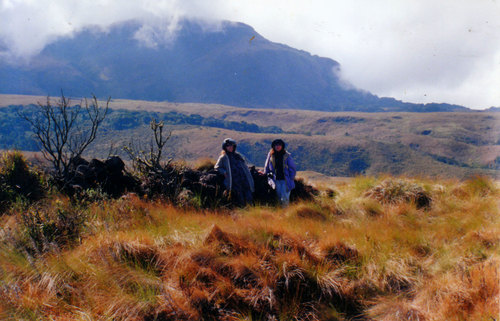
The foothills of Mt Nyangani. Nicky Rosselli and Sally Scott.
The weather was warm and welcoming as we bounced along the track that led up to Robin’s Nest cottage, nestling in the southern foothills of Mt Nyangani, at 2 592 metres (8 504 feet) Zimbabwe’s highest peak. There were three of us in the old bakkie – my two artist sisters, Sally Scott and Nicky Rosselli, and I – and we were finally making a journey we had often fantasized about. Below us the land rolled and sloped in an emphatic way, criss-crossed by streams and patches of plantation and jumbles of granite hills which reflected silver in the bright sunshine. It was good to be back. There was a healing magic in the air and I could have all but shouted out with joy, I was so excited to be in the landscape of my youth.
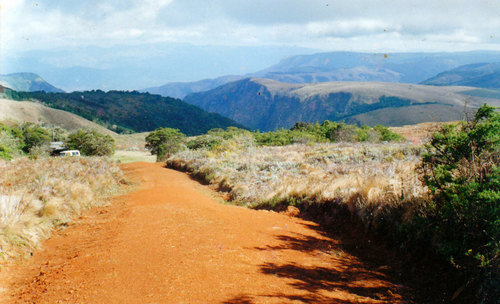
The Road to Robin’s Nest. ,Nyazengu Gorge in mid-distance. Honde Valley behind.
It was here I had made my first real discovery of that intangible sense of mystery some mountains have in abundance.
Sparse, rustic and startling basic, our windswept accommodation, could hardly have seemed more remote. Tucked away in a small grove of trees, it consisted of two wooden sheds linked by a roof of corrugated iron. It was like a hermits cell or the sort of place monks might have used when they wanted to get close to God. The two bedrooms with their rickety bunks were both extremely small. The kitchen area-cum- lounge, in the other section, contained a couple of battered, much-used, old chairs and a tiny wood stove which, I would soon learn, had a mind of its own.
Sally sketching atRobin’s Nest.
As I dumped my gear on the bed, I knew I was going to fall in love with the place. I have always been a bit of an ascetic with a taste for the Spartan. Robin’s Nest fitted my needs perfectly.
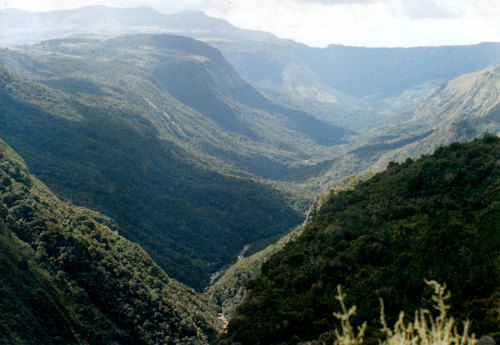
And if the building was on the ramshackle side, this, in no way, detracted from the magnificence of its setting. Directly behind us, the mist-shrouded mountain rose into steep pillars of rock, in front of us the land sloped away, gently at first, before suddenly plunging into a steep-sided, gaping abyss. The Nyazengu Gorge is not as well known as the Pungwe Gorge, into which it opens out, but, although of a smaller scale, it is equally beautiful. Protected from the worst of the winds but benefiting from the moisture-laden clouds they bring, it supports a profusion of plant life.
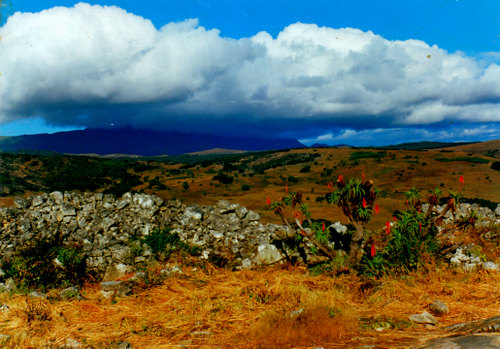
The morning sun was breaking through the cloud as we set out, early the next day, following a meandering path that led us over the downs. Everything about the morning was lovely. The call of the birds, the great blue sky, the sound of the river gurgling through the green hills. We hadn’t got too far when we came across some overgrown old stone-walled fortifications, remnants of what is now known as the Nyanga Uplands Culture. It seemed a bleak and lonely spot to have lived.
Old Ruins with Mt Nyangani in background.
Still glorying in the voluptuous sunlight we pressed on along the path. Now and again we would find ourselves entering patches of dark remnant forest. Scattered through the undergrowth were numerous large, mossy boulders that looked like sleeping animals while, in other places, the trail was almost overgrown with ferns and low foliage.
Wherever we went there was that rich, yeasty smell of damp and decomposing matter. Adding to the slightly Middle Earth atmosphere was the wispy- white streams of Old Man’s Beard hanging down from some of the trees. Faraway from the shrieking commotion of city life, I felt like I had entered a very secret and enchanted place.
There were all sorts of birds here although, because of the gloom of the forest, they were not always easy to see. I did manage to get one “lifer”- the White-tailed Crested Flycatcher, a beautiful little bird with a penchant for fanning its handsome tail. Something of a rarity, its distribution in Southern Africa is restricted to the montane forests of Zimbabwe’s the Eastern Highlands and adjacent Mozambique. The even rarer Blue Swallow is also supposed to occur in the surrounding grasslands but I did not see any.
We emerged out of the cool shadows of the forest to find ourselves on the very lip of the gorge, at a point where a high waterfall plunged down its side and into the gloom below. Taking off my hiking boots, I dipped my big toe into the water and took it out very quickly indeed. It was every bit as cold as I feared it would be but at least it gave me the excuse to boil some tea to warm ourselves up.
Where the waterfall plunges into Nyazengu Gorge.
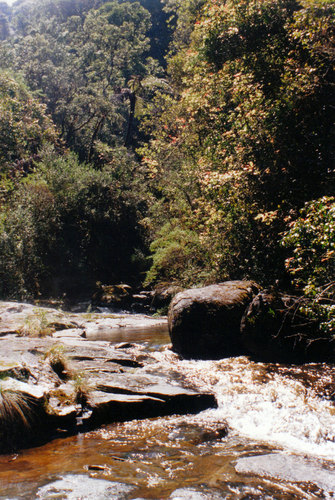
Upstream of the waterfall.
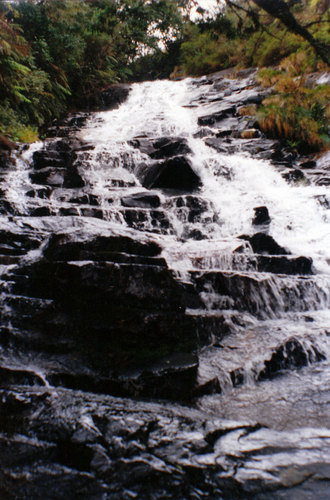
Later we squelched down a valley that was half bog, half rock until we came to another waterfall that tumbled down a massive sheet of exposed rock. It was hard to imagine anywhere more unvisited, wild and sublime. There was something about the way the sunlight sparkled on the beautiful, clear water, the way the light and water bubbled and swam together, the pure energy of the current flowing over the smooth grey rock that made us want to stop and tarry there. It was as if the water spoke best of the passion of the place.
More waterfalls…
This was, of course, the other reason we had wanted to come back. All three of us are artists and we were looking for inspiration. There was no shortage of it here.
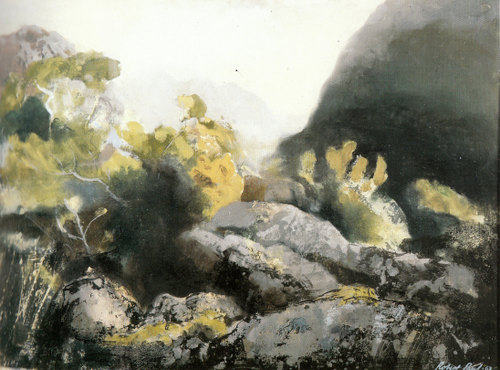
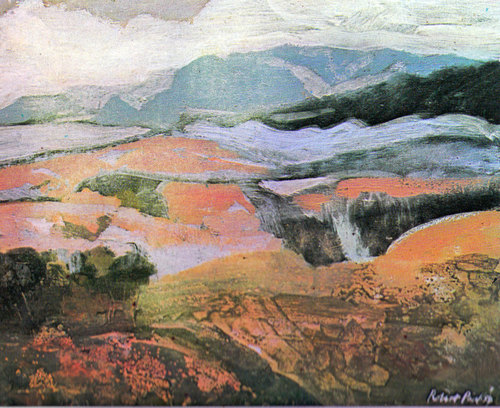
With its endless vistas and ever-changing moods and atmosphere, Nyanga has been a favourite venue for many painters including, most notably, Robert Paul. A friend of the British artist John Piper, Paul (1906-1980) – who has been described by Brian Bradshaw, the former director of the National Gallery in Salisbury (now Harare), as “a ‘genuine’ whose artistic dimensions exist not only in Rhodesia but would be recognised anywhere the values and evidence of art are understood” – returned to paint in Nyanga many times.
Deceptively slapdash in his brushwork, Paul had an uncanny ability to strip a scene down to its basics and select from nature only those elements which seemed to capture its essential spirit and feel. There is a perennial freshness about his work; in it. you immediately see a man who is comfortably at home in this scenery. It is why, whenever I am feeling homesick and want to reconnect with the landscape that exerted such a force on me in my childhood, I haul out a book* I have of his paintings.
Inyangani 1967. By Robert Paul. Oil.
Inyanga Landscape 1950. By Robert Paul. Oil.
By the time we eventually tore ourselves away from this hallowed spot and headed home to Robin’s Nest, the cloud had begun to build up again along the mountain. We had barely made it back to the cabin when the whole area was engulfed in a thick tablecloth of mist. As night fell it grew intensely cold. Alone in our chilly hut, on the edge of that imposing mountain, it felt we had the universe all to ourselves.
Poking the wood stove to get more warmth, listening to the murmurings of the mountain and the soft conversation between the wind and the trees, I could not have been happier. I felt I had found a place set apart, one with that quality of isolated purity that helped restore the soul.
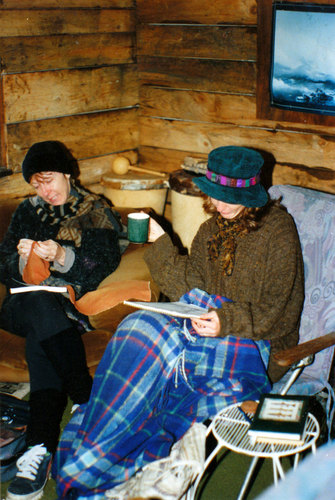
Sally and Nicky full of inspiration…
The keeper of the flame.
Although I had grown up in the area, I had never actually climbed Mt Nyangani. So I decided I was going to stir my old bones and make my way up to its summit. My sister Sally elected to join me.
Mt Nyangani from far side of Nyazengu Gorge.
Although it is Zimbabwe’s highest mountain, the hike to the top only takes a few hours. The first section is the steepest to climb. Thereafter it opens up into a lush, gorse-covered, sprawling moors and undulating plateau.
When the going gets tough. My sister Sally Scott pausing for a breather.
We were the only ones on the mountain that day which only added to the seremity of it all, the feeling of pure solitude.
It was well worth the initial slog, too, because the view from the top is one of the most beautiful I have ever beheld. Sitting on the apex of grey-green rock, with the sun shining through the clouds and anointing our heads, I really did feel like I was amongst the gods.
Geologically, Mt Nyangani is composed of an upper sill of dolerite and sandstone with the harder dolerite forming the cliffs on top of which, having reached the highest point, we now sat celebrating our achievement with a hot cup of tea (it’s my British ancestry). This, in turn, intrudes out of a sub-strata of ancient granite – the extensive Basement Complex that makes up much of the country’s geology and which has been gradually weathered away and exposed over the aeons.
On the eastern side of this high exposed ridge, lies the hot, humid Honde Valley, into which the countries highest waterfall, the 762 metre Mutarazi Waterfall, drops. It was also the scene of much fierce fighting during the Rhodesian Bush War. Extending from the border of Zimbabwe into Mozambique, its unusual position and topography cause it to have the highest rainfall in the country.
This is because moisture-laden clouds coming in from Mozambique are blown smack into the mountain wall and as they rise they cool and the rain comes. The constant watering has created a mini eco-system and the cliffs and crags here are covered in dense forest – making it quite distinct from the western side slopes which are mostly grassland, with only the odd tree hunched down again the bitter winter winds.
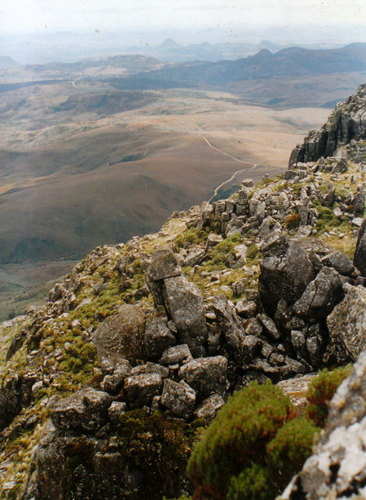
As one turns one’s eyes around further, the vast V-shaped Pungwe Gorge, with its tumbling, two-channel, waterfall, sweeps into view, followed by the entire Nyanga National Park and its environs. Beyond, that, shrouded in mystery lie, the ruin-strewed hills of Ziwa, and Nyahokwe and then, silhouetted, against the skyline, the massive granite dome of Mt Dombo. Crane your head still further and you will find yourself looking down the broad spine of the Nyanga escarpment to where both Mt Mouzi and the twin peaks of Nyangui mountain – whose beacon marked the edge of our old farm – jut out in the far distance.
View down to Nyazengu Gorge and Honde Valley.
View towards Ziwa and Nyahowe
Three main rivers have their source on Mt Nyangani – the Nyamaziwa, the Gaerezi and the Pungwe. The first two are tributaries of the Mazowe which eventually flows north into the Zambezi. The Pungwe, which grows steadily wider as it follows its eastwards course, has its mouth in the Indian Ocean, at the port city of Beira in Mozambique.
Despite the relative ease of the climb Mt Nyangani has an ominous reputation. One local newspaper even went so far as to label it, in bold type, as “A MOUNTAIN WHICH SWALLOWS PEOPLE”. Others have, in equally dramatic terms, compared it to the Bermuda Triangle and Japan’s Devil’s Triangle. To some extent, its reputation as some sort of dark, hungry, malfeasant, force is well deserved for numerous hikers have indeed disappeared on the mountain never to be seen again.
Back in colonial times the word “Nyanga” was usually interpreted as meaning “place of the witchdoctor” which added further to the reputation of the mountain for being a bit of a scary, forbidden, place although the correct translation of the word is ‘herbalist ‘which has far less sinister connotations.
Like other sacred mountains in Southern Africa, Mt Nyangani has its prohibitions and taboos, including the fairly common stricture against pointing at it. No laughter is permitted either. The mountain is, also, subject to sharp weather changes particularly mist-build-up which make it easy to get disorientated and lost in. Hence, presumably, all those missing hikers who got ‘swallowed’ by the mountain.
We got first- hand experience of how quickly this can happen. I was posing for the obligatory Hail-the-All-Conquering-Mountaineer photo when I noticed a slight drop in temperature and a sudden jab of wind against the back of my neck. Pivoting around, I saw, to our immediate north, a low bank of cloud, glistening white in the sunshine. I think something about this sort of weather breeds an anxious hyper-alertness of the senses for I realised instantly it was time to get off the mountain.
As we hastened back down the track, more thin wisps of cloud began chasing one another along the mountain top towards us. I felt tiny splashes of rain. By the time we had got back to the parking area, the whole mountain, which had previously seemed so benign, had taken on a more sinister aspect.
We retreated down the road to the Nyangwe fort, just above Mare Dam, and sat on the rock walls watching the drama unfold. In the blink of an eyelid, Mt Nyangani was engulfed under a massive cumulonimbus cloud which, just kept growing and growing in size.
The angry mountain, seen from Nyangwe Fort.
I was very glad we had got down in time to avoid being caught up in that vast, vortex of rising air. Awed by the spectacle, I found myself succumbing to all sorts of nagging, corrosive doubts. Maybe we had angered the mountain? Had I made a big mistake being so cheerful and upbeat as I posed for my vanity photographs? Was it some ill-humoured, demonic spirit that had sent that towering storm cloud?
I was not the only one with concerns about the mountain’s temperamental nature and sudden mood swings. Since we got to the summit, the park’s management has decided that you can now only climb it in the company of a guide.
And with a reputation like that who would not want to climb it?
Pungwe Gorge and river, leading up to Mt Nyangani.
*Robert Paul by Colette Wild, Brian Bradshaw, Francois Roux, Patricia Broderick and Martin Van der Spuy. Printed by Grillford Limited.
GALLERY:
Some artwork inspired by our trip:
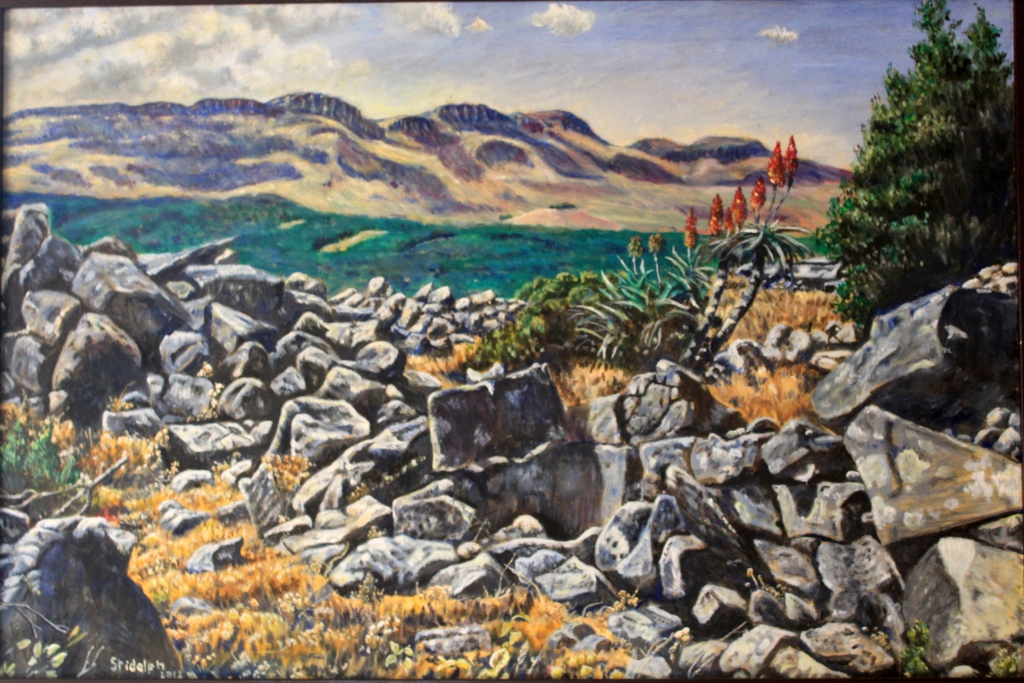
Mt Nyangani from Nyangwe Fort. Artwork by Anthony Stidolph. Oil.
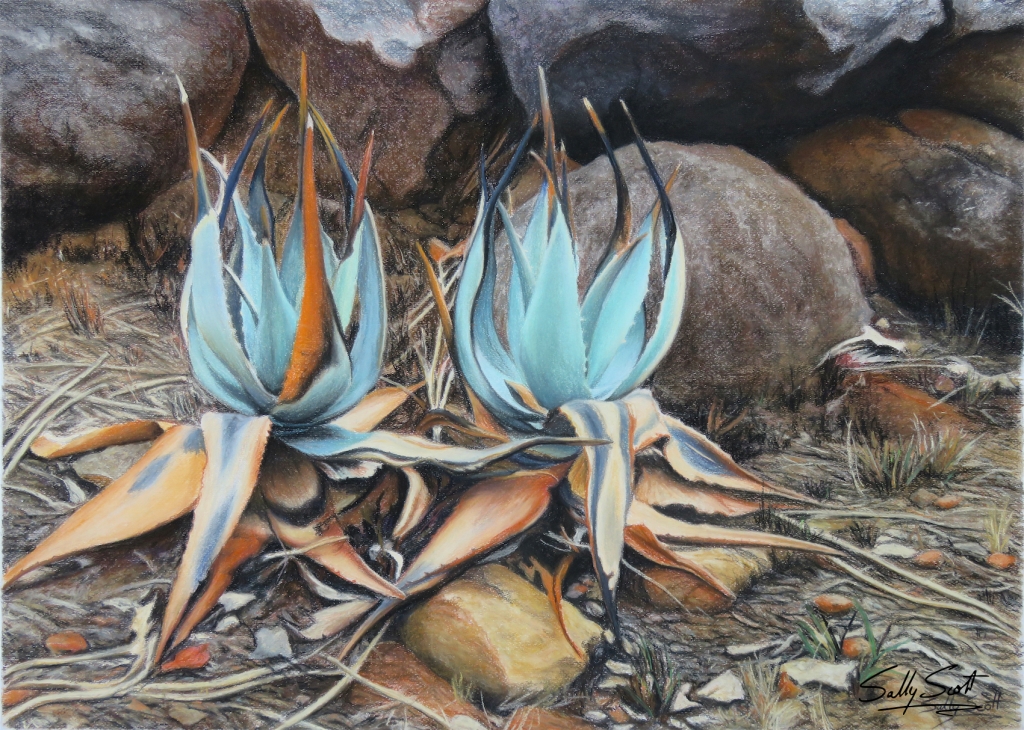
Nyangui aloes. Artwork by Sally Scott. Pastel.
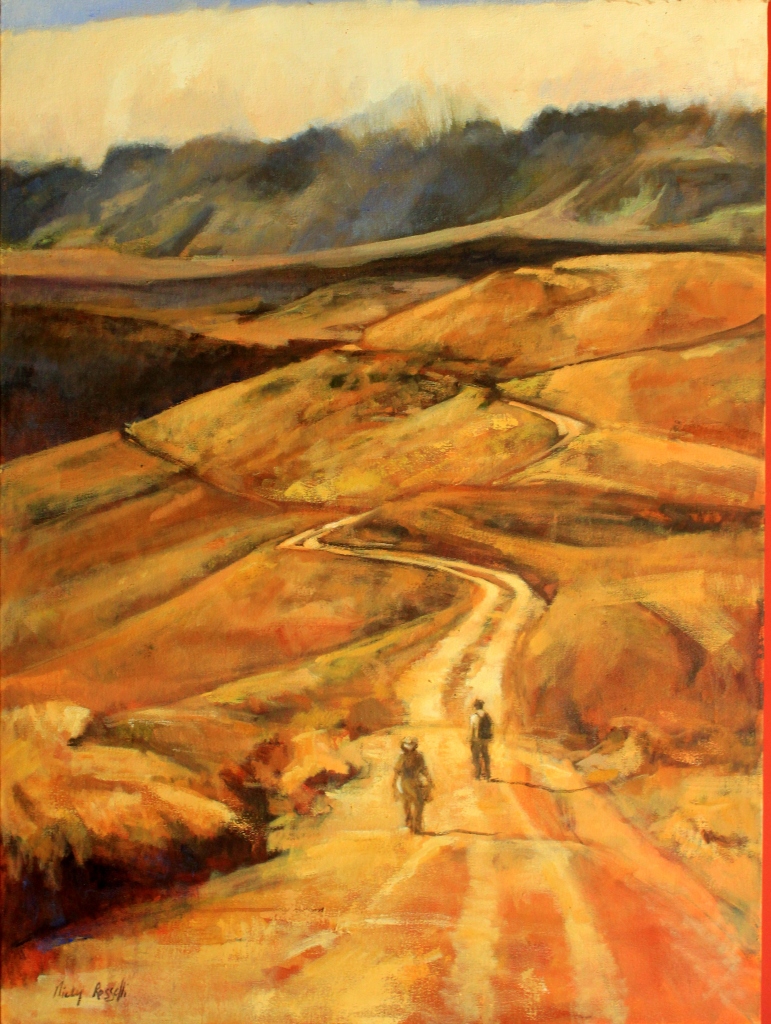
The Climb. Artwork by Nicky Rosselli. Oil. The two figures in the foreground are Sally and myself…
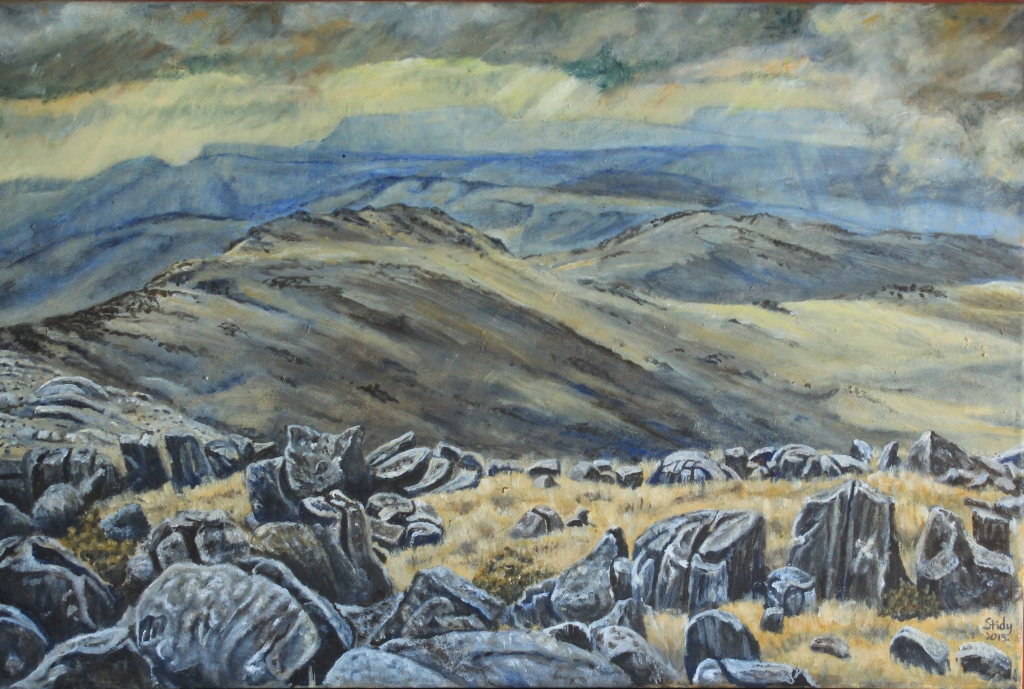
Summit of Mt Nyangani, looking North. Artwork by Anthony Stidolph. Oil.
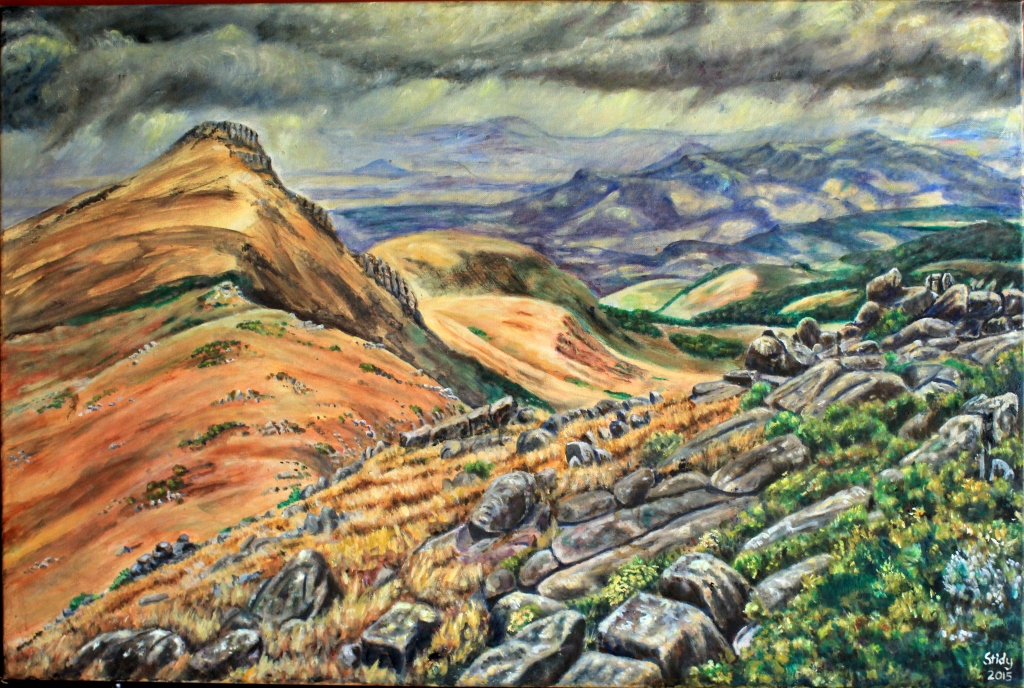
Summit of Mt Nyangani, looking South. Artwork by Anthony Stidolph. Oil.
A lack of financial controls and consequence management had resulted in the KwaZulu-Natal conservation entity, Ezemvelo KZN Wildlife, incurring more than R48 million in irregular expenditure, it was revealed during a virtual KZN Scopa meeting. Ezemvelo – currently struggling to find R100million to fix its porous fences, which have seen wild animals escaping from its facilities – is battling to comply with Treasury supply guidelines due to the entity’s weak financial unit.
Despite the ANC leaders describing their meeting with former president Jacob Zuma as “positive and constructive”, political analysts described the gathering as a waste of time. In the meeting, the ANC top brass led by President Cyril Ramaphosa could not convince Zuma to change his mind on his decision to defy the Constitutional Court order that he should appear before the Zondo Commission.
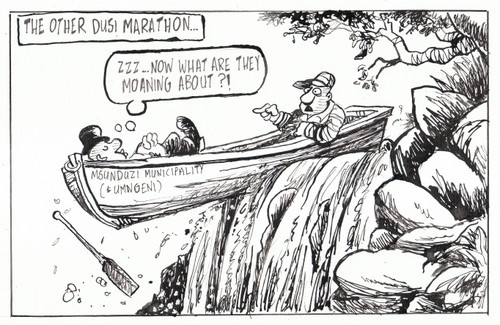
Msunduzi Municipality’s financial reserves continued to be a huge source of concern, with the City’s December accounts showing it owed a whopping R500 million to its suppliers. Further evidence of the general malaise gripping the municipality was then provided when large parts of the city were again plunged into darkness, for up to twenty-four hours, as two Eskom breakers tripped. This was in addition to the normal Stage Two load-shedding being implemented by Eskom.
On a happier note, the 70th MyLife Dusi Canoe Marathon got underway in Pietermaritzburg although, because of the Covid restrictions, there weren’t the usual large crowd of fans to cheer the canoeists on…
As South Africa acknowledged the first anniversary of the start of the Covid-19 pandemic, the maladministration in the Msunduzi municipality once more came into focus. In a two-part package devoted to the failing city, the Witness provided a range of stories showing how ordinary residents (and city workers) felt they had been abandoned by the uncaring administration. The newspaper’s report also captured the frustration of the business, real estate, tourism and other sectors of the local economy who had suffered as a result of bad management, bad choices and lack of consequences.
Following a heated ANC meeting over the weekend, former president Jacob Zuma’s supporters, who had come out second best in the battle to control the party, were now at risk of being expelled from the party should they continue with their campaign against President Cyril Ramaphosa and the judiciary. Meanwhile, the election of mostly white males to key leadership positions, at the DA’s KZN provincial congress, seemed to suggest the party had ditched its “inclusive” policy, according to some political analysts.
At a time when he needed to be busying himself with the urgent business of running the country and fighting the Covid-19 pandemic, President Cyril Ramaphosa found himself having to ward off more attacks from former president Jacob Zuma and his supporters within the ANC. In 23 pages of speaking notes, Zuma complained that his comrades had left him high and dry and attacked Ramaphosa for stopping the state from paying his legal fees. Zuma also launched a broadside at the independence of the judiciary, questioning the legitimacy and credibility of South Africa’s constitutional democracy.
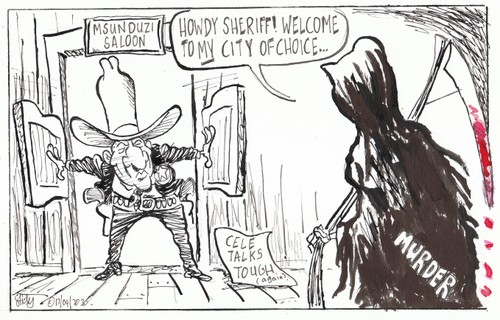
Plessislaer is now one of South Africa’s murder capitals. This was revealed by the country’s Minister of Police, Bheki Cele, who urged police to get tougher on criminals following a spate of murders in and around Pietermaritzburg. Cele said KwaZulu-Natal had become a problem area along with the Western Cape and more police would be deployed to the area to try and curb the violence that has been spiraling out of control.
While fires raged on in Cape Town and emergency services battled blazes around the clock, it was revealed that KwaZulu-Natal’s fire-fighting capacity had heavy shortfalls. Not only did it lack over 550 fire-fighters but it did not have enough Urban Search and Rescue (USAR) equipment or personnel. The problem was not confined to KZN alone with a Daily Maverick report revealing similar shortcomings throughout the country.
The granite of the ancient north. A return visit to the Matopos hills with my English cousin, Rebecca.
When I was seven-years-old I was despatched, by train, to a boarding school on the other side of the then Southern Rhodesia and my world changed. From a life of being surrounded by family and a familiar, comforting, routine, I found myself thrust into a society whose mores, customs and rules were all terra incognita to me. Caught in a fusion of fear and fascination I didn’t know quite what to expect from this new arrangement. Whether I was ready for whatever challenges lay ahead of me only time would tell.
My departure, by train, on that balmy summer’s evening, would set the pattern for the next six years of my life. Three times a year my parents would drop me off at Salisbury station and three times a year they would be waiting at the same station to collect me.
The all-boy boarding school I found myself clanking towards in that old, coal-fired, steam train was named Rhodes Estate Preparatory School (REPS), after the man whose devious machinations laid the groundwork for the seizure of a country: Cecil John Rhodes. Overlooking the glorious Matopos Hills, the school specialised, as its name implied, in preparing impressionable young white boys for the rigours of life in the colony, and fostering a simple pride in the country. It also served as the main feeder school for Plumtree High, one of the oldest and most prestigious schools in Southern Rhodesia, situated alongside the main railway line to South Africa, near where it crossed the border into Botswana.
REPS Hostel
REPS Church
The headmaster of REPS, when I got there, was a Scotsman, Mr McClaren, a strict disciplinarian who was nevertheless loved by the boys for his dry, depreciating, wit. In my mind, I can still hear him thundering at me in his thick Scottish brogue when I had messed up an answer: “You are up the pole boy – COME DOWN!!!”
I was always a fairly shy child and, initially at least, I found the forced gregariousness, regimentation and lack of privacy difficult to deal with. I suppose I was lucky in that my one brother, Pete, a couple of years my senior, was already at R.E.P.S. Unlike me, however, he had faced his separation from home in a manner entirely consistent with his straightforward, practical approach to life. He had taken it all in his stride. Determined that I, too, should learn to stand on my own two feet he made a point of leaving me to my own devices for the first couple of weeks.
Fortunately, I think my easy-going nature and innate cheerfulness helped here, for I soon managed to acquire a circle of friends, was never really picked on or bullied and ended up enjoying my days at R.E.P.S. It that sort of setting it would have been hard not to.
Made up of labyrinthine chaos of granite rocks, kopjes, domes, whale-backs and other formations*, pushed out of the earth aeons ago, the Matopos Hills are an area of breath-taking beauty. Both the Shona and, later, the Ndebele believed them to be the residence of their high God – Mwari for the Shona, Mlimo for the Ndebele – and regarded them as sacred. Mzilikazi, the first king of the Ndebele, was buried there. Eager to stamp his authority on the land, Cecil John Rhodes also chose World’s View (or Marindidzuma – the haunt of the ancestral spirits) as the site of his grave, so impressed was he by “The peacefulness of it…the chaotic grandeur of it all”.
Worlds View.
In his funeral poem, “The Burial”, Rudyard Kipling, who had been Rhodes house guest in Cape Town, refers to the hills in his oft-quoted line “The Granite of the ancient North, Great spaces washed with sun.” Whether Rhodes was worthy of all the praise Kipling lavished on him in the poem (“The immense and brooding spirit…Living he was the land, and dead, His soul shall be her soul”.) is, of course, a matter open to debate…
World’s View
Grave of Cecil John Rhodes
View from World’s View
During the Matabele Rebellion, Rhodes had, indeed, shown considerable bravery by riding unarmed in to the Matopos, with a small group of companions, to negotiate a peace deal with the Matabele leaders. Also interred at World’s View are the remains of his sidekick, Doctor Leander Starr Jameson, whose impetuous and ill-considered Jameson Raid into the Transvaal, had precipitated the Boer War. Encouraged by its failure and the absence of so many white troops outside the country, the Matabele (or Ndebele) – a northern offshoot of the warlike Zulu – launched the first sustained campaign against colonial authority in Africa. Many of Matabele impi would subsequently operate from and seek refuge amongst the hills where even the likes of Colonel Robert Baden – Powell, despite all his scouting experience, would be hard-pressed to flush them out.
On the same smooth granite batholith on which the two lies buried there is another, larger monument, erected, on Rhodes’ instructions, in memory of the ill-fated Shangani Patrol.
Memorial to Shangani Patrol
Memorial – detail.
On the afternoon of December 3rd, 1893, Major Allan Wilson had led a patrol of 16 volunteers across the rising Shangani River in pursuit of Lobengula, king of the Matabele. Cut off from the main force under Major Forbes by the swollen waters, Wilson found himself surrounded, the next day, by an estimated 3 000 Matabele warriors. Fighting to the last round he and his men were all eventually killed.
Before they met their death, the final six reputedly took off their hats and sang “God Save the Queen”. Because of his brave actions – although some historians consider his pursuit of the much larger Matabele force to have been a reckless gamble, on par with General Custer’s last stand at Little Bighorn – Wilson would be elevated to the level of national hero and have a school named in his honour. For his part, Lobengula, protected by the remnants of his loyal impi, continued northwards. He died, by taking poison, when he heard his army had surrendered and was buried, sitting up, in a cave. Disciplined as it was by pre-colonial standards, his forces were no match for the lethal British Maxim gun, which was used for the first time here.
It was a sad ending for a man who, by all accounts, had been an impressive figure and a shrewd opponent.
In the school dining room there was, in my time (I imagine it has long since been removed), a reproduction of the 1896 painting by Allan Stewart depicting this famous episode (the painting would go on to inspire two films: the 1899 short silent war film, Major Wilson’s Last Stand and The Shangani Patrol (1970)). Also hanging from the dining room walls was a large portrait of Rhodes, himself. It used to spook us at mealtimes because his penetrating, pale-looking eyes appeared to follow you around no matter where you sat…
Shangani Patrol by Allan Stewart.
It was at R.E.P.S. that I was to commit one of those life-defining, acts of stupidity that I seem to have a peculiar talent for.
It happened like this. At the centre of the school, there was a swimming pool, below which was a small room that was always locked. Returning from classes one day, I noticed there was a pipe protruding from under its door out of which a strange yellow-green cloud of gas was rising. Intrigued, I wandered over to it, lifted it up and took a good whiff. Words cannot describe the searing pain that engulfed my whole chest. I felt like my lungs had caught fire. I broke out in an immediate fit of non-stop coughing.
The gas I had inhaled was chlorine, one of the weapons of choice in the trenches of the First World War until its usage was banned by international treaty. It is also used, in diluted quantities, to keep swimming pools clean and sparkling but I was too young to know about either of this. Another boy, I don’t remember who, saw me staggering around like a crazy person and realising I was in serious trouble led me, choking and gagging, off to see the sickbay matron. In between further fits of coughing I spluttered out the story of what had happened. I was rushed to Bulawayo Central Hospital, injected and fed all sorts of medicine, and placed in an oxygen tent.
When I got back to school, a week or so later, the pipe was gone. In my absence, I had also become something of a local legend – Chlorine Stidolph was but one of the many names I would be remembered by – attracting a lot of sympathy and solicitude and some good-natured ribbing as well. Later in life, the consequences of my inhalation of poisonous gas would come back to haunt me, my scarred lungs making me susceptible to a variety of respiratory problems.
This moment of madness notwithstanding, I don’t think my parents could have chosen a more right school for me than R.E.P.S.
Based on the British models, it was a school that believed firmly in the importance of open-air life. The headmaster and staff placed great emphasis on physical exercise and besides playing lots of sport, which I was never much good at, we were encouraged to go for long hikes – or “exeats” as they were called – into the country over the weekends. I, for one, needed little prompting. Walking is a pleasure I have always enjoyed for its own sake and I exulted in the freedom of escaping the school’s bounds and getting out into the natural world.
Reliving old memories. A return trip to the Matopos hills. Pic courtesy of Nicky Rosselli.
All three of my brothers, who had been at REPS before me, had been keen egg collectors, a hobby I also took up (the older me is strongly disapproving). We were always very careful to only take one egg from the nest, leaving the others for the birds to hatch and rear.
With over 50 species of raptor being recorded in the nearby Rhodes Matopos National Park , it was certainly a birder’s paradise. The park was especially famous for its number of Black (Verreaux’s) Eagles. It still contains the most concentrated population of an eagle species anywhere in the world. The Ndebele believe these magnificent birds are the spirits of the departed dead. Watching them soaring in the thermals it is not difficult to understand why.
Wildlife was also plentiful in the park. There were leopards lurking in the hills while herds of round-haunched zebras, sable, giraffe and fidgety wildebeest grazed in the plains below. White Rhinos were still relatively common. This was classic klipspringer country as well and on our hikes, we would often see them standing outlined on a rock’s crest, like some sort of spirit guardians, as we tramped below.
Balancing rocks. We used to call this formation Rhodes’s Chair.
In such idyllic surroundings, there was certainly enough to satisfy both my curiosity and spirit of adventure. It was in the Matopos that I really began to develop an eye for the detail of country life and nature’s endless variety and mystery. Like many a schoolboy before me, I had that peculiarly – although not exclusively – British desire to explore the unknown and amongst the Matopos kopjes there was more than enough to keep me occupied.
Each term was thirteen weeks broken by a half-term holiday (more when there were public holidays such as Easter and Rhodes and Founders Day). Because my parents lived so far away I never got to go home during these breaks but had to stay at school with a few other, similarly unlucky, boys. To soften the blow, the master who had been left on weekend duty would usually organise a whole day outing for us, often taking us, by vehicle deep, into the hills. Once we reached our destination, we would be left free to climb the kopjes and summit such imposing domes as Mount Efifi. On their top we would stand, awed by the view, with endless roves of monumental granites, of all shapes and sizes, radiating out in every direction, seemingly forever. Sculpted by a millennia of erosion, it was certainly a vista fit for any re-incarnate god.
After rain, the rocks and domes glimmered silver, which added a slightly supernatural quality to the landscape and contributing to my sense of privilege at being able to observe these ancient forms.
There were also numerous dams – the Matopos, Maleme, Mtshelele, Toghwana among others – bordered by rocks and dense thickets where we would often go to picnic and explore. There was plenty of fish in them while fast swimming duck jinked along the surface and weavers and widow birds chattered in the reed beds. As beautiful and as inviting as the water looked, especially on a hot day, it also concealed a hidden menace – bilharzia, a parasitic worms that penetrates human skin and enters the bloodstream and migrates to the liver, intestines and other organs.
Mtshelele Dam
Toghwana Dam
The cure for this back then (I speak from first-hand experience having been treated several times while I was at REPS) was almost worse than the infection – a large pill that turned your skin a weird yellowish colour, made you feel nauseous and sick and often induced vomiting.
Even in paradise, it seems, there is evil…
In the past, other people had inhabited this wilderness. The first had been the San Bushmen, peaceful hunter-gatherers who had used the outcrops of elephant-coloured boulders as a canvas on which to record both the physical and spiritual aspects of their lives. Often, after hours of clambering and squeezing your way through huge boulders and vines, you would stumble across their beautiful paintings on the under-surfaces of the rock, exquisitely executed in red, cream and ochre-coloured silhouettes. Indeed, the Matopos contain the highest concentration of rock paintings in southern Africa with many dating back to the Late Stone Age.
Rock Art, Inanke Cave, Matopos. Pics courtesy of Nicky Rosselli.
In other cases, we used to find clay pots, iron smelters and grain bins, often very well preserved, although these were probably of more recent origin.
Sitting up there, amongst the encircling piles of boulders, in the heat and silence, alone with my lazy thoughts, it was easy to see why the Bushmen had chosen the Matopos as a site for their enigmatic outdoor art galleries and why both the Shona and Ndebele continued to revere these mysterious hills.
They certainly cast their unique grip upon me.
Stables erected on instructions of C.J.Rhodes.
Rhodes’s Summer- house, Matopos. His coffin rested here on the night before its final trek to the grave-site…
NOTE: In my day, the area I write about was still known as the Rhodes Matopos National Park so, for this story, I have retained the old spelling. Since then it has been renamed the Matobo National Park and become a UNESCO World Heritage Cultural Site. For similar reasons, I have used the old word Matabele rather that Ndebele.
I grew up in an era in which there was still a certain romance attached to train travel although, at my first encounter, its charms were not immediately apparent to me.
I was seven-years-old at the time and at the end of that railway track there existed a dark, foreboding place called ‘boarding school’ which, my parents had solemnly informed me, was where my destiny lay. Making that trip was not something I was particularly looking forward to. Sitting on my large black metal trunk with my name and that of my prospective school house freshly painted in white on its surface, I remember feeling more like a convicted felon than a young innocent setting off on an exciting, new, life-changing, adventure.
While train travel and boarding school will always be inextricably linked together in my mind with time my view of it did, indeed, begin to change.
I came to love the old fashioned compartments with their iron luggage racks, green bunks, polished woodwork and framed pictures featuring the best known local sights. I recall, as a young boy, also being intrigued by the signs that appeared in each compartment urging us not to “expectorate”. It took me some time to figure out that this was posh railway-speak for “spit”.
Being hit in the face by great gobs of phlegm was not the only thing you had to worry about when you put your head out the window. Since the locomotives were still mostly powered by steam you also ran the risk of being knocked unconscious by large lumps of coal.
Then
there was the whole complicated ritual of departure and arrival.
First, you would have to scan the notice boards to find what section
of the train you were in, then the frantic rush to get all your
luggage aboard. Trying to lay claim to our seats, people would
already be crammed in the corridor which made this an exceedingly
difficult manoeuvre.
Finally, the time would come for the train to leave. Somewhere down the end of the line, a whistle would blow, a flag would wave and the carriage would croak and grown beneath you as the train began to pull slowly out of the station. Because of some strange optical illusion it always seemed to me that it was the station and the surrounding buildings that were moving – taking with them my waving parents and other family members until they were just small dots on the horizon – while the train itself remained perfectly still.
As we began to gather momentum I would sit looking out the window as the lights of the suburbs and industrial plants gradually gave way to fields of crops and grazing lands and then the bush. Rattling along, I would catch the occasional glimpse of lights away in the darkness and settlements suggesting that some of the countryside we were passing through was inhabited. Sitting there I would find myself imagining their owners sitting at their dinner tables or asleep in their comfortable beds and envy them.
This
reverie would invariably be interrupted by the arrival of the
conductor in our compartment asking for tickets while behind him a
porter would move to and fro under his burden of sheets, blankets and
pillows making our beds.
At some point of our journey down the tracks, I would fall asleep, lulled by the methodical, rolling motion of the train. There was something about the rhythm of of the train wheels over those iron tracks and the clean smell of the bushveld sweeping away under stars towards the shadowy outlines of the Great Dyke that I found immensely comforting.
Now and again the train would ground to a halt with a massive groaning of brakes and a screeching of wheels. I had done the journey often enough to be used to this strange habit it had of stopping for interminable periods for no apparent reason in the middle of nowhere. Then, without warning, it would hiss and clang and start slowly pulling away again.
For the most part, the journey began and ended in darkness. Later on, when I went to university in Natal, we used to do most of the Botswana leg in daylight. The one feature of this stretch of the journey, I remember, besides the miles and miles of red Kalahari sand and interminable thorn and mopane scrub, was that in places where the train stopped to take in water dozens of enterprising salesmen and women would run along the side of the platform trying to persuade us to buy their goods.
Looking back on it all, I realise now how incredibly lucky I was. In an age in which regular jet flights have shrunk time and distance, and sucked most of the pleasure out of the experience, this was travel at its leisurely and meditative best.
As anybody who has tried it can tell you, birdwatching is something that can start as an innocent pleasure, then become a habit and finally morph in to something akin to an obsession.
Rupert Watson, who describes himself as “a lawyer, mediator, naturalist and writer”, is a person so afflicted. In the course of a 40-year career, the Kenya-based author has travelled the length and breadth of Africa seeking out its numerous and varied birdlife.
His latest book, Peacocks and Picathartes: Reflections on Africa’s Birdlife, is very much a distillation of these experiences. Drawing extensively on literature, history, science, avian miscellany and his observations, it is intended as a celebration of the diversity of African birds, especially those peculiar to the continent.
Chapter Two of the book, for example, is devoted to birds that occur only in Africa, Chapter Three to those that occur MAINLY in Africa and Chapter Four contains a list of his personal favourites.
Watson writes in a chatty, conversational style and most of the book’s pages are enlivened with little vignettes. In the course of its pages, he shows how certain birds – the Hamerkop and the Ground Hornbill are obvious examples – have acquired a special, even mythic status in local folklore and belief systems. Elsewhere he explains how some of the scientific names for birds have changed in the light of the most recent hypotheses about generic relationships. More controversially, common names have suffered a similar fate for the sake of international consistency, a factor which has led to some consumer resistance and resentment.
Other birds find themselves being shunted from one grouping to another, a factor that only serves to highlight the difficulty in resolving classification conundrums even with the advent of DNA analysis. The four African hyliotas, for example, now compromise their own family after being claimed by both the Old World warblers in Sylviidae and the batises and wattle-eyes in Platysteiridae.
There are many more insights and happy phrasings. We all thrill to an unusual sighting and you can feel Watson’s palpable excitement when he describes how he tracked down a rare White-necked Picathartes in the Bonkro region of Ghana. Even common birds can arouse his interest. There is an amusing description of the almost feral Egyptian Goose, a bird that has developed a singular attraction to swanky golfing estates where its habit of moulting and defecating on fairways has made it extremely unpopular with golfers.
The result of all of these reflections is a classic birder’s bedside book full of insight, anecdotes, information and an imaginative sympathy with the natural world. Hopefully, it will give non-birders some idea of what they are missing..
published by UKZN Press
The spectacular rise of bird-watching over the last fifty to a hundred years has led to a growing interest in not only avian territorial behavior but in other aspects of ornithology, including the question of how birds come by their names. While most of South Africa’s best-known bird books and field guides provide some explanation as to their vernacular names what has been needed is a book examining the subject in depth.
As the author of
Zulu Names (2002) and Zulu Plant Names (2015), Adrian
Koopman, who is also an emeritus professor at the University of
KwaZulu-Natal, has the intellectual armoury to fill this gap, at
least insofar as far as the Zulu names go. In a book that combines
scholarship with readability, his knowledge and learning is apparent
on every page of this book and he deserves full credit for the
remarkable amount of information he has amassed.
Utilising up-to-the-minute research (including information gleaned from a series of local workshops conducted between 2013 and 2017), his hugely detailed survey explores the link between birds, names and people. While intended primarily as a reference work the book is more than just that; it also includes all sorts of interesting critical, cultural, personal and historical observations
What rapidly emerges is just how complex a subject it is. In an early chapter, the author looks at the underlying meaning of African birds and shows how these are linked to identity and function. Thus there can be lexical meanings, connotative meanings, associative and symbolic meanings. These, in turn, can be broken down into other categories such as names based on appearance, song, habits, habitat, behaviour, motion, season and weather, superstition etc.
What also constantly astonishes is the radiant aliveness and poetic sensibility behind so many of the Zulu bird names. Koopman revels in explaining fascinating things that some readers may know little about. For example, the name impofana for the Eurasian Golden Oriole while meaning ‘slightly dun-coloured’, is also one of the nicknames of the Kaiser Chiefs Football Club, whose uniform is a striking half-yellow/half-black, just like the plumage of this bird. As apt as it is lyrical is the coined name umambathilanga for the Yellow Bishop which translates out as “the one that wears the sun as a blanket”.
The book is littered
with other similarly colourful examples.
In addition to
explaining how the birds got their wide range of Zulu names, Koopman
also examines the extremely important role birds play in Zulu praise
songs, proverbs, riddles, beliefs and traditional lore. Certain birds
are seen as omens, portents of things to come (the arrival of the
Red-chested Cuckoo, for example, heralds the start of the ploughing
season), others are regarded as charms, such as love charms and
protective charms. Linked to this are the taboos against killing,
eating or even imitating certain birds.
Leaving nothing to
chance, the author concludes his investigation by underlining the
critical role such knowledge can play in encouraging both
conservation and avitourism.
Prodigiously researched and sparklingly expressed, this is likely to remain the most comprehensive and authoritative book on the subject for some time. Koopman’s cabinet of curiosities is not only handsomely produced, with a neat bibliography and index, but is further enhanced by numerous colour photographs and his own fine watercolour bird paintings.
Hours after hundreds of President Donald Trump’s supporters stormed the US Capitol in a harrowing assault on American democracy, a shaken Congress finally certified Democrat Joe Biden’s election victory. Immediately afterwards the White House released a statement from Trump promising an “orderly transition” when Biden is sworn in to office on 20th January although he repeated his false claims that he won the November election.
It was a dark start to the year as residents living in large parts of Pietermaritzburg, Hilton and Howick West found themselves without electricity for up to seven-days. Besides causing widespread anger and frustration, the severe electricity disruptions plaguing the city also posed a threat to the local economy as industries considered pulling out and potential investors were scared away. To overhaul the entire ageing infrastructure will cost the bankrupt municipality at least R4 billion.
The alcohol sales ban was extended along with other restrictions as part of adjusted lockdown Level 3, President Cyril Ramaphosa announced in an address to the nation. On the much-anticipated vaccine roll-out in the country, Ramaphosa, without giving a time frame, said “South Africa’s vaccine strategy is well underway,
Joe Biden was sworn in as the president of the United States, pledging to unite a deeply divided nation reeling from the Covid-19 pandemic. Faced with a country whose fissures have been widened by a brutal wedge over the past four years, he acknowledged the social wasteland he had inherited, but emphasised unity, conciliation and called for an end to the “uncivil war” that had ravaged the country. In an extremely rare move his predecessor, Donald Trump, chose not to attend the ceremony.
Heavy rain, with flooding in places, hit the northern parts of South Africa as Cyclone Eloise moved down the Mozambique Channel – with more large downpours falling in KZN later in the week. At the same time, the murky world of spies, black ops and the unauthorised spending of millions of rand took centre stage at the Zondo Enquiry as evidence concerning the activities of the secretive State Security Agency (SSA) was heard. In a related ruling, Concourt ordered former president Jacob Zuma to obey all summons issued against him by the State Capture Enquiry and appear before it – saying he does not have the right to remain silent in proceedings.
ANC secretary-general Ace Magashule reacted defensively in an effort to deflect questions about Jacob Zuma’s defiance of state capture saying the former president should not be suspended from the party he believes in. “Leave president Zuma alone,” he said. Magashule, himself, was granted bail of R200 000 after he was arrested on 21 charges of fraud and corruption, alternatively theft and money laundering, stemming from the Free State asbestos scandal.
Glossing over government’s plans to vaccinate the nation to beat Covid-19, President Cyril Ramaphosa focused on South Africa’s economic recovery from the pandemic in his State of the Nation Address, in a thinly populated National Assembly Chamber. Adding to the many problems the under pressure Ramaphosa faces was the news that EFF leader, Julius Malema, had travelled to Nkandla to have tea with his long time adversary, former president Jacob Zuma, as part of a plan to form a broad alliance to undermine both the president and the Zondo Commission.
The first group of KwaZulu-Natal healthcare workers got their Covid-19 jab amid an outcry from doctors over the slow pace at which government is procuring vaccine. The South African Medical Association (Sama), which initially supported government’s vaccine procurement plan, said its members were becoming disillusioned with the manner in which the entire vaccination programme was unfolding. “We are worried that the target to vaccinate 40 million people by the end of the year will not be achieved,” Sama KwaZulu-Natal provincial chairperson Dr Zanele Bikitshe said.
Taxpayers were able to breathe a sigh of some relief as Finance Minister Tito Mboweni tabled a 2021 Budget free from substantial tax hikes aimed at bank-rolling South Africa’s Covid-19 vaccination programme. The sting in the tail – for smokers and drinkers anyway – was that excise duties on tobacco and alcohol would increase on average by eight per cent – double the rate of inflation.
NOTE: In addition to my normal weekly cartoons for the Weekend Witness, I did two extra ones for the paper in February:
(1). A cartoon celebrating the 175th anniversary of The Witness, the oldest continuously published newspaper in South Africa:
(2) A farewell cartoon for editor Yves Vanderhaeghen who retired from the Witness at the end of February, 2021:
NOTE: I wrote this piece shortly after I officially retired from the Witness newspaper but for some reason did not post it at the time. Since many of the concerns I raised remain as relevant now as they did back then and with the Covid-19 pandemic wreaking further havoc on parts of the print media, I decided it was still worth airing...
When I first joined the now-defunct SCOPE Magazine back in 1984 the print media was still in a state of rude good health, with full coffers and an ability to attract the brightest and the best, as well as providing a ready home for mavericks, misfits and nonconformists like myself. There seemed to be a lot more space for individual opportunism too.
Even when I got appointed to The Witness in February 1990, as their first-ever full-time political cartoonist, the industry was enjoying something of late Indian summer. With the final breaching of the apartheid wall and political change in the air, it was an exciting time to be a journalist and – again by association – a political cartoonist.
For a small, independent, provincial newspaper, the Witness, to my mind, boxed way above its weight and did an excellent job telling its readers what was happening on their patch. In fact, the newsroom was so stuffed full with reporters and specialist writers that, initially, there was no place to put a desk for me and I had to be content with a cardboard box on the floor – to which some wag glued another, much smaller, box and wrote on it:“Stidy’s Branch Office”. I decided to use this to my advantage and persuaded the editor to let me work from home.
Since then there has been a major tectonic shift. Faced with competition from the new technologies and declining circulation, newspaper budgets have been cut back to the bone, staff numbers slashed, the content has shrunk and newsrooms are now but a pale shadow of their former bustling selves. A lot of the old spirit has vanished with it; the atmosphere has become more muted and factory-like while the exodus of experienced journalists means that far less shoe leather is now expended on proper investigations.
As a result of all this, the law of unintended consequences has come into play – the cost-cutting measures have led to smaller newspapers and a more superficial content which, in turn, has caused the number of readers and advertisers to drop still further.
Looking back on it all I am just thankful that my career in cartooning happened before the rot set in too deeply and that I was offered this unique vantage point from which to view some of the major events of our recent past – the collapse of the old Soviet Union, the demise of Apartheid and the birth of the New South Africa, the recall of Thabo Mbeki and his replacement by Jacob Zuma (with all the attendant scandals) and, most sad of all, the passing of Nelson Mandela. Hopefully, my cartoons provided some sort of pictorial and historical guide to the period.
I now realise how
lucky I was to have had the privilege to serve under editors of the
calibre of Richard Steyn and John Conyngham, neither of whom tried to
place any sort of restriction or requirement on what I drew. I am not
sure how much longer that sort of artistic and editorial freedom is
likely to continue.
Indeed, with continued declining circulation and more and more cutbacks, I suspect I am going to be the only full-time political cartoonist the Witness ever employed. As someone who believes in the continuing importance of visual satire, I find that sad. What worries me still further is that, in their weakened state, newspapers will no longer be able to properly fulfil their important watchdog role, giving the Government and, by extension, the municipalities yet more licence to do as they like.
I am still naïve enough to believe that a flourishing, diverse, credible, media is essential to a functioning democracy. Unfortunately, newspapers, in their current form, seem to be in a death spiral – and there doesn’t appear to be any any magic wand to save them.
FOOTNOTE:
In my almost thirty-years at The Witness, I have drawn literally thousands and thousands of cartoons. Here is a very arbitrary selection, showing some of the high but mostly the low points in our recent history…
This cartoon – depicting the collapse of the old Soviet Union – was one of the first I did for the Witness. It is still a favourite of mine.
The negotiations to end Apartheid-ruled South Africa begin…
The death of Apartheid, mourned by few…
Winnie Mandela appears before the Truth and Reconciliation Committee. She proves most uncooperative…
Two South African icons – Bishop Desmond Tutu and Nelson Mandela.
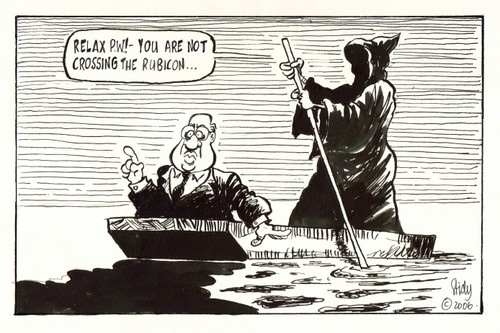
Former SA President PW Botha – the “Groot Krokodil”- dies, unrepentant to the bitter end..
As true today as it was when I drew it.
President Thabo Mbeki ponders his achievements.
South African “Quiet Diplomacy” towards Zimbabwe at work.
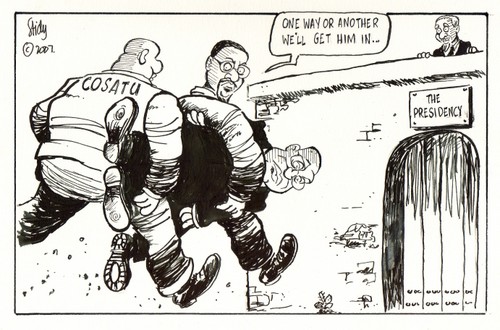
Cosatu boss Zwelinzima Vavi throws his weight behind the bid to oust President Thabo Mbeki from office. He later undergoes a change of heart as to the worthiness of Mbeki’s successor, Jacob Zuma.
The Schabir Shaik trial in Durban proves the fraudulent and corrupt relationship between the Durban-based businessman and South African leader, Jacob Zuma. Shaik is sent to jail but is later released on very dubious “health” grounds.
President Thabo Mbeki finds his State of the Nation address being overshadowed by a much larger issue – his own survival.
Drawn back in the days when a newly elected Jacob Zuma was still trying to act presidential. He very soon gave up the pretense. Julius “Juju” Malema’s behaviour has remained unchanged…
A cartoon depicting the huge gap between electoral promises and actual delivery..
Ex-President Thabo Mbeki’s Aids denialism costs South Africa dearly.
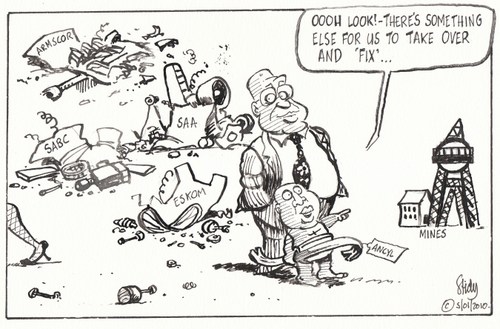
So far Juju’s high hopes for the mines have not been realised. The position of South Africa’s parastatals has, meanwhile, got a whole lot worse.
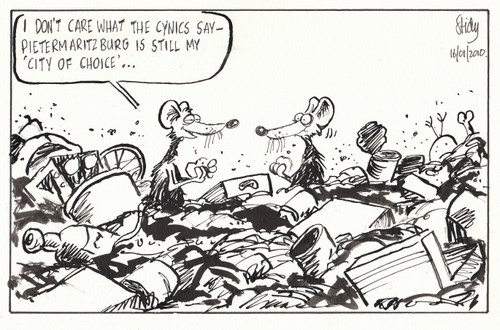
Pmb’s refuse problem also got worse…
Former Health Minister, Manto Tshabala-Msimang dies. In her life she became an object of ridicule because of her recommended AIDS cure.
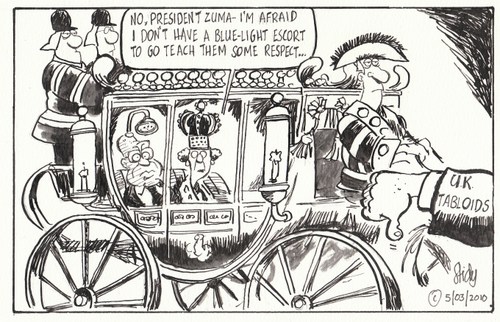
On a state visit to Britain, President Jacob Zuma receives a hostile reception from the British tabloid press. He is not amused…
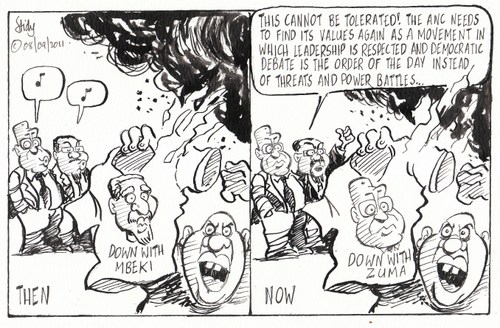
What goes around, comes around – and President Zuma is, once again, not amused.
Julius Malema is expelled from the ANC by the man he helped bring to power.
One of the many, many, many scandals that dogged Jacob Zuma’s term in office.
The death of an icon. The whole world mourns.
Another cartoon which shows how little some things have changed.
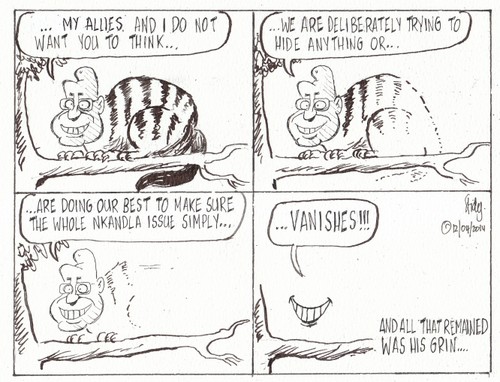
Dogged by one scandal after another, Jacob Zuma remains a master of evasion.
Once his staunchest ally, Juju becomes President Jacob Zuma’s staunchest critic.
Does life hold any greater pleasure than lying in bed, soaking up the early morning melody of bird song? I tend to think not! With the dawn comes enchantment.
It was certainly one of my main reasons for wanting to quit city life and return to my rural roots.
Setting up home on Kusane Farm, overlooking the Karkloof, I had to, first, try and get to know all the local birds and familiarise myself with their repertoire of songs. The more I grew accustomed to their various calls, the more I began to feel a part of things.
My view over the Karkloof Valley.
Birds sing most in spring because that is usually when they are courting and nesting. Of course, they don’t only vocalise because they are trying to attract a mate. They also call to warn of predators, defend their territory and distinguish between friend or foe.
Most species have highly distinctive songs so this is often a good way of identifying them. Even within a particular species it can help as, for example, with all the dun-coloured Cisticolas who are otherwise often extremely difficult to tell apart.
Birds like to sing early in the morning because that is when sound travels best and furthest. To avoid interference they will often – but not always – sing from a perch above ground level. Sometimes there are a few false starts. A dove starts to coo, changes its mind and goes back to sleep. This is followed by a lull as the whole feathered choir shuffles to their seats, clear their throats and stretch their vocal chords.
And then the joyous symphony begins…
The listing habit has an old and honourable pedigree dating back to ancient Sumeria, so I take some pride in being able to add my little tally of bird calls to it. My list is short, incomplete and contains no rarities because I have confined it, for the most part, to the more common garden birds of my area.
For me, the most bewitching of all these calls belongs to the Southern BouBou, the male of which, can be seen here taking a shower under my garden spray. The resident female (also shown) is sweet to his sound, invariably answering it with a tune of her own.
Southern Boubou (male)
Southern Boubou (female)
My old, much-thumbed and annotated, copy of Roberts Birds of South Africa describes their voice this way: “A duet of ‘ko-ko’ replied by ‘kweet’ or ‘boo-boo’ replied to by ‘whee oo’; often reversed thus ‘too, whee’ answered by ‘boo-boo’” The alarm note a guttural ‘cha-chacha’ or ‘bizykizzkizz’”.
In other words, it is a rather long, idiosyncratic and complex love song…
Another regular member of my dawn chorus is the Cape Robin-Chat, seen here sitting in a Sneezewood tree (Ptaeroxylon obliquum) I planted when I first came up to Kusane.
Cape Robin-Chat.
Friendly and inquisitive, he may lack the grandmaster skills of his cousin, the White-browed Robin-Chat (formerly Heuglin’s Robin) – whose song is complex, subtle and piercingly beautiful – but he sings his little heart out and for that he gets full marks. He is also, invariably, the first bird up and the last to go to bed.
What William Blake observed about the English robin, could just as much apply to his free-spirited African equivalent:
“A Robin Red breast in a Cage
Puts all Heaven in a Rage.”
Number Three on my list is the Olive Thrush. Like the robin, he is one of the first birds to break the tension of waiting for sunrise, bursting in to song just before the first streaks of light appear in the East.
In a poem dedicated to this common garden bird, the Grahamstown poet, Harry Owen, describes it, rather beautifully, as an “Avian Buddha…hunched up in ruffled chestnut gentleness…”
His emotional and aesthetic reaction differs somewhat from that of the English poet, Ted Hughes, who wrote:
“Terrifying are the attent sleek thrushes on the lawn,
More coiled steel than living – a poised
Dark deadly eye…”
Cold killing machine or not – and he is an effective hunter as this photograph shows – I am still happy to wake up every morning to its uplifting, fluty call.
Olive Thrush.
If I had to name the Joker in the Kusane pack, my vote would go to the Dark-capped Bulbul (formerly Black-eyed Bulbul) – or Toppie as it is more affectionately known.
Black-capped Bulbul (or’Toppie’).
One of the most common and widespread birds in South Africa, the fruit-loving Toppie is more to be admired for his persistence and effort than the quality of his singing – but he is unfailingly cheerful and upbeat and that makes him all the more loveable.
It would also take a very sneaky snake to slither by without a Toppie spotting it and notifying the universe!
As something of a nomad, a bird who comes and goes seemingly on whim, the Black-headed Oriole is an infrequent participant in the Kusane Farm Dawn Chorus.
Few birds, however, are so dramatically beautiful and it would take a very cold heart indeed not to thrill to its wonderfully liquid call. It is like listening to the bird-world equivalent of Mozart’s Magic Flute.
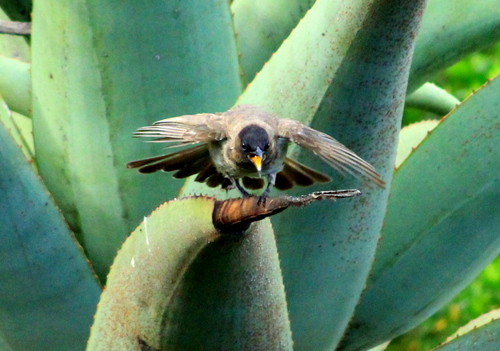
Black-headed Oriole in Aloe Ferox
Black-headed Oriole in fig tree
As one of the more charismatic bird species, the oriole has been co-opted in to the name and logo of various sports teams. In America, for example, there are the Baltimore Orioles. Closer to home, the Zulu name impofana has been given to the Eurasian Oriole because of the nick-name “Mpofana”of the Kaiser Chief’s Football Club. The name refers to the striking yellow and black colours worn by the teams’ players (see Zulu Bird Names and Bird Lore by Adrian Koopman).
Although it is a highly subjective question, I suspect most South Africans, if asked, would name the African Fish Eagle as the bird whose call best cptures the spirit of wild Africa.
While I, too, am always deeply moved by its haunting evocative, cry, I would, if forced to do so, choose a different bird as my favourite – the humble, common Cape Turtle Dove. Maybe it is a question of association as much as call. For me, the Turtle Doves familiar, comforting coo ( rendered, in English, as: “How’s father, how’s father” or, if your conscience is bothering you: “Work harder! Work harder!”,) carries all sorts of echoes and evoacations of a childhood spent amongst the beautiful Nyanga mountains and deep in my beloved bushveld.
Cape Turtle Dove
Cape Turtle Dove
With the possible exception of the Fiery-necked Nightjar it touches a depth in me no other bird does.
The English poet William Blake, who seems to have spent as much time conversing with Angels and Demons as ordinary mortals and knew a bit about these things, had something to say about doves in captivity as well:
“A Dove house fill’d with Doves & Pigeons
Shudders Hell thro’ all its regions.”
Although they stay mostly down in the valley, I think I can safely add cranes to my list because their sound drifts up to me as I sit on my verandah sipping my early morning cup of rooibos waiting for the sun to come up. With their elegant courtship rituals, fidelity and haunting calls, cranes have, since antiquity, exerted a peculiar hold on the human imagination.
Greek and Roman myths portrayed their dance as love of joy and a celebration of life and associated them with Apollo and Hephaestus. In Chinese myths, cranes were symbolically connected with the idea of immortality.
In South Africa, the Zulu King Shaka reputedly wore a single Blue Crane feather.
They are special. On the ground they are exceptionally regal, elegant in stature and stately in bearing. In flight, they are equally impressive, thrusting forward with powerful wing beats, their heads and necks fully extended in front of them.
In his book, The Birds of Heaven, the author Peter Matthiessen saw cranes as “striking metaphors for the vanishing wilderness of our once bountiful earth.”
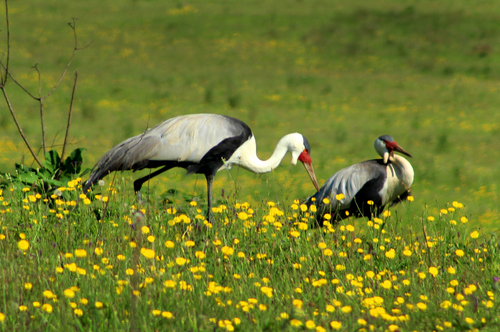
We are very fortunate in that all three of South Africa’s resident cranes – the Blue, the Grey Crowned and the Wattled – occur on our door step. They are also shy and wary so I was quite lucky to get as close as I did to this pair of endangered Wattled Cranes without disturbing them.
Wattled Crane.
My list would not be complete without a migrant although they only call in summer. The sound of the cuckoo’s call, for instance, is so familiar and so much part of our inherited sonic landscape that we mark our seasons by its appearance.
The most obvious of these, because he is so vocal and so well known, would be the Red-chested Cuckoo (the ubiquitous Piet-my Vrou) but since he tends to stay down on the river line I have opted for the Dideric Cuckoo instead. As his brood host is the weaver, of which we have many, he is the common cuckoo in our garden.
Perched on top of the uppermost branches of a dead pine, bill arrowed skywards, he cuts a conspicuous figure in his striking green and white tunic. Throwing his whole body into the effort, he trills out his clear, persistent ‘dee-dee-deederick‘. His female, if he has one, may choose to respond with a plaintive ‘deea deea deea‘.
Diederic Cuckoo (right), plus Cape Sparrow.
Like all cuckoos, it is very swift in flight. John Clare, who has been described as the “finest poet of Britain’s minor naturalists and the finest naturalist of Britain’s major poets” called it perfectly when he wrote:
‘The cuckoo, like a hawk in flight,
With narrow pointed wings
Whews over our heads – soon out of sight
And as she flies she sings…‘
Another bird whose call captures something of the presence, the spirit, the essence of the old Africa is, for me anyway, the Natal Spurfowl. Preferring thick cover, it more often than not remains invisible. It is just a loud, agitated, scoffing, scolding noise deep in the foliage.
Having scoped out the situation, my resident pair will sometimes explode out the bushes and streak across the lawn lawn, a fleeting chaos of orange bills, feathers and moving legs, heading for the thick bramble on the other side of the fence where they like to hide from the prying eyes of predators.
Natal Spurfowl – a loud, agitated,scoffing, scolding noise…
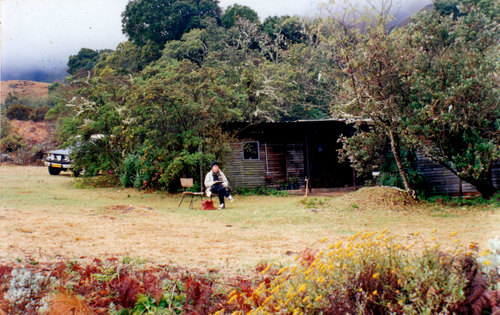
The Zulu name inkwali gives some indication of is call. To quote Roberts again: “The bird is more often to be heard at sunrise and sunset, sounding like ‘kwaali, kwaali, kwaali’ …” Newman’s gives a similar rendering: “The call is a harsh ‘kwali, KWALI, kwali‘; when alarmed utters a raucous cackling…”
Sasol gives a slightly different interpretation: “Raucous, screeching ‘krrkik-ik-ik”. They all agree on the main point though – they kick up quite a fuss…
I hesitated about including the Hadedah Ibis because its similarly deafening ‘ha-ha-da-da’ is not a song. It is is a din. A rioutos cacophony, far more effective as a wake-up call than any alarm clock, gong or bugle.
Having happily transplanted itself in to our cities and towns, it has become such an iconic bird, its familiar call so much part of our everyday lives, I decided in the end it would be a travesty to leave it out…
An unmistakeable, almost prehistoric-looking creature, the Hadedah’s name is, of course, onomatopeic; it’s a sort of phonetic reminder of its most obvious attribute – so extraordinary a noise as to be once heard and never forgotten. As they fly it seems to get louder and quicker and more excited, ending in a burst of dirty hilarity, as if one of them cracked an off-colour joke…
Hadedah Ibis.
My former Witness colleague (and good friend), the poet Clive Lawrance, devoted three poems to the Hadedah in his wonderfully wry and whimsical little compendium, Butterflies & Blackjacks: Poems from A Maritzburg Garden (to which I contributed the illustrations).
He captured something of the birds unruly character and strange charm with these lines:
‘Every day three hadedas swoop
into my garden; they come
in turquoise-brown-metallic coats
that glow in the sun; or they come
bedraggled with drizzle; even, sometimes,
plastered with rain and muck;
but
always they come…’
The numerous members of our ever-expanding Village Weaver colony don’t so much sing as keep up an excited, incessant, day-long chatter between themselves, especially at nest building time. It is the male who builds the nest and he has to be fully on his game because his bride to be is a very exacting arbiter of what does and doesn’t constitute a highly desirable piece of real estate.
It is a taxing business, requiring considerable skill and mental acumen, and he has to work his tail feathers off to please his partner. If the nest fails to meet the female’s high standard, he will tear it down and start all over again.
Village Weaver in early nest-building stage.
Almost complete – next to get his mate’s approval!
As a result the drive-way up to the house is regularly strewn with discarded homes.
When we first came up to Kusane there was no resident Helmeted Guineafowl flock on the farm. We tried to rectify this by importing a batch of guineafowl chicks and raising them, with mixed results for they frequently fell victim to our local predators.
Besides being highly vocal – Roberts’ describes their clattering, machine gun-style of delivery as ‘a grating, rapidly stuttered “kekekekekek”’ – they are also very jittery birds. If suddenly disturbed or frightened by anything, real or imagined (it is often the latter), they all take to the air, their wings making a whooshing noise as they alternatively flap and sail, labour and glide either on to the top of the farm owners’ vegetable tunnel, the roof of the house or the topmost branches of the surrounding trees.
An Impi of young Helmeted Guineafowl on the march…
This habit of fleeing at the first hint of trouble has given rise to a Zulu proverb: Impangel’ enhle ngekhal’ igijima (a good guineafowl is one that calls while running) – meaning, to put it in Shakesperian terms, that discretion IS the better part of valour…
The Zulu name for guineafowl, impangele, was also given to one of Mzilikazi’s regiments because they wore its black and white spotted feathers and also, presumably, because of the active way this bird moves in packs through the undergrowth.*
Most people respond positively to all birdsong. Whole anthologies of poetry and prose have been devoted to the subject, celebrating it as some sort of natural miracle.
Alas, I can see nothing poetic or anywhere near miraculous about the incredibly noisy sideshow my two strutting, foolish roosters – Rowdy and Motley – with their Chauntecleer-size inflated egos, produce each morning.
Determined to shame each other – and all the other roosters in the district – in the high-decibel stakes, they like to do a short practice run around 0130am, just as I am getting in to my deepest sleep. Then, with military precision, at exactly 0430am, the floodgates open and they don’t close until late in the day.
Rowdy, the Rhode Island Red
Motley the Bosvelder
As I bury my head under my pillow, desperately trying to shut out the racket, the voice of the poet Sir Charles Sidley (1639-1701) speaks down the centuries to me:
“Thou cursed Cock, with thy perpetual noise,
Mayst thou be capon* made, and lose thy Voice,
Or on a dunghill mayst thou spread thy blood,
And Vermin prey upon thy craven brood…”
But then I remember the lines from Robert Frost:
“The fault must partly have been in me.
The bird was not to blame for his key.
And of course there must be something wrong
In wanting to silence any song.”
(*A ‘capon’,for those not familiar with the word, is a castrated chicken fattened for eating)
REFERENCES:
Newman’s Birds of South Africa by Kenneth Newman (1983 edition, published by SAPPI)
Roberts Birds of South Africa by McLaghlan & Liversidge (1970 edition, published by Cape & Transvaal Printers Ltd)
Sasol Birds of Southern Africa (2011 edition, published by Struik Nature)
The Genius of Birds by Jennifer Ackerman (published by Penguin)
The Penguin Book of Animal Verse (1965 edition)
*Zulu Bird Names and Bird Lore by Adriaan Koopman (2019 edition, published by UKZN Press)
SPECIAL THANKS to Harry Owen and Clive Lawrance for allowing me to quote from their poems and my brother, Patrick, and his wife, Marie, for giving me my first bird book thus triggering off a life-long passion……
It is four ‘o’clock in the morning and I am lying in my tent in the Sugarloaf camp-site on the fringes of Lake St Lucia town. It is still dark. Although little stirs at this hour, it is not completely silent. In the distance, I can hear the waves crashing against the shores of the Indian Ocean. A sea breeze ruffles the leaves in the trees above me. Someone is snoring softly in one of the tents.
I am agog with anticipation. I know the dawn chorus is coming any moment soon but I am not sure when. I feel that same sense of hushed expectation I get when a concert is about to begin.
The first to start up is the Red-capped Robin-chat, one of the most melodious tune-smiths in the business. When he wants to show off his vocal virtuosity, he can elaborate and vary his tune for as long as he wants, throwing his whole body into the effort, song after song. Next, even deeper in the forest, I hear the amiable chortle of an Eastern Nicator. Him, I want to find (I don’t but I have got him before). Then, that other well-known songbird, the thrush (probably the Olive Thrush) chips in, followed by a whole cacophony of song.
Red-capped Robin-chat.
As I think about dragging myself out of my sleeping bag, I try to identify some of these bird calls although I am not sure whether it is actually the bird I think it is singing or the robin mimicking their sound. Most species have very distinctive calls, but the robin is a master at impersonation. He can do pitch-perfect renditions of virtually every call from the Fish Eagle to the Fiery-necked Nightjar. He can even do convincing imitations of human sounds which is a lot to ask of a bird…
With streaks of light now appearing in the east, I unzip my tent and lookout. The world seems welcoming enough so I crawl out and stagger towards a kettle already boiling on the gas stove. Once my tea is made I pause to take in my surroundings. They are beautiful.
There is a rather long story behind how I got to be standing here with my mug of tea in hand amongst this greenery and the musical melody. Being in this camp-site was never part of our original plan. We had hoped to go to Ndumo, upon the Mozambique border. Chomping at the bit with impatience to get there, my one birding partner, Mark, a professional photographer, had booked the three of us (Ant, an ex-game ranger and all-round nice guy, is the other member) well ahead of time, signing on the dotted line and paying the requested fees.
Ken, a sports-writer based in Jo’burg and the fourth member of the team, had decided to delay booking because he was still waiting to hear what cricket assignments he had coming up. It is he who eventually discovers Ndumo is closed.
In yet another example of the bureaucratic ineptitude that cripples so many governmental bodies in South Africa, Ezemvelo KZN Wildlife had simply not bothered to let any of those who had booked know about this closure. If Ken had not found out we would have merrily made the five and a half hour journey to Ndumo only to be turned back at the gate. Another friend of my mine was actually all packed and due to leave, with his family, the next day. Until I messaged, no one had notified him either.
His patience fraying, Mark tried to book us into Mkhuze but it is the same story. The camp-site is closed for “water reasons”. In the end, he settles for Sugarloaf and checks us in there. Ken and I are sceptical. When we go camping we like to get off the beaten track. A camp-site in suburbia is not our idea of wilderness. Mark is adamant about it so for the sake of group harmony we relent.
Which brings me back to how I am here.
As I take another sip of tea, I hear a strange whooshing sound. A largish bird alights in a wild fig tree near me. With its bright, green colours and upright crest, I recognise it immediately. It is a Livingstone’s Turaco, a ‘special’ of the area. It is a bird that only lives in a very narrow band of elevation and in South Africa is restricted to the thin coastal strip on the upper reaches of Zululand. It is very similar to the more well-known, Knysna Turaco, differing only in having a longer, more pointed, black-and-white-tipped (not white) crest.
I am pleased to be able to tick it off my list so early in the trip.
Still nursing my mug of tea, I concede that Mark may be right after all. Forests are great providers of solitude and he has managed to hide us all in a very secluded spot, away from where the majority of campers have erected their tents (and parked their boats). After the aridity of Mapungubwe and the heat of Kruger (where I have just been), this garden of delights feels like another country to me and a very agreeable one at that. I decide maybe it is advantageous to be open to the new and flexible in your thinking.
Once we have finished our mugs of tea, we set off to explore the iSamgaliso Wetland Park (formerly the Greater Lake St Lucia Wetland Park), South Africa’s largest estuarine system. Its centrepiece is a vast lake that stretches for 38 000 hectares and its rippling waters are home to an enormous population of hippos and crocodiles, as well as pelicans and flamingos. It has the distinction of being the first area in KwaZulu-Natal to be declared a World Heritage Site.
Main lake, iSamgaliso Wetland Park.
Pink-backed Pelican (juvenile).
Ken is bubbling over with enthusiasm because he has heard, via the birding grapevine, that a Rufous-bellied Heron had been sighted at one of the small pans, just to the south of the lake. I have seen one once before, on the banks of the Zambezi at Mana Pool, but for the rest of the group, it will be a lifer. It is a bird that is seldom seen in South Africa. My copy of SASOL describes it as “fairly common resident in north Botswana; uncommon migrant and nomad elsewhere.”
I’m a bit of a nomad myself so I am as anxious as Ken to find it. We are in luck. Parked at the very first pan we come to, we see one fly out from the edge of the water and land on the vegetated matter on the other side. A few minutes later it is followed by another! There is not one, as was reported, but two! A pair!
It is always exciting to see some rare bird in a remote place that is not always easy to reach, so Ken is ecstatic, leaping into the air and high-fiving us all. Thanks to the miracles of modern technology, it is very easy to quickly disseminate information these days so he also lets the Rare Bird Sighting bunch know.
For my part, my heart swells with pride because, as the birder who saw it first, it means I will get to drink red wine tonight out of the special silver goblet we reserve for Best Sighting of the Day! Ken and I take this solemn ritual very seriously but Mark does not share our religious devotion to it. He thinks he has a far superior, much more finely-made wine goblet, failing to understand it is not about the level of craftsmanship – it is about the historical, spiritual and symbolic associations the vessel has.
The Silver Goblet. Pic courtesy of Ken Borland.
Over the course of many years, we have toasted a long list of very fine and stately birds with that goblet…
We drive on, towards the massive, tree-covered dunes that stretch forever along the Zululand coast. The summer rains haven’t started properly yet but everywhere you look it is the same relentless green. In between the forest are open glades of wild parkland in which Zebra, Wildebeest, Giraffe and an assortment of buck roam. The deeper we get into the dune forest, the more the vegetation crowds to the road, In places flat wet dung raises its reassuring familiar smell, meaning that, although we cannot see them, elephant are definitely about. Having had my share of close shaves, I pray they are in good mood…
Near the top of the one high dune, there is a lookout point which provides an exhilarating view over the lake, shimmering under an amorphous sky. Buck and buffalo graze along its banks, a fish eagle’s call adds to the sense of mystery. Ken’s attention is, however, quickly diverted from this Eden-like scene by movement in a nearby tree. It is a White-eared Barbet, another species confined mostly to the Zululand coastal belt and regarded as a ‘special’ although they are quite common here.
We continue up the dune. Another hundred metres or so, we find ourselves staring not over the lake but the mighty Indian Ocean whose rollers are sweeping in endless procession on to the Mission Rocks below.
Mission Rocks. Pic courtesy of Ant Williamson.
Getting on to the surf-flecked rocks, the conchologist in Ken kicks in and he is soon wading around in the tidal pools looking for shells and sticking his fingers into places he ought not to. While he is doing this, Mark is giving an up-country fisherman advice on where to cast his line. Ant snaps the coastline from every conceivable angle with his camera, so he can give his young daughters some idea of where he has been.
I gaze out to the ocean and think about the U Boats that once cruised up and down these waters, attacking merchant shipping lanes off the South African and Mozambican coasts. In a now mostly forgotten episode of the Second World War, 75 Catalina Flying Boats of 10 Royal Airforce squadrons were based, among other places, at Lake St Lucia. They were used for spot and destroy operations along the South African coastline where 163 allied ships were lost to Japanese and German submarines.
On a previous visit, my brother, Patrick, and I had been shown a cellar under a house in the town where it was believed, a spy in the employ of the Germans, had sent radio messages to the submarines.
From here it is a short drive, through yet more forest, to Cape Vidal, a beautiful stretch of shoreline but with too many tourists doing dumb touristy things for my taste. I am not too put out when we turn around and head home.
That evening, Mark and Ant are keen to show us the Ski Club they have discovered the previous day, so we pile back into the car and head down to it. The setting can hardly be improved upon. Directly in front of the club deck is the estuary in which flamingos, in their gossiping hundreds, parade up and down like models on a watery cat-walk. The edges team with waders feeding avidly before night falls. On the other side of the estuary dune, the ocean drives at the shore without pity. Gulls and terns skim overhead eyeing the thundering waves for signs of edible sea life
Flamingo in estuary.
I cannot imagine anything more conducive to relaxation than all this – the cold beer, the balmy African sky, the flamingo, the heady perfume of the sea, the companionship of those who are prosecuting with zeal and enthusiasm the same path of science as you.
Next morning we are up early again and on the road. I am hoping we will have some good sightings over the next few days. There is a good chance of that. Ken is possessed of the sort of doggedness that distinguishes any good birder and when you go with him you know you are in for the long haul. It is almost impossible for him to drive past some small, subsidiary road and not want to go down to see what might be lurking there. Ken would make a top-notch detective if he weren’t so mad about sport.
Our convoluted route takes us all the way back to the N2 freeway and then down to Charter’s Creek on the western shores of the lake. We find the camping facilities here are also shut because of the water situation even though there is a whacking great lake full of the liquid directly in front. Mark smells neglect and rank incompetence in the air.
Charter’s Creek.
Grey-headed Gull, Charter’s Creek.
He then gets out the skottle and makes a sumptuous breakfast fit for a king, near the jetty where some folk are fishing. Ken and I search for water-birds. Ant takes more photos for his daughters.
Cooking breakfast at Charter’s Creek. Pic courtesy of Ant Williamson.
Afterwards, we head off along a route that takes us down the western side of the estuarine system. Near the Dukuduku gate, lying in the grass, close to the road, is a magnificent old Waterbuck bull with one horn. He is all on his own. His surviving horn is long and whorled. If the others weren’t there to set me straight, I would have sworn I have found a unicorn.
A unicorn?
Over the next few days, we explore this whole water-wonderland of river, streams, lakes, vleis, marshes, and oozing filament as it drains into the Indian Ocean. We drive over dunes, through grassland and more pristine forest. We follow a walkway which leads to a lookout point built high up in a gigantic, evergreen Cape Ash (Ekebergia capensis), looking out over an expanse of the swamp. We stand and look towards the spot where one of the Catalinas, that once hounded the Germans, crashed into the lake. Its fuselage still lies under the murky waters providing an object of interest for passing fish.
View from lookout in massive Cape Ash tree. Dunes in distance.
As we do all this our bird list mounts up – Bataleur, Forest Buzzard (immature) Crested Guineafowl, Spurwing Goose, Yellow-bellied Bulbul, Caspian Tern, Purple-banded Sunbird, Red-billed Oxpecker, Trumpeter Hornbill, Ringed Plover, Yellow-breasted Apalis and much more. The top sighting is, once again, reserved for me. Scoping the shores of a small pan I pick up several Collared Pratincoles. Once again I lick my lips in anticipation. The silver goblet is mine!
It is only on our last day, when we drive to Lake Bhangazi, that the animals come out in force.
Lake Bhangazi.
We get up close and personal with two old buffalo. The buffalo is said to be the most aggressive animal in Africa and the way these two keep a beady eye on us makes me hope I will never have to put it to the test. Then we see White Rhino. Three of them. Their horns have been sawn off to try and deter poachers from killing them. Covered in black mud after a good wallow, they look like they have grown out of the soil itself. They also appear quite oblivious to the dark clouds hanging over the future of the species. I love Rhino although I have been chased, on more than one occasion, by their highly irritable and bad-tempered cousin, the Black Rhino.
Buffalo with Oxpecker.
We come upon several herds of fleet-footed Kudu, the male members of whom boast some of the finest horns I have ever seen.
A fine pair of horns…
Sniffing the air…dune forest in background.
Finally, just as we are about to abandon hope: elephant. I have witnessed elephant looming up through trees, lashing the air with their trunks, massive ears flared, angry as all hell, but these two look as peaceful as lambs as they doze in the midday sun, using a Water-berry tree (Syzygium cordatum. Zulu: umdoni) as a make-shift beach-umbrella. You never can tell, though, so I am glad they are not blocking our exit.
Elephant under Water-berry Tree.
My trip ends on a birding high note. On the final morning, while Ken is performing his lengthy ablutions and Mark is packing his vehicle with military-style precision, I spot a bird creeping through the creepers where the Red-capped Robin-chat normally hangs out.
It is a robin but not the robin I expected – it is a Brown Scrub – Robin which I have only seen once before!
A happy camper, I start whistling (very badly) self-congratulatory robin tunes to myself as I exit the park…