Back in the days before
the Internet, Facebook, Twitter and cellphones with cameras, one of
the few things you could do, as a hip young thing, was immerse
yourself in music or, more particularly, rock ‘n roll.
The music of the time certainly influenced the way I looked at and felt about life. At boarding school it provided a tremendous mental and emotional release from the strict discipline and conservative family values which the authorities, in the paternalistic form of the Rhodesian Front Government, seemed so determined to ram down my throat.
It was an age when music was still seen as a catalyst for political and social change. At university I tried to fob myself off as a member of the counter-culture revolution, rejecting the materialism of my parents generation. I let it all hang out and felt groovy and grew my hair long, just like my music idols did, although, truth to tell, I was way too well-mannered to ever practice free love and too scared to take drugs.
Trying to fob myself off as a member of the counter-culture movement…
These days that spirit of youthful rebellion, that was a defining feature of my generation, seems to have all but petered out partly, I imagine, because the modern youth no longer faces the prospect of military conscription.
Likewise, most of the groups I listened to back then have long since disintegrated or disappeared off the scene (the Rolling Stones proving the one stubborn exception) but there are three singer/songwriters who have stuck with me along my life journey and provided a continuing link in my ongoing love affair with rock music – Bob Dylan, Neil Young and Bruce Springsteen. That chain has gone through periods of strength and weakness with albums of unquestionable brilliance being mixed up with the occasional dud.
The Future of Rock ‘n Roll…
Of the three artists, Springsteen was undoubtedly the late arrival although it’s hard to believe that it has been almost thirty years since rock critic Jon Landau penned the portentous lines: “Last Thursday, at the Harvard Square theatre, I saw my rock ‘n’ roll past flash before my eyes. And I saw something else: I saw rock and roll future and its name is Bruce Springsteen. And on a night when I needed to feel young, he made me feel like I was hearing music for the very first time”.- a eulogy the Boss has spent the rest of his life trying to live down
Besides their obvious musical genius, Dylan, Young and Springsteen shared certain other common characteristics. All three have made a career out of defying people’s expectations, constantly seeking to evade the mantle their fans had placed on them.
Starting out as an
acolyte of Woody Guthrie, Dylan famously scandalised members of the
folk music scene with his decision to go electric, prompting outraged
shouts of “Judas” from the audience. Springsteen, whose
ground-breaking Born To Run had come out in the shadow of the Vietnam
war, found himself being deserted in droves by his overwhelmingly
liberal fan base with the release of Born in the USA an album many,
mistakenly, saw as a paean to the policies of Ronald Reagan.
Another trait the
three share is that all they have all enjoyed late period career
revivals. Freer than ever before and liberated from the constraints
of labels and packaging, it seemed like they were finally able to
just relax and rediscover their mojo.
For his part Dylan displayed an astonishing return to form with 1997’s Time Out Of Mind and then, just to show this was no fluke, followed it up in 2001 with Love and Theft, an album which confirmed his renaissance, establishing a tighter sound and a looser attitude
A return to form…
With his craggy face and unkempt hair, Neil Young nowadays looks more like a weather-beaten farmer than a musician but that does not mean he has lost his edge or his ability to read the mood of the times. Both Springsteen and Young beat their much younger counterparts to the finish line with the release of their devastating post -9/11 albums (The Rising – Springsteen; Living with War – Young) which reflected a mounting alarm with the direction George W Bush was taking America. Young followed this up with his Freedom of Speech Tour – along side former band mates Crosby, Stills and Nash – staged during the US 2006 mid-term elections. Consisting mostly of anti-war songs, from Buffalo Springfield oldies such as For What Its Worth and CSNY’s era-defining Ohio, their tour received a mixed reaction with enthusiastic reviews being counterbalanced with scornful appraisals of the “ageing hippies” attempts to rouse America into antiwar protest.
Continuing on his lonesome way…
No matter. Young, who,
somewhat to his own bemusement, had been one of the inspirations
behind the whole “grunge” movement just shrugged it off and
continued on his lonesome, iconoclastic, way.
At this stage of my
life it seems unlikely I’ll ever get to realise my ambition of seeing
either Dylan or Young perform live but I did manage to catch
Springsteen when he visited South Africa. It was all I had hoped for
and more. For a few glorious – if rain-drenched – hours I, too,
felt young again.
In the same week it was announced that South Africa was in recession, King Zwelithini tried to lever support for a vanity project of his. Claiming, somewhat dubiously, to have the support of Britain’s Prince Charles, Zwelithini announced at the opening of the KZN Legislature that he wanted a dam – not just any old dam but the biggest and longest in Africa.
What he didn’t explain was how he expected it to be funded given the cash-strapped state of the country’s economy and the burgeoning national debt.
The World Health Organisation declared Covid-19 a global pandemic as the virus, unknown to world health officials three-months ago, rapidly spread to more than 120 000 people across the world. The growing crisis saw the rand crash through R17/$ and South African shares plummet as scenes of market mayhem played out across the globe.
In the midst of this carnage, Eskom chose to announce it was once again implementing Stage Four load-shedding putting the already ailing South African economy under even greater strain.
With Italy seeing 475 deaths in one day – the highest daily toll in one country throughout the entire pandemic – World Health Organisation head Adhanom Ghebreyesus warned Africa “to prepare for the worst and prepare today”.
His views were backed up by Professor Saloshini Naidoo, the head of public health at the University of KwaZulu-Natal, who said she could not emphasise enough the importance of behaviour change to prevent a wide scale and unprecedented spread of the virus in South Africa.
“These next two weeks are vitally important for people to adhere to the president’s recommendations and ensure that there is little to no contact with others so we can flatten the curve,” she warned.
Following the example of numerous other countries around the world, South Africa went in to full lock-down at midnight, 26th March. The drastic measures, aimed at slowing the spread of the Covid-19 virus, included a complete prohibition on non-essential movement, a ban on liquor sales, a closure of public spaces, community halls and religious premises, all under penalty of prosecution.
The first week of the Covid-19 lock-down saw many South Africans already beginning to feel the pinch, with many of the self-employed fast running out of cash. Their anxiety levels were not eased by the warning from Health Minister, Zweli Mkhize, that they must not expect the increase in cases and deaths to slow immediately as a result of people staying at home. He added that the lock-down may need to be extended.
With the rate of infection from the Covid-19 soaring to unprecedented levels in the United States, President Donald Trump continued to bluster, misspeak and ad-lib his way through the crisis. Having earlier clung to a narrative of normality (It is a Democrat “hoax”, it is just a flu), he had been obliged to make an embarrassing U-Turn and now sought to transfer the blame for the pandemic elsewhere. He found another convenient scapegoat in the form of the World Health Organisation who he sharply criticised for being too focused on China and issuing bad advice during the outbreak.
While President Cyril Ramaphosa’s – and his Health Minister, Zweli Mkhize’s – political capital soared over their handling of the Covid-19 crisis in South Africa, the same could not be said of his grand-standing, thuggish, Police Minister, Bheki Cele. With many reports of police brutality emerging, he was criticised for, among other things, allowing his personal obsession with alcohol to lead to unconstitutional and criminal action by security force members.
In an address to the nation, President Cyril Ramaphosa announced the gradual easing of Covid-19 lock-down restrictions from the beginning of May although public gatherings and movements would still be highly restricted and some parts of the country would remain in hard lock-down. The easing of restrictions meant the country would move from its current strict Level 5 lock-down to a slightly relaxed Level 4.
If she had lived my mother would have turned a hundred this year. To mark this milestone, I decided to write this tribute to her…
My mother in her youth.
When in doubt have a cup of tea…Pic courtesy of Sally Scott.
My mother was one of life’s naturally good people; someone who managed to combine intelligence and kindness with an innate graciousness. Although she lived by clear standards of morality, she eschewed the judgemental; throughout her long and not always easy life, she remained a devoted mother and constant wife.
Born at Cassington in Oxfordshire on the 15th April, 1920, her father, Sydney Ralph Bridgen (who had married Helen Perkins), a veteran of the WW1 trenches, taught at the local school.
Helen & Sydney Bridgen.
He would later
assume the headship at King Sorbonne in Hampshire and then, in 1928,
Herstmonceux. It was in this idyllic, semi-rural setting that my
mother spent most of her formative years.
She had a happy, if sheltered, childhood. Her family – which included her two sisters (Barbara and Marguerite) and brother (Harry) – was close and supportive. From her father she inherited a love of the English country side and also his creative genes.
Barbara and Monica Bridgen.
Marguerite, Barbara, Monica, Harry, Sydney and Helen Bridgen.
She was especially interested in English, History and Art and showed real talent in these subjects. Her father encouraged her literary efforts. One of her poems, To a Seagull, appeared in CornhillMagazine in July, 1936, its then editor, Lord Gorell, commenting that “for one of your age your lines show very considerable promise”. Another poem, Sussex Downs, which she wrote and illustrated when she was only thirteen was published in the Daily Mail.
Monica Bridgen, 1934.
She excelled in art. Her drawings were really wonderful, so delicate and full of life and yet also extraordinarily confident for someone who had only just turned seventeen and often appeared unsure of herself. She won several Royal Drawing Awards.
Marguerite by Monica Bridgen (later Stidolph).
Barbara by Monica Bridgen (later Stidolph)
My mother was
particularly close to her brother Harry who, at the outbreak of the
Second World War, would join the RAF. It was Harry who arrived home
on pass, one weekend, with a group of his air-force colleagues.
Amongst them was a young RAF officer from Southern Rhodesia, Reginald Neville Stidolph. He was handsome and full of charm and in outlook and background very different from the few young men the shy, young, English rose had met. The attraction seems to have been instant and mutual. Putting on a posh accent my father’s first words were “Introduce me….please!”
R.N.Stidolph as a young airman, Fairy Swordfish.
Wing Commander R.N.Stidolph, DFC.
They were married on
the 10th July, 1940, in Herstmonceux. Progress in the
romance was curtailed when, on the 22nd August, my father
flew back to Alexandria in Egypt where he was stationed. He would not
return until March, 1943, two and a half years later.
Such was the
schizoid life of a bomber pilot trying to conduct a relationship
during a war.
Nine months after they got married my eldest brother, Patrick Alan, was born. In my mother’s version of the story he arrived by candle-light at Monk’s Rest, the long time Bridgen home in Herstmonceux, as German planes dropped incendiary bombs all around the village.
Monica Stidolph with Patrick. 1941.
A second son, Andrew
Paul Rosslyn, would also be born during the course of the war.
At the end of the war, my father was keen to get back to Africa and so, for my mother, there had to be a parting, sad like all farewells. Leaving the only world she had known she climbed on board the Carnavon Castle with her two young sons and set sail for Cape Town – and a new life.
My mother and unknown child, leaving England.
I have often wondered what she must have felt as she stood on the deck, watching the coast of England sinking in to the ship’s wake. No doubt there must have been a sense of expectation and adventure, mingled with the inevitable regret. I imagine she must have been nervous about the new challenges which faced her, whether she was equal to them only time would tell.
How my mother, Monica Stidolph, imagined Africa would be…
My mother’s first home was in the suburb of Parktown, in Salisbury, near to the airport where my father was now working as a pilot for Central African Airways. It was here my brother Peter and I were born although I have little recollection of the place.
Monica Stidolph with her four boys – Paul, Patrick, Anthony and Peter. Parktown.
Having settled in to
her new home my mother set about doing what was expected of a woman
in her position back then. Forsaking her artistic interests she
devoted her life to motherhood and keeping a tidy house.
For his part, my father – who had always hankered after having a place in the country – decided to scout out what smallholdings were available within a reasonable distance of Salisbury. In the end he brought one, about thirty acres, in Umwindsidale, just off the Enterprise road.
The only building on the property was a long rectangular room made of mud and grass and local poles which had a corrugated-iron roof and a floor of beaten earth. It was here we all lived, cheek by jowl, while my father set about building a new home which he loosely modelled on the traditional Cape Dutch style of house.
Our original house.
My mother with puff addder she shot with my father’s RAF-issue revolver.
My main memory of
the property is the view which was spectacular. Immediately below our
front verandah was a long, wide valley, extensively cultivated, along
whose edges the Umwindsi River flowed, its path marked by an outline
of dark green. Beyond this fertile plain stretched a further
succession of hills and valleys, blue and hazy, each one becoming
successively paler, in turn, as they rose to meet the sky.
When I was nine or
thereabouts my father decided the time had finally come to go the
whole hog and buy a proper farm. A natural optimist, once he had
chosen a course of action he was not one to be easily diverted from
it. More cautious by nature, my mother, I think, had her reservations
but eventually succumbed to the idea and allowed herself to be swept
along by my father’s enthusiasm.
I was away at boarding school at REPS, in the Matopos hills, when my father set out in search of his dream property. As it turned out he settled for the first one he laid his eyes on. Situated at the end of the Nyanga range the farm was, indeed, very beautiful although whether it would prove suitable for agriculture was a question which still had to be answered.
Consisting of five separate farms – Wheatlands, Barrydale, Groenfontein, Ellenvale and Witte Kopjes – it was in the shape of an inverted ‘L’ with its two northern-most beacons being situated on the top of Mount Nyangui (my father decided to apply this name to the whole farm) and Muchena respectively.
Nyangui (“The Place of Shouting”) mountain with baobab and old lands. Picture courtesy of Patrick Stidolph.
The rest of the farm
was low-lying with a long strip of red land, held between two rivers:
the Mwenje and the Pendeke. To the west and north lay the Zimbiti
Tribal Trust Land, on the eastern side it was flanked by the Nyangui
Forest Reserve.
It was also the
last white, commercial farm, in the district, and some distance from
the nearest rail head. Beyond it lay even more broken country with
yet more hills covered in ancient terraces and fortifications,
stretching down to the Ruenya River. Very few whites ever visited
this part of the world although there were two Catholic missions –
Elim and Avila.
On the other side of
the Ruenya was Makaha – literally meaning “Wild Country”. It
certainly was. A gold belt in this area had drawn some early
prospectors, including the German, Carl Peters, whose name you
forever find cropping up all over Africa. He claimed them for
Germany as the Kaiser Wilhelm Goldfields in 1892. The name was used
for the whole area until the war with Germany broke out in 1915, when
it was hastily dropped.
This, then, was our new home. If Southern Rhodesia was little more than a distant outpost of the British Empire, we occupied a very remote corner of that outpost.
For my mother, surveying the farm for the first time, it must have seemed a long way from the small English village she had left behind; the enormous view down the sun-drenched valley with the mountains running alongside, the tall, billowing clouds, the emptiness, the sense of space.
There was much to do. The farm hadn’t been worked for years so there were lands to stump and clear, furrows to dig, paddocks to fence off. While the land was being cleared, a house of sorts was built, using mud and local rock, next to the small stream which had a waterfall with a pool below. Upstream from that was a wide reed bed in which a family of wild pig and a large python lived.
View towards Muchena mountain. Pic coutesy of Patrick Stidolh.
Preparing the lands. Pic courtesy of Patrick Stidolph.
When
my father bought the farm he had great plans for it. He wanted to
make good. He visualised a future in which the farm would prosper to
the point where it could one day be divided up and each portion left
to one
of
his sons to run in turn.
The
reality turned out somewhat different for reasons which were not
altogether his fault.
Although situated in a beautiful part of Rhodesia, it was not good agricultural country. The soils were mostly poor, the rainfall patchy and unreliable. We were also very far from the markets. My father had little capital to start with and soon found himself indebted to the Land bank.
Inspecting the cattle. Anthony, Monica, Reg and Peter Stidolph.
The
time would come when he would be forced to take stock. We were far
from prosperous. Going through the bank statements and farm books it
became obvious to my father that there was no way we could get out of
the slough we were in, if we continued as we were.
He
needed to find more money. The most obvious way to do this was for
him to return to his old job as a pilot.
And
so the next eight-years or so my father all but disappeared out of
lives, working, at first, in the Persian Gulf and then, later, the
Sudan and Sierra Leone.
In his absence my mother was left to cope with the running the farm, as well as raising six (later seven) children, as best she could. Even though it must have seemed miles away from the world she imagined when she first came out to Africa, it was a struggle she faced courageously.
With her children away at boarding school, it was an isolated life. Her only neighbours, Old Man Mienie and his wife, lived about 10km away. Visitors were few and far between – the occasional animal health inspector come to check the cattle, the odd policeman on patrol. Sometimes our relations, the MacKenzie’s, would motor up from Salisbury for a visit.
There was no electricity so my mother had to rely on candles and paraffin lamps (and later gas) for lighting. Our water was pumped up to a tank on the hill behind our house by a hydraulic ram that fed off a furrow. In the early days she had to boil it in a drum on an outside fire and it was here she did her cooking too.
Mum’s kitchen.
Building a house, circa 1958.
When
we started out we could not afford a tractor so had to rely on oxen
to pull the single furrow plough. It was a slow, laborious process
and because we could not afford too much labour either, us children
were also expected to muck in.
The
weather was changeable. In the dry season bush fires were a constant
threat. Hot, dry winds seemed to suck all the goodness out of
everything. Drought could ruin the crops and enfeeble the cattle to
the point where they gave up hope and died.
You
never could predict when the rains would arrive and when they
did you could never tell what they would do. Sometimes
the storms moved in narrow swaths, drenching one part of the farm but
completely missing the next.
It
was very easy to think that there was indeed, some capricious mind
behind it all, a mind that took a certain impish delight in seeing
your moods oscillate between hope and despair..
Despite having no
background in agriculture my mother battled on as best she could. The
farm consumed her life. Just when it seemed it was finally about to
start paying for itself a new, more ominous, threat loomed on the
horizon: the outbreak of the Rhodesian Bush War in the early1970s.
When my mother was
eventually forced to leave Nyangui because of the deteriorating
security situation she floundered and then recovered but, deep down,
I sensed her life had been irreparably altered. It was like a light
had switched off inside her and she was never quite able to regain
her old enthusiasm.
Thereafter she accepted whatever hand fate chose to deal her with an almost Buddha-like stoicism. Nevertheless, I think she was happy enough in Francistown where she moved to join my father who was flying for WENELA and then later Bowmont, the small farm they purchased near Kadoma.
Some years after my my father died she married our next door neighbour, Jim Hastings, a small-worker who set up a three-stamp mill on the property to crush for gold. When Zimbabwe started to go through a rather tumultous patch in its history, it was decided they should both move on to my brother Peter’s tobacco farm, Sangalolo, in Karoi.
When his farm was seized during Robert Mugabe’s violent and chaotic land grab we arranged for her to come down South Africa to live with my sister, Penny, and her husband , Ric, in Grahamstown. All three of my sisters lived in the area and I was able to come down on regular visits from Pietermaritzburg, so she was loved and well cared for.
Her final years were peaceful and happy. After the hard life and sacrifices she had made it was the least she deserved.
My mother in old age with Henry the cat.
When I think of my
mother the qualities which stand out for me are her honesty, her
integrity, her decency and her quiet strength. She played the hand
she had been given, she was never one to complain about her lot.
Despite having led a life mostly cut-off from normal society, she
showed no sign of being lonely; on the contrary she seemed to derive
a certain comfort from the solitude.
Like many married women of that generation, her life involved compromises which left her talents unfulfilled. I have always thought it sad that she gave up on her art at such an early age. It is one of the reasons I felt compelled to persist with my own efforts. I wanted to live the life she could have had.
Although she remained reticent on the subject, I don’t think she had many regrets about this sacrifice. Her children came first. She was certainly proud of us. “I didn’t produce a single dud,” she liked to say towards the end of her life.
That we turned out
the way we did was largely due to her.
My hope is that as she lay dying, with her three loving daughters by her side, she got an inkling of how much we appreciated what she had sacrificed for us and how much she would be missed…
MORE EXAMPLES OF MONICA BRIDGEN’S ARTWORK:
The following drawings were mostly done when my mother was only seventeen..
My father R.N.Stidolph.
My father, R.N.Stidolph
My mother’s sisters, Marguerite (above) and Barbara.
My father, R.N.Stidolph.
POEMS OF MONICA BRIDGEN:
ACKNOWLEDGEMENTS:
Many thanks to my brother, Patrick, for researching our family tree and to my mother, Monica, whose own memoirs I drew on for this tribute.
Literature and butterflies are the two sweetest passions known to man.
Vladimir Nabokov.
A host of butterflies. I took this pic near Barberton, Mpumalanga.
It is 7.30 am and I am taking my usual nosey wander down the path that leads from my house to the Kusane river. It is a beautiful, balmy, sun-filled, day. Suddenly a butterfly – or rather a butterfly and its passenger – alights on a plant just to my right.
In the past I would have just cast a cursory glance in their direction and then proceeded on my way.
This time I stop, grab my old Canon out of its bag and start snapping away. The reason for this is that I have recently been given a field guide to the butterflies of South Africa* to review and suddenly I have become enamoured with the subject.
I circle around the butterfly, trying to get closer and closer, angling in for the perfect shot. I have no idea what the butterfly is but as soon as I get home I will get out the book and try and identify it, looking for its most distinctive features (as a political cartoonist I have had a lot of experience in this – it is what I do when a new president or other public figure appears). I will also look at the butterflies habits and distribution, hunting for those tell-tale clues that might aid me in my search.
African Monarch (Danaus chrysippus), Kusane Farm.
Then I will add it to my list.
As an artist my approach to nature has always been more sentimental than scientific. I am attracted by the lyrical rather than the factual. I look for beauty and seek solace in my natural surroundings. I love the intense intimacy you can develop with your local landscape over time.
All of which makes it strange that I have neglected – although not completely ignored – butterflies for so long because if anything inspires a sense of wonder in nature they do.
I am determined to remedy this. I have probably left it rather late in life to ever become anything like an expert but you have to start somewhere. And, because it is so open, Kusane Farm seems a good place to begin. Also, I live here.
A Pirate Butterfly (Catacroptera cloanthe cloanthe) about to take off. Note small beetles. Kusane.
In spring and summer we get lots of wild flowers coming up in the mist-belt grasslands, especially after a burn. That serves as a magnet for the nectar-loving insect.
It is 7.30 am again and I am back on the familiar path hoping to carry on where I left off before. Around me the swallows are diving and swooping with quick forward thrusts. There is a strong impression of activity and movement everywhere.
I home in on a butterfly which has landed in a cluster of flowers.
As I approach it, it glides off, stalls, hovers and drops down on to another flower with closed wings. Out comes its long, thin, tube-like proboscis and inserting it in to the flower it proceeds to feed. Once it has sated itself, off it goes in search of the next flower.
Everywhere I look there are other butterflies doing the same.
Their flight paths seem wildly erratic, they keep making continual adjustments to their speed, direction and angle of flight. Unlike most birds or bees, you don’t get that sense they know where they are going.
And yet they obviously do.
Sometimes – as happens in the annual migration of the Brown-veined White Butterfly (Belenois aurota) which takes place at midsummer each year – they come floating by in straggly groups for days on end. There are thousands and thousands of them in seemingly endless flight. I was amazed to read, in my guide, that this particular species originate in the dry Karoo and Kalahari where they gather in their millions and take to the sky heading in a southerly to easterly direction up through the East Cape and Kwa Zulu – Natal to the Mozambique coastline.
Brown-veined White (aka Pioneer Caper White)…
…on mid-summer migration. Kusane.
That is a long way to fly for something so fragile and small.
What makes this mass migration even more astonishing is that the butterflies need precisely timed stopovers for feeding – which means they need to find flowers growing at regular intervals.
This can’t be easy since to fuel this epic marathon they probably have to harvest hundreds of flowers a day.
The other question which kept whizzing around my brain, as I stood watching them zig-zagging their way across the farm, was this – how can a creature with such a pin-size brain navigate and keep track of its position?! I must confess I have no explanation. As happens everywhere in nature, there still are many unanswered questions, which intrigue amateurs at least as much as scientists.
My butterfly list, so far, is not very long and includes no rarities, just your common varieties (although back in 2018, when I was in Marakele, I did see a Kransberg Widow, a very rare and beautiful butterfly which briefly appears during November and early-December and only occurs on this particular mountain. Unfortunately, I did not get a photograph of it).
I hope to rectify that.
To an outsider this making of lists probably seems like a strange passion, one bordering on obsession. Almost a perversion. They may be right. I don’t care. For me it is all part of the thrill of the chase.
As a long-standing twitcher, I have experienced the sense of excitement and privilege which comes from finding something special (a Pel’s Fishing Owl, Narina Trogon, African Broadbill, Rudd’s Apalis, Southern Banded Snake Eagle, Palm-nut Vulture, a pale, female, morph form of the Eurasian Honey Buzzard – to name a few). That thrill grows even stronger when you come across what we interpret as a “rarity” or a “vagrant” (my list is probably topped by the Gull-billed Tern which I got at Nyamithi Pan in Ndumo Game Reserve in Zululand).
Already I am picking up some valuable tips and learning some important life-lessons as I pursue my quarry and record my sightings.
I have discovered, for example, that while we humans may abhor them in our gardens, butterflies simply love weeds. The irritating black jack, which you find so annoying because it sticks to your clothes when you brush past it, seems to be a particular favourite of theirs.
Garden Acraea (Acraea horta) on blackjack flower, Kusane.
This in turn has caused a major rethink on my part. Suddenly I am far more reluctant to pull these bothersome plants out of my flower garden and toss them to the chickens to turn in to mulch. They fulfil a role. They feed the butterflies who I want to attract to my garden. I want the butterflies to look upon my home as their home.
With climate change already taking its toll, one wonders what will happen to the humble, unassuming, butterfly in the future? Will they be able to evolve or adjust their behaviour?
Rising temperatures, associated with climate change, have already begun to change birds schedules. Many have started moving south.
When I first arrived in KwaZulu-Natal, for example, it was unusual to see the Wooly-necked Stork south of the Zululand parks. An uncommon resident they were regarded as a wetland species associated with lagoons, ponds and rivers. In recent years they have started showing up in increasing numbers in cities such as Pietermaritzburg and Durban, in a sense swapping one habitat for another.
A Wooly-necked Stork in Pietermaritzburg suburbia, ignoring metal imposters. Picture courtesy of Mark Wing.
Some plants are also making this latitudinal shift.
I would imagine the same is happening to butterflies although I don’t know enough about them to be sure. Assuming that tree and flower-blossoming times are also changing it seems likely though.
What I do know for certain, is that I hope they will always be around. If the ancient Greek Goddess, Gaea – the first deity to be born after Chaos, the gaping emptiness – is seen as the personification of the earth and the Mother of Everything Beautiful, then the unassuming butterfly must, surely, be one of her most potent and miraculous symbols?
GALLERY:
Herewith a selection of photographs, showing some of the butterflies in our area:
African Blue Pansy, Kusane
Angled Grass Yellow, Kusane.
Common Zebra Blue, Kusane
Dark Blue Pansy, Kusane.
Forest Swallowtail (aka Bush Kite), Karkloof Forest.
Narrow Green-banded Swallowtail, Kusane
Painted Lady, Kusane
Pea Blue, kusane.
Pirate, Kusane
Polka Dot, Kusane
Rainforest Brown, Kusane.
Garden Inspector, Kusane.
Southern Gaudy Commodore, Kusane.
Vine Leaf Vagrant, Kusane.
Yellow Pansy, Kusane
.
* Field Guide to Butterflies of South Africa by Steve Woodhall (published by Struik Nature).
Having grown up and lived in it for most of my youth it is where I always felt most settled and where my heart belonged. No other environment has affected me the way it did nor created the same feeling of mystical bond. Recalling that early period of my life never fails to excite the deepest nostalgia.
It is the romantic in me, I guess.
The true bushveld has a spirit, ancient and impassive. It is a spirit which lives on; I know it, I feel it. It lives on despite the ripple of human effects. It lives on despite our attempts to tame and domesticate it. It lives on despite our plans to commercialise and exploit it and turn it to profit. It lives on despite the encroachment of farms and cities…
Typical bushveld country, South Kruger.
Even when I am not in it, I can still imagine it: the dust, the heat, the dryness. It is a place of extremes. In the bushveld the sun is brighter, the full moon seems bigger than anywhere else.
Its summer storms are a wonder to behold. The high, piled, whipped cream clouds. The gradual darkening to an intense blue. The sudden ragged bolts of lightning.
And then the rain drumming down and getting soaked up by the parched ground. There is no smell on earth quite like the liberated scents of dust, grass and vegetation released after the first bushveld storm of the season.
Summer storm in the bushveld.
Immediately you feel a new energy, a new hope. A quickening of the blood. A rising excitement.
Everything suddenly seems to come alive. The buck start leaping and cavorting, the birds become a flutter of activity, twittering and chirping in the trees.
In next to no time the grass starts sending up new green shoots, the trees break out in bud.
And such trees! What can be more African then the Baobabs, Kiaats, Mopani, Leadwood, Tamboti, Marula, Jackalberry, Nyala trees, Sausage trees, Acacias, Bushwillow, Silver Cluster-leaf, Sycamore Figs and all the other, seemingly infinite, variety trees you associate with it.
These feelings did not diminish when I moved from Zimbabwe to South Africa. Although I elected to live far from the bushveld, in Pietermaritzburg, in KwaZulu-Natal, my heart still lay to the North. On my birding trips you would invariably find me heading up towards the crocodile-infested, fever tree-lined, pans of Ndumo, the broken, granite country around the Crocodile River in Mpumalanga, the enormous sun-drenched plains of Kruger, the red cliffs of Mapungubwe and the mopani-covered Limpopo Valley.
When I wanted to get even further away there was the Matobo Hills, Kariba, Mana Pools, Mangwe and Gona-re-Zhou in Zimbabwe, on the other side of the border.
My kind of country: Gona-re-Zhou, Zimbabwe.
Although I had done the KwaZulu-Natal Midlands Meander many times, I had never really thought about living there. For me it was just a green, pretty, tranquil, place to escape to when I needed a break from the bedlam and noisy confusion of city life. I liked sticking my nose in to its arts studios. I liked sampling the fare at its numerous food outlets, pubs and restaurants. I enjoyed soaking up the slightly bucolic, Surrey-in-Africa, atmosphere.
That all changed when my friends, William and Karen, bought Kusane Farm in the Curry’s Post area, on a hill overlooking the Karkloof Valley, and asked me if I would like to come and live on it.
Having reached an age where I felt my life needed a change of direction I duly motored up to check it out.
Like William and Karen I loved Kusane from first sight. Staring over the valley below I just stopped and whispered “Oh boy!” softly to myself. It had just rained and everything about the day was lovely. The pleasing tidiness of the fields below. The tree-clad slopes of the Karkloof Hills stretching along the one side of it and, near the centre of valley, the oddly leonine shape of Loskop hill thrusting itself out of the earth. The Kusane river – from which the farm took its name – passing through a belt of trees and then snaking its way in a series of bends across the wide plain towards the edge of an escarpment.
View over Karkloof Valley after rain.
There was a freshness in the air, an exhilarating quality to the light. The grass underfoot was soft and green and moist with life.
It was clear I had found a place set apart; one which also had its own special isolation of spirit. Relocating to it became, in its own paradoxical way, a kind of homecoming.
I was surprised by my reaction because anything less like my beloved bushveld in Southern Africa would be hard to find.
Curry’s Post is mostly mist-belt grassland with pockets of remnant indigenous forest (or at least it was until the timber companies discovered its potential and despoiled the countryside by planting miles and miles of sterile fir trees).
In summer the mist comes drifting in most evenings, reducing visibility and creating as slightly unreal radiance as it gets hit by the dying embers of the sun.
Unreal radiance: Karkloof Valley.
As the winter cold fronts move through they often bring mist too. From my upstairs balcony I watch it with curiosity as it rolls closer, like a grey wave, until it suddenly enfolds me in a blanket of cold damp.
It is strangely disorienting but also oddly comforting, even as it obliterates all the familiar visual landmarks that surround me and provide me with a frame of reference.
In the end, I did not have to consult any crystal-gazers or soothsayers of some kind to find out why I so quickly fell under its spell. It was my sister, Penny (who is, admittedly, a soothsayer of sorts), who pointed out the obvious.
“It is wired in to your DNA,” she explained.
Originally of Viking descent, my Scottish ancestors, the Moodies, had dwelt for centuries among the heather and bleak, rain-swept hills of the Isle of Hoy on the Orkney Islands. Another branch came from Ireland, the original ‘Misty Isles’. Such scenes would have been familiar to both. Accustomed to the mist and rain, they, too, would have felt quite at home here.
I have always been very proud of my Norsemen roots although I fear that something must have gone wrong with me because although I may have inherited the complexion and hair, I completely lack the marauding temperament! On the contrary, I am a very friendly, peaceful, law-abiding sort of chap, quite happy to let my neighbours keep what is rightfully theirs.
In this respect, maybe I take after my mother’s side of the family.
I do like to roam though. One of the pleasures of being in the autumn of my years is that I am now a man of (limited) independent means, beholden to no one.
I get to decide when I want to be active and when I want to be passive. Should I dig a hole and plant a tree, or just sit and look at a tree?
Or should I be both active and passive and go for a walk? It on these daily ambles that I get to delight in my new found sense of freedom.
Walking in the mist with Minki and Whisky.
I especially like walking in the mist. Something about the half gloom brings out an ancient instinct, a memory buried deep in the back of my brain. There is a healing magic about such weather, it is very evocative of the mysteries, it induces a feeling of solitude in me. It is like having the whole universe to myself.
The Kusane, after which the farm is named, is a small stream but has a waterfall and pool further up, closer to its source. To get to it you follow the path that runs along the ridge that forms the backbone of the farm. Near its highest point is a bald expanse of rock, Lizard Rock, which on a sunny day offers a clear 360-degree view but that window closes down altogether when the mist drifts in. I often like to pause and sit here, alone with my thoughts.
From the top of the ridge the path zig-zags its way down from the one end of the valley all the way to the other. As it winds along you can hear the river but you cannot see it.
The route down to the Kusane River.
Sometimes, if I am lucky, the vague shape of a reedbuck will emerge out of the dripping greyness. Momentarily startled, we will both stand and stare at each other before it bounds away, out of sight.
Reedbuck in the mist, Kusane Farm.
Other times I will hear the strange whooshing sound of a gaggle of Spurwing geese winging overhead.
Spurwing Geese, Karkloof Valley.
The half light can play tricks with your eyes. Even the rocks can take on the appearance of something living: a crouched lion, a sleeping hippo or some sort of dragon-creature, the fissures on the surface of the stone becoming its hide.
At the path’s lowest point you reach a river crossing near where the old pump-house used to be.
Once I get here, I like to sit on the river bank and listen to the sounds: the conversation between rock and flowing water; the plaintiff call of the Longclaw as it rises high in the air; the thin beleaguered cries of the plovers flying overhead and the wind whispering in the grass.
To the ancient folk such sounds carried meaning. I like to think they still do, it is just that our busy, modern minds have forgotten how to hear.
For some reason our local black crows become more vocal on these grey, overcast days. They, too, speak a language which comes from a remote, mysterious time. Their raucous yet eerie sound-shifts, echoing through the swirling mist, conjures up both the natural and the supernatural, magic and wizardry.
You can understand why they were associated with the dark arts in traditional European folklore.
In Zulu society, too, crows and ravens are seen as an omen of misfortune and death (although in New Mexico, as I discovered, the native Americans believe the exact opposite. They see them as bearers of good tidings).
White-necked Raven.
Crows are also, arguably the world’s smartest bird so perhaps it is a little unfair to cast them in such terms. Maybe our irrational fears and prejudices say more about our own morbid thought patterns and preoccupations than it does those of these maligned and often misunderstood birds?
The Black Cuckoo, a summer visitor to our parts, is another wisp of a figure, barely glimpsed but often heard. His mournful call ‘hoo hooee’ is sometimes rendered as “I am so siiiiick!” With climate change casting its grim spectre over our lives, it is a sound which, for me at least, seems to capture some mystical truth about the state of the natural world.
Sitting in the grey gloom I find myself imagining something else – what if one day there were no birdsong at all? What if, in our hard-nosed materialism and clumsy efforts to dominate the planet, we drove all the other species to the edge of extinction?
I do not think I could live in a world where their beautiful cacophony of sounds exist only in memory.
For me there is an important truth to be acknowledged here. While the misty landscape invariably infuses me with a sense of well-being, this feeling is, at times, tinged with a touch of melancholy. I am only too aware that what I am enjoying offers only a temporary escape from the troubles of the rest of the world, lying just over the hill. Yet, in a strange way, this awareness only sharpens one sense of momentary pleasure. It makes you enjoy it all the more because you realise how transitory it is.
And so, as I continue to totter along the straight, stony, path to old age and beyond I intend to keep glorying in the mist.
As the Australian bush-fires continued to rage across large tracts of the continent – by early January an estimated 5 million hectares had been destroyed (as opposed to 906 000 hectares in the Amazon fires) – its governments initial tepid response and refusal to acknowledge the true extent of the crisis attracted widespread criticism. Prime Minister Scott Morrison’s own inability to utter the words “climate change” without breaking in to a cold sweat also showed a woeful reluctance to engage with the issues presented.
In the same week that it was reported that the two big KZ-N municipalities, Msunduzi and uMgungdlovu, were muscling up against each other to become a regional metro, Pietermaritzburg was visited by two ANC heavyweights, Zweli Mkhize and Blade Nzimande. They were both blunt in their assessment. The city is filthy, it stinks and its leadership is useless.
Eskom continued to be in the news for all the wrong reasons with the embattled power utility now saying that if it is not granted the substantial tariff increases it wants from March, its finances might collapse, triggering a national crisis, as both the state’s credit ratings and consumers’ well being would suffer. Responding to this, Melanie Veness, CEO of the Pietermaritzburg and Midlands Chamber of Business, warned that the proposed increases would be the final nail in the coffin for local businesses and would lead to retrenchments and a greater strain on the already struggling business sector.
Under pressure from detractors and enemies both inside and outside government and the ANC, Public Enterprises Minister, Pravin Gordhan, said he was following a mandate given to him by President Cyril Ramaphosa and that he must be left alone to complete the task he was given. With load-shedding costing the country between R59billion and R118billion in 2019, one can only hope he succeeds with his Eskom turnaround strategy.
After several years of acrimonious debate, the United Kingdom officially left the European Union on the 31st January, 2020. The country’s exit will undoubtedly prove to be British Prime Minister, Boris Johnson’s, biggest victory. At the same time it is very much a leap in to the dark and whatever happens in the coming stages of the Brexit process things look set to get more, not less, tricky.
The University of KwaZulu-Natal shut its doors after a week of violent protests which saw several buildings set alight on both the Pietermaritzburg and Durban campuses. Condemning, the incidents, the Minister of Higher Education, Blade Nzimande, said “These attacks look like well-orchestrated acts of sabotage and criminality meant to undermine and reverse the already achieved milestones reached with the South African Union of Students.”
Ignoring the loutish behaviour of Julius Malema and the EFF, President Cyril Ramaphosa implored South Africans to “…not allow fear to stand in our way” in his annual State of the Nation Address (SONA) to Parliament. While his national call to action contained some positive announcements, the fear remains that with state finances in dire straits, the economy all but ground to a halt and state companies floundering, the president will allow himself to remain captured by party dogma and constrained by indecision.
Former President, Jacob Zuma, continued to use every trick in the book to avoid his day of reckoning in court, charged with corruption. Having presented a sick note to excuse his absence – it was rejected by Judge Dhaya Pillay of the Supreme Court because the dates appeared to have been altered – Zuma then went on to accuse the National Prosecuting Authority (NPA) of employing Apartheid-era tactics against him.
He also insisted that these were not deliberate delaying tactics on his part…
A proposal to cut the state’s wage bill by R160,2 billion over the next three years as Treasury warns of ever-rising debt repayments, was one of the key announcements of the 2020 budget, presented by Finance Minister, Tito Mboweni. The move was immediately opposed by the Public Services Union (PSA) who vowed to fight any threat to freeze public servants’ salary increases.
With the Rhodesian Bush War intensifying and many whites leaving the country because they saw no future for themselves, it was probably not the wisest of times to be considering such an investment – some might even have called it foolhardy – but my father was never one to doubt his own judgement and went ahead anyway.
He had recently come
in to some money, as a result of finally selling our long abandoned
Nyanga ranch to the new (and destined to be short- lived)
Zimbabwe-Rhodesia Government who wanted it for resettlement.
With the proceeds my
father bought a 1500 acre property adjoining my brother Paul’s
cattle ranch in the Battlefields area (so named because many of the
old gold mines and farms in the area had been named after famous
battles) in the Rhodesian Midlands.
Situated in a
marginal rainfall area about halfway between the towns of KweKwe and
Kadoma the farm consisted mostly of mixed mopani woodland. Although
there were some crops grown in the area (mainly cotton and wheat),
usually where there was irrigation available to supplement the
unreliable rainfall, this was mostly cattle country.
The ranches tended
to be large, each one separated from its neighbour by miles and miles
of rough, ribbed, ungoverned country. If I stood on top of the low
range of hills that ran immediately behind the old homestead I could
see no other sign of human settlement in all directions other than
the cooling towers of the Umniati Power Station which protruded above
the tree line and the electricity pylons that marched like an army of
ungainly giants alongside the main Salisbury-Bulawayo Road.
There was already a house built on the farm, simple but comfortable in the old settler style. It consisting of whitewashed brick with a corrugated iron roof, big, bare rooms and a wide veranda which jutted forward over what remained of a lawn.
Bowmont house with vlei.
It had been built
on a small shoulder of land, in front of which was a vlei that
sometimes flooded in the rainy season but for the most part consisted
of a series of potholes caked with cracked mud. On the other side of
this stood a thin belt of thorn trees and beyond that a fenced
enclosure that had once been a cultivated field but was now slowly
being reclaimed by the bush.
Although my first
loyalty will always be to the Nyanga farm, where I grew up, Bowmont
came to exert a similar hold over me; it had the same haunting and
mysterious familiarity although, on the surface, its attractions were
a whole lot less obvious.
On the Inyanga farm
our horizons had been ringed by mountains and no matter where you
stood you were more or less guaranteed a great view. On Bowmont once
you left the Big Vlei, the trees closed in around you and your vision
became restricted to a few hundred metres on every side.
Whereas I had fallen
for the Inyanga landscape almost on sight, Bowmont revealed its
beauty in a more subtle, slower way.
Having bought the farm, my parents had to decide what to do with it. In her usual quiet, methodical way my mother immediately set about creating a garden, one that would provide a bright, colourful oasis in the middle of the dry veldt.
The house when we first arrived.
The house after my mother had created a garden.
For his part my father decided that Bowmont was good sheep farming country. Unfortunately he could never persuade the sheep themselves to accept this fact. For some reason they didn’t like the area at all and despite my father best efforts to convince them otherwise they persisted in growing thin and dying with a monotonous regularity.
It soon became more
than obvious that we would be hard-pressed to earn a living this way.
In a letter to my English cousin, Rebecca, I noted somewhat despairingly: “August is our cruellest month: the nights are still cold but the days are hot and we are pestered by an angry dry wind that blows dust into everything and slowly frazzles out the landscape. The grass turns harsh and tough and stubbly and in between the soil is dry and cracked, the blood sucked out of it; waiting to get whipped up along with the dead leaves and other winter-time debris and carried away by the meandering dust-devils. It is also the month when the sheep driven on by visions of green begin to stray and get preyed on by the equally hungry jackal…”
Our sheep herder.
My nephew has a go at being a sheep herder…
The advent of the
rains – which could happen any time between October and December –
always marked the turning point of the year. For weeks beforehand I
would find myself anxiously panning the skies for the first tell-tale
signs that they were on their way. Normally there would be a few
false starts before the day would come when the dark storm clouds
would start banking over head and the air became charged and tense
and then suddenly you would hear the first big, shiny drops falling
and hissing as they hit the sun-parched ground.
Living in a dry
country, there was no nicer sound than lying in my bed at night
listening to the rain drumming down on the corrugated iron roof while
the old mango tree outside my bedroom window heaved and swung and the
thunder rolled along the line of kopjes.
At his stage of my
life I was – in between my numerous army call-ups – six weeks in,
two months out – employed at the Mining Commissioner’s office in
Gwelo. Built somewhat optimistically in 1896 as a Stock Exchange the
building which housed our offices had that air of beguiling
shabbiness one so often associates with government departments –
especially those banished to the sub-regions. The work itself was of
a fairly dull and routine nature – issuing prospectors’ licences,
registering mining claims and trying to sort out disputes between
farmers and miners over land rights. Most weekends I would jump into
my battered old Datsun 1200 and together with my border collie,
Bruce, head off to Bowmont.
In the meantime the
war ground inexorably on towards its inevitable conclusion. The
advent of majority rule finally gave me the excuse I needed to quit
my government job and to move to the farm to help out my father who
was becoming increasingly ill.
He eventually died in Harare on the 3rd February, 1983. After his death and with my mother now working during the weekdays at a boarding school just outside Chegutu I lived alone in the farm. During the holidays I would be joined by my young sister, Nicola, who was a boarder at Queen Elizabeth in Harare.
The solitude suited
me. During the preceding years, my double life as as part-time
civilian, part-time soldier had taken its toll. After seven years of
fighting for a cause I had never really believed in I had found
myself consumed by an increasing sense of futility.
When the war
finally ended, I had left the army with a feeling of moral blankness
but now I had plenty of time on my hands to think about my
experiences and get back in touch my feelings.
Just being there and going for long tramps with the dogs through the bush was a therapy of sorts, a way of clearing the cobwebs out of my mind. I enjoyed fixing up the farm which when we had taken it over had been in a fairly dilapidated state. I planted lots of fruit trees and grape vines; I fenced off paddocks and built drinking troughs for the sheep. I even started making my own wines which, although they were unlikely to win any awards, were at least drinkable.
Cooling off in the trough…
I particularly liked
the early mornings before the heat tired and numbed one and sapped
out all your energy. I also loved sitting on the veranda in the
evenings drinking gin-and tonics and listening to the comforting
“kuk-cooo-kuks” (“Work harder, work harder”) of the Cape
Turtle Doves while the francolin called from Kwali Corner and the
guinea fowl clinked softly in the old lands. Sometimes, especially in
summer, I would sit out there with my feet propped up on the veranda
wall until way after dark, gazing at the large yellow moon as it rose
above the tree line and listening to the jackal calling and the
insects shrilling in the encircling gloom.
Two large tributaries of the Zambezi – the Umniati (corrupted from sanyati meaning “many buffalo in the area”) and the Umsweswe (derived from the onomatopoeic word sweswe – meaning “the sound of dragging feet”) – flowed through the area.
The Umniati River.
The Umsweswe River with my nephew, Alex.
The former provided the southern boundary of my brother Paul’s next door property, Thetis. It provided a favourite walk. When I was not working the land, it was to here I often headed, a shotgun slung over my shoulder just in case of I was not sure what. I just felt comfortable with it. A hangover from the war, I suppose.
I would pick my way
along the river’s bank, my senses alert to any sounds, my eyes peeled
for a flicker of movement. Although there were no longer any menacing
buffalo to worry about, the countryside still had a wild and
uncultivated look.
There was other game about. I often saw kudu, and every now and again a male warthog would come trotting out in to the open with an impudent air, followed, shortly, afterwards by the rest of the family. Despite the shotgun, I was never interested in shooting at anything. The war had cured me of that.
Exploring the bush. Brother Paul and myself.
On some days I took
a rod with me but although there were plenty of promising looking
pools to fish in I never caught much. That was not really the
purpose. I was content just to sit on the hot rocks, listening to the
birds and watching the shreds of cloud drifting overhead
As happy as I
thought I was it became increasingly apparent to me that I could not
carry on indefinitely like this, that this was only a temporary
stopping- off point.
I began to wonder
what on earth I was going to do with the rest of my life. As much as
I enjoyed the outdoors I didn’t really feel I was cut out to be a
farmer; even if I had the farm was too small to be economical and I
had no capital of my own to invest in it.
I had no idea what
other form of employment lay open to me. Neither my qualifications
nor my inclination fitted me for the few jobs on offer.
Indeed, I was no
longer even sure if an independent Zimbabwe was the place for me. I
was beginning to feel that I had come to the end of this particular
road. My innate restlessness also played a part, a taste for change
and new adventures, a fresh start in a place where I was not bogged
down by memories.
The time had come
for me to move on. But to where?
It was my sister,
Sally, who suggested a way out of my predicament. After the war had
ended she and her husband had emigrated to South Africa, settling
first in Phalaborwa and then, later, Durban.
I had always been an
inveterate scribbler, filling the margins of my exercise books at
both school and university with drawings when I should have been
listening to what the person in front of the blackboard was saying.
It probably explains why so many of my exam results were not as good
as they could have been.
Remembering this and
believing in my talent – at that stage she had far more faith in it
than I did – Sally set me up with a couple of interviews in Durban.
So, at the end of 1983, I drove down to South Africa, feeling very
sceptical about whether anybody would actually want to employ me.
Much to my surprise
they did. In fact, I was offered a job by the first person who
interviewed me – the MD of Scope Magazine.
That settled the
matter. There could be no more dragging of feet. A new chapter of my
life had begun.
The day before I left Bowmont for good, I set out for my last walk along the farm boundary fence, trying to memorise all the sights and scenes and take in all the scents and feelings in the hope I could carry them away with me. After that I went back to the old house, packed up my few possessions in to the boot of my car and early next morning set off down the familiar dusty road that crosses the railway track by the old Battlefields General Dealer store.
Then I branched off down the tar towards the border, desperately trying to keep the lid down on all my choked-up emotions as I did.
It is the Thursday before Christmas. I am driving among the ancient rocks of the Nelspruit Batholith (a batholith, for those who have forgotten their school geography, is a large emplacement of igneous rock that forms deep in the earth’s crust) which contains some of the oldest magnetite- granite so far found.
There is something very consoling about this scenery. I feel a connection with it. As I drive fragments of my past come floating back to me. The countryside reminds me of the Matobo Hills, where I went to junior school, many years ago.
There is the same labyrinthine chaos of granite rocks, kopjes, domes and other formations, pushed out of the earth aeons ago. It is like suddenly finding myself in a parallel universe, an echo world.
The road in front of me is dry and dusty and deeply corrugated. The sky above is cloudless and a deep indigo blue. The road goes up, the road goes down, altering my perspective of the surrounding bush-covered hills.
When I stop and wind down my car window to look at a bird I am hit by a blast of furnace- like hot air. That, in itself, is hardly surprising. The temperature outside is hovering on the cusp of forty degrees and because of the high humidity there is nowhere for the sweat to evaporate. I am left trapped in an all-enclosing clamminess.
Because I am in one of my ’embrace the real Africa’ moods I stubbornly refuse to switch on the car’s air-conditioner.
The reason I am here is to visit my sister, Penny, who lives in a small Eco Estate, just off the Uitkyk Road, in the Crocodile Mountain Conservancy. Unlike so many other of the other fashionable “Eco-Estates”, this one feels like the real deal. There are only five houses in it. They are strategically placed to blend in to the terrain and create the illusion of untouched nature.
The Uitkyk Road, Crocodile Mountain Conservancy.
My sister’s house is at the very end of the road which leads, through a pole and thatch-covered gate, in to it. It sits, precariously, on top of a steep slope covered with trees, crammed together so closely they form an almost unbroken roof. The view from the house is wonderful. From the front verandah one looks down over a succession of valleys and stony, rolling hillsides.
Although well-wooded, most of the trees growing on these slopes shed their leaves in winter. The last time I visited they were still in the process of doing this which meant the hills were a carpet of colour, ranging from green to russet-red with varying shades of brown, grey, yellow, orange and ochre in between. It was the blending of these colours that give such depth and richness and texture to the countryside.
Typical granite country – a quick sketch I did on the spot.
This time it it completely different. Good rains had fallen several weeks before. The trees have been quick to respond. Stretching as far as the eye can see, the hills are covered in an apparantly endless variety of tree species of every kind of green.
Immediately below the house the small, oddly-named, Tipperary River (anywhere less like Ireland I can hardly imagine) flows through a narrow gorge of polished rock, weaving its way around great boulders that have tumbled down from the cliffs; or slowing in to deeper green pools under grassy banks.
The Tipperary River, Crocodile Mountain Conservancy.
The vagaries of the weather create extremes. After heavy rains fall in the catchment area, there is the routine excitement of the brown, coffee-like swirl of flood water hurtling through the ravine. It is a wonderful sound to fall asleep to at night.
In winter, however, the river shrinks back to a trickle and then usually dries up altogether except for a few isolated pools that harbour fish with weavers’ nests in the reed beds growing alongside them.
On the other side of the river there is a small, private, nature reserve so there is still a fair amount of game about – kudu, bush-buck, water-buck, impala, wildebeest, baboon and even a few giraffe. The kudu, in particular, have become very tame and often come around to the house, wanting food in winter.
Waterbuck.
Kudu.
This is python country as well. There are several monster ones living in the rock crevasses that line the bank of the river. Penny has seen one that measures between 4,5 and 5 metres.
A quick sketch I did, in situ, of one of the rocks under which the python has been seen.
It seems fated that my sister should find herself living in the company of these magnificent serpents. She is a Social Anthropologist and part of her PhD thesis was about the role snakes (and mermaids) play in accounts and narratives concerning water divinities in local African belief.
A very wise and knowledgeable lady looking over her beloved, python inhabited, valley. My sister, Dr. Penny Bernard.
The African Rock Python features prominently in these.
In traditional Zulu society, for example, some are believed to possess both mystical and metamorphosing abilities. On occasion the ancestors come to visit houses in their form. Such snakes are seen as the amakhosi, the great ancestors; in this sense they are viewed as intermediaries of God.
The python (and reed-beds) also features in some Zulu origin myths.
Baby African Rock python lying among the reeds, Tipperary River. Pic courtesy of Dr. Penny Bernard.
Picture courtesy of Dr Penny Bernard.
I have not seen the python myself but I did once come across the skin of one while climbing over some boulders near the Tipperary river. The ancient Greeks also regarded snakes as sacred; they saw this skin-shedding as symbolic of rebirth and renewal.
Shed python skin, Tipperary River.
On my first morning I sit on the verandah of the guest cottage which juts out in to the canopy of tall trees. From the riverine forest below emanates a whole bouquet of birds-song. I catch the beautiful ‘whee-cheree, cheroo, cheree-cheroo…’ of the Black-crowned Tchagra, the piercing cry of the fish eagle, various other calls.
The verandah of the guest cottage.
The odd thing is that it all coming from the same spot. It takes a lot of hunting but eventually – having resorted to a little vocal spishing – I manage to lure the sound imposter out of his hidey-holes deep inside a jungle of tangled creepers and bush. It a solitary White-browed Robin-Chat (formerly Heuglin’s Robin) spilling his soul in song.
White-browed Robin-Chat.
Unlike my Cape Robins back home who have become very tame and friendly and take a keen interest in everything I do in my garden, he is very shy and secretive, and wary of human contact.
He makes up for this social rectitude in other ways. He is obviously a good listener and a quick learner. He is also a wonderful tune-smith and mimic, storing a way what he hears for future usage.
Each morning he takes all the sounds and songs he has memorised and starts practising and testing and rehearsing them until he comes up with a version he likes.
Once he has honed his repertoire to perfection he uses it to try to get the girl. If he feels a particular song is not working he will often switch tunes or find other ways to make it sufficiently sexy to send his intended in to a swoon.
Quite why he should feel the need to imitate all these other birds is a bit of a puzzle because his own natural call – a loud crescendo of repeated phrases – is one of the most beautiful and evocative in the whole of Southern Africa. I would list it very close to the top of my Ten Most Favourite Bird Calls.
The robin is invariably the first bird to start up each morning and the last one to finish off in the evening. Thereafter his duties are assumed by the nocturnal Freckled Nightjar whose distinctive, dog-like, ‘yip-yip!’ lacks the sheer complexity of the robin’s song but has its own peculiar magic. There is another nightjar who calls in the region and its song is as every bit as beautiful and as evocative as the White-browed Robin-Chat – the Fiery-necked Nightjar. In English its lyrics have been interpreted as “Good Lord Deliiiiiver Us” but that hardly does them justice.
For me its glorious, persistent melody swells the warm summer air and stands out above all. No other bird can match it for sheer haunting beauty, no other bird manages to capture the elusive spirit and feel of the starlit bush at night the way it does. Its call is a hymn, a love song to Africa.
They say that a bird in full song often experience those rewarding chemicals – dopamine and opioids. I don’t know how true that is but the nightjar’s music certainly triggers the same feeling of intense pleasure in me.
There are plenty of other birds about. I don’t even have to go far to see them. Sitting on my front verandah I pick up two specials – an Eastern Nicator foraging on the forest floor below me as I sit drinking my morning cup of tea and a Eurasian Honey Buzzard (the pale, female, form) who comes gliding down the valley and lands in a tall tree, sitting there for a sufficiently long time to allow us to make a proper identification. Then, just in case I didn’t get it right the first time, it flies back again a couple of hours later.
Eurasian Honey Buzzard, female, pale form. Crocodile Mountain Conservancy
None but a birder can understand the excitement I feel when we identify it.
The Honey Buzzard is a rare summer visitor who flies all the way to Central Africa from its breeding grounds in Central Europe. To get to our beautiful green valley it doesn’t rely, like us lazy humans do, on Google Earth or GPS but makes use of its hippocampus, that neuronal network that helps us orientate in space. It is like his mental map.
The first person to recognise it as a distinct species from the common buzzard was Francis Willughby who, along with his friend, Cambridge tutor John Ray, compiled the ground-breaking, monumental, encyclopaedia Ornithology in 1678.
‘ Honey Buzzard’ is probably one of the most inappropriate of all names because the bird does not, in fact, eat honey. Recent molecular studies also suggest that rather than being a close relative of the common buzzard it may be more closely related to some of the tropical kites.
At this time of the year there is plenty of food about for the birds. The Red Milkwood tree (Mimusops zeyheri) in front of the house is a magnet for them.
The beautiful green pigeon, in particular, loves to gorge on its fruit. So do the equally colourful Purple-crested Turacos. The sunbirds (mostly white-bellied and collared) enjoys its flowers.
Green Pigeon
Green Pigeon with fruit on beak
Purple-crested Turaco
Collared Sunbird
Black-headed Oriole
Kurrichane Thrush
It is later in the day. The sun has gone. In the far distance storm clouds are gathering on the horizon. The frogs are in full voice. Grabbing our torches we head down to the darkening pool on the side of which Penny once saw a baby python and above which two nightjar are now hunting.
I love birds; always have but I don’t know much about frogs. Now is my chance to start learning. The young man I am going with is an expert on everything from frogs to Ferraris.
It is a strange experience to enter this dark reptilian underworld. It is like penetrating a highly secret society with its own peculiar set of arcane rites and rules.
The first one we see is the Red Toad, hopping purposely down the same path as us. Maybe he has come to escort us? I feel the excitement of Charles Darwin himself. It is like I am embarking on a momentous Voyage of Discovery.
There is a surprising variety of hawking insects and hunting spiders near or on the water surface or scurrying over the rocks – and, of course, toads and frogs. The noisy chap we heard from the house, whose decibel level is way over the limit, turns out to be the aptly named Raucous Toad.
Amongst the reeds on the edge of a pool we spot a real beauty – a tiny, bright, Painted Feed Frog with alternating green and white stripes running down its back. It looks like it had been fashioned out of glass.
A bit further on we discover two more amphibians. I feel a little embarrased because at first glance it appears we have caught them in flagrante delicto/captus amore faciendi.
It turns out they are not love-making at all but are two completely different species, the one piggy-backing on the other. The one on top is a Flat-backed Toad, the other possibly a Foam Nest Tree Frog. The expert is not sure. Quite what they are up to is anyone’s guess. Maybe it some sort of weird male domination thing. A froggy Donald Trump asserting his manly authority.
Red Toad.
Foam Nest Tree Frog
Painted Reed Frog
Flat-backed Toad and possibly Foam Nest Tree Frog.
We shine our head-torches in to a different pool. A small catfish rises up to the surface, followed, a few seconds later, by a much larger one. There is something a little alien, sinister and slippery about them; their skin looks ghostly and eerily translucent in the moonlight.
With their soulless, dead, eyes and cavernous, whiskered, mouths they don’t look like they have very much in the way of a conscience. I am glad I am not some small creature having to share the pool with them
It is a few nights later. A thin drizzle is falling. Much further down the valley, in Kanyamazame, it sounds like the Battle of the Somme is being fought all over again. In the huge township they are celebrating the arrival of a new decade – 2020.
I have other things on my mind. I am frogging again.
The rocks are wet and we have to tread cautiously to avoid slipping. I still manage to lose my footing and fall. I curse myself for having had the beer and two glasses of red wine beforehand.
On the rocks themselves there seems to be some sort of ‘greet-the -new decade’ frog orgy going on. Wherever we shine our torches there are copulating couples.
Oddly fascinated by all of this feverish froggy fornication on such a seminal calendar date, I snap away with my camera. Next we face the difficult challenge of identifying all the Romeos.
After consultation with a colleague, this is what the wildlife boffin decides the frogs (all of which occurred within a fifty metre radius of the deep pool) are:
Natal Sand Frog
Natal Sand Frog
Painted Reed Frog
Plain Grass Frog
Snoring Puddle Frog
Southern Foam Nest Frog
Even though I play no real part in the identification process, it is again absurdly exciting to have put a name to something. I especially like the one called the Snoring Puddle Frog. I suspect I may have been one in a previous life…
Back at the house I top up my glass with more red wine and drink a toast to one of the most pleasurable New Year’s nights I have ever had.
Who needs fireworks when you have frogs?
REFERENCES:
Messages from the Deep: Water Divinities, Dreams and Diviners in Southern Africa. PhD Thesis, Penelope Susan Bernard.
The Wonderful Mr Willughby by Tim Birkhead. Published by Bloomsbury Press.
In presenting his mini-budget to Parliament, Finance Minister, Tito Mboweni once again faced the near impossible task of trying to prevent government from spending more than it has, while maintaining what is one of the most redistributive economies in the world. Placing an aloe on his lectern he gave an update: the aloe is not doing well. “Our problem,” he said, “Is that we spend more than we earn.”
The long-running legal drama starring our former president continued with Jacob Zuma now maintaining the Pietermaritzburg high court “misfocused” on the gist of his permanent stay of prosecution application and was biased against him when it dismissed it. Zuma also dodged the latest round of the Zondo commission of enquiry in to state capture claiming he was ill.
For someone who continues to insist on his innocence of all the charges listed against him, Zuma seems to be going to extraordinary lengths to avoid having the opportunity to clear his name in court…
The deluges (including a tornado) that caused widespread damage and death across swathes of KwaZulu-Natal put all thoughts of drought out of most people’s minds. However, agricultural body, AgriSA, forcefully reminded the country of the damage drought has already caused and warned of the peril that exists if the government is not forthcoming with aid.
In the same week this was happening, Australia was hit by some of the worst bush fires on record, another timely reminder of the scary spectre of climate change…
Forcing SAA under was probably not the intention of the unions who went on strike demanding an eight per cent increase but that could well be the result. As Parliament was told the SOE is bankrupt, having run up a debt of over R28billion over the past 13-years. With little prospect of the situation improving there no longer seems any good reason to keep it on life support.
Non-compliance with key regulations as well as lack of accountability and consequence management were blamed for the regression in KZN provincial audit outcomes which saw the province get six qualified opinions for 2018/9, compared to four received in 2017/8. Only the Department of Social Development and the Provincial Treasury managed to score clean audits.
A never before seen affidavit, deposed by a former employee of On-Point Engineering, contains explosive evidence that EFF leader Julius Malema’s extravagant lifestyle was funded with money from Limpopo public coffers. For reasons it has not, to date, made clear the NPA chose to ignore this evidence and dropped the charges against Malema some time ago.
Having assured the public it wouldn’t happen in the near future embattled power utility Eskom once again introduced load-shedding. With the country teetering on recession, the impact of this was expected to be devastating with many companies and businesses predicting a bleak Christmas and a “worst ever” festive period.
Always happy to flog a dead horse I decided to make both my Christmas and New Year cartoons Eskom-related as well…
When William and Karen , the current owners of Kusane Farm, first came up to check out the property that would ultimately become their home it was not looking at its bounteous best. One of the worst fires to hit the KZN Midlands in decades had just swept through the area leaving behind it a black expanse of desolation.
The Kusane house and farm outbuildings had been completely guttered and reduced to a smouldering ruin. Little remained of the once extensive garden. There was hardly a good tree left.
As a result, many of the birds, like the previous owners, had departed. When I first started coming up to visit them at weekends, all I remember seeing is a solitary Amethyst (formerly Black) Sunbird, a pair of Cape Robins, some cheery Bluff-streaked Chat – hopping among the rocks around the side of the house – and a few Village (formerly Spotted-backed) Weavers, still living in their swinging homes amongst the branches.
Amethyst Sunbird. Male.
Buff-streaked Chat. Male.
William and Karen are not ones to shrink from a challenge or let a little adversity stand in their way. Undeterred, they started rebuilding from scratch. Slowly a phoenix emerged out of the ashes.
A very beautiful
phoenix too.
While they were busy rebuilding, I took it upon myself to start planting lots of indigenous trees, flowers, aloes and shrubs in the area where a shed had once stood and which they had now been designated as my new home.
Remains of old shed after fire, Kusane.
What it was replaced with – my new home “The Barn”.
As the garden
expanded and boomed, so the birds started to return.
The most noticeable – and voluble – increase has been the Village Weaver population. With the arrival of the rains each year our ever-growing flock go in to a frenzy of nest building and egg-hatching. From dawn to dusk you can see them hurtling back and forth chattering excitedly as they construct their wondrously crafted homes – many of which prove useless because, after a cursory inspection, the exacting female declares them to be unsuitable habitation.
Life can be full of thwarted hopes and disappointments when you are a male Village Weaver.
Anxious male Village Weaver – waiting to see if his wife is satified with the new house.
With the weavers
came the cuckoos, in particular the Diderick’s Cuckoo, who parasites
on the weavers’ nests, driving them in to a protective frenzy. The
Red-chested (Piet-my-Vrou) and Black Cuckoos also pass through
the garden although they mostly seem to prefer the wooded country
down by the river.
On my very first day living up here, sitting in my studio working on my cartoon, I was stunned to see a Jacobin Cuckoo in the Tree Fuchsia (Halleria lucidia) outside the window. It is a bird I more commonly associate with dry bushveld. I saw it exactly a year later in more or less the same spot.
Over the years which have followed, I have grown accustomed to the daily rhythm of the birds lives. In the cold light of dawn they come venturing out looking for food, browsing and scurrying and fluttering about. The food table I have erected in the middle of my lawn is always a scene of restless, unremitting activity with the highly aggressive male Pin-tailed Whydah doing his best to protect his food source – and impress his inscrutable little wife – by constantly trying to drive away the other birds which have gathered there.
The very territorial and aggressive male Pin-tailed Whydah.
Again, it is a thankless task because he is vastly outnumbered and as soon as he moves away the other birds come back.
Sun-up is also the time when the birds do most of their calling (the infernal rooster starts much earlier) and courtship rituals. I especially love hearing the Southern Boubous with their double-call: the cock calling and the female answering with a different tune. Most comforting of all is the endless coo-ing of the Cape Turtle Doves.
My resident male (left) and female Southern Boubou.Cape Turtle Dove.
Waking up to its
familiar “Work harder! Work harder!”, I rejoice in the fact I
live in Africa.
The morning mists
and our relatively high rainfall (by South African standards anyway)
mean that maintaining a garden is not a constant battle as it can be
elsewhere in this arid, water-challenged country. Most shrubs and
flowers grow relatively easy, a fact which does not go unnoticed by
the birds.
Sunbirds with their long curved beaks and quivering wings are always busy in the wild dagga (Leonotis leonorus) bushes and the ever-flowering Cape Fuchsia (Phygelius capensis) I have planted next to the fish pond and (in the winter months) the aloes. So too are the little Cape White-eyes.
Cape White-eye in Cape Fuchsia.
As the garden has grown, our resident Ameythst Sunbird has been joined by others types of sunbird, including the gorgeous Malachite Sunbird with its pencil-long tail. A translucent, iridescent green, as they fly they glitter in the sunlight like some precious sapphire.
Malachite Sunbird in Cape Fuchsia.
Malachite Sunbird – male.
Malachite Sunbird.
In a sense, they are
like an eager labour force, helping keep all the plants pollinated.
Besides the boubou and the sunbirds there are two other birds I deem essential for any proper, self-respecting garden: the robin and the thrush. We get the cheerful little Cape Robin and the ever-busy Olive Thrush.
Cape Robin.
Olive Thrush.
There is one other bird I would also consider adding to this list – a wagtail. Our pair of Cape Wagtails have become very tame, frequently joining me on the verandah when I have my morning cup of coffee. There is something both comical and endearing about their ever-moving, constantly bobbing little bodies, as they parade themselves in front of me.
Cape Wagtail.
My home has also become a home for various other birds. I have a pair of Rock Pigeons nesting on my verandah who never seem to tire of breeding, producing batch after batch of chicks.
My resident pair of Rock Pigeons.
The persistent
female Amethyst Sunbird had less luck. First, she tried building her
elaborately constructed little nest on both of the air-plants hanging
from the beams.
Then she changed her plan. Maybe she wanted more privacy or perhaps she was just not happy with the view but she relocated around the corner and attached her home to the TV satellite dish.
Ameythst Sunbird. First nest in Air Plant.
Ameythst Sumbird in her second nest.
Ameythst Sunbird off to search for food. Note my home-grown onions.
Ameythst Sunbird. Male.
Unfortunately, even
though she did manage to hatch her eggs a couple of times, in every
instance some mysterious creature either killed the chicks or ripped
the nest to shreds.
I also have pair of Red-winged Starlings living around the back of The Barn. They may make an attractive-looking couple but they are also very bold, noisy and aggressive birds and highly protective of their turf. I am often woken up by them in the early hours of the morning banging things on my corrugated-iron roof.
Red-winged Starling – male.
Red-winged Starling – female.
The one year a pair of Cape Sparrows also successfully raised a clutch of chicks on the other end of the verandah to the pigeons’ apartment although, for some reason, they did not return after that even though I still see both birds regularly at my bird feeder.
Brighter than any illustration could ever be, the Black-headed Oriole is another regular in the garden. For a long time there just seemed to be the one. All day you would hear its beautifully liquid song echoing from tree to tree as it tried to attract a mate. Eventually it did just that and then it became an even lovelier duet.
Black-headed Oriole in fig tree outside my bedroom.
Another bird I frequently hear calling from the fringes of the property but don’t always see is the Red-throated Wryneck, a rather odd bird that looks like a cross between a woodpecker and a cuckoo. Its squeaky “kweeek!”, urgent and relentless, is not nearly as melodious as the oriole.
Red-throated Wryneck
Sometimes I find it
easier to bird by ear. I often hear the lonely, heart-piercing call
of the African Fish Eagle as it passes down the valley on its
scheduled flight between the dams (the male who is slightly smaller
than the female has a higher pitched call). I keep hoping it will
land in a tree up here but so far it never has.
Because we inherited a very old orchard with the farm, we also inherited several species of fruit-eating birds along with it. The two most common of these are the ebullient, ever-cheerful, Black-eyed Bulbul and the comical, clumsy Speckled Mousebird. These two species are definitely the comedians of Kusane.
Pair of Black-eyed Bulbuls
Speckled Mousebirds in fig tree.
Then there are the free and independent spirits, who breeze in, hang around for a while and then move on. The beautiful African Hoopoe, with his magnificent crest and odd, dipping flight, is one such bird; so, too, is the small Cardinal Woodpecker who every once in a while I will hear hammering away on some dead branch.
African Hoopoe.
Cardinal Woodpecker.
Finally you get the
rarities and vagrants.
Working in my garden
the one day I was thrilled to see the dainty little Fairy Flycatcher
with its distinctive grey, black and white plumage creeping through
the undergrowth. Although they are not uncommon in the high-lying
areas (and also the Karoo) it is the only time I have seen one here.
At the other end of
the spectrum you get the big guys. The one afternoon I was lying on
my bed, reading a book when I heard something loud and flappy
crashing clumsily in to the topmost branches of the tall fir tree
around the back. The moment it started its extraordinary,
high-pitched, screaming – just like a baby throwing a tantrum – I
knew instantly what it was: a Trumpeter Hornbill.
The day was heavy with mist, so I can only assume it had got separated from the main flock and then got hopelessly lost. Whatever the reason, the resident Fort-tailed Drongo wasn’t having it to stay and immediately started furiously dive-bombing the confused and very distressed hornbill.
Fork-tailed Drongo.
The last I saw of it, the cumbersome bird was still flapping and sailing, labouring and gliding towards the distant Karkloof Hills, closely pursued by the much smaller drongo.
Returning to my book and bed, I offered up a silent prayer of thanks that he has not been able to chase me off the farm – yet…


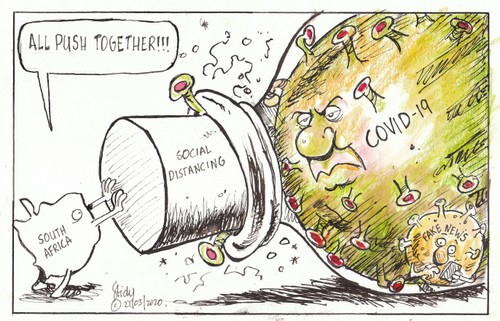
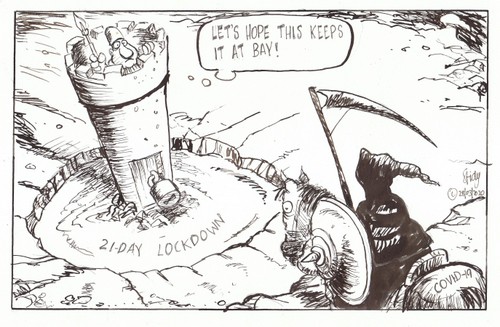
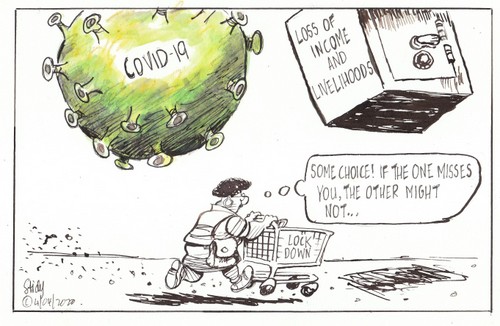

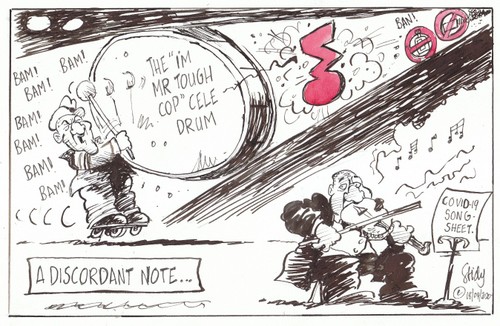


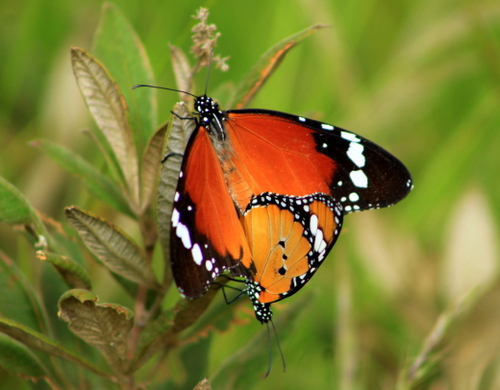
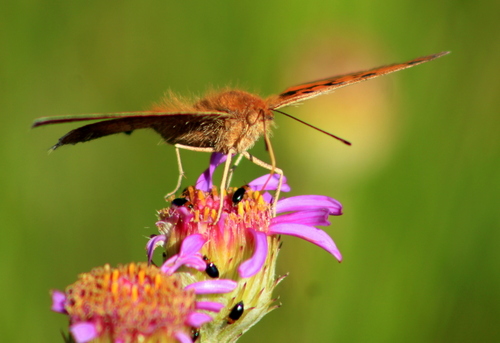

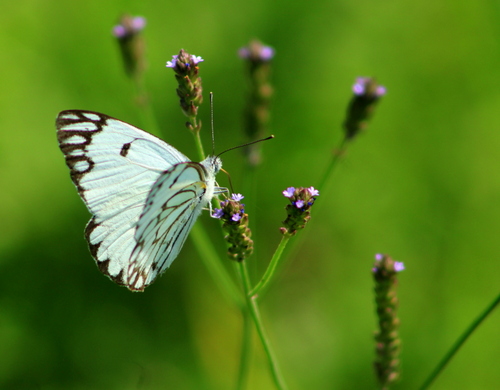


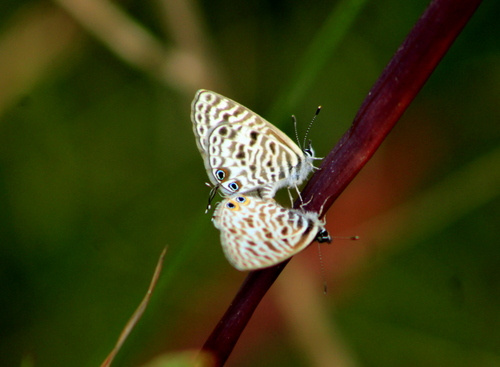


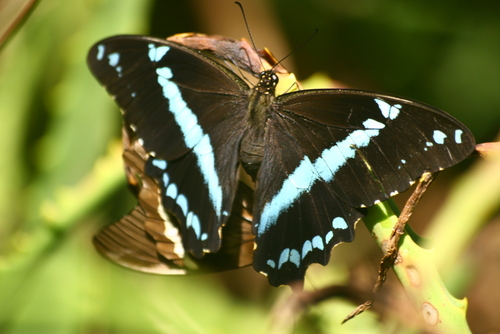

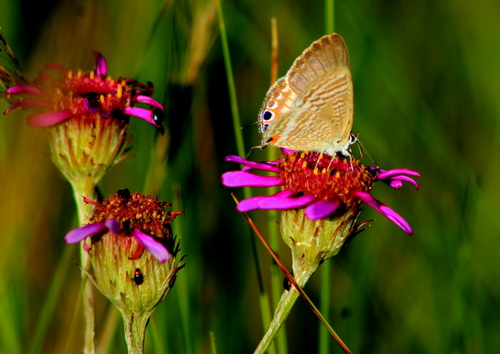


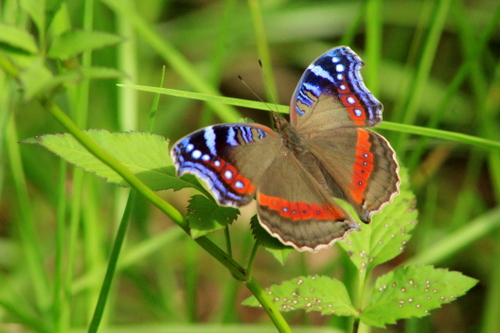


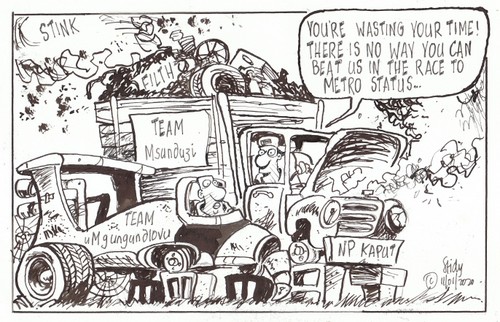


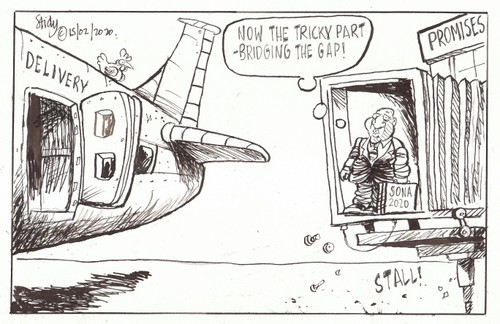
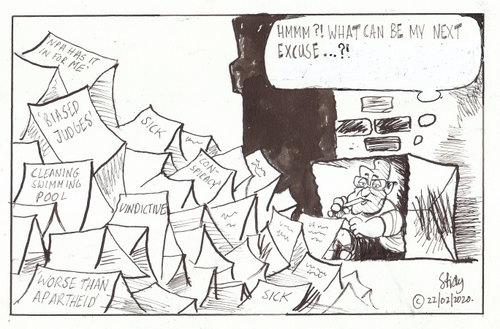


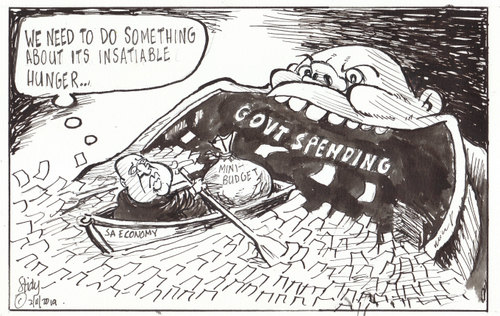


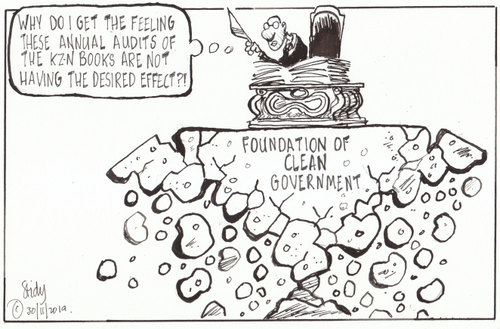
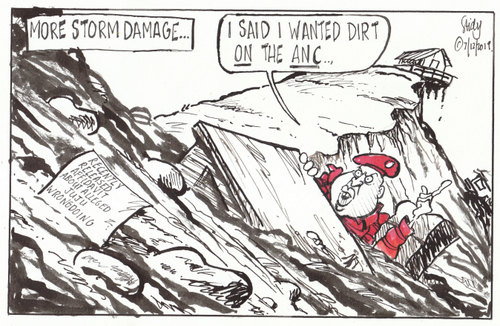
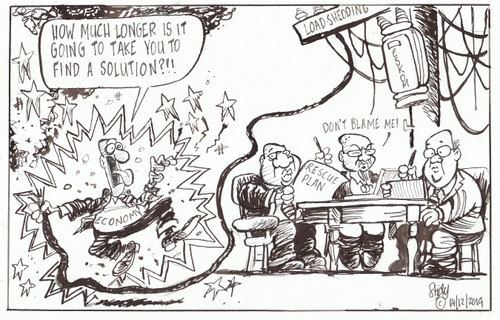

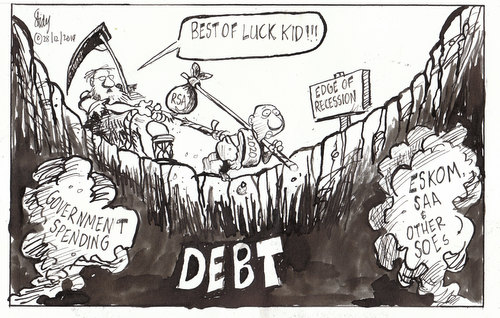


 Stidy's Eye