Book Review – Arabia: A Journey Through the Heart of the Middle East

published by Hodder and Stoughton

There is a class of travel writer who seem to delight in deliberately seeking out danger and are at their happiest when the going is manifestly not good. For them such journeys can be redemptive. They escape feeling a little wiser and – equally important – they have an exciting story to tell.

Levison Wood clearly belongs to this group: a man who is not one to flinch in the face of adversity.

Ignoring the advice of the pundits and the doom-sayers he, in 2017, embarked on an epic 5000 mile journey through the Mid-East, knowing full well that much of it was in turmoil and that as a Westerner he could have easily found himself a target..

Travelling sometimes on foot, at other times by camel, mule, donkey and battle tank, his 13-country odyssey would take in such hotspots as Syria, Iraq (where he would find himself witness to a battle between its Government forces and ISIS) Yemen and the pirate-infested waters of the Gulf of Aden.

The Arab world he journeyed through has, of course, long exerted a mysterious fascination on a certain type of English adventurer; in part because its landscape is so dramatically different from the one back home and partly because its people seemed to embody strengths and virtues that challenged European arrogance.

The world that these classic “British Arabists” – Richard Burton, TE Lawrence, C.M Doughty, St John Philby, Wilfrid Thesiger, Gertrude Bell etc – wrote about has, of course, been radically transformed by the discovery of oil, with even the Bedu now swapping their camels for the latest 4 X 4s. Part of Wood’s self-imposed mission was to discover just how much it had, in fact, changed.

Following in the footsteps of Thesiger he crossed the waterless Empty Quarter. He also retraced the route taken by his idol, Colonel T.E.Lawrence, along the old Hejaz railway line.

Rich in character and anecdote Wood’s book conveys with unusual immediacy both the stark beauty and the volatility of the Middle-East. While the scale of the problems that beset the region defies anything that could be dignified as solutions, he finds its people stoical in the face of adversity and not without hope.

Book Review – The Last Hurrah: South Africa and the Royal Tour of 1947


published by Jonathan Ball Publishers

In 1947 South Africa welcomed King George VI and Queen Elizabeth and their two daughters, Princess Elizabeth (the future Queen) and Princess Margaret on a Royal Tour which the then Prime Minister, General Jan Smuts, hoped would put a positive spin on the country and its achievements. For their part the British saw the visit as an opportunity to not only thank South Africa for their contribution to the war effort but also to reinforce the concept of a constitutional monarchy as the binding force behind the Commonwealth.

As the author of The Last Hurrah: South Africa and the Royal Tour of 1947, Graham Viney, shows, in his persuasive and beguiling guide, not all went quite to script. Indeed, the whole lengthy and carefully planned shindig proved to be something of a double-edged sword.

While most English-speaking, white South Africans greeted their Royal Guests with an enthusiasm and patriotic fervour that is now hard to imagine, others saw it as a golden opportunity to highlight their various causes. Many Afrikaners, still smarting from their treatment during the Boer War, were deeply resentful and used the visit as a platform from which to push their conservative, pro-republic, agenda. At the other end of the political spectrum, the ANC saw it as a chance to expose the evils of racial segregation

Although it brought the world’s focus on to South Africa and it policies, the Royal Tour of 1947 was not able to stall the country’s massive lurch to the right. Shortly afterwards, Smut’s government was defeated at the polls and the National Party took over the reins of power. The apartheid era was about to begin.

Reading about it all, seventy-odd years on, it is hard not to be impressed by the sheer stamina of the Royal Party as they travelled 11 000 miles, mostly by train, visited hundreds of out of the way dorps, shook hands with over 25 000 people, attended countless boring functions, and were seen by 60-70 per cent of the country’s population. Queen Elizabeth, in particular, proved a fine ambassador. Gracious, friendly, beautiful and reassuringly normal, she seems to have charmed everyone she met.

Very much a blast from the past, Viney’s book offers a revealing snapshot into a now all but vanished world. Shrewd and absorbing in the way it captures the complicated politics of the time, his fast-paced account pedals along with never a dull paragraph as facts, events, characters and period photographs flash by.

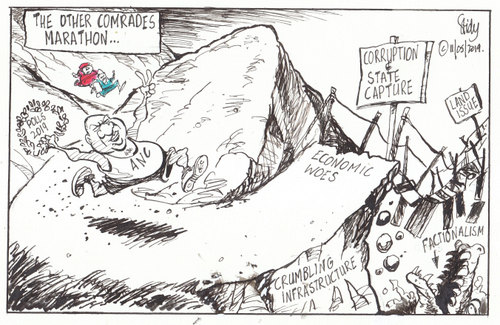
The Elections and After: Cartoons for May and June, 2019

SUMMARY:

With only a few days to go before the May 8 general election, all South Africa’s political parties were in a final push to woo citizens. Among those visiting KwaZulu-Natal were President Cyril Ramaphosa, former president Jacob Zuma and former deputy president Kgalema Mothlanthe.

As expected, the elections were won by the ANC, although the official results – which saw the party down to a 57% share of the votes from 62% in the 2014 elections – underlined the huge task which faces President Cyril Ramaphosa as he tries to push through his reformist agenda. For their part, the official opposition, the Democratic Alliance, failed to make any gains while the radical Left, Economic Freedom Front, led by firebrand Julius Malema, was in third place – up four per cent from 2014. Reflecting a world-wide growth in nationalism, the Afrikaner-rights FF+ and the Zulu-orientated IFP also made substantial gains.

With the elections over, speculation next turned to what changes President Ramaphosa would make to his cabinet and whether he would cut the number of Ministries. Hopes were also expressed that he would use the pending cabinet reshuffle as an excuse to get rid of some of his more controversial ministers such as Bathabile Dlamini and Nomvula Mukonyane.

Cyril Ramaphosa was duly elected unopposed as president by the National Assembly. In a unifying speech in Parliament he promised to be “a President for all South Africans and not just the African National Congress”.

His message of inclusivity was not, unfortunately, picked up by all members of the party. In his inaugural address to the provincial legislature, the newly appointed premier of KZ-N, Sihle Zikalala, declined to pay tribute to the new official opposition, the IFP, by neglecting to mention that party’s previous premiers when he praised previous ANC premiers..

On the 29th May, President Cyril Ramaphosa finally announced his new cabinet in the process downsizing his number of ministers from 35 under Zuma to 28.The big surprise was his appointment of Good Party leader, Patricia de Lille, who had quit the DA after months of acrimony, as Minister of Public Works and Infrastructure.

Underlining the huge problems facing Ramaphosa, was the news that South Africa’s economy had shrunk by more than three percent in the first quarter of 2019 – as load-shedding, a strike on the gold mines and a dire lack of investment hit growth. In KZN there was another fiery weekend on the roads with 17 truck-and-rigs being torched on the N3 between Johannesburg and Durban. To date over 200 people have been killed, 1400 vehicles damaged and R1,2billion lost as result of these ongoing incidents – losses the country can ill-afford with its economy under huge economic strain.

The divisions within the ANC once again came under the spotlight when it was announced that the ANC would launch a probe, chaired by Kgalema Mothlanthe, in to claims that its Secretary-General, Ace Magashule, was involved in the formation of the African Transformation Movement (ATM) – a rival political party – ahead of the previous month’s election. Former President Jacob Zuma’s confidante, Bishop Timothy Ngobo, who had aggressively campaigned for the new party, to which Zuma had also been linked, immediately rubbished the probe as being a “witch-hunt”.

Delivering his State of the Nation (SONA) speech in parliament, President Cyril Ramaphosa announced a number of measures to grow the economy, tackle poverty and unemployment and fight corruption. Whether the ambitious targets he set – such as halving violent crime in the next 10-years and creating two million jobs for youth over the same period – are achievable remains to be seen.

The following week, his predecessor, Jacob Zuma, confirmed he would testify before the Zondo Commission in to State Capture even though he believed it is “prejudiced” against him and “lacks requisite impartiality”. According to his lawyer the former president “can’t wait to attend…he is relishing the moment.”

On the Road Again – Kosi Bay and Black Rock

Kosi Bay Estuary. Note fish traps.

Back in the day, I used to have my own favourite road tracks on a compilation tape I kept in my car. I would slip it in to the machine every time I set off on a long journey just to get me in the right mood for the long haul ahead of me.

The one that has always stuck in my mind is Canned Heat’s On the Road Again, probably because I like the whine of their voices and the songs slightly manic, repetitive, feel. The tape long ago wore out and the CD Player in my old Hyundai no longer works but its words were buzzing around in my brain when I drove, in high spirits, through the gates of Ndumo Game Reserve.

It seemed to catch the personality of the country I was driving through.

My destination was Kosi Bay, a place I knew very little about having never been there before. What I had heard, though, was enough to convince me it was somewhere worth seeking out.

Reaching the tar road that eventually leads to Ponto do Oura in Mozambique, we turned east, crossing the Pongolo and skirting Tembe Elephant Park with its tangled, labyrinth of trees. The last town we came to, before the turn-off to Kosi Bay, was Manguzi.

As we were running low on provisions we had decided to stop and stock up here.

I duly swung in to the local supermarket and was immediately up to my bumper in the biggest crush of people, animals, taxis and bakkies I had encountered on the entire trip (although Jozini came in a close second). Loud music blasted out from several makeshift stalls that had been set up along the side of the car park and an aroma of choking smoke and sizzling meat pervaded the air.

My immediate instinct was to panic, turn tail and bolt for the nearest exit but my birding colleague, Ken, who has a much more phlegmatic disposition than I do, was not to be denied his resupply of ice-cold Windhoek Lager. We stayed.

It was at this late stage of our journey that Ken, who, unlike me, had been to Kosi before, also chose to announce that he didn’t think my old Hyundai would cope with all the sand in the park. “You really need a 4X4…” he said, helpfully, before, smugly, climbing back in to his one.

I gave him the full force of my Evil-Eye for only telling me now, when it was much too late to turn back, but, as usual, it had absolutely no effect. The man is impervious to criticism, especially mine…

So on we went.

Shortly after Manguzi we turned off the main tar road and drove down a cow-dotted sand track with scatterings of trees and fields of stubby, overgrazed grass on either side. As I got to the top of the one rise, I finally spied the Indian Ocean, vivid and alluring in the shimmering heat haze, ahead of us.

Arriving at the entrance to Kosi, Ken informed the man at the barrier that we intended to leave my car parked outside for the duration of our stay. The guard looked horrified: “It will be stolen if you do that!!!”

I did a quick mental weighing-up of options in my head – stolen or stuck?

“I’ll risk the road!” I cried. And so, full of false confidence, I drove through the gate.

Kosi Bay Nature Reserve, which lies several kilometres south of the Mozambique border, consists of four lakes and a series of interconnecting channels which drain via the sandy estuary in to the Indian Ocean. Our camp site was in a patch of dense coastal forest full of raffia palms whose feathery branches met overhead like the tracery in a medieval cathedral. In front of us stretched KeHlange, the largest of the freshwater lakes.

KeHlange, largest of the fresh-water lakes.

The estuary, which is most famous for its for its Tsonga fish traps, is an area of peerless beauty but not without its hidden dangers. Its waters conceal, among other things, the deadly – and incredibly ugly – stonefish. The currents can also be very strong which is why we prudently decided it would be safer to pay one of the locals to paddle us to the other side.

Ken the Fearless sails forth in to the Great Unkown…

We spent most of our first day here. While Ken, who had also forgotten to remind me to bring my flippers, mask and snorkel (not that I have any), splashed and snorted and blew big galoops of water up in to the air like a learner baby whale showing off, I sat on top of a high dune and watched the sea birds through my binoculars, wishing I hadn’t left my bottle of cold water in the car.

Kosi Bay fish traps.

Obeying the same irresistible urge to look for new and wilder places that had brought us here in the first place, Ken and I set off the next day to try and reach Black Rock, an isolated but beautiful stretch of beach on the north Zululand coast. We had barely driven out the park gate when we got our first good sighting of the day – a Eurasian Hobby sitting in a small Water Berry tree (Syzygium cordatum).

Like the road down to the estuary, the one to Black Rock is strictly 4X4. First, though, we headed back to the tar before turning left and following a complicated network of minor and diminishing tracks, through every thickening sand in what the guide, we had hired, assured us was the right direction.

As we drove the sun bore down like a jack-hammer. We saw no other vehicles and the few settlements we passed seemed mostly deserted.

Then abruptly we entered an area of lush coastal bush and found ourselves breaking through onto a beach of dazzling white.

While Ken had been wrestling his way down the treacherous road I had deconstructed and reconstructed the surrounding scenery in my mind. Mentally, I removed all the asphalt, electricity poles, brick buildings and other vestiges of our grubby civilization and tried to imagine what it must have looked like when this was still unexplored country.

Looking at the beautiful beach in front of me, I now got a much clearer image. Like something out of the pages of an old-fashioned adventure yarn, it had the romance of distant continents, faraway islands and lost lands.

Black Rock, Zululand Coast.

We were not the only ones on that little slice of paradise, however. There were three young men snorkelling in the clear, crystalline waters in front of us.

They had obviously come here, for the day, not only to swim but to conduct some sort of scientific research because, when they finally emerged out the water the one, who I took to be their team leader, ambled over and asked us if we would like to see a Bouton’s Snake-eyed Skink? Not wanting to reveal my ignorance on matters Skink or admit that I had never heard of this one I nodded my head enthusiastically in assent.

There were quite a few of these dark-coloured, unprepossessing little lizard-things darting backwards and forwards over the jagged dark rocks that give this stretch of coastline its name. What makes them interesting, the man told us, is that they are a Malayan species whose ancestors must have floated over the ocean on a pile of driftwood or some such, adapted to their new environment and successfully started breeding here. Darwin in action.

Taking the same torturous route that had got us to the beach, only in reverse, we later headed back to camp.

We arrived in time to witness a dramatic change in the weather. A sharp new wind had risen that brought sudden whirls of spray spiralling like furious little water-sprites across the lake. A solitary Caspian Tern was fluttering hard against these winds before it decided to give up and headed off to find a more protected spot.

Everything, including the sun, was pulling out. It made me feel quite melancholy especially as I realised I, too, would be leaving the next day.

For a while I sat on the bench at the end of the pier and watched the waves grow more boisterous. Splish and splosh turned to slap and then headbutt. Under the leaden sky the water became a strange mineral-green.

That night the trees and palms heaved above our tents with an end-of-the world fury. Snuggled up inside my sleeping bag, I could easily imagine how similar winds must have once hammered old sailing ships and driven them on to the rocks.

There were sudden jolts of lightning and explosions of thunder. I thought we were in for a thorough drenching but, as it turned out, there was surprisingly little rain.

When I awoke it was all stillness. I did a quick reconnoitre but could find little sign of damage while the denizens of the forest seemed completely unfazed by the previous nights theatrics. The Red Bush Squirrel – this is one of the few places in South Africa where it occurs – that had befriended us came down, as it had the previous day, to hunt for rusk crumbs while we were drinking our coffee. A Livingstone’s Turaco, its crest sticking up like an antennae, landed in the dense foliage above us.

Red Bush Squirrel, Kosi Bay.

And then it was time to leave. Having slung all my gear in to the boot of the Hyundai I contemplated my prospects of successfully negotiating the thick sand.

I was lucky that morning. My biggest worry had been surmounting the steep section of road that takes you over the main dune. With a sceptical Ken looking on, I revved the car’s engine and hit the slope at full tilt. The next thing I knew I was up and over. As I crested the summit I turned around and gave Ken a big thumbs-up and a triumphant grin.

It was my turn to feel smug and very pleased with myself. My little Hyundai had done me proud.

I was on the road again…

Getting Lucky in Ndumo

View over Ndumo towards Nyamithi Pan.

Like some migratory waterfowl, I find myself continually being drawn back to Ndumo Game Reserve. The remoteness, the vegetation, the balmy, sub-tropical heat, the feeling of freedom and space, the thin, pure light, the distant grape-blue outline of the Lebombo mountains and the beautiful, sun-dappled, pans of the Pongolo-Usutu river floodplains, all make it a place one can never forget.

Also the birds. A lush ecological mix of wetlands, riverine forest, sand forest and acacia woodlands, has made Ndumo famous for its birds. Its impressive list of species include many of the Mozambique ‘specials’ which you won’t find anywhere else in South Africa.

For any aspiring birder the reserve should be near the top of their list in the Must-Visit stakes.

Water Dikkop, Ndumo Game Reserve.

And so it was I found myself meandering back to what has almost become my second home, in my beat up old Hyundai Getz…

I had arranged to meet my birding colleague Ken, who was driving down from Jo’burg, at the Ghost Mountain Inn, at Mkuze. Wanting to avoid the mad highway, I thought I’d allowed myself plenty of time to navigate the back roads that took me from my home in the Karkloof through Rietvlei, Greytown, Kranskop, Nkandla (as far as I could tell our erstwhile Number One was not at home) and Eshowe then on to the N2 but I hadn’t factored in all the speed bumps along the way which slowed my progress down considerably.

Much to my surprise – for I am usually a lot more punctual then he is – I arrived to find Ken sitting, waiting for me. As soon as I saw his smug, self-satisfied expression I knew he was not going to let me forget this…

Having re-filled with petrol, we headed north, driving up the steep shoulder of the Lebombo range with its impressive cliffs and immense view over Jozini dam to the hills of Hluhluwe and beyond. A few patches of forest still clung to the hilltops but many of the trees had been felled.

On the other side, the land became flat, wide and featureless with only the distant edge of the Swaziland mountains to provide any sense of perspective.

There were a whole lot more speed humps on this stretch of the road. By the time we reached Ndumo, all the braking, stopping and crawling forward again had left me feeling severely jittered. I quickly regained my equilibrium, however, once I passed through the main gate and found myself driving down the familiar avenue of thorn and Silver Cluster-leaf trees.

It was all just as I remembered it: the film of dust over the pale, sun-bleached grass and the twisted trees, the languid giraffe looking down at you from their lofty heights, the familiar ‘whit-purr’ of the Greater Honeyguide drifting across the veld, the cheerful banter and chattering of a party of White-crested Helmetshrike on the move…

White-crested Helmetshrike.

At the far end of the low ridge along which the road runs, overlooking the Pongolo floodplain, is the hutted camp. Unlike most game reserves in South Africa, it is unfenced despite the presence of buffalo and hippo (on our previous visits there had also been white rhino but they, sadly, seem to have all gone). Sitting out under the stars at night really gives you the feeling of getting up, close and personal, with nature.

Once we had pitched our tents we decided to take a drive down to the Nyamithi Pan, slowing down, along the way, to gaze at a gang of Wooly-necked Storks and a solitary Palm-nut Vulture eating a dead giraffe near the side of the road.

The outline of the pan had changed dramatically since my last visit. Because of the poor rains, the water that normally lapped at the side of the hide, had retreated several hundred metres back up the channel, leaving a big flat grassy space in front of us.

The withdrawing water had obviously left some rich pickings in its wake. The plain was alive with birds. Among them were Kittlitz, Three-banded and Ringed Plovers and some nesting Collared Pratincoles, a species of bird I had hitherto only seen in flight.

The whole scene was wonderfully convivial. As the birds started flying off to their nightly roosts, we cracked open a beer and sat watching the sun, a great red ball on the horizon, sinking over the distant Lebombo. As it did so it turned the bark of the fever trees, that grew along the edge of the pan, a beautiful yellow-gold.

Sunset over Nyamithi Pan. Lebombo mountains in distance.

It is at moments like this, when you have been able to briefly loosen the chains of civilisation and escape, for an instant, from the daily grind that you begin to understand the nature of spontaneous happiness.

With the disappearance of the sun, everything began to lose its sharpness, the whole atmosphere was transformed: one became aware of a changing of the guard as the night creatures started emerging and the bush became alive with a secret activity that shut out man.

The next morning we were up early and heading back to the pan for a guided walk along the one side of the water’s edge. The sky was gunmetal grey going on stormy black, with rain threatening, but this did not seem to have put off the birds.

The pan was still a mass of bustling, feathered activity.

Like a carefully choreographed troupe of dancers, a small flock of flamingo moved gracefully back and forth through the shallows. A pelican, immense and white with its great beak, floated on the water. Elsewhere there were waders and ducks and stilt and storks and egrets and herons.

Yellow-billed Stork and Greater Flamingo, Nyamithi Pan.

Nor were the variety of birds confined to just the water loving ones. We had several good sightings of a rare Sooty Falcon as it skimmed, open-eyed and alert, along the tops of the fever trees and Ken picked up his first lifer of the trip – a Stierling’s Wren-Warbler. We also got another Ndumo ‘special’ in the form of a Rudd’s Apalis.

There are several other, equally rewarding, guided walks you can go on at Ndumo. The 5 kilometre North Pongolo walk, which is easily accessed from the camp site and takes you through some magnificent riverine forest, is a must. African Finfoot, Pel’s Fishing Owl, Narina Trogon and White-eared Barbet all occur here. It is also where I had my first sighting of the strange little African Broadbill, a bird that looks like it could have stepped straight out the pages of Lewis Carroll. Another good walk is the ones that takes you through the Sycamore Fig (Ficus sycomorus) Forest on the edge of Shokwe pan.

Sycamore Fig Trees, Shokwe Pan.

Because we had decided to do a day trip to the nearby Tembe Elephant Park we did not have time to do any of these walks on this trip but there is one place I make it a point of honour to go to every time I return to Ndumo – the picnic site at Red Cliffs.

The picnic site, on the northern edge of the park, has lodged in my mind with absolute clarity. Every time I go back its aspect never ceases to amaze. It is that beautiful.

There is no better place to fire up the skottle and cook breakfast (in addition to this, it has probably the best situated long-drop in all of Zululand although I have always been a bit hesitant about using using it for fear of what nasties might be lurking in its murky depths)..

From where I found myself sitting, propped up against the trunk of a shady tree, eating my eggs, tomato and bacon and sipping a cup of coffee, I had a panoramic view over the Usutu, a lazy, gently-flowing, river, broken by sand spits and clumps of reeds and lined by a dense network of tall, overhanging, trees. On its far bank, its presence flagged by a grove of massive Sycamore figs, lies Mozambique.

View over Usutu River, Red Cliffs.

Red Cliffs is one of those places where time really could be described as having stood still. You have that feeling of being completely alone with creation. There are no signs of habitation, nor any tracks or roads, nothing seems spoiled or sullied or abused. Below us a few crocodile lay doggo on sandbanks or drifted with the currents, only their nostrils showing, coloured like logs.

Nearby there is a good 4X4 track that runs along the river line; edging its way past the bases of a seemingly endless variety of trees. Prominent among these are the huge figs, supported at their base by mats of root fibres, or buttresses or tap roots like wigwam frames.

On several occasions, in the past, we have got lucky on this route and got the elusive Southern Banded Snake-Eagle (its limited distribution in South African makes it another Ndumo ‘special”). It didn’t put in an appearance this time but I was quite content just to be driving through this magnificent countryside.

For our final day’s outing we chose to take the dirt road that runs along the southern boundary fence of the reserve and which forms part of the Manzimbomvu Loop. The country grows more and more open as you drive along the loop with thorn trees and a grove of tall Knob-thorn woodland on the far western side, making it a good place to pick up your more typical bushveld species.

The next morning I went for one last stroll around the camp. It was a grey day, with a cold wind gusting in from the south, and occasional spits of rain. I felt a little melancholy to be leaving this special place but also full of anticipation. Ahead of me lay the open road – okay, a road full of irritating speed humps – and my next destination, a place I hadn’t been to before: Kosi Bay.

Crocodile catching fish below road drift. I took this pic on a 2011 visit when Ndumo had good rains.

The Ever Hopefuls

Five-Stamp Mill.

When I left school I had absolutely no idea what I wanted to do with the rest of my life. In this respect, I was quite different from my three elder, more practical, brothers who all knew from a relatively early age in what direction their futures lay.

After considering one option after another, I finally elected to apply for a mining cadetship with the Rhodesian Ministry of Mines – for no other reason than a friend, Nick Bertram, had done this.

Much to my surprise, for my science exam results had been nothing to brag about, I was accepted. I was one of only twelve boys in the country to be selected.

As part of the course, we were expected to spend three months in each of the four departments that made up the Ministry of Mines – Geology, Mining Engineering, Metallurgy and the Office of the Mining Commissioner – to give us a feeling for where our future interest might lie. Depending on how well you performed, the Government would then decide whether to sponsor your further education and where best to send you if they did.

I enjoyed my time in the Geological Survey and the Mining Engineer’s Office (where I spent most of my time in the Mine Surveyor’s Office) but found I had no aptitude for the science of metallurgy and working in the Mining Commissioner’s Office – which mostly involved sitting behind a desk doing lots of paper work – bored the pants off me.

Ironically, many years later as the Rhodesian Bush War was dragging to its inevitable end, I got a job with the Mining Commissioner’s Office in Gwelo (now Gweru). I still found the work soul-destroying but I needed the money especially as it meant I would get back-up pay during my innumerable call-ups with the army.

While I was working in these various mining-related jobs I got to see a great deal of the country, or at least in Mashonaland and the Midlands, the two provinces I got posted to.

Most of the mines we visited were small-workings, often in extremely remote locations and usually operated by a lone individual or a small syndicate. Because they were invariably cash-strapped and operated on a shoe-string, their owners tended to chase the gold values rather than operate according to a clearly laid-out, strategic, plan-of-action, the way the big mining companies did.

As a result the shafts and tunnels were more like rabbit warrens, wandering up and down and around and about, seemingly without logic or purpose. They were usually low, unlined, poorly lit and jagged inside which made working in them a rather hazardous occupation…

Much to my own surprise, for I tend to be claustrophobic, I loved descending in to the cool, wet depths of these subterranean tombs. We usually began by dropping down the vertical shaft in some creaking, rickety, old bucket operated by a winch. Down at the bottom it was like another world. In the half gloom the mineworkers, in their dripping overhauls, looked like a race of Cyclops with their solitary lamps on their heads.

Ayrshire Mine in the early days. I went down shafts not to different to this one. Picture from Rhodesian Miners Handbook.

Sometimes, when we were taking a break, I would find some dark corner of the mine, switch off my helmet lamp and just sit there, alone with my thoughts, in the Stygian gloom. In the distance I could often hear the muffled thudding of picks or catch the occasional acrid whiff from the lasting.

Most of the old prospectors and small-workers whose claims we visited were drifters by nature. They tramped around the country with their geological picks and prospecting pans, ever hopeful that they would one day stumble on some undiscovered, gold-bearing reef that would make them rich beyond their wildest dreams.

In the process their faces were burned dark brown by the sun and were covered by creases and wrinkles from being outdoors all the time and through screwing up their eyes because of the harsh glare of the African sun.

Very few ever found their pot of gold at the end of the rainbow. Reluctant to accept normal work or hold down a steady job, that did not seem to bother them. Happiest when wandering, unable to settle down, for them it was a way of life. Even back then I could tell they were a dying breed.

In the early days, Southern Rhodesia had, of course, been linked to the fabled Ophir of the Bible. It is what drew a lot of the early adventurers and fortune-seekers in to the country in the first place.

Hans Schroeder – early Rhodesian prospector. Picture: National Archives of Zimbabwe

Nor was it all just wish-thinking or pie in the sky stuff.

There is ample evidence to show that there was a thriving mining industry in the country, long before the first whites set foot there. In fact, there are over 4 000 recorded gold deposits in Zimbabwe, nearly all of them based on ancient workings. Some of the country’s largest mines – including the Globe & Phoenix, Cam and Motor and the Shamva mines, which between them, at one stage, produced one third of the country’s gold – were discovered this way.

The gold trade was an important aspect of both medieval Great Zimbabwe and the Munuhumatapa Empire. The early Portuguese had also got wind of the rumours of gold and naturally wanted to get their hands on it as well.

A list of ‘Mines Known in the District of Senna’ was actually published in Lisbon in 1857 in response to a decree calling for an inventory of mineral resources south of the Zambezi. Compiled by Izidoro Correia Pereira, a Zambezi valley trader, the document represents the mining activities of various Shona dynastic rulers that existed in the 1500s when the Portuguese invaded the modern country of Zimbabwe to wrest the centuries-old Sofala gold trade from Arab-Swahili hands.

No doubt aware of all of this, Cecil John Rhodes was but one of the group of optimists who believed there were huge riches just waiting to be discovered. In fact, it was one of the principal reasons (another was its agricultural potential) he was so anxious to annexe the country for his British South Africa Company.

As it turned out he was wrong about what he referred to as the “exceedingly rich auriferous indications” which he believed would exceed anything found “south of the Zambezi”.

CJ Rhodes. Picture from National Archives of Zimbabwe.

Shortly after he penned these words the largest gold-fields the world had known were discovered on the Witwatersrand. Compared to its riches, the amount of gold produced in Southern Rhodesia was negligible.

And yet despite this, hordes of hopefuls kept making their way to the country. As an inducement to join the Pioneer Column, Rhodes had promised each member that they could peg fifteen claims once they got to Mashonaland. Many of these ‘pioneers’ were amateurs with little knowledge of either geology or prospecting.

Undeterred by their own lack of experience, within weeks of reaching Fort Salisbury on the 12th September, 1890, the majority of the new arrivals had headed off in to the veld in search of gold. As luck would have it, they discovered that a lot of the prospecting had already been done for them by the ‘ancients’. All they often had to do was bribe one of the locals to show them where the previously-worked reefs were.

Inspired by the rumours, others followed in their wake.

You can still see the fruits of their endeavours all over the countryside. For example, Shamva Hill, where I spent time both in the Mines Department and, later, as a very unhappy guest of the Rhodesia Army, is conspicuous from miles away because of the huge gash running almost through it. Originally pegged in 1893, this opencast gold mine grew and grew in size over the years, eventually forming a 700 metre long pit, 120 metres at its widest and nearly 170 metres deep.

When I went to work for the Mining Commissioner’s Office in Gwelo in the late 1970s there were still a few of these old-style prospectors about. Dirty and bedraggled, they would wander in to our offices clutching their bags of broken stones for assay or wanting to register their latest claims.

“I think I have struck it rich this time!” they would whisper to me with a conspiratorial wink and I would just nod my head, smile sympathetically and sign the relevant documentation.

As the Assistant Mining Commissioner for the Midlands area, I got to know a lot of them quite well. There was one old prospector who looked like Wild Bill Hickock with his long mane of flowing white hair and neatly trimmed beard. He was very well-spoken and his manners were impeccable although if you ever needed to find him the best place to look was the seediest dive in town.

There was another old timer who slept in a tent but still insisted on getting dressed up in a suit for dinner every night. He was scared of the dark so always had a candle burning by his camp bed. The person he employed as his “manservant” was expected to watch over him while he slumbered.

Some of them actually did make a bit of money but invariably squandered it just as quick.

One of those who carried on in the old way was my stepfather, Jim Hastings, a retired miner, who on marrying my mother, proceeded to install an old stamp-mill around the back of our house. It was a ramshackle piece of machinery held together with bush poles and bits of wire but I found it strangely comforting listening to its methodical “Thump! Thump! Thump!” echoing away in the background…

My step-father, Jim Hastings, next to his stamp mill.

Again, he never made much money out of it. For him, too, it was something he just wanted to do…

Jim Hastings and my sister, Nicky, next to his three-stamp mill.

The Battlefield area, where we lived at that time, had also once been – and still was to a diminished extent – gold country. In the old days prospectors had come wandering through with their meagre equipment, panning for gold in the river beds and crushing bits of rock in the hope of finding traces of the precious metal. The countryside was littered with old diggings, abandoned shafts, prospecting trenches and slimes dumps.

Strangely, there were no workings on our farm, Bowmont.

Battlefield had actually got its name not because it fell in an old war zone but because many of the mining claims and reefs in the area had been named after famous battles, such as Trafalgar and Tel-el-Kebir.
Given the tenacious way in which so many of these old prospectors fought on ever-hopeful, it always seemed to me a very appropriate name.

Some of my own ancestors and relatives caught the prospecting bug. My grandfather’s eldest brother, Neville Harold Stidolph – described, in one account, as “charming but unsettled, a wanderer and prospector both in Rhodesia and Australia” (Valerie Alberts) – was one who was afflicted by the malady.

Another one who contrived to make a life out of it, was a relative of his, through marriage – Percy Hughes. Percy learnt his trade at the aforementioned Shamva Gold Mine where he was employed from 1915. Thereafter he prospected all over the country and ended up working at the wonderfully named Bushtick Mine in Matabeleland during the 1930s.

Bushtick Mine where Percy Hughes worked.

Their genes were passed down.

My one brother Paul, a cattle/tobacco/maize farmer when he was not looking at stones, also did some prospecting in the Kadoma district when he was farming there and actually pegged a few claims. He has also done great deal of research in to – and made himself something of an authority on – the ancient workings of Zimbabwe.

He provided many of the old black and white photographs I have used here.

My eldest brother, Patrick, a qualified geologist, worked for the Rhodesian Ministry of Mines before emigrating to Australia. Among other things Patrick mapped much of the Shamva area where Percy Hughes had started out.

Patrick also became the Regional Geologist for Matabeleland where, strangely enough, old Percy had also ended up.

History has, of course, moved on since those days. Most of the old prospectors and smallworkers I knew back then have died, the syndicates have folded, many of the gold mines (including the Globe & Phoenix) have closed, their reefs having petered out. The stamp mills have fallen silent.

When I tried to find more information on it, on Google, I discovered the old Mining Commissioner’s Office, in Gwelo had been closed down some time after Independence because of ‘corruption’. That is not something I recall ever being a problem when I worked there although it was a long time ago so my memory on this might be faulty…

If nothing else, reading about its closure, made me realise the territory I had once thought of as mine was no longer mine at all.

In a sense, those grizzled old prospectors – and I – had become period pieces in our own lifetime…

*Somewhat ironically, the Mining Commissioner’s Office was housed in the Old Stock Exchange Building, erected back in 1902 when it was still believed boom times were just around the corner…

GALLERY:

The following pictures, all of ancient workings, were provided by my brother, Paul:

Walking the Wall

In the area where I live we have something US President Donald Trump desperately wants but so far hasn’t been able to get – a wall. Okay, so our wall is not nearly as long or as high or as strong or as illegal-immigrant proof as the one he is after but it is still a wall.

In fact, it is reputed to be the longest stretch of dry stone walling in the whole of Southern Africa.

The longest stretch of dry-stone walling in South Africa?

I am kind of fond of walls myself. One of my favourite poems is Robert Frost’s Mending Wall although, conversely, its theme is about why walls are not necessarily a good thing:

“Before I built a wall I’d ask to know

What I was walling in or walling out,

And to whom I was likely to give offence.

Something there is that doesn’t love a wall,

That wants it down…”

He has a point – one that Trump, with his self-reverence, isolationist views and divisive politics, should perhaps ponder – although that hasn’t stopped me developing my own fixation with our wall.

The first thing I wanted to know was – who built it? It looks very old and, like Frost’s wall, many of the stones have ‘spilled’ so my immediate thought was that it must have been erected by the early white settlers to prevent their stock from straying.

Not so, says our neighbour whose farm is one of those it runs through – it was built by Italian POWS during the Second World War. Wanting to find out if this was indeed true and why they had built it in the first place I popped in to see our local museum in Howick but drew a blank because the curator knew nothing about it.

So I reverted to my standard fall-back position when I am stuck for information – I sent an email to my ex- Witness work colleague, journalist Stephen Coan. He is a man who seems to know something about everything and if he doesn’t he can invariably point you in the right direction.

Sure enough, back came an article, written by Val Woodley and Marthanett Valentini, that he just happened to have stored away in his files on the subject of Italian POWS incarcerated in Pietermaritzburg and environs during the Second World War.

Reading it made me realise our next-door-neighbour could be right. According to the authors, the Italians, many of whom were sent to work on local farms, were among thousands captured when Tobruk fell to the Allied Forces. Some of these POWS also participated in the building of the Italian church at Epworth from 1943 to 1944.

The Italians evidently preferred working on the farms because the nosh was better and they were treated as employees rather than as inmates to be lorded over. After the war many of them chose to remain behind in South Africa. Our local TV repair man is descended from one.

Unfortunately, I have not been able to discover why they went to so much trouble to build the wall although, I suspect, it was partly to give the Italians something to do while they waited for the war to end. In some sections it does run along farm boundaries so that could be a reason although I would have thought a barbed wire fence would probably have worked just as well and required far less sweat and toil.

All that remained for me now was to go out and take a good look at the wall. I had no idea – and still don’t – how long the wall actually is although my neighbour seem to think it stretches from the Karkloof to Nottingham Road, which would, indeed, make it a very long wall.

It was still early morning but already the sun was boiling the brains out of the land when I set off to explore the western section. My goal was to follow it to the top of a high hill on which there was a trigonometrical beacon and then check-out what lay beyond that.

As I toiled up the slope I wondered what it must have been like for those Italian prisoners having to cart all those stones up here. Hot, gut-busting work, I decided, pausing to gather my breath and rest before I had got even a quarter of the way up.

You could also tell the blood of their ancient Roman forebears still coursed through their veins because the wall travels in a dead straight line, up hill, down dale, through watercourses and rivers and patches of marsh and forest and other natural obstacles with only one minor kink in its entire length (at least in the part I have explored).

Travelling in a dead straight line…

By the time I got to the top of the hill my face was as pink as a prawn but I had no regrets because the view made it all worth while. Directly below me there was a small stream rolling lazily between meadowy green fields dotted with trees and farms and dams and fir plantations. Beyond that I could make out the outline of World’s View and Table Mountain. Between those two distinctive features, concealed under a pall of white haze, lay Pietermaritzburg.

For a while I sat on the wall drinking a cup of coffee and munching a rusk watching a few Common Reedbuck staring back at me from the opposite hill. Surveying the tranquil scene in front of me I could understand why many of the POWS decided to remain behind.

Having finished my coffee, I considered carrying on with my mission but the wall disappeared in to a tangled confusion of trees so I figured it would be simpler to just drive around to the Old Halliwell Inn and pick it up there.

For my next outing I headed in the opposite direction, following the wall over sprawling moors and through a stretch of exotic gum plantation until I came to a beautiful deep-blue pool with a waterfall trickling in to it. It was a magical spot and I would love to have lingered but I didn’t exactly have permission to be there so after a quick look around I headed back.

The waterfall.

The air was as warm as toast so, on the way, I did a quick detour down to a nearby stream for a dunk in its cold waters before resuming my walk along the wall. The most impressive part of it is in this section. If ever I had to defend the Karkloof against an invading army this is where I would make my stand.

The most impressive section of the Wall.

Back home, I sat at my desk and plotted my next strategic move.

Of course, walking the length of the wall in the full glare of the sun was never going to be enough for me. Now I wanted to photograph it. And then do a painting of it. In fact, quite a few paintings.

Which I did.

I am pleased to report that Stephen Coan actually bought one of them although I suspect he only did so because it showed Otto’s Bluff in the far distance. He has a sentimental attachment to Otto’s Bluff although I have forgotten the exact reason why. I think someone may have made an important historical film there once. Stephen is also a movie buff. And a history buff.

My painting of the wall.

I am probably kidding myself but I like to think my painting reminds Stephen of better views as he huddles behind his own high wall in his new home amongst the ugly sprawl of gated villages that have spread, like a cancer, all over Johannesburg.

Living where I do, I don’t need a wall to repel invaders of my privacy so it doesn’t really matter that the one I do have can easily be breached.

So far, I haven’t been slapped with any harsh, punitary, tariffs either for hopping over it at will. For which I am truly thankful because it means I can go on walking the wall…

Old Ruins and Rock Engravings – Exploring Mpumalanga.

I have always been conscious of the nearness of times past which is why, I suppose, I always get a little melancholy when I stumble across old ruins. This may be because, all to often, an enormous energy had been galvanised in to building them, only for it to all fizzle out and come to nought. Or perhaps it is because they serve as a reminder of my mortality and the transitory nature of life.

Whatever the reason, I always like exploring these dry, skeletal, remnants of past lives.

It was because of this compulsion that I found myself, many hundreds of miles from my home, driving through Mpumalanga. I was after something. I didn’t know exactly what it was – some sort of spirit I guess. And a link with my childhood and the old Nyanga ruins I had grown up amongst in Zimbabwe.

The ruins I wanted to see, on this particular trip, constitute but a tiny fragment of the literally hundreds of thousands of stone wall-settlements that can be found in South Africa. Although there have been many fanciful theories as to who built them the general consensus, amongst professional archaeologists anyway, is that they are largely the work of the Sotho-Tswana people.

My sister, Penny, had agreed to accompany me on my mission. Having spent a morning exploring the old gold-mining town of Barberton we duly found ourselves barrelling westwards towards Badplaas, branching off just before Machadadorp and then heading back along the N4 in the direction of Mbombela (Nelspruit). The main purpose of this detour was to take a look at the ancient stone wall settlements that litter the open, virtually treeless, veld at Rooidrai.

Unfortunately, they were burning fire-breaks along the road in the area where these ruins are mostly situated so we were not able to get up close to them but, parking the car on the burnt verge, I was able to get out and examine them through my binoculars.

In a landscape so devoid of other detail, so empty of anything higher than a Hadedah’s head, they looked like nothing so much as giant pieces of geometric art etched in to the dry earth and bleached grass. The feeling of abstraction was reinforced by the contrast between the layered ground, with its graded colours, and the blue sky above.

Stone wall circles, Rooidraai.

Although they were, for all practical purposes, probably nothing more than old cattle byres it seemed strange they should have found their way to this lonely spot. Deprived of purpose, abandoned and ignored by all save a few curious onlookers like myself, they exuded an air of sadness, neglect and also mystery.

Rooidraai was still haunting parts of my mind when Penny and I set off again, a couple of days later, this time to the Lydenburg area. We had arranged to meet Marius Brits, an amateur archaeologist with a beard like my own and an extensive knowledge of all the old ruins in this area (See Ancient Ruins: A Window into the Lydenburg Stone-walled Ruins by Marius Brits).

A genial, friendly man, who owns a second-hand bookshop in town, he took us to two nearby sites:

The first was Badfontein, situated just off the Lydenburg to Machadorp road. The road there was riddled with potholes the size of bomb craters and the truck drivers who use it seem to have little regard for human life but the ruins themselves while not comparable in size, elaboration or fame to Great Zimbabwe made the journey worthwhile.

My sister Penny – contemplating the mysteries, Badfontein.

Covering a steep hillside overlooking a fertile flood plain, the site was presumably chosen for its strategic value rather than agricultural potential. We had chosen the right time of the year to visit because the magnificent Mountain Aloes (Aloe marlothii) that thrive in these barren, rocky conditions, were out in bloom

Built of round stones the size of cannon balls, the walls, themselves, are very similar in design and layout to the ones I grew up amongst in Nyanga: numerous stone walled structures, both simple and complex, with stone-walled roadways and terracing. Although overgrown and broken down in parts you can still easily appreciate the amount of work that went in to their construction.

At times it was a little hard to understand the science behind the walls as they tadpoled their way higgledy-piggledy all over the hills not that I wanted an explanation. I liked the mystery. There was something curiously serene about those old stones.

Rock walls, tadpoling their way higgledly-piggedly all over the hills, Badfontein

For the record, archaeologists believe they were built by the Bakoni whose civilization was fragmented and largely destroyed during the Mfecane in the early 19th century.

From Badfontein we travelled to Boomplaats on the Burgersfort road which contains one of the largest and most famous engraving sites in South Africa. Situated on the high plateau in open grass, with a range of hills running along the one side, it, again, exuded its own peculiar energy.

Boomplats Stone engravings.

We were the only visitors. Indeed, I got the feeling few people bother to visit this intriguing outdoor gallery with its enigmatic stones and elusive scratchings.

Arriving there, walking amongst them, I was once again engulfed by the same sense of mystery and wonder that I had experienced at the other two sites.

According to the one theory I read, the reason for their existance is that the majority of the rock engravings represent settlements. Some of the engravings are plain concentric circles while others are elaborate settlement seen in plans: a cattle kraal surrounded by huts, with cattle tracks connecting various homesteads.

Rock engraving, Boomplats.

In other words: a sort of stone age Google Earth. A bird’s eye view of the land.

Initially, this sounded plausible enough. But then I found myself thinking – surely there must be more to it than just that? While I could, on a sort of flat-earthish level, see how the experts came to formulate this theory it raises still more questions – why this particular spot, why these stones?

Such dry, academic, reasoning fails to take in to account man’s quest for purpose and meaning, the need to believe in something beyond ourselves, a need that exists deep within the human soul.

Most African tribes do have a highly developed relationship with the spirit world, so, for me, it could just have easily served as a sacred site, a place for making offerings to the ancestors, performing rituals and possibly animal sacrifice.

There was plenty of support for this line of conjecture.

Some of stones have obviously been shaped and burnished suggesting a deeper purpose than mere illustration. There was one dome-shaped rock, for example, that looked like some sort of fertility symbol, another where what appeared to be an altar had been incised into the rock. We could even see traces of what looked like blood stain suggesting it might have been used, for these very purposes, fairly recently.

A fertility symbol? Boomplats.

In other instances shallow hollows had been bored into the top of the rock. Penny, who has a PhD in Social Anthropology and is very knowledgeable about African belief systems, thought these could could have been used to burn incense and herbs for the ancestors.

It certainly left me thinking more research is required – when were they made, why and by who?

The farm on which the rock engravings occur was the subject of one of the first successful land claims under the ANC Government and has been returned to its original owners, the Dinkwanyane community. The hope is that they will realise the importance of the site and help preserve it.

So far the signs are not exactly encouraging..

The site itself has a sadly neglected air. There has been some vandalism. In one instance, a segment of a rock has been sawed off, elsewhere there is graffiti (including several Christian crosses). Another boulder has had a large trench excavated around its base. When Marius later spoke to one of the community elders about this, it turned out a sangoma had told some treasure-seekers that Kruger’s Gold was buried there! Other stones have clearly been removed in the past (some, regrettably, by museums).

There are some signs of vandalism…

Oddly, there are no road signs to indicate the presence of the rock engravings. I also felt the site would benefit from some sort of shelter that includes a display of maps and pictures directing visitors to important features and explaining the way of life of this vanished people.

Although numerous wood and metal, shanty-town-style huts have been erected on the bare, open veld, the whole place looked strangely deserted; other than a few cows, penned in a kraal, we saw virtually no one.

Late that afternoon we drove back to Mbombela with the sun dipping down towards the trees and throwing long shadows over the road. Tired as I was after a long day it was all so perfect; we had explored some intriguing ruins together and seen some magnificent country.

But I felt my quest for meaning was from over…

GALLERY:

I was so fascinated by Boomplats that I ended up taking a great deal of photos of the site. Here are a selection:

The Circle of Life

Away to the north of Nyanga, in Zimbabwe, at the base of the range of mountains that forms its eastern wall, there was, once, an isolated group of farms. In a gesture which seemed quite out of character for a man who had never shown much sympathy for the Boer cause – and had, indeed, gone out of his way to thwart their political ambitions – they had been granted to a small party of Afrikaner farmers by the arch-imperialist, Cecil John Rhodes, himself.

In recognition of this fact, the dirt road that ran through the middle of them was known, in years gone by, as “The Old Dutch Settlement Road”.

The Old Dutch Settlement Road, looking from our farm towards Nyanga.

Although seldom visited by all the tourists who like to holiday in the more temperate Nyanga uplands (many staying at Rhodes’ old estate), it is an area I used to know well because it was here we had once farmed too.

When we arrived in the district, back in the 1950s, there was only one surviving remnant of this original group – Gert “Old Man” Mienie who farmed at Cream of Tartar Kops. A jovial giant of a man with twinkling eyes and invariably dressed in stained khaki, he had worked as a transport rider before ending up in Nyanga North where he grew mealies and farmed cattle.

Long before it became fashionable to do so Gert Mienie lived totally off the grid. He had a house generator that operated off a Pelton wheel with buckets on a water furrow. His wife made soap and candles from the fat stored in the tails of their Blackhead Persian sheep. They never bought medicines either, preferring to manufacture their own concoctions which they used to treat both man and beast.

He also had his own brandy still while his old ox-wagon remained parked around the back.

Mr and Mrs Gert Mienie with my parents, Reg and Monica Stidolph. Cream of Tartar Kops.

Although the rest of these pioneering farmers had either long since left or died, their presence still lingered on in the names of many of the properties – Witte Kopjes, Groenfontein, Summershoek, Doornhoek, Flaknek etc. Mount Pleasant, the farm to our immediate south, on which there stood the remains of some crumbling tobacco barns, was still referred to, in our day, as Bekker’s Place.

If you hunted around you could occasionally stumble upon the remains of their old homes (there was one on Witte Koppies, for example, which had been built out of white quartz quarried from the nearby hill) and even the odd graveyard. The two young Oosthuizen children who lay buried on our farm had both died of Black-water Fever back in the early 1900s, a common cause of death in those days.

There was something quite sepulchral about the mountain-fringed valley in which they had chosen to live. Maybe it had something to do with all the old ruins, perhaps it was the mountains themselves, with their constantly changing moods, but there seemed to be a presence here, a spirit. I sometimes felt I was walking among ghosts I could never see.

I had some idea who they belonged too. The original Afrikaners who had settled here, courtesy of Mr CJ Rhodes, had not been the first cultivators of this land to have suddenly packed up and left without explanation.

There had been others before them.

The whole country from the Nyanga uplands, north to the Ruenya River and westwards to the Nyangombe River, was strewn with relics from their stay – dozens and dozens of loopholed stone forts, look-out points, pit structures, furnace sites, grinding stones, monoliths and miles of terracing stretching along the mountain sides; the latter were often irrigated by means of furrows that carried water long distances from the streams.

Nyahokwe Ruins with Sedze Mountain (the “Rhino mountain” as we called it) in background. Note monolith.

The amount of rock that had been moved to build all this was astonishing although, as Herculean as their labours had been, the stone fortifications tended to suggest that the ordinary villagers had lived in constant fear of attack. Clambering over the piles of rocks I had, in my youth, always imagined some fabulous Rider Haggard vision of lost mines and lost worlds but the sad reality is that the people were probably desperately poor (in his book The Shona and Zimbabwe 900-1850, the academic D.N.Beach describes it as a “culture of losers”. That is as maybe but they certainly appear to have been very hard-working ones!), because the soils they had cultivated were, for the most part, thin and infertile – although they probably supplemented them with kraal manure.

Our farm was no exception. From beacon to beacon it, too, was covered in a jumbled mass of ruins. Exploring them, I was seized by a kind of incredulity. It was impossible not to marvel at the intensity of the endeavour that went in to their construction.

My sister, Nicky, among ruins on Muchena mountain, old farm. Picture courtesy of John Louch.

And where had all that passion and effort gone? That was the mystery for me.

One of the aspects of this now abandoned civilisation which especially intrigued me were the endless piles of gathered stones that lay scattered all over the veld. What was their purpose? Why all the effort for so seemingly pointless a task? Again I was flummoxed.

Endless piles of gathered stones. Picture courtesy of Paul Stidolph.

To me, the ruins seemed very old – none of the local tribes people we spoke to appeared to know much about who had constructed them – yet the consensus amongst the experts is that they were mostly built between the 16th and 19th Century by the Tonga people from Zambezi. Adding to the air of mystery, no one seems to be able to state with any degree of certainty why the whole complex was eventually abandoned.

Our own sojourn in this hot, dry, haunted valley came to an end during the Rhodesian Bush War. Remote, cut-off and situated close to the Mozambique border, our farm became an obvious target for the incoming liberation forces. Our only two neighbours were killed, the roads regularly mined, the few cattle we had which had survived drought and disease were rustled and we were eventually forced to move, our farm becoming part of, in the military parlance of the day, a “frozen” area.

Our old house.

It was twenty-years after the war ended before I got to go back to the farm again, only it was no longer a farm. In the interim it had become a black resettlement area.

There was not much left to remind me of the years we had spent there. Time – and the war – had taken its toll. Of our old house little remained. At the one end, where the lounge had been, the old fireplace still stood; elsewhere our former home, once so full of life, had been reduced to the cement squares and oblongs that marked our vanished rooms.

Here and there bits of the old wall survived but it no longer supported the roof which had completely vanished. Of my mother’s once extensive garden there was no trace other than one lone bougainvillea which still clung stubbornly to the hillside.

My sister, Nicky, and my mother, Monica, among the remains of our old home.

Everywhere else wild nature had come back and reclaimed its own.

As I wandered around looking at all the places that had once meant so much too me I could not help but reflect on the transitory nature of things. As a young boy I had been intrigued by the ancient ruins that lay scattered across the farm; now our old house had joined them.

I found myself thinking about those early Afrikaner settlers too. Like us, they had arrived here, full of innocent optimism and hope that they could create a future and yet few if any of the families had stayed beyond one generation. Now, all that remained of their hard work and industry were a few old bricks, stones and mortar and the occasional gum tree.

The same had happened to us.

What hadn’t altered were the mountains themselves. It is difficult to capture in words the feelings they engendered in me. Looking at them I realised it did not make any real difference what we did. They would live on without us, watching the next generation grow up in a place we had once called home. We had only been there for a few moments and all that mattered was that we had cherished the place and made the most of the time we had had there.

View of Nyanga range from north of farm, Nyangui mountain on left.

As I pulled over, onto the edge of the road, for one final look back, I realised it was not so much the fact that I had come back but rather that the farm had never left me.

FOOTNOTE:

For the sake of convenience the extensive Nyanga ruin system is often separated in to the Upland and Lowland Cultures. Because our farm lay in the Nyanga valley, the ruins on our farm obviously fell in the latter category.

Below are a selection of photographs showing examples of both types of ruin.

A special thanks to my brother, Paul Stidolph, for providing many of the old black and white pics. A semi-retired farmer still living in Zimbabwe, Paul has conducted an enormous amount of research of his own in to the early history of the country and unearthed a great deal of fascinating material on both its ruins and ancient mine-workings.

A Tale of Two Rivers. Part Two – The Limpopo

The Limpopo at Mapungubwe.

My love affair with the Limpopo began relatively late in life.

Although it forms the southern boundary of the country I grew up in, until I moved to South Africa in 1984, my sole acquaintance with the river had been crossing over it at the Beit Bridge border post.

In the back of my mind, though, I always had this strange feeling that it was waiting for me, beckoning me, and that I was duty bound to answer its call.

And so I did.

All rivers have their own personalities and the Limpopo is no exception. In his “Just So” stories, Rudyard Kipling famously characterised it as the “great, grey-green, greasy Limpopo, all set about with fever trees”.

Fever trees at Pafuri, Limpopo.

It is an apt description. There is something rather wild and romantic about the Limpopo; it is both a purveyor of adventure and a river which seems to have its origins in the realms of legend and folk lore.

Even the name sounds made up.

Approximately 1600 kilometres long, it flows in a huge arc after leaving its headwaters in the Krokodil (Crocodile) River in the Witwatersrand. Skirting the edges of the Kalahari it passes through some of the driest, least populated areas in South Africa before making a dog leg in to Mozambique and then disgorging itself in to the ocean near the port town of Xai Xai.

In its own way, it is the embodiment of both the sheer size and the mystery of Africa. The sky above it is huge, the horizon stretches out forever. Travelling towards that horizon you are always conscious of the distance between it and you.

Despite being the second largest river in Africa – next to the Zambezi – that flows in to the Indian Ocean, for a substantial part of the year it contains very little actual water. In dry years its upper reaches flow for 40 days or less.

This can change very rapidly. The one time I visited, a heavy rain storm somewhere up near its source had seduced the river in to breaking loose. Standing on the bank the raging torrent whooshed past us, the colour of caramel, swirling around rocks and eddying over tree roots.

It was a brute demonstration that the Limpopo was not to be messed with when aroused. The next day it had dwindled back to almost nothing…

For my first foray up to the drier western section of the river, I arranged to stay at Ratho, a large agricultural estate, just upstream from the Pontdrift Border Post with Botswana, which has camping facilities on its banks.

To get there you travel north from Jo’burg on the N1, branching off at Polokwane and heading towards Vivo. Beyond this tiny settlement, the road runs through open, rather lonely country. About 100 kilometres further on you reach the oddly named Alldays, a straggling, dusty town only a few streets deep from front to back.

Here you veer left.

As the horribly pot-holed road drops down to the border post at Pontdrift, a change suddenly takes place: at this point of its long journey to the sea, the Limpopo opens in to an immense valley hemmed in by sandstone cliffs, mesas and buttes that glow as if they were red hot. In places they have been honeycombed by erosion and blackened by fires. Out of the sides of the cliffs and the rocky outcrops grow fig trees with long, trailing, ghost-white roots. These are Large-leaved Rock Figs or Ficus abutilifolia.

There is something both wonderful and tantalising about this strange, eroded scenery.

The road to Ratho.

There was no water flowing in the river when we arrived at Ratho although, on our walk the next day, we did find a long, rather greasy-looking pool further upstream, concealed in a grove of tall, thorn trees. There was something a little scarifying about this shadowy section of the river.

I found myself wondering what dangers lurked beneath its placid surface. It looked like the sort of place where an elephant could have easily got his trunk, courtesy of an enormous crocodile.

There was plenty of evidence of elephant being about as well, which also made me a bit nervous…

Back in camp, dangerously untroubled by doubts, my birding colleague decided to take advantage of this absence of a liquid barrier in front of us and sallied forth across the dry river bed, disappearing in to foreign territory. More circumspect by nature, I declined to join him.

In the end I was rather glad he didn’t get trampled on by an elephant or eaten by a lion or carted off in irons because if he hadn’t made it back safely he would not have been able to find me the elusive Pel’s Fishing Owl, that evening. We heard it before we saw it, a strange, pig-like grunt which was then followed by a deep, booming ‘hoo-huuuum‘. Grabbing his binoculars and powerful spotlight my birding colleague eventually located it sitting in a tall thorn tree.

It was a bird I had long wanted to tick off my “Lifer” list. What made it all the more exciting was that we hadn’t needed a guide to find it for us which is usually the case with this bird, which Roberts describes as: “Vulnerable… largely confined to to protected areas, threatened by disturbance…” We were also lucky to find it because we were on the western-most extreme of its range.

From Ratho, we returned to the main tar road and then struck eastwards towards one of South Africa’s most important Stone Age archaeological sites – Mapungubwe.

I have a tenuous family link with this area. Somewhere between Pontdrift and Mapugubwe a bunch of my ancestors forded the Limpopo on the 1892 Moodie Trek to Gazaland. In the diary she kept of the journey, my great-grandmother, Sarah Susannah Nesbitt, describes the river as being “very rough and stormy” and says they crossed at a point called “Selika’s Wegdraii” (this could possibly be the old crossing which is today known as “Rhodes’ Drift”).

Every night they heard lion, sometimes close by, sometimes further off across the river. The sound sent chills through my great-grandmother because she had her two infant daughters (who included my grandmother, Josephine) with her and was worried for their safety as they lay there in their wagon.

This was not their only concern. Having crossed the river the trek-party found themselves faced with another problem when they got delayed at Macloutsie, in Bechuanand (now Botswana), by an outbreak of foot and mouth disease with many of their animals becoming so weak they fell easy prey to hyena.

Travel was a lot more difficult in those days.

Mapungubwe is one of those places I find myself drawn to like a pin to a magnet. Once a thriving city and important trade centre with links as far afield as China, India and Egypt, it was abandoned in the 14th Century for reasons largely unknown.


There is still a rather eerie feel to it. This is a place of secrets and questions…

Mapungubwe. A strangely puckered landscape…

Driving through its strangely puckered landscape, I found myself wondering why its original inhabitants had chosen to settle here. It seemed to me this wasn’t a country to live in at all with the heat and the desolation but – who know? – maybe the climate was different back then?

It is good country for birds, however, including yet more varieties of owl. At night you can regularly hear Wood Owl, Pearl-spotted Owl and African Scops Owl. Pel’s occurs here too although I haven’t seen it.

On the one occasion, driving out from camp, just before dark, we hadn’t got very far when we spotted a Giant Eagle Owl squatting on the ground, next to an old termite mound. It was so close I felt I could lean out and touch it. Perhaps suspecting I might actually attempt something so impertinent the huge bird suddenly rose in the air and flapped off to a nearby tree.

Giant Eagle-Owl, Mapungubwe.

In the half light of the forest it sat and regarded us from this perch. Relaxed, enormous, extraordinary with formidable talons, curved black beak, deep, luminous, saucer- like eyes and finely barred grey overalls it seemed quite unconcerned by our presence.

Every now and again it would blink at us, like a camera shutter going off, and tilt its head sideways as if trying to get a better angle to observe us from. Or maybe it was just sizing up my birding colleague as a potential meal.

It was difficult to tell.

Watching it, I could not help but reflect on what a marvellously well adapted creature it was. Shaped by millions of years of evolution everything about it is tuned to hunt and kill at night. In the dark it can see with precision things which for you and I are just a generalised blur.

Perhaps because it is such harsh and difficult country, the park is always a scene of restless, unremitting activity devoted to the purpose of staying alive. There is always something to see.

The Maroutswa Pan in the Western section of the Park is usually well worth a visit as there are invariably herds of animals and flocks of birds coming down to drink, especially in the dry season.

One of my special memories of the pan, is returning at dusk as the sun was touching the leaves of the tall Lala palms in the rectangular-shaped clearing nearby and golden sheets of silken light came pouring down. It was an extraordinarily beautiful scene.

Lala Palms. Western section, Mapungubwe.

The Eastern section is more broken country but is also full of scurrying, browsing and fluttering life. From a raised walkway that leads through the canopy you can view the river in both directions. There are usually elephant here. It is also a good place to get Meyer’s Parrot and Broad-billed Roller too.

A kilometre or so downstream from here there is hill top view point which once served as an old SANDF army base during Apartheid day because of the immense view it gave over the surrounding bush.

It has become a place of pilgrimage for me. It is here, at the confluence of the Shashe and Limpopo rivers, that the borders of the three countries – Zimbabwe, Botswana and South Africa – that have played such a pivotal role in shaping my life converge.

Confluence of Shashe and Limpopo rivers.

It is difficult to exaggerate the wild, romantic beauty of this spot with its great baobabs and fig trees growing out of a chaos of rocks. Standing on the edge of the cliff face I sometimes feel like I have been magicked into some parallel world. This is the ancient Africa of myth which the old writers and cartographers had heard about but weren’t too certain how to depict in their books and their maps.

Mapungubwe. Limpopo in mid-ground.

From Mapungubwe the Limpopo continues its long, leisurely loop along the border with Zimbabwe before crossing in to Mozambique at Pafuri. When I do this route I normally stop off at the town Musina to stock up with provisions.

The quickest way to get from Musina to Pafuri is probably to take the tar road that goes via the hot springs at Tschipise – but by using this route you miss out on seeing the Limpopo so we usually go on the old SANDF dirt road that runs alongside where the old minefield once was. In the past we have seen taxis parked here, picking up the Zimbabwean refugees fleeing across the river.

The Limpopo, east of Musina. View from old SANDF dirt road.

The road is in fairly good condition although, on the one trip, my birding colleague did manage to crack his car’s sump. Somehow we managed to get back to the tar and then limp all the to Tschipise without the engine seizing. At the local garage we gummed up the leak with soap and topped up the oil. That got us back to Musina where we were obliged to stay over while it got repaired.

Musina is an armpit of a place and not somewhere I would normally choose to stop for a night’s sleep on account of its perspiring proximity to the Limpopo river. It is definitely not the sort of town you want to get stuck in for any length of time especially in summer.

Apparently not everyone agrees with me. The copper mine which provided it with its reason for being might have closed but it is still a bustling, clamorous hub full of all the usual transients who ebb and flow around border towns – in this case mostly Zimbabweans come down to shop or escape that country’s collapsing economy and hoping to find employment in South Africa (the bush mechanic who fixed our car was one such refugee).

We checked in to a hotel on the main road. Towering cumulonimbus clouds were massing all around us and it looked like we were about to be inundated as fractious gusts of rain kept splattering against the windows of my room. The storm surge held back, however, as if it had had a sudden rethink, and then veered off to the West.

It had been a long day. Neither the sweltering heat, the music from the nearby bar nor the constant rumbling of trucks along the Great North Road, could disturb me. I fell instantly asleep.

Next morning, the car repaired, we resumed our journey along the Limpopo to Kruger.

Covering a huge swathe of the country Kruger is undoubtedly South Africa’s best known and most visited game park. Although most people are attracted by its animals – which includes the Big Five – it is also a Mecca for birders with over 500 recoded species.

One of the most popular of its birding spots, Pafuri, benefits from its proximity to the Mocambique coast and the Limpopo river that acts as a migration corridor to birds normally found further east and north. It was here, that I obtained my first sighting of the elusive Bohm’s Spinetail, a localised and uncommon species that favours riparian forest and is usually linked to baobab trees which this area has in abundance.

It is also where I saw my first Ayres Hawk Eagle, perched in a massive Jackalberry tree alongside the Luvuvhu River.

To get to Crooks Corner, another place I get a little sentimental about because it demarcates the meeting point of South Africa, Zimbabwe and Mozambique, you drive along the muddy Luvuvhu River, a tributary of the Limpopo. In the foreground the riverbank rises two to three metres and is capped by a flat plain whose edges are packed dense with tall Nyala, Jackalberry, Ana and Fever trees. Behind them, stretching away forever lies a sea of Mopani trees.

Luvuvhu river from bridge. Elephant below

I like to stop for lunch at the picnic site on the Luvuvhu where the sunlight is subdued and dappled by the trees, and the place is alive with birds.

Crook’s Corner – which is where the Luvuvhu (strangely enough I have never seen this river without water) and Limpopo meet – is another spot where it would be quite easy to slip across the border by just strolling over the often dry, river. In fact, this is how it actually got its odd moniker – because in the early days fugitives from the law used to do just that.

Here is another odd fact about it: in July 1950 a Zambezi Shark (Carcharinus lucas) was caught at the confluence of the Luvuvhu and Limpopo, hundreds of miles from the sea. Why it had decided to swim so far inland is a mystery.

Maybe, like me, it just responded to the river’s call…