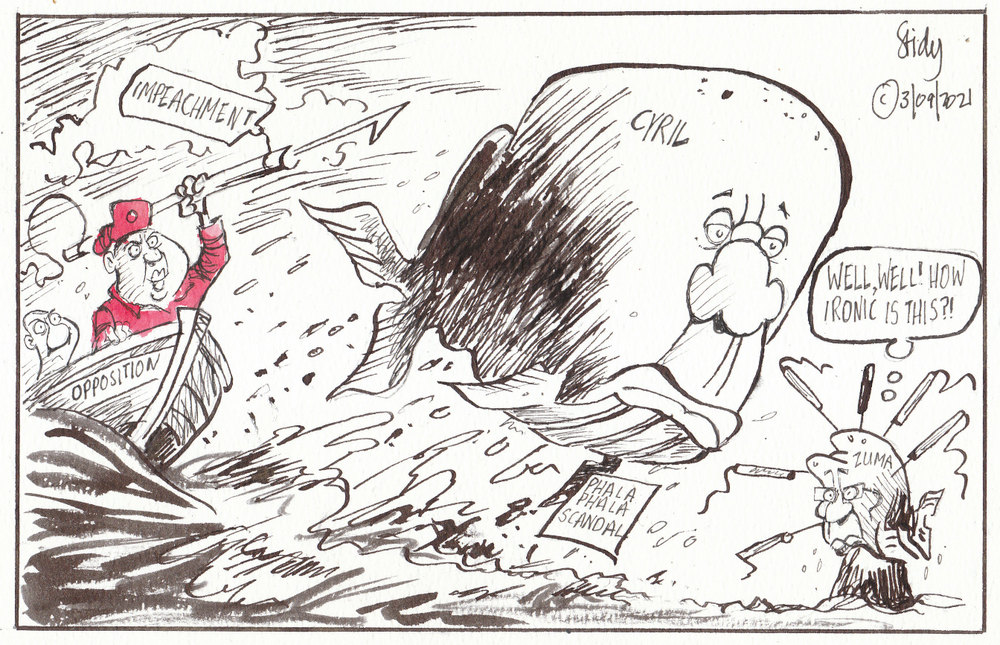
In scenes reminiscent of former president Jacob Zuma in the dying days of his presidency, President Cyril Ramaphosa again refused to answer questions in Parliament about the robbery at his Phala Phala farm citing “due process” as a number of law enforcement agencies were investigating the matter. Opposition members remained equally determined to not let him off the hook.
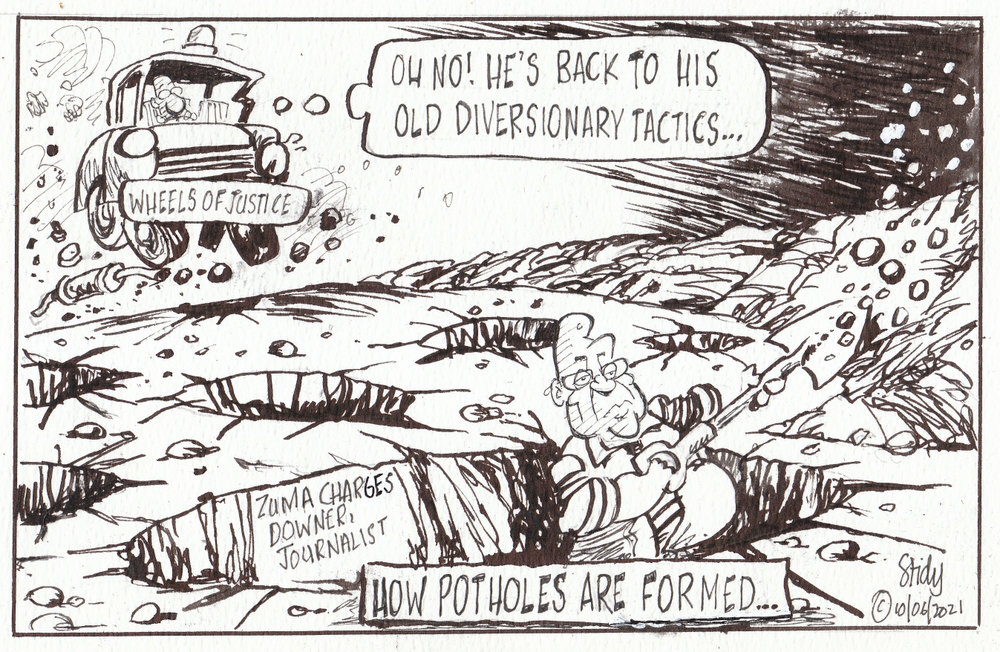
Former president Jacob Zuma summoned state attorney Billy Downer SC, who is the lead prosecutor in his fraud case, and News 24 journalist Karyn Maughan to court for allegedly disclosing his medical records. The case was expected to affect and cause more delays in Zuma’s corruption matter.
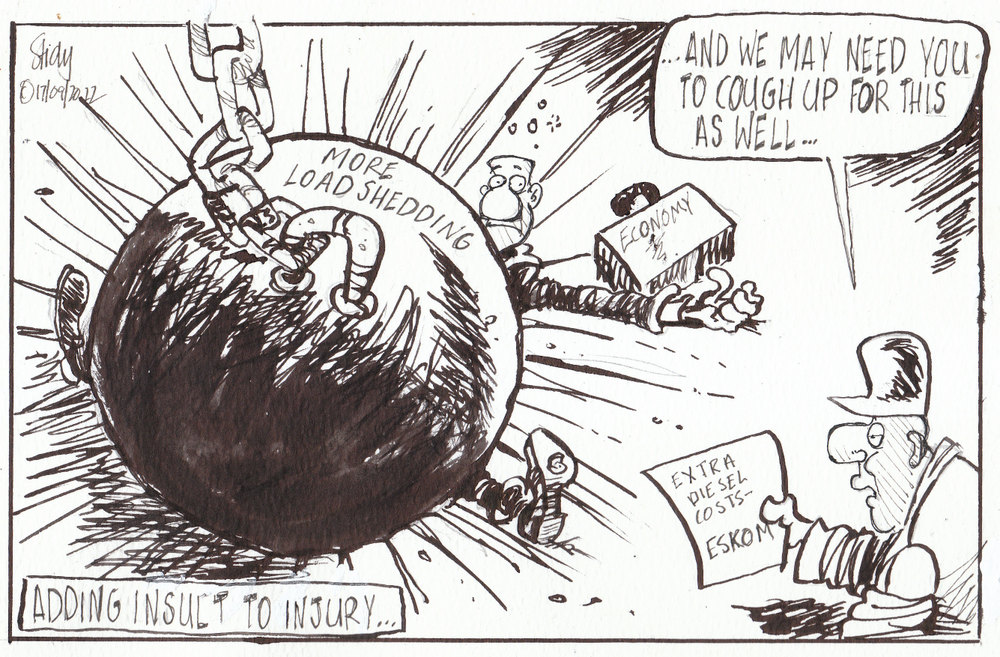
Six months into its financial year struggling power entity Eskom had spent R7.7 billion on diesel for emergency generators – far in excess of the budgeted amounts. The news came as the state-owned enterprise implemented yet more power cuts across the country.
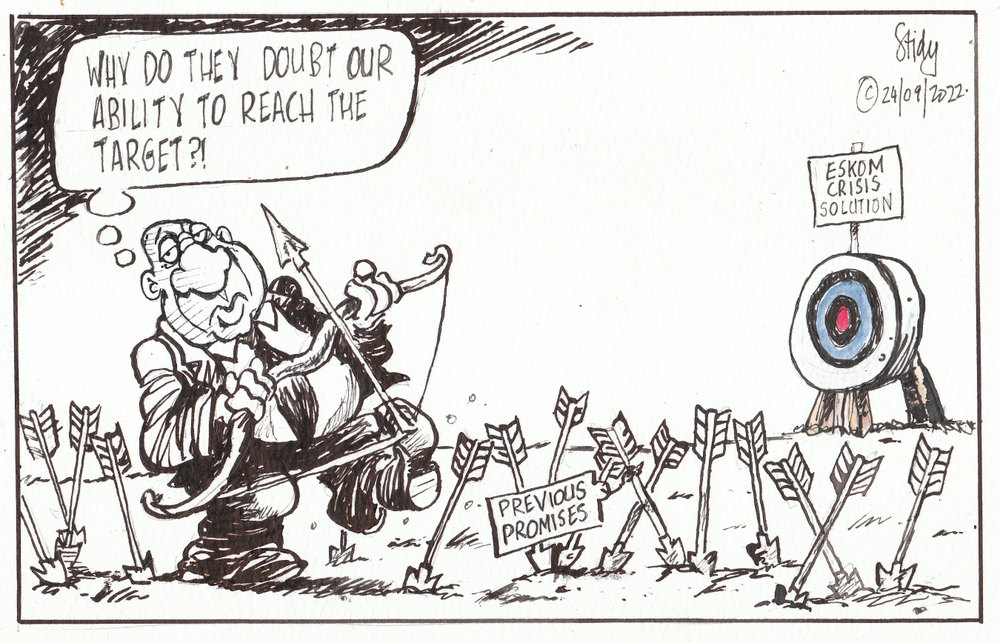
Worsening power cuts forced President Cyril Ramaphosa to cut short his overseas visit to deal with the ongoing problems. Back home, he once again listed a number of solutions to fix Eskom and improve its fleet of power stations.
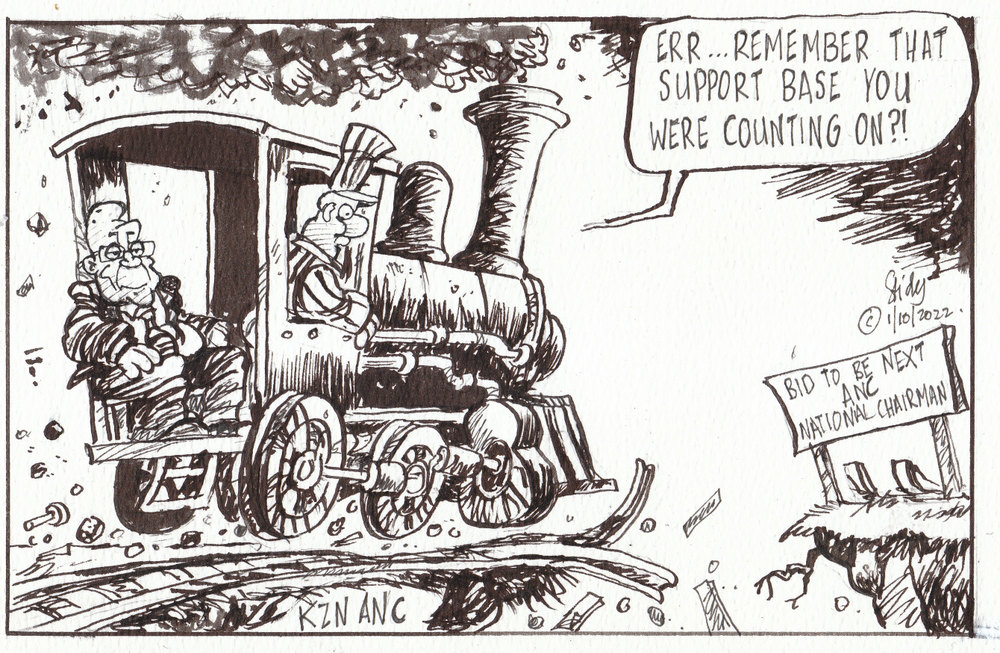
Former president Jacob Zuma’s home province decided not to support his bid to be elected the next ANC national chairman. The KZN provincial executive committee said it had resolved to throw its weight behind Limpopo Premier, Stanley Mathabatha, for the position.
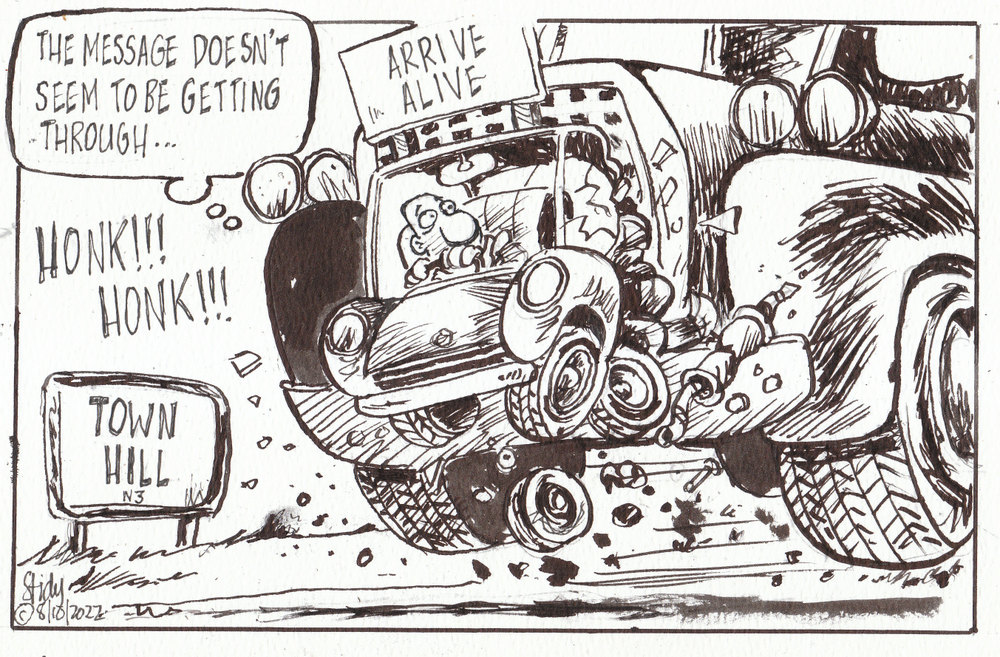
It was a case of another day, another crash as a runaway truck lost control on the N3 at Townhill and crashed into a barrier blocking the main Jo’burg to Durban artery for hours. The problems on this dangerous section of the highway have been exacerbated by the ongoing roadworks near the Peter Brown off-ramp which had caused huge snarl-ups.
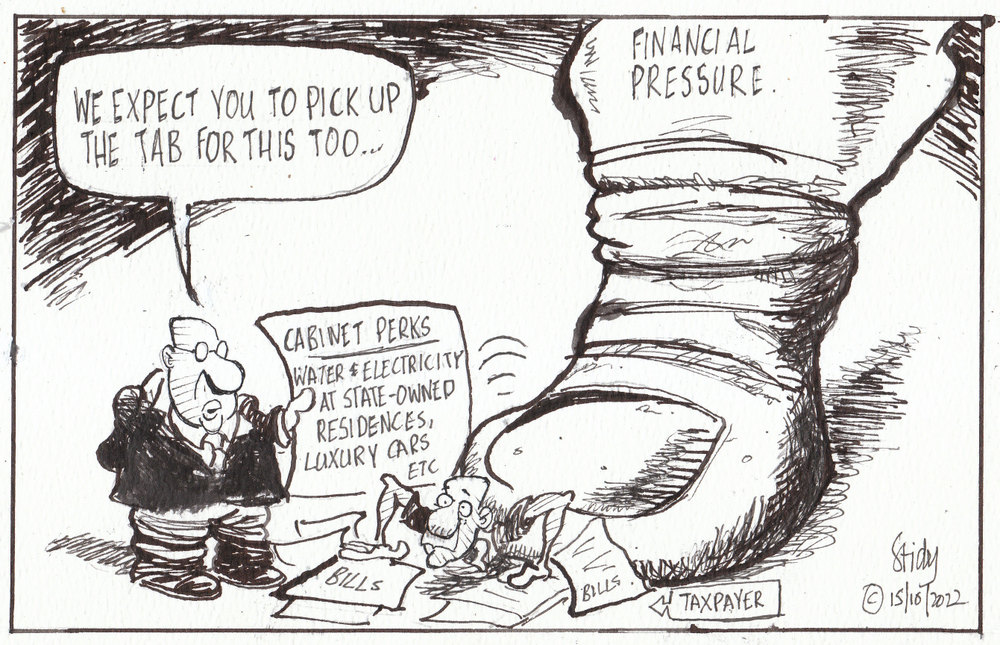
As the country endured yet another extended wave of load-shedding, President Cyril Ramaphosa signed an amendment to the ministerial handbook which would have seen taxpayers forking out for ministers’ water and electricity – as well as other benefits. After a vociferous public backlash, the new perks were later scrapped.
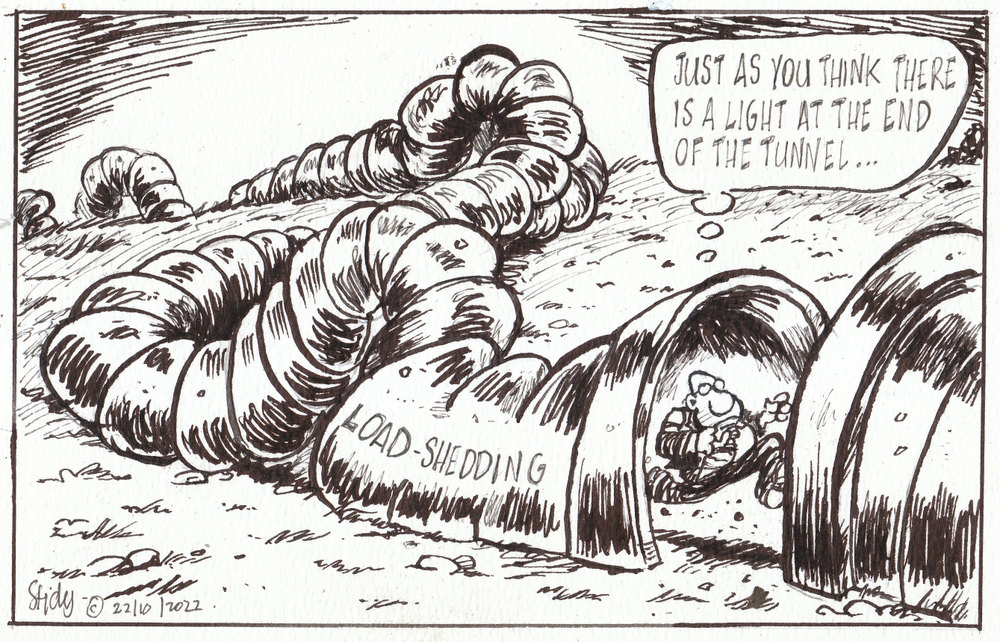
The term load-shedding was announced as the 2022 South African Word of the Year by the Pan South African Language Board (PanSALB). The announcement came as Eskom painted another grim picture of the load-shedding schedule for the week…
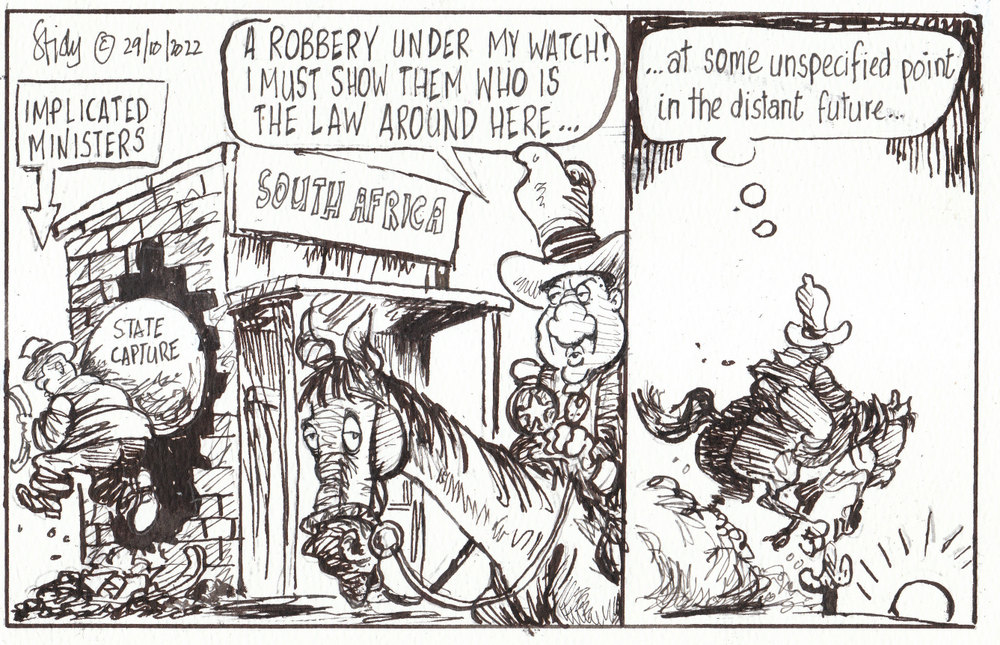
Opposition parties slammed President Cyril Ramaphosa for failing to take decisive action against Cabinet ministers implicated in state capture. Among those listed in the Zondo Commission Report were Mineral and Energy Resources Minister Gwede Mantashe and Deputy State Security Minister Zizi Kodwa.
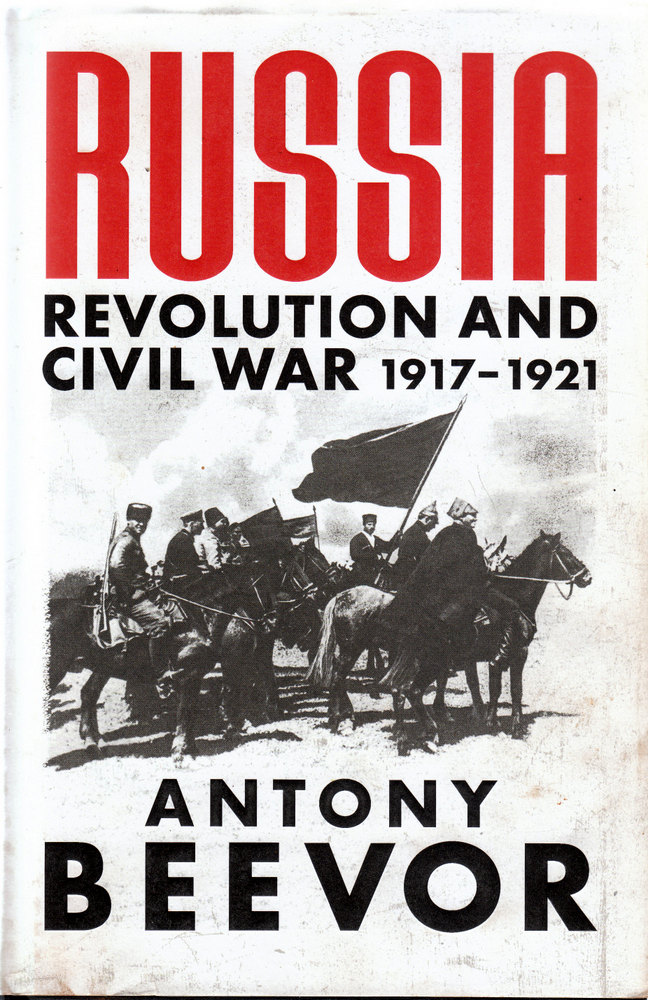
Just over a century ago, Russian society suffered a massive convulsion, the after-shocks of which are still being felt across the world to this day. A widespread discontent amongst peasants, workers and soldiers, serving on the WW1 battle fronts, both with Tzarist imperial rule and a system of government they regarded as anachronistic, corrupt, extremely unequal and exploitative, led to a series of revolts and uprisings which culminated in the overthrow of the Romanov dynasty. The deposed monarchy was replaced by a liberal Provisional government (Duma) which did not last long and was, in turn, overthrown by the Bolshevik Revolution of October 1917.
The Bolsheviks were, by no means, the majority party but their leader Vladimir Lenin – ably assisted by Trotsky and Stalin – was more than happy to sacrifice ethics on the altar of the cause, tell useful lies and suppress harmful truths if it got him what he wanted. Their ruthlessness, obsessive vision and scorn for all forms of conventional morality helped propel them into power.
In Marxist mythology, both the revolution and civil war that followed are usually cast in heroic terms but the reality, as this book makes only too clear, was anything but with both sides displaying an almost limitless capacity for killing once the means were in their hands – thanks in part to an indoctrination programme that persuaded murderers that their victims deserved their fate.
The more vulnerable or threatened they felt, the more brutal they got. Terror begot yet more terror.
Most famous amongst the many murders carried out was that of Tzar Alexander and his family, whose execution, in cold blood, represented, in the author’s words, “a declaration of total war in which the ‘sanctity of human life’, as well as notions of guilt and innocence, counted for nothing.”
Opposing the Bolshevik’s Red Army were the Whites, a somewhat shaky and improbable alliance of moderate socialists, reactionary monarchists and members of the old military officer class. Like the Bolsheviks, they were quickly corrupted by the cause and perpetrated their share of horrors and atrocities. At various stages, both sides were aided and assisted by several outside powers, including the US, England, Germany, France, Poland, China and Japan..
Riven with internal divisions and wide ideological differences, the Whites, in the end, proved, no match for the single-minded dedication and relentless determination of the Reds. Their victory helped usher in the modern era of the all-powerful, all-seeing state.
In this fascinating and meticulously researched account author Anthony Beevor, who earned plaudits for his previous book Stalingrad, takes the reader on a chronological journey through events, showing how an incompetent and out-of-touch tsar, a group of ruthless revolutionaries and a catastrophic world war, all combined to plunge Russia into a maelstrom of human hatred and destruction. Offering new insights and drawing imaginatively on a range of eyewitness accounts, it provides a powerful panorama of a watershed moment in history
With Vladimir Putin seeking to rehabilitate the memory of Josef Stalin with his own dangerous gamble in Ukraine, the legacy of these years remains as relevant now as it ever did.
It is why histories like this one must continue to be written and read.
Published by Jonathan Ball
The Anglo-Boer War which took place between 1899 and 1902 was one of the seminal events in South African history. It came about as the result of a deliberately aggressive policy adopted by imperial Britain – and in particular the high commissioner at the Cape, Sir Alfred Milner (hence its other name: Milner’s War) – towards the Boers of the Transvaal and Orange Free State republics. The major prize on offer was control of the incredibly rich Rand goldfields.
In the end, it did not turn out to be the quick dust-up many of the British had anticipated and for a while, the Boers actually held the upper hand, a situation which only changed when the British poured in more troops. At the end of the conflict, twenty-five thousand British and imperial troops were dead, many of them by disease rather than enemy fire.
More than this, it provided Britain with its first taste of modern warfare and it proved a humiliating lesson for a country which then laid claim to a substantial portion of the world.
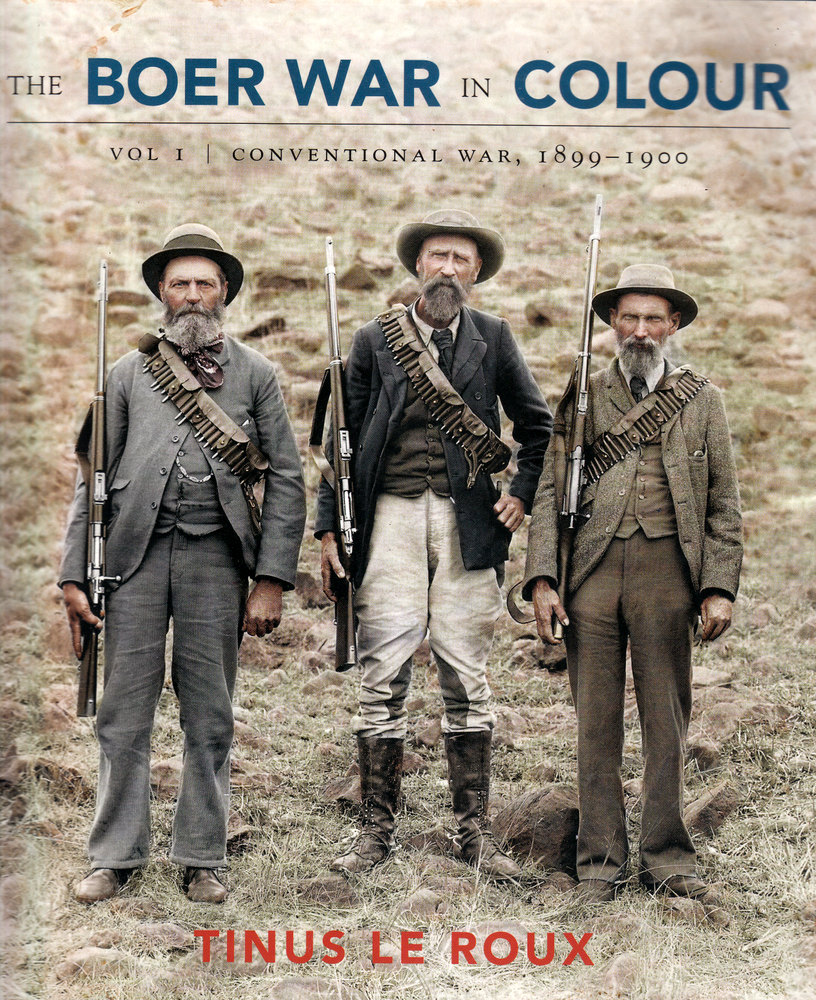
The war was also modern in the sense that it was one of the first to be photographed extensively thanks to advances in photographic technology and the introduction of hand-held cameras. Tinus Le Roux, a South African photographer, has sifted through thousands of these old black and white photographs and selected a representative sample which he has then hand-coloured with the aid of a computer to give them an added freshness and lustre.
Put together in chronological order, the first volume of his The Boer War in Colour covers the conventional phase of the war, from October 1899 to September 1900. The result is a triumph of judgement and selection, that offers a vivid new picture of a country preparing for and then torn apart by what effectively became a civil war; a war that left behind a legacy of bitterness that still lingers on today. Famous faces are there but perhaps it is the portraits of ordinary burghers, civilians and soldiers going about their everyday business in a time of great upheaval and change that gives these iconic historical photos their power and poignancy.
Although its importance has long since declined, the “Great North Road” was, in its time, one of South Africa’s most famous roads and considered of great strategic value, in spite of the fact it passed through some of the harshest, driest, least populated parts of the country. Skirting, for much of its length, the north-western border of the country, it was the original highway into the interior and favoured by many of the early traders, hunters, transport riders and missionaries. The significance of the road was not lost on the politicians either. The conniving arch-imperialist Cecil John Rhodes saw it as the key to British expansionism, and the opening up of the African continent. As part of his plan to outflank and contain the Boers (as well as ward off the threat posed by the Portuguese in the East and the Germans in the West), he sent his ‘Pioneer Column’ up it to annexe all the land north of the Limpopo.
Adding to its allure for me was the fact my ancestors also toiled up it in their ox-wagons, in 1892, as part of what became known as the Moodie Trek (see Travels Back: Trekking with the Moodies). Having received the blessing of Rhodes, they had set out with high hopes for their promised land but within a year of attaining it, their leader was dead. Unable to carve out a life there, many of the others drifted on.
A rebel group, who, on reaching Fort Victoria, had elected to continue on to Salisbury in the north rather than struggle on to their original destination – Gazaland in the east -, fared slightly better, in many cases finding a more permanent base to operate from.
After the demands and travails of their journey it must have felt good to be able to put down roots although, having only been established a few years earlier with the arrival of the Pioneer Column, Fort Salisbury was still barely a town. A few robust iron and wood structures, as well as mud-brick houses, had sprung up alongside the tents and grass-thatched, pole ‘n daga huts of the original settlement. It still had a frontier feel, a hint of the American Wild West with its wagons, stagecoaches, noisy bars and men on horseback with guns.
Stagecoach (Pic: Stidolph family collection)
Determined to establish their place in the sun, my ancestors wasted little time. Within months, another thatched hut had been added to all the others – a photograph from the time dutifully records it as “Moodies First House in Salisbury”. From an architectural standpoint, it wouldn’t have won any design awards but judging by their self-confident, languorous poses its occupants were pleased enough. It was a start. Wanting a place he could call his own my great-grandfather John Warren Nesbitt lit upon a happy patch of fertile agricultural land in the Mazoe Valley, just north of Salisbury – an area which would play a small part in my family annals as we shall see. Unfortunately, it was here the sins of his past caught up with him for he was told by the BSA Company that he could not register it because he had broken the terms he had agreed to when he signed up for the Moodie Trek. Undeterred he would go on to acquire two other farms, one in Goromonzi and one in Nyanga, both of which he duly named after himself (Warrendale)
Moodie’s first house in Salisbury.
Not too surprisingly, this willy-nilly parcelling out of land among the white settlers, at the expense of the local tribes, caused a certain amount of resentment and bitterness, as well as a desire to shake off the yoke of the invaders. In 1896, the Ndebele, who had occupied much of what came to be known as Matabeleland, launched the first sustained campaign against a colonial authority anywhere in Africa. Although a warlike people (they had conducted periodic raids into Shona country) with numbers on their side, they had no answer to the British Maxim Machine Gun and the revolt was eventually crushed. The settlers who had helped suppress it were rewarded with yet more land.
Salisbury laager. Note Maxim gun.
In Mashonaland, the white community was caught napping a little later on when – encouraged by the failure of the Jameson Raid in South Africa – the supposedly more docile, downtrodden Shona also rose up in a similar rebellion. My great-grandmother Marjorie Coleman and her two grand-daughters Josephine ( better known as Josie – my father’s mother) and Nora were to get a foretaste of what was to come when they narrowly escaped being killed as they were returning from Umtali to Salisbury and found themselves surrounded by an armed horde. Fortunately for them, the order to kill all white people would only come a few hours later and they were allowed to continue on unmolested.
In the short but bloody conflict which ensued another relative, Randolph Cosby Nesbitt – the brother of John Warren and uncle of my father – would distinguish himself as one of the heroes of the beleaguered white community holed up behind their defensive laager in Salisbury.
A captain in the Mashonaland Mounted Police during the rebellion, he led a patrol consisting of only 13 men to rescue a group of miners who had been surrounded by over a thousand rebels, armed with an assortment of Lee- Metfords, Martini-Henrys and old muzzle loaders, at the Alice Gold Mine in the Mazoe valley. J.W.Salthouse, the manager of the mine, had had the good sense to fit out a wagonette with bulletproof iron sheets to give protection to the women and one sick man. Riding alongside this, Randolph and his men succeeded in getting the beleaguered party – which included three women – back to Salisbury, some 27 miles away, despite coming under particularly heavy fire as they fought their way through the long grass and well wooded, hilly country that bordered the Tatagura river, on the side of which the road ran. Considering how outnumbered they were, their casualties were surprisingly light, with only three of the small rescue party being killed and five wounded. The arrival of the exhausted little group back at the Salisbury laager was greeted with gasps of astonishment as everybody had given them up as dead.
For his actions Randolph was awarded the Victoria Cross (see picture below), the first Rhodesian to receive Britain’s highest award for gallantry and combat. As a national hero, his medal used to be housed in the National Museum in Salisbury. The famous episode also became the subject of a popular book – Remember Mazoe by Geoffrey Bond.
There exists a snapshot of Randolph in officer’s regalia posing outside the old BSAP Mess in Nyanga, the same area where we would, much later, buy our own farm. Backdropped by a high mountain and a house that looks like it was built by elves, it is a study in contrasts and, somehow, captures an era.
With his snowy hair, military dress, spread-eagled legs and a mouth masked by a large moustache, he looks every inch an imperial officer. Handsome with something of a sportsman’s build, he comes over as a man who cannot imagine failure and who is clearly accustomed to being in a position of authority, command and living a life of discipline and order. From every pore, he projects purpose and certainty. Tough, resourceful and obviously used to leading from the front, one can easily imagine him remaining calm and collected in the face of overwhelming odds.
Sitting beside him, the loyal, supportive, spouse, his wife cuts a more demure, feminine figure although, in her own way, she, too, exudes an air of quiet competence. Calm, steady-eyed, in her sun hat and long dress, one can easily imagine her organising tea parties or quietly setting out to recreate the comforts and dignities of the Victorian upper-middle class in the depths of the African bush.
Standing behind them are two, uniformed black servants. They are staring dutifully at the camera but with looks, one can’t quite interpret. Whatever they are thinking, they are not letting on
In the light of history, there is a slightly surreal quality to the picture. Little could that imposing couple have foreseen or foretold that within eighty years their secure, timeless, confident world would be gone; the era of their mastery would be over, the colonial order they represented would be dismembered, their monopoly of political power lost or that White Rhodesia would have been swept away.
Within nationalist historiography, the African resistance of 1896-7 became popularly known as the First Chimurenga War and provided both an inspiration and a dress rehearsal for what was to come. Seventy years later the country would once again find itself facing an armed uprising as the ZANLA and ZIPRA forces led by Robert Mugabe and Joshua Nkomo clashed with the Rhodesian security forces of Ian Smith. This time around, the Shona – who would go on to become the dominant political group in an independent Zimbabwe – were better prepared and better equipped. They ensured they had plenty of weapons, something the Soviets, who were then involved in some Empire-building of their own, were only too happy to supply. Once they had replaced the white government they turned their attention to their former foe, the Ndebele, settling a few old scores with the help of some instructors from North Korea.
Largely ignorant of (or perhaps just indifferent to) the cataclysm of social change their arrival had unleashed on the local tribes and happily oblivious of what lay ahead, the whites carried on creating new urban centres and taming the land. Not without reason, they were immensely proud of what they were able to achieve in so short a period of time. The tribes who had been ejected from the more fertile, productive land, however, probably saw it through more jaundiced eyes. When her husband died, Marjorie Coleman opened the first boarding house in Salisbury which, although on a small two-room structure, was evidently able to accommodate 32 boarders at a time. Ironically my grandmother’s sister Nora, who achieved the rare distinction of living in the country longer than any other white, would survive to see both the first and second Chimurenga wars and the rapid dismantling of all of Rhodes’s dreams for the country.
Although Nora would live on to become the grand old lady of Rhodesia, her sister, Josephine, having given birth to four children, including my father, would die, while she was in confinement with her fifth, Joseph, on the 21st of August 1921. She was only 33. From the pictures I have seen of her, she was an attractive lady, with a smile both gentle and a little whimsical.
Sarah Susannah Nesbitt (centre) and her daughters Josephine and Nora.
Her husband, Alan Stidolph, a slightly more austere figure, later got remarried to Marion Hughes and around 1948 they moved to Broadlands Avenue on the Avondale Ridge, in Salisbury, where they built a double-storey house, named Badsel after the family home in Kent.
Alan Stidolph – lying in front, mysteriously clutching the end of the walking stick. I am not sure who the others are. (Pic: Stidolph family collection)
When Alan died he was buried in the nearby Avondale Church where my father’s ashes would, in turn, be interred.
There are numerous other black-and-white photos from these bygone eras stored away in my files under the heading ‘Family Mix’. And what a mix they are. Frozen in time and place with their peculiar hairstyles (the ladies’ abundant hair usually bobbed up on top), strange clothing, their starched and frilled dresses, their old-fashioned jackets, neck-ties and wide-brimmed hats, their pipes, their faithful mutts and gawky children (is that really my father in flannels with a tennis racket?), they provide a link to a now departed world of over-dressed Europeans and half-naked Africans, of conflicting cultures, class systems, languages and tribal differences. Precious keepsakes of the past, the pictures also help give these now long-dead relatives an identity, a sort of existence, a life of their own – although, since they left so little behind in the way of letters or memoirs, their stories must, sadly, remain forever incomplete, their inner lives mostly unknowable.
Spectres in a hazy, monotone landscape, they glitter on the edge of my imagination but I can never quite grasp them.
GALLERY
Some more photos from the Stidolph family collection:
This photo is titled ‘Picnic on the Shashe River’ although the surrounding trees, which look like Miombo woodland, suggest another location. I have no idea who any of the people are but they presumably have some connection with my family. From the family collection. Again, I have no idea who the man with the pipe is but the photo does give you a good idea of the master/servant relationships of the time Picnic time. My father, Reginald Neville Stidolph (top left), his mother, Josie (top left second) and father, Alan (top left third). Around 1920.Stidolph offspring. From top left: Jack (killed WW2), Harold, Joyce, Reginald (my father)My father as a tennis playerMy father’s siblings: Phyllis, Jack (who later served in the RAF and was killed during WW2) and Harold at the wheel (who would go on to become the Provincial magistrate for Matabeleland). Kutema in the background.My father’s Uncle Randolph’s medals.
ACKNOWLEDGEMENTS:
Many thanks to my eldest brother, Patrick Stdolph, whose research into our family history filled in many of the blanks…
I grew up in the dying days of Empire, that now fast receding period in history when the British nation spread out across the globe and ended up laying claim to and governing a substantial portion of it. Their motives for doing so were numerous, their impact (both good and bad) enormous. In terms of size and influence, it was the greatest empire of all time. As the historian, Niall Ferguson put it, in his critically acclaimed book Empire: How Britain Made the Modern World: “No other country in the world came close to exporting so many of its inhabitants…The Britannic exodus changed the world.”
For better or worse, I am a product of this mass exodus. My father’s grandfather, Harold Edward Stidolph, a musician, organist, composer and writer of verse, was among the countless many who decided to try their luck in the colonies arriving in Cape Town around 1884, ship unknown. Patriotic and devout (if his verses are anything to go by) and very much a man of his time, he took to South Africa with enthusiasm – among other things, touring the Cape Colony with Ede Remenyi, a popular Hungarian violinist who had worked with Franz Liszt.
Harold Stidolph.
There are Scots and Irish in my ancestry on my father’s mother’s side and their connection to this country goes back even further. In 1817, Benjamin Moodie, the last Laird of Melsetter in the Orkney Islands, facing ruin and a drastic decline in social status, led a party of indentured Scotsmen out to South Africa, on the ship Brilliant, with the intention of establishing a settlement in the Cape where he hoped to recoup his position and fortune. For various reasons – a separate story in itself – Benjamin’s feudal visions were never fully realised but he did end up buying land at Groot Vader’s Bosch near Swellendam which his descendants still farm to this day.
Not my side of the family though. For reasons unclear, Benjamin disinherited his firstborn son, James – from whom I am descended – which meant Groot Vader’s Bosch was left to his second son. It was a decision I had good cause to regret the moment I first laid eyes on the farm with its magnificent old house sheltering on the slopes of the beautiful Langeberg.
What is known is that James equipped with a wagon and a load of either timber or of saleable mixed goods decided, to head inland towards the Orange river to seek his fortune. He fell ill near the northern borders of the Cape Colony, got taken in by a Boer family, and was then nursed back to health by Sara Van Zyl (whose South African family tree dates back to the days of Van Riebeek) who he subsequently married.
She bore him eleven children one of whom, Thomas – or Groot Tom as they called him because of his size and amazing strength – would also uproot his extended family and take them off in search of pastures new.
The trek that he would lead – the Moodie Trek – was an experiment, in that it marked the first organised attempt to establish a European settlement from the south in Gazaland. The inspiration for it had come from George Benjamin Dunbar Moodie, a young adventurer from Natal who, having explored the area and realised its potential, put the idea to his uncle Thomas, then a wheat and maize farmer in the Bethlehem district of South Africa. Taken in by Dunbar’s glowing descriptions (”the prettiest country I have ever seen”) Thomas agreed to lead the trek. Hoping, like his grandfather before him, to create a new Melsetter in the wilds, he led a small delegation of interested farmers, in January 1892, to see Cecil John Rhodes.
It must have been a relatively easy sell. Rhodes’s interest in the area was well known and had, over the years, grown even greater (to say nothing of his grand plan to attach the whole of the continent to Britain). Realising the importance of establishing a European settlement in Manicaland to act as a buffer against the Portuguese who were actively seeking to resuscitate their ancient claims to “Monomatapa”, as well as outflank the Boers of the ZAR by claiming the territory north of the Limpopo, he readily agreed to the proposal once suitable terms had been arranged.
Having obtained the necessary backing Groot Tom returned home. There was much to be done before they could set off. Most important, he needed people. To this end, Groot Tom set about recruiting a group of mostly Afrikaans-speaking farmers to join him. In the end, the party that set off on this long, arduous journey was made up of 29 families consisting of 37 men and 31 women, with 17 wagons and 350 horses and cattle. Where they paved the way, others would follow.
Dunbar Moodie did not join the trek party but instead sailed up to the port of Beira, in Mozambique, and then travelled via Umtali to Salisbury before linking up with the trek in Fort Victoria.
On the 8th May 1892, cheered on by a crowd, the trek rumbled out of Bethlehem “with a great lowing of cattle, whipping and whooping”. They were joined by an ox wagon in which rode John Warren Nesbitt (the Nesbitts were of Irish extraction), his wife, Sara, and their very young daughter, Josephine – my grandmother – who had been born on the farm of White Hills near the old gold-rush town of Barberton (in present-day Mpumalanga).
The seeds of my future life in Rhodesia/Zimbabwe had been laid.
Route taken by the Moodie Trek.
The wagon train struck out into the interior, heading across the open high plateau until they reached Zeerust. From there, they followed the route taken by the old hunters, missionaries, transport riders and, more recently, the Pioneer Column. For much of its length, it skirted the north-western border of South Africa, leading them across the dusty, flat plains until eventually, they sighted the waters of the Limpopo, glimmering in the distance. It is likely they crossed the river at a point, now known as Rhodes Drift, just west of its confluence with the Shashe River. From here they headed up into the Tati Concession area (now Botswana).
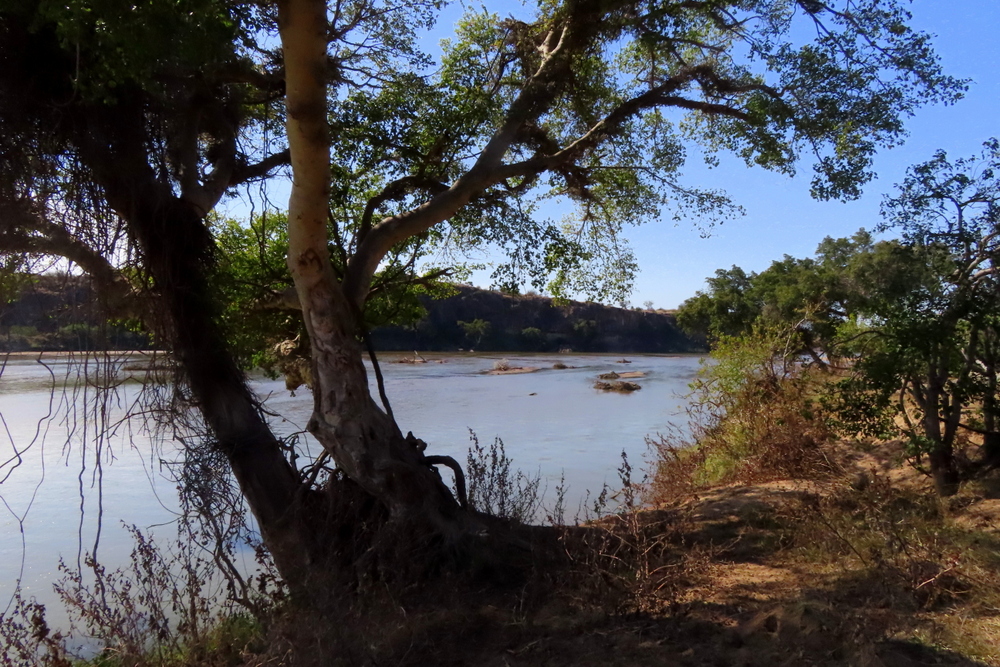
The Limpopo. The trek most likely crossed several kilometres upstream.
This is a harsh, arid country. In summer the sun hammers down relentlessly, and water is often hard to come by. Coming in fast, huge thunderstorms sweep across it, the lightning illuminating the landscape below in jagged flashes. There were other perils to be faced. Awareness of animals must have bought an awareness of details. One can imagine their senses growing attuned to lions, hyaenas and elephants, all of whom were common in these parts.
As often happened in these emigration stories, all did not go quite according to the script either. Groot Tom had hoped to complete the trek in four months but such were the hazards and hardships they encountered along the way it took them that amount of time just to reach Limpopo and then another four months to get to their final destination.
At Macloutsie, just over the border, there was an outbreak of foot and mouth disease amongst their cattle, many of whom grew so weak they were eaten alive by the hyena that prowled around their camp. This delayed them for another month. There were also attacks by lions and shortages of water. Snakes proved an ongoing problem with several of their dogs being killed by the fearsome, deadly, Black Mamba. Undeterred the party struggled on. Ahead of them lay more hills, more flatness.
They reached Fort Tuli on 12th September, Occupation Day where they were able to replenish their diminished supplies. They also organised a dance (“the jolliest I have ever attended” according to one of the trek members). One of their concerns for the next leg of the trek was the possible hostility of the Ndebele raiding parties who were active in the area. Apart from one or two small incidents, they got through unscathed.
They were to face more drama, however. Upon reaching the small settlement of Fort Victoria (modern-day Masvingo) a major falling-out occurred amongst the trek members when it was discovered in which direction their true destination lay. It would appear that a large number of the party had not been paying close attention when the objectives of the trek had originally been spelt out. Now they could not understand why, instead of following the wagon wheel marks up to Salisbury and the more healthy highveld, they were branching off into what looked like wild, untamed, malaria-ridden country. Or maybe they were just exhausted after months of trekking under the hot African sun and this caused some confusion in the mind…
Looming large amongst the group of dissidents was John Warren Nesbitt who, having been appointed correspondent of the trek, proceeded to pen an angry letter to the Tuli Chronicle, a newspaper, I must confess, I did not even know existed (considering that Tuli is in one of the most remote and isolated parts of modern-day Zimbabwe one wonders what its circulation figures were).
Unable to reach an agreement the party split up into two groups with one half continuing on to Salisbury while the other trekked on to their original goal, Gazaland and the Chimanimani Mountains.
Having written an equally indignant letter refuting John Nesbitt’s allegations, Dunbar Moodie decided to take advantage of the impasse by getting married to his cousin, Sarah Moodie. For their honeymoon, they chose the nearby, mysterious Zimbabwe Ruins, which were to become the subject of much contentious debate. They were, in all likelihood, the first European couple to choose this site to celebrate their nuptials…
Zimbabwe Ruins.
The Gazaland-bound group set off on the last leg of their journey. It proved every bit as challenging an ordeal as what they had already been through. Before them stretched yet more miles of wilderness, the initial terrain was rough and broken, then flat but extremely hot. The party was afflicted with malaria, and their animals succumbed to horse sickness and other ailments. Reaching the Sabie River, with the Eastern Highlands now in plain sight, Groot Tom decided to stop and celebrate. The party gathered together under a large baobab and a demijohn of brandy was produced. The ragged survivors beneath it must have seemed like some ghostly apparition. As one account, now in the National Archives in Harare, put it “Our stricken folk and wagons presented a pitiful sight. The enthusiasm of the men under the circumstances brought tears to the eyes of the owner of the demijohn of brandy (Mrs Dunbar Moodie). The demijohn was brought to the light of day and added considerably to the zest of celebrations.” Dunbar put it more pithily. In his diary, he simply recorded: “Got squiffy – all of us.”
Some photos showing location of Moodies drift taken at a later date.
They crossed the river at what would subsequently become known as Moodie’s Drift, just south of the present-day Birchenough Bridge, then headed up the final steep stretch. Eight months after they had set off, the loyal remnants of Tom Moodie’s original group finally reached the rolling green hills and mountains of what would become the new “Melsetter”, still full of high hopes and ideas about how they were going to create an ideal rural society on the land. For the Moses-like figure who had guided them, there was to be no happy ending of rippling crops and pasture lands full of fat sheep and contented cattle. Within a year of pegging his farm, Waterfall, Groot Tom had succumbed to malaria and blackwater fever and was dead. You can see his grave still there to this day, by the side of the main tar road. Above his name is inscribed the dedication “For Queen and Empire”.
The inscription is hardly surprising. The Moodies lived in an era when many of those who had gone out to the colonies were conservative by nature and loyal to the crown. They saw themselves as emissaries of established imperial power, the bearers of a universal, unquestioned, order, part of a civilising force whose duty was to uplift the rest of mankind. The fact that the people they subjugated in the process did not always see it in quite such heroically romantic terms did not occur to them or else was conveniently overlooked.
Memorial to the Moodie Trek in Melsetter (since demolished)
A memorial to the trek was later put up in the centre of Melsetter. Because of its unwanted associations with colonialism, it was dismantled after Robert Mugabe came to power. The village was renamed Chimanimani, after the nearby range of mountains.
Chimanimani Mountains
After Tom’s death, his wife Cecilia Moodie, returned to her relatives in South Africa where she died in 1905, She was buried on the farm of Rietvlei, today known as the Rietvlei Nature Reserve, south of Pretoria.
For many of the other emigrants, it would prove an equally, fragile, brief interlude. More died, others moved and moved on again leaving behind them an ominous hole. Soon there would be very few of the original trek members, or their descendants left.
For their part, the breakaway group had, in the interim, continued trundling their way towards Salisbury which, at that stage, consisted of little more than a village of tents, pole and dagga huts and a few brick homes sprawled around The Kopje. Bit by bit the town would spread out from this hill slowly engulfing the surrounding veld, vleis and acres of long, pale grass until eventually, it became the modern city of today with its concrete skyscrapers and buildings, just like metropolises all over the world.
Salisbury in the 1890sSaliasbury 1890s
The arrival of the dazed and travel-stained home-seekers amongst the bare scatter of buildings caused something of a stir. As was so often the case in frontier towns, the majority of the early white settler population was young and male, so this unexpected infusion of more women was a cause for great celebration (according to Sarah Susannah Nesbitt, who later wrote an account of her experiences, there were only eight women and a few children in the town when they arrived, not counting the Roman Catholic nuns and sisters).
Sarah’s daughter, Josephine Nesbitt, would go on to marry Alan Stidolph, the son of Harold, mentioned above. They had five children together, one of whom was my father, Reginald Neville Stidolph. Another piece in the family jigsaw had slotted into place.
During my youth, none of this meant much to me. It is only that I have reached an age when I am only too aware I am living on borrowed time and have started doing some serious stocktaking of my life it has assumed a much greater significance. Each generation passes something on to the other. If you want to understand the present, the best place to start is usually looking back.
I met none of the folk here described, not even my grandmother who died at a relatively young age, but – like my father before me (another adventurous spirit) – I think I have inherited a few of their traits. I possess something of their wanderlust, curiosity and desire to seek out new frontiers. I, too, like to test myself against nature by periodically returning to a harsher – and more simple – mode of existence than the more safe and sedentary one I live on a daily basis. I have never, admittedly, subjected myself to such an exhausting physical ordeal as they did on their long trek (in my case a hike in the Berg or along the Wild Coast usually suffices). For this reason, if no other, I find their achievements awe-inspiring.
I am aware, however, that not everyone views my ancestors’ achievements – their ‘opening up of the continent’ – in such a heroic light. I am equally aware that the legacy they left behind brings its own political, spiritual and psychological baggage. Through no particular fault of mine, I was born on the wrong side of history, under a now-defunct set of ideas and beliefs; a political system which denied basic political rights to others and led to an ever-widening turmoil in the sub-continent. A certain amount of guilt attaches itself to this, an awareness that British rule was not quite as enlightened as it often tried to present itself to be. It is not something that can be easily wished away; the best thing one can do is acknowledge, understand and learn from it.
History, as we know, abounds with ironies and this story has its little postscript too. The collapse of the former Rhodesia triggered a massive reverse trek as many whites, fearful of their future under Robert Mugabe’s hard-line, Marxist-style, regime, packed their bags and became part of a new diaspora. Many of their concerns appeared justified, too, when his government launched its chaotic and violent land grab which sent the economy into freefall.
I was part of this general exodus, swept along, by the turning tide from the country of my birth. In a sense, I had returned to the starting point, and the journey had gone full circle…
REFERENCES:
Many Treks Made Rhodesia by C.P. Olivier (Published by Howard B. Timmins)
The Scots in South Africa: Ethnicity, Identity, Gender and Race, 1772-1914 by John M. Mackenzie with Nigel R. Dalziel (published by Wits University Press)
Overberg Outspan by Edmund H. Burrows (published by Swellendam Trust)
Experiences of Rhodesia’s Pioneer Women by Jeannie M. Boggie (published by Philpot& Collins)
Many thanks to my eldest brother Patrick Stidolph whose research into our family tree I have also drawn on here.
Following continued disruptions which Eskom blamed on striking employees, the power utility increased load shedding to stage six. With the economy already under heavy strain, the move, yet again, highlighted the fact that the Government had not been very successful in dealing with Eskom’s numerous problems.
Adding to local motorist’s woes was the news that they faced further large fuel price hikes as the petrol levy cut fell from R1,50 a litre to 75c. As a result, the cost of petrol was raised by R2,37 (93) and R2,57 (95) a litre while the price of diesel rose around R2,30 depending on what grade you bought.
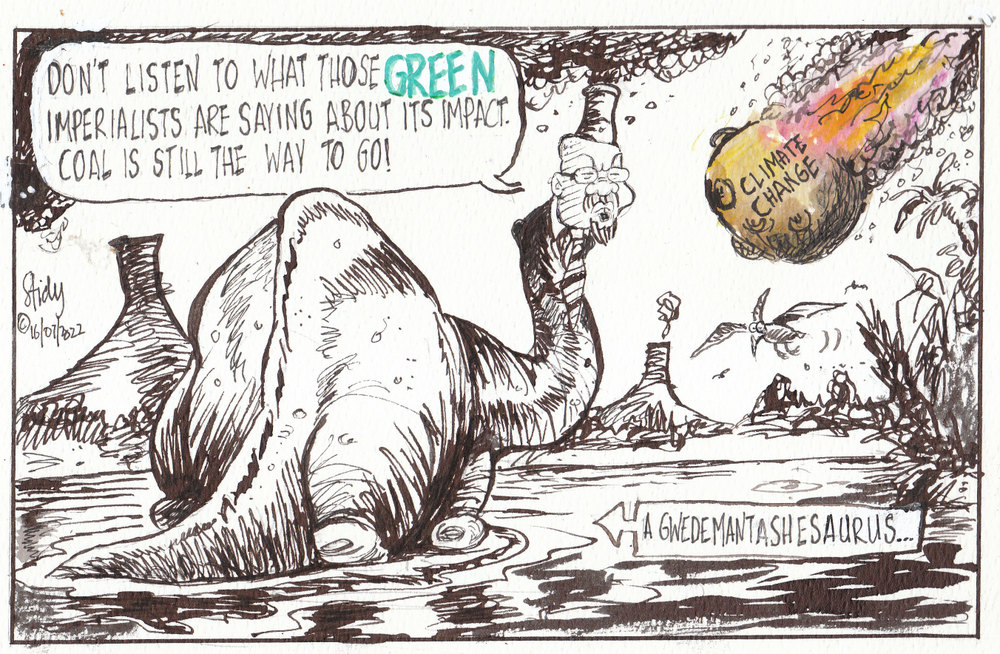
Stuck in the past, wedded to the use of coal, the Minister of Mineral Resources and Energy Gwede Mantashe continued to pour scorn on those seeking cleaner alternatives, calling them “climate imperialists”.
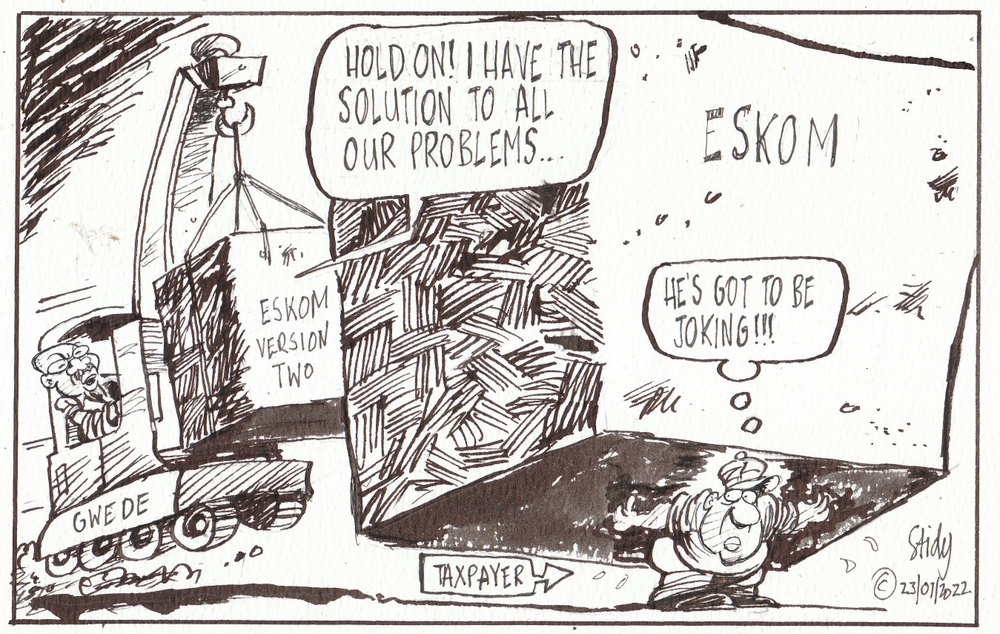
Energy Minister Gwede Mantashe’s suggestion that South Africa create a second SOE power utility to foster competition in the electricity space was greeted with derision by most political commentators – including me.
In an apparent blow to President Cyril Ramaphosa, the KwaZulu-Natal ANC voted against his alliance and instead elected leaders sympathetic to former president Jacob Zuma.
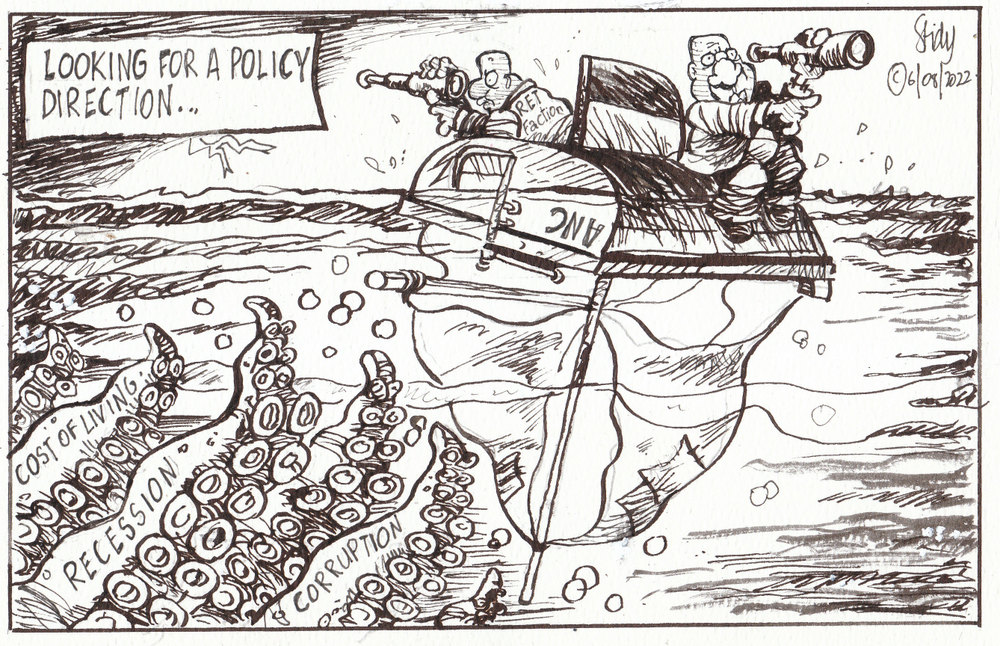
A sombre mood hung over the ANC policy conference. Although a rebellion against President Cyril Ramaphosa and his reformist agenda was neutralised many questions still hang over the future of the party.
KwaZulu-Natal treasury MEC Nomusa Dube-Ncube was sworn in as Premier during a special sitting in Mooi River in the Midlands. She replaced outgoing Premier Sihle Zikalala who had resigned. The first woman to be appointed Premier, her swearing-in came at a time when there was widespread public dissatisfaction over the provincial government’s performance.
While President Cyril Ramaphosa continued to maintain a stoic silence in dealing with the question about the big money found at his Phala Phala farm in 2020, opposition parties in Parliament continued to pile on the pressure, calling for his impeachment and requesting an ad hoc committee be set up to look into what they believed was a cover-up and abuse of state resources.
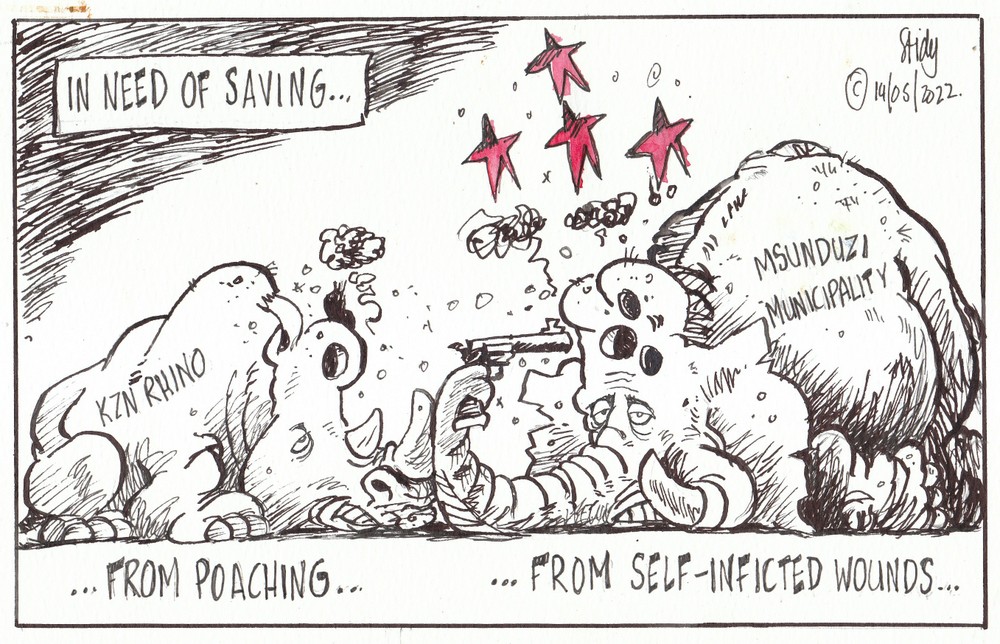
Labour union Cosatu and affiliates embarked on a day-long “national shutdown” to protest against the rising cost of living – warning the ANC voters would punish them at the polls unless they did something to rein it in. In an unrelated incident, two lions and two rhinos escaped from Hluhluwe-Imfolozi Game Reserve as the cash-strapped KZN Ezemvelo Wildlife struggled to resolve an ongoing conflict with the surrounding communities over, among other things, similar escapes.
“Art washes away from the soul the dust of everyday life”
Pablo Picasso
Confession time (in case it isn’t obvious): my name is Anthony Stidolph (aka Stidy) and I am an art addict. It is my form of DIY therapy, my way of coping with what seems an increasingly dangerous and dysfunctional world. I am a believer in art’s healing properties, and its ability to refresh and reinvigorate. It can help the head, mend the heart (and – when it is not going the way you want it to – drive you to distraction).
When I studied art at school – obtaining a distinction at Ó’ Level – I always found myself naturally attracted to drawing rather than painting. I was certainly more proficient in it. My early attempts at putting paint (back then this was limited to prehistoric powder paints which I never got the hang of) on paper were mostly an unmitigated mess. And so pencil, pen and ink became my chosen instruments and when I decided to make a career out of my art, it was to cartooning I turned.
It was only later, with the prospect of retirement looming, that I finally plucked up the courage to venture into colour once more. Thinking big, I decided to go the whole hog and start with oils, which I had never used before. I did this mostly because I knew oil can stand much more abuse in its handling than other mediums (such as watercolour). Any mistakes or errors can be easily covered. You can constantly construct and reconstruct, at leisure.
My first efforts were very tentative and not too successful. Expanding my range made me only more conscious of my lack of experience in this field. I went through periods of doubt and self-questioning. Had I left it too late in my creative life to indulge my craving for colour and pick up the necessary skills to be any good at it? Held on a leash for so long, I did not know quite how to channel my creative energy.
I am nothing if not obsessive, however. I battled on doggedly. My moods continued to alternate between youthful enthusiasm and discouragement. Finally, I began to enjoy it. I discovered that if you are more relaxed, you can concentrate better.
Although I did not take up painting until the middle years of my life, intimations of a desire to do so appeared much earlier. In some ways, my long career as a cartoonist laid the groundwork for what followed. For a start, I had learnt that it is not necessarily part of the job to copy nature exactly as it is and that by simplifying it and omitting the superfluous you could signal just as much and also make your art more immediately accessible.
As with cartooning, too, you begin to develop your own style over time too, almost unconsciously. It is like a signature, your personal handwriting, something that develops without you having to think too much about it. Aspects of your personality, preoccupations and predispositions begin to shine through.
Having decided to take the plunge into oils, it was almost inevitable that I should be drawn to landscape painting. I grew up on a remote but beautiful farm in Zimbabwe’s Eastern Highlands. It was situated in a wilderness of mountains, kopjes and hills. In every distance stood strange shrouded landscapes, dotted with baobabs and inset with rivers and fleeting pools. Mysterious, unmortared, stone ruins, scarcely touched by archaeologists, stretched for miles upon miles along the valley floors and right up onto the mountain slopes into the narrowest of crevasses and the steepest cliff faces.
Pit enclosure, NyangaRuins on Nyahokwe Hill, NyangaNyahokwe Hill, NyangaThe road home…
These magical scenes provided a treasury of wonders for a lively, enquiring mind.
To take up landscape painting – or at least be successful – I think you have to have this inherent sensitivity or “feel” for scenery. This is the unteachable part of it. In my lifetime, I have seen way too many landscape paintings which, while technically competent, just lack this intrinsic thrill – or SOUL. It is merely painting by formula, there is no sense of an aesthetic experience, they lack the understanding that comes from constant association with a scene. It is landscape done through a tourist’s rather than a painter’s eye.
Over the succeeding years, I have continued to plug away at my painting, trying hard to establish a balance between seeing and imagining while exploring the possibilities and harmonies of colour and form. I lay no claim to having in any way mastered the subject. I am only too aware of my limitations and shortcomings (I battle with my greens, for example). However, I am not yet ready to throw in the towel or toss away my paintbrushes. I plan to carry on looking and thinking and experiencing and practising, knowing that in art, knowledge assists invention and helps you overcome creative obstacles.
The alternative – which I don’t fancy – is to do an “art detox” and quit…
PORTFOLIO:
Herewith is a selection of my paintings which I have divided into sections.
NYANGA SCENES
I have cherished my memories of the Nyanga landscape all my life so it was inevitable they should insinuate their way into my painting and that I should try to recapture the warm feelings I had about them.
World’s View, NyangaMt NyanganiNyazengu Gorge, NyangaSummit of Mt Nyangani.
BAOBAB PAINTINGS
With its gigantesque bulk and primitive appearance, the baobab is undoubtedly the tree of Africa. I also love painting them…
Baobab near Mopane, Kruger.Baobab at Makwekwete, Zimbabwe.
KZN SCENES
These days I don’t have to stray to find too far to find scenes to paint. The beautiful Karkloof Valley, where I live, is full of them…
Loskop, Karkloof ValleyKarkloof Hills from Kusane Farm
OTHER PAINTINGS
I still love travelling further afield though. The Bushveld and the Karoo are two favourite destinations…
Granite kopje, Mbombela areaKaroo scene near MurraysbergBaviaanskloofFarmhouse, Kouga mountains
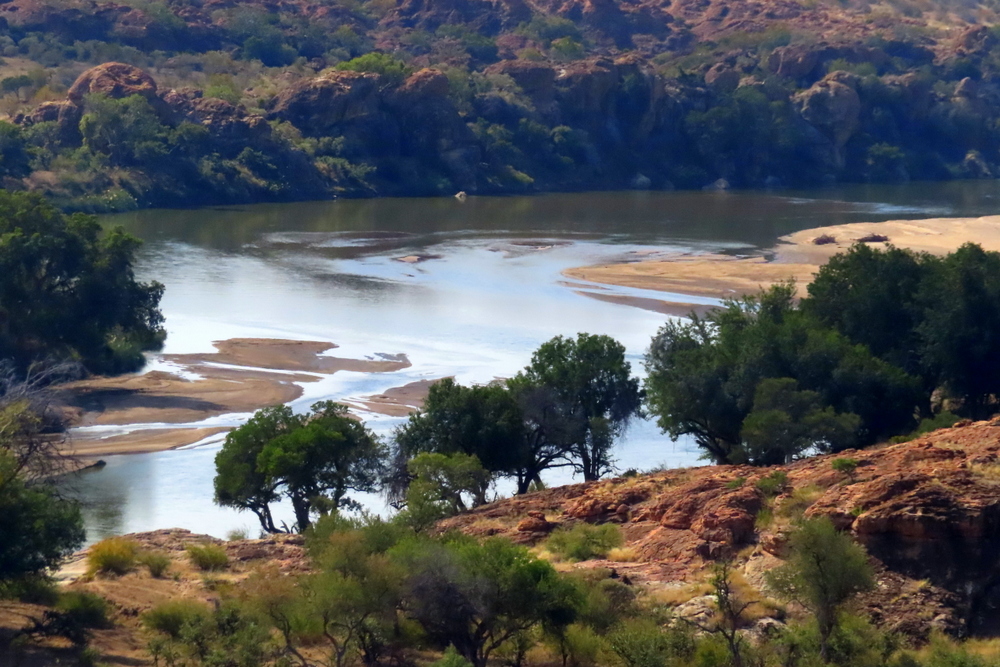
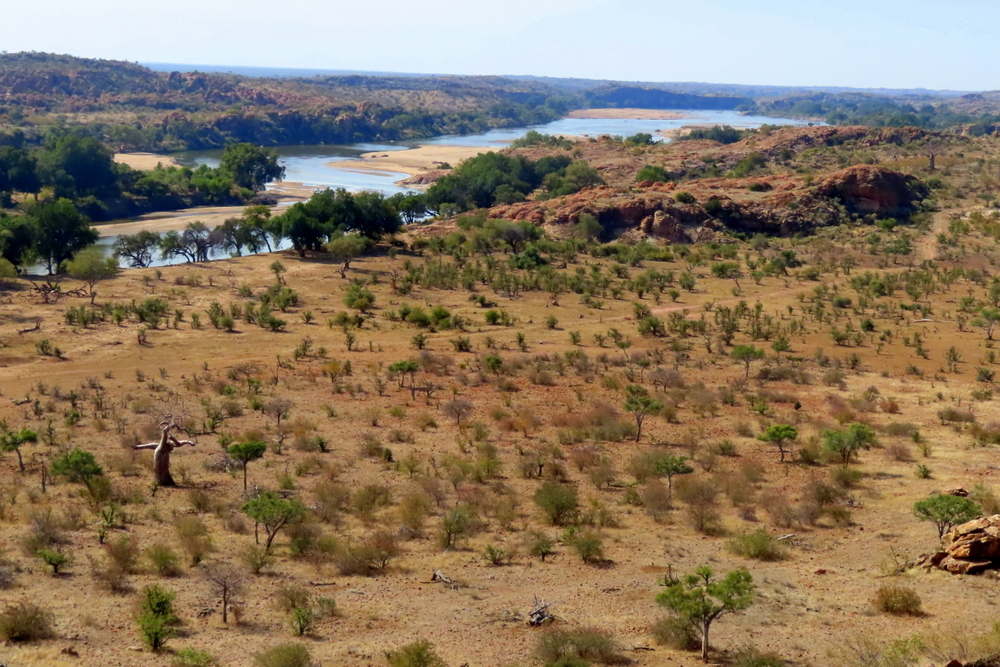
It is a dramatic view in every sense. Directly below the hilltop viewpoint (once an old army base), on which I now stand, the wide-banked, sand-filled Shashe river has its confluence with the legendary Limpopo River, immortalised by Rudyard Kipling in one of his Just So Stories, The Elephant’s Child. In making this union, the two rivers provide a meeting point for the three countries that have provided me with a home, ingrained themselves in my soul and helped shape my life – Zimbabwe, South Africa and Botswana. From there, the now enlarged river runs eastwards through a series of hills and plains, broadening out in places, and narrowing in others. Behind and to the south of me, the land stretches back into the blue haze of the distant ramparts of the Soutspanberg mountain range.
Confluence of Shasdhe and Limpopo Rivers.
Having paid my nostalgic dues, I make my way back to the car. Overhead a Martial Eagle soars – a huge, unmistakable bird even to the naked eye. The leisure of its circles seems to express a total assurance in its power and domination of the amazing landscape below.
For we are in the heart of Africa.
I fell in love with Mapungubwe the first time I went there. I have always had an interest in archaeology and knew something about the region’s history. I knew that it was home to an important early Southern African kingdom whose trade links stretched to the shores of the Indian Ocean and beyond. I knew that one of South Africa’s most iconic archaeological artefacts – a gold rhino – had been found there. I knew that, for reasons that are still not entirely clear (climate change, exhaustion of resources?), it eventually fell into decline and was supplanted in importance by Great Zimbabwe.
Nothing, however, prepared me for reality.
Situated in the extreme north-west of the country Mapungubwe is a strange but fascinating place where everything seems for me infused with a mysterious significance. Each rock and feature and tree exudes its own peculiar energy. In this magnificent theatre of nature, you can still feel something of the ancient spirit of the continent.
A magnificent theatre of nature…
Each time I return – and I have now done so many times – I feel the same stirring of the soul and quickening of the senses. On this trip, I had an added reason for being glad to be back. My sister, who lives in Mpumalanga, had organised a reunion of the four siblings who live in South Africa. Given our mutual love of landscape (three of us are artists, the other a social anthropologist) – and in particular the bushveld – it was the perfect place for such a gathering of the clan.
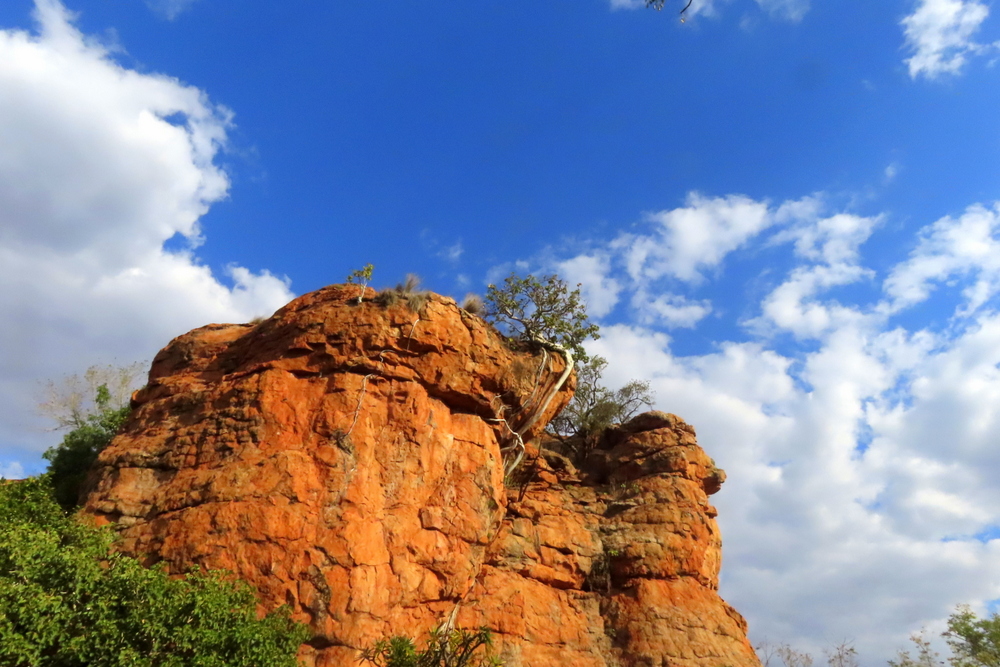
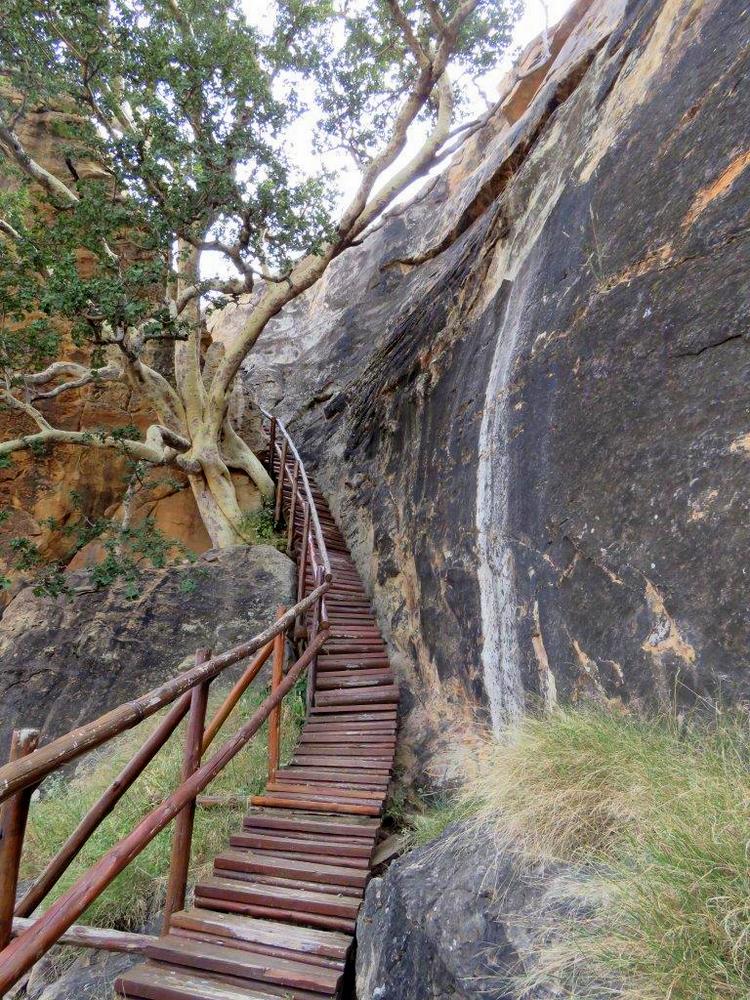
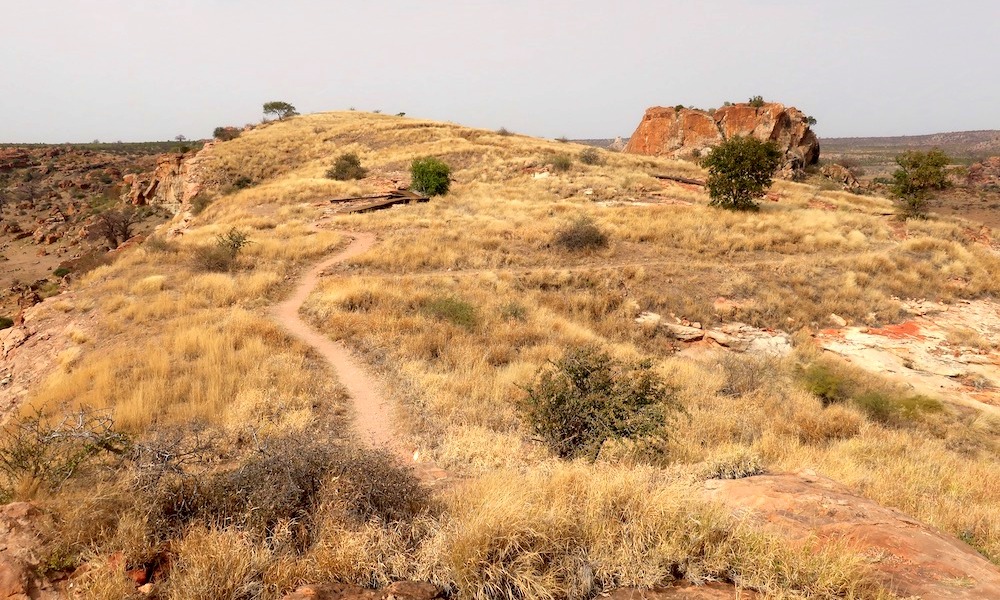
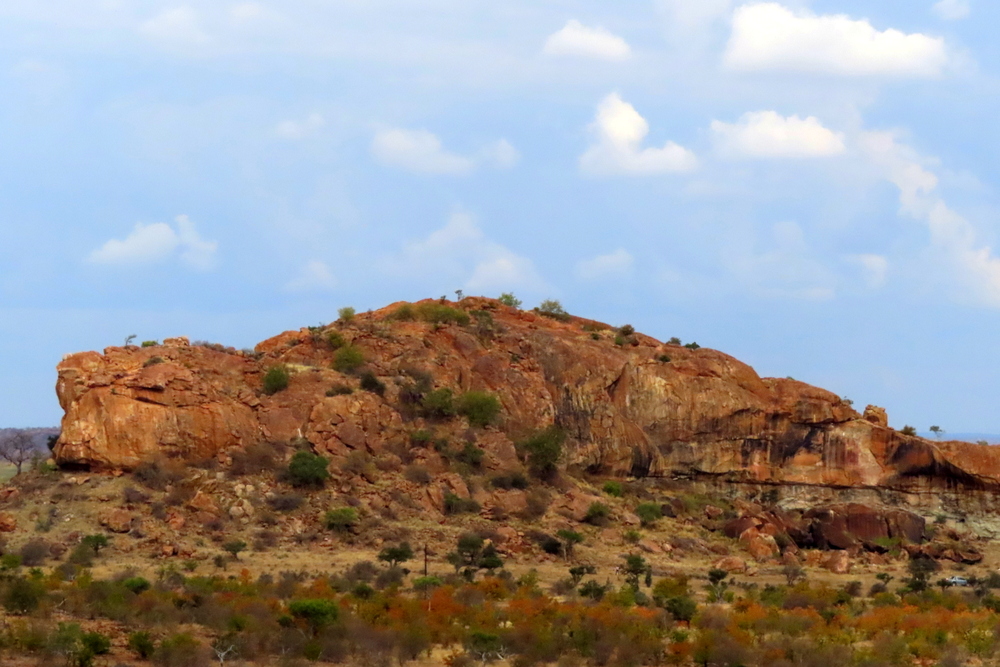
Much of Mapungubwe’s magic stems from its convergence of habitats, geology and especially its dramatic red sandstone scenery – the rocks which glow like hot embers in the early morning and when the sun sets, only adding to its mythical, otherworldly feel. Stunted mopane dominates much of the landscape. From the Main Entrance Gate, the road passes through a tumbled landscape of heavily eroded and deeply gouged hills. Ghostly Large-Leafed Rock Figs (Ficus abutilfolia) curl around the rocks and send their enormous white roots shooting down through the fissures (hence their other name – rock-splitter figs). Further down, the scuffed and sparse terrain of the hillier parts gives way to rich and luxurious trees that grow along the Limpopo flood plain.
The LimpopoRocks with Large-leafed Rock Figs
It was here, between 900 and 1300AD, that the kingdom of Mapungubwe was established by Bantu-speaking people who had moved down from the north. It is now widely accepted as being southern Africa’s first state. At its heart was a large sandstone hill, flat-topped and kidney-shaped, with steep cliffs on all sides. Its summit was the exclusive abode of royalty with the commoners living in the surrounding low-lying land. According to Mike Main and Tom Huffman, in their book Palaces of Stone, this separation marked a “dramatic change from traditional ways…now the elite was no longer part of the commoners but physically separated from them”
I had hoped to climb the hill but because I was still recovering from a bout of flu which had badly affected my breathing, I decided not to risk I because of the steep climb involved – although the others did.
Mapungubwe Hill. Pic courtesy of Nicky Rosselli.The climb. Pic courtesy of Nicky RosselliSummit of Mapungubwe Hill. Pic courtesy of Sally ScottView from summit of Mapungubwe Hill. Pic courtesy of Sally Scott
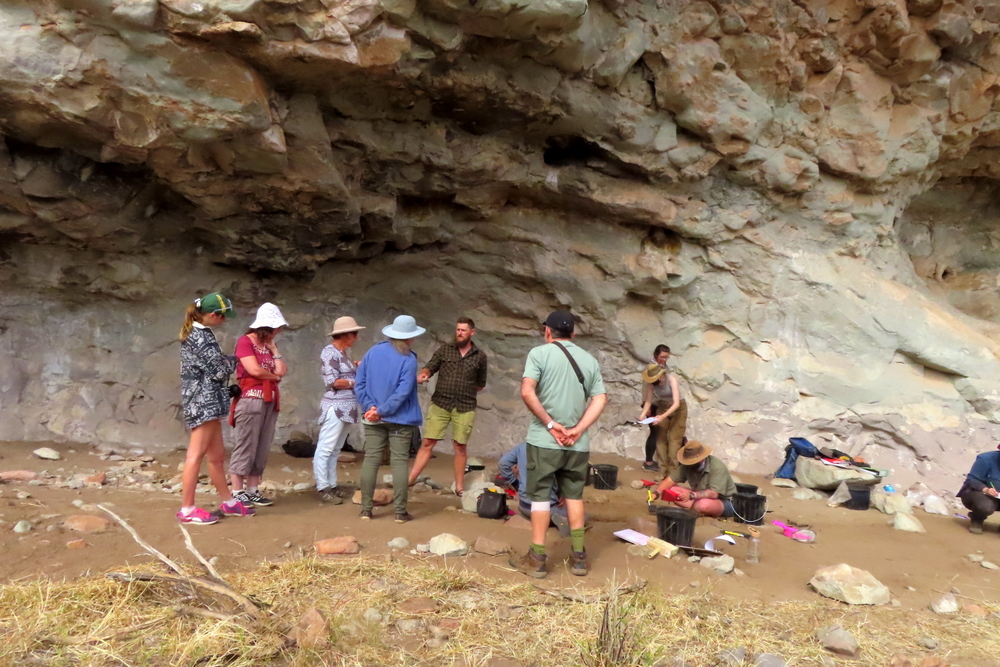
Fortunately, my sister had also arranged for us to visit an archaeological dig at an old settlement, that was being supervised by one of her university colleagues, to the south of the Mapungubwe complex. We set off for it the next morning.
To get there, we drove down a rough dirt track crisscrossed with game and elephant tracks and surrounded by a sea of mopane trees out of which rose balancing rocks and oddly-shaped sandstone islands. I saw one that looked like a fossilised terrapin, another that resembled a crocodile and a third which looked like it had swallowed a large fish which now lay there, entombed until the very end of time. Even though it was still mid-winter I could feel a steady thickening of the heat. In front of us, the clouds were piling up like castles in the sky. A great baobab thrust itself up from the earth in front of us, dwarfing all the surrounding trees.
One which looked like a terrapin…
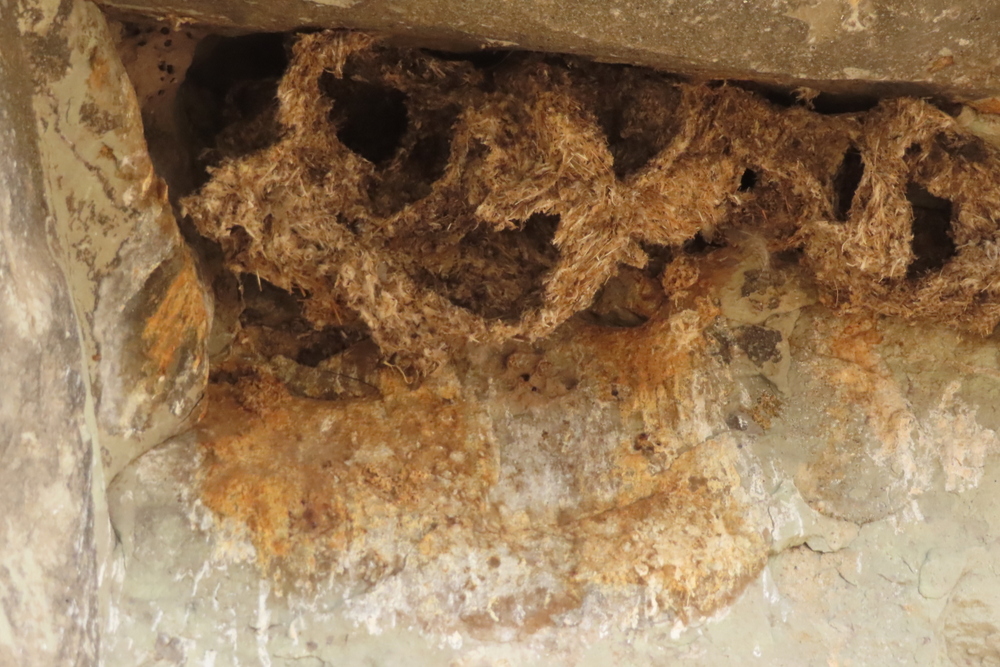
Nestled at the base of a long ridge of stone, entirely hidden from the world, lay the site where a now-vanished people had left their traces in the patches of dry stone walling, clay-lined huts, grain bins and shards of fired pottery. There was evidence of a more recent occupation. For want of decent clay, the swallows that nest under its arch had constructed their nests out of what appeared to be elephant dung.
Watching the team of students laboriously sifting through the sand while keeping an eye out for something which might reveal a tell-tale clue about the past, I got a real whiff of history, a tentative and somewhat blurry outline of how this area must once have been.
The dig A bit of stone walling where a hut once stood
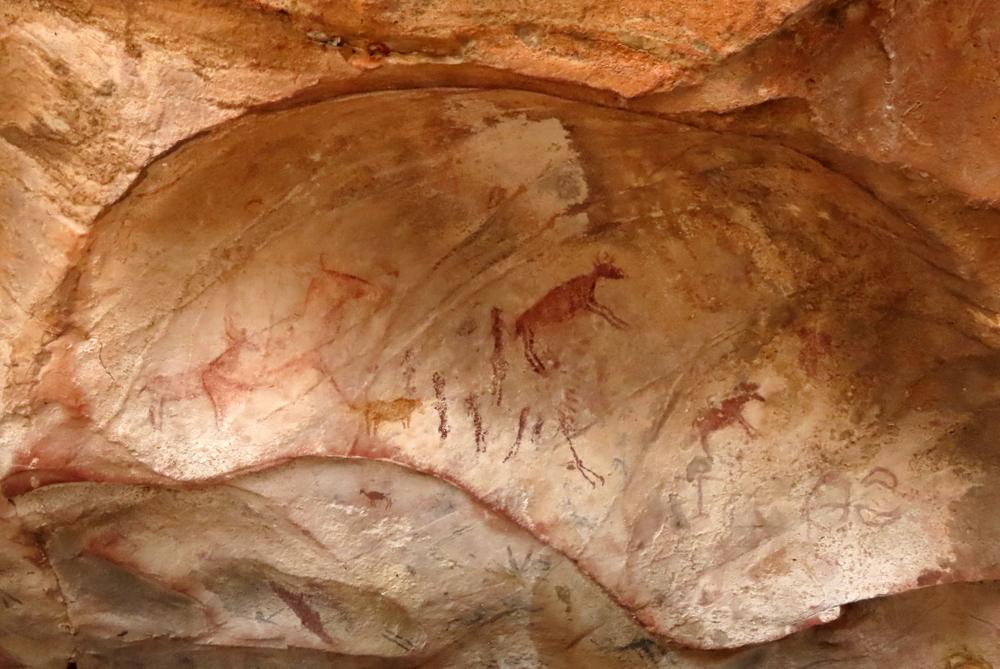
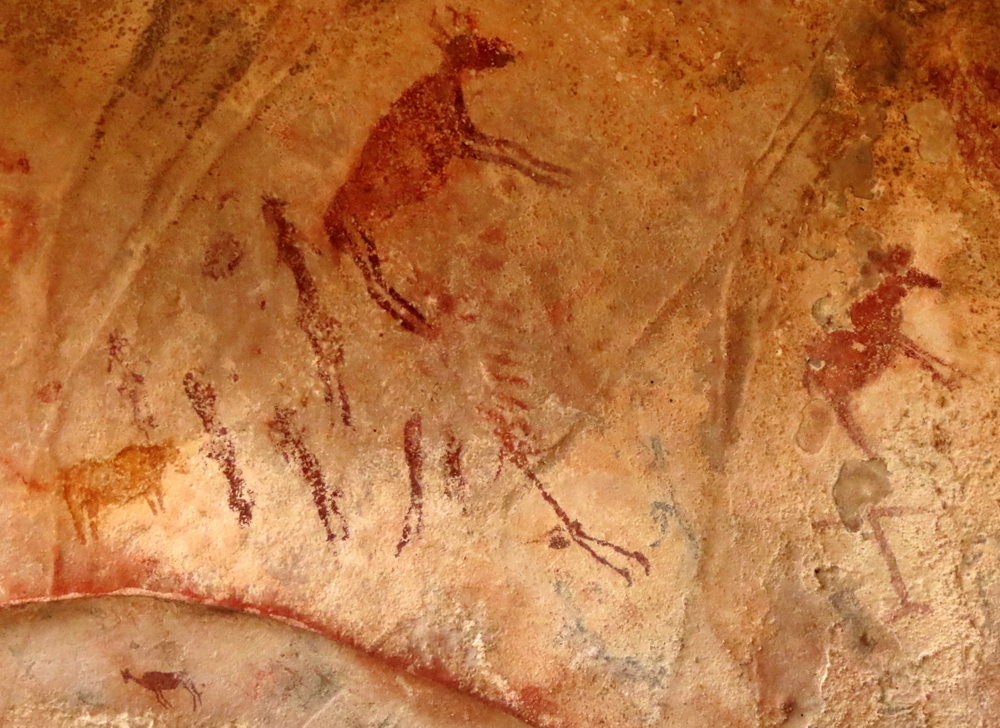
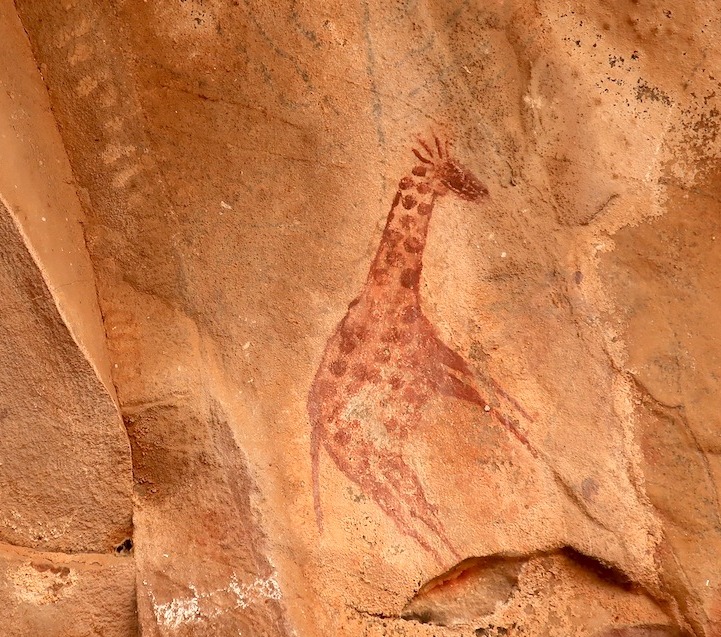
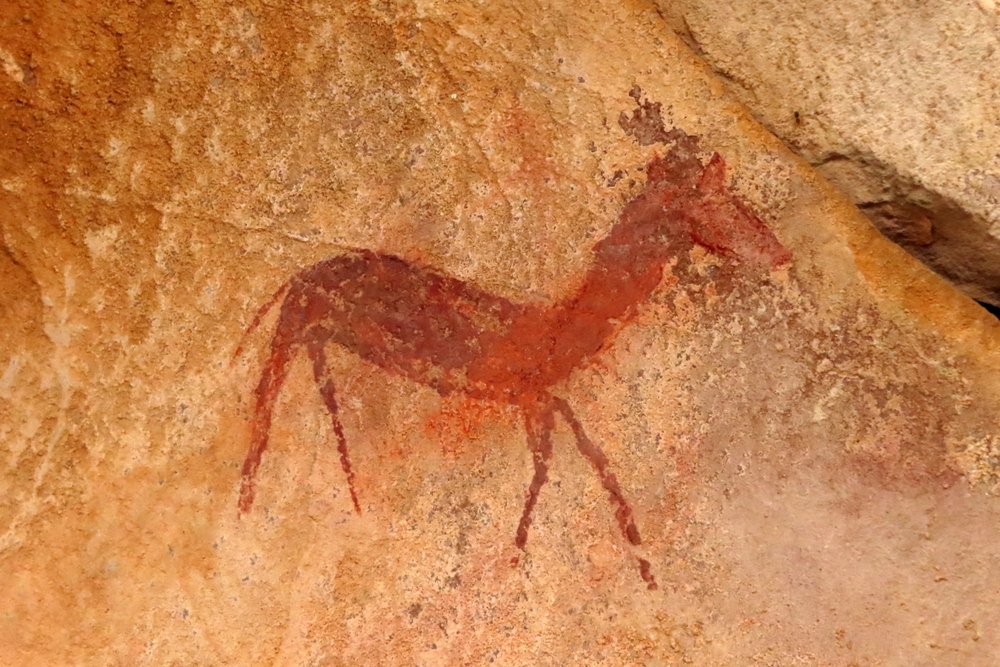
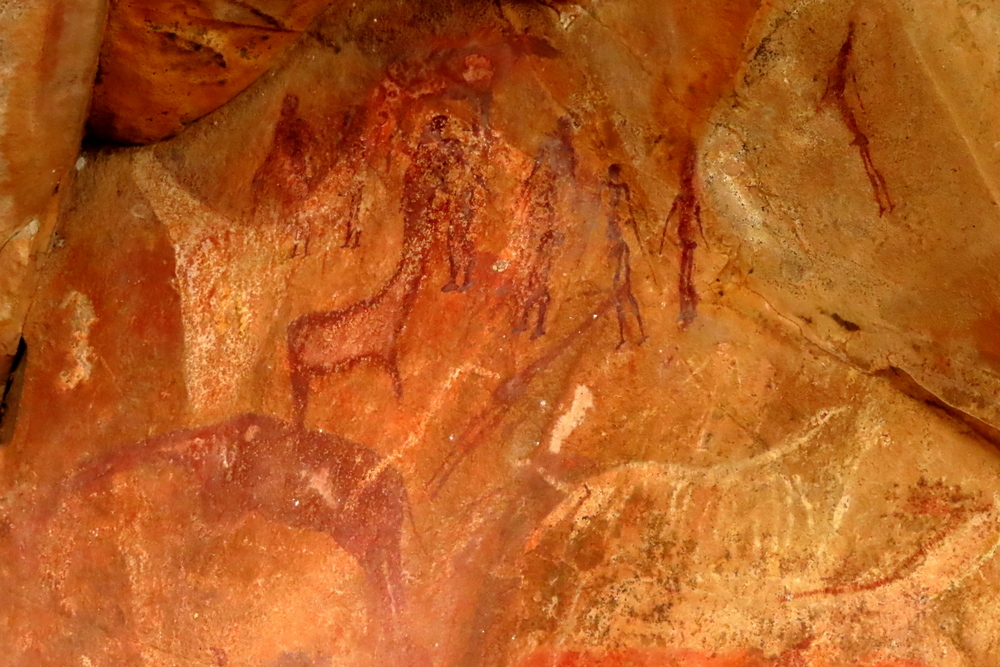
The original inhabitants of South Africa were, of course, the San who had travelled and hunted in this valley in small nomadic bands since time immemorial. Their cultural presence is conserved in the many cave paintings that lie scattered throughout southern Africa. Not far from the dig lies a boulder-strewn canyon which contains some wonderful samples of their rock art.
Kaoxa’s Shelter. San rock art site
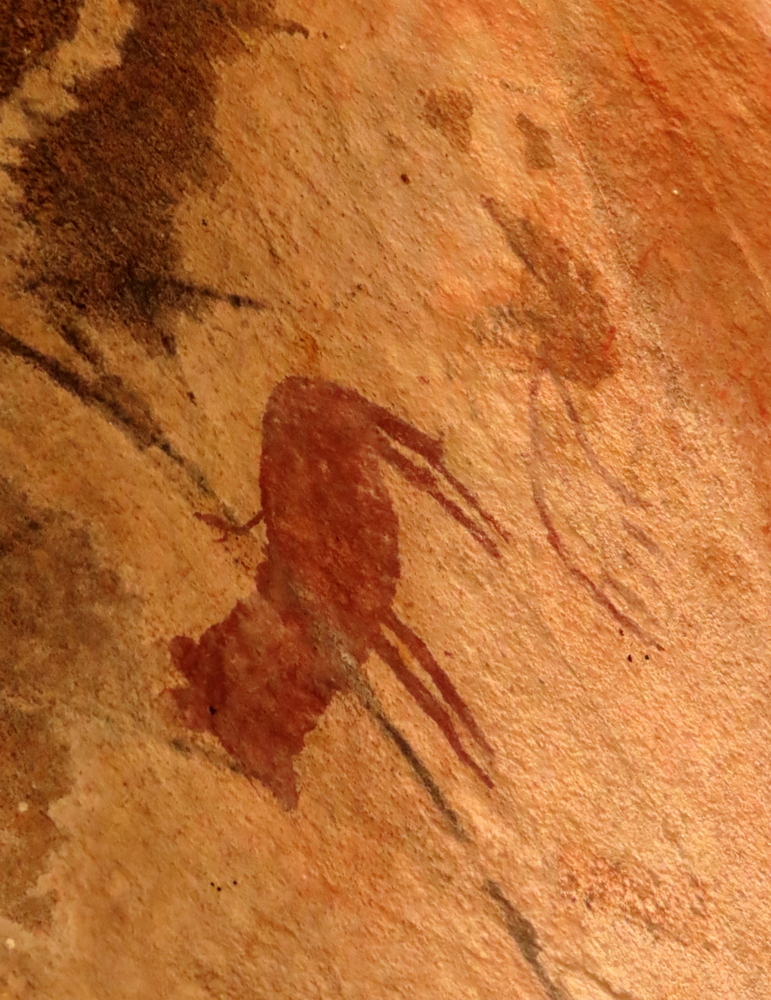
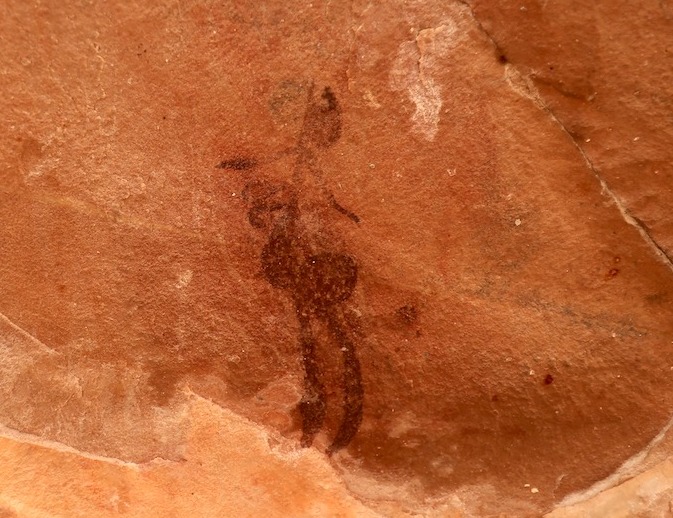
A hot climb bought us to the ledge under the overhang, also well hidden from the rest of the world, where the paintings are. We stood before them in a line, awed by the artistry. Painted mostly in red ochre, the site contains images of 16 species of animal among its roughly 200 images including rare depictions of locusts, mongoose, spring hare and a hippopotamus. Alive to the constant movements of nature, spirits and human moods, others show supernaturally potent animals and various ritual activities. Some of the paintings are believed to be thousands of years old.
San rock art. Kaoxa’s Shelter.
It would be interesting to know how the San reacted to having to share their ancestral ground and what sort of dealings they had with the Bantu-speaking people, one of whose old settlements we had just visited. A fundamental continuity would, presumably, have been the hunting of wild animals although the introduction of cattle into this habitat might well have provided a point of friction, as they competed for valuable grazing. There is some evidence to suggest that the new settlers regarded the San as powerful rain-makers and made use of these skills. In a low rainfall area such as this, it must have been a useful talent to possess.
Hopefully, further archaeological investigation will reveal more about this
What is beyond doubt, however, is that when the first Europeans arrived in Africa they regarded the diminutive race in a very negative light The concept of private property lay outside the world of the San and this, alone, would be enough to condemn them in the eyes of the Europeans, with their clear notions of orderly land use and rational planning. Nor did their mobile lifestyle fit in with European ideas. There were inevitable clashes and confrontations while the “primitive” San’s apparently haphazard and wasteful ways provided justification to stereotype them as ‘savages’ and drive them out and, in other instances, exterminate them. The treatment of the San provides one of the most shameful footnotes to South African history.
After visiting the cave, I clambered breathlessly up a large nearby boulder-topped kopje that provided a stunning view over the surrounding hills which included several other important archaeological sites – Leokwe Hill, K2, Little Muck – and tried to imagine the landscape as it must once have been when this was still a relatively well-inhabited area.
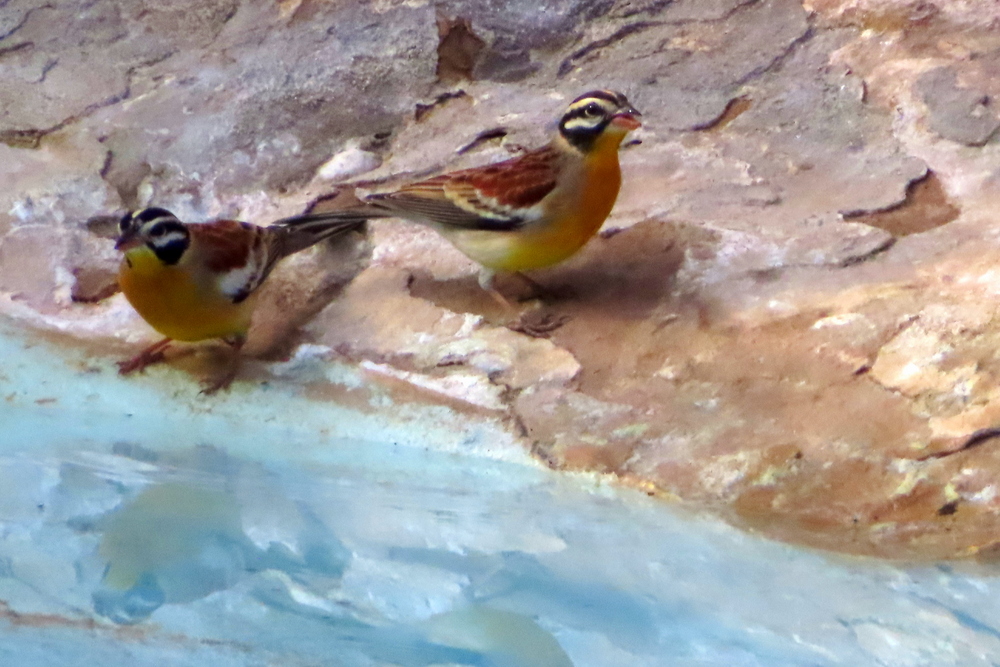
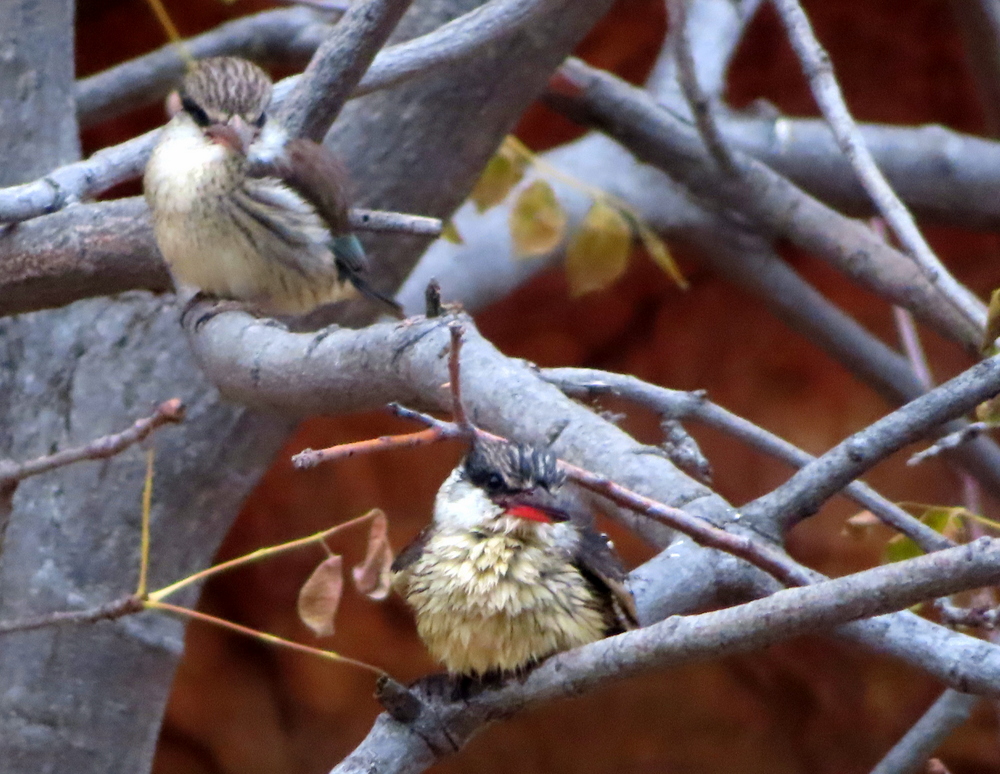
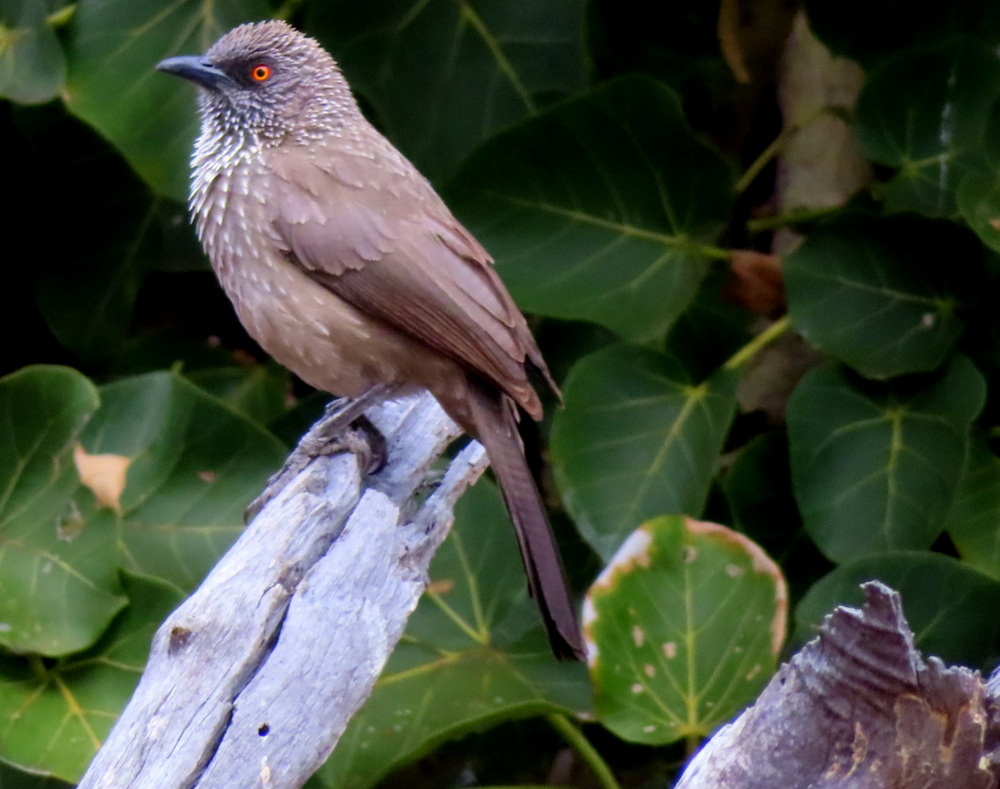
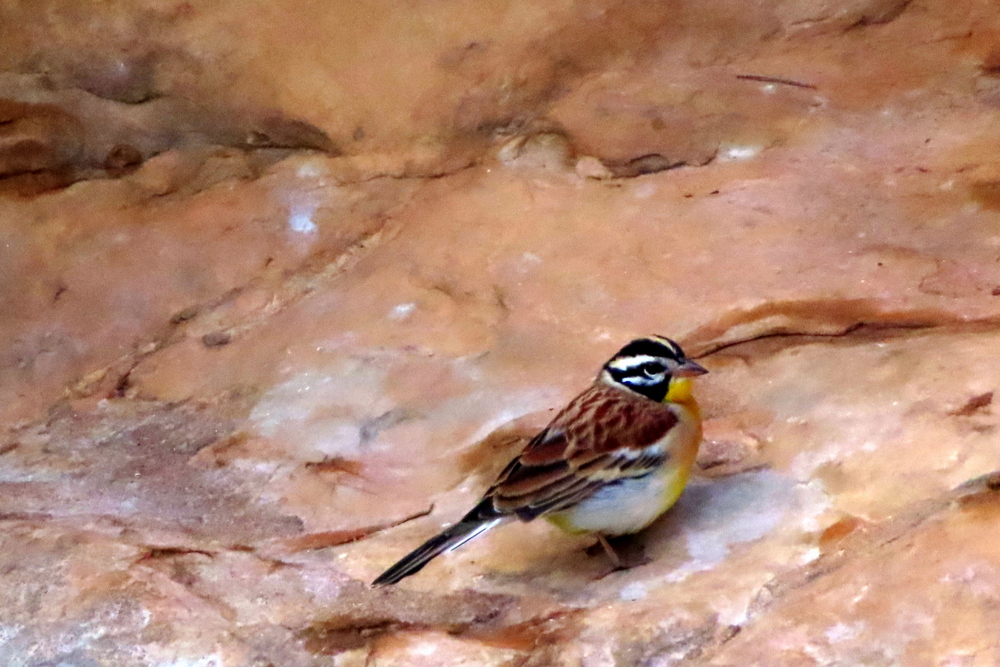
Then, I did what any sensible twitcher would do in such a situation. I went in search of birds – for Mapungubwe – situated at an environmental crossroad where any bird could turn up -is just as good a place for birding as it is for its cultural history. Although we arrived in winter when all the migrants were away there is still plenty to see. For a start, there are the dry-land specials you don’t get in my neck of the woods – Pied Babbler, Cut-throat Finch, Great Sparrow, White-browed Sparrow-Weaver, Red-billed Buffalo-Weaver, and Chestnut-backed and Grey-backed Sparrow-Lark. In the riverine forest and along the water line you get unusual species such as White-crowned Plover, Maeve’s Starling and – most eagerly sought after of all – the Pel’s Fishing Owl, as well as several predominantly Zimbabwean birds whose territory extends just across the river into South Africa (Tropical Boubou, Meyer’s Parrot, Senegal Coucal and Three-banded Courser – I have seen this relatively uncommon bird twice in the park). This is also great bunting country. Our lodge supported a huge flock of Golden-breasted Buntings who gathered at the swimming pool to drink each morning and evening along with an assortment of doves, Mocking Cliff Chat, Arrow-marked Babbler, Glossy Starling, Striped Kingfisher, Red-headed Weaver, Lesser-masked Weaver, Dark-capped Bulbul and a family of squirrels. Strangely enough, there was also a resident Klaas Cuckoo. It had obviously decided not to join the annual migration northwards (unlike other Cuckoos some Klaas Cuckoos do overwinter).
There was more to be discovered. The next day, I came across both a Red-crested Korhaan and a Kori Bustard, the largest flying bird in the world. In the Western section of the park (Mapungubwe is split into two) a solitary African Hawk Eagle sailed overhead, followed, a bit later, by a flock of White-backed Vultures looking for suitable thermals to take them up still higher into the heavens where it would be easier to spot recent kills. On the drive home, an African Hoopoe floated alongside us. I am always pleased to see them – they are considered to be good omens in some societies, messengers from the gods. I can believe that.
And then there are the animals. Because of its arid climate, Mapungubwe doesn’t support the density of population you get in wetter parks, like Kruger, but they are there to be found if you look for them. As you drive through the park, the heads of giraffes can be spotted. gently swaying above the tree tops, pausing every now and again to nibble on the leaves. A sudden cloud of dust might indicate the direction a herd of Zebra had taken after being spooked by some phantom in the shadows.
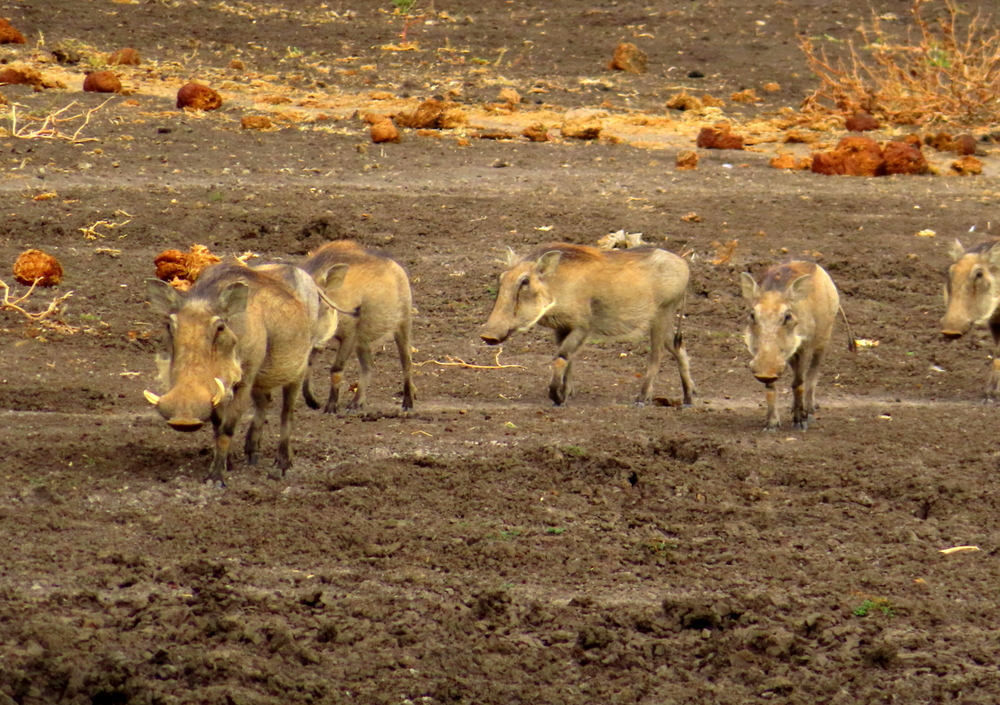
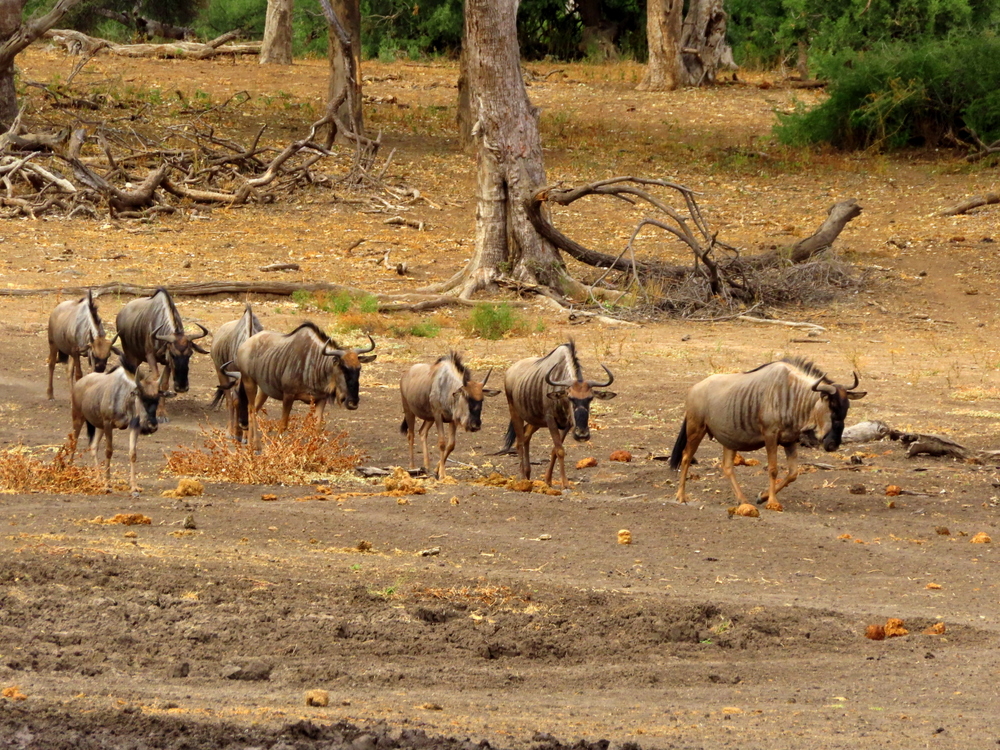
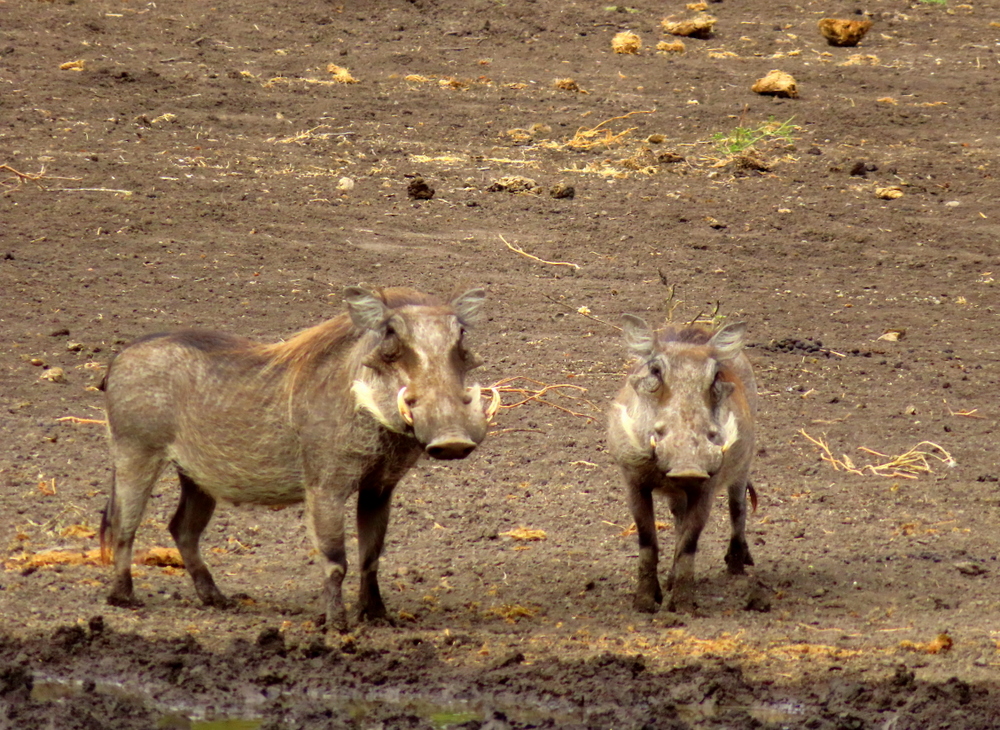
At the Maloutswa Hide, we watched a group of warthogs trotting in file down to the water’s edge, followed shortly afterwards by another family. Having checked to ensure there were no predators lurking around, a herd of Wildebeest joined them.
A family of Warthogs.Wildebeest
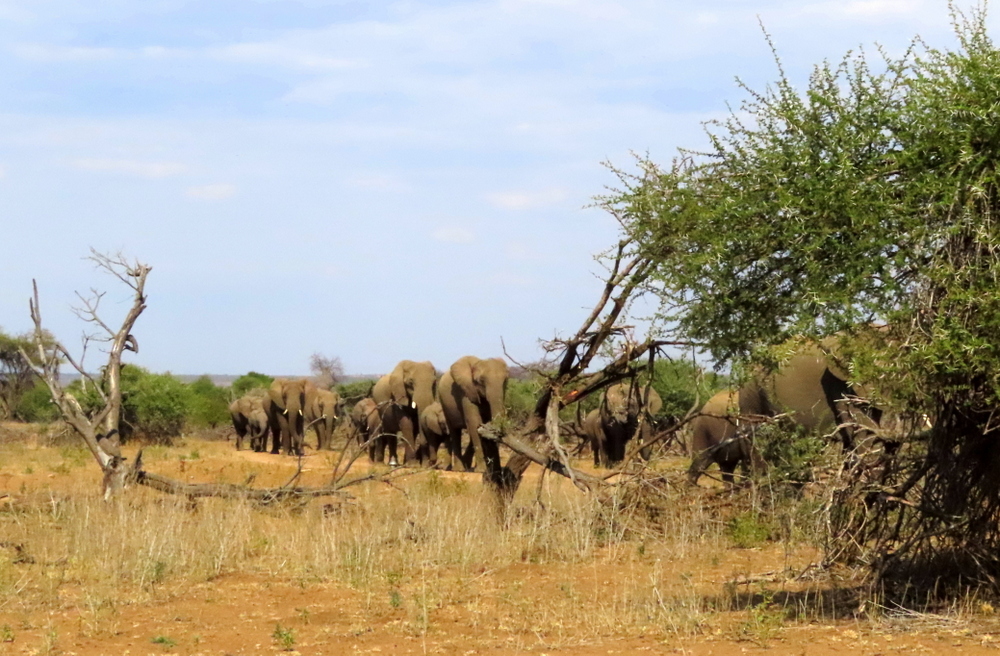
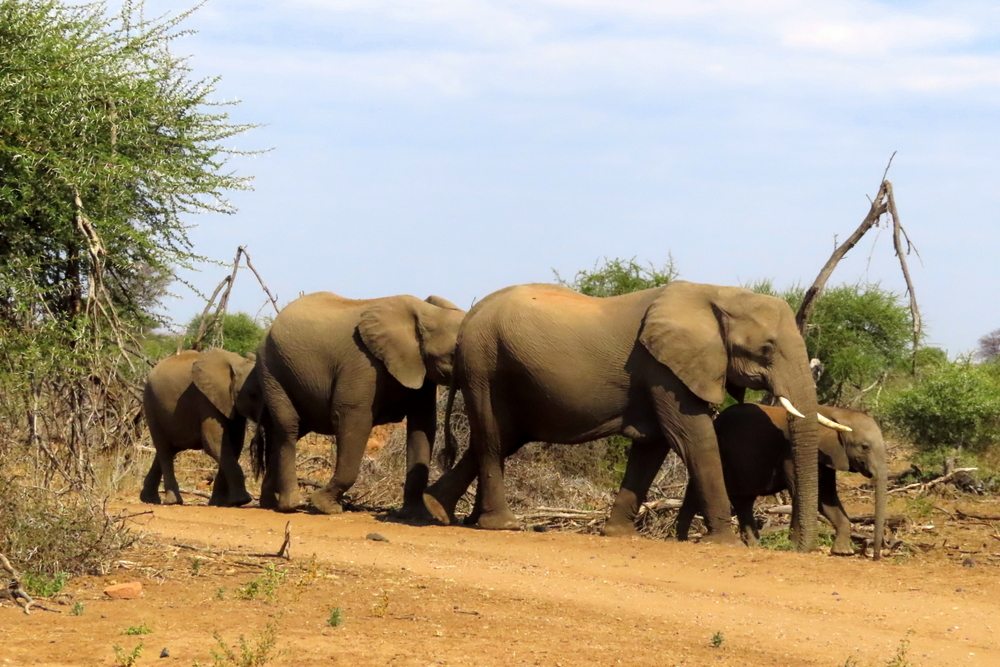
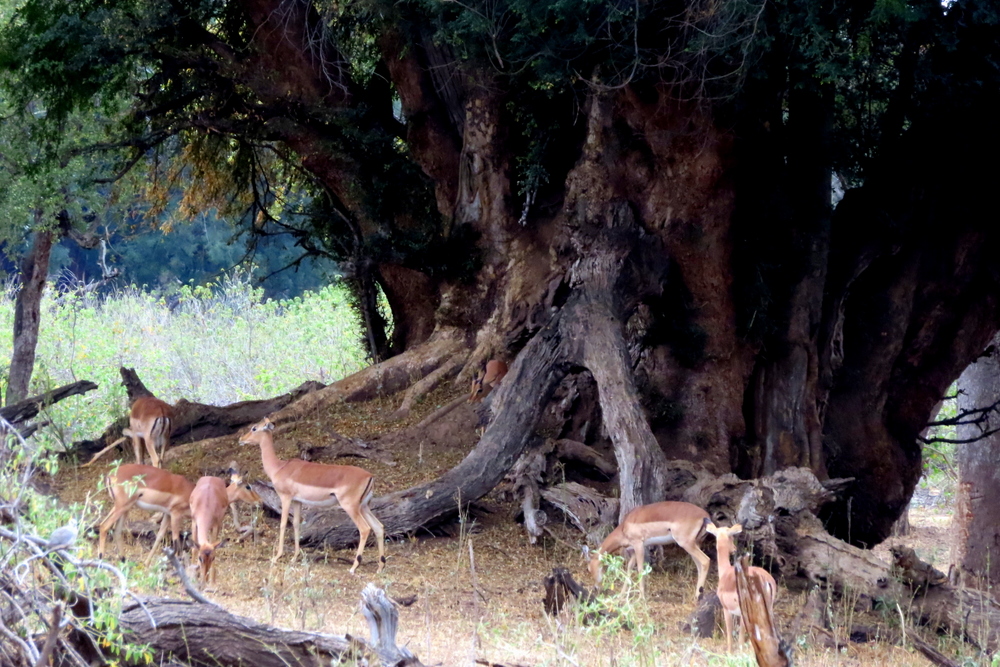
Heading from the hide towards the Mazhou campsite, which lies alongside the Limpopo, we were greeted by a great company of elephants coming out of the woodland. They paid not the slightest heed to our presence as we sat in the car watching their slow-stepping mass crossing the road in front of us, heading towards the denser bush that demarcated the course of the river. The largest cows were on the outer flanks and the bulls and young calves scattered in between. Closer to the river, impala, bright rust red in the falling light, frolicked and scampered over the roots of the massive Nyala Berry trees that are a common feature of the flood plain on which the nearby campsite has been built…
A great company of elephants…
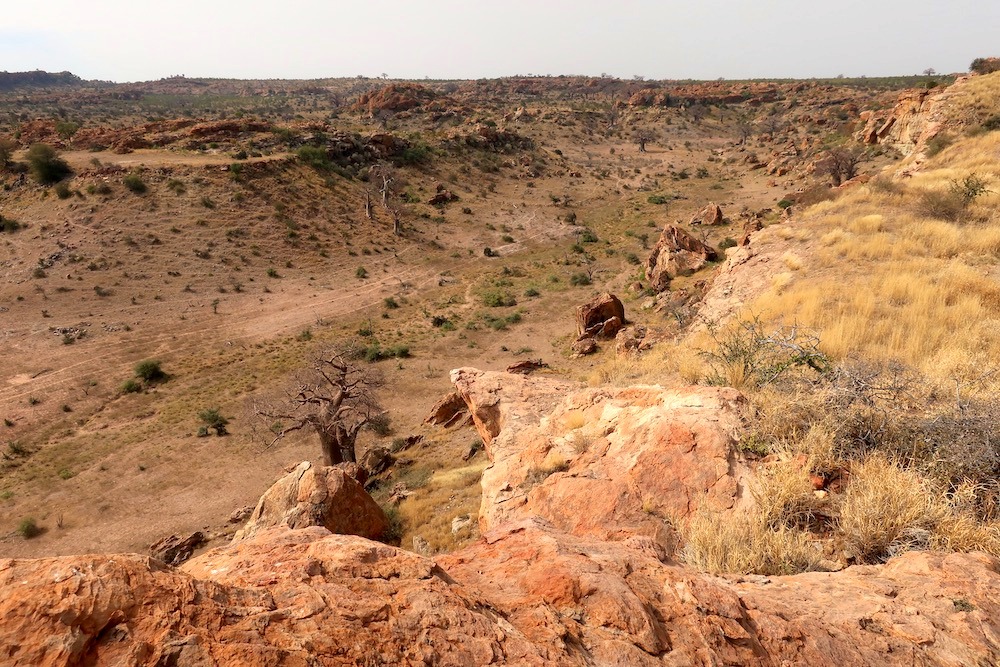
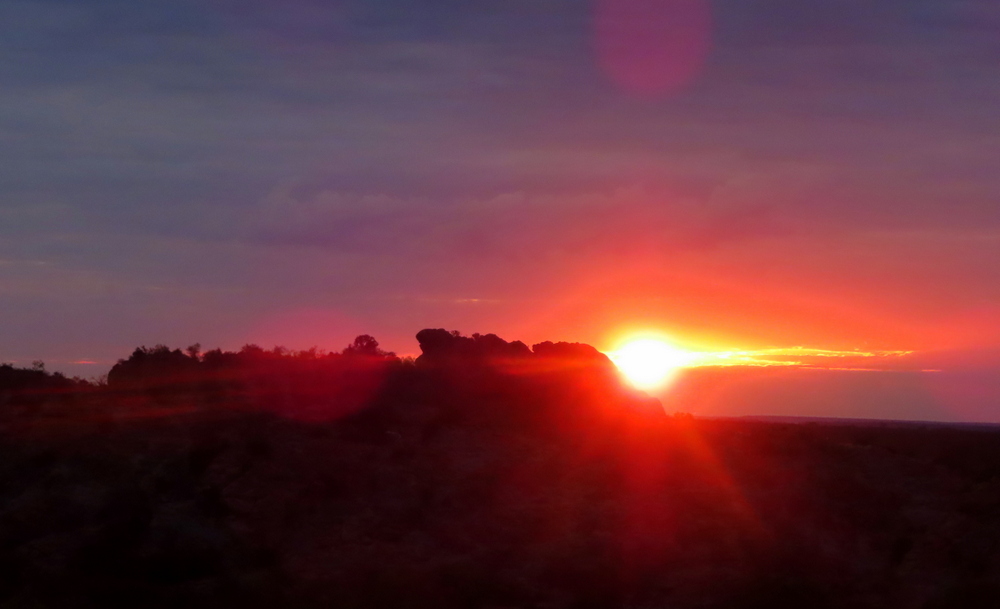
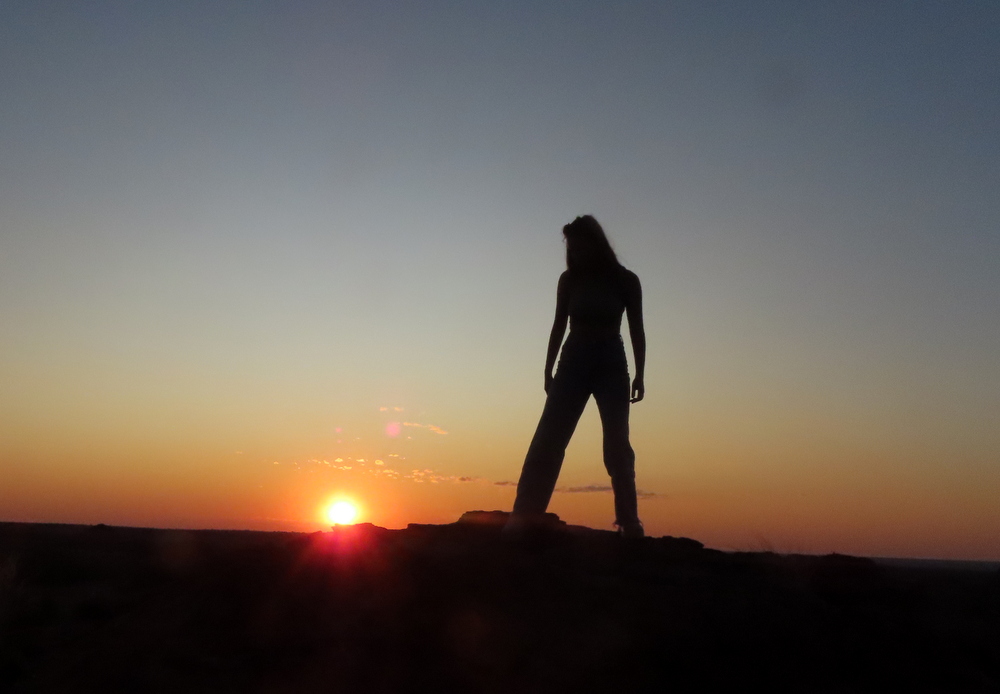
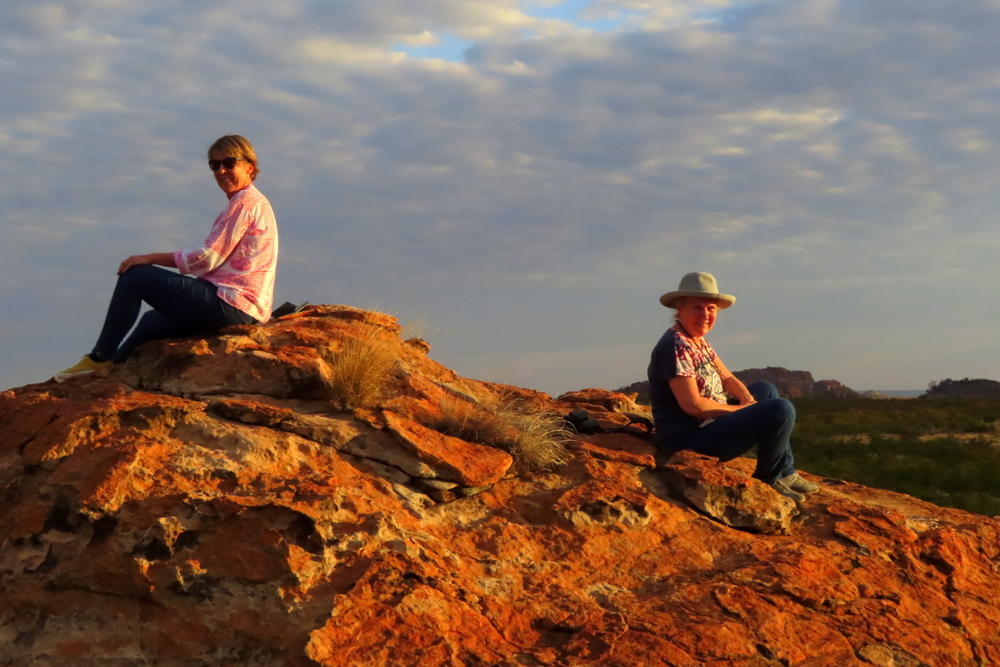
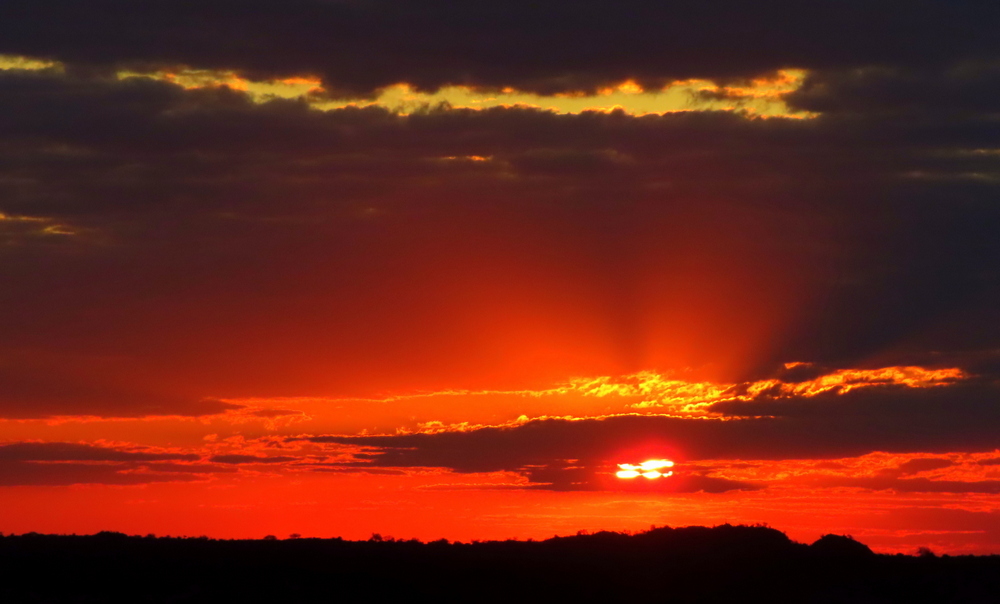
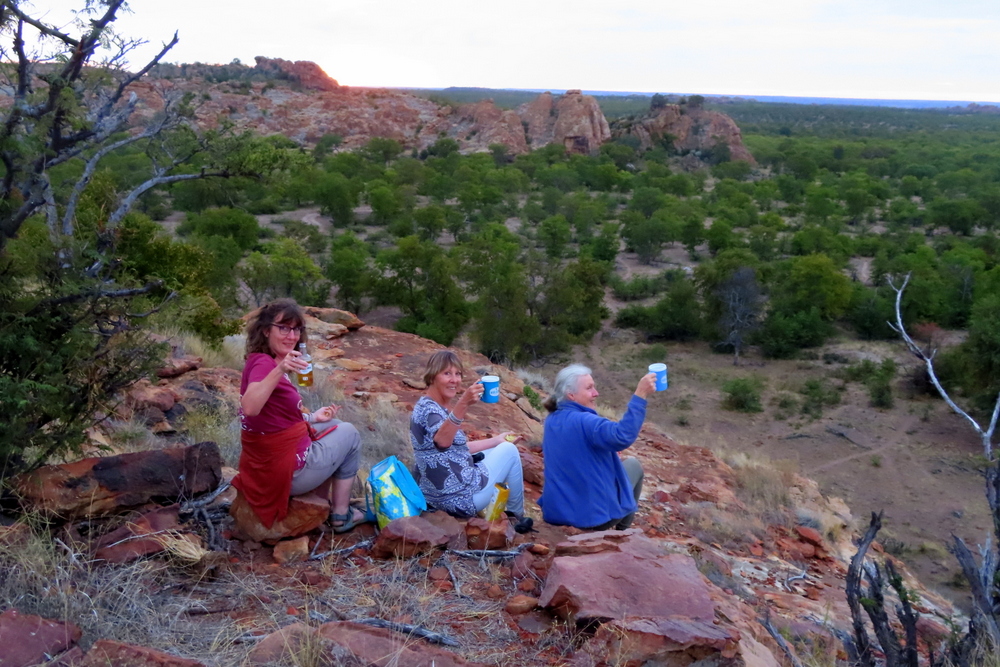
On our final night, my three sisters and I put some drinks in a cool box and drove to a viewpoint, on the crest of a stony ridge, to watch the sun go down over a labyrinth chaos of rock. Apart from the sudden trumpeting of an elephant, somewhere down in the valley below, the magnificent scene that greeted was intimate and peaceful. There seemed no limit to our vision. As it sank through the thin layer of cloud and over a line of jagged hills directly in front of us the dying sun put on a spectacular light show. Except for the birds and animals, it felt like we were all alone in this mythical kingdom. When the air grew cold we came down off the rocks. Although the sun had departed an enormous full moon was shining overhead lighting up the random boulders and ground around us.
Sunset over Mapungubwe.
I looked and listened, felt the air, and wondered if there is an evolutionary explanation for the deep sense of affinity I feel for this place. Our past is composed of images, experiences, and memories. I knew that someplace around here my ancestors (including my grandmother, then a very young child) crossed the Limpopo by ox wagon on their arduous trek * up to Gazaland in the old Rhodesia. Could this provide another connection?
I was still thinking about all this when we got back into our car and headed home through the dusk…
*Footnote: The wagon train was held up in Macloutsie, on the other side of the river, by foot and mouth disease and many of their cattle became so weak they were devoured alive by the hyaena that prowled around the camp. Thomas Moodie (or “Groot Tom” as he was known) the leader of the trek and brother of my great grandmother, died of blackwater fever within a year of reaching his Promised Land – Melsetter in the Eastern Highlands.
GALLERY:
More Mapungubwe scenery:
Limpopo from viewpointLimpopo near Poacher’s CornerLimpopoOld SADF bunkerRock with what looks like a fish entombed in it
More San paintings:
Pic courtesy of Sally ScottPic courtesy of Sally ScottPic courtesy of Sally Scott
More Mapungubwe birds (and a butterfly and some terrapin):
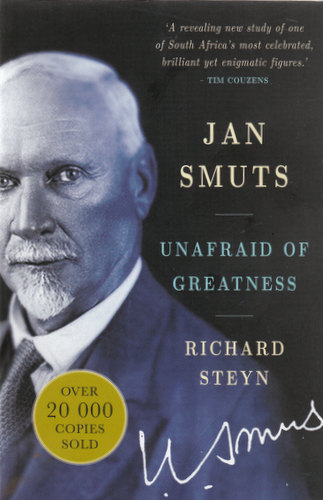
A man of great intellect and boundless drive, energy and vision, Jan Smuts’s contribution to the creation of modern South Africa has been rather glossed over in recent years probably because it doesn’t fit into the current political narrative. It is a situation which author Richard Steyn – a former editor of the Witness – sought to redress in Jan Smuts: Unafraid of Greatness. His book struck a responsive chord. Since it was first published in 2015 it has sold over 20 000 copies and has now been reissued.
Born in Riebeek West in the Western Cape in 1870, Smuts had a fierce intelligence and focus that assured success at virtually everything he turned his hand to. After a distinguished academic career, he rose to political prominence when President Paul Kruger appointed him Transvaal State Attorney at the tender age of 28. Although vastly different, the two men established a good working relationship based on mutual respect for one another. As a guerilla leader, fighting against the English in the Anglo-Boer War, he displayed great physical bravery and a good grasp of tactics even though he had not trained as a soldier.
At the end of the war, believing the best way forward was to attempt to reconcile Boer and British interests, Smuts would play an instrumental role in the formation of the Union of South Africa.
At the outbreak of the First World War, Smuts returned to his role as a military leader helping to drive the Germans out of South West Africa and then taking part in the East African campaign. Lionised abroad for his achievements, he would go on to become an adviser to numerous leaders and heads of state and served in the British War Cabinet.
At the end of hostilities, Smuts, almost alone among Allied leaders, argued that it was a mistake to place a crippling burden on defeated Germany because he believed it would ultimately backfire. In this, he would be proved correct. Adolph Hitler would later exploit this sense of grievance.
After becoming Prime Minister, he lead South Africa into the Second World War as part of a pro-Interventionist group, further alienating himself from large sections of the Afrikaans community. The British Prime Minister, Winston Churchill made full use of his talents, however, and he became both his trusted confidant and adviser. More than any other Commonwealth leader Smuts commanded Churchill’s respect and affection in part, no doubt because he appeared to share the British world view.
The massive disruption and carnage caused by both wars had a profound effect on Smuts. Believing that the world could not carry on like this he set out to transform the whole international scene by advocating the establishment of the League of Nations which later morphed into the United Nations.. In many ways, it was an impossible ideal but it initiated something we are still trying to do: put the pieces back together.
Like Thabo Mbeki, much later, Smuts enjoyed far greater fame and prestige overseas than he did back home where he remained a divisive figure despite his best efforts to unify the nation. Failing to read the mood of the country, he was eventually defeated at the polls in 1948 by the more hard-line, pro-segregationist National Party who took over the reins of power. It was the end of an era.
In charting his astonishing career, Steyn does an excellent job in rescuing Smuts and restoring him to his rightful place in history. Although largely admiring of the man’s achievements, he does not spare us his failings: he could be aloof and high-handed, paternalistic and patronising. Although far-sighted in other matters, he never really got to grips or acted decisively on the race issue
Deeply researched, but light of touch and rich in insight, Steyn succeeds in performing one of the main duties of a historian (and a journalist for that matter): he provides a highly readable narrative.
Published by Jonathan Ball
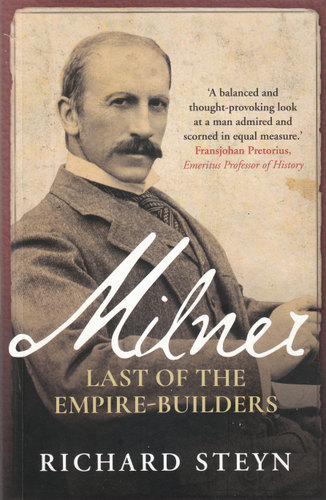
As Governor of the Cape and High Commissioner of South Africa, Alfred Milner was a man who cast a long shadow and it is largely as a result of his, often devious, machinations that the country came to exist in its current form.
Having already written several acclaimed books on the era, including one on Louis Botha as well as the recently re-released Jan Smuts: Man of Greatness, Richard Steyn – a previous editor of the Witness – is the ideal candidate to resuscitate and re-examine Milner’s contribution and place in history. While researching and writing his recent series of books, Steyn has acquired a terrific knowledge of the subject and in Milner: Last of the Empire Builders he tackles the political circumstances, the personalities and the rationale behind their actions.
Sent to South Africa to try and resolve the heightening tensions between the Boers and the Uitlanders in the Transvaal, Milner was and remains a controversial figure. Entrenched in his belief in English racial superiority he was, as some commentators have mentioned, the wrong man to handle the country’s complex, multi-layered, problems. In negotiations, he showed little concern to appease grievances or try and bridge the gap between the two camps. Driven by his messianic belief in Empire his overriding aim was to unite the whole of Southern Africa under British rule.
What seems beyond doubt is that he was ready to go to war to achieve this goal and thanks to a bit of political skulduggery on his part he achieved just this. It soon emerged, however, that he had misjudged his adversary and instead of the hoped-for quick, decisive victory what he got was a long, clumsy, chaotically fought campaign that left him a detested figure in the eyes of the Boers, for whom he never showed any real sympathy.
As a man, Milner embodied a contradiction. A brilliant scholar, he could be warm, personable and charming (although he married late he seems to have been popular with women) but when it came to his life work he could, as an imperialist ideologue, be arrogant, haughty and single-minded. Convinced of his rightness and confident in his powers of persuasion he was not easily swayed from his chosen course of action.
He was hardly exceptional in his crusading zeal. Nowadays, it has become quite commonplace to look upon Empire as a bad thing but back then a whole generation of, often very gifted, young men grew up believing themselves to be the true heirs to the Romans and considered it their duty, as Englishmen, to bring civilization to decadent or barbarian people – by whatever means necessary.
(An irreverent aside: it has been observed elsewhere that the rise and fall of the British Empire coincided with that of the British moustache so it is interesting to see that most of the main protagonists in this book – Milner, Lord Roberts, Kitchener – all sported very fine examples of these).
After he left South Africa, Milner’s vision of a unified South Africa was partly realised by the group of carefully selected young administrators he left behind him – his Kindergarten as they came to be known. Back in England, he remained a prominent and respected public figure although not without his detractors. Steyn makes a convincing case that, as War Secretary in Lloyd George’s five-man War Cabinet, he played an instrumental role in shaping an Allied victory. In so doing, he not only cemented his legacy but partly redeemed himself for whatever damage he may have done to his reputation in his often high-handed handling of the South African crisis.
In writing about his achievements, Steyn has found a single life that illuminates a dark chapter. For any biographer, it is a fascinating story but the author is exceptional in bringing not only a thorough knowledge but also an elegant style and a gift for narrative,
In the same week that Eskom implemented yet another round of load shedding, the Msunduzi Municipality announced it had assigned a team to investigate what was suspected to be a coordinated campaign to sabotage its electricity and water infrastructure. Ongoing outages caused by a persistent lack of investment in maintenance further added to the problems, continuing to cripple an already battered local economy.
The KwaZulu-Natal Department of Economic Development, Tourism and Environmental Affairs (Edca) revealed that while 97 rhinos were poached in 2021, a startling 60 rhinos were killed between January 1 and March 25 this year. Ezemvelo KZN Wildlife blamed budget constraints for the inadequate resources to curb the scourge. Meanwhile, COGTA MEC, Sipho Hlomuka announced additional support measures – including an amount of R25 million – for the embattled Msunduzi Municipality, still struggling to address crippling electricity supply problems and growing pothole challenges.
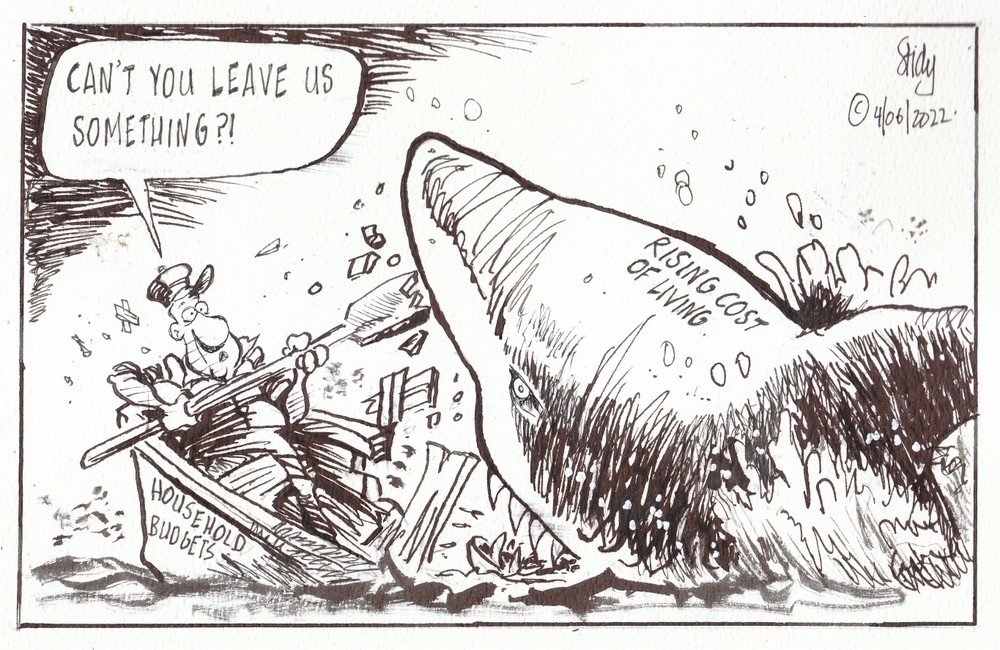
According to the latest data from the Central Energy Fund, petrol and diesel prices looked set for large increases in the first week of June. Grain prices also sky-rocketed on the back of shortage fears also brought about, in part, by the ongoing conflict in Ukraine.
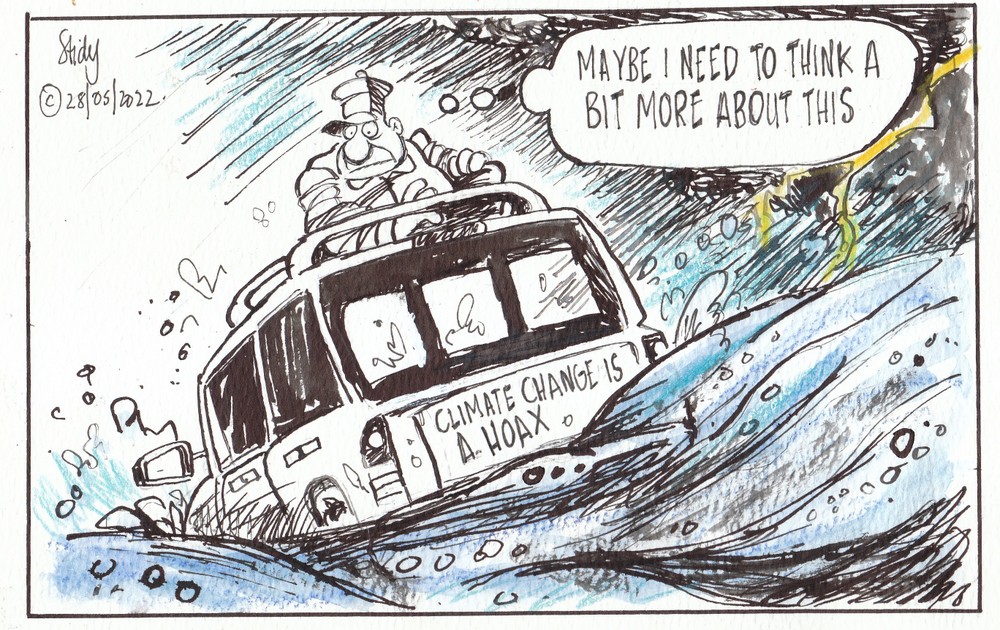
Nature’s wrath struck again as the second bout of floods damaged homes and infrastructure in parts of KwaZulu-Natal. The weekend’s heavy rains came as many of the April flood victims were still trying to rebuild their lives while others searched for their loved ones who had been washed away.
Businesses and consumers would have to tighten their belts as the recent fuel price hikes were predicted to have a devastating effect on everyone. They would also have an effect on the country’s repo rate as the government struggled to rein in rising inflation.
Questions were raised about whether President Cyril Ramaphosa was involved in criminal behaviour after former SSA director-general Arthur Fraser opened a criminal case against him. Fraser alleged that Presidential Protection Unit head Major-General Wally Rhoode and Ramaphosa were involved in a cover-up of a burglary on the president’s farm in 2020.
The public furore over the burglary of alleged millions from President Cyril Ramaphosa’s Limpopo farm just before the ANC holds it its crucial provincial conference has left his enemies in the ANC – mostly the Jacob Zuma-aligned RET faction – scenting blood. A delegation of secretaries and chairpersons from all eleven of KwaZulu-Natal’s regions immediately descended on Nkandla to confer and receive “wisdom” from the former president.
The four-and-a-half-year State Capture Enquiry finally came to an end when Chief Justice Raymond Zondo released the final part of his voluminous report. Former president Jacob Zuma, who condemned South Africa to state capture, remained the golden thread running throughout the report although Zondo also said that President Cyril Ramaphosa could have done more to lessen its grip.
It is not news that classical liberalism is under assault, across the globe, from both the political right and left. In an age when the dumbness of many plays into the hands of the scheming few it has become the convenient whipping post for populists (as well as social theorists) everywhere.
In this devastatingly reasonable critique, Francis Fukuyama lays out the case for the defence of what he prefers to call “humane liberalism” and explains why it would not be a good idea to ditch it at this point. Fundamental to his argument is that it is a doctrine of moderation, a means of governing over diversity and in its purest form it prioritises public-spiritedness, tolerance, open-mindedness and active engagement in public affairs
His belief in liberalism does not blind him to its shortcomings, past and present. As he puts it – if liberalism is to be preserved as a form of government, we need to understand the reasons it has generated opposition and criticism. As an example, Fukuyama admits that the neo-liberal policies that became dominant in the 1970s were not an unqualified success. Amongst other things, it led to excessive inequality and financial instability. As a result, life got harder for most people.
In admitting this, however, he takes issue with those critics of the system who insist that liberalism must lead inevitably to neoliberalism and an exploitive form of capitalism. He shows how, historically, liberal societies have, in many cases, been engines of economic growth, creators of new technologies, and producers of vibrant arts and culture
He also acknowledges that the checks and balances that liberal regimes place on the exercise of power prevents radical redistribution of power and wealth – but then counters that by pointing out these same checks and balances prevent autocratic abuses of power.
In taking us on this fascinating journey through the history of liberal thought, Fukuyama displays a masterly understanding of his subject and in a book that combines scholarship with readability, he proves himself to be the perfect guide. Even when dealing with the more abstruse theoretical positions, he never reveals anything but a lively and compassionate engagement with the subject matter.
Fukuyama is probably shouting across too great a gulf to win over anti-liberal nationalists and authoritarians of the Putin, Orban, Erdogan and Trump mould – to say nothing of our disgraced ex-president Jacob Zuma and his RET crowd – but in the increasingly polarised and uncertain times we live in the books release could hardly have been more timely – or pertinent.
Published by Basic Books
The constitutional guarantee of individual freedom of religion and speech lies at the very heart of Western rationalism and democracy. As developed by thinkers like Locke, Mill, Thomas Paine and others, the liberal notions that underpin it have proved the most effective antidote to tyranny and arbitrary injustice.
In the last few decades, though, it has found itself very much on the back foot. Not only has liberalism become the scapegoat of contemporary political and cultural discourse but the whole concept of Free Speech has come under increasing question and threat. The belief that it is now a moribund ideology has been given further traction by the advent of the new communication technology which has given access to those previously unheard and in the process amplified division, sown distrust, and unleashed a flood of unmediated disinformation (and hate speech) and eroded trust in public institutions.
No less a figure than Barack Obama has warned that an unrestrained internet and social media pose “the single biggest threat to our democracy”. It is a claim that is being echoed around the world by others.
The argument that free speech breaks down respect for authority is, however, one that has been used countless times before by the ruling elite and is one we still need to be very wary of according to author Jacob Mchangama. A telling reminder of just how fragile the liberal political order is, his book,Free Speech: A Global History from Socrates to Social Media, offers an admirable historical summary of how we got to our current position, the sacrifices that have been made along the way and why we should fear the forces of reaction and repression.
Although its roots go back far in time, it was the ancient Athenians, of course, who first made the right to free speech an inherent part of their political system and civic culture (although women, foreigners and slaves were specifically excluded). During the Middle Ages, it was, interestingly enough, in the Islamic world where the ideas of the Greeks were rediscovered and where a more fruitful environment existed for the cultivation and dissemination of rationalist philosophy and science. In Europe, it was a different story. For centuries the continent remained in the grip of despotic powers, such as the church, the nobility and various absolute monarchs, all of them intent on preserving their hold over their subjects and not having their authority questioned. Here and there, however, and in ever-increasing numbers, people began to challenge the prevailing orthodoxies. For these free thinkers, government existed not to preserve privileges but to advance the equal rights and freedoms of the people.
Mchangama extols some of the early pioneers and intellectual heroes in this struggle for the freedom of conscience. He stresses, for example, the role played by the invention of the Gutenburg Press in spreading new ideas and of Martin Luther whose proclamations ushered in the Reformation even though, later on, he came to regret the forces he had unleashed.
Not surprisingly, Mchangama devotes a fair amount of space to that great document of liberalism, the US Constitution. On the flip side, he also shows how The Declaration of the Rights of Man and of the Citizen that launched the French Revolution gave way, in turn to the Reign of Terror.
Mchangama concludes his book with an extended warning about the growing abuse of power and how our hard-won liberties are being eroded around the world, even in countries once seen as bulwarks of freedom, like the United States and Britain. He makes a strong point and one we ignore at our peril.