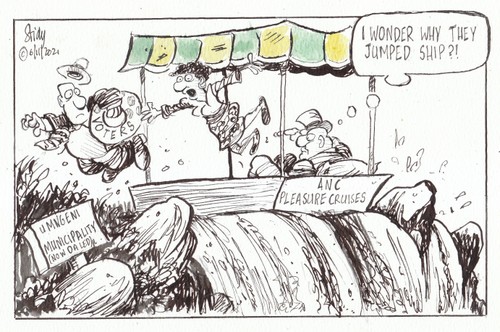
After running a smooth, spirited campaign the Democratic Alliance snatched a historic victory in the hotly contested uMngeni Municipality, receiving 47% of the votes with 13 seats in the council, while the ANC had 39%, followed by the EFF with seven percent. uMngeni is the first municipality to be led by the DA in KwaZulu-Natal.
Outage turned to outrage as Eskom once again implemented load shedding with next to no notice. With the power utilities, woes showing no signs of improving CEO Andre de Ruyter came in for heavy criticism while industry, already battered by the economic effects of Covid-19, continued to suffer.
While politicians tried to make everyone believe that the coalition negotiations were being pursued in the interests of the residents in the country’s 70 hung municipalities the opposite appeared to be true. Rather than being about service delivery or good governance, they were used to advance narrow political interests to the detriment of voters.
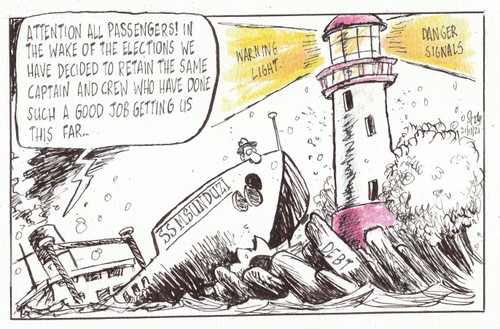
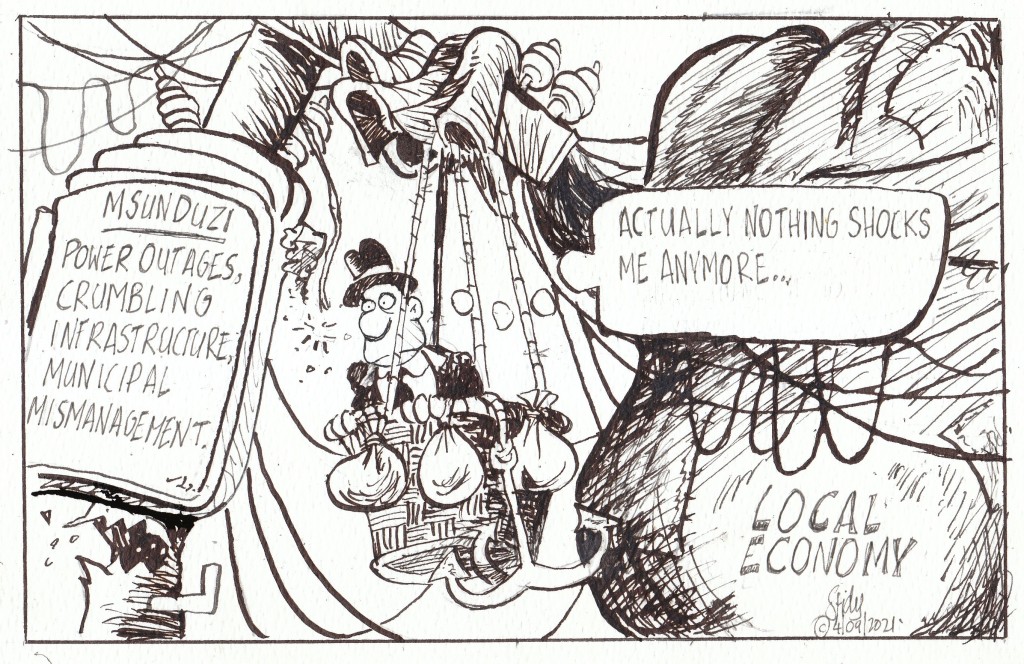
With the reappointment of the old mayor, Mzimkulu Thebolla, and many of the same councilors there was a feeling that nothing much had changed in Msunduzi as a result of the recent municipal elections. In the same week, it was also announced that the municipality was drowning in debt, owing Umgeni Water an outstanding amount of R367 million.
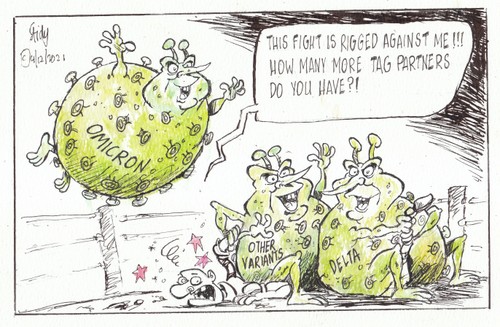
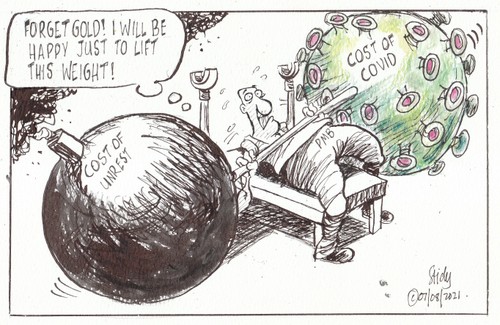
The recently identified Omicron variant had fuelled a worrying surge in coronavirus cases in South Africa and is rapidly becoming the dominant strain, health officials warned. With the imposition of various travel bans to and from South Africa, the government complained it was being punished – instead of applauded – for discovering the concerning new variant of Covid-19.
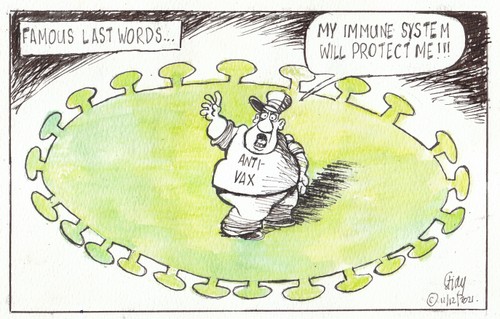
Despite the fact that the majority of people in hospital with Covid-19 are unvaccinated the roll-out campaign faced continuing scepticism and resistance from a section of the public…
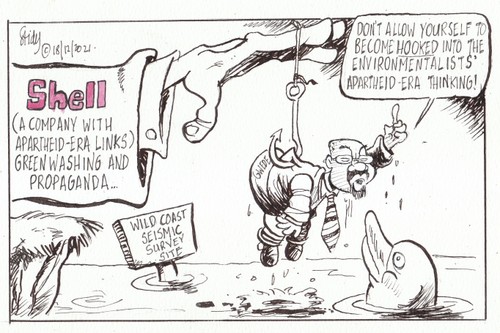
Minister Gwede Mantashe rubbed environmental organizations up the wrong way after saying protests against Shell’s seismic survey along the Wild Coast are examples of apartheid and colonialism of a special type.
While the holiday season should be about sending time with loved ones and doing things we enjoy, the Covid-19 pandemic continued to pose a threat to their health and well-being.
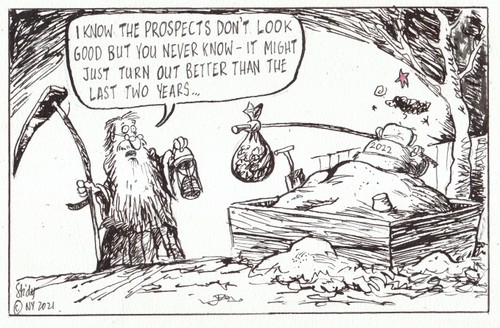
With the highly transmissible Omicron variant having driven cases of Covid-19 to record levels and with no end in sight to the pandemic, the prospects for 2022 do not look good. The one silver lining is that weekly cases appear to be on a downward trajectory.
“If a man does not keep pace with his companions, perhaps it is because he hears a different drummer. Let him step to the music which he hears, however measured or far away.”
Henry David Thoreau
It is probably my British heritage but there is nothing I love more than dashing madly about the countryside, in all types of weather – sunny, showery, cool, breezy – with a pair of binoculars in one hand and a camera in the other. Given this genetic predisposition of mine, it is perhaps just as well I live in an area where it is very easy to feed the habit.
A rambling man...Pic courtesy of Sally Scott.
Kusane is a farm with a commitment to conservation. All I have to do is step out of my front door, skip around the corner of the balcony and then slip across the gangplank that connects it to the ground beyond and I am into the unspoilt, open, pristine countryside. In a moment everything is altered. Any cares or worries I may have quickly get left behind. All my senses come alive. I am agog with anticipation. Another day of happy rambling awaits…
View from Kusane over Karkloof Valley
I never tire of these walks. The countryside is breathtakingly beautiful. There are subtle changes to it every day and every season. These become more pronounced after the first spring rains fall. The colours become more vivid and intense, wildflowers burst through the earth. As the summer storms intensify, the greater the profusion around me. In what seems like the blink of an eye, the deciduous trees start unfurling their new leaves. As sun and rain come together, the lengthening grass shimmies all around me. Great idle puddles lie across my path.
The first Yellow-billed Kites swoop over Kusane. Then swallows and other migrants arrive. They seem happy to be back and they let you know it. The cuckoos start calling, none more so than the ubiquitous ‘ Piet-my-Vrou‘ (Red-chested Cuckoo) who drones on for hours on end, often way into the night. In the dense canopy of trees up by the main house the Village Weavers go into a frenzy of nest-building as if operating according to some unconscious internal calendar.
While all this activity is erupting around me I ramble on. Amongst the comforting familiarity of everyday landmarks, I still stumble on the unexpected. One day, I might stop and watch a female Spurfowl emerge from a thicket with her stripey chicks in tow and scuttle over the road in front of me. Or a kestrel will skim across the edge of my vision, hover, then slip forward again, its head rock still, its sharp eyes scanning the wide landscape for the luckless rats, mice and moles that form its staple diet. On another day, I might see a regal Reedbuck ram, silhouetted against the outline of some rocky ridge, lord of all he surveys, Sometimes, too, in the magic of twilight, I will hear the plaintive, heart-wrenching call of a flock of cranes flying above me, wings gracefully waving. My heart soars out to reach them. They have become my spirit birds.
Living up here, close to the sky and the elements, nature has become both my solace and my passion. Nor is my love affair confined just to the boundaries of Kusane Farm. It extends down into the valley, laid out below as in a view from an aeroplane window, then stretches out across the plains to the Karkloof hills beyond – taking in, as it goes, the iconic Loskop hill which stands alone in the middle of it all like some ancient, all-knowing, sentinel. Local lore has it that this dominant feature once served as an important rain-making site. Judging by the tumultuous storms that get magically conjured up around it, I can believe that…
A mini-storm conjured out of nowhere. Note lighting striking Loskop hill, once a rain-making site.
This, then, has become my heartland.
By going out each day and covering the same patch – or patches – I am slowly building up a permanent record of it. In the course of my exploring, I have taken hundreds and hundreds of photographs. I am not a professional photographer but I love taking pictures because they help me to remember. The ones below are but a small selection of these…
They represent a year in a life. They are my act of homage and recognition, my salutation, my love letter to this extraordinarily beautiful valley and the creatures who inhabit it.
GALLERY:
Nature is all circles and cycles and living up at Kusane you soon feel yourself becoming part of the ever-changing seasons. Winter, for example, is a time of low temperatures and dryness in which the animals and birds have to go searching for food…
This year (2021), it snowed for the first time since I moved up to Kusane. Hailing originally from Zimbabwe, I haven’t had much exposure to this white winter wonderland experience beloved of newspaper headline writers but standing on my balcony, in the silvery half-light, it felt quite magical…
The strange white stuff that fell from the sky didn’t seem to bother most of the weavers at Kusane who carried on with their daily routines. A few were not so sanguine…
Winter is also the firebreak-burning season at Kusane. It is a busy time of the year for the farm manager, Michael Ndlovu, our one-man fire brigade…
As the weather begins to warm up, the first wildflowers appear. I did not plant them. Their seeds get harboured safely in the earth ready to burst forth when the first spring showers fall…
The flowers, in turn, bring in butterflies, bees and other winged insects. Soon, there is a whole world of life in the fields…
Summer is storm season. Sometimes, when I am out walking, I will spot a deep purple wall coming towards me. The next thing I know I will be engulfed in hissing water and rumbling thunder. I get back home drenched to the core…
Approaching storm…
…departing storm.
The real drama is often in the skies; an ever-shifting vista shot through with blue and rippling with an energy that can quickly turn explosive and jagged, even become slightly apocalyptic – a foreboding of mayhem…
A regular routine of mine, throughout the year, is to drive through the valley to the Karkloof Farmer’s Market on a Saturday morning. I go there, mostly, because I like browsing around Huddy’s second-hand books where there are regularly literary gems to be found. The journey can often be as rewarding as the destination…
African Spoonbill feeding in a dam in the Karkloof Valley.
The Karkloof is a good place to spot cranes. Cranes are becoming increasingly rare everywhere so we are lucky to have all three South African species (including the critically endangered Wattled Crane. There are only around 260 left) occurring here. There is not a day in my life that is not improved by seeing them…
Blue CraneWattled Crane (including immature)Blue Crane with chicksCrowned Crane feeding…
Occasionally, driving through the farmlands, you come across other unusual birds like these two…
Denham’s (formerly Stanley’s) Bustard
Bald Ibis
The road to the Karkloof Farmer’s Market takes me past the iconic Loskop, a hill that continues to exert a strange pull on my imagination…
The Karkloof area is good cycling and running country too…
The hour after dawn is nature’s happy hour, a moment when the world still belongs to animals such as this regal Reedbuck ram, surveying his domain…
It is also a good time to see birds because they are usually at their most active then…
Three Midland’s ‘specials’: Malachite Sunbird…
…Black-winged Lapwing…
…Buff-streaked Chat.
To try and seduce birds to come and live at my home I have erected two bird tables on either side of the building. By far the most regular and numerous visitors are the Village Weavers but a host of other birds have taken to frequenting it…
Rock Pigeon on bird feeder
Red-winged Starling (male)
This Cape Sparrow and African Firefinch like to drop in as well…
Seasons of mist and mellow fruitfulness. Kusane lies in the KwaZulu-Natal mistbelt. In summer the mist comes drifting in most evenings engulfing the countryside in a blanket of damp grey…
With the effects of climate change becoming more and more apparent, the need to shift to new “green” technologies has become a mantra and a rallying call for a generation. In the rush to embrace these supposedly cleaner and more efficient inventions what is often overlooked, however, is that many of them come with their own ecological cost.
Just as the disruptive effects of fossil fuel on the climate threaten our continued existence so, too, does this new revolution present its dangers. This is because so many of the items we now consider indispensable to modern living – wind turbines, electric batteries, solar panels, as well as smartphones computers and the like – are dependant for their manufacture on a cluster of little known rare metals found in terrestrial rocks in infinitesimal quantities.
Already, in some countries, most notably China, the mad rush to mine these metals has had dire consequences on the environment, as vast tracts of land are ripped up and rendered virtually uninhabitable by the extraction and refining methods. This pattern is being repeated elsewhere in the world – the DRC (Cobalt mining) and South America (Lithium) for example.
There are, of course, important geopolitical reasons for all of this. By capturing the lion’s share of the rare metal market China has been able to consolidate its growing global power, as well as gain greater economic and military leverage.
In short, rare metals have become the “new oil”.
One of the more worrying aspects of these developments is that the West seems to have been happy to allow China – in part because it means less pollution in their backyards, in part because of a poor assessment of China’s competitive streak – to develop its stranglehold on world production. Only now is the West waking up to the fact that they are lagging seriously behind in this new energy race – a case of closing the stable door after the horse has bolted – and that it could leave them very vulnerable.
In this extensively researched investigation into the subject, Guillame Petron, a French Award-winning journalist and documentary maker, has talked to many experts as well as travelled around the world gathering information. The amount of data he has collated is vast, yet he succeeds in making it (mostly) comprehensible to the lay reader.
The book’s timely message may make jarring reading for those pinning their hopes on a greener future. As the author writes: “The energy and digital transition is sending humanity on a quest for rare metals, and is doomed to aggravate divergence and dissent. Rather than abate the geopolitics of energy, it will compound them.” Petron also argues that we need to be more sceptical about how many of the new technologies are produced.
For all this, The Rare Metals War is by no means a hatchet job intended to reveal the evils of the new technological order. Instead, it’s a careful analysis that sets out to both pose and answer some pressing questions, as well as suggest possible solutions and alternatives.
Published by Manilla Press
This book tells the incredible true story of nine women resistance fighters during World War Two who find themselves imprisoned in a country that has itself become a criminal conspiracy. Having been captured while fighting against their German occupiers, they were interrogated, tortured and sent east into Greater Germany to a concentration camp at Leipzig where their lives were made a living hell.
What comes over with striking force, on reading about their experiences here, is, once again, the sheer barbarity and depravity of the SS and the Gestapo, as well as a Nazi government that saw fit to licence mass slaughter as a political process.
Not all the German soldiers were complicit in this almost unimaginable cruelty. In the Leipzig camp, for example, there was, one kindly older guard who, realising the game was up, smuggled in a pair of wire-cutters for the prisoners.
They never got to use it.
With the allies closing in on all sides, the women, already badly malnourished, were forced out onto the open road. The German plan seems to have been to march them to their deaths since there was no longer any food at Leipzig and they had no gas chambers or efficient ways to execute them en-masse. Many were indeed slaughtered by machine guns along the way.
Determined that this would not be their fate, the nine women, by now close friends, made plans to escape. Led by the indomitable, well-educated, Helene they finally seized their chance.
Gwen Strauss, the author, is the great-niece of Helene and in this riveting, impeccably researched and extremely moving story of hope and courage in the face of seemingly impossible odds, she tells the harrowing tale of their capture, imprisonment and subsequent flight to freedom.
Nor did problems end when they finally got back to their homes. At the time, the population was urged to put the war behind them as quickly as possible and get on with their lives. This was easier said than done. Damaged and changed forever by their traumatising experiences in the German camps, they suffered from depression, shame, rage, helplessness and guilt and found it hard to settle back into a peacetime existence they hardly recognised at all.
Written from the viewpoints of each of the women involved, The Nine is always absorbing, frequently horrifying but with odd unexpected moments of humour to lighten the load.
Pietermaritzburg and Midlands Chamber of Commerce CEO Melanie Veness called on the City to protect its electricity structure or risk losing out on investment. She said some businesses in the Mkondeni area were at times forced to go without power for up to two weeks as a result of, among other things, illegal connections. This was having a devastating impact on confidence and some had already relocated to other parts of the country…
The situation in many South African municipalities remained dire with the Auditor-General warning, in a recent report, that the financial situation of just over a quarter of them was such that there was doubt that they would be able to continue operating as going concerns. Leadership instability, poor oversight by councils, significant financial health problems, protests and strikes, a lack of consequences and interventions that were not effective, were all contributing factors to a general inability to deliver services to citizens.
In KZN, the position had been exacerbated by the recent unrest and looting with more than half of its rural towns facing economic devastation.
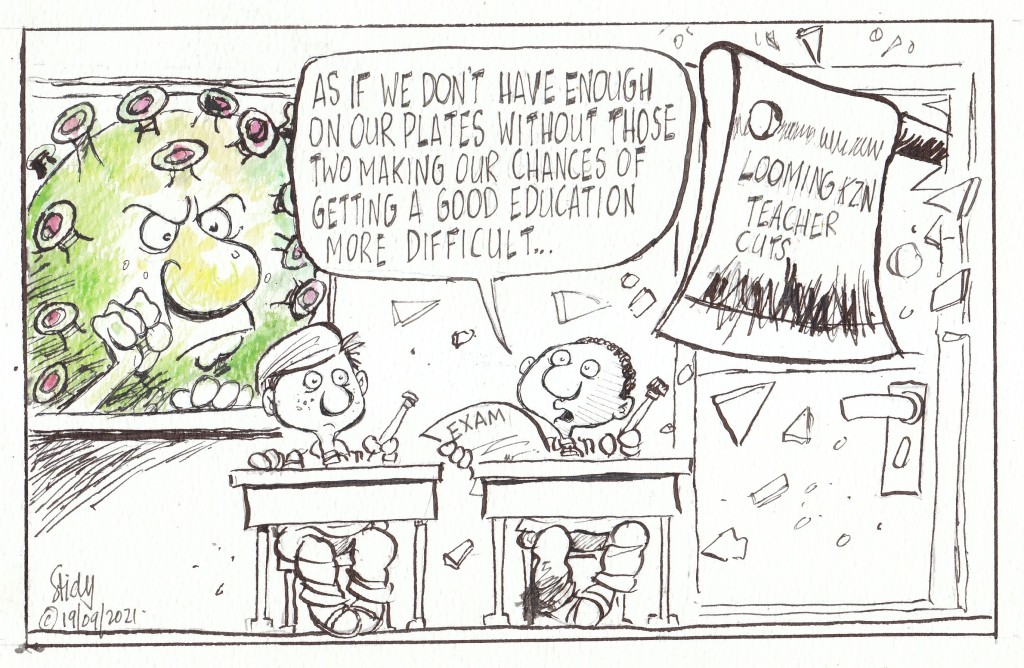
The National Teacher’s Union (Natu) slammed the KwaZulu-Natal provincial government for using budget cuts as an excuse to deny pupils quality education. Natu acting president, Sibusiso Malinga, said the union would approach the courts should the KZN education department go ahead with plans to retrench 2 000 teachers.
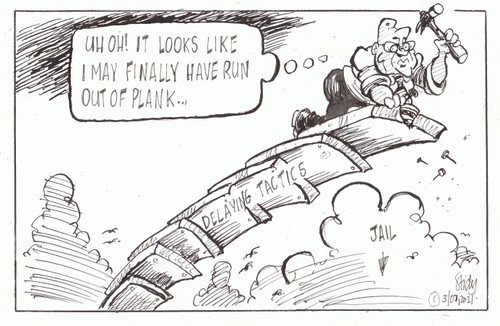
Appearing before the Pietermaritzburg High Court, Jacob Zuma’s advocate, Dali Mpofu, said the former president continued to be “most concerned” by the alleged leaking of his confidential medical information by state advocate Billy Downer. This was but the latest in a long list of arguments put forward by Zuma in his attempts to get the Arms Deal corruption charges against him dropped. The judgement was postponed until 28th October.
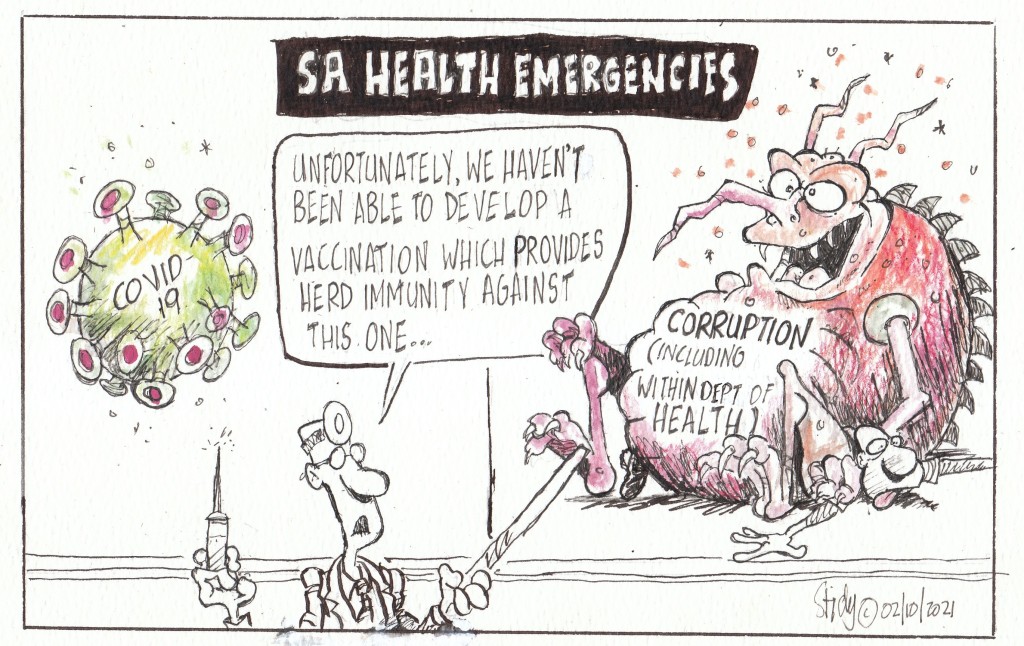
Despite damning Special Investigative Unit (SIU) findings against former health minister Zweli Mkhize, his family and his local ANC branch (and President Cyril Ramaphosa himself) rallied behind him. In a report, which the president had sat on for three months, the SIU claimed that Mkhize failed to exercise oversight in relation to the Digital Vibes communications tender awarded to the company by the Health Department.
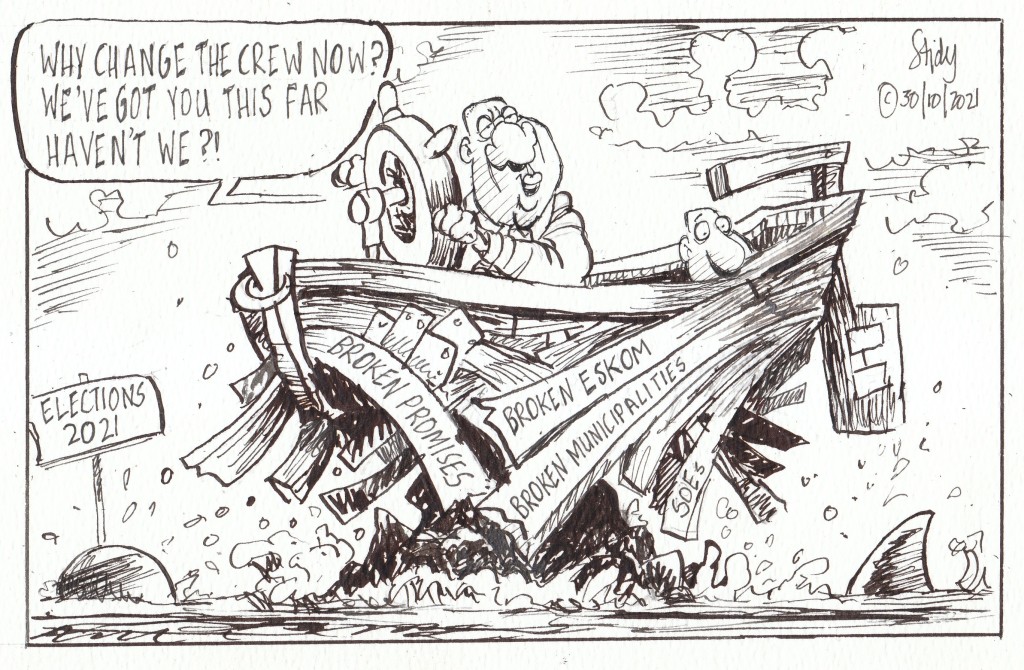
Delivering the parties so-called corrective manifesto ahead of the forthcoming local elections, President Cyril Ramaphosa promised that this time the ANC will do better. Considering his party has spent almost three decades in power, during which time they have delivered very little of their promises, his assurances were met with a certain degree of scepticism. Elsewhere, the eruption of the Cumbre Vieja volcano on the Spanish island of La Palma intensified, prompting the evacuation of 6000 people.
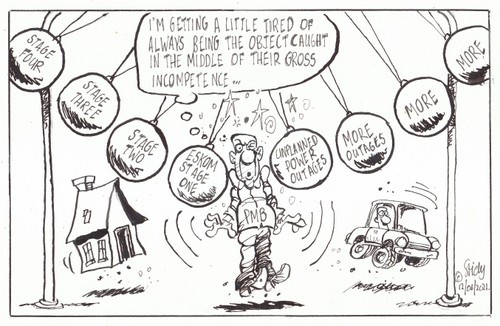
Various businesses in the Pietermaritzburg area again warned that the prolonged power outages and load shedding were crippling them. The situation was exacerbated by the exorbitant price of electricity in Msunduzi.
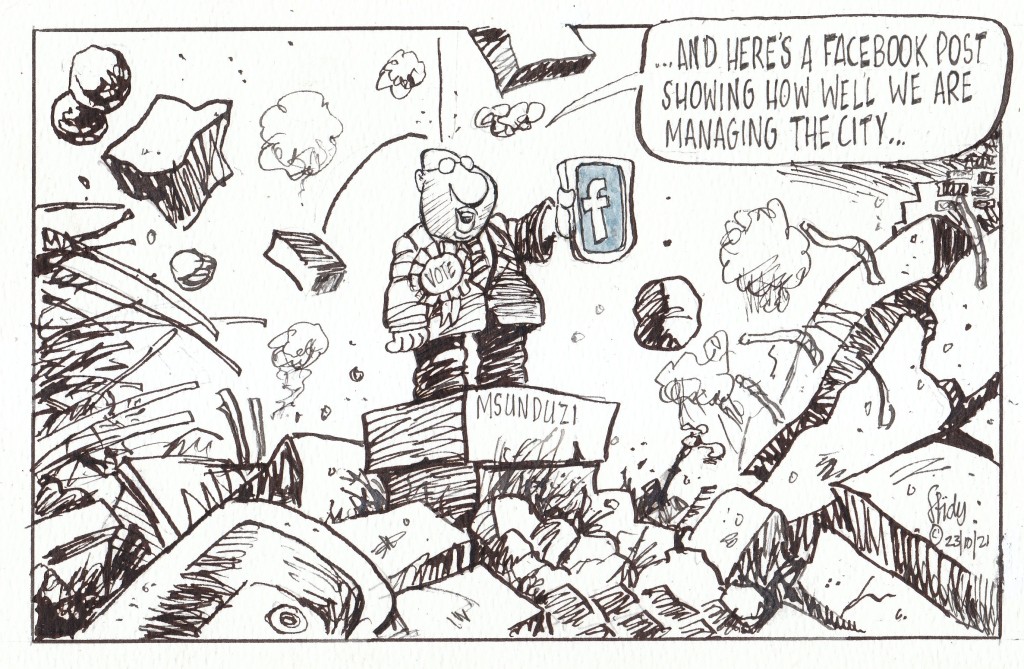
Msunduzi’s attempt to boast about its service delivery achievements was blasted by irate residents who called the city out on its glaring failures. They were responding to a Facebook post where the municipality had a picture of the Moses Mabhida road which they listed as one of their success stories even though it had been funded entirely by the national Department of Transport.
With municipal elections looming in just under a week, Eskom announced it would be implementing Stage Four load shedding because of numerous breakdowns, including a key unit at the Koeberg power station. At a media briefing, public enterprises minister Pravin Gordhan and current Eskom group chief executive Andre de Ruyter both acknowledged the endemic corruption and mismanagement that had plagued the power utility for the last decade. Meanwhile, the latest Citizen Satisfaction Index dropped to a five-year low as South African municipalities continued to fail to meet basic delivery requirements.
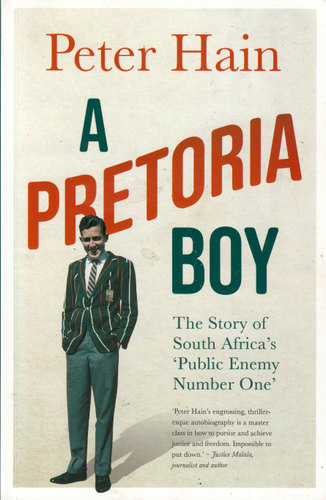
With the benefit of hindsight, it is strange to think that there was a time when the mere mention of the name ‘Peter Hain’ was enough to send the average sports-loving, white South African into an apoplectic fit. Reading his well-written, unflinchingly candid memoir, however, certainly brings it all back home.
From the start, Hain was nothing but contrary. Both of his parents were active members of the South African Liberal Party and as a young schoolboy, growing up in Pretoria, he found himself rubbing shoulders with the likes of Allan Paton and other such luminaries. Inspired by their core principles and selfless example, he rebelled against the country’s official policies at an early age learning, in the process, what it was like to live under constant state surveillance.
Later, Hain’s fierce opposition to Apartheid would see him become not only an irritating thorn in the flesh of the National Party government but also a loathed figure in the eyes of a large portion of their supporters (and a few liberals as well), who saw him as nothing more than a grandstanding, young upstart.
In 1963 Hain’s parents were served with a five-year banning order which restricted their movements and prevented them from entering certain areas. Faced with a ruthless regime that crushed all peaceful protest, many other anti-Apartheid activists began calling for a rethink of tactics. Hain’s parents, however, remained steadfast in their commitment to change through non-violent means but their close friendship with the Johannesburg station bomber, John Harris, brought them under increasing scrutiny by the country’s security services. They were harassed to the point where his father was unable to find employment and although reluctant to do so his family were eventually forced to leave the country.
Exiled to Britain, Hain did not forget his roots nor his steadfast opposition to the South African government and its policies. Mad about sport himself, he knew only too well how important this was to the white South African sense of self. He began organising militant campaigns in the UK against touring South African rugby and cricket sides as his contribution to the struggle. It had the desired effect. In no time Hain found himself dubbed ‘Public Enemy Number One’ by the South African media.
As successful as his tactics were they did not go unchallenged. In 1972 he was hauled before the court on conspiracy charges in a trial that would become something of a cause celebre. After that got thrown out, he would be maliciously framed for a bank robbery. Behind all of this, he sees the malignant hand of the South African Bureau of State Security (BOSS) – with some assistance from elements within MI5 – who wanted to both discredit and neutralise him.
With the release of Nelson Mandela from Victor Verster prison on 11th February 1990, the public perception of Peter Hain underwent a startling metamorphosis. No longer the despised young firebrand of yore (‘Hain the Pain’), his formerly controversial views now became part of – in his words – ‘mainstream opinion.’ To his bemusement, he even had people apologising to him for previously dismissing him as nothing more than a troublemaker.
A career in British politics followed, culminating in him becoming a minister in the Labour government and then getting elevated to the House of Lords.
Wishing only what is best for the country of his birth, Hain has remained true to the values his parents instilled in him. When President Jacob Zuma’s malfeasance was becoming harder and harder to ignore he returned to South Africa and at the behest of several senior ANC members went on to use British Parliamentary privilege to expose the extent of the looting and money laundering. He also testified against Zuma and the Gupta brothers before the Zondo Commission. Nor did he confine his condemnation of wrongdoing to South Africa. As Britain’s Africa minister, he publicly castigated President Robert Mugabe of Zimbabwe for betraying the ideals of democracy and human rights they had both ostensibly fought for.
Part autobiography, part history primer, A Pretoria Boy serves as a salutary reminder, at a time when memories of those dark days have taken on a rosier tint, of just how grim and brutal life was under a regime that used fear to mould human behaviour and where people could be driven into exile – or, in some cases, killed – for expressing dissenting beliefs.
Although Hain displays little rancour or ill will towards his one time adversaries, his book will make uncomfortable reading to many of those he holds to account across the political spectrum.
The urge to migrate, to quest, to go on a journey lies deep-rooted in our DNA. For hundreds of thousands of years before we became sedentary, urban dwellers it was how we lived. We were hunter-gatherers, nomads. I certainly still feel this instinctual pull. It is the reason you so often find me hundreds – sometimes thousands – of kilometres from home and it is why I am always quick to respond to an invitation to do a road trip. For me, there is something magical about going to a place you have never been before and feeling an immediate connection to it.
Thus it was with the Baviaanskloof.
The Baviaanskloof
The Baviaanskloof – ‘Valley of the Baboons’ – lies mostly in the East Cape and is dominated by the Baviaanskloof and Kouga mountains which run parallel to one another in an East-West orientation. Separating the wet coastal belt from the dry interior these mountains form part of a ragged chain that make up much of the South-East coastline of South Africa. Two main rivers drain it, namely the Baviaanskloof and Kouga. They converge at Smitskraal where they travel in an easterly direction to the Kouga dam. The Grootrivier and Witrivier also flow through the reserve and there are a few other minor rivers, streams and odd springs formed where the rare rains come down from the mountains. Here birds and animals come to water.
As a first time visitor to the Baviaanskloof, I was most fortunate to have Goonie Marsh as my guide. Besides making a good travelling companion, he lectures in Geology so was able to explain to my sister Sally and me how this world of marvels came into being. He is also a man with a deep interest in the world around him and as a long time East Cape resident has acquired a great general knowledge of the area.
Goonie Marsh explains how the Baviaanskloof came into being...
Driving down the dusty, twisting, often tortuous road, it is hard to believe there was a time when the climate and landscape were different but some of the Baviaanskloof was once underwater. As part of what is known as the Cape Super Group, its geology consists of alternating layers of sandstone and shale that were deposited on the bed of a large inland sea between 300-400 million years ago. Since then it has been tilted, folded, twisted, faulted, buckled, redeposited in new layers and eroded into its current fantastical shapes (see notes below by Goonie Marsh)*.
Enon conglomerate, Andrieskraal, on which the profile of Queen Victoria can be seen. Made up of quartzite boulders derived by erosion from Table Mountain Group which form the high mountains in the area.
‘The Skull’ – also Enon conglomerates as seen in the Baviaanskloof Cretacious basin. The colour of these sediments is redder compared to Andrieskraal possibly because the latter was open to the ocean whereas these were probably entirely terrestial.
Strata of Table Mountain quartzite which have been pushed vertically, perhaps even overturned.
More Table Mountain quartzite in which the strata are clearly folded – horizontal at the top before flattening out at the base,
We were not, of course, the only nomads, driven by curiosity, to come wandering into this almost mythic landscape. The first anatomically modern humans emerged in the Baviaanskoof during the Middle Stone Age – between 120 000 and 30 000 years ago. They are believed to have been the ancestors of the San who would later live in the area. They left their traces in a large number of caves and overhangs which provided them with both shelter and walls to decorate.
They were displaced and eliminated by the Khoekhoe and early European settlers. Although various explorers and hunters had passed that way before, the first white farmers settled in the Gamtoos Valley in the 1730s. As more arrived, the deeper into the Baviaanskloof they penetrated.
Lonely, sparse and cut off by its mountains from the rest of the world, life could not have been easy for these early settlers. Initial access into the area was by way of an ox wagon. Because of the difficulty of travelling over the terrain, many farmers only made the journey out the valley once a year using the Ouberg track. Getting in and out got just a little bit easier with the construction of a dirt road between 1880 and 1890 by the hard-working, prodigous Victorian road-builder Thomas Bains, son of Andrew Geddes Bains, South Africa’s first geologist and another great road-maker.
Having approached the Baviaanskloof from the East, through the important citrus growing region of the Gamtoos Valley and the towns of Hankey and Patensie, it was along this road that we now travelled. On both sides of us, dry trees rose towards the dusty mountains. Above them would normally hang the hazy blue sky of Africa but – as if to thwart my sunny mood – it was cloudy and cold on our first day. It was still mightily impressive. Here one could sense what the continent must have been like before its wild animals were not confined to a few parks but roamed everywhere and man had not had such an indelible – and, at times, destructive – impact on the environment.
We began by taking a detour off the main road to the Kouga dam. Although a marvel of engineering it made a sorry sight. The East Cape is battling a severe drought with its dams averaging out at only 15% full. At 4,5% of its capacity, the Kouga dam is currently at its lowest level since it was constructed in 1957. Here, like everywhere else, climate change is taking its toll…
Kouga Dam
Dam wall. Pic courtesy of Sally Scott.
It is not always so dry in the valley. Sometimes there are floods. In 1916, for example, over 350mm of rain fell in the catchment area and a great solid bank of water came tearing down the narrow valleys sweeping all before it. Four members of the Campbell family lost their lives when the tree they had climbed to escape the raging torrent gave way under them. There is now a memorial to them.
We spent our first night at Bruintjieskraal in the Rivierspoort, just outside the entrance to the park, on a sheep farm, enclosed in a narrow valley between two ramparts of dark mountain. Our thatched-roofed, timber-framed accommodation proved more modern and more stylish than I had expected, blending seamlessly into the surrounding bush and the mountain itself.
Kudu Cottage, Bruintjieskraal
Sheep, Bruintjieskraal/Glencoe area.
The sky was clearing as we set off the next morning. Pale wisps of cloud danced and dissolved along the mountain peaks casting shifting shadows on the valleys below. After stopping at the Park’s Interpretative Centre (the whole park has now been classified as a World Heritage Site), we followed the road that snakes its way up the Combrink Pass. The higher we went, the more spectacular the scenery got. It was along this stretch of road that we encountered the only other travellers we were to meet in the park – two Germans on motorbikes who stopped to enjoy the same view we did.
Heading towards Combrink Pass.
Combrink Pass. Pic courtesy of Sally Scott.
A fellow traveller.
Near top of Combrink Pass.
At the top of the pass, the country opens up into the extensive Bergplaas grassland plateau which, when we visited, had an almost Alpine feel to it on account of all the swirling cloud, mist and drizzle on its upper peaks. Crossing it, we were greeted by yet more breathtaking views. An interesting oddity here is Winston LeRoux’s rusting, cable system which spans the gaping Waterpoort Gorge. It was once used to link the Enkeldoorn and Bergplaas farming communities and to transport goods between the two but was abandoned in the 1960s.
On the Bergplaas Plateau, looking up to cloud-covered mountains
The old cable system across the Waterpoort Gorge
From Bergplaas we descended the twisting Holgat Pass through more craggy overhangs, clefts and soaring rock The surrounding slopes were covered in fynbos and proteas and – further down – spekboom, aloes (Aloes ferox, africa, speciosa, striata and arborescens all occur in the area) and euphorbia. Strange plants and succulents, that have adapted to vertical living, clutched onto the cliffs. A pair of Black Eagle wheeled overhead.
The Holgat Pass.
The country grew steadily drier the further west we went. In places, the desolation was offset by the dense growth of trees which grew along some of the river banks. The water in these rivers was beautifully cool, clear, tasty and refreshing. In places, pondweed, lilies and something like giant cress grew so thick they looked like little green islands rising out of the water. We stopped at one of the streams, scooping up handfuls of the precious liquid and then sipping it with the all the reverence a person in a parched desert might do.
Drinking from mountain streams.
Lilies.
At mid-morning we pulled into the Smitskraal picnic site for a coffee break. Goonie hauled out his furnace, gathered some kindling, and then fired it up. It was a sight to behold. In no time, the water inside was boiling and the metal contraption was belching out plumes of steam and smoke like an active mini-volcano.
The firing of the furnace…
Coffee break at Smitskraal.
Aside from a bored-looking baboon who watched us from the shade of a tree, we were the only ones around – or, at least, so it appeared. There are buffalo in the park but they must have been lying low that day for we didn’t see any of them although their dung was everywhere scattered across the roads. Black rhino also lurk in the thickets around here but they, too, declined to show themselves. It did not bother me. With their poor vision and small powers of deduction, they are, like the fierce buffalo, notoriously short-tempered. I would prefer not to have a face to face encounter with either and always keep a close eye out for hospitable trees to climb when I am in their presence. Here, unfortunately, the available trees consisted mostly of sharp-needled Vachellia karroo (Sweet Thorn).
An audience of one…note thorns!
There are still leopards living in this mountain wilderness. Maybe one was even watching us from some rock ledge with eyes that see everything but reveal nothing? Cape Mountain Zebra have been reintroduced into the area and there are also Klipspringer, Mountain Reedbuck and several types of highly poisonous snake (including Puff-Adder and the fearsome Cape Cobra). Them I was happy to avoid too…
From the picnic site, we headed up the Grasnek Pass, stopping high up on its neck so I could take yet more photographs of its panoramic view. Pressing on, we passed several tattered and long-abandoned old habitations, disintegrating memorials to those who had tried their luck in this harsh environment before calling it quits. We stopped for a roadside lunch directly opposite one such derelict farmhouse. Looking at its collapsing walls and sun-bleached, corrugated iron roof, I decided it might make a meaningful painting about the fragility and uncertainty of human life (a subject much on my mind since the outbreak of the Covid-19 pandemic) so I hauled out my camera again and photographed it from various angles.
Grasnek Pass
View near the top.
Grasnek Pass
Deserted farmhouse in the Baviaanskloof
Exiting the park we found ourselves back in farmland. Down the hills came herds of goats and sheep, little white flecks against a vast expanse of rock. The scenery remained as majestic as before.
We spent our second night at Speekhout farm, nestling in a vast amphitheatre of mountains with a crocodile-shaped outcrop of red rock at the one end. Sitting outside the flimsy, reed-walled house, that served as our night’s accommodation, with our evening drinks, we watched the dying sun turn the mountain tops gold. Below us, a small band of springbok slipped across a field. Nomads themselves, these buck (once called trekbokke or “travelling buck”) used to migrate across the Karoo in their hundreds of thousands, trampling all before them. Now their movements have been restricted and the few that remain exist mostly behind fences, like these. As a wanderer myself, it was hard not to feel sorry for them.
Speekhout farm, with springbok.
Lying on my own, later that night, in a tent I had found erected around the back of the reed shack, I got to experience just how cold the Karoo can get when the sky is clear and the stars are out. I slept poorly.
The next day we resumed our journey west, heading up through the jagged walls of Nuwekloof Pass which links the western section of the Baviaanskloof with the higher Karoo hinterland and the towns of Willowmore and Uniondale.
The Nuweklood Pass
The moorland-type country, at the top, was covered with low bushes with tough, wiry leaves that can survive where grass cannot. At certain times of the year – like now – little perennial daisy plants pop up all over the place, providing a cheerful contrast to all the greys, browns and ochres. Hardy succulents of many kinds also thrive here, providing additional food for the fat merino sheep who blend in so well with their surroundings.
Blending in with the scenery.
Up here in sheep country, the valleys start getting a lot wider than the mountains they separate. The further west one goes, the more enormous the landscape becomes, and the straighter and emptier the roads. Once you get onto them, it is hard to believe you will ever reach your destination. It certainly felt like that when we hit the N9, about halfway between the towns of Willowmore and Uniondale. Instead of continuing West towards the jagged outlines of the Swartberg mountains, running along the far horizon, however, we turned East again heading back towards the more densely populated Indian Ocean side of the sub-continent.
We stopped in Uniondale for coffee and a quick shop (succulent Karoo lamb was on the menu for that night). The town is famous for, among other things, its ghost, a young woman who stands alongside the same lonely stretch of road we had just driven down. When people stop to offer her a lift she gets in and then scarily vanishes. The story has inspired an Afrikaans film and a song by Andrew Goosen, both titled “Die Spook van Uniondale”.
Uniondale
Uniondale scene
Back on the ghost road, I kept watching out of the corner of my eye but did not see her although, in this deserted landscape, it was quite easy to believe she exists. We passed through Unionpoort and carried on to where the road branches off eastwards, down the Langkloof – the ‘long valley’ that separates the Kouga and Tsitsikamma móuntain ranges – following a long-used route that runs roughly parallel to the one we had been on in the Baviaanskloof.
The Ghost Road with Swartberg mountains in the distance.
A bit of family history here. Many of my ancestors have felt the same, restless urge that had caused me to be cruising down this road. One of them, Benjamin Moodie, the last Laird of Melsetter, had, in 1817, crossed the globe from his home on the Isle of Hoy in the Orkney Islands and set himself up in an old Dutch-style farmhouse at Grootvadersbosch, near Swellendam, at the base of the Langeberg. He was later joined by two of his brothers, John Wedderburn and Donald Moodie. Although he later emigrated to Canada (his two brothers remained, both founding South African dynasties that spread across the country and into neighbouring Zimbabwe). John Wedderburn left an extremely entertaining – and insightful – account of his time in the country in his book Ten Years in South Africa (first published in 1835).
A few years after he arrived, John Wedderburn (who had fought in the Napoleonic Wars and had returned home to find there were few jobs available for ex-soldiers) also came travelling down the Langkloof, en-route to the Grahamstown area where he and his brothers hoped to be granted some land. Like a lot of early travellers on the sub-continent, John Wedderburn found the parched and ancient Karoo a frightening, hostile, place. He was not overly impressed by the more arid and treeless upper parts of the Langkloof even though its fruit growing potential had already been recognised:
“I was much disappointed in the appearance of this tract of country, which, notwithstanding the number of farmhouses and well-watered gardens, was rather bleak and forbidding, from the total absence of wood, and the uniformity of its mountains,” he would later write.
As a Scotsman, he possessed an obvious natural bias towards wet weather and greener pastures and it is only when he reached the coastal end of the valley, where the rainfall is higher and the vegetation more luxuriant, that his opinions began to improve:
“The eastern extremity of the Lange Kloof opens into the valley of the Kromme river; and here the landscape becomes interesting and romantic.”
The greener coastal end – much preferred by John Wedderburn Moodie.
John Wedderburn is generally a reliable guide and I find myself in agreement with much of what he writes but here I am very much at odds with his views. I think the Kouga mountain range, of which he was so dismissive, is an area of extraordinary variety, beauty and – dare I say it? – romance.
Our destination lay in a remote, secluded valley in the Kouga Mountains Wilderness Area. To get to it you have to drive down another rough and lonely road, through a perilously steep gorge and then up the other side. It made for a dizzying, jittery ride.
The road into the Kouga mountains.
The closer you get to the mountains the more impressive they become. Stream beds and ravines trench the foothills. Ahead of the house, in which were to spend the night, a steep gorge cleaved through the mountains, well-wooded in parts, belying John Wedderburn’s thoughts on the matter. In the late afternoon, my sister and I wandered through the peach and apricot orchards which were in full blossom, entranced by the light. Afterwards, we followed up the stream into the mountain gorge. In places, the water flowed straight over the road, so we had to cross on stepping stones.
The gorge in which our guest cottage was situated.
This was, – and still is – Ferreira country. Long before John Wedderburn came riding down the Langkloof, there had been Ferreiras living in the Onder-Kouga. Among these hardy frontiersmen was Johannes Stephanus Ferreira (1848-1896) also known as “Jan Been” on account of his bandy legs (hoepel been), a legacy from his being shot during one of the countless Frontier Wars. According to Bartle Logie, in his book Boots in the Baviaans, Johannes may have been the inspiration for the famous Afrikaans folk-song “Vat jou goed en trek Ferreira” [literal translation: “Take your stuff and move on, Ferreira”]. The romantic in me wanted to believe it was true.
Isolated by its topography it, too, must have been a tough environment to live in although I imagine they must have also developed a strong sense of community still embodied, in many of the Karoo dorps you pass through, by their beautifully built churches, in which the faithful gathered on Sundays. Although in some places houses have been modernised or rebuilt, many of the whitewashed outbuildings are still the same as when they were when constructed.
The church at Uniondale.
Other aspects remain the same. Back doors open up to vegetable gardens which run into orchards which stretch down to sheep paddocks which, in turn, melt into the rough, rock-strewn hillsides. Chickens scratch around in dusty backyards, ducks and geese float on ponds, Border collies snooze in the shade, Ostrich eye-ball you…
In the orchards…
Getting eye-balled by two Ostrich…
Here generations of children have grown up and taken over the running of their parents farm, building on what has gone before.
I was to get further glimpses into the continuity of life in these isolated communities as we headed out along a dirt road that runs along the base of the range the next morning. There are still many working farms in the Onder-Kouga but inter-dispersed amongst them are yet more abandoned old homes which are slowly being reclaimed by the fynbos. The sites of these houses had usually been carefully chosen, often with a mountain as a backdrop and a view that looked on to yet another mountain.
A working farm.
A deserted farmouse…
and another…
…and another.
Having crossed the Kouga river yet again we found ourselves back on R62, near Kareedouw where we stopped for more coffee…
And so my journey into the Baviaanskloof came to an end. As we headed back to Grahamstown, along the N2, I realised that travelling through it had been far too big an undertaking for me to be able to give anything other than a shallow summing-up of my thoughts, impressions and experiences. Nevertheless, I still emerged from the journey feeling I had learnt a little bit more about my country and – just as important if travel is to prove redemptive – myself.
My life had been both broadened and enriched by my foray into the Valley of the Baboons…
GALLERY:
Aloe ferox. Baviaanskloof.
Aloe ferox near Uniondale.
Sombre Greenbul.
Blue Crane.
Ostrich
Cape Bunting
African Black Duck.
Old boots abandoned on side of road.
Sheep sheltering in shade.
Ruined house.
Conglomerate.
Lunch break in the Baviaanskloof.
Kouga mountains.
More fold mountains, Baviaanskloof. Pic courtesy of Sally Scott.
*NOTES ON CAPE FOLD BELT
by Goonie Marsh
The Cape Fold Belt has a long history starting about 500 million years ago with the
formation of a shallow marine basin, the Agulhas Sea, along the southern margin of
Gondwana, a single land mass or supercontinent, which was made up of the continents
currently known as Antarctica, Australia, India, Africa and South America.
For the next 170 million years until about 330 million years ago, this basin received sandy
and muddy sediment derived by erosion from the interior of Gondwana. With compaction
and cementation the accumulated sediment formed a succession of sandstones and shales
more than 8 km in thickness. This succession is known in formal terminology as the Cape
Supergroup and it is subdivided into 3 major units depending on the proportion of
sandstone to shale in the sequence. The oldest and lowermost unit is the Table Mountain
Group which is dominated by quartz sandstone of exceptional purity. This is overlain by
the Bokkeveld Group which has thick units of shale interleaved with thinner sandstone
layers. The topmost, and therefore youngest unit, is the Witteberg Group with
intercalated shales and sandstones in approximately equal proportions.
Starting about 330 million years ago and continuing for over 100 million years, the
southern margin of Gondwana was subjected to powerful laterally compressive forces
directed northwards. These forces destroyed the Agulhas Sea and Cape Basin, squeezing it
against the continental mass of Gondwana, rumpling, folding and uplifting the sedimentary
strata that had accumulated to form a major fold mountain belt, the Cape Mountains. The
folding process also fuses the grains in the rocks tightly together and they harden,
particularly the quartz sandstones, which are converted into exceptionally hard quartzites.
The general processes and products of this fold mountain building event are known as the
Cape Orogeny. A good ‘modern’ analogy would be the creation of the Himalayas – Earth’s
still active major fold mountain chain formed by India pushing into Asia
ACKNOWLEDGEMENTS:
Baviaanskloof – A World Untouched. Compiled by Liesl Hattingh (published by Baviaans Tourism).
Boots in the Baviaans by Bartle Logie (Bluecliff Publishing).
Ten Years in South Africa by Lieut. J.W.D Moodie published by Richard Bentley)
SPECIAL THANKS to Goonie Marsh and Sally Scott for organising this trip and being happy to stop whenever I wanted to take a photograph – which was very often – or have a cup of coffee…
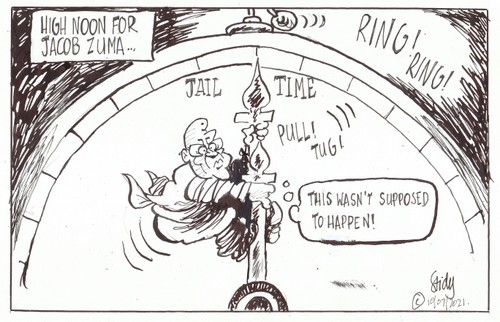
The Constitutional Court sentenced former president Jacob Zuma to 15 months imprisonment for defying its order to appear before the Zondo Commission to give evidence on state capture. In its judgement, the ConCourt gave police minister Bheki Cele three days to arrest Zuma should he fail to hand himself over to the police within five days.
Jacob Zuma finally surrendered himself to police less than an hour before midnight on Wednesday 7th July after a night of high drama during which a phalanx of heavily-armed police units was on its way to arrest him at his Nkandla home. The disgraced former president, who oversaw a decade of state capture and decline, spent his first night at the Estcourt prison after high-stakes-cat-and-mouse negotiations with the police.
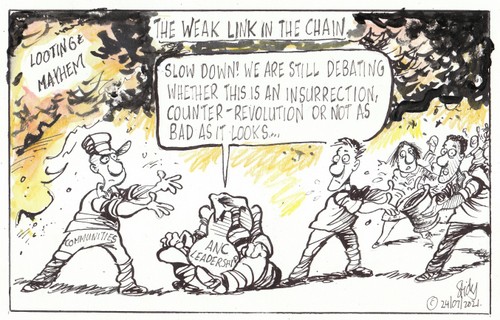
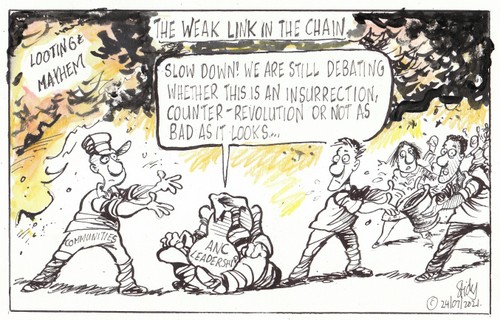
In a week that marked the darkest point in South African history since independence, large parts of KwaZulu-Natal and Gauteng found themselves at the mercy of marauding gangs of looters, ostensibly protesting the imprisonment of former president Jacob Zuma. Extremely tardy in their response, the security cluster ministers would continue to insist the situation was being contained despite numerous lives being lost and billions of rands worth of property destroyed. President Cyril Ramaphosa, would, to his credit, later admit the Government had been caught unprepared.
While fire-fighters, private security companies and local communities joined forces to try and protect the towns and cities, the ANC government was slammed for failing to be more visible on the ground while the country was gripped by riots and looting that brought the economy to its knees. Its slow and poor response was later blamed on budget cuts, poor intelligence and rifts between the security cluster ministers. Visiting the Liberty Midlands Mall in the aftermath of the wave of unrest, Police Minister Bheki Cele belatedly acknowledged the extent of the damage and warned that the country was “not out of the woods” even if it appeared on the surface that life was returning to normal.
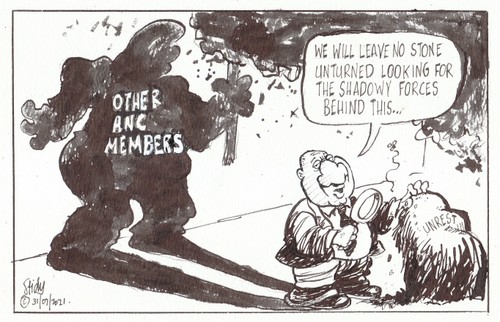
President Cyril Ramaphosa’s assurance, to the nation, that his government would “leave no stone unturned” in its efforts to bring the anarchy that played out across parts of the country to an end seemed unlikely to convince a sceptical public, long inured to the ANC’s empty promises. This was especially so as most of the prime instigators behind the unrest came from within the party itself and the ANC had always shown a marked reluctance to deal with its wrongdoers.
Msunduzi Municipality warned that it might not be able to assist businesses that were affected by the unrest. With some of its commercial customers having had their businesses looted and destroyed, the municipality was also unlikely to collect the revenues it had estimated at the start of the 2021/22 financial year and this could also severely impact its ability to deliver services – already under strain as a result of the ongoing Covid pandemic.
Appearing before the State Capture Enquiry President Cyril Ramaphosa spent much time trying to avoid directly implicating ANC members in state capture. He did, however, admit that ANC factionalism had debilitated its ability to fight corruption because it led to people having “vested interests in maintaining certain activities.”
Following reports that KwaZulu-Natal schools had emerged as the biggest contributor to the rapid increase in Covid-19 cases in the province, there were calls for the closure of those most badly hit. According to KZN Premier Sihle Zikalala, more than 120 schools had reported clusters in their school settings and more than 800 teachers and learners had been affected. Learners made up 95% of the number, while educators accounted for the remaining 5%.
The Msunduzi Municipality Council agreed to sponsor Maritzburg United FC to the tune of R9 Million for the next three years despite warnings from opposition parties that it could not afford the expenditure. Questioning where the council’s priorities lay, the Msunduzi Association of Residents, Ratepayers and Civics (MARRC) said they would be seeking legal advice.
The insurrection or attempted coup or counter-revolution (the various ministers in the ANC defence cluster differed in their interpretation) began on a cool winter’s day in July. Spurred on by cynical ideologists, crowds of supposedly pro- Jacob Zuma loyalists went on the rampage, protesting his recent jailing. Supermarkets and warehouses across Kwa Zulu-Natal and parts of Gauteng were broken into, trashed and ransacked. Everything that could not be taken was destroyed, including the buildings themselves.
For several days after the looting, many shops were still closed, as was the main Jo’burg to Durban freeway. In the absence of effective policing, alarmed communities set up roadblocks in an attempt to protect themselves. Much to my consternation, I found myself having to go out on a night-time patrol, something I hadn’t done since the Rhodesian Bush War days.
My take on the unrest…
It was something I had hoped I would never have to do again too…
From where I sat, on my hilltop home, it all seemed hideously unreal. I felt dazed, finding it hard to believe that almost thirty years after the ending of Apartheid something like this could still happen in South Africa. And yet I was not completely surprised either – given the rampant corruption and mismanagement in the country, as well as the grinding levels of poverty.
Worn out by the never-ending Zuma saga – as well as having our lives upended by the continuing Covid crisis – I found myself longing for an escape.
A chance to get away from it all duly came when my sister, in Mpumalanga, phoned to ask if I would be interested in joining them for a break in Kruger National Park. I said yes. I hoped such a journey would be redemptive. That it would remind me of why, in spite of everything, I still love living in Africa.
And so a week or so later I found myself passing through the Phalaborwa gate and into Kruger. It was good to be back. I suppose it is not surprising that I found the sights and sounds of this place so familiar and comforting since I have visited it countless times before both with my family and my regular birding companion, the sports journalist Ken Borland. I always revel in the sense of freedom and discovery the park gives me which even the occasional discomforts – it can get incredibly hot in summer, the mosquitoes can be a nuisance – cannot detract from.
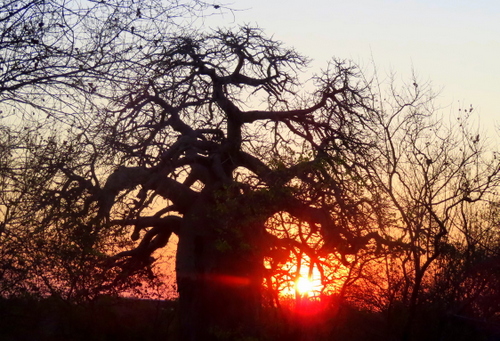
Familiar and Comforting scenes – Baobab at Mopani…
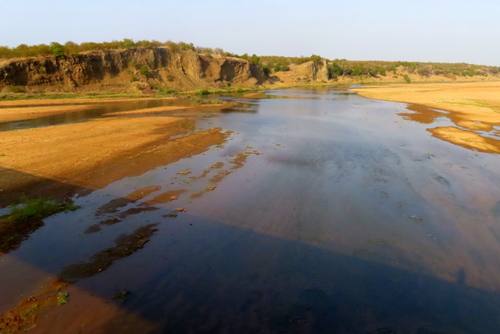
…Oliphants river.
It is all part of the experience.
Besides its animals and small, biting insects, Kruger is famous for its birds. The variety is bewildering with over 500 species having been recorded, representing roughly 60 per cent of the total for South Africa.
Because it was winter, a time of the year I had never visited the park before, I wasn’t sure what to expect, however. I was immediately reassured. We had not got far into the park when we came across a strangely behaving Spotted Hyena, intently ploughing its way through a small, muddy pan, its nose skimming close to the water’s surface as it went like it was searching for something it had mislaid. I wasn’t sure what that was although, later, I was told that they do sometimes hide the remains of their kills and scavenged carrion underwater.
Spotted Hyena
As we drove on I was rewarded with other happy reunions. I hadn’t anticipated seeing many swallows at this time of the year but as I scanned the sky, above the Letaba bridge, I spotted several beautiful Mosque Swallows – a bird confined mostly to the Kruger area – dipping and soaring over the river. Like the similar water-loving Wire-tailed swallow, they are one of the few swallows that overwinter in South Africa instead of heading north like the rest of their species.
We carried on. Overhead sailed vultures and Bateleur eagle, still relatively common in the park but hardly seen outside it now. In my head I had a sort of hit-list of birds I hoped to encounter and I found myself eyeing each bit of terrain we travelled through, trying to imagine what species might be lurking there. It is not as easy as it seems. Coming from the KZN mist-belt, it always takes me time to readjust to the harsh Bushveld but gradually I felt myself getting my eye and ear in and start to remember how things fit together and relate to one another.
White-backed Vulture
White-backed Vulture
Then I heard a party of Brown-headed parrots, shrieking overhead. Because of their relative rarity (and cheerful personalities), I was keen to locate them. The gaudy birds aren’t as easy to find as you might think, since they always seem to be flying away but these obligingly landed in a tree and started squawking away, giving us plenty of opportunities to study them as they clambered up and down the branches of the trees, playing their parrot games.
Resuming our journey we eventually joined the main tar road, that runs down the centre of Kruger, near the Mooiplaas picnic spot where we stopped for a short tea break. From here we headed north to our first stopover camp, Shingwedzi.
This is very much Mopani country. Stretching as far as the eye can see and farther they are the dominant tree of the northern part of Kruger.
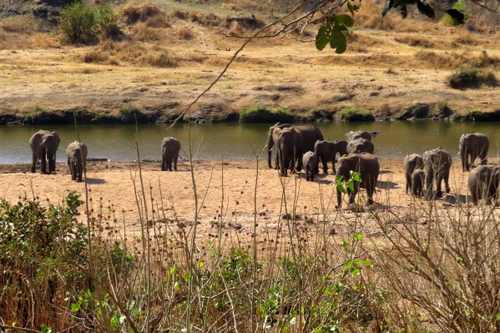
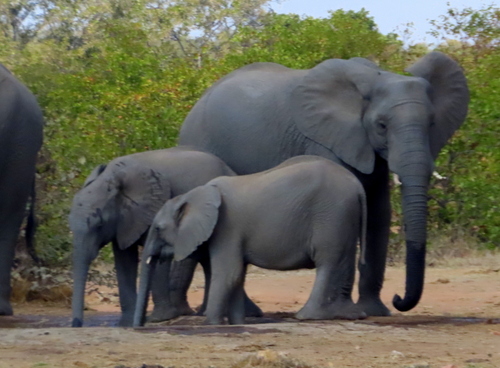
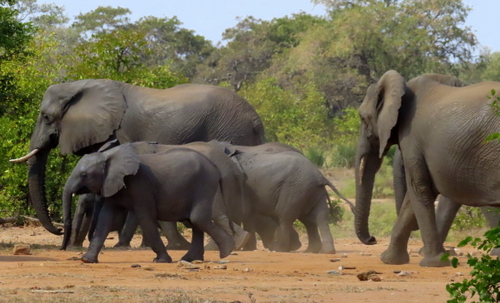
Shingwedzi, itself, is associated first and foremost with elephants and we were to see plenty of these, the largest of mammals, over the next few days. Even when we didn’t see them their impact on the environment was everywhere evident – branches strewn across the roads, entire trees shoved over, paths hammered through the thickets, water holes dug in dry river beds. To the uninitiated eye, the amount of damage the elephant cause may seem shocking but it serves a very useful purpose, reshaping the natural environment for the benefit of other smaller creatures. In this sense, they are regarded as an umbrella species although they require vast tracts of land to maintain their populations.
Elephants on Shingwedzi river
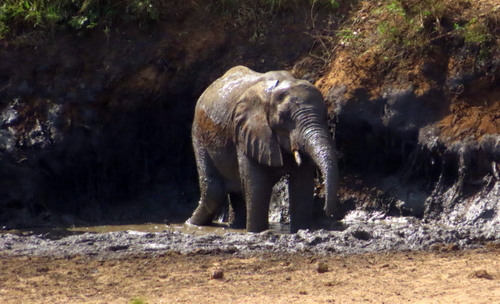
Elephant enjoying a mud bath
Our lodge could hardly have had a more perfect setting. Whereas most of the chalets have, for some reason, been built at some distance from the river our accommodation overlooked it.
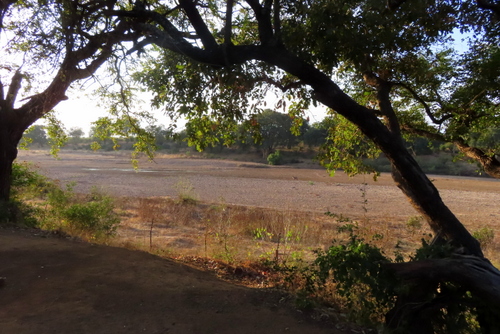
View from our lodge
That evening I sat on the river’s edge, sipping a beer and taking in my surroundings as our outside fire sent up its golden fountain of sparks. The light began to fade, the bushes and then the trees on the bank darkened and then got engulfed in the blackness. In the distance, the fiery-necked nightjar started calling. It is a heart-stealing sound, one that captures the very heart and soul of Africa.
Lying in my bed later, I could hear a restless lion roaring from the other side of the river, then, a bit later, the the spooky whooping of a hyena. Not to be upstaged, a convocation of baboons started barking and hurling obscenities from their sleeping positions in the treetops. I wondered what had got them so aroused? Maybe a leopard was on the prowl and they had scented it?
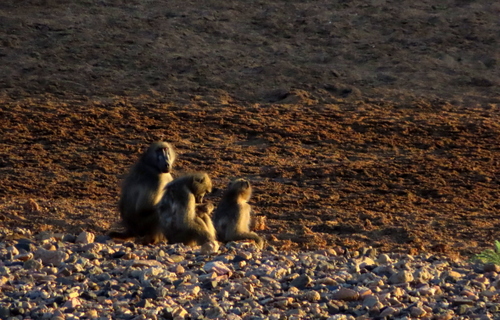
The next morning I woke with a new sense of wonder. The sun appeared. The pale golden tones it cast illuminated the animals drinking at the pool below the lodge, giving them a slightly ghostly appearance. The large troop of baboon that had kicked up such a row the night before now looked completely relaxed as they squatted on the dry river bed, peaceably grooming one other.
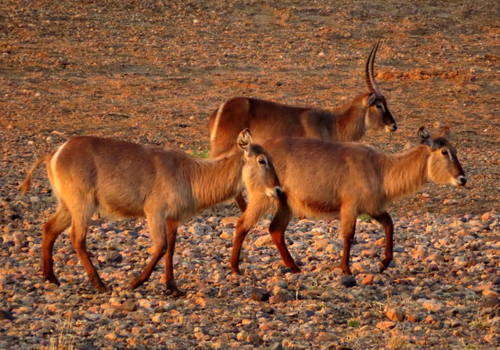
Waterbuck
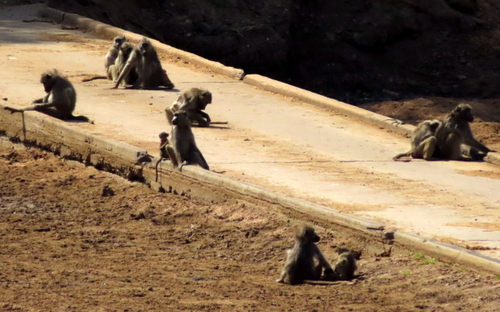
Grooming time.
At moments like this, I felt I could live this sort of life forever.
The rush hour traffic grinds to a halt on the S51 road...
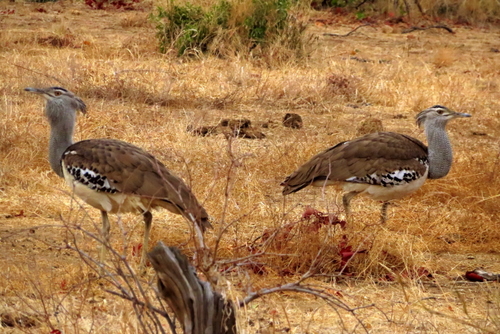
After a quick cup of coffee to warm us up, my nephew, his wife and I set off along the Red Rocks loop which follows the Shingwedzi upstream to a point where it crosses a band of Gubyane sandstone which has been eroded into a series of potholes. Every birdwatcher enjoys coming across the unexpected so we were understandably delighted to see three Kori Bustard – the heaviest of all flying birds on earth – and then, a little further on, another pair. We also saw – again, the first of several sightings – a Red-crested Korhaan, a bird famous for its peculiar flight display in which the male flies straight upwards, then folds its wings and drops, kamikaze-style, towards the ground, pulling out just before impact.
Kori Bustard
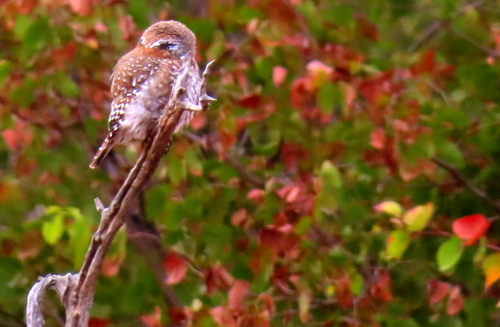
With their big, binocular eyes, distinctive flight, cuddly size and softy, dumpy shape owls have acquired a special mystique and status, figuring in folklore, myths and legends. I love all owls but have a particular affection for the three tiny ones that occur in South Africa – the African Barred Owlet, the African Scops Owl and the Pearl-spotted Owlet. I was as instantly as happy as a lark when my nephew’s wife spotted one of the latter sitting on a deadwood stump, not far from where we had stopped. What makes this particular owl somewhat unusual is that it is often active during the day. Another curious characteristic is that it has a pair of false “eyes” on its nape, presumably to confuse friend and foe alike.
Pearl-spotted Owlet
Red-crested Korhaan
Seeing it immediately made it my Bird of the Day.
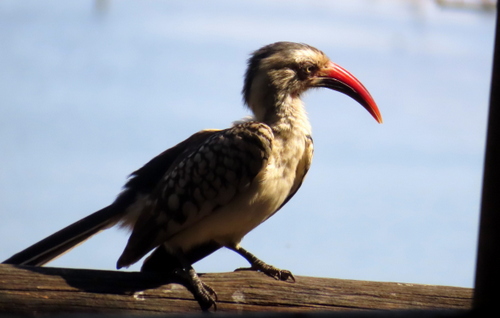
After lunch we headed up the tar road to the Babalala picnic site which marks the turn-off point to the Mphongolo River Route, to my mind, one of the best drives in the entire park, taking you through some exceptionally lovely riverine country. As we drove we were met by a dust-devil spinning a plume of red dust, burnt grass and ash. At the picnic site itself, I picked up a Bennet’s Woodpecker which is always nice to get. Plus the usual assortment of picnic site hangers-on: Greater Blue-eared Starlings, Red and Yellow-billed Hornbills and their cousin, the Grey Hornbill. Used to a steady flow of traffic they have become very tame here constantly filching for food.
Yellow-billed Hornbill
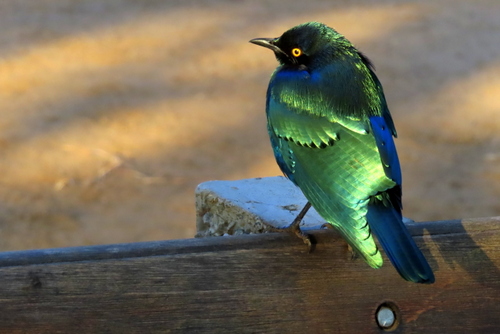
Greater Blue-eared Starling
Red-billed Hornbill
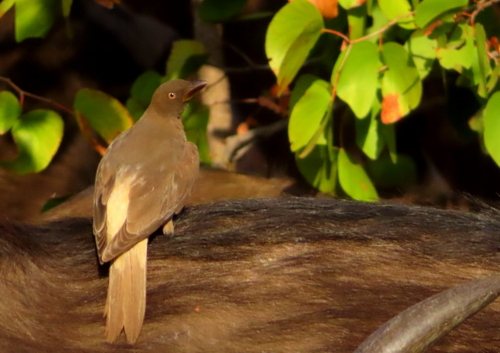
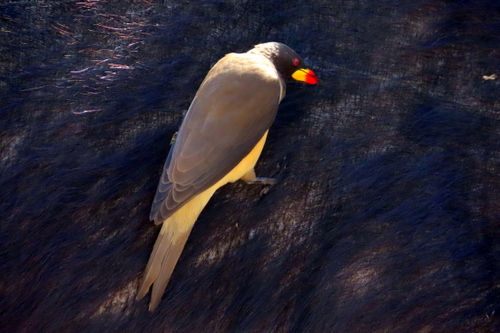
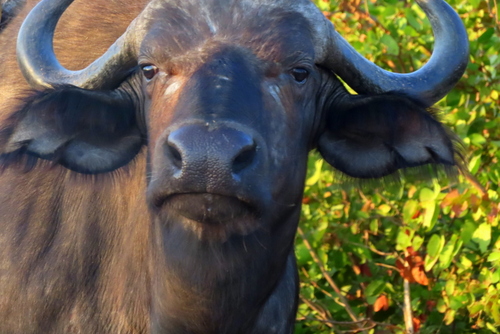
You invariably see elephants both here and along the loop. We hadn’t driven for too long when I heard the sombre crack of a branch being snapped and we rounded the bend to find our path barred by a small herd of them. They were feeding on both sides of the road and seemed in no hurry to depart so we had to sit and wait for them to move on. There are also several big herds of buffalo in this area, often carrying both Red and Yellow-billed Oxpeckers on their backs. They are said to be the most aggressive animal in Africa so it always pays to be wary around them.
Redbilled Oxpecker
Yellowbilled Oxpecker
We also saw several giraffes, their heads swaying gently above the trees. They are far less menacing creatures although a kick from one of them could land you in the next world.
The Mphongolo river
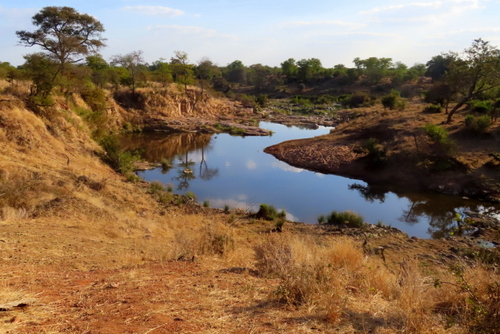
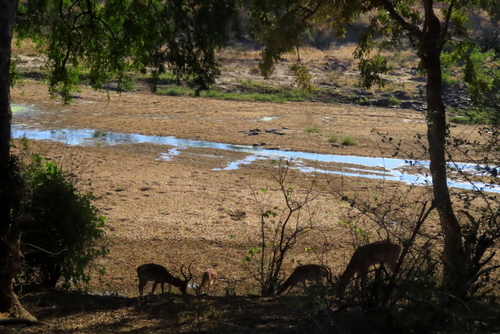
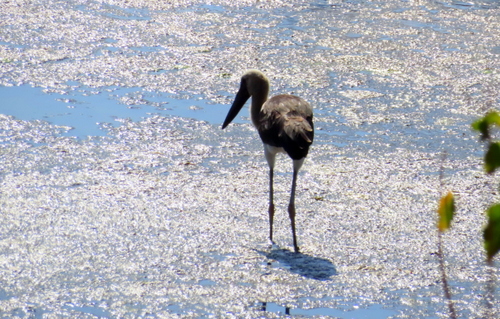
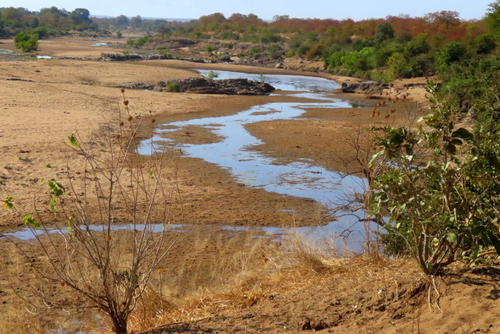
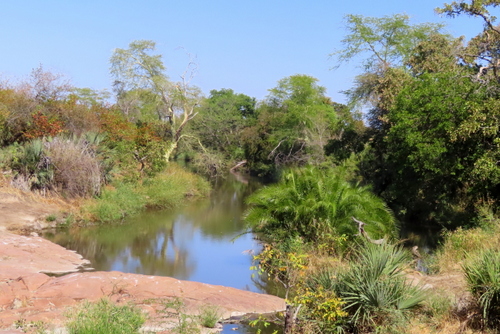
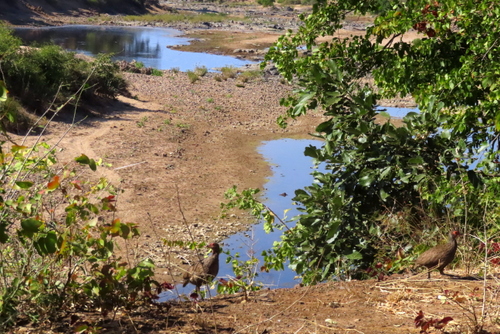
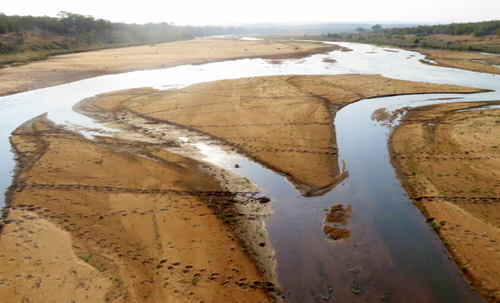
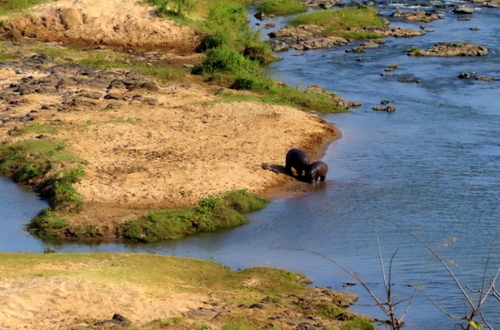
The next morning we set off for Mopani, taking the road that winds eastwards along Shingwedzi river to near the point where it cuts through the Lebombo mountains into Mozambique. Huge Jackalberry and Nyala trees lined its banks. Even though we were in the dry season there were still pools of water where wading birds were mirrored, crocodiles lay doggo in the sun and other animals came to slake their thirst. Game trails and hoof prints radiated out from each watering point. The deeper pools had pods of hippo blowing bubbles and snorting into the air.
The Shingwedzi river with impala
Water Dikkop (now Thick-knee)
Wooly-necked Stork
Crocodile lying doggo
The Shingwedzi
At the base of the Lebombo mountains, we said goodbye to the river and turned southwards. Apart from this long low ridge, which provides Kruger with its spine, the low, hot woods around here lack rises or landmarks. Looking across it, as we did from the Nyawutsi viewpoint, halfway up the Lebombo, was like scanning an ocean. On foot, it would be very easy to lose your bearings.
We halted for breakfast at the Nyawutsi hide, a beautiful little glade with a winking, crystal-clear pool, surrounded by Lala palms, Fever Trees and some magnificent old Leadwood and Apple leaf trees.
View from Nyawutsi Hide
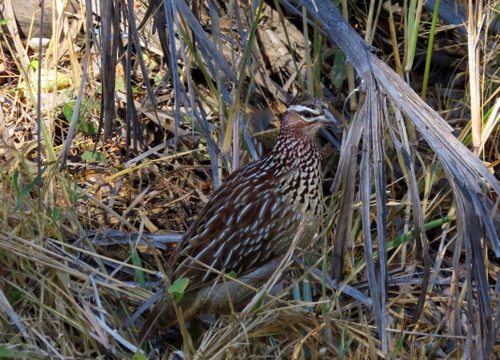
Crested Francolin at hide
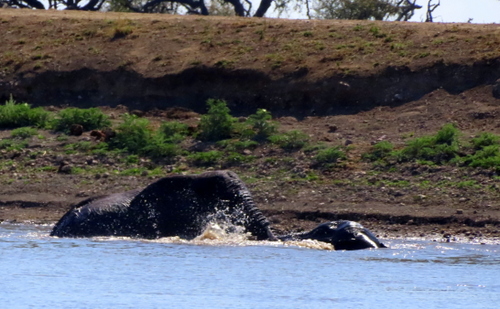
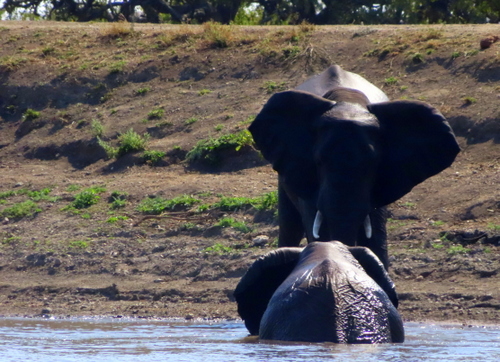
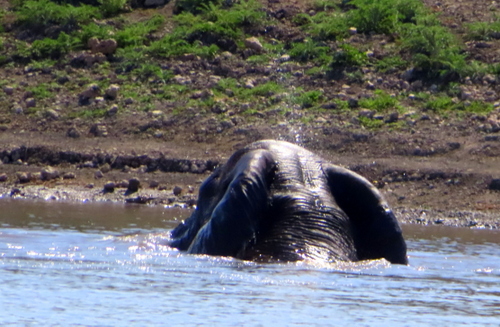
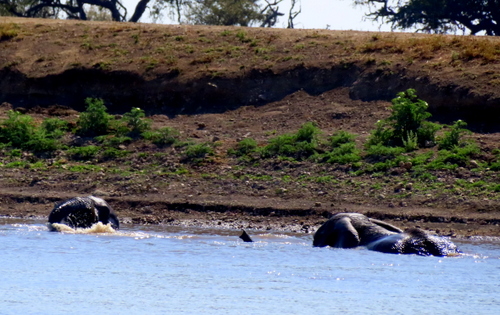
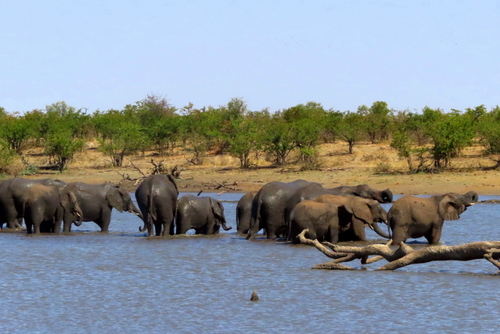
The scene that greeted us at our next stop, the Grootvlei dam, provided me with one of those spontaneous moments of happiness you only get when you loosen the bonds that tie you to civilisation and escape into the wilds. A small herd of elephants were swimming. Elephants form complex social bonds and language structures and there was ample evidence of this in their playful behaviour here. There was much good-natured jostling and sparring as they splashed around, spraying one another and rolling in the water.
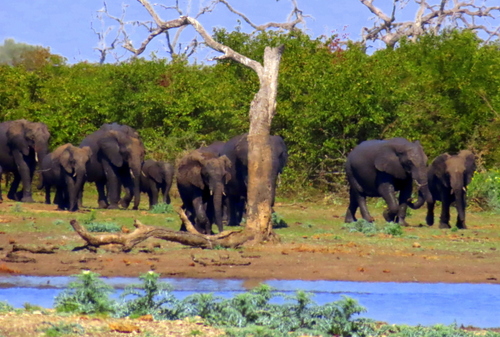
As we watched them another, bigger, herd of elephants loomed through the trees on the other side of the dam, ears flapping, trunks waving, dwarfing the scrub and deadwood. A few minutes later, an even larger herd came lumbering out from a slightly different angle. It was a splendid sight. With all the comings and goings, I felt like I had been given a free front-row pass to some grandiloquent parade, a mesmerising piece of outdoor theatre.
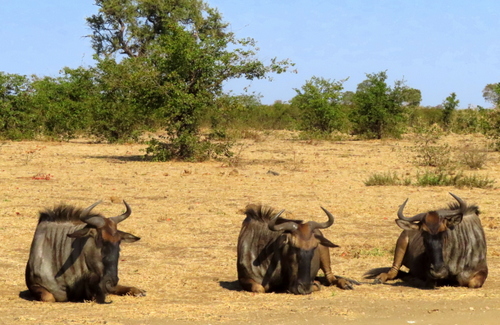
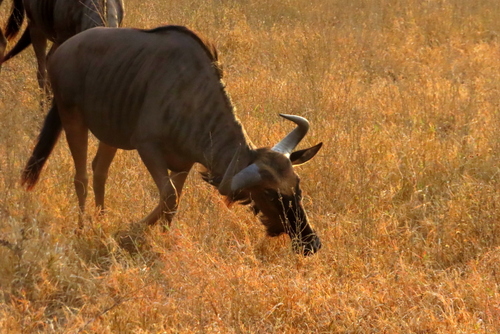
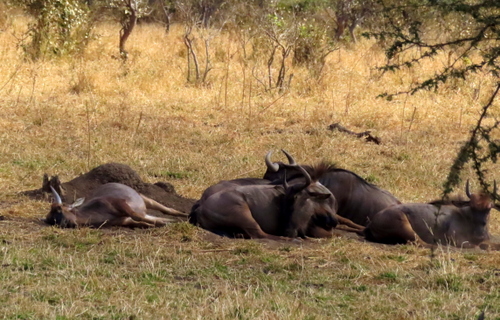
Time was not on our side so having lingered as long as we could we pushed on south past small companies of zebra and wildebeest and even some tsessebe who took mute note of us. We continued to see elephants everywhere.
A g’nother, g’nother, g’nother gnu (wildebeest)
Wildebeest
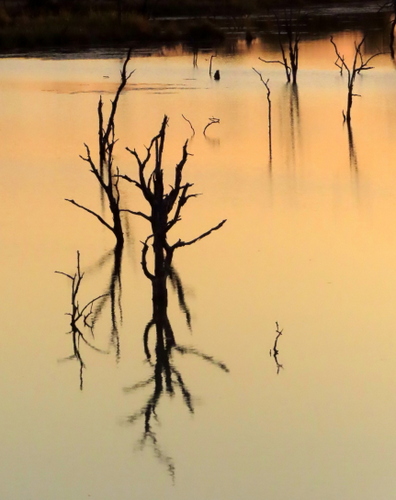
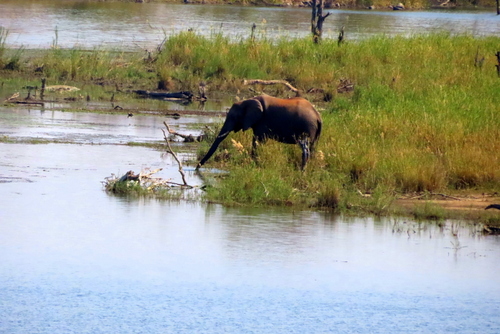
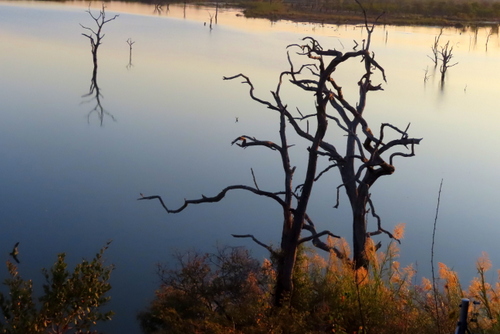
At Mopani, I was pleased to find we had been allocated the same chalet as last time. The view from it, across the Pioneer dam, was just as beautiful as I remembered. At sunset, the air became completely still and the water turned to gold, perfectly reflecting the dead trees that studded its surface, as well as the surrounding greenery. White-faced Whistling Ducks whistled to one other as they flew off to their sleeping quarters, Great White Egret flapped across the water with thick wings and guttural protests. Huge flocks of Red-billed Quelea landed in the trees below us, weighing down the branches as they did so while chattering non-stop. All around us bats flitted off to meet the dark.
Sunset over Pioneer Dam
Egyptian Geese, Pioneer Dam
Elephant, Pioneer Dam
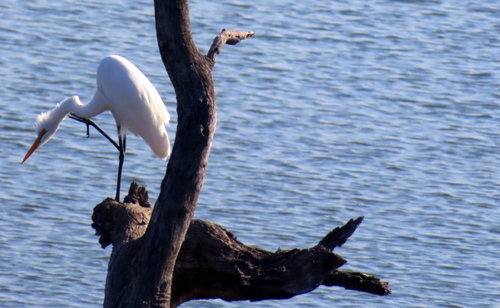
Great White Egret, Pioneer Dam
I scanned the darkening sky for signs of the elusive Bat Hawk but didn’t see any this time.
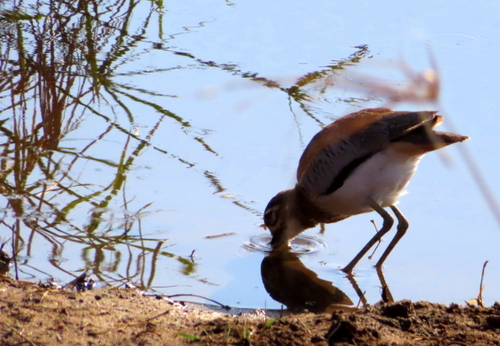
Green-backed Heron
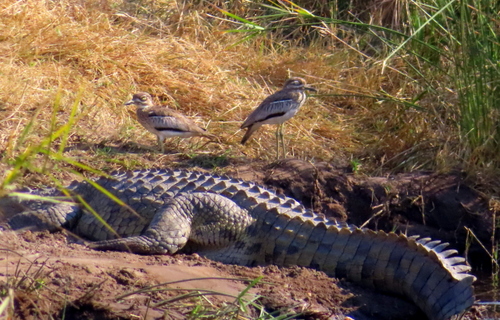
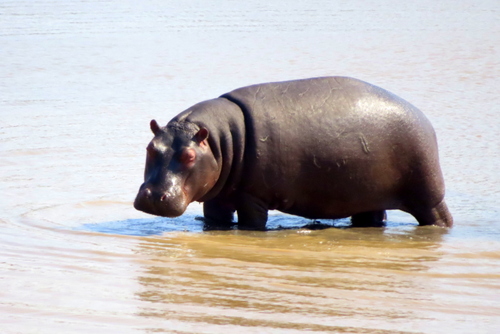
The next day we explored the S49 and S50 and the various loops along the Tsendze river, before driving down to the drift at the bottom of the Pioneer dam. In the past this has always proved a happy hunting ground for me and, sure enough, I quickly spotted a Green-backed (or Striated) Heron hunched up over a small pool, a study in single-minded focus and concentration. A few hippos rose and sank in the pool on the other side of the drift. On the far bank, a large crocodile sunned itself. Two Water Dikkop (now Thick-knee. I prefer the old name) stood just behind it, totally unconcerned by its ominous, cadaverous presence. Another large crocodile was swimming just beyond the hippo, with only its snout, eyes and a few ridges along its back visible.
Water Dikkop with croc
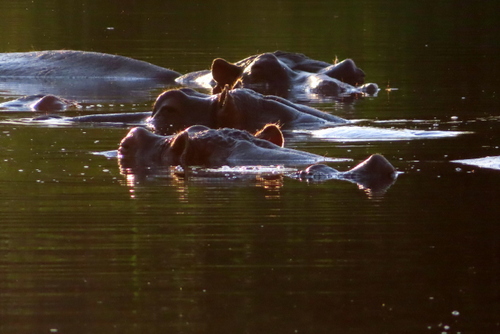
Hippo
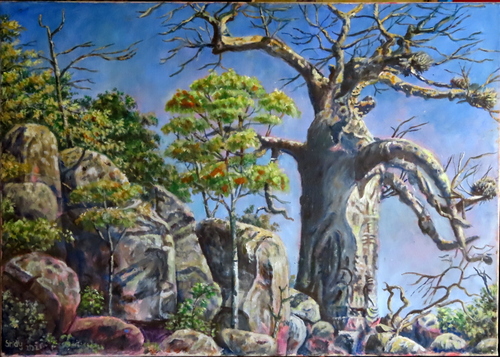
Having exhausted the drifts possibilities we drove on towards the Staplekop dam. A few small kopjes inset with elephant-coloured boulders rose out of the flat mopane veld. The one, which has a huge baobab growing out of its side, I once did a painting of.
Apart from another Korhaan, skulking on an old airstrip, we saw few birds and not many animals either but that didn’t bother me too much. The fact you don’t have any surprising experiences doesn’t necessarily make the journey an unrewarding one. For my part, I was content just to soak up the sun, heat and stillness of the scene.
What it also means is that when you do finally come across something unexpected you get doubly excited. I was to get proof of that the next morning, on our way out of the park.
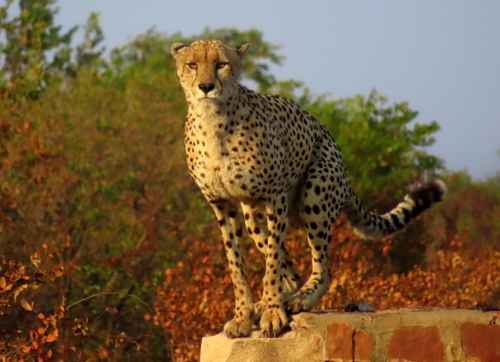
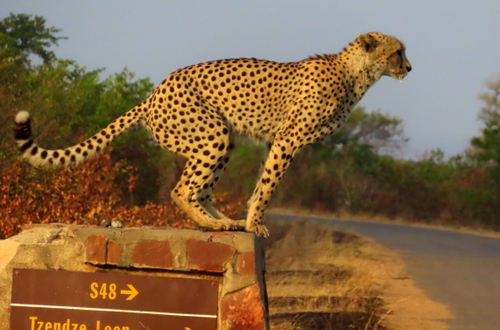
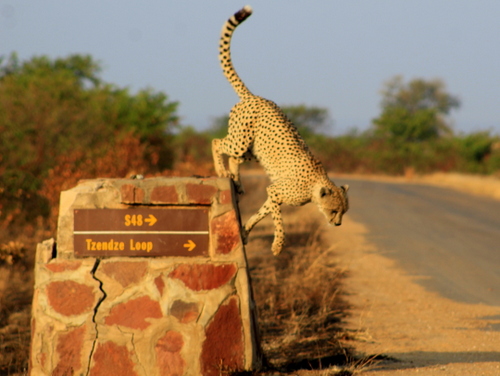
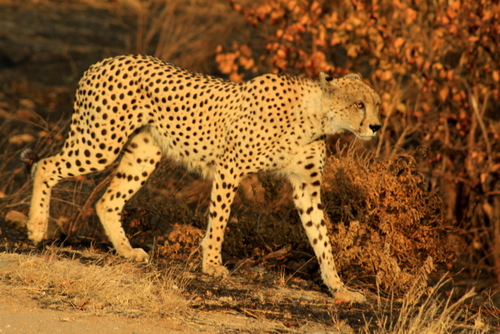
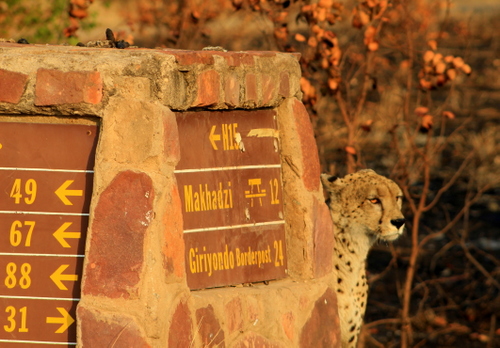
We had hit the road and driven south for about an hour when we came to a junction. There seemed to be some animal activity just to the left of it, so we left the tar and crunched down the dirt track for about fifty metres. I couldn’t see what was happening so I stuck my elbow out the window, gazed across the grass stubble and then gasped in amazement. Slinking towards us was a cheetah. Long-legged, streamlined and beautiful, they are an animal built for speed, the fastest in the world. Indifferent to our presence, this magnificent specimen strode disdainfully along, its small head hung low. I was worried I was not going to get any decent shots because it seemed intent on disappearing from view but, at the last moment, it changed its mind and instead of fleeing turned around and leapt up onto the large stone cairn, on the side of the road, that pointed the way to Tsendze Loop.
On top, it struck various poses, like a well-trained model on a ramp, and then – having marked its territory – leapt down and set off again, with its gaunt gait, across the tar road, still unafraid, still searching. It came to a stop at the opposing cairn on the other side of the road, peering around from behind it, as if inviting us to partake in a game of hide-and-seek. It sat there for a few more minutes and then, losing interest, strode off without looking back and got swallowed up by the encircling bush.
I am not normally given to religious flights of fancy but it was hard not to believe that the whole trip had been divinely arranged to lead up to this point. It was a moment of pure elation, one to savour and rejoice in. I may have not got any new ticks for my bird list but I had found a cheetah and, with it, salvation of sorts.
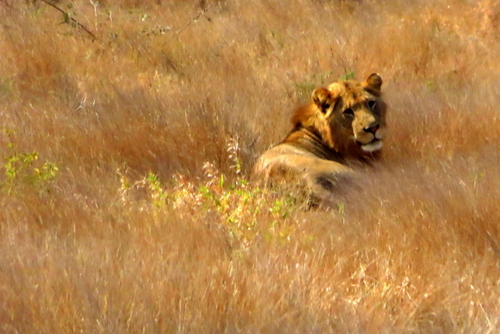
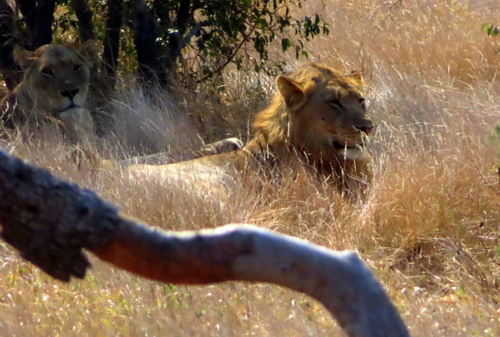
Nor was that the end of it. A little further on, as we were approaching Satara, we came across a pride of lions lazing in the long grass. Unlike the more solitary leopard, lions are social animals and this lot looked especially relaxed and happy in each other’s company although should a rival male appear I imagined the mood would swiftly change and there would be much snarling and gnashing of teeth. And maybe a rather brutal fight.
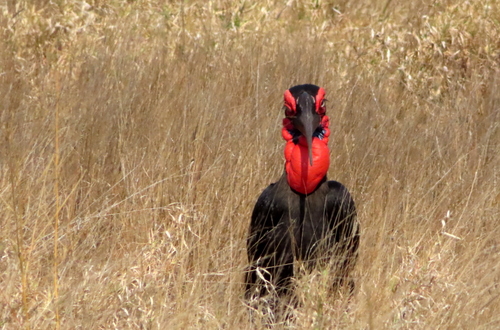
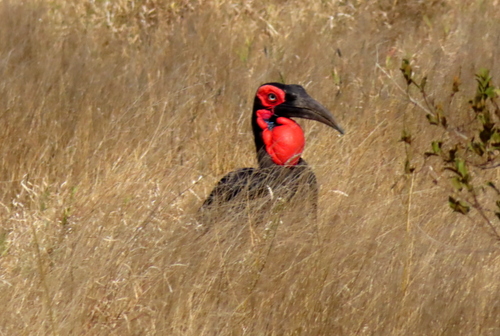
I would have been quite content for that to be my last big sighting but then, a few hundred metres on, we came upon a small group of those most lugubrious of birds, the Ground Hornbill, waddling across the veld in search of food while cautiously observing us through long eyelashes.
Here’s the funny thing though. I am convinced one of them winked at me, as if to say – see, miracles do happen, especially here in the Bushveld!
As we drove away, I found myself nodding in agreement…
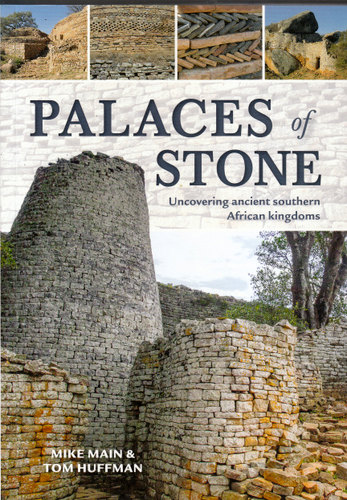
Scattered over substantial portions of northern South Africa, Zimbabwe, Botswana and Mozambique are a series of, often beautifully decorated, palaces and citadels whose existence points to a chain of once highly developed and flourishing city-states, each with clear rankings of authority and concern for all citizens. To date, over 560 of these unique stone structures have been found, many of which were only the central feature of a much larger urban sprawl.
In the case of Great Zimbabwe, in particular, all sorts of wild theories and explanations proliferated among the early white explorers (and later) as to who built them, with some linking them to the biblical land of Ophir, others to King Solomon’s Mines and the Phoenicians.
In this marvellously panoramic overview, authors Mike Main and Tom Huffman put these romantic notions firmly to rest by drawing on the latest research, discoveries and excavations to explain how and why they were constructed, as well as their subsequent rise and fall.
Although there had been earlier settlements, Mapungubwe, on the Limpopo flood plain was probably the first one that could be classified as a full, pre-colonial state. Built around the base of a steep-sided sandstone hill that rises abruptly from the valley floor, it was strategically placed on an important trading network. What may come as a surprise to some readers is just how extensive and far-reaching these trade links were, stretching, as they did, as far as the Indian Ocean and then to the Middle East and Asia.
It certainly puts a lie to the notion that Africa remained largely “undiscovered” until the first Europeans arrived.
The reasons for Mapungubwe’s sudden demise are still not fully understood although the authors proffer various possible scenarios including the most obvious one – changing climatic conditions. This would explain the subsequent expansion and consolidation of communities on the highveld plateau to the north, close to the greenstone belt and gold – besides cattle rearing another important source of wealth.
The most famous of these was, of course, Great Zimbabwe and it was here the local stone-building skills reached their zenith. Ruled by a succession of kings its influence would spread, making it an important power in the sub-region. Because they were often situated in drought-prone areas, rainfall and the supply of water played a critical role in these societies, so it is hardly surprising that rain-making became an essential part of this political power.
Vasco da Gama’s circumnavigation of Africa was, however, to have major repercussions for these once-powerful kingdoms by bringing to an end the golden age of Islam. The loss of this regular and organised outlet for trade had a disastrous impact on the prosperous African economy based, and dependent on it. Zimbabwe would subsequently be occupied by new invaders who did not know the purpose of the vast buildings. Eventually, they would become overgrown and fall into disuse. The myth of a large golden empire would, however, persist.
Lavishly illustrated and eminently readable, Palaces of Stone provides an excellent introduction to this fascinating chapter of Southern African history.
Appearing before the state capture enquiry, President Cyril Ramaphosa was asked to provide the commission with evidence about the ANC’s policy of cadre deployment. While acknowledging that state capture had occurred, Ramaphosa seemed reluctant to delve into details of how it had happened and why it was not stopped far sooner.
Confusion reined after embattled ANC secretary-general Ace Magashule issued a statement saying he would appeal his suspension and that he had, in turn, suspended President Cyril Ramaphosa. However, ANC national chairperson Gwede Mantashe insisted he had no power to suspend Ramaphosa because the decision could only be taken through party structures.
As scientists continued their warnings of a third wave, the figures coming through from some provinces, notably Gauteng, showed a definite upward trend. In comparison to many other countries, South Africa still lagged woefully behind in its vaccination roll-out.
The fraud and corruption case against former president Jacob Zuma and French arms company Thales was postponed for the umpteenth time in the Pietermaritzburg High Court – and it seemed likely it would be postponed again when the parties meet on May 26. With the case having dragged on for over a decade, an increasingly cynical public was left wondering if the ex-head of state will ever get to answer the allegations made against him.
Ex-president Jacob Zuma pleaded not guilty, before the Pietermaritzburg High Court, to charges of corruption, racketeering, fraud and money laundering linked to the multi-billion rand Arms Deal. In his 141-page plea for immediate acquittal, Zuma relied on arguments that had already been exhausted in other courts about his inability to get a fair trial. He also sought the removal of state advocate Billy Downer, accusing him of bias. The case was postponed to 19th July.
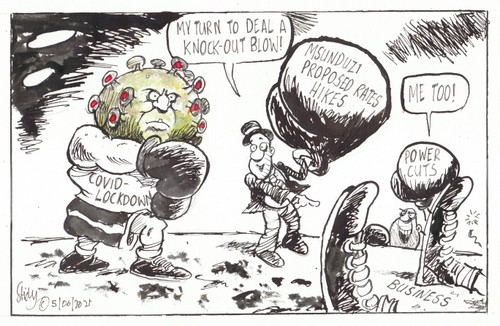
“ We can’t afford it and we object.” That was the message from the Pietermaritzburg and Midlands Chamber of business in response to Msunduzi Municipalities new approved hikes. With Covid having taken its toll and people have lost their jobs, the general feeling was that the increases couldn’t have come at a worse time for many individuals and businesses already battling to stay afloat.
Msunduzi residents mounting anger over ongoing power outages spilt onto the streets with protests in the Pietermaritzburg CBD and Sweetwaters – as some citizens complained they had been without power for seven days. Fuelling the frustration was the fact that Eskom yet again decided to implement load-shedding across the country, with virtually no notice being given.
Addressing the nation, President Cyril Ramaphosa cited the sharp increase in infections as the main reason behind the government’s decision to reinstate alert level 3 lockdown restrictions. The latest measures were criticised by the South Africa Medical Association (Sama) for not going far enough. They felt the government should have honed in on the way people live their lives and not just on the alcohol trading hours and stricter curfew hours. The situation had also not been helped by the government’s tardy response to the virus in terms of vaccine roll-out.
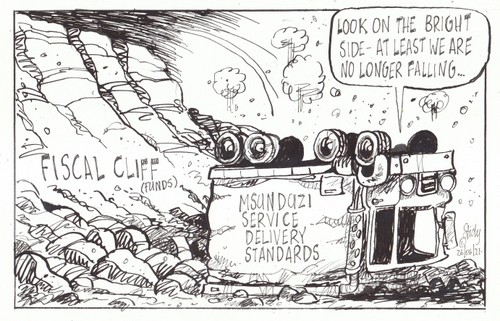
Service delivery in Msunduzi ground to a halt after the city’s coffers apparently ran dry. Ward councillors were told during a Rapid Response meeting that there was no money to deliver critical services. Services not being delivered included repairing of traffic lights, grass cutting and attending to power outages.



































 Stidy's Eye